Front matter (continued 2)
Reading edition
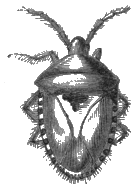
The Field-bug.
"The mother," says De Geer, "was accompanied by a troop of little ones, sometimes as many as forty in number. She remained constantly with them, generally on a twig or leaf. I noticed that the little ones and their mother did not always remain in the same place, and that as soon as the mother began to move to another position, all the little ones began to run after her, and stopped whenever the mother halted. She used to take them, as it were, for a walk from twig to twig, or from one leaf to another, parading up and down the branches of the tree, and she conducted them wherever she pleased, just as a hen does her chickens. It frequently afforded me great pleasure to observe their movements. One day I cut a young branch of the birch-tree inhabited by such an insect family, and I immediately saw the mother, apparently in great anxiety, begin to flap her wings violently, but without attempting to fly away, as though she would frighten away her enemy. At another time she would have immediately made her escape, thus plainly showing that she remained only in order to defend her young brood."
As if to furnish an instance of precisely the opposite import, the cruel and murderous father of this interesting little family is one of the greatest enemies the poor mother has to contend against. This hard-hearted parent does not hesitate whenever he falls in with one of his children to seize him and eat him up! If the mother spies him at this horrible feast she immediately attacks him in the manner described; and does her utmost to deter him from his cannibal propensities, by placing herself in an attitude of determined resistance before him. Was ever mother's love more plainly manifested than this love? No other instance of an affection so strange and strong is to be found in the tribe to which she belongs.
The care of the earwig not only extends to her eggs, but also to her young larvæ. "In the beginning of June," writes the author last quoted, "I found under a stone a female earwig, surrounded by a number of little creatures which I discovered to be her tiny family. She did not attempt to leave them, and they frequently ran and crouched under her, just as chickens under the wing of a hen. I took them up and placed them under a sand-glass, under which I had put a little fresh earth. They did not bore into the earth; and it was most curious to see them running for shelter under the mother, and pushing about between her feet, while she remained perfectly quiet. I fed them with pieces of ripe apple, which the mother seized and ate with great avidity, detaching morsels of it by means of her teeth, and swallowing them. The young ones also ate a little of it, but with less avidity."
When the eggs of the spider mentioned in the last chapter as so devotedly attached to its treasure as to prefer death to parting with them, are hatched, they make their way out of the bag by an opening in it, being assisted by the mother in this difficult task. De Geer indeed states that this is the reason why the mother clings so tenaciously to the bag of eggs, as if she knew that her assistance in extricating her young from it was necessary. But this is not altogether correct, as they are able to make their way out by themselves in due time. When the young larvæ have come forth from the shell they run towards the mother, and climb upon her body; some get on her head, some on her back, and some on her limbs. In this manner she carries them about, and is said to feed them until they become strong enough to shift for themselves. "I have more than once been gratified," (writes one of the authors of the Introduction to Entomology,) "by a sight of this interesting spectacle; and when I nearly touched the mother, thus covered by hundreds of progeny, it was most amusing to see them all leap from her back, and run away in all directions."
For another instance of affection almost maternal for the young and helpless larvæ, let us take a peep into an ant's nest. So soon as ever the young larvæ emerge from the eggs they require the unremitting attention of the best and most careful nurses in order to rear them. They must be kept clean, fed, and taken for an airing as regularly as the day returns. By means of their tongues, which are incessantly used in licking them, their coats are kept of the most snowy white. They are fed three or four times a day by their nurses, who take care to masticate the food for them, and thus prepare it for their tender mouths. But the most strange part is their regularly being taken out for the benefit of the air and warmth. Some of the ants at the top of the nest watch for the first beams of the welcome sun, and, as soon as they pour upon the nest, they hasten down below in a great bustle to wake up the nurses, and bid them take the young ones out of their chambers and bring them up to the light, which these indefatigable ants quickly set about to do. After basking there all day long the nurses take care not to expose the delicate constitutions of the larvæ to the chill evening air; and soon as the sun begins to sink towards the horizon they carefully take them up and carry them to the warm deep cell below. For fear, perhaps, of their taking cold, they never allow them to be taken out in raw, damp, or frosty weather. It must not be forgotten, however, that these ants are not the parents of the larvæ; they are only the nurses.
But it becomes us now to pursue the more immediate subject of these remarks, and ask the reader's attention to a few particulars about the larva. It is a great pity, for the sake of a clear perception of the facts of insect history, that there is a sad confusion of names in use among the majority of persons in speaking of the different forms and changes of insects. Who would imagine that caterpillar, grub, maggot, and larva, signified one and the same stage of the life of an insect? This abuse of terms cannot but render the knowledge of any science less easily retained than it would otherwise be, for the question is continually arising in the mind—If these all mean the same, why is not one term enough to express them? Let us then renounce those of uncertain meaning, and when we wish to give a name to the insect just emerged from its eggshell, let us call it by its proper name, the Larva.[C]
The larva, then, is the first form assumed by the insect on quitting its shell. No more a little inactive object lies before us, as in the egg and its slumbering tenant, but a sharp fellow, full of life, and soon walking off the field of the microscope, should we happen to be looking at it in that way, or from our book or table, should it be there placed by us for observation. By what hidden and mysterious power this has been effected who can tell? It was not heat alone that could animate the contents of the shell, nor could all a mother's care do more than preserve it from injury. It is very possible that chemistry had some share in it, and when the tiny being first awoke in the shell the oxygen of the air undoubtedly was necessary to its health, and the fulfilment of its early functions, but no more. Not chemistry, nor electricity, nor heat, nor any other known force could effect this wonderful change of apparently inanimate fluid into a lively, active, and well-organized being; much less could either of these give it its definite form, causing one larva to differ from another in its characters. No, we cannot tell how it has taken place, nor what has wrought the change; but we know the author of it—even Him who from the beginning created all things, and established those principles which, though hidden from our eyes, work out the marvels of the created world. It is enough for us to know and to remember this. Should we attempt more, we should probably fall under the Scripture reproof, "Professing themselves to be wise, they became fools."
Speaking generally, insects in the larva form appear as fleshy worms, having long and round bodies, marked with rings, and provided with a head and a certain number of legs, mostly six. How different in this condition, from the ballroom gaiety of the butterfly, or the elegant robes of the lace-wing flies. To look at a number of larvæ, all crawling over one another, and bearing perhaps not the most loving behaviour to each other as they scramble about, who would dream that, in a little while, those slowly moving bodies will be whirled through the air faster than our feet can pursue, or even than the eye can follow? Who also, but one well versed in the knowledge of insects, could venture to say what insect could be formed by this or that larva, now so little resembling winged insects at all?
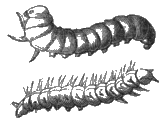
Larvæ unlike the future Insects.
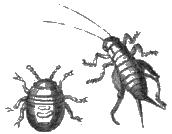
Larvæ like the future Insects.
In studying the forms and appearances of various larvæ, we shall find that some of them bear a tolerably close resemblance to the future insect; while others, on the contrary, do not resemble their future condition at all; and had we to decide to what tribe of insects they belonged, merely judging by their shape and character, we should be sorely perplexed to do so, and if we did, we should often in all probability be very far wrong. We need not go far for an illustration, first, of a larva like the perfect insect, and next, for one totally unlike it. Taking a candle and exploring into some snug hole near the kitchen fire-place, we shall not be long, probably, before we extricate a number of the larvæ of the cricket. Those of the bug also are very like the perfect insect; so also are young spiders, cockroaches and grasshoppers. These all resemble more or less perfectly the insect in its complete form.
Even amongst the larvæ not resembling the perfect insect, a little attention will enable us to perceive a sort of general resemblance between those of different genera and species, which we may call the Larva family likeness. This consists in the form of the body, in a number of instances; but in all in the ring-like marks or segments of the body, as they are called, which are thirteen in number. If the reader will take the trouble to count the rings in the larvæ of different insects, he will generally find that they are thirteen in number. The general resemblance of larvæ to one another may also be noticed. The larva is, in every instance, destitute of wings. In many cases, larvæ are provided with feet, in many others they have none. And in some instances, they have no distinct head, as in the larva of the blow fly.
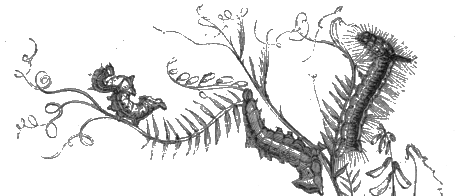
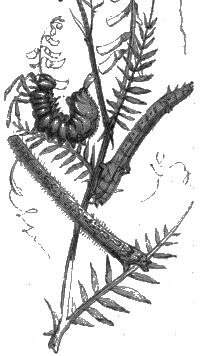
By far the larger number of larvæ belong to this class; that is, they do not resemble the perfect insect. Do not resemble! could any one believe that these strange, and some of them awful looking larvæ ever became butterflies? yet they all belong to that tribe of insects.
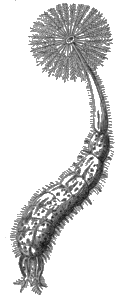
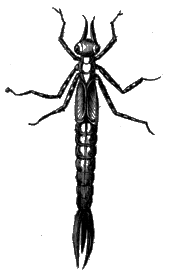
In order to give a clear conception of the structure of a larva, we may briefly mention the names of its various parts. First then, there is a head of various shapes, sometimes of the shape of a heart, sometimes round or triangular. Attached to the head are the two antennæ; or, as they are commonly called, feelers, most probably an incorrect expression, as it appears that insects may possibly hear as well as feel by their means. At the side of the head are the eyes, which are formed much more simply than those of the perfect insect. Next is the mouth, provided with its upper and lower pair of jaws. Then there is the body and its legs; and lastly, there is in many larvæ, living in the water, a tail, which, strange to say, is provided with a delicate tube, through which the larva breathes. A beautiful instance of such an appendage to the body of the larva, is represented in the adjoining cut; the various parts of the larva are also represented in the accompanying figure.
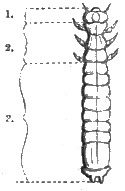
Diagram of a Larva.
We may now enter upon a few particulars connected with the general history of insects in the larva form.
CHAPTER II.
HABITS OF THE LARVA.
Generally, for a little while after the larva has emerged from the shell, it is in a very weak and languid condition. The effort of extricating itself from its little prison-house, seems to leave it almost without strength; and for a period which varies in different insects, it lies helpless and almost motionless at the mercy of any wandering adversary, and might be demolished without resistance. But this hour of weakness, except in a few cases, is not prolonged. In the course of an hour or two, or even much less in some instances, the larva revives, takes heart, and begins by eating whatever food may happen to lie in its way; and now the larva becomes a terror to the world of insects, or even, indirectly, to man and to nations. Instead of simply eating, in order to live, like most other beings, it only lives to eat; it has no other duty to perform at present but to eat as fast and as much as it possibly can in a certain time; and it must be confessed, the larva, generally speaking, leaves little to be desired on the score of a sharp appetite. Unlike other creatures who allow themselves a certain period between their meals, the larva sets to its feast and does not leave the table until it has devoured all its contents,—upon which it immediately begins again elsewhere. No gourmand in the world, whether among human beings or brutes, can compare with the insect in this form for the amount of food consumed. Morning, noon, and night, is to it only a continued round of feasting; and, as may well be imagined, the larva grows very rapidly accordingly. Some larvæ consume animal, others vegetable food; or, in the language of science, some are carnivorous, some are graminivorous or herbivorous, and some will eat anything almost that comes before them—these would be called, and very appropriately so, omnivorous.
Let us speak of carnivorous larvæ first. The larvæ which have carnivorous propensities render themselves often truly terrible to the insect world around them. The most mighty warrior that ever lived in his whole career never slew half so many of his own species as the larva of a beautiful fly does of aphides in a few hours. Well does Réaumur call them the "lions of the aphides," and thus does he describe their method of proceeding:—
Lion of the Aphides.
"There is no beast of prey in nature who hunts so entirely at his ease as does this larva. Resting upon a twig or a leaf, he is surrounded on every side by the insects on which he feeds; often, indeed, they touch his sides, and he is able to catch hundreds of them without changing his position. Not only do the poor little aphides not fly from him, but they may be often seen creeping over the body of their enemy. It is only after the larva has eaten up the greater number of his prey around him, that he has any need to remove to a spot as thickly inhabited by them as that in which he has been making his cruel ravages. In order to observe the manner in which he attacks them, the best plan is to take him, put him between two leaves, and shut him up in a box for ten or twelve hours to sharpen his appetite. After this fast he must be placed on some spot where the aphides are found in abundance. Immediately he begins exploring around for prey, which he does simply by the sense of touch, as he does not appear to be able to see. At length an unhappy insect comes within his reach. Brandishing a trident with which he is armed, he immediately transfixes the insect, just as we take up a morsel of food upon a fork!" The little creature is then sucked into a sort of cavity like the neck of a bottle, where it is retained by a couple of pins until its juices are emptied by the destroyer, when he casts it away, now nothing more of it being left but a dry, shrivelled, empty skin. The aphis-lion, however, loses no time, and presently seizes another, which he pierces and sucks dry as quickly as the last.[D] When very hungry he will devour one a minute. Réaumur says, "I have seen him eat twenty of these insects one after another in twenty minutes; nor did this satisfy him: for in the course of two hours he devoured more than a hundred insects with which I supplied him!" These larvæ do repose a little, but never for long, for they are seldom without some prey in hand. "I have seen," adds the last author, "twigs of the elder seven or eight inches in length entirely covered with these insects, (the aphides,) and in four days' time there remained not one alive."
This larva is a rare specimen of courage, as well as of destructive powers; for when it is quite young it often seizes upon an insect twice as big as itself. It is very amusing to see the unequal contest between the little but courageous foe, and his great, bulky, and stupid adversary. Immediately the larva thrusts its trident into the body of the enemy, who, stupid as he is, does not like the sensation of the wound in his side, and makes off as fast as he can. The lion-hearted larva follows him up and wrestles with him, and at length actually boards him, to use a sailor's term, clambering up his sides, and, in triumph, piercing him through and slaying him. What is perhaps most singular of all, the larvæ of some species of these flies not only slay their victims, but actually clothe themselves, after the manner of Hercules on his victory over the Nemæan lion, with the skins of their prey!
It is almost to be regretted that the insect world has not had the privilege of having its combats sung by the poets. Who can forget the animated scenes, painted in such life-like colours by Homer and Virgil, of the conflicts, hand to hand, of the heroes of their verse? But the history of insects supplies us with more singular and more interesting deeds of fight than have ever yet been fabled by poets, or commemorated in song. In the instance we are about to quote, the larva of the ant-lion is the crafty Giant Grim, who lives by entrapping, as we have before said, poor wayfaring travellers. Like those giants of old, of whom we read in books a little more wonderful than true, this subtle and powerful enemy lies deeply ensconced in his subterraneous cavern, patiently abiding the time when his unsuspecting prey shall fall into his power. His trap is depicted on the opposite page.
An Ant-lion in its Trap.
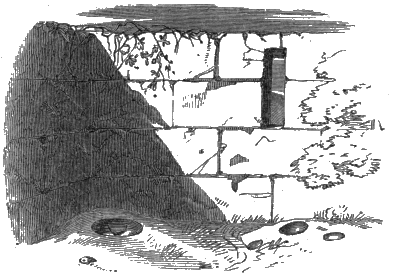
This insect is naturally a very helpless being, it can only walk at a slow pace, and strange to add, it can only walk backwards, and not forwards! Yet its food is the juice of insect bodies. How, then, is it to seize upon them circumstanced so unfavourably as it is, having neither swiftness nor ability to direct its motions sufficiently actively to fit it for such a task? It succeeds by an artifice of the most refined character. Nothing daunted by what we might call its natural disadvantages, the insect sets bravely to work to construct a trap for its prey; and the manner in which this is performed may well strike us with wonder, and raise our admiration up to Him who has so marvellously endowed this humble being with wisdom and skill. It first takes care to choose out a proper site for the work it is about, and in this always selects a soil composed of fine, loose, and dry sand, well aware that, as we shall presently see, no other would be fit for its purpose. Generally it chooses such a soil under the shelter of an old wall, where the rain cannot easily penetrate and ruin its work. In so doing it shows its wisdom; for thither, when the heat of the sun is great, or when the rain-drops fall heavily, crowds of insects come for shelter, and fall into its cruel embrace.
Circular Ditch of the Ant-lion.
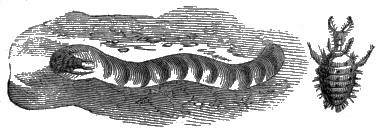
The site being chosen, the next important step is to mark out the bounds of its habitation, and with this view the insect begins digging a circular ditch, walking backwards until it has completed the circle. This defines the outer limits of its trap, and is a sort of guide line to it in its future operations. Then it sets about the more proper task of excavating its trap. Would that our readers could see this insect at work! Of all the wonderful sights presented to us in the insect world there is none to equal it in interest, none so calculated to enlist our sympathies on the part of the patient, skilful, and unwearied little labourers of this kingdom of nature. Guided by the line it has marked out, the workman steps into the circle, and sets to work with a hearty good will, and with a degree of diligence and excavating skill that would put our railroad "navigators" to the blush. Shower after shower of sand is seen flying up and beyond the boundary described, with the most unintermitting diligence, until the insect has completed the circle again; arrived there, it turns round and excavates back again until it arrives at the same point. But it may perhaps be asked, where are its tools, and by what means does it succeed in casting up these loads of earth? We fear that at best any written description will hardly do justice to our ingenious labourer; its method, however, is as follows:—It uses the head as the spade, or rather shovel, and in the strangest manner it fills the shovel with one of its feet with a load of sand, and then by a quick movement of the head tosses it out of the cavity. By working in alternate directions it manages so as never to over-fatigue one leg, for on its return the leg previously in use is at rest, while the one on the opposite side is now called into duty. The insect thus works on until its trap is completely excavated, the task occupying a variable time; sometimes being finished in half an hour, sometimes even in less, but occasionally occupying several hours, the little labourer being obliged to rest a certain time. Réaumur, who has given a fascinating account of these insects, writes, "I have had at times hundreds of ant-lions in a large box, and I have often been amused with filling up their traps. Some of them would immediately begin to form another; but the greater number in the warm long days of summer deferred executing the work until the sun began to go down. They seldom worked in the heat of the day; but in cold or cloudy weather they would excavate at any hour."
We well know what perplexity a chain of rocky hills causes to a railroad engineer, and what vast outlays of money, labour, and time are necessary in order to overcome the obstacle thus presented to the path of the engine and its train. But it may be safely said that we can furnish a parallel instance of difficulty and of patient, all-surmounting exertion from the history of the insect before us. M. Bonnet was curious to know what it would do if a stone or some such obstacle were met with in the process of its excavations, and one day had the gratification of observing the behaviour of the insect under these trying circumstances. Not being able to cast it out with its head, the insect determined to carry it out, if possible, on its back. With this view it contrived by various manœuvres to place the stone upon its back and to balance it there. This was the least difficult part of the undertaking. The insect had to climb up an inclined plane upon soil, chosen with other views purposely by itself, as shifting and unsteady as possible, and not only so, but to preserve the balance of the stone with which it was encumbered. Undaunted by these difficulties it made the attempt, but the first step brought down a shower of sand, and tumbled the little rock to the bottom. Again and again did the heroic insect attempt the same feat, and with the same ill success, and we might have thought we beheld a realization of the fable of Sisyphus and the rolling-stone, in the vain endeavours of the insect to get rid of its encumbrance. Five or six times did the insect repeat its endeavours, and at last, after one or two narrow escapes, the stone was fairly lodged on the outside of the trap, and the insect returned to its subterraneous recess at the bottom of the cell in triumph.
The traps vary in size in proportion to the age of the insects which construct them. The young insects only form very small ones; but as even from the moment of their birth they are destined to toil for their food, they do not wait in idleness and hunger because they cannot make large efforts, but are content to make little traps not more than a few parts of an inch in diameter. Thus they set us the needful example of not despising to do small things because our strength is not yet equal to the performance of as much as we could desire. The diameter of the trap formed by a full-grown insect is about three inches; the depth about two.
When its labours are over, it has been well remarked, the insect now only requires patience—but it must have a good deal of it! It generally buries itself, all but its jaws, in the sand at the bottom, and here awaits its victims. If it requires much patience, surely it also needs to have much power of endurance of hunger, for it may wait for days sometimes without catching any prey. Frequently, when this is the case, it marches out of its trap, and tries its fortune in some more favourable spot. But see! an ant who has been out foraging for the young ants at home is hastening back laden with sweet treasures, when suddenly she finds her path arrested by what appears to her to be a deep but smooth precipice. To plunge down and rise on the opposite side is a shorter cut, in her estimation, than to go round; or perhaps she is led by curiosity to wish to explore this singular cavity, and she plants her feet on its treacherous edge, causing a few grains of sand to roll down and give notice to the wary giant below that a victim is at hand. A step back, and her life would be saved; but no, she leaves the bank, trusts herself to the unfaithful soil of the sides of the precipice, and instantly rolls down in a cloud of dust to the bottom. Terror has now laid hold of her, and with all speed she strives to clamber up the unsteady sides. For a moment escape appears possible, but the Argus-eyed monster below starts up into activity, and piling upon his head a huge load of sand, he shoots it after the escaping ant, and once more brings her down covered with dust into his embrace. The terrible jaws are instantly closed upon the unhappy insect, and in a few minutes her existence is at an end, the savage enemy shaking her violently, or dashing her quivering frame against the earth.
Singular to add, the ant-lion loves not dead prey, and will indignantly cast it out of its trap. Says Réaumur, "They appear so much to delight in the glory of a victory, that they disdain to touch an insect who is not, to say the least, in a condition to contend with them!" It certainly is not that the food when offered to it dead is not fresh enough that it is thus treated; for if only killed an instant before the insect still refuses to touch it. Réaumur is disposed to believe that, like our sportsmen, these interesting but cruel insects destroy prey more for the pleasure of exhibiting their superior skill, than to appease their hunger. But it is rather uncharitable even to the ant-lion, to say so much as this. When the insect has sucked all the juices out of its victim's body, it casts it out of its trap, and the earth around, strewed with dead bodies, is thus the silent witness to the destroying powers of the giant within.
This singular insect, whose exploits have detained us so long, remains in its larva form two years, growing daily in size until it has completed its existence as a larva, and must then enter upon another condition of life. It is to be regretted that it is not to be found in England, or at least it has not been for some time discovered in our island; but it is common in France and other parts of the continent, and would well repay the trouble of being brought over. As the insect is very patient of hunger, it might easily be conveyed in a little wooden box, half filled with fine sand, and its proceedings could be readily watched by placing it under a bell-glass, or in a little glass case, introducing a few ants or spiders for its food from time to time.
The insect exhibits to us a wonderful instance of what we may call, after the example of Dr. Paley, the principle of compensation in nature. It can neither run nor fly with the speed necessary to overtake its prey who are swifter of foot than itself. But God never created it to starve, and has endowed it with a rare combination of faculties by which it is enabled to live in the midst of plenty if not even of luxuriance. So it is in a thousand other cases in nature. So it is indeed in Providence likewise. If He sends us trials, "He also makes a way to escape that we may be able to bear them." If our day is to be dark and cloudy, and to call for the exercise of much faith and patience, there is still the same provision made; "as thy day so shall thy strength be." If our lot in life is one of hardship He can, and if it is sought of him aright He will, and He does bear us up, revive our drooping strength, and enable us to go on our way rejoicing.
Cells of Sand-Wasp.
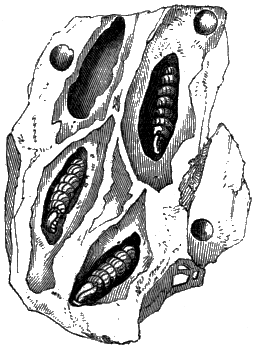
Let us go on to speak now of some other carnivorous larva. If in the month of July we can find out a spot where we can detect the traces of the labours of the sand-wasp, of whom mention has been made at page 15, and cutting out a little mass of the sand-rock containing several of their burrows, then take the trouble to open gently one of the cells formed by these insects, we shall see a carnivorous larva in as happy a condition as a fox in a hen-roost, or a mouse in the midst of a cheese! The best way to obtain access to this securely imbedded and luxurious larva, is to moisten the mass of sand with a little water, and then slice it gently down with an old knife until we come to the cells. They are here represented. At the bottom of each we shall see the larvæ which have sprung from the eggs deposited in the manner before described, after the arduous and affectionate labours of the parent. Then above each is a heap of caterpillars, arranged with beautiful neatness, and larvæ and caterpillars are both fast locked in their prison house by the firm stopping with which the parent wasp has closed the mouth of the cells. These caterpillars are all alive, and are rolled into a ring-like form, but are so chained down that they cannot move in the least degree. The poor prisoners, like the sheep in the slaughter-yard, are only waiting their turn to be killed and devoured. The larva soon after it is hatched finds himself in the midst of a well-stored larder, and has nothing to do but eat, which he does not long delay doing. He devours at his ease, and revels in the dainty fresh food which the care of his parent had laid up. When he has eaten all his prisoners up, and grown to his full size, he lays down to sleep, to awake again in another and a far different form.
Larva of Wood-boring Wasps.
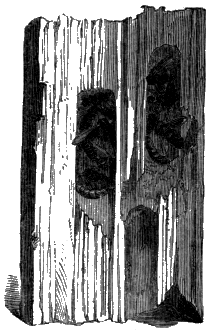
Sometimes the reader may have the opportunity, it may be, of finding out the nest of the wood-boring wasp, and he may in June or July, perhaps, succeed in discovering another instance of a larva in a happy state of plenty. The larva is sure to be found at the bottom, and above it will be piled a heap of insects for its food. What is remarkable about this store of food is, that the insects thus made prisoners are not dead, for they would, if so, soon become corrupted, and unfit for the diet of the larva; they are in a sort of half stupified condition, in all probability very like that induced by the late plan of breathing ether and other vapours to render persons insensible to pain, while surgically operated on. Since this plan has been introduced, we read in some of the newspapers—we may question with what truth—that the butchers in Albany (America,) give ether to the oxen before killing them, so as to make them insensible to the pain of the death-blow! But the wasps in question have for ages been in the habit of effecting the same end by stinging their captives, the poison not sufficing to kill them, nor yet permitting them to be actively alive.
The insects thus stored up for the larva cost the parent many a conflict in their capture. And here we may interest the reader by describing the exploits of a warrior wasp, abundant in the Isle of France. It is curious that in the Isle of France the common bee is not to be found as a native of the woods, while, in the Isle of Bourbon, it is very common, and furnishes an abundance of wax and honey. This is explained by supposing that the warriors of whom we are about to speak destroy the bees, and have thus prevented their multiplying in the island in question. Truly, like the banditti of whom we read in books, these wasps are splendidly attired, although not in the spoils of those they have robbed. Their head, chest, and body is of a resplendent lustre; now green, or, seen in another position, blue, and glistening with all the lustre of an exquisite varnish; their antennæ are black, their eyes of a brownish yellow, and their legs partly bronze-coloured, and partly of a beautiful violet. They are strong and swift of wing, and are possessed of a terrible lance, the thrusts of which even man cannot endure without far more pain and inflammation than attends an ordinary sting.
The foe with whom these magnificently-dressed warriors have to contend, is a kind of insect allied to the cockroach, which, in our kitchens, has acquired the incorrect title of "black beetle." This insect is detested by the inhabitants of the island, for its ravages upon almost everything of value or delicacy, and is not less hated by the sailor for its destructiveness on ship-board. It is called Kakerlac, and is much larger than the cockroaches, which are the plague and terror of our cooks. Imagine that one of these great and odious insects is marching along the highway. The warrior wasp has also been making his expeditions for prey abroad, when suddenly his eager eye catches sight of the kakerlac hastening to some new scene of depredation. The warrior instantly alights, and the kakerlac stops, thinking perhaps to intimidate its adversary by its size and ferocious aspect. Both insects glare at one another;—
——"each other from afar They view, and rushing on, begin the war. They launch their spears; then hand to hand they meet, The trembling soil resounds beneath their feet; Their bucklers clash, thick blows descend from high, And flashes of fire from their hard helmets fly. Courage conspires with chance, and both engage With equal fortune yet, and mutual rage."
Virgil's description, though scarcely accurate in all points, gives us a lively image of this insect combat. The kakerlac, however, is the Turnus, and the warrior wasp the Æneas of the fight. The wasp is the first to attack, and darts upon the other, seizing it by the muzzle with its strong jaws, then bending its body so as to bring its tail under the abdomen of the kakerlac, the lance with its charge of poison is deep-plunged into the body of the unhappy foe, imbuing a deadly venom into its system. Having made this thrust, the warrior looses the foe, and soars in triumph a little way into the air, satisfied of a successful issue.
The wretched kakerlac, after a few brief convulsions, lies paralysed on the ground unable to stir a step from the spot where it encountered its terrible adversary. Fully aware of this, the victorious wasp, after taking a few turns, as if to proclaim the downfall of the Giant Kakerlac to the surrounding neighbourhood, returns to the scene where the conflict was fought. The kakerlac, unable to resist the victor, and being naturally, though a great devourer, a very faint-hearted creature, lies immovable while the wasp seizes the prostrate foe by the head, and in a sort of triumphal march drags it along the road to its nest. But though the kakerlac was not a difficult enemy to overcome, the weight and size of its body are a sore burden to the victor wasp. The way to the nest is long, tedious, and rugged. After a hard pull over all sorts of obstacles the wasp becomes completely breathless, and is obliged to let go, and for a rest it generally rises into the air, probably with a view of reconnoitring future difficulties, and of ascertaining the best route to pursue. Thus, after alternately dragging along the body of its victim and rising up to spy out the path, at length the conqueror succeeds in bringing the carcase home.
Here, however, arises another difficulty. To attempt to get the body of the huge kakerlac in, is just as if one were to attempt to get an elephant through a small street-door. What is to be done? The wasp enters the hole backwards, and, seizing the head of the kakerlac, endeavours with all its might to drag it in, but all in vain. Many times it repeats these efforts with the same want of success; and now it appears that its labours in bringing hither the corpse, and its dangers in the battle, were all for nought, for the great body cannot be put in the place the wasp had designed for it. As if exasperated with the difficulties, out comes the wasp in fury, and falling upon the body of the kakerlac, hews off the large wing-cases, together with several of the limbs, and goes back into the hole again to repeat the attempt to get it in. Success at length crowns its efforts; by little and little the body becomes lost to sight, and finally disappears altogether from view, being carried down to the very bottom of the nest. Here the larva, as soon as hatched, feeds upon it, thrives, and grows, and falls asleep, awaiting the time when itself shall awake to follow in the steps of the glittering and formidable warrior who, with the boldness of an amazon and affection of the tenderest of mothers, supplied it with nourishment during its hours of infancy.
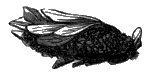
This may be thought a scene of sad carnage, but the following will, perhaps, appear even more so. What should we say, if deep in the forests of some wild uncultivated country was found a den, the bottom of which was strewed with skulls, with bones, and mangled limbs? What fearful scenes should we not suspect to have taken place in this dark and horrid place; and as we shuddered in looking round upon its walls, as the once witnesses of terrible deeds, we might even fancy we heard the cry of the poor traveller, whose last agonies were seen by no eye but that of the monster who had waylaid and murdered him? Such a den may be found in the forest, made horrible by the cut-off heads, limbs, and wings of insects—it is the habitation of the carnivorous larva of a wasp. Nay more, as is seen in the engraving, the insect monster actually works up the cut-off wings and limbs into a sort of covering for itself, and finally buries itself in a shroud partly made of the spoils of former victims.
The Larva of a Wasp in its coat of wings and limbs.
Perhaps the carnivorous larva of the tiger-beetle, or cicindela, is as ferocious a being as any in this state. In this respect, indeed, it resembles the perfect insect, whose title sufficiently indicates its swiftness, cunning, and blood-thirsty nature. "These larvæ," writes Mr. Westwood, "burrow cylindric retreats in the earth, to the depth of a foot or more, employing their legs and jaws in loosening the particles of sand and earth, which they carry to the surface upon their broad, saucer-like head, ascending by the assistance of the two hooks upon the back, somewhat after the fashion of a sweep going up a chimney! Having completed this burrow, they station themselves, by means of their legs and back hooks, at its mouth, their large flattened head and great segment filling the hole." Here they remain all day long, and many an insect might pass close by, little dreaming of the terrible foe who lay under that trap-door. Presently comes a spider scrambling over the ground in haste to mount up a branch on which to hang one of its web lines; the treacherous trap-door is in its direct path. Its feet rest on it; instantly the trap drops, and the poor insect falls into the dark den, and is caught in the powerful jaws of the artful larva. Truly, there is something even to man a little intimidating in the sight of such a monster as is represented here; how much more to the unfortunate insect who happens to be caught in its embrace, and having only time to just catch a glimpse of its fearful captor, is dragged down in a cloud of dust to be devoured in darkness at the bottom of the den. Yet this also, like other cruel creatures, is in reality a very timid larva, and instantly on the approach of danger, drops to the bottom of the cell, where, if we have courage to pursue it, we shall find it much in the attitude in which it is here represented. The singular pair of hooks on its back are used as the flukes of an anchor to sustain the insect in the position it assumes at the mouth of the cell.
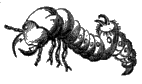
Larva of the Tiger-Beetle.
Mention has already been made in the previous chapter of the insects called Ichneumons, which deposit their eggs in the bodies of the larvæ of other insects. These, when hatched, are also to be reckoned among the larvæ which prey upon flesh, since they devour the bodies of the larvæ in which they have been deposited. They are thus most useful to mankind in destroying the devourers of his vegetable food.
Larva of the Dragon-fly.
The Mask partly open. The same partly closed.
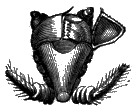
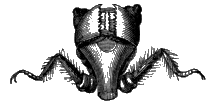
We may now see an instance yet more strange of a carnivorous larva. We must wend our way to the riverside in the months of May or June. There, after a diligent search at the bottom, in some moderately shallow portion of the stream shall we find a larva, the study of which might well occupy us for many pages. Yet it is the larva of an insect well known to every angler and brook-side wanderer—the dragon-fly. This larva is provided with one of the most remarkable contrivances for seizing its prey and conveying it to its mouth, of any being in the zoological kingdom. By the assistance of the engraving, we may perhaps be able to render this apparatus, which is somewhat complicated, intelligible to the reader. Looking at the larva's head, we are reminded somewhat of that of a horse who has got blinders over his eyes, and a nose-bag over his nose, and partly up his cheeks. Now suppose the two blinders thrown back on each side, then conceive that the lower part of the face which we have supposed covered with a nose-bag were to be uncovered, we should then see the following curious contrivance. The lower lip of this larva is lengthened downwards into a sort of arm, if we may so speak; at what we may call the elbow, is a joint connecting the upper and lower portions of it, and the place of the hand is occupied by two cross plates, with a claw at the end of each. Suppose an unhappy insect, or even a tadpole, swims carelessly by the larva, immediately the two sides of the mask, or blinders, as we have called them, fly open; the arm is uncovered, the forearm let down, and by means of the plates, which we have compared to the hand, the victim is caught, and bending the arm back, is presented to the mouth of the larva. There is much similarity in this organ with the wonderful apparatus of the elephant called its trunk; but of the two, the trunk of this insect is the most beautiful piece of animal mechanism. When the prey has been devoured, the arm folds up, covers the mouth and part of the face of the insect, and the blinders, or two side pieces of the mask, fall in, and lock together in a toothed manner, as the engraving in the last page shows.
The apparatus in the act of seizing.
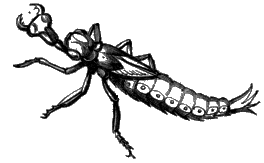
Thus provided, the larva is a formidable creature to the inhabitants of the pond or brook; few, indeed, more so. It preys with incessant activity on all aquatic insects that happen to come in its way, and sometimes, as we have said, even upon tadpoles. They do not even spare one another, and woe to the unhappy relative of the family who happens to wander near the abode of another of the same family, anxious to begin his feasting for the day! So ferocious are they, that they even attack small fish, and make little work of swallowing them up. Not only are these creatures fierce, but they also possess all the cunning of a tiger or a cat. To watch them seize their prey is an interesting occupation, and as the larvæ are common enough, and may be easily recognised by comparing them with the accompanying cut, we may venture to recommend the amusement of observing their proceedings to the reader. A little way off lies an unsuspecting insect delighting in the warm sunshine, and securely floating upon the waters on the corner of a leaf. Such an idea as danger at hand is probably the very last from its conceptions, and pluming its bright and glossy wings, it beguiles away the sunny hour unmolested by a passing enemy, or a breath of air. The larva has marked it already for its own.[E] See it rouse itself up, and noiselessly make ready to pounce upon the unsuspecting lounger. It creeps stealthily along, concealing itself from view as far as possible, and not even the tell-tale glassy surface of the water feels its movements. Measuring its distance well, the larva prepares to seize its prey; in a moment, swifter than the eye can follow, the victim is caught by the apparatus we have described, and in another instant, is in all the agonies of a violent death in the mouth of the larva. So exceedingly cautious are these larvæ in their movements, and so expert and active in darting upon their prey, that it scarcely ever escapes their power.
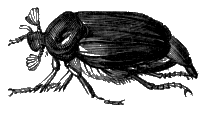
Cockchafer.
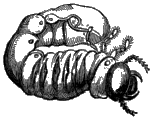
Larva.
Having mentioned these particulars about carnivorous larvæ, let us consider some circumstances connected with those larvæ that are vegetable feeders—graminivorous or herbivorous. Of these, we could scarcely select a more destructive one than the larva of an insect well known to every school-boy from the times of Greece and Rome down to our own—the common cockchafer, (Melolontha vulgaris.) Our schoolboys, however, are less merciful than those of Greece, for they only tied a string round the leg of the unhappy cockchafer, while these thrust a pin through its tail. Yet, its terrible ravages considered, the insect little deserves to be pitied; but, we are not therefore to be understood as by any means sanctioning the cruel and inhuman sport alluded to. These larvæ are hatched in a sort of little cavern dug by the parent insect's care under the ground in our meadows, or corn-fields. Here they begin their ravages by devouring the roots of the grasses which surround them on all sides. In this manner they very quickly destroy the plants, which wither and die in a manner quite mysterious to the agriculturist, if he does not happen to think of these insects. The turf soon becomes so completely undermined by these excavators, that it may be rolled off as smooth as if a knife had been used underneath to cut off all its connexions with the ground. In a few weeks, meadows which shone in all the fresh and luxuriant green raiment of Spring, change colour, and before Summer has yet come, and before the stalks of the grass are yet grown up, one would think Autumn had passed over the face of the field, from its dry and dead aspect. About seventy years ago, we are told these larvæ did so much injury to a poor farmer's fields near Norwich, that the court of that city, out of compassion, presented him with twenty-five pounds. Some idea of their numbers on this farmer's property may be formed from the fact that the farmer and his servant declared, with very long faces, we may be sure, that they had gathered eighty bushels of them. Sometimes they even attack the roots of young trees, and in this manner do an incalculable amount of mischief to plantations. They were at one time so abundant in France, and did such immense mischief, that the Government, in order to get rid of them, offered a handsome reward for the best method of destroying them. A number of experiments were made, and it really seemed as if nothing would kill these larvæ, in the way of poison at least, for several poisons which are rapidly fatal to man and animals failed to produce the least effect on them. It was found, however, at last, that a solution of alkalies, such as potash and soda, were certain poisons to them, and should land be much infested with them, it would be worth the trial to water it with such solutions, especially as they tend rather to enrich the soil than otherwise. A French manufacturer, determining to turn the visitation of these insects to good account, has succeeded in distilling an excellent lamp-oil from their bodies, and offers tenpence a bushel for them. From seventeen bushels he extracted twenty-eight quarts of good oil! In Hungary, a kind of grease is obtained from them which is useful for carriage wheels. The ingenuity of man may thus even procure good out of a very formidable evil, although the mischief done by the cockchafer larva undoubtedly far exceeds the benefit it confers upon its captors in the amount of oil extracted from it.
An insect almost equally familiar to all persons is the long-legged gnat, of whom the famous children's rhyme runs:—
"'Old father long-legs' would not say his prayers; Take him by the left leg and throw him down stairs."
Many of our farmers would be glad, no doubt, if taking him by the left leg would keep him out of their meadows, for there this insect commits fearful ravages in the larva form. In some parts of England it has as completely destroyed the pasture-grass as if it had been consumed by fire. In the spring of 1813, hundreds of acres of pasture in the rich district of Sunk Island in Holderness were entirely destroyed by it, being rendered as completely brown as if they had suffered a three months' drought, and no other vegetation but that of a few thistles was left on land, which, at more favoured periods, was more than commonly luxuriant. On a square foot of the turf being dug up from the affected spot, the enormous number of two hundred and ten larvæ was counted in it. Fortunately, the next year showed a very different result, for then it was difficult on careful search to find one! In some districts of France it is also very destructive, the grass of large tracts being so completely destroyed by it, that enough food for the maintenance of the cattle is not to be obtained. These larvæ, like the last-named, appear to destroy by eating away the roots of the grass. From these and the foregoing facts, entomology teaches us to regard these two insects, upon which we commonly look with compassion, as occasionally becoming the formidable, though indirect, enemies of man. The scientific name for "Father Long-legs" is Tipula oleracea. The French call them oddly enough milliners, or tailors, (couturiéres, tailleurs,) a name of which it is harder to guess the origin than the common one of father-long-legs, which is sufficiently expressive of one of the features of the insect in the perfect state: perhaps the French tailors are distinguished for being very long and thin!
The Gamma Moth and Larva.
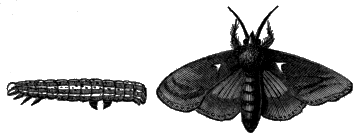
We may yet linger awhile in the fields for another illustration of the devouring propensities of vegetable-feeding larvæ. The pretty moth represented in the accompanying engraving, together with its larva, was once the cause of more alarm in France than we can readily conceive. It is often to be seen in our meadows plunging its minute drinking apparatus into the depths of the wild flowers, and flitting to and fro at no great height from the ground all the day long, and even after sun-down. It is called generally the Gamma moth, or Plusia gamma, in consequence of the little mark in its wings, which resembles the Greek letter [Greek: g]. Its larva is striped with green, and when multiplied excessively, as was the case in France in the year 1735, produces scenes of desolation which, as the results of apparently an insignificant insect's doings, can scarcely be credited. In the months of June and July in that year they became so numerous, that the gardeners and peasantry in the districts plagued by them declared that they must have been created by enchantment. In some places Réaumur was assured that an old soldier had been seen to throw the spell. In other places an ugly old woman, who was as wicked as she was frightful, had caused all the mischief. Their prodigious numbers appeared to the ignorant and superstitious peasantry an indubitable proof that they were created by sorcery. And though we cannot, of course, sympathise with their thoughts on this subject, we can well imagine and feel for their astonishment and dismay as they beheld the wide desolation of every green thing produced by the innumerable millions of these larvæ, which covered forest, field and garden with their bodies. Many persons began to fear they were really poisonous creatures, and refused in consequence to partake of salads or other vegetable food of a similar kind. This was probably an equal error with the last; and it is very droll to find the talented Réaumur pleading with great earnestness that the caterpillars were not unwholesome as food. He even declares his opinion, that if these creatures were to become excessively numerous in France, the inhabitants might be compelled to treat them as the wretched inhabitants of Africa do the locusts, and when they have eaten up every green thing, fall upon and eat them. With as much learning and eloquence as if he was treating one of his most favourite topics in entomology, M. Réaumur recommends these larvæ for human food, adding, that a very little time would enable us to conquer our disgust at such aliment, and that we should even welcome to our tables a dish of the larvæ in question as an agreeable luxury! It is to be hoped, if ever such a custom be originated, it will be confined to the place of its birth—the country of this great, but, in this respect, whimsical naturalist.
To account for their excessive multiplication, we have no need to have recourse to enchantment for a solution of the difficulty. Each of the gamma moths produces about four hundred eggs; now, if there were only twenty larvæ in a certain locality which lived through the winter, and became perfect insects in May following, the eggs deposited by these would, supposing all to be hatched, produce, according to a calculation made by Réaumur, in the course of a single year, eight hundred thousand larvæ. Well may we exclaim, then, with this learned author, "Should we not rather wonder at the wisdom and forethought which has ordered matters so that these insects increase to annoy us so rarely?" The wonder is, in truth, not that they should multiply so excessively at particular periods, so much as that it should be so seldom that they are multiplied even to the extent of which they are naturally capable. Thus, if we suppose that all the eggs of the moths of this species were to be hatched, it is more than probable that a large portion of our vegetation would be consumed by them. How is this guarded against? In various ways. The eggs are not all capable of being hatched, or if so, are not allowed to escape injury by various accidents, and the larvæ themselves are a prey to countless enemies among the birds, while they also frequently perish owing to the severity of winter. From these considerations we may readily perceive how completely the well-being of a great nation, with the lives of a large portion of its inhabitants, are dependent upon the preserving, protecting, and restraining influence of the providence of God. With the return of every year, we may say, the question is asked by this tribe of insects alone, "Shall we go forth to destroy and devour at once, or shall we refrain?" With every year the silent reply is experienced by man in the unmolested condition of his fields, gardens, and vineyards. "Oh!" we may ejaculate with the Psalmist, "Oh that men would consider these things! then should they understand the loving-kindness of the Lord."
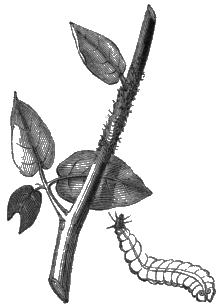
Destructive Larva and its Nest.
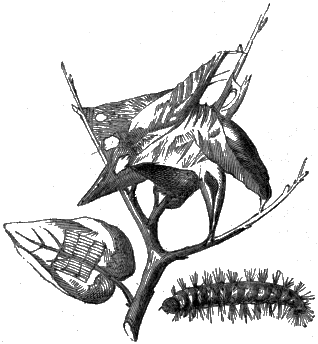
Another and more remarkable instance of the destruction caused by vegetable-eating larvæ may be quoted from the fertile pages of the same illustrious naturalist, M. Réaumur, particularly because it is the narration of one who was an eye-witness to the facts of which he speaks. "In two journeys," he writes, "which I made from Paris to Poitou, at the commencement of the month of September in 1730, and also in 1731, I noticed that from Paris all the way to Tours every oak, great and small, had been attacked by larvæ; the highest branches appeared to be principally selected by them. Great isolated oak trees, as well as those which formed dense forests, were alike attacked in this manner, their summits being absolutely withered and dry. Had we not known how greatly the larvæ may multiply, and what fearful ravages they are capable of committing, one might have conceived that some hot and blasting wind had reduced the leaves to this condition. In certain districts, the hedges along the road-side had not a single leaf that was not withered up." The engraving represents one of these mischievous larvæ; it also shows the winter-nest into which they creep, and a leaf which a regiment of them have already attacked.
Securely protected from the severity of the winter of 1731, in their warm nests, these larvæ quitted them again early in April of 1732, to set forth upon another mission of destruction. They had now multiplied to a degree calculated to excite the most serious public alarm. It began to be feared that the leaves of the trees would not be sufficient for the support of the devouring millions; and that if, during that year, the larvæ multiplied in the same proportion as in the preceding year, a famine more terrible than any recorded in history as produced by insect destroyers would be the result. These fears were in some measure groundless, as, in all probability, so soon as the larvæ had devoured all the leaves, they would rather have perished of hunger than have attacked the grass and other plants. But the matter was sufficiently serious as it was. The French parliament took the alarm, and determined to resist the threatened invasion of these small but formidable enemies. An edict was therefore issued, calling upon all persons to assist in removing the larvæ from the trees, while they were as yet not reinforced by the addition of countless millions more. In orchards, gardens, and pleasure-grounds this became a far from difficult duty, because it was easy to ascend the trees and to remove the larvæ and their nests. But in dense forests, where the tall trees waved high in the air, and where every branch and every twig was loaded with larvæ, it was plainly impossible. Although, as we know, acts of parliament are able to effect a great deal, these insects set their powers at defiance, and little good was really accomplished. Having thus, as it were, manifested to the nation how powerless were their efforts to remove the plague, it pleased God to interfere by his providence, and a succession of cold rains for three days in May effectually stopped the progress of the destroyers, by utterly annihilating them.
Réaumur's remarks well deserve extracting; he says:—"I had been hoping much from the effect of these showers, and attentively watched what would be the result. I saw day by day that among the little bands of larvæ which were aggregated together in order to cover the twigs of the trees with silk, or to despoil them of their leaves, there were many whose bodies became flabby, elongated, and devoid of roundness. These quickly perished. Every day the mortality became more serious among them. In a short time the larvæ, which had previously swarmed upon the trees, became so few, that before ten or twelve days had passed by I could not find a single one, although I looked carefully for them." It is remarkable enough, and sets forth strikingly the short-sightedness and ingratitude of man, that these very showers, which produced what no combined efforts of human power could or did effect, were bitterly complained of as inappropriate to the season, at the time when they were falling! These larvæ were hatched from eggs deposited by a common species of moth.
Although England has been often mercifully spared while continental countries have largely suffered by such visitations as we have last described, we have not always come off unscathed. The larvæ of a moth nearly allied to, if not the same as the last-mentioned, produced an alarm in 1782 in our country, perhaps even more extensive than the previous one in France. All sorts of strange and silly rumours were spread abroad; some believing that the larvæ were the harbingers of coming disease and death. Poor people were hired to cut off the webs of these larvæ at the rate of one shilling a bushel, and they were then burned under the inspection of the churchwardens and overseers. In the parish of Clapham, we are told by an author who wrote upon the history of this insect, eighty bushels were collected in one day! Prayers were offered up in some churches to deliver the country from the apprehended approaching calamity.
We need not, however, dwell longer upon the vegetable-consuming larvæ out of doors. Unfortunately we are acquainted with instances equally formidable within our barns, store-houses, and larders. In vain does man lay up the increase of his fields with care in granaries of the best construction, and using all possible precautions against the introduction of insect enemies. The weevil, called scientifically the Calandra granaria, finds entrance, and in a short time makes its presence felt in the vast destruction it produces. So soon as they are discovered, they are collected with all expedition by the owners of the stores and consigned to the flames for their misdeeds. Sometimes they are collected thus by bushels, from which it may readily be conceived what has been the amount of damage they have done.
There is a little moth whose larva is equally mischievous in appropriating to its own use the food and property of man; its name is the Tinea hordei. This fly, we are told, deposits perhaps twenty or thirty eggs in a single grain; but as one grain only is to be the portion of one larva, so soon as they are hatched they disperse by mutual consent in a very amicable manner, and each selects its future home, so that in a short time the whole family is comfortably lodged in twenty or thirty distinct grains of corn. There, surrounded by food, they live and thrive, eating up all the precious parts of the grain, until nothing remains but the husk. They then fall asleep and enter upon the further stages of insect development. No one could possibly tell by the external appearance of the corn, that the least mischief had taken place within, the fulness and general aspect of the grain being the same; but on carefully examining it, a very minute hole may be found in some spot or other;—it was here the enemy got in. We need scarcely add, that for any purpose grain which has been thus attacked is rendered perfectly useless.
Any one who has ever been on a long sea-voyage will find it easy to supply us with another example of a vegetable-food devouring larva. The hard substances commonly called captain's biscuits are the objects of attack, together with flour, peas, and similar articles of food, and the attacking insect is the larva of the meal-worm, the entomological title of which is Tenebrio molitor. In vain does the ship's cook, with all his art, prepare a soup composed of the richest ingredients, and calculated, as one would think, to gratify the taste of the greatest epicure. The larvæ have been beforehand with him; they have attacked and become mixed with the flour or the peas; and when the soup which has cost him so much pains is brought to table, not even the keen appetite of seafaring people can reconcile them to it, for it is full of the dead bodies of these larvæ. So likewise is the biscuit, and in disgust the guests are compelled to confine their attention principally to such articles of food as are unpalatable to their insect enemies.
We have but little experience, in our favoured land, of the more extensive domestic destructions wrought by larvæ. But in hot countries they become formidable, by reason of their numbers. In India,[F] particularly during the rainy season, the interior of the houses swarms with them; some climb the walls, some ascend the table, some feast on the viands, and altogether, by their numbers and appearance, they produce a degree of disgust and loathing at food, which cannot be overcome for a long time by fresh residents. We may mention, before concluding this part of our subject, that of those that do annoy us domestically, some have appetites for very strange kinds of food, some love wine, some vinegar, some butter and cheese; some revel in a pot of preserves, some attack our meat, and one is mentioned by Réaumur as delighting in chocolate!
If surprise be expressed that we have dwelt so long upon the eating propensities of larvæ, let it be remembered that it was formerly said at p. 94, that the principal duty of the larva, so long as it lived, was to eat. It is born often only to eat as much as possible, and to grow as large as possible within a given time; and in obedience to this principle, we find larvæ with the sharpest of sharp appetites embark in their career of existence, eating from their birth, all the way along to their final change. It is therefore, obviously, a very important part of the larva's history of which we have been speaking for some pages past. Considering the fact to have been now brought into sufficient prominence, we shall proceed to notice the rate at which larvæ grow, and the actual quantities of food some of them devour. Let us speak of the last first.
Silk-worm Moth and her Eggs.
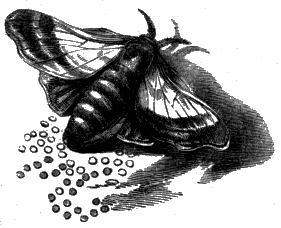
Silk, as the youngest of our readers knows, is the production of a little larva commonly called the silk-worm. Now, some years ago, the calculation was made that in the United Kingdom alone was consumed, every year, not less than five million pounds of raw silk. By means of very accurate experiments, it has been ascertained that, in order to procure one pound of raw silk, we must have twelve pounds of the cocoons spun by these larvæ. In order to produce twelve pounds of cocoons, one hundred and ninety-two pounds of mulberry-leaves must be eaten up; or, which is the same thing, for every pound of raw silk, we have to supply to the worms one hundred and ninety-two pounds of leaves. We can now leave the calculation in the reader's hands; but we may mention the sum total: it is, that for every year's consumption of raw silk by our country, there is a certain consumption of ninety-six millions of pounds of mulberry-leaves; and as one hundred pounds of leaves are calculated as the produce of one tree, it follows that nine millions six hundred thousand mulberry trees must grow, in order to supply food to the silk-worms necessary to furnish Great Britain with silk for one year. Let us add, that this five million pounds of raw silk is the production of the inconceivably great number of eighteen thousand million silk-worms. The Count Dandolo, who has written an excellent treatise on this subject, in Italian, made a number of experiments upon the actual quantity of leaves devoured by the larvæ hatched from an ounce weight of eggs; and he found that the quantity of leaves consumed by them up to the completion of their development as larvæ, amounted to upwards of sixteen hundred and nine pounds! In a month from being first hatched, each larva consumes above an ounce of leaves. As at first each larva only weighs the hundredth part of a grain, it follows that it devours, in thirty days, about sixty thousand times its original weight of leaves. If we suppose a puppy dog, just born, to weigh a quarter of a pound, and to eat in the same proportion for one month, it would have consumed, at the month's end, fifteen thousand pounds of food. Could the puppy eat meat from the first, which, as all are aware, he cannot, he would, at this rate, devour in one month, from the time of his birth, one hundred and fifty sheep, supposing each to weigh one hundred pounds; or about five sheep for his daily food! These calculations will show how voracious the larvæ of the silk-worm are; and they are, probably, far from being among the most voracious of the larvæ, only we are better acquainted with their rate of devouring than with that of other insects in this state.
Growth of Silk-worm Larvæ.
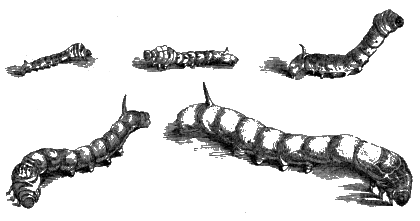
All this eating cannot, of course, be unattended with a great increase in the size of the larva. In some insects growth is prodigiously rapid. A naturalist, who closely investigated this subject in the common blow-fly, which is so apt to deposit its eggs upon meat in hot weather, found that in the space of four-and-twenty hours, the larvæ hatched from these eggs had increased to from one hundred and forty to two hundred times their original weight. The larva of the great goat moth, we are told by another, grows, altogether, to about seventy-two thousand times its weight; but it takes three years so to do. In thus growing, the larva becomes very fat and plump; and should it unhappily cross the path of any bird, it would probably be nipped up as a dainty morsel for the little ones in the distant nest. In birds, beasts, and fishes, the rate of growth is much slower, and the amount of increase much less. Fortunate is it for us that it is so; for what would become of mankind if animals of the size of dogs could grow in a month to the size of elephants, or young elephants to the size of little hills? yet these comparisons are not exaggerated, remembering the increase and growth of the silk-worm and of larvæ generally.
CHAPTER III.
MOULTING OF THE LARVA.
We are now to enter upon a very interesting part of the history of a larva: this is called moulting, and consists in the larva casting off its old skin, and appearing clothed in a new garment, often more brilliant than before. The change is well and clearly described in the following passage from the Introduction to Entomology, of Messrs. Kirby and Spence:—"A day or two previously to each change of skin, the larva ceases eating altogether; it becomes languid and feeble; its beautiful colours fade; and it seeks a retreat in which it can undergo this important and sometimes dangerous and even fatal operation in security. Here, either fixing itself by its legs to the surface on which it rests, or, as is the case with many caterpillars, by its pro-legs, to a slight web spun for this purpose, it turns and twists its body in various directions, and alternately swells and contracts its different segments. The object of these motions and contortions seems to be, to separate the exterior skin, now become dry and rigid, from the new one just below it. After continuing these operations for some hours, resting at intervals, without motion, as if exhausted by their violence, the critical moment arrives: the skin splits in the back, in consequence of the still more violent swelling of the second and third segments. The opening thus made is speedily increased by a succession of swellings and contractions of the remaining segments; even the head itself often divides into three triangular pieces, and the enclosed larva by degrees withdraws itself wholly from its old skin." The engraving is intended to show the larva just escaping out of its old skin.
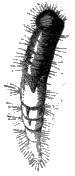
Sometimes the larva comes out of its skin at the side; sometimes it has been seen to bite off portions of the skin. The most common way is that above described. The skin, when cast in this manner, resembles a sort of universal coat, which has fitted into every crack and joint of the insect's body; and just as a lady's glove, if we could suppose it tinted of a flesh-colour, and marked for the various markings on the hand, might be mistaken, if cast down after inflating it with air, for a hand cut off, so, only far more closely, does the cast skin represent, in the minutest particular, the larva which has emerged from it. It is a perfect mould of all its parts, even to the very antennæ, eyes, jaws, &c. "Thus," say the authors last quoted, "if you saved the skins cast by the larva of the insect called Callimorpha, or Arctia Caja, you would appear to have ten different specimens of caterpillars, furnished with every external necessary part, and differing only in size and in the colour, perhaps, of the hairs, and all representing the same individual."
In order to show how completely this is the case, some singular experiments have been made by various observers, in the following manner:—Just before the larva was about to cast off its skin, they have, by means of a sharp instrument, cut off one or two of its feet. The larva was then allowed to moult, and was carefully examined, and it was invariably found that the feet cut off when in its old skin were also wanting when it appeared in its new robes; thus plainly proving that the feet were really sheathed in the old skin completely. It was just as if we had gloves on our hands and were to put one finger or more between a pair of sharp and powerful shears, we should, of course, find that when we took off the glove we should be short of one or two fingers!
But the hairs are not thus sheathed. The old skin, if the larva was a hairy one, such as many of those with which we are familiar under the more popular title "caterpillars," is cast off with the hairs attached to it—a circumstance which makes the cast skin look still more like the real larva. How, then, it may be asked, does the larva acquire new hairs to take the place of the old ones? Were we to take a larva just before its moulting, and by a sharp and delicate instrument, to slit open and raise its old skin, we should soon perceive how this has been contrived. We should there perceive sundry little tufts of very delicate hairs, lying down smoothly on the surface of the larva's body, and arranged in certain directions, with great regularity. When the old skin is cast, in the course of a little time these hairs stand upright, and assume precisely the same appearance as those on the former skin.
The keeper of silk-worms can tell us well, and perhaps with many a sigh, that the period of moulting is one of great peril to his tender charge. The larvæ are sick and feeble for some time after each period of moulting; and large numbers die at this time, apparently unable to bear the exhaustion attending the loss of their old skin. Larvæ generally are much debilitated by each moult that takes place; for a variable period, sometimes for some hours, sometimes for a whole day, they will refuse food, and lie without motion. All their parts are very soft and tender, and require hardening by exposure to the air. After a certain period, however, these effects pass off; the larva recovers its original strength, its body becomes firm, its colour brightens, and appears more brilliant than ever; and, above all, like convalescents among ourselves, its appetite is twice as keen as before, which, when we call to mind what has been already said about the voracity of larvæ, it will be confessed, appears scarcely possible.
These changes of skin take place a definite number of times in the larvæ of each species. The breeders of silk-worms tell us that that precious, if not priceless, little larva, sheds its skin four times; other larvæ moult oftener than these: some five times, some seven times, some eight times, and some nine, or even ten times; others, again, only moult thrice. The ordinary number of moults appears to be about three or four. Some, however, never moult at all in the larva state. The larva of the common bee, and that of the flesh-fly, and some others, are among this number.
Whatever may be the general opinion upon the want of beauty and comeliness in insects, and particularly during the larva stage of their history, it is very certain that it is quite erroneous. We may possibly fail, unaided by the pencil and colours of the artist, in conveying even an approach to an adequate conception of the rich and glowing raiment with which it has pleased God to clothe these minute and humble beings. But a very little actual observation of a few even of the commoner larvæ or caterpillars of the butterfly and moth species, will convince the reader that few other created things have been so exquisitely adorned with magnificence of colour and apparel as the larvæ of these insects. Here will be found hues so rich and deep as to—
"Make the rose's blush of beauty pale, And dim the rich geranium's scarlet blaze."
Here is a larva of a moth before us whose head is a delicate orange colour, whose belly and feet a pale pure green, whose sides are of primrose tint, variegated with slashes of green, and along the back there runs a beautiful band of white, the intensity of which is most agreeably relieved by a vein of lovely pink, which divides it in the middle. There is another clothed in purple, green, and white; another, the larva of the butterfly called the "Camberwell Beauty," is of a brilliant black, dotted with spots glowing like carbuncles along its back; another has a coat which seems as if set with precious stones, blazing with an intensity of colour which cannot be conveyed by description. In a word, larvæ, on the whole, can boast as varied a display of beautiful hues as can almost the whole array of flowers in our gardens. In consequence of the, unfortunately, too general feeling of loathing, to which allusion has already been made, but few persons are in reality acquainted with their beauties. Their diminutive size also renders them less attractive than they might otherwise prove, since we are generally most pleased with the beauty of an object when its size makes it so manifest to our eyes, as to render it impossible it should escape our attention.
It is a very remarkable fact, and corresponds, to a certain extent, with the influence of the same agent upon plants[G]—that light seems to be in some measure necessary in order to develop the colours of the larva. Thus it has been noticed, that those larvæ which are, by their habits, much in darkness, dwelling, perhaps, in caves of the earth, or immured in the heart of a piece of timber, or inhabiting a cell scooped out of the solid rock, are, most frequently, of a uniform whitish colour. Some experiments have shown that when these whitish larvæ have been brought out of darkness and exposed to the sunlight, their colour has turned to brown. Very probably this effect is due to precisely the same kind of change as takes place when a fair-skinned European travels into a southern clime, his face and hands becoming so brown, tanned, and dark, as to form a ludicrous contrast to the whiteness of his chest or arms, which are not exposed to the influence of the solar ray.
Larvæ resembling Twigs.
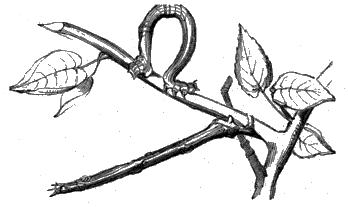
There is still something more to be said about the coats of the larva. To look at some of them, it would be difficult for a person unacquainted with entomology, to guess at the real nature of the object before him. Some look like dry twigs. Some look far more like little Cactuses than insects. Some are clothed with hairs, arranged in the most curious and eccentric manner. Some have hairs so long as to give them all the appearance of very minute shock-dogs. In some, the hairs are arranged like stars; in others, like the quills of the "fretful porcupine." The backs of other larva look just as if they were studded over with little camel-hair pencils. Madame Merian has described the larva of an insect found in Surinam as having the various divisions of its body ornamented with three blue tubercles, like turquoise beads, from each of which proceeds a long, delicate, feathery plume of a black colour. Another, described by the same lady, is splendidly adorned on each side with fifty red tubercles, shining like coral, from each of which proceed five or six long hairs. Some, again, are covered as thickly as possible with sharp processes, like thorns, sufficiently strong and sharp to pierce the skin of any one who incautiously ventures to take them up. The body of a small caterpillar brought from Brazil, is described by Kirby and Spence as possessing a body so thickly planted with spines, like the branches of a tree, as absolutely to wear the appearance of a forest or thicket in miniature! It has been stated, indeed, by some travellers, that the larva of some insects has the power of darting out, when alarmed by the approach of anything, such as the human hand, from as many knobs or protuberances in its back, eight bunches of little stings, with which it inflicts a very painful and venomous wound.
Singularly coated Larva.
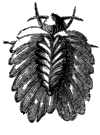
The larvæ of some insects again seem as if they were clothed from head to foot in the most delicate and snowy white cotton wool. These may sometimes be seen on our apple-trees; but one of the most singular is figured in the cut, from an engraving given in Baron de Geer's work. The larva is covered completely with a coat of cottony flakes of the most dazzling white, and these are arranged, as will be perceived, with great regularity. The larva has, in this white and warm raiment, somewhat of the aspect of a coachman buried in the old-fashioned great coats with the many capes.
Having dwelt so long upon the food and clothing of the insect in the larva form, it is right we should now devote a little space to consider how they breathe. Some one perhaps will say, Breathe?—do larvæ breathe? Most certainly; and respiration, or the function of breathing, is not more necessary to us than it is to these creatures. For this purpose, however, we must begin a fresh chapter.
CHAPTER IV.
RESPIRATION OF THE LARVA.
We well know, from the various melancholy accidents which have taken place, that unless human beings have a constant supply of pure fresh air they must perish. Many years ago, a number of unfortunate persons were shut up in a narrow cell, called the Black Hole, at Calcutta, where they could scarcely find room to stand, much less obtain air to breathe. In one night the greater part of them died. More recently, as some poor Irish were being conveyed in a steamer in stormy weather, the captain, out of prudence and mistaken kindness, ordered the hatches to be all battened down, so that fresh air was prevented from getting in. A shocking spectacle was beheld soon afterwards:—in the close, suffocating cabin lay a number of dead bodies, of men, women, and children, all destroyed by the want of air. Now, precisely the same fatal results take place if we treat larvæ in the same manner; from which we learn that undoubtedly breathing is not only one of their functions, but a most necessary and important one.
This may be easily proved. If the reader will procure about a dozen caterpillars of any common kind, and put them into a dry phial, corking them closely up, and if he leaves them in their prison of glass a sufficient time, all will die, even though he may have supplied them, on putting them in, with an abundance of food. Clearly, therefore, they do not die of starvation, and we should be naturally disposed to say they must have died of suffocation; that is, they died because the function of breathing could not take place, as there was not the necessary change of the air contained in the phial. But suppose that other caterpillars were procured and put into another phial, with a sufficiency of green food, the mouth being covered over with a piece of muslin, or fine lace, what would then be the result? Simply that they would live and thrive for as long a period as they received their proper quantity and quality of food, and would pass through all their stages of existence as comfortably as if in the open air. The reason would be because the open fibres of the muslin, or lace, do not interfere in the least with the requisite change of air for respiration.
Again, if after corking up the bottle for a short time, we were to shake out all the caterpillars from it, and then put into it a little water, in which quick-lime has been slaked—sold by chemists under the name of lime-water,—we should find it become quite white and milk-like. This would be, because, as the physiological chemist well knows, the function of breathing causes carbonic acid gas to be poured out of the body, no matter whether it is the body of an insect or an elephant; and this gas has the property of turning lime-water of the colour mentioned. Hence we have a second and convincing proof that larvæ breathe—we need scarcely remind the reader that caterpillars are larvæ—and more than this, that the function of breathing in them resembles, so far as the discharge of this peculiar gas is concerned, the same function, whether carried on in the human body or in that of the most mighty and majestic of the beasts of the field.
The great chemist, Scheele, has experimented, somewhat in the manner we have recommended, upon the breathing of larvæ. He found that when caterpillars and maggots, to use the customary terms for these varieties of larvæ, were confined in vessels containing only about eleven cubic inches of atmospheric air, and so stopped as to preclude the ingress of any fresh air whatever, although furnished with an abundant supply of food, they soon died. When he put them into a still smaller vessel, they died the sooner. In fact, precisely in proportion to the purity, or to the amount of the air contained in the space in which he confined them, were their lives prolonged or shortened. He found on examining the air that it contained, as above stated, carbonic acid gas.
A Spiracle open. The same shut.
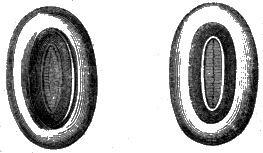
We may, therefore, consider the question as settled—that larvæ do breathe. Strange it may appear to some, but neither in the larva nor in any other form of its existence do insects breathe by the mouth. How, then, it may be asked? We shall now describe their breathing apparatus very briefly. Along each side of the body runs a delicate tube for the conveyance of air, called a trachea, or when both are spoken of, the tracheæ; these channels run underneath the muscles and skin, and open to the air by little branch tubes, the mouths of which are called spiracles. Besides these branch tubes which open to the air, the large tubes send off a great number of smaller ones, which extend to all parts of the body, penetrating even to the legs and wings. In some insects, the spiracles, or breathing holes, are defended by a pair of flaps, which swing to and fro, so as to let in the air, and close upon it after each inspiration. By this simple means the breathing of insects is carried on; the air enters the tubes, passes along them, and is then conveyed to every part of the body; after which, having fulfilled its duties, it escapes again. In man, and the higher animals, there is a separate place for the air in the body, which we call the lungs, and here the blood is conveyed to the air, in order to be purified. But, as we have just seen, in insects it is very different, for in them the air is conveyed by innumerable minute pipes to every portion of the frame. Such is the breathing mechanism common in larvæ which live in the air.
It will be readily imagined that those larvæ which dwell in the water must be furnished somewhat differently, in order to enable them to breathe. And here, as we shall now find, there are some very curious arrangements, in order to effect this object. They may be considered under two divisions. First, contrivances for breathing air while the larva is immersed in the water; and, second, apparatus for extracting the dissolved oxygen gas necessary for breathing from the water.
Breathing apparatus of an aquatic Larva.
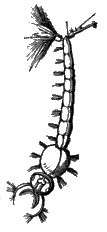
Let us select a few of the most singular instances under the first of these divisions. "No better example," write the entertaining authors of the Introduction to Entomology, "can be selected than the gnat. You must have occasionally observed in tubs of rain-water, numerous little wriggling worm-like animals, which frequently ascend to the surface, there remain awhile, and then bending their head under the body, rapidly sink again to the bottom. These are the larvæ of some species of the genus just named; and if you take one out of the water and examine it, you will perceive that it is furnished, near the end of the body, with a singular organ, which varies in length according to the species, and forms an angle with the last segment but one. The mouth of this organ is funnel-shaped, and terminates in five points like a star; and by this it is usually suspended at the surface of the water, and preserves its communication with the atmosphere. In its interior is a tube which is connected with the tracheæ, and terminates in several openings, visible under a microscope at the mouth of the organ. The points or rays of this mouth are used to close it when the animal is disposed to sink in the water, and thus cut off its communication with the atmosphere. When the animal is immersed, a globule of air remains attached to the end of the tube, so that it is in fact of less specific gravity than water, and it is not without some effort that it descends to the bottom; but when it wishes to rise again, it has only to unclose the tube, and it rises without an effort to the surface, and remains suspended for any length of time. The extremity of the larva is clothed with bunches of hairs, which are furnished with some repellent material which prevents their becoming wet. It is this repellent quality that probably causes a dimple or depression of the surface, which, if you look narrowly, you will discover round the mouth of the tube."