Volume 1 — CHAPTER VIToC
Reading edition
CHAPTER VIToC
STEINLE AND ITALY AGAIN—FIRST IMPRESSIONS OF THE EAST, 1856-1858
In Mr. Henry Greville's diary we find the following entry:—
Thursday, July 24th, 1856.
Went on Monday to Hatchford with Leighton, and passed all Tuesday with him and Mrs. Sartoris on St. George's Hills. The day was enchanting, and the Hills in their greatest beauty.
Before leaving London in 1856 Leighton wrote to his mother:—
London, Wednesday, 1856.
As my stay in London is drawing to a close, and nobody writes to me, I must write to somebody. I am happy to say (for I know it will interest you) that my "Pan" and "Venus" are admired as much as I could wish, so that I am not without hopes of selling one of them at Manchester. Gibson was quite delighted with them; I am, however, bound to say he knows nothing about it. The sketches of my "Orpheus" I have sold to White for £25, which comes "unkimmon" handy, as this place is ruinous. I have made the acquaintance of Rossetti, one of the originators of the pre-Raphaelite movement. He is apparently a remarkably agreeable and interesting man. Hunt also I like much. My plans are these: on Monday next I leave London, and shall spend a small week between the Cartwrights and (perhaps) the Grotes, after which on or before the 12th I shall be with you in Bath, where I shall remain until the 16th, on which day I shall come up by the early train to town, where I shall meet H. Greville, stay long enough to get my passport in order, and then be off double quick to Italy. I am longing to get to work again; I am doing nothing whatever except Henry's dog, which takes up what little time I have. Will you tell Papa that I went to the shop he recommended, and got a splendid Shakespeare ready bound in eight volumes for three guineas!
From Bath he wrote to Steinle:—
Translation.]
9 Circus, Bath, August 2, 1856.
My very dear Friend,—In about ten days I expect, on my way to Italy, whither I go on a short student journey, to pass through Frankfurt or Cologne, according as you are in one or the other, exclusively in order to take my dear master once more by the hand; and if you are at the moment in Frankfurt, I might even spend two or three days in the old Bokaga, and even draw a composition as in the old times. Do, dear friend, send me a line by return of post in order that I may make arrangements.
The rest verbally—I have sadly forgotten my German.
Hoping to meet very soon, dear master.—Think of your pupil,
Fred Leighton.
Translation.]
Bath. 9 Circus (later).
My very dear Master,—I have just received your dear lines, and hasten to say that nothing could be more delightful to me than to travel with you again, if only for a few days.
I had intended to go viâ Milan for the sake of quickness, but I will go direct through the Tyrol to Venice.
If all goes well, I will arrive in Frankfurt on the 23rd of this month; does that fit in with your plans?
How delighted I am to see you again, my good Master!
To our speedy meeting!—Your grateful pupil,
Fred Leighton.
Leighton had felt his failure keenly, though, with his usual consideration, he had tried to lessen the disadvantages of it in writing to his mother. The friend who enjoyed constant intercourse with him at the Bagni de Lucca in 1854 wrote at the time of his death: "Leighton longed for and desired success; but only in so far as he deserved it. When he was sharply checked in his upward career, he accepted the rebuke with humility, for he was a modest man." Mrs. Browning writes to Mrs. Jameson, May 6, 1896, from Paris: "Leighton has been cut up unmercifully by the critics, but bears on, Robert says, not without courage. That you should say his picture looked well, was comfort in the general gloom." Though those critics who were spokesmen for the envious among the artists seemed to revel in Leighton's disaster, he had many friends who took perhaps a too favourable view of the unfortunate picture. But neither excess of abusive ridicule, nor a too favourable view taken by intimate friends, could unduly influence Leighton himself—Leighton the actualist. He had a firm faith that in the actual it is man's lot to find the true and the really helpful. These words of his master, Steinle's, written to him in 1853, doubtless recurred to him, and he felt he must return to the Eternal City to be reinspired after his fall:—
I would rather remember that you will receive these lines in the Eternal City, that you are with our friend Rico, and that you are settling to work with renewed vitality and a pocketful of studies. In Cornelius, besides much that is stubborn, you will find so much that is admirable, and so much truly artistic greatness, that you will soon love him, for he is also of a truly childlike disposition, and much too good for Berlin, for which reason he has left the place. You lucky men who have crossed the Tiber—the Vatican of St. Peter, the Courts of St. Onofrio, the Villa Pamfili—where in the world is there anything like them? Where is there a town in which every stone has greater, more splendid things to tell us of every period? Where is there a place where the artist could soar higher than in Rome? Forget that you are practically in an island, and study your Rome; it is invaluable for one's whole life, which is otherwise so commonplace and so small. Your youth and courage—"the sparrow among the beans" ("Triton among the minnows")—need not be injured thereby; but, dear friend, you must become a man, and there is nothing great in the world that has been achieved except by taking pains. Addio, carissimo; greet Rico and the friends most heartily. My wife reciprocates your friendly greetings, and I remain, your devoted friend,
Steinle.
He travelled there viâ Frankfort to see Steinle, with whom he went to Meran, thence to Venice and Florence, then on to Rome.
Frankfurt, Brauseler Hof, August 24.
Dearest Mamma,—Being at last in Frankfurt, and having seen Steinle and his works, and, en revanche, shown him mine, I sit down to write to you. You will, I am sure, be glad to hear that he was much pleased with my drawings, that he liked the compositions, and what is more, gave me good advice about them. He also suggested to me to paint the little "Venus" rising out of the sea (from Anacreon), of which I have already made a sketch. My studies he seemed to think excellent; I gave him three of them; I was so charmed to see his dear face again, looking just the same as he always did, and when he showed me what he had been doing, I fairly set up the pipes. He took me in the afternoon to the Guaitas, who have a series of drawings by him from Clemens Brentano's poems; they are perfectly exquisite; the richness and variety of his imagination is something marvellous. Mr. Guaita, who is about to have them photographed for his friends, has kindly promised me a copy. To-morrow morning I am off for the Lake of Constance, whence through the Finstermünz to Meran, where I and Steinle part, though not till I have stayed there two or three days. To-day I shall go to Mr. Bolton and to Madame Beving to deliver your letter. Altogether Frankfurt has improved in appearance; it looks much more like a capital than it did formerly; new shops have sprung up, old ones are improved, and the whole town looks gay and busy; all this does not prevent it from being highly antipathetic to me, which is, I daresay, in some measure attributable to the hideous jargon that one hears wherever one turns. I have seen Gogel and Koch, who were both very civil, the former asking me to dine with him, which, however, I could not do, being already engaged to Steinle. And you, dearest Mamma, how are you? and Papa and the girls? Tell me all about them—write Venice p. restante.
God bless you, dear Mamma. Remember the boy.
I have had such a letter from Henry (Mr. Henry Greville); there never was anything like the tenderness of it—you would have been just enchanted.
Venice, September 6.
I believe I told you in my last letter that I was going to spend a few days at Meran with Steinle. Now when I got there I found the place so beautiful and so healthy, and so rich in subjects for "my pencil," that I stayed a week, and this accounts for my being rather behindhand with this letter.
Steinle and I had rooms at a sort of hydropathic boarding-house, with splendid accommodation for bathing in the coldest possible mountain water, a convenience of which I availed myself daily to my great enjoyment.
I lived comme les poules. I was up at daybreak and a good bit before the sun (who takes a long time before he gets his nose into a valley) and went to bed very shortly after sunset; I worked and walked and ate and slept, that was my simple bill of fare. My good Steinle and myself got on, as of course, capitally. He is most affectionate and kind, and I have derived a good deal of artistic advantage from his intercourse even in that short time.
By-the-bye, before I left Frankfurt I received through H. Greville a letter from Mr. Harrison, secretary to Col. Phipps, asking me to go to the Palace to look at the canvas of the "Cimabue," which appeared to be defective in some parts; though what on earth can be the matter with it I don't know; at the same time I got another saying, that as I was not in England, there would be no necessity for me to make a special journey to England on that account, and merely wishing to know when I expected to return. I sent an appropriate answer, which I submitted to Henry Greville, and now am waiting for further instructions from Harrison here in Venice.
Writing of his delight in being again in Italy he adds:—
How I revelled in the first really Italian bit, the lake of Lugano! What an exquisite little picture it is with its villas and terraces, its cypresses and its oleanders, and the little town itself too! stretching its cool arcades along the blue margin of the water; a lovely drive along the lake took me to that of Como, and from thence I went by rail to Milan; stayed a day, went to the Scala, performance so bad I was obliged to leave the house, and now I am for a week in Venice gliding along in lazy gondolas, winking up at grey palaces and glittering domes. I suppose you won't leave Italy this time without seeing Venice once more, and feeding your eyes again on Titian and Bonifazio, Veronese and Tintoretto. By-the-bye, I am doing a sketch from a superb Bonifazio in the Academy here; yesterday I painted hard for six hours, so you see it is not all boats, and now I must close. I will write to you again from Florence, and I hope with a better pen. God bless you, Mammy, give my love to all from your loving boy.
To his father Leighton writes:—
Florence, Hôtel du Nord, 25th September 1856.
About my pictures[67] I have heard (for Henry makes the Ellesmeres keep him au courant, which of course is very convenient for me) that they are pretty well hung, but that the "Romeo" is not seen very well owing to a defect in the lighting of the room. Lady E. said the "Pan" and "Venus" seemed to be very well painted, or something, but Lord Brackley thought them improper! Henry, of course, was furious at their prudishness. I don't for the life of me know where to have them sent to, nor can I know for the next three weeks about, as I must write to consult Henry and get his answer and then write to you, but surely there is time. You have, of course, received the letter in which I tell you that I must go to England at the beginning of November to see about my picture, but you need not be afraid about my having to do it over again; that would be a good joke; no artist ever yet was responsible prospectively for what might happen to his picture; but it will be a frightful bore in the expense line coming back from Italy fairly swept out as I shall be. Were you so kind as to pay the rent for me as I asked you?
Translation.]
Florence, 28th September.
My very dear Friend,—Well may you say that the Meran post is tardy, for I only received your dear letter of the 13th three days ago. Meanwhile you have probably long since received mine, in which I thanked you heartily for the beautiful coat received in Venice.
I have already stayed here in Florence eight days, and though I have not worked very arduously, I have yet thoroughly enjoyed myself, and also, I hope, learned something from the lovely things that I am seeing again here; meanwhile there remains much for me to see in the two days that I have still to stay, amongst others the Capella of Benozzo Gozzoli in the Palazzo Riccardi, a work which I love excessively. To see the old Florentine school again is a thing which always enchants me anew, for one can never be sated with seeing the noble sweetness, the childlike simplicity, allied with high manly feeling, which breathes in it. But I speak to you of plain things which you know far better than I. I am quite eager to see the new drawings at Fabiola, and I am much excited about those at Cologne; but the gods alone know when I shall see them.
On Wednesday I go to Rome, where I hope to see Rico; if only I could take you with me, dear master! Meanwhile I beg you to remember me most kindly to Madame Steinle, and yourself believe in the love of your grateful pupil,
Fred Leighton.
P.S.—My stay in Rome will (alas!) only be very short, for I am unexpectedly obliged to go soon to London, confound it!—instead of a month, ten days! Povero me!
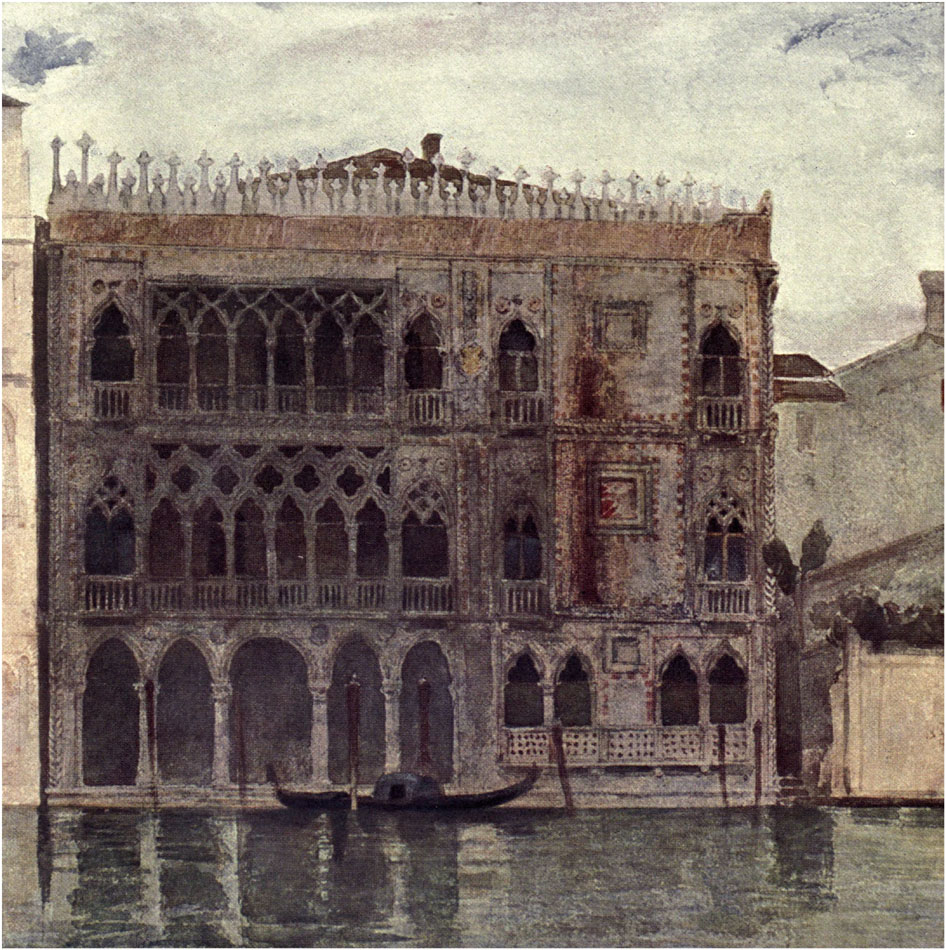
CA' D'ORO, VENICE. WATER COLOUR. 1856ToList
Florence, 11th October 1856.
Dearest Mammy,—I wonder whether you are coming to Florence, and, if so, how long you are going to stay. I suppose you will go to the Hôtel du Nord as in old times—I go there invariably, and write now from my own particular room. I wrote to you last from Venice, where I spent ten days in a very satisfactory manner between work and flânerie of an artistic description—indeed I flâned this time with more advantage than hitherto, for I went more closely than I had yet done into the architecture of Venice, studying the different masters, their different styles and relative merit; I need not say that I found this extremely interesting. Fred Cockerell, a young architect friend of mine, was there with Villers Lister, another very nice boy, a London acquaintance of mine. We were a great deal together, and they accompanied me to Padua, where I left them doing Giotto, which I would most willingly have done myself if I had not been hard pressed for time. In the painting line I only made one sketch, a Bonifazio of the first water, which will figure very satisfactorily on my studio wall; it took me a good deal of time, and is on the whole, I think, very fair. In Florence I have had one or two great disappointments which have rather diminished my enjoyment of this loveliest place. I expected confidently to find both Browning and his wife and Lyons. Neither of them are here, the former not having yet returned from the North, and the latter having been called home to see his father, who is very ailing. I have seen the Fenzis, who received me with their wonted cordiality, and am going to-day to call on the Maquays. I am here too short a time to work, beyond a pencil sketch or two, and am off for dear old Rome on Friday morning as ever is. I shall stay there till I find a studio, which I hope won't be long, and shall then rush off to Cervara in the mountains to paint.
Good-bye, Mammikins. Give my best love to all, and believe me your loving boy,
Fred.
In Rome Leighton received the following from his friend Mr. Cartwright:—
Aynhoe, September 26, 1856.
My dear Leighton,—Truly was I delighted with your letter, so that in spite of my "nature to" I gulped my huff, though I was like to choke; but self-interest is a wonderful smoothener, and as I want you to do something for me I mean to behave myself. Leighton, by the squints which you shot over my park from your outspread umbrella, by those you are hereafter to shoot, by Tokay cup and venison hash—by anything you like, I want you to belumber yourself with some ripe stone pinecones, and a hundred cork acorns. I have found a true legitimate stone pine about forty to fifty feet high on my property, and as for the cork trees you have seen the one in my garden, and therefore, I do not see why I should not have a lot in the park. They can only be raised from acorns. Now, if you could take steps to get me these things—God! I don't know what I would not do for you, and how would we enjoy it in years to come to watch the growth of our trees. It is a national object. You may have some difficulty in getting the acorns and cones; Pantaleone or Erhardt might perhaps mention to you some gardener who would procure them. You know probably the trees would get to be called L. pines and Leighton oaks, which is one way to immortality if Orpheus and Eurydices won't help you. I wrote to Mason about the pines; by all means make him answer, the exertion will do him good, he wants exercise, and therefore don't get on with his work. My God! when I came in at twelve to-day he was not up!
How I envy you at Rome when I think of it; how would I enjoy being there, and yet I can't help thinking of ——'s death at the same time. Remember me to little Cornhill and every Roman who remembers me. Write Poste Restante, Paris. I go there, I believe, next week, but where I shall be the winter ——? Forster is in the Westminster—be d——d to it for stale wine that it is. As for Mason, make him write, and believe me, yours affectionately,
W.C.C.
Rome, October 14, 1856.
Dearest Mamma,—I have delayed writing to you for a few days in the hope of finding a letter from you in answer to my last; however, as the posts here are frightfully irregular, and I think it very possible your answer may have been lost, I wait no longer. I enclose two little criticisms on my "Romeo" and "Venus," which will I think please Papa and you, and which were sent me through Mrs. Sartoris by Henry Greville.[68] There is, however, not the remotest chance of my selling them at Manchester, and I am considering where to show them next. I am trying here in Rome (where I shall stay till the end of October) to make up by rigid economy for the expense inevitably incurred by living at inns all the way here. I can't tell you what a delight it was to me to see this dear old place again. Everything is so unaltered since I left it, that I felt on returning exactly as if I was coming home from a drive instead of a lengthened absence. The frescoes which I knew so well were as new to me again from their colossal grandeur, and I wished I could spend a month or so exclusively copying in the Sixtina. My picture, though not well seen, is not particularly badly hung, but it can only be seen from a distance, so that the expressions are almost entirely lost; it does not look so well as in my studio. The Pre-Raphaelites are very striking, full of talent and industry, but unpleasant to the eye. Meanwhile they have the day. Colnaghi told me that he thought he could sell "Romeo" if I made the price four hundred, and said I could do it without derogating, as it went through his, a dealer's, hands. I consulted Henry and Mrs. S., who strongly advised me to follow his advice. I have done so. May it bring me luck. If the remarks you quote, dear Mamma, are meant to apply to my relation with Mrs. Sartoris, I can only say, that as I have derived from her more moral improvement and refinement (you know it), and from her circle more intellectual advantage than from all my other acquaintances put together twice over, I can't join with Mrs. Whatshername in apprehending "a great number of inconveniences."
In a later letter Leighton announces the sale of the "Romeo" picture:—
The "Romeo," which had the best place in the Exhibition, has been sold for £400, which to me represents £360 after deduction of percentage. They have in a most slovenly way sold my picture for pounds though marked guineas, they want to know if I claimed the difference; as they have behaved without sufficient égard about other things also, I have directed the secretary in England to say that I should like the error to be rectified, though I do not wish the sale to be cancelled on that account if it be too late. I don't want to miss the money of course, but I have no idea of such negligence on their part.
You see, dear Mamma, that my little pension to Lud has become, for this year at least, so easy that I have scarcely any merit left.
19 Queen Street, Mayfair.
Dearest Mamma,—Having arrived in London, and been to the Palace to see my picture, I hasten both to tell you the result of my inspection and to answer your very kind letter to Paris which, like an ass that I am, I have neglected to bring with me. The damage to my picture is trifling and easily remediable, having arisen in no way from the precarious nature of paint or varnish, but from a faulty canvas, and probable rough usage in moving. I shall set all right in a few days; the holes or raw places are in the sky, and luckily not near the faces. I have not yet seen Colonel Phipps, and am waiting for further instructions; the Court I shall of course not see, as it is at Windsor.
I don't remember whether I told you that I got an invitation from Manchester to exhibit next spring, and having nothing to send but "Cimabue," have respectfully applied to the Queen through Colonel Phipps to obtain it of her for that occasion.
I am truly sorry not to see you all but as you say, I can't afford it; indeed, I write now partly to ask Papa to send me some money, the £50 he gave me in the middle of August when I started are not only gone, but scarcely took me back to Paris, and but for Petre, whom I met coming back from Naples, and who lent me a trifle with most friendly alacrity, I should have been frightfully pinched; the first part of my journey being all travelling, and hotel life was very dear. In Rome, however, I lived for nothing, and sailed from Civita Vecchia to Marseilles "before the mast," a thing I will never do again if I can help it, but which enabled me just to get home to Paris within a few francs of the £50. Meanwhile I have no hesitation in saying that I never spent three months more profitably or more agreeably. I suppose Papa kindly paid my last quarter as I asked him, but not having received your letter I don't in reality know.
P. Delaroche is dead, I am sorry to say. Going through Paris I went to see Rob. Fleury, who with characteristic kindness put me up to several dodges in picture-restoring with a reference to "Cimabue"—invaluable information.
After doing what was required to the Buckingham Palace picture, Leighton returned to Paris, where he wrote the following to Steinle:—
Translation.]
21 Rue Pigale, 1st December.
Dear Friend and Master,—I read with real distress the sad news of your severe loss, but sincere and deep as is my sympathy, I pass on in silence, for in such an hour of trial there is but one comfort for you, and that not from man.
I should no doubt have come back to you from Rome in the beginning of October, but I had to go to England, where I spent three weeks, and am consequently now just established again in Paris. My Italian journey afforded me in every way the greatest pleasure and edification, and I seem now for the first to have grasped the greatness of the Campagna and the giant loftiness of Michael Angelo; still the dear old town, now as ever, is quite unchanged. The good Cornelius is so cheerful and friendly that it is a real pleasure; he has finished some works which have much beauty in the design, but, quite in confidence, they are nevertheless a trifle "solite cose," and much too weakly drawn: from a man who makes claims to style, one expects something more of solidity. Cornelius is a richly and powerfully endowed man, but he does the young generation no good; if young people would only look at work of Michael Angelo's! I except the sculptor Willig, he is a famous fellow, and also an agreeable man. I was glad to meet Gamba again, but unfortunately I did not see any work of his.
Dear Friend, in spite of all my efforts I could nowhere find the right garment for your composition, and learnt only after a long search what is properly the official dress; I learnt at last from the custodian of the Sixtina, who inquired from the head "Ceremoniere," that the cardinal in these days wears the Cappa Magna pavonazza, not the red.[69] The costume therefore is: purple undergarment, lace shirt (rochetto), cappa magna of violet cloth (those in the Charwache will wear no silk), black shoes, four-cornered hood, and gloves with the ring; I enclose a drawing of the real confessional in St. Peter's Church; I hope it may be of use to you. Dear master, how can you possibly excuse yourself for closing your letter with a word of true and wise advice! You know that I owe to you, and to no one else, the whole of my serious education, and am proud of it.
If you do not get the work at Cologne, it will be a downright infamy and a dirtiness without parallel; but I hope for the best.
How I should like to see your "Marriage at Cana."
Keep in remembrance your loving pupil,
Fred Leighton.
Translation.]
Saturday, 9th May 1857.
My dear Friend and Master,—Your letter, just received, has given me intense pleasure. Your constant and affectionate remembrance of a pupil who is under so many obligations to you, rejoices my heart. On this occasion, however, your letter was particularly welcome, because I had already begun to worry myself a little about your long silence, and was almost afraid you might imagine that I had not exerted myself sufficiently in the matter of your cardinal.
But first of all I offer my best congratulations on the completion of the Cologne affair, and on the splendid field which is offered to you also in Münster. At last you have work which is worthy of your abilities and your efforts, and will give them scope. With such employment I must not regret that I shall not have the pleasure of seeing you again in Paris. That I have not seen the "Marriage of Cana" is, I candidly confess, a source of regret to me; I know the design of the composition, and should have liked extremely to have seen how it has turned out. When shall I see one of your works again?
What shall I tell you about myself, my dear friend? I am getting on with my pictures, and have now got them all three into a fairly forward state of under-painting; completion, however, will only be reached in the course of next winter, for I intend to execute them with minute care. I have simplified my method of painting, and foresworn all tricks. I endeavour to advance from the beginning as much as possible, and equally try to mix the right tint, and slowly and carefully to put it on the right spot, and always with the model before me; what does not exactly suit has to be adapted; one can derive benefit from every head. Schwind says that he cannot work from models, they worry him! a splendid teacher for his pupils! nature worries every one at first, but one must so discipline oneself that, instead of checking and hindering, she shall illuminate and help, and solve all doubts. Has Schwind, with his splendid and varied gifts, ever been able to model a head with a brush? Those who place the brush behind the pencil, under the pretence that form is before all things, make a very great mistake. Form is certainly all important; one cannot study it enough; but the greater part of form falls within the province of the tabooed brush. The everlasting hobby of contour (which belongs to the drawing material) is first the place where the form comes in; what, however, reveals true knowledge of form, is a powerful, organic, refined finish of modelling, full of feeling and knowledge—and that is the affair of the brush (Pinsel).
You see I have again begun discoursing, my dear Master; you must excuse all this silly talk, and ascribe it to the pleasure I feel whenever I enjoy intercourse with you, even if only by letter. How much we have already talked over together!
And now adieu, dear Friend. Rest assured that you have not wasted your affection on an ungrateful man, and keep always in remembrance—Your faithful pupil,
Leighton.
Please remember me most kindly to your wife.
I do not know of any work of mine that has appeared in an illustrated paper—Louie has been dreaming.
Three interesting letters to Steinle belong to the following year. In the second Leighton states that he is about to start for Algiers. After his arrival there he writes to his mother describing the place. Notwithstanding the difficulty he found in drawing the natives of Algiers, owing to their shyness and to their prejudices, Leighton succeeded while there in making drawings which rank among his very best; in fact, in certain qualities no others he ever drew can be said to equal them. To quote Mr. Pepys Cockerell (Nineteenth Century, November 1896):—
"I do not believe that more perfect drawings, better defined or more entirely realised, than these studies of heads of Moors, camels, &c., were ever executed by the hand of man."
Unfortunately the paper Leighton used was of the kind which becomes injured by time. The brown stains which now disfigure the sheets and the faint tone of the pencilling make it impossible to reproduce these drawings with any worthy result, but some of the original sketches can be seen in the Leighton House Collection.
Translation.]
Rome, 11 Via Della Purificazione, March 3, 1857.
My very dear Master,—Heartiest thanks for your kind lines of the 3rd of last month.
I hear with the greatest interest that your cartoon is now finished, and that you expect to get to the wall next year. How I envy you this great work! I cannot deny that I rejoice a little, secretly, that you are tied down to buon fresco, for I have a passion (unfortunately an altogether unsatisfied one) for this material. You may be quite sure that if it is in any way possible for me, I shall make a little excursion to Cologne in order to offer my humble assistance; nothing could be more delightful to me.
Some works of yours have just come to Rome; illustrations to a prayer-book, engraved (I believe) by Keller. When did you make these charming drawings? The one with the blossoming staff and the little Madonna is quite specially sympathetic to me. The things are, however, engraved without feeling or delicacy.
With what you say about the advantage of growing older I quite agree, and I am in a certain respect anxious for the time when I shall find my niveau, and shall be able to work with more peace and equanimity. I have been for some time in a very painful position—I feel so humbly my incapacity even from afar off to approach the entrancing beauty of nature, that I have not the courage to embark upon any large work. For some time I have scarcely composed at all; partly, it is true, because I have no time, but partly also because I do not feel myself in a position to embody an idea properly. I know that such a condition is morbid, and hope to extricate myself from it in time. It arises also partly from the fact that my individuality is not yet sufficiently developed; I see it coming, but it takes a very long time. I know already, on the smallest computation, what I want, but I do not know how I am to accomplish it.
I went recently to see Cornelius, who is always genial and charming. He is drawing on one of the Redelli for the Campo Santo. Rich and spirited in invention and arrangement, the form in details, however, is very badly drawn—heads that are unpermissible; he treats God's nature quite cavalierly. I saw at his house a composition by a certain Wöredle (or some such name) of Vienna, a pupil of Führich, the subject taken from the Apocalypse: "There shall be wonders." Above, the Saviour, in the usual attitude, with the usual flowing garment; to the right and left, Mary and John, in their respective usual attitudes; at their feet four angels blowing trumpets, by Cornelius; in the background a number of comets; lying about in the middle and foreground, a quantity of figures, which have been collected from different works of Cornelius', strike convulsive attitudes on the floor; for the rest, the whole is constructed with appalling academic execution and lifelessness. Cornelius seemed to think it quite right; I consider it difficult, with reverence and love, to complete the head of one girl; for that reason I am not fond of going to him, for although personally he is extremely sympathetic to me, I cannot help feeling that I do not fit in with him, and am obliged to dissemble. But you must be quite weary of this chattering letter, dear Master; I will close. Remember me most kindly to your wife and children, and rely always upon the friendship of your grateful pupil,
Leighton.
Translation.]
Thursday, September 3, 1857.
Dear Friend and Master,—I was, as usual, most delighted to receive your cordial letter of 21st August; I am touched by your constant friendship, but also somewhat ashamed that you should treat your much indebted pupil almost as an equal and counsellor. I have the greatest desire to see your second cartoon, but I am very much afraid that this year it will be quite impossible, for I am going on a journey in quite the opposite direction; I am shortly going to Africa, partly to make some landscape studies, but also to make acquaintance with that very interesting race, but not in order to become a painter of Bedouins. It was my intention, as I am starting immediately, not to write till I came back, in order that I might have something to tell you; however, the following has suddenly made me change my mind; the fat, affected, tailor-like, civil-spoken little Jew visited me recently and told me you want to make inquiries about wall painting, and that I might tell you, if I was writing, that Conture has just gone away. This impelled me to write immediately. Will you forgive me, for old friendship's sake, if I put in a word here, to which you need not give the smallest attention? I want to protest vehemently, dear Master, against all oil-painting on walls; and that, not because fresco painting has sufficed for the greatest works of the greatest masters, but on account of the positive disadvantages of oils. How, in effect, do the two materials stand to one another? Fresco is certainly the one material for monuments. First, because it is the most suitable for a broad, massy, imposing form, for in no material can one pursue form so completely without losing colour; secondly, because by no other method can one attain such masterly, earnest, quiet, virile effect in colour; thirdly, however, and principally, because fresco is visible from all points alike, this advantage is immeasurable for architectural art. What, on the other hand, are the advantages of oil? Only one occurs to me and that is quite illusory, i.e. you have a wider range of colour; but all the colours that an oil palette has in advance of fresco are, for fresco, superfluous if not pernicious. Superfluous, because the broken, fine grey tones which have such an infinite charm in easel pictures, and which counteract the otherwise too great brilliance of the material, are quite superfluous in a painting where all tones are dull and solid. Pernicious, where they would be applicable, because they might mar the majestic peace of the work. And then it should be remembered that the limited scale of the fresco palette, so far as it extends, is unsurpassable for glow and atmosphere and strength. Titian's frescoes at Padua in the Tenola St. Antonio rival his oil-paintings in colour. M. Angelo's "Madonna in the Last Judgment" might (for colour) be by Tintoretto, and many figures on this glorious wall are as glowing as Titian's! As regards the disadvantages of oil-painting, I can only say that they often blister in the shadows, and that one can only see them from one point of view. I know very well that fresco is exposed to damp, but one can, indeed one must, have one's wall examined before one begins to work, and if it is well dried and "drained" there is no danger; at the worst, one can cover one's wall with sheets of lead; it has been discovered that this was often done in Pompeii. Or one can also (there are instances) paint upon a specially prepared canvas away from the wall. But you know all this better than I. Have you forgiven me, dear Friend? I could not forbear from saying this, and rely upon your indulgence.
Do not allow Schlösser to mislead you about my work. I daub on steadily, but am by a very long way not contented.
I send these lines to Frankfurt in the hope that they will be forwarded to you.
I shall stay some weeks in Algiers—can I do anything for you? in that case send me a line. Till the 1st October a letter will find me; address, Poste Restante, Algiers.
All good luck be with you on your holidays, and may you gain the desired strength.
Keep in remembrance your loving pupil,
Fred Leighton.
21 Rue Pigalle.
Algiers, Friday, 18th.
Dearest Mamma,—I arrived here only last Monday, as the little delay about the money made me lose the boat by which I intended to sail; having, however, nothing in my studio that was dry enough or otherwise fit to work on, I left Paris all the same and visited Avignon, Nîmes, and Arles, most interesting towns which I had long desired to see. Avignon reminded me so vividly of certain parts of Rome that it was all I could do not to take a place for Civita Vecchia and succumb to my longing desire to see Italy once more.
I have not the least idea (especially in this hot weather) how to describe to you this strange and picturesque town in which I have taken up my temporary quarters; everything where the African element has been preserved is so entirely new, so unlike anything that you have seen, that I see no chance of putting before your mind any living image of the thing. Before going further I may as well tell you, dearest Mammy, that although it is very hot I am perfectly well and have an enormous appetite. I walk from six to eight hours every day, and bathe regularly in the sea.
Algiers occupies one horn of a most beautiful bay, thickly studded with villas and farms, and reminding one greatly of Italy. The aspect of the town, however, shows you at once, and from a great distance, that you are in no European land. You must know that oriental houses have no roofs, but are surmounted by terraces, that they have no windows, the rooms being lit from the inner court, and that they are painted three times a year of the purest white, so that on approaching Algiers, rising as it does steeply up the hillside, it looks from the sea and under an African sun like a pyramid of alabaster or marble, or, as some poet or other has said of it, like a swan about to spread her wings. The effect of this whiteness glittering out from the green and purple hills and hanging over a dark-blue sea is really most beautiful; unfortunately, however, the whole of the lower part of the town that runs along the port has been so completely Europeanized that, but for a rather pretty mosque on the waterside, you might fancy you were at Havre or any other French seaport town. As soon, however, as you get up into the Arab town, your illusions are not only restored but enhanced, for assuredly nothing could be more perfectly picturesque and striking than the steep, tortuous streets that climb up to the Casbah, or fortress, at the top of the town. The upper storeys of the houses jut out into the street in such a manner that they constantly meet, forming an archway underneath, and yet the streets are never dark, from the dazzling whiteness of all the walls, which reflect the light in every direction and gild and brighten the darkest corners. Fancy, in the midst of all this gleaming white, the gorgeous effect produced by the varied colours of oriental costumes and complexion: the copper-coloured Arabs, the sallow Jews, the ebony negroes; and then the frequent display of every kind of fruit—crimson tomatoes and purple aubergines, emerald and golden melons, glowing oranges, luminous green grapes, and to relieve the blaze of ardent colour, the tender ivory tones of the tuberose, and the soft milk-white jessamine. I don't think a colourist could have a more precious lesson than seeing this place; you see in half-an-hour a sufficient number of fine harmonies to set you up for a year. Not less striking than the display of colour is the variety of types and costumes. Arabs of the desert, with their lofty bearing and ample drapery, the tattered, brawny Kabyles, the richly dressed Jewesses, the negresses, dressed in long indigo-coloured draperies, and with bracelets of horn round their ankles; in fact, you cannot imagine a greater medley than is presented by a street in the Arab quarter of the town. It has this drawback, that in the midst of such an embarras de richesses, I don't know how I shall ever be able to work; as yet I have not seen a pencil even, indeed I have not been off my feet since I arrived, and my head is in a perfect muddle. I spend next week in the interior of the country, and when I come back I shall have a fortnight in which I hope to do something. Getting anybody to sit here is exceedingly difficult, and costs mints. The price of living here is the same as Paris, but anything at all extra is very dear; a horse or a cab to get to some place beyond a walk is very expensive, and my consumption of drink (lemonade, coffee, &c., for pure water is not wholesome here) from six in the morning till bedtime is something incredible. Good-bye, dearest Mother, I will write a longer letter next time. I have no news from India. Best love to all, from your most affectionate boy.
If you hear from Lina, mind you let me know, as I am most anxious for news.
I am so sorry the ink is so pale. I have written over half the letter, but it is not much use; next time I will have darker ink.
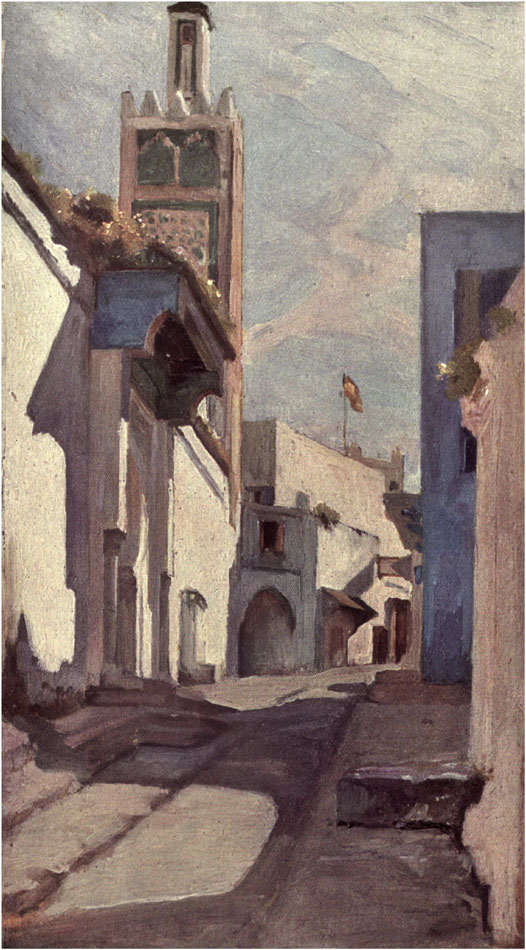
SKETCH IN OILS. ALGIERS. 1895ToList
Algiers, Monday 29, 1857.
Dearest Mamma,—Poor Lina,[70] what a state of wretched suspense and terror she must live in! what a frightful crisis it is! God grant all may end well. Have you heard lately? Pray let me know whatever you can; at this distance I can get only the most salient facts, and am most eager to hear some more circumstantial account of the progress of affairs. Poor Sutherland, I often think of his kind grey eyes and manly carriage; what a harassing, anxious life he must lead!
Before I go any further I must ensure saying a thing that I have been intending to tell for some time past, and which has always been driven out of my head by the more immediate subject of my letter. I am by no means certain that I have not already mentioned it; I wish to be quite certain. The fact is that as besides corresponding with you I write often to Mrs. Sartoris, and still oftener to Henry Greville, and have continually much the same to tell all of you, I often cannot remember to whom I have written what, and I am therefore uncertain whether I told you that Romeo and Juliet and Pan and Venus are by this time exciting (let us hope) the admiration of the citizens of America at the town of Philadelphia. It costs me nothing at all either to send or to fetch, and the percentage is ten per cent. I sent them off the end of last month, just before leaving Paris for Africa. Tom Taylor is on the committee, and I think the speculation may turn out good, particularly if Mrs. Kemble, who is in America now, takes an interest in them.
Putting aside all question of anxiety and sorrow, I am delighted with my visit to Algiers. I feel that, though I have as yet been unable to touch a pencil, I have already taken a great deal of new stuff, and if I were to leave Africa with an empty sketch-book, I should still return to my easel improved in knowledge of form and combination of colours. Still it is a great mortification to me to see such fine types around me without any means of getting them to sit, an operation to which they have an insuperable objection; if it were not vexatious, it would be quite amusing to see how they slink away when they perceive you are trying to sketch them.
Of course, one of my great desires was to see if possible a Moorish intérieur; and in this, though it is difficult to achieve, I have been very fortunate, through the instrumentality of a young native, with whom I became accidentally acquainted. I have made the acquaintance of one Achmet, son of Ali Pasha, a decayed native gentleman, now holding office in the French customs, but once very well to do in the world. I have been twice to his house, which I may as well describe to you, as it is a type of all Moorish houses in this part of the world. The whole of the centre of the building is taken up by a little cortile, open to the sky and surrounded by two storeys of arcades of a graceful shape, on to which the rooms open as in Greek houses. These arcades are painted pure white, and are relieved by fillets of coloured porcelain tiles that have a most original and charming effect; the first-floor gallery is closed in by a breast-high balustrade, elegantly carved and painted blue or green; the top of the house is invariably an open terrace, adorned with flowers and shrubs. The rooms, I said, open on the corridors and have no windows (except little peeping holes) on to the street; they are consequently always wrapped in a sort of clear, cool, reflected twilight that is inexpressibly delightful and soothing in hot, glaring weather. Each room takes up one side of the house, and is therefore a long narrow strip; immediately opposite the door is an alcove, containing a raised, handsomely cushioned and carpeted divan, and ornamented invariably with three florid gilt looking-glasses. At the foot of the raised divan is another lower one for those who like low seats; other such divans run along the wall, and a few highly wrought, embossed chests and other oriental articles of furniture complete the decoration of the room. In such a room Achmet Oulid received us, putting before us delicious hot coffee in tiny cups with filagree stands, a delightful kind of peach jam, and the pipe of peace. You would have laughed to see your son lolling on a Turkey carpet and puffing away at a long pipe. Our host has the dearest little daughter, ten years old, whom by a great stretch of courtesy we were allowed to see. By-the-bye, nearly all Arab children are lovely, and look great darlings in their Turkish dress.
My paper is coming to an end and the boat does not wait, so I close. I shall write you another letter before I leave this and tell you more of what I have done and seen.
Good-bye, dearest Mammy.
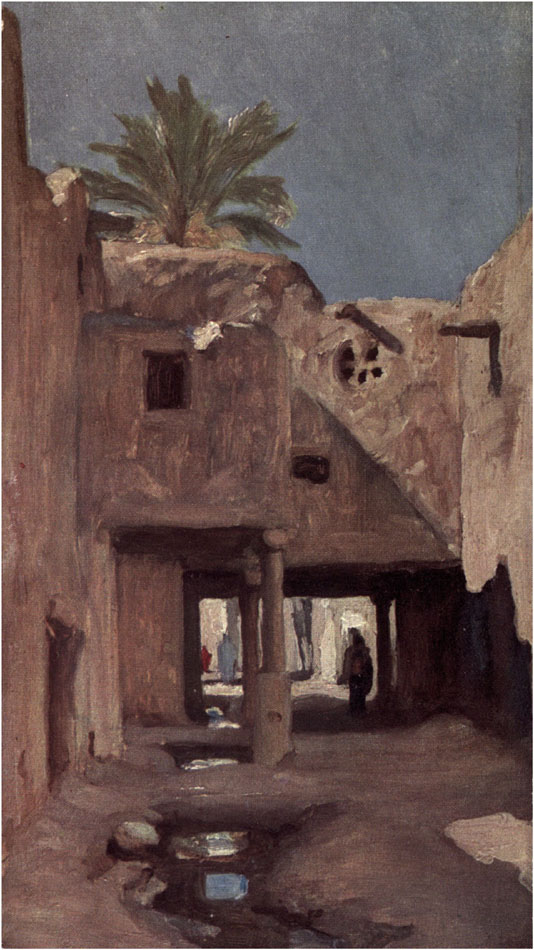
SKETCH IN OILS. ALGIERS. 1895ToList
Leighton refers to this visit in a letter to Mrs. Mark Pattison (1879), who was about to write an account of his art. "This visit made a deep impression on me; I have loved 'The East,' as it is called, ever since. By-the-bye, I drew here my (almost) only large water-colour drawing 'A Negro Festival' (the picture Leighton always referred to as 'The Niggers'), which was thought very well of by my friends."
To his sister in India he wrote:—
Since I last wrote I have spent a month or six weeks in Algeria, and have opened an acquaintance with the East which I hope to keep up, not only from the pleasure but from the instruction I have derived from even a short visit. My next journey, however, will be to the old, original cradle of Western Art—to Egypt, which country, as I shall visit it under widely different circumstances from what you did, poor dear, and I trust in much better health, will of course strike me in a very different manner. There are many things in the Arab quarter in Algiers which will probably stand comparison with Cairo, but besides that, Egypt has far more physiognomy as a country than the coast of Algeria. I am anxious to study the Egyptian type, which is truly grand and wonderful. However, these are plans for a tolerably remote day, as I shall spend my next winter in my dear, dear old Rome, to which I am attached beyond measure; indeed, Italy altogether has a hold on my heart that no other country ever can have (except, of course, my own); and although, as I just now said, I was most delighted with Africa, and have not a moment to look back to that was not agreeable, yet there is an intimate little corner in my affections into which it could never penetrate. If I am as faithful to my wife as I am to the places I love, I shall do very well. What the first impression of an Eastern country is, you already know by experience as far as the mere aspect goes, but to understand my sensations you must translate your own into a far brighter key. In my case everything was for me: a decent passage, a glorious day, a light heart, and a firm determination to enjoy myself; to this add that more rapid apprehension of what is beautiful which belongs to an artist's eye, and is the natural consequence of the constant exercise and cultivation of that faculty.
I saw in Algiers many things that interested me, very much du point de vue mœurs fêtes, with strange music on queer instruments, odd dances, odder singing. The music of the Moors is altogether very strange; it is monotonous in the extreme, fitful, and sometimes apparently without any kind of shape, and yet there is something very characteristic and almost attaching about it. This applies only to instrumental music, for as for the voice, they seem to consider it only as a shriller instrument, using always at full pitch, with neck outstretched and eyes half shut, always from the throat and always higher than they can go. It is very strange that a nation which attained once so high a pitch of civilisation, should either never have known or have entirely forgotten that the human voice is capable of inflection, and what an all-powerful vehicle it may be made of every passionate sentiment or soothing influence. However, much the same thing is noticeable in the peasants near Rome, whose songs consist (within a definite shape) of long-sustained chest notes that are peculiar in the extreme, and though often harsh seem to be wonderfully in harmony with the long unbroken lines of the Campagna.
À propos of chanting, I saw a very striking thing one day in Algiers, in the shape of a Rhapsodist, who recited, with an uncouth instrumental accompaniment, a long string of strophes describing (I am told) the life and deeds of some hero; it was exactly what a recital of the Homeric poems must have been amongst the early Greeks. The Homer stood up in the midst of a motley and most picturesque group of breathless listeners, and chanted, with a sort of animated monotony, verses of about two lines each, heightening the colour of his tale by gesticulations. After each strophe the music struck in, consisting of two queerly shaped tambours and a shrill flute. After the performance, or rather, during the pauses, money was collected in the tambourines. Homer (if he ever lived) no doubt did the same.
On his return to Paris Leighton wrote to Steinle:—
Translation.]
Paris, October 22, 1857.
My very dear Friend,—Since I know your industry better than any one else, and also know that at this moment you are quite particularly busy, I cannot be surprised that you have not answered my letter of last month; however, some warm expressions slipped from me in that letter which you may perhaps have taken amiss; lest this should be indeed the case, I hasten, my dear Master, to make you an ample apology and to beg you not to take amiss what I may have said too hastily; but if it is not so, do send me a short note that my doubt may be solved; for it is an excessively painful idea to me that a single word from my mouth should have displeased you.
I have just come back from Africa, where I have spent some weeks with extreme pleasure, and, I believe, not without great benefit; indeed, I might say that an artist cannot perfect his sense of form so well anywhere as in the East; the types of characteristic stamp which meet one's eye at every step are a wonder to see, and of the simple grandeur of the costumes one can form no previous conception—one sees real Michael Angelos running about the streets.
I have done little or almost nothing, for one cannot possibly induce the Arabs to sit; however, I believe I have learnt a great deal by my observations; I have already made a resolution to become acquainted with the Egyptian race in the near future. But now I must see to it that I produce something this winter, for time goes bye with giant strides, and will not be called back again.
And you, my dear friend? what are you working at now? How I should like to see your second cartoon! but unfortunately that is one of the impossibilities. What has happened about the church you were to paint? Has anything been settled? Once more I beg you to write me a few lines to assure me that you are not angry at my indiscretion.
Please remember me most kindly to your wife. And keep in kindly remembrance, your grateful pupil,
Leighton.
And again:—
Translation.]
Paris, 21 Rue Pigalle, November 2, 1857.
Dear Friend and Master,—All my best thanks for your kind letter, and for the enclosed photograph of your splendid cartoon; there is no need for me to tell you how greatly this has rejoiced and delighted me; by now you know that beforehand regarding every work of Steinle's (Steinleischen Arbeit), and in no work more than in this do I recognise the fulness and the brilliance of your fancy; meanwhile (as is only human) my joy is a trifle damped by the overwhelming desire to know the complete composition, and then to see the original itself. How glad I am that at last you have a worthy task!
It was a great relief to me to find that you did not take amiss what I wrote about wall painting, and that you quite understood that I could only become so wrathful regarding a matter which interests me in the highest degree. I wish with all my heart that you may discover something which will fill all requirements, while at the same time, as a bigoted frescoist, I shake my head a little at your heresy. You will certainly find me dreadfully stiff-necked, dear Friend! That is because lately I have seen fresco painting much nearer, and have compared it with oil painting directly beside it; I cannot deny that in colour I find it immeasurably more frank and stronger than its oil-neighbour, which appears muddy and dull next it. True, Cennini mentions wall painting, but only supplementarily, and after he has written at length of buon peseo. I certainly fall into his views again!
Now, adieu, my dear friend; once more all my best thanks; you may rely upon it, that the very first thing of mine that is photographed shall immediately find its way to you at Frankfurt; meantime, I candidly confess to you that I am quite terribly dissatisfied with my performances, and could only submit a hasty work to you.
Think often of your most devoted pupil,
Fred Leighton.
(Written below by Steinle) Answered, 4th June 1858.
The following letters, dated 30th November 1857, Paris, refer to Mrs. Orr's narrow escape from Aurungabad, owing to the fidelity of Sheik Boran Bukh, in the time of the Mutiny. It is a good example of the ease with which Leighton threw himself into the atmosphere of a situation. It reads like the writing of an Oriental!
Most valued Friend,—The report of your gallant and generous conduct towards my sister and the companions of her flight has reached my ears, not only by private letters but also through several of the first English newspapers. From one end of this country to another, Englishmen have read the account of your loyal bearing, and from one end of the country to the other there has been but one voice to praise and to admire it; for uprightness and fidelity are precious in the eyes of all Englishmen, and honour and courage are to them as the breath of life; but my feelings towards you are naturally doubly warm and grateful, for to your care and vigilance I owe the safety of a most precious and valued life, that of a beloved sister. It is to express to you this gratitude that I now write, and also to beg you to accept as a small token of my regard a shawl which I send together with this letter, and which will be as a sign to cement our new friendship. Wear it in remembrance of that perilous night at Aurungabad, and in wearing it remember that on that night your fidelity won for you many new friends, and amongst the truest and most sincere count the brother of Mrs. Orr,
Fred Leighton.
To Frederick Leighton, Esq., &c. &c.
Aurungabad, 13th July 1858.
Most respected Sir,—I beg to return you my humble and hearty thanks for your kindness in having sent me a revolving pistol, which was highly admired by all who saw it. I cannot be sufficiently thankful to your invaluable kindness. I shall not part with it till death, but keep it as a remembrance of your high estimation of me your unworthy servant, and ever pray for your and family's welfare and happiness.
I feel very uneasy in not hearing from Captain Orr since he left us; I beg you will kindly let me know how he is getting on, as I hear that he is not altogether very well. I was very anxious to accompany him, and he agreed to take me, but on second consideration he changed his mind. I hope some day or other to be able to see you and family by God's grace.
I conclude, sir, with my humble respects and good wishes to self and family. Hoping all's well.—I am, Sir, your most obedient and grateful servant,
Sheik Boran Bukh, Silladar.
Thursday.
Dear Papa,—In accordance with your request, yesterday received, I enclose an envelope for B.B., on which perhaps you will be so good as to add his rank, whatever that may be—I believe Subahdar. I am glad the letter is right, and knowing your great epistolary facilities, I don't feel as sorry as I ought to have interfered with your design. I don't think it will fall heavily on you.
I have a great favour to ask of you; and I feel sure you won't grudge it me, as it concerns a man whose house is a second home to me: Cartwright—indefatigable as he is, he keeps constantly on the alert for any vacancy in Parliament, and is in frequent communication with Hayter on the subject. Now the representation of Scarborough has just become vacant, and I should take it as the greatest kindness if you would write to that great friend of yours in that town (a banker—whose name I, if I were to sit on my head, I could not remember; but you know), mentioning Cartwright as a great friend and most appropriate man. He (your friend) is sure to be very influential amongst the townsfolk. I should wish you to say this: state who Cartwright is, his family, place (Aynhoe Park, Brackley), his relations with Hayter the Whipper-in (that he may not appear tombé des nues), and the following creed: Pledge himself to Reform Bill with extension of franchise; considers the Educational question amongst the most important of the day; wants a thorough inquiry into India and Indian affairs (government), and is prepared to support Lord Palmerston's administration. All this is very important to mention, because all his relations are hot Tories. Also, in case your friend should accept the suggestion and want to communicate at once Cartwright, give his (C.'s) direction in Paris, No. 5 Rue Roquépine. Will you do this for me?
Please give dear Mamma a wigging for expressing no pleasure at the prospect I hinted at of running over to Bath for a day or two in the winter; tell her if she does not behave better I won't come. I would write at greater length, but my model is waiting, and I have no time.—With anticipated thanks, your affectionate son,
Fred.
It was in the year 1857 that Leighton painted the beautiful figure of "Salome, the Daughter of Herodias," which apparently was never exhibited in any exhibition of his works till that of 1897. A sketch (see List of Illustrations) made for the picture is in the Leighton House Collection, also other drawings of dancing figures sketched in Algiers.
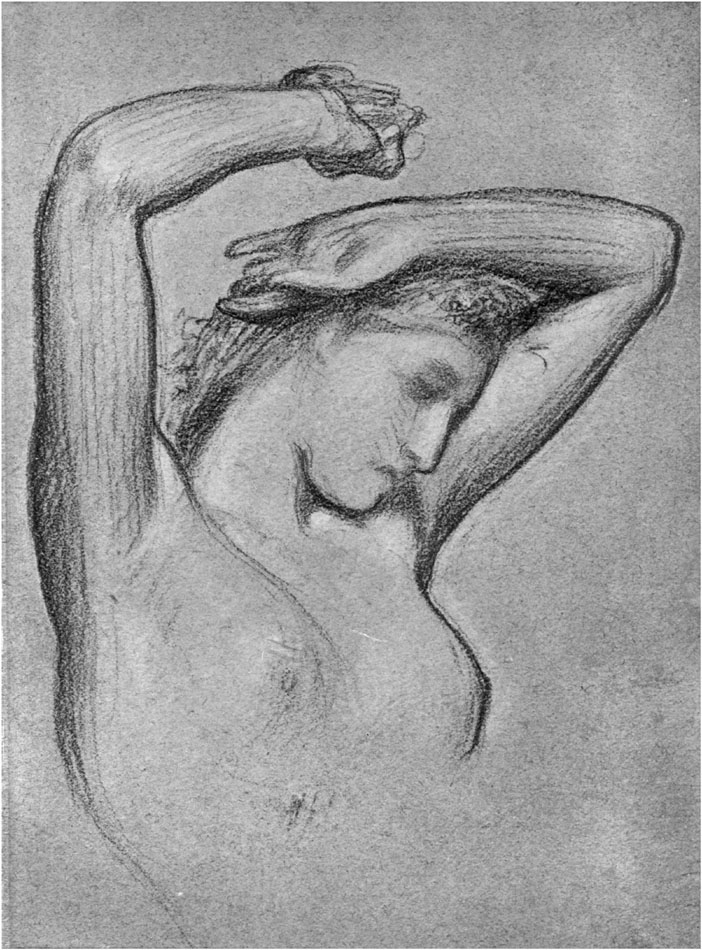
STUDY FOR "SALOME, THE DAUGHTER OF HERODIAS." 1857 Leighton House CollectionToList
To his mother he wrote in the beginning of 1858:—
Monday, Jan. 1858.
Dearest Mamma,—Many thanks for your nice long letter, which I had been anxiously expecting not only for news of yourself but to hear what tidings had reached you from India. I am so glad dear Lina continues tolerably well considering her position. I can fully understand how dreadfully anxious poor Sutherland must have been the whole time about her. I mean to write to her myself without delay. Will you please let me have her present direction, as I don't know it? How kind Sutherland is to have remembered at such a moment about my tigerskin! What an excellent and thoughtful creature he must be! The extract from Brig. Stuart's despatch is most gratifying and satisfactory, but I want to see it in print; where is it published? can't you somehow get it and let me have it? I have the greatest desire to possess it in that shape. What a nice letter Booran Buckh's is. I am afraid that about the regiment returning to Aurungabad is a hope not very likely to be realised. There is still a frightful deal to do in Oude. Sir Colin wants men sadly, and cavalry is particularly precious.
Mario's étrenne cost me a pound, it was the least I could do. Let me reassure you, dear Mamma, about my behaviour to that amiable creature. I have been at his house often since, and am sure he is not in the least hurt; as for his thinking I was proud about his being an actor, that is so out of the question that I could not help laughing when I read the passage in your letter. In the first place, he would never dream of suspecting me of such a piece of vulgarity, and in the next, actor or no, he still is Count Candia, and therefore more than my equal in rank.
I hope I may be with you somewhere about the 6th or 7th February, and should stay till the 10th or 11th. It would be humbug to say that I should not rather find you alone than in a whirlpool of funereal gaieties; but, however, I am at your disposal; do with me as you wish. I have been suffering very much of late from tooth and face ache. I am rather better now, thanks to, or in spite of, homœopathy.
Lady Cowley I have never found in yet. The Embassy parties have not begun yet. I go out almost every evening, but only in a circle of four or five houses. I can't stay at home, my eyes are too weak to do anything, I am sorry to say; I have not opened a book this winter. The Hollands are going to Naples, to my great regret; they were very kind; poor Lady Holland has only just recovered from a very serious illness.
You tell me to bring over my Algerine sketches, but I have very little to show, a few scratches only of types; my two principal studies are in oils; I can't well take those over. I am working away at my pictures as well as the pitch-dark weather allows (which is very badly); however, I hope they may turn out well. The silent Sartoris said to-day he thought my Juliet picture "safe to succeed."
Good-bye, dear Mamma; best love to all from your most affect. boy,
Fred.
END OF VOL. I
Printed by Ballantyne, Hanson & Co. Edinburgh & London
FOOTNOTES:
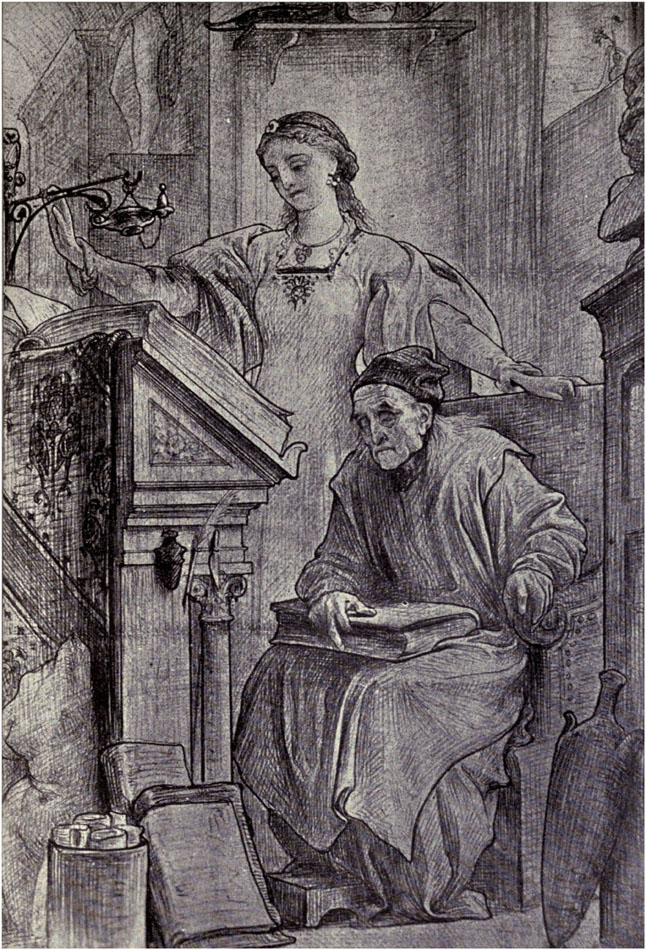
"BLIND SCHOLAR AND DAUGHTER" No. 1. "Romola"ToList
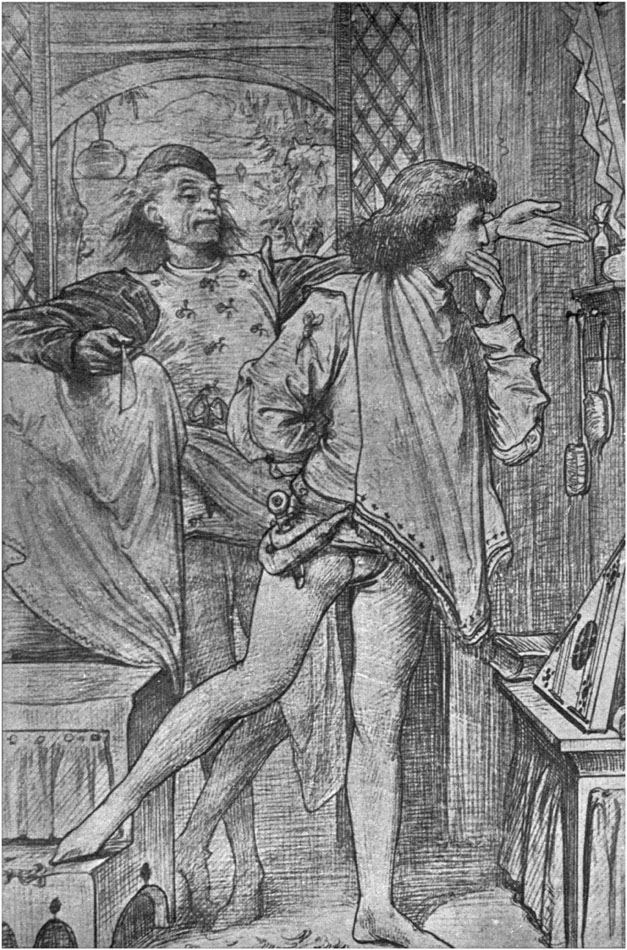
NELLO'S SHOP: "SUPPOSE YOU LET ME LOOK AT MYSELF" No. 2. "Romola"ToList
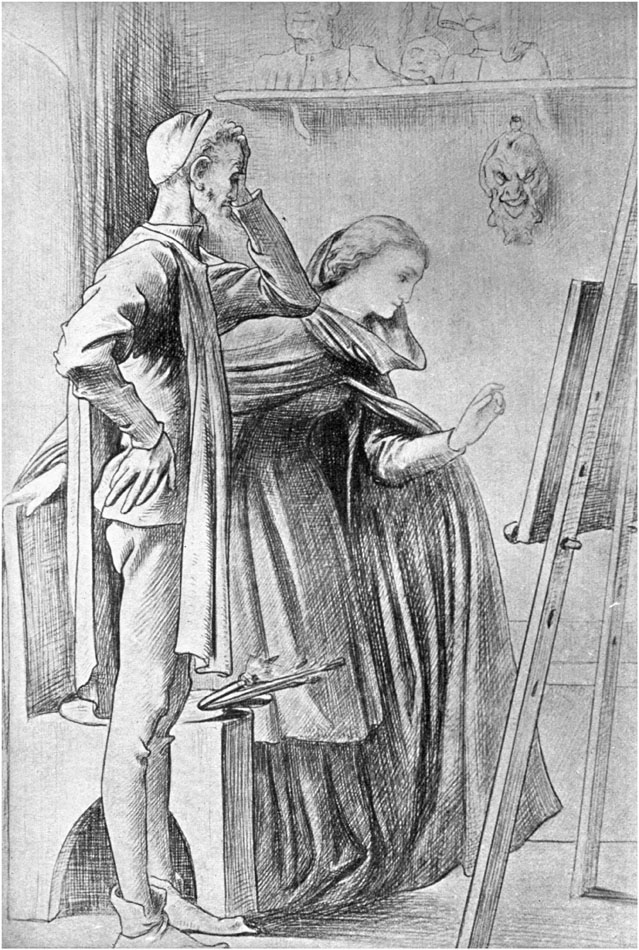
"THE FIRST KEY" No. 5. "Romola"ToList
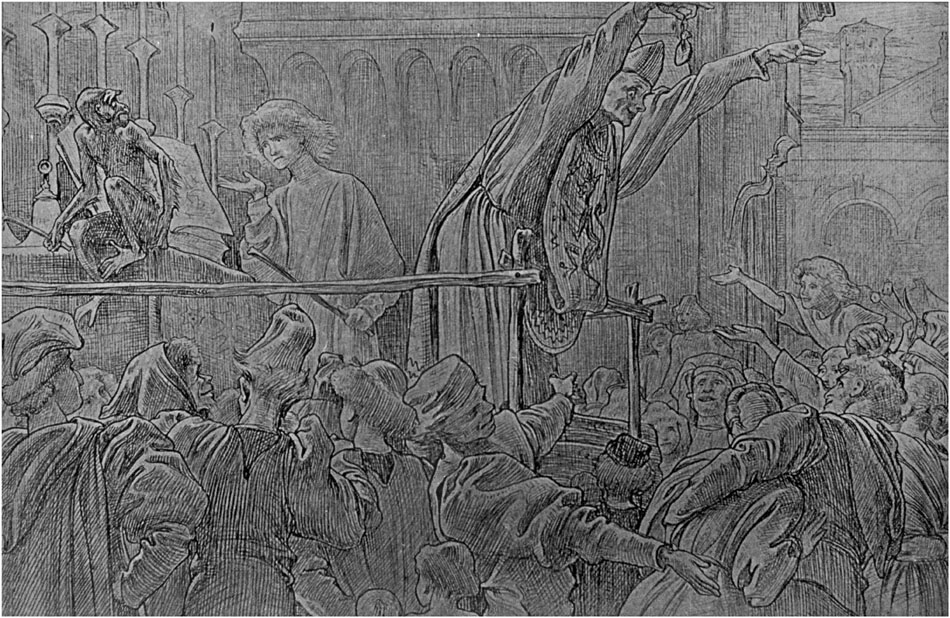
"THE PEASANTS' FAIR" No. 6. "Romola"ToList
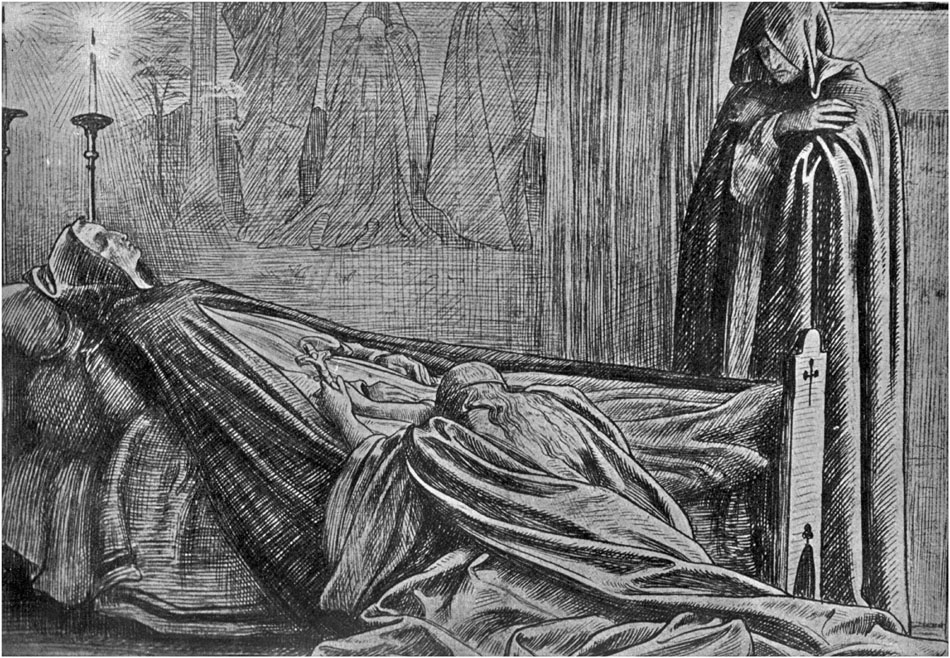
"THE DYING MESSAGE" No. 7. "Romola"ToList
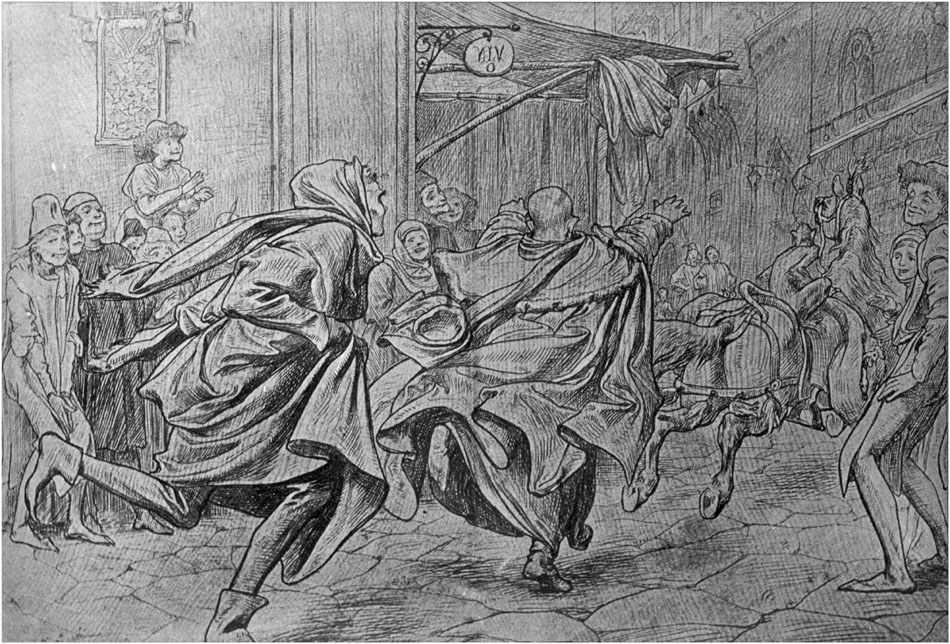
"FLORENTINE JOKE" No. 8. "Romola"ToList
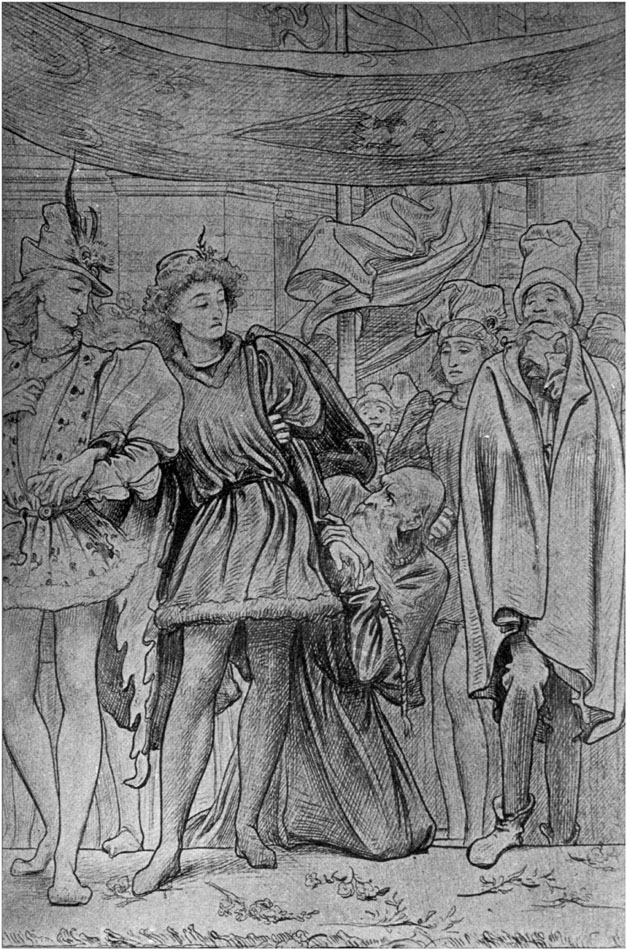
"THE ESCAPED PRISONER" No. 9. "Romola"ToList
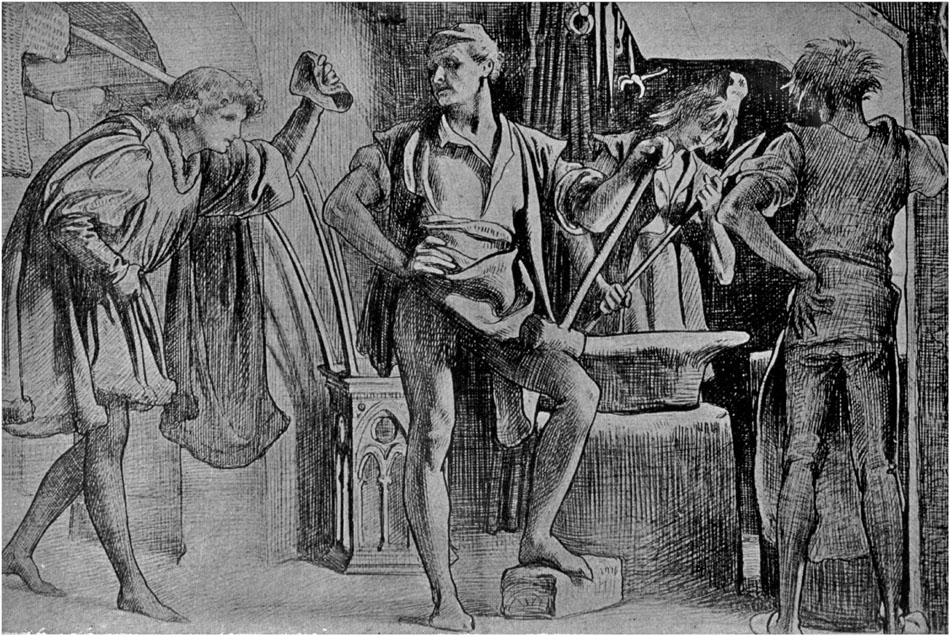
"NICCOLO AT WORK" No. 10. "Romola"ToList
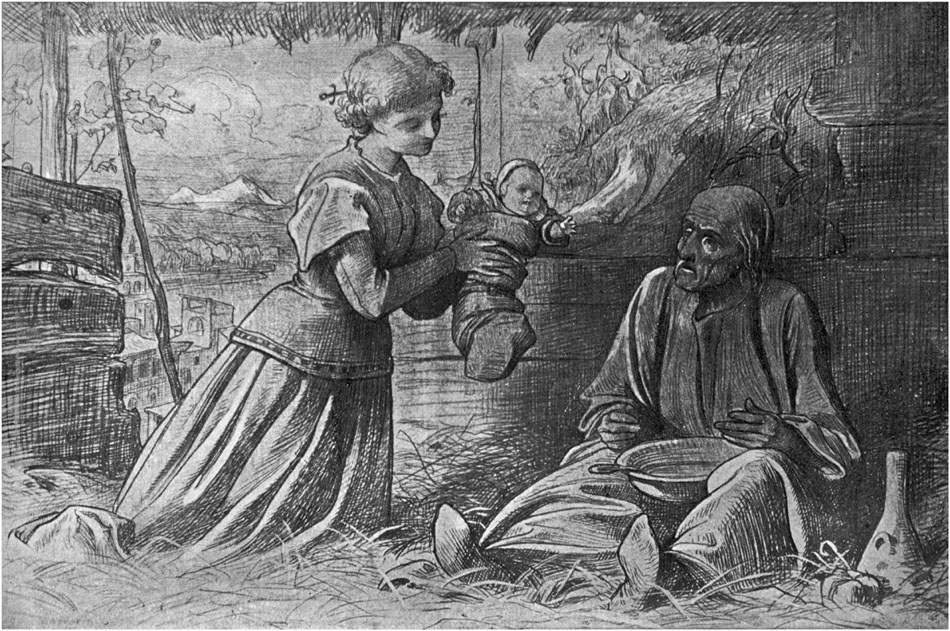
"YOU DIDN'T THINK" No. 11. "Romola"ToList
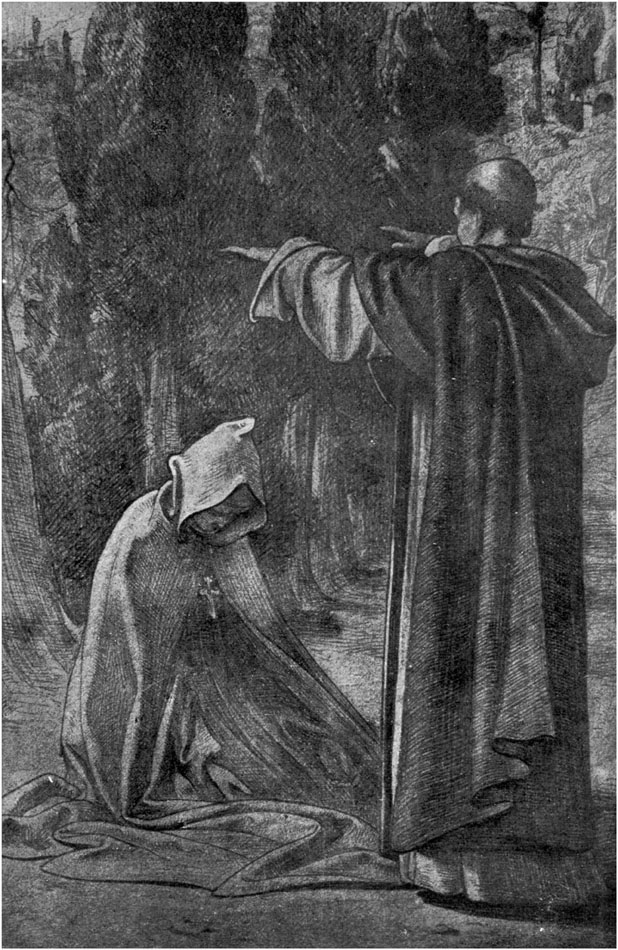
"FATHER, I WILL BE GUIDED" No. 13. "Romola"ToList
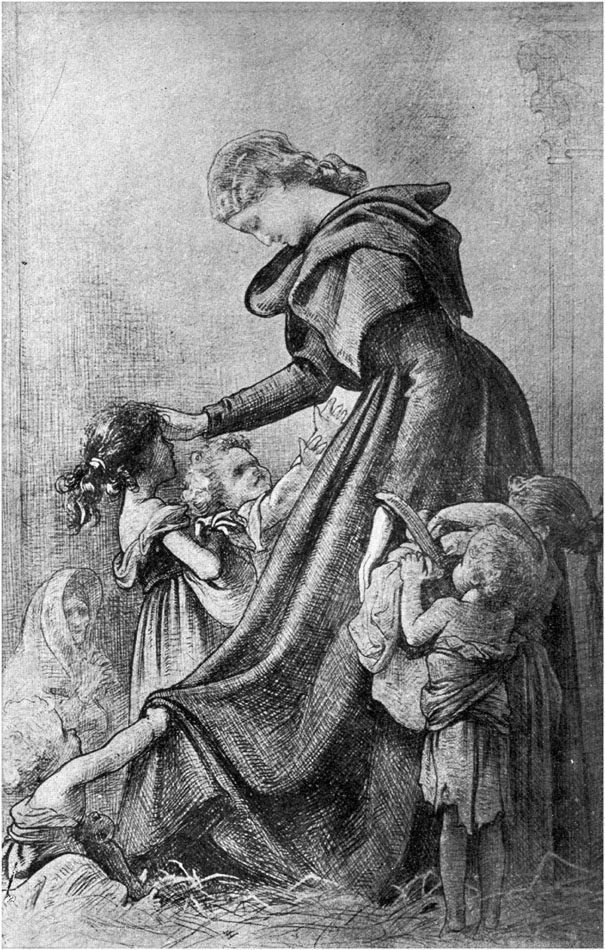
"THE VISIBLE MADONNA" No. 15. "Romola"ToList
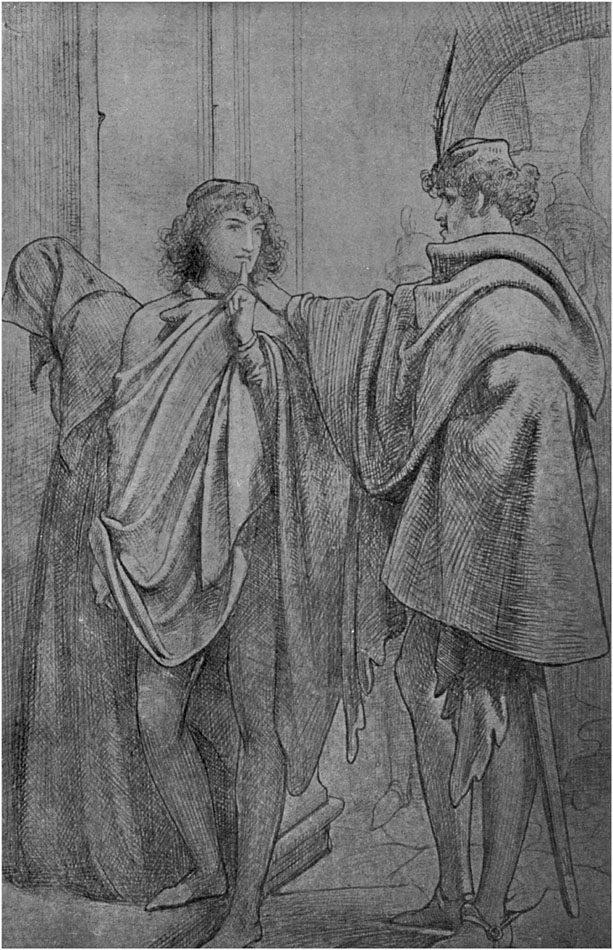
"DANGEROUS COLLEAGUES" No. 16. "Romola"ToList
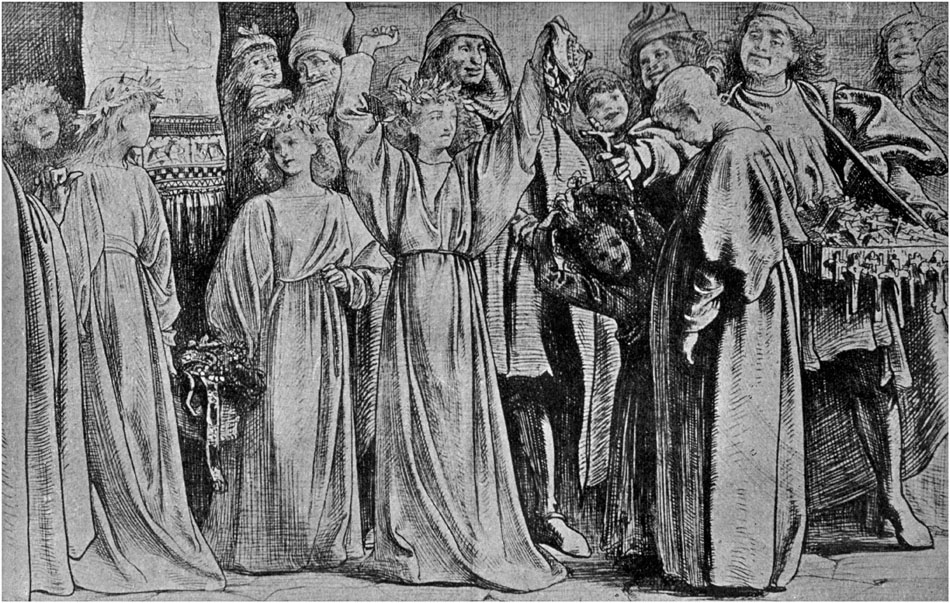
"MONNA BRIGIDA" No. 17. "Romola"ToList
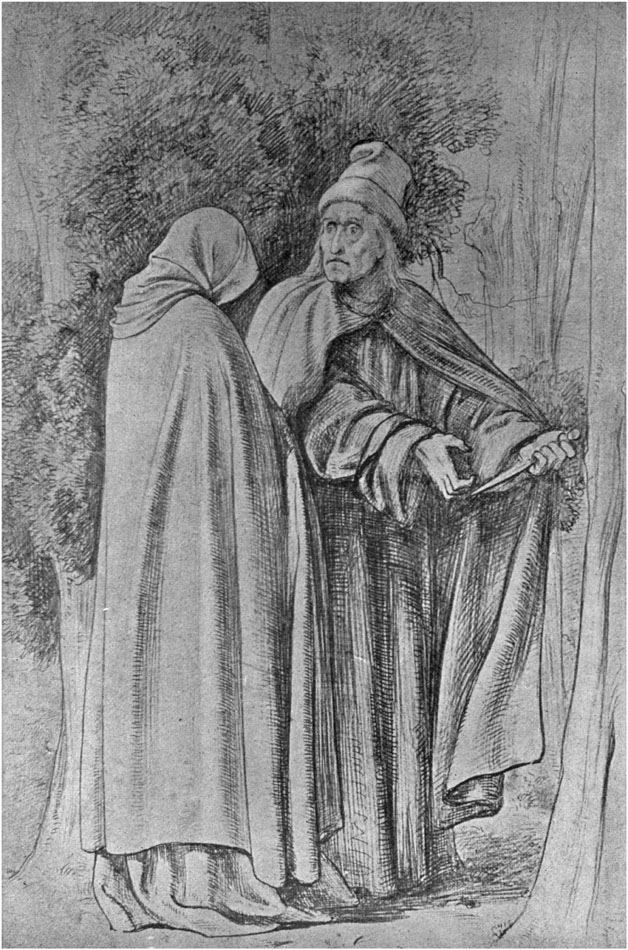
"BUT YOU WILL HELP" No. 18. "Romola"ToList
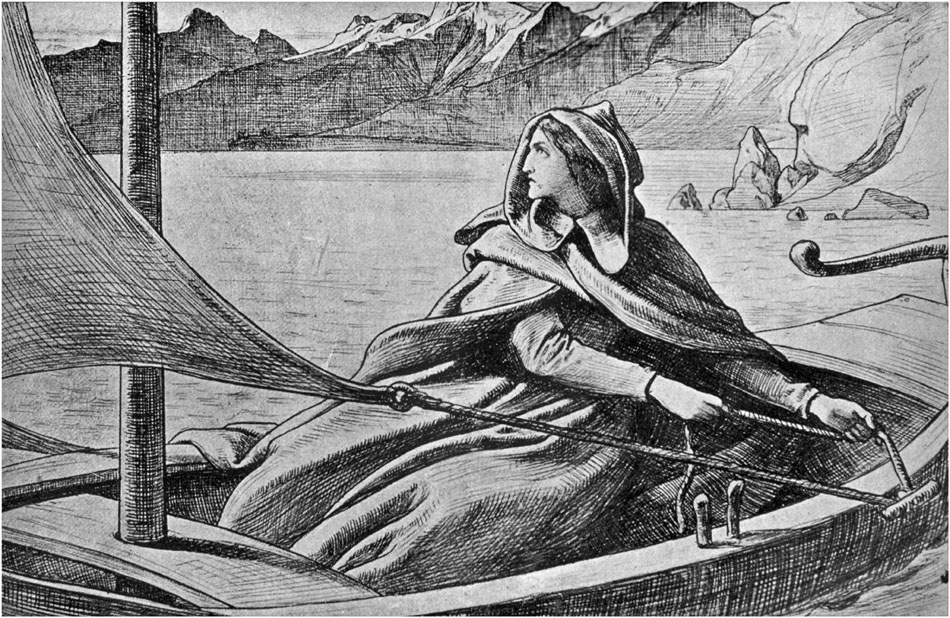
"DRIFTING" No. 20. "Romola"ToList
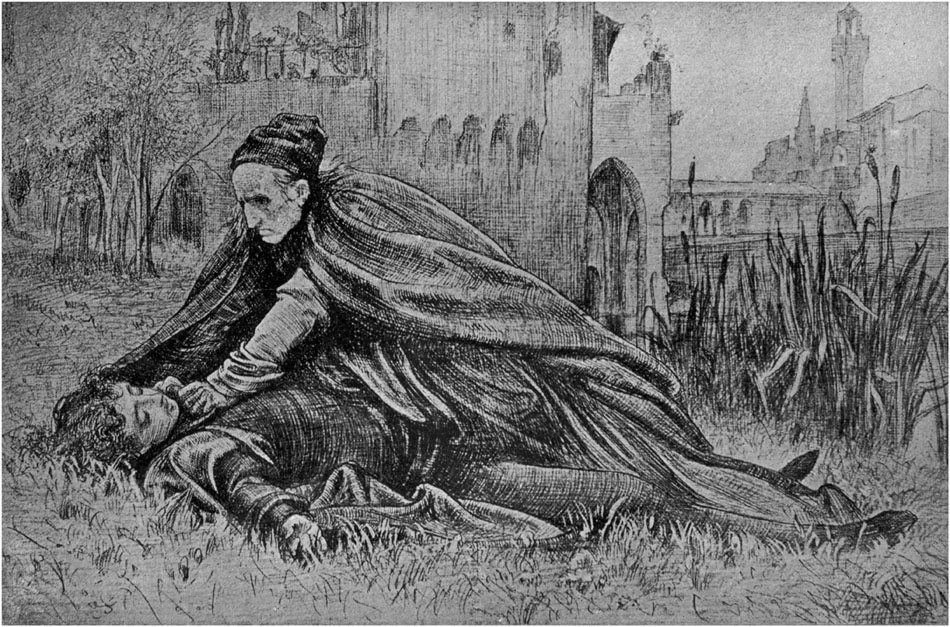
"WILL HIS EYES OPEN?" No. 21. "Romola"ToList
Typographical errors corrected in text:
Page xviii: Spagniola replaced with Spagnola
Page 63: Middelburg replaced with Middelburgh
Page 69: antlered replaced with anthered
Page 136: Spagniola replaced with Spagnola
Page 160: Kuppelwiesser replaced with Kuppelwieser
Page 153: volorous replaced with valorous
Page 190: Sclosser replaced with Schlosser
Page 198: antlered replaced with anthered
Page 210: "magnificent intellectual capacity, and unerring and instantaneous spring upon the point to unravel." replaced with "magnificent intellectual capacity, and an unerring and instantaneous spring upon the point to unravel." (see "Reminiscences of G.F. Watts" by Mrs. Russell Barringtong, page 193.)
Page 226: Spagnolli replaced with Spagnola
Page 261: "bran new" replaced with "brand new"
Page 272: "He offers you £25 for if" replaced with "He offers you £25 for it"
Page 273: "your sincerely" replaced with "yours sincerely"
Page 291: Pigale replaced with Pigalle
Footnote 10: Sain-Damien replaced with Saint-Damien; l'envalussait replaced with l'envahissait; and, remplet replaced with remplit
Footnote 36: Caranco replaced with Carcano (see Adelaide Sartoris' book "A Week in a French Country-House" page xxx.)
Note that the names I'Anson and Ffrench are legitimate surnames.
Frankfort a/M. is the abbreviation for Frankfurt am Main, (in English 'Frankfort on the Main') a city on the Main River, Germany.