Volume 1 — CHAPTER IIToC
Reading edition
CHAPTER IIToC
ROME 1852-1855
The first group of letters from Leighton to his family from Rome tells of his instalment, his projects, his disappointments, his indifferent health, and his eye-troubles. But more important are the views he expresses on his "artistic impressions," and the ideas which force themselves on his mind, resulting from these impressions; the increased anxiety with which he regards the task he has set before him; the "paralysing diffidence" which he feels with regard to "composing." In the letter he wrote on January 5, 1853, he enters more intimately into his own feelings in addressing his father than in any previous letter I have seen. This letter is in answer to one from his father, which Leighton describes in writing to his mother[20] as "the longest I ever got from him, at all events it was the first in which he said anything beyond what was necessary to business; it gave me sincere pleasure. I was touched; it seemed to me that distance had brought me nearer to him." Leighton was evidently eager to respond to any advance from his father towards possible intimacy on the ground of his art-interests. In "Pebbles" he writes that he opens the "introductory chapter of the second volume" of his life, "a volume on the title-page of which is written 'artist'"; in these first letters from Rome he begins the second volume itself. The letter to his younger sister, on her "coming out," contains at its close memorable advice on the subject of the development of her musical taste.[21] "You must descend into yourself, and draw at the fountain of your own natural taste, but mind you go very deep, that you may really get at your genuine, natural taste, and I think you won't go far wrong. He who knows how to hear the voice of nature has found the safest guide, and he only is a good master who opens the mind of his pupil to that voice." At the age of twenty-one, Leighton had realised, and was himself pursuing, the only right course in studying any art. By invariably drawing deeply from the fountain in his own nature, he ever remained true and sincere as an artist. It is evident that, if there is no fountain to draw from in a nature, any study of art becomes useless, and Leighton, when consulted in later years, never encouraged false hopes in those who possessed no natural endowments. When he wrote,[22] "being very receptive and prone to admire, I have learnt, and still do, from innumerable artists, big and small; Steinle's is, however, the indelible seal," he referred to the fact that in Steinle he had fortunately found the master who opened his mind to the voice of his own nature. Leighton felt a great necessity to sift the various influences which played upon his receptive nature, on account of his ready sympathy with all that was admirable. He had constantly to seek for that inner light, that "genuine, natural taste," which his revered master had led him to search for and find, and to act from the dictates of that light, and from no other.
The commencement of the first letter from Rome to his mother is missing; the date of the post-mark is November 25, 1852, Rome.
"...unnoticed, and which now requires to be woven in with the rest. I mean, of course, my more directly and practically artistic impressions, and their results. I take them up 'ab ovo.' To an artist an occasional change of scene is of the greatest advantage, if not importance; for, generally speaking, when he has stayed long in one place, surrounded day after day by the same objects, his eye becomes, by the deadening effect of constant habit, indifferent to what he sees around him, and often even inaccessible to the impressions which a newcomer might receive from the same natural beauties; most things that please the eye or the imagination, do so (in my case, at least) by some peculiar association; indeed I should imagine it must be so with all things, for even when one cannot (as one often can) define precisely the association which creates the echo within of the impressions received, it seems to me that one is instinctively aware of a kind of indefinable innate relationship to the beauties manifested in nature, to which, by-the-bye, I think, all other associations might ultimately be traced through different degrees of consanguinity. It is in being unexpectedly reminded (however indirectly or unwittingly) of this affinity, that lies all the pleasure that we experience by the means of sight; indeed, it strikes me, although I am too ignorant to explain why, that the 'feu sacré' of the artist is a kind of inward, spontaneous, ever active, instinctive impulse, blind and involuntary, to manifest and put forth this his pedigree—as it were a yearning of son to father, an attraction of a part to the whole, which is, as it were, the living motive and condition of his existence, and which sometimes infuses in his works 'un non so chè' that is felt by others, but for which he would be at a loss to account, and of which he is perhaps barely aware; it is a manifestation of a truth which is felt to be fit, and called beautiful. These reflections, which have often involuntarily forced themselves on me, suddenly remind me of an expression I once heard Papa quote from some German philosopher, I think Hegel: 'Der Mensch ist das Werkzeug der Natur.' Good gracious, where am I running to? and how far out of my depth! and yet one feels the want to empty one's head a little now and then; latterly, especially, these ideas have been stirred up in me by the perusal of fragments on the theory, philosophy, of Art, &c., by Eastlake, which gave rise in me to some painful feelings. At the first onset I was amazed and bewildered at the quantity and great versatility of Eastlake's acquirements, a man who has yet found time to cultivate his art with success. I was filled with regret and mortification when I looked at myself and considered how little I know, and how little, comparatively, my health and eyes will allow me to add to my meagre store. As I got further into the subject, my feelings altered; it seemed to me to grow more and more vast and comprehensive, but not more intricate, for it appeared by degrees to embrace and involve in itself (and be involved in) all human knowledge, so that I felt that there must be only one key to all mystery, the non-possession of which key is the characteristic, the condition des Menschseins. Then it struck me as utterly absurd for anybody to pretend to know anything about anything; but it also struck me that it is not given to man to be a neutral spectator, that he must advance or recede; and that beautiful saying of Lessing's, which Papa read to us, occurred to my mind: 'Wenn der Allmächtige' (I quote from memory, and therefore probably not quite correctly) 'vor mich hin träte in der Rechten die vollkommene Erkenntnis, in der Linken ein ewiges Streben nach Wahrheit, ich würfe mich flehend in seine Linke und sagte: Vater, gieb! die reine Wahrheit ist doch nur Dir allein!'[23] I hardly meant to say all this, especially as it must seem horridly weak to a philosopher of Papa's calibre, but I really could not help it; I wish such thoughts would never come into my head, for I am painfully aware that I have not the grasp of mind to investigate any abstract subject deeply, and I wish that I had a mind, simple and unconscious, even as a child. I hurry back to the point with my tail between my legs; I was saying, was not I? that habit deadens us (read me) to the suggestive qualities of nature, and that change of scene is sometimes required to make us again aware of nature; after such change she speaks a more eloquent language than ever; I have heard her voice, ever since I left Frankfurt, ring more powerfully than ever before, and it has been the key to all that I have done, and to all that I have omitted. But there are some cases in which this numbing effect of habit has more lasting, almost irrevocable consequences; when one has been for a long space of time utterly familiarised with an object (a work of art in particular) of which one did not, when the acquaintance or liaison was contracted, appreciate all the beauties, though in process of time the understanding may become fully aware of these qualities, the heart of the mind—if I may use such an expression—can never feel that ingenuous fulness of admiration which would penetrate a sensitive and cultivated spectator on seeing it for the first time. This I have felt more particularly in the case of the 'Transfiguration' here in the Vatican; I am so utterly familiar with it from a child, when I could in no way understand it, that I find it impossible to judge of it objectively; I see colossal merit in it, and yet, when I have looked at it for a few minutes, I turn away and walk on; I am deadened to it. Thank God, it is not so with his (Raphael's) divine frescoes, which are so maimed and profaned in the engravings that the originals were new to me. But I am at the end of my paper, and as you do not wish me to cross, I must this time close by just telling you what my disappointments have been, that you may not form a false idea of them. First, I expected to find an atmosphere of high art, and every possible 'günstige Anregung' for its cultivation; in this I have been completely disappointed; of the numberless artists here, scarcely any can call themselves historical painters, and Gamba and I, who hoped for emulation, are thrown completely on ourselves; Overbeck is the only remains of that much to be regretted period when he and Cornelius and Veit and Steinle and others were labouring together in friendly strife; he will, however, never be to us what Steinle was. The next greatest sore point was the difficulty of getting a studio. When we arrived in Rome the first thing we heard was that all the ateliers were taken; and it was only after some days despondent search that I got a little bit of one most skimpingly furnished, that I should have sneered at when I first arrived. I have no sécrétaire; I am obliged to lock up my papers with my shirts; I have been obliged to buy a lamp, for the one they gave me tried my eyes; and if I want any article of furniture I must buy it, because I understand that at the end of the year hiring costs as much here as buying. My atelier for next winter I shall take in the spring, as a good many become vacant at that time. Rome is twice, nearly three times, dearer than Florence in some respects; I am in despair; Gamba, who has just half what I have, absolutely starves himself in his food, and can hardly keep himself cleanly dressed; yet he has fewer expenses than I, who have calls to make now and then, and must dress accordingly. Oakes, too, who had sent me a charming letter to Florence, saying that he delighted in the idea of coming to spend the winter with me in Rome, was suddenly prevented; this was a bitter disappointment; I had expected a great deal of improvement from his conversation. I am in the bleak position of one who stands in immediate contact with no cultivated and superior mind. The Laings have not come yet; I hope to goodness they won't disappoint me also.—I remain, dearest Mamma, your dutiful and affectionate son,
"Fred Leighton."
(La suite à un prochain numéro.)
"1852.
"Dearest Gussy,—As a gallant brother, I can't well do less than answer separately your postscript to Mamma's letter. I shall make a point, if I meet with it, of reading Andersen's 'Dichterleben'; your recommendation is sufficient to predispose me favourably. I perfectly understand what you say about St. Paul's, and quite agree with you on that subject. What suits a salmon-coloured ribbon? By George, that's a weighty question, and requires mature reflection; it would look best on a white dress with blue flowers or spots; a sea-green would not look bad, and on black silk it would be distingué; a bluish violet would not be bad either. I am sincerely sorry that I am not able to 'assister' at your triumphal entry into your eighteenth year; I am afraid the spell is beginning to fall by degrees from the greatest of days. If my directions have been attended to, I was present by proxy on the memorable occasion. Do you fully appreciate the immense importance of the epoch? Do you sufficiently feel that you are on the brink of being OUT? You are very much mistaken in supposing that I hear much good music here; there is little or none to hear; the theatres, at least, are all bad. I sincerely hope that you cultivate assiduously the talent with which you are blessed; especially the vocal part I am very anxious about; of course you will take lessons in Bath. I sympathise very much with you on the want of Rosenhain's guiding influence; I fully appreciate your difficulty; you must descend into yourself, and draw at the fountain of your own natural taste, but mind you go very deep, that you may really get at your genuine, natural taste, and I think you won't go far wrong. He who knows how to hear the voice of nature has found the safest guide, and he only is a good master who opens the mind of his pupil to that voice.—Believe me, with many kisses, your very affectionate brother,
"Fred.
"If Gussy did want to be a charitable Christian, she would copy in her pretty handwriting five lines a day of my horrid scrawl, for I am ashamed that my Pebbles should remain in such a state."
"Bath, Sunday, November 29, 1852.
"My beloved Child,—I need not tell you how close an account I keep of the day of the month, nor how my heart beats as the foreign post hour approaches, because you know how tenderly I love you, and what it cost me to part from you, and consequently how anxiously I look for the consolation for your absence which your letters afford me, and I had hoped you would supply this balm liberally. Of course while you were actually travelling I made every allowance for weariness, &c. &c., but if you have carried out your intentions, you must have been in Rome quite ten days, and though I said in my last I hoped for the future you would leave only three weeks between each of your letters home, it is now more than a calendar month since I had last the great happiness of seeing your handwriting. I would not, my love, be unreasonable, but you must remember that, in addition to the natural desire to hear how you manage for yourself, my maternal anxieties have been awakened by the indisposition you spoke of as not serious, it is true, but which has started up before me, explaining your delay in writing, and which, in spite of reason's suggestion that a slight illness would not hinder your work, whilst Gamba would prevent the addition of suspense to the trouble a serious attack would cause us, has brought the evil of separation very bitterly before me. The goodness of your heart, my child, will teach you how you can soften this to me; it is one of the few occasions remaining to you to exercise self-denial, as you live alone and have no one to please but yourself. I now and then wonder a little anxiously whether you ever think of my exhortations, so much have I wished that you should be in the retirement of your house as gentlemanly as you are in company. But then I recollect sentences in your letter, proving such right views in important matters, such a clear understanding of your responsibilities, that I resolve to believe that you will strive to do right in small matters as well as in great ones; indeed, my child, I have remarked with deep satisfaction your appreciation of the blessings that are allotted to you, and indeed you do right to enjoy them with all humility, for I cannot flatter you in opposition to the dictates of my conscience that you are so well deserving of happiness as your poor sister. She is deserving of the highest respect of all, bearing all her trials with admirable patience. The persevering rain, which has caused a great deal of illness in Bath, has had a very bad effect on her, throwing her back just as she was beginning to mend, so that she has a great deal of rough ground to go over again. We revel in literary abundance, even German and French books are in the circulating libraries, and I often wish the days longer to read and to work. Gussy says she hopes you will not think her ill-natured if she declines copying your letters, for, indeed, were she willing to undertake this difficult task, I should forbid it, as her eyes, always delicate, are unusually weak; whether this comes from too long confinement to the house, or from crying, I cannot say; the latter is produced by Heimweh! what do you think of this for an English girl? Thank God, she employs the best remedy against regretful feelings, as she is occupied from morning till night. Are you equally industrious? I read the other day the following assertion by Southey, which I copy for you, in case you should still have the habit, so common amongst young people, of wasting during the day occasional quarter-hours or ten minutes, because, they ask, only such a few minutes, how often have I heard that excuse. This is the portion: 'Ten minutes' daily study, for seven years, will give the student sufficient knowledge of seven languages to read them with ease, and even to travel without an interpreter in the respective countries.' Is not this an encouragement to industry? We imagine you by this time settled in your lodging and beginning to feel at home. God grant that you may have your health there and meet with kind friends; we are curious to know what your letters will do for you. In the meantime you will, I doubt not, have met some old acquaintances—the Henry Walpoles, the Laings, Mr. Petre, the Isembourgs, and Princess Hohenlohe; to what amount the latter will condescend, I know not, but remember, I entreat you, my advice. The two former families you will most likely have first met at church; let me hope at least that you will not abandon the habit; it may at last bring a blessing upon you. The intentions of your Frankfurt acquaintances we learnt in a letter from Mme. Beving; she had heard from M. Fenzi that he had given you a general invitation to his villa, and that you had dined with him, or been asked to do so; I do not know whether he made any comment on you. Did your organ of veneration do its duty? Forgive my hints, dear son; all your good qualities are pictured in lively colours before my eye, but I do not even try to forget your faults, lest I should neglect my duty to you; with the best resolutions we all occasionally require a fillip to our conscience. Next Friday is your birthday. It will be the first on which you have not received your parents' blessing in person. We shall not forget you, my darling. God bless you, my own dear Freddy; in this prayer your father joins most fervently; think often of the advice and love of your devoted mother,
"A. Leighton."
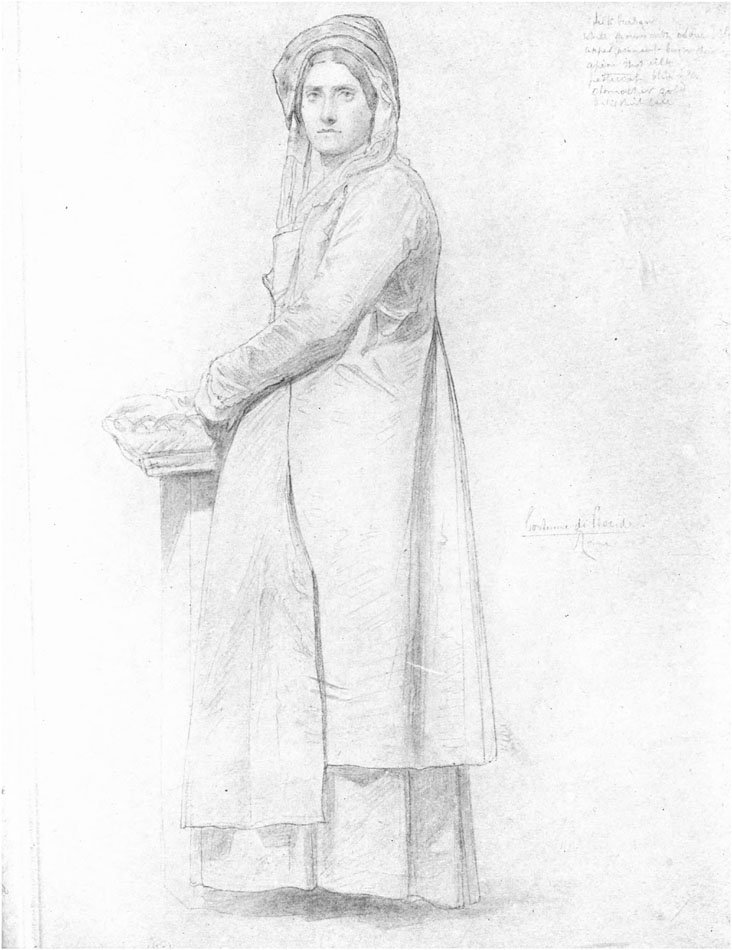
COSTUMI DI PROCIDA. Rome, 1853ToList
1 Brock Street, Bath, December 13, 1852.
Dear Frederic,—I need not say that we had all of us great pleasure in receiving your letter from Rome, though not before your dear mother had suffered great anxiety from the delay—the greater, because your former letter did not give a very encouraging account of your health. It gave us also great pain to hear of the vexatious disappointments which have attended your first entrance into the Eternal City, but this was, perhaps, to be expected, as the sanguine expectations of youth are seldom realised, and we may hope that by this time you will have found in other advantages and opportunities for improvement a sufficient compensation for the loss of those you had expected. What you say about the weakness of your eyesight is far more serious, and, indeed, would have occasioned us alarm if we did not hope and believe that you meant no more than we already knew at Frankfort, that your eyes were weak, and not that they had continued to grow weaker. But when I consider that your only means of acquiring an honourable independence and gratifying your laudable ambition depends upon your eyesight, I surely need no arguments to urge you in the strongest manner to use all those precautions for its preservation which your own good sense must suggest—to throw aside your brush or pencil the first moment that your eyes begin to smart or water, not to draw on white paper or by candlelight (or lamp or any artificial light), nor read except large print, nor small print even by daylight, except for a few minutes occasionally in a book of reference, and to acquire as much knowledge as you can, independently of books, by conversation with well-informed men, if you are so fortunate as to meet with them; when you cannot paint, talk, or observe, exercise your memory, it will store and cultivate your mind more and try your eyes less than reading, which in your case cannot be systematically pursued. You may perhaps meet some well-informed young men amongst the German artists. Above all, draw your compositions as large as possible (or rather as necessary for your eyes) and not such as your architectural drawings, "Four Seasons," &c., which contain so many objects minutely drawn. I suppose, likewise, that chalk and charcoal must be better than pencil, and the paint-brush better than either. You have no reason to complain either of want of ideas or of power of expressing them (at all events with your pen), however deficient you may think yourself in a command of language for conversation; but the fact is that, considering the distance that separates us, it is of much more importance to us to know how you are, what you do, and what you observe, than what you think. Your letters remind me of my friend, Dr. Simpson of York, who, when we sat down for dinner, would enter into some abstract discussion, say, of the nature and varieties of fish, or, à propos of the aitch-bone, on the homologies of the skeleton, while in the meantime fish and beef were growing cold and my appetite impatiently vivacious; so in your letters, while we are burning with impatience to know how you are, what progress you are making, or at all events what are your opportunities of progress in the art, you indulge us with abstract reflections on the theory of art in general. Your last letter, it is true, begins and ends with interesting matter, but with an interpolation of some three pages of disquisition on the nature of genius in art, &c., &c., which, however well thought or expressed, would be more in place in an essay than in your letter to us who are so much more interested in what immediately concerns yourself. The consequence is that, although with a praiseworthy wish to please us you have tried your eyes with a long letter, you have omitted much we were anxious to know—whether, for instance, you were conscious of having made any progress, or derived any advantage from the many pictures both in art and nature you have had so many opportunities of seeing; whether you had been making many, and what sketches or copies, for we are quite convinced that you have not been losing your time; whether you have been comparing what you can do with what other artists of about your age and standing in Italy can do, and whether the result is satisfactory; whether there are any among them from whom you can take any useful hints; whether Overbeck or any other competent artist is willing to assist you; whether, above all, you saw Power at Florence, and what he thought of your compositions; whether you find in Rome the material advantages you expected in the way of models, &c., and whether you will think it advisable to draw from the antique—the Apollo, Torso, &c.; in short, I cannot too strongly impress upon you that one fact is of more value to us than a volume of reflections. Of course, I would not have you infer that the progress of your mind, your thoughts and feelings, are by any means a matter of indifference to us, but after all they can be only imperfectly shown in occasional letters, and must necessarily exclude information of a more positive and, for the present, of a more important nature. Let me caution you, too, against reading any of the modern German works on æsthetics; they can be only imperfectly understood without a knowledge of the philosophies, of which they form a part, and any advantage you may derive from them will not be at all commensurate to the time and trouble, especially for you who have so much positive knowledge to acquire. If, however, any of your German friends can convey to you in conversation any clear ideas on the subject (and if they have them themselves there is no reason why they should not), well and good, but do not let them impose upon you, as they so often do upon themselves, with words either without any well-defined meaning, or one different from, or even the direct contrary, of the usual one. According to Hegel, for instance, 'das Schöne, ist das scheinen' (Schöne from scheinen) 'der Idee durch ein sinnliches Medium.' Now every artist knows without Hegel that his idea, or, if he prefers to think so, nature's idea within and through him, appears or manifests itself in the sensuous material, in colours if he be a painter, or stone if he be a sculptor, but this would be worse than trite, it would be intelligible to a plain understanding. Idee has a far deeper meaning. If you hear a German flourishing away with the magic word, ask him what he means. He will tell you, perhaps, that it is das Absolute or der objective Geist as distinguished from the Begriff or subjectiver Geist, or rather the indifference of both, and that is neither one nor t'other, but potentially either, or the an sich, or an und für sich, or rather the an, für, über sich; at last after much hin und herreiten you get some faint glimmering of what is meant; perhaps what some people call the soul in nature, or in still plainer English, nature, or the unknown cause of all we see, not an abstraction but a real entity, impersonal, however, and therefore not a god, acting according to certain laws, unconsciously in external nature (in ihrem Anders'sein) coming to itself—acting consciously in man, but more reflectively in science, more instructively in art. Well, you have caught the Idee at last (perhaps!) through its many Proteus-like changes and recognise an old friend after all—scratch your head, and ask whether you are any wiser than before. 'Das scheinen der Idee durch ein sinnliches Material'—in the Madonna of Raphael, for instance—'ist das Schöne.' Why then, says Punch, not equally so in the pork-pie and the mustard-pot, since the Idee manifests itself equally in both. The German solves the difficulty by "Sie sind ein practischer Engländer, und haben keinen speculativen Geist." In the meantime, let us hope that nature will use you as her tool to carry out in colours and canvas some of her beautiful ideas, and leave it to the German to find out how the practical Englishman who has not read Hegel's "Æsthetics" has set about it. That you may accomplish this to the utmost extent of your wishes is the sincere wish of, dear Fred, your affectionate father,
Fredc. Leighton.
P.S.—"Werkzeug der Natur" is an idea by no means peculiar to Hegel.
"Your birthday—
"Dearest Mamma, may it be a right happy one—one that may serve, and be used, as a pattern to cut out others on. Judging by your accounts, there is one among you who will contribute mirth to your enjoyment—one who takes as many shapes as Proteus, and is always the most welcome of guests; his name is Bettering. In this world confident expectation is a greater blessing, almost, than fruition. I too, if my directions have been followed (as I confidingly hope), shall have appeared to you on the great day as good as gold.
"How grieved I was, dearest Mother, to hear that I had given so much pain to the kindest of hearts! My excuse, such as it was, you got in my last letter, which reached probably the day after you posted your epistle to me; I was sincerely sorry; I had not, I must confess, any idea of anxious suspense on your part, as you were not in expectation of any particular news; I shall in future try to be more deserving of your solicitude; this time, you see, I am punctual.
"Health Report. Taking all in all, tol. sat., owing, no doubt, to the unusually magnificent weather which we have had since I arrived here; rheumatism, average; colds, not more than usual; eyes?... hum ... might be better; I suppose macaroni 'al burro' are not unwholesome—I and Gamba and several others eat it nearly every day.
"I now turn to your letter. Little Gussy an authoress! dear child, it gives one unfeigned pleasure to hear of her successful début. I have myself had no opportunity of judging of her talent for writing, but feel convinced that with her warm heart, impressionable soul, sterling understanding, and quick powers of observation, whatever she writes will please a healthy taste. She has my very best wishes. And yet, what slight cloud was that, I felt pass over my pleasure, casting (I could not help it) an undefined shadow on my heart? Did not I feel startled at being so palpably reminded that the child Gussy no longer exists? Did I not seem to feel, disagreeably, that the bridge was cut down behind us, that the last tie was broken that, in Gussy's person, still linked us to childhood, the buoyantly confiding age, the irresponsible age? Did not I become, through her, painfully aware that when I took leave of you, you all sealed with your kiss the first volume of my life, that I am indeed launched into the second, that the rehearsal is indeed over and the curtain drawn up?
"And do I not feel, even now, a hypocrite, to know my path, and yet so often to deviate from it? Write often, dear Mother!
"The hint you gave me about husbanding my time, I shall take to heart; it is a thing of which I myself full well feel the necessity and know the unfailing benefit; but I confess that when I read your quotation from 'Bob,' I felt irresistibly reminded of the question once put to sage and wise courtiers by the facetious monarch 'who never said a foolish thing, and never did a wise one,' viz. Why is a tub of water with a goose in it lighter than one without?
"'God help thee, Southey, and thy readers too!' (Byron).
"Your next question is: Am I comfortably settled in Rome? Well, I am happy to say that since the first week or fortnight my prospects have been slowly but steadily brightening, one cloud after another has passed away, and though I do not expect to see the bright sky of fulfilled expectations quite unveiled, yet I look forward to the enjoyment sooner or later of contentment. I wrote my last letter in a tone of considerable disheartenment, which I was indeed labouring under; perhaps it was the triumph of a selfish feeling that made me communicate my woes to you when it was not in your power to mend them; but yet it is such a relief to feel that there are those who are not indifferent to our grievances, who rejoice when we rejoice, and weep when we weep; and then, too, it seemed to me that perhaps a word from you might throw a new light on my position and give me new reason to be comforted. Meanwhile, altered circumstances have reassured me on some points, and my own reason has pacified me on others which I saw to be irremediable; the prospect of emulation of a peculiar kind, such as I found in Steinle, and generally speaking in the German school (I do not mean the emulation of industry which I find amply in Gamba, or in the science of the art which I have lately discovered amongst certain young Frenchmen, but that which affects the animating spirit of the art, the spiritual taste, the tendency of one's thoughts), I have entirely renounced; the visions that I had (God knows why, for I don't think I ever expected to grasp them) of a time like that of Steinle's sojourn in Rome, when so many master-minds were united together in friendly strife, all inspired by the same spirit, all going hand in hand—have all faded away, and only linger in my mind as a sweet regretted image, like the gentle glow of twilight in the western sky when the cold moon is already in the heavens. But I have, on the other hand, seen reason to believe that this will turn out for my good; that it is proper that I should, once for all, and in all things, accustom myself to the idea that I am, or should be, a self-dependent and self-actuated being, accountable to myself for good and for evil; that I must therefore learn to build and rely on my own resources, and remember the most important of truths, that if the growth of my art is to be healthy, lasting, fruit-bearing, it must, though fostered from without, be rooted deeply in, and receive its vital sap from the soil of my own mind. Still, I have thought it good to hang up in my studio a work of Cornelius and one or two of Steinle, to animate myself by dwelling constantly on an idea of excellence (not ideal, I hate such stuff) irrespective of the specific mode in which it is manifested; and in this I think I have chosen the juste milieu—so far my reason. Yet I do not deny that I every now and then feel longings and regrets that make me feel the truth of those lovely words—
"'We look before and after, And pine for what is not; Our sincerest laughter With some pain is fraught.'
"Among the irremediable disappointments on which I have to put the best face, is that of not seeing Oakes here this winter. From a man of warm feelings, of tastes congenial to my own, of a cultivated and liberal mind, I had hoped to derive much pleasure and especially advantage, and thus to have supplied in some measure the void which must arise (and, alas! remain) in my brain from want of time, want of robuster health, want of eyes. A friendship, too, of mutual seeking is so agreeable a thing. Matters stand so: when I was in Florence I received from him a letter full of a kind and friendly spirit, in which he seized with eagerness at the idea of spending a winter with me in Rome; he was already in Paris, where he was in treaty with a travelling servant in order to continue his journey; he had written to you (did you get the letter?) to know where he was most likely to catch me up; he was anticipating the enjoyment we should find together in Venice, or in Florence, or wherever we should meet; this letter has been waiting for me a month at the post. I arrive in Rome, and look anxiously about for Oakes, who, I suppose, must already have arrived; no Oakes—no news—suspense—despair; at last a letter: he has been recalled from Paris; he is obliged, willy nilly, to stand for his borough (Conservative, Ministerial); he is an M.P.
"Another disappointment, hitherto, is the non-arrival of the Laings; I had promised myself great enjoyment in Isabel's society; the footing on which we stand is such an agreeable one: enough familiarity (for old friendship's sake) to make our intercourse easy—a relaxation; enough restraint to refine it and make it improving; she plays, too. Music! How I yearn for music, which I never hear in the land best adapted to foster it; music, that humanises the soul, that calls forth all that is refined and elevated and glowing and impassioned in one's breast, and without which the very lake of one's heart ('il lago del cuore,' Dante) stagnates and is congealed. I express myself extravagantly, but my words flow from my heart.
"Again, the studio, which I at last found, though snug and cheerful, very (let's give the devil his due), is, in its professional capacity, bad beyond description; the light is execrable; I could not dream of painting a picture in it (thank God, I have only taken it till spring), scarcely even a portrait, 'which is absurd,' Euclid, hem. What a list of lucubrations! for goodness' sake, let me look at the gay side of the picture. It has been a great comfort to me all through that all the artists resident here, whom I have spoken to on the subject, felt on first arriving the same kind of disappointment that I did, and that all by degrees have acquired the conviction that, after all, it's the best place in the world for study. I have myself begun to feel what an incalculable advantage it is always to have models at your disposition whenever, and however, you want them; I look forward, too, with the greatest delight to the studies that I shall make this summer in the exquisitely beautiful spots to which the artists always take refuge from the heat and malaria of Rome. I long to find myself again face to face with Nature, to follow it, to watch it, and to copy it, closely, faithfully, ingenuously—as Ruskin suggests, 'choosing nothing, and rejecting nothing.' I have come to the conviction that the best way for an historical painter to bring himself home to Nature, in his own branch of the art, is strenuously to study landscape, in which he has not had the opportunity, as in his own walk, of being crammed with prejudices, conventional, flat—academical. But I am getting to the end of my paper, and I have as yet said but little to the point; I have not yet answered Papa's question about my sketching, and therefore that I may not seem to be shirking the point, I shall just tell you that amongst the sketches that I have made (mostly architectural) are some by far the best I ever did.[24] I have also to justify Marryat about not writing; I got his letters the other day with a kind note to say that he had been ill; that to the Princess Doria has availed me nothing, as she is in mourning for her father, Lord Shrewsbury; that to the Prince Massimo has opened to me at once two of the first and most exclusive houses in Rome, those of his two sisters, the Princess Lancelotti and the Duchess del Drago. Enough for to-day. Good-bye, dearest Mother. Very best love to all. Think often of your dutiful and affectionate son,
"Fred Leighton.
"I am ashamed to think of the time I have taken writing this letter; not from want of ideas, not from any great difficulty in expressing them, but from the great difficulty I have in getting at them, controlling them, holding them fast.
"'A saucepan without a handle. Soup without a spoon.'
"Via di Porta Pinciana, N. 8."
"Roma, Via di Porta Pinciana, N.V. (Postmark, Jan. 5, 1853.)
"Dear Papa,—When I received, the other day, your kind and most interesting letter, and felt the appropriateness of your admonitions—felt, too, how foolish it is for me, who am ignorance personified (in certain matters, at least) to waste my time in speculations on subjects beyond my grasp, and to exhaust your patience by twaddling them out to you, whilst your own penetrating and comprehensive mind takes, in preference, a practical view of the subject—a question suddenly presented itself to me: Bless my soul! what will he say to the epistle I have just sent off? For, as you, by this time, know yourself, it is, though perhaps less groggy than the last, still insufficient in point of practical purport; a messed-up dish, not a joint. I hasten, if possible, to make 'amende honorable' by communicating to you in language as concise as possible whatever information you either express or hint a desire to have.
"One word only, a farewell one, on the subject of my ci-devant digressions; no, three words; I must say in my own justification. 1st. That when I sat down to write, it was always with an idea of telling all (or nearly), and all in detail, too, from which I was prevented by invariably getting to the end of my paper, my time, and my eyes (as it would try them to cross) before I had accomplished my object; 2nd. That I have been discursive with an idea of entertaining for a time the suffering members of the family; 3rd. That all my abstract drawl, though it in some cases abutted in tenets that I had at different times heard you let fall, was altogether my own; indeed it was, perhaps, the consciousness of the instinctive self-suggestedness of such thoughts that made me turn round on myself and take an objective view of ditto. A philosopher is very like a dog trying to catch his own tail.
"Now to business. You speak of my eyes; I cannot conceal from you that they are worse than they were at Frankfurt, but I do not know whether I can say that they are getting gradually worse; everybody takes some time in getting acclimatisé to Rome; my sufferings may perhaps be ascribed to that. I intend for some months to give up the nude in the evening. Your advice about gathering information from the conversation of men of cultivated mind I would most gladly follow, but, alas, I only know two really well-informed people here, and one is an old man I hardly ever see. There is no fear of my drawing my compositions too small, for (I shall tell you why presently) I am drawing none at all, and probably shall draw none for a considerable time; but close and minute study of Nature in its details is, as I now see more plainly than ever, of paramount importance. I come to another point which it is difficult to touch with conciseness: have I made any progress? Perhaps I am not entitled to answer positively in the affirmative till I shall have painted some portrait or picture better than anything I have yet produced; this I have not yet had an opportunity of doing; but if, from superlative confidence, having fallen to a more beseeming diffidence, if having improved and chastened my taste, if having become more anxiously aware of the extent of my task and more deeply humbled by those who have fulfilled it, may be called progress, then I can answer: Yes, I have made a step.
"I was deeply impressed with the glorious works of art I saw in Venice and Florence, and was particularly struck with the exquisitely elaborate finish of most of the leading works by whatever master; the highest possible finish combined with the greatest possible breadth and grandeur of disposition in the principal masses; art with the old masters was full of love, refined, utterly sterling. I had got during my journey through the Tyrol into a frame of mind that rendered me particularly accessible to such impressions; I had been dwelling with unwearied admiration on the exquisite grace and beauty of the details, as it were, of Nature; every little flower of the field had become to me a new source of delight; the very blades of grass appeared to me in a new light. You will easily understand that, under the influence of such feelings, I felt the greatest possible reluctance to sketch in the hasty manner in which one does when travelling; I shunned the idea of approaching Nature in a manner which seemed to me disrespectful, and the consequence was that until I got to Verona I did not touch a pencil. In Venice and Florence, however, I made several drawings, some of which are most highly finished, and afforded me, whilst I was occupied on them, that most desirable kind of contentment, the consciousness of endeavour. Of course I was obliged to conquer to a certain extent my aversion to anything but finished works, and accordingly I made a considerable number of sketches 'proprement dits.' With regard to composing, however, I still feel the same paralysing diffidence, I cannot make up my mind to draw compositions like those I have hitherto produced, but, at the same time, I feel that I am as yet incapable of drawing any in the manner I should wish, and as I see no prospect of such a desirable state of things till I have spent a summer in the mountains and drawn landscape, men and animals for several months, it is very unlikely that I shall put my hand to anything original till next winter; then I shall pour myself out with a vengeance. When I left Frankfurt I asked Steinle whether I should compose the first winter; he answered: 'Oh, wenn Sie mögen.' He foresaw how it would be. It gives me great comfort to feel that I am quietly settled to study for some years in one place, and that I am able to make plans for the future without having to reckon on removals and changes. Meanwhile, this winter I take models, I have been studying the anatomy of the horse, I shall draw at the Vatican from Raphael and Michael Angelo (perhaps, too, from the antique), &c. &c. A digression, whilst I think of it: I think that the pains in my eyes are in some measure nervous, for mentioning them invariably brings them on, in broad daylight. About the little emulation I find here I have spoken in my last letter. The general tone here (of course with some exceptions) is one of public toadying mediocrity. There is here one young Frenchman, remarkable for correctness but coldly scientific (only in his art), without that warmth and spontaneity which give such a peculiar charm to works of genius. Overbeck was endlessly courteous and praised me very highly, talked of the artists in Rome acquiring in us 'einen ächten Zuwachs' ('a real addition'), but the half century between our respective ages and his pietistical manner make me sure that we shall derive but little advantage from him; I neither expected nor wished to find a second Steinle.
"As for Powers, though he was very polite to me in his own sort of way, I am pretty certain that he had entirely forgotten, nor did he ask me to show him anything. You may console yourself on that score—a sculptor, especially one who can do little but busts (however pre-eminently good they may be, and his are), can very seldom judge well of pictures. Gibson, the great sculptor, whom I know very well, and who shows me great kindness by-the-bye, has about as little judgment in painting as a man well can. That I do find models here, and many other material advantages, I told you in the letter that you lately received.
"I have now, dear Papa, answered all your questions; it only remains for me to thank you for your poignant and admirably practical remarks on the German philosophers—remarks, I assure you, which have quite answered their purpose; both they and the kind wishes you have expressed concerning my future advancement shall not have been thrown away on your grateful and affectionate son,
"Fred Leighton."
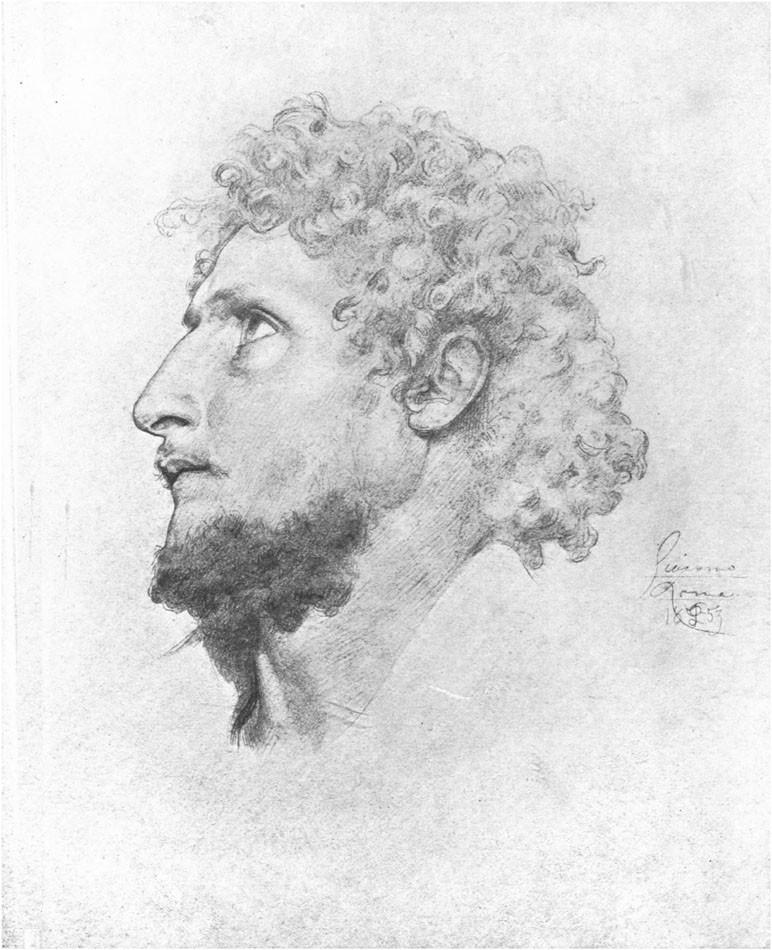
STUDY OF HEAD FOR "CIMABUE'S MADONNA." 1853 Erroneously supposed to be the Portrait of Lord Leighton Leighton House CollectionToList
(Postmark, Jan. 5, '53.)
"Dearest Mamma,—To your appendix an appendix. Paper and time force me to laconism.
"My personal discomforts, for which you show such kind sympathy, are, I am happy to say, now only very slight; the only thing I suffer annoyance from is my stove, which makes my head ache; with regard, however, to beating a retreat, I must candidly tell you that I see my only chance of coming to anything is studying here steadily for some three years; the more so that it is by all accounts only at the end of the first year that one feels all the advantages which Rome affords. My plans seem to be these: this winter, studies; next summer, ditto, in the mountains, or wherever it is coolest; next winter, pictures, portraits, compositions; summer after, Paris, see the large Veronese (which was invisible the last time I was there); from Paris to Bath to see all you darlings again, spend two or three weeks in England studying its character under the ciceroneship of Oakes, that thorough Briton, and collecting materials for some large (in meaning if not in size) picture to be painted in Rome during the third winter, and to be my firstling in an English exhibition; I feel that one day my painting will have a strongly national bias. That autumn I should probably return to Rome viâ Spain to see the Murillos, &c.
"When you next write to Lady Pollington, pray remember me very kindly to her; her merry face and facetious ways are still before me. Lord Walpole, whom you mention as coming to Rome, and whom I shall know if he does, is indeed, I believe, a very agreeable and clever man. The Henry Walpoles have been very civil to me; Mrs. Walpole told me that if I wrote to you I was to give her best—I think she said, love—for that you were a great favourite of hers.
"Here I must absolutely close, though I have plenty more to say. My very best thanks to Papa and you all for the kind presents, but I don't see why you won't allow me the pleasure of giving you anything. As I have written this letter immediately after the other, I cannot promise to write again soon. To yourselves, very best love from your dutiful and affect.
"Fred Leighton."
The following letters from Steinle are evidently the first Leighton received in Rome from his master. No comment on them is necessary. Every line is evidence of the affectionate quality and beauty of the nature that so permanently influenced Leighton's for good.
Translation.]
"Frankfurt am Main, January 6, 1853.
"My very dear Friend,—Although I do not know your address, and am uncertain whether this will reach you, yet I can no longer withstand the urging of my heart; I only know that you and Gamba are in Rome, that you have visited Overbeck, as he himself has written me; assuming, however, that you also visit the Café Greco, I will risk that address. Your spirited lines from Venice reached me safely, and I can truly say that since then my thoughts and my good wishes for you and for Gamba have daily accompanied you. A report which has been circulated here, that you, Gamba, and André had been attacked by robbers, made me anxious for a time, and I expected from day to day that you would yourself write me something about this adventure—in vain. Overbeck writes me now that it would give him particular satisfaction to be able to help or serve you in any way during your stay in Rome, and cordially wishes that you and Gamba would give him the opportunity to do so, but unfortunately he knew nothing else about you to tell me. What Schäffer writes me is also so extremely scanty, that for all that concerns you and Rico I am thrown back on my own thoughts and suppositions. That you are both absent from me is unfortunately a painful truth; as to whether the ideal life which from old and dear habit I still live with you, be also true, the future, I hope, may show. I have an idea that you, dear friend, and perhaps also your faithful comrade, already suffer from the artistic fever of Rome, which every one feels in the first year. It is that glorious old Rome, with her wealth, and the multitude of her impressions, which works so powerfully upon the receptive mind, that it can retain nothing in contradiction, and cannot escape her influence; this period is one of discomfort, because we feel ourselves oppressed; but though it is of the greatest value, and no doubt bears rich fruit, the work of artists of to-day is neither in a position to offer you anything important, nor to deceive you in sight of the old masters; if the multitude of impressions is first gradually assimilated, if everything is assigned its place, if we take a wide survey, and can stride forward freely in pursuit of the goal set before us, then only does that wonderful spirit which hovers over Rome rise up in us strong and inspiring, and then we are able to recognise what we have actually won in the fight with discomfort. Thus, and in similar circumstances, I fancy that my dear friends are in the same case as the bees, which swarm, and toil with all the load they collect, but cannot make honey by perpetual sucking. That is inconvenient and oppressive, but ah! when this time is past, what wealth will they unfold, with what comfort will they look upon the well-filled satchel, how quickly they will recognise that such wealth pays interest for the whole life! But if it is otherwise, dear friend, then laugh at the all-wise Steinle, and resolve finally to free him from such delusions, and to set the matter before his eyes as it really is, and be you assured of one thing, that he always wishes that everything may be good and prosperous for you, that all that you are longing to attain you may attain, and that Almighty God may guard you and Rico from all ill! You can have had no idea with what feelings your friend would read your vigorous, spirited lines from Venice. I received them, on my return, from Gamba, a very dear lad, and could not help being sorry that you, who have become so dear to me, should know absolutely nothing of what distressed your friend. We are men; hear, then, the news. Returning from Switzerland, I heard of the illness of my daughter Anna, in Metz, and I and my wife hurried to her, and spent six sorrowful days by the death-bed of my little sixteen-year-old daughter. After the funeral, I came back here, and finished 'The Raising of Jairus' Daughter.' The real pleasure of my art I felt shrink from me day by day in Metz; and now all my pleasure depends upon the beloved art, for happiness is more and more confined within the four walls of my atelier. Do not read any complaint in this; I have learnt much sadness, but have also found rich cause to thank God from my heart. What manner of children should we be, if we would not kiss the rod when we are chastised? And now, dear friend, with all my heart a greeting to Rome, and to all who remember me kindly. All friends here send greetings to you and Gamba, including Casella il Professore; Senator Nay is in Rome. I hope with all my heart that you have good news of your dear ones, and remain, always and altogether yours,
"Steinle."
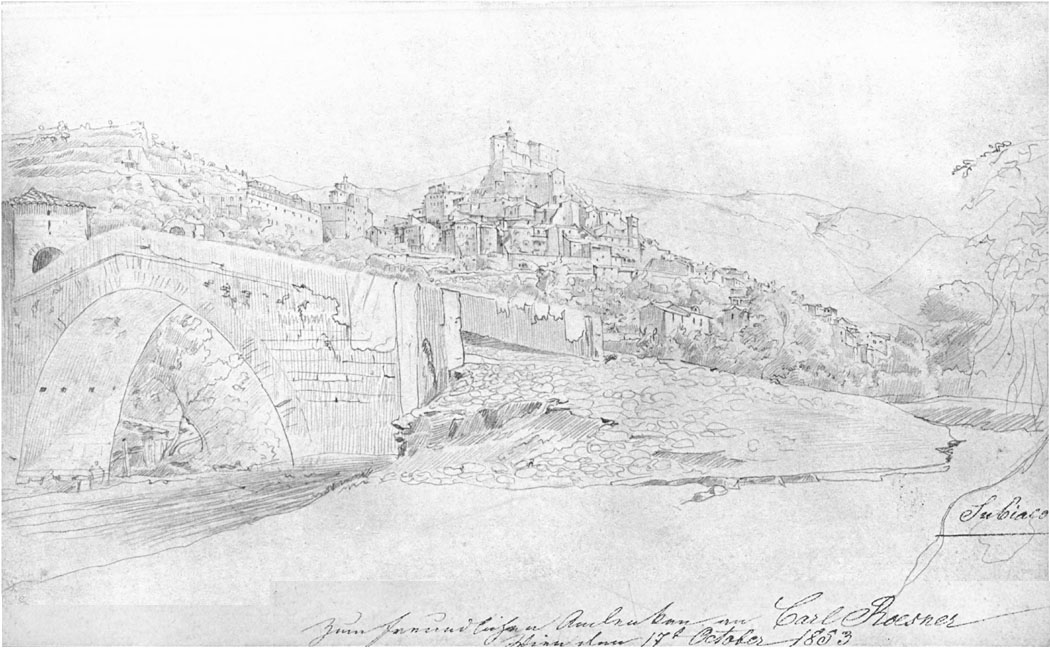
VIEW OF SUBIACO, NEAR ROME. 1853 Leighton House CollectionToList
Translation.]
"Most Esteemed Herr Steinle,—When you receive these lines I shall have already been long in the lovely land wherein I lack nothing but your presence; I beg you to accept from me the accompanying translation of the first volume of the works of the Father of English Poetry as a little remembrance; whether it is a good rendering of the great master I cannot judge, as at the moment of writing it has not arrived; but one thing I can answer for: it is the only volume of the only translation of Chaucer into the German language in existence; I only regret that there is also no Italian version; may it serve you as a souvenir of your devoted and grateful pupil,
"Fred Leighton."
"Frankfurt a/M."
Translation.]
"Rome, Via Della Purificazione No. 11, January 11.
"My Very Dear Friend,—At last I am able to write you a few words, and (although very late) to send you my very best good wishes and congratulations for the New Year. I am sure that you will be kind enough to forgive my long silence, and will believe me when I tell you that I absolutely could not help it. I hope with all my heart that in the meantime you have been well and strong, and that your beautiful works have progressed in accordance with your wishes. How has the experiment with the new ground turned out? Have you already started on the other cartoon? I, for my part, have experienced the fact that to make plans and to carry them out are two different things; for nothing has come of the pictures which I set myself to paint. I have already told you in Frankfurt, dear Master, how painfully my deficiency pressed upon me, and how clearly I felt that my works lacked a highly genuine finish in the form, an intimate knowledge of nature; this consciousness had so increased when I arrived in Rome that without more ado I determined to employ myself during the whole winter exclusively upon school tasks, and by all means to endeavour to rid my artistic capacity a little of this defect; so now I continually paint study heads, which I try to finish as much as possible, and in which I especially have good modelling in view; that I have achieved this, unfortunately I cannot yet assert, but I derive great enjoyment from the attempt, and hope that my efforts will not remain unrewarded; I shall then next year, if I come to the painting of pictures again, go to work with greater knowledge and clearness, and shall be able, I hope, to clothe my ideas more suitably.
"I have nothing further to report of myself. I hope, my dear Friend, to receive a few lines from you, telling me what you are doing, for you know well how deeply interested I am.
"Will you be so kind as to tell Mr. Welsch that my trouble to find the Palazzo Scheiderff was in vain, and I have also unluckily not seen his brother? If I pass through Florence again in spring, I will try my luck once more. And now, adieu, dear Master. Kindest remembrances to your wife and children, and to you the warmest greeting, from your grateful pupil,
"Leighton."
Translation.]
"Frankfurt am Main, March 24, 1853.
"My Very Dear Friend,—My desire for news of you and Gamba was certainly great, but I possessed my soul in patience, for I was convinced that it would come at last; you and Rico have given me so many proofs of your love and friendship, that I was able to face with perfect calm and confidence all the numerous and impatient questions for news of you which came to me. Now, however, I see by your welcome lines, to my inward regret, that some restrained anxiety about you is justified, and while on one hand I greatly regret the weakness of your eyes and in a manner suffer with you, yet I have also my consoling argument that the Roman climate, at a better time of year, will certainly be good for your ailment, and that my Leighton can rise up again, that he will not lose courage. But whatever joy I had when you and your noble friends bore such splendid witness of one another, I cannot express myself as very easily satisfied; that you, in your efforts, would stand alone in Rome, I knew well, I am sure you are cut out for it, and it appears to me, even, as if every good heart that rises to a happy independence nowadays, must feel his loneliness, I might even say, that it must in order to give skill and power of conviction. The better you get to know Rome, the more you will learn to love her, and much will be freely given, when once the year of struggle is past, that could never be seized by force. How much I have rejoiced over all that you write of your and Rico's studies, how I should like to see them! Cling now to nature, you are quite right, you will not lose the art of composition, for it is not a thing that can be acquired: it is a gift, and one that you and Rico possess. Now, indeed, it always seems to me, when I consider the highest aims of art, and indeed the greatest capacities of man, that there should be a certain equalisation of the various powers, and it strikes me as indispensable, if we are not to become one-sided, that we should by such equalisation balance these various powers so as to achieve a complete harmony. Thus, however great a delicacy goose-liver may be, it always indicates a diseased goose, the monstrous enlargement of an organ, &c.; I do not say this by way of blame, and am thinking perhaps too much only of my own feeble powers, but merely as a little warning that it may be well to keep in view. Do not think that it is the Professor asserting himself, I say this only as a matter of experience and because you and Rico lie very close to my heart, and are associated with my own feeling of the sacredness of art. I have, however, no anxiety; you have good and noble natures, and will not lose the tracks of truth. Spare and save your eyes, I hope that you will soon be quite free from this ill, and then—forward! What you write me of the friends is certainly quite correct, and I myself thought no otherwise; Overbeck is the purest and noblest man that I have ever met; moreover a genius—therefore I rejoice that you and Rico know him; he speaks with feeling and judgment of his art. Excuse, dear Leighton, my forgetfulness; I have not thought of the dear and lovely present which with your note surprised me so pleasantly on my return—I mean the powerful and rich Chaucer; I find the prologue splendid, rather knotty, but the Germans of that time are still knottier. I thank you heartily. Of myself, I can inform you, that I daily rejoice more over the grey canvas; I have worked two months on my picture of the 'Whitsun-sermon,' and now in three weeks have painted half the picture, and am, even though somewhat exhausted, not altogether discontented with the result. This picture, which grows daily more like a fresco, is getting on fast, but much still remains to be done, and I have the progress of the whole picture in hand. Of the friends here, I can tell you that all speak of you and Gamba with love and sympathy, and that you are kindly remembered by all. Thank Rico cordially for his welcome note; if you and Rico always call me 'master,' a title which abashes me, we shall be friends, and I hope that as I grow old in years, at least I shall remain young in art. Tell Rico that I had a visit from his grandmother, who loves him dearly; with a few lines he would give her extreme pleasure. Now, adio, dear friend; equip yourself with patience and courage, and keep sad thoughts far from you. Greet all friends from me most heartily, also I have to send to you and Gamba warmest greetings from all here, including my wife, Frau Ruth Schlosser, and Casella. Let me hear sometimes how you get on. Always and altogether yours,
"Edw. Steinle."
(Postmark, March 28, 1853. Received April 6.)
(On cover—Mrs. Leighton, 1 Brock Street, Bath, England.) "Rome, Via de Porta Pinciana 8.
"Dearest Mamma,—If I did not, as was naturally my first impulse, answer your letter directly I received it, it was because Isabel's[25] portrait has of late taken up all the time, or rather eyes, that I can dispose of; this being, however, a drying day, I seize the opportunity of making up for lost time. As I have mentioned the portrait, I may as well say en passant that I expect it to be a very successful likeness, and as decent a painting as a thing done in so desultory a manner can be expected to be; Gamba admires it very much, and intends to copy some parts. I was much touched at the affectionate sympathy you show for me in my visitation, and am as glad for you as for myself to say that there is a decided improvement in the state of my eyes, so that, although they are by no means well, it would hardly be worth while to go to a doctor for a written account of my symptoms; the more so as Dr. Small, who is a man very well thought of, thinks it all depends on the weather, and will go away when fine weather sets in, which God give! Add to this that several people of my acquaintance, i.e. Mrs. Sartoris and Mrs. Walpole, who never had anything the matter with their eyes, find them affected now. About two months ago I went to consult Dr. Small, or rather, on calling on him one day he had me up professionally, for I felt a delicacy about going myself, as he had told me that he would be very happy to be of service to me without any remuneration. Finding that Dr. Small's prescription had done me no perceptible good, I determined at last to go to a homœopathic physician, of whom I heard great things. He was originally the apothecary of Hahneman (do I spell the name rightly?) the father of Homœopathy. Under his hands I certainly improved rapidly; but it so happened that, just as I went to him, the rains, which had lasted without interruption for six weeks, ceased, and we had some days of glorious weather—now, who cured me, Jove or the apothecary? The weather is now as bad again as ever; but though less well, I have not relapsed with it. Most days I can paint three or four hours (I don't think I could draw), and the other evening I even read half an hour with a lamp without feeling pain; what a pass things have come to that that should be a boast! I confess that the little I do, I do without energy or great enjoyment. I have not yet given my eyes the fair trial of complete rest which, when the Laings go, I shall be able, through your kind promise of a piano and singing lessons, to do for a fortnight or three weeks. My sincere thanks to Papa for his kindness and liberality. I shall begin immediately after the holy week, for until the forestieri, of which there are a fabulous number, have gone to their respective summer quarters, neither piano nor masters are in any way come-at-able.
"Having now spoken of my health, I return to your letter, for I find that the only way of writing at all to the point, is to answer sentence for sentence the questions and remarks you ask and make, and in the same order.
"I indeed count myself fortunate in having the acquaintance of Mr. and Mrs. Sartoris; it is a source of the greatest enjoyment to me; they show me the most marked kindness, which I value all the more because it is for my own sake, and not for that of a dinners-demanding letter of introduction. I am never there less than three times a week, and often more; I have dined with them en famille four times, and it is only seven weeks since I made their acquaintance. Although I have a good many friends here, it is the only house which it is improving to me to frequent; her conversation is most agreeable to me, not from any knowledge she displays, but from her great refinement of feeling and taste; her husband is an enthusiastic amateur painter. I also meet there a young man of the name of Cartwright, a very old friend of theirs, who seems to me to possess an extraordinary amount of information, a mine which I have already begun to 'exploiter' to my own profit.
"I have made a considerable number of acquaintances, and have had more than enough parties, for people have a habit here of receiving once a week, so that, especially towards the end of the season, there never was an evening when I could not have gone somewhere, and often I had two or three places for one night; I used often to stay away from them, till I was afraid of offending people, which one does not wish to do when one experiences kindness from them. Then came a long series of arrears, which I found most monotonously tiring, for I am more lazy about dressing for a party than ever; more than once, when I have gone to my room to go through that hateful operation, I have slipped into bed instead of into my glazed boots; and yet, if I had taken the steps a great many young men do take, I should have gone to twice the number of places. Now all this was very well for this winter, as I could do nothing else on account of my eyes, but next year I shall turn over quite a new leaf; in the first place, give up dancing altogether—it is too fatiguing; and in the next, go nowhere but to my old acquaintances (of this winter, I mean).
"I have lionised Isabel all over Rome, and devoted to her nearly all my afternoons since she came; it is the luckiest thing in the world, her coming here at a time when I am not able to paint; she is going in a few days; you may easily imagine that I have not slept in the afternoons since she has been here.
"Gamba is, as you rightly suggested, far too straitened to go into society; however, he no way requires it, he has good health and untiring industry, and requires no such relaxation. As my paper is coming to an end, I must pass over the rest of your letter more rapidly. I fully feel with you that it is better in many respects that I should not go to Frankfurt, but I confess that when I saw it was out of the question, I felt painfully having to wait another year before seeing you; however, it is for the best. I am interested in hearing that you have bought a house in Bath; it looks as if you had at last found an anchor in your own country; is the society of Bath really agreeable? I always hear it spoken of in a jocular tone. What becomes of the Frankfurt house? You won't sell it, will you? Pray remember me most kindly to Kate Chamberlayne, and thank her for giving such an unworthy a corner in her memory.
"And now, dear Mamma, I must close. Pray write very soon, and give me a quantity of news about all your doings; tell me how dear Lina gets on and Gussy's Pegasus."
The preceding letter contains the first mention that I have seen of Leighton's friends, Mr. and Mrs. Sartoris, who were to be so much to him during twenty-five years of his life. He had known them seven weeks when he wrote it, and already Rome had become a happier place. All that most interested him in social intercourse was satisfied in their companionship, and in that of the intimate circle of friends who frequented their house. It soon became a second home, a home doubly welcome, as Leighton felt keenly being separated from his family. Mr. Sartoris was a fairly good amateur artist, and was considered by his friends to be a first-rate critic of painting. To Leighton's reasoning mind, ever prone to analyse and to give expression to the results of his analysis, it must have been inspiringly interesting to discuss art in general and his own in particular with one who had a natural gift for criticism.
Again, music was ever a joy to Leighton, a joy only equalled by that inspired by his own art. Mrs. Sartoris (Adelaide Kemble), imbued with the noble dramatic instincts and traditions of the Kembles, was not only a great singer, but a great musician, and had in all matters a fine taste, bred of true and deep feeling united with keen natural perceptions. In Miss Thackeray's "Preface to a Preface" to Mrs. Sartoris' delightful story, "A Week in a French Country House," she quotes the description of one who had known the two sisters, Fanny and Adelaide Kemble, from their youth: "Mrs. Kemble is essentially poetic and dramatic in her nature; Mrs. Sartoris, so much of an artist, musical, with a love for exquisite things and all that belongs to form and colour." (Some of us remember hearing Lord Leighton say that, though Mrs. Sartoris did not paint, she was a true painter in her sense of beauty of composition, in her great feeling for art.) Another old friend, referring to Mrs. Sartoris, with some show of reason deprecated any attempt to record at all that which was unrecordable: "Would you give a dried rose-leaf as a sample of a garden of roses to one who had never seen a rose?" she exclaims, recalling, not without emotion, the golden hours she had spent, the talks she had once enjoyed in the Warsash Pergola. "You have only to speak of things as they are," said a great critic who had known Mrs. Sartoris in her later years. "Use no conventional epithets: those sisters are beyond any banalities of praise." Again, take another verdict: "That fine and original being, so independent and full of tolerance for the young; sympathising even with misplaced enthusiasm, entering so vividly into a girl's unformed longings. When I first knew her, she seemed to me to be a sort of revelation; it was some one taking life from an altogether new and different point of view from anything I had ever known before." Such are the descriptions given by those who knew her intimately of the lady who held out so kind a welcoming hand to Leighton when, as a youth of twenty-two, he started for the first time alone on the journey of life. I saw Mrs. Sartoris only two or three times at the house of our mutual friends, Mrs. Nassau Senior and Mrs. Brookfield. It was during the last years of Mrs. Sartoris' life, when illness and sorrow had marked her noble countenance with suffering. A friend of mine, however, who was greatly attached to Mrs. Sartoris, would often talk to me of her. My friend had had exceptional opportunities of coming in contact with the most distinguished minds in Europe. She told me she had never met with any personality who naturally, and apparently without effort, so completely dominated all others who were present. However distinguished the guests might be at a dinner, Mrs. Sartoris, she said, was invariably the centre of interest to all present.
The Sartoris children were another source of delight to Leighton in this home. No greater child-lover ever existed. He writes, moreover, that all social pleasures which he enjoyed during the three years he lived in Rome he owed to these friends.
With life brightened and inspired by their sympathy, and by all the sources of interest and culture which their society included, Leighton began brooding over the work which he meant should embody the best of his attainments so far as they were then developed. Florence and her art had cast a spell on his spirit very early in his existence. He had become especially enamoured of Giotto, the half-Catholic, the half-Greek Giotto. Pheidias had not yet touched him intimately; but his loving, spontaneous appreciation of this Florentine master, whose work in one sense echoes the secret of the noble, serene sense of beauty to be found in that of the Greeks, proves that in very early days Leighton's receptive powers were alive to it. The subject which inspired his first great effort appealed especially to Leighton from more than one point of view. In the historical incident which he chose was evinced the great reverence and appreciation with which the early Florentines regarded art, even when expressed in the archaic form of Cimabue's painting. The fact of his picture of the Madonna causing so much public enthusiasm was in itself a glorification of art; a witness that in the integral feelings of these Italians such enthusiasm for art could be excited in all classes of the people. One of the doctrines Leighton most firmly believed, and most often expressed, was that of the necessity of a desire for beauty among the various classes of a nation, poor and rich alike, before art of the best could become current coin.[26] In painting the scene of Cimabue's Madonna being carried in triumph through the streets to the Church of Sta. Maria Novella, Leighton felt he could record not only his own reverence for his vocation, but the fact that all who follow art with love and sincerity find a common ground, whatever the class may be to which they belong. To Steinle, religion and art were as one, and his pupil had so far been inoculated with his master's feeling that, as his friend and brother artist, Mr. Briton Rivière, writes: "Art was to Leighton almost a religion, and his own particular belief almost a creed." As no difference of class should be recognised in church, so neither should any be accentuated between artists, when such are worthy of their calling, a belief which Leighton carried into practice all his life in his relations with his brother artists. He makes Cimabue, the noble, lead by the hand the shepherd boy Giotto, who was destined to outstrip his patron in the race for fame, and to become so great an influence in the history of his country's art. The magnates of the city are represented in Leighton's procession as forming part of it, while Dante, standing in a shadowed corner, is watching it pass.
Again, Leighton was afforded an opportunity, in the accessories of the design, of painting the things which had entranced him in those days when he first fell in love with Italy; the mediæval costumes in the old pictures, the background to the Città dei Fiori of hills, spiked with cypresses pointing dark, black-green fingers upwards to the sky, and the beautiful San Miniato crowning one of their summits, the stone pines, the carnations, the agaves—all these things that had appealed to his native sense of beauty as such wonderful revelations, when, at the age of ten, he was transported to the sunlit land of art and beauty, after being accustomed to the sights and surroundings of a dingy region in fog-begrimed London.
The subject of Leighton's early opus magnum was indeed no bare historical fact to his mind; it was a symbol of everything to which, in his enthusiasm for his calling, he attached the most earnest meaning, and which was also steeped in the radiant glamour cast over his spirit from childhood by the land that inspires all that is most ardent in the æsthetic emotions of an artist.
The subject decided on, in the spring-time of 1853 he began working, as hard as the trouble in his eyes would permit, at the cartoons for the design. His intention of remaining in Italy during the summer was frustrated, partly by the unsatisfactory state of his eyes and health generally, partly by the decision of his family to return to their home in Frankfort for the summer, before finally settling in Bath. This change of plans is first mentioned in a letter to Steinle received February 23, 1853:—
Translation.]
Rome, Via Di Porta Pinciano 8.
Dear Master and Friend,—How gladly I seize the opportunity to answer your delightful letter, and to connect myself again through the post with a man and a time round whom and which so many dear remembrances cling; that I did not do this immediately on receipt of your lines, I hope you have not set down to a possible negligence or to any sort of cooling of my grateful attachment to you, but that you have thought,—something has happened, Leighton has not forgotten me; and so it is; I suffer with my eyes. How sorry I am to begin a letter by giving you such news, for you expected only to hear from me of industrious making of progress; therefore exculpation of my silence is my first duty. The disorder of my eyes is not painful; I do not suffer with it; I am only incapacitated. Oh, that I were again in Frankfurt, then I should be well! Otherwise I am fairly well, and am intensely eager to do a great deal—and dare not; I am not altogether incapacitated, only my wings are clipped; I work for two or three hours every day, but as I cannot accomplish all that I desire, the little I can affords me the less pleasure; what, however, particularly damps my ardour is the lack of intellectual stimulus, because for nearly six weeks I have not looked at a book, for in the evening I simply dare not do anything. I have driven myself out into society, till I absolutely prefer going to bed. If I could only compose in my head! but first this was always difficult for my unquiet head, and secondly I have, in consequence of this moral Sirocco, been blown upon by such a svoglia-tezza that it is quite impossible; it only remains for me to think sadly of my, and I may say to you, most sympathetic friend, of our hopeful expectation, and to vex myself with the recollection of the zeal and joy with which I had commenced to put my plans into execution in Venice and Florence. My optic ailment is partly of the nerves, but principally rheumatic. You can imagine whether it has been improved by four weeks of unbroken wet weather! But enough of these complaints. I will now turn to your letter and answer the points on which you touch. What a refreshment your lines were to me! They are a mirror of your warm, rich soul; I read with unfeigned emotion how sympathetically you still think of your two pupils; you have not been out of our minds for a moment; see how it is in my atelier here: in your portrait you are bodily, in your writings you are spiritually, present with me daily. That I did not write to you immediately on my arrival was certainly wrong of me, for then I had not begun to suffer with my eyes; but my head was in such a maze that I always put off and thought, I will wait till I hear if he has received my first lines, quite forgetting that you did not know my address in Rome. I am sure you will forgive me. What you imagined about my impressions, agrees at the first blush with the facts, but as regards the "gathered honey" it has unfortunately turned out quite differently. I feel as if blighted, and until I have the full use of my eyes it will not be otherwise. Of Rico I will say nothing, for he will write himself either to-day or to-morrow; I can only tell you that so far we have travelled through Italy in perfect concord and friendship; but there is one thing that he will not tell you himself, he is indefatigably industrious, and has made marked progress in both drawing and painting. One word about my own development. Since I left Frankfurt, my observations on nature and art, in all beyond what is technical, have produced in me a curious shyness, a peculiar and uncomfortable distrust of myself. When on my journey I saw Nature unfold before my eyes in her teeming summer glory, and saw how each flower is like a miracle on her richly worked garment, when I saw how golden threads wound everywhere through the whole fabric of beauty, then it seemed to me that the artist could not without sacrilege pass over the least thing that is sealed with the love of the Creator; when, later on, I noticed in Venice and Florence with what love and truth the great Masters had rendered the smallest, then my feelings arose; I knew only too well that I, until I should have drawn a multitude of studies, could not possibly complete a composition in the sense that I should wish, and otherwise I would not; and the consequence of this knowledge is that I have not attempted a stroke of composition, and I often anxiously ask myself whether I could; thus far it has worked to paralyse me, but on the other hand it has led me to draw some very complete studies which would certainly not displease you, dear Master. Finally, I touch upon a point which, on account of its painfulness, I would gladly pass over. I heard in Florence from André of your severe loss, and my first impulse was to write to you to express my sympathy; but when I set about it, I found it so infinitely difficult to say anything suitable without irritating your wound, that in the end I forbore. Your consolation you draw from a higher source than human friendship.
We have visited Overbeck several times, and have found him a dear and estimable old man, but naturally the difference of age and of aims is too great between us for him to supply your place with us; besides, I do not wish that he should in any way supplant Steinle in my memory or affection.
Flatz and Rhoden have welcomed us both most cordially; your name is a charm with them; as regards their art, both are thoroughly able, but unfortunately such literal copyists of Overbeck's style that absolutely no difference is perceptible; consequently they are quite insipid to me, for I consider a real independence indispensably necessary in an artist. From all three I send you most cordial greetings.
Much as I could still tell you, my dear friend, I must hasten to a close on account of my eyes. I beg you not to repay my silence in kind, but when you have a moment, put a few lines on paper for the encouragement of your distant pupil. I long also to know how your works prosper, particularly the large one on the grey canvas with the light from above.
Accept the assurance of the unalterable, devoted attachment of your grateful pupil,
Fred Leighton.
It is not impossible that I might come to Frankfurt for a short time this summer.
A Monsieur Frederic Leighton, Frankfort a/M. Poste Restante.
Bath, May 15, 1853.
My beloved Son,—I have hardly the courage to tell you how intense is our joy at the prospect of meeting you, so much sooner than we had hoped, knowing that our pleasure is obtained, or will be, at the expense of a grievous disappointment to your long cherished and quite reasonable hopes. Your father was quite depressed the whole evening after the receipt of your last letter. I am sure I need not tell you how willingly I would relinquish my expected happiness to promote yours. I shall write but a short letter, as we hope to be in Frankfort soon after this reaches its destination. Surely I told you in my last epistle we mean to spend the summer at home, for the last time to bear that name, alas! I fear I shall never, in England, feel as I do in Germany when tolerably well. The climate makes it impossible for me to feel that springiness of spirit so nearly allied to youthful feelings which I have often enjoyed at Frankfort and for no particular reason. It was in the air, but never notice these observations in your father's presence. He is sufficiently troubled at the thoughts of depriving me of my beloved house and garden, which, after all, is done by my own desire. I have just been reading an extract from a letter to Miss Pakenham from Mrs. Maquay, partly at that lady's request, that we might know the agreeable impression you made on her and your acquaintances at Rome. I will not gratify your vanity by repeating words of praise that have sunk deep into my mother's heart; "for the matter of that," I think your father and sisters are equally pleased at the tribute to your attractive qualities.
I will no farther fatigue your eyes as we hope so soon to embrace you. We fervently hope your eyes will be obedient to the treatment, which shall enable you to return to Rome for the winter. You cannot doubt that your father desires as much as you that you may be in a fit state to return.
God bless you, my dearest, all unite in this wish, if possible, more than the others.—Your tenderly attached Mother,
A. Leighton.
Leighton went for medical treatment to Bad Gleisweiler, bei Landau, and writes to Steinle from there on July 25, 1853:—
Translation.]
Honoured and Dear Friend,—What can you think of me for leaving you so long without news of me! It certainly did not occur through forgetfulness, but because I always deferred in the hope of being able to announce some marked improvement in my condition, but that is still impossible, although my general health (particularly in respect of the hardening against cold-catching) is much stronger, though unfortunately the improvement in my eyes is not great; this, however, requires time, and especially patience. I shall be here another fortnight, then my medical treatment will proceed in a so-called after-cure (Nachkur); I shall be dieted, take many baths, work in moderation—ouf! But I will conform to it all willingly, if only I may very soon return to my adored Italy. How I cherish the beloved image in my heart! how it comforts me! how many idle hours it beautifies for me! how mightily it draws me! The remembrance of the beautiful time spent there will be riches to me throughout all my life; whatever may later befall me, however darkly the sky may cloud above me, there will remain on the horizon of the past the beautiful golden stripe, glowing, indelible, it will smile on me like the soft blush of even. In the meantime, I impatiently await the moment when I shall see you again, my dear friend, and when I shall be permitted to set before your eyes the work which we have already discussed together; I shall seek so to deal with my affairs that you shall not be ashamed of your grateful and devoted pupil,
Fred Leighton.
P.S.—I beg to be remembered most kindly to your wife, and to all my friends.
(On envelope—A. Madame Leighton, 50 Frankfurt a/M.)
Bad Gleisweiler, bei Landau. (Postmark, July 30, 1853.)
I had the first quarter last year; so that I shall still be where I started; however, I can say nothing more myself to Papa, since he has given me to understand that his reason is want of confidence in me, for, having rejected the obstacle which I myself suggested—that he could not afford it—he leaves no other reason possible. I confess I do not feel much flattered that this feeling should have so penetrated him as to make him fall back from me on an occasion so momentous as the painting of my first exhibiting picture, a moment critical in my career, and on the immense importance of which nobody can, at other times, dwell with more disheartening eloquence than himself; how, he says, do I know that your picture will succeed? Is it this doubt that makes him throw obstacles in my way? Nobody is better persuaded than myself of the kindness of Papa's heart, and of the sincerity of his desire for my welfare, but he does not seem in any way to realise the importance of the occasion. Now, if I, like so many other young men, had gone into the army, he would not—for what father does?—have hesitated for a moment to provide me with my complete outfit as required by the rules of the regiment, for he would have felt that I could not canter about on parade without a coat; but now that I am girding myself for a far greater struggle, now that I am about, single-handed, to face the bitter weapons of public criticism, does he withhold the sword with which he might arm me, for fear I should waste my blows on the butterflies that pass me as I march into the field? At two and twenty I am still in his eyes a schoolboy whose great aim is to squeeze as much "tin out of the governor" as he can by any ingenuity contrive.
Will you remember me most kindly to my uncle, aunt, and cousins, and take for all yourselves the best love of your dutiful and affectionate son,
Fred Leighton.
Leighton took the cartoons for his picture of Cimabue's Madonna to Frankfort to discuss the designs with Steinle and obtain from him his criticism and advice. In the autumn of 1853, the home in Frankfort was finally given up, and the family returned to Bath. Leighton, on his journey back to Rome, stopped some weeks at Florence, to steep himself afresh in her mediæval art, and to gather fresh material for the details of his picture. During this visit, he drew the group of figures painted al fresco by Taddeo Gaddi on the walls of the Capella Spagnola of Sta. Maria Novella, which included the portraits painted from life of Cimabue and Giotto. In this portrait Leighton found the costume for the hero of his picture. He also repeated the dress in painting the cartoon for Cimabue's portrait executed in mosaic in the Victoria and Albert Museum. The pencil sketch (see List of Illustrations) is wonderful as a drawing, considering the conditions under which it was made. It was secured for the Leighton House Collection, and in the preface for the catalogue it is described (see Appendix). While at Florence he wrote the following letter:—