Volume 1 — CHAPTER IIToC (continued 2)
Reading edition
Florence, 386 Via del Fasso, November 13, 1853.
[My Very Dear Mamma],—How could you for one instant suppose that I could suspect you of coldness towards me? I was quite distressed that you should have entertained such an idea, and had I followed my first impulse should have written at once to tell you so; but, as it so easily happens when one is newly arrived in a strange place, first one thing and then another made me defer writing, till at last I made up my mind to stay at home all this morning, and not to get up till the letter should be finished; I am, however, still several days within my month. With regard to my health, I made no especial mention of it, probably because, as I have a treatment before me when I get to Rome, I attached little importance to my feelings in this state of interim; however, as you mention it, I am happy to say that my faceache makes its appearance decidedly less often than it did in Frankfurt, and that my eyes seem to me, if anything, better since I have got to Italy. One thing is certain, and that is that my spirits are very much improved since I have got back to the dear land of my predilection; I felt it as soon as ever I arrived in Venice; I felt a heavy cloud roll away from over me, the sun burst forth and shone on my path, and a thousand little springs, stifled and half-forgotten fountains of youth and joyousness, gurgled up in my bosom and buoyed up my heart, and my heart bathed in them and was glad—happy Fred! that he has such sources of joy and happiness! Unlucky Fred! for he will never be able to live but where the heavens always smile—and where he can economise on umbrellas!
I have had many happy hours within the last three weeks, but I think that the happiest time of all was the afternoon of our descent on to Florence from the mountains of the Romagna; even the morning of that day was very enjoyable, for although the sky was murky and cross, and it rained as far as you could see, yet I knew that that very evening, in that very coach, I should be rattling along the streets of dear, dear Florence, and that bore me up, and I made light of the rain, and whistled out of tune in order to take off the wind, who, in spite of his fine voice, has certainly no ear for music. Then, too, we had a most amusing coachman, who did nothing but tell stories and crack jokes the whole time. One episode is worth transcribing: "Seen to-day's paper, sir?" (turning sharply round). "Well, no" (says I); "anything in it?" "Ah!" (says he), "very interesting correspondence from the moon." The article seems to have been as follows: "Our correspondent in the moon tells us of rather a discreditable affair which has just taken place in a high quarter. It seems that the other night St. Peter, having spent the evening with a few friends, by whom he was entertained with the distinguished hospitality which his high position entitled him to expect, left them in such a state of excitement and, in short, intoxication, that he lost his way, and was missing at his post till ten o'clock the next morning. Unfortunately, too, he had taken the keys with him. About two o'clock in the morning a batch of souls, with passports for heaven, came up to the gates and requested admittance, but finding all knocking in vain, they were obliged to spend the night behind a cloud in a very exposed situation, which was made doubly disagreeable by their having put on in anticipation the very slight costume habitually worn in the abode of eternal happiness; several severe colds were caught." "But all this," he added (mysteriously producing a key from his waistcoat pocket), "does not affect me—letters, you know, despatches." I have myself subsequently consulted the papers in question, and find that St. Peter, in the confusion of his ideas, had taken up his seat at the other Sublime Porte, and had inadvertently let a lot more Russians into the Danubian Principalities. So the papers say. However, I confess that I rather question the whole affair.
I close with the old, yet ever new refrain. Pray, write very soon! if at once, to Florence, Poste Restante; if not, to Rome, Poste Restante.—With very best love to all, I remain, dearest Mamma, your dutiful and affectionate son,
Fred Leighton.
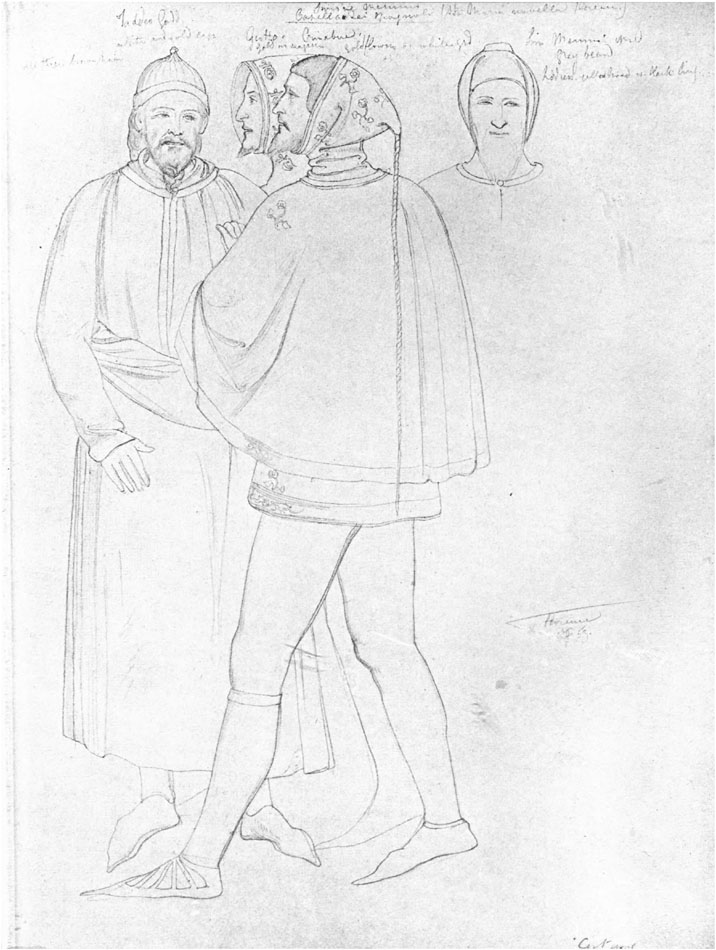
Portraits of Cimabue, Giotto, Simone Memmi, and Taddeo Gaddi, from Fresco in Capella Spagnola, by Taddeo Gaddi. Santa Maria Novella, Florence, 1853.ToList
Bath, August 13, 1854.
My dearest Freddy,—We are delighted to know you are out of Rome, for it is possible to have too much of a good thing; and much as you delight in "seeing the streets flooded with light and glittering under a metallic sky" (how beautiful it must be!), the pure air of the country, a less fierce heat, and a total change of scene, will, I trust, make a new man of you. How long a holiday shall you take, and did you mean that you are staying with the Sartoris family as a visitor? under all circumstances you will be a great deal with them, and as for the happiness you would so affectionately share with me, I would not, if I could, deprive you of a morsel of it; you are enjoying such unusual social advantages that it is a solace to me to know that you are capable of appreciating them. Thank God, you have no taste for what so many men of your age call pleasure, and that in spite of your sociable disposition, you always show good taste in the choice of your companions. I wish we could have a little of your society. The —— are still familiar and dear friends, but their minds are so different, so conventional, that many sides of your sisters' minds are closed, even to them.
The next letter from Leighton to his mother was written after he returned to Rome:—
(On cover—Mrs. Leighton, No. 9 Circus, Bath, England.)
Rome, Via Felice 123, January 19, 1854. (On cover—Arrived Jan. 6, '54.)
Dearest Mamma,—When I received your long expected letter, which, by-the-bye, took sixteen days reaching me, I was just winding myself up to write and tell you that I was sorely afraid some letter of yours must have been lost; I need hardly tell you that I was relieved of a considerable anxiety when I found that all was right, and that your letter, not mine, had been detained in that most slovenly of all institutions, the Roman post.
And now that I have taken up my pen, what a quantity I have to make up for in the way of congratulations, and greetings, and good wishes relative to days often and felicitously to recur! what jolly birthdays loom in the imagination, what Christmas Eves and Christmas Days, and old years going out and new ones coming, with a punctuality never known to fail! Alas! that I cannot send you some outward and visible sign of my inward sympathies and hearty yearnings; here would be a fine opportunity of enumerating an extensive catalogue of blessings which I sincerely wish to see showered down upon you, but that they can all be returned in one compendious, all-embracing word—Health! I therefore laconically but heartily wish you all that, positive or relative; and this leads me to mine. Well, let me confess it (unromantic as it undoubtedly is); I feel there is no shirking the avowal that, stamping all things down into an average, and squinting at little annoyances, I—must I say it?—am about as happy as the day is long: may my happiness reflect a little of its light on your days, dearest and best of mothers! I have begun my report of health by an average of my spirits; I think there is more à propos in this than one might at first sight imagine. I proceed to the other details which differ widely from your probable expectations; you ask me whether I leech myself with conscientious regularity. Now I don't leech myself at all! My reason for abstaining when I first came was that I feared so strong a measure till my spectacles should arrive that I might therewithal screen and protect my exhausted blinkers. It is only the other day that the said barnacles arrived, and as I have meanwhile gone on working day after day without great inconvenience to my eyes, I really think I might do myself more harm than good by drawing blood, the more so that I am by no means a person of full habit that I could spare much of that article.
On turning to your letter, I find the next point you touch is my music. I did indeed try my voice at the Hodnett's as you anticipated, but unfortunately I never by any chance had anything like a decent note in my voice during the whole time that I was in Florence; indeed at the very best of times it is the merest "fil de voix" that I have, which, however, would not prevent my cultivating it for my own private enjoyment, but for a circumstance which will astound you perhaps, but is nevertheless a great fact—to wit, that I can't afford it! The expenses of my pictures are far too considerable to allow of it this winter; next winter I hope to make up for lost time and still to be able to chirp some little ditty when I once more skim by the paternal nest. A piano I have, such a hurdy-gurdy! I fear, alas! I am an inveterate blockhead; I daily lament that you did not drub music into me when I was a child; I should then have broken my fingers in time; my youngsters shall most assuredly learn it with a stick in their minds' eye. As we were just talking of the ——s, I must mention that I founded my opinion less on what they say than on what I think and see; they could not either of them be happy if they could not have their bonnets and dresses from the most fashionable modiste, turn out drag of their own, and in every way be "the thing"; that they like me, I know, but I believe they would not have me if they liked me twice as much; I am not exactly poor, I admit, but I seem something like it in Florence, where it is the custom for young men to drive to the Cascine in elegant broughams or phaetons, to find their riding-horses at the round piazza, to prance and amble round the ladies, and then to drive home again in the style they went. But let me speak of more important things; you will be pleased to hear that my compositions have been highly approved of by all those whose opinion has weight with me. Cornelius said, the first time he saw them, "Ich sehe Sie sind weiter als alle Engländer ausgenommen Dyce;" that is a great compliment from such a man. I have made one alteration in my plans, of which Papa, I think, will not disapprove; I found, on more accurate calculation, that, in order to paint my Cimabue of such a size as to be admissible to the London Exhibition, the figures would be far smaller than my eyes would tolerate; I have therefore reversed the order of things, and am painting it on a large scale for the great Exhibition in Paris (spring, '55), in which all nations are to be represented, and where size is rather a recommendation than an obstacle. My "Romeo" I shall send to London in the same year; it will be a foot each way smaller than Lady Cowley's portrait; thus I also have the advantage of giving the Florentine picture a size more commensurate to the art-historical importance of the event it represents. With regard to the sale of it, I hug myself with no vain delusions. I paint it for a name; I could not have a finer field than is offered by the great International Exhibition in question. I must come to a close, for I expect a model immediately, and do not wish to miss to-morrow morning's post. La suite au prochain numéro.
Pray write soon, dearest mother, and tell me all I long to know about yourselves, the house, the furniture, your friends, and your dinner-party; meanwhile, having first largely helped yourself, pass up to all the dear ones very best love and kisses from your dutiful and affectionate boy,
Fred Leighton.
(On cover—Mrs. Leighton, 9 Circus, Bath, England.)
Rome, Via Felice 123, March 22, 1854. (Received March 31.)
Dearest Mamma,—As I see no chance of finding time to write to you in the ordinary course of things by merely waiting for it, I lay down my brush for this afternoon, and "set to" regularly pen in hand to answer your last, dated the fifth (let us be business-like), but which did not reach me till a few days ago. According to the egotistical practice which you have wished me to adopt, I begin with an account of myself: I am very much at a loss to tell you anything of my eyes that shall convey to you a correct idea of their state; one thing is certain, which is that their weakness bears no regular proportion to the work done; sometimes when I do little or nothing my eyes feel uncomfortable, and at others, when I do a great deal, I suffer nothing. For instance, yesterday, having a great deal of work cut out for the day, I worked eleven hours, with barely half an hour's respite at twelve, and, pour comble de méfaits, I did what I rarely venture on—I read at night; and yet I feel little or no inconvenience. The fact is, my eyes are the humble servants of my head, which is particularly sensitive; at the same time I hesitate to adopt leeches (unless, of course, Papa adheres to his opinion), because I don't feel as if I were over-troubled with blood; what do you think? My otherwise health is, thank God, very decent. I am not a robust man, but I jog on very comfortably, and feel very jolly, and I am sure I have a good many reasons to be so. About the hours I spend inactive, I don't feel that so severely as I did last winter, by any means; in the first place, I work till five or so (from seven or eight in the morning), then, you know, I dine at six, which I make rather a long job; then, in the evening, instead of tiring my eyes as I did last winter with dancing, which I have totally forsworn (there are more "whiches" in my letter than in the whole tea-party on the Blocksberg in "Faust"), I spend nearly all my time at the house of my dear friends, the Sartoris, where, I assure you, to pass to another point in your letter, I neglect no opportunity to cultivate my poor unlettered mind. It is indeed my only opportunity, for to study, alas, I have neither time, health, nor eyes, and the hopes to which you allude, and which I myself once entertained, must, I fear, be given up. The worst feature in my mental organisation is my utter want of memory for certain things, a deficiency of which I am daily and painfully reminded by the mention in my presence of books which I have read and enjoyed, and which I have utterly forgotten. My only consolation I find in the hope that I shall be able to devote myself with double energy to the art "proprement dit," and in the reflection that hardly any of the modern artists (alas, what a standard!), that have possessed extensive knowledge and varied accomplishments, have had them as a super-addition to the gift of art, but at the expense of their properly pictorial faculties; to every man is dealt a certain amount of calibre—in one man's brain it breaks out in a cauliflower of variegated bumps, in another's it flows into one channel and irrigates one mental tree, and "sends forth fruit in due season"—hem! Thus, whilst I paint, others shall know all about it; I shall be an artist, let them be connoisseurs. What did poor Haydon (for I have read the book) get by his mordant gift of satire and his devouring thirst for ink? He embittered old enemies, made new ones, estranged his friends, encouraged the fierce irascibility of his own temperament, allowed himself to cuddle the phantoms of undeserved neglect which always haunted him, distorted his own perceptions, and cut his throat! Without that pernicious gift, Haydon would not have written, the Academy would have hung his pictures as they deserved, for his early works were full of promise, they would have stood by him in the hour of need; had everything that he saw and heard not fallen in distorted images on the troubled mirror of his mind, he would, no doubt, have produced better works. Haydon might have been a happy man! With regard to the practical lesson to be drawn by myself, this painful book undoubtedly shows in a strong light the absurdity of always painting large pictures—a practice in which, I assure you, I have not the remotest idea of indulging. To one thing, however, which you observe, dear Mamma, I must beg to take exception, as involving a very important question: you say Haydon persisted in following the historic style, to the exclusion of pictures of a saleable size; now this would only avail as precedent against historical art on the supposition that that walk necessarily implies colossal proportions, than which idea (though Haydon seems to have entertained it) nothing can be more false. Is it necessary to mention Raphael's "Vision of Ezekiel," "Madonna della Seggiola," or a thousand other pictures, by him and others, which utterly confute any such notion? But even were it so, we must also not overlook the fact that the unsaleability of Haydon's pictures had its cause as much in their quality as in their quantity, and I will hold up to you, in contrast to his sad story, the case of Mr. Watts, who gives a sketch of the artistical character at the end of the autobiography, and who has as many orders for fresco as he can execute for a considerable number of years.
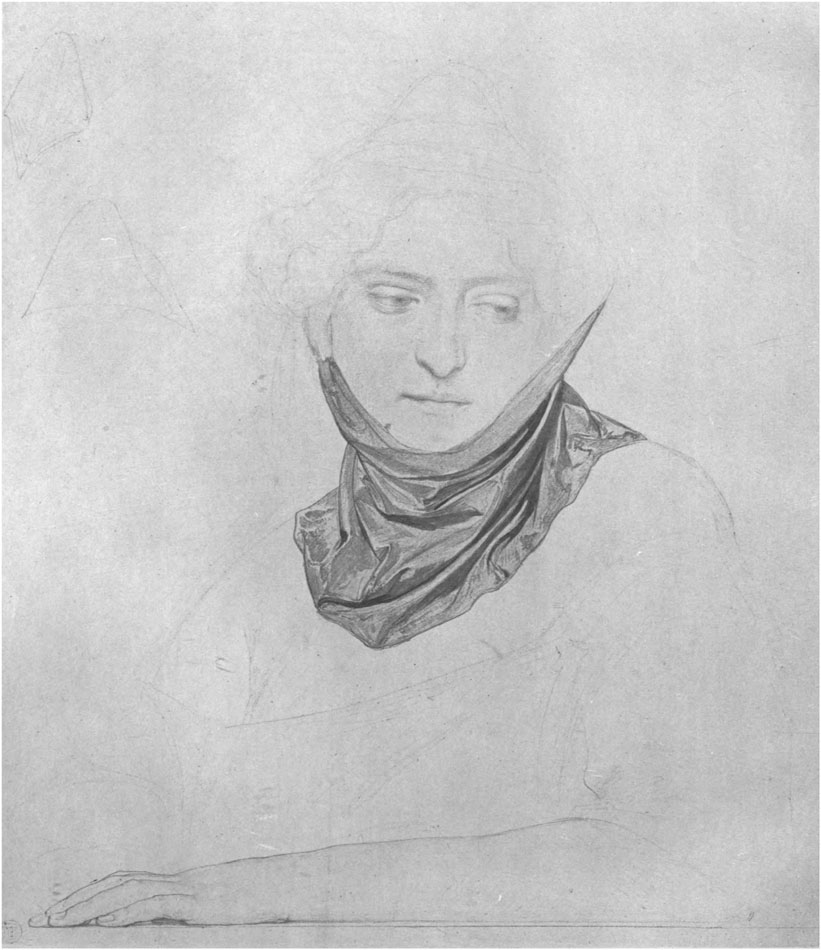
STUDY OF HEAD OF WOMAN AT WINDOW IN "CIMABUE'S MADONNA" Leighton House CollectionToList
Bath, April 17th.
My very dear Fred,—I have left a longer interval than usual between this letter and my last, for your convenience and my advantage; that is to say, that by arriving close on the time for your writing to me, the contents of this sheet, or anything in it needing comment, may not have escaped your memory till no longer wanted, for, with the best possible wish to be contented with the epistles for which I look forward so anxiously, I cannot help feeling a little disappointed when you do not answer inquiries. I do not wish to be unreasonable, my darling, in my demands on your time, but I cannot bear that your letters should be mere unavoidable monthly reports, and not what mine are to you, that is, in intention; though I make every allowance for natural infirmity. Could we but have foreseen your weakness of sight, I should have felt a great inclination to thrash you into exercising your memory more than you did, though I am not at all sure that the result would have been satisfactory; and with respect to music, I am convinced you would not have made a satisfactory return for any knowledge acquired by dint of birch, but—if it were not useless—I would enlarge upon the imprudence of having neglected your father's admonitions at a more recent period to store your memory; remember it for the sake of your own young people when you are the venerable papa of an obstreperous youth like yourself. I think upon the whole it is satisfactory that the uneasiness in your eyes depends on your general health. Papa thinks the sensation you describe when drinking must be nervous, and connected with the narrow swallow you inherit from me, a peculiarity which has shown itself in four generations. We do not feel so certain as it would be comfortable to do that the climate of Rome is the one best suited to a nervous person; but of course you will seek a healthy change of place as soon as the heat makes it desirable. I must remind you of the unpleasant fact that your constitution very much resembles mine; remember what I have come to, and do not trifle with yourself; do not say to yourself: What a bore Mamma is! I am constantly thinking of my precious absent son, and long, as only a mother can, to see you; when I look at your picture, I feel quite wretched sometimes that I cannot, though you seem alive before me, stroke your cheek and lean my head on your chest. The other day we were startled by the appearance in the drawing-room of Andrew, Lizzy, and the girls; and the first greeting over, "That's my saucy Fred," burst out of your aunt's mouth; "dear fellow, what a likeness;" and Lina was equally admired, and we all agreed in deploring Gussy's absence from the wall. I wish I could see your studies, for I suppose you have a great many for your great undertaking. Models are probably cheaper than in Germany—are you conscious of improvement? This seems an odd question, but it is suggested by the fact that while Gussy practises most diligently, she seldom seems conscious of the improvement I perceive distinctly. Do you see Cornelius from time to time, and gain anything from him? You never mention if you have any friends amongst the artists distinguished in any way.
Rome, April 29, 1854.
I have of late, since the underpainting of my large picture (at which I worked like a horse) given myself rest and recreation in the way of several picnics in the Campagna under the auspices of Mesdames Sartoris and Kemble. We are a most jovial crew; the following are the dramatis personæ: first, the two above-mentioned ladies; then Mr. Lyons, the English diplomatist here (whom your friend probably meant); he is not ambassador, nor is he in any way supposed to represent the English people here, he is only a sort of negotiator; however, a most charming man he assuredly is, funny, dry, jolly, imperturbably good-tempered; then Mr. Ampère, a French savant, a genial, witty, amusing old gentleman as ever was; then Browning, the poet, a never-failing fountain of quaint stories and funny sayings; next Harriet Hosmer, a little American sculptress of great talent, the queerest, best-natured little chap possible; another girl, nothing particular, and your humble servant who, except when art is touched, plays the part of humble listener, in which capacity he makes amends for the vehemence with which he starts up when certain subjects are touched which relate to his own trade; in other things, silence, alas! becomes him, ignorant as he is, and having clean forgotten all he ever knew![27] I shall not be able to leave Rome more than a month in the summer, as the work which I have carved out for myself makes it utterly impossible. You must know, however, that the hot months (July and August) are not the dangerous ones, but September, when the rains set in. During that month I shall give myself a complete rest from work, and shall go to the baths of Lucca, the healthiest spot in Italy, where I shall enjoy cool air, country scenery, and, better than all, the society of the Sartoris, who are going to spend the summer there; meanwhile, I shall take what precautions I can; I shall live as the Italians do, getting up early, and sleeping in the middle of the day, and shall resume flannel, if you do not advise the contrary, as I see reason to believe that it is a great preservative against fever. As for the general climate of Rome, I don't give it much consideration, as there is not the least probability of my ever residing here; I think there is not a worse place for a rising artist to set up his abode in than Rome, on account of the want of emulation as compared, for instance, to a place like Paris, where there are hundreds of clever men, all hard at work, and where an artist is always exposed to comparisons. It is impossible for me to give you any decisive answer about my progress, for you know I have been busy all the winter drawing studies; I shall see when I come to the picture itself what steps I have made forwards; I reckon on its being the best thing I shall have done, I can say no more. I believe Sartoris, whose judgment in all the arts is excellent, considers me the most promising young man in Rome; but that does not mean much—we shall see!
Of my daily life and occupations, I have little or nothing to say, as they are monotonous to a degree; parties, of course, have ceased, and I am just about to leave p.p.c.'s everywhere, as I don't mean to go into the world at all next year. I don't remember whether I told you that some little time back Mrs. Sartoris gave some tableaux and charades in which your humble servant co-operated; the whole thing was, I believe, very successful. The greatest treat I have had lately has been hearing Mrs. Kemble read on different occasions Julius Cæsar, Hamlet, and part of Midsummer Night's Dream; I need not tell you how delighted I was.
(Cover—Mrs. Leighton, Circus, Bath, England.)
Rome, May 25, 1854. (Received June 5.)
Very dearest Mamma,—Your letter (which I received the day before yesterday, and should have answered the next day but for an engagement I had made to go into the country) caused me great pain; if you have known me hitherto for a dutiful and loving son, believe that in this case nothing has been further from me than the least umbrage at the advice and suggestions that you always offer me with kindness and delicacy, and that I am much distressed at the idea of having in any way aggravated the discomforts which an English winter make you suffer; let me rather attribute, and beg yourself to refer, to the depressed state of your spirits any misconstruction you have laid upon a letter in which, if there was any constraint, it arose only from a desire to answer satisfactorily and systematically such questions as you asked me; I will endeavour in future to present my report in a more ornamental form. The delay, too, of my last letter arose from a misconception on my part of your expectations, for I was waiting and eagerly waiting for your answer to intervene, and, considering the irregularity of Roman posts, you can hardly have a day on which you particularly expect to receive news of me. Let me hope, dear Mamma, that on these points, as on the others that I am going to touch, you will be able in future to think more cheerfully, in spite of the distorting medium of British fogs. I fear from the tone of alarm I detect in your letter that I (myself perhaps, at the time, under the influence of the scirocco) must have conveyed to you an idea of greater ill-health than I labour under: my eyes, certainly, are not strong, so that I avoid using them at nights, and I am, as I ever was, incorrigibly bed-loving, but this is "the whole front" of my ailments; meanwhile I work all day with little or no annoyance. I am of good cheer and contented, and altogether more free from rheumatism than I have been for a long time; that, thus deprived of the means of reading, such little information as I ever had should have effectually made its escape from a noddle that never had the capacity of fixing itself on any one thing at a time, is deplorable, but not to be wondered at; let us hope for a better day. Nor is spending the hot months of the summer here in Rome so dreadful a thing as it appears to your tender anxiety; with proper precautions and a regular life I shall no doubt go through it as well as so many of my friends that have tried the experiment; the more so that the worst part of the summer is in September and early October, at which period I shall be enjoying the particularly cool and healthy air of Bagni di Lucca. How could you be surprised, dear Mamma, at my having begun the pictures? did I not tell you the size of them? do you not know the quantity of figures in the composition? do you not know that it will be considered a piece of extraordinary rapidity if I finished them in time for the Exhibitions, i.e. by the beginning of next February? You perceive the necessity of my staying here, willy nilly. The Sartoris seem to you too prominent a motive in my desire to stay; alas! and again alas! they are off to Lucca in a few days, and I shall be left alone. Judge whether I am eager to get off, and whether anything but necessity of the most urgent kind will keep me here, for I am warmly attached to both, and her I dearly love. Be quite at ease about the amount of advice I can get here, I do not lack that if I want it; but as it is, the compositions were so completely sifted by Steinle before I left Frankfurt, that I have nothing left but the material execution, in which you know every artist must fumble about for himself. Cornelius is very kind and amiable to me, has been to see me twice, and speaks well of me behind my back; he told Mrs. Kemble (Fanny) that there was not another man in England that could paint such a picture as my "Cimabue" threatens to be, and the same was unhesitatingly asserted by Browning, the poet, who is also a connoisseur. Such details as these from my mouth savour of intolerable vanity; they are not meant so, and I give you them simply because I think they will fall pleasantly on the ear of the mother of the daubster. To show you the revers de la médaille about advice from influential men, I will just tell you that I received the other day from Cornelius some advice which was diametrically opposed to that of Steinle, arrangez vous! Gamba and I are still capital friends, and he is making great progress, which is the well-earned fruit of his talent and assiduity.
Now, dear Mamma, you see how letters come to be dry; by the time you have shaken off the responsibility of question answering, and begin to breathe a little, you have got to the end of time and paper, and have no margin left for a little dessert; the fact is, your only chance is this: next time you write, ask me no questions, and then I'll devote my epistle to telling you a most thrilling story which, though it far surpasses in strangeness the common run of works of fiction, is perfectly and literally true, as I have it almost from headquarters; them's your prospects!—Meanwhile, with very best love to all, I remain, your affectionate and dutiful son,
Fred Leighton.
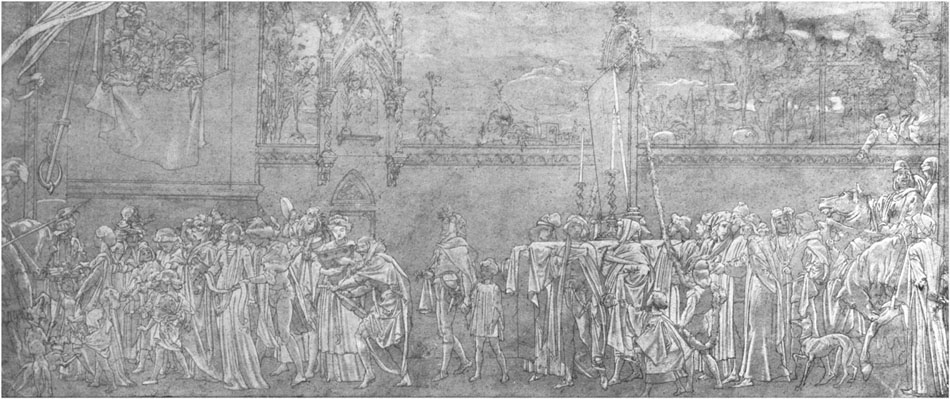
ORIGINAL SKETCH OF COMPLETE DESIGN FOR "CIMABUE'S MADONNA" Drawn in 1853 Leighton House CollectionToList
Translation.]
Rome, Via Felice 123, May 29, 1854.
Dearest Friend,—Delightful as it always is to me to receive any news of you, yet your last letter, along with pleasure, caused me some pain, for I could not help fearing that my long silence had annoyed you a little; if this should be indeed the case I must express my extreme regret, and beg you to believe that my gratitude and love can only cease when my memory ceases; how could it possibly be otherwise?
You paint me a very melancholy picture of the situation in Frankfurt; it is certainly a most unpleasant state of things, all this quarrelling and dissension! When I, at this distance, think of such a regular hermit-like way of going on, I feel quite disgusted; it is fortunate that you, dear Friend, have in the ecstasy of creation a resource that can never fail you. But how comes it that Hommel and Hendschel, formerly your enthusiastic pupils, have now cooled down? That is very incomprehensible; they do not know their own interests. I congratulate you most heartily on the completion of your large picture, which I am very sorry not to have seen finished, and I am especially glad to hear what you tell me about the shield-bearer, for that breathes to me of industrious study of nature! Believe me, that you, the mature master, who still consents to play the part of a student, will not be without your reward.
What you have written me about my work has put me into a most terrible dilemma, a dilemma which I am still very deep in. It is a presumption that I should set up my ideas, and a disobedience that I should take the advice of other friends, against your judgment; but I have gone so carefully into this manner of representation, that I beg you, dear Friend, to reconsider the matter, and see whether I am not right. These are my reasons: it seems to me that the action in my pictures, if ostensibly a triumph of the artist, yet, at the same time, as an historical event, is just as much the consecration of a Madonna, for which reason I (as you know) have placed the masterpiece which is being carried upon a small decorated altar; that such a solemn event probably took place on a church festival (as was the case with the consecration of the Chapel) may very well be assumed; would not such a festival in the thirteenth century be important enough to justify the presence of the bishop? But much more important than this question of historical probability, appears to me the consideration that the conception of a bishop is only made tangible to the general mass of spectators by certain symbolic articles of apparel, which are in some degree inseparable from it; a bishop's presence in the procession is most probable. Why should I not put him there? Amongst others, this opinion was also held by Cornelius, to whom, as an experienced Catholic, I naturally applied at the outset, and who told me candidly that he would leave it. I hope you will not accuse me of being too stiffnecked; in other respects I am certainly docile.
Since I last wrote to you I have been fairly industrious on an average. I have now under-painted "Romeo and Juliet" in grey (grau untermalt), made both the colour sketches, and have now fairly got into the over-painting, or rather second under-painting, of "Cimabue"; but I have not been always within four walls; on the contrary I have profited by the beautiful spring weather, and have often gone out into the divine Campagna with a party of dear friends, male and female, and I need not tell you that we have enjoyed it. I wish with all my heart you could be with us, my dear Master. Rico, the ever-industrious, for he does twice as much as I, sends you warm greetings. I must now close. I wish I could tell rather than write to you how you are loved and esteemed by your devoted pupil,
Fred Leighton.
Please remember me most kindly to your wife.
Translation.]
Frankfurt am Main, August 6, 1854.
My very dear Friend,—You have heaped coals of fire upon my head, for I have not answered your last dear note, brought me by André, and now I have received by Miss Farquhar the lovely study of Vincenzo's head, which you so kindly wish to present to me. I am almost dumfounded to find that you could believe I was angry with you because you have not written me for so long, and that you believe that the indignation had been ignored in my last note. That, dear friend, was a complete delusion, for there is nothing to which I am more partial than to artists' letters, and nothing to which I am more insensible than to such flattering praise as you lavish upon me, while I know only too well how unfortunately little I have deserved it. In earnest, dear friend, call me no more master, but rather regard me as your true and sincere friend, who only out of friendship for you and love of art, far removed from despicable dissimulation, faithfully shares with you his opinions and experience, and never regards them as the pronouncements of an oracle. I know very well what a difference there is between the description of a work of art and the sight of it; the first, at best, only gives one side, one part, whilst seeing places before our eyes the whole soul of the artist, from all sides, and then much is made mutually clear which in the former case appeared either not understood or misunderstood. Miss Farquhar could not tell me enough about you and your work, and greatly kindled my curiosity and desire to be in your atelier for once; I was only sorry that she had nothing to tell me about Gamba; indeed, on the whole, she knew nothing about him. If I am to express my thoughts of the very beautiful head of Vincenzo, it seems to me that Leighton ought to guard against striving for excessive fineness, for works of art can only be produced by quite the contrary method. A certain roughness must bring out fineness, but if everything is fine, nothing remains fine, &c. But believe, though this head half displeases me, especially on account of these theories, I think it beautiful and masterly in drawing, and am consequently proud to possess it, as I am of all that I have from your hand. I thank you a thousand times for this fresh proof of your friendship. About this place, let me be silent; you are right to say that art is my refuge, and that I find in it my compensation for much that goes ill here and everywhere; I must also not allow this asylum to be profaned by the trifles of the very human things that surround us in this world.
Greet from me Rome, Gamba, Cornelius, and all the friends who remember me; and to yourself, dear friend, heartfelt greetings from your true and unchanging friend,
Edw. Steinle.
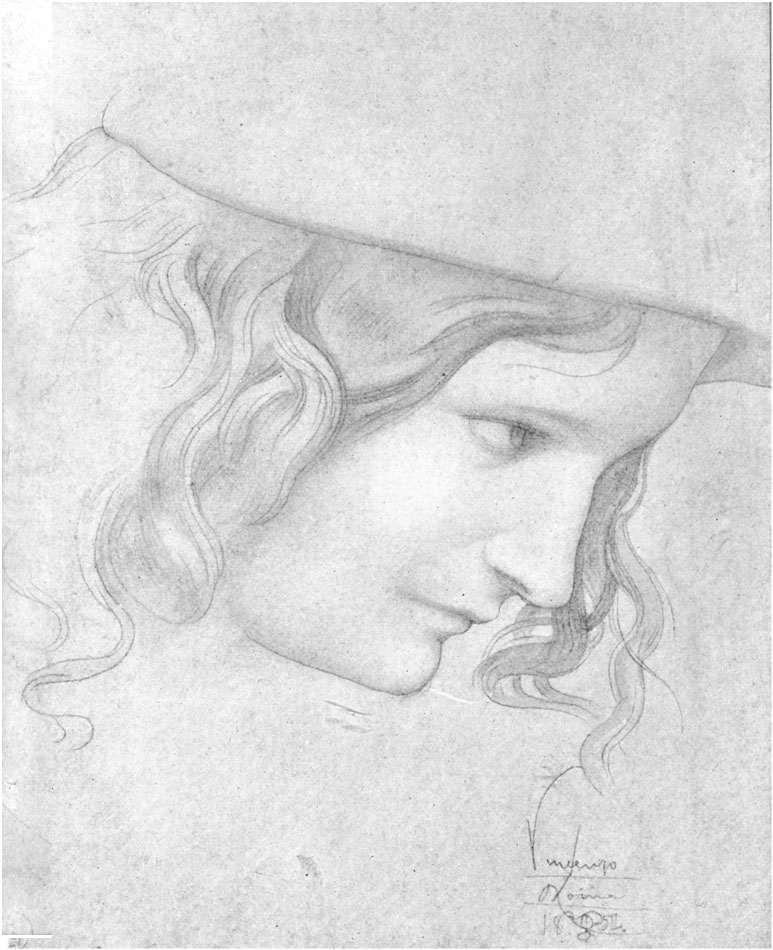
"VINCENZO, THE PRETTIEST AND WICKEDEST BOY IN ROME." 1854 Leighton House CollectionToList
Before leaving Rome Leighton received the following characteristic letter from Mr. Cartwright, one of his truest life-long friends:—
Carlsbad, July 11, 1854.
My dear Leighton,—You will be astonished to see a letter from me. I can assure you that I have often thought of you, and meant to indite you an epistle in the hope of eliciting a reply full of Roman tale from you, and lately, when through Papeleu I heard of your great canvass labors, my yearning got a new twinge which at last has been pinched into expression by the start at Pollock's resuscitation. I had heard of his death in Paris and had mourned his fate most sincerely, when the first man whom I met tramping health out of the hot water of Carlsbad was Pollock himself. He is himself again every inch of him; indeed a most wonderful recovery; and, after deep and valorous potations of hot water, we take long walks in the hills. He goes from here to Marienbad and Prague, and means to be back in Rome by the end of October. And I also mean to return there. Like a true drunkard, I can't forswear my bottle, and I must have another pull at it. We shall be there, I hope, in the beginning of October, and I hope, my dear Leighton, that you will not grudge me the pleasure of letting me have a few lines, so that I may know whether you will be there in the winter and what are the changes in Rome since my time. Are the Sartorises to be there next winter, and where are they now? Pray answer me this, as I particularly wish to know where they are. I have heard that there were such crowds of strangers at Rome last winter that quarters were not to be had; and for this reason I wish to be there early. Do you happen to know what is the price of the floors in the house on the Pincio which was built by Byström the sculptor? Next to the Trinità, immediately after the sculptor's studio, there is a small house inhabited when I was last in Rome by some French officers (at least a sentinel was at the door) and years ago by Mrs. Sartoris. Pollock tells me it is now to be let. Would you be kind enough to give me any information you can about it. It is a house I have often coveted on account of the view. I beg your pardon for my coolness; I hope you will bear kindly with it; if I can do anything for you in Paris, command me: but anyhow pray write to me, if only a few lines, for in my heart I wish to have some news about you and old Rome. The other day I saw at the Louvre our old friend the very questionable Vittoria Colonna which was at Minardis. It was for Exhibition there in the Gallerie d'Apollon: what the picture is I cannot pretend to pronounce, but I do not like it: it is a picture in which I have no confidence. I think that if not a made picture, it is at all events a tame one. This year there was no Salon as it has been put off till next year's great Exhibition. Robert Fleury has sold a picture to the Luxembourg which is not so good as his former ones; but the man who I think is the most marked one of the day is Conture. Excuse my scrap, and pray take pity on my longing and write me, were it only a line. I should be grievously disappointed were you to refuse me the pleasure. I shall be here till the 7th August; until the 25th August, after that date letters will find me Frankfurt Poste Restante; and after that in Paris Poste Restante. If you write here, put Carlsbad—Böhmen—and in a corner, Austria. And now farewell; with a real ... I am longing for a letter. The kindest regards to my Caffé Greco and other friends.—Yours most sincerely,
W.C. Cartwright.[28]
After his stay at the Bagni di Lucca, in the summer of 1854, Leighton went to Frankfort, Venice, and to Florence, returning to Rome in October.
In the following letter to Steinle are sentences it might be well to print in finest gold, for the benefit of students who try to run before they walk, who aim at the freedom and glorious inevitability of a Velasquez touch without taking the pains to equip themselves worthily to enter the lists with the giants; not realising that skipping over the underpinning, necessary in creating any work of art, must result in the shakiest of edifices. The sentence refers to the criticism in Steinle's letter of August 6, 1854, on the drawing of "Vincenzo" (called by Leighton "the prettiest and wickedest boy in Rome") which Leighton had sent him.
Translation.]
Rome, Via Felice 123, October 22, 1854.
As I am making a short pause to-day in my work, I cannot employ it better than in writing a letter to you, my very dear Friend. It was a very great comfort to me to see by your last lines that you had not construed my former long silence as a cooling of my friendship and gratitude, and I therefore hope that you will also this time meet me with the same forbearance. You will certainly be interested to hear, my dear Friend, that both my pictures are by this time fairly forward, and I expect to finish them within three months. How much I wish that you could see them here, and that I could put in the finishing touches under your supervision! I would give you an account of my work, but, bless me, what is there to tell about my picture, except that it has given me a fearful amount of trouble, and that in the end one perceives how circumstantially one has gone to work on the whole matter; the "Cimabue" goes to London and the "Romeo" to Paris. While I am speaking of my works, I take this opportunity to touch gratefully upon your kind remarks about the study head of Vincenzo, and to inform you, however, that my opinion of it takes rather more the form of a question than that of an objection. I have often considered the question of the self-guidance of an artist who is left to his own devices, and it has often struck me how many wander in evil by-paths through an unorganised, may I say unprogressive, development of their gifts; and now it seems to me that most of them are wrecked because they maturely study the object to be attained, while the means are not considered which should lead to such results. For example, a young man sees a Raphael, a Titian, a Rembrandt, all in their latest manner, and hears people say: See how broad, how full, how round, how masterly! And the student naturally conceives the wish that he also might produce broad and masterly works, and so far he is right; but from that point he goes aside. He goes home and strives and strains after masterly breadth; he succeeds (apparently), and he is lost. The soap-bubble is quickly blown; he rejoices in its gay colours; it flies up and breaks in the air. And the cause is simple; the true, genuine mastership is not an acquired quality but an organised result. As with art itself, so is it also with the individual artist. If we cast an eye over the progress of art-history, we see how the full, conscious, free, has developed itself out of the meagre, timorous, scrupulous, dry. Similarly if we compare the first efforts of the individual with his last, we perceive the same thing: place M. Angelo's "Pinta" beside the decorations of the Sixtine, one of Raphael's works at Perugia beside the "Stanzen," Rembrandt's "Leçon d'anatomie" beside the "Nightwatch," and it will be evident in the most striking manner that not one of these men had risen by means of his talent to full breadth in his youth, or had been in any way studious to do so, but on the contrary that they have attained mastery by natural growth. In order, therefore, to reach the same altitude, the young artist must proceed in the same manner as his exemplars, and must endeavour so to direct his studies that he, according to his gifts, may achieve a similar result. He who would fill his threshing-floor must not glean, but rather he must sow that he may richly harvest; he who would have rare fruits all his life must plant and cherish the tree; even so should the young artist seek to plant a tree the normal fruit of which is called "artistic perfection." You will easily understand how by the application of these maxims my preliminary works go forward rather timorously. Entire conscientiousness is now the chief thing to me. I am laying the foundation on which I hope to rely firmly later on; I am amassing capital and am not yet in enjoyment of the interest. "How many objections to a couple of words?" you will laughingly remark; dear Friend, I must feel myself indeed well equipped before I permit myself to oppose anything against your judgment.
Of Gamba I will say nothing, for he is going to enclose a few lines in this.
I have made a trip to Florence this summer, and again thoroughly enjoyed the art-treasures. I think I have spoken to you of the wall-paintings by Giotto which were discovered two years ago in Santa Croce; one of them, which represents the death of St. Francis, is the literal prototype of the celebrated fresco by Ghirlandajo (on the same subject) in the Sta. Trinita, and I really prefer it.
Time, eyes, paper fail me, and I must close. I hope that, if you write to me again, you will tell me exactly what you are doing.—Meantime, dear Master, accept the heartfelt greeting of your grateful pupil,
Fred Leighton.
Please remember me most kindly to your wife and to all my friends.
Leighton's eye trouble having become a constant anxiety and hindrance to him, he resolved to consult Graefe, the great German oculist. From Florence, on his return journey, he writes his impressions of Berlin to Steinle. In this letter he repeats again the sense of happiness which he always experienced in Italy.
Translation.]
Florence, 386 Via Del Posso, November 13.
My very dear Friend and Master,—At last I am able to write to you. In the hurry and bustle of travelling, and even in the short sojourns that I have made here and there, it has been impossible for me to sit quietly down and compose a letter. Even to my parents I have written this morning for the first time since I left Vienna. But you will readily believe that during this time I have often travelled in thought to Frankfurt in loving remembrance of you, my dear Friend.
Strange things have happened to me since I saw you. I had not even reached Berlin when I was informed by a "jebildeten" (cultivated) Prussian that Graefe, on whose account exclusively I was travelling to the "geistreichen" (clever) capital, had gone away for an indefinite period; imagine my dismay! Luckily on my arrival I found an old friend who was acquainted with the family of Geheimerath von Graefe, and who found out through them that Graefe must arrive at the Golden Lamb (Leopoldostadt) in Vienna on such and such a day. I met him, and had a consultation at which he examined my eyes with the ophthalmoscope, and told me to be of good cheer, my trouble was certainly obstinate but in no way dangerous, and I might hope for a complete cure. He prescribed me a course for Rome, which consists principally of local blood-letting and wearing spectacles, and will be very tedious; but I will gladly conform to anything in order to get my eyes back again. One thing is certain, since I have been in Italy they have been quite markedly better, which I attribute for the most part to the diminution of my hypochondria. Yes, since I have been in Italy I have become a new man; I breathe, my breast throbs higher; heavy clouds have rolled away from me; the sun shines again on my path, and my heart is once more full of youth and love of life; if only you were also here, dear Friend!
But I must tell you something about my German travels, and I will begin with Berlin. There is certainly something special about that town. At the first glance it is somewhat imposing, and the prodigious quantity of new buildings, which evidently aim at architecture, gives (one may hold one's own opinion as to the taste of the buildings) the appearance of great artistic activity and of a widespread taste for art; but I have since found reason to regard this apparent love of art as something feigned or forced. One gets quite sick of education in Berlin; would you believe that now every girl has to pass an examination as governess?[29] Kaulbach understands the Berliners well; in Raeginski's house a study of a Roman piper hangs in great honour, which he has purchased from the great master on account of a doggerel verse which is written on it in large letters, and runs thus:—
"Upon my travels in Italy, This little boy I found, but he, Although my brush may his form repeat, Remains to my sorrow incomplete."[30] —W. Kaulbach.
Divine! eh? I knew a counterpart in the Belgian art-world. When I visited Gallait in Brussels some years ago, before the door stood a ragged, most picturesque Hungarian rat-catcher, who asked me if an artist did not live there. Recently I saw my Slav again, with a violin under his arm, in a window, very finely lithographed, I believe even an "artistes contemporains"; in the corner was "Louis Gallait pinx"; underneath, "Art et Liberté"! Thus do pictures originate!
In Berlin everything is valued extrinsically. One sees that most strikingly in the new Museum. When it is finished, it will be, in proportion to the means of the town in which it stands, the most splendid that I know; moreover, it cannot be denied (unsuitable as a three-quarters Greek building may be on the banks of the Spree) that much in the architecture is even very beautiful. But what is the good of it all? With the exception of some Egyptian antiquities, in all these lavishly gilded and painted rooms there are only plaster casts! Yes, and, I must not forget it, the great tea-service of Kaulbach. A wretched thing, made, moreover, with superfluous productiveness; simple allegory carried out without any fine sense of form, with utter denial of all individuality, and painted—well, of that one would rather say nothing; and yet "Kaulbach has the Hellenic art," &c. &c., and all the rest that is in the papers. One would like to exclaim with Cassius: "Has it come to this, ye gods!"
Unfortunately I cannot praise the Cornelian things in the old Museum much either. I must confess they displeased me greatly; when I consider them from a distance in their connection with the building, I find them disproportioned; in a long, very simple colonnade, built on a large scale, I require of a fresco painting that it shall show in form and colour large, quiet, plastic masses; instead of that I see here a gay, unquiet, confused fricassée of thought and allegory that makes one dizzy; ideas in such profusion that nothing remains with the spectator; he goes away without having received anything; nor is the mental impression plastic. If, however, one goes nearer to see the execution, again one finds nothing pleasing—a constrained, unlovely drawing—positions that could only be attained by complete breaking on the wheel—a general appearance as if the figures had no bones, but muscles made of brick instead. The colour is not much better than Kaulbach's. The end-piece on the right, an allegorical representation of the death of man (or something of the kind), gives the most ordinary and at the same time most awkward sudden impression that I have yet seen. Cornelius may look at the Vatican in Rome and see if he can find anything like it there. Altogether the once certainly great artist seems to have somewhat deteriorated; the Cartoons at the Campo Santo are not by a long way so good as the design (which I find charming in parts); they are here and there, which greatly surprised me, disgracefully out of drawing; and then the theatrical attitudes, conventional clothes, &c. &c. In the Museum itself there are few pictures of the first rank, but so much the more beautiful are those by masters of the second rank. What a Lippi! what a Basaiti! what a Cos Rosetti! I was entranced; that is art, character, form, colour, all in beautiful harmony. The "Daughter of Titian" does not deserve its celebrity; it is weak and dull.
But my paper is exhausted, as are also my eyes; I will therefore defer the rest to another letter, and only mention that in Vienna Kuppelwiesser, Führich, and Roesner received me like a son of the house, and all sent hearty greetings to you. Do write to me very soon, dear Friend, and keep in kind remembrance your grateful, devoted pupil,
Fred Leighton.
My address is, Poste Restante, Rome.
Please remember me most kindly to your wife, and generally to all friends.
When tracing the ever-swaying ebb and flow in the tides of joy and sorrow in a life, we come to times which seem to accumulate in their days the whole strength of feeling and vitality of which a nature is capable; prominent summits that rise triumphant out of the troublous waves, up to which the past existence has seemed to climb, and the memory of which retains a dominating influence in the descent of the future.
"I—h'm—must I say it?—am just as happy as the day is long." So wrote Leighton to his mother when at the age of twenty-three he was spending his days in and about Rome—that wonderful Rome with her world of ghosts, her solemn eventful past skimmed over and made faint by her actual sunlit present. To Leighton that sunlit present became vividly, excitingly alive. Fountains of joy were springing up in the artist-nature, catching as they sprang golden rays from all that is most beautiful in youth's dominions. Leighton writes to Steinle (July 25, 1853): "The remembrance of the beautiful time spent there (Rome) will be riches to me throughout my life; whatever may later befall me, however darkly the sky may cloud over me, there will remain on the horizon of the past the beautiful golden stripe, glowing, indelible; it will smile on me like the soft blush of even."
When, in the late autumn of 1852, he first arrived in Rome, he had just stepped from the position of being one in a family to that of being an independent unit; and, though accompanied by his brother artist, Count Gamba, he felt greatly the loss of what he had left behind—the inspiring companionship of Steinle, compared to which nothing in Rome was worthy to count as an art influence. Obliged to work in a small, inconvenient studio, the only one obtainable—expected friends, whose society he valued, failing him—he felt the want of so much that he could hardly enjoy what he had. In those first days (as we gather from his letters) the Eternal City cast no fresh glamour over his spirit.
Spring came, and the tune changed with the entrancement of Persephone's release in the balmy warmth of the South. The spring air twinkles with sunshine, and the fruit-trees are again alive with gay blossom, of fluttering petal, frail as the soft moth wing; the villa gardens are again bedecked with grand, more solid petalled flowers—brilliant-hued camellias—and later,—the noble magnolia's ivory white goblets; while the ground is carpeted with violets and varied-hued anemones. All over the wild spaces of the Campagna spring up grasses and lovely unchequered growth, spreading a green and golden fur, bristling in the bright light for miles and miles under a cloudless sky away to the faint blue line of mountains on the horizon. On one summit—golden in the sunlight—the old town of Subiaco is poised; on nearer slopes—summer haunts of the ancient Roman world, Tivoli, Frascati, Albano: the wastes of budding herbage between checked only here and there by some spectre of old days, some skeleton of a broken archway, some remnant of a ruined wall.
It was on these strange wilds of the Roman Campagna that the life-long friends, Giovanni Costa and Leighton, first met. Here is the description of the delightful scene of their meeting, and of Leighton's previous introduction to Costa's work at the famous Café Greco, written by Costa after his friend's death:—
"In the year 1853, the Café Greco at Rome was a world-renowned centre of art, a rendezvous for artists of all nationalities, who had flocked to Rome to study the history of art as well as the beauties of nature surrounding the sacred walls of the Eternal City.
"At the Café Greco[31] there was a certain waiter, Rafaello, a favourite with all, who had collected an album of sketches and water-colours by the most distinguished artists, such as Cornelius, Overbeck, Français, Bénonville, Brouloff, Böcklin, and others, and I felt much flattered when I too was asked to contribute, with the result that I gave him the only water-colour I have ever done in my life. Leighton was also begged by Rafaello to do something for the album, and having it in his hands, he saw my work, and asked whose it was. On being told, he advised Rafaello to keep it safely, saying that one day it would be very valuable. When I came later to the Café, Rafaello told me how a most accomplished young Englishman, who spoke every language, had seen my water-colour, and all he had said about it. I was very proud of his criticism, and it gave me courage for the rest of my life.
"That same year, in the month of May, the usual artists' picnic took place at Cervara, a farm in the Roman Campagna. There used to be donkey races, and the winner of these was always the hero of the day. We had halted at Tor dé Schiavi, three miles out of Rome, and half the distance to Cervara,[32] for breakfast. Every one had dismounted and tied his beast to a paling, and all were eating merrily.
"Suddenly one of the donkeys kicked over a beehive, and out flew the bees to revenge themselves on the donkeys. There were about a hundred of the poor beasts, but they all unloosed themselves and took to flight, kicking up their heels in the air—all but one little donkey, who was unable to free himself, and so the whole swarm fell upon him.
"The picnic party also broke up and fled, with the exception of one young man, with fair, curly hair, dressed in velvet, who, slipping on gloves and tying a handkerchief over his face, ran to liberate the poor little beast. I had started to do the same, but less resolutely, having no gloves; so I met him as he came back, and congratulated him, asking him his name. And in this way I first made the acquaintance of Frederic Leighton, who was then about twenty-two years old; but I was not then aware that he was the unknown admirer of my drawing in Rafaello's album. I remember that day I had the great honour of winning the donkey race, and Leighton won the tilting at the ring with a flexible cane; therefore we met again when sharing the honour of drinking wine from the President's cup, and again we shook hands. When I heard from Count Gamba, who was a friend and fellow-student of Leighton's, what great talent he had, I tried to see his work and to improve our acquaintance; for as I felt I must be somewhat of a donkey myself, because of the Franciscan education I had received, and because I was the fourteenth in our family, I thought the companionship of the spirited youth would give me courage."
And again it was on the Campagna that that choice and delightful company picnicked in the spring-time of the year, of which company Leighton wrote on April 29, 1854 (see p. 146).
Who knows but that it was at one of these notable picnics that Browning was inspired to write his wonderful little poem on the Campagna?
"The Champaign, with its endless fleece Of feathery grasses everywhere, Silence and passion, joy and peace, An everlasting wash of air— Rome's ghost since her decease. Such life there, through such lengths of hours, Such miracles performed in play, Such letting nature have her way, While Heaven looks from its towers."
Life was full to overflowing in those inspiring days, and Leighton was indeed "as happy as the day was long." Friendships grew apace. Many were made which were lasting, notably that with Mr. Henry Greville, the most intimate man-friend of Leighton's life. His friendships with Sir John Leslie, Mr. Cartwright, George Mason, Mr. Aitchison, Sir Edward Poynter, all began in those early happy days in Rome. Artists living there, who included this gifted brother-painter in their comradeship, showed more and more sympathy towards his work as they became more intimate with the delightful nature. Leighton had arrived so far forward on the threshold of his success that anxiety about his pictures was outweighed by hopeful expectancy; but it was while still standing on the threshold—that really most inspiring of all stages in the journey, during the two years from 1853 to 1855, before the great triumph of signal success crowned him—that we catch the happiest picture in Leighton's life. To use his own words, "In this world confident expectation is a greater blessing, almost, than fruition."
In a letter he wrote to Fanny Kemble on February 1, 1880, Leighton refers to a conversation he had with her at this "outset of his career"—a conversation which recurred to him, he tells her, when he first addressed the Royal Academy students from the presidential chair in 1879. He offers a copy of his discourse for her acceptance, ending his letter by the words: "If you remember that conversation, you may perhaps feel some interest in reading the Lecture, of which I ask you to accept a copy. If you do not remember it, nevertheless accept the little paper for the sake of old days which were not as to-day."[33] How much can a few words say! If gratified ambition could ever make an artist-nature happy, how transcendently happy Leighton ought to have been in 1880! But the fibre which strung the highest note in his nature never vibrated to worldly success. Though his ambition may have sought success, and his passion for fulfilling to the utmost his duty towards his fellow-creatures may have greatly welcomed it, he remained to the end of his life ever on the threshold of that kingdom, the possession of which could alone have satisfied what he "cared for most."
The following letters mention the progress of the opus magnum to its completion, also of the "Romeo" picture, and his visits to Florence and the Bagni di Lucca. The first begins by his expressing his ever-growing dislike of general society.
[Commencement missing.]
Miss —— is no less than ever, and no less agreeable, as far as I can judge; I have only called once as yet, I have an ungovernable horror of being asked to tea; my aversion to tea-fights, muffin-scrambles, and crumpet-conflicts, which has been gathering and festering for a long time, has now become an open wound. The more I enjoy and appreciate the society and intercourse of the dozen people that I care to know, the more tiresome I find the commerce of the others, braves et excellentes gens du reste; the Lord be merciful to the overwhelming insipidity of that individual whose name is Legion—the unexceptionable—the highly respectable! My great resource is, of course, Mrs. Sartoris, whom I see at some time or other every day, for it would be a blank day to me in which I did not see her; God bless her! for my dearest friend. I warm my very soul in the glow of her sisterly affection and kindness. Little baby is the same sunbeam that he always was; did I tell you I painted his likeness in oils as a surprise for his father? as a picture it is not unsuccessful, but any attempt at a portrait of that child is a profanation, and will be till we paint with the down of peaches and the blood of cherries, and mix our tints with golden sunlight; still, it pleased them, and that ought to be enough; but I am an artist as well as a friend. A very interesting acquaintance I have here in the shape of Rossini, the great Rossini! Poor Rossini, what a sad fate is his, to have lived to see the people on whom the glory of his splendid genius has shone turn away from him in forgetfulness, neglecting his classical beauties to listen to the noisy trivialities of a ——, who has made the Italian name in music a by-word of ridicule; with the music of course, the singers have degenerated also; a singer no longer requires to be an artist, it is no longer necessary that he or she should study his or her part till every note has a meaning and a character expressive of the words of the libretto, and accompanied by musical and impassioned mimica; no, let the prima donna only squall out her never-ending fioriture with sufficient disregard for the safety of her lungs, or the primo tenore shake the stage with a la di petto, and all is right. This is a digression, but as an artist I can't help taking it to heart, and wanted to have it out. Amongst Mrs. Sartoris' few "intimes" at this moment is a Neapolitan lady, la Duchessa Ravaschieri, daughter of Filangièri the minister, who has given her himself an education almost unique amongst Italian noblewomen, who are insipid and ignorant beyond anything.
Florence, Hôtel Du Nord, September 20, 1854.
Dearest Mamma,—I was much surprised, as we very naturally measure time past by the number of events that have taken place in it, the interval between this your last letter and the previous one seemed to me doubly long, for I have changed scene so often during these last four or five weeks, and have moved so much from place to place, that it seems to me an age since I last despatched a letter to England; from which you will naturally and correctly infer that it was a very great pleasure to me once more to see your handwriting. Your kind anxiety and advice about the cholera I shall remember when I get to Rome (which will be in a week or ten days), where that disease prevails, although mildly, for what are thirty cases a day in a town of that size? In the meantime, both at the baths where I have been, and at Florence, where I am, the cholera has not dared to show its face; indeed, such a prestige of salubrity attaches to the name of the baths of Lucca that eight days' sojourn at that place is considered tantamount to a "quarantaine!" It is a very strange thing, this exemption from disease, for in a number of the surrounding villages the number of people carried off has been frightful. As for that after apprehension of yours, dearest Mamma, about my being alone and uncared for in case of illness, I am happy to say that nothing can be more unfounded; I have in Mrs. Sartoris that genuine friend, and, especially, genuine woman friend that in such a case would leave nothing undone that you, the best of mothers, and my own dear sisters, would do for me. It is her habit, when any of her bachelor and homeless friends are poorly, to go and sit with them and nurse them, and do you think that I, who have become one of her most intimate circle, should need to fear neglect? In the friendship of that admirable woman I am rich for life. Poor thing, she has lately received a great blow in her own family from the sudden calamity which has befallen her. This shocking news reached me here, at Florence, where I had come on from the baths, and ascertaining that her husband was gone off to England to inquire into the matter, and that by a chance her boy's tutor was absent at the same time, I instantaneously went off to Lucca, where I stayed a week (till the return of the tutor), taking care of her boy, hearing him his lessons, and especially keeping him out of the way; in the evening I used to walk or drive with her, and to my infinite gratification was able to be some little comfort and distraction to her; my only regret in the whole business was that I was making no material sacrifice of my own time and pleasure, so that I had not the satisfaction of comforting her at my own expense. In adopting the resolution, which I have communicated to you, of retiring from society, I have taken into consideration all that you say, dear Mamma, and more too, for I feel I have of my nature a very fair share of the hateful worldly weakness of my country-people; still, I have found no sufficiently great advantage or compensation for the tedium of going out; the Roman grand monde, a small part of which I know, and which, had I chosen to push a little, I might have known all, is of no use whatever in reference to my future career; added to which I believe I told you that I never by any chance got introduced to anybody, so that whomever I know, I know by chance, or by their own wish. For instance, last winter I met the Duke of Wellington constantly, both at the Sartoris' (he is a very old friend of hers) and at the Farquhars', and though he is the most accessible of men, I made no attempt to make his acquaintance, and so it is with everybody. But for the tableaux charades which Mrs. S. gave last winter, in which I was joint-manager with herself, and was therefore brought into contact with her numerous co-operating friends, I should probably have known few or none of those who were at her house every week; always excepting our own intimate circle, to wit, Browning, Ampère, Dr. Pantaleone, Lyons, Count Gozze, Duke Sermoneta, &c. You know, when I say I shan't go out, it is in so far a façon de parler, that, as I shall be at least every other day at Mrs. Sartoris', I shall not be at home, trying my eyes. I quite agree with you in thinking this business of ——'s a most awkward thing; I cannot understand a man having once gone into the army and made his profession to be honourably killed for his country, should not jump at the idea of going to the scene of war; I have felt a very strong desire to lend a hand myself, but one cannot drive two trades. My singing (in particular, and music in general) I have avoided mentioning, because, dear Mamma, it is a subject on which I have no reason to dwell very complacently; my first disappointment was finding my voice, instead of strengthening in an Italian climate, getting if possible weaker than it was. It is the merest "fil de voix." I have therefore as the onset very insufficient "moyens"; this is owing, not only to the insufficiency of my "organe," but also to an unpleasant visitation in the shape of swollen and irritated tonsils, the very ailment, I believe, under which Gussy labours. This symptom, which I have carried about some time, is, I fancy, not likely ever to leave me permanently; add to this that as soon as I sit down to thump with elephantine touch a most ordinary accompaniment, the little voice I have vanishes; thus between two stools ... you know the rest. Still, I am bound to add that Mrs. Sartoris (who could not flatter) has great pleasure in hearing me coo a little song or two that I know, and says I have what is better than voice, which is a musical "accent," and that (she is pleased to add) to a rather remarkable degree; my voice is weak and powerless, but true and facile. I will tell you exactly what to expect when you see me again. I shall be able to sit down to the piano and whine some half-dozen pretty little ballads, with a rum-tum-tum accompaniment of affecting simplicity. Gussy dreams of me as "very handsome" and "are my whiskers growing?" I am not very handsome, none of my features are really good. My whiskers have grown, they are undeniable, there is no shirking them, or getting out of the way of them; I wear whiskers though you were short-sighted; but they are modest ones; as for moustaches, the seven hairs which I have (and wear) are not worth mentioning, but still I have none of that delicacy which you profess on the subject. In my opinion, if gentlemanhood is a thing dependent on the scraping of four square inches of your face, and residing only in the well-shaved purlieus of a (probably) ugly mouth, I feel equal to going without it, in that shape at all events. A moustache, and even a beard, if kept short enough to be in keeping with a not very flowing costume, is both becoming and convenient, and I fear that the whole prestige of respectability hovering around Mr. and Mrs. ——, or the withering contempt of the irreproachable Sir John and Lady ——, would not make me shave, unless, indeed, I felt too hot about the chin. I have gone through your letter, and shall wind up with a few words about my doings, which, by-the-bye, might be compendiously characterised by one word: nothing. My holidays are drawing to a close, and I shall be in Rome, working very hard to get my pictures done for the Exhibitions. Meanwhile I am enjoying Florentine sunsets, the gorgeousness of which defies description. The other day, in particular, I was on the heights near the Miniato, I thought I had never seen anything like it. I remembered Papa's fondness for that spot, and wished he had been there to share my enjoyment; the lanes were cool and pearly grey; over them hung in every fantastic shape the rich growth of the orchards and gardens that crowned the lengthened walls; the olives, strangely twisted, flaming with a thousand tongues of fire; the wreathing vine flinging its emerald skirts from tree to tree; the purple wine flashing in the fiery grape; the stately maïs flapping its arms in the breath of the evening; the solemn cypress; the poetic laurel; the joyous oleander—all glorified in the ardour of the setting sun, that flung its rays obliquely along the earth; you would have been enchanted.
Rome, Via Felice 123, February 10, 1855.
Dear Papa,—I hasten to answer your kind letter and to thank you for the willingness you express to advance such a sum of money as I shall require to cover the heavy expenses I am incurring. I forgot to mention in my last letter that my picture will be directed straight to the frame-maker's who undertakes the exhibiting of it.
In approaching the other points which you touch in your letter, I feel that my letter will unavoidably have a combative colouring, which I sincerely hope you will not misconstrue, and beg that you will consider whether the reasons I advance for not conforming to your suggestions are not sound ones. If I particularly object to accompanying my picture, it is because I think that the small advantages that might accrue from so doing would in no way make up for all I should lose; whatever can be done to my picture on its arrival in England will be kindly done for me by my friend, Mr. T. Gooderson, who is in the habit of receiving and varnishing Buckner's works on similar occasions; with respect to the interest to be made amongst the Academicians in behalf of my op. magn., I have neglected that on the express advice of Buckner, who has great experience in those matters and is a most kind and honest man; he says, such is the party spirit of R.A.'s, that the best chance of securing impartial treatment (in the case of a work of merit) is to be completely unknown to all of them, a condition which I am admirably calculated to fulfil. You are also perhaps not aware that my picture will reach England five weeks before the opening of the Exhibition, so that by accompanying it I should completely lose all the best part of the year here in Rome. There are a great number of things which I propose doing now that my pictures are about to be off my hands. There are here several very remarkable heads of which I wish to make finished studies, and especially also I am loth to go without having drawn anything from Michael Angelo and Raphael, which is one of the chief objects for which one comes to this city of the past; but, I do not hesitate to say, the principal task which I propose to myself is a half-length portrait of Mrs. Sartoris, to which I wish to devote my every energy that it may be worthy of perpetuating the features of the last Kemble; irrespective of the enormous artistic advantage to be derived from the study of so exceptional a head, you will easily understand my eagerness to give some tangible form to my gratitude towards those whose fireside has been my fireside for so long a time; nothing would grieve me more than missing so good an opportunity. I confess, too, that I wished to see a little more leisurely the glorious scenery that lies all round Rome, and which I have hitherto hardly glanced at, and partly indeed not seen at all. I had indeed contemplated before leaving Italy, making a trip to Naples, Capri, Oschia, Amalfi, and all the spots about which artists rave. This, however, will I fear be under all circumstances a financial château en Espagne.
Translation.]
Rome, Via Felice 123, February 12.
Honoured and dear Friend,—That you, who know me so well and are so well aware of how I carry your image in my heart, could misinterpret my silence I did not fear for a moment, for rather will you have thought to yourself that the stress of my occupations in the course of the day, and my incapacity to do anything at night, have hitherto prevented me from writing; and so it is; for, be you assured, dear Friend, that, as long as I pursue art, you will be ever present with me in the spirit, and that I shall always ascribe every success which I may possibly attain in the future to your wise counsel and your inspiriting example, for "as the twig is bent the tree's inclined."
First I will tell you about my health; thank Heaven, as regards my general health, I have nothing to complain of; if not exactly strong, still I am lively and in good spirits, and look out upon the world quite contentedly. My eyes—well, yes, they might be better; otherwise I am always in a condition to work my seven or eight hours a day without over-exertion, in return for which I dare not do anything in the evenings. To tell the truth, my position is not an agreeable one; I am not bad enough to follow the course prescribed for me by Graefe, but on the other hand not well enough to be able to feel quite tranquil....
Time has slipped away in stress of work since I commenced this letter. I throw myself again upon your goodness, dear Master, and beg you will not measure my love by my readiness in writing, for then I should certainly come off a loser. I told you that my affairs have pressed upon me; I have finished my "Cimabue." I am dreadfully disappointed, dear Friend, that I cannot, as I hoped, send you a photograph, but it has been impossible for me to have one taken, since the picture is so large that it could not be transported to a photographic loggia without fearful ado and unnecessary risk to the canvas; I will therefore exert myself to write you what it looks like. First you must know that I changed my intention as to the respective sizes of the two pictures, for I perceived that my eyes could not possibly permit the Florentine composition to be carried out on the proposed scale. I therefore took a canvas of 17-½ feet (English measure), in consequence of which my figures have become half life size (like Raphael's "Madonna del Cardellino"), and do not look at all ill. The other picture (which I shall send to London) will be something over 7 feet long by 5 feet. If I am to get them both finished by next January, I must set to work in earnest. I have made the following alterations: first, those prescribed by you, viz. I have made the picture which is being carried larger, the chapel smaller, and have suppressed the flower-pots on the walls. A further alteration I have made by the advice of Cornelius; he said to me that the foremost group (the women strewing flowers with children) seemed to him somewhat to disturb the simplicity of the rest of the composition, and suggested that I should put in a couple of priests, especially as the portrait is of a Madonna and is being taken to a church; he further advised me, in order to prevent the picture from being too frieze-like, to allow this foremost group to walk up to the spectator. It now looks something like this:
(Slight sketch of the design for "Cimabue's Madonna.")
I hope with all my heart that you will approve these alterations. I have drawn a quantity of heads and hands, which are all finished, like the "Chiaruccia" which I gave you; drapery is not lacking. How I regret, dear Friend, that I cannot show them to you. Gamba also is very industrious; he has made endless studies, and has also got his record ready. He sends you most hearty greetings. Of his diligence there is always plenty to tell, and you will not be surprised when I tell you that he has made very gratifying progress.
I could still tell you a great deal, my dear Master, of what I have seen and experienced! but time and, alas! especially eyes compel me to be laconic, or this oft-begun letter will never be finished. Therefore I will only briefly narrate what happened to me in the imperial city; my goodness! how long ago that seems. My first impression, as I alighted from the train, was very pleasant. A lovely autumn morning, the Prater with its beautiful trees, the Jägerheil in the sunshine, all together welcomed me gaily. I alighted in the Leopold suburb, and set off on foot the same morning in quest of Kuppelwieser, a cordial, charming man. Through him I became acquainted with Führich and Roesner, who both received me no less kindly. They all remembered with warm affection their dear comrade, Steinle, and sent most hearty messages to him. Of their works (for to you, best of friends, I write frankly) I cannot, candidly, speak very highly, but perhaps I might of the tenacious maintenance of their opinion in spite of the boundless, oppressive indifference of the Viennese towards high art. Now, the dear friends are somewhat ascetic representatives of their mode of thought—a mode of thought which can be combined, as we have seen in the great days of art, with the greatest charm of representation; but this quality is unfortunately too often absent from our friends. Of the two, Kuppelwieser is the less offensive; he is perhaps rather antiquated, but not without cleverness; Führich is far too ornamental for me, and as a painter, God save the mark! Good gracious! what is nature there for? What can the people make of all this! how is it possible that one can get so far in spite of a perverted training! that people do not perceive their fearful arrogance! They plume themselves upon piety and humility, and in God's beautiful creation nothing is right for them; do they then ever admit, these gentlemen, that they do not want nature any more because they are aware that they no longer know how to use her? Would they feel happy if they saw a Masaccio, a Ghirlandajo, a Carpaccio? But they in their drawings are pretentious and puffed up, but there is no learnedness in them, and that which God has made so lovely with all the brilliancy of colour, they daub with any dirt, and call it a picture; some even (that was still lacking) shrug their shoulders spitefully and mock—at the unattainable. And whence does all that arise? How is it that even sensible, clever men are so ill equipped? It is due solely and alone to the topsy-turvy, involved principle of education, to the fact that the people, while they are still young, labour and worry day and night at the representation of unrepresentable ideas, instead of drawing from nature and from nothing else for ever and ever amen, till they are in close harmony with her; that would be a soil from which the tree of their art could grow upwards, fresh, powerful, ever-herbescent; that they might not stand there in their old age as high, proud, upward-aspiring trunks without leaves, without sap. Naturally all this is not aimed at the good Führich, but in general against all those who in their infatuation allow themselves, behind the shield of severe sentiments and high efforts, to throw overboard all the difficulties of art. How gladly my thoughts turn away from such unpleasing reflections to you, dearest Friend, who take nature for your model in every part of your pictures, and with your high degree of ability are always the devoted pupil of nature! Keep, I beg you, your grateful pupil in sympathetic remembrance, and never doubt the devotion of your loving friend,
Fred Leighton.
Please remember me most kindly to your wife; also to my other friends. If you see Schalck, will you kindly say to him that I have received his letter, and will answer it when my eyes permit. I am longing to hear what pictures and drawings you are making! Will you forgive my silence, and write to me?
My picture is under-painted grey-in-grey (grau in grau); I finished it in a week; it was a great effort.
Rome, Via Felice, February 19, 1855.
Dearest Mamma,—As the body of the letter I have just received is written by Papa, I have thought well to address to him the important part of mine; you will therein see all the business news that I have to give, and will, I know, be much pleased to hear that my picture has had great success here; I hope it may not have less in London. As the picture is of a jovial aspect and contains pretty faces, male and female, I think the public will find leur affaire; the "Romeo and Juliet" (also nearly finished) will, though perhaps a better picture, probably be less popular from its necessarily serious and dingy aspect. Dear Mamma, I am much tickled at your comparison between the Campagna and the environs of Bath; it is like saying that strawberries and cream are equal and perhaps superior to a haunch of wild boar! l'un n'empeche pas l'autre, but they can never be compared, nor can they answer the same purpose. The Sartoris are well; I am there every evening of my life.
The next page is Papa's. Good-bye, dear Mamma. Best love from your affectionate and dutiful son,
Fred Leighton.
P.S.—My resolution not to dance I have kept (excepting in the case of quadrilles), and have avoided making new acquaintances, as I intend next winter not to go out at all; but if I have no longer agitated the fantastic toe, and have acquired a cordial dislike to balls, I have been all the oftener to my dearest and best friends, the Sartoris, to whom I go about four times a week, and of whose sterling worth it is impossible to speak too warmly; at their house also I have made several interesting acquaintances; Fanny Kemble (as you know), Thackeray, Lockhart, Browning, the authors; Marochetti, the sculptor, and so on; as for Mrs. Sartoris, I look upon her as an angel, ni plus ni moins, and I feel terrified at the idea of how much more exacting she has made me for the future choice of a wife, by showing one what opposite excellencies a woman may unite in herself.
To his Father—Part of letter missing.]
1855.
It is with very great pleasure that I announce to you the completion of my large picture, which I have exhibited privately to my English friends and a crowd of artists of all nations. You will, I am sure, be gratified to hear that it had a remarkable "succès"; artists of whatever school seem equally pleased, some admiring the drawing, others the colouring. I hope that what I say does not savour of vanity; I simply tell it you from a conviction that it is agreeable to you to hear what people say of your son, and to anticipate in some measure the verdict of a larger public. As for the positive value of it, we all know what to think about that. It amused me to hear that several people compared my picture to the works of Maclise, and came to conclusions considerably in my favour. Swinton paid me the compliment of requesting to be introduced to me, and seemed very sincerely to admire my picture, as also a portfolio of leads which I have drawn at different times, and which are much admired by everybody.
Of course you did perfectly right in not dreaming of exhibiting Isabel's likeness. Pray do not think from what I said about my lengthened stay in Rome, that I undervalue the delight of seeing you all again, but still I think that if by a little postponement I can have that pleasure without losing my spring, it would be better. My idea is to remain in Italy till the end of May, and then visiting Paris (to see the great Exhibition) on my road to get home by the middle or end of June, which will still leave me a long summer's holiday.
This letter from his mother contains the news of Leighton's father's joy at the success of the picture in Rome:—
February 18, 1855.
Now I think of it, you have probably some signs of spring about you—how enviable! My dear Fred, I did not compare the artistic resources of Bath with those of Rome, well knowing that the transparent atmosphere there imparts beauty to the country which, without it, might not be remarked; equally bright and clear the sky is not in England, but I assure you that many parts of the country near us and in Devonshire, and doubtless in many other counties, may for beauty challenge a comparison with many most admired spots in Italy and elsewhere, though the character of the landscape is different. Nevertheless, I shall be very glad to see again Switzerland, Southern Germany, &c. &c. Pray, dear Fred, if you do go to sketch in the Campagna, take care not to expose yourself to any disagreeable adventures with Brigands; I entreat you, be prudent. Not to tire you with repetition, I have not alluded to the success of your picture, but I must tell you that your father was radiant with joy as he read your letter and gave it into my hands with the words, "That is a satisfactory letter." I am curious to know when we shall see your Paris picture, and whether we shall winter in that delightful town; Papa and I have always wished it. I must just mention, what I had nearly forgotten, that a great treat is in store for the inhabitants of Bath, as next week Mrs. Fanny Kemble is to read some of Shakespeare's plays in public, with appropriate music. A great treat is expected. God bless you, love, I can no more. Our united affectionate greetings.—Your attached Mother,