Volume 1 — LETTERS 1877-1889 (continued 4)
Reading edition
Plympton has been here on his way to the W. Indies via Florida—a white shadow, a ghost, a Voice,—utterly broken down. I fear his summers are numbered. He will return to his desk only to die, I fancy. A good, large-minded, frank, eccentric man—always a friend to me.
If you are interested in Provençal literature and song, and are not acquainted with Hueffer’s “Troubadours” (Chatto & Windus), let me recommend the volume as one of the most compact and scholarly I have yet seen. It is not exactly new, but new in its popularity on this side. His theories are original; his facts, of course, may be all old to you.
Houssaye is not a New Orleans favourite, like Albert Delpit, the Creole,—or Pierre Loti,—or Guy de Maupassant,—or the leaders of the later schools of erudite romance, such as Anatole France,—or the psychologists of naturalism. Finally, I am sorry to say, the same material saw light months ago in the Figaro, and is now quite ancient history to French-speaking New Orleans. However, I have to leave the matter entirely to Page, and the greatest obstacle will be price,—as we usually only pay $5 for foreign correspondence. Picayunish, I know; but Burke will pay $75 for a note from Loti, or a letter from Davitt, just for the name.
Try Roberts Bros, for Tunison. Chatto & Windus, of London, might also like the book;—the only trouble is that in England there is a lurking suspicion (not without foundation) of the untrustworthiness of American work of this kind,—so many things have been done hastily in this country, without that precision of scholarship and leisurely finish indispensable to solid endurance. If they can only be induced to read the MS., perhaps it would be all right. Rivington of London is another enterprising firm in the same line.
I expect to see you this summer—also to send you a volume of Chinese stories. Material is developing well. Won’t write again until I can tear and wrench and wring a big letter out of you
Affectionately,
L. Hearn.
TO H. E. KREHBIEL New Orleans, February, 1886.
My dear Musician,—Your letter delighted me. Strange as it may seem to you, the books and papers you sent me, I never received!
I feel a somewhat malicious joy in telling you that the translations you considered so abominable are printed without the least alteration, and also in assuring you that if you can spare time to read them you will like them. Still, I must say that the book is not free from errors, and that were I to do it all over again to-day, I should be able to improve upon it. It is my first effort, however, and I am therefore a little anxious; for to commence one’s literary career with a collapse would be very bad. I think I shall see you in New York this summer. I have a project on foot—to issue a series of translations of archaeological and artistic French romance—Flaubert’s “Tentation de Saint-Antoine;” De Nerval’s “Voyage en Orient;” Gautier’s “Avatar;” Loti’s most extraordinary African and Polynesian novels; and Baudelaire’s “Petits Poëmes en Prose.” If I can get any encouragement, it is not impossible that I might stay in New York awhile; but there is no knowing. I am working steadily toward the realization of one desire—to get rid of newspaper life.
No: I am not writing on music now—only book reviews, French and Spanish translations, and an occasional editorial. The musical reviews of the Times-Democrat are the work of Jean Augustin—one of the few talented Creoles here, who is the author of a volume of French poems, and is personally a fine fellow. We are now very busy writing up the Carnival. I have charge of the historical and mythological themes,—copies of which I will send you when the paper is printed. One of the themes will interest you as belonging to a novel and generally little known subject; but I have only been able to devote two days apiece to them (four in all), so you will make allowance for rough-and-ready work.
I am very happy to hear you are cozy, and nicely established, and the father of a little one, which I feel sure must inherit physical and mental comeliness of no common sort.
I cannot write as I wish to-day, as Carnival duties are pressing. So I will only thank you for your kindness, and conclude with a promise to do better next time
Your friend and admirer,
L. Hearn.
By the way, would you like a copy of De l’Isere’s work on diseases of the voice, and the rapports between sexual and vocal power? I have a copy for you, but you must excuse its badly battered condition. I have built up quite a nice library here; and the antiquarians bring me odd things when they get them. This is one, but it has been abused.
L. H.
TO W. D. O’CONNOR New Orleans, April, 1886.
My dear O’Connor,—Your dainty little gift was deeply appreciated. By this mail I send you a few papers containing an editorial on the subject—rather hastily written, I much regret to say, owing to pressure of other work,—but calculated, I trust, to excite interest in the nobly-written defence of Mrs. Pott’s marvellous commentary.
I have not written you because I felt unable to interest you in the condition I have been long in—struggling between the necessities of my trade and the aspirations of what I hope to prove my art. I have a little Chinese book on Ticknor & Co.’s stocks: if it appear you will receive it, and perhaps enjoy some pages. The volume is an attempt in the direction I hope to make triumph some day: poetical prose. I send also some cuttings,—leaves for a future volume to appear, God knows when, under the title “Notebook of an Impressionist.” Before completing it I expect to publish a novelette, which will be dedicated to you,—if I think it worthy of you. I will work at it all this summer.
I may also tell you that since I last wrote a very positive change has been effected in my opinions by the study of Herbert Spencer. He has completely converted me away from all ’isms, or sympathies with ’isms: at the same time he has filled me with the vague but omnipotent consolation of the Great Doubt. I can no longer give adhesion to the belief in human automatism,—and that positive skepticism that imposes itself upon an undisciplined mind has been eternally dissipated in my case. I do not know if this philosophy interests you; but I am sure it would, if you are not already, as I suspect, an adept in it. I have only read, so far, the First Principles; but all the rest are corollaries only.
Now I have been selfish enough with my Ego;—let me trust you are well, not over-busy, and as happy as it is possible to be under ordinary conditions. I may run away to the sea for a while; I may run up North, and take the liberty of spending a few hours in Washington on my way back from New York. But whether I see you or not, believe always in my sincere affection
Your friend,
Lafcadio Hearn.
TO W. D. O’CONNOR New Orleans, April, 1886.
Dear O’Connor,—I had not received your letter when I wrote mine. It pained me to hear of your having been ill, and especially ill in a way which I am peculiarly well qualified to understand—having been almost given up for dead some eight years ago. The same causes, the same symptoms—in every particular. Luckily for me I found a warmer climate, a city where literary competition was almost nothing, and men of influence who took an interest in my work, and let me have things my own way. Rest and cultivation of the animal part of me, and good care by a dear good woman, got me nearly well again. I am stronger than I ever was in some ways; but I have not the same recuperative vitality,—I cannot trust myself to any severe mental strain. “Sickness is health,” they say, for those who have received one of Nature’s severe corrections.
I mention my own case only to show that I understand yours, and to give you, if possible, the benefit of my experience. Long sleep is necessary, for two or three years. Do not be afraid to take ten, eleven, or twelve hours when you so feel inclined. I observe that the mind accomplishes more, and in a shorter time, after these protracted rests. Never work when you feel that little pain in the back of the head. Rare beefsteaks,—eggs just warmed,—and claret and water to stimulate appetite as often as possible, are important. Doctors can do little; you yourself can do a great deal. I think a few months, or even weeks, at the sea, would astonish you by the result. It did me. The abyss, out of which all mundane life is said to have been evolved,—the vast salt gulf of Creation,—seems still to retain its mysterious power: the Spirit still hovers over the Face of the Deep,—and the very breath of the ocean gives new soul to the blood.
You will already know what I think of your beautiful book, with all of which I heartily concur. But do not attempt to overwork any more. You ought not to trust yourself to do more than three or four hours’ work a day,—and even this application ought to be interrupted at intervals. I take a smoke every hour or so. The main thing—please do not doubt it—is plenty of nourishment, cultivation of appetite, and much sleep. Then Nature will right herself—slowly, though surely.
Do not write to me if it tires you. I know just how it is; I know also that you feel well toward me even if you have to keep silence. I will write whenever I think I can interest you,—and never fail to drop me a line if I can do anything to please you—just a line. I would not have been silent so long, had I even suspected you were ill. My own illness of eight years back was caused by years of night-work—16 hours a day. Several of my old comrades died at it. I quit—took courage to attempt a different class of work, and, as the French say, I have been able to re-make my constitution. I trust it won’t bore you, my writing all this: I understand so exactly how you have been that I am anxious to give all the suggestions I can.
I remain, dear O’Connor,
Very affectionately,
Lafcadio Hearn.
TO H. E. KREHBIEL New Orleans, May, 1886.
Dear Krehbiel,—I think I shall soon be able to send you a Hindoo. Yes, a Hindoo,—with Orientally white teeth, the result of vegetal diet and Brahmanic abstemiousness—rather prognathous, I am sorry to say, and not therefore of purest Aryan breed. He may be a Thug, a Sepoy deserter, a Sikh drummed out of the army, a Brahmin who has lost caste, a Pariah thief, a member of the Left-hand or of the Right-hand caste (or other sections too horrible to name), a Jain, a half-breed Mongol Islamite from Delhi, a Ghoorkha, a professional fraud, a Jesuitic convert on trial ... I know not;—I send him to you with my best regard. You are large and strong; you can take care of yourself! I send him to the Tribune,—fearing the awful results of his visit to 305 West Fifty-fifth Street.
How did I find him? Well, he came one day to our office to protest about some of my editorials on Indian questions. I found he talked English well, wrote with sufficient accuracy to contribute to the T.-D., and had been in the Indian civil service. I questioned him on Hindoo literature: found him somewhat familiar with the Mahabharata and Ramayana, the Bhagavad-Gita and the Vedantas,—heard him reiterate the names of the great Sanscrit poets and playwrights—Kalidasa, Vyasa, Jayadeva, Bhartrihari. He first taught me accurately to pronounce the awful title Mricchakatikâ, which means “The Chariot of Baked Clay;” and he translated for me, although with great effort and very badly, one of the delicious love-lyrics of the divine Amaron. Therefore I perceived that he knew something vaguely about the vast Mother of Languages.
And he sang for me the chants of the temples, in a shrill Indian tenor, with marvellously fine splintering of notes—melancholy, dreamy, drowsy, like the effect of monotonous echoes in a day of intense heat and atmospheric oppression.
Why, then, did not my heart warm toward him? Was it because, in the columns of the Times-Democrat, he had boldly advocated the burning of widows and abused the Government of which I remain a loving subject? Was it because he made his appearance simultaneously with that of that colossal fraud, the “North, South and Central American Exposition”? Nay: it was because of his prognathism, his exceedingly sinister eye, like the eye of a creature of prey; his shaky suppleness of movement; and his mysterious past. How might I trust myself alone with a man who looked like one of the characters of the “Moonstone”? And yet I regret ... what a ridiculous romance I might have made!
Never mind, I send him to you! He says he is a Brahman. He says he can sing you the chants and dirges of his sun-devoured land. Let him sing!—let him chant! If he merit interest in the shape of fifty cents, give it to him, and watch him slip it into his swarthy bosom with the stealthy gesture of one about to pull forth a moon-shaped knife. Or tell him where to get, or to look for work. He worked here in a moss-factory and in a sash-factory and other factories; living upon rice and beans more cheaply than a Chinaman. Yet beware you do not smite him on the nostrils without large and solid reason. I give him a letter to you. Amen! (P.S. His alleged name is Sattee or Suttee—perhaps most probably the latter, as he advocates it.)
I received your book—a charming volume in all that makes a volume charming: including clear tinted paper, not too glossy; fascinating type; broad margins; tasteful binding. Thanks for dear little phrase written in it. I will send first criticism of contents in shape of a review. Have something else to talk of later.
I hope you received photograph sent by Baker through me,—and paper. The translation does not convey original force of style; but it may serve to reveal something of the author’s intensity. His power of impressing and communicating queer sensations makes him remarkable
Affectionately,
L. Hearn.
TO H. E. KREHBIEL New Orleans, 1886.
Dear Krehbiel,—I was waiting to write you in the hope of being able to send you some literary news. I have my little Chinese book in Ticknor’s hands; but the long silence is still unbroken. The omen is not a bad one, yet I am disappointed in not being able now, when replying to your delightful letter, to tell you everything is O. K.,—because the book is dedicated to you. There are only six little stories; but each of them cost months of hard work and study, and represent a much higher attempt than anything in the “Stray Leaves.” The dedication will, I think, amuse you if the book appears,—and will be more or less mysterious to the rest of the world. I fear now it cannot be published in time to reach you before you leave for Europe.
Well, dear old fellow, I think I must try to see you at New York anyhow. At all events I must have a change. The prolonged humidity and chilliness of our winter is telling on me; I have been considerably pulled down in spite of an easy life, and must try the sea somewhere. I fear the Eastern beaches are too expensive; but I could run North, and spend the rest of the time allowed me after my visit at some obscure fishing village. Europe, I fear, must be given up this summer. I could visit Spain in company with a dear friend, Dr. Matas; but I feel it a duty to myself to stick at literary work this summer in order to effect a new departure.
Now, I must tell you about it. I am writing a novelette. It will require at least twelve months to finish—though it will be a tiny book. It will be all divided into microscopic chapters of a page or half-a-page each. Every one of these is to be a little picture, with some novel features. Some touches of evolutionary philosophy. I want to make something altogether odd, novel, ideal in the best sense. The theme, I fear, you will not like. The story of a somewhat improper love—a fascination developed into a sincere but vain affection—an effort to re-create what has been hopelessly lost,—a seeking after the impossible. I am not quite sure yet how I shall arrange the main part;—there will be much more of suggestion than of real plot.... I do, indeed, remember your advice; but I am not sorry not to have followed it before. My style was not formed; I did not really know how to work; I am only now beginning to learn. Ticknor writes that if I should undertake a novelette, he is certain it would succeed. So I shall try. In trying I must study from real material; I must take models where I can find them. Still the work will be ideal to the verge of fantasy.
So much for that. If I have been selfish enough to talk first about myself, it is partly because I cannot answer your question without giving some of my own experience. You ask about style; you deem yours unsatisfactory, and say that I overestimated it. Perhaps I may have overestimated particular things that with a somewhat riper judgement I would consider less enthusiastically. But I always perceived an uncommon excellence in the tendency of your style—a purity and strength that is uncommon and which I could never successfully imitate. A man’s style, when fully developed, is part of his personality. Mine is being shaped for a particular end; yours, I think, is better adapted to an ultimately higher purpose. The fact that you deem it unsatisfactory shows, I fancy, that you are in a way to develop it still further. I have only observed this, that it is capable of much more polish than you have cared to bestow upon it. Mind! I do not mean ornament;—I do not think you should attempt ornament, but rather force and sonority. Your tendency, I think, is naturally toward classical purity and correctness—almost severity. With great strength,—ornament becomes unnecessary; and the general cultivation of strength involves the cultivation of grace. I still consider yours a higher style than mine, but I do not think you have cultivated it to one fourth of what it is capable. Now, let me say why.
Chiefly, I fancy, for want of time. If you do not know it already, let me dwell upon an art principle. Both you and I have a trade: journalism. We have also an art: authorship. The same system of labour cannot be applied to the one as to the other without unfortunate results. Let the trade be performed as mechanically as is consistent with preservation of one’s reputation as a good workman: any more labour devoted to it is an unpaid waste of time. But when it comes to writing a durable thing,—a book or a brochure,—every line ought to be written at least twice, if possible three times. Three times, at all events, to commence with. First—roughly, in pencil: after which correct and reshape as much as you deem necessary. Then rewrite clean in pencil. Read again; and you will be surprised to find how much improvement is possible. Then copy in ink, and in the very act of copying, new ideas of grace, force, and harmony will make themselves manifest. Without this, I will venture to say, fine literary execution is impossible. Some writers need the discipline less than others. You, for example, less than I. My imagination and enthusiasm have to be kept in control; my judgements to be reversed or amended; my adjectives perpetually sifted and pruned. But my work is ornamental—my dream is poetical prose: a style unsuited to literature of the solid and instructive kind. Have you ever worked much with Roget’s "Thesaurus"?—it is invaluable. Still more valuable are etymological dictionaries like those of Skeat (best in the world), of Brachet (French), of Dozy and Engelmann (Spanish-Arabic). Such books give one that subtle sense of words to which much that startles in poetry and prose is due. Time develops the secret merit of work thus done.... These, dear K., are simply my own experiences, ideas, and impressions. I now think they are correct. In a few years I might modify them. They may contain useful suggestions. Our humblest friends may suggest valuable things sometimes.
Talking of change in opinions, I am really astonished at myself. You know what my fantastic metaphysics were. A friend disciplined me to read Herbert Spencer. I suddenly discovered what a waste of time all my Oriental metaphysics had been. I also discovered, for the first time, how to apply the little general knowledge I possessed. I also learned what an absurd thing positive skepticism is. I also found unspeakable comfort in the sudden and, for me, eternal reopening of the Great Doubt, which renders pessimism ridiculous, and teaches a new reverence for all forms of faith. In short, from the day when I finished the “First Principles,”—a totally new intellectual life opened for me; and I hope during the next two years to devour the rest of this oceanic philosophy. But this is boring you too much for the nonce.
Believe me, dear friend, affectionately,
Lafcadio Hearn.
TO H. E. KREHBIEL New Orleans, 1886.
Dear Krehbiel,—I must drop you another line or two; for you must let me hear from you again before you go to Europe.
I have completely recovered from the nervous shock which the sudden return of my tiny volume produced in spite of myself; and all my scattered plans are being re-crystallized. I know my work is good in some respects; and if it bears reading over well, next winter I may take a notion to publish a small edition at my own expense. In fact, I believe I will have to publish several things at my own expense. Even if my art-ideas are correct (and I sincerely believe they are)—in their most mature form they would represent a heterodox novelty in American style, and literary heterodoxies no publisher will touch. I am going to give up the novelette idea,—it is too large an undertaking at present,—and will try short stories. My notebooks will always be useful. Whenever I receive a new and strong impression, even in a dream, I write it down, and afterwards develop it at leisure. These efforts repay me well in the end.
There are impressions of blue light and gold and green, correlated to old Spanish legend, which can be found only south of this line. I obtained a few in Florida;—I must complete the effect by future visits: therefore I shall go to the most vast and luminous of all ports known to the seamen of the South—the Bay of the Holy Ghost (Espiritu Santo),—in plainer language, Tampa. So I shall vegetate a while longer in the South. I have some $600 saved up; but, I fear, under present circumstances, that I would be imprudent to expend it all in a foreign trip, and will wait until I can make some sort of impression with some new sort of work. The T.-D. will save expenses for me on Florida trip, and instead of roar and rumble of traffic and shrieking of steam and dust of microbes, I shall dream by the shores of phosphorescent seas, and inhale the Spirit that moveth over the face of the Deep.
I forgot in my last to thank you for little notice in the playbill of my Gautier stories; but you were mistaken as to their being paraphrases. They were literal translations, so far as I was able to make them at the time. I am sorry that they now appear full of faults: especially as I cannot get any publisher to take them away from Worthington. If I succeed some day, I may be able to get out a more perfect edition in small neat shape. “Stray Leaves” also has several hideous errors in it. I never dare now to look at them for fear of finding something else worse than before.
By the way, last year I had to muster up courage to condemn a lot of phantasmagoria to the flames
Very affectionately,
Lafcadio.
Dear K.,—Like a woman I must always add a P.S.
Something that has been worrying me demands utterance. A Paris correspondent of the Tribune, grossly misinformed, has written an error to that paper on “Lakme.” “Lakme” may have been drawn from “Le Mariage de Loti,”—the weirdest and loveliest romance, to my notion, ever written;—but that novel has nothing to do with India or English officers. It is a novel of Polynesian life in Tahiti. It is unspeakably beautiful and unspeakably odd. I translated its finest passages in a so-and-so way when it first came out, and won the good will of its clever author, Julien Viaud, who sent me his portrait and a very pretty letter. I have collected every scrap “Loti” wrote, and translated many things: will send you a rough-and-ready translation from his new novel on Sunday. No writer ever had such an effect upon me; and time strengthens my admiration. I hold him the greatest of living writers of the Impressionist School; and still he is something more—he has a spirituality peculiarly his own, that reminds you a little of Coleridge. I cannot even think of him without enthusiasm. Therefore I feel sorry to hear of him being misrepresented. He is a great musician in the folk-lore way, too; and in one of my letters to him I mentioned your name. Some day you might come together; and he could sing you all the Polynesian and African songs you want. He has lived in the Soudan. I sent you once a fragment by him upon those African improvisors, called Griots. If the Tribune ever wants anything written about Loti, see if you can’t persuade them to apply to me. I know all about his life and manners, and I would not ask any remuneration for so delightful a privilege as that of being able to do him justice in a great paper. His address is 141 Rue St. Pierre, Rochefort-sur-Mer. You might see him in Europe, perhaps.
Lafcadio H.
TO H. E. KREHBIEL New Orleans, October, 1886.
Dear Krehbiel,—While in hideous anxiety I await the decision of my future by various damnably independent censors, I must seize the moment of leisure—the first calm after a prolonged storm of work—to chat with you awhile, and to thank you for your musical aid. Alden is, of course, deliberating over the “Legend of l’Ile Dernière;” Roberts Bros. are deliberating over “Chinese Ghosts;” I am also deliberating about a voyage to Havana, the Mystical Rose of a West Indian dawn—with palms shaking their plumes against the crimsoning. What are you deliberating about? Something that I shall be crazy to read, no doubt, and will have the delight of celebrating the appearance of in the editorial columns of the provincial T.-D.! O that I were the directing spirit of some new periodical—backed by twenty million dollar publishing interests,—and devoted especially to the literary progression of the future,—the realization of a dream of poetical prose,—the evolution of the Gnosticism of the New Art! Then, wouldn’t I have lots to say about The Musician,—my musician,—and the Song of Songs that is to be!
For my own purpose now lieth naked before me, without shame. I suppose we all have a purpose, an involuntary goal, to which the Supreme Ghost, unknowingly to us, directs our way; and when we find we have accomplished what we wished for, we also invariably find that we have travelled thither by a route very different from that which we laid out for ourselves, and toward a consummation not precisely that which we anticipated—although pleasing enough. Well, you remember my ancient dream of a poetical prose,—compositions to satisfy an old Greek ear,—like chants wrought in a huge measure, wider than the widest line of a Sanscrit composition, and just a little irregular, like Ocean-rhythm. I really think I will be able to realize it at last. And then, what? I really don’t know. I fancy that I shall have produced a pleasant effect on the reader’s mind, simply with pictures; and that the secret work, the word-work, will not be noticed for its own sake. It will be simply an eccentricity for critics; an originality for those pleased by it—but I’m sure it will be grateful unto the musical ear of H. E. K.!
Now I remember promising to write about going to New York.
Br-r-r-r-r-r-r-r-r-r-r-r!
’Tis winter. My lizard blood freezes at the thought. In my room it is 71°: that is cold for us. New York in winter signifieth for such as me—Dissolution,—eternal darkness and worms. Transformation of physical and vital forces of L. H. into the forces of innumerable myriads of worms! “And though a man live many years, and rejoice in them all—yet let him remember the Days of Darkness,—for they shall be many!” No: March, April, or May! But you say,—“Then it will be the same old story, and seasons will cycle, and generations pass away, and yet he will not come.” Yet there are symptoms of my coming: little spider-threads of literary weaving with New York are thickening. When the rope is strong, I can make my bridge.—Think of the trouble I would have with my $1800 of books, and all my other truck. Alas! I have an anchor!
My friend Matas has returned. He tells me delightful things about Spanish music, and plays for me. He also tells me much concerning Cuban and Mexican music. He says these have been very strongly affected by African influence—full of contretemps. He tried to explain about the accompaniments of Havanen and Mexican airs having peculiar interresemblances of a seemingly dark origin—the bass goes all the time something like Si, Mi, Si,—si, mi, si. “See me?—see?” that’s how I remembered it. But he has given me addresses, and I will be able to procure specimens
Affectionately,
Lafcadio.
TO W. D. O’CONNOR New Orleans, February, 1887.
Dear O’Connor,—Please, if feeling free enough from other and more important labours, write to me, let me have a few lines from you—telling me how you are, and how the years pass.
With me they have been somewhat uneventful—except, indeed, that your wish to see me succeed with the Harpers has been realized: I have become a contributor to the Magazine, and am going to have the honour of a short sketch of myself in it,—of course, in connection with the New Southern Literary Movement. And I will also soon have the pleasure of sending you a new production, just got, or getting out by a Boston house,—my “Chinese Ghosts;” brief studies in poetical prose, if you like. They may amuse you in a leisure moment.
I am soon going to run away to Florida, and perhaps the West Indies, for a romantic trip—a small literary bee in search of inspiring honey. There is a good market for books on Florida; and I may be able to get one out this next winter. You will like my sketch in Harper’s when it appears, as it deals with topics in which you are directly interested professionally,—Gulf-coasts and shifting dunes, sands, winds and tides, storms, and valiant saving of life. I think I am beginning to learn how to do good work.
I trust you are feeling strong and hearty. Last time you wrote me you were quite ill.
How delightful it would be if you could take a trip with me in March, to the Floridian springs, to windy Key West, or to the palmier Antilles, where we might watch together the rose-blossoming of extraordinary sunrises, the conflagration of apocalyptic sunsets. Is it impossible? My dreams now are full of fantastic light—a Biblical light: and the World-Ghost, all blue, promises inspiration. Could we not celebrate the Blue Ghost’s pentecost together?
Affectionately,
Lafcadio Hearn.
TO W. D. O’CONNOR New Orleans, March, 1887.
Dear O’Connor,—I was sincerely pained to hear of your illness; and reading your long, kind, affectionate letter, felt that I had, without intending it, strained your generosity by causing you to write so much while ill. Not that your letter was wanting in any of those splendid and unique qualities which, I think, make you unrivalled as a letter-writer; but that, having been once severely shocked by overwork myself, I am fully aware how much it costs to write a long letter when the nervous system flags. In sending you this tiny book, I only desire to amuse you in leisure moments when you might feel inclined to read it;—don’t think I want you to write me about it; for if you were to write again before you get quite strong you would pain me....
I find I will have to go to the West Indies by way of New York;—at first I intended to go through lower Florida, and take a steamer at Key West for Havana. But I would have to change vessels so many times, I thought it best to get a New York steamer for Trinidad. In Trinidad I can see South American flora in all their splendour; in Jamaica and, especially, Martinique, I can get good chances to study those Creole types which are so closely allied to our own. I want to finish a tiny volume of notes of travel—Impressionist-work,—always keeping to my dream of a poetical prose.
But I feel you will have to make some new departure in your own work at Washington: so terrible a mill as they have there for grinding minds, frightens me! I used to think Government positions were facile to fill, and exacted less than ordinary professions in private life. I see such is not the case; and I hope you will be prudent, and not return to the same exacting duties again—enemigo reconciliado, enemigo doblado. My own sad experience at journalistic work, which broke me down, did me great good: it rendered it out of the question ever to put myself in a similar situation, and instead of the old loss of liberty I found leisure to study, to dream a little, to conceive an ambition which I now hope to fulfil in the course of a few years, if I live. Out of the misfortune, good came to me; and I notice that Nature is really very kind when we obey her;—she gives back more than she takes away, she lessens energies to increase mental powers of assimilation; she compels recognition, like the God of Job “who maketh silence in the high places,” and after having taught us what we cannot do, then returns to us a hundredfold that which she first took away. This is just what she will do for you; and I even hope the day will come when you will feel quite glad that you did overwork yourself a little, because the result turned the splendid stream of your mind into a broader channel of daily action, not confined within boundaries of hewn stone, but shadowed by odorous woods, and swept by free winds, and changing under the pressure of the will-current.
I want you to feel full of cheer and faith in this dear Nature of ours, who is certain to make you strong and lucky,—if you don’t go back to that horrid brain-mill in the Capital.
I will write you a little while I am gone,—if I can find a little strange bit of tropical colour to spread on the paper,—like the fine jewel-dust of scintillant moth-wings.
Believe me, with sincerest wishes and regards,
Affectionately,
Lafcadio Hearn.
TO H. E. KREHBIEL New Orleans, 1887.
Dear Krehbiel,—Your letter contained a cutting truth,—“This is not a country to dream in; but to get rich or go to the poorhouse.” Still, O golden-haired musician, is it not a crime to stifle the aspirations toward the beautiful which strive to burn upon the altar of every generous heart? Why not aim to kindle the holy fire, in spite of harsh realities and rains of Disappointment?
If you have written any pretty things recently let me see a copy soon as possible.
Don’t forget me altogether. It will be best to address me at post-office.
A gentleman lent me a bundle of Creole music yesterday. I could not copy it; the writing was too funny; but he is going to have it copied in order to send it to you
Very truly yours,
Lafcadio Hearn.
Afterthought!—It has just occurred to me to ask if you are familiar with Lissajous’ experiments. I know nothing about them except what I found in Flammarion’s great “Astronomie Populaire.” One extraordinary chapter on numbers gives diagrams of the vibrations of harmonics—showing their singular relation to the geometrical designs of crystal-formation;—and the chapter is aptly closed by the Pythagorean quotation: Ἀεὶ ὁ Θεὸς γεωμετρεί.—“God geometrizes everywhere."... I should imagine that the geometry of a fine opera would—were the vibrations outlined in similar fashion—offer a network of designs which for intricate beauty would double discount the arabesque of the Alhambra. I was reading in an article on Bizet not long ago that music has ceased to be an art and has become a science—in which event it must have a mathematical future!... Probably all this is old to you; but it produced such an impression upon me when I first saw it, that I believe its mention won’t tire you anyhow. And then, between friends, it is a pleasure to exchange thoughts even of the most hyperbolical, and, perhaps, useless description.
L. H.
I send specimen music choral dance of Greek women in Megara. It is called La Trata, and was first published in Bourgault-Ducoudray’s "Souvenirs d’une mission musicale en Grèce;”—I took mine from Mélusine. The dance is very peculiar, and is supposed to have been danced in antique times at the festival of Neptune or Poseidon. The women form a chain, by so interlacing their hands that across each woman’s breast the hands of those on either side of her are clasped. The dancers move forward and retreat in file,—as if pulling nets. Ancient tomb-paintings show it was known in early Roman times also;—might not the music be as old as the dance,—as old as Phidias anyhow?... I suppose this is absurd, but wish it wasn’t.
TO H. E. KREHBIEL New Orleans, 1887.
Dear Krehbiel,—Excuses for silence between us are, I fancy, recognized as unnecessary, since they always have a good cause. I read with admiration and pleasure the fine critiques you were kind enough to send me; and I verily believe that you will be recognized sooner or later, if you are not already, as the best musical critic in the United States. Of course, I’m talking now on a subject I know little about; yet, if there be any superior to you, I am sure it is only that, being much older than you, they may have had a generation longer of opportunities for study.
My little book is advancing; and I am now face to face with what I recognize as one of the most awful situations in life, the criticism of the proofreader. I don’t mean the commonplace proof-reader, who is a mere printer; but the terrible scholar who supervises proofs for a leading class of publishers, such as the man of the University or Riverside Press, who knows all rules of grammar, all laws of form, all the weaknesses of writers,—and whose frightful suggestions are often simply crushing! What you have spent a month in making a beauty-blossom of style, may suddenly fade into worthless dust at one touch of his terrific pencil, making the simple hook-mark “?”. I can imagine I hear a voice asking: “Do you desire to make a fool of yourself by having this line in print?” And then the after-thoughts, the premature hurrying away of proofs, the frantic rush to the telegraph-office to have them returned or corrected, the humble letters of apology for trouble given, the yells of anguish in bed at night when I think to myself, “Oh! what a d—d ass I have been!” I have been now three times in front of this awful man, and like the angels he is without wrath and wholly without pity.
Your query about an opera-subject which suggested my lines about Rabyah, also inspired me to make the story a poetical sketch in my best style, which I sent to Harper’s Bazar; and perhaps, when you read it, you will think again more favourably about the theme. I am going one of these days to make a study on the romance of Rabyah’s courtship and marriage, which is very pretty in the rendering of the old Arabian chronicles. I understand exactly what you want; but not having any accurate idea of stage-necessities and theatrical exigencies, I fear you must always remain the one to determine the worth of any operatic suggestion possible to make. Now, for example, I can’t understand why Rabyah’s death could not be mounted, etc. You will like the colour of my sketch for the Bazar, to which I gave the title of “Rabyah’s Last Ride.” I have adopted the Arabic names, in preference to Lyall’s or Muir’s, unpronounceable at sight.—It seems to me that you can devise a splendid piece of gloomy beauty from the “Kalewala.”
I am going to the West Indies as soon as my book is out. It will be a tiny 16mo, with Chinese figures.
Believe me always your warmest friend,
Lafcadio.
I made a mistake in writing you about Hindola and Kabit; they represent poetical measures, or styles of chant, not instruments. See how my memory failed me.
TO ELIZABETH BISLAND New Orleans, 1887.
Dear Miss Bisland,—More than two weeks before receiving your most welcome letter, I wrote to Messrs. Roberts Bros. of Boston to send you, as soon as published, a copy of “Chinese Ghosts,” which will appear in a few weeks. It opens with the story of the Bell—the legend of the Great Bell of Pekin, or Pe-King;—and you will also find in it the “Legend of the Tea-Plant:” both in better form than that which you first saw.... If you watch the Harper’s Bazar, you will find in it a little pre-Islamic story—“Rabyah’s Last Ride,”—which I expect will please you.
I am under so many obligations to you that I can’t attempt to thank you seriatim; but I am especially grateful to you for the pleasure of knowing something of Mrs. Alice W. Rollins. All the nice little things you have written about me and said about me, I can only hope to thank you for as I should like, when I am better able to prove what I feel.
As for your criticism of my queer ways, I can only say in explanation that I suspected a slightly sarcastic tendency where I was no doubt mistaken, and simply beat retreat from an imaginary fire.
Anyhow, let me assure you no one has ever had a sincerer belief in, or a higher opinion of your abilities, or a profounder recognition of many uncommon qualities discerned in you,—than myself. I trust you will soon receive the visit of the Ghosts: there are only six of them
Very truly and gratefully,
Lafcadio Hearn.
TO ELIZABETH BISLAND New Orleans, April 7 and 14, 1887.
Dear Miss Bisland,—Your delightful letter ought, I imagine, to have been answered before; but among literary brothers and sisters a little delay can always be comprehended and forgiven, even without explanation. The explanation, however, might be interesting to one who feels so generous a sympathy with my work. I am trying to find the Orient at home,—to apply the same methods of poetical-prose treatment to modern local and living themes. The second attempt, in form of a novelette, is nearly ready. The subject of the whole is one which you love as much as I,—Louisiana Gulf-life.
Yes, indeed, I remember the Baboo!—with his prognathic profile, and his Yakshasa smile. I remember him especially, perhaps, because I first learned in his presence that your eyes were grey, instead of black.... I sent the Baboo to Krehbiel with a letter last summer;—taking care, however, to warn my friend against the ways of the Phansigars. Really the Baboo was an uncanny fellow; and the mysterious fact of his discharge from the British Civil Service impressed me as suspicious.
I think you are really lucky to be able to see and hear a Brahmin, and to find the East at your right hand. Atmans and mantras, and the skandhas, and the Days and Nights of Him with the unutterable name, and the mystic syllable Aum! Enough to suggest all the rest,—light, warmth, sounds, and the splendour of nights in which fountain-jets of song do bubble up from the rich flood of flower-odours.... Perhaps I shall be able to see the Brahmin;—I hope to be in New York early in May. I do not know whether I shall behold you;—you will be there, as here, a blossom dangerous to approach by reason of the unspeakable multitude of bees!
I have always wondered at your pluck in going boldly into the mouth of that most merciless of all monsters—a Metropolis of the first dimension,—and at your success in the face of very serious difficulties of the competitive sort. Let me hope you will feel always confident, as I do, that you are going to do more. You have one very remarkable and powerful faculty,—that of creating an impression, that remains, with a very few words. It shows itself in little things—for example, your few lines about the composite photos. Do you still write verse? A little volume of poetry by you is something I hope to see one of these days. The only thing I used to be afraid of regarding you was that you might lack the rare yet terribly necessary gift of waiting. And yet, there is something very unique in your literary temperament;—you are able to reach an effect at once and directly which others would obtain only by long effort. If you like anything I have done, it is because I have taken horrible pains with it. Eight months’ work on one sketch;—then eight months on another—not yet finished; but happily 120 pages are done; and the first was only 75. The attempt at romantic work on modern themes taught me lots of things. One is, that the purpose, as well as the thought, must evolve itself, but the thought must come first;—then the thing begins to develop—and always in a different way from that at first intended. Also I found that the importance of noting down impressions, introspective or otherwise,—and expanding them at leisure, is simply enormous. Perhaps you know all this already;—if not, try it and get a pretty surprise.
I have one thing more to chat about;—I am trying to get all my friends to read Herbert Spencer—beginning with “First Principles.” Slow reading, but invaluable; systematizes all one’s knowledge and plans and ideas. I’ve made three converts. The only way to read him is by paragraphs—all of which are numbered. I am now wrestling with the two big volumes of “Biology,” and have digested one of the “Sociology.” The “Psychology” I will touch last, though it is his mightiest work. Four years’ study, at least, for me to complete the reading. But “First Principles” contain the digest of all;—the other volumes are merely corollaries. When one has read Spencer, one has digested the most nutritious portion of all human knowledge. Also the style is worth the labour,—puissant, compact, and melodious.
Believe me always with many thanks for kind letter,
Your friend and literary brother,
Lafcadio Hearn.
Twice commenced, it is time this rambling document should finish. But I forgot to tell you C. D. Warner is here—stops at No. 13 Rampart. He called once at my rooms, seated himself among the papers, dust, bad pictures, and general desolation; and went away, leaving his card upon the valise (long-extemporized into a desk). I did not see him! He never called again.
TO GEORGE M. GOULD New Orleans, April, 1887.
Dear Sir,—However pleasant may have been the impulse prompting your generous letter, I doubt whether you could fully comprehend the value of it to myself,—the value of literary encouragement from an evidently strong source. There is nothing an author or an artist needs so much,—nothing that is more difficult to obtain.
After all, the reward for him who strives to express beauty or truth, for its own sake, is just such a letter as yours; for his aim is only to reach and touch that kindred something in another which the Christian calls Soul,—the Pantheist, God,—the philosopher, the Unknowable.
Your wish as to the application to modern themes of the same literary methods is about to be accomplished. I do not know how the work will be received by the public, nor can I tell just when it will appear; but I think soon, and in Harper’s Magazine (entre nous!). If it appears subsequently (or immediately) in more enduring form, I shall show my gratefulness by sending you a copy
Believe me, very sincerely,
Lafcadio Hearn.
TO GEORGE M. GOULD New Orleans, April, 1887.
Dear Mr. Gould,—You could not have done me more pleasure than by sending me your pamphlet on the “Colour-Sense.” I am an Evolutionist, and as thorough a disciple of Spencer as it is possible for one not a practical scientist to be; and such studies, combined with art and poetry, with which they serve in my case to stimulate and illustrate and expand, are my delight. I like your criticism on Grant Allen, too. In his “Physiological Æsthetics,” as well as in “Common-Sense in Science” and various other volumes, he has occasionally made singularly wild divergences from the perfectly smooth path he professes to travel—tumbled into imaginative thickets, lost himself in romantic groves. Still he is, as you observe, more than interesting sometimes; delightful, suggestive, skilled in giving a charming homeliness and familiarity to new truths vast as the sky.
The pamphlet on retinal insensibility I have not yet read through; and I fear some parts of it will prove too technical for me. But its larger conclusions and elucidations impress me already sufficiently to tell me that a more complete grasp of it will more than please and surprise.
My novelette is complete and in a publisher’s hands. When you read the first part, whether in the Magazine or in book form,—I think you will find much of what you have said regarding the Æsthetic Symbolism of Colour therein expressed, intuitively,—especially regarding the holiness of the sky-colour,—the divinity of Blue. Blue is the World-Soul
With grateful regards,
Lafcadio Hearn.
TO GEORGE M. GOULD New Orleans, 1887.
Dear Mr. Gould,—Reading your letter, I was strongly impressed by the similarity in thought, inspiration, range, even chirography, with the letters of a very dear friend, almost a brother, and also a physician,—though probably less mature than you in many ways. A greater psychological resemblance I have never observed. My friend is very young, but already somewhat eminent here;—he has been demonstrator of anatomy for some years at our University, and will ultimately, I am sure, turn out a great name in American medicine. But he is a Spaniard,—Rodolfo Matas. I first felt really curious about him after having visited him to obtain some material for a fantastic anatomical dream-sketch, and asked where I could find good information regarding the lives and legends of the great Arabian physicians. When he ran off a long string of names, giving the specialties of each man, and criticizing his work, I was considerably surprised; and even felt a little skeptical until I got hold of Leclerc and Sprengel and found the facts there as given to me by word of mouth. I trust you will meet him some day, and find in him an ideal confrère, which I am sure he would find in you. It is a singular fact that most of my tried friends have been physicians.
You asked me about Gautier. I have read and possess nearly all his works; and before I was really mature enough for such an undertaking I translated his six most remarkable short stories: (“Une Nuit de Cléopâtre;” “La Morte Amoureuse;” “Arria Marcella;” “Le Pied de Momie;” “Le Roi Candaule;” and “Omphale”), which were published by R. Worthington under the title of the opening story,—“One of Cleopatra’s Nights.” The work contains, I regret to say, several shocking errors; and the publisher refused me the right to correct the plates. The book remains one of the sins of my literary youth; but I am sure my judgement of the value of the stories was correct, and if ever able I shall try to get out a new and correct edition. Of Sainte-Beuve I have read very little—found him silver-grey. Most of the Romantic school I have. If you like Gautier, how much more would you like the work of Julien Viaud (Pierre Loti). We know each other by letter. Read “Le Roman d’un Spahi” first; I think it will astonish you. Then “Le Mariage de Loti;” then "Fleurs d’Ennui.” All his work, which has already won, even for so young a man, the highest encomium of the Academy, and the Vitel prize, is extraordinary; but my dislike of grey skies, fogs and ice, causes me to find less pleasure in “Mon Frère Yves,” and “Pêcheur d’Islande,” though there are superb tropical pages scattered through the latter.
I send you a little Arabian story, which I wrote for Harper’s Bazar last winter, and which I will reproduce some day in another shape, if I live to complete my Arabian plan. Perhaps you are familiar with the legend.
You will be glad to hear my novelette has been purchased by the Magazine. So that I may ultimately hope to be able to leave journalism alone. It is not arduous work for me; but I am a thorough demophobe, and it compels me to meet many disagreeable experiences,—experiences which often result in absolute nervous prostration caused wholly by annoyance. You can imagine the difficulties of creating artistic things only in the intervals of a long succession of petty troubles. Such troubles would be absurd to most minds, but to me they are horribly serious: I have a badly-balanced nervous make-up.
Next week I go away to hunt up some tropical or semi-tropical impressions. The Atlantic has given me some attention, and I am going to try to make a sketch for them.
Yours must be a very remarkable mind: I was greatly impressed by the plan and purpose and admirable instructive excellence of that optic model you sent me the circular of. In fact, I feel very small when I compare the work of my fancy with the work of such knowledge as yours. Still I have the power to give you pleasure, which is quite a consolation.
Believe me very truly, your friend,
Lafcadio Hearn.
P.S. Are you inclined to believe in a further evolution of the colour-sense? Spencer, in vol. II “Biology,” is rather conservative as to the further prospects of physical evolution, although I suppose further moral evolution must necessitate a further progress in the nervous system.
TO GEORGE M. GOULD New Orleans, 1887.
In reply to nearly all the questions about my near-sightedness, I might answer, “Yes.” Had the best advice in London. Observe all the rules you suggest. Glasses strain the eye too much—part of retina is gone. Other eye destroyed by a blow at college; or rather by inflammation consequent upon blow. Can tell you more about myself when I see you, but the result will be more curious than pleasing. Myopia is not aggravating.
I knew you were going to have thorough success;—you will do far better than you think. Wish I had the opportunity to study medicine, or rather, the ability to be a good physician. Ah! to have a profession is to be rich, to have international current-money, a gold that is cosmopolitan, passes everywhere. Then I think I would never settle down in any place; would visit all, wander about as long as I could. There is such a delightful pleasantness about the first relations with people in strange places—before you have made any rival, excited any ill will, incurred anybody’s displeasure. Stay long enough in any one place and the illusion is over: you have to sift this society through the meshes of your nerves, and find perhaps one good friendship too large to pass through. To be a physician, an architect, an engineer,—anything that makes one capable of supplying to a universal or cosmopolitan want, is a great capital. Next to this, a good tradesman is worthy of envy: he may feel as much at home in Valparaiso as in New York; in Bangkok as in Paris.
Apropos of a medical novel, again,—have you had occasion to remark the fact that among the French, every startling discovery in medicine or those sciences akin to medicine, is almost immediately popularized by a capital story? The best of those I have seen appeared in the Revue Politique et Littéraire and in the Revue des Deux Mondes. The evolution of electricity by the human body suggested a powerful but very Frenchy sketch in the former some years ago, which appeared concomitantly with those theatrical exhibitions of a famous “electrical woman.” Then there was one dealing with the super-refinement of the five senses, particularly vision and smell,—entitled “Un Fou.” The researches of Charcot and others into hypnotism and its phenomena, doubtless suggested “Une Tresse Blonde” in the Revue des Deux Mondes.
It is always a safe and encouraging thing to trace one’s ancestral history, supposing one be very philosophical. In your case it is. A fine physical and mental man can feel sure from the mere fact of his comparative superiority that he has something to thank his ancestors for. But suppose the man be small, puny, sickly, scrofulous,—the question of ancestry becomes unpleasant. We are far ahead of Tristram Shandy, nowadays; the inferiority of the homunculus is no mere matter of accident or interruption. How depressing some knowledge is, and how little philosophy betters the situation some discoveries bring about. Take such an example as this: a nice, sweet girl, full of physical attractiveness, grace, freshness, with a delicious disposition, fascinates you, you think of marriage. Somebody tells you the mother and grandmother both went mad. How much of a change in your admiration is produced by this simple fact. I saw this feeling put into practice. A Southern planter—splendid man!—was asked for his daughter’s hand by a gentleman of the neighbourhood, whose grandfather had committed a terrible crime. The young man was wealthy, accomplished, steady, brave, had the best of reputations and was liked by the girl. The father refused him frankly for the simple reason that he had in his veins some of the blood of a great criminal.
It must have struck you, if you have studied Buddhism—(not “esoteric Buddhism,” which is damnable charlatanism!)—how the tenets of that great faith are convertible into scientific truths in the transforming crucible of the new philosophy. The consequence of the crime or the sacrifice in the forming of the future personality; the heights attainable by discipline, of indifference to external things; the duty and holiness of the extinction of the Self; the monstrous allegory of the physical metempsychosis, which is the shadow of a tremendous truth; the supreme Buddha-hood which is the melting into the infinite life, light, knowledge, and the peace of the immensities: science gives an harmonious commentary upon all these, which it refuses to the more barbarous faith of the Occident. All that is noble in the Christianity, too much boasted of, belongs also to the older and vaster dream of the East—is perchance a dim reflection of it; the possibility of the invasion of the Oriental philosophy into the Occident seems to me worthy of consideration. In the meanwhile, it is unfortunate that such apes as the —— should parade their detestable macaqueries as Buddhism and obtain such hosts of hearers.
Speaking of the sexual sense being “such an infernal liar,” there are reasons that lead me to doubt whether it is all a liar. I think it never tells a physical lie. It only tells an ethical one. The physical memory of the most worthless woman that ever ensnared a man vibrates always afterward with a thrill of pleasure. But that is not really what I intended to say: I want to know if there be any scientific explanation of this fact. A woman wicked enough to tempt a man to cut his mother’s throat may have a peculiar physical magnetism. The touch of her hand in passing, the character of a look from her,—although she be ugly,—may be irresistible, damning. A good woman, beautiful, graceful, infinitely her physical superior, may have no such charm for the same man. Here is a mystery I cannot explain. This phenomenon is especially noticeable in the tropics, where differences of race and race mixture produce astounding sexual variations. Never was there a huger stupidity than the observation that “all women are in one respect alike.” On the contrary, in that one respect they differ infinitely, inexplicably, diabolically, fantastically.
L. H.
TO GEORGE M. GOULD New Orleans, 1887.
Dear Mr. Gould,—I posted a letter, thanking you for two treatises so kindly sent, just before receiving your note. Be sure that I will find it no small pleasure to have a chat with a brother-thinker, if I find myself in Philadelphia this summer.
To the best of my recollection the book you speak of is a small, thin volume which only pretends to be a synopsis of the most gigantic of existing epics—the Mahabharata excepted. There are three complete translations of the colossal Ramayana:—The Italian version of Gorresio, I think in ten vols.; the French prose one by Hippolyte Fauche in nine, which I have read; and the exceedingly tiresome English translation (now O. P.) by Griffith, in Popish verse. It was, I think, on this last that “The Iliad of the East” was based—a very poor effort, artistically.
These epics are simply inexhaustible mines of folk-lore and legend,—like the Kathā-sarit-Sāgara. But one gets cloyed soon. It requires the patience of a Talmudist to work in these huge masses to get out a diamond or two. But diamonds there are. You know that mighty pantheistic hymn, the “Bhagavad-Gita,” is but a little fragment of the Mahabharata;—also the story of Nala, so beautifully translated by Monier Williams, Arnold, and the wonderful dead Hindoo girl, Toru Dutt, who wrote English and French as well as Hindustani and Sanscrit, made also some exquisite renderings. All you could wish for in this direction has not indeed been done; but it will take a hundred years to do it.
I am only a dilettante, not a linguist; and I only try to familiarize myself with the aspect of a national Idea as manifested in these epics. Some day I shall try to offer the public a little volume dealing with the Old Arabic spirit—pre-Islamic and post-Islamic. The poetry of the desert is Homeric. And I don’t know but that for pure natural poetry, the great Finnish Kalewala is not more wonderful than the Indian epics. When I made my brief renderings from the French edition of 1845, I was not familiar with the completion of the work by the labours of Loennrot.
Pardon long letter. You and I may have a good chance to talk these things over later on
Very cordially yours,
Lafcadio Hearn.
TO ELIZABETH BISLAND New Orleans, 1887.
Dear Miss Bisland,—At the time your letter reached me, the few proofs sent had been given away;—I have not many friends, of course, but I did not have many proofs either. The best I can therefore do is to send original photo. This is taking a liberty, I suppose, to send what wasn’t asked for; but it is the best I can do, and you can pitch it away if you don’t want it.
My novelette is done, and I am waiting to hear of its fate before starting. I am sure you will like it, and recognize a good deal of the scenery. I do not know how long I shall stay in New York;—might only stay a very short time, but quite long enough to see you once,—for a little while. Then again I might take a notion to stay in the North—don’t really know what I shall do.
What would be nice, if one could manage it, would be to live in the country, or in some vast wilderness, and ship one’s work away. But I fear that will only be possible when I have become Ancient as the Moon,—if I should ever become ancient
Very truly,
Lafcadio Hearn.
P. S. I met no more Hindoos here, but I met some other singular beings.
My last pet was a Chinese doctor, whose name I cannot pronounce. He tried to teach me Chinese; but I discovered nasal tones almost impossible to imitate,—snarling sounds like the malevolent outcries of contending cats.... “Gha!—ho-lha! Koum Yada! Gha! ghwang hwa!—yow sum!” Under the placid naïveté of a baby, my Chinese tutor concealed a marvellous comprehension of human motives and of human meannesses. He observed like a judge, and smiled always—always, with the eternal, half-compassionate, half-divine smile of the images of Fo.
TO H. E. KREHBIEL New Orleans, 1887.
Dear Krehbiel,—All that is now delaying me is news from the Harpers which I am waiting for. I have sent on my completed novelette,—an attempt at treatment of modern Southern life in the same spirit of philosophic romance as the “Ghosts” attempted to exemplify,—an effort to reach that something in the reader which they call Soul, God, or the Unknowable, according as the thought harmonizes with Christian, Pantheistic, or Spencerian ideas, without conflicting with any. Of course, I am a little anxious over this parturition;—have no idea how it is going to impress Alden. In a week from this date I expect to hear from him. Then I will be able to go.
Of course, New York is a horrible nightmare to me. I have been a demophobe for years,—dread crowds and hate unsympathetic characters most unspeakably. I have only been once to a theatre in New Orleans; to hear Patti sing, and I got out after she had sung one song. I can’t be much of a pleasure to any one. Here I visit a few friends steadily for a couple of months;—then disappear for six. Can’t help it;—just a nervous condition that renders effort unpleasant. So I shall want to be very well hidden away in New York,—to see no one except you and Joe. There are one or two I shall have to visit; but I shall take care to make those visits just before leaving town.
Your suggestion about the catalogue was so kind, that I don’t know how to thank you. What bothers me about it are the following points:—
1. If the collection is a large one, seems to me that each department should be entrusted to a specialist. Japanese armourers-work alone demands that. You know what Damascus-steel means in literary and scientific research; and the Japanese artisans surpassed the world in such work. Then porcelains, lacquers, inlaid work, pictured books, goldsmithery, etc. I know nothing about these things.
2. The Japanese expert may have simply confined himself to titles, dates, names;—or have made explanatory text as fitting and dry as possible. If he has, I don’t see how a unique catalogue could be made. The only way it could be made, I imagine, would be to make explanatory text picturesque and rich in anecdote; which would require immense reading, and purchase of many expensive books on the subject of art and history—De Rosny, Gonse, Metchnikoff, etc. Oriental art is one of the things I can never afford to study. It costs too much—the luxury of a rich dilettante.
3. Seems to me such a work would require at least six months to do at all, a whole year to do well. Don’t think I could afford to do it. I cannot write or read at night. If it were simply a question of translation and arrangement, it would be done soon; and I would need only a few technical and art treatises, some of which I already have....
I need rest and change a while,—not that I feel sick, but the continual fight with malaria leaves a fellow’s nerves terribly slack, like the over-strained chords of a—well, better leave the rest of the simile to you.... I don’t know whether the “Ghosts” walk; but I have been told it did me much good in Boston literary circles. The publishers voluntarily made a 5-years’—10 per cent—contract with me; but I have not heard from them. Notices were very contradictory outside of New York and Boston. Some said the stories were literal translations; others said they were fabrications, without any Chinese basis; others said the book was obscene; others called it “exquisitely spiritual,”—in short, the critics didn’t seem to know what to make of it. Three lines in the Atlantic consoled me amply for naughty Western criticism.
You may expect to hear definitely from me very soon,—at latest, I suppose, ten days
Affectionately,
L. Hearn.
Have you any idea how big a catalogue it ought to be?—if 100, 200, 300 pp. 16mo? Would it be indexed generally, or by departments,—duplex or single? Five pp. a day on such a job would be work. Then rewriting at rate of 10 pp. per day. All supposing that no research or elaborated treatment of incident were required,—only description and explanation.
I’ve had to open envelope to ask another question: Does he want the catalogue written in French? Because if he does, I wouldn’t attempt it. No one but a Frenchman, or some rare men like Rossetti and Swinburne can write artistic French. I can’t write French with delicacy and correctness.
Or does he simply want bad French turned into good English?
My experience is this. Translation—except for an artistic motive, and with ample leisure—never pays, either in self-satisfaction or anything else. Cataloguing, pure and simple, is the most terrible and tiresome of earthly labours;—first notebook and eyes; then arrangement of amplified notes by “a’s” and “b’s;” then enveloping or boxing, and pasting, then rewriting; then, O God!—the proofs!
I know how to do it, but it is so much life thrown away—so much thought-time made sterile. In this case the chief compensation would be opportunity to study the phases of Japanese art,—the esprit.
TO ELIZABETH BISLAND New York, 1887.
Dear Miss Bisland,—A small creature rang the bell at 136 Madison Avenue. A large and determined concierge responded, and the following converse ensued:—
S. C.—“Miss Bisland—?”
C.—“No, sir!”
S. C.—“Miss E-liz-a-beth Bisland—?”
C.—“No, sir!”
S. C.—“Isn’t this 136 Madison Avenue?”
C.—“Yes.—Used to live here.—Moved.”
S. C.—“Do you not know where—?”
C.—“No, sir.”
S. C.—“None of her friends or relatives here, who could tell me?”
C.—“No!”
The sudden closing of the door here made a Period and a Finis.
Then I wandered away down a double row of magnificent things that seemed less buildings than petrifactions,—astonishments of loftiness and silent power,—and wondered how Miss Elizabeth Bisland must have felt when she first trod these enormous pavements and beheld these colossal dreams of stone trying to touch the moon. And reaching my friend Krehbiel’s house I made this brief record of my vain effort to meet the grey eyes of E. B.
Lafcadio Hearn.
TO H. E. KREHBIEL Saint-Pierre, Martinique, 1887.
Dear Krehbiel,—I was delighted to get your letter, the first which reached me from America during my trip. My own correspondence has been irregular, though I have written a good many short letters; but the amount of work on my hands has been something enormous,—and I have only had five idle days, caused by a fever due to imprudence. I got into a marshy town, got wet, and came home with a burning headache. The result was not serious except that I had to stop all writing for a while.
You ask me to send you a hint about my work; but I think it were best to say nothing about it. I have a very large mass of MS. prepared, and don’t yet know what I am going to do with it: it is not polished as I should wish, but I hope to work it into proper shape in a few days more. It consists simply of a detailed account of impressions, sensations, colours, etc. I have tried to put the whole feeling of the trip on paper. Then I have about $60 worth of photos to illustrate it. My photo set is very complete;—I have also a rich collection of Coolie and half-breed types, including many nude studies.
Strange as you may think it, this trip knocks the poetry out of me! The imagination is not stimulated, but paralyzed by the satiation of all its aspirations and the realization of its wildest dreams. The artistic sense is numbed by the display of colours which no artist could paint; and the philosophical sense is lulled to inactivity by the perpetual current of novel impressions, by the continual stream of unfamiliar sensory experiences. Concentration of mind is impossible.
It pleases me, however, to have procured material for stories, which I can write up at home; and for romantic material the West Indies offer an unparalleled field of research. I shall return to them again at my earliest opportunity;—the ground is absolutely untilled, and it is not in the least likely that anybody in the shape of a Creole is ever going to till it.
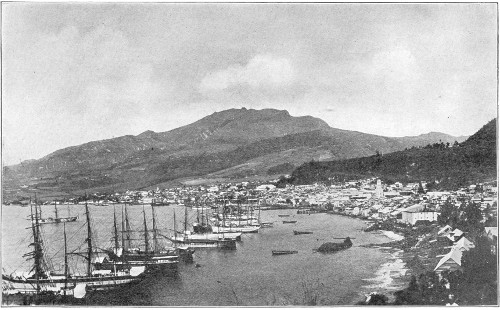
SAINT-PIERRE AND MT. PELÉE BEFORE THE ERUPTION
By this time you will have seen the doll. I want to remind you that this is more than a doll; it is really an artistic model of the dress worn by the women of Martinique,—big earrings and all. The real earrings and necklaces are pure gold; the former worth 175 francs a pair; the latter often running as high as 500, 600, even 900 francs.
In case this reaches you before leaving New York, I hope you will be able to make some arrangement with Joe or somebody, so that I can put my things in a place of safety for a day or two, until I can try to arrange matters with the Harpers. I will be obliged to stay a short while in New York,—and shall want a room badly, until my MS. and photos have been disposed of, and my proof-reading has been done on “Chita.” With affectionate regards to all,
Very truly yours,
Lafcadio Hearn.
P. S. I return with the Barracouta.
My inquiries about the Marimba and other instruments have produced no result except the discovery that our negroes play the guitar, the flute, the flageolet, the cornet-à-piston! Some play very well; all the orchestras and bands are coloured. But the civilized instrument has killed the native manufacture of aboriginalities. The only hope would be in the small islands, or where slavery still exists, as in Cuba, There are one or two African songs still current, but they are sung to the tam-tam—
Welleli, welleli, hm, hm! Papa mon ce papa mon hm, hm! Welleli, welleli, hm, hm! Maman mon ce maman mon hm, hm! Welleli, etc.
TO ELIZABETH BISLAND Georgetown, Demerara, July, 1887.
Dear Miss Bisland,—I suppose you will have just a tiny little bit of curiosity to know about my impressions here? They have been all flavoured with that enchanting sensation which artists term surprise. The effect upon me has been such that I think the North will always look torpid to me,—as a benumbed and livid part of our planet. Nearly all these isles are volcanic; and this largely accounts for the green and purple symmetry of their shapes. The colours are of the kind called "impossible;”—and the days have such an azure expansion, so enormous a luminosity that it does not really seem to be our sky above, but the heaven of some larger world.
That’s all I can attempt to say about it now (in a general way) without wearying you.
Imagine old New Orleans, the dear quaint part of it, young and idealized as a master-artist might idealize it,—made all tropical, with narrower and brighter streets, all climbing up the side of a volcanic peak to a tropical forest, or descending in terraces of steps to the sea;—fancy our Creole courts filled with giant mangoes and columnar palms (a hundred feet in height sometimes); and everything painted in bright colours, and everybody in a costume of more than Oriental picturesqueness;—and astonishments of half-breed beauty;—and a grand tepid wind enveloping the city in one perpetual perfumed caress,—fancy all this, and you may have a faint idea of the sweetest, queerest, darlingest little city in the Antilles: Saint-Pierre, Martinique. I hope it will be my residence for the next two months,—and for the latter part of my wretched little existence. I love it as if it were a human being.
Outside are queer little French islands, with queer names—Marie Galante is rather an old appellation for an island,—full of Cytherean suggestion.
We leave this very fantastic and unhealthy land—now smitten with Gold-fever as well as other maladies—to-morrow. Then will come Trinidad, with its Hindoo villages to see. Photos, bought at Demerara and St. Kitts, predict visions of Indian grace worth daring the perpendicular sun to see. I am now the only passenger. My last companion—a fine Northwestern man—goes, I fear, to leave his bones in the bush. From the interior men are being carried back to the coast to die, yet the stream pours on to the gold-mines. My miner thinks he can stand it: he has dug for African gold, under a fiercer sky. He was an odd fellow. Saw no beauty in these islands. “No, partner—if you want to see scenery see the Rockies: that’s something to look at! Even the sea’s afraid of them mountains,—ran away from them: you can see four thousand feet up where the sea tried to climb before it got scared!”
Sometimes the apes on board are taught the experiences of life, the advantages of civilization. Torpedoes are tied to their tails; fire-crackers surround them with circles of crepitation and flame. Also they are occasionally paralyzed by unexpected sensations of electricity;—they have made the acquaintance of a galvanic battery; they have been induced to do foolish things which resulted in sharp and unfamiliar pains and burnings. Their lives are astonishments, and prolonged spasms of terror.
The sea at night is an awful and magnificent sight. It looks infernal,—Acherontic;—black surges that break into star-spray;—an abyss full of moving lights that come and go.
Well, I can’t write a good letter now;—wait till I get back to Martinique. I wanted you to know I had not forgotten my promise to write. You must make a trip down here some day. It is not hotter than New York except in the sun. You can do whatever you wish. You have force to do it. You have more brains in your finger-tips than some who have managed to get a big reputation. The little talk about Grande Isle that night was an absolute poem,—gave me a sense of the charm of the place such as I felt the first beautiful morning there. You don’t know what you can do, if you want to.
I think I should do something with this novel material, it is so rich in absurd colour! But I don’t feel enthusiastic now. Enthusiasm has been numbed by a long series of violent sensations and unexpected experiences. I have artistic indigestion;—going to try to dream it away at divine, paradisaical Martinique. There I will write you again. My address will be, care American Consul. But you mustn’t write unless you have plenty of time;—I am only paying my debts, not trying to make you waste paper answering me.
I believe I am beginning to write absurdities: it is so hot that rain-clouds form in one’s head.
Good-bye, believe the best you can of me
Your friend,
Lafcadio Hearn.
TO ELIZABETH BISLAND Saint-Pierre, Martinique, 1887.
Dear Miss Bisland,—I am settled here for at least a month:—wish I could settle here forever. I love this quaint, whimsical, wonderfully-coloured little town,—all its ups and downs, vistas of azure harbour and overshadowing volcanic hills,—all the stones that whisper under the myriad naked feet of this fantastic population. It pleases me to find my affection for it is not merely inspiration: the place has fascinated more than one practical American,—persuaded them to abandon ambitions, contests, popular esteem, friends, society,—and to settle here for the rest of their days, in delightful indolence and dreamy content.
In my trunk I have something for you: a Coolie girl’s bracelet. It will not look so well on your arm as on hers, because its effect depends on a background of dark colour; and all this clumsy Indian jewelry is inartistically wrought. It is indeed made chiefly for economical reasons. Coolies so carry their wealth;—I saw one Hindoo wife with some $900 worth of jewelry upon her.
In the little Coolie village near Port-of-Spain, Trinidad, I sat, and looked at rudely painted Indian gods, while waiting for the silversmith to sit down before his ridiculous little anvil. All the palm-shadows, intensely black, crawled outside like tarantulas; it was a glowing day,—blindingly blue: the light of a larger sun seemed to fill the world,—a white sun,—Sirius!
“Ra!” called out the Coolie smith when I told him I wanted to look at his jewelry;—and his wife came in. She wore the Hindoo garb without the long veils: a white robe like a Greek chiton, or rather like a lady’s chemise,—leaving the arms and ankles bare, and confined about the waist. I thought her very lovely,—slender and delicate,—a perfect bronze-colour: the gold-flower attached to the nostril did not impair the symmetry of the face;—extraordinary eyes and teeth. She held out her pretty round arms for examination: there were about ten silver rings upon each: the two outer ones being round, the inner eight being flat. The arm was infinitely prettier than the bracelets;—I selected one ring, and the smith opened and removed it with an iron instrument and gave it me. It had a faint musky odour: perhaps that was why the smith insisted on putting it into an absurdly small furnace, and purifying it after the Indian manner.
I wanted to buy a pair of baby bracelets;—so they brought in the baby,—a girl, and therefore (?) having a dress on. The little babies of the other sex wear nothing but circles of silver on arms and ankles. Sometimes the custom is extended; for the little wife who carried her girl baby to the post-office when I was at Demerara, carried it naked at her hip in the most primitive manner.
This Trinidad baby had absurdly large eyes,—looked supernatural: the mother’s eyes magnified. She held up her little arms and I chose two rings. Then she talked to me in—Creole patois! It is the commercial dialect of the poor; and the Hindoos learn it well
Always truly,
Lafcadio Hearn.
There are palms here over 200 feet high. There are fish here of all the colours of marsh-sunset.
TO ELIZABETH BISLAND Fort de France, Martinique, July, 1887.
Dear Miss Bisland,—Imagine yourself turned into marble, all white,—robed after the fashion of the Directory,—standing forever on a marble pedestal, under an enormous azure day,—encircled by a ring of tall palms, graceful as Creole women,—and gazing always, always, over the summer sea, toward emerald Trois Islets.
That is Josephine! I think she looks just like you, “Mamzelle Josephine,”—or Zefine, if you like.
I want to tell you a little story about her,—just a little anecdote somebody told me on the street, which I want to develop into a sketch next week.
It was after the fall of the Second Empire,—after France felt the iron heel of Germany upon her throat.
Far off in this delicious little Martinique, the Republican rage made itself felt;—the huge reaction passed over the ocean like a magnetic current. So it happened, in a little while, that the Martinique politicians resolved to do that which had already been done in France,—to obliterate the memories of the Empire.
There was Mamzelle Zefine, par exemple!... They put a rope round her beautiful white neck. They prepared to destroy the statue.
Then Somebody rang the Church-bell—(you ought to see the sleepy little church: it makes you want to doze the moment you pass into its cool shadow). A vast crowd gathered in the Savane.
It was a crowd of women,—mostly women who had been slaves,—quadroons, mulattoesses; the house-servants, the bonnes, the nurses and housekeepers of the old days. (You could form no possible idea of this coloured Creole element without seeing it: it does not exist in New Orleans.) They gathered to defend Mamzelle Zefine.
When the Republican officials came with their workmen at sunrise, Mamzelle Zefine was still gazing toward Trois Islets; she was white as ever; her pure cold passionate face just as lovely: she seemed totally indifferent to what was about to happen,—she was dreaming her eternal plaintive dream.
But she could well afford to feel indifferent! About her, under the circle of the palms, surged a living sea,—a tide of angry yellow faces, above which flashed the lightning of cane-knives, axes, couteaux de boucher. “Ah! li vieu!—lâches! cafa’ds! pott’ons! Vos pas cabab toucher li! Touché li—yon tête fois!—Osé toucher li. Capons Républicains! Osé toucher li!“
Mamzelle Zefine still gazed plaintively toward Trois Islets. She must have seemed to that yellow population to live;—for each one she represented some young mistress, some petted child, some memory of the old colonial days. And all the love of the slave for the master—all the strange passionate senseless affection of the servant for the Creole family—was stirred to storm by the mere idea of the proposed desecration. The man who should have dared to lay an evil finger upon Josephine that day would have been torn limb from limb in the public square. The officials were frightened and foiled: they pledged their faith that the statue should not be touched.
So they took the ropes away; and they piled flowers at Mamzelle Zefine’s white feet; they garlanded her; they twined the crimson jessamines of the tropics about her beautiful white throat.
And she is still here,—always in the circle of the palms, always looking to Trois Islets, always beautiful and sweet as a young Creole maiden,—dreamy, gracious, loving,—with a smile that is like some faint, sweet memory of other days.
Always,
Lafcadio Hearn.
TO ELIZABETH BISLAND New York, 1887.
Dear Miss Bisland,—Thanks for the gracious little letter. I wish I could see you, and see other friends; but fate forbids. Distances are too enormous; engagements imperative; preparations for coming journey made my head whirl. For I return to the tropics, dear Miss Bisland,—probably forever: I imagine that civilization will behold me no more, except as a visitor at very long intervals. I would like to write you sometimes, praying only that my letters be not ever shown unto newspaper people. You will hear from me soon again. I am off on Friday afternoon, and have not even the necessary time to do what I ought to do in the mere matter of exceedingly small purchases, outfits, etc.
Good-bye, with best regards and something a little more, too.
Lafcadio Hearn.
I have not seen Krehbiel at all,—was out of town when I returned, and seems to have found no time afterwards.
TO ELIZABETH BISLAND New York, 1887.
Your letter reached me just at a time when everything that had seemed solid was breaking up, and substance had become Shadow. It made me very foolish,—made me cry. Your rebuke for the trivial phrase in my letter was very beautiful as well as very richly deserved. But I don’t think it is a question of volition. It is necessary to obey the impulses of the Unknown for Art’s sake—or rather, you must obey them. The Spahi’s fascination by the invisible Forces was purely physical. I think I am right in going: perhaps I am wrong in thinking of making the tropics a home. Probably it will be the same thing over again: impulse and chance compelling another change.
The carriage—no, the New York hack and hackman (no romance or sentimentality about these!)—is waiting to take me to Pier 49, East River. So I must end. But I have written such a ridiculous letter that I shan’t put anybody’s name to it.
TO GEORGE M. GOULD Saint-Pierre, Martinique, May, 1888.
Dear Gould,—One of your letters, I think a P. Cd., many months ago, caught me in British Guiana, another to-day finds me here. I left N. O. in June, 1887, and have been travelling since, or at least sojourning in these tropics. I have been sick, too,—have had some trouble fighting the influences of climate, trouble in trying to carry out large plans with absurdly small resources; and have been unable to do my friends justice. How could you think I could have been offended? It was only the other day, in a letter to the editor of Harper’s, that I referred to one of your delightful colour-theories.
Praise from you I value very highly. As to impress such a mind as yours means to me a great pride and pleasure. I am delighted “Chita” pleased you.
I have written a number of sketches on the West Indies,—some of which may appear in a few months, others later on. It has been a hope of mine to make a unique book on these strange Hesperides, with their singularly mixed races; but I don’t know whether I shall be able to carry the project out.
The climate is antagonistic to work. It is a benumbing power, rendering concentrated thought almost out of the question. I can now understand why the tropics have produced so little literature.
We are quarantined and isolated for the present by a long epidemic of small-pox, which among these populations means something as fatal as an Oriental plague. The whites are exempt. But the disease, although on the decline, still prevails to an extent rendering it doubtful when I can get away from here.
I would like much to hear from you when you have time. I am temporarily settled here, and everything goes well enough now, so that I can write regularly
With best affection,
Lafcadio Hearn.
TO GEORGE M. GOULD Grand Anse, Martinique, June, 1888.
Dear Dr. Gould,—I am writing you from an obscure, pretty West Indian village, seldom visited by travellers. Tall palms, and a grand roaring sea, blue as lapis lazuli in spite of its motion.
I was certainly even more pleased to hear from you than you could have been at the receipt of my letter;—for in addition to the intellectual and sympathetic pleasure of such a correspondence, the comparative rarity of friendly missives, enhancing their value, lends them certain magnetism difficult to describe,—the sensation, perhaps, of that North, and that Northern vigour of mind which has made the world what it is, and that pure keen air full of the Unknowable Something which has made the Northern Thought.
I seldom have a chance now to read or speak English; and English phrases that used to seem absolutely natural already begin to look somewhat odd to me. Were I to continue to live here for some years more, I am almost sure that I should find it difficult to write English. The resources of the intellectual life are all lacking here,—no libraries, no books in any language;—a mind accustomed to discipline becomes like a garden long uncultivated, in which the rare flowers return to their primitive savage forms, or are smothered by rank, tough growths which ought to be pulled up and thrown away. Nature does not allow you to think here, or to study seriously, or to work earnestly: revolt against her, and with one subtle touch of fever she leaves you helpless and thoughtless for months.
But she is so beautiful, nevertheless, that you love her more and more daily,—that you gradually cease to wish to do aught contrary to her local laws and customs. Slowly, you begin to lose all affection for the great Northern nurse that taught you to think, to work, to aspire. Then, after a while, this nude, warm, savage, amorous Southern Nature succeeds in persuading you that labour and effort and purpose are foolish things,—that life is very sweet without them;—and you actually find yourself ready to confess that the aspirations and inspirations born of the struggle for life in the North are all madness,—that they wasted years which might have been delightfully dozed away in land where the air is always warm, the sea always the colour of sapphire, the woods perpetually green as the plumage of a green parrot.
I must confess I have had some such experiences. It appears to me impossible to resign myself to living again in a great city and in a cold climate. Of course I shall have to return to the States for a while,—a short while, probably;—but I do not think I will ever settle there. I am apt to become tired of places,—or at least of the disagreeable facts attaching more or less to all places and becoming more and more marked and unendurable the longer one stays. So that ultimately I am sure to wander off somewhere else. You can comprehend how one becomes tired of the very stones of a place,—the odours, the colours, the shapes of Shadows, and tint of its sky;—and how small irritations become colossal and crushing by years of repetition;—yet perhaps you will not comprehend that one can actually become weary of a whole system of life, of civilization, even with very limited experience. Such is exactly my present feeling,—an unutterable weariness of the aggressive characteristics of existence in a highly organized society. The higher the social development, the sharper the struggle. One feels this especially in America,—in the nervous centres of the world’s activity. One feels at least, I imagine, in the tropics, where it is such an effort just to live, that one has no force left for the effort to expand one’s own individuality at the cost of another’s. I clearly perceive that a man enamoured of the tropics has but two things to do:—To abandon intellectual work, or to conquer the fascination of Nature. Which I will do will depend upon necessity. I would remain in this zone if I could maintain a certain position here;—to keep it requires means. I can earn only by writing, and yet if I remain a few years more, I will have become (perhaps?) unable to write. So if I am to live in the tropics, as I would like to do, I must earn the means for it in very short order.