Volume 1 — LETTERS 1877-1889 (continued 2)
Reading edition
And you speak of the Song of Solomon. I love it more than ever. But Michelet, the passionate freethinker, the divine prose-poet, the bravest lover of the beautiful, has written a terrible chapter upon it. No lesser mind dare touch the subject now with sacrilegious hand.
I doubt if you are quite just to Gautier. I had hoped his fancy might please you. But Gautier did not write those lines I sent you. They are found in the report of conversations held with him by Emile Bergerat;—they are mere memories of a dead voice. Probably had he ever known that these romantic opinions would one day be published to the world, he would never have uttered them.
Your Hindoo legends charmed me, but I do not like them as I love the Greek legends. The fantasies created in India are superhumanly vast, wild, and terrible;—they are typhoons of the tropical imagination;—they seem pictures printed by madness,—they terrify and impress, but do not charm. I love better the sweet human story of Orpheus. It is a dream of human love,—the love that is not only strong, but stronger than death,—the love that breaks down the dim gates of the world of Shadows and bursts open the marble heart of the tomb to return at the outcry of passion. Yet I hold that the Greek mind was infantine in comparison to the Indian thought of the same era; nor could any Greek imagination have created the visions of the visionary East. The Greek was a pure naturalist, a lover of “the bloom of young flesh;”—the Hindoo had fathomed the deepest deeps of human thought before the Greek was born.
Zola is capable of some beautiful things. His “Le Bain” is pure Romanticism, delicate, sweet, coquettish. His contribution to “Les Soirées de Médan” is magnificent. His “Faute de l’Abbé Mouret” does not lack real touches of poetry. But as the copy of Nature is not true art according to the Greek law of beauty, so I believe that the school of Naturalism belongs to the low order of literary creation. It is a sharp photograph, coloured by hand with the minute lines of vein and shading of down. Zola’s pupils, however,—those who wrote the “Soirées de Médan,”—have improved upon his style, and have mingled Naturalism with Romanticism in a very charming way.
I was a little disappointed, although I was also much delighted, with parts of Cable’s “Grandissimes.” He did not follow out his first plan,—as he told me he was going to do,—viz., to scatter about fifty Creole songs through the work, with the music in the shape of notes at the end. There are only a few ditties published; and as the Creole music deals in fractions of tones, Mr. Cable failed to write it properly. He is not enough of a musician, I fancy, for that.
By the time you have read this I think you will also have read my articles on Gottschalk and translations. I sent for his life to Havana; and received it with a quaint Spanish letter from Enrique Barrera, begging me to find an agent for him. I found him one here. His West Indian volume is one of the most extraordinary books I have ever seen. It is the wildest of possible romances.
L. H.
TO H. E. KREHBIEL New Orleans, 1881.
My dear Krehbiel,—How could you ever think you had offended me? I was so sick—expecting to go blind and “lift the cover of my brains,” as the Spaniards say, and also ill-treated—that I had no spirit left to write. You will be glad to know that I have now got so fat that they call me “The Fat Boy” at the office.
Your letter gave me great pleasure. I think your plan—vague as it appears to be—will crystallize into a very happy reality. You have the sacred fire,—le vrai feu sacré,—and with health and strength must succeed. What you want, and what we all want, who possess devotion to any noble idea, who hide any artistic idol in a niche of the heart, is that independence which gives us at least the time to worship the holiness of beauty,—be it in harmonies of sound, of form, or of colour. You have strength, youth,—not in years only but in the vital resources of your being,—the true parfum de la jeunesse is perceptible in your thoughts and hopes and abilities to create; and you have other advantages I will not mention lest my observations might be “embarrassing.” I should be surprised indeed to hear in a few years from now that you had not been able to emancipate yourself from the fetters of that intensely vulgar and detestably commonplace thing, called American journalism,—of which I, alas! must long remain a slave. A prize in the Havana lottery might alone deliver me speedily; but I mostly rely on the hope of being able next year to open a little French bookstore in one of the tense quaint old streets. I had hoped to leave New Orleans; but with my eyes in their present condition, it would be folly to fight for life over again in some foreign country.
You say you hope to see some day a product of my pen more durable than a newspaper article. But I very much doubt if you ever will. My visual misfortune has reduced my hours of work to one third. I only work from 10 A.M. to 2 P.M. You will see, therefore, that my work must be rapid. At 2 P.M. my eyes are usually worn out. But as you seem to have been interested in some of my little fantasies, I take the liberty of sending you several now. They are too flimsy, however, to be ever collected for publication, unless in the course of a few years I could write a hundred or so, and select one out of three afterward.
Your observations about Amphion and Orpheus prompted me to send you an old issue of the Item, in which you will find some very extraordinary observations on the subject of Greek music, translated from a charming work in my possession. But you will be disgusted, perhaps, to know that with all his erudition upon musical legends and musical history, Gautier had no ear for music. I almost feel like asking you not to tell that to anybody.
If you could pay a visit this winter I think you would have a pleasant time. I would like to aid you to get some of the Creole music I vainly promised you. I found it impossible so far to obtain any; yet had I the ability to write music down I could have obtained you some. If you were here I could introduce you to the President of the Athénée Louisianaise, who would certainly put you in the way of doing so yourself.
What I do hope to obtain for you—if you care about it—is Mexican music. Mexicans are common visitors here; and every educated Mexican can sing and play some instrument. They have sung here for us,—guitar accompaniment. Did you ever hear “El Aguardiente”? It is a very queer air,—boisterous, merry with a merriment that seems all the time on the point of breaking into a laugh—yet withal half-savage like some Spanish ditties. When they sang it here, it was with a chorus accompaniment of glasses held upside down and tapped with spoons.
Did you ever hear negroes play the piano by ear? There are several curiosities here, Creole negroes. Sometimes we pay them a bottle of wine to come here and play for us. They use the piano exactly like a banjo. It is good banjo-playing, but no piano-playing.
One difficulty in the way of obtaining Creole music or ditties is the fact that the French coloured population are ashamed to speak their patois before whites. They will address you in French and sing French songs; but there must be extraordinary inducements to make them sing or talk in Creole. I have done it, but it is no easy work.
Nearly all the Creoles here—white—know English, French, and Spanish, more or less well, in addition to the patois employed only in speaking to children or servants. When a child becomes about ten years old, it is usually forbidden to speak Creole under any other circumstances.
But I do not suppose this will much interest you. I shall endeavour—this time I’m afraid to promise—to secure you some Mexican or Havanese music; and will postpone further remarks to a future occasion.
I am sorry Feldwisch is ill; and I doubt if the Colorado air will do him good. When he was here I had a vague suspicion I should never see him again.
Remember me to those whom you know I like, and don’t think me dilatory if I don’t write immediately on receipt of a letter. I have explained the condition of affairs as well as I could.
I remain, dear fellow, yours,
L. Hearn.
TO H. E. KREHBIEL New Orleans, 1882.
How are you on Russian music?
You could make a terrible and taking operatic tragedy on Sacher-Masoch’s “Mother of God.” Get it, if you can, and read it. I send you specimen translation. It was written, I believe, in German.
Have you read in the “Kalewala” of the “Bride of Gold,”—of the "Betrothed of Silver"?
Have you read how the mother of Kullevo arose from her tomb, and cried unto him from the deeps of the dust?
TO H. E. KREHBIEL New Orleans, 1882.
Dear K.,—It got dark yesterday before I could finish some extracts from “Kalewala” I wanted to send. They are just suggestion. I must also tell you I have only a very confused idea of the “Kalewala” myself, having read it through simply as a romance, and never having had time to study out all its mythological bearings and meanings. In fact my edition is too incomplete and confusedly arranged in any case: notes are piled in a heap at the end of each volume, causing terrible trouble in making references. See if you can get Castrén.
I want also to tell you that the Pre-Islamic legends I spoke of to you are admirably arranged for musical suggestion. The original narrator breaks into verse here and there, as into song: Rabiah, for instance, recites his own death-song, his mother answers him in verse. All Arabian heroic stories are arranged in the same way; and even in so serious a work as Ibn Khallikan’s great biographical dictionary, almost every incident is emphasized by a poetical citation.
Your idea about your style being heavy is really incorrect. Your art has trained you so thoroughly in choosing words that hit the exact meaning desired with the full strength of technical or picturesque expression, that the continual use of certain beauties has dulled your perception of their native force, perhaps. You do not feel, I mean, the full strength of what you write—in a style of immense compressed force. I would not wish you to think you had done your best, though; better to feel dissatisfied, but not good to underestimate yourself. I am now, you see, claiming the privilege of criticizing what I could not begin to do myself; but I believe I can see beauty where it exists in style, and I don’t want you to be underestimating your own worth.
Are your letters of a character suitable for book-form? Hoppin,—I think, is the name,—the author of “Old England,” a Yale professor, who made an English tour, formed one of the most charming volumes in such a way. Think it over.
Affectionately,
Lafcadio.
Please never even suspect that my suggestions to you are made in any spirit of false conceit: a friend of the most limited artistic ability can often suggest things to a real artist, and even give him confidence.
TO H. E. KREHBIEL New Orleans, 1882.
KALEWALA
Dear K.,—The Society of Finnish Literature celebrated, in 1885, I think, the first centennial of the publication of the “Kalewala.”
There are two epics of Finland—just as most peoples have two epics—most people at least of Aryan origin; and the existence of such tremendous poems as the “Kalewala” and “Kanteletar” affords, in the opinion of M. Quatrefages, a strong proof that the Finns are of Aryan origin.
Loennrot was the Homer of Finland, the one who collected and edited the oral epic poetry now published under the head of the “Kalewala.”
But Léouzon Le Duc in 1845 published the first translation. (This I have.) Loennrot followed him three years later. Le Duc’s version contained only 12,100 verses. Loennrot’s contained 22,800. A second French version was subsequently made (which I have sent for). In 1853 appeared Castrén’s magnificent work on Finnish mythology, without which a thorough comprehension of the “Kalewala” is almost impossible.
You will be glad to know that the definitive edition of the "Kalewala,” as well as the work of Castrén, have both been translated into German by Herr Schiefner (1852-54, I believe is the date). Since then a whole ocean of Finnish poetry and folk-lore and legends has been collected, edited, published, and translated. (I get some of these facts from Mélusine, some from the work of the anthropologist Quatrefages.)
In order to get a correct idea of what you might do with the “Kalewala,” you must get it and read it. Try to get it in the German! I can give you some idea of its beauties; but to give you its movement, and plot, or to show you precisely how much operatic value it possesses, would be a task beyond my power. It would be like attempting to make one familiar with Homer in a week.
Once you have digested it, I can then be of real service, perhaps. You would need the work of Castrén also—which I cannot read. To determine the precise mythological value, rank, power, aspect, etc., of gods and demons, and their relation to natural forces, one must read up a little on the Finns. I have Le Duc, but he is deficient.
I don’t think that any epic surpasses that weirdest and strangest of runes. It is not so well known as it deserves. It gives you the impression of a work written by wizards, who spoke little to men, and much to nature—but the sinister and misty nature of the eternally frozen North.
You have in the “Kalewala” all the elements of a magnificent operatic episode,—weirdness, the passion of love, and the eternal struggle between evil and good, between darkness and light. You have any possible amount of melody,—a universe of inspiration for startling and totally novel musical themes. The scenery of such a thing might be made wilder and grander than anything imagined even by the Talmudically vast conceptions of Wagner.
An opera founded on the “Kalewala” might be made a work worthy of the grandest musician who ever lived: think of the possibilities suggested by the picture of Nature’s mightiest forces in contention,—wind and sea, frost and sun, darkness and luminosity.
I don’t like the antique theme you suggest, because it has been worn so threadbare that only a miracle could give it a fresh surface. Better search the “Kathā-sarit-Sāgara,” or some other Indian collection,—or borrow from the sublimely rough and rugged poetry of Pre-Islamic Arabia. You will never regret an acquaintance with these books—even at some cost. They epitomize all the thought, passion, and poetry of a nation and of a period.
I prefer the “Kalewala” to any other theme you suggest. I might suggest many others, but none so vast, so grand, so multiform. Nothing in the Talmud like that. The Talmud is a Semitic work; but nothing Jewish rises to the grandeur of Arabic poetry, which expresses the supreme possibilities of the Semitic mind,—except, perhaps, the Book of Job, which is thought by some to have had an Arabian creator.
What you say about the disinclination to work for years upon a theme for pure love’s sake, without hope of reward, touches me,—because I have felt that despair so long and so often. And yet I believe that all the world’s art-work—all that which is eternal—was thus wrought. And I also believe that no work made perfect for the pure love of art, can perish, save by strange and rare accident. Despite the rage of religion and of time, we know Sappho found no rival, no equal. Rivers changed their courses and dried up,—seas became deserts, since some Egyptian romanticist wrote the story of Latin-Khamois. Do you suppose he ever received $00 for it?
Yet the hardest of all sacrifices for the artist is this sacrifice to art,—this trampling of self under foot! It is the supreme test for admittance into the ranks of the eternal priests. It is the bitter and fruitless sacrifice which the artist’s soul is bound to make,—as in certain antique cities maidens were compelled to give their virginity to a god of stone! But without the sacrifice can we hope for the grace of heaven?
What is the reward? The consciousness of inspiration only! I think art gives a new faith. I think—all jesting aside—that could I create something I felt to be sublime, I should feel also that the Unknowable had selected me for a mouthpiece, for a medium of utterance, in the holy cycling of its eternal purpose; and I should know the pride of the prophet that had seen God face to face.
All this might seem absurd, perhaps, to a purely practical mind (yours is not too practical); but there is a practical side also. In this age of lightning, thought and recognition have become quadruple-winged, like the angels of Isaiah. Do your very best,—your very, very best: the century must recognize the artist if he is there. If he is not recognized, it is because he is not great. Have you faith in yourself? I know you are a great natural artist; I have absolute faith in you. You must succeed if you make the sacrifice of working for art’s sake alone.
Comparing yourself to me won’t do!—dear old fellow. I am in most things a botch! You say you envy me certain qualities; but you forget how those qualities are at variance with an art whose beauty is geometrical and whose perfection is mathematical. You also say you envy me my power of application!—If you only knew the pain and labour I have to create a little good work. And there are months when I cannot write. It is not hard to write when the thought is there; but the thought will not always come—there are weeks when I cannot even think.
The only application I have is that of persistence in a small way. I write a rough sketch and labour it over and over again for half a year, at intervals of ten minutes’ leisure—sometimes I get a day or two. The work done each time is small. But with the passing of the seasons the mass becomes noticeable—perhaps creditable. This is merely the result of system.
You may laugh at this letter if you please,—this friendly protest to one whom I have always recognized as my superior,—but there is truth in it. Think over the “Kalewala,” and write to
Your friend and admirer,
Lafcadio Hearn.
TO H. E. KREHBIEL New Orleans, 1882.
My dear Krehbiel,—When I got your letter I felt as if a great load was lifted off me—the sky looked brighter and the world seemed a little sweeter than usual. As for me, you could have paid me no higher compliment. Glad you did not disapprove of the article.
Your clippings are superb. I think your style constantly gains in force and terseness. It is admirably crystallized; and I have not yet been able to form a permanent style of my own. I trust I will succeed in time; but in purity and conciseness you will always be my master, for your art has taught you style better than a thousand university professors could do. I suppose, however, you will always be slightly Gothic,—not harshly Gothic, but Middle Period,—making ornament always subordinate to the general plan. I shall always be more or less Arabesque,—covering my whole edifice with intricate designs, serrating my arches, and engraving mysticisms above the portals. You will be grand and lofty; I shall try to be at once voluptuous and elegant, like a colonnade in the mosque of Cordova.
I send you something your article on the Jubilee Singers makes me think of. It is from the pen of a marvellous writer, who long lived at Senegal. If you do not find anything new in it, return it; but if it can be of use to you, keep it. I hope to translate the whole work some day.
Your friend,
L. H.
Have heard Patti; but did not understand her power until you explained it me.
TO H. E. KREHBIEL New Orleans, 1882.
My dear Krehbiel,—Much as it pleased me to hear from you, I assure you that your letter is shocking. It is shocking to hear of anybody being compelled to work for seventeen hours a day. You have neither time to think, to study, to read, to do your best work, or to make any artistic progress—not even to hint of pleasure—while working seventeen hours a day. Nor is that all; I believe it injures a man’s health and capacity for endurance, as well as his style and peace of mind. You have a fine constitution; but if once broken down by over-straining the nervous system you will never get fully over the shock. It is very hard for me to believe that it is really necessary for you to do reportorial work and to write correspondence, unless you have a special financial object to accomplish within a very short space of time. The editorial work touching upon art matters which you are capable of doing for the Tribune might be done in the daytime; but what do you want to waste your brain and time upon reportorial work for? D—n reportorial work and correspondence, and the American disposition to work people to death, and the American delight in getting worked to death! Well, I have nothing more to say except to protest my hope that the seventeen-hours-a-day business is going to stop before long; for the longer it lasts the more difficult it will be for you to accomplish your ultimate purpose. The devil of overworking one’s self is that it renders it impossible to get fair and just remuneration for value given,—impossible also to create those opportunities for self-advancements which form the steps of the stairway to the artistic heaven,—impossible to maintain that self-pride and confident sense of worth without which no man, however gifted, can make others fully conscious of it. When you voluntarily convert yourself into a part of the machinery of a great daily newspaper, you must revolve and keep revolving with the wheels; you play the man in the treadmill. The more you involve yourself the more difficult it will be for you to escape. I said I had nothing further to observe; but I find I must say something more,—not that I imagine for a moment I am telling you anything new, but because I wish to try to impress anew upon you some facts which do not seem to have influenced you as I believe they ought to do.
Under all the levity of Henri Murger’s picturesque Bohemianism, there is a serious philosophy apparent which elevates the characters of his romance to heroism. They followed one principle faithfully,—so faithfully that only the strong survived the ordeal,—never to abandon the pursuit of an artistic vocation for any other occupation however lucrative,—not even when she remained apparently deaf and blind to her worshippers. The conditions pictured by Murger have passed away in Paris as elsewhere: the old barriers to ambition have been greatly broken down. But I think the moral remains. So long as one can live and pursue his natural vocation in art, it is a duty with him never to abandon it if he believes that he has within him the elements of final success. Every time he labours at aught that is not of art, he robs the divinity of what belongs to her.
Do you never reflect that within a few years you will no longer be the YOUNG MAN,—and that, like Vesta’s fires, the enthusiasm of youth for an art-idea must be well fed with the sacred branches to keep it from dying out? I think you ought really to devote all your time and energies and ability to the cultivation of one subject, so as to make that subject alone repay you for all your pains. And I do not believe that Art is altogether ungrateful in these days: she will repay fidelity to her, and recompense sacrifices. I don’t think you have any more right to play reporter than a great sculptor to model fifty-cent plaster figures of idiotic saints for Catholic processions, or certain painters to letter steamboats at so much a letter. In one sense, too, Art is exacting. To acquire real eminence in any one branch of any art, one must study nothing else for a lifetime. A very wide general knowledge may be acquired only at the expense of depth. But you are certainly right in thinking of the present for other reasons. Still, there is nothing so important, not only to success but to confidence, hope, and happiness, as good health and a strong constitution; and these you must lose if you choose to keep working seventeen hours a day! It is well to be able to do such a thing on a brief stretch, but it is suicide, moral and physical, to keep it up regularly. The rolling-mill hand, or the puddler, or the moulder, or the common brakeman on a railroad cannot keep up at such hours for a great length of time; and you must know that even hard labour is not so exhausting as brain-work. Don’t work yourself sick, old friend,—you are in a fair way to do it now.
Your friend,
L. H.
TO JEROME A. HART New Orleans, May, 1882.
Dear Sir,—Thanks for your kindly little article. I suppose it emanated from the same source as the charming translation of Gautier’s “Spectre de la Rose”—which we reproduced here, comparing it with the inferior translation—or rather mutilation—of the same poem which appeared in the ——.
Your translation of the epitaph seems to me superb as far as the first two lines go; but I can hardly agree with you as to the last. “La plus belle du monde” cannot be perfectly rendered by “the loveliest in the land”—which is a far weaker expression, by reason of the circumscribed idea it involves. “La plus belle du monde” is an expression of paramount force, simple as it is; it conveys the idea of beauty without an equal, not in any one country, but in the whole world. But I think your second line is a masterpiece of faithfulness; and, as you justly remark, my hobby is literalism.
Very sincerely yours,
Lafcadio Hearn.
TO JEROME A. HART New Orleans, May, 1882.
Dear Sir,—I am very grateful for your kind letter and the pleasure of making your acquaintance even through an epistolary medium.
We have the same terrible proverb in Spanish that you cite in Italian; but it certainly can never apply to the Argonaut’s exquisite translations—preserving metre, colour, and warmth so far as seems to be possible. Still, I must say that I do not believe the poetry of one country can be perfectly reproduced in corresponding metre in the poetry of another: much that is even marvellous may be done,—yet a little of the original perfume evaporates in the process. Therefore the French gave prose translations of Heine and Byron: especially in regard to the German poet they considered translation in metrical form impossible. Nevertheless it is impossible also to refrain from attempting such things at times,—when the beauty of exotic verse seems to take us by the throat with the strangulation of pleasure. I have felt impelled occasionally to make an essay in poetical translation; the result has generally been a dismal failure, but I venture to send you a specimen which appears to be less condemnable than most of my efforts. I cannot presume to call it a translation,—it is only an adaptation.
As for the lines in “Clarimonde,” if the book ever reaches a second edition, I think I will be able to remedy some of their imperfections. Skaldic verse, I suppose, would be anachronistically vile; but something corresponding to the metre of “La Chanson de Roland,” unrhymed, what the French call vers assonances. This corresponds exactly with your lines in breadth; also in tone, as the accent of the assonance is thrown upon the last syllable of each line
Very gratefully yours,
L. H.
P. S. Just received another note from you. Have seen the reproduction; I am exceedingly thankful for the compliment; and you know that so far as the copyright business is concerned, the credit must do the book too much good for Worthington to find any fault. I suppose you receive the Times-Democrat of New Orleans. I forward last Sunday’s issue, containing a little compliment to the Argonaut.
Very sincerely yours,
Lafcadio Hearn.
TO JEROME A. HART New Orleans, December, 1882.
Dear Sir,—I venture to intrude upon you to ask a little advice, which as a brother-student of foreign literature you could probably give me better than any other person to whom I could apply. I am informed that in San Francisco there are enterprising and liberal-minded publishers, with whom unknown authors have a better chance than with the austere and pious publishers of the East. It would be a very great favour indeed, if you could give me some positive indication in this matter. I desire to find a publisher for that excessively curious but somewhat audacious book, “La Tentation de Saint Antoine,” of Flaubert, of which I have completed and corrected the MS. translation. You who know the original will probably agree with me that it would be little less than a literary crime to emasculate such a masterpiece in the translation. I have translated almost every word of the Heresiarch dispute, and the soliloquy of the god Crepitus, etc.
Consequently I have very little hopes of obtaining a publisher in New York or Boston. Do you think I could obtain one in San Francisco? I would be willing to advance something toward the cost of publishing,—if necessary.
Trust you will pardon my intrusion. I think the mutual interest we both feel in one branch of foreign literature is a fair excuse for my letter.
With thanks for previous many kindnesses,
I remain, truly yours,
Lafcadio Hearn.
TO JEROME A. HART New Orleans, January, 1883.
Dear Sir,—Writing to San Francisco seems, after a sort, like writing to Japan or Malabar, so great is the lapse of time consumed in the transit of mail-matter, especially when one is anxious. I was quite so, fearing you might have considered my letter intrusive; but your exceedingly pleasant reply has dispelled all apprehension.
I am not surprised at the information; for the difficulty of finding publishers in the United States is something colossal, and my hopes burned with a very dim flame. I do not know about Worthington,—as he is absent in Europe, perhaps he will undertake the publication; but I fear, inasmuch as he is a Methodist of the antique type, that he will not. Now the holy Observer declared that the “Cleopatra” was a collection of “stories of unbridled lust without the apology of natural passion;” that "the translation reeked with the miasma of the brothel,” etc., etc.,—and Worthington was much exercised thereat. Otherwise I should have suggested the publication in English of “Mademoiselle de Maupin.”
I regret that I cannot tell you anything about the fate of “Cleopatra’s Nights,” but the publisher preserves a peculiar and sinister silence in regard to it. Perhaps he is sitting upon the stool of orthodox repentance. Perhaps he is preparing to be generous. But this I much doubt; and as the translations were published partly at my own expense, I am anxious only regarding the fate of my original capital.
Yes, I read the Critic—and considered that the observation on Gautier stultified the paper. If the translator had been dissected by the same hand, I should not have felt very unhappy. But I received some very nice private letters from Eastern readers, which encouraged me very much, and among them several requesting for other translations from Gautier.
“Salammbô" is the greatest, by far, of Flaubert’s creations, because harmonious in all its plan and purpose, and because it introduces the reader into an unfamiliar field of history, cultivated with astonishing skill and verisimilitude. It was twice written, like “La Tentation.” I translated the prayer to the Moon for the preface to “La Tentation.” I sincerely trust you will translate it. As for time, it is astonishing what system will accomplish. If a man cannot spare an hour a day, he can certainly spare a half-hour. I translated “La Tentation” by this method,—never allowing a day to pass without an attempt to translate a page or two. The work is audacious in parts; but I think nothing ought to be suppressed. That serpent-scene, the crucified lions, the breaking of the chair of gold, the hideous battles about Carthage,—these pages contain pictures that ought not to remain entombed in a foreign museum. I pray you may translate “Salammbô,”—a most difficult task, I fancy,—but one that you would certainly succeed admirably with. In my preface I spoke of “Salammbô” as the most wonderful of Flaubert’s productions.
“Herodias" is another story which ought to be translated. But I would write too long a letter if I dilate upon the French masterpieces.
I will only say that, in regard to recent publications, I have noticed some extraordinary novels which have not earned the attention they deserve. “Le Roman d’un Spahi” seems to me a miracle of art,—and “Le Mariage de Loti” contains passages of wonderful and weird beauty. These, with “Aziyadé,” are the productions of a French naval officer who signs himself Loti. Think I shall try to translate the first-named next year.
Verily the path of the translator is hard. The Petersons and Estes & Lauriat are deluging the country with bogus translations or translations so unfaithful to the original that they must be characterized as fraudulent. And the great American public like the stuff. One who translates for the love of the original will probably have no reward save the satisfaction of creating something beautiful, and perhaps of saving a masterpiece from desecration by less reverent bards. But this is worth working for.
With grateful thanks, and sincere hopes that you will not be deterred from translating “Salammbô” before some incompetent hand attempts it, I remain,
Sincerely,
Lafcadio Hearn.
TO REV. WAYLAND D. BALL New Orleans, 1882.
Dear Sir,—I am very grateful for the warm and kindly sympathy your letter evidences; and as I have already received about a half-dozen communications of similar tenor from unknown friends, I am beginning to feel considerably encouraged. The “lovers of the antique loveliness” are proving to me the future possibilities of a long cherished dream,—the English realization of a Latin style, modelled upon foreign masters, and rendered even more forcible by that element of strength which is the characteristic of Northern tongues. This no man can hope to accomplish; but even a translator may carry his stone to the master-masons of a new architecture of language.
You ask me about translations. I am sorry that I am not able to answer you hopefully. I have a curious work by Flaubert in the hands of R. Worthington (under consideration); and I have various MSS. filed away in the Cemetery of the Rejected. I tried for six years to obtain a publisher for the little collection you so much like, and was obliged at last to have them published partly at my own expense—a difficult matter for one who is obliged to work upon a salary. As for “Mademoiselle de Maupin,” much as I should desire the honour of translating it, I would dread to work in vain, or at best to work for the profit of some publisher who would have the translator at his mercy. If I could find a publisher willing to publish the work precisely as I would render it, I would be glad to surrender all profits to him; but I fancy that any American publisher would wish to emasculate the manuscript.
I am told that an English translation was in existence in London some years ago, but I could not learn the publisher’s name. Chatto & Windus, the printers of the admirable English version of the “Contes Drolatiques,” might be able to inform you further. But I am afraid that the English version was scarcely worthy of the original, owing to the profound silence of the press in regard to the matter. An American translation was being offered to New York publishers a few years ago. It was not accepted.
Although my own work is far from being perfect, I think I am capable of judging other translations of Gautier. The American translations are very poor (“Spirite,” “Captain Fracasse,” “Romance of the Mummy”), in fact they are hardly deserving the name. The English translations of Gautier’s works of travel are generally good. Henry Holt has reprinted some of them, I think.
But out of perhaps sixty volumes, Gautier’s works include very few romances or stories. I have never seen a translation of “Fortunio” or "Militona,”—perhaps because the sexual idea—the Eternal Feminine—prevails too much therein. “Avatar” has been translated in the New York Evening Post, I cannot say how well; but I have the manuscript translation of it myself, which I could never get a publisher to accept. Then there are the “Contes Humoristiques” (1 vol.) and about a dozen short tales not translated. Besides these, and the four translated already (“Fracasse,” “Spirite,” “The Mummy,” and possibly "Mademoiselle de Maupin”) Gautier’s works consist chiefly of critiques, sketches of travel, dramas, comedies—including the charmingly wicked piece, “A Devil’s Tear,”—and three volumes of poems.
My purpose now is to translate a series of works by the most striking French authors, each embodying a style of a school. I tried in the first collection to offer the best novelettes of Gautier in English, relying upon my own judgement so far as I could. Hereafter with leisure and health I shall attempt to do the same for about five others. I can understand your desire to see more of Gautier, and I trust you will some day; but when you have read “Mademoiselle de Maupin” and the two volumes of short stories, you have read his masterpieces of prose, and will care less for the remainder. His greatest art is of course in his magical poems; except the exotic poetry of the Hindoos, and of Persia, there is nothing in verse to equal them.
I must have fatigued your patience, however, by this time. With many thanks for your kind letter, which I took the liberty to send to Worthington, and hoping that you will soon be able to see another curious attempt of mine in print, I remain,
Sincerely,
Lafcadio Hearn.
I forgot to say that in point of archæologic art the “Roman de la Momie” is Gautier’s greatest work. It towers like an obelisk among the rest. But the American translation would disappoint you very much; it is a poor concern all the way through. It would not be a bad idea to drop a line to Chatto & Windus, Pub., London, and enquire about English versions of Gautier. You know that Austin Dobson translated some of his poems very successfully indeed.
In haste,
L. H.
TO REV. WAYLAND D. BALL New Orleans, November, 1882.
Dear Sir,—I translate hurriedly for you a few extracts from "Mademoiselle de Maupin,” some of which have been used or translated by Mallock, who has said many very clever things, but whose final conclusions appear to me to smack of Jesuitic casuistry.
Gautier was not the founder of a philosophic school, but the founder of a system of artistic thought and expression. His “Mademoiselle de Maupin” is an idyl, nothing more, an idyl in which all the vague longings of youth in the blossoming of puberty, the reveries of amorous youth, the wild dreams of two passionate minds, male and female, both highly cultivated, are depicted with a daring excused only by their beauty. I think Mallock wrong in his taking Gautier for a type of Antichrist. There are few who have beheld the witchery of an antique statue, the supple interlacing of nude limbs in frieze or cameo, who have not for the moment regretted the antique. Freethinkers as were Gautier, Hugo, Baudelaire, De Musset, De Nerval, none of them were insensible to the mighty religious art of mediævalism which created those fantastic and enormous fabrics in which the visitor feels like an ant crawling in the skeleton of a mastodon. With the growth of æstheticism there is a tendency to return to antique ideas of beauty, and the last few years has given evidence of a resurrection of Greek influence in several departments of art. But when the first revolution against prudery and prejudice had to be made in France, violent and extreme opinions were necessary,—the Gautiers and De Mussets were the Red Republicans of the Romantic Renaissance. Gautier’s poems utter the same plaints as his prose; mourning for the death of Pan, crying that the modern world is draped with funeral hangings of black, against which the white skeleton appears in relief. But the dreams of an artist may influence art and literature only; they cannot affect the crystallization of social systems or the philosophy of the eye.
They were all pantheists, these characters of Romanticism, some vaguely like old Greek dreamers, others deeply and studiously, like De Nerval, a lover of German mysticism: nature, whom they loved, must have whispered to them in wind-rustling and wave-lapping some word of the mighty truths she had long before taught to Brahmins and to Bodhisatvas under a more luxuriant sky. They saw the evil beneath their feet as a vast “paste” for which the great Statuary eternally moulded new forms in his infinite crucible, and into which old forms were remelted to reappear in varied shapes;—the lips of loveliness might blossom again in pouting roses, the light of eyes rekindle in amethyst and emerald, the white breast with its delicate network of veins be re-created in fairest marble. The worship within sombre churches, and chapels, seemed to them unworthy of the spirit of Universal Love;—to adore him they deemed no temple worthy save that from whose roof of eternal azure hang the everlasting lamps of the stars; no music, save that never-ending ocean hymn, ancient as the moon, whose words no human musician may learn.
I do not know whether Mallock translated Gautier himself, or made extracts; but Gautier’s madrigal pantheistic alone contains the germ of a faith sweeter and purer and nobler than the author of “Is Life Worth Living?” ever dreamed of, or at least comprehended. The poem is a microcosm of artistic pantheism; it contains the whole soul of Gautier, like one of the legendary jewels in which spirits were imprisoned.
Speaking of the “Decameron,” Petronius, Angelinus, and so forth, I must say that I think it the duty of every scholar to read them. It is only thus that we can really obtain a correct idea of the thought and lives of those who read them when first related or written. They are historical paintings, they are shadows of the past and echoes of dead voices. Brantôme or De Châteauneuf teach one more about the life of the fifteenth or sixteenth centuries than a dozen ordinary historians could do. The influence of sex and sexual ideas has moulded the history of nations and formed national character; yet, except Michelet, there is perhaps no historian who has read history fairly in this connection. Without such influence there can be no real greatness; the mind remains arid and desolate. Every noble mind is made fruitful by its virility; we all have a secret museum in some corner of the brain, although our Pompeian or Etruscan curiosities are only shown to appreciative friends.
I have read your enclosed slip and am quite pleased with the creditable notice given you by way of introduction, and quite astonished that you should be so young. You have fine prospects before you, I fancy, if so successful already. Of course Congregational is so vague a word that I cannot tell how latitudinarian your present ideas are (for people in general), nor how broadly you may extend your studies of philosophy. Your correspondence with a freethinker of an extreme type would incline me to believe you were very liberally inclined, but I have often noticed that clergymen belonging even to the old cast-iron type may be classed among warm admirers of the beautiful and the true for their own sakes
Very sincerely yours,
Lafcadio Hearn.
P. S. Have just been looking at Mallock, and am satisfied that he made the translation himself because he translated the “virginity” by “purity.” No one but a Catholic or Jesuit would do that; only Catholics, I believe, consider the consummation of love intrinsically impure, or attempt to identify purity with virginity. Gautier would never have used the word—a word in itself impure and testifying to uncleanliness of fancy. I have translated it properly by the English equivalent. I suppose you know that Mallock’s aim is to prove that everybody not a Catholic is a fool.
ENCLOSURE
“Mademoiselle de Maupin,” petite édition, Charpentier, 2 vols.; vol. ii, page 12.
“I am a man of the Homeric ages;—the world in which I live is not mine, and I comprehend nothing of the social system by which I am surrounded. Never did Christ come into the world for me; I am as pagan as Alcibiades or Phidias. Never have I been to Golgotha to gather passion-flowers; and the deep river flowing from the side of the crucified, and making a crimson girdle about the world, has never bathed me with its waves.”
Page 21: “Venus may be seen; she hides nothing; for modesty is created for the ugly alone; and is a modern invention, daughter of the Christian disdain of form and matter.”
“O ancient worlds! all thou didst revere is now despised; thine idols are overthrown in dust; gaunt anchorites clad in tattered rags, gory martyrs with shoulders lacerated by the tigers of the circuses, lie heaped upon the pedestals of thy gods so comely and so charming;—the Christ has enveloped the world in his winding sheet. Beauty must blush for herself, must wear a shroud.”
Pages 22, 23: “Virginity, thou bitter plant, born upon a soil blood-moistened, whose wan and sickly flower opes painfully within the damp shadows of the cloister, under cold lustral rains;—rose without perfume, and bristling with thorns,—thou hast replaced for us those fair and joyous roses, besprinkled with nard and Falernian, worn by the dancing girls of Sybaris.”
“The antique world knew thee not, O fruitless flower!—never wert thou entwined within their garlands, replete with intoxicating perfume;—in that vigorous and healthy life, thou wouldst have been disdainfully trampled under foot! Virginity, mysticism, melancholy,—three unknown words, three new maladies brought among us by the Christ. Pale spectres who deluge the world with icy tears and who,” etc., etc.
TO REV. WAYLAND D. BALL New Orleans, 1883.
SECRET AFFINITIES
(A Pantheistic Madrigal) “Emaux et Camées—Enamels and Cameos”
For three thousand years two blocks of marble in the pediment of an antique temple have juxtaposed their white dreams against the background of the Attic heaven.
Congealed in the same nacre, tears of those waves which weep for Venus,—two pearls deep-plunged in ocean’s gulf, have uttered secret words unto each other;—
Blooming in the cool Generalife, beneath the spray of the ever-weeping fountain, two roses in Boabdil’s time spake to each other with whisper of leaves;—
Upon the cupolas of Venice, two white doves, rosy-footed, perched one May-time evening on the nest where love makes itself eternal.
Marble, pearl, rose, and dove—all dissolve, all pass away;—the pearl melts, the marble falls, the rose fades, the bird takes flight.
Leaving each other, all atoms seek the deep Crucible to thicken that universal paste formed of the forms that are melted by God.
By slow metamorphoses, the white marble changes to white flesh, the rosy flowers into rosy lips,—remoulding themselves into many fair bodies.
Again do the white doves coo within the hearts of young lovers; and the rare pearls re-form into teeth for the jewel-casket of woman’s smile.
And hence those sympathies, imperiously sweet, whereby in all places souls are gently warmed to know each other for sisters.
Thus, docile to the summons of an aroma, a sunbeam, a colour, the atom flies to the atom as to the flower the bee.
Then dream-memories return of long reveries in white temple pediments, of reveries in the deeps of the sea,—of blossom talk beside the clear-watered fountain,—
Of kisses and quivering of wings upon the domes that are tipped with balls of gold; and the faithful molecules seek one another and know the clinging of love once more.
Again love awakens from its slumber of oblivion;—vaguely the Past is re-born; the perfume of the flower inhales and knows itself again in the sweetness of the pink mouth.
In that mother-of-pearl which glimmers in a laugh, the pearl recognizes its own whiteness;—upon the smooth skin of a young girl the marble with emotion recognizes its own coolness.
The dove finds in a sweet voice the echo of its own plaint,—resistance becomes blunted, and the stranger becomes the lover.
And thou before whom I tremble and burn,—what ocean-billow, what temple-font, what rose-tree, what dome of old knew us together? What pearl or marble, what flower or dove?
L. Hearn.
Dear Ball,—Hope you will like the above rough prose version—of course all the unison is gone, all the soul of it has exhaled like a perfume;—this is a faded flower, pressed between the leaves of a book,—not the exquisite blossom which grew from the heart of Théophile Gautier.
L. H.
TO REV. WAYLAND D. BALL New Orleans, 1883.
Dear Ball,—So far from your last being a “poor letter,” as you call it, I derived uncommon pleasure therefrom; and you must not annoy yourself by writing me long letters when you have much more important matters to occupy yourself. To write a letter of twelve pages or more is the labour equivalent to the production of a column article for a newspaper; and it would be unreasonable to expect any correspondent to devote so much time and labour to letter-writing more than once in several months. I have always found the friends who write me short letters write me regularly, and all who write long letters become finally weary and cease corresponding altogether at last. Nevertheless a great deal may be said in a few words, and much pleasure extracted from a letter one page long.
I should much like to hear of your being called to a strong church, but I suppose, as you say, that your youth is for the time being a drawback. But I certainly would not feel in the least annoyed upon that score. You have all your future before you in a very bright glow, and I do not believe that any one can expect to obtain real success before he is thirty-five or forty. You cannot even forge yourself a good literary style before thirty; and even then it will not be perfectly tempered for some years. But from what I have seen of your ability, I should anticipate a more than common success for you, and I believe you will create yourself a very wide and strong weapon of speech. And your position is very enviable. There is no calling which allows of so much leisure for study and so many opportunities for self-cultivation. Just fancy the vast amount of reading you will be able to accomplish within five years, and the immense value of such literary absorption. I have the misfortune to be a journalist, and it is hard work to study at all, and attend to one’s diurnal duty. Another misfortune here is the want of a good library. You have in Boston one of the finest in the world, and I believe you will be apt to regret it if you leave. Speaking of study,—you know that science has broadened and deepened so enormously of late years, that no man can thoroughly master any one branch of any one science, without devoting his whole life thereunto. The scholars of the twentieth century will have to be specialists or nothing. In matters of literary study, pure and simple, a fixed purpose and plan must be adopted. I will tell you what mine is, for I am quite young too, comparatively speaking, and have my “future” before me, so to speak. I never read a book which does not powerfully impress the imagination; but whatever contains novel, curious, potent imagery I always read, no matter what the subject. When the soil of fancy is really well enriched with innumerable fallen leaves, the flowers of language grow spontaneously. There are four things especially which enrich fancy,—mythology, history, romance, poetry,—the last being really the crystallization of all human desire after the impossible, the diamonds created by prodigious pressure of suffering. Now there is very little really good poetry, so it is easy to choose. In history I think one should only seek the extraordinary, the monstrous, the terrible; in mythology the most fantastic and sensuous, just as in romance. But there is one more absolutely essential study in the formation of a strong style—science. No romance equals it. If one can store up in his brain the most extraordinary facts of astronomy, geology, ethnology, etc., they furnish him with a wonderful and startling variety of images, symbols, and illustrations. With these studies I should think one could not help forging a good style at least—an impressive one certainly. I give myself five years more study; then I think I may be able to do something. But with your opportunities I could hope to do much better than I am doing now. Opportunity to study is supreme happiness; for colleges and universities only give us the keys with which to unlock libraries of knowledge hereafter. Isn’t it horrible to hold the keys in one’s hands and never have time to use them?
Very truly yours,
L. Hearn.
Don’t write again until you have plenty of time;—I know you must be busy. But whenever you would like to hear anything about anything in my special line of study, let me have a line from you, as I might be able to be of some use in matters of reference.
TO REV. WAYLAND D. BALL New Orleans, 1883.
My dear Ball,—I suppose you are quite disgusted with my silence; but you would excuse it were you to see how busy I have been, especially since our managing editor has gone on a vacation of some months.
I was amused at your ideal description of me. As you supposed, I am swarthy—more than the picture indicates; but by no means interesting to look at, and the profile view conceals the loss of an eye. I am also very short, a small square-set fellow of about 140 pounds when in good health.
I read with extreme pleasure your essay, and while I do not hold the same views, I believe yours will do good. Furthermore, if you familiarize the public with Buddhism, you are bound to aid in bringing about the very state of things I hope for. Buddhism only needs to be known to make its influence felt in America. I don’t think that works like those of Sinnett, or Olcott’s curious “Buddhist Catechism,” published by Estes & Lauriat, will do any good;—they are too metaphysical, representing a sort of neo-gnosticism which repels by its resemblance to Spiritualistic humbug. But the higher Buddhism,—that suggested by men like Emerson, John Weiss, etc.,—will yet have an apostle. We shall live, I think, to see some strange things.
I am sorry I cannot gratify you by my reply about your projected literary sketches. The policy of the paper has been to give the preference to lady writers on such subjects, with a few exceptions to which some literary reputation has been attached. You would have a much better chance with theosophic essays; but you would be greatly restricted as to space. You did not write, it appears, to Page; and he is now at Saratoga, where he will remain about two months. Anyhow, I would personally advise you—if you think my advice worth anything—to devote your literary impulse altogether to religious subjects. By a certain class of sermons and addresses you can achieve in a few years much more success than the slow uphill work of professional journalism or literature would bring you in a whole decade. With leisure and popularity you could then achieve such literary work as you could not think of attempting now. As for me, if I succeed in becoming independent of journalism in another ten years, I shall be luckier than men of much greater talent,—such as Bayard Taylor
Believe me, as ever, yours,
L. Hearn.
TO REV. WAYLAND D. BALL New Orleans, June, 1883.
My dear Friend,—You have been very kind indeed to give me so pleasant an introduction to your personality;—I already feel as if we were more intimate, as if I knew you better and liked you more. A photograph is generally a surprise;—in your case it was not;—you are very much as I fancied you were—only more so.
I read with pleasure your article. The introduction was especially powerful. I must now, however, tell you frankly what I think would be most to your interest. When I wrote before I had no definite idea as to the scope or plan of your essay, nor did I know the Inter-Ocean desired it. Now I think it your duty to give the next article to that paper,—as the first is incomplete without it. It does not contain more than the parallel. However, the publication of your writing in the Inter-Ocean, even though unremunerative, will do you vastly more good than would the publication in our paper at a small price. The Inter-Ocean circulation is very large; and you must be advertised. It is not necessary to seek it, but it would be unwise to refuse it. In the mean time I shall call attention to you in our columns occasionally,—briefly of course. I only proposed T.-D. with the idea you might have need of a medium to publish your opinions and ideas. But so long as the Inter-Ocean takes an interest in you,—even without compensating you,—you have a right to congratulate yourself, as you are only beginning to make your voice heard in the wilderness. I shall bring your paper to Page Baker to-night,—who has just returned to town. Will send photo when I write again.
I would scarcely advise you to quote from my book. I am still too small a figure to attract any attention; and I think it would be best for you only to cite generally recognized authorities. Needless to say that I should feel greatly honoured and very grateful; but I think it would not be strictly to your interest to notice me until such time as I am recognized as a thinker, if such time shall ever arrive. With you it is very different;—your cloth—as we say in England—gives every gamin the right to review and praise you as a public teacher
Yours very affectionately,
Lafcadio Hearn.
TO W. D. O’CONNOR New Orleans, February, 1883.
Dear Sir,—Mr. Page M. Baker, managing editor of the Times-Democrat, to whose staff I belong, handed me your letter relative to the article on Gustave Doré—stating at the same time that it seemed to him the handsomest compliment ever paid to my work. I hasten to confirm the statement, and to thank you very sincerely for that delicate and nevertheless magistral criticism; for no one could have uttered a more forcible compliment in fewer words. As the author of a little volume of translations from Théophile Gautier I received a number of very encouraging and gratifying letters from Eastern literary men; but I must say that your letter upon my editorial gave me more pleasure than all of them, especially, perhaps, as manifesting an artistic sympathy with me in my admiration for the man whom I believe to have been the mightiest of modern artists.
Very gratefully and sincerely yours,
Lafcadio Hearn.
TO W. D. O’CONNOR New Orleans, March, 1883.
My dear Mr. O’Connor,—My delay in answering your charming letter was unavoidable, as I have been a week absent from the city upon an excursion to the swampy regions of southern Louisiana, in company with Harpers’ artist, for whom I am writing a series of Southern sketches. As I am already on good terms with the Harpers, your delicate letter to them cannot have failed to do me far more good than would have been the case had I been altogether unknown. I don’t know how to thank you, but trust that I may yet have the pleasure of trying to do so verbally, if you ever visit New Orleans.
Your books came to hand; and do great credit to your skill—I am myself a compositor and have held the office of proof-reader in a large publishing house, where I tried to establish an English system of punctuation with indifferent success. Thus I can appreciate the work. As yet I have not had time to read much of the report, but as the Life-Saving Service has a peculiar intrinsic interest I will expect to find much to enjoy in the report before long.
You are partly right about Gautier, and, I think, partly wrong. His idea of work was to illustrate with a mosaic of rare and richly-coloured words. But there is a wonderful tenderness, a nervous sensibility of feeling, an Oriental sensuousness of warmth in his creations which I like better than Victor Hugo’s marvellous style. Hugo, like the grand Goth that he is, liked the horrible, the grotesqueness of tragic mediævalism. Gautier followed the Greek ideal so potently presented in Lessing’s “Laocoön,” and sought the beautiful only. His poetry is, I believe, matchless in French literature—an engraved gem-work of words. Well, you can judge for yourself a little, by reading his two remarkable prose-fantasies—“Arria Marcella" and “Clarimonde”—in my translations of him, which you will receive from New York in a few days. Something evaporates in translation of course, and as the book was my first effort, there will be found divers inaccuracies and errors therein; but enough remains to give some idea of Gautier’s imaginative powers and descriptive skill. Will also forward you paper you ask for.
I regret having to write very hurriedly, as I have a great press of work upon my hands. You will hear from me again, however, more fully. A letter to my address as above given will reach me sooner than if sent to the Times-Democrat office
Very gratefully your friend,
L. Hearn.
TO W. D. O’CONNOR New Orleans, August, 1883.
My dear Mr. O’Connor,—I had feared that I had lost a rare literary friend. Your charming letter undeceived me, and your equally charming present revealed you to me in a totally new light. I had imagined you as a delicate amateur only: I did not recognize in you a Master. And after I had read your two articles,—articles written in a fashion realizing my long-cherished dream of English in splendid Latin attire,—I felt quite ashamed of my own work. You have a knowledge, too, of languages unfamiliar to me, which I honestly envy, and which is becoming indispensable in the higher spheres of literary criticism—I mean a knowledge of Italian and German. As for your long silence, it only remains for me to say that your letter filled me with that sympathy which, in certain sad moments, expresses itself only by a silent and earnest pressure of the hand,—because any utterance would sound strangely hollow, like an echo in some vast dim emptiness.
Your beautiful little book came like a valued supplement to an edition of “Leaves of Grass” in my library. I have always secretly admired Whitman, and would have liked on more than one occasion to express my opinion in public print. But in journalism this is not easy to do. There is no possibility of praising Whitman unreservedly in the ordinary newspaper, whose proprietors always tell you to remember that their paper “goes into respectable families,” or accuse you of loving obscene literature if you attempt controversy. Journalism is not really a literary profession. The journalist of to-day is obliged to hold himself ready to serve any cause,—like the condottieri of feudal Italy, or the free captains of other countries. If he can enrich himself sufficiently to acquire comparative independence in this really nefarious profession, then, indeed, he is able freely to utter his heart’s sentiments and indulge his tastes, like that æsthetic and wicked Giovanni Malatesta whose life Yriarte has written.
I do not think that I could ever place so lofty an estimate upon the poet’s work, however, as you give,—although no doubt rests in my mind as to your critical superiority. I think that Genius must have greater attributes than mere creative power to be called to the front rank,—the thing created must be beautiful; it does not satisfy me if the material be rich. I cannot content myself with ores and rough jewels. I want to see the gold purified and wrought into marvellous fantastic shapes; I want to see the jewels cut into roses of facets, or turned as by Greek cunning into faultless witchery of nude loveliness. And Whitman’s gold seems to me in the ore: his diamonds and emeralds in the rough. Would Homer be Homer to us but for the billowy roar of his mighty verse,—the perfect cadence of his song that has the regularity of ocean-diapason? I think not. And did not all the Titans of antique literature polish their lines, chisel their words, according to severest laws of art? Whitman’s is indeed a Titanic voice; but it seems to me the voice of the giant beneath the volcano,—half stifled, half uttered,—roaring betimes because articulation is impossible.
Beauty there is, but it must be sought for; it does not flash out from hastily turned leaves: it only comes to one after full and thoughtful perusal, like a great mystery whose key-word may only be found after long study. But the reward is worth the pain. That beauty is cosmical—it is world-beauty;—there is something of the antique pantheism in the book, and something larger too, expanding to the stars and beyond. What most charms me, however, is that which is most earthy and of the earth. I was amused at some of the criticisms—especially that in the Critic—to the effect that Mr. Whitman might have some taste for natural beauty, etc., as an animal has! Ah! that was a fine touch! Now it is just the animalism of the work which constitutes its great force to me—not a brutal animalism, but a human animalism, such as the thoughts of antique poets reveal to us: the inexplicable delight of being, the intoxication of perfect health, the unutterable pleasures of breathing mountain-wind, of gazing at a blue sky, of leaping into clear deep water and drifting with a swimmer’s dreamy confidence down the current, with strange thoughts that drift faster. Communion with Nature teaches philosophy to those who love that communion; and Nature imposes silence sometimes, that we may be forced to think:—the men of the plains say little. “You don’t feel like talking out there,” I heard one say: “the silence makes you silent.” Such a man could not tell us just what he thought under that vastness, in the heart of that silence: but Whitman tells us for him. And he also tells us what we ought to think, or to remember, about things which are not of the wilderness but of the city. He is an animal, if the Critic pleases, but a human animal—not a camel that weeps and sobs at the sight of the city’s gates. He is rude, joyous, fearless, artless,—a singer who knows nothing of musical law, but whose voice is as the voice of Pan. And in the violent magnetism of the man, the great vital energy of his work, the rugged and ingenuous kindliness of his speech, the vast joy of his song, the discernment by him of the Universal Life,—I cannot help imagining that I perceive something of the antique sylvan deity, the faun or the satyr. Not the distorted satyr of modern cheap classics: but the ancient and godly one, “inseparably connected with the worship of Dionysus,” and sharing with that divinity the powers of healing, saving, and foretelling, not less than the orgiastic pleasures over which the androgynous god presided.
I see great beauty in Whitman, great force, great cosmical truths sung of in mystical words; but the singer seems to me nevertheless barbaric. You have called him a bard. He is! But his bard-songs are like the improvisations of a savage skald, or a forest Druid: immense the thought! mighty the words! but the music is wild, harsh, rude, primæval. I cannot believe it will endure as a great work endures: I cannot think the bard is a creator, but only a precursor—only the voice of one crying in the wilderness—Make straight the path for the Great Singer who is to come after me!... And therefore even though I may differ from you in the nature of my appreciation of Whitman I love the soul of his work, and I think it a duty to give all possible aid and recognition to his literary priesthood. Whatsoever you do to defend, to elevate, to glorify his work you do for the literature of the future, for the cause of poetical liberty, for the cause of mental freedom. Your book is doubly beautiful to me, therefore: and I believe it will endure to be consulted in future times, when men shall write the “History of the Literary Movement of 1900,” as men have already written the "Histoire du Romantisme.”
I don’t think you missed very much of my work in the T.-D. I have not been doing so well. The great heat makes one’s brain languid, barren, dusty. Then I have been making desperate efforts to do some magazine work. Thanks for your praise of “The Pipes of Hameline.” I wish, indeed, that I could drag myself out of this newspaper routine,—even though slowly, like a turtle struggling over uneven ground. Journalism dwarfs, stifles, emasculates thought and style. As for my translation of Gautier, it has many grave errors I am ashamed of, but it is not castrated. My pet stories in it are “Clarimonde” and “Arria Marcella.”
Victor Hugo was indeed the Arthur of the Romantic Movement, and Gautier was but one of his knights, though the best of them—a Lancelot. I think his “Emaux et Camées” surpass Hugo’s work in word-chiselling, in goldsmithery; but Hugo’s fancy overarches all, like the vault of the sky. His prose is like the work of Angelo—the paintings in the Sistine Chapel, the figures described by Emilio Castelar as painted by flashes of lightning. He is one of those who appear but once in five hundred years. Gautier is not upon Hugo’s level. But while Hugo wrought like a Gothic sculptor, largely, weirdly, wondrously, Gautier could create mosaics of word-jewelry without equals. The work is small, delicate, elfish: it will endure as long as the French language, even though it figure in the Hugo architecture only as arabesque-work or stained glass or inlaid pavement.
Oh yes! you will catch it for those articles! you will have the fate of every champion of an unpopular cause,—thorns at every turn, which may turn into roses.
I hope to see you some day. Will always have time to write. Sometimes my letter may be short; but not often. Believe me, sincerely,
Lafcadio Hearn.
TO JOHN ALBEE New Orleans, 1883.
Dear Sir,—Your very kind letter, forwarded to me by Mr. Worthington, was more of an encouragement and comfort than you, perhaps, even desired. One naturally launches his first literary effort with fear and trembling; and at such a time kind or unkind words may have a lasting effect upon his future hopes and aims.
The little stories were translated five years ago, in the intervals of rest possible to snatch during reportorial duty on a Western paper. I was then working fourteen hours a day. Subsequently I was four years vainly seeking a publisher.
Naturally enough, the stories are not even now all that I could wish them to be; but I trust that before long I may escape so far from the treadmill of daily newspaper labour as to produce something better in point of literary execution. It has long been my aim to create something in English fiction analogous to that warmth of colour and richness of imagery hitherto peculiar to Latin literature. Being of a meridional race myself, a Greek, I feel rather with the Latin race than with the Anglo-Saxon; and trust that with time and study I may be able to create something different from the stone-grey and somewhat chilly style of latter-day English or American romance.
This may seem only a foolish hope,—unsubstantial as a ghost; but with youth, health and such kindly encouragement as you have given me, I believe that it may yet be realized. Of course a little encouragement from the publishers will also be necessary. Believe me very gratefully yours,
Lafcadio Hearn.
TO H. E. KREHBIEL New Orleans, September, 1883.
Dear Krehbiel,—I trust you will be able to read the hideously written music I sent you in batches,—according as I could find leisure to copy it. The negro songs are taken from a most extraordinary book translated into French from the Arabic, and published at Paris by a geographical society. The author was one of those errant traders who travel yearly through the desert to the Soudan, and beyond into Timbuctoo occasionally, to purchase slaves and elephants’ teeth from those almost unknown Arab sultans or negro kings who rule the black ant-hills of Central Africa. I have only yet obtained the great volume relating to Ouaday; the volume on Darfour is coming. Perron, the learned translator, in his “Femmes Arabes” (published at Algiers), gives some curious chapters on ancient Arab music which I must try to send you one of these days. The Japanese book—a rather costly affair printed in gold and colours—is rapidly becoming scarce. I expect soon to have some Hindoo music; as I have a subscription for a library of folk-lore and folk-lore music of all nations, of which only 17 volumes are published so far—Elzevirians. These mostly relate to Europe, and contain much Breton, Provençal, Norman, and other music. But there will be several volumes of Oriental popular songs, etc. Some day, I was thinking, we might together get up a little volume on the musical legends of all nations, introducing each legend by appropriate music.
I have nearly finished a collection of Oriental stories from all sorts of queer sources,—the Sanscrit, Buddhist, Talmudic, Persian, Polynesian, Finnish literatures, etc.,—which I shall try to publish. But their having been already in print will militate against them.
Couldn’t get a publisher for the fantastics, and I am, after all, glad of it; for I feel somewhat ashamed of them now. I have saved a few of the best pieces, which will be rewritten at some future time if I succeed in other matters. Another failure was the translation of Flaubert’s “Temptation of Saint Anthony,” which no good publisher seems inclined to undertake. The original is certainly one of the most exotically strange pieces of writing in any language, and weird beyond description. Some day I may take a notion to print it myself. At present I am also busy with a dictionary of Creole Proverbs (this is a secret), four hundred or more of which I have arranged; and, by the way, I have quite a Creole library, embracing the Creole dialects of both hemispheres. I have likewise obtained favour with two firms, Harpers’, and Scribners’—both of whom have recently promised to consider favourably anything I choose to send in. You see I have my hands full; and an enormous mass of undigested matter to assimilate and crystallize into something.
So much about myself, in reply to your question.... Your Armenian legend was very peculiar indeed. There is nothing exactly like it either in Baring-Gould’s myths (“Mountain of Venus”) or Keightley’s “Fairy Mythology,” or any of the Oriental folk-lore I have yet seen. The ghostly sweetheart is a universal idea, and the phantom palace also; but the biting of the finger is a delightful novelty. Many thanks for the pretty little tale.
I don’t think you will see me in New York this winter. I shudder at the bare idea of cold. Speak to me of blazing deserts, of plains smoking with volcanic vapours, of suns ten times larger, and vast lemon-coloured moons,—and venomous plants that writhe like vipers and strangle like boas,—and clouds of steel-blue flies,—and skeletons polished by ants,—and atmospheres heavy as those of planets nearer to the solar centre!—but hint not to me of ice and slush and snow and black-frost winds. Why can’t you come down to see me? I’ll show you nice music: I’ll enable you to note down the musical cries of the Latin-faced venders of herbs and gombo fève and calas and latanir and patates.
If you can’t come, I’ll try to see you next spring or summer; but I would rather be whipped with scorpions than visit a Northern city in the winter months. In fact few residents here would dare to do it,—unless well used to travelling. Some day I must write something about the physiological changes produced here by climate. In an article I wrote for Harper’s six months ago, and which ought to appear soon (as I was paid for it), you will observe some brief observations on the subject; but the said subject is curious enough to write a book about. By the way, I have become scientific—I write nearly all the scientific editorials for our paper, which you sometimes see, no doubt. Farney ought to spend a few months here: it would make him crazy with joy to perceive those picturesquenesses which most visitors never see.
I thought I would go to Cincinnati next week or so; but I’m afraid it’s too cold now. If I do go, I’ll write you.
As to your protest about correspondence, I think you’re downright wrong; but I won’t renew the controversy. Anyhow I suppose we keep track of each other, with affectionate curiosity. I am quite sorry you missed my friend Page Baker: he is a splendid type,—you would have become fast friends at once. Never mind, though! if you ever come down here, we’ll make you enjoy yourself in earnest. Please excuse this rambling letter
Your Creolized friend,
Lafcadio Hearn.
P. S. By the bye, have you the original music of the Muezzin’s call,—as called by the first of all Muezzins, Bìlâl the Abyssinian, to whom it was taught by Our Lord Mohammed? Bìlâl the black Abyssinian, whose voice was the mightiest and sweetest in Islam. In those first days, Bìlâl was persecuted as the slave of the persecuted Prophet of God. And in the "Gulistan,” it is told how he suffered. But after Our Lord had departed into the chamber of Allah,—and the tawny horsemen of the desert had ridden from Medina even to the gates of India, conquering and to conquer,—and the young crescent of Islam, slender as a sword, had waxed into a vast moon of glory that filled the world,—Bìlâl still lived with that wonderful health of years given unto the people of his race. But he only sang for the Kalif. And the Kalif was Omar. So, one day, it came to pass, that the people of Damascus, whither Omar had travelled upon a visit, begged the Caliph, saying: “O Commander of the Faithful, we pray thee that thou ask Bìlâl to sing the call to prayer for us, even as it was taught him by Our Lord Mohammed.” And Omar requested Bìlâl. Now Bìlâl was nearly a century old; but his voice was deep and sweet as ever. And they aided him to ascend the minaret. Then, into the midst of the great silence burst once more the mighty African voice of Bìlâl,—singing the Adzan, even as it has still been sung for more than twelve hundred years from all the minarets of Islam:
“God is Great! God is Great! I bear witness there is no other God but God! I bear witness that Mohammed is the Prophet of God! Come to Prayer! Come to Prayer! Come unto Salvation! God is Great! God is Great! There is no other God but God!”
And Omar wept and all the people with him.
This is an outline. I’d like to have the music of that. Sent to London for it, and couldn’t get it.
L. H.
TO H. E. KREHBIEL New Orleans, 1883.
I’m so delighted with that music that I don’t know what to do.
First, I went to my friend Grueling, the organist, and got him to play and sing it. “It is very queer,” he said; “but it seems to me like chants I’ve heard some of these negroes sing.” Then I took it to a piano-player, and he played it for me. Then I went to a cornet-player—I think the cornet gives the best idea of the sound of a tenor voice—and he played it exquisitely, beautifully. Those arabesques about the name of Allah are simply divine! I noticed the difference clearly. The second version seems suspended, as a song eternal,—something never to be finished so long as waves sing and winds call, and worlds circle in space. So I thought of Edwin Arnold’s lines:—
“Suns that burn till day has flown, Stars that are by night restored, Are thy dervishes, O Lord, Wheeling round thy golden throne!”
I believe I’ll use both songs. The suspended character of the second has a great and pathetic poetry in it. Please tell me in your next letter what kind of voice Bìlâl ought to have—being a woolly-headed Abyssinian. I suppose I’ll have to make him a tenor. I can’t imagine a basso making those flourishes about the name of the Eternal.
Next week I’ll send you selections of Provençal and other music which I believe are new. My library is very fine. I have a collection worth a great deal of money which you would like to see.
If you ever come down here, you could stay with me nicely, and have a pleasant artistic time.
Lafcadio Hearn.
TO H.E. KREHBIEL New Orleans, October, 1883.
My dear Krehbiel,—I have been too sick with a strangling cold to write as I had wished, or to copy for you something for which I had already obtained the music-paper. Nevertheless I am going to ask another favour. I hope you can find time to copy separately for me the Arabic words of the Adzan: I prefer Villoteau. As for Koran-reading, it would delight me; but please give me the number of the sura, or chapter, from which the words are taken.
My article on Bìlâl is progressing: the second part being complete. I am dividing it into four Sections. But I do not feel quite so hopeful now as I did before. Magazine-writing is awful labour. Six weeks at least are required to prepare an article, and then the probability is that the magazine editor will make beastly changes: my article on Cable suffered at his hands. The Harpers change nothing; but they keep an article over for twelve months and more. One of mine is not yet published. I have been hoping that if my “Bìlâl” takes, you might follow it up with an article on Arabic music generally: the open letter department of Scribner’s pays well, and the Harpers pay even better. I would like to see you with a series, which could afterward be united into a volume: you could copyright each one. This is only a suggestion.
I will not make much use of the Koran-reading in “Bìlâl:” I want to leave that wholly to you. I feel even guilty for borrowing your pithy and forcible observation upon the cantillado.
If you have a chance to visit some of your public libraries, please see whether they have Maisonneuve’s superb series: “Les Littératures populaires de toutes les nations.” I have fourteen volumes of it, rich in musical oddities. If they have it not, I will send you extracts from time to time. Also see if they have Mélusine: my volume of it (1878) contains the music of a Greek dance, older than the friezes of the Parthenon. Of course, if you can see them, it will be better than the imperfect copying of an ignoramus in music like me.
I grossly offended a Creole musician the other day. He denied in toto the African sense of melody. “But,” said I, “did you not tell me that you spent hours trying to imitate the notes of a roustabout-song on your flute?” “I did,” he replied, “but not because it pleased me—only because I was curious to learn why I could not imitate it: it still baffles me, but it is nevertheless an abomination to my ear!” “Nay!” said I, “it hath a most sweet sound to me; and to the ethnologist a most fascinating interest. Verily, I would rather listen to it, than hear a symphony of Beethoven!” ... Whereupon he walked away in high fury; and now ... he speaketh to me no more!
Yours very thankfully,
L. Hearn.
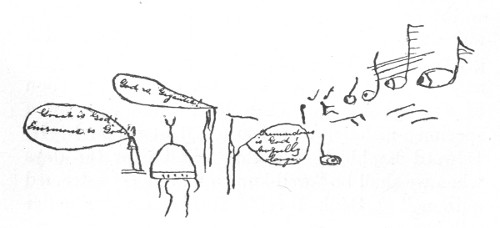
TO H.E. KREHBIEL New Orleans, 1883.
My dear Krehbiel,—There is nothing in magazine-work in the way of profit; for the cent-a-word pay does not really recompense the labour required: but the magazines introduce one to publishers, and publishers select men to write their books. Magazine-work is the introduction to book-work; and book-work pays doubly—in money and reputation. I hope to climb up slowly this way—it takes time, but offers a sure issue. You could do so much more rapidly.
I find in my Oriental catalogues “Villoteau—Mémoire sur la Musique de l’antique Egypte.—Paris: Maisonneuve & Cie, 1883 (15 fr.).” Wonder if you have the work in any of your public libraries. If you have not, and you would like to get it, I can obtain it from Paris duty-free next time I write to Maisonneuve, from whom I am obtaining a great number of curious books.
You must have noticed in the papers the real or pretended discovery of an ancient Egyptian melody,—the notes being represented by owls ascending and descending the musical scale. Hope you will get to see it. I have been thinking that we might some day, together, work up a charming collection of musical legends: each legend followed by a specimen-melody, with learned dissertation by H. Edward Krehbiel. But that will be for the days when we shall be “well-known and highly esteemed authors.” I think I could furnish some singular folk-lore.
Meanwhile “Bìlâl” has been finished. I wrote to Harper’s Magazine;—the article was returned with a very complimentary autograph letter from Alden, praising it warmly, but recommending its being offered to the Atlantic, as he did not know when he could “find room for it.” Find room for it! Ah, bah!... I am sorry: because I had written him about your share in it, and hoped, if successful, it would tempt him to write you. It is now in the hands of another magazine. I used your Koran-fragment in the form of a musical footnote.
I notice you called it a “brick.” Are you sure this is the correct word? Each sura (or chapter) indeed signifies a “course of bricks in a wall;” but also signifies “a rank of soldiers”—and the verses, which were never numbered in the earlier MSS., are so irregular that the poetry of the term “brick” could scarcely apply to them. However, I may be wrong.
I was delighted with your delight, as expressed in your beautiful letter upon the Hebrew ceremonial. Hebrew literature has been my hobby for some time past: I have Hershon’s “Talmudic Miscellany;” Stauben’s “Scènes de la Vie Juive” (full of delicious traditions); Kompert’s “Studies of Jewish Life,” which you have no doubt read in the original German; and Schwab’s French translation of the beginning of the Jerusalem Talmud (together with the Babylonian Berachoth), 5 vols. I confess the latter is, as a whole, unreadable; but the legends in it are without parallel in weirdness and singularity. Such miscellaneous reading of this sort as I have done has given new luminosity to my ideas of the antique Hebrew life; and enabled me to review them without the gloom of Biblical tradition,—especially the nightmarish darkness of the Pentateuch. I like to associate Hebrew ceremonies rather with the wonderful Talmudic days of the Babylonian rabbonim than with the savage primitiveness of the years of Exodus and Deuteronomy. There are some queer things about music in the Talmud; but they are sometimes extravagant as that story about the conch-shell blown at the birth of Buddha—“where of the sound rolled on unceasingly for four years!” The swarthy fishermen of our swampy lakes do blow conch-shells by way of marine signalling; and whenever I hear them I think of that monstrous conch-shell told of in the Nidānakathā.
As I write it seemeth to me that I behold, overshadowing the paper, the most Dantesque silhouette of one who walked with me the streets of the far-off Western city by night, and with whom I exchanged ghostly fancies and phantom hopes. Now in New York! How the old night-forces have been scattered! But is it not pleasant to observe that the members of the broken circle have been mounting higher and higher toward the supreme hope? Perhaps we may all meet some day in the East; whence as legendary word hath it—“lightning ever cometh.” Remember me very warmly to my old comrade Tunison.
But I think it more probable I shall see you here than that you shall see me there. New York has become something appalling to my imagination—perhaps because I have been drawing my ideas of it from caricatures: something cyclopean without solemnity, something pandemoniac without grotesqueness,—preadamite bridges,—superimpositions of iron roads higher than the aqueducts of the Romans,—gloom, vapour, roarings and lightnings. When I think of it, I feel more content with my sunlit marshes,—and the frogs,—and the gnats,—and the invisible plagues lurking in visible vapours,—and the ancientness,—and the vast languor of the land. Even our vegetation here, funereally drooping in the great heat, seems to dream of dead things—to mourn for the death of Pan. After a few years here the spirit of the land has entered into you,—and the languor of the place embraces you with an embrace that may not be broken;—thoughts come slowly, ideas take form sluggishly as shapes of smoke in heavy air; and a great horror of work and activity and noise and bustle roots itself within your soul,—I mean brain. Soul = Cerebral Activity = Soul.
I am afraid you have read the poorest of Cable’s short stories. “Jean-ah Poquelin,” “Belles-Demoiselles,” are much better than “Tite Poulette.” There is something very singular to me in Cable’s power. It is not a superior style; it is not a minutely finished description—for it will often endure no close examination at all: nevertheless his stories have a puissant charm which is hard to analyze. His serial novel—“The Grandissimes”—is not equal to the others; but I think the latter portion of “Dr. Sevier” will surprise many. He did me the honour to read nearly the whole book to me. Cultivate him, if you get a chance.
Baker often talks with me about you. You would never have any difficulty in obtaining a fine thing here. Perhaps you will be the reverse of flattered by this bit of news; but the proprietors here think they can make the T.-D. a bigger paper than it is, and rival the Eastern dailies. For my part I hope they will do it; but they lack system, experience, and good men, to some extent. Now good men are not easily tempted to cast their fortunes here at present. It will be otherwise in time; the city is really growing into a metropolis,—a world’s market for merchants of all nations,—and will be made healthier and more beautiful year by year.
Good-bye for the present
Your very sincere friend,
L. Hearn.
TO W. D. O’CONNOR New Orleans, 1883.
My dear O’Connor,—I felt the same regret on finishing your letter that I have often experienced on completing a brief but delightful novelette: I wanted more,—and yet I had come to the end!... Your letters are all treasured up;—they are treats, and one atones for years of silence. My dear friend, you must never trouble yourself to write when you feel either tired or disinclined: when I think I have the power to interest you, I will always take advantage of it, without expecting you to write. I know what routine is, and what weariness is; and some day I think we shall meet, and arrange for a still more pleasant intimacy.
Your preference for Boutimar pleases me: Boutimar was my pet. There is a little Jewish legend in the collection—Esther—somewhat resembling it in pathos.
Your observation about my knowledge is something I cannot accept; for in positive acquirements I am even exceptionally ignorant. By purchasing queer books and following odd subjects I have been able to give myself the air of knowing more than I do; but none of my work would bear the scrutiny of a specialist; I would like, however, to show you my library. It cost me only about $2000; but every volume is queer. Knowing that I have nothing resembling genius, and that any ordinary talent must be supplemented with some sort of curious study in order to place it above the mediocre line, I am striving to woo the Muse of the Odd, and hope to succeed in thus attracting some little attention. This coming summer I propose making my first serious effort at original work—a very tiny volume of sketches in our Creole archipelago at the skirts of the Gulf. I am seeking the Orient at home, among our Lascar and Chinese colonies, and the Prehistoric in the characteristics of strange European settlers.
The trouble kindly taken by you in transcribing the little words of praise by a lady was more than compensated by the success of its purpose, I fancy. The only pleasure, indeed, that an author derives from his labours is that of hearing such commendations from appreciative or sympathetic readers. Your sending copies “hither and thither” was too kind; I could scold you for it! Still, the consequences indicated that the book may some day reach a new edition; and I receive nothing until the publisher pockets $1000.
Have you seen the exquisite new edition of Arnold’s “Light of Asia”? It has enchanted me,—perfumed my mind as with the incense of a strangely new and beautiful worship. After all, Buddhism in some esoteric form may prove the religion of the future. Is not the cycle of transmigration actually proven in the vast evolution from nomad to man,—from worm to King through innumerable myriads of brute form? Is not the tendency of all modern philosophy toward the acceptance of the ancient Indian teaching that the visible is but an emanation of the Invisible,—a delusion,—a creature, or a shadow, of the Supreme Dream? What are the heavens of all Christian fancies, after all, but Nirvana,—extinction of individuality in the eternal interblending of man with divinity; for a bodiless, immaterial, non-sensuous condition means nothingness, and no more. And the life and agony and death of universes, are these not pictured forth in the Oriental teachings that all things appear and disappear alternately with the slumber or the awakening, the night or the day, of the Self-Existent? Finally, he efforts of Romanes and Darwin and Vignoli to convince us of the interrelation—the brotherhood of animals and of men were anticipated by Gautama. I have an idea that the Right Man could now revolutionize the whole Occidental religious world by preaching the Oriental faith