Volume 1 — LETTERS 1877-1889 (continued 3)
Reading edition
Very affectionately,
Lafcadio Hearn.
If Symonds praises Whitman, I stand reproved for my least doubts; for he is the very apostle of classicism and form.
TO H. E. KREHBIEL New Orleans, December, 1883.
Dear Krehbiel,—I greatly enjoyed that sharp, fresh, breezy letter from Feldwisch, which I re-enclose with thanks for the pleasure given. While I am greatly delighted with his success, I cannot say I have been surprised: he possessed such rare and splendid qualities of integrity and manliness—coupled with uncommon quickness of business perception—that I would not have been astonished to hear of Congressman Feldwisch,—always supposing it were possible to be a politician and an upright member of modern American society,—which is doubtful. Please let me have his exact address;—I would like to write him once in a while.
After all, I believe you are right in regard to magazine-work. I fully appreciated the effect upon a thoroughbred artist of being asked to write something flimsy,—ask Liszt to play Yankee Doodle! Our magazines—excepting the Atlantic—do not appear to be controlled by, or in the interest of, scholars. Fancy how I felt when asked (indirectly) by the Century to write something “SNAPPY”!—even I, who am no specialist, and if anything of an artist, only a word-artist in embryo!... I also suspect you are correct in your self-interest: your forte will never be light work, because your knowledge is too extensive, and your artistic feeling too deep, to be wasted upon puerilities. It has always seemed to me that your style gains in solid strength and beauty as the subject you treat is deeper. To any mind which has grasped the general spirit and aspect of a science, isolated facts are worthy of consideration only in their relation to universal and, perhaps, eternal laws: anecdote for the mere sake of anecdote is simply unendurable.
Five years of hard study here have resulted in altogether changing my own literary inclinations,—yet, unfortunately, to no immediate purpose that I can see; for I must always remain too ignorant to succeed as a specialist in any one topic. But a romantic fact—the possession of which would have driven me wild with joy a few years ago, or even one year ago, perhaps—now affects me not at all unless I can perceive its relation to some general principle to be elucidated. And the mere ideas and melody of a poem seem to me of small moment unless the complex laws of versification be strictly obeyed. Hence I feel no inclination to attempt a story or sketch unless I can find some theme of which the treatment might do more than gratify fancy. Unless a romance be instructive,—or inaugurate a totally novel style,—I think it can have no lasting value. The old enthusiasm has completely died out of me. But meanwhile I am trying to fill my brain with unfamiliar facts on special topics, believing that some day or other I shall be able to utilize them in a new way. I have thought, for example, of trying to write physiological novelettes or stories,—based upon scientific facts in regard to races and characters, but nevertheless of the most romantic aspect possible: natural but never naturalistic. Still, I am so fully conscious that this idea has been suggested by popular foreign novelists, that I fear it may prove merely a passing ambition.
Another great affliction is my inability to travel. I hate the life of every day in connection with any idea of story-writing: I would give anything to be a literary Columbus,—to discover a Romantic America in some West Indian or North African or Oriental region,—to describe the life that is only fully treated of in universal geographies or ethnological researches. Won’t you sympathize with me?... If I could only become a Consul at Bagdad, Algiers, Ispahan, Benares, Samarkand, Nippo, Bangkok, Ninh-Binh,—or any part of the world where ordinary Christians do not like to go! Here is the nook in which my romanticism still hides. But I know I have not the physical qualifications to fit me for such researches, nor the linguistic knowledge required to make such researches valuable. I suppose I shall have to settle down at last to something horribly prosaic, and even devoid of philosophic interest.... Alas! O that I were a travelling shoemaker, or a player upon the sambuke!
I have two—nay three—projects sown: the seed has not yet sprouted. I expressed to Harpers’ a little Dictionary of Creole Proverbs—a mere compilation, of course, from many unfamiliar sources; “Bìlâl” is under consideration at the Century (where, I fear, they will cut up every sentence which clashes with Baptist ideas on the sinfulness of Islam); and my compilation of Oriental stories is being “seriously examined” by J. R. Osgood & Co....
This letter is getting wearisome; but I don’t know how soon I can again snatch time to write.... Ah yes!—for God’s sake (I suppose you believe just a small bit in God) don’t try to conceive how I could sympathize with Cable! Because I never sympathized with him at all. His awful faith—which to me represents an undeveloped mental structure—gives a neutral tint to his whole life among us. There is a Sunday-school atmosphere.... But Cable is more liberal-minded than his creed; he has also rare analytical powers on a small scale.... Belief I do not think is ridiculous altogether;—nothing is ridiculous in the general order of the world: but at a certain point it prevents the mind from expanding;—its horizon is solid stone and its sky a material vault. One must cease to believe before being able to comprehend either the reason or beauty of belief. The loss is surely well recompensed by the vast enlargement of vision—the opening up of the Star-spaces,—the recognition of the Eternal Life throbbing simultaneously in the vein of an insect or the scintillations of a million suns,—the comprehension of the relations of Infinity to human existence, or at least the understanding that there are such relations,—and that the humblest atom of substance can tell a story more wondrous than all the epics, romances, legends, or myths devised by ancient or modern fancy.—Now I am getting long-winded again. I conclude with a promise soon to forward another little bit of queer music. Hope you like the last. Come down here and I will turn you loose in my library. I need hardly specify that if you come, your natural expenses will be represented by 0,—that is, if you condescend to live in my neighbourhood. It is not romantic; but it is comfortable. I’m sick of Creole Romance—it nearly cost me my life.
Bye, my friend
Your old goblin,
Lafcadio Hearn.
TO H. E. KREHBIEL New Orleans, February, 1884.
Dear Krehbiel,—I hope you may prove right and I wrong in my judgement of ——. As you say, I have a peculiar and unfortunate disposition; nevertheless I had better reasons for my suggestions to you than it is now necessary to specify.
Your syrinx discoveries seem to me of very uncommon importance. What is now important to learn is this: Is the syrinx an original instrument in those regions whence the American and West Indian slave-elements were drawn?—an account of which slave-sources is to be found in Edwards’s “History of the West Indies.” The Congo dances with their music are certainly importations from the West Coast—the Ivory Coast. Have you seen Livingstone’s account of the multiple pipe (chalumeau, Hartmann calls it in French) among the Batokas? I would like to know if it is a syrinx. We have no big public libraries here; but if you have time to make some West African researches, one could perhaps trace out the whole history of the syrinx’s musical migration. I send you the latest information I have been able to pick up. Just so soon as I can get the material ready, will send also information regarding the various West Indian dances in brief—also the negro-Creole bottle-dance, danced over an upright bottle to the chant—
“Ça ma coupé,— Ça ma coupé,— Ça ma coupé,— Ça!
Ça ma coupé,— Ça ma coupé,— Ça ma coupé,— Ça!”
I’ve reopened the envelope to tell you something I forgot—a suggestion.
I was quite pleased to hear you like my Chinese paragraph; and I have a little proposition. Do you know that a most delightful book was recently published in France, consisting wholly of odd impressions about strange books and strange people exchanged between friends by mail. Each impression should be very brief. Why couldn’t we do this: Once every month I’ll write you the queerest and most outlandish fancy I can get up—based upon fact, of course—not more than two hundred words; and you write me the most awful thing that has struck you in relation to new musical discoveries. In a year’s time we would have twenty-four little pieces between us, which would certainly be original enough to elaborate into more artistic form; and we could plot together how to outrage the public by printing them. I would contribute $100 or so—if we couldn’t find an enthusiastic printer. The book would be very small.
Everything should be perfectly monstrous, you know—ordinary facts, or ideas that could by any chance occur to commonly-balanced minds, ought to be rigidly excluded.
I don’t think I can go North till April. March would be too cold for me. The temptation of hearing grand singers is not now strong,—I’m sorry to say,—for I never go to the theatre on account of the artificial light, never read or write after dark; and I anticipate no special pleasure except that of seeing an old friend, and talking much monstrous talk about matters which I but half understand.
Yours very affectionately,
L. Hearn.
TO H. E. KREHBIEL New Orleans, February, 1884.
Extra volume of the series: Price, $500. Large folio.
The Battle-Cries of All Nations. With accompaniment of Barbaric instruments. Arranged for modern Orchestral reproduction.
I. Aryan Division.—Battle-Shouts of Gothic Races.—Teutoni and Cimbri—Frank and Alleman—Merovingian—The Roar of Pharamond. Iberian.—The Triumph of Herman.—Viking War-Chants.—The Song of Roland as sung by Taillefer.—Celtic and Early British War-Cries, etc., etc.
II. Semitic Division.—Hebrew War-Cries. “God is gone up with a shout, the Lord with the sound of the Trumpet.”—Arabs and Crusaders.—“Allah—hu-u-u Akbar!” etc. Berber Cries.—The Numidian Cavalry.
(The work also contains Ancient Egyptian, Babylonian, and Scythian war-cries; war-cries of the Parthians and Huns, of the Mongols and Tartars. Sounds of the Battle of Chalons; Cries of the Carthaginian mercenaries; Macedonian rallying-call, etc., etc. In the modern part are included Polynesian, African, Aztec, Peruvian, Patagonian and American. A magnificent musical version of the chant of Ragnar Lodbrok will be found in the Appendix: “We smote with our swords.”)
(This is not intended as a part of our private extravaganzas: but is written as a just punishment for your silence.)
Vol. I. Monograph upon the Popular Melodies Of Extinct Races. XXIII and 700 pp.
Vol. II. Music of Nomad Races. Introduction. “Men of Prey; the Falcon and Eagle Races of Mankind.” Part I. The Arabs. Part II. The Touareg of the Greater Desert. Part III. The Turkish and Tartar Tribes of Central Asia. With 1600 examples of melodies, engravings of musical instruments, etc.
Vol. III. Manifestation of Climatic Influence In Popular Melody. In Two Parts. Part I. Melodies of Mountain-dwellers. Part II. Melodies of Valley dwellers and inhabitants of low countries. (3379 Ex.)
Vol. IV. Race-Temper as Evidenced in the Popular Music of Various Peoples. Part I. The Melancholy Tendency. Part II. The Joyous Temperament. Part III. Ferocity. Part IV. etc., etc.,—2700 ex.
Vol. V. Peculiar Characteristics of Erotic Music in All Countries. (This volume contains nearly 7000 examples of curious music from India, Japan, China, Burmah, Siam, Arabia, Polynesia, Africa, and many other parts of the world.)
Vol. VI. Music of the Dance in the Orient. (3500 pp.)
Chap. I. The Mussulman Bayaderes of India (17 photolith).
Chap. II. The Bayaderes of Hinduism—especially of the Krishna and Sivaite sects.
Chap. III. Examples of Burmese Dance—music (with 25 photographic plates).
Chap. IV. The Tea-house dancers of Japan; and Courtesans of Yokohama. (34 Photo-Engrav.)
Chap. V. Chinese dancing melodies. (23 Photo-Engrav.)
Chap. VI. Tartar dance-melodies: the nomad dancing girls. (50 beautiful coloured plates.)
Chap. VII. Circassian and Georgian Dances, with Music. Examples of Daghestan melodies (49 plates).
Chap. VIII. Oriental War-Dances (480 melodies).
Vol. VII. The Weird in Savage Music (with 169 highly curious examples).
Vol. VIII. History of Creole Music in The Occidental Indies.
Part I. Franco-African Melody, and its ultimate development. (298 ex.)
Part II. Spanish. Creole music and the history of its formation (359 examples of Havanese and other West Indian airs are given).
Vol. IX-X-XI. Melodies of African Races. (This highly important work contains no less than 5000 different melodies, and a complete description of all African musical instruments known, illustrated with numerous engravings.) Price per vol., $27.50.
Vol. XII. Reconstruction of Antique Melodies after the Irrefutable Scientific System of the German School of Musical Evolutionists. (By this new process of anthropological research, it is now possible to reconstruct a lost melody, precisely as it was previously possible to affirm the existence of an extinct species of mammal which left no fossil record of which we know.)
Vol. XIII. Magical Melodies. The music of Apollo and Orpheus.—The Melodies of Wäinamöinen.—The Harp-playing of Merlin the Great.—Exhumation of the extraordinary Wizard-music referred to in the Kalewala.—Melodies that petrify.—Melodies that kill.—Melodies which evoke storms and tempests.—The Hávamál of Odin.—Scandinavian belief in chants which seduce female virtue.—The Indian legend of Amaron.—Polynesian magic song.—The thief’s song that lulls to sleep: a musical “hand-of-glory.”—The invocation of demons by song.—Examples of the melodies which fiends obey.—Songs that bring down fire from heaven.—Strange Hindoo legend of the singer consumed by his own song.—The melodies of the greater magic.—The chants that change the colour of the Moon.—Deva-music: the conch-shells sounded at the birth of Buddha.—Notes on the Kalewala legends of singers who made the sun and moon to pause in heaven and changed the courses of the stars.
Vol. XIV. The Melodies of Mighty Lamentation. Isis and Osiris.—Demeter and Persephone.—“By the Rivers of Babylon.”—Jeremiah’s knowledge of music.—Lamentation of Thomyris.—The musicians of Shah Jehan, etc. Apocalyptic music of the Bible.
Vol. XV. Mourning for the Dead. History of cries of mourning in all nations.—Description of ancient writers.—Howling of the women of the Teutoni and Cimbri.—Terror of the Romans at the hideous sounds. (With 1300 examples of musical wailing among ancient nations.)—Modern wailing.—Survival of the Ancient Mourning Cry among modern peoples.—The Corsican voceri.—African funeral-chants.—Negro-Creole funeral-wail. (Tout pití çabri—ça Zoé non yé).—Irish keening.—Gradual development of funeral-music, etc., etc.
Vol. XVI. Songs of Triumph.—“Up to the everlasting Gates of Capitolian Jove.”—Triumphal Chants of Rameses and Thotmes.—Assyrian triumphal marches.—A Tartar triumph.—Arabian melodies of war-joy, etc., etc.
KOROL AR C’HLEZE (The Sword-Dance)
Ancient dialect of Léon (Bretagne)
Goad, gwin, ha Korol. D’id Heol! Goad, gwin, ha Korol. Tan! tan! dir! oh! dir! tan! tan! dir ha tan! Tann! tann! tir! ha tonn! tonn! tir ha tir ha tann! Ha Korol ha Kan, Kan, ha Kann! Ha Korol ha Kan. Tan! tan!... Korol ar c’hleze, Enn eze; Korol ar c’hleze. Tan! tan!... Kan ar c’hleze glaz A gar laz; Kan ar c’hleze glaz. Tan! tan!... Kann ar c’hleze gone Ar Rone! Kann ar c’hleze gone. Tan! tan!... Kleze! Rone braz Ar stourmeaz! Kleze! Rone braz! Tan! tan!... Kaneveden gen War da benn! Kaneveden gen! Tan! tan! dir! oh! dir! tan! tan dir ha tan! Tann! tann! tir! ha tonn! tonn! tann! tir ha tir ha tann!
LITERAL TRANSLATION
Blood, wine, and dance to thee, O Sun!—blood, wine and dance! And dance and song, song and battle! dance and song! The Dance of Swords, in circle!—the dance of swords. Song of the Blue Sword that loves murder!—song of the blue sword! Battle where the Savage Sword is King!—battle of the savage sword! O Sword!—O great King of the fields of battle!—O Sword! O great King! Let the Rainbow shine about thy brow!—let the rainbow shine!
(The chorus is literal in my own translation, or rather metrification!)
(Rude metrical translation by your most humble servant.)
CELTIC SWORD-SONG
Dance, battle-blood and wine, O Sun, are thine! Dance, battle-blood, and wine! O Fire!—O Fire! O Steel!—O Steel! O Fire!—O Fire! O Steel and Fire! O Oak!—O Oak! O Earth!—O Waves! O Waves!—O Earth! O Earth and Oak! The dance-chant and the death-lock In battle-shock!— The dance-chant and the death-lock! O Fire!—O Fire! O Steel!—O Steel!... The Sword-dance, circling In a ring!— The Sword-dance, circling! O Fire! O Fire! O Steel! O Steel!... Sing the Slaughter-lover blue Broad and true! Sing the Slaughter-lover blue! O Fire!—O Fire! O Steel!—O Steel!... Battle where the savage Sword Is sole Lord,— Battle of the savage Sword! O Fire!—O Fire! O Steel!—O Steel!... O Sword! mighty King! Battle-King! O Sword! mighty King!... O Fire!—O Fire! O Steel!—O Steel!... Let the Rainbow’s magic rays Round thee blaze!— Let the Rainbow round thee blaze! O Fire!—O Fire! O Steel!—O Steel! O Fire!—O Fire! O Steel and Fire! O Oak!—O Oak! O Earth!—O Waves! O Waves!—O Earth! O Earth and Oak!
TO H. E. KREHBIEL New Orleans, February, 1884.
Dear K.,—Charley Johnson’s coming down to spend a week with me. I shall be soon enjoying his Rabelaisian mirth, and his Gargantuesque laughter. He is going to Havana, and I shall ask him to get, if possible, the music of the erotic mime-dance,—the Zamacueca of the Creoles.
I see they are offering prizes for a good opera. Why don’t you compose an opera? I can suggest the most tremendous, colossal, Ragnarockian subject imaginable—knocks Wagner endwise and all the trilogies: “The Wooing of the Virgin of Poja,” from the “Kalewala.” The “Kalewala” is the only essentially musical epopea I know of. Orpheus is a mere clumsy charlatan to Wainamoinen and the wooers. The incidents are more charmingly enormous than anything in the Talmud, Ramayana, or Mahabharata. O! the old woman who talks to the Moon!—and the wicked singer who turns all that hear him to stone!—and the phantoms created by magical chant!—and the songs that make the stars totter in the frosty sky!—and the melodies that melt the gates of iron! And then, too, the episode of the Eternal Smith, by whose art the blue vault of heaven was wrought into shape; and the weird sleigh-ride over the Frozen Sea; and the words at whose utterance “the waters of the great deep lifted a thousand heads to listen!” And the story of the Earth-giant, aroused by magical force from his slumber of innumerable years, to teach to the Magician the runes by which all things are created,—the enchanted songs by which the Beginning was made to Begin. If you have not read it, try to get a prose translation: no poetical version can preserve the delightful goblinry and elfishness of the original, whereof the metre rings even as the ringing of a mighty harp.
I have also a delightful Malay poem which would make a much finer operatic subject or dramatic subject than the European féeries modelled upon the Hindoo drama of Sakuntala, or, as my French translator writes it, Sacountala. I have an inexhaustible quarry of monstrous and diabolical inspiration.
Yours truly, etc.
I spend whole days in vocal efforts—vain ones—to imitate those delicious arabesques about the Name of Allah in the Muezzin’s Song,—and do suddenly awake by night with a Voice in my ears, as of a Summons to Prayer. Bismillah!—enormous is God!
(Punishment No. 2)
Monograph upon the Music of the Witches’ Sabbath.
Dictionary of the Musical Instruments of all Nations.
With 50,000 wood engravings.
The Musical Legends of All Nations.
By H. Ed. Krehbiel and Lafcadio Hearn. Seven Vols. in 8vo, with 100 chromolithographs and 2000 eau-fortes. Price $300 per vol. 24th edition.
On the Howling Dervishes, and on the melodies of the six other orders of Dervishes. With music.
The Song of the Muezzin in All Moslem Countries. From Western Morocco to the Chinese Sea. Nine hundred different Notations of the Chant—with an Appendix treating of the Chant in the Oases and in the Soudan, as affected by African influence. Price $8000.
Dance-Music of the Ancient Occident, 1700 Ex.
Temple-Melodies of the Ancient and Modern World. Vol. I, China. Vol. II, India. Vol III, Rome. Vol. IV, Greece. Vol. V, Egypt, etc.
(To be continued.)
TO H. E. KREHBIEL New Orleans, February, 1884.
Dear Krehbiel,—Please don’t let my importunacy urge you to write when you have little time and leisure. I only want to hear from you when it gives you pleasure and kills time. Never mind if I take a temporary notion to write every day—you know I don’t mean to be unreasonable.
Now, as I have your postal card I’ll cease the publication of my imaginary musical library, and will reserve that exquisite torture for some future occasion when I shall think you have treated me horribly. Just so soon as this beastly weather changes I’ll go to New York, and hope you’ll be able—say in April—to give me a few days’ loafing-time.
I’m afraid, however, I shall have to leave my Ideas behind me. I know I could never squeeze them under or over the Brooklyn Bridge. Furthermore, I’m afraid the Elevated R. R. cars might run over my Ideas and hurt them. In fact, ’t is only in the vast swamps of the South, where the converse of the frogs is even as the roar of a thousand waters, that my Ideas have room to expand.
Your banjo article delighted me,—of course, there is a great deal that is completely new to me therein. By the way, have you noticed the very curious looking harps of the Niam-Niams in Schweinfurth? They seem to me rather nearly related to the banjo in some respects. I am glad my little notes were of some use to you. I will take good care of the proof. Every time I see anything you’d like, I’ll send it on. The etymology of the banjo is a very interesting thing; perhaps I may find something fresh on the subject some day
Yours enthusiastically,
L. Hearn.
I know you would not care to hear about “the thousand different instruments to which the daughter of Pharaoh introduced King Solomon on the day he married her,” because the names of the instruments and the melodies which were performed upon them and the various chants to all the idols of Egypt which the daughter of Pharaoh taught Solomon are utterly forgotten. Yet, by the Kabbalistic rules of Gematria and Temurah might they not be exhumed?
In treatise Shekalim of Seder Mo’ed of the Talmud of Jerusalem it is related on the authority of Rabbi Aha, that Hogrus ben Levi, who directed the singing in the temple, “knew a vast number of melodies, and possessed a particular talent for modulating them in an agreeable voice. By thrusting his thumb into his mouth he produced many and various sorts of chants, so that his brethren, the Cohanim, were utterly amazed thereat.”
Hast read in Chap. XII of the Treatise Shabbat (Seder Mo’ed) concerning that lost Hebrew musical instrument, unlike any other instrument known in the history of mankind?...
TO H.E. KREHBIEL New Orleans, March, 1884.
Dear Krehbiel,—I was quite glad to get your short letter, knowing how busy you are. Johnson changed his mind about Havana, as the season there has been very unhealthy; and for the time being I am disappointed in regard to the Spanish-Creole music. But it is only a question of a little while when I shall get it. I sent you the other day some Madagascar music. You will observe it is arranged for men and women alternately. By the way, speaking of the refrain, I think you ought to find it scientifically treated in Herbert Spencer’s “Sociology;” for in that giant summary of all human knowledge, everything relating to the arts of life is considered comparatively and historically. I have not got it: indeed I could not afford so immense a series as a mere work of reference, and life is too short. But you can easily refer to it in your public libraries. This reminds me of a curious fact I observed in reading Tylor—the similarity of an Australian song to a Greek chorus at Sparta,—at least, the construction thereof. You remember the lines, sung alternately by old men, young men, and boys:—
(Old Men) “We once were stalwart youths.” (Young Men) “We are: if thou likest, test our strength.” (Boys) “We shall be, and far better too!”
Now Tylor quotes this Australian chant:—
(Girls) “Kardang garro.”—Young-brother again. (Old Women) “Manmal garro.”—Son again. (Both together) “Mela nadjo Nunga broo.”—Hereafter I shall see never.
And it is also odd to find in Jeannest that in certain Congo tribes there is a superstition precisely like the Scandinavian superstition about the hell-shoon”—a strange coincidence in view of the fact that these negroes do not allow any save the king and the dead to wear shoes.
I am happy to have discovered a new work on the blacks of Senegambia—home of the Griots; and I expect it contains some Griot music. I have sent for it. It is quite a large volume. I am beginning to think it would be a pity to hurry our project. The subject is so vast, and so many new discoveries are daily being made, that I think we can afford to gain material by waiting. I believe we can pick up a great deal of queer African music this summer; and I feel convinced we ought to get specimens of West Indian Creole music.
I am afraid my imagination may have outstripped human knowledge in regard to negro physiology. You remember my suggestion about the possible differentia in the vocal chords of the two races. I feel more than ever convinced there is a remarkable difference. I heard a negro mother the other day calling her child’s name—a name of two syllables—Ella;—the first syllable was a low but very loud note, the second a very high sharp one, with a fractional note tied to its tail; and I don’t believe any white throat could have uttered that extraordinary sound with such rapidity and flexibility. The Australian Coo-eee was nothing to it! Well, I have been since studying Flower’s “Hunterian Lectures on the Comparative Anatomy of Man;” and I find that the science of comparative anatomy is scarcely yet well defined—what, then, can be said about the Comparative Physiology of Man? Nevertheless Flower is astonishing. He indicates extraordinary race-differences in the pelvic index—(the shape of the pelvis)—the length and proportion of the limbs, etc. I have been thinking of writing to him on the subject. Tell me,—do you approve of the idea?
I have also sent to Europe for some works on Oriental music
Your affectionate friend,
L.H.
Charley Johnson spent a week with me. He is the same old Charley. We had lots of fun and talk about old times. He was quite delighted with my library; nearly every volume of which is unfamiliar to ordinary readers. I have now nearly five hundred volumes—Egyptian, Assyrian, Indian, Chinese, Japanese, African, etc., etc. Johnson seems to have become a rich man. The fact embarrassed me a little bit. Somehow or other, wealth makes a sort of Chinese wall between friends. One is afraid to be one’s self, or even to be as friendly as one would like toward somebody who is much better off. You know what I mean. Of course, I only speak of my private feelings; for Charley was just the same to me as in the old days.
TO W. D. O’CONNOR New Orleans, March, 1884.
My dear O’Connor,—What a delicious writer you are!—you do not know what pleasure your letter gave me, and how many novel combinations of ideas it evoked. I like your judgement of the Musée Secret; and yet ... I do not find it possible to persuade myself that the “mad excess of love” should not be indulged in by mankind. It is immemorial as you say;—Love was the creator of all the great thoughts and great deeds of men in all ages. I felt somewhat startled when I first read the earliest Aryan literature to find how little the human heart had changed in so many thousand years;—the women of the great Indian epics and lyrics are not less lovable than the ideal beauties of modern romance. All the great poems of the world are but so many necklaces of word-jewelry for the throat of the Venus Urania; and all history is illuminated by the Eternal Feminine, even as the world’s circle in Egyptian mythology is irradiated by Neith, curving her luminous woman’s body from horizon to horizon. And has not this “mad excess” sometimes served a good purpose? I like that legend of magnificent prostitution in Perron’s “Femmes Arabes,” according to which a battle was won and a vast nomad people saved from extinction by the action of the beauties of the tribe, who showed themselves unclad to the hesitating warriors and promised their embraces to the survivors,—of whom not over-many were left. Neither do I think that passion necessarily tends to enervate a people. There is an intimate relation between Strength, Health, and Beauty; they are ethnologically interlinked in one embrace,—like the Charities. I fancy the stout soldiers who followed Xenophon were far better judges of physical beauty than the voluptuaries of Corinth;—the greatest of the exploits of Heracles was surely an amorous one. I don’t like Bacon’s ideas about love: they should be adopted only by statesmen or others to whom it is a duty to remain passionless, lest some woman entice them to destruction. Has it not sometimes occurred to you that it is only in the senescent epoch of a nation’s life that love disappears?—there were no grand loves during the enormous debauch of which Rome died, nor in all that Byzantine orgy interrupted by the lightning of Moslem swords.... Again, after all, what else do we live for—ephemeræ that we are? Who was it that called life “a sudden light between two darknesses”? “Ye know not,” saith Krishna, in the Bhagavad-Gita, “either the moment of life’s beginning or the moment of its ending: only the middle may ye perceive.” It is even so: we are ephemeræ, seeking only the pleasure of a golden moment before passing out of the glow into the gloom. Would not Love make a very good religion? I doubt if mankind will ever cease to have faith—in the aggregate; but I fancy the era must come when the superior intelligences will ask themselves of what avail are the noblest heroisms and self-denials, since even the constellations are surely burning out, and all forms are destined to melt back into that infinite darkness of death and of life which is called by so many different names. Perhaps, too, all those myriads of suns are only golden swarms of ephemeræ of a larger growth and a larger day, whose movements of attraction are due to some “mad excess of love.”
The account your friend gave you of De Nerval’s suicide is precisely like the details of M. de Beaulieu’s picture exposed in 1859—and, I think, destroyed by the police for some unaccountable reason. It is described in Gautier’s “Histoire du Romantisme,” pp. 143-4 (note).... I am glad you notice my hand once in a while, and that you liked my De Nerval sketch and the “Women of the Sword.” You speak of magazine-work. I think the magazines are simply inabordables. My experiences have been disheartening. “Very good, very scholarly—but not the kind we want;”—“Highly interesting—sorry we have no room for it;”—“I regret to say we cannot use it, but would advise you to send it to X—;" "Deserves to be published; but unfortunately our rules exclude”—etc. I have an article now with the Atlantic—an essay upon the Adzan, or chant of the muezzin; its romantic history, etc. This has already been rejected by other leading magazines. Another horrible fact is that after your article is accepted, the editor rewrites it in his own way,—and then prints your name at the end of the so-created abomination. This is the plan of ——. I would like to see the ideal newspaper started we used to talk about: then we could write—eh?
So you think Doré’s Raven a failure! I hope you are not altogether right. I thought so when I first looked at the plates; but the longer I examined them, the more strongly they impressed me. There is ghostly power in several. What do you think of “The Night’s Plutonian Shore;” and the “Home by Horror haunted”? I must say that the terminal vignette with its Sphinx-death is one of the most terrible ideas I have ever seen drawn—although its force might be augmented by larger treatment. I would like to see it taken up by that French artist who painted that beautiful “Flight into Egypt,” where we see the Virgin and Child (in likeness of an Arab wanderer with her baby), slumbering between the awful granite limbs of the monster.
Your Gautier has just arrived. If you had sent me a little fortune you could not have pleased me so much. I never saw the photo before: it not only pleased, it excelled anticipation. You know our preconceived ideas of places we should like to visit and people we should like to know, usually excel the reality; but the head of Gautier seems to me grander than I imagined. One can almost hear him speak with that mellow, golden, organ-toned voice of his which Bergerat described; and I like that barbaric luxury of his attire,—there is something at once rich and strange about it, worthy some Khan of the Golden Horde.... I really feel quite enthusiastic about my new possession.
I am glad to hear you dislike Matthew Arnold. He seems to me one of the colossal humbugs of the century: a fifth-rate poet and unutterably dreary essayist;—a sort of philosophical hermaphrodite, yet lacking even the grace of the androgyne, because there is neither enough of positivism nor of idealism in his mental make-up to give real character to it. Don’t you think Edwin Arnold far the nobler man and writer? I love that beautiful enthusiasm of his for the beauties of strange faiths and exotic creeds. This is the spirit that, in some happier era, may bless mankind with a universal religion in perfect harmony with the truths of science and the better nature of humanity.
You ask about this climate. One who has lived by the sea and on the mountain-tops, as I have, must spend several years here to understand how this intertropical swamp-life affects the unacclimated. The first year one becomes very sick—fevers of unfamiliar character attack him; the appetite vanishes, the energies become enfeebled. The second summer one feels even worse. The third summer one can just endure without absolute sickness. The fourth, one begins to gain flesh and strength. But the blood has completely changed, the least breath of really cool air makes one shiver, and energy never becomes quite restored. After a few years in Louisiana, hard work becomes impossible. We are all lazy, enervated, compared with you Northerners. When my Northwestern friends come down here, it seems to me like a coming of Vikings and Berserkers; they are so full of life and blood and vital electricity! But when it is cold to me, it seems frightfully warm to them; and yet we used once to work together as reporters with the thermometer 20 below zero.
Sorry to say that Leloir died before completing the illustrations; and I suppose the subscribers to the edition will be the losers. It was to be issued in parts. Perhaps ten numbers were out. But I am not sure whether any of the engravings were printed. I based my error upon the critique of Leloir’s work in Le Livre. It is dangerous to anticipate!
I believe I have the very latest edition of W. W. [Walt Whitman]—1882 (Rees, Welsh & Co.), which I like very much. You did not quite understand my allusion to the Bible. I wished to imply that it was when W. W.’s verses approached that biblical metre in form, etc., that we most admired him. I agree with all you say about slang,—especially nautical slang; also about the grand irregularity of the wave-chant. Still I’ll have to write some examples of what I refer to, and will do so later.
Yours very warmly and gratefully,
L. Hearn.
TO H. E. KREHBIEL New Orleans, March, 1884.
Dear Krehbiel,—I am sorry to be in such a hurry that I have to write a short letter; but I must signal my pleasure at seeing you coming out in public, and I have a vision of future greatness for you. As for myself, I trust I shall in a few years more obtain influence enough to be able to return some of your many kindnesses in a literary way. Eventually we may be able to pull together to a very bright goal, if I can keep my health.
I think that Osgood will announce the book about the 1st of April, but I am not sure. It would hardly do to anticipate. I send you his letter. The terms are not grand; but a big improvement on Worthington’s. Next time I hope I will be able to work to order. You can return letter when you are done with it, as it forms a part of my enormous collection of letters from publishers—(199 rejections to 1 acceptation).
I expect I shall have to postpone my visit until the book is out, as I must wait here to receive and correct proofs. I have dedicated the book to Page Baker, as it was entirely through his efforts that I got a hearing from Osgood. The reader had already rejected the MS. when Baker’s letter came.
From the Atlantic I have not yet heard. If I have good luck (which is extremely improbable) I would make the Muezzin No. 1 in a brief series of Arabesque studies, which would cost about two years’ labour—at intervals. I have several subjects in mind: for example, the lives of certain outrageous Moslem Saints, and a sketch of the mulatto and quadroon slave-poets of Arabia before Mahomet; “The Ravens,” as they were called from their color;—also the story of the Ye monnat, or those who died of love.... But these are beautiful dreams in embryo! Yours affectionately,
L. Hearn.
TO H. E. KREHBIEL New Orleans, March, 1884. Postal-card.
... It is related by Philostratus in his life of Apollonius of Tyana, that when Apollonius visited India, and asked the Brahmins to give him an example of (musical) magic, the Brahmins did strip themselves naked and dance in a ring, each tapping the earth with a staff, and singing a strange hymn. Then the earth within the ring rose up, quivering, even as fermenting dough,—and rose higher,—and undulated and was lost in great waves,—and elevated the singers unto the height of two cubits....
TO H. E. KREHBIEL New Orleans, April, 1884.
Dear Krehbiel,—I read your leader with no small interest; and “the gruesome memories” were revived. The killing of the man in the Vine Street saloon, however, interested me most as a memory-reviving interest. That murderer was the most magnificent specimen of athletic manhood that I ever saw,—I suspect he was a gipsy; for he had all the characteristics of that race, and was not a regular circus-employee,—only a professional rider, now with one company, now with another. Did you see him when you were there? He was perhaps 6 feet 4; for his head nearly touched the top of the cell. He had a very regular handsome face, with immense black eyes; and an Oriental sort of profile:—then he seemed slender, in spite of his immense force,—such was the proportion of his figure. A cynical devil, too. I went to see him with the coroner, who showed him the piece of the dead man’s skull. He took it between his fingers, held it up to the light, handed it back to the coroner and observed; “Christ!—he must have had a d—d rotten skull.” He was ordered to leave town within twenty-four hours as a dangerous character. It is a pity such men should be vulgar murderers and ruffians;—what superb troopers they would make! I shall never forget that splendid stature and strength as long as I live....
I don’t know whether I shall ever be living in that terrible metropolis of yours. It will be impossible for me ever again to write or read by night; and hard work has become impossible. If I could ever acquire reputation enough to secure a literary position on some monthly or weekly periodical where I could take it easy, perhaps I might feel like enduring the hideous winters. But I am just now greatly troubled by the question, What shall I work for?—to what special purpose? Perhaps some good fortune may come when least expected.
Now I want to talk about our trip. I think it better not to go now. Page wants me to take a good big vacation this summer,—a long one. If I wait till it gets warm, I will be able to escape the feverish month; and if you should be in Cincinnati at the Festival, or elsewhere, I would meet you anyhow or anywhere you say. Were I to leave now I could not do so later; and I am waiting for some curious books and things which I want to bring you so that we can analyze them together. A month or so won’t make much difference.
Will write you soon. Had to quit work for a few days on account of eye-trouble
Yours very truly,
L. Hearn.
TO H. E. KREHBIEL New Orleans, May, 1884.
Dear Krehbiel,—I have been so busy that I have not been able to answer your last. They are sending me proofs at the rate of twenty pages a day; and you can imagine this keeps me occupied in addition to my other work. Alas! I find that nothing written for a newspaper—at least for an American newspaper—can be perfect. My poor little book will show some journalistic weaknesses—will contain some hasty phrases or redundancies or something else which will mar it. I try my best to get it straight; but the consequences of hasty labour are perpetually before me, notwithstanding the fact that the collocation of the material occupied nearly two years. I am thinking of Bayard Taylor’s terrible observation about American newspaper-work. It seems to be generally true. Still there are some who write with extraordinary precision and correctness. I think you are one of them.
What troubles my style especially is ornamentation. An ornamental style must be perfect or full of atrocious discords and incongruities; and perfect ornamentation requires slow artistic work—except in the case of men like Gautier, who never re-read a page, or worried himself about a proof. But I think I’ll improve as I grow older.
I won’t be away till June. Then I’ll have some queer books in my satchel, and we’ll talk the book over. I fear it is no use to discuss it beforehand, as I shall be overwhelmed with work. Another volume of the Talmud has come, and some books about music containing Chinese hymns. By the way, in Spencer’s last volume there is an essay on musical origination. I have had only time to glance at it. Your Creole music lecture cannot fail to be extremely curious; wish I could hear and see it. The melodies will certainly make a sensation if you have a good assortment. Did you borrow anything from Gottschalk?—I hope you did: the Bamboula used to drive the Parisians wild.
Thanks for the musical transcription. I’m afraid the project won’t pan out, however. Trübner & Co. of London made an offer, but wanted me to guarantee the American sale of 100 copies—that means pay in advance. I would not perhaps have objected, if they had mentioned a low price; but when I tried to get them to come down to about 5s. per copy they did not write me any more.
Then I abandoned the pursuit of the Ignis Fatuus of Success, and withdrew into the Immensities and the Eternities, even as the rhinoceros withdraweth into the recesses of the jungle. And I gave myself up to the meditation of the Vedas and of the Puranas and of the Upanishads, and of the Egyptian Ritual of the Dead,—until the memory of magazines and of publishers faded out of my mind, even as the vision of demons
Yours very truly,
L. Hearn.
TO W. D. O’CONNOR New Orleans, May, 1884.
My dear O’Connor,—I did not get time until to-day to drop you a line; and just at present I am enthusiastically appreciating your observations regarding The Foul Fiend Routine. I wish I could escape from his brazen grip; and nevertheless he has done me service. He has stifled my younger and more foolish aspirations, and clipped the foolish wings of my earlier ambition with the sharp scissors of revision. It is true that I now regret my inability to achieve literary independence; but had I obtained a market for my wares in other years, I should certainly have been so ashamed of them by this time, that I should fly to some desert island. These meditations follow upon the incineration of several hundred pages of absurdities written some years back, and just committed to the holy purification of fire....
I am not, however, sorry for writing the fantastic ideas about love which you so thoroughly exploded in your letter; they “drew you out,” and I wanted to hear your views. I suppose, however, that the mad excess is indulged in by every nation at a certain period of existence—perhaps the Senescent Epoch, as Draper calls it. What a curious article might be written upon “The Amorous Epochs of National Literatures,”—or something of that sort; dwelling especially upon the extravagant passionateness of Indian, Persian, and Arabic belles-lettres,—and their offshoots! Not to bore you further with theories, however, I herewith submit another specimen of excess from the posthumous poetry of Gautier. It has been compared to those Florentine statuettes, which are kept in shagreen cases, and only exhibited, whisperingly, by antiquaries to each other....
There is real marmorean beauty in the lines,—their sculpturesqueness saves them from lewdness. I think them more beautiful than Solomon’s simile, or the extravagances of the Gita-Govinda.
June 29.
You see how busy I have been. And my brain seems so full of dust and hot sun and feverish vapours that it is hard to write at all.... I am thinking of what you said about Arnold’s translating the Koran. There are two English translations besides Sale’s—one in Trübner’s Oriental Series, and one in Max Müller’s “Sacred Books of the East” (Macmillan’s beautiful edition). Sale’s is chiefly objectionable because the suras are not versified: the chapters not having been so divided in early times by figures. But it is horribly hard to find anything in it. The French have two superb versions: Kazimirski and La Beaume. Kazimirski is popular and cheap; the other is an analytical Koran of 800 4to pp. with concordance, and designed for the use of the Government bureaux in Algeria. I have it. It is unrivalled.
My book is out; and you will receive a copy soon. If you ever have time, please tell me if there is anything in it you like. It is not a gorgeous production,—only an experiment. I have a great plan in view: to popularize the legends of Islam and other strange faiths in a series of books. My next effort will be altogether Arabesque—treating of Moslem saints, singers, and poets, and hagiographical curiosities—eschewing such subjects as the pilgrimage to the ribath (monastery) of Deir-el-Tiu in the Hedjaz, where fragments of the broken aidana of Mahomet are kissed by the faithful....
I’m sorry to say I know little of Bacon except his Essays. Those surprised and pleased me. I started to read them only as a study of Old English; but soon found the ideas far beyond the century in which they were penned. You will be shocked, I fear, to know that I am terribly ignorant of classic English literature,—of the sixteenth, seventeenth, and eighteenth centuries. Not having studied it much when at college, I now find life too short to study it,—except for style. When I want to clear mine,—as coffee is cleared by the white of an egg,—I pour a little quaint English into my brain-cup, and the Oriental extravagances are gradually precipitated. But I think a man must devote himself to one thing in order to succeed: so I have pledged me to the worship of the Odd, the Queer, the Strange, the Exotic, the Monstrous. It quite suits my temperament. For example, my memories of early Roman history have become cloudy, because the Republic did not greatly interest me; but very vivid are my conceptions of the Augustan era, and great my delight with those writers who tell us how Hadrian almost realized that impossible dream of modern æsthetes, the resurrection of Greek art. The history of modern Germany and Scandinavia I know nothing about; but I know the Eddas and the Sagas, and the chronicles of the Heimskringla, and the age of Vikings and Berserks,—because these were mighty and awesomely grand. The history of Russia pleaseth me not at all, with the exception of such extraordinary episodes as the Dimitris; but I could never forget the story of Genghis Khan, and the nomad chiefs who led 1,500,000 horsemen to battle. Enormous and lurid facts are certainly worthy of more artistic study than they generally receive. What De Quincey told us in his “Flight of a Tartar Tribe” previous writers thought fit to make mere mention of.... But I’m rambling again.
I don’t know whether I shall be able to go North as I hoped—I have so much private study before me. But I do really hope to see you some day. Couldn’t you get down to our Exposition?...
Did you ever read Symonds’s “Greek Poets”? The final chapters on the genius of Greek art are simply divine. I mention them because of your observation about our being or not being ephemeral. I feel fearful we are. But Symonds says what I would have liked to say, so much better, that I would like to let him speak for me with voice of gold.
Very truly your friend,
Lafcadio Hearn.
TO H.E. KREHBIEL New Orleans, June, 1884.
Dear Krehbiel,—I’m expecting every day to get some Griot music and some queer things, and have discovered an essay upon just the subject of subjects that interests Us:—the effect of physiological influences upon the history of nations, and “the physiological character of races in their relation to historical events.” Wouldn’t it be fine if we could write a scientific essay on Polynesian music in its manifestations of the physiological peculiarities of the island-races? Nothing would give me so much pleasure as to be able some day to write a most startling and stupefying preface to some treatise of yours upon exotic music—a preface nevertheless strictly scientific and correct. By the way, have you any information about Eskimo music? If you have, tell me when I see you. I have some singular songs with a double-refrain,—but no music,—which I found in Rink. Why the devil didn’t Rink give us some melodies?
I am especially interested just now in Arabic subjects; but as I am following the Arabs into India, I find myself studying the songs of the bayaderes. They are very strange, and sometimes very pretty—sweetly pretty. Maisonneuve promised to publish some of this Indian music; but that was in ’81, and we haven’t got it yet. I have found curious titles in Trübner’s collection; but I’m afraid the music isn’t published—“Folk-Songs of Southern India,” etc.
I want you to tell me how long you will stay in New York, as I would like to go there soon. The vacations are beginning. Don’t fail to keep me posted as to your movements. How did you like the sonorous cry of the bel-balancier man?
Am writing in haste; excuse everything excusable
Yours affectionately,
L. Hearn.
A man ignorant of music is likely to say silly things without knowing it when writing to a professor; so you must excuse my faults on the ground of good will to you. I have just destroyed two pages which I thought might be waste of time to read.
TO H.E. KREHBIEL New Orleans, June, 1884.
Dear K.,—I want you to let me hear about old Bìlâl for the following reasons:—
1. I have discovered that a biography of him—the only one in existence probably—-may be found in Wüstenfeld’s “Nawawi,” for which I have written. If the text is German I can utilize it with the aid of a bouquiniste here.
2. I have been lucky enough to engage a copy of Ibn Khallikan in 24 volumes—the great Arabic biographer. It containeth legends. The book is dear but invaluable to an Oriental student,—especially to me in the creation of my new volume, which will be all Arabesques.
And here is another bit of news for you. My Senegal books have thrown a torrent of light on the whole history of American slave-songs and superstitions and folk-lore. I was utterly astounded at the revelation. All that had previously seemed obscure is now lucid as day. Of course, you know the slaves were chiefly drawn from the West Coast; and the study of ethnography and ethnology of the West Coast races is absolutely essential to a knowledge of Africanism in America. As yet, however, I have but partly digested my new meal.
Siempre á V.,
Lafcadio Hearn.
New Orleans, June, 1884.
Dear K.,—Your letter has given me unspeakable pleasure. In making the acquaintance of Howells, you have met the subtlest and noblest literary mind in this country,—scarcely excepting that prince of critics, Stedman; and you have found a friend who will aid you in climbing Parnassus, not for selfish motives, but for pure art’s sake. Cultivate him all you can....
I got a nice letter from Ticknor. He actually promises to open the magazine-gates for me. And a curious coincidence is that the book is published on my birthday, next Friday.
I will write you before I start for New York in a few weeks more....
I will bring my African books with me, and other things.
Yours sincerely,
Lafcadio Hearn.
TO H. E. KREHBIEL New Orleans, October, 1884.
Dear Krehbiel,—I sit down to write you the first time I have had leisure to do justice to the subject for a month.
Now I must tell you what I am doing. I have been away a good deal, in the Creole archipelagoes of the Gulf, and will soon be off again, to make more studies for my little book of sketches. I sent you the No. 2, as a sample. These I take as much pains with as with magazine work, and the plan is philosophical and pantheistic. Did you see “Torn Letters,”—(No. 1) about the Biscayena. The facts are not wholly true; I was very nearly in love—not quite sure whether I am not a little in love still,—but I never told her so. It is so strange to find one’s self face to face with a beauty that existed in the Tertiary epoch,—300,000 years ago,—the beauty of the most ancient branch of humanity,—the oldest of the world’s races! But the coasts here are just as I described them, without exaggeration,—and I am so enamoured of those islands and tepid seas that I would like to live there forever, and realize Tennyson’s wish:—
“I will wed some savage woman; she shall rear my dusky race: Iron-jointed, supple-sinewed, they shall dive and they shall run,— Catch the wild goat by the hair, and hurl their lances in the sun, Whistle back the parrot’s call,—leap the rainbows of the brooks,— Not with blinded eyesight poring over miserable books.”
The islanders found I had one claim to physical superiority anyhow,—I could outswim the best of them with the greatest ease. And I have disciplined myself physically so well of late years, that I am no longer the puny little fellow you used to know.
All this is sufficiently egotistical. I just wanted, however, to tell you of my wanderings and their purpose. It was largely inspired by the new style of Pierre Loti—that young marine officer who is certainly the most original of living French novelists.
All this summer Page could not get away; so you will not have the pleasure of seeing my very noble and lovable friend,—a tall, fine, eagle-faced fellow, primitive Aryan type. I only got away on the pledge to give the results to the T.-D., which is giving me all possible assistance in my literary undertakings.
I was glad to receive Creole books, as I am working on Creole subjects. Several new volumes have appeared. I have some Oriental things to send you—music, if you will agree to return in one month from reception. But you need not have expressed those other things—made me feel sorry. I expressed them to you for other reasons entirely.
I have a delightful Mexican friend living with me, and teaching me to speak Spanish with that long, soft, languid South American Creole accent that is so much more pleasant than the harsher accent of Spain. His name is José de Jesus y Preciado, and he sends you his best wishes, because he says all my friends must be his friends too.
Now, I hope you’ll write me a pretty, kind, forgiving letter,—not condescendingly, but really nice,—you know what I mean.
Your supersensitive and highly suspicious friend,
Lafcadio Hearn.
TO H. E. KREHBIEL New Orleans, January, 1885.
Dear Friend Krehbiel,—Many, many happy New Years. Your letter came luckily during an interval of rest,—so that I can answer it right away. I have not been at all worried by your silence,—as your former kind lines showed me you had fully forgiven my involuntary injustice and my voluntary, but only momentary malice. (Please give this last the French accent, which takes off the edge of the word.)
In a few days my Creole Dictionary will be published in New York; and I will not forget to send you a copy, just as soon as I can get some myself. I do not expect to make anything on the publication. It is a give-away to a friend, who will not forget me if he makes money, but who does not expect to make a fortune on it. This kind of thing is never lucrative; and the publication of the book is justified only by Exposition projects. As for the “Stray Leaves” I have never written to the publishers yet about them,—so afraid of bad news I have been. But I have dared to try and get a good word said for it in high places. I succeeded in obtaining a personal letter from Protap Chunder Roy, of Calcutta, and hope to get one from Edwin Arnold. This is cheeky; but publishers think so much about a commendation from some acknowledged authority in Oriental studies.
The prices are high; the markets are all “bulled;” and for the first time I find my room rent here (twenty dollars per month) and my salary scarcely enough for my extravagant way of life. Money is a subject I am beginning to think of in connection with everything except—art. I still think nobody should follow an art purpose with money in view; but if no money comes in time, it is discouraging in this way,—that the lack of public notice is generally somewhat of a bad sign. Happily, however, I have joined a building association, which compels me to pay out $20 per month. Outside of this way of saving, I save nothing,—except queer books imported from all parts of the world.
Very affectionately yours,
Hearn.
TO H. E. KREHBIEL. New Orleans, January, 1885.
My dear Krehbiel,—I fear I know nothing about Creole music or Creole negroes. Yes, I have seen them dance; but they danced the Congo, and sang a purely African song to the accompaniment of a dry-goods box beaten with sticks or bones and a drum made by stretching a skin over a flour-barrel. That sort of accompaniment and that sort of music, you know all about: it is precisely similar to what a score of travellers have described. There are no harmonies—only a furious contretemps. As for the dance,—in which the women do not take their feet off the ground,—it is as lascivious as is possible. The men dance very differently, like savages, leaping in the air. I spoke of this spectacle in my short article in the Century.
One must visit the Creole parishes to discover the characteristics of the real Creole music, I suspect. I would refer the Century to Harris’s book: he says the Southern darkies don’t use the banjo. I have never seen any play it here but Virginians or “upper country” darkies. The slave-songs you refer to are infinitely more interesting than anything Cable’s got; but still, I fancy his material could be worked over into something really pretty. Gottschalk found the theme for his Bamboula in Louisiana—Quand patate est chinte, etc., and made a miracle out of it.
Now if you want any further detailed account of the Congo dance, I can send it; but I doubt whether you need it. The Creole songs, which I have heard sung in the city, are Frenchy in construction, but possess a few African characteristics of method. The darker the singer the more marked the oddities of intonation. Unfortunately most of those I have heard were quadroons or mulattoes. One black woman sang me a Voudoo song, which I got Cable to write—but I could not sing it as she sang it, so that the music is faulty. I suppose you have seen it already, as it forms part of the collection. If the Century people have any sense they would send you down here for some months next spring to study up the old ballads; and I believe that if you manage to show Cable the importance of the result, he can easily arrange it....
You answered some of my questions charmingly. Don’t be too sarcastic about my capacity for study. My study is of an humble sort; and I never knew anything, and never shall, about acoustics. But I have had to study awful hard in order to get a vague general idea of those sciences which can be studied without mathematics, or actual experimentation with mechanical apparatus. I have half a mind to study medicine in practical earnest some day. Wouldn’t I make an imposing Doctor in the Country of Cowboys? A doctor might also do well in Japan. I’m thinking seriously about it.
This is the best letter I can write for the present, and I know it’s not a good one. I send a curiosity by Xp to you.
The Creole slaves sang usually with clapping of hands. But it would take an old planter to give reliable information regarding the accompaniment.
Yours very truly,
L. Hearn.
TO H. E. KREHBIEL New Orleans, 1885.
Dear Krehbiel,—I regret having been so pressed for time that I was obliged to return your MS. without a letter expressing the thanks which you know I feel. I scribbled in pencil—which you can erase with a bit of bread—some notes on the Cajan song, that may interest you.
The Harpers are giving me warm encouragement; but advise me to remain a fixture where I am. They say they are looking now to the South for literary work of a certain sort,—that immense fields for observation remain here wholly untilled, and that they want active, living, opportune work of a fresh kind. I shall try soon my hand at fiction;—my great difficulty is my introspective disposition, which leaves me in revery at moments when I ought to be using eyes, ears, and tongue in studying others rather than my own thoughts.
I find the word Banja given as African in Bryan Edwards’s “West Indies.” My studies of African survivals have tempted me to the purchase of a great many queer books which will come in useful some day. Most are unfortunately devoted to Senegal; for our English travellers are generally poor ethnographers and anthropologists, so far as the Gold Coast and Ivory Coast are concerned. You remember our correspondence about the comparative anatomy of the vocal organs of negroes and whites. A warm friend of several years’ standing—a young Spanish physician and professor here—is greatly interested in this new science: indeed we study comparative human anatomy and ethnology in common, with goniometers and Broca’s instruments. He states that only microscopic work can reveal the full details of differentiation in the vocal organs of races; but calls my attention to several differences already noticed. Gibb has proved, for instance, that the cartilages of Wrisberg are larger in the negro;—this would not affect the voice especially; but the fact promises revelations of a more important kind. We think of your projects in connection with these studies.
I copied only your Acadian boat-song. What is the price of the slave-song book? If you have time to send me during the next month the music of “Michié Preval,” and of the boat-song, I can use them admirably in xml:lang="fr">Mélusine....
Your friend,
L. H.
TO W. D. O’CONNOR New Orleans, March, 1885.
Big P. S. No. 1.
I forgot in my hurried letter yesterday, to tell you that if you ever want a copy of “Stray Leaves,” don’t go and buy it, as you have been naughty enough to do, but tell me, and I’ll send you what you wish. I hope to dedicate a book to you some day, when I am sure it is worth dedicating to you.
I am quite curious about you. Seems to me you must be like your handwriting,—firmly knit, large, strong, and keen;—with delicate perceptions, (of course I know that, anyhow!) well-developed ideas of order and system, and great continuity of purpose and a disposition as level and even as the hand you write. If my little scraggy hand tells you anything, you ought to recognize in it a very small, erratic, eccentric, irregular, impulsive, variable, nervous disposition,—almost exactly your antitype in everything—except the love of the beautiful.
Very faithfully,
L. H.
Big P. S. No. 2.
I did not depend on Le Figaro for statements about Hugo; but picked them up in all directions. What think you of his refusal to aid poor blind Xavier Aubryet by writing a few lines of preface for his book? What about his ignoring the services of his greatest champion, Théophile Gautier? What about his studied silence in regard to the works of the struggling poets and novelists of the movement which he himself inaugurated? I really believe that the man has been a colossus of selfishness. One who prejudiced me very strongly against him, however, was that eccentric little Jew, Alexander Weill, whose reminiscences of Heine made such a sensation. Perhaps after all literary generosity is rare. Flaubert and Gautier possessed it; but twenty cases of the opposite kind, quite as illustrious, may be cited. In any event I am glad of your rebuke. Whether my ideas are right or wrong, I believe we ought not to speak of the weaknesses of truly great men when it can be avoided;—therefore I cry peccavi, and promise to do so no more.
Yours very sincerely,
Lafcadio Hearn.
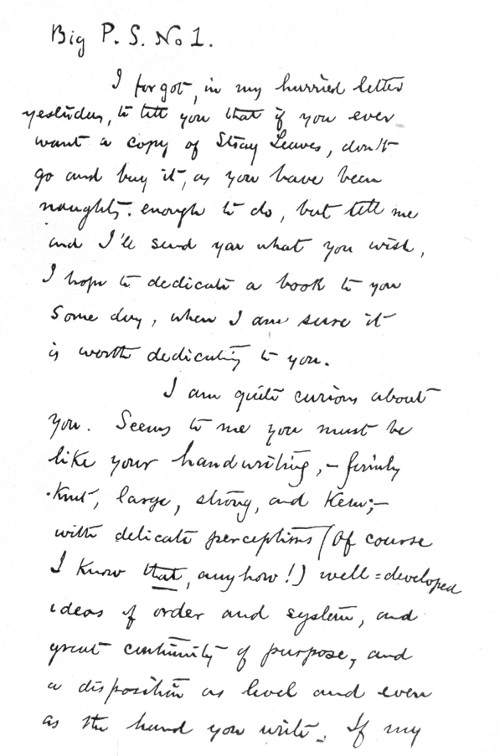
MR. HEARN’S EARLIER HANDWRITING
TO H. E. KREHBIEL New Orleans, 1885.
Dear Krehbiel,—I have been away in Florida, in the track of old Ponce de Leon,—bathing in the Fount of Youth,—talking to the palm-trees,—swimming in the great Atlantic surf. Charley Johnson and I took the trip together,—or to be strictly fair, it was he that induced me to go along; and I am not sorry for the expense or the time spent, as I enjoyed my reveries unspeakably. For bathing—sea-bathing—I prefer our own Creole islands in the Gulf to any place in Florida; but for scenery and sunlight and air,—air that is a liquid jewel,—Florida seems to me the garden of Hesperus. I’ll send you what I have written about it....
Charles Dudley Warner, whose acquaintance made here, strikes me as the nicest literary personage I have yet met.... Gilder of the Century was here—a handsome, kindly man.... A book which I recently got would interest you—Symonds’s “Wine, Women, and Song.” I had no idea that the Twelfth Century had its literary renascence, or that in the time of the Crusades German students were writing worthy of Horace and Anacreon. The Middle Ages no longer seem so Doresquely black
Your friend,
Lafcadio Hearn.
TO REV. WAYLAND D. BALL New Orleans, 1885.
My dear Ball,—I regret my long silence, now broken with the sincere pleasure of being able to congratulate you upon a grand success and still grander opportunities. The salary you are promised is nearly double that obtained by the best journalist in the country (excepting one or two men in highly responsible positions of managers); it far exceeds the average earnings of expert members of the higher professions; and there are not many authors in the United States who can rely upon such an income. So that you have a fine chance to accumulate a nice capital, as well as ample means to indulge scholarly tastes and large leisure to gratify them. I feared, sensitive as you are, to weigh too heavily upon one point before, but I think I shall not hesitate to do so now. I refer to the question of literary effort. Again I would say: Leave all profane writing alone for at least five years more; and devote all your talent, study, sense of beauty, force of utterance to your ministerial work. You will make an impression, and be able to rise higher and higher. In the meanwhile you will be able to mature your style, your thought, your scholarship; and when the proper time comes be able also to make a sterling, good, literary effort. What we imagine new when we are young is apt really to be very old; and that which appears to us very old suddenly grows youthful at a later day with the youth of Truth’s immortality. None, except one of those genii, who appear at intervals as broad as those elapsing in Indian myth between the apparition of the Buddhas, can sit down before the age of thirty-five or forty, and create anything really great. Again the maxim, “Money is power,”—commonplace and vulgar though it be,—has a depth you will scarcely appreciate until a later day. It is power for good, quite as much as for evil; and “nothing succeeds like success,” you know. Once you occupy a great place in the great religious world of wealth and elegance and beauty, you will find yourself possessed of an influence that will enable you to realize any ambition which inspires you. This is the best answer I can now give to your last request for a little friendly counsel, and it is uttered only because I feel that being older than you, and having been knocked considerably about the world, I can venture to offer the results of my little experience.
As you say, you are drawing nearer to me. I expect we shall meet, and be glad of the meeting. I shall have little to show you except books, but we will have a splendid time for all that. Meanwhile I regret having nothing good to send you. The story appeared in Harper’s Bazar.
Sincerely your friend,
Lafcadio Hearn.
TO REV. WAYLAND D. BALL New Orleans, July, 1885.
My dear Ball,—Your welcome letter came to me just at a happy moment when I had time to reply. I would have written before, but for a protracted illness. I am passionately fond of swimming; and the clear waters of that Florida spring seduced me into a plunge while very hot. The water was cold as death; and when I got back to New Orleans, I had the novel experience of a Florida fever,—slow, torpid, and unconquerable by quinine. Now I am all right.
The language of “Stray Leaves” is all my own, with the exception of the Italic texts and a few pages translated from the “Kalewala.” The Florida sketch I sent you, although published in a newspaper, is one of a number I have prepared for the little volume of impressions I told you about. I sent it as an illustration of the literary theory discussed in our previous correspondence, which I am surprised you remember so well.
Apropos of your previous letter, I must observe that I do not like James Freeman Clarke’s work,—immense labour whose results are nullified by a purely sectarian purpose. Mr. Clarke sat down to study with the preconceived purpose of belittling other beliefs by comparison with Christianity,—a process quite as irrational and narrow as would be an attempt in the opposite direction. My very humble studies in comparative mythology led me to a totally different conclusion,—revealing to me a universal aspiration of mankind toward the Infinite and Supreme, so mighty, so deeply sincere, so touching, that I have ceased to perceive the least absurdity in any general idea of worship, whether fetish or monotheistic, whether the thought of the child man or the dream of hoary Indian philosophy. Nor can I for the same reason necessarily feel more reverence for the crucified deity than for that image of the Hindoo god of light, holding in one of his many hands Phallus, and yet wearing a necklace of skulls,—symbolizing at once creation and destruction,—the Great Begetter and the Universal Putrifier.
A noble and excellently conceived address that of yours on Thos. Paine,—bolder than I thought your congregation was prepared for. Yes, I certainly think you are going to effect a great deal in a good cause, the cause of mental generosity and intellectual freedom. I almost envy you sometimes your opportunities as a great teacher, a social emancipator, and I feel sure what you have already done is nothing to be compared with what you will do, providing you retain health and strength.
I don’t know just what to say about your literary articles; but I can speak to the editor-in-chief, who is my warm personal friend. The only difficulty would be the bigotry here. Even my editorials upon Sanscrit literature called out abuse of the paper from various N. O. pulpits, as "A Buddhist Newspaper,” an “Infidel sheet,” etc. If published first in the Boston paper, I could get the lecture reproduced, I think, in ours. If you expect remuneration you would have to send the MS. first to us and take the chances. I think what you best do in the interim would be to write on the subject to Page M. Baker, Editor T.-D., mentioning my name, and await reply.
You asked me in a former letter a question I forgot to answer. I have no photograph at present, but will have some taken soon and will send you one.
Very sincerely yours,
Lafcadio Hearn.
TO REV. WAYLAND D. BALL New Orleans, 1885.
Dear Ball,—I regret extremely my long delay in writing you—due partly to travel, partly to work, for I have considerable extra work to do for the Harpers, and for myself. You ask me about literary ventures. I suppose you have seen the little book Osgood published for me last summer—“Stray Leaves from Strange Literature,” a volume of Oriental stories. Since then I have had nothing printed except a dictionary of Creole proverbs which could scarcely interest you,—and some Oriental essays, which appeared in newspapers only, but which I hope to collect and edit in permanent form next year. Meantime I am working upon a little book of personal impressions, which I expect to finish this summer. Of course I will keep the story you want for you, and mail it; and if you have not seen my other book I will send it you.
Your project about a correspondence is pleasant enough; but I am now simply overwhelmed with work, which has been accumulating during a short absence in Florida. In any event, however, I do not quite see how this thing could prove profitable. I doubt very much if Christ is not a myth, just as Buddha is. There may have been a teacher called Jesus, and there may have been a teacher Siddartha; but the mythological and philosophical systems attached to these names have a far older origin, and represent only the evolution of human ideas from the simple and primitive to the complex form. As the legend of Buddha is now known to have been only the development of an ancient Aryan sun-myth, so probably the legend of Jesus might be traced to the beliefs of primitive and pastoral humanity. What matter creeds, myths, traditions, to you or me, who perceive in all faiths one vast truth,—one phase of the Universal Life? Why trouble ourselves about detailed comparisons while we know there is an Infinite which all thinkers are striving vainly to reach by different ways, and an Infinite invisible of which all things visible are but emanations? Worlds are but dreams of God, and evanescent; the galaxies of suns burn out, the heavens wither; even time and space are only relative; and the civilization of a planet but an incident of its growth. To those who feel these things religious questions are valueless and void of meaning, except in their relation to the development of ethical ideas in general. And their study in this light is too large for the compass of a busy life
In haste, your friend,
Lafcadio Hearn.
I read your sermon with pleasure and gave a copy to our editor-in-chief.
TO W. D. O’CONNOR New Orleans, July, 1885.
My dear O’Connor,—Your kind little surprise came to me while I was very ill, and, I believe, helped me to get better; for everything which cheers one during an attack of swamp-fever aids convalescence. As you know, I made a sojourn in East Florida; and I exposed myself a good deal, in the pursuit of impressions. The wonderful water especially tempted me. I am a good swimmer, and always crazy to enjoy a dive, so I yielded to the seduction of Silver Spring. It was a very hot day; but the flood was cold as the grip of old Death. I didn’t feel the effect right away; but when I got back home found I had a fever that quinine would take no effect upon. Now I am getting all right, and will be off to the sea soon to recruit.
Well, I thought I would wait to write until I could introduce myself to you, as you so delicately divined that I wanted you to do to me; but I delayed much longer than I wished or intended. Photographs are usually surprises;—your face was not exactly what I had imagined, but it pleased me more—I had fancied you a little stern, very dark, with black eyes,—partly, perhaps, because others of your name whom I knew had that purplish black hair and eyes which seems a special race-characteristic,—partly perhaps from some fantastic little idea evolved by the effort to create a person from a chirography, as though handwriting constituted a sort of track by which individuality could be recognized. I know now that I should feel a little less timid in meeting you; for I seem to know you already very well,—for a long time,—intimately and without mystery.
I send a couple of little clippings which may interest you for the moment,—one, a memory of Saint Augustine; the other, a translation which, though clumsy, preserves something of a great poet’s weird fancy.
I am sorry that I have so little to tell you in a literary way. As you seem to see the T.-D. very often, you watch me tolerably closely, I suppose. I have been trying to complete a little volume of impressions, but the work drags on very, very slowly: I fear I shan’t finish it before winter. Then I have a little Chinese story accepted for Harper’s Bazar, which I will send you, and which I think you will like. Otherwise my plans have changed. With the expansion of my private study, I feel convinced that I know too little to attempt anything like a serious volume of Oriental essays; but my researches have given me a larger fancy in some directions, and new colours, which I can use hereafter. Fiction seems to be the only certain road to the publishers’ hearts, and I shall try it, not in a lengthy, but a brief compass,—striving as much as possible after intense effects. I think you would like my library if you could see it,—it is one agglomeration of exotics and eccentricities.
And you do not now write much?—do you? I would like to have read the paper you told me of; but I fear the Manhattan is dead beyond resurrection—and, by the way, Richard Grant White has departed to that land which is ruled by absolute silence, and in which a law of fair play, unrecognized by our publishers, doth prevail. Do you never take a vacation? If you could visit our Grande Isle in the healthy season, you would enjoy it so much! An old-fashioned, drowsy, free-and-easy Creole watering-place in the Gulf,—where there is an admirable beach, fishing extraordinary, and subjects innumerable for artistic studies—a hybrid population from all the ends of heaven, white, yellow, red, brown, cinnamon-colour, and tints of bronze and gold. Basques, Andalusians, Portuguese, Malays, Chinamen, etc. I hope to make some pen drawings there.
Have you seen the revised Old Testament? How many of our favourite and beautiful texts have been marred! I almost prefer the oddity of Wickliffe.... And, by the way, I must tell you that Palmer’s Koran is a fine book! (“Sacred Books of the East,” Macmillan.) Sale is now practically obsolete.
Hoping I will be able, one of these days, to write something that I can worthily dedicate to you,
Believe me
Very affectionately,
Lafcadio Hearn.
TO H. E. KREHBIEL New Orleans, October, 1885.
Dear Krehbiel,—I would suggest as a title for Tunison’s admirably conceived book, “The Legends of Virgil,” or, better still, “The Virgilian Legend” (in the singular), as it is the custom among folklorists to assemble a class of interrelated myths or fables under such a general head. Thus we have “The Legend of Mélusine, or Mère Lusine;” “The Legend of Myrrdlium, or Merlin;” “The Legend of Don Juan”—although each subject represents a large number of myths, illustrating the evolutional history of one idea through centuries. This title could be supplemented by an explanatory sub-title.
Of course you can rely on me to praise, sincerely and strongly, what I cannot but admire and honourably envy the authorship of. I wish I could even hope to do so fine a piece of serious work as this promises to be.
I am exceedingly grateful for your prompt sending of the Creole songs, which I will return in a day or two. Some Creole music of an inedited kind—just one or two fragments—I would like so as to introduce your rôle well. I now fear, however, that I shall not be able to devote as much time to the work as I hoped.
As for my “thinkings, doings, and ambitions,” I have nothing interesting to tell. I have accumulated a library worth $2000; I have studied a great deal in directions which have not yet led me to any definite goal; I have made no money by my literary outside work worth talking about; and I have become considerably disgusted with what I have already done. But I have not yet abandoned the idea of evolutional fiction, and find that my ethnographic and anthropologic reading has enabled me to find a totally new charm in character-analysis, and suggested artistic effects of a new and peculiar description. I dream of a novel, or a novelette, to be constructed upon totally novel principles; but the outlook is not encouraging. Years of very hard work with a problematical result! I feel pretty much like a scholar trying hard to graduate and feeling tolerably uneasy about the result.
Since you have more time now you might drop a line occasionally. I hope to hear you succeed with the Scribners;—if not, I would strongly recommend an effort with Houghton, Mifflin & Co., the most appreciative publishers on this side of the Atlantic
Yours very affectionately,
Lafcadio Hearn.
TO H. E. KREHBIEL New Orleans, 1885.
Dear K.,—I was in hopes by this time to have been able to have sent you for examination a little volume by La Selve, in which a curious account is given of the various negro-creole dances and songs of the Antilles. The book has been ordered for a very considerable time, but owing to some cause or other, its arrival has been delayed.
I find references made to Duveyrier (Les Touaregs du Nord) in regard to the music of those extraordinary desert nomads, who retain their blue eyes and blonde hair under the sun of the Timbuctoo country; and to Endemann (by Hartmann) as a preserver of the music of the Basutos (South Africa). Hartmann himself considers African music—superficially, perhaps, in the smaller volume—in his “Peuples d’Afrique;” and in his “Nigritiens” (Berlin: in 2 vols.). I have the small work (“Peuples d’Afrique”) which forms part of the French International Scientific Series, but has not been translated for the American collection. Hartmann speaks well of the musical “aptitudes” of the African races, while declaring their art undeveloped; and he even says that the famous Egyptian music of Dendera, Edfu, and Thebes never rose above the orchestration at an Ashantee or Monbuttoo festival. He even remarks that the instruments of the ancient Egyptian and modern Nigritian peoples are almost similar. He also refers to the negro talents for improvisation, and their peculiar love of animal-fables—the same, no doubt, which found a new utterance in the negro myths of the South. The large work of Hartmann I have never seen, and as it is partly chromolithographed I fear it is very expensive. The names Hartmann and Endemann are very German: I know of the former only through French sources,—perhaps you have seen the original. He supports some of his views with quotations you are familiar with perhaps—from Clapperton, Bowdich, and Schweinfurth.
It is rather provoking that I have not been able to find any specimens of Griot music referred to in French works on Senegal; and I fancy the Griot music would strongly resemble (in its suitability to improvisation especially) the early music of the negroes here. Every French writer on Senegal has something to say about the Griots, but none seem to have known enough music to preserve a chant. The last two works published (Jeannest’s “Au Congo” and Marche’s “Afrique Occidentale”) were written by men without music in their souls. The first publishes pictures of musical instruments, but no music; and the second gives ten lines to the subject in a volume of nearly 400 pp. Seems to me that a traveller who was a musician might cultivate virgin soil in regard to the African music of the interior. All I can find relating to it seems to deal with the music of South Africa and the west and north coasts;—the interior is unknown musically. I expect to receive La Selve soon, however,—and if his announcement be truthful, we shall have something of interest therein regarding the cis-Atlantic Africa.
L. H.
I saw a notice in the Tribune regarding the negro Pan’s pipe described by Cable. I never saw it; but the fact is certainly very interesting. The cane is well adapted to inspire such manufacture.
TO H. E. KREHBIEL New Orleans, 1885.
Dear K.,—Just got a letter from you. Hope my reply to your delightful suggestion was received. I fear I write too often; but I can only write in snatches. Were I to wait for time to write a long letter, the result would be either 0 or something worse.
I have already in my mind a little plan. Let me suggest a long preface, and occasional picturesque notes to your learning and facts. For example, I would commence by treating the negro’s musical patriotism—the strange history of the Griots, who furnish so singular an example of musical prostitution, and who, although honoured and petted in one way, are otherwise despised by their own people and refused the rites of burial. Then I would relate something about the curious wanderings of these Griots through the yellow desert northward into the Moghreb country—often a solitary wandering; their performances at Arab camps on the long journey, when the black slaves come out to listen and weep;—then their hazardous voyaging to Constantinople, where they play old Congo airs for the great black population of Stamboul, whom no laws or force can keep within doors when the sound of Griot music is heard in the street. Then I would speak of how the blacks carry their music with them to Persia and even to mysterious Hadramaut, where their voices are held in high esteem by Arab masters. Then I would touch upon the transplantation of negro melody to the Antilles and the two Americas, where its strangest black flowers are gathered by the alchemists of musical science, and the perfume thereof extracted by magicians like Gottschalk. (How is that for a beginning?)
I would divide my work into brief sections of about 1½ pages each—every division separated by Roman numerals and containing one particular group of facts.
I would also try to show a relation between negro physiology and negro music. You know the blood of the African black has the highest human temperature known—equal to that of the swallow—although it loses that fire in America. I would like you to find out for me whether the negro’s vocal cords are not differently formed, and capable of longer vibration than ours. Some expert professor in physiology might tell you; but I regret to say the latest London works do not touch upon the negro vocal cords, although they do show other remarkable anatomical distinctions.
Here is the only Creole song I know of with an African refrain that is still sung:—don’t show it to C., it is one of our treasures.
(Pronounce “Wenday,” “makkiyah.”)
Ouendé, ouendé, macaya! Mo pas barassé, macaya! Ouendé, ouendé, macaya! Mo bois bon divin, macaya! Ouendé, ouendé, macaya! Mo mangé bon poulet, macaya! Ouendé, ouendé, macaya! Mo pas barassé, macaya! Ouendé, ouendé, macaya!— Macaya!
I wrote from dictation of Louise Roche. She did not know the meaning of the refrain—her mother had taught her, and the mother had learned it from the grandmother. However, I found out the meaning, and asked her if she now remembered. She leaped in the air for joy—apparently. Ouendai or ouendé has a different meaning in the eastern Soudan; but in the Congo or Fiot dialect it means “to go”—“to continue to,” “to go on.” I found the word in Jeannest’s vocabulary. Then macaya I found in Turiault’s “Etude sur la Langage Créole de la Martinique:” ça veut dire "manger tout le temps”—“excessivement.” Therefore here is our translation:—
Go on! go on! eat enormously! I ain’t one bit ashamed—eat outrageously! Go on! go on! eat prodigiously! I drink good wine,—eat ferociously!— Go on! go on!—eat unceasingly!— I eat good chicken—gorging myself!— Go on! go on! etc.
How is this for a linguistic discovery? The music is almost precisely like the American river-music,—a chant, almost a recitative until the end of the line is reached; then for your mocking-music!
And by the way, in Guyana, there is a mockingbird more wonderful than ours—with a voice so sonorous and solemn and far-reaching that those Creole negroes who dwell in the great aisles of the forest call it zozo mon-pè (l’oiseau mon-père), the “My father-bird.” But the word father here signifieth a spiritual father—a ghostly father—the "Priest-bird"!
Now dream of the vast cathedral of the woods, whose sanctuary lights are the stars of heaven!
L. H.
TO H. E. KREHBIEL New Orleans, 1885.
Dear Krehbiel,—You are a terribly neglectful correspondent: I have asked you nearly one hundred questions, not a single one of which you have ever deemed it worth while to answer. However, that makes no matter now,—as none of the questions were very important, certainly not in your estimation. I think you are right about the negro-American music, and that a Southern trip will be absolutely essential,—because I have never yet met a person here able to reproduce on paper those fractional tones we used to talk about, which lend such weirdness to those songs. The naked melody robbed of these has absolutely no national characteristic. The other day a couple of darkeys from the country passed my corner, singing—not a Creole song, but a plain negro ditty—with a recurrent burthen consisting of the cry:—
Oh! Jee-roo-sa-le-e-em!
I can’t describe to you the manner in which the syllable lem was broken up into four tiny notes, the utterance of which did not occupy one second,—all in a very low but very powerful key. The rest of the song was in a regular descending scale: the oh being very much prolonged and the other notes very quick and sudden. Wish I could write it; but I can’t. I think all the original negro-Creole songs were characterized by similar eccentricities. If you could visit a Creole plantation,—and I know Cable could arrange that for you,—you would be able to make some excellent studies.
Cable told me he wanted you to treat these things musically. I am sure, however, that his versions of them lack something—as regards rhythm (musical), time, and that shivering of notes into musical splinters which I can’t describe. I have never told him I thought so; but I suggest the matter to you for consideration. I think it would be a good idea to have a chat with him about a Southern trip in the interest of these Creole studies. I am also sure that one must study the original Creole-ditty among the full-blooded French-speaking blacks of the country,—not among the city singers, who are too much civilized to retain originality. When the bamboulas were danced there was some real “Congo” music; but the musicians are gone God knows where. The results of your Southern trip might be something very important. There is a rage in Europe for musical folk-lore. Considering what Gottschalk did with Creole musical themes, it is surprising more attention has not been paid to the ditties of the Antilles, etc. I am told there are stunning treasures of such curiosities in Cuba, Martinique,—all the Spanish and French possessions, but especially the former. The outlook is delightful; but I think with you that it were best to rely chiefly upon personal study. It strikes me the thing ought to be scientifically undertaken,—so as to leave as little as possible for others to improve upon or even to glean. If you care for names of French writers on African music, I can send.
Didst ever hear the music of the Zamacueca?
L. H.
TO H. E. KREHBIEL New Orleans, February, 1886.
Dear Krehbiel,—Your very brief note was received almost simultaneously with my first perusal of your work in the Century. But the Cala-woman’s song is, I really think, imaginary. I have the real cry,—six notes and some fractions,—which I will send you when I get a man to write it down. The patate-cry is less African, but very pleasing. I have been somewhat surprised to discover that the word Voudoo is not African, but the corruption of a South-American mythological term with a singular history—too long to write now, but at your service whenever you may need it.