Volume 3 — CHAPTER XVII
Reading edition
1848
The King of the Belgians to Queen Victoria.
Laeken, 1st January 1848.
My dearest Victoria,—This is a most melancholy beginning of the year. Our poor Aunt Adélaïde,1 so kind to us, has departed this life yesterday morning. Poor Louise feels it dreadfully, as nothing could be more affectionate and more motherly than she was for Louise. She was always very kind and friendly to me, and I must confess I feel the blow much. I am very much alarmed about the poor King; he must feel the loss of a sister and friend so entirely devoted to him deeply; it is the thing most likely to hurt and shake his health. You will forgive if I cut short here, as I am much disturbed by this melancholy event. I think you would act kindly in writing to the King. We are too nearly connected not to do it, and it will soothe him, who has been enough persecuted since last year. I trust you begin better than we do this most melancholy January. My best love to Albert, and believe me ever, my dearest Victoria, your truly and devoted Uncle,
Leopold R.
Footnote 1: Sister of King Louis Philippe.
Queen Victoria to Lord John Russell.2
DEATH OF MADAME ADÉLAÏDE
Windsor Castle, 3rd January 1848.
The Queen sends Lord John Russell a letter from her Uncle, the King of the Belgians, which will show how dreadful a blow Mme. Adélaïde's death will be to the King of the French and Royal Family. The Queen's first thought was to write to the King, which she would not have done without first mentioning it to Lord John; but upon reflection she thought it quickest and best to write at once to her cousin Clémentine (Princess Augustus of Saxe-Coburg), to convey in her name to the King her sincere sympathy at this melancholy event. The King of the Belgians' letter has, however, brought back to the Queen her first thought of writing to the King, and she wishes to know what Lord John thinks of it. The Queen thinks it as undignified as unfeeling to carry on political coolness at moments like these, when her own feelings of sympathy are so strong and so sincere. The Queen would certainly under other circumstances have instantly written to the King. On the other hand, her first letter to her cousin (the King's daughter) may be sufficient, as it conveys a direct message; and there may be people who will construe this into a political act, but the Queen thinks that this risk should rather be run than that she should appear unfeeling and forgetful of former kindness and intimacy.
The Queen would be glad to have Lord John's opinion on this subject as soon as possible.
Footnote 2: This letter is headed "Reproduction—Substance of a letter to Lord John Russell, written from recollection."
The Queen of the Belgians to Queen Victoria.
Laeken, 3rd January 1848.
My dearly beloved Victoria,—I thank you most sincerely for your kind last letter, and all your good wishes for the New Year. Alas! the year ended and began in a most painful and heartrending way for us. The loss of my good, excellent, beloved Aunt is an immense misfortune for us all, and the most dreadful blow for my poor Father. We are all broken-hearted by this, at last unexpected event. Some years we were uneasy about my poor Aunt's health, and of late I had been particularly alarmed by what I heard of her increasing weakness; but I was very far from believing that her end was so near. I was only anxious for the winter. At least her end was peaceful. She went to sleep and did not wake more. She died without a struggle; the horror of death, and the still greater pang of the last farewell, of the last leave-taking of her beloved brother, was spared her. I thank God for this proof of His mercy, and hope He will keep up my Father under such a heavy affliction. To him the loss is irretrievable. My Aunt lived but for him; one may almost say that her affection alone had kept her alive these last years, and a devotion like hers—that devotion of all instants—so complete, so full of self-denial—cannot, will never, be replaced. A heart like hers, so true, so noble, so warm, so loving, so devoted, is rarely seen. To us also, independently of my Father, the loss is a dreadful one. My Aunt was a second mother for us; we loved her and looked up to her in this way, and certainly few mothers do for their children what she did for us, or loved them better. We are overwhelmed with grief by the sudden disappearance of a being so dear and so necessary to us all, and we go to-morrow to Paris, to mourn with the remainder of the family, and offer my poor Father the only consolation he can feel at this cruel moment, that of being surrounded by all those he loves. I have still so much to do previous to our melancholy journey that I cannot say more to-day. I am sure you will excuse me. I shall, God willing, write in a more proper way the next time. In the meanwhile I thank God that you are unberufen all well, and, in sorrow or in joy, I am equally, my beloved Victoria, from the bottom of my heart, yours most devotedly,
Louise.
Lord John Russell to Queen Victoria.
LETTER TO KING LOUIS PHILIPPE
Woburn Abbey, 4th January 1848.
Lord John Russell presents his humble duty to your Majesty, and has no hesitation in saying that he thinks your Majesty will do well to follow your own kind impulse to write a letter to the King of the French. There will be some persons, and M. Guizot perhaps among the number, who will construe this into a political act; but it is better to be subject to such misconstructions than to leave undone any act of sympathy to the King of the French in his sore affliction.
Should the King attempt to found upon your Majesty's letter any political intercourse, Lord John Russell has no doubt that your Majesty will explain to him that your present proceeding is entirely founded upon private regard, and past recollections of intimacy, and is not intended as an opening for political correspondence.
Queen Victoria to the King of the French.
Ch. de Windsor, 5 Janvier 1848.
Sire et mon bon Frère,—Je ne voulais pas suivre l'impulse de mon cœur, dans les premiers instants de la vive douleur de votre Majesté, en vous écrivant—mais maintenant où la violence de cette rude secousse peut-être sera un peu adoucie, je viens moi-même exprimer à votre Majesté la part sincère que nous prenons, le Prince et moi, à la cruelle perte que vous venez d'éprouver, et qui doit vous laisser un vide irréparable. Ayez la bonté, Sire, d'offrir nos expressions de condoléance à la Reine, et faisant des vœux pour le bonheur de V.M., je me dis, Sire et mon bon Frère, de V.M., la bonne Sœur,
V. R.
A S.M. le Roi des Français.
The King of the French to Queen Victoria.
Paris, 8 Janvier 1848.
Madame ma bonne Sœur,—Dans la profonde douleur où m'a plongé le coup cruel qui vient de me frapper, une des plus douces consolations que je pusse recevoir, est la lettre que votre Majesté a eu la bonté de m'adresser, tant en son nom qu'en celui du Prince son Epoux. L'expression de la part que vous prenez tous deux à mon malheur, et de l'intérêt que vous continuez à me porter, m'a vivement ému, et quelque douloureuse qu'en soit l'occasion, qu'il me soit permis, Madame, de vous en remercier, et de dire à votre Majesté que mon cœur et mes sentimens pour elle, sont et seront toujours les mêmes que ceux que j'étais si heureux de Lui manifester à Windsor et au Château d'Eu.
Je prie votre Majesté de vouloir bien être, auprès du Prince son Epoux, l'interprète de toute ma sensibilité. La Reine est bien touchée de ce que votre Majesté m'a chargé de Lui témoigner, et je la prie de croire que je suis toujours, Madame, ma bonne Sœur, de votre Majesté, le bon Frère,
Louis Philippe R.
Queen Victoria to Viscount Palmerston.
ENGLAND AND THE PORTE
Claremont, 11th January 1848.
The Queen has this morning seen a draft addressed to Lord Cowley, in which he is desired to advise the Sultan to give Abd-el-Kader a command in his Army—a step which the Queen cannot approve, not because it is not good advice to the Porte, but because it is uncalled for on our part, and might be considered by France as a hostile step towards her. What would we say if the French were to advise M. Ali to give Akbar Khan the command of his army? 3
Footnote 3: See ante, vol. i. p. 254.
Queen Victoria to the King of the Belgians.
CLAREMONT
Claremont, 11th January 1848.
My dearest Uncle,—I always write with pleasure to you from this so very dear old place, where we are safely and happily housed with our whole little family since yesterday. The weather is very cold, and it is the third night of a black frost which is likely to continue for some days. Many thanks for your kind letter of the 7th, which, according to the new arrangement, I received already on the 8th. Your visit will, I fear, have been a very melancholy one. Poor Mme. Adélaïde's death was so extremely sudden, it must be a dreadful blow to the poor King. I have written to him. Louise will have told you that poor Aunt Sophia4 is decidedly sinking.
I wish, dearest Uncle, if even Louise feels unequal to coming to us now (which would be a sad disappointment), you would come to see us. Why not come while she is at Paris? It would be such a pleasure to us. You will of course have no balls, and you might come even sooner than you originally intended. Pray do see if you could manage this. I am sure you could. If Louise could come, of course that would be still better.
Albert desires me to ask you the following favour, viz. if you would give us the picture that is here of Grand Uncle Frederic (the Field-Marshal), that we might hang it up in London, where we have made a fine collection of his contemporaries, and we would replace it by a faithful copy, which could be hung up in the frame here. Will you grant this?
We are very desirous of getting the Woods and Forests to build a small glass dome to the greenhouse here where the palm-trees are, and (if you approved) there could be no difficulty in getting this done; the palm-trees are beautiful, and will be quite stunted and spoilt if not allowed to grow. We shall stay here till Monday next. With Albert's love, ever your truly devoted Niece,
Victoria R.
Footnote 4: Fifth daughter of George III., born 1777. She died in May 1848.
The King of the Belgians to Queen Victoria.
THE FRENCH ROYAL FAMILY
Laeken, 12th January 1848.
My dearest Victoria,—A messenger of my own going to England, I take advantage of it to write you a few words. Your kind letter to the poor King was an act for which I thank you from the bottom of my soul, because it made him so happy. I was still in his rooms—where the family has been breakfasting and dining till now—when your letter arrived; he was so delighted with it that he kissed it most tenderly. I left him tolerably well on Monday, but with rather a severe cold. He had certainly at the end of December the Grippe, which perhaps was the immediate cause of poor Aunt's death, as from over-anxiety for her beloved brother, she got up in the night to find out how he was. His cold had been better when he went to Dreux, then he met the procession, and walked with it bareheaded to the church; this seems to have given him a new cold. His nerves are also a good deal shaken, and this renders him very irritable. He is much occupied about some of the arrangements connected with poor Aunt's fortune; she left her landed property to Nemours, Joinville, and Montpensier, charged with the various sums she left to nearly all the branches of her family. The King is to have, however, the enjoyment of the whole of this fortune for his life. His great wish would be to employ the revenues, from the whole of the succession legacies as well as landed property, to free the landed property of the mortgage of the various legacies. This will require a good many years, and I told him that it would force him to live till it would be arranged, which will easily require ten years. In France a good feeling has been shown on this occasion. I heard from trustworthy quarters that even people who were known to be personally not very kind to the King, expressed themselves most anxious for his preservation. Whenever that sad event will take place, the reaction in Europe will be great, as all the bad passions which are kept down by him will then of course try to get the over hand. The Queen is much affected by all this, and thinks much of her own end. The children, including good Hélène, have all behaved with the utmost affection to their parents, and nothing can equal particularly good Nemours' devotion and attention. My beloved Child, your truly devoted Uncle,
Leopold R.
The King of the Belgians to Queen Victoria.
REVOLUTION IN FRANCE
Laeken, 12th February 1848.
My dearest Victoria,—... From Paris the news are alarming;5 the struggle of the Liberal Party leaning towards radicalism, or in fact merely their own promotion; principles are out of the question. This state of affairs reacts in a very lamentable way upon the well-being of the great European community. Great complaints are made that the working classes are deprived of work and at the same time political agitation is kept up, which must have the effect of stopping transactions of every description. The human race is a sad creation, and I trust the other planets are better organised and that we may get there hereafter.... Your devoted Uncle,
Leopold R.
Footnote 5: The Republican movement had been making rapid headway in Paris, and the leader of the Opposition, M. Odilon Barrot, proposed Guizot's impeachment on the 22nd of February. Louis Philippe, when it was unfortunately too late, consented to a change of Ministry, but the formation of a new Government proved impossible. The Revolution could have been quelled, had it not been for the King's reluctance to shed blood in defence of the Throne to which he had been elected; even to the agitators themselves the completeness of the Revolution was a surprise.
Lord John Russell to Queen Victoria.
Downing Street, 23rd February 1848.
Lord John Russell presents his humble duty to your Majesty, and will have the honour of waiting upon your Majesty at three o'clock to-morrow.
Lord Normanby's letters from Paris give a little information.6
There has been some fighting in the streets, and some apprehension for the night. But it does not appear probable that any serious danger will be incurred, with the troops in such force in Paris.
Hereafter there may be a serious struggle between the Government of the King, and the Republicans. But in that case such men as M. Odilon Barrot will shrink from the contest.
Footnote 6: A letter from Lord Normanby on the 13th of March to Lord Palmerston (published in Ashley's Life of Palmerston, vol. i. chap. iii.) gives an account of the situation on the eve of the 22nd of February. On the 25th of February he wrote:—
"The National Guards, mixed with the people, were in full march upon the Tuileries, and the latter threatening the life of the King, when Emile Girardin, the editor of the Presse newspaper, who was in advance as an officer of the National Guard, hastily drew up an Act of Abdication, and placed it before the King as the only means of safety. The King at first refused, saying that he would rather die; but the Duc de Montpensier urged him, not only for his own sake, but to save his country from confusion. The King at last signed it, and threw it impatiently at the Duc de Montpensier, who, I believe, has been in favour of conciliatory counsel throughout. The Royal Family then retired through the garden, the King saying to every one as he passed, 'J'abdique, j'abdique.'"
The King of the Belgians to Queen Victoria.
Laeken, 26th February 1848.
My dearest Victoria,—I am very unwell in consequence of the awful events at Paris. How will this end? Poor Louise is in a state of despair which is pitiful to behold. What will soon become of us God alone knows; great efforts will be made to revolutionise this country; as there are poor and wicked people in all countries it may succeed.
Against France we, of course, have a right to claim protection from England and the other Powers. I can write no more. God bless you. Ever your devoted Uncle,
Leopold R.
The Queen of the Belgians to Queen Victoria.
FLIGHT OF FRENCH ROYAL FAMILY
Brussels, 27th February 1848.
My dearly beloved Victoria,—I understand by an account arrived this morning, and which seems to be correct, that my unfortunate parents arrived in England before yesterday evening: but I don't know where they are. (I don't know anything of them since the 23rd, evening!!!) But you will surely know, and kindly forward the letter to my poor mother. I have just received your kind letter of the 25th, but I am unable to say more to-day. You will easily conceive my agony and anguish. What an unbelievable clap of thunder! I know still nothing of what Nemours and Montpensier are become. I rely on your interest and sympathy, and remain as ever, yours most devotedly,
Louise.
I hear this moment with an extreme relief that my parents were to arrive yesterday at London, and thank God from the bottom of my heart for their safety! In my agony I did not wish for anything else.
The King of Prussia to Queen Victoria.
[Translation.]
THE KING OF PRUSSIA
27th February 1848.
Most gracious Queen and Sister,—Even at this midnight hour of the day, on the evening of which the awful news from Paris has arrived, I venture to address these lines to your Majesty. God has permitted events which decisively threaten the peace of Europe.
It is an attempt to "spread the principles of the Revolution by every means throughout the whole of Europe." This programme binds together both these individuals and their parties. The consequences for the peace of the world are clear and certain. If the revolutionary party carries out its programme, "The sovereignty of the people," my minor crown will be broken, no less certainly than the mighty crowns of your Majesty, and a fearful scourge will be laid upon the nations; a century [will follow] of rebellion, of lawlessness, and of godlessness. The late King did not dare to write "by the Grace of God." We, however, call ourselves King "by the Grace of God," because it is true. Well, then, most gracious Queen, let us now show to men, to the peoples threatened with disruption and nameless misery, both that we understand our sacred office and how we understand it. God has placed in your Majesty's hands, in the hands of the two Emperors, in those of the German Federation, and in mine, a power, which, if it now acts in union and harmony, with reliance on Heaven, is able humanly speaking, to enforce, with certainty, the maintenance of the peace of the world. This power is not that of arms, for these, more than ever, must only afford the ultima ratio.
The power I mean is "the power of united speech." In the year 1830 the use of this immeasurable power was criminally neglected. But now I think the danger is much more pressing than it was then. This power is divided among us in equal portions. I possess the smallest portion of it, and your Majesty has by far the greatest share. That share is so great that your Majesty, by your powerful word, might alone carry out the task. But the certainty of victory lies, subject to the Divine blessing, solely in our utterance being united. This must be our message to France; "that all of us are cordial well-wishers to France; we do not grudge her all possible welfare and glory; we mean never to encroach on it, and we will stand by the new Government as by the old, foi de gentils-hommes. But the first breach of the peace, be it with reference to Italy, Belgium, or Germany would be, undoubtedly and at the same time, a breach with 'all of us,' and we should, with all the power that God has given us, let France feel by sea and by land, as in the years '13, '14, and '15, what our union may mean."
Now I bless Providence for having placed Lord Palmerston at the head of your Foreign Office, and keeping him there at this very moment. During the last quarter of the past year I could not always cordially agree with him. His genuine British disposition will honour this open confession. All the more frankly may I now express the hopes which rise in me, from the very fact of his holding that office at the present moment; for a more active, more vivid, more energetic Minister of foreign affairs, a man that would more indefatigably pursue great aims, your Majesty could probably never have. If at this grave hour he sets himself to proclaim that our forces are united; if he himself utters his message as befits St George, he will earn the blessing of millions, and the blessing of God and of the world will rest on your Majesty's sacred head. That I am your Majesty's and Old England's most faithful and most devoted brother and companion, you are aware, and I mean to prove it. On both, knees I adjure you, use, for the welfare of Europe, "Engellands England."
With these words I fall at your Majesty's feet, most gracious Queen, and remain your Majesty's most faithfully devoted, most attached Servant and good Brother,
Frederic William.
P. S.—The Prince I embrace. He surely feels with me, and justly appraises my endeavours.
ANARCHY IN PARIS
Post scriptum, 28th, in the evening.
I venture to open my letter again, for this day has brought us news from France, which one can only call horrible. According to what we hear, there is no longer left a King in France. A regency, a government, and the most complete anarchy has ensued, under the name of the Republic—a condition of things in which, at first, there will be no possibility of communicating with the people, infuriated with crime. In case a Government should evolve itself out of this chaos, I conscientiously hold that the "united word" of the great Powers, such as I have indicated in the preceding pages, should be made known, without any modification, to the new holders of power. Your Majesty's gracious friendship will certainly not take amiss this addition to my letter, though it be not conformable to strict etiquette.
The fate of the poor old King, of the Duchess of Orleans, of the whole honourable and amiable family, cuts me to the heart, for up to this time we do not know what has become of any of them. We owe Louis Philippe eighteen happy years of peace. No noble heart must forget that. And yet—who would not recognise the avenging hand of the King of kings in all this?
I kiss your Majesty's hands.
The Queen of the Belgians to Queen Victoria.
LETTER FROM QUEEN LOUISE
Brussels, 28th February 1848.
My dearly beloved Victoria,—What a misfortune! What an awful, overwhelming, unexpected and inexplicable catastrophe. Is it possible that we should witness such events, and that this should be the end of nearly eighteen years of courageous and successful efforts to maintain order, peace, and make France happy, what she was? I have heard, I read hourly, what has happened: I cannot believe it yet; but if my beloved parents and the remainder of the family are at least safe I won't mind the rest. In the hours of agony we have gone through I asked God only to spare the lives, and I ask still nothing else: but we don't know them yet all saved, and till I have heard of my unfortunate parents, of my unhappy brothers far away, of all those for whom I would lay my life at any moment and whose danger I could not even share or alleviate, I cannot exist.
I was sure, my beloved Victoria, of all you would feel for us when you would hear of these awful events. I received yesterday your two kind, warm, sympathising letters of the 25th and 26th, and thank you with all my heart for them, and for yours and Albert's share and sympathy.
ANXIETY OF QUEEN LOUISE
Our anguish has been undescribable. We have been thirty-six hours without any news, not knowing even if my parents and the family were still alive or not, and what had been their fate. Death is not worse than what we endured during these horrible hours. We don't know yet what to think, what to believe, I would almost say, what to wish; we are stunned and crushed by the awful blow. What has happened is unaccountable, incomprehensible; it appears to us like a fearful dream. Alas! I fear my dear beloved father was led away by his extreme courage; by that same courage which had made his success and a part of his strength; for it is strange to say that even those that deplored most his resolution never to yield on certain things gave him credit for it. The exaggeration of the system of peace and resistance, or rather immobility, lost him, as that of war lost Napoleon. Had he shunned less war on all occasions, and granted in time some trifling reforms, he would have satisfied public opinion, and would probably be still where he was only eight days ago, strong, beloved, and respected! Guizot's accession has been as fatal as his fall, and is perhaps the first cause of our ruin, though my father cannot be blamed for having kept him in office, as he had the majority in the Chamber, and an overwhelming one. Constitutionally, he could not have been turned out, and it was impossible to foresee that when all was quiet, the country prosperous and happy, the laws and liberty respected, the Government strong, a Revolution—and such a Revolution—would be brought on by a few imprudent words, and the resistance (lamentable as it was) to a manifestation which, in fact, the Government had a right to prevent. It was the Almighty's will: we must submit. He had decreed our loss the day He removed my beloved brother7 from this world. Had he lived still, all this would have turned otherwise. It has been also an immense misfortune that Joinville and Aumale were both away. They were both popular (which poor dear never-to-be-sufficiently-respected Nemours was not), energetic, courageous, and capable of turning chance in our favour. Oh! how I long to know what is become of them! I cannot live till then, and the thought of my unfortunate parents annihilates me! Poor dear Joinville had foreseen and foretold almost all that has happened, and it was the idea of the crisis he apprehended which made him so unhappy to go. He repeated it to me several times six weeks ago. Alas! nobody would believe him, and who could believe that in a day, almost without struggle, all would be over, and the past, the present, the future carried away on an unaccountable storm! God's will be done! He was at least merciful to my dear Aunt, and I hope He will preserve all those dear to me!
Here everything is quiet: the horror general, and the best feeling and spirit prevailing. There is still now nothing to fear: but if a republic really established itself in France, it is impossible to tell what may happen. For this reason your Uncle thinks it right that we should remove to some place of safety what we have of precious. If you permit I will avail myself of the various messengers that are going now to send under your care several boxes, which you will kindly send to Claremont to Moor, to keep with those your Uncle already sent. They contain your Uncle's letters and those of my parents—the treasure I most value in the world.
29th.—My dearly beloved Victoria,—This was written yesterday, in a moment of comparative quiet, when I thought my parents at least safe and in security in England. Albert's letter to your Uncle of the 27th, which arrived yesterday evening, says they were not arrived yet, and I am again in the most horrible agony. I had also yesterday evening details of their flight (my father flying!!!) by Madame de Murat, Victoire's lady, who has gone to England, which quite distracted me. Thank God that Nemours and Clém at least are safe! I am quite unable to say more, and I hope the Duchess and Alexandrine will excuse me if I don't write to them. Truly, I can't. I thank you only once more, my beloved Victoria, for all your kindness and interest for my unfortunate family, and trust all the anxiety you feel for us won't hurt you. God bless you ever, with all those dear to you. Believe me always, my beloved Victoria, yours most devotedly,
Louise.
I send you no letter for my mother in the present uncertainty.
Footnote 7: The Duc d'Orléans, who was killed on 13th July 1842.
Lord John Russell to Queen Victoria.
Chesham Place, 29th February 1848.
Lord John Russell presents his humble duty to your Majesty, and has the honour to transmit a short note from Lord Normanby, which is very satisfactory.
Lord John Russell declared last night that your Majesty would not interfere in the internal affairs of France. But in repeating this declaration, in answer to Mr Cobden, he added that the sacred duties of hospitality would be, as in all times, performed towards persons of all opinions. Both declarations were generally cheered. In extending this hospitality to members of the Royal Family of France, it is only to be observed that no encouragement should be given by your Majesty to any notion that your Majesty would assist them to recover the Crown. In this light it is desirable that no Prince of the House of Orleans should inhabit one of your Majesty's palaces in or near London.
Queen Victoria to Viscount Palmerston.
THE NEW FRENCH GOVERNMENT
(Undated.)8
The Queen has perused the enclosed despatches and the proposed Minutes of a draft to Lord Normanby with Lord John Russell's remarks. She approves generally of the Minutes, but would like that amongst the laudable intentions of the new French Government, that of keeping inviolate the European Treaties should be brought in in some way. In the paper No. 2, the expression "most cordial friendship" strikes the Queen as rather too strong. We have just had sad experience of cordial understandings. "Friendly relations" might do better or the whole sentence might run thus: "that not peace only but cordial friendship with France had been at all times [instead of "is one of the," etc.] one of the first wishes of the British Government, and that this will remain," etc., etc., etc.
Footnote 8: Apparently written at the end of February.
Queen Victoria to the King of the Belgians.
ESCAPE OF KING LOUIS PHILIPPE
Buckingham Palace, 1st March 1848.
My dearest Uncle,—Every hour seems to bring fresh news and events. Victoire and her children and Montpensier are at Jersey, and are expected to arrive to-morrow. About the King and Queen, we still know nothing, but we have some clue, and think he may be somewhere on the coast, or even in England. We do everything we can for the poor dear Family, who are indeed most dreadfully to be pitied; but you will naturally understand that we cannot make cause commune with them and cannot take a hostile position opposite to the new state of things in France; we leave them alone, but if a Government which has the approbation of the country be formed, we shall feel it necessary to recognise it, in order to pin them down to maintain peace and the existing Treaties, which is of great importance. It will not be pleasant for us to do this, but the public good and the peace of Europe go before one's feelings. God knows what one feels towards the French. I trust, dear Uncle, that you will maintain the fine and independent position you are now in, which is so gratifying to us, and I am sure you will feel that much as we all must sympathise with our poor French relations, you should not for that quarrel with the existing state of things, which however is very uncertain. There were fresh reports of great confusion at Paris, which is sure to happen. All our poor relations have gone through is worthy only of a dreadful romance, and poor Clém behaves beautifully, courageously, and calmly, and is full of resignation; but she can get no sleep, poor thing—and hears the horrid cries and sees those fiend-like faces before her! The children are very happy with ours, but very unmanageable. I saw the Duchesse de Montpensier to-day.
Now, with every wish for all going on well, believe me ever, your devoted Niece,
Victoria R.
Mr Featherstonhaugh9 to Viscount Palmerston.
MR FEATHERSTONHAUGH
Havre, 3rd March 1848.
My dear Lord Palmerston,—It was a hair-trigger affair altogether, but thanks be to God everything has gone off admirably. I was obliged to abandon the plan of trusting the King in a fishing-boat from Trouville. The weather was very stormy; had he attempted to find the steamer, he might have failed, for the sea was in a furious state and the wind ahead. There was also the danger of the fishing-boat being lost, a contingency the very idea of which made me miserable.
I therefore abandoned the plan altogether, and after much and careful reflection determined to execute one more within my control, and the boldness of which, though trying to the nerves, was its very essence for success. It was to bring the King and Queen into Havre itself before anybody could suspect such a dangerous intention, and have everything ready for their embarkation to a minute. To carry out the plan, I wanted vigilant, intelligent, and firm agents, and I found them as it turned out. It was known to me that the lower classes suspected it was M. Guizot concealed at Trouville, and as some sinister occurrence might reasonably be expected there, I sent a faithful person into Calvados. It was high time. The mob had assembled at the place where the King was, who had to slip out at the back door and walk two leagues on foot. At length he reached a small cottage belonging to a gardener at Honfleur, where the Queen was. This was half-past six o'clock A.M. yesterday. My agent saw the King and Queen, who, after some conversation, sent him back with this message, that they "would wait where they were until they again heard from me, and would carry out my final arrangements with exactitude, as far as it depended upon them." I now instructed Captain Paul to be ready at half-past seven P.M., when it would be dark, to have his water hot, ready to get up steam; to have only a rope moored to the quay with an anchor astern; to expect me with a party a little before eight P.M., and as soon as I had got on board with my party and told him to push off, he was to let me go on shore, cut his rope and cable, get into the middle of the Basin, up with his steam and jib and push for England. Not a word was to be spoken on board.
A GRAPHIC NARRATIVE
To get the King here from Honfleur the following method was adopted: M. Bresson, a loyal and intelligent officer in the French Navy and well known to the King, and Mr Jones, my Vice-Consul and principal Clerk, went in the steam ferry-boat a quarter before five P.M. to Honfleur. From the landing-place it is three-quarters of a mile to the place where the King and Queen were concealed. The ferry-boat was to leave Honfleur for Havre a quarter before seven o'clock. I had given M. Bresson a passport for Mr and Mrs Smith, and with this passport the King was to walk to the landing-place, where he was to be met by my Vice-Consul and be governed by him.
If the gens d'armes disputed his passport Mr Jones was to vouch for its regularity, and say that he was sent by me to conduct Mr Smith to Havre, who was my Uncle. M. Bresson was to follow with the Queen, and the rest of the suite were to come to the ferry-boat one after another, but none of the party were to know each other. The ferry-boat was to arrive in Havre about half-past seven, and I was to do the rest. A white pocket-handkerchief was to be twice exhibited as a signal that all was right so far. The difficulty of the gens d'armes being infinitely more to be provided against and apprehended here, I first confidentially communicated to the greatest gossips in the town that I had seen a written statement from an official person that the King had reached England in a fishing-boat from the neighbourhood of Tréport, and then got some persons whom I could rely upon, sons of my tradesmen here who are in the National Guard, to be near the steamer that was to receive the King, to give me their assistance if it should be necessary, on account of the turbulence of the crowd, to embark some friends of mine who were going to England. And if an extraordinary number of gens d'armes were stationed at the steamer, and they hesitated about letting my Uncle go on board, then about one hundred yards off I had two persons who were to pretend a quarrel and a fight, to which I knew the gens d'armes would all go as well as the crowd. In the meantime I hoped that as Captain Paul made no noise with his steam that the crowd would not assemble, and that we might find no gens d'armes. The anxiously expected moment at length arrived. The ferry-boat steamer came to the quay; it was almost dark, but I saw the white pocket-handkerchief. There was a great number of passengers, which favoured the debarkation. When half of them were out, the trembling Queen came up the ladder. I took her hand, told her it was me, and M. Bresson walked with her towards our steamer. At last came the King, disguised, his whiskers shaved off, a sort of casquette on his head, and a coarse overcoat, and immense goggles over his eyes. Not being able to see well, he stumbled, when I advanced, took his hand and said, "Ah, dear Uncle, I am delighted to see you." Upon which he answered, "My dear George, I am glad you are here." The English about me now opened the crowd for their Consul, and I moved off to a quiet and shaded part of the quay. But my dear Uncle talked so loud and so much that I had the greatest difficulty to make him keep silence. At length we reached the steamer; it was like a clock-work movement. The crowd was again opened for me. I conducted the King to a state-room below, gave him some information, and having personally ascertained that the Queen was in her cabin, and being very much touched with her tears and her grateful acknowledgments, I respectfully took my leave, gave the Captain the word to cut loose, and scrambled ashore. In twenty minutes the steamer was outside, steaming away for England. I drove down to the jetty, and had that last satisfaction of seeing her beyond all possibility of recall, and then drove home. Much has been said this morning about the mysterious departure of Captain Paul, and I have been obliged to confess that the gentleman I was seen conducting on board was a brother of the King of Naples, who was immensely frightened without cause, and that I had engaged the steamer for him and his family. Many think, however, that it was the King, but then again that could not be if he crossed over from Tréport in a fishing-boat. We have got everybody completely mystified, and there are only four persons in the secret, who will all remain in the same story.
I have scribbled, amidst the most hurried engagements, this little narrative, believing that it would interest your Lordship. It has the interest of romance and the support of truth. I have the honour to be, etc.
G. W. Featherstonhaugh.
Information has just reached me that one hour after the King and Queen left their hiding-place last night, and just when I was embarking them, an officer and three gens d'armes came to the place to arrest him. They were sent by the new Republican Préfet. It appears that the man who gave him refuge had confessed who he was as soon as the King had left Trouville, and had betrayed the King's hiding-place at Honfleur. What an escape! Your Lordship will see a paragraph in the enclosed newspaper not altogether false. We in the secret know nothing about Louis Philippe; we know something about the Count of Syracuse and something about Mr William Smith. If it leaks out, it must come from England. Here no one has any proof. In the meantime almost everybody here is delighted to think that he may have escaped.
Viscount Palmerston to Queen Victoria.
ARRIVAL IN ENGLAND
Carlton Gardens, 3rd March 1848.
(3 P.M.)
Viscount Palmerston presents his humble duty to your Majesty, and begs to state that General Dumas has just been with him to announce that the King and Queen of the French landed this morning at Newhaven, having been brought over in the Steam Packet Express, in which they embarked at Havre yesterday evening about eight o'clock.
General Dumas says that till the morning of their arrival at Dreux the King and the Queen imagined that the Comte de Paris had succeeded to the Throne, and that the Duchess of Orleans had been declared Regent; that when they heard that a Republic and a Provisional Government had been declared they thought it unsafe to remain at Dreux; and that they then separated in order to go by different roads to Honfleur, where they were to meet at a small house belonging to a friend of General Dumas. At that house they remained for some days, until Mr Featherstonhaugh opened a communication with them. The King then removed to Trouville in order to embark from thence in a manner which Mr Featherstonhaugh had arranged, and he remained there two or three days for that purpose; but the weather was too stormy, and prevented his departure. In the meanwhile the people of Trouville found out who he was, and their demonstrations of attachment became inconvenient. He therefore returned to Honfleur, and the arrangements were altered. Yesterday evening at seven o'clock the King, the Queen, and General Dumas came to the ferry-boat which plies between Honfleur and Havre, and were met by the Vice-Consul, who treated the King as uncle of the Consul. On landing at Havre the King walked straight down to the Express Packet, which was lying ready; the Queen went separately, and after making a slight round through the streets of Havre embarked also; the Packet then immediately started, and went into Newhaven in preference to any other port, because no Packets start from thence for the French coast. General Dumas says that the whole party were unprovided with anything but the clothes they wore, and he was going to the King's banker to provide funds to enable him to come to town, and said that the King begged him to apologise for his not having at once written to your Majesty to thank your Majesty for the great interest which your Majesty has taken in his safety, and for the assistance, which he has received for his escape, but that he would do so this evening.
General Dumas said that the King's present intention is to remain in England in the strictest incognito, and that he and the Queen will assume the title of Count and Countess of Neuilly.
RECEPTION AT CLAREMONT
Viscount Palmerston explained to General Dumas that your Majesty has made arrangements for the King's reception at Claremont, and that your Majesty intended to send down an officer of your Majesty's Household to communicate with the King.
General Dumas said that the King would most gratefully avail himself of the arrangement as to Claremont, but that under all circumstances, and as the King wished to remain in entire privacy, he thought it would be better that no person from your Majesty's Household should go down to the King at Newhaven, and that he was sure the King would rather find his own way from the railway station at London Bridge to Claremont than attract attention by being met at the station by any of your Majesty's carriages.
The King would remain to-night at Newhaven, and would come up to-morrow morning. General Dumas said that the King and the Queen had gone through much personal fatigue and mental anxiety, but are both well in health. The General was going to Count Jarnac before he returned to Newhaven.
The King of the French to Queen Victoria.
THE KING'S GRATITUDE
Newhaven, Sussex, 3ème Mars 1848.
Madame,—Après avoir rendu grâces à Dieu, mon premier devoir est d'offrir à votre Majesté l'hommage de ma reconnaissance pour la généreuse assistance qu'elle nous a donnée, à moi et à tous les miens et que la Providence vient de couvrir d'un succès complet, puisque j'apprends qu'ils sont tous à présent sur la terre hospitalière de l'Angleterre.
Ce n'est plus, Madame, que le Comte de Neuilly qui, se rappelant vos anciennes bontés, vient chercher sous ses auspices, un asyle et une retraite paisible et aussi éloignée de tout rapport politique que celle dont il y a joui dans d'autres temps, et dont il a toujours précieusement conservé le souvenir.
On me presse tellement pour ne pas manquer le train qui emportera ma lettre que j'ai à peine le temps de prier votre Majesté d'être mon interprète auprès du Prince votre auguste Époux.
Ma femme, accablée de fatigue par la vie que nous venons de mener depuis dix jours! écrira un peu plus tard à votre Majesté. Tout ce qu'elle a pu faire, est de tracer quelques mots pour notre bien aimée Louise que je recommande à votre bonté. On me presse encore, Madame, je ne puis que me souscrire avec mon vieil attachement pour vous, de votre Majesté, très affectionné,
Louis Philippe.
The Queen of the French to Queen Victoria.
Newhaven, 3ème Mars 1848.
Madame,—A peine arrivée dans cette contrée hospitalière après 9 jours d'une cruelle agonie, mon premier sentiment, après avoir béni la Divine Providence, c'est de remercier, du fond de mon cœur, votre Majesté, pour les facilités qu'elle a bien voulu nous donner pour venir dans ce pays terminer nos vieux jours dans la tranquillité et l'oubli. Une vive inquiétude me tourmente, c'est d'apprendre le sort de mes enfants chéris desquels nous avons dû nous séparer; j'ai la confiance qu'ils auront trouvé aussi un appui dans le cœur généreux de votre Majesté, et qu'ils auront été également sauvés comme leur admirable Père, mon premier trésor. Que Dieu vous bénisse, Madame, ainsi que le Prince Albert et vos enfants, et vous préserve de malheurs pareils aux nôtres, c'est le vœu le plus sincère de celle qui se dit, Madame, de votre Majesté, la toute dévouée,
Marie Amélie.
Lord John Russell to Queen Victoria.
ARRIVAL OF GUIZOT
House of Commons, 3rd March 1848.
Lord John Russell presents his humble duty to your Majesty: he has read with deep interest the affecting letter of the fallen King.
After the vicissitudes of a long life, it may be no irremediable calamity if a Prince of great powers of mind and warm domestic affections is permitted by Providence to end his days in peace and tranquillity.
Of course all enmity to his projects as a King ceases with his deposition.
M. Guizot came to London from Dover at half-past six.
Queen Victoria to the King of the French.
Palais de Buckingham, 3ème Mars 1848.
Sire et mon cher Frère,—C'était une consolation bien vive pour moi de recevoir la bonne lettre de votre Majesté qui m'a bien touchée. Nous avons tous été dans de vives inquiétudes pour vous, pour la Reine et toute la famille, et nous remercions la Providence pour que vous soyez arrivés en sûreté sur le sol d'Angleterre, et nous sommes bien heureux de savoir que vous êtes ici loin de tous ces dangers qui vous ont récemment menacés. Votre Majesté croira combien ces derniers affreux événements si inattendus nous ont péniblement agités. Il nous tarde de savoir que vos santés n'ont pas été altérées par ces derniers jours d'inquiétude et de fatigue. Albert me charge d'offrir les hommages à votre Majesté, et je vous prie de déposer les nôtres aux pieds de la Reine, à qui je compte répondre demain. Je me dis, Sire et mon bon Frère, de votre Majesté, la bien affectionnée Sœur,
Victoria R.
Queen Victoria to the Queen of the French.
Palais de Buckingham, 4ème Mars 1848.
Madame,—Votre Majesté aura excusé que je ne vous ai pas de suite remercié de votre bonne et aimable lettre de hier. C'est des fonds de mon cœur que je me réjouis de vous savoir en sûreté à Claremont avec le Roi. Mes pensées étaient auprès de votre Majesté pendant tous ces affreux jours, et je frémis en pensant à tout ce que vous avez souffert de corps et d'âme.
Albert sera le Porteur de ces lignes; j'aurais été si heureuse de l'accompagner pour vous voir, mais je n'ose plus quitter Londres.
Avec l'expression de l'affection et de l'estime, je me dis toujours, Madame, de votre Majesté, la bien affectionnée Sœur,
Victoria R.
Viscount Palmerston to Queen Victoria.
THE ROYAL FUGITIVES
Carlton Gardens, 5th March 1848.
Viscount Palmerston presents his humble duty to your Majesty, and cannot see that there could be any objection to the King and Queen of the French coming to town to visit your Majesty, and indeed, on the contrary, it would seem under all the circumstances of the case natural that they should be anxious to see your Majesty, and that your Majesty should be desirous of receiving them.
Viscount Palmerston was sure that your Majesty would read with interest Mr Featherstonhaugh's account of the manner in which he managed the escape of the King and Queen of the French. It is like one of Walter Scott's best tales, and the arrangements and the execution of them do great credit to Mr Featherstonhaugh, who will be highly gratified to learn, as Viscount Palmerston proposes to inform him, that your Majesty has approved his conduct. Mr Featherstonhaugh has also probably rendered a good service to the Provisional Government, who would have been much embarrassed if their Commissioner had arrested the King and Queen.
Queen Victoria to the King of the Belgians.
Buckingham Palace, 7th March 1848.
My dearest Uncle,—Albert has written to you so constantly that I have little to add; he just tells me this is not quite true. However, there is nothing very new except that we have seen the King and Queen; Albert went down to Claremont to see them on Saturday, and yesterday they came here with Montpensier. They both look very abattus, and the poor Queen cried much in thinking of what she had gone through—and what dangers the King had incurred; in short, humbled poor people they looked. Dearest Vic I saw on Sunday; she has also gone through much, and is so dear and good and gentle. She looked wonderfully well considering. They are still very much in want of means, and live on a very reduced scale.
Queen Victoria to the King of the Belgians.
THE QUEEN'S VIEW OF THE CRISIS
Buckingham Palace, 11th March 1848.
My dearest Uncle,—I profit by the departure of Andrews to write to you a few lines, and to wish you joy of the continued satisfactory behaviour of my friends, the good Belgians; fervently do I hope and really trust all will go on well; but what an extraordinary state of things everywhere! "Je ne sais plus où je suis," and I fancy really that we have gone back into the old century. But I also feel one must not be nervous or alarmed at these moments, but be of good cheer, and muster up courage to meet all the difficulties.
Our little riots are mere nothing, and the feeling here is good.... What is your opinion as to the late events at Paris? Do you not think the King ought to have retired to Vincenness or somewhere else a day or two before, and put himself at the head of the army? Ought not Montpensier at least to have gone to Vincennes? I know Clém even thinks this—as also that one ought to have foreseen, and ought to have managed things better. Certainly at the very last, if they had not gone, they would all have been massacred; and I think they were quite right, and in short could not avoid going as quickly as they could; but there is an impression they fled too quickly. Still the recollection of Louis XVI.... is enough to justify all, and everybody will admit that; but the Princes, they think, ought to have remained. What do you think of all this? I think the blunders were all on the last three or four days—and on the last day, but were no longer to be avoided at last; there seemed a fatality, and all was lost. Poor Nemours did his best till he could no longer get to the troops. People here also abuse him for letting Victoire go alone—but he remained to do his duty; a little more empressement on her arrival here I would have wished. Albert told you all about the Montpensiers' journey. It would do the King irreparable mischief if they went now to Spain; the feeling of anger would all return. Poor people! they are all in a sad state of want at present.
I must conclude. Hoping to hear from you, and to have your opinion.
Ever your devoted Niece,
Victoria R.
Queen Victoria to Viscount Melbourne.
THE QUEEN'S SYMPATHY
Buckingham Palace, 15th March 1848.
The Queen cannot let this day pass without offering Lord Melbourne hers and the Prince's best wishes for many happy returns of it in health and strength.
Lord Melbourne will agree with the Queen that the last three weeks have brought back the times of the last century, and we are in the midst of troubles abroad. The Revolution in France is a sad and alarming thing.... The poor King and his Government made many mistakes within the last two years, and were obstinate and totally blind at the last till flight was inevitable. But for sixteen years he did a great deal to maintain peace, and made France prosperous, which should not be forgotten.... Lord Melbourne's kind heart will grieve to think of the real want the poor King and Queen are in, their dinner-table containing barely enough to eat. And the poor Nemours hardly know which way to turn. If the private property be not restored God only knows what is to become of these distinguished young Princes and their little children. What will be their avenir? It breaks one's heart to think of it, and the Queen, being so nearly related to them and knowing them all, feels it very much. Surely the poor old King is sufficiently punished for his faults. Lord Beauvale will surely be shocked at the complete ruin of the family. Has he seen or heard from his old friend Madame de Montjoye, who is here with the Queen of the French? The poor dear Queen of the Belgians is quite broken-hearted, but, thank God, Belgium goes on admirably. In Germany also there are everywhere disturbances, but the good Germans are at bottom very loyal....
The state of Paris is very gloomy; the rabble armed—keeping the Government in awe—failures in all directions, and nothing but ruin and misery. This is too gloomy a letter for a birthday, and the Queen must apologise for it. The Prince wishes to be kindly remembered to Lord Melbourne.
The Emperor of Russia to Queen Victoria.
THE CZAR'S VIEW
St. Petersburg, le 22 Mars ———– 3 Avril 1848.
Madame ma Sœur,—Veuillez me permettre, Madame, d'offrir à votre Majesté mes sincères félicitations de son heureuse délivrance.10 Puisse le bon Dieu conserver votre Majesté et toute son auguste famille, c'est mon vœu de tous les jours. Plus que jamais, Madame, au milieu des désastres qui renversent l'ordre social, l'on éprouve le besoin de relier les liens d'amitié que l'on a été heureux de former dans de meilleurs temps; ceux-là au moins nous restent, car ils sont hors de la portée des hommes, et je suis fier et heureux de ce que votre noble cœur me comprendra. En jettant les yeux sur ce qui se passe, peut-être votre Majesté accordera-t-elle un souvenir à ce que j'eus l'honneur de lui prédire, assis à table près d'elle: depuis, 4 années à peine se sont écoulées, et que reste-t-il encore debout en Europe? La Grande-Bretagne et la Russie!
Ne serait-il pas naturel d'en conclure que notre union intime est appelée peut-être à sauver le monde? Excusez, Madame, cet épanchement d'un cœur qui vous est dévoué et qui a pris l'habitude de souvenir à vous.
J'ose avec une entière confiance compter sur l'amitié de votre Majesté, et la prie de recevoir l'assurance de l'inviolable attachement avec lequel je suis, Madame, de votre Majesté, le tout dévoué et fidèle bon Frère et Ami,
Nicolas.
Veuillez, Madame, me rappeler au souvenir de son Altesse Royale Monsieur le Prince Albert.
Footnote 10: The Princess Louise was born on 18th March.
The King of the Belgians to Queen Victoria.
Brussels, 25th March 1848.
My dearest Victoria,—... England seems quiet, and even the attempt in Ireland seems to have passed over. But Germany is in an awful state, beyond what I ever should have thought possible in that country, and with such a good nation. For years, however, all sorts of people had been stirring them up, and half measures, seeming dishonest, of the Sovereigns have done harm. Curious enough that I, who in fact was desirous of retiring from politics, should be on the Continent the only Sovereign who stood the storm, though I am at ten hours' distance from Paris. I trust we shall be able to go on with our money matters to enable us to keep up; our working classes are at this moment what occupies us most, and much has been done, and our Banks, which were much threatened, are now safe.
We work hard, and with these few days I suffered a little, but I am better to-day. Louise is tolerably well; the poor children are attentive and amiable. Poor things! their existence is a good deal on the cards, and fortunes, private and public, are in equal danger.
Now I will leave you that you should not be tired. Ever, my beloved child, your devoted Uncle,
Leopold R.
Queen Victoria to the King of the Belgians.
THE CHARTIST DEMONSTRATION
Buckingham Palace, 4th April 1848.
My dearest Uncle,—I have to thank you for three most kind letters, of the 18th and 25th March, and of the 1st. Thank God, I am particularly strong and well in every possible respect, which is a blessing in these awful, sad, heart-breaking times. From the first I heard all that passed, and my only thoughts and talk were—Politics; but I never was calmer and quieter or less nervous. Great events make me quiet and calm, and little trifles fidget me and irritate my nerves. But I feel grown old and serious, and the future is very dark. God, however, will come to help and protect us, and we must keep up our spirits. Germany makes me so sad; on the other hand, Belgium is a real pride and happiness.
We saw your poor father and mother-in-law with the Nemours, Joinville, and Aumale yesterday. Still a dream to see them thus, here! They are well in health, and the young people's conduct most praiseworthy; really the three Princesses are astonishing, and a beautiful lesson to every one. They are so much admired and respected for it. My beloved Vic, with her lovely face, is perfection, and so cheerful. She often comes to see me, and this is a great pleasure to me, if only it was not caused by such misfortunes!
Now good-bye. With fervent prayers for the continuation of your present most flourishing position, ever your devoted Niece,
Victoria R.
Lord John Russell to the Prince Albert.
Chesham Place, 9th April 1848.
Sir,—The Cabinet have had the assistance of the Duke of Wellington in framing their plans for to-morrow.
Colonel Rowan11 advised that the procession should be formed, and allowed to come as far as the bridge they may choose to pass, and should there be stopped. He thinks this is the only way to avoid a fight. If, however, the Chartists fire and draw their swords and use their daggers, the Military are to be called out.
I have no doubt of their easy triumph over a London mob.
But any loss of life will cause a deep and rankling resentment. I trust, for this and every reason, that all may pass off quietly. I have the honour to be, your Royal Highness's most obedient Servant,
J. Russell.
Footnote 11: Chief Commissioner of Police, afterwards Sir C. Rowan, K.C.B. The Chartist meeting had been fixed for the 10th.
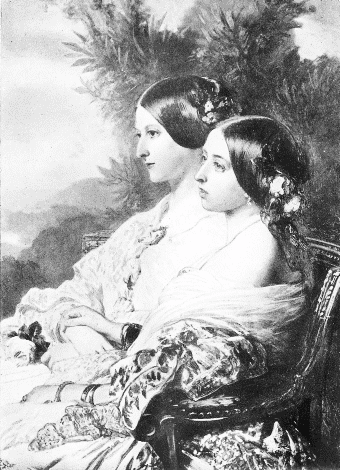
"THE COUSINS."
H.M. QUEEN VICTORIA AND THE DUCHESS OF NEMOURS
From the picture by F. Winterhalter at Buckingham Palace
To face p. 168, Vol II.
The Prince Albert to Lord John Russell.
THE UNEMPLOYED
Osborne, 10th April 1848.
My dear Lord John,—To-day the strength of the Chartists and all evil-disposed people in the country will be brought to the test against the force of the law, the Government, and the good sense of the country. I don't feel doubtful for a moment who will be found the stronger, but should be exceedingly mortified if anything like a commotion was to take place, as it would shake that confidence which the whole of Europe reposes in our stability at this moment, and upon which will depend the prosperity of the country. I have enquired a good deal into the state of employment about London, and I find, to my great regret, that the number of workmen of all trades out of employment is very large, and that it has been increased by the reduction of all the works under Government, owing to the clamour for economy in the House of Commons. Several hundred workmen have been discharged at Westminster Palace; at Buckingham Palace much fewer hands are employed than are really wanted; the formation of Battersea Park has been suspended, etc., etc. Surely this is not the moment for the tax-payers to economise upon the working classes! And though I don't wish our Government to follow Louis Blanc in his system of organisation du travail,12 I think the Government is bound to do what it can to help the working classes over the present moment of distress. It may do this consistently with real economy in its own works, whilst the reductions on the part of the Government are followed by all private individuals as a sign of the times. I have before this spoken to Lord Morpeth13 upon this subject, but I wish to bring it specially under your consideration at the present moment. Ever yours truly,
Albert.
Footnote 12: Alluding to the Ateliers Nationaux, to be established under the guidance of a Council of Administration.
Footnote 13: Chief Commissioner of Woods and Forests.
Lord John Russell to Queen Victoria.
FEARGUS O'CONNOR
Downing Street, 10th April 1848.
(2 p.m.)
Lord John Russell presents his humble duty to your Majesty, and has the honour to state that the Kennington Common Meeting has proved a complete failure.
About 12,000 or 15,000 persons met in good order. Feargus O'Connor, upon arriving upon the ground in a car, was ordered by Mr Mayne14 to come and speak to him. He immediately left the car and came, looking pale and frightened, to Mr Mayne. Upon being told that the meeting would not be prevented, but that no procession would be allowed to pass the bridges, he expressed the utmost thanks, and begged to shake Mr Mayne by the hand. He then addressed the crowd, advising them to disperse, and after rebuking them for their folly he went off in a cab to the Home Office, where he repeated to Sir George Grey his thanks, his fears, and his assurances that the crowd should disperse quietly. Sir George Grey said he had done very rightly, but that the force at the bridges should not be diminished.
Mr F. O'Connor—"Not a man should be taken away. The Government have been quite right. I told the Convention that if they had been the Government they never would have allowed such a meeting."
The last account gave the numbers as about 5,000 rapidly dispersing.
The mob was in good humour, and any mischief that now takes place will be the act of individuals; but it is to be hoped the preparations made will daunt those wicked but not brave men.
The accounts from the country are good. Scotland is quiet. At Manchester, however, the Chartists are armed, and have bad designs.
A quiet termination of the present ferment will greatly raise us in foreign countries.
Lord John Russell trusts your Majesty has profited by the sea air.
Footnote 14: Mr Richard Mayne, Commissioner of Police, created a K.C.B. in 1851.
Lord John Russell to Queen Victoria.
Chesham Place, 15th April 1848.
Lord John Russell has a letter from Lord Clarendon to-day in better spirits, but somewhat fearing an outbreak in Dublin to-night. He speaks confidently of the disposition of the troops.
Lord John Russell cannot wonder that your Majesty has felt deeply the events of the last six weeks. The King of the French has brought upon his own family, upon France, and upon Europe a great calamity. A moderate and constitutional Government at home, coupled with an abstinence from ambitious projects for his family abroad, might have laid the foundation of permanent peace, order, and freedom in Europe. Selfishness and cunning have destroyed that which honesty and wisdom might have maintained. It is impossible not to pity the innocent victims of the misconduct of Louis Philippe. Still less can one refrain from regarding with dread the fearful state of Germany, of her princes, her nobles, and her tempest-tossed people.
The example of Great Britain, may, however, secure an interval of reflection for Europe. The next six months will be very trying, but they may end with better prospects than we can now behold. It was impossible that the exclusion of free speaking and writing which formed the essence of Prince Metternich's system could continue. It might have been reformed quietly; it has fallen with a crash which spreads ruin and death around.
Lady John is deeply grateful for the congratulations of your Majesty and the Prince.15 She is going on well to-day.
Footnote 15: On the birth of a second son.
Queen Victoria to Lord John Russell.
ALARMING STATE OF IRELAND
Osborne, 16th April 1848.
The Queen has received Lord John Russell's letter. The state of Ireland is most alarming and most anxious; altogether, there is so much inflammable matter all around us that it makes one tremble. Still, the events of Monday must have a calming and salutary effect. Lord John Russell's remarks about Europe, and the unfortunate and calamitous policy of the Government of the poor King of the French are most true. But is he not even most to be pitied for being the cause of such misery? (Though perhaps he does not attribute it to himself), for, to see all his hopes thus destroyed, his pride humbled, his children—whom he loves dearly—ruined—is not this enough to make a man wretched? and indeed much to be pitied; for he cannot feel he could not have prevented all this. Still Guizot is more to blame; he was the responsible adviser of all this policy: he is no Bourbon, and he ought to have behaved differently. Had the poor King died in 1844 after he came here, and before that most unfortunate Spanish marriages question was started, he would have deservedly gone down to posterity as a great monarch. Now, what will be his name in history? His fate is a great moral!
With regard to Germany, Prince Metternich is the cause of half the misfortune. His advice was taken by almost all the sovereigns of that country, and it has kept them from doing in time what has now been torn from them with the loss of many rights which they need not have sacrificed. We heard yesterday that the Archduke John16 had arrived at Frankfort. This is a wise measure, and may do much good and prevent much evil, as he is a popular and most distinguished prince....
Footnote 16: Uncle of the Emperor (Ferdinand I.) of Austria, born 1782.
Queen Victoria to Viscount Palmerston.
LORD PALMERSTON AND THE QUEEN
Osborne, 17th April 1848.
The Queen not having heard anything from Lord Palmerston respecting foreign affairs for so long a time, and as he must be in constant communication with the Foreign Ministers in these most eventful and anxious times, writes to urge Lord Palmerston to keep her informed of what he hears, and of the views of the Government on the important questions before us.
She now only gets the Drafts when they are gone.
The acceptance of the mediation between Denmark and Holstein is too important an event not to have been first submitted to the Queen.
Viscount Palmerston to Queen Victoria.
Carlton Gardens, 18th April 1848.
Viscount Palmerston presents his humble duty to your Majesty, and regrets much that he has not lately had an opportunity of giving your Majesty verbally such explanations as your Majesty might wish to receive with respect to the progress of foreign affairs, but Viscount Palmerston hopes to be able to get down to Broadlands for a few days on Saturday next, and he could easily from thence wait upon your Majesty on any morning and at any hour your Majesty might be pleased to appoint.
Although events of the greatest importance have been passing in rapid succession in almost every part of Europe, the position of your Majesty's Government has been one rather of observation than of action, it being desirable that England should keep herself as free as possible from unnecessary engagements and entanglements, in order that your Majesty may be at liberty to take such decisions as the state of things may from time to time appear to render most advisable.
Queen Victoria to the King of the Belgians.
LOYALTY OF BELGIUM
Barton, 18th April 1848.
Dearest Uncle,—Detained here by a heavy shower of rain, I begin my letter to you and thank you warmly for your dear and kind letter of the 15th, which I received yesterday.
Truly proud and delighted are we at the conduct of the Belgians,17 and at their loyalty and affection for you and yours, which I am sure must be a reward for all that you have done these seventeen years. I must beg to say that you are wrong in supposing that no mention is made of what took place on the 9th in our papers; on the contrary, it has been most gratifyingly mentioned in the Times, Chronicle, John Bull, etc. You are held up as a pattern to the German Sovereigns, and the Belgians as a pattern to the German people.
In France, really things go on dreadfully.... One does not like to attack those who are fallen, but the poor King, Louis Philippe, has brought much of this on by that ill-fated return to a Bourbon Policy. I always think he ought not to have abdicated; every one seems to think he might have stemmed the torrent then still. On the other hand, Joinville says it was sure to happen, for that the French want constant change, and were quite tired of the present Government. Qu'en dites-vous? How is poor, dear Louise? I hope her spirits are better.
Our weather is terribly rainy, though very fine between. We have got nightingales in the pleasure ground, and in the wood down near the sea. We are all extremely well, and expect the Prince of Prussia here to-day for two nights. Ever your devoted and attached Niece,
Victoria R.
Footnote 17: A party of French Republicans entered Belgium with the intention of exciting an insurrection; the attempt signally failed.
Queen Victoria to Viscount Palmerston.
Osborne, 1st May 1848.
The Queen has this morning received Lord Palmerston's letter.18 She cannot see any reason for deviating from the established rules, and inviting to Court Frenchmen who are not recognised in their official capacity, and have no natural representatives to present them as private individuals. As an invitation cannot be claimed by them, the omission of it ought not to lead to any misrepresentation; whilst the contrary, under the fiction of their being private individuals, might lead to misconstruction and to most inconvenient precedents.
Footnote 18: M. de Tallenay had arrived in London with a letter from M. Lamartine, accrediting him as provisional chargé d'affaires of the French Government, and Lord Palmerston had suggested to the Queen that etiquette would not be violated by inviting him to a Court Ball.
Queen Victoria to the King of the Belgians.
AFFAIRS IN FRANCE
Buckingham Palace, 9th May 1848.
My dearest Uncle,—Many thanks for your very kind letter of the 6th. How delightful it is to hear such good accounts of Belgium! If only dear Germany gets right and if all our interests (those of the smaller Sovereigns) are not sacrificed! I cannot say how it distresses and vexes me, and comme je l'ai à cœur. My good and dear Albert is much worried and works very hard....
I had a curious account of the opening of the Assemblée from Lady Normanby.19 No real enthusiasm, dreadful confusion, and the Blouses taking part in everything, and stopping the Speakers if they did not please them. The opinion is that it cannot last.
I enclose another letter from Lady Normanby, with an account of the poor Tuileries, which is very curious and sad; but the respect shown for poor Chartres is very touching, and might interest poor dear Louise, if you think fit to show it her. But why show such hatred to poor Nemours and to the Queen? Montpensier's marriage may cause his unpopularity, possibly. I shall beg to have the letter back.
I must conclude, as we are going to pay a visit at Claremont this afternoon. Ever your truly devoted Child and Niece,
Victoria R.
Footnote 19: The National Assembly commenced its sittings on 4th May, when the Oath of Allegiance was abolished, and the Republic proclaimed in the presence of 200,000 citizens.
Queen Victoria to the King of the Belgians.
Buckingham Palace, 16th May 1848.
My dearest Uncle,—I have just heard the news of the extraordinary confusion at Paris, which must end in a Blutbad. Lamartine has quite lost all influence by yielding to and supporting Ledru Rollin!20 It seems inexplicable! In Germany, too, everything looks most anxious, and I tremble for the result of the Parliament at Frankfort.21 I am so anxious for the fate of the poor smaller Sovereigns, which it would be infamous to sacrifice. I feel it much more than Albert, as it would break my heart to see Coburg reduced.
Many thanks for your kind and dear letter of the 13th. Thank God! that with you everything goes on so well. I will take care and let Lord Normanby know your kind expressions. The visit to old Claremont was a touching one, and it seemed an incomprehensible dream to see them all there. They bear up wonderfully. Nothing can be kinder than the Queen-Dowager's behaviour towards them all. The poor Duchess of Gloster is again in one of her nervous states, and gave us a dreadful fright at the Christening by quite forgetting where she was, and coming and kneeling at my feet in the midst of the service. Imagine our horror!
I must now conclude. The weather is beautiful, but too hot for me. Ever your devoted Niece,
Victoria R.
Footnote 20: Lamartine and Ledru Rollin were members of the Provisional Government, and subsequently of the Executive Committee. The mob, holding that the promises of general employment had been broken, invaded the Assembly en masse, and attempted a counter-revolution.
Footnote 21: Out of the revolutionary movement in Germany had grown their National Assembly, which after a preliminary session as a Vor-Parlament, was to reassemble on 18th May.
Queen Victoria to Viscount Palmerston.
AUSTRIA AND ITALY
(No date.)
The Queen has carefully perused the enclosed papers, and wishes to have a copy of Baron Hummelauer's22 note sent to her to keep.
The basis laid down in it is quite inadmissible, and the Queen was struck by the light way in which the claims of the Dukes of Parma and Modena are spoken of (as disposed of by the events), whilst their position and that of Austria are in every respect identical.23 The Queen thinks Lord Palmerston's proposition the one which is the most equitable, still likely to be attained, but it does not go far enough; the position which Austria means to take in Italy with her Italian province ought to be explained, and a declaration be made that Austria will, with this province, join any Italian league which the other states of Italy may wish to establish. This will be useful to Italy, and much facilitate the acceptance of the Austrian proposal, as the Queen feels convinced that as soon as the war shall be terminated, the question of the political constitution of Italy (as a whole) will have to be decided. Why Charles Albert ought to get any additional territory the Queen cannot in the least see. She thinks it will be better to proceed at once upon the revised Austrian proposal, than to wait for Italian propositions, which are sure to be ridiculously extravagant.
Footnote 22: The Austrian Government, in its efforts to maintain its ascendency in Lombardy, had sent Baron Hummelauer to negotiate with Lord Palmerston.
Footnote 23: The Dukes had both been driven from their dominions, while the King (Charles Albert) of Sardinia threw in his lot with the cause of United Italy as against Austria, which then ruled Lombardy.
Queen Victoria to Viscount Palmerston.
ENGLAND AND SPAIN
Osborne, 23rd May 1848.
The Queen has received Lord Palmerston's letter respecting Spain and Italy this morning. The sending away of Sir H. Bulwer24 is a serious affair, which will add to our many embarrassments; the Queen is, however, not surprised at it, from the tenor of the last accounts from Madrid, and from the fact that Sir H. Bulwer has for the last three years almost been sporting with political intrigues. He invariably boasted of at least being in the confidence of every conspiracy, "though he was taking care not to be personally mixed up in them," and, after their various failures, generally harboured the chief actors in his house under the plea of humanity. At every crisis he gave us to understand that he had to choose between a "revolution and a palace intrigue," and not long ago only he wrote to Lord Palmerston, that if the Monarchy with the Montpensier succession was inconvenient to us, he could get up a Republic. Such principles are sure to be known in Spain, the more so when one considers the extreme vanity of Sir H. Bulwer, and his probable imprudence in the not very creditable company which he is said to keep. Lord Palmerston will remember that the Queen has often addressed herself to him and Lord John, in fear of Sir H. getting us into some scrape; and if our diplomatists are not kept in better order, the Queen may at any moment be exposed to similar insults as she has received now in the person of Sir H. Bulwer; for in whatever way one may wish to look at it, Sir Henry still is her Minister.
The Queen wishes Lord Palmerston to show this letter to Lord John Russell, and to let her know what the Government mean to propose with respect to this unfortunate affair.
Footnote 24: Lord Palmerston had written a letter to Bulwer (which the latter showed to the Spanish Premier), lecturing the Spanish Queen on her choice of Minister. This "assumption of superiority," as Sir R. Peel called it, led to a peremptory order to Bulwer to leave Spain in twenty-four hours. His own account of the affair appears in his Life of Palmerston, vol. iii. chap. vii.
The Prince of Prussia to Queen Victoria.
THE PRINCE OF PRUSSIA
[Translation.]
Brussels 30th May 1848.
Most gracious Cousin,—I obey the impulse of my heart in seizing my pen, without any delay, in order to express to you my warmest and most heartfelt thanks for the infinitely gracious and affectionate way with which you and the Prince have treated me during my stay in London.25 It was a melancholy time, that of my arrival. By the sympathetic view which you took of my situation, most gracious Cousin, it became not only bearable, but even transformed into one that became proportionately honourable and dignified. This graciousness of yours has undoubtedly contributed towards the change of opinion which has resulted in my favour, and so I owe to you, to the Prince, and to your Government, a fortunate issue out of my calamities. So it is with a heavy heart that I have now left England, not knowing what future lies before me to meet—and only knowing that I shall need the strengthening rest and tranquillity which my stay in England and an insight into her institutions have afforded me in full measure.
Offering my most cordial remembrances to the Prince, to whom I shall write as soon as possible, I remain, most gracious Cousin, your faithful and most gratefully devoted Cousin,
Prince of Prussia.
Footnote 25: The Prince of Prussia, afterwards the Emperor William I., having become intensely unpopular at Berlin, had been obliged in March to fly for his life, in disguise, viâ Hamburg, to England.
Queen Victoria to Lord John Russell.
THE ROYAL EXILES
Buckingham Palace, 1st June 1848.
The Queen had not time the other day to talk to Lord John Russell on the subject of the French Royal Family, and therefore writes to him now. As it seems now most probable that they, or at least some of them, will take up their residence for a lengthened period in this country, and as their position is now a defined one, viz. that of exiles, their treatment should be defined and established.
At first everything seemed temporary, and the public were much occupied with them, inclined to criticise all that was done or was omitted by the Court; all their movements were recorded in the papers, etc. The lapse of three months has a good deal altered this. They have lived in complete retirement, and are comparatively forgotten; and their poverty and their resignation to their misfortunes have met with much sympathy! The Queen is consequently anxious to take the right line; particularly desirous to do nothing which could hurt the interests of the country, and equally so to do everything kind towards a distinguished Royal Family in severe affliction, with whom she has long been on terms of intimacy, and to whom she is very nearly related. She accordingly wishes to know if Lord John sees any objection to the following: She has asked her Cousin, the Duchess of Nemours, to come for two or three nights to see her at Osborne when she goes there, quite privately; the Duchess of Kent would bring her with her. The Duke will not come with the Duchess, as he says he feels (very properly) it would be unbecoming in him till their fate (as to fortune, for banished they already are) is decided, to be even for a day at Osborne. The Duchess herself wishes not to appear in the evening, but to remain alone with the Queen and the Prince.
The Queen considers that when she is staying in the country during the summer and autumn, and any of the branches of the French Royal Family should wish to visit her and the Prince, as they occasionally do here, she might lodge them for one or two nights, as the distance might be too great for their returning the same day. They are exiles, and not Pretenders, as the Duc de Bordeaux and Count de Montemolin are (and who are for that reason only not received at Court). In all countries where illustrious exiles related to the Sovereign have been they have always been received at Court, as the Duc de Bordeaux, the Duchesse d'Angoulême, etc., etc., invariably have been at Vienna (even on public occasions), there being a French Ambassador there, and the best understanding existing between France and Austria. The Duke of Orleans (King Louis Philippe) in former times was constantly received by the Royal Family, and was the intimate friend of the Duke of Kent. Probably, if their fortunes are restored to them, the French Royal Family will go out into society in the course of time, and if the state of France becomes consolidated there may no longer exist that wish and that necessity for extreme privacy, which is so obvious now. What the Queen has just mentioned, Lord John must well understand, is not what is likely to take place (except in the case of her cousin, the Duchess of Nemours) immediately, but only what might occasionally occur when we are permanently settled in the country. Of course events might arise which would change this, and which would render it inadvisable, and then the Queen would communicate with Lord John, and ask his advice again upon the subject. All she has suggested refers to the present state of affairs, and, of course, merely to strictly private visits, and on no state occasion. This is a long letter about such a subject, but the Queen wishes to be quite safe in what she does, and therefore could not have stated the case and her opinion in a smaller space.
Queen Victoria to Viscount Palmerston.
AFFAIRS IN LOMBARDY
Buckingham Palace, 4th June 1848.
The Queen returns the enclosed draft. She has written upon it, in pencil, a passage which she thinks ought to be added, if the draft—though civil—is not to be a mere refusal to do anything for Austria, and a recommendation that whatever the Italians ask for ought to be given, for which a mediation is hardly necessary.26 The Queen thinks it most important that we should try to mediate and put a stop to the war, and equally important that the boundary which is to be settled should be such a one as to make a recurrence of hostilities unlikely. The Queen has only further to remark that Lord Palmerston speaks in the beginning of the letter only of the Cabinet, and adverts nowhere to the proposition having been submitted to her.
Footnote 26: War was now raging in Lombardy between the Austrians under Marshal Radetzky and the Piedmontese under the King of Sardinia.
Lord John Russell to Queen Victoria.
Chesham Place, 14th June 1848.
Lord John Russell presents his humble duty, and thanks your Majesty for the perusal of this interesting letter.
An Emperor with a rational Constitution might be a fair termination of the French follies; but Louis Napoleon, with the Communists, will probably destroy the last chance of order and tranquillity. A despotism must be the end.
May Heaven preserve us in peace!
Queen Victoria to Viscount Palmerston.
SIR HENRY BULWER
Buckingham Palace, 15th June 1848.
The Queen has received Lord Palmerston's letter explaining his views as to the reparation we may be entitled to receive from the Spanish Government. She considers them as quite fair, but does not wish to have Sir H. Bulwer again as her Minister at Madrid, even if it should be necessary that he should repair there in order to be received by the Queen of Spain. It would not be consulting the permanent interests of this country to entrust that mission again to Sir H. Bulwer, after all that has passed. When the Queen considers the position we had in Spain, and what it ought to have been after the constitution of the French Republic when we had no rival to fight and ought to have enjoyed the entire confidence and friendship of Spain, and compares this to the state into which our relations with that country have been brought, she cannot help being struck how much matters must have been mismanaged.
Queen Victoria to Lord John Russell.
Buckingham Palace, 16th June 1848.
The Queen sends the enclosed draft,27 and asks whether this note is what Lord John directed Lord Palmerston to send to Lisbon as a caution to Sir H. Seymour not to mix himself up with party intrigues to upset a particular Ministry?28 ...
Footnote 27: The draft ran:—"As it is evident that the Queen and the Government of Portugal will listen to no advice except such that agrees with their own wishes, I have to instruct you to abstain in future from giving any longer any advice to them on political matters, taking care to explain both to the Queen and the Government your reasons for doing so. You will, however, at the same time positively declare to the Portuguese Government that if by the course of policy they are pursuing they should run into any difficulty, they must clearly understand that they will not have to expect any assistance from England."
Footnote 28: Lord John Russell replied that he would write immediately to Lord Palmerston respecting Portuguese affairs. He added that he did not approve of the proposed draft.
Viscount Palmerston to Lord John Russell.
Carlton Gardens, 17th June 1848.
My dear John Russell,—The draft to Seymour was written in consequence of what you said to me, and what the Queen wrote to you; but my own opinion certainly is that it would be best to leave the things with him as they are. It must, however, be remembered that the Portuguese Government have not in reality fulfilled the engagements taken by the Queen in the Protocol of last year....
Palmerston.
Queen Victoria to Lord John Russell.
PALMERSTON'S FOREIGN POLICY
Buckingham Palace, 17th June 1848.
The Queen returns Lord Palmerston's letter. The country is at this moment suffering, particularly with regard to Spain, under the evil consequence of that system of diplomacy, which makes the taking up of party politics in foreign countries its principal object. This system is condemned alike by the Queen, Lord John, the Cabinet, and, the Queen fully believes, public opinion in and out of Parliament. Lord Palmerston's objection to caution our Minister in Portugal against falling into this fault brings it to an issue, whether that erroneous policy is to be maintained to the detriment of the real interests of the country, or a wiser course to be followed in future. Does Lord John consider this so light a matter as to be surrendered merely because Lord Palmerston is not to add to such a caution a gratuitous attack upon the Queen and Government of Portugal? The Queen thinks it of the utmost importance that in these perilous times this question with regard to the basis of our foreign policy should be settled, and has no objection to Lord John showing this letter to Lord Palmerston.
Lord John Russell to Queen Victoria.
Pembroke Lodge, 18th June 1848.
Lord John Russell presents his humble duty to your Majesty; he begs to assure your Majesty that if he was disposed to rest on the known discretion and temper of Sir Hamilton Seymour without specific instruction, it was not from regarding the matter lightly, but from a sense of the inconvenience which might arise to your Majesty's service from raising a question with Lord Palmerston in the present critical state of Europe which might induce a belief that he had not conducted foreign affairs to the satisfaction of his colleagues or of his Sovereign.
Lord John Russell feeling, however, that on the particular point at issue your Majesty has just reason to expect that precautions should be taken against the chance of intrigue with foreign parties against a foreign government, with which this country is on terms of friendship, is ready to insist on an instruction to Sir Hamilton Seymour similar to that which was given to Sir Henry Bulwer to take no part in the struggle of parties, and to refrain from any interference with respect to which he has not specific directions from your Majesty's Government.
But in this case he must take upon himself the whole responsibility of requiring such a note from Lord Palmerston. It would not be conducive to your Majesty's service, nor agreeable to the wholesome maxims of the Constitution to mix your Majesty's name with a proceeding which may lead to the most serious consequences.
It is just to Lord Palmerston to say that his general course of policy has met with the warm approval of the Cabinet, and that the cases of difference of judgment have been rare exceptions.
Lord John Russell submits to your Majesty the letter he proposes to write before sending it to Lord Palmerston. He would wish to have it returned as soon as your Majesty can do so.
Queen Victoria to Lord John Russell.
THE QUEEN AND PALMERSTON
Buckingham Palace, 18th June 1848.
The Queen returns to Lord John Russell his letter to Lord Palmerston,29 which is excellent, and shows that the Queen's and Lord John's views upon the important question of our foreign policy entirely coincide. The Queen is sorry that the trouble of such an altercation should be added to the many anxieties which already press upon Lord John, but she feels sure that his insisting upon a sound line of policy will save him and the country from far greater troubles....