THE SADDLE AND HARNESS SHOP
Reading edition
Elkanah Deane, carriagemaker of New York, removed his business from that city to the little metropolis of Williamsburg shortly before the Revolution. Both in New York and in the capital of the Virginia colony he enjoyed the patronage of His Lordship Governor Dunmore. Deane’s house in Williamsburg looked out upon the same green as did the Governor’s Palace, along with the mansions of the wealthy Robert Carter and the learned George Wythe.
22
This was heady company for “an Hibernian Cottager,” as one rival coachmaker called him, and perhaps Deane deserved the label of “Palace Street puffer” conferred on him by the same fellow citizen. Be that as it may, the carriagemaker advertised that he also made, repaired, and sold harness, although the actual work was probably done by another craftsman in his shop.
Perhaps this was Edward Roberts, who gave notice in 1775 that he “continues to carry on the business of Saddling, Cap and Harness making, at the late Mr. Elkanah Deane’s shop.” The shop, it is to be presumed, was primarily devoted to the varied specialties that were needed in the manufacture of wheeled vehicles, of which blacksmithing was one of the more vital. Deane’s forge, to the rear of his property, is a favorite attraction in restored Williamsburg, especially for children.
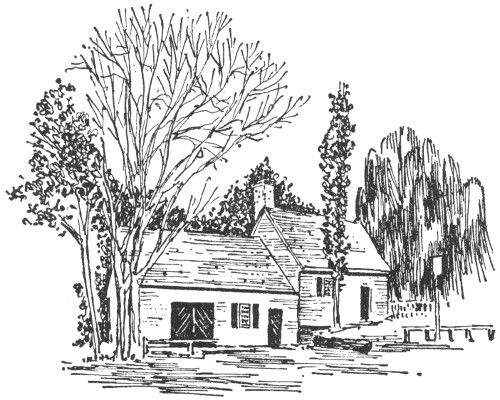
Exterior view of the Deane Forge and Harnessmaking Shop in Williamsburg today. The sign before the door is the coat of arms of the Saddler and Coach Harnessmakers’ Company of London. Redrawn from a photograph.
23
Adjoining the forge, the saddlery and harnessmaking shop of two hundred years ago has again resumed operation. There the visitor may see examples of saddle and harness work done in the eighteenth-century manner with tools and equipment resembling those shown in the great eighteenth-century illustrated encyclopedia of Denis Diderot.
The basic operations in the making of harness were only two: cutting the hides into appropriate strips and shapes, and stitching the pieces together as needed. Simple as it sounds, skillful choice of the leathers, flawless cutting, and thorough stitching made the difference between good harness and poor. Finish and ornamentation, although not essential to the task of attaching a draft animal securely to its load, made the product distinctive and handsome, and no doubt gave the craftsman more pleasure in the making.
The harnessmaker’s knife had a semicircular or half-moon shape to its blade, with the handle sometimes at right angles to the back of the blade and sometimes with a right-angled tang that put the handle parallel to the back of the blade. For sewing he possessed an assortment of punches and awls and a very important holding device called a “clam.” This last was a hinged wooden clamp with jaws somewhat resembling the shell of a clam. Holding it between his crossed thighs, the harnessmaker used it to hold fast the straps he was sewing, thus freeing both of his hands for the tough job of stitching through heavy leather.
In most essentials, and indeed in most details, the harness of the eighteenth century looked like and functioned like that of today—or of the not-so-distant yesterday before the motorization of everything on wheels. Saddles, at least some of them, were slightly different in shape and detail from the present-day English riding saddle. For their making, as well as for the making of collars, the saddler-harnessmaker needed a variety of tools to pack and shape the stuffing of pads. By and large, however, the result would seem to have been less comfortable to both horse and rider than the modern saddle.
24