GEORGE WILSON, BOOT AND SHOEMAKER
Reading edition
George Wilson came originally from Norfolk, where his older brother—or perhaps it was his uncle—John Wilson, did boot and shoemaking on a large scale. In May 1771 the Virginia Gazette of Williamsburg carried this advertisement:
I TAKE this Method to acquaint the Publick, and my Customers in particular, that Mess. James Campbell and Company have resigned the SHOE FACTORY in Favour of me, by which Means I carry on double the Trade I did formerly. Gentlemen who may please to favour me with their Orders for Negro Shoes, or others, are desired to send them soon, that I may be capable of supplying them better than it was in my Power last Fall, on Account of the Scarcity of Leather. Ladies and Gentlemen may depend on being supplied with as neat Shoes, either Leather or Calimanco, as any from London; as I have on Hand London, Philadelphia, and New York Calf Skins, red, green, and blue Morocco Leather, Calimancoes of all Colours, and of the best Kinds. Those who choose to favour him with their Custom shall be served on reasonable Terms, by applying to him at the Sign of the Boot and Shoe in Norfolk. JOHN WILSON
Just five months later, announcing his death, the Gazette described John Wilson as a tradesman of “Credit and Reputation in Norfork, whose Industry, Integrity, and whole Deportment, were truly exemplary.” Shortly thereafter the same paper carried the notice that Wilson’s estate would be auctioned and that “The Shoemaker’s Business, in all its Branches, is carried on by George Wilson, Junior, and Company.”
The “Company” here seems to have been John’s widow, for the next advertisement to appear in the Gazette disclosed that her partnership with George Wilson having been dissolved, Mary Wilson “still carries on the Shoemaking Business, in all its Branches.” She was one of innumerable colonial widows whom fate threw into the awkward position of being master craftsmen, at least until they found another man to take over the shop—and very often the household, too.
25
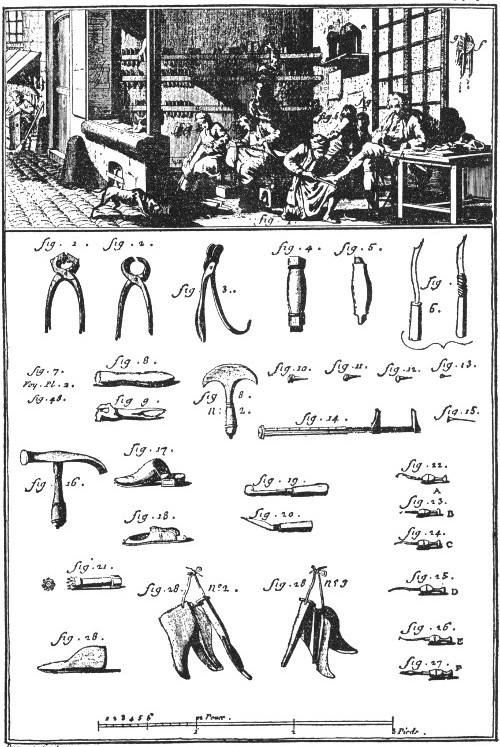
Cordonnier et Bottier A shoemaker’s shop and an assortment of his most important tools. Note the rows of lasts on the wall and the customer whose foot is being measured with a size stick, also shown as fig. 14. Diderot.
26
George Wilson promptly turned up in Williamsburg, announcing to the public that he had just imported a “choice Cargo of the best sorts of English LEATHER for all Manner of Mens Shoes and Pumps, and excellent LONDON DRAW-LEGS for BOOTS.” Underscoring the ambitious size of the business he hoped to establish, he again signed himself “George Wilson & Co.,” and appended a notice that “Two or three JOURNEYMEN SHOEMAKERS, who understand making BOOTS and Mens WOOD HEELS, will meet with good encouragement by applying immediately to me, next Door to Mr. Greenhow’s Store in Williamsburg.”
Like other colonial shoemakers, George Wilson not only made shoes but also repaired them. Put another way, they all did both cordwaining and cobbling. But George Wilson seems not to have catered to the ladies; his advertisements mention only footwear for gentlemen, and when his shop was broken into in March 1774 the thief took away nineteen or twenty pairs of men’s shoes.
Whether his earlier ad failed to bring him the desired journeymen or whether he needed still more help cannot be said, but he advertised again that “Two or three journeymen shoemakers will have a good set of summer work, by applying early, at the rate of 3s. 6d. for plain shoes, 5s. for stitched work, and 10s. for boots.” Before the end of the year George Wilson, too, had died.