THE DIFFICULTY OF MAKING A LIVING
Reading edition
For all its great length and detail, the act of 1691 seems not to have had much effect. Governor Edmund Andros in 1697 asserted, “There are no manufactures setled in Virginia Except Inconsiderable tanning and shoemaking (bad Leather).” And in 1705 Robert Beverley wrote of the Virginians:
They have their Cloathing of all sorts from England, as Linnen, Woollen, Silk, Hats, and Leather.... The very Furrs that their Hats are made of, perhaps go first from thence; and most of their Hides lie and rot, or are made use of, only for covering dry Goods, in a leaky House. Indeed some few Hides with much Adoe are tann’d, and made into Servents Shoes; but at so careless a rate, that the Planters don’t care to buy them, if they can get others, and sometimes perhaps a better manager than ordinary will vouchsafe to make a pair of Breeches of a Deer-Skin.
Nearly a half-century later, as Williamsburg’s era of greatest affluence began, a merchant of Louisa County, Francis Jerdone by name, lamented that “the Virginians have most of their shoemakers in their own families, and have no occasion for any but stuff [i.e., cloth] shoes from Britain.” He referred to members of the well-to-do planter class, who customarily maintained on their plantations one or more skilled workmen. Among these there was almost sure to be included a cordwainer to make and repair the footwear of the plantation “family,” a term that included the slaves. The shoemaker might be a slave himself, or an indentured servant, or a journeyman receiving wages.
12
However, Francis Jerdone could just as well have been writing of another kind of Virginia planter, the small farmer who built his own house and barns, made his own crude furniture, coopered his own hogsheads, ground his own corn, sheared his own sheep, and made the family’s shoes while his wife spun and wove their clothing. These small farmers, far outnumbering the great planters, would not have ordered cloth shoes from London, to be sure. But neither would they have ordered very many leather ones, either from England or from Williamsburg shoemakers.
Documentary records—fairly full in a few cases, fleeting in most—name 24 men who worked in leather in Williamsburg during the eighteenth century. The ghostly existence of others can be discerned in references to unnamed indentured servants, journeymen, slaves, and a few apprentices who were leatherworkers. Among Williamsburg slaves having some craft skills, the second greatest number were shoemakers, the greatest number being carpenters.
A few of these Williamsburg leatherworkers seem to have done fairly well at their trade. Most of the others probably had little success and moved elsewhere or into farming; at any rate they left no trace of a continuing career.
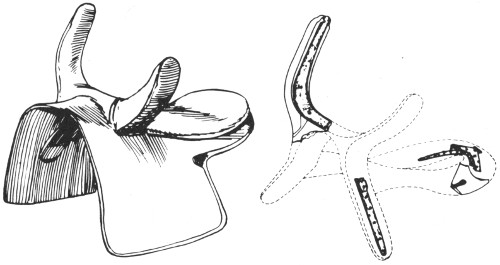
The conjectural drawing at the right shows how pieces of metal, wood, and cloth found in 1961 at the bottom of an eighteenth-century well in Williamsburg could have formed parts of a lady’s sidesaddle of that day. To the left, partially completed, is such a saddle copied by today’s master saddler in Williamsburg from surviving examples.
13