TRUE MEATS
Reading edition
“And God said, Behold I have given you every herb bearing seed, which is upon the face of all the earth, and every tree, in the which is the fruit of a tree yielding seed; to you it shall be for meat.” Gen. 1:29.
“The food which God gave Adam in his sinless state is the best for man’s use as he seeks to regain that sinless state.
“The intelligence displayed by many dumb animals approaches so closely to human intelligence that it is a mystery.
“The animals see and hear and love and fear and suffer.
“They manifest sympathy and tenderness toward their companions in suffering.
“They form attachments for man which are not broken without great suffering to them.
“Think of the cruelty to animals that meat eating involves and its effect on those who inflict and those who behold it. How it destroys the tenderness with which we should regard these creatures of God!”
The high price of flesh foods, the knowledge of the waste matter in the blood of even healthy animals which remains in their flesh after death, and the well authenticated reports of the increasing prevalence of most loathsome diseases among them, causes a growing desire among thinking people to take their food at first hand, before it has become a part of the body of some lower animal.
So, the great food question of the day is—“What shall we use in the place of meat?”
Nuts, legumes (peas, beans, lentils and peanuts) and eggs contain as do flesh meats, an excess of the proteid or muscle-building elements (nuts and legumes a much larger proportion than flesh), so we may combine these with fruits, vegetables and some of the cereals (rice, for instance) and have a perfect proportion of food elements.
It must be borne in mind, however, that proteid foods must be used sparingly, since an excess of these foods causes some of the most serious diseases.
The bulk of our foods should be made up of fruits and vegetables and some of the less hearty cereals and breads.
NUTS
As nuts occupy the highest round of the true meat ladder, we give a variety of recipes for their use, following with legumes and eggs in their order.
With nuts, as with other foods, the simplest way to use them is the best. There are greater objections to foods than that they are difficult of digestion, and in the case of nuts, that objection is overcome by thorough mastication; in fact, they are an aid to the cultivation of that important function in eating.
For those who are not able to chew their food, nuts may be ground into butter.
Another aid to the digestion of nuts is the use with them of an abundance of acid fruits. Fruits and nuts seem to be each the complement of the other, the nuts as well, preventing the unpleasant effects felt by some in the free use of fruits.
“No investigations have been found on record which demonstrate any actual improvement in the digestibility of nuts due to salt.”—M. E. Jaffa, M. S., Professor of Nutrition, University of California.
Be sure that nuts are fresh. Rancid nuts are no better than rancid butter. Shelled nuts do not keep as well as those in the shell.
Almonds stand at the head of the nut family. It is better to buy them in the shell as shelled almonds are apt to have bitter ones among them. Almonds should not be partaken of largely with the brown covering on, but are better to be blanched.
To Blanch Almonds—Throw them into perfectly boiling water, let them come to the boiling point again, drain, pour cold water over them and slip the skins off with the thumb and finger. Drop the meats on to a dry towel, and when they are all done, roll them in the towel for a moment, then spread them on plates or trays to dry. They must be dried slowly as they color easily, and the sweet almond flavor is gone when a delicate color only, is developed. For butter they must be very dry, really brittle.
Brazil Nuts—castanas—cream nuts, do not require blanching, as their covering does not seem to be objectionable. They are rich in oil and are most valuable nuts. Slice and dry them for grinding.
Filberts—hazelnuts—cobnuts—Barcelonas, also may be eaten without blanching, though they may be heated in the oven (without browning) or put into boiling water and much of the brown covering removed. They are at their best unground, as
Brazil nuts and filberts often agree with those who cannot use English walnuts and peanuts.
English Walnuts—The covering of the English walnut is irritating and would better be removed when practicable. This is done by the hot water method, using a knife instead of the thumb and finger. The unblanched nuts may however, be used in moderation by nearly every one.
Butternuts and black walnuts blanch more easily than the English walnut.
When whole halves of such nuts as hickory nuts, pecans or English walnuts are required, throw the nuts into boiling water for two or three minutes, or steam them for three or four minutes, or wrap them in woolen cloths wrung out of boiling water. Crack, and remove meats at once. Do not leave nuts in water long enough to soak the meats.
Pinenuts come all ready blanched. When they require washing, pour boiling water over them first, then cold water. Drain, dry in towels, then on plates in warm oven.
Peanuts—ground nuts, because of their large proportion of oil, and similarity in other respects to nuts are classed with them, though they are truly legumes.
The Spanish peanut contains more oil than the Virginia, but the flavor of the Virginia is finer and its large size makes it easier to prepare. The “Jumbos” are the cheapest.
To blanch Spanish peanuts the usual way, heat for some time, without browning, in a slow oven, stirring often. When cool rub between the hands or in a bag to remove the skins. The best way to blow the hulls away after they are removed is to turn the nuts from one pan to another in the wind.
Spanish peanuts can be obtained all ready blanched from the nut food factories.
The Virginias, not being so rich in oil must always be blanched the same as almonds. Be sure to let them boil well before draining. I prefer to blanch the Spanish ones that way, too, the results are so much more satisfactory.
When peanuts are partly dried, break them apart and remove the germ, which is disagreeable and unwholesome: then finish drying.
A FEW SUGGESTIVE COMBINATIONS
For Using Nuts in the Simplest Ways
Brazil nuts, filberts or blanched almonds with:—
Fresh apples, pears or peaches;
Dried, steamed or stewed figs, raisins, dates, prunes, apple sauce, baked apples or baked quinces;
Celery, lettuce, cabbage, tender inside leaves of spinach, grated raw carrot or turnip;
Breakfast cereals, parched or popped corn, well browned granella, crackers, gems, zwieback, Boston brown and other breads;
Stewed green peas, string beans, asparagus, corn, greens, potatoes, squash, cauliflower, all vegetables;
Pies, cakes and different desserts when used.
Nut Butter
A good nut butter mill is an excellent thing to have, but butter can be made with the food cutters found nowadays in almost every home. If the machine has a nut butter attachment, so much the better; otherwise the nuts will need to be ground repeatedly until the desired fineness is reached.
For almond butter, blanch and dry the almonds according to directions, adjust the nut butter cutter, not too tight, put two or three nuts into the mill at a time, and grind. When the almonds are thoroughly dried they will work nicely if the mill is not fed too fast.
Brazil nuts and filberts need to be very dry for butter.
Pine nuts are usually dry enough as they come to us.
All nuts grind better when first dried.
Raw peanut butter is a valuable adjunct to cookery. To make, grind blanched dried nuts; pack in tins or jars and keep in a dry place.
For steamed butter, put raw butter without water into a double boiler or close covered tins and steam 3–5 hours. Use without further cooking in recipes calling for raw nut butter.
Or, grind dried boiled nuts the same as raw nuts. For immediate use, boiled nuts may be ground without drying.
When roasted nut butter is used, it should be in small quantities only, for flavoring soups, sauces or desserts.
My experience is that the best way to roast nuts for butter is to heat them, after they are blanched and dried, in a slow oven, stirring often, until of a cream or delicate straw color. By this method they are more evenly colored all through. Do not salt the butter, as salt spoils it for use with sweet dried fruits as a confection, and many prefer it without salt on their bread.
The objection to roasted nuts is the same as for browning any oil. Raising the oil of the nuts to a temperature high enough to brown it, decomposes it and develops a poisonous acid.
Hardly too much can be said of the evil effects of the free use of roasted nut butter.
“There are many persons who find that roasted peanuts eaten in any quantity are indigestible in the sense of bringing on pain and distress.... Sometimes this distress seems to be due to eating peanuts which are roasted until they are very brown.”
—Mary Hinman Abel, Farmers’ Bulletin, No. 121, U.S. Department of Agriculture.
Nut Meal
Nut meal is made the same as nut butter except that the nuts are ground fewer times through the finest cutter of the mill, or once only through the nut butter cutter loosely adjusted. Either cooked or raw peanuts may be used, but a cooked peanut meal is very desirable. The nuts may be cooked, dried and ground, or cooked without water, after grinding, the same as steamed nut butter.
When one has no mill, meal of many kinds of nuts may be made in the following manner:
Pound a few at a time in a small strong muslin bag; sift them through a wire strainer and return the coarse pieces to the bag again with the next portion. Be sure that not the smallest particle of shell is left with the meats.
A dear friend of mine used to keep jars of different nut meals prepared in this way on hand long before any manufactured ones were on the market.
One writer says: “The children enjoy cracking the nuts and picking out the meats, and it is a short task to prepare a cupful.”
Cooked nuts and some raw ones may be rubbed through the colander for meal.
Nut meals are used for shortening pie crust, crackers and sticks; and all except peanut, are delightful sprinkled over stewed fruits or breakfast foods.
Nut Butter for Bread
Nut butters (except raw peanut) may be used on bread as they are ground; but are usually stirred up with water to an agreeable butter-like consistency, and salt added.
Strained tomato may be used instead of water for a change. This is especially nice for sandwiches. With peanut butter made from boiled or steamed nuts it has a flavor similar to cheese.
Nut butter is more attractive for the table when pressed through a pastry tube in roses on to individual dishes. Use a cloth (not rubber) pastry bag.
While pure nut butter, if kept in a dry place, will keep almost indefinitely, it will sour as quickly as milk after water is added to it.
Nut Cream and Milk
Add water to nut butter until of the desired consistency, for cream; then still more, for milk.
Almond milk makes a delightful drink and can be used by many who cannot take dairy milk. It may be heated and a trifle of salt added.
Cocoanut Milk
If you have not a cocoanut scraper, grate fresh cocoanut, one with milk in it, or grind it four or five times through the finest cutter of a mill. Pour over it an equal bulk or twice its bulk, of boiling water, according to the richness of the milk desired or the quality of the cocoanut. Stir and mix well and strain through cheese cloth or a wire strainer. Add a second quantity of hot water and strain again, wringing or pressing very dry. Throw the fibre away.
Use cocoanut milk or cream for vegetable or pudding sauces or in almost any way that dairy milk and cream are used. Stir before using. To break the nut in halves, take it in the left hand and strike it with a hammer in a straight line around the center. It may be sawed in two if the cups are desired for use.
Cocoanut Butter
Place milk on ice for a few hours when the butter will rise to the top and can be skimmed off.
Ground or Grated Cocoanut
Is delightful on breakfast cereals, or eaten with bread in place of butter. The brown covering of the meat should first be taken off.
Shredded Cocoanut
Put any left-overs of prepared cocoanut on a plate and set in the sun or near the stove to dry. Keep
Milk and Rich Cream of Raw Peanuts
May be prepared the same as cocoanut milk, except that cold or lukewarm water is used instead of hot.
To raw nut meal (not butter) add one half more of water than you have of meal. Mix and beat well, strain through a thin cloth, squeeze as dry as possible. Let milk stand in a cool place and a very rich cream will rise which may be used for shortening pie crust, crackers and sticks, or in place of dairy cream in other ways. The skimmed milk will be suitable for soups, stews or gravies. It may be cooked before using if more convenient. The pulp also may be used in soups. It should be thoroughly cooked.
Nut Relish
Different nut butters and meals may be combined in varying proportions. For instance, 2 parts Brazil nuts, 1 part each pine nuts and almonds; or 1 part each Brazil nuts, almonds, pecans, and pine nuts. Dry nuts well and grind all together or combine after grinding. Press into tumblers or small tins and stand in cool place. Unmold to serve. The relish may be used in combinations suggested for whole nuts, and it is a great improvement over cheese, with apple pie.
Toasted Almonds
When blanched almonds are thoroughly dried, put them into a slow oven and let them come gradually to a delicate cream color, not brown. These may be served in place of salted almonds.
Sweetmeats of fruits and nuts will be found among confections.
COOKED NUT DISHES
Nut Croquettes
1 cup chopped nuts (not too fine), hickory, pecan, pine or butternuts, or a mixture of two with some almonds if desired; 2 cups boiled rice or hominy, 1½ tablespn. oil or melted butter, salt, sage. Mix, shape into rolls about 1 in. in diameter and 2½ in. in length. Egg and crumb; bake in quick oven until just heated through and delicately browned, 8 to 10 m. Serve plain or with any desired sauce or vegetable.
Nut Croquettes No. 2
1 cup chopped nuts, 1 cup cooked rice, any desired seasoning or none, salt; mix.
Sauce—
2 tablespns. oil
½ cup flour
1–1¼ cup milk
1 egg or yolk only or no egg
salt
Heat but do not brown the oil, add half the flour, then the milk, and when smooth, the salt and the remainder of the flour, and combine with mixed nuts and rice. Cool, shape, egg, crumb, bake. Crumb also before dipping in egg the same as Trumese croquettes, if necessary. Bake only until beginning to crack. Serve at once.
Savory Nut Croquettes
1 cup stale, quite dry, bread crumbs, ½ cup (scant) milk or consommé, ¼–½ level teaspn. powdered leaf sage or winter savory, ½ cup black walnut or butternut meats, salt. Mix, shape, egg, crumb, bake.
1 cup chopped mixed nuts may be used and celery salt or no flavoring. Hickory nut meats alone, require no flavoring.
Nut and Sweet Potato Cutlets
1 cup chopped nut meats
2 cups chopped boiled sweet potato
1 tablespn. butter
1 egg
salt
Mix while warm. Pack in brick-shaped tin until cold. Unmold, slice, egg, crumb or flour. Brown in quick oven or on oiled griddle. Serve plain or with sauce 16 or 17.
★ Baked Pine Nuts
After picking out the pieces of shell, pour boiling water over 2 lbs. of pine nuts in a fine colander. Rinse in cold water and put into the bean pot, with 2 large onions sliced fine, 1–1⅓ cup strained tomato and 2–2½ teaspns. salt. Heat quite rapidly at first; boil gently for a half hour, then simmer slowly in the oven 10–12 hours or longer. Leave just juicy for serving.
Black Walnut and Potato Mound
Mix 1 qt. nicely seasoned, well beaten mashed potato, ½–1 cup chopped black walnut meats and 2 or 3 tablespns. grated onion. Pile in rocky mound on baking pan or plate. Sprinkle with crumbs or not. Bake in quick oven until delicately browned. Garnish and serve with sauce 6 or 16.
Nut and Rice Roast or Timbale
1–2 cups chopped nuts, one kind or mixed (no English walnuts unless blanched), 2 cups boiled or steamed rice, 1½–3 tablespns. oil or melted butter, salt.
Mix ingredients and put into well oiled timbale mold or individual molds or brick shaped tin. Bake covered, in pan of water ¾–1½ hr. according to size of mold. Uncover large mold a short time at the last. Let stand a few minutes after removing from oven, unmold, and serve with creamed celery or peas or with sauce 16 (cocoanut cream if convenient) or 34.
Loaf may be flavored, and served with any suitable sauce.
Loaf of Nuts
2 tablespns. raw nut butter
⅓ cup whole peanuts cooked almost tender
½ cup each chopped or ground pecans, almonds and filberts (or butternuts,
2 cups stale bread crumbs pressed firmly into the cup
salt
¾–1 cup water or 1 of milk
The quantity of liquid will depend upon the crumbs and other conditions. Put into oiled mold or can, cover, steam 3 hours. Or, have peanuts cooked tender, form into oval loaf, bake on tin in oven, basting occasionally with butter and water or salted water only. Serve with sauce 9, 10, 57, 59, or 69. Loaf may be served cold in slices, or dipped in egg, and crumbed, and baked as cutlets.
Other nuts may be substituted for peanuts.
One-half cup black walnuts and 1½ cup cooked peanuts, chopped, make a good combination. A delicate flavoring of sage, savory or onion is not out of place with these.
To Boil Peanuts
Put blanched, shelled peanuts into boiling water and boil continuously, for from 3–5 hrs., or until tender. (When the altitude is not great it takes Virginias 4 or 5 hours and Spanish about 3 to cook tender).
Drain, saving the liquid for soup stock, and use when boiled peanuts are called for.
Nut Soup Stock
Use the liquid, well diluted, poured off from boiled peanuts, for soups. Large quantities may be boiled down to a jelly and kept for a long time in a dry place. If paraffine is poured over the jelly, it will keep still better. Use 1 tablespn. only of this jelly for each quart of soup.
Peanuts with Green Peas
Boil 1 cup blanched peanuts 1–2 hrs., drain off the water and save for soup. Put fresh water on to the peanuts, add salt and finish cooking. Just before serving add 1 pt. of drained, canned peas. Heat well. Add more salt if necessary, and serve. Or, 1 pt. of fresh green peas may be cooked with the nuts at the last. Small new potatoes would be a suitable addition also.
★ Peanuts Baked like Beans
1 lb. (¾ qt.) blanched peanuts
¼ cup strained tomato
½–1 tablespn. browned flour
1¼–1½ teaspn. salt
Mix browned flour, tomato and salt, put into bean pot with the nuts and a large quantity of boiling water. Boil rapidly ½ hr., then bake in a slow oven 8–14 hours. Add boiling water without stirring, when necessary. When done the peanuts should be slightly juicy.
Small dumplings steamed separately, may be served with baked peanuts sometimes.
Baked Peanuts—Lemon Apples
Pile peanuts in center of platter or chop tray. Surround with lemon apples, garnish with grape leaves and tendrils or with foliage plant leaves.
Peanuts with Noodles or Vermicelli
Cook peanuts in bouillon with bay leaf and onions. Just before serving, add cooked noodles or vermicelli.
Nut Chinese Stew
Use boiled peanuts instead of nutmese and raw nut butter, and rice (not too much) in place of potato, in Nut Irish Stew.
Peanut Gumbo
Simmer sliced or chopped onion in butter; add 1 pt. stewed okra; simmer 5–10 m. Add 1 pt. strained tomato, then ¾–1 qt. of baked or boiled peanuts. Turn into a double boiler and add ½ cup boiled rice. Heat 15–20 m.
Hot Pot of Peanuts
Put layers of sliced onion, sliced potatoes and boiled peanuts into baking dish with salt and a slight sprinkling of sage. Cover the top with halved potatoes. Stir a little raw nut butter with water and pour over all. Cover with a plate or close fitting cover and bake 2 hours. Remove cover and brown.
Peanut Hashes
Cooked peanuts, chopped very little if any, may be used in place of trumese with potatoes or rice for hash.
Bread, cracker or zwieback crumbs may be substituted for potato
Peanut German Chowder
1 pt. cooked peanuts
1 large onion
2 tablespns. chopped parsley
½ medium sized bay leaf
⅛ level teaspn. thyme
1 small carrot
1 level tablespn. browned flour
2 level tablespns. white flour
1 pint milk
1 pt. thin nut milk or broth
small biscuit of universal dough
oil or melted butter
Split biscuit and brown slowly in the oven. Slice or chop carrots and onions and mix together; mix thyme, broken pieces of bay leaf, both kinds of flour and salt, and pour into them gradually, stirring, the milk and broth.
Put a little oil in the bottom of a baking dish, then layers of the vegetables, peanuts and twice baked biscuit and pour some of the liquid over. Repeat layers, leaving biscuit on top. Pour remaining liquid over all. Sprinkle with what remains of the chopped parsley. Cover and bake 1½–2 hrs. in a moderate oven. Uncover and brown on top at last. Serve in the dish in which it was baked.
With care, the chowder may be cooked in a kettle by using more oil at the bottom, standing where the heat is not too intense, and replenishing with water when necessary.
Serve on a platter or turn into a tureen with a cup of hot rich milk or broth added if more liquid is desired.
The flavorings may be varied; savory and marjoram are sometimes used, garlic for some tastes, also a little tomato. The herbs may be omitted entirely. Crackers may take the place of biscuit. Nut milk only, may be used.
Peanut and Rice Croquettes
2 cups boiled or baked peanuts
2 cups boiled rice
1½ tablespn. oil
sage, savoury or chopped onion
salt
Chop nuts very little if at all. Mix all ingredients. Shape, egg, crumb, bake. Serve plain or with sauce 6, 44, 57, or 75
Peanut Pie
Universal crust of ¾–1 cup of liquid, 1 qt. of peanuts boiled with salt and a little lemon juice, drained (liquid saved for soups and gravies). Chopped onion and parsley.
Sauce—
5 tablespns. oil and melted butter or all butter
6 tablespns. flour
1 qt. boiling water
salt
Mix butter and flour, pouring boiling water over, boil up, add salt, and half of onion and parsley; pour into oiled baking dish, put peanuts in, sprinkle remainder of onion and parsley over, cool to lukewarm, lay crust on, let rise, bake.
A pastry, rice or mashed potato crust (without eggs) may be used: if pastry, put a cup in the center of the pie to support the crust; with potato crust it would be better to simmer the onion in the oil of the sauce first.
Peanut Pie with Turnip Crust
Bake or boil peanuts (leaving quite dry when done) with sliced onion and a little carrot, browned flour and a little tomato, parsley, salt and celery salt, a trifle of thyme and garlic if desired. Thicken slightly, turn into baking dish, cover with mashed turnip, sprinkle with crumbs and chopped parsley, dot with butter or oil. Bake until top is nicely browned.
Cups or pastry shells may be used in place of large dish for Nut Scallops.
★ Peanut Cheese
½ lb. peanuts, boiled, ground; 5–5½ tablespns. Nut French soup or consommé which has been cooked down thick; 4 eggs, 1 teaspn. salt, a trifle of sage if desired. Mix all ingredients and put into well oiled porcelain or glass jars (if glass, follow directions for cooking trumese in glass), cover close and steam 1½–2 hrs.
Pine Nut Cheese
½ lb. coarse pine nut butter
4 tablespns. thick tomato pulp, either red or yellow tomatoes
3–4 tablespns. water
1–1½ teaspns. salt
Steam 3–4 hrs.
Pine Nut and Banana Cheese
½ lb. coarse pine nut butter
5 tablespns. banana pulp
1–2 tablespns. water
1½ level teaspn. salt
Steam 3–4 hrs.
Fruit and Nut Relish
1 cup fine chopped nuts—shell barks, almonds, pine nuts, cashews and English walnuts or other combinations; 1 cup banana pulp, ¼ teaspn. salt; mix all together, pack in mold, steam 3 hours. Serve cold in slices, with gems, wafers, sweet fruits or cakes. Nice for travelling lunches.
Almond Cheese
½ lb. blanched almonds
4 tablespns. tomato pulp
2 eggs
½–¾ teaspns. salt
Cook almonds 5 hours; grind through nut butter cutter, or press through fine colander; add other ingredients, mix well, steam 1½–2 hrs.
Almond Confection
½ lb. almond butter
½ level teaspn. salt
5⅓ tablespns. banana pulp
3 tablespns. water
⅔ cup fine cut citron
16 candied cherries cut fine
Bake 1–2 hours (according to size of loaves) in slow oven. Cherries and citron may be ground through food cutter—finest knife.
⅔ cup very finely-cut raisins and ½ cup hickory nut meats, in pieces, may be used instead of citron and cherries.
★ Nesselrode Confection—Peanut
½ lb. raw Virginia peanut butter
5⅓ tablespns. banana pulp
4 tablespns. water
½ teaspn. salt
3 tablespns. raisins cut fine with shears
1½ tablespn. well washed and dried currants
1½ tablespn. fine cut citron
2 tablespns. pieces hickory nut, black or English walnut meats
Mix. Bake 1½–2 hours in very slow, just warm, oven, on pad.
TRUMESE
Many years ago when experimenting with gluten washed from wheat, the thought came to me that it would be a good thing if it could be combined with nuts, as the nuts would supply the oil lacking in the gluten. From former experiments I knew it would be a difficult problem, but it was finally solved and has resulted in giving to the world a valuable food product, which gives me great joy.
I give directions (the results of my own experimenting) for making this food as perfectly as it can be made in our homes without the aid of special machinery.
Whether it pays to make it or not depends on the value of our time or whether we can procure similar foods all ready prepared. (Similar manufactured foods on the market are called “protose,” “nutfoda” and “nut cero”, according to where they are made).
A part of the process will be entirely new to many but it is not at all difficult, and if directions are carefully followed the result will be success and soon the making of a quantity of “trumese,” as I have called it for convenience, will not be considered a greater task than baking a batch of bread.
The first thing of importance in making trumese is securing a good fresh bread flour one that is called a heavy flour, not a blended or a light flour.
A good bread flour will yield about two pounds of gluten to each seven pounds of flour: but in trying a brand with which you are not familiar, take ½–1 lb. more if you wish to have two pounds of gluten.
I give the recipe for two pounds of gluten, but if you are making trumese for the first time it may be well to take half that quantity.
The following suggestions will enable you to substitute measures for weights if you have no scales, and to calculate the recipe for trumese:
1 scant qt. of bread flour, laid lightly in the measure, equals 1 lb.
1 scant qt. of washed gluten equals 2 lbs.
1 scant pt. of blanched, dried, Virginia peanuts, before grinding, equals ½ lb.
1 scant half pt. of Virginia butter equals ½ lb.
1 good ¾ pt. blanched, dried, Spanish peanuts, before grinding, equals ½ lb.
1 good ⅜ pt. of Spanish butter equals ½ lb.
1 large ¾ qt. of pine nuts equals 1 lb.
Spanish peanuts require 3 hours for cooking.
Virginia peanuts require 4–5 hours for cooking.
In mixing flour and water, calculate a little over 1 cup of water to each pound of flour, or 8½–9 cups for 7 lbs.
The starch from the first one or two washings of the gluten dough may be used wherever thickening is required; and for blanc mange, by adding it to boiling (sweetened or unsweetened) milk until of the right consistency to mold; or, for starching clothes. It is much better than whole flour for any of these purposes. It may also be used in place of the corn starch in Corn Starch Nutmese. No exact rule can be given for that, but a trial or two will enable one to calculate the quantity, and
Make consommés double strength when using them for liquid in trumese. As a rule, it is better to make trumese plain and season as desired when preparing for the table.
If cans containing trumese do not leak, cook in a kettle of water with something beneath the cans, otherwise use a steamer. If glass jars are used, start in cold water and afterwards put into steamer, if preferring not to leave in kettle.
Trumese from peanuts is more satisfactory in flavor as well as cheaper, but to meet all cases I give recipes for making it of different kinds of nuts. The general directions will apply to all.
Trumese
2 lbs. gluten
½ lb. raw Virginia peanut butter
½ lb. Virginia peanuts cooked 4 hrs.
3½ teaspns. salt
2–2½ cups very strong cereal coffee
If not sure of a pure cereal coffee use 4 teaspns. browned flour with 2 cups of water.
Steam 6–12 hrs., or steam 5 hrs. and bake 1 hr. in a very slow oven.
The cooked peanuts are boiled and drained and the liquid saved for soups.
TO PREPARE THE GLUTEN
When sifted flour is weighed or measured, spread about ⅓ of it on the molding board and put the remainder in a pan. To this add cold water, stirring, until you think the dough when kneaded with the flour on the board will be very stiff. Stir the soft dough well, turn it on to the board and knead in the remaining flour. If dough is too soft it will waste in washing, and if too stiff (of which there is not much danger) it will be more difficult to wash.
After kneading return the dough to the pan, cover with cold water (or with several thicknesses of towel wrung out of cold water) and let it stand ½ hr. only.
Now, set the pan in the sink with a large fine colander in the dish drainer beside it. Let water run from the faucet to nearly fill the pan (if the water from the faucet is very cold, have a teakettle of hot water at your right hand to take off the chill) and work the dough with the hands until the water is thick with starch. Pour that through a strainer into some vessel where it can settle, to be used for any of the purposes mentioned. Continue to wash the dough, draining the water through the colander (so as to catch any particles of gluten) into the sink, until no starch remains in the water. You now have the part of the wheat which gives strength, the proteid element. Put the mass of gluten into a bowl, cover and let stand in a cold place about an hour (no longer,) draining occasionally.
Weigh out the 2 lbs. of gluten, run it through the food cutter with the finest knife, add the cooked and raw nuts which have been ground into butter and mixed together with the salt, and put all through the machine five or six times. If desired very fine, use the nut butter cutter the last time. Now mix with the cereal coffee, put into oiled cans with close fitting covers and steam. Sealed glass jars may be used if it is necessary to keep the trumese for some time, but it cannot be taken out of them in as good shape.
Another way to fill the cans is to divide the nut and gluten mixture into equal parts, put equal parts of the liquid into as many different cans, and run each part of the mixture through the mill again into the separate cans, or drop it into the cans in the shreds in which it comes from the mill. This may give a little better fibre.
Another way of preparing the whole. Cut the gluten into pieces with the shears; mix the cooked and uncooked nuts without grinding; put a piece of gluten into the mill, then a few nuts, grinding, until all are through. Sprinkle salt over the mass and put it through the mill five or six times more, the last time with the nut butter cutter. This gives a coarser grained trumese, but is an easier way.
A still easier way is to use all cooked nuts, but the trumese is a little tasteless to eat as it comes from the can. In making it, use 4½ teaspns. of salt and 2 cups of liquid only.
Trumese No. 2
Larger proportion of nuts
1 lb. gluten
¼ lb. raw nuts or butter
¾ lb. cooked nuts or butter
3 teaspns. salt
about 1¼ cup cereal coffee
Steam 6–12 hrs., or steam 5 hrs. and bake 1 hr. When baked 1 hr., use about 1½ cup cereal coffee.
Red Kidney Bean Trumese
1 lb. gluten
½ lb. raw nut butter
½ lb. (1⅓ cup) red kidney beans
3½–4 teaspns. salt
7 tablespns. (large half cup) cereal coffee
Cook beans until tender and dry, rub through colander, combine with other ingredients and finish as for nut trumese.
Pine Nut Trumese
1 lb. gluten
1 lb. pine nuts, raw
3 teaspns. salt
3–4 teaspns. browned flour
about 2½ cups water or cereal coffee and no browned flour
Almond Trumese
1 lb. gluten
1 lb. almonds, raw, blanched
2½–3 teaspns. salt
2 cups water, scant
With both Almond and Pine Nut trumese it is better to grind the gluten and nuts together first.
English Walnut Trumese
1 lb. gluten
1 lb. English walnut butter
2½ teaspns. salt
1½–1¾ cup water
Brazil Nut Trumese
1 lb. gluten
1 lb. Brazil nut butter
2½–3 teaspns. salt
about 2 cups cereal coffee
Cashew Nut Trumese
1 lb. gluten
1 lb. cashew nuts, ground
3 teaspns. salt
about 2⅔ cups cereal coffee
A little sage or savory if desired
TRUMESE DISHES
Trumese may be cut down the center, if loaf is round, laid on its flat surface, sliced and served with celery, olives, apples, salt and oil, oil and lemon juice;
When serving trumese to any one for the first time, prepare it in some of the hot ways, either broiled with a nice sauce, or in cutlets or pie perhaps, since many people would not be favorably impressed with it cold, until their taste had been educated to it.
“Taste is a matter of education.” We naturally like what we have been accustomed to.
Trumese Salad Entrée. Better than Sardines
1 tablespn. chopped parsley
¾ tablespn. chopped onion
¾–1 teaspn. salt
¾–1 teaspn. celery salt
½ cup olive oil
⅓ cup lemon juice
Mix dry ingredients, add oil, then lemon juice slowly, stirring. Pour this over 1 lb. of trumese which has been cut in suitable shapes and laid in a flat pan. Let stand 2 hrs. or longer. Serve on lettuce leaves or with garnish of tomato and lemon.
Broiled Trumese
Lay slices of trumese on a well oiled hot, not burned, griddle and brown delicately on both sides. Or, brush lightly with oil, lay in a shallow pan and put into a hot oven. Or, broil in a wire broiler over coals or over or under a gas blaze. Serve with sauce 6, 12, 16, 17, 51, 54, 57, or 73 and vegetable sauces; with apple sauce, baked apples, lemon apples or jelly; with green peas, string beans, creamed corn or any creamed vegetables; with cabbage or celery in tomato or with stewed onions. It may also be served on or around a mound of boiled rice with lentil or brown gravy, or with pilau or mashed Irish or sweet potatoes.
Trumese—Jelly Sauce
Add jelly or jelly and lemon juice to melted butter in a sauce pan and when hot dip slices of broiled trumese in the sauce, lay them on a platter and pour sauce over.
Trumese and Italian Sauce on Biscuit or Dumplings
Lay steamed dumplings or split biscuit on platter, pour hot sauce over and cover or surround with slices of broiled trumese.
★ Trumese with Poached Egg
Broil round slices of trumese and serve with a nicely poached egg on each slice. Do not forget the parsley garnish. The trumese and soft poached egg make a delightful combination. Cream sauce poured over the slices of trumese before the eggs are put on makes a very rich dish.
★ Trumese and Eggs
Mix nut butter smooth with water or tomato, add chopped ripe olives. Spread round slices of broiled trumese with the mixture, just warm in oven and slide a nicely poached egg on to each.
★ Trumese with Mushrooms
Lay slices of broiled trumese on platter with crisp toast points surrounding. Place broiled mushrooms on trumese, pour hot (not browned) melted butter over and serve.
★ Trumese à la Mode
Cook together chopped onion and carrot and fine sliced celery, drain and spread over slices of broiled trumese which have been laid on an agate baking pan. Add a little fresh or stewed tomato, a trifle of fresh or powdered thyme and a very little chopped fresh mint. Sprinkle with chopped parsley. Mix salt, a little celery salt, browned flour, butter or oil and hot water and pour over all. Bake in a slow oven, covered part of the time. In serving, lay trumese carefully on platter, cover with vegetables remaining in pan and pour liquid, if any, over.
Parsley and sliced carrots make an appropriate garnish, but the dish is well garnished of itself.
A whole brick-shaped loaf, or halves of round loaves laid the flat side down in a pan, may be used instead of slices of trumese.
Vegetables may be put under as well as over the trumese.
The following combinations may be substituted for the one given:
Chopped raw carrots and onion, thyme, bay leaf, browned flour, butter and oil and consommé. Bake, covered most of the time, when the raw vegetables are used. A gravy of nut butter, tomato and water, thickened, may be used instead of the consommé.
Celery, carrots, turnips, onions, bay leaf, parsley, salt, browned and white flour, oil or butter, water.
Onion, tomato, garlic, parsley, butter or oil, browned flour, salt, water. This sauce may be thickened a little and the whole served on boiled rice, the Mexican way.
★ Trumese in Tomato
This is one of the most satisfying preparations and is just as good cold as warm.
Pour enough slightly salted, strained or unstrained stewed tomato over the bottom of a granite pan to cover it well. Lay ¾ in. slices of trumese in the tomato and heat all in a moderate oven until the trumese has absorbed the tomato and is well dried. If too moist, the character is not developed. The pulp in the pan is all the sauce that is required. Ripe olives are an excellent accompaniment.
Trumese with Onions
Lay slices of broiled trumese in baking pan, cover with sliced onions and sprinkle with salt mixed with browned flour. Pour a little oil, melted butter or nut cream over. Add a little water when necessary. Cover and bake until onions are tender. Remove cover at the last. Make gravy of the remains in the pan after trumese is removed by adding water and thickening. Strain into a bowl or over trumese. May serve on boiled rice.
Spanish Trumese
Cover “Trumese with Onions” with stewed, or raw sliced, tomatoes about ½ hour before it is done and make gravy the same.
Trumese Smothered with Bananas
Cover slices of broiled trumese with sliced bananas, sprinkle lightly with salt, pour a little lemon juice over and bake until bananas are soft. Serve hot or cold.
Trumese Baked with Onion Dressing
Place layers of broiled trumese in a pan with a little water, cover with a dressing made in the proportion of 2 cups bread crumbs, 2 chopped onions, 1 level tablespn. butter or oil and 2 beaten eggs. Bake, covered, ½ hour, uncover and brown on top grate. Make gravy in pan by adding consommé and thickening, after the trumese and dressing are removed. Or, lay slices of stale bread over trumese, cover with sliced onions and a little oil, sprinkle with salt and bake 1 hour covered.
★ Trumese Cutlets
Dip slices of trumese in egg beaten with salt and water, 1 teaspn. of water to each egg. Roll in fine zwieback, cracker or bread crumbs. Brown in hot oven. Serve at once, plain or with any desired sauce.
The yolk or white of egg only with salt and a teaspoon of water may be used. Sometimes, substitute lemon juice for water with the yolk.
Again, stir 2 level tablespns. raw nut butter with 1¾–2 tablespns. of water and add to 1 egg with salt and chopped onion or any desired flavoring.
1–1½ tablespn. cream to an egg makes a rich dipping mixture.
Lemon Rings—Parsley Butter
Cream butter, add finely-chopped parsley and place paste in pyramids in the center of thick slices of lemon; serve with plain cutlets. Paste to be spread on hot cutlet and lemon squeezed over by each individual. Many enjoy a mince of green onions and garlic in the parsley butter.
Imperial Cutlets
Dip trumese in batter of 1 egg, 1 level tablespn. thick tomato pulp, a little grated onion, browned flour and salt; then in crumbs. Bake and serve with string beans or greens.
Savory Cutlets—Mashed Potato
Use salt, a trifle of sage and 1 tablespn. grated or chopped onion (no water) with the egg. Crumb; bake, and serve on or around mound of mashed potato with drawn butter.
★ Batter Cutlets
Batter—
2 tablespns. oil
3–4 tablespns. flour
1½ cup boiling water
2 eggs
stale bread crumbs
salt
Heat but do not brown oil in sauce pan, stir in flour, add water, stirring smooth. Remove from fire, add eggs and salt and a few bread crumbs.
Broil slices of trumese on one side, turn and drop a small spoonful of the batter on each. When broiled on the other side, turn again, leaving the batter next to the griddle and drop another spoonful on the trumese, turning again when the first batter is delicately browned. Serve (without sauce) as soon as second side is browned.
Or, drop spoonfuls of batter on a hot, well oiled baking pan, lay slices of broiled trumese on each and spread another spoonful of batter on top of each slice; bake in a quick oven.
★ Green Corn Cutlets
Batter—
2 tablespns. oil or butter
3 tablespns. flour
⅞ cup boiling water
½–¾ cup grated or ground green corn
1 teaspn. sugar if corn is old
3 tablespns. dry or toasted bread crumbs
1 egg
Cook batter and use with trumese the same as batter cutlets.
Batter No. 2
1 pt. grated corn (if canned, grind through food cutter), 2 eggs, with dry or toasted bread crumbs to make a batter thick enough to bake well, salt. If corn is dry, add a little milk or cream; if very moist, add oil or butter only.
Use with trumese the same as batter cutlets.
Ragout (Stew) of Trumese
Thicken bouillon or consommé to the consistency of thin cream. Add trumese cut into dice and simmer for 20 m. or longer. Serve plain in tureen, or on toast, or in rice or mashed potato border.
When noodles, or macaroni in any form are to be added to the stew, simmer a bay leaf and more onion in the bouillon before thickening; garlic also if liked.
One day we added some water drained from spinach to consommé, thickened it and added a little cream,
Ragout of Trumese No. 2
Trumese; onion, garlic, browned flour, tomato, bay leaf; juniper berries crushed, one teaspoon to a quart of stew.
Stewed Hashed Trumese
Simmer hashed trumese in bouillon or consommé until just moist. Serve on toast, thin crackers or rice: or put trumese into cream sauce and serve on toast with or without a poached egg on each slice of toast.
Trumese for Luncheon or Second Course
1 pt. trumese in dice
2 level tablespns. butter
2 level tablespns. flour
½ cup milk
salt
½ cup cream
2 hard boiled eggs
1 tablespn. orange juice flavored with rind of orange
½–1 teaspn. vanilla
Rub butter and flour together over the fire, add milk and salt. Rub the yolks of the eggs to a paste with the cream and stir into the sauce, then add trumese and sliced whites of eggs. Heat to just boiling, remove from fire, stir in quickly the flavored orange juice and vanilla and serve at once. ½ cup mushrooms may be added with the trumese. In that case, the mushroom liquor may form a part of the liquid instead of the whole half cup of milk.
Trumese with Truffles and Mushrooms
2 tablespns. butter
3 tablespns. flour
1 pt. hot milk
1 teaspn. grated onion
2 truffles
2 mushrooms
yolks of 2 eggs
rings of green onion tops or shreds of lettuce
⅛–¼ teaspn. celery salt
salt
Melt butter in saucepan, add flour and milk, stirring until smooth. Add the onion and yolks of eggs, then truffles and mushrooms which have been cut into small pieces and simmered (without browning) in butter, then the onion tops or shreds of lettuce and the celery salt. Let all come nearly to the boiling point and serve over broiled trumese without delay.
★ Trumese and Mushrooms à la Crême
1 lb. trumese
1 can (1 cup) mushrooms
zwieback, cracker crumbs or granella
3–4 tablespns. oil
2 tablespns. chopped onion
4–5 tablespns. flour
¾ cup water
½ cup cream
¾ teaspn. salt
Simmer onion (without browning) in oil, add flour, water, cream and salt. When smooth, remove at once from fire and mix in lightly the mushrooms in halves or quarters and the trumese in small dice. Put into scallop dish, or pile in the center of shells. Sprinkle lightly with crumbs or granella and bake in a quick oven until a delicate brown and just heated through. When shells are used they should be set in a dripping pan and baked on top grate of oven. They must not bake too long. If the shells are the large silver ones, they can be prettily garnished. Serve on small plates, with delicate unfermented bread and celery if desired. Small patty pan shells of pie paste may be used.
When this dish was served at a diplomatic dinner in Washington, one of the guests pronounced it “sweetbreads” and could not be convinced to the contrary.
Trumese and Celery à la Crême—Substitute 1¼ cup (1¼ pt. before cooking) stewed celery for the mushrooms; or for
Trumese and Macaroni à la Crême—Use 1 cup small macaroni which has been cooked with a little garlic in the water; or for
Trumese and Oyster Plant à la Crême—Take 1¼ cup cooked oyster plant, and use the liquor in which it was cooked in place of water for the sauce.
Trumese en Casserole
1 qt. onions, sliced or quartered
1 pt. turnip diced
1 pt. carrots, quartered and sliced
¾–1 pt. celery, sliced
3 tablespns. raw nut butter or meal
¼ cup tomatoes
1¾ cup water
1–2 teaspns. browned flour
2½–3 teaspns. salt
1 bay leaf in small pieces
slices of broiled trumese
Put vegetables in pudding dish in order given, with a piece of bay leaf occasionally. Mix butter, browned flour, salt, tomatoes and hot water and pour over them. Lay slices of broiled trumese over all; cover and bake in a rather hot oven 1–1¼ hour. pin folded napkin around and send to table. If preferred, thicken liquor slightly before pouring it over the vegetables, and bake 15 m. longer.
★ ★ Trumese Pie
Sprinkle fine chopped onion and parsley in baking dish and lay in slices of trumese (part nutmese if desired). Repeat the same until about 1 lb. of trumese has been used. Sprinkle last with onion and parsley.
Sauce—Rub together 5 tablespns. oil or melted butter and 5 or 6 tablespns. of flour. Add 1 qt. of boiling water, boil up, add salt and pour over trumese. When cool enough, cover with biscuit of universal crust. Cover and let stand in a warm place until crust is very light, then bake in a moderate oven about ¾ of an hour. Cover with paper or asbestos sheet if the crust becomes brown before baking is finished. It is well to have some extra sauce to serve with the pie. This dish is a general favorite. Finely-sliced celery or 1 teaspn. of celery salt or ¾ teaspn. of sage may be substituted for the onion.
★ Rice and Trumese Pie
Boil 1 cup of rice in salted water. When done add ½ cup of milk; spread over above pie instead of universal crust and bake at once, covered most of the time. Use the 6 tablespns. of flour in making sauce for rice crust.
Nicely seasoned, not too moist mashed potato, without egg, may be used for crust. A little chopped parsley mixed with the potato makes it more attractive.
A pastry crust not quite so rich as for fruit pies is nice also; put a small cup or mold in the center of the dish to hold it up.
Savory Sauce or Vegetable Gravy may be poured over chopped or sliced trumese, and a nicely seasoned stuffing used for the crust, for a different pie. Slices of hard boiled eggs may be combined with trumese.
All Ready Crusts
When keeping house I nearly always have on hand crusts, either raised or pastry, baked on tins about the size of my pudding dish, so that I can lay them over the top of pie fillings or a nicely seasoned stew and just heat them through in the oven. Small pastry crusts, the size of individual dishes, are very convenient sometimes.
Trumese Shortcake—Italian Sauce
Add trumese in small dice to hot Italian sauce; heat to boiling and pour over split hot shortcake crust, in two layers.
Serve shortcake on chop tray or platter, suitably garnished.
Cream of mushroom or Boundary Castle sauce may be used the same.
Trumese Scallop with Cracker Crumbs
Sprinkle cracker crumbs in bottom of dish with chopped onion and the least bit of powdered sage. Pour a little sauce No. 41 over and cover with a thin layer of minced trumese. Continue these layers, pour a larger quantity of sauce over the last layer of trumese, then sprinkle with crumbs, dot with butter and bake till well heated through and delicately browned over the top.
Onion and sage may be omitted. Zwieback crumbs may be used instead of cracker, and sauce No. 8 or 46 in place of 41 for other scalloped dishes.
Trumese Pot Pie
Well oil the inside of a kettle. Place in it the filling and crust for trumese pie, making the sauce with 1 or 2 tablespns. less of flour. When crust is light, set the kettle covered tight, over a moderate fire, and when it comes to the boiling point let it just simmer for 30–35 m. without removing the cover. It may be necessary to very carefully place an asbestos pad under the kettle during the latter part of the cooking. Serve with dumplings around edge of platter, and trumese with gravy in center.
The dumplings may be steamed on a pie pan (perforated if convenient) and laid over the filling which has been baked in a pudding dish as for trumese pie.
A nicely seasoned trumese stew may be served with a border of small steamed dumplings, and other varieties of pot pie may be made according to taste and convenience.
★ Trumese Boiled Dinner—New England Style
Raw nut butter, a little browned flour and tomato, salt, carrots in 1–2 in. lengths, according to thickness, turnips in sections or thick slices, cabbage in quarters or eighths according to size, 1 beet (white if possible), pared and cut into four pieces, onions, whole, cut at right angles ⅓ of the way up from the root end, potatoes pared and cut into equal sizes, winter squash in large pieces, pared, slices of broiled trumese, parsley.
Oil the bottom of the kettle. Mix in it the nut butter, browned flour, salt and tomato, adding as much boiling water as necessary to cook the dinner. When the liquid is boiling put in the cabbage, carrots, turnips and beet. In about an hour, add the onions; then in ¾ of an hour the potatoes, with the squash laid inside down over the whole. When all are done, if you have a very large platter, lay pieces of squash around the edge with cabbage overlapping and the other vegetables in the center, with slices of broiled trumese around and sprays of parsley for garnish. The liquid remaining in the kettle, with a little water added if necessary, may be strained and served as gravy for the vegetables. The more nearly dry the vegetables can cook without scorching the better, but do not let them scorch. The squash need not be used, but it would not be a boiled dinner to a New Englander without it.
Steamed dumplings may be served with the dinner.
Timbales of Rice—Trumese Stuffing
Line a well oiled mold ½–1 inch deep (according to size of mold) with hot cooked rice. Fill nearly to top with mixture of Elsa’s roll, spread rice over top. Cover with oiled lid and steam ½–¾ of an hour. Serve with sauce 8, 12, 36 or 48, or any desired sauce.
Hot hominy grits (which have been cooked 2–3 hrs. in double boiler in proportion of 1 cup of grits to 3 of water) may be used in place of rice; also cold boiled macaroni chopped fine, with 1 egg added to each pint of macaroni.
★ Trumese Timbale—Boundary Castle Sauce
1¾ cup stale (or 1 good cup dry) bread crumbs
1 cup hot water
½ lb. trumese
¼ cup raw nut butter
¼ teaspn. powdered bay leaf
½ teaspn. powdered sage
½–¾ teaspn. salt
2 eggs
The nut butter may be omitted and 2 cups of stale (1¼ dry) crumbs used. Use the crust as well as the center of the loaf of bread. Soak crumbs in the water until soft, then stir over the fire until smooth and dry enough to leave the sides of the pan. Remove from the fire, add trumese chopped fine, bay leaf, sage, salt, nut butter and yolks of eggs. Beat until well mixed and if convenient rub through a fine colander, then add the whites of the eggs beaten a little. Press into a well oiled mold, which may have been garnished with truffles, and steam 1½ hour. Let stand a moment after taking from the steamer, then invert upon the center of the platter. Serve with Boundary Castle sauce, which is the crowning feature of the dish.
The timbales may be made in a round mold, or in individual molds and served on a chop tray. Omit herbs if preferred. If truffles are used for garnishing, the cuttings may be
★ Trumese and Rice Timbale, Roast or Loaf
This is one of the simplest and most convenient preparations, and is as delicious as it is convenient.
2 cups minced trumese
2 cups boiled or steamed rice
⅛–¼ cup of oil or melted butter
salt
Mix the ingredients thoroughly and put into a timbale mold or brick shaped bread tin, a covered can, or individual molds; steam, or bake in pan of water (covered until the last) ¾–1½ hour according to size of loaf. Serve with creamed celery, peas, some of the mushroom sauces, a plain cream or any desired sauce.
Rice Timbale—Trumese and Asparagus Tips
Partly fill buttered timbale mold, round or oblong, with hot, nicely cooked rice. Unmold on to tray or platter, surround with slices of broiled trumese standing against the sides of the mold. Pour a little drawn butter around on the dish, and lay clusters of cooked asparagus tips around the edge. Serve with plenty of the sauce. Sauce may be flavored with onion and parsley.
Elsa’s Roll of Trumese
3 pts. minced trumese
2 eggs
1 cup cracker dust or granella
½ cup milk
salt
Shape into a large roll; bake ½ hour, basting occasionally with oil or butter, and water. Serve with any desired sauce or accompaniment.
Cannelon of Trumese
1 pt. minced trumese (or part nutmese)
1⅓ tablespn. butter or oil
1–3 teaspns. chopped onion
1 teaspn. chopped parsley
salt
Form into roll, cover with pastry crust, fastening well at the ends, and bake in moderate oven 20–30 m. Serve with 16, 34 or any desired sauce. Shelled whole hard boiled eggs may be put into the center of the roll for a novelty, when desired.
Trumese Rissoles, Pasties or Turnovers
Cut pastry crust into circles the size of a large saucer or small plate. Lay a spoonful of the filling of Cannelon of Trumese on one side of each; fold the other side over (after moistening edges) like a turnover. Bake. Nice for travelling lunches.
★ Trumese Soufflé
1 pt. chopped or ground trumese
1 cup milk
2 tablespns. flour
1 tablespn. butter
4 eggs
1 teaspn. salt
Stir flour smooth with part of the milk, heat the remainder to boiling, add flour and cook until thickened. Remove from fire and add butter, trumese, salt and beaten yolks of eggs; then chop in the stiffly-beaten whites. Put into baking dish, custard cups or molds. Set into pan of hot water and bake (covered part of the time with oiled paper) in slow oven 20–30 m., or until firm in the center. ¼ nutmese may be used.
★ Trumese Croquettes
½ lb. trumese
½ teaspn. celery salt, or
1½ tablespn. fine cut celery
1 tablespn. grated onion
½ teaspn. powdered sage
2 teaspns. chopped parsley
Chop trumese fine, mix with other ingredients, stand in cool place until sauce is made.
Sauce—
2 tablespns. oil
⅓ cup browned flour No. 1
½ cup white flour
2 tablespns. grated onion
1 teaspn. browned flour No. 3
¼ cup strained tomato
1 teaspn. salt
Mix onion, browned flour No. 3, salt and tomato in pint measure, fill the measure with boiling water. Heat the oil, rub half the flour into it, add the boiling liquid, and when smooth, add the remainder of the flour, stirring well; cook thoroughly over a slow fire. Remove from fire, chop in lightly the trumese mixture and cool. When cold, shape into rolls about three inches long and 1 inch in diameter, roll in fine toasted bread or cracker crumbs, dip in beaten egg and roll again in crumbs. Bake in quick oven 10 m., or until croquettes begin to crack a little and are a delicate brown. croquettes require no sauce. I sometimes plan to have creamed potatoes with trumese croquettes.
This quantity will make twelve croquettes. They may be shaped into cones if preferred.
In making more than once the recipe, use a little extra flour, as the evaporation is less in proportion. One secret of success with croquettes is to have the mixture as soft as possible to shape. In shaping, drop the soft mixture on to the crumbs by spoonfuls, lift carefully from beneath (so as not to get any of the crumbs inside the croquettes), and shape deftly with the fingers; then roll in the crumbs, taking care that the ends are well covered. Drop from one hand to the other to remove the loose crumbs and lay croquettes on a plate or board until all are crumbed the first time. (With some mixtures, the fingers may be dipped in oil and the croquettes shaped neatly before putting into the crumbs). For dipping, have eggs beaten slightly with salt and water, 1 teaspn. of water to each egg. Dip the croquettes into the mixture with the left hand only, see that the ends are moistened with the egg, drop on to a flat dish of crumbs, with the right hand roll them until they are well covered, and lay on to the pans in which they are to be baked.
All ready croquettes may be kept in a cold place for a day or two before baking when necessary.
★ Trumese Croquettes No. 2
Chop or grind trumese to make ¾–1 qt. Add 1½–2 teaspns. salt, 2 tablespns. each chopped parsley and grated onion. Fine cut celery may be used instead of onion.
Sauce—Rub to a smooth paste 5½ tablespns. of flour and 2–3 of butter or oil. Pour 1 pt. of boiling milk over slowly, stirring. Boil well, add trumese, mix, cool. When cold, form into croquettes, dip in egg, roll in crumbs, bake.
★ Brother Barnett’s Savory Trumese and Rice Croquettes
Use recipe for Trumese and Rice Timbale, p. 170. Flavor with sage or winter savory, shape into croquettes, bake. Serve with sauce 4, 9, 12, 44 or 54. You will be surprised to see how nice these are. Cooked hominy grits or chopped boiled macaroni may be used in place of rice.
Russian Croquettes
Cover small rolls of Elsa’s roll, p. 171, or of filling for cannelon of trumese, p. 171, with pastry crust. Bake. Serve with eighths of red apples, sections of orange or with baked bananas, or with any suitable sauce or vegetable.
★ Trumese and Potato Hash
Put trumese and double the quantity of cold potatoes (those cooked in their jackets until nearly tender being ideal) through food cutter, using next to the coarsest cutter. (If chopping by hand, be sure not to chop too fine, especially the potatoes.) Mix carefully. Simmer without browning, chopped onion in oil. Add the mixed trumese and potato, pour consommé or nicely seasoned gravy over and set in the oven to heat, and brown over the top. If obliged to finish on top of the stove, set back, on an asbestos pad, and heat slowly, covered.
The onion may be mixed with the trumese and potato, all put into a baking dish, nut butter stirred to a cream with consommé poured over and the hash baked for ¾–1 hour. Finely-sliced celery, celery salt, or any of the sweet herbs, powdered, may be substituted for the onion. Sage may be used occasionally with the onion.
Trumese and Rice Hash
Use boiled or steamed rice in place of potato in the preceding recipe.
NUTMESE
½ lb. Virginia peanuts, raw
1 lb. Virginia peanuts, cooked
2 teaspns. salt
⅔ cup water
Grind both cooked and raw nuts into butter, add salt and water, mix well, put into oiled tins. Steam 5 hrs. or bake 1 hr. in slow oven on asbestos pad. May cook in sealed glass jars, following directions p. 156, for trumese in glass jars.
Use a trifle less water for Spanish peanuts.
Cereal coffee or consommé may be used in place of water.
All ready prepared foods similar to nutmese are variously named “nuttolene”, “nutmete”,
Tomato Nutmese
¼ lb. Virginia peanuts, raw
1 lb. Virginia peanuts, cooked
2 teaspns. salt
5–5⅓ tablespns. thick tomato pulp (strained tomato cooked down)
Cook same as nutmese, having oven very slow in baking.
Cornstarch Nutmese
The following recipe makes a very palatable preparation for those who can use the starch; but meat substitutes should be made without starch.
3 cups raw Spanish nut meal, or coarse butter
1 cup cornstarch
3–3½ teaspns. salt
1 cup cold water
3 cups boiling water
Stir dry ingredients with the cold water, then add the boiling water gradually, stirring. Cook the same as nutmese. Use a little more water with Virginia nuts. See suggestion p. 155, for using starch washed out of gluten dough, in place of corn starch.
NUTMESE DISHES
Nutmese of nuts only, is suitable to serve with breads of all kinds instead of butter. It takes the place of cheese nicely with apple pie and may be served sliced, with Chili, apple, grape and different fruit sauces or with jelly.
Nutmese Cottage Cheese
Take the broken pieces of nutmese left from slicing, press them through a wire strainer, add salt and enough lemon juice to give the slight tartness of cottage cheese. Use plenty of salt and not too much lemon juice. Mix well and press through the strainer again. Shape into balls and roll in chopped parsley.
Carefully Broiled Nutmese may be served with creamed parsnips or celery on toast, or with mint sauce, tomato and tomato cream sauce, and nearly all the sauces and vegetables with which trumese is served. It is especially nice with green peas.
Tomato Nutmese and Eggs
Lay ¼ inch slices of broiled tomato nutmese on thin pieces of toast of the same shape and place a soft poached egg on each. Garnish with parsley.
Use soft scrambled eggs instead of poached sometimes.
Nutmese and Rice with Peas Sauce
Add chopped parsley and cooked green peas to tomato cream sauce which has been flavored with onion, and pour sauce over a low, rocky mound of rice surrounded by broiled nutmese.
Nutmese with Baked Beans
Score nutmese of the desired shape, on one side. Broil the scored side carefully and set in the oven to just warm through. Place in center of platter, pile baked beans around and garnish with parsley and lemon. Nutmese made in an oblong, square-cornered tin would be very suitable in shape.
String beans which have been cooked whole with raw nut butter in the water may be used in place of baked beans, and French dressing or Sauce Amèricaine poured over.
★ Nutmese Cutlets are made the same as trumese cutlets, p. 162, except that nutmese cutlets are better with granella than with bread crumbs.
★ Nut Irish Stew—a universal favorite
In 2 qts. of salted water to which have been added 4 or 5 tablespns. of raw nut butter, cook from 4–6 large onions sliced thin, and 3 pts. to 2 qts. of potato cut into irregular pieces about an inch in diameter.
When the potatoes have cooked enough to give a little consistency to the stew, drop in pieces of nutmese in strips about 1½ in. long and ¾ in. thick. Heat without stirring. Serve.
Nutmese in Cream of Tomato Sauce
makes a delightful stew. It may be served alone, on toast, in rice border, or in mashed bean border. Cut nutmese into dice and add to sauce just long enough before serving to heat through. Do not stir.
Add nutmese to Cream of Spinach soup when you have some left over and you have an enjoyable meat dish with very little trouble.
Nutmese and Green Peas with New Potatoes
Serve in cream or drawn butter sauce. Old potatoes cut in small pieces may be used.
Nutmese à la Crême
¾ lb. nutmese
3 hard boiled eggs
Break nutmese into irregular pieces with a fork and mix it with the eggs, chopped coarse and ¾ teaspn. salt.
Sauce—
¼ cup oil or melted butter
¼–½ cup chopped onion
¾ cup flour
water to leave stiff, about 1 pt.
1 egg, or the yolk only
1 teaspn. chopped parsley
salt
Add onion to hot oil and simmer slowly without browning, for 10 m. Add flour, rub smooth, pour on hot water, stir until smooth and well cooked. Remove from fire, add parsley, salt and beaten egg. Put sauce, and nutmese with eggs, into pudding dish, in layers, with sauce on top. Sprinkle with crumbs, corn meal or browned flour No. 1. Bake in moderate oven until bubbling all through and delicately browned on top.
We sometimes use a little garlic, and sometimes a little cream with a very little strained tomato in the sauce. Another is made with the following sauce and finished the same as the preceding:
Sauce No. 2—Rub ⅞ cup pastry flour smooth with water; pour it gradually into 1 pt. of boiling milk, stirring until smooth. Pour this over 2 beaten eggs or yolks only. Add 1 teaspn. each chopped onion and parsley, and ¾–1 teaspn. salt.
The sauce must be very stiff or the character of the dish is spoiled.
A tablespn. of butter may be added when the sauce is taken from the fire, if desired richer.
Nutmese and Oyster Plant in Shells
Use nutmese and oyster plant in place of trumese and mushrooms, in Trumese and Mushrooms à la Crême, and the liquor in which the oyster plant was cooked instead of water in the sauce.
Scallop of Nutmese and Tomato
Layers of crumbs, thin slices of nutmese and tomato sauce or tomato cream sauce, or slices of tomato and a thick cream sauce; have sauce on top, sprinkle with crumbs, bake.
Use chopped or grated onion with tomato if desired. Sauce Imperial may be used.
★ Nutmese and Corn
Place nicely seasoned, canned or grated fresh corn in layers with dice or small pieces of nutmese. Sprinkle with cracker dust or browned flour No. 1. Heat in moderate oven.
Nutmese Pie with Potato Crust
Prepare nutmese pie the same as trumese pie, p. 167. Cover with nicely seasoned mashed potato. Pour a little cream, oil or melted butter over and bake until top is delicately browned.
Sprinkle with chopped parsley, or, chopped parsley may be mixed with the potato. Universal or rice crust may be used.
Hashed Potato Crust for Nutmese
Use sauce No. 9 with nutmese and cover with well seasoned hashed or hashed creamed potatoes and brown in oven.
Nutmese and Potato Pie with Pastry Crust
Use sauce 43 or 14 with or without sage and onion, drop into it chunks or slices of fresh boiled potato, lay thin slices of nutmese over, cover with pastry crust and bake in moderate oven.
Apple and Nutmese Pie
Make the same as apple pie, using enough less apple to make room for a layer of nutmese, and only about half as much sugar. Serve for luncheon or early supper.
Nutmese Croquettes or Patties
Use nutmese in recipe of trumese croquettes, No. 2. Shape into patties if preferred. Serve with green peas or on a bed of mashed turnip sprinkled with chopped parsley.
Nutmese may be used instead of trumese in many dishes not mentioned.
TRUMESE AND NUTMESE DISHES
Nut Fricassee
Put equal quantities of trumese and nutmese in small pieces into baking dish. Pour nut and tomato bisque, p. 93, over and bake in moderate oven until nicely browned.
★ Nut Fricassee with Rigatoni
1–1¼ cup rigatoni
1 lb. nutmese
¾–1 lb. trumese
2 or 3 inferior stalks of celery with tops on
nut butter, flour
salt, water, cream
Make a thin nut gravy, simmer in it the stalks of celery, bruised and tied together (for convenience), and the cooked rigatoni. When the sauce is well flavored, remove the celery and add the nut meats cut into convenient pieces; and lastly, a little cream.
Rigatoni is macaroni in large, round, corrugated pieces.
A few green peas may be served on each plate with the fricassee.
★ Nut Corn Pudding
Put layers of sliced trumese and nutmese in baking dish and sprinkle finely-sliced celery between. Cover with green corn pudding, p. 116, sprinkle with crumbs and bake 20–30 m. in moderate oven. If canned corn is used bake only long enough to heat through and brown over the top. Serve at once.
Nut Pastry Pie
Line as deep a pie pan as you have with a rich pastry crust; cover the bottom with a thin layer of cold drawn butter, sprinkle with chopped onion and parsley and lay on very thin slices of trumese and nutmese. Fill the pan in this way. Cover with crust as for fruit pies and bake. Slip on to chop tray and garnish with parsley or spinach leaves. Cut the same as fruit pies and serve with drawn butter. The pie may be sent to the table in the pan in which it was baked. It may be served as a complete course, or with celery, jelly, or small boiled onions. It may also constitute the principal dish of a luncheon.
★ Cream Timbales of Trumese and Nutmese
½ cup each minced nutmese and trumese
1 cup soft white bread crumbs
½ cup milk
5 tablespns. heavy cream
whites of five eggs
Put the bread crumbs and milk in a sauce pan or double boiler over the fire, stir until smooth. Remove from the fire, cool, add trumese and nutmese which have been rubbed to a cream together. Stir all very smooth. Add salt and cream and rub through a fine colander. Chop in the stiffly-beaten whites of eggs. Put into small timbale molds which have rounds of buttered paper in the bottom, decorated with truffles or not. Set in pan of hot (not boiling) water. Cover with oiled paper and bake in moderate oven about 20 m., or until firm in the center. Remove molds from water, carefully. Let stand a moment. Invert on to thin rounds of toast and place in center of chop tray or platter. Surround with tiny molds of jelly, button mushrooms, green peas, or small spoonfuls of thick cream sauce, according to the sauce to be served with them, whether a cream or creamed mushroom sauce.
Trumese alone may be used for the timbales.
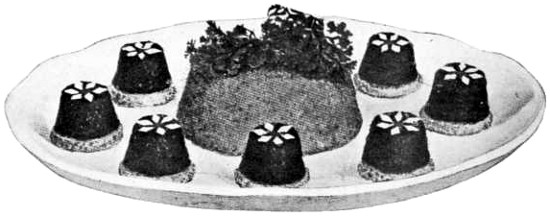
PROTOSE TIMBALE WITH INDIVIDUAL SPINACH SOUFFLÉS
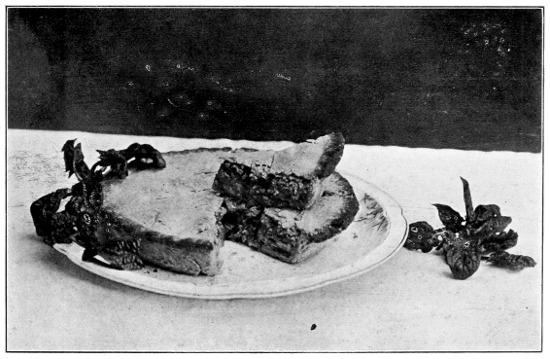
NUT PASTRY PIE, P. 180
ROASTS
Roasts are among the most popular of vegetarian dishes. In the home, in sanitariums and in our vegetarian restaurants they are always in demand. Except soups there are no dishes that we are so often asked to give the recipes for as our roasts. We always plan to have left-overs that will be good for them, as the proper combination of different ingredients is very satisfying, and richer flavors are often developed by reheating foods.
When we start to make a roast, we gather up the suitable ingredients: for instance, a few baked beans or mashed lentils, a little cold boiled rice, some tomato macaroni, a nut cutlet or two, perhaps one or two croquettes, a spoonful or so of tomato, some boiled onions, a few peas or string beans or baked peanuts, may be a little corn, and the vegetables strained out of a soup from the day before; throwing them one after another into a pan. Then we often add a handful of nut meats, chopped or whole, a little sage, sometimes sliced celery or chopped onion, occasionally a little browned flour; never potatoes unless an infinitesimal quantity. Then we scatter over some coarse bread or zwieback crumbs or granella and pour on consommé, broth or gravy, some soup we happen to have, or water, and add one or more beaten eggs, according to the number and size of the loaves; just enough to hold the ingredients together. The eggs may be omitted, but we are more sure that the roast will turn out of the tin well without being too solid, by using them; then, too, they add to the nutritive value of the roast.
Mix well, but not to pastiness, adding more crumbs or liquid as required to make a rather soft mixture. Allowance must be made for the swelling of the crumbs, if they are very dry, and the thickening of the eggs. More salt may be necessary but not much if the foods were seasoned before. The roast should not be as salt as the gravy that is to be served with it.
When of the desired consistency put the mixture into well oiled molds or brick shaped tins, taking care that the corners are well filled. Brush the tops with oil or melted butter or pour a little thin cream over. Bake in a moderate oven in a dripping pan or covered baker without water until the roast is well heated through and the eggs set, then pour boiling water into the baker, cover and bake for an hour or so longer. Remove from oven, let stand a few minutes, invert on platter, lifting mold carefully, garnish, and send to table with a suitable sauce. Some of the meaty flavored sauces are most appropriate. The pieces of nut meat in the roast add much to the pleasure of masticating it. Roasts may be warmed over by setting in pan of hot water in the oven.
Cutlets of Roast
Cut cold roast into not too thin slices. Egg and crumb, or flour only. Bake or broil and serve with or without a sauce. Some such accompaniment as stewed onions or carrots is enjoyable. Cutlets may be served on a bed of pilau.
Below are given the ingredients of a few roasts that were made in a small institution at different times.
No. 1
Some macaroni strained out of the soup from the day before, a little nutmese à la crême, some trumese cutlets, hard boiled eggs, a little nutmese, sage, crumbs, eggs, consommé. The nutmese was put in the center of the loaf in a layer.
No. 2
Stewed red kidney beans ground, egg macaroni ground, dry zwieback ground, a few nuts, eggs, consommé, nutmese in layers. Served with Sauce Imperial.
No. 3
Baked peanuts, rice, garlic, a little melted butter, savory tomato gravy (made with tomato, Chili sauce, bay leaf and a little cream) a very little sage, eggs, crumbs, soup.
No. 4
Macaroni, rice, peas purée, trumese cutlets, some trumese in tomato, and nutmese, laid in the center of the loaf. Sage, eggs, crumbs, soup.
Brazil Nut and Lentil Roast
3 cups coarse, dry bread crumbs
3 cups mashed lentils (1½ cup before cooking)
1½ cup chopped Brazil nut meats
2 teaspns. salt
2 cups hot water
Mix all ingredients, using more or less water according to dryness of crumbs. Press into brick shaped tin or any convenient mold; brush with oil or cover with thin cream. Bake in moderate oven until well heated through, then set in pan of hot water, cover and finish baking. Serve with sauce 6, 9, 10,16 or 17. Flavorings of onion and browned flour, or of sage may be used if desired.
Rice and stewed lentils are good ingredients for the foundation of a roast.
Black Walnut Roast
5 cups medium dry bread crumbs
2 cups coarse chopped black walnut meats
1½ teaspn. sage or winter savory
1½ teaspn. salt
2½ cups hot water
Bake as Brazil nut and lentil roast. Serve with sauce 16,17 or 45.
LEGUMES
The mature, dry seeds only are considered under this head.
Legumes—peas, beans and lentils form an important part of the vegetarian dietary, containing as they do a so much larger proportion of the muscle-building material than flesh meats, and being at the same time inexpensive.
Another advantage is that they are grown in considerable variety in nearly all countries.
We have beans—white, large and small; colored, of all shades and sizes; peas—dry, green and yellow, split and whole, chick peas and other varieties; lentils—German or Austrian, red or Egyptian. The ground nut or peanut is also a legume.
Chick peas are found in the Italian groceries or macaroni stores. They have a rich flavor peculiar to themselves.
The Soy bean, most common in China and India, has almost no starch and is richer in oil than any other legume.
The legumes require a prolonged, slow cooking to render them digestible and to develop their rich flavors. The hulls of some are difficult of digestion. It is for this reason that we suggest rubbing legumes through a colander in so many recipes. Experiments have proven, also, that a larger percentage of their nutritive value is assimilated when the hulls are excluded.
Parboiling causes beans to be flat and tasteless; then the need is felt of a piece of pork or at least a lump of butter; while if they are put at once, without soaking, into the water in which they are to be cooked, their own rich, characteristic flavor (which nothing can replace) will be retained.
The large, dark flowering beans and a few other colored ones are exceptions, and should be parboiled, as their flavor is so rich that it may be denominated “strong.”
Nearly all legumes for stewing or baking should be put into boiling salted water (most authorities to the contrary notwithstanding), to keep them from cooking to pieces and to preserve their color and flavor. In sections where the altitude is great, however, legumes must be soaked for several hours and be put to cooking in cold, soft water; even then a longer time will be required for cooking than nearer the sea level.
The water may be rendered soft by boiling and settling, if necessary. Soft or distilled water will cause legumes to be more digestible at any altitude. Rain water is the very best. Most legumes about double in bulk in cooking.
★ Mashed Lentils
“Rice is good, but lentils are my life.”—Hindu proverb.
Do not waste time by looking lentils over by handfuls, but put them into a large, flat colander, give them a shake or two to remove the fine dirt, slide them to one side of the colander, then with the fingers draw a few at a time toward you, looking for particles of sand or gravel. Pick these out but do not pay any attention to the wheat, chaff or poor lentils. Those will come out in the washing in much less time than it takes to pick them out and if a grain or two of wheat is left it will do no harm.
When you are sure all the gravel is out, set the colander into a dish pan and pour cold water over the lentils. Stir with the hand until all but the waste matter has settled to the bottom; then carefully pour the water off. Repeat the process until all objectionable substances are removed. Rinse the colander up and down in water, drain the lentils and put immediately into a large quantity of boiling water in a broad-bottomed vessel. (The shape of the utensil has much to do with the drying out without scorching.)
Let the lentils boil fast for a short time, then simmer without stirring. If they are stirred after they begin to soften they will scorch. Now keep the vessel over a slow, even fire until the lentils are well dried out. The drying may be finished in the oven if the dish is covered so the lentils will not become hard on the top. This drying is imperative. It develops a rich flavor that we do not get without it.
When well dried, add a little water and rub the lentils, a few at a time, through a fine colander with a potato masher. (Do not deceive yourself by thinking that you can get along faster by putting a large quantity into the colander at once.)
Throw the hulls into a dish of boiling water. At the last, stir the hulls well and rub again in the colander, reserving what goes through this time for soups and gravies.
When all the lentils are through the colander (of course care should be taken to keep them hot during the process), add plenty of salt and beat until smooth and creamy. Keep hot in a double boiler, covered, till serving time. Beat again just before serving. Serve piled in rocky form or in smooth mound on hot platter (or in a hot covered dish if to be long on the table), with different garnishes: a wreath of celery tops, sprays of parsley or chervil, spinach leaves or cooked vegetables. Serve with sauce 16, 17, 53 or 54.
Do not be afraid of the simple dishes; they are the best.
Mashed Lentils—Rice
Make well in center of lentil mound and fill with sauce 8, 53 or 54. Surround mound with hot boiled rice; garnish with green.
★ Mashed Peas
Prepare dried green peas the same as mashed lentils. Serve with sauce 16, 17, 18, 21, 22, 57 or 59.
Sauce 1, flavored or not, combines nicely with peas. Serve mashed peas and rice with sauce 16 sometimes.
Mashed Beans
Sauce 16, 18, 19, 34, 57, 58 or 75
★ Variegated Meat
Put different colored mashed legumes, for instance, red and white beans, or red and white beans and green peas, lentils and white beans (sometimes red beans also), green peas and red beans, yellow peas and red or black beans, or green and yellow peas, red and
The Salad Entrée dressing is delightful with mashed legumes.
★ Peas Pie—Corn Crust
Crust—
2 cans (1 qt., 16 ears) of corn not very moist
2 or 3 eggs
1 cup milk
salt
Beat eggs, add corn, milk and salt.
Put mashed green peas in oiled baking dish, cover with crust, bake only till the eggs in the crust are set; serve at once. No sauce.
Lentil Pie—Potato Crust
Cover mashed lentils in baking dish with nicely seasoned mashed potato, brown in oven; serve with sauce 6, 16, 49, 51, 53 or 54.
Lentil Pie—Universal Crust
Mashed lentils, not too dry, flavored with browned flour and chopped onion, a little sage also if desired, with universal crust. Serve with sauce 1, 16, 43 or 53.
Mashed Peas—Macaroni or Vermicelli
Cook macaroni or vermicelli with garlic, or onion and garlic. Put into thick cream sauce and serve around rocky mound of mashed peas.
Creamed Beans
1 pint white beans
1 tablespn. butter
1 tablespn. flour
1 large cup milk
1 teaspn. salt
2 eggs
crumbs
Cook and mash beans according to directions for mashed lentils; add salt, and cream sauce made with butter, flour and milk; then eggs beaten. Turn into oiled baking dish, sprinkle with
Colored beans, peas and lentils may be prepared in the same way.
Lentils—Poached Eggs
Spread a half-inch layer of mashed lentils on slightly moistened rounds of toast and place a nicely poached egg on each. Garnish.
Bean Croquettes
Shape dry mashed beans into thick croquettes (oiling the hands or dipping them in hot water occasionally), coat delicately with oil or melted butter, heat in oven till beginning to crack a little, no more. Sprinkle with chopped parsley, serve with Sauce Amèricaine, Sauce Imperial, or Mayonnaise or French dressing, or with a garnish of lemon rings with parsley butter, p. 163. Any seasoning but salt in the croquettes spoils them.
Lentil Croquettes
Prepare the same as bean croquettes, serve with any sauce given for mashed lentils, or with small boiled onions sometimes. A little browned flour and chopped onion may be used in the croquettes. Rice and lentil croquettes may be served with Boundary Castle sauce.
Peas Croquettes
Shape the same as bean croquettes, adding a little finely-sliced tender celery if desired. Serve with sauces given for mashed peas. The croquettes are very pretty rolled in parsley before baking. Chop the parsley, not too fine, and spread it out thin with spaces between the particles on a vegetable board. Roll the croquettes over it once.
Legume Patties
Shape mashed peas, beans or lentils into thick flat cakes instead of into croquettes, and serve with suitable sauces.
Peas Timbales
1 cup mashed peas
2 eggs
a few drops of onion juice
½ tablespn. melted butter or 1 of cream
⅔ teaspn. salt
Mix all with beaten eggs, bake in a single or in individual molds well oiled, in pan of hot water until firm.
(Very finely sliced celery may be used instead of onion juice. Peas and eggs only may be used for plain timbales). Serve with cream sauce. Finely sliced celery, a few whole green peas, a little stewed corn or a few pieces of tomato pulp may be added to the sauce.
The individual timbales may be used as a garnish for some vegetable dish, giving meat value to it. Decorate timbales with egg daisies, carrots, or anything desired.
Rice and Lentil Timbales
Line a well oiled mold with a ¾ in. layer of boiled rice. Nearly fill the center with mashed lentils, cover with rice, steam or bake 20 m. to ½ hr. Unmold carefully, garnish, serve with cream, brown, mushroom or any suitable sauce.
Mashed peas may take the place of lentils, with sauce of celery, onion or tomato cream.
Lentil Roast
1 pt. lentils
½ cup raw nut butter
a few bread crumbs, or
¼ cup browned flour No. 1
1 small onion chopped
salt
sage
1 egg
⅝–¾ cup water
Cook and mash lentils, add nut butter and onion which have been cooked with salt ½ hour in the water, then the browned flour or the crumbs, sage and beaten egg; more salt and water or crumbs if necessary for right consistency. Press into well oiled mold or brick-shaped tin, bake, covered, in pan of water about 1 hour or until firm. Dry in oven 10 m., out of water if necessary. Let stand in warm place 5 m. Unmold on to platter, garnish. Serve with sauce 6, 16, 18,54 or 57.
Flavorings of roast may be varied or omitted.
1 cup chopped nuts might be used in place of raw nut butter.
1 cup stewed tomato may be used for liquid.
For people with good digestion, the lentils may be ground through a food cutter instead of being put through the colander.
Chick Peas Roast
Substitute
Peas Roast
1 pt. mashed, dry, split or whole green peas, 1 to 2 eggs or whites of eggs only, or a little fresh cracker dust. Bake as lentil roast until firm only. Serve with tomato cream sauce or almond cream, tomato or celery cream sauce. Peas require no flavoring, but celery or celery salt may be added, serving with plain cream sauce.
Sister Boulter’s Red Kidney Bean Loaf
Cook and crush or grind red kidney beans, add salt and sage, mold. Serve cold, sliced, with or without oil, or use for sandwiches. A few crumbs may be added if necessary, the loaf baked, and served hot with any suitable accompaniment.
Purées of Legumes
Add sufficient water, nut or dairy cream or milk to mashed beans, peas or lentils to make of the consistency of a thick batter. No sauce is required.
★ Rich Baked Beans
Wash beans and get them into boiling salted water, in the bean pot, as quickly as possible. For each pint of beans use 1¼ to 1¾ teaspn. of salt. Add plenty of water at first, perhaps three times the quantity of beans. Put into a hot oven until they begin to boil, then reduce the temperature to such a degree as will keep them just simmering for from 12 to 24 hours. The old-fashioned New England baked beans were kept in a brick oven for three days, and each day they were better than the last.
Do not stir the beans after the skins begin to break. When necessary to add more water, pour it boiling over the top and let it settle in gradually. A gentle shaking may be helpful. After they are swollen and softened they should not have too much water on at a time, nor be baked too fast; if so, they will be “mushy.”
They are most generally liked slightly juicy when served—not too wet nor too dry, but just “juicy.” They may be served with the Salad Entrée dressing, Improved Mayonnaise or French dressing, with oil or lemon juice or with Chili sauce, but they all spoil that delightful bean flavor in the rich, thick juice. Beans have a characteristic flavor which is destroyed by the addition of anything but salt and water. Molasses, cream, nut butter and tomato are all good in their place, but that is not in baked beans if we attain to the keenest enjoyment of the bean flavor. We get the rich red color, without the rank molasses taste, by prolonged baking. Cream and milk deaden the flavor, and nut butter and tomato change it.
Those who taste our baked beans for the first time exclaim, “I would not have believed it,” and it is hard for them to believe that there is no meat in them.
Bake Red Kidney and other varieties of beans the same as white beans.
For those who think they must have the molasses, use 1 teaspn. molasses (or 2 teaspns. for a very strong molasses flavor) 2 teaspns. oil and 1½–1¾ teaspn. salt to each pint of beans.
★ Western Baked Beans
Boil beans in salted water until the skins are broken. Put into a pudding dish with plenty of water and bake in a slow oven until dry and mealy and delicately browned over the top.
Baked Split Yellow Peas
1 qt. (1½ lb.) split peas
1–2 tablespns. browned flour
½ cup strained stewed tomato
3–3½ teaspns. salt
Wash peas, put into bean pot, add browned flour, tomato and salt which have been mixed together, then turn over them two or three times their quantity of boiling water. Stir well. When boiling, regulate the heat of the oven so as to keep them gently simmering for from 5 to 7 hours. Do not stir after they are first put to cooking. They require greater care than beans to keep them from breaking. However, if they do not keep their shape they will be of a jelly-like consistency not at all objectionable. May add 2 large onions sliced fine.
Baked Split Yellow Peas No. 2
1 qt. peas
¼ cup roasted nut butter
1 cup tomato
3–3½ teaspns. salt
Rub nut butter smooth with tomato and add with salt and boiling water to peas. Raw nut butter and browned flour may be substituted for the roasted nut butter.
★ Baked Split Green Peas
Wash peas and put into a baking dish with 1 teaspn. of salt to each pint of peas and 2 to 2½ times the quantity of water. Cook on top of the stove until tender (about 1 hour), then put, covered, into a slow oven and bake until dry and mealy all through, which will not be long if there was not too much water in them. Peas lose their delicate flavor and develop a strong taste if cooked too long. If this amount of water is too great, use a little less. Serve if desired in the dish in which they were baked, with sauces given for mashed peas. A mint and celery flavored raw nut butter sauce is nice with them.