TRUE MEATS (continued 2)
Reading edition
When desired very smooth they may be put through a colander. They may be used in soups and in all dishes where mashed peas are required.
Baked Lentils—great favorites
Stew lentils with salt, with or without chopped onion, until nearly tender.
Add a little cream, turn into a baking dish and finish in the oven. Serve juicy.
A little thick cream poured over the lentils during the last of the baking gives a nice crusty finish to the top.
Stewed Beans
Put red kidney and other beans with tough skins into boiling unsalted water and cook until nearly but not quite tender before adding the salt. Common white, Lima and all beans with tender skins must be put into boiling salted water at first. After a short time of rapid boiling let beans just simmer until tender, then add a little heavy cream and stand back where they will keep hot but will not boil, for a half hour or longer. A little raw nut butter may be cooked with them sometimes, or, cocoanut cream may be substituted for dairy cream.
Red kidney and some of the richer varieties may be served with boiled rice or in a mashed potato border.
Stewed Split Green Peas
Cook peas in salted water ¾ to 1 hour, add cream, heat and serve. Two parts stewed dried or green sweet corn to one of peas, may be added sometimes.
Flowering Beans
which have no equal in flavor, should be put into a large quantity of cold water, brought to the boiling point, boiled for 10 m., drained and put to cooking in boiling unsalted water. Add salt when nearly tender. Try them.
Stewed Beans in Bean Sauce
Mash a few of the stewed beans, add cream, or milk and butter with the water from the beans, more salt if necessary; blend well, pour over remainder of beans, heat. Serve on toast or as preferred.
Stewed Lentils—for people with good digestion
Cook lentils with raw nut butter, onion, garlic, browned flour and salt, until tender, rich and juicy. Serve without mashing with boiled rice or with some of the large sizes of macaroni, cooked.
Lentils may be cooked plain with salt and seasoned with cream or butter at the last.
Ragout of Chick Peas—especially delicious
Soak the peas over night. Cook and cook and cook in the water they were soaked in. When about half done add garlic, onion, a very little browned flour, tomato and salt. Serve with dressing, rice, dumplings—steamed or baked, or on toast.
Cabbage Leaf Rolls of Lentils
1 cup lentils
1 cup rice
2 tablespns. raw nut butter
onion
sage
salt
1 loose head of cabbage
a little tomato if desired
Boil cabbage leaves in salted water 5–8 m., or sprinkle with salt, pour boiling water over and let stand 20 m. to ½ hour. Refresh with cold water, drain.
Cook lentils till beginning to get tender but not until broken, drain and save water.
Cook rice in salted water until swollen but not soft (about 15 m.), drain if necessary and save the water. Mix lentils, rice, sage, chopped onion, raw nut butter and salt smooth with a little of the lentil water. Put a tablespoonful of this mixture in the center of each cabbage leaf. Fold the sides of the leaf over and roll into croquette shape. Pack close in layers in an oiled baking dish. (A flaring granite pan would do nicely.) Pour the rice water and lentil water over, with a little tomato if desired, and add enough boiling, slightly salted water to cover. Press a plate over the rolls, cover and bake ¾ to 1 hour in a moderate oven.
Drain, save liquid, remove plate, invert dish on to chop tray, leaving rolls in a mound. Thicken liquid slightly and turn over rolls or serve separately. Garnish mound.
Dairy butter may be used in place of raw nut butter.
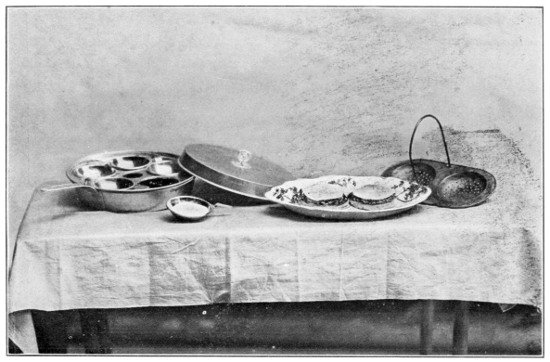
POACHED EGGS AND POACHERS
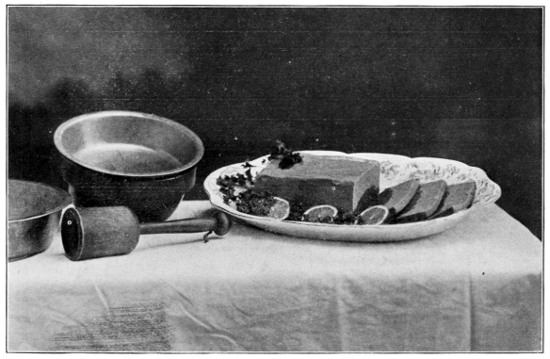
VARIEGATED MEAT, P. 186
Savory Hash
Equal quantities mashed lentils and boiled rice or chopped potato, seasoned with sage or onion. Add water or cream and salt. A few soaked and chopped dried olives may be added to the hash.
“The pea and the lentil are roasted in the Mediterranean countries and form there a regular article of food. In India peas are parched in hot sand. The chick-pea, as found by experiment, can be parched over coals in a few moments and thus be made edible. The taste reminds one of pop corn and roasted chestnuts. A slight bitterness is present, due, probably, to the skin which does not slip off in roasting as does the skin of the peanut. When this skin is removed before roasting, as it may be by a half hour’s soaking, the product is improved.
“Mary Hinman Abel, Farmers’ Bulletin No. 121, U. S. Dept. of Agriculture.
EGGS
“Milk and eggs should not be classed with flesh meat. In some cases the use of eggs is beneficial.”
“While their use will become more and more unsafe as disease in animals increases, they should not be discarded entirely, when other foods to supply the needed elements cannot be obtained. Great care, however, should be taken to obtain milk from healthy cows and eggs from healthy fowls that are well fed and well cared for.”
Though eggs are, to some extent, stimulating, they do not contain the poisonous, excrementitious matter found in the flesh of dead animals; and no animal life is destroyed by their use.
As eggs, at present, form so important a part of the Vegetarian dietary, care should be taken to prepare them attractively and palatably.
Suggestions
Only strictly fresh eggs should be used for any purpose. There is danger in stale eggs.
The beaten raw egg is usually considered the most digestible, but there are some with whom lightly cooked eggs, as “Eggs in the Shell” agree best, and still others upon whom the soft yolk acts almost like poison, who can take omelets or scrambled eggs better, where the whites and yolks are thoroughly mingled (when cooked in not too large a quantity of oil).
Occasionally we find a person with whom the white of the egg disagrees; but very seldom.
Try taking the beaten white of an egg when you have a sour stomach. It is very soothing, also, to an irritated, sensitive stomach.
The white of an egg relieves the pain and prevents inflammation when applied quickly to a burn or scald.
A few sliced Brazil nuts or filberts or broken pieces of other nuts added to omelets or scrambled eggs aid mastication.
Salt should not be put into the water for poaching eggs; it renders them less digestible.
The cooked yolk of the egg is most digestible when cooked long enough to be dry and mealy, and the white when just jellied.
Never use milk in scrambled eggs or omelets. The casein of the milk hardens with cooking and renders the eggs tough; besides, the flavor of the eggs is much finer with water, and omelets are lighter. Cream spoils the flavor though it does not toughen the egg as does milk.
Always bake soufflés, puff omelets, cakes, all things to be made light with egg, slowly, and well from the bottom, so that they will stay up, after rising. Serve soufflés and puff omelets as soon as done.
For custards or any thickening, beat eggs just sufficiently to mingle, not to a foam.
Drop yolks of eggs in cold water to keep them from drying up when whites only are desired, and lift carefully from the water with a teaspoon when ready to use.
Add a trifle of salt to whites of eggs before beating; they will be lighter.
Stand yolks of eggs in half the shell on a wrinkled towel while waiting to prepare the whites for egg creams and other dishes.
When eggs are used freely in breads, cakes or puddings, other proteid foods will not be required, so they need not add to the expense of the meal.
Eggs In the Shell, or Curdled Eggs
The objection to the “soft boiled” egg is that the white is hard while the yolk is soft. To obviate this difficulty, put from 1 to 4 eggs into boiling water, 1 pint for each egg (cover if the dish is broad and shallow; if deep, leave uncovered), and let stand off from the fire for from 5 to 10 minutes according to the age of the eggs. Fresh laid eggs will cook in a shorter time than those several days old.
When a larger number of eggs is required, use a smaller proportion of water and let them stand on the back of the range where the water will be below the boiling point, for 5 minutes.
The most accurate way to obtain the desired result is to keep the water at the temperature (by the thermometer) of 168 to 170 degs. for 10 minutes; never allowing it to go above 170 nor below 168. The flavor of eggs cooked in this way is as much more delicate and delightful as is the consistency.
Roasted Eggs
Prick the shells of the eggs several times at the pointed end to prevent their bursting during cooking, set them on the large end in the hot sand or ashes under the camp fire, cover with leaves, hot sand and embers and cook for 10 minutes. When opened they will be smooth and of a velvety consistency. The same result may be obtained by putting eggs in the hot ashes under the grate of the kitchen range.
Poached Eggs
In an oiled, shallow pan have unsalted boiling water deep enough to be at least ½ in. above the eggs. Slide the broken eggs (only fresh laid eggs will poach nicely) into the perfectly boiling water, singly, or all from one large dish. Set pan on asbestos pad, cover and leave where the water will keep hot but will not boil, until the eggs are jelly-like. Remove carefully from the water with a small oiled skimmer and cut off the ragged edges with a biscuit cutter. Nothing is more offensive to the eye than a rough ragged poached egg.
Besides the usual toast, poached eggs may be served on cream toast, round slices of broiled trumese, on hash or creamed vegetables, or in shallow nests of boiled rice, mashed potato or spinach. Do not forget the garnish, as there is no place where a spray of parsley gives a better effect than on poached eggs.
Or, place oiled muffin rings in the pan of water and break an egg into each ring; take up with griddle cake turner and remove the ring.
The most nearly perfect of all, however, are eggs poached in the Buffalo Steam Poacher after the following method:
Have the lower part of the poacher ⅔ full of boiling water; set the well oiled poacher cups, each containing an egg, into their places; cover, let stand over the hot fire just a moment to allow the cover to become filled with steam, then set off from the fire. Leave, covered tight, for 6 m., when you will have eggs beautifully jellied all through, which (if the cups were oiled sufficiently will slide out on to whatever you wish to serve them on.)
Sometimes poach eggs in thin cream or in milk and butter, lay on to slices of toast, halves of biscuit or large thin wafers, and pour the cream around.
Poached Yolks of Eggs
Drop yolks, one at a time, into rapidly boiling water; keep them rolling, by rapid boiling, for at least 10 m.; then stand where they will boil more slowly till done, 20–25 m.
Poached Whites of Eggs
To be cut in fancy shapes for garnishing.
Break whites of eggs into thoroughly oiled cup or bowl, set in pan of hot water, with something to keep the dish from touching the bottom of the pan, and leave over the fire until the white is set.
Poached Beaten Eggs
Beat eggs to a foam with water, or any desired addition, and cook in steam poacher.
Creamed Eggs
Break eggs into a shallow baking dish, cover with thin cream and bake in a moderate oven; sprinkle with salt and dot with parsley leaves before serving. Or, bake or steam singly in ramekins or custard cups. Rye bread crumbs may be sprinkled in the bottom of the dish and over the eggs for variety, also ground pine nuts.
Rice with Poached Eggs
Steam rice in shallow dish; when done, make depressions for the required number of eggs; break one into each hollow, set dish in steamer for 2 m., or till whites are set, sprinkle with chopped parsley and send to table. Creamed potatoes may be substituted for rice sometimes, and either may be baked in the oven by covering with a pan.
Poached Eggs—Creamed Celery
Put nicely poached eggs on rounds of toast and arrange in a circle on a chop tray; fill the center with celery in cream sauce. Garnish with leaves of spinach.
Hard Boiled Eggs
Put eggs into warm water, bring to just below the boiling point, 200 degs. and keep at that temperature for about 30 m. Drop for a moment into cold water before removing the shells. Or, when necessary, boil rapidly for 10–20 m.
Hard eggs agree with some stomachs better than soft ones.
Italian Eggs
Cut hard boiled eggs in halves lengthwise, lay on to cutlets of corn meal porridge and pour Italian sauce around.
Creamed Eggs on Toast
Serve halves or quarters or slices of hard boiled eggs on toast with cream sauce, plain, or flavored with celery or onion, with chopped parsley sprinkled over. Plain or tomato drawn butter may be substituted for cream sauce.
Eggs and Macaroni
Cook macaroni in 2-in. lengths, in salted water with onion and garlic or garlic only. Drain and arrange in nest fashion on chop tray. Lay whole, shelled eggs in center, pour cream of tomato sauce around and over nest. Sprinkle with parsley. Drawn butter or cream sauce may be used.
Or, cut eggs in halves, crosswise, remove yolks and mix to a paste with melted butter, salt, onion juice and chopped parsley. Fill whites with the mixture and arrange on bed of macaroni. Pour sauce over. The roast gravy or some of the mushroom sauces may be used.
Eggs With Sauce
Hard boiled eggs, whole or in halves, may be served with cream, cream of tomato or mint sauce, or with sauce Imperial or fruit sauces or jellies; with mint sauce on broiled nutmese.
Stuffed Eggs
Cut hard boiled eggs in halves, lengthwise, remove yolks and add to them bread or roll crumbs soaked in cream, a little chopped parsley and salt. Rub all together until smooth, add raw egg (or yolk only) to bind, fill spaces in the whites of eggs and press the halves together. Add beaten whole egg to the mixture remaining, dip eggs into it, roll in crumbs and heat in oven or steamer, covered, until just warmed through. Serve with any desired sauce.
A little onion juice may be added to the yolk mixture, or nutmese or trumese cut very fine, with or without chopped mushrooms. Mashed potato may be substituted for bread crumbs.
The eggs may be served as a garnish for green peas or on slices of toast with or without sauce.
Eggs with Ripe Olives
3 eggs
12 (or more) olives, chopped coarse
French dressing
chopped parsley
Cut eggs in halves crosswise, remove yolks and mix with olives and dressing, return to the whites, stand on leaves of lettuce and sprinkle with parsley. Pour dressing around. Improved Mayonnaise dressing is suitable also. May garnish with whole olives.
Pickled Eggs
Pickle—2 parts each of lemon juice and water, ⅓ part sugar, salt and a little celery salt. Heat to boiling, pour over hard boiled eggs with a few slices of red beet. Let stand 24 hours.
Eggs à la Salade
Cut hard boiled eggs in halves lengthwise, remove yolks, rub through wire strainer and mix to a smooth paste with Improved Mayonnaise dressing (flavored with onion or garlic if desired), fill the whites and press the halves together. Lay in nests of shredded lettuce dotted with the dressing.
Or, rub whites through strainer, place around the inside of nests of shredded lettuce; mix yolks with dressing, shape into small eggs and place in nests.
Shirred Eggs
Butter and crumb individual dishes, break 1 or 2 eggs into each, set over pan of hot water in oven and bake until eggs are set. The dish may be rubbed with a cut clove of garlic.
If preferred, sprinkle oiled griddle with crumbs, set buttered muffin rings on it, pressing them down firmly, and drop an egg into each ring. Bake. Sprinkle with chopped parsley, serve on toast with any desired sauce.
Scrambled Eggs.
Put oil in pan and heat very hot but not smoking. Turn in eggs which have been broken and salted but not beaten. As they set, draw carefully from the bottom of the pan with a spoon without turning over. When all are set but not hard, slide quickly (leaving the shining side up) on to a plate or platter. The dish must be all ready, as a moment’s delay will overcook the eggs.
Another Way—Take from 1 teaspn. to 1 tablespn. of water (never milk) for each egg; beat, and scramble as above.
Do not stir, just draw the eggs from the bottom of the pan. Cream may be used but the flavor is inferior to the water scramble. Nut cream may be used instead of water.
To Scramble a Large Quantity of Eggs
Break 3 or 4 dozens of eggs into an oiled agate or aluminum kettle, add salt and water, beat slightly and set kettle into hot water. Stir occasionally at first, then more often as eggs begin to set.
Do not try to keep warm long, but make fresh lots as required.
★ Tomato Scrambled Eggs
Take ¾–1 teaspn. thick tomato pulp to each egg, with salt. May flavor with onion.
★ Sour Milk Scrambled Eggs
1 tablespn. thick sour milk to each egg, salt; cook till just done.
Various Scrambles
Simmer sliced celery or onion in oil a few minutes before adding eggs. Or, add asparagus tips, green peas, mushrooms, a little boiled rice or a few broken nuts or bits of trumese or nutmese to eggs before scrambling.
The yolks only may be scrambled.
★ Cream Sauce Scramble
Add 3 eggs to each half-cup of hot cream sauce; mix until done. Garnish with sliced tomato. Mushrooms may be added to the cream sauce before the eggs. Any desired sauce may be used.
Florentine Scrambled Eggs
Spread nicely scrambled eggs on rounds of moistened toast and place a broiled or baked half of tomato on top. Garnish with parsley or spinach leaves or with lettuce and fringed celery.
Egg Croquettes
Sauce—
1 tablespn. butter
2–2⅔ tablespns. flour
1 cup milk or thin cream
1 teaspn. onion juice
1 teaspn. salt
6 hard boiled eggs, chopped
The whites of eggs may be rubbed through a wire strainer or a ricer. Make sauce the usual way; cool; add the eggs and shape into croquettes, egg, crumb and bake. A few cooked chopped fresh or dried mushrooms may be added with the eggs.
Egg and Rice Croquettes
2 cups boiled rice
¼ cup cream
oil or melted butter
3–4 hard boiled eggs, chopped or the whites riced
grated onion or finely-sliced celery, or both
chopped parsley
Shape, heat in oven, serve with cream sauce, with or without peas or celery.
OMELETS
The making of an omelet is very simple, requiring just a little practice, and it is by far the most attractive way of serving eggs.
It is better to make several small omelets of 3 or 4 eggs each than one very large one. Six eggs is the most that can be handled at all properly.
Use 1 teaspn. to 1 tablespn. of water to each egg. The water may be omitted entirely.
Eggs may be beaten a very little, or until light and foamy.
Omelet pans should not be used for anything else. To keep them smooth, rub with soft pieces of paper or a cloth after using, and occasionally scour them with salt. Do not wash them. Keep in warm, dry place.
Omelets should be served immediately, when made.
Plain French Omelet
3 eggs
1–3 tablespns. water
½ teaspn. salt
Beat. Have butter or oil in pan to well cover the bottom. Heat hot, but not to smoking or brownness. Turn the eggs in and with a spatula (or a thin bladed knife) lift the set portions, allowing the liquid part to run underneath. When all is set, jelly-like, not hard, roll quickly from one side into the form, as one writer says, of an “oval cushion.” Hold omelet for a moment over the fire to take a delicate cream color underneath. Turn on to a hot platter, the under side up, garnish and serve.
If an omelet is quite thick it may be folded over just double.
It should be a little soft on the top before folding.
The perfect shape is higher in the center and pointed at the ends.
Olive oil, in the pan, gives a flavor much enjoyed by many.
If the oven is just right, setting the pan in the oven a moment before or after folding puffs the omelet nicely.
The plain omelet may be varied by mixing some garnish with the eggs and spreading it over the top before folding, or serving it around the omelet on the platter.
When the material is to be folded in, leave the center of the omelet a little thinner.
Accompaniments to omelets must be well seasoned and flavored.
Sweet omelets with fruits make nice desserts or luncheon dishes.
Omelet Variations
Apple and Onion—Garnish omelet with apple and onion sauce.
Apricot—Stewed, dried apricots folded in omelet.
Asparagus—Season asparagus tips with butter and salt; lay between folds of omelet and on the top, or, pile at one side of the omelet. The butter may be omitted and a rich cream or egg cream sauce poured over the tips and around the omelet.
★ Banana Cream—Heat, do not boil cream and sugar; add banana cut into small dice; cover omelet (which has had a little sugar beaten with the eggs), fold, serve with wafers. Do not heat the cream after adding the banana.
Corn, a great favorite—Use 1½ tablespn. nicely seasoned, rather dry stewed corn (no water) for each egg. Mix well and cook as plain omelet. Use 1 tablespn. grated fresh corn for each egg. Creamed dried corn may be used.
Crumb—2 eggs, 2 tablespns. bread crumbs, ¼ cup milk, salt. Beat eggs together or separately.
Fine Herbs—Finely-chopped fresh thyme, tarragon and chives; or, parsley, thyme and marjoram, beaten with the eggs. Lemon butter sauce may be spread over the omelet after it is on the platter.
Gooseberry—Spread omelet with not too sweet stewed gooseberries.
Imperial—Serve with Sauce Imperial.
Jelly—Spread with jelly before folding; or garnish with spoonfuls; or unmold a small flat mold of jelly beside the omelet on the platter and serve with it. Garnish with geranium or spinach leaves.
Mayonnaise—Spread or garnish with Improved Mayonnaise dressing.
★ Mushroom—Cook mushrooms, fresh, in their own juices, in a double boiler with butter and salt. Cover half the omelet before folding and garnish the folded omelet with some of the most perfect mushrooms. Pour the liquid around. Chopped mushrooms may be used on the inside if prepared in the same way.
★ Another—Broil the mushrooms, pour melted butter over and use in the same way as above.
Nut—Add a few broken or coarse chopped nuts to egg mixture and garnish top with halves of nuts.
Onion—Add grated or finely-sliced onion and chopped parsley to egg mixture. Cook omelet very soft. Or, simmer sliced onions in oil till tender (not brown), add egg mixture and cook. Or, simmer onions in oil, drain oil into omelet pan, cook omelet and cover with onions before folding.
Onion and Tomato—Simmer onions in oil, add a little drained, stewed tomato and salt, heat and serve around omelet.
Oyster Plant—Cover omelet with stewed oyster plant in slices with a little of the liquor seasoned with butter, cream or cream sauce, before folding.
Parsley—Chopped parsley in omelet mixture and omelet served with parsley butter.
Peas-green—Same as oyster plant omelet. The dried chick peas, cooked and richly seasoned as on p. 194, make a delightful accompaniment.
Peas-mashed—1 tablespn. of mashed peas and ½ tablespn. of water to each egg. Salt.
Prune—Prunes stewed in a small quantity of water so that the syrup is rich; pitted, quartered and folded into omelet.
Rice—Mix boiled rice with eggs, cook soft, serve with tomato sauce if desired.
Tomato—Drain stewed tomatoes, season well with butter and salt, or salt only. Serve in and around omelet. Or, thick tomato pulp may be added to the egg mixture. Serve omelet plain or with cream sauce.
Trumese Salad Entrée—Lay strips of trumese salad entrée on half of omelet; fold, turn on to platter, pour dressing around, garnish with parsley or spinach leaves.
Omelet with Okra in Almond Cream Sauce—delicious
¾ tablespn. almond butter, ⅓ cup water, salt, mix, boil; add ⅔ cup drained stewed okra, heat. Serve in and around 3-egg omelet.
Vegetable Pudding Omelet
Put hot creamed vegetables—asparagus, peas, peas and carrot, or any preferred, in bottom of pudding dish. Cover with omelet mixture, bake in moderate oven till eggs are just creamy and delicately browned; serve at once.
Puff Omelet
2 eggs
2 tablespns. water
salt
Mix yolks, salt and water; beat the whites to a stiff froth with a little salt, and chop into them the yolk mixture. Turn into a hot well oiled pan and set on an asbestos pad back from the direct heat of the fire. Cover and cook until the top will not stick when lightly touched with the finger. It should take from 15 to 20 m. If cooked too rapidly the omelet will fall. Fold, or slide on to a hot dish without folding. Serve plain or with any desired accompaniment.
Sauces 16, 18, 44, 50 or 75 are all suitable for the puff omelet.
If the oven is not too hot, the omelet may be baked, but it should be set on something to keep it from the bottom of the oven and may need to have a pan turned over it. May score across the top with a hot iron when omelet is not folded.
One egg only, makes a nice little omelet. It may be baked in a large muffin ring (or two small) on a griddle and served on a thin slice of toast, with or without cream sauce.
These omelets are delightful and one requires but little practice to attain perfection in them. They will admit of the same variations as the French omelet.
Fruit juices with a little sugar may be substituted for the water sometimes. The water may be omitted.
Omelet may be tinted with tomato, spinach or other colors for variety.
A delightful omelet may be made by mixing 2 teaspns. of pine nut, almond or steamed nut butter with the water.
Foam Omelet
Mix beaten yolks with ⅓ less water than for the puff omelet; cook until delicately jellied, spread stiffly-beaten whites near the edge of half the omelet; set on top grate of oven to warm. Fold and serve at once. Omelet may be dotted with jelly before putting the whites on. Half the beaten whites may be mixed with yolks as in puff omelets.
Savory Puff Omelet
2 eggs
2 tablespns. cream of nut butter
2–4 tablespns. chopped, thoroughly soaked, dried olives
chopped parsley
Add olives and parsley to yolk mixture and fold in beaten whites.
Orange Omelet
2 eggs
2 tablespns. orange juice
2 teaspns. sugar
salt
bits of orange pulp with sugar
Beat yolks, add 2 teaspns. of sugar, then orange juice and then the stiffly-beaten whites. Cook, spread half of omelet with orange pulp sprinkled with sugar, fold, serve.
Another
Add orange juice and grated rind with a little vanilla to yolks, then beaten whites as usual. When baked, fold and dust with powdered sugar.
Grape Omelet
Use grape juice instead of water in puff omelet. Fold and dust with powdered sugar.
Unroasted Nut Butter Omelet. Choice
2 teaspns. steamed nut butter
1½ tablespn. water
2 eggs
Mix nut butter, water, yolks and a little salt; add stiffly-beaten whites and cook as puff omelet. 1½ tablespn. of cooked cream of raw nut butter may be used if more convenient.
Almond Butter Omelet
1 teaspn. almond butter and ½ tablespn. water to each egg; combine and cook as above.
BREAD AND BAKED OMELETS
Bread and baked omelets may be served with gravies, sweet sauces or jelly, or with green peas or asparagus, or may have corn, peas, etc., mixed with omelet before baking. They may be made of milk, cream or water. Water makes the lightest and most delicate omelets. Stale, not dry, crumbs are used.
Baked Omelet
2 eggs
½ teaspn. flour
2 tablespns. water
1 teaspn. oil
salt
Beat all together or beat the whites of eggs separately, and bake in a slow oven until set. Fold or serve without folding. A few chopped nuts may be added when desired.
Bread Omelet
Pour 1 cup boiling water over 1 cup bread crumbs; let stand until soft. Beat 6 eggs just enough to mix them, add moistened bread crumbs, salt and a little chopped parsley. Turn into hot oiled omelet pan and bake on top of stove or in oven. This omelet may be baked in muffin rings on a griddle as may many omelets. Try molasses sauce with it.
Bread and Milk Omelet
Soak 1 cup of bread crumbs in 1 cup of sweet milk; add yolks of 3 eggs with salt, then the stiffly-beaten whites. Cook as puff omelet. Serve with or without jelly in the center.
German Crumb Omelet
6 eggs
1 cup water
1 cup fine bread crumbs
1 tablespn. corn starch
salt
a little chopped onion and
parsley
Beat yolks of eggs, add corn starch blended with water, then crumbs, salt, onion and parsley. Chop in stiffly-beaten whites. Bake in oven.
Miss Chaffee’s Cracker Omelet
⅔ cup of cracker crumbs, fill cup with milk; when crumbs are soft, add well-beaten yolks of 3 eggs, then stiffly-beaten whites.
Cook as puff omelet. Fold and serve.
Bread Omelet Pie
Soak 1 cup soft bread crumbs in 1 cup hot milk or water, add 1 tablespoon of oil or butter, 1 teaspn. each chopped onion and parsley, salt, and 2 well beaten eggs. Have hot, in baking dish, a thin layer of nicely seasoned drained tomato, or trumese seasoned with oil and lemon juice, or any desired filling; cover with the omelet and bake until just set.
Breaded Tomato Omelet
¾ cup of crumbs soaked in 1 cup strained tomato. Add yolks of 3 eggs, 2 or 3 tablespns. cream, salt, chopped parsley and stiffly-beaten whites of eggs. Bake.
Corn Starch Omelet. Extra Good
3 eggs
1½ tablespn. corn starch
½ teaspn. salt
½ cup milk
Beat yolks of eggs, corn starch and salt together; add milk gradually; beat and chop in the stiffly-beaten whites of eggs. Cook as puff omelet.
White Sauce Omelet. Unequaled
1 cup rich milk
1 tablespn. oil or butter
5 eggs
2 tablespns. flour
½ teaspn. salt
1 teaspn. sugar
Heat butter, add flour, then hot milk and salt; pour over beaten yolks of eggs, add sugar, fold in stiffly-beaten whites; turn in to well oiled omelet pan and cook as puff omelet.
This recipe is copied almost verbatim from “A Book for a Cook,” by permission of the Pillsbury Flour Mills Company.
Omelet Soufflé
6 eggs
3 tablespns. powdered sugar
1 tablespn. lemon juice
Beat the yolks of the eggs with the sugar, add the lemon juice, chop in stiffly-beaten whites, heap in buttered baking dish; bake in slow oven till set. The yolks of 4 eggs only may be used.
Top of soufflé may be dusted with sugar before baking.
★ Omelet Soufflé No. 2
1 cup flour
1 pt. milk
1 tablespn. sugar
1 tablespn. oil or butter
5 eggs
¾ teaspn. salt
Mix flour, butter and sugar, pour boiling milk over, stirring. Boil well.
When partially cool add yolks of eggs, then the stiffly-beaten whites with salt; bake in a slow oven; serve plain or with maple syrup, honey, or hard sauce.
Egg Timbales
4 eggs
½ teaspn. salt
a few drops of onion juice
1 cup water, milk or thin cream
Beat eggs, salt and onion juice until blended only; add liquid gradually. Divide equally among 6 well buttered timbale molds (common cups will serve the purpose). Stand in a pan half filled with hot water and bake in a moderate oven about 20 m., or till firm to the touch. Turn out carefully on heated platter and pour bread or tomato sauce around. 5 or 6 eggs are sometimes used.
A teaspn. of chopped parsley with or without onion, a few peas or a little stewed corn may be added to eggs before putting into cups.
The timbales may be served on rounds of toast or of broiled trumese or nutmese.
Rice and Egg Timbales
4–6 hard boiled eggs
2 cups boiled rice
¼ cup oil
½–1 cup finely-sliced celery
1 tablespn. chopped parsley
salt
Slice eggs and chop a little, leaving coarse; mix with rice, celery, parsley, oil and salt and press into well oiled mold; set in pan of water in oven, cover and bake ¾–1 hour. Unmold and serve with cream sauce. Celery may be omitted and creamed celery or creamed peas served with the loaf. Individual molds may be used.
Scalloped Eggs and Potatoes
4 cold boiled potatoes
4 hard boiled eggs
1 pt. white sauce
crumbs
chopped parsley
salt
Put alternate layers of sliced potatoes and eggs in serving dish, sprinkle with salt, pour white sauce (with parsley stirred through it) over. Cover with oiled crumbs and bake. Sage, savory, onion or celery salt may be added.
★ Scalloped Eggs and Celery
2 large bunches celery 5 hard boiled eggs 1 pt. cream sauce
Slice and cook celery and arrange in layers with the cream sauce and sliced hard boiled eggs, in oiled baking dish with the sauce on top. Sprinkle with oiled crumbs, bake.
Eggs in Perfection
For luncheon or for an invalid
Poach yolk of egg and rub through coarse strainer; beat white stiff with a trifle of salt and place in mound on a gilt edged plate or small platter; dot with riced yolk, sprinkle with salt, press slightly salted, green tinted, whipped cream through pastry tube in small roses on to the top. Serve immediately with wafers or long strips of zwieback.
This dish gives both the yolk and white in their most digestible form. A little thick tomato pulp may be added to the white. The cream may be dropped on with a teaspoon.
UNCOOKED EGG DISHES
Egg creams, in their great variety, are the most delightful ways of serving uncooked eggs, both for desserts and for invalids.
For preparing them, the ingredients and all utensils and dishes should be as nearly ice cold as possible.
The white of the egg should be beaten very stiff. The milk and cream should have been sterilized.
The creams must be prepared just at the time of serving as they become liquid and lose their creamy consistency very soon.
Set the glass or dish of cream on to a small plate with a doiley, and if possible lay a delicate flower or leaf beside it.
The recipes are given for one egg but several may be prepared at once, when required, by using a cake bowl for beating.
Lemon juice added to the white renders it stiffer, but other juices and liquids soften it, so small quantities of them should be used and they should be mixed in very lightly.
High colored fruits and juices should be poured between layers of the egg, not mixed with it.
Lemon Egg Cream
Sprinkle a trifle of salt on to the white of an egg in a bowl and beat with a revolving egg beater to a very stiff froth; then add 1 tablespn. of sugar and beat until smooth and creamy. Remove the egg beater, chop in lightly 2 teaspns. of lemon juice and remove ⅓ of the beaten white to a cold plate. Add the yolk and another teaspoon of lemon juice to the white remaining in the bowl. Chop them in lightly and quickly, not mixing very thoroughly. Drop this egg mixture into a cold glass and on top of it lay the white which was taken out. Serve at once.
All of the white may be beaten with the yolk if preferred. The whites of 2 eggs and yolk of one may be used.
A company of ladies to whom I once served this cream as a dessert pronounced it “the most delicate boiled custard” they had ever tasted.
Raspberry Egg Cream
Beat the white of 1 egg to a stiff froth with 1 teaspn. of sugar, chop in the yolk with 1 tablespn. of cream, drop a spoonful or two into a glass, then pour over a little rich red raspberry juice or drop on a few crushed or stewed berries. Continue this until all the egg is used. Serve at once.
A little lemon juice may be mixed with the raspberry if desired. The cream may be omitted. A part of the white may be left for the top. Strawberry, grape, currant and other juices may be substituted for raspberry. Pineapple and orange juices can be mixed with the egg: they are improved by combining with lemon juice.
Banana Egg Cream
Combine 1 or 2 tablespns. of fresh banana pulp and 1 tablespn. of cream with a beaten egg, leaving a part of the white on top if desired.
Vanilla Egg Cream
Beat the white of an egg with 1–2 teaspns. of sugar, reserving a little for the top; chop in the yolk with 1 tablespn. of cream and a delicate flavoring of vanilla; serve in a glass, with white on top of yolk mixture.
Or, for a change, beat the white and yolk separately, add half the sugar and cream to each, flavor yolk with vanilla, pile white in a dainty glass dish and pour yolk mixture over it. A little of the white may be chopped with the yolk.
Almond Egg Cream
Use 1 teaspn. almond butter, mixed to a thick cream with water, in place of dairy cream, in preceding recipe. Vanilla may be omitted.
Maple or Honey Egg Cream
Beat the white of an egg, add ⅔–1 tablespn. of maple syrup or of honey (malt extract sometimes); chop in yolk and if desired, 1 tablespn. of cream.
Caramel Egg
Beat white of 1 egg, add 2 teaspns. of sugar, beat, chop in yolk; pour over, stirring, the hot liquid made from boiling 1½–2 tablespns. of cereal coffee in ¾ cup of water to which 1 teaspn. of melted cocoa butter has been added. Liquid may be added cold, with a few drops of vanilla instead of cocoa butter.
Egg and Milk
Take 1–2 teaspns. of sugar and 3 tablespns. of milk, with the beaten egg in vanilla cream.
Egg and Hot Milk
Beat whole egg with 1–2 teaspns. of sugar until creamy; add a few drops of vanilla and pour over ½ cup boiling milk, stirring.
Carbonated Egg
Beat an egg, all together, with salt, add 1–3 tablespns. of cream and as much carbonated water as desired.
Fruit juices may be used, with or without dairy or nut cream.
The carbonated water may be used with the beaten egg only.
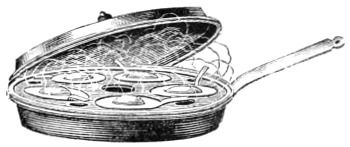
EGG POACHER