Front matter (continued 4)
Reading edition
The days dragged along and my strength was slow to return. I read and re-read the letter I had received just before the take-off from South Korea.
"I am getting along fine," Pat had written, "in spite of feeling somewhat bloated and clumsy, which, after all, I must expect. We had some more news about Harry. Apparently the raiding party he was with got ashore all right and set up their headquarters in one of the small villages near the coast. They seem to be getting along real well so far.
"I am so glad Polly is staying with me, we are good company for each other. When I got the letter from General Rawlins that told me you had left, I was relieved in a way, as I had wondered why you didn't write. Now at least I know and I am sure you are glad that, one way or another, it will soon be over. I don't expect to hear from you again until your mission is completed. Darling, please be careful. The General told me you had had shots for the measlepox, (they sent some out for Harry's team too), so I am not quite so worried. At least the dangers you face will be those of a soldier and you will have a fighting chance."
"She obviously had never heard or had forgotten about hemorrhagic fever," I thought ruefully, the pages trembling in my fever-weakened hands.
"Dr. Hallam is often over to see us in the evenings," she continued. "I believe he is really fond of Polly ... and she of him ... but naturally he doesn't express such feelings. If anything happens to Harry I'm sure he will take care of her."
"And who will take care of you and the baby if I don't come back," I thought as I crumpled the letter and burned it. We shouldn't have carried that last batch of mail into the airplane. It was the one sentimental chink in our disguise. As soon as I was well enough I checked to be sure that everyone else had destroyed all mementoes. I was not naive enough to think that we could keep our secret if captured, but pages of letters could be misplaced or fragments blown away and picked up by anyone coming into the area.
The Rangers kept busy. Only one or two remained in the house to cook and look after Kim and me. The rest lay low during the day and reconnoitred by night so that they were soon familiar with the layout of the virus factory and the surrounding country. They briefed me on every trip they made until I felt I knew it almost as well as if I'd seen it myself.
That week, Anders came three times. We always had guards posted and, once he knew he was safe, he relaxed and talked quite volubly in Russian or English.
"It may be fortunate for you that you have had Songho Fever," Anders said, during one of these early talks.
"Why so?"
"The western world has not yet discovered the cause of it, but we have."
He was obviously proud of the achievements of his laboratory, in spite of the horrible use to which they had been put.
"It's a very simple virus, carried, as you suspected, by mites which live on small rodents. We have now taken that virus and changed it so that it does not require to pass through other animals as part of its life cycle. It can now pass in droplets of sputum from one man to another. In the process of change it has become much more virulent, almost one hundred percent fatal, I would say, with an incubation period of only one or two days. Also it is now extremely infectious and, I believe, far worse than the measlepox. That is the virus we have begun producing, in large quantities, in our factory."
"What are the symptoms of this new disease?" I asked.
"It acts much like the natural disease except for its extreme rapidity. There is a tremendous increase in the hemorrhagic tendency, with fatal bleeding into the gastrointestinal tract, the urinary system, or sometimes the lungs. The victims die in shock within forty-eight hours, as a rule."
"How do you know how it will act on human beings?" I said curiously although I thought I already knew the answer.
"Our people are more realistic than yours," he said, quite sincerely. "We offered men condemned to die a pardon if they lived after being exposed to the virus. Most of them agreed."
"I'm surprised they got a choice," I said acidly.
"Our rulers have softened since the days of Stalin," he replied with a wry smile.
"Why didn't you use it instead of the measlepox?" I asked him.
"We did not have enough, and also we did not have a vaccine against it until recently. In fact only a few people have been protected. I am one, and so are my helpers in the Laboratory ... and, to some extent, so will you be for a while."
"Do you really think so?"
"We have found there is limited cross-immunity from having had the natural fever, especially early in convalescence, but that protection wears off rapidly."
"What do you mean by limited?"
"Let us suppose you had an accident with the vials I shall give you for your return journey and spilled the contents on you. You would be very ill with the fever but you would have a fair chance of living."
"Have you given the new syndrome a name?"
"Yes, a melodramatic one. We call it the bleeding death."
In the third week of our stay he came unexpectedly, late on a Wednesday afternoon. I talked to him alone as the other officers had gone on an early patrol. He was extremely agitated.
"I believe the counter-offensive will soon be starting," he said. "The Americans have refused to sell any more food to us and our radio is full of reports that the return of another wet spring in Europe and drought in Siberia is their doing. Today we were ordered to load all our available virus for shipment to Russia. We expect to send it Saturday."
"How will it go?"
"In refrigerated tank cars," he replied, and seeing my amazement, he added, "We do not have a bottling plant here. There are barely enough immune technicians to load it and seal the containers properly. I have been told there is an automatic bottling plant in Siberia which can put the virus in missile warheads without human aid, but of course I am not completely informed about these things."
"God! They must be desperate if they intend to let this thing loose on America without being immunized themselves."
"A calculated risk, Colonel. We can produce vaccine rapidly and protect those who matter before the disease rebounds to our lands."
"Those who matter! That's good! I'll give you three guesses who makes the decisions."
On their return that night I called in my officers and explained the situation.
"We must stop that stuff from getting out of here," I said at the end. "In fact, if possible we should blow up the tank cars and let it all run out and at the same time try to put the laboratory out of action. It won't do much good now for us to take the virus home ... there would be too little time to produce a vaccine against it even if we have the formula."
"There's a railway bridge about two miles from the plant, about four from the way we'd have to go, that crosses a deep ravine," Makstutis said. "It's on the spur line from the main Wonsan-Vladivostok railway. That's the only way out of this fever factory of theirs. We can put demolition charges on that to blow when the train goes over. There's only three or four bridge guards. I'm sure we could cut the telephone wire and handle them before the train gets there."
"Suppose not all the tank cars are destroyed," Kim said. "Could they use that crap again, or would they go near it?"
"Yes, they would," I said. "Some of the technicians are protected by immunizations."
"Then somebody has to be designated to explode the tanks in case they survive the drop," Blackie said. "And what about the train guards?"
"You're so right!" I said. "That makes me the mouse that ties the bell on the cat. You boys hold off the guards, I'll get the tank cars."
"Hell, Doc, you've lost your marbles!" Makstutis burst out in amazement. "That's our job. We've got to keep you all wrapped up like a dame in mink so you can tell them back home what's in that lousy stuff."
I laughed at his pop-eyed indignation. "That's true ordinarily, Mak," I said, "but this new virus is one hundred percent fatal if you get it. Anybody who blows those tanks is likely to get some on him, especially since they'll be damaged by the fall into the gorge. But people who've had this hemorrhagic fever are partly protected, especially while they are in the convalescent stage, as I am, so I'll have to explode the tanks."
"I still don't like it, Colonel," Blackie said.
"Look, Blackie, if you get this new fever you die for sure ... and probably all the rest of the unit will die too. Then how do I get back to the States?"
"But if you blow it, sir, we can't bring the formula home," Kim said.
"That's true, but that's the lesser of two evils. We must destroy the virus, and if possible the factory too, before they shoot the stuff over to North America. If we don't, knowing the formula will be like a condemned man knowing how he's going to be executed ... what difference will it make?"
"Geez, Colonel, I don't know," Makstutis began.
"I do," I cut him short. "And I'm going to get those tanks. That's an order. It's certain death for anyone else."
"Except me, Colonel." Lim On stood up as tall as five feet three would stretch. We had forgotten him sleeping in the corner on a pile of straw and he had heard the last part of our argument as our rising voices awakened him. He looked about as pale as a yellow-skinned man can, which to me seems more a ghastly green, but he was steady enough, and determined enough to argue with me when I tried to set him down.
"Colonel, I'm the demolitions man of the section," he persisted. "I'm as fit as you are, and, if the Colonel will pardon me for saying so, I know a lot more about it than you do."
"OK, Sergeant," I gave in, "I'll carry the charges and you set them."
The next day Anders was back again, his bird face no longer amiable but haggard and harried. "The tank cars begin loading tomorrow morning. I believe they will go out as soon as finished, which should be shortly before sunset. The Commissar is worried about possible sabotage and, I believe, has falsified the departure time." He pondered for a moment and then looked at me. "Colonel, I am afraid to stay here. May I go with you when you leave?"
"You may," I said slowly, "if you will do something else for us. Otherwise I think it would be better if you pretend to know nothing and stay behind." I explained our plan to wreck the train and then added, "We will be concentrating on this attack and won't be able to come back and pick you up. Obviously you will not be able to go with the train after it is loaded so you could not find us. On the other hand," I paused to estimate my man, "if we were able to have help to get inside the camp and sabotage it, you could escape in the confusion and come with us."
"But what about the formulae?" he asked anxiously. "Are you not coming to get them from me?"
"We would like to have them, of course," I replied. "But it is not worth the risk for them alone since there will not be time now for our people to set up production facilities."
"You ask a lot of me," he said heatedly. "I could easily betray you and stay in the factory. You could not remain here indefinitely."
I threw a trump card. "What makes you think the factory is going to stay here indefinitely?"
His face seemed to sicken as I watched. "This means atomic warfare," he said, "and the end of the world."
"If we have to die, you are going to die too. You have about two weeks." I was exaggerating, actually it was two months. "If we don't report success to our headquarters by that time, an atomic submarine, armed with a Polaris missile with atom bomb warhead, has orders to obliterate this whole area."
"No," he shook his head. "No—this is too much. I have had enough of this killing. I will not betray you."
"I didn't think you would," I said drily.
"But I must come with you," he said. "I am afraid the Commissar is becoming suspicious. Yesterday we were warned by intelligence to expect parachuting American raiders and the political commissar was asking me about my botanical excursions. He doesn't like me anyway because I am a Pole, and he may have put someone to watch me and report on my movements." I looked at Blackie and he raised his eyebrows. Was this a shrewd guess on the part of the Russian G-2 people or had some of our rangers been picked up?
"Poor devils," I thought. "They're probably being brainwashed right now. Time is running out on us, for sure. We must get moving right away."
Anders was saying, "What do I have to do for you?"
I told him my plan, slowly and carefully.
"One thing more," I said, as he started to go out the door. "Don't forget to bring samples of the viruses and vaccines with you ... and anything else you may think important."
"I will do that," he promised. "Goodbye and good luck, Colonel."
When the sound of his steps had faded, Blackie spoke again.
"You're taking quite a chance, Colonel. He knows enough now to ruin us all."
"Yes, I am. He is a proud man and I played on his pride as a scientist. Deep down, he probably is ashamed of having prostituted his discoveries for the purpose of murder, even though there wasn't much he could have done about it. He wants to make amends and I think he will go with us. Anyway, I could see no other way of doing it, could you?"
I looked around the circle of officers squatting on the rice mat floor. "We're with you, Doc," Makstutis said. "All the way, by heaven."
Three heads nodded in agreement.
CHAPTER 14
At last light we sent out a small party to set up a diversionary attack behind the factory. There was a little gully screened by low bushes that seemed a suitable place from which to fire. It could not be approached in the daytime without some danger of observation. The plan here was to bury small charges on the railway line to be fired from the gully just after the train had passed. This would twist the rails and prevent the engineer from backing up to the factory again. A few well placed rounds should help to speed him on his way down the track, and if the shots punctured some of the tanks, so much the better. After the charges were laid, two men were to be assigned to stay and do the shooting. They would rejoin us later.
Late the following morning, we broke camp. We carried only weapons, ammunition, demolition charges and one day's ration. Sammy Lee, the aidman for Blackie's section, also carried his aid kit and extra dressings. I brought mine along for our section. We moved out with extreme caution, our scouts well ahead. We could not afford discovery now, of all times. At fourteen hundred hours we stopped for rest and food. For a while I let the men relax. Then I gathered them around me except for the guards.
"We separate here," I said. "Captain Balakireff and Lieutenant Pak and his section will go to the virus factory and carry out the plan for which you have all been prepared. Captain Makstutis, Lieutenant Kim and I will lead our party to the bridge. From now on you must start thinking and acting like Koreans, at all times. You must not speak English under any circumstances. The Reds will be hunting for us after the raid as guerrillas. If they find out that we are Americans the chase will be ten times as fierce. It might even make the men in the Kremlin decide to launch an open attack on the United States. Certainly if they capture us it will give them an excuse to do so. You must not surrender. You will take no prisoners." I looked around the group and paused for effect.
"How many of you have had the S-Flu?"
To a man they raised their hands.
"Then remember that," I said, "whenever you feel soft-hearted. These are the people who did it to you."
I turned to Blackie and Pak. "Itdah popsidah ... see you later," I said in Korean and shook hands. The two officers sprang to attention and with wide smiles on their faces gave me the communist salute. I returned it. Pak faced his men, the smile gone. A stream of rapid Korean orders poured from his thin lips. The change was amazing. What had been a bunch of slouching G.I.'s having chow in comic opera uniforms was transformed into heel clicking, jumpy NCO's barking at slightly harassed, overly anxious oriental soldiers. They quick-stepped down the trail and out of sight. A minute later we too were on our way.
Ahead of me, as I looked back towards the virus factory area, the tracks went straight over the single arch of the steel bridge that spanned the narrow ravine and, slowly dropping, twisted to my left behind a small hill to be lost about a half a mile away. I was lying in the brush on top of the hill that rose in a steep curve out of the gorge. To my immediate right, a deep cutting with jagged rocky walls slashed through the hill from where the bridge jumped the gap. Fortunately for us, the side of the ravine farthest from the virus factory, where I now lay, was much higher than the other, which enabled us to control the approaches. The rise in gradient would also slow the train. It was a marvellous trap.
We had crossed the fast-running foamy little river higher up, where it dropped down from the steep mountain ridges. Now, in the cleft below, I could hear the deeper growling as it fought for space among the heavy boulders of its bed. I was tired after the march; tired enough to quit right there. A few feet away, over the reverse slope in a little hollow, Lim On was concentrating on his demolition charges, his skeleton face immobile and thin fingers working surely as he fixed the special fuses. He had finished three, with two to go. Anders had told us there were five tank cars. We had to get them all.
I rolled over a little, the better to reach my pants pocket where I had a pair of tiny Japanese field glasses. The sun was warm and, under the special steel of the American-made Russian model helmet, my forehead was wet where the headband touched. Like all the others, I was wearing one of the new lightweight plastic body armor suits under the uniform. It was good to know that even a burp gun bullet would bruise but not penetrate. Only high velocity rifle fire could cut through the flexible weave but I wondered momentarily if it was worth all the sticky discomfort to wear it. The glasses were up to my eyes now and I waited, propped on my elbows. The round magnified world was blurred by the heat waves and the exhaustion which blunted my concentration and sent quick tremors through my tired arms. A fly found me, his feet tickling my face as he sucked the sweat drops. The crawling became intolerable and I had to brush him off. When my eyes adjusted again to the glasses I saw Makstutis and Kim, with seven men. They were filing down the edge of the cutting in full view.
As they neared the abutment, a soldier came out of the bushes at the side of the bridge. Seeing the officers, he saluted smartly and, a moment later, called to a companion who joined the group. Then Kim and four men moved off across the bridge to where another pair of guards had come out of hiding. Thirty seconds later it was all over. At the near end of the bridge, two of my men had moved casually behind the enemy soldiers as they talked to Makstutis. Suddenly they wrapped their left arms around the victims' faces to stop a shout. Their right arms came up and the commando knives flashed down into that soft triangle behind the collar-bone. It was done almost in rhythm, like some hellish ballet. The dying men writhed a little and then went limp. By the time I swung my glasses to the other end of the bridge, the scuffle there was already over. I lowered the binoculars. My stomach churned a little as it had done on my first visit to a slaughter-house. The rest of our men were now out of hiding and working furiously on the bridge, setting up the charges. Up from below, his face covered with sweat and breathing quickly from the climb, came Makstutis. He sat down beside me.
"Dead easy, Doc," he said, as he got his breath.
"Dead, easy, is right," I said grimly. Killing of any kind always depressed me.
He glanced sideways at me, "Feel OK?"
"I'll make it," I replied quietly, with much more optimism than I felt.
We zigzagged down to the bridge. Kim was dispersing his section along the rim of the gorge and up on both sides of the cutting. We would have to eliminate any Commies who were stranded on our side by the explosion but we wanted to leave a line of retreat open for the rest. None of our men would stay on the other side. Any who survived on the far side of the ravine were welcome to go home ... and I hoped they would. We settled down in the brush to the left of the bridge—Makstutis, who was to set off the charges and then go where he felt he was needed, Lim, who would be with me, and Sergeant Kang and Corporal Hip Sing who were to cover us as we blew up the remaining tank cars.
The sun was lowering to the hills now and soon would drop behind them. The waves of its heat shook the rails in the cutting, the mirage twisting them in fancy as the explosives would soon do in fact. A weak little breeze came fitfully up the tracks and cooled my face. The soft sad whistle of a locomotive drifted with it and seconds later a dull thudding noise. I thought I heard a faint crackling of rifles.
"And away we go," I said inanely.
As Blackie told me much later, the first part of the attack went off as smoothly as a Tri-Di melodrama.
"I took the men down the trail at a good pace," he said. "I wanted to get into position and take a long look at the layout in daylight. There wasn't much movement, a guard or two patrolling the fence and in the gatehouse, with my glasses, I could make out a couple of soldiers playing rummy or poker or whatever these people play. We didn't dare get out behind the plant for a look but I could hear some noises and occasionally an engine huffed and puffed like they do when they are shunting. About seventeen hundred hours a loud bell signal went off. I was frightened it might be an alarm but it must have been chow call or the end of a shift. Anyway, a few more men came out and walked about here and there and the guards changed.
"Getting close to eighteen hundred I was wondering if anything had gone wrong when I saw the guard get up and answer the phone. Maybe this was it. I alerted the men. About three minutes later I saw a tall man I thought was Anders coming down the front steps of the factory with a haversack slung over his shoulder. He moved towards the gate and we came down off the hill, going fast. By the time we got there the guards were out, watching us come, and Anders was apparently clueing in their leader.
"Why, hello, Captain Balakireff," he said as I came up. "I didn't know you were out in this part of the world. Are you the group searching for the guerrillas?" I admitted we were and said to the sergeant of the guard, "Let us in. I have to report to the Commissar."
"He opened the gate and we began to enter as the train whistle blew. I was stalling for time, exchanging small talk with Anders, when the explosions came and then the shots.
"It must be the guerrillas! Behind the plant!" I yelled. "Follow me." I took off on the double with the boys coming right behind. I skidded around the corner and, by Golly, I ran smack into the Political Commissar's fat belly. Anders told me later who he was. When I got to my knees I saw he had four Russian guards with him so I guessed he must be a honcho. There was no time for argument. If I tried to play along and he found out, we were finished.
"Get them!" I shouted in Korean, and jumped on the Commissar again as he got up. Our men were fast with the knives but one guard got off a few rounds with his tommy-gun as he died. They hit poor Kwong Lin, our demolitions man ... punched holes in him through his thighs and his neck where the suit didn't cover. Sammy says he couldn't do a thing for him. I didn't wait around to see.
"Hold this old fool and keep him quiet a minute. We may need him," I said to one of the boys. "The rest of you cover while Pak and I clean out the power house." I stooped down and pulled the bag of explosives from Kwong's body. Pak was away ahead of me. He was already going up the steps and hit one guy in the belly with a couple of slugs as they met in the doorway. Knives were no use now. We whizzed around inside that place like a couple of squirrels playing tag. Up and down the ladders, and everywhere we went we slapped beehive blasters with quick fuses, on generators, transformers, anything that looked important. The first ones were going off as we set the last and one of them blasted me out the door with the shock wave. I picked myself up for the second time, feeling like the last pin in a bowling alley, and looked about for my burp gun. I found it just in time to join in a nice firefight. The Reds had caught on by now. The doggoned alarm bell was making the dickens of a racket and a bunch of soldiers came charging around the corner from the railway yards. The boy with the Commissar fired first and knocked down three and the kids covering us at the powerhouse got two more as they scrambled for cover back around the corner. We started for the gate with Benny Quong and Joe Park covering the rear. Meantime some bright so-and-so had got up on the second floor and he leaned out and dropped a grenade down between them. We got him right after the bang but it didn't do those two any good. The shrapnel went up under their helmets and caught their legs as well. I hope they died fast. Sammy wanted to go back for them but I dragged him along with me. I figured we had to get Anders out of there with the big secret and we were expendable until we did.
"By now Pak was prodding the Commissar around the corner in front of the guardhouse with a knife in his backside. We came in sight and found the four guards watching for us—Anders was standing by the door."
"Tell them to open that gate," I screamed at the fat boy. He opened his mouth but it was no use. Either somebody had it in for him or else those goons really obey orders. The alarm had gone off and the gate was closed and that was that. We kept walking. Pak stuck him again and he let out a yelp. That's when the guard commander figured the setup as fishy. He lifted his gun and sprayed. Of course all of us hit the dirt, firing, when he started to act mean, but the old Commissar wasn't a combat man. He was still on the way down when he got it in the throat and crumpled up on top of Pak. By Golly, it was a mess. Pak came up looking like a Red Indian instead of a Korean and then he blew his stack. He let out a shriek of rage like a runaway stallion and started straight for the gate, shooting from the hip. He knocked out the commander and one more and the other two beat it behind the guardhouse. Where Anders had got to I don't know. I think he went inside, but he wasn't in the guardroom when we reached it. It was getting pretty hot with rounds coming in through the windows from the three floors of the factory and some from around the corners; fortunately the gate was partly protected by the guardhouse or we'd never have made it. Pak went out and dragged the dead commander into the door to look for the gate key but a sniper got him in the arm. That was when I knew we had to get out fast or die. I sent Sammy to fix up Pak and detailed Sergeant Wong to blow the lock to pieces while the rest of the men kept the snipers' heads down with continuous fire. Then I remembered Anders. I poked my gun around the back end of the guardhouse just in time to hear a couple of shots and see the two guards go down. I hollered and he stepped out of the door of the latrine holding an automatic. I guess he'd got tired waiting and decided to finish it himself.
"'Good, Doctor, very good,' I said. 'Now let's get out of here.'
"He looked a bit shaken but he tucked his haversack under his free arm and we ran for the gate.
"Well, that's about all there was to it," Blackie concluded. "We got to the woods with no more casualties and left three men to cover the open area for a while and discourage pursuit until it got dark and we could get lost. Most of us had a scratch or two and Pak was woozy from loss of blood but we got back to the old village all right and waited for your party to come in."
As I said before, Blackie told me all this much later. At the time they started fighting we were lying hidden in the scrub by the gorge. Makstutis had a transistor switch to the demolitions in his hand. He and I were right beside the track. We would move to safer places when the train came in sight.
"Make sure the last tank car is on the bridge before you blow it," I said anxiously. "If one is left on the far side we'll never get to it."
"OK Colonel," he said. "It's all set up. Should be a piece of cake, as the Limeys say."
Ten minutes after the first explosion we heard the quick hard slapping of the beehive charges and the rattling as the firefight got going.
"Sounds like they're having plenty of trouble," I muttered.
"Yeah, I guess so," Makstutis admitted, "but that Blackie's a hot shot and so are Pak and his boys. I'll bet they make hash outa that joint."
"They'd better or they'll be in the stew themselves," I said, in a weak attempt at levity.
He gave me an anguished frown and then, his face suddenly grim, shushed for silence. Faintly I thought I heard an engine straining up the grade. Makstutis crawled over and put his head to the rail.
"It's on the way," he said. "Better take cover." He stood up and signalled the alert.
Lim and I were crouching behind a big rock outcropping halfway down into the gorge. A faint trail led from there to the bottom—perhaps a relic of the construction days when the bridge was being built. It was far enough away to be safe when the bridge blew up but from there we could reach the bottom in a hurry. My heart was hammering fast, partly from excitement and partly from weakness. My knees were wobbly and I could hear the blood rush past my ears. I tried to swallow but I was too dry. Now the train was around the bend and I could hear the slow chuff-chuff-chuff as it crawled up the track. The sound suddenly sharpened as the engine, a big American style steam cylinder, shoved its nose past the cutting and out on to the bridge, travelling at a walking pace. A movement at the other end caught my attention and, for a moment, a great tightness clamped down on my chest. Kim was standing at the edge of the cutting, calmly waving to the engine driver.
"The damn fool," I raged inside. "What in Hell is he doing?" And then I realized and almost wept in admiration and pride. Afraid that the enemy, already on the alert, would notice the lack of guards and stop in time, he was calmly risking his life, pretending to be one of them and enticing the Reds on to destruction. By now the engine was almost up to him. He waved again and moved casually up the embankment into the bush.
Behind the coal tender came a passenger coach full of soldiers, two flat cars and then the five tank cars. At the end, as the train clawed over the bridge, came two more flat cars, another guard coach and a sort of caboose. The bridge itself was exactly six car lengths from bank to bank. To be sure that all the tank cars would be caught, Makstutis had to let the first passenger coach get into the cutting on our side and the other one remain on the far approach. He threw the switch.
For a moment in time the bridge buckled upwards under the last tank car. Then, like a slow motion close-up, it started to bend downwards in a vee, moving faster and faster as the law of gravity took over. The rear tank car dropped into the vee, pulling the flat cars down with it. The crash of the explosion was rolling away down the canyon and now the screech of tearing metal sounded. The rear flat cars fell off to the side and the passenger coach behind them twisted over and wedged itself crossways between the main concrete buttresses and the far bank. By a miracle of bad luck it did not go down with the other cars and even as I turned away the guards came tumbling out of windows and doors unhurt. I looked towards our end. Three tanks had gone down with the bridge and lay twisted among the steel girders in the foaming river. Of the other two, one hung crazily over the angle between the steel and the bank. I could not see the leading tank car but I learned later it had remained upright but derailed. The couplings had broken just ahead of it, leaving the engine, the first guard car and the two flat cars free. That engineer was a smart man. Realizing that they hadn't much chance pinned down in the depths of the cutting, he pulled the throttle wide open and went for the open country as fast as the train would accelerate. With the wheels screeching and sparking on the tortured rails the engine bellowed up the grade like a charging bull trying to escape from the stockyards.
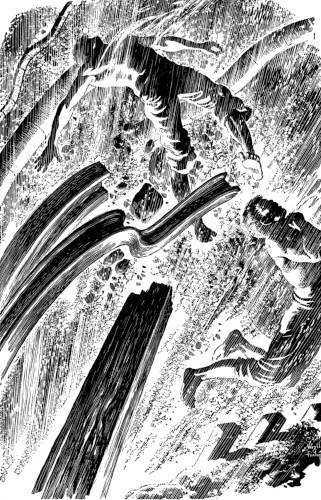
I didn't know all this. I could hear the roaring engine and the storm of firing that followed. It would be suicide to attack the tank cars in full view, I thought. Better first dispose of the three that lay in the bottom of the ravine. I nodded to Lim and we started down. It was slow work at the bottom. In places the river ran right to the edge of the cliff and we had to scramble around on the big boulders or climb up and down the rough rock face, but we made progress and eventually we stood under the shattered bridge. Down here the light was dimmer and the sound of water washing around the wreckage deadened the noise of the sporadic firing above. In mid-stream the rearmost tank car lay on its side, split open by the fall. The other two, though buckled, were intact. They had toppled off to the side of the bridge and now lay across the big rocks on our side of the river in the shape of a twisted Z. Lim laid down his gun and started to work. His lungs heaving in his poor sick chest, he scrambled over the rocks and then disappeared under the middle tank car. He came back up dripping wet and motioned for a demolition charge. I crawled to him and gave him one. Between gasps for breath and above the noise of the water and the echoing battle he shouted in my ear.
"I'm going to blow this one from underneath, at the lowest point above the water, so all the stuff will drain out."
I nodded in approval and he disappeared again. In a couple of minutes he was back. "We have about five minutes," he cried, his voice shaky with fatigue. "Let's get the other one."
I pulled him to his feet, where he stood shivering with cold and exhaustion, and picked up the guns and charges. We moved to the second car. This one was propped up at an angle with the low end dug into a patch of sand, easy to get at. I handed him another explosive and he jammed it against the steel, in the sand. He was about to activate the fuse when suddenly he straightened, twisted half around to face me and fell forward. The echoes of the shot ricochetted off the walls of the gorge. I estimated it came from across the water and in the same instant made a diving run for cover. I hit hard and rolled behind a small boulder as another shot hit it and whined away into the air. I was thinking fast. Some of the Reds must have been trying a sneak attack across the bottom of the gorge and had seen us at work. In spite of our uniforms it was obvious from what we were doing that we weren't friendly. I'd be marked down and shot if I tried to get back and ignite the last fuse. And there wasn't time now. I had to get out of there! The first charge might explode that full car like a can of tomato juice, spraying death in all directions. I was trying to get up the nerve to dash for safety when the shouts came from behind me. It was Makstutis, with Kang and Hip Sing. They had crawled up close to me when the fighting started.
"Doc! Doc!" Makstutis was yelling, "Get that last fuse started. We'll keep their heads down."
"Get back!" I screamed frantically. "The other tank is gonna explode. It'll cover you with virus."
"That's rough, Doc," Makstutis called back calmly, "but what's four men compared to millions. Better get cracking."
I felt ashamed, physically sick and disgusted. I had a chance and they had none and yet, facing that death, they could still think of others while all I wanted to do was to lie there, afraid even to run. Oh, I could blame my sick mind or my weakened physical state. They would excuse it on those grounds and never say a word to me no matter what I did. But I knew better. Today I was beaten down while better men than I were still fighting.
I was up and running with the nausea of moral defeat rising in my guts. Quitter! The one word I feared above all ... and it applied to me. Better to die now than have to live the rest of my miserable life with it. I felt a heavy blow on my back that threw me off stride. At the same time I heard the crack of a small mortar shell behind me and something sharp and stinging penetrated my right hip. They must be lobbing them across at extremely short range, trying to drop in behind the rocks and get my riflemen. A burp gun gnattered and chewed up the sand beside me as I reached the tank car but stopped abruptly as somebody blasted back. I stooped down and activated the fuse. I was halfway back across the open sandy patch when the first tanker blew up.
CHAPTER 15
There was a faint smell of decay, of cold moist flesh, in the air. I shoved up from the sand and rose wearily to my feet. I looked down and saw the wet stain spreading over me from the back. My legs felt damp. I was too tired to care. The odor of the virus culture, of the bleeding death, was in my nose and mouth and I was too tired to care. I staggered past a rocky outcrop and almost fell. Sergeant Kang reached for me from cover.
"Don't touch me," I protested weakly. "The stuff's all over me."
"Some of it got us too, Doc. Better let me help you get away before the next one goes up."
We advanced cautiously up the ravine away from the bridge. The second tank car had blown and there was no pursuit. Apparently our men on the rim of the gorge had pinned down the attackers or else the horror of the bleeding death had driven them away. Now that my aching chest had eased a bit I could think again. We went around a couple of bends and the sound of firing died away.
"We've got to get this virus off, it's our only hope," I said.
"OK Doc," Makstutis was agreeable. "Whatever you say. The damn stuff stinks like a frightened polecat."
I led the way along the stream and found a chest-deep pool with a fast water flow. I walked right in, gun, helmet, jack boots and all, and thrashed around for a moment under water.
"Now you do the same," I said when I came out.
I had some soap in my pocket and Hip Sing produced another bar. With one man standing guard, we undressed and scrubbed ourselves and then our clothes and weapons as thoroughly as possible while the light faded. Numbly I noticed a large hole in my jacket and a ragged tear in the plastic suit. I shook the suit and a piece of iron two inches square fell out. No wonder my ribs were sore and my chest ached! Makstutis saw it fall and grinned at me crookedly.
"Your lucky day, ain't it, Doc?"
"Yeah, out of the frying pan, now into the fire. Wait until tomorrow."
He shrugged. "That's the way the rocket roars."
We wrung out the water as best we could and wiped it off the guns. I felt better from the cold bath though I was weary to the crying stage. The wound in my thigh was small and not troubling me much so I let it alone.
"That should help a little," I surmised when we were dressed again. "At least it may protect the others from the disease."
We were starting to climb back up the side of the gorge when an ear-battering crash rolled up the river to meet us. Then there was silence.
I don't remember too much about that climb back up the gorge. I know I fell often and always there was a helping hand, a quiet word. We got back to the bridge in darkness and were stopped by Kim's guards. The fight was over. They had been waiting for us. Four men were dead, three in the fight for the train and Lim in the river bed. Two more were wounded in the arm and head but could walk. One man had a broken leg. I vaguely remembered telling Kim how to splint it with poles cut from brush and giving him some morphine. I didn't like the risk of exposing any of them to the bleeding death but there wasn't much I could do about it right then except try not to touch anyone. Makstutis, the two NCO's and I, kept apart from everyone else and waited for the fever to strike. We kept going in the darkness, a darkness that became a dream world to me except for the steady support of hands at my elbows and the slow dragging of my feet as I lifted them and put them forward. Just one more step; one step more; one more step; one step more. We stopped and the hands released me. I crumpled where I stood and slept.
I woke to a pattern of shifting light and shade beyond my closed eyelids and a cool wind that blew across my face. I opened my eyes and slowly they focused on the leaves that rustled above me. The aching misery of my legs and body forced itself into my brain and carefully, deliberately, I sat up. We were in a thickly wooded valley. A tiny clearing opened from where I sat, bisected by a narrow stream. On the other side, about ten yards away, Kim and his men moved about quietly, cooking the last of their rice on a dry wood fire that gave no smoke. I stood up for a moment while specks whirled before my eyes as my blood pressure dropped. The feeling passed. I was still damnably weak but better than yesterday. I looked around for my companions in isolation and saw them squatting close to their own fire. They seemed normal. So far so good! We might have another twelve to twenty-four hours before the hemorrhagic fever started to raise hell with us. By that time, with luck, we could be holed up in our refuge. Maybe Anders would be able to help us. At the worst, as he was immune, he could take care of us and feed us.
I was still not completely aroused when Makstutis came over with a mixed mess of hot rice and kimchi in a ration can.
"Here's your bacon and eggs, Colonel," he grinned irrepressibly. The man just wouldn't give in, I thought. "How do you feel this morning?"
"Pretty good, considering," I replied.
I finished eating and walked down to the stream to splash some water on my face. Kim was there, washing up. I kept down-stream from him.
"How are you feeling, sir?" he said, towelling his face with his undershirt.
"OK so far, Kim. I need a cigarette. Have you got any? No, not your packet! Just one. I'll ask again if I need it." I caught the black Russian weed he threw at me and dragged gratefully. "I didn't see much of the fighting at the bridge after Makstutis threw the switch," I said, sitting down on a boulder. "I was down in the bottom of the gorge most of the time. Clue me in on what happened."
He squatted comfortably on his heels, oriental style, and I was momentarily amused at how quickly he had reverted from his western training.
"When the bridge fell down," he began, "the boys along the canyon rim all fired on the coach stuck in the approaches across the way. A lot of the Reds were hit getting out of it but a lot more made it and started a firefight across the canyon with us. That lasted quite a while."
"I saw the beginning of it," I said.
"I heard from Makstutis that some of them got down in the bottom and shot at you and you were hit."
"That's true, but I was hit by mortar fragments. Did he tell you that I'd never have got out if it hadn't been for him and his two men?"
"No, he didn't. He did tell me you all got splashed with that virus stuff."
"We sure did, and nobody except Anders is to come near us until we find out if we're going to get the fever or not. But what happened to you?"
"While the fight was going on back and forth across the canyon," he began again, "the engineer tried to take off with what was left of his train ... it broke apart just ahead of the first tank car. He almost did it too! The two men I had posted up above, on either side of the cutting, couldn't do much as they were firing down at too steep an angle. They did manage to keep the Commies' heads inside the coach, however, and, when the train started up the grade, five of us were able to scramble up on the flat cars, leaving the other six guys to finish the fight at the bridge. Two of them were killed later on by an unlucky mortar shell burst.
"As soon as we got on the flat car I put a half a dozen burp gun pellets straight down the middle of the passenger coach and while they were wondering what to do about it, Tommy Lin sneaked up close and threw a grenade through the glass of the back door. But he didn't hold it long enough. Somebody fielded it and threw it right back before it could explode. Lucky for us he was too strong. It bounced out past the door and rolled over the side just as it went off. About that time I figured we had to stop the train or they'd take us to Vladivostok, so Tommy and little Rhee Sung boosted me up on the roof.... It took both of them to do it ... while the other guys gave the Reds a few rounds to keep their heads down. I hauled my two buddies up with me and we pussyfooted over the top, hoping the Commies wouldn't try to shoot up through the roof. It was steel anyway. That helped! We jumped down on the coal tender and the fireman saw us. Boy! Did he yell! He dropped that shovel and dived out the side like a frightened frog. The engineer took to the other door.
"By now the train was out of the grade and in open country, really travelling. I sent Rhee back over the top to warn the others, before the Reds got wise, and when I figured they were set I put on the emergency brake ... it's a good thing I learned about engines on the pineapple plantations back in Hawaii ..." he laughed. "Well, sir, that damned train just about stood on its nose and jack-knifed. I'll bet the gooks really got thrown about. Then I put her in reverse. The wheels were screeching like a drunk wahine at a hula, and slipping and sliding like crazy until they caught a hold. When she stopped and began to back up a lot of the Reds made a break for it. We got a few but most of them got away. When they saw we were going back towards the bridge a gang of those left tried to rush the cab. Tommy was waiting on the coal pile and mowed them down but a wild shot downed him when he tried to get back to me. I wanted to stop the train but he yelled at me to go on. I tied down the whistle as the signal and the other guys jumped. Then I gave her full throttle and I jumped too. Tommy stayed on. I guess he figured he was finished and he might as well take some of the Reds with him. Anyway they never got into the cab to stop the engine. It must have barrelled down that grade at a hundred miles an hour. It smashed those two tank cars to glory and pushed the whole damn lot into the canyon."
"That was the big explosion I heard?"
"That was it," Kim agreed and added, "That broke up the fight. Good boy, that Tommy. He went out the right way for a soldier."
We set out for the rendezvous about midmorning. It would have been safer to wait for night but I was afraid the virus would knock us out and Kim agreed. The scouts reported no signs of life ahead so we marched in our two groups, a prudent interval of twenty-five yards between. The day was warm later on. About sixteen hundred hours I started to sweat a bit and I noticed beads of perspiration on Makstutis' forehead and a large drop forming on the end of his nose. He smiled weakly when he caught my eye.
"Guess I'm starting to get that fever, Doc," he said. "The other two guys have it too. How're you doing?"
I wasn't too bad and said so. The protection Dr. Anders said I'd get from the Songho Fever must be working. We went up on top of a steep ridge and I noticed Hip Sing was unsteady on his feet. I went over to him.
"How are you making out, boy?"
"I ..." he swayed slightly and licked his lips.... "I don't feel so good, sir."
"Sit down, son. Let's have a look at you."
His head was scorching hot and his cheeks flushed like an inebriated Japanese. I felt his pulse. Even after a rest it was over one hundred and forty. At a rough guess he must have been running a fever of one hundred and three degrees. I let him rest for a bit and then, with Makstutis on one side and I on the other, we stumbled on down the trail into the valley. He collapsed a couple of times before we got to the bottom and finally we were dragging him along, his arms over our shoulders, toes catching in the dust. Sergeant Kang followed reeling in semi-delirium but still carrying our weapons. Somehow he reached almost to the bottom of the slope, right behind us, and then pitched forward on his face. The guns clattered and rolled down ahead of him. His arms, outstretched as he fell, caught my legs and tripped me. I went down on one knee, Hip Sing crazily over me, while Makstutis struggled to keep his balance and pull us up again. We got Sing over to the narrow brook that tumbled along the valley floor and there Makstutis' knees buckled under him and he sat down. I was feeling rough myself, but not that rough.
"Get Hip Sing's clothes off him if you can, Mak," I said, and went back for Kang. He was still comatose so I grabbed his arms and jerked him down the slope to level ground. I couldn't drag him any more, I hadn't the strength. I got down on my knees and rolled him over to the water's edge. I stripped him to his undershirt and poured water over him with his helmet. His pulse was almost impossible to count, it was beating so fast, but it was still surprisingly strong. That fever had to be brought down before it fried his brains! No man can live long at a body temperature over 105° and I knew his must be at least that. Even if he recovered his brain could be permanently damaged by the intense heat inside his skull. I got him into the water with his head and shoulders on the bank. It was cold but there was no time for gentler measures. The exertion made the swirling come back in my head and I lay down beside him until the world came to rest again.
About five minutes later I heard gasping sounds and looked up. I had forgotten Makstutis and Hip Sing. The Mak was still fumbling with Sing's clothes but in his delirium he would forget and sit there, muttering to himself, while his fingers fluttered uselessly at the buttons. He was doing that now. The sounds were coming from Hip Sing. As I watched, he started to retch, his face was a sweaty grey-green. A great gush of dark brown blood came up and flowed away from the side of his mouth. He sank back and was still. I crawled over to feel his pulse but he was dead. Makstutis sat there and whispered. Somewhere above I heard a shout. Under the weary haze that covered my mind I knew I had to act but it was so much trouble.
"Doc ... Doc ..." I heard it again and looked up. Kim, watching back on the trail, had seen that we were not following. Now, heedless of the danger, he was coming to help us.
"Don't come any nearer!" I forced the words through the dry lining of my throat. He was perilously close already if this virus was transmissible through the air, as Anders claimed.
"But I can't just leave you there," he pleaded from the other side of the water.
"We'll all die if you catch it too," I croaked, and rallied my wits. "Kim, Anders may be at the farmhouse waiting for us. Get there as fast as you can. Tell him the bleeding death has got us. Maybe he can still help. And don't let anybody touch us, no matter what happens, until he gives the order." I heard no more. Forcing the last bit of strength from my aching muscles I turned back to Makstutis and pulled off his outer clothes. He lay there mumbling and rambling like a Yogi in a trance, the foam drying on his cracked lips. He was too big to roll into the water so I poured it on him from his helmet. The cold seemed to restore his sanity for a moment ... his eyes opened. The whites were gone and, from the center of those bright red bleeding spheres, the blue irises flickered as he tried to focus on me. He smiled.
"Good old Doc," he said feebly.
It was too much. I crouched there and sobbed, the aching tightness blocking my throat as I shakily poured water over him.
The light kept bobbing about in the strangest way. It couldn't be a firefly, too big. It was up high on the slope at first but soon it dropped down, wavering back and forth. I knew then it was a shaded flashlight and I heard the sliding of boots on the rocky path.
"That's close enough." The voice was strange at first and then I remembered that was how Anders sounded.
Until the darkness and rising fever stopped me I had kept pouring the water over Makstutis where he lay, unconscious and unmoving on the ground. Kang floated low and lifeless in the water like a beached log. I checked him once. His pulse was still there but slow and almost imperceptible. As the fearful heat rose within me I lay down in the stream beside him and shivered there as long as I could endure. Then I would get out again and return to my work. Finally, too sick and dizzy to do any more, I crawled to the bank and lay down on my back with my legs in the water to cool off the blood steaming inside me. Then I passed out.
The light flickered closer and waved about over my companions. It came to me and I squinted up feebly, trying to avoid the glare.
"How are they, Dr. Anders?" The voice came from the slope.
"One of them is dead ... a corporal. The Russian and the Sergeant are very bad, unconscious. Dr. Macdonald is awake," Anders said and then, to me, "Do you understand me?"
"Yes, I do," I whispered.
"I am going to inject some serum." He was busy tying a tourniquet of rubber tubing above my elbow to bring out the veins. I felt the needle probing for the collapsed tissues and later the pressure as he pulled it out and stopped the bleeding. He jabbed me again in the biceps.
"You have had your anti-serum and a sedative," he said, leaning close to be sure I heard. "Now you must relax and concentrate on getting well."
With that thought in my mind I went to sleep.
Three days later I was over the worst of it. I had bled again from the kidneys but fortunately the disease had not been severe enough to cause a massive internal hemorrhage that would have choked their filtering mechanism and killed me.
"How do I look?" I said to Anders that morning as he examined me where I lay, in the dappled shade of the clearing.
"Your eyes are very red, of course," he smiled, "and you have purpuric spots ... what your laymen call bruising, isn't it ... in the creases of your elbows and thighs, but I think you have been fortunate."
"I agree with that statement, Doctor," I said as I looked over at his other patients, lying there so quietly beside me. A horse fly lit on Kang's nose. Feebly his face twitched, trying to dislodge it. He lifted his right hand, bending the arm from the elbow. It stayed there, too weak to go farther. Anders shooed the fly. Kang's hand, poised uncertainly for a time, slowly fell back to his side. To all appearances he was lifeless.
"They're in bad shape, aren't they?" I asked.
"Yes, but they should recover. You saved their lives, you know."
"I did? How?"
"By using that cold water. When I checked them, their temperatures were very low, especially Kang. You might say you had put them into artificial hibernation. They were both in shock but, with the low body temperatures reducing their metabolism during the crucial stage, I am sure they have a much better chance of returning to normal. I maintained their low temperatures with one of our new hypothermic drugs for the first two days. Now they have returned to a more normal state except that they are still asleep."
"They look more dead than asleep," I said and raised myself up to sit. Even that was an effort as my swimming head and pounding heart warned me. In a moment or two I felt better. I inched over to a tree and used it as a back rest. Soaking in the friendly warmth of the sun like a cat on a garden wall, I dozed off.
"Take this, Colonel." Anders' face was close to mine as he woke me gently and held out a bowl of warm rice. The sparse light-colored stubble on his unshaven chin stood out like the tattered wheat stalks on a dustbowl farm. Gaunt with fatigue, bleary-eyed and scruffy though he was, his red-rimmed eyes shone with a fierce determination to pull us through and cheat his former masters of at least three victims. I ate and watched as he gently spooned a thin paste of rice into the cracked and crusted mouths of his patients. As it touched their tongues, they swallowed automatically like patients under anaesthesia, which, in a way, I suppose they were.
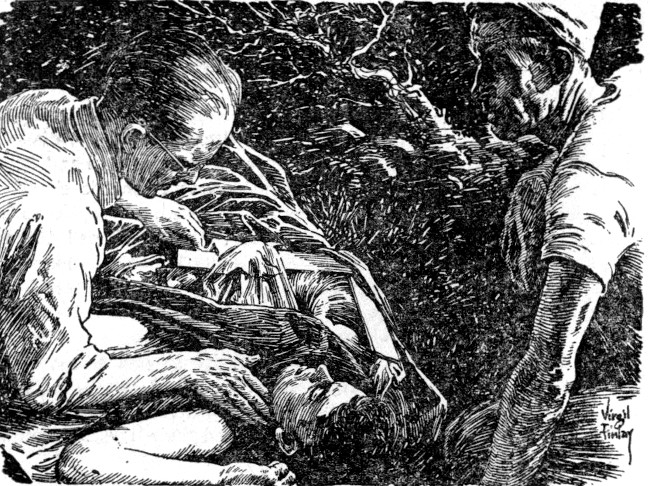
"Have you had any sleep at all?" I said, watching him.
"Not much. An hour here and there. I was afraid to sleep."
"Then why don't you sleep now while I watch. I can wake you easily if you lie down here."
"Thank you. I will do that. I am very tired."
I let him sleep six hours. The sun was low over the ridges and Kim and his men were preparing the evening meal when he awoke. Renewed vigor showed in all his actions as he moved about lighting a fire and preparing our rice gruel. This time I crawled over to help him with the patients. As we dripped the thick rice soup into those impassive faces and later washed the dry drum-tight skin stretched over bare bones, I asked about our plans.
"Yesterday," he said, "Lieutenant Pak On took a small party down to the coast, to Wongpo. They are to find Lee Sung and tell him that there will be a delay until you are well enough to travel. They also must try to get more food. It will be at least three days before they are back. I have vaccinated all your men against the bleeding death and we must wait until you are no longer infectious and I am sure they are immune before we escape. We cannot risk spreading the disease in the western democracies."
"Do you think it got spread when the tank cars were blown up?" I asked.
"It is quite possible. The concentration of virus in that river must have been very high. Unfortunately there are still villages down its course and along the Imjin where people live, and they may get it. For that reason we must move as soon as it is safe. If disease breaks out near the coast we will never be able to get a boat to take us off."
The thought worried me. Suppose Lee Sung died? Only he could make the contacts to get us away, I supposed, by small fishing boat out to sea where a submarine, or perhaps a destroyer, could pick us up outside the territorial limits. We had to avoid the coastal patrols too and only Sung could help us there.
By the end of that week, May was two thirds gone and we were all recovering slowly. Pak came back and the news was bad. Lee Sung and Blackie had come with him. I met them as I strolled along the trail and went back with them to our camp for a conference. Before it began, Anders got out his syringe and inoculated Lee Sung.
"We can't afford to lose our only contact with freedom," he said.
"I appreciate your kindness, even if it is somewhat self-centered," Lee replied, with a disarming smile.
"Let's have it," I said to Pak when all the officers were gathered in the glade. Makstutis, too weak as yet to participate actively, was lying quietly taking in all that was said.
"We got into Wongpo without too much trouble," he began. "We kept away from any signs of people on the way. It wasn't too hard to locate Lee Sung either when I walked into the little town; several people knew him and I pretended the North Korean Army had business with him. I found him down at the wharf where his boat is moored and he took me aboard. I was alone of course," he said, as an afterthought. "The men stayed back in the hills."
"Is that the boat you mentioned when we first met?" I interrupted to ask Lee.
"Yes. Actually it belongs to the United States," Lee Sung said. "It is fitted as a deep sea fishing or trading junk. It has souped up engines that look ordinary and a false bottom where I hide guns or radio or anything we need to smuggle into or out of North Korea. The boat is registered in my name of course. I'm supposed to be a part-time fisherman and local cargo carrier, as well as a merchant. I have a small store in Wongpo. The Reds used to wink their eyes at my activities because I smuggled things they wanted from Hong Kong or South Korea."
"Sorry to interrupt," I said to Pak. "I wanted to get the background straight."
"That's all right, sir," he replied. "Now, where was I?"
"You'd got to Lee's boat," I said.
"Oh yes. We had to get some food so that's the first thing we talked about. Lee had bags of rice in his store so we went there and loaded up a mule cart he borrowed. We were going to drive it as far as we could to where our men could get the rice and pack the sacks on A-frames back over the trail to the farmhouse. We thought it would be less noticeable if we did it that night. In the meantime Lee went out to get some vegetables and see if he could scrounge any meat. That's when the trouble started." He turned to Lee Sung. "Maybe you'd better tell the rest of it."
"I went to the house of a farmer, an old friend of mine, who lives on the edge of the village, to bargain for some vegetables and perhaps a pig," Lee said. "I was still there, drinking tea to conclude the transaction, as is our custom, when a detachment of about fifty North Korean soldiers in three trucks rolled along the coast road into the village. I finished my business as rapidly as possible, and, with the help of the farmers' sons, brought the food down to my store. Then I walked out around the village seeking information. Lieutenant Pak stayed with the supplies. I was afraid someone would have told the detachment commander of the presence of another North Korean officer but fortunately he was so busy and the people so frightened that no one remembered Lieutenant Pak."
"That evening the commander called an open meeting in the village and announced there was to be curfew for everyone beginning that night. Anyone who disobeyed would be shot. He also announced that nobody could enter or leave the village by land or sea and he has seized the fishing vessels, including mine."
"Oh, my God!" I said. "Why did he do that?"
"Apparently a new epidemic of some sort has broken out at several villages along the Imjin River."
I looked across at Anders and shook my head. He lifted his shoulders in a shrug of resignation.
Lee Sung continued. "There is a great search being made for American bandits of oriental descent masquerading as soldiers of the Peoples Army who attacked the virus factory. You will be interested to know that it was a large and heavily armed force of capitalist reactionaries which was driven off with very heavy losses."
"Losses to whom?" Blackie asked with a grin.
"To the Americans of course. The virus factory was not damaged."
"At least that's the truth; we got the powerhouse," Pak laughed.
"The moment he made the announcement about American soldiers I left the meeting quietly and went back to my store. Somebody was going to wake up, perhaps soon. I told Pak and we decided to risk it as the soldiers were still moving into the police barracks and getting set up. We drove the mule cart quickly out the back end of the village and got away without being challenged. In fact we didn't see anyone at all until we met our own people."
"It looks like we've stirred up the whole country," I said. "They certainly seem frightened."
"I'm not surprised," Anders broke in. "When I left the factory, besides the virus cultures, my rucksack was full of bottles of vaccine against the bleeding death and as much of the anti-serum as I could carry. I expected we might need it. I destroyed all I could of what I had to leave behind and the papers too. The Communists have very little left."
"A fine piece of work, Doctor," I said. "You saved our lives and deprived the Reds of their protection, all at the same time." I turned back to Lee Sung. "I wonder how they figured we were Americans. All our papers were in order. There wasn't a thing to show we weren't native guerrillas, admittedly in the service of an unfriendly power. Why not think we were from South Korea?"
"Possibly some of the men we left in the factory lived long enough to talk," Blackie said, "put I doubt it very much. Of course seeing the white officers would give them grounds for suspicion."
"Suspicion, yes, but not fact," I said.
"The radio has been talking mysterious explosions and guerrilla warfare in Siberia and parts of China recently," Lee Sung reported.
"That's it, by Golly!" Blackie burst out. "The raids on the nerve gas centers must have started. It could be somebody has been captured and brainwashed."
"Could be," I said, "and if so, we'd better get home. If the Reds can suppress news of how successful the raids are, they may still bluff the democracies, with threats of nerve gas and CBR warfare, into giving them more food and a good settlement of the war, but if we get home with our story then they'll realize they are licked and maybe quit."
The following day we set out to do the last few miles to the farmhouse. The Reds didn't have enough men to search the hills and the wilder the area the safer we'd be. Our trouble would be to break through the barrier at the coast. With one wounded man and two sick ones on litters we were heavily loaded and could make only slow time. I had all I could do to carry my own weight and when we got to the house late that night I collapsed on a pile of straw and stayed there for the whole of the next day.
CHAPTER 16
We stayed in the village for three weeks. Each day Makstutis and Kang were a little better.
"We have to get out of here," I said to Anders one day in the last week, after we had examined our patients. "The A-bomb carrier is probably on its way right now."
"They can't march all the way to the coast," Anders said dubiously. "If we must go, we shall have to carry them."
Blackie and Kim had been watching us with interest. Now Kim spoke up.
"We've got some real husky boys in the unit, Doc. How about fixing up seats on a couple of A-frames. Then we could chogi them up the hills and they could maybe make it down the other side."
"It's a good idea, sir," Blackie agreed. "Those back trails are too narrow for litters. We can change chogi bearers frequently."
"What about Yip Kee?" Kim said. "Can he travel the same way?"
I looked at Anders. "What do you say, Doctor? It's a month since his leg was fractured. I think we could take a chance on it provided he is carried all the way."
"I see no alternative," Anders agreed.
We borrowed the A-frames from the farmhouse and Pak wove basket seats across the carrying prongs. With wider shoulder straps and some padding our men could carry the patients quite well, changing frequently. We assigned two bearers to each A-frame; it was all we could spare. The first time we tried it, Makstutis, irrepressible as ever, cracked, "This'll be the first time I ever went into action sitting on my ass. I feel like a damn tanker." The name stuck; from then on they were called the tank section.
In the first part of June, Lieutenant Pak and Lee Sung made a reconnaissance and came back with an encouraging report. The furor over the raid on the virus factory had died down. Work on the power house had started but in a half-hearted fashion, either from a sense of defeat or perhaps a shortage of supplies and workmen. The bleeding death had hit hard along the Imjin and spread over the watershed to the coastal villages. It continued to spread as the panic-stricken natives, completely out of control after two terrible epidemics, fled from the disease and disseminated it wherever they went. Most of the enemy troops were being used to try to halt the crazy rush away from the death zone but some of them had also become infected, either by contact with refugees or perhaps in the age-old fashion by consorting with prostitutes in the towns. The result was disorganization and a very low morale.
The garrison at Wongpo, still kept at fifty men, was in good health as they had commandeered plentiful food supplies and driven out or killed most of the villagers who had not already died. They held the harbor and the three boats tied up there. One was Lee Sung's, the other two were much smaller fishing boats.
Counting Anders and the three convalescents, we were down to a total strength of twenty-three. It would not be easy to capture the boat unless we could catch the North Koreans by surprise, but we had to try it. We set off over the wildest part of the country, avoiding all villages or farmland that might still be inhabited. By the evening of the third day we lay on a ridge overlooking Wongpo. Shortly after dark, Lee Sung and Pak went down to see what the situation was. The day had been warm but a cool breeze began blowing towards the sea as the land cooled off. I fell asleep, lulled by the quiet murmur of the distant breakers and the rustle of leaves in the steady wind.
"Doc, Doc, wake up! Wake up, Doc," the insistent whisperer was Kim.
"Yeah, what, what's that?" I struggled confusedly back to consciousness. Obviously something was wrong the way Kim was still shaking me. "OK Kim ... lay off ... I'm awake," I said crossly. I was still fagged out and hated to come back to reality.
"Sorry sir, there's trouble. Lee Sung has been captured."
"Captured!" I echoed. "How do you know?"
"Pak just came back. He says Lee Sung left him hidden near his store while he tried to sneak back on board the junk. He could see Lee go aboard but he never came on deck again. A few minutes later a North Korean soldier came off the boat and went to the police barracks. Two officers came back with him and went aboard. Then Pak figured he'd need help and high-tailed it up here."
"OK, get everybody up. We move out right now," I growled and started to put my equipment on. "Where's Blackie?"
"Talking to Pak, Colonel," he said as he moved away.
While the men got ready, the officers gathered around me.
"What's the plan, sir?" Blackie said.
"I'm not absolutely sure," I said, "but I do know this, if we don't rescue Lee Sung and his junk you might as well figure on walking back to the States via Siberia." I thought over the plan of the village for a moment. "The boat is lying alongside the jetty about five hundred yards north of the police barracks. The houses there thin out along the coast road. You, Blackie, take four men. Swing north from here and come in at the jetty as quietly as you can. If it isn't well guarded maybe you can get aboard before they suspect. Then wait for us. Better take Pak with you ... he knows exactly where the boat is in this darkness. Kim, you take five men and surround the police barracks as well as you can. At least try to cover the way north to the boat. Don't do a thing unless you hit trouble or Blackie gets into a fight." I paused, there was some detail I wanted to be sure of. "Oh yes, locate all power and telephone lines you can and cut them the moment shooting starts. Then hold off the Commies as long as possible and withdraw towards the junk. I'll take the tank section and Dr. Anders. We'll go along with Kim as far as seems safe and then make for the boat by way of the beach while he tackles the barracks. The challenge is Pusan ... the answer, Tokyo. One thing more. I don't want to leave without Lee Sung for two reasons. One, we owe our lives to him, and two, without him we'll have one hell of a time running that boat and contacting help. I'm betting he is still held on the junk but there's no guarantee of that. I wouldn't be a damn bit surprised if the Reds were holding him for bait to catch us, so watch yourselves every minute. Is that clear?"
It was. Blackie and his boys moved off first, going north over a trail that would gradually lead them down the slope and north of the village. A few minutes later we followed. Makstutis and Kang were to walk downhill although they were exhausted from the day's march, but Yip Kee had to ride. There was not quite a half moon, enough to see the trail but not enough to make us conspicuous. I looked down to the village. There were no lights. Even in the police barracks there was blackout, either in fear of guerrilla sniping or perhaps waiting for us. In thirty minutes we were on level ground with the beach a quarter of a mile away. There was little wind now and the waves must have been small. I couldn't hear anything but my own breathing and the scuffing of our feet. There were no dogs and I wondered if there ever had been; dog is a tasty meal to some of these people. Tonight certainly it was a blessing.
Kim came back to me quietly, a short strong silhouette against the low moon, and stuck his mouth up close to my ear.
"We go straight from here, Doc. The Police barracks is on the coast road dead ahead. You'd better cut north a bit before you get on the beach. Watch it crossing that road. In this light you'll stand out like a neon sign."
I nodded to him. He and his men moved away, shadows that merely faded until I was not sure they were there at all. I waited a little longer, then I took the lead with Anders next, followed by the three tanks, all the patients now riding, and the three spare men acting as a bodyguard. We walked in a wide arc, going north and finally swinging down a narrow mud lane between thatched houses to come to the coast road. In the moonlight I could see no sign of life, so, one at a time, we skimmed across it as quietly as we could, dodged the fishing net racks that cluttered the soft sand and got out on the tidal area of the beach. I saw at once that I had made a mistake. Kim was right. We were far too conspicuous out there on the hard sand. I led them back close to the nets and we stumbled on, tripping over the rocks and loose stones that thrust up through the sandy patches, tiring ourselves out in that loose shifting footing.
I stopped, trying to breathe silently. Faintly ahead I saw the outlines of the jetty, the masts of the three boats silhouetted above it.
"Let's get back beside the road," I whispered to Anders. "We have to get on it soon anyway, to approach that pier where the boats are. The chogi bearers are about all in, trying to carry the patients in this soft sand."
We had just stumbled and crawled back over the rocks and debris to the side of the road when a light machine gun chittered angrily to the south. I heard the yelling of commands cut short by the quick blasting crack of a hand grenade. For a moment the flame burned a pattern on my retina so I couldn't see clearly. I thought there were figures moving down that way but I wasn't sure. Ahead, where the masts of the junks jousted at the stars, there was a flash of light as a door opened. A man's harsh scream followed it as thunder follows lightning and then there was a splash, shouts, and running feet on the planks of the wharf. The firing at the police barracks was heavier now and I could see rifle flashes that appeared to come from a second floor window. One of our boys must have marked it down too. The rifle cracked once more, followed instantly by a grenade explosion inside the room. It lit up the outline of the window like a furnace door opened in a dark cellar. Something fell out. After that there was a lull behind us. Ahead, sporadic shooting rattled back and forth from boat to jetty to shore, the flashes jerking about like fireflies playing tag.
I could make no sense out of that battle so I gave orders in a low voice.
"Let's stay here right now. Tanks, dismount and cover the rear. Anders, you and the three guards move north twenty-five yards and cover both sides of the road. Stay hidden, halt everybody, and don't forget to give the challenge before you shoot." I returned to Makstutis. "I'll drop back south a bit," I said, "and outflank anybody you stop."
I walked away and hid behind poles supporting one end of a large fishing net that was hung on the long racks to dry. The shadows broke my silhouette but I could see well through the net.
Across the road the low thatched roofs of the houses formed an almost unbroken bar of shadow against the faint light of the moon. I had been looking at it for a long time. I stared at it once more and thought I saw slight movements in the blackness. I looked away and tried the old trick of not staring straight at where I wanted to see, to give my night vision a better chance. There it was again!
"Halt!" Makstutis gave the order in Korean. There was neither movement nor sound now.
"Pusan!" He hissed the word explosively. Still no answer!
The light from his grenade was an instant before the roar. Crouched along the walls of the houses across from me was a group of men, more than five, maybe ten, spread apart for safety. He had caught the first two with the explosion, the grenade right between them. The others opened up, firing generally north and across the road, hoping to catch their assailant.
"Makstutis is smart," I was thinking. "I'd probably have used my gun and given my position away first thing." I marked the approximate area of the flashes and, from my knees, covered it with one swinging burst and then dropped behind the poles. The answering fire went over my head and now our tanks really let go, all six of the men blasting at the black shadow. It was enough. There was no answer. Except for an occasional moan and some dragging and scrabbling in the dirt, I heard only the ringing in my ears. Five minutes later I decided it was safe to go back to my men.
The battle south of us stuttered and chattered as the burp guns spat at each other. Northward it was quiet, too much so. An hour went by. Then I heard the challenge again.
"Halt! Pusan!"... "Tokyo!" came the answer. It was Kim.
"What the Hell's going on?" he asked.
"I don't know," I said. "I think Blackie has the bear by the tail and can't let go. There hasn't been a sound for a long time."
"We've got the Reds bottled up in the barracks," Kim said cheerfully. "All except a patrol of ten that got out and went north. I figured you could hold them while we took care of the rest."
"We cleaned them up. They're lying over there across the road."
"That's real neat work, Doc." I imagined him smiling in the dim light. "Now what do we do?"
"Damned if I know," I admitted. "We'd better try to find Blackie, I guess."
We found him lying behind the heavy timbers of the jetty where it joined the road. He was boiling over with anger and frustration.
"The so-and-so's went back down inside the boat when the fighting started and I don't dare go after them. They've still got Lee Sung there and threaten to kill him if we attack. I told them we'd show them real torture if they hurt him and promised to let them go free if they surrendered but I guess they're counting on being rescued."
"Any of your men ever do any sailing?" I asked.
"I have a couple who know how," said Kim. "What's in your mind?"
"We can't get to the engines of the junk and I'm afraid to stay here." I turned to Kim. "Did you ever get those power and phone lines, by the way?"
"Yeah, I got them; but they could call for help if they have a battery-powered transmitter."
"That's what's worrying me," I said. "The only alternative I can think of is to get on that junk and try to sail the damn thing away. Maybe, when they find out they are at sea, the gooks will surrender. Kim, you go back and hold the fort while we try to get on the boat."
"But sir," Blackie spoke up, "when we go we'll have to take all three boats or the garrison might take after us."
"I forgot about that, Blackie," I said ruefully, and then, as the thought struck me, "Say, maybe one of them has an auxiliary motor and we could tow the whole lot out to sea. Is there anyone on the little boats?"
"I don't think so. I watched for a while when the fight started and didn't see anybody. But they're small," he concluded doubtfully. "I wouldn't bet on any engines."
"Engines or no engines," I decided, "we take all three boats. Can you get aboard them safely?"
"We'll have to rush the big one," Blackie replied. "There's a couple of ports they can fire through that cover most of the wharf except out towards the bow."
"Let's see if we can find a rowboat first, or make a raft from those fish racks," I said. "Then you can row out to the end of the wharf with three or four men and approach the junk head on. While you're about it, check the fishing boats for engines but don't start them up if they have any. Tie all three boats together and find something we can use for paddles or oars too. We'll try to float away with the tide. It seems to be going out now."
Down by the nets we found a long flat-bottomed rowboat that seemed serviceable. It was a struggle to get it to the water but we managed with the help of some choice swearing and rude remarks about Korean fishermen and Marine operations in general. The long sweep oars were stacked by the nets and, in a short time, Blackie and his amateur crew splashed out into the darkness. Some time later he was back with one man.
"We got aboard," he related proudly, "and found the two fishing boats have small motors that might be enough to pull the big junk along for a while. We've got them all tied together and I left three men on the deck of Lee Sung's boat. They can make sure the gooks keep their heads inside but we'll have to ferry everybody out to the small boats first. We still can't risk crossing that wharf."
"OK," I agreed. "Start ferrying the tanks. I'll go and get Kim and his gang."
There was no more firing around the barracks. Either the Reds were waiting for daylight or perhaps for help. The moon had set and in the blackness finally I found Kim and explained the situation. We sent off all the men and together we sat and watched for a surprise sortie from the building. It must have been about two in the morning when Blackie sent back for us. We were the last to leave and, as I passed the racks, I pulled off a fishing net.
"Give me a hand with this, Blackie, I want to take it along with me."
"What on earth for, Colonel?"
"We can't get below decks on the junk. Our food is low. We can try for fish with this. What about water?"
"Everybody filled their canteens with water before starting.
"It's not enough," I complained, "but we can't wait now."
By this time half our men were on the deck of the junk. The sick men stayed in the smaller craft in case of trouble. We filled the rowboat with six of the strongest men and cut loose from shore. With the ebbing tide to help, the rowboat crew pulled slowly away from the wharf, aided by others paddling in the fishing craft. Our prisoners made no noise and we could hear no sounds of pursuit. An hour later we started the small boats' motors.
My first impulse had been to run for the open sea, beyond the territorial limits of North Korea but I reconsidered. The Soviets, if they were looking for us, wouldn't bother about the niceties of international law. We were fair game until picked up. So we putted along the coast, running towards the thirty-eighth parallel. Shortly before dawn we sailed close in to the rugged shoreline and anchored. We loosed the small boats and ran them in to shore behind a rocky headland. Perhaps a reconnaissance plane would miss us in the shelter of the cliffs. We would have to chance the wind and weather in our rather insecure hideout.
Sitting on the pebbly beach beside Anders, I was wondering what to do next when he broke the silence.
"I believe I have a solution, Doctor," he said in his precise manner, "if you will give me permission to try."
"What can we lose?" I said.
Approaching Lee Sung's vessel from dead ahead, we climbed over the bow. Anders leaned over the side and yelled in fluent Korean for the senior officer of the Communist soldiers. After a short silence there was a rough shout from the forward port.
"What do you want with me?"
Anders talked slowly and clearly. "I am Dr. Anders from the virus factory. You know I escaped and that I cannot go back if I want to live. Therefore, if this boat is found by your comrades I will kill you before I die myself."
"You cannot touch us and you cannot sink the boat. Your threat does not scare me." The Red officer did not attempt to conceal his scorn.
"I promise you that if you free Lee Sung we will set you ashore and let you go unharmed."