Front matter (continued 2)
Reading edition
As he had predicted, the newspapers soon heard of the new investigations and the noon headlines, shown over the TV, were large and frightening. "Are Flu Victims Sterile?" the Daily Mail screamed hysterically in three inch letters and went into a long discourse based only on a cautious statement, attributed to Dr. Smith, that some experimental animals, after the flu, showed a decrease in procreative powers. The Sun was more cautious but the tune was the same. An hour after the papers appeared, Hallam ordered all telephone lines to the Laboratory shut down and a short dictated speech, intended to calm the hysteria, was played continuously over the trunks and repeated on both radio and TV.
The mayor came to the hospital, as mad as a clucking hen whose eggs have been disturbed, as indeed they had. She cooled off considerably after Hallam spoke to her on the inside telephone, and, in cooperation with the local director of the RCMP, the head of the Metropolitan School Board, the Medical Officer of Health and various other officials summoned to the spot, agreed to form a Public Safety Committee to take immediate action if the need arose. They too, after their meeting, could only sit and wait for Smith's report.
"Why didn't you go down and talk to them sir?" I said later.
"I don't want to get the flu."
I smiled condescendingly. "Oh? I didn't think it would mean that much to you."
"It doesn't," he said levelly, "but it would to you and Pat if I brought it back up here with me."
There was nothing I could say. I have seldom felt so foolish.
Later in the day, I played a lazy game of cribbage with Hallam while Pat knitted and watched TV at the other end of the room. Deciding to have some fun, as the Chief dealt a new hand, I picked up the paper that was lying on the table.
"Say, Pat, here's a little item that should interest you," I said, and pretended to read. "Lovely woman scientist, possible Nobel prize winner, knits little things and dreams of rose-covered cottage. I always wanted at least ten children, our reporter quotes Mrs.—" I started loudly, cocking one eye over the top of the paper; but I didn't finish.
Pat got up abruptly. For an instant I thought she would throw the wool at me, needles and all.
"You stinker ... you absolute stinker," she spat at me, and almost ran from the room.
"Lord! She must be getting stir crazy," I said, bewildered.
"John, sometimes I think you spent too many years overseas," Hallam said quietly. "You still can't imagine how a woman thinks."
That broke up the crib game. Neither of us had the heart to continue. For the first time I really began to imagine a world full of sterile people; the falling population; the frustrated family life; the emptying houses; the already empty schools.
"God, what a dreary prospect," I said aloud. "And we were worrying about overpopulation."
The Chief caught my train of thought but he just nodded. There was no answer.
An hour later the phone rang. He answered it and then turned to me with a smile. "That was a report from Smith about the ovaries of those convalescent ferrets I inoculated with the first cases of flu. They seem OK. Maybe it affects only a few females after all."
"Well, we can't go peeking into the tummies of all the ladies in Vancouver just to find out," I said.
"No, but we could try to get permission to biopsy ovaries on women who have abdominal operations in the city hospitals. Many of them have had the flu. It should tell us something."
He turned back to the telephone and in a matter of minutes Bruce Thompson had agreed to cooperate and to pass the word on to the surgical departments of the other hospitals in town.
Pat showed up to make us afternoon tea but she was clearly disturbed ... even more so when she heard the news.
"I thought you'd have been pleased to hear about the females," I said dubiously.
"Suppose it does apply to women. What good are active ovaries to a prospective mother if all the men are sterile?" she said, scornfully.
"Well, you could always marry a Russian, when they take over the world."
"Fool," she sneered. "That probably will be years from now, and I'll be too old. For another thing, I don't want to be part of anybody's harem, even for a baby."
"Where do you get that harem stuff?" I grunted. "The Russkis aren't Moslems."
"This isn't your good day, John," Hallam interrupted. "It is obvious that there will be a tremendous demand for fertile males, and I can even visualise the female voters of this country and the United States demanding a quota for Russian immigrants to this continent. Just how the disgruntled American males would react I don't know. It could lead to a very nasty situation, and maybe to that retaliatory war the Reds are trying to avoid. Of course, it could also mean civil war ... a war between the sexes ... with our males trying to revenge themselves on the Russians and our more realistic females trying to prevent it so they could use the Slavs to rebuild the nation ... on Communist terms of course."
"Boy, this is really science fiction gone wild," I said. "Seems as if I picked the wrong place to live, unless I can avoid the flu."
Pat didn't even look at me after that crack. The day dragged on. Radio reports came every few minutes and the interruptions of the TV programs to announce the spread of the epidemics were almost as frequent as the commercials.
By now the Chinese had admitted that thousands were dying in the big cities of Peiping and Shanghai, while panic had disrupted communications to the interior. The first frightened reports were in from India, where efforts to block the Himalayan passes were too late and refugees had spread the deadly "measlepox", as it was now called, to Assam and Upper Bengal. There were rumors of flu in Texas and the Rangers had redoubled their efforts to keep the Mexican "wetbacks" from sneaking across the Rio Grande. All trans-Pacific air travel was cancelled.
About that time, the Intercom lit up again.
"Are you there, George?" It was Dr. Smith.
"Yes. What have you found?"
"We have the reports on thirty sperm counts taken today from professional personnel in this hospital. They are all negative."
"You mean normal, I hope."
"I mean negative for sperm. Three are from doctors who are just over the fever. They show a few abnormal forms in the secretion but no live ones. All the others are several days convalescent and show nothing but epithelial cells, a few polymorphs and more lymphocytes."
"What about the biopsies?"
"We have half a dozen that we rushed through. The slides aren't the best but it's perfectly obvious that something serious is happening. The spermatogonia are degenerating. The Sertoli cells seem all right and the interstitial cells are apparently untouched."
"What's he mean?" Pat whispered to me.
"He means the cells that form the sperm are dying but the ones that give a man his masculinity are intact."
"How many more biopsies have you?" said the Chief.
"About fifty."
"That's not enough. We're going to need at least several hundred. There must be absolutely no doubt in anyone's mind that this is a national emergency when we present the facts to the Government. I know that the statisticians can prove that this present number is highly significant but a politician is much more impressed with a lot of people than with a small group."
Joe Armstrong came on the line. "George, I'm convinced now that this virus does have serious after-effects. Let me talk to the other hospitals. We can get enough specimens in another twenty-four hours to prove your point." He paused, obviously considering his words. "I can't go along with this secret weapon idea yet.... I don't think there's enough evidence. What do you say?"
"There isn't any evidence for the weapon theory," Hallam admitted, "but Gordon is well on the way to showing that the structure of the virus is synthetic. What I mean is that it looks more like a crazy mixture of mumps and flu than like any of the natural viruses or their known mutations."
"I still don't think we'd better let that story get out. There'll be enough hell raised as it is."
"All right ... just as long as we stop this thing."
"How do you suggest we go about it?"
"Joe, there isn't time to search for a way of preventing it by vaccines. It will take months to manufacture enough, even if we succeed. Our only hope is to alert the civil authorities to its after-effects and get a strict quarantine set up. Frankly, I think it's almost hopeless by now. The Eastern Seaboard started reporting cases just a short time ago. Agents must be working in seaport cities like Montreal, New York, Charleston and all the others. I'm afraid we're licked except for isolated communities in the far north or in some rural areas which can be ringed around with guards to prevent contamination. Every male we can save must be protected either until the disease dies out or we can devise a vaccine."
"Do you have any other ideas?"
"You could get a Blood Donor Program going to collect blood from those who have had the flu. We might be able to separate out antibodies from convalescent serum strong enough to give a temporary protection to those who haven't had the disease ... and then hope for a vaccine."
"OK, George," said the Intercom. "Why don't you three stay in there and work on the vaccine since you haven't had the flu yet. I'll alert the Minister of Health. The Public Safety Committee is already back in session."
"Do that, Joe," Hallam said, "and tell Harry Cope and Polly Cripps to stay on call. We're going to need help with the electron pictures and other procedures."
So that day had gone by and here was another one, a day of coffee drinking and waiting, a day of writing reports, of listening to the mounting clamor in the outside world. In the Vancouver area, schools were closed at noon. The Public Safety Committee, impressed sufficiently by yesterday's preliminary reports, barred all public meetings and ordered theatres, bars and dance halls to close. Families not yet affected by the flu were urged to stock up on supplies and then remain home. Quarantine regulations were put in effect to protect them. This reversal of the usual procedure in which those who had not had the disease were kept isolated, was explained as necessary since the majority of the people had already been victims and therefore were unsalvageable. By nightfall the day's biopsy reports were coming in from all the city hospitals. There was no doubt. Every male who had had the flu was sterile!
The extras hit the streets an hour after dark. The Lieutenant Governor came on the TV and radio to declare a state of emergency. Curfew was to be enforced, beginning the next night, for all except essential medical services and food supply. At least the country was aroused. All trace of former unconcern had disappeared.
I went to bed early. There was nothing more I could do.
CHAPTER 5
At midnight I awoke suddenly. My mind was alert and bright, with that extreme clarity which comes sometimes after working hard on a problem. The moon was pouring a pale light over the window sill. It bathed my face in its lambent glow as I lay there for a moment, wondering what chemical time bomb had exploded in my brain. I looked at my watch. It was midnight.
I got up and looked out. Spreading up from the delta, curling over the fishing fleet and the canneries, flowing between the houses and filling the streets as the incoming tide runs in the channels and covers the stones of a rocky shore, the fog filled the hollows and smoothed over the humps of the city, until at last all but the higher tops of the buildings sank under the woolly wave.
The sense of urgent discovery had faded from my mind. There was something I had to remember, I knew, something that my mind had worked out as I slept, but, though I searched for a clue, it would not come. Idly, in my wakefulness, I watched the fishing fleet as it slowly sank in the mist, until at last even the tall masts were gone. A bad night to be out fishing, I thought, but a good night for smugglers or anybody who didn't want to be seen.
"By God ... that's it! That must be it!"
The key had turned. The clue had been found. The sudden excitement of discovery set the pulse pounding in my ears until I thought it must be audible, like the ticking of an alarm clock. I opened the closet and rummaged in my suitcase for the sweater and light windbreaker and my old, cut-down paratrooper boots that I had brought from my apartment. It would be cold where I wanted to go, and go I must, virus or no virus.
I had just finished blousing my pants over my socks, GI style, and was moving towards the door when it opened, and Pat, holding a book in one hand, yawned in my face.
"What's all the noise about?" she said, standing there sleepily in her rumpled pajamas. The yawn froze in amazement and then snapped shut as her eyes travelled over me.
"Well, I declare!" she said. "Where on earth are you going?"
"I haven't time to explain," I said in a low voice, afraid of waking Hallam.
She suspected as much. "Have you told the Chief?"
"No, I don't want to tell him just now. I've got a hunch on this virus warfare idea of his. It's only a wild guess and I've got to go out to follow it up. He might not want me to take the risk of catching flu."
"I don't want you to either."
"I'm sorry, Honey, but I've got to do it. There's too much riding on this thing to let our personal affairs interfere."
"But you said yourself it's only a wild guess. Why risk our whole future on that?"
"Look, I'm going to keep away from people as much as possible, but I'm going out just the same. This may be the last chance I'll ever get to see if the boss is right."
"Then I'm going with you."
"Oh, hell! This is no job for a woman."
"It's no job for one man! Either I go or I wake up Dr. Hallam."
"All right," I said resignedly. "On your own head be it."
We trotted down the stairs and over to the parking lot. The Ferguson started easily and picked up speed quickly as the hydraulic drive fed power to the four wheels. I watched the center strip and wished for the radar control that was now being installed on the turnpikes south of the border. We didn't have it here yet so I had to rely on what little my eyes and ears revealed as we tunnelled through the fog. Over the Burrard Bridge it seemed thinner and we made better time. We dived back into the depths along Georgia and I used the curb as a guide as we curved through Stanley Park and over the Lion's Gate bridge. The tunnel would have been quicker but I wanted to see the extent of the fog. At the center of the bridge it was too deep to tell but that in itself was encouraging. We swung around the cloverleaf and on to the old West Van. road.
"Where are we going? Horseshoe Bay?" Pat said quietly, as she drew on a cigarette. It was the first time she had spoken since we started. I liked that about her; she could wait better than any other woman I knew.
"Yes, to the wharf."
"I'd like to know why, if you don't mind telling me."
"I don't mind at all. You should know," I said, and paused to reflect. "Light me a cigarette and I'll give you the whole picture as I see it."
I was lining up the facts in my mind as she put the burning cigarette to my lips.
"The first thing we have to do," I began, "is to assume that Hallam is right. If he is, if this is biological warfare, then how did it get started? There are several possible ways. The virus could be brought in by agents; it could be sprayed, or floated, or in some fashion sent ashore from ships or submarines; or it could be seeded from the air, either by aircraft or by something like those balloons the Japanese sent over on the air currents during World War II. Now, it started right in the city of Vancouver, so it seems to me that would rule out some of these possibilities."
"The balloon theory for one," Pat murmured.
"Right. Balloons drift as they please and anyway none has been reported. The same is true of airborne mists or floating devices. They would hardly have such a localized effect to begin with; that seems to rule out air or sea propagation, at least in the general sense."
"You mean except for agents coming by air or sea?"
"Exactly! Let's look at the air entry possibilities. The Russian air lines are now running regular over-the-pole flights that land here, but our customs people are quite strict and our mechanics help to service their planes. I doubt if they'd take a chance on bringing in stuff that way."
"What about freighters docking here or in New Westminster?"
"A very good possibility, but here too they have to evade customs and harbor police, and with the occasional seaman jumping ship to claim political asylum, the RCMP must keep a close watch on the movements of the crew. I think we have to rule this out."
"Then the only other way is agents coming overland; but that doesn't make sense," she objected. "Why would they come all the way out west, or if they sneaked in from Mexico, why start the epidemic up here in the north where we are so much stricter?"
"I don't believe these agents came by land, for the reasons you've mentioned. I believe they come in by sea."
"You mean by submarine?"
"No, although that would seem likely at first thought. There have been too many reports, in the last few years, of unidentified submarines off the coast. The Royal Canadian Navy and the United States Coastguard and Navy are watching all the time. It would be too big a risk." I stopped for emphasis. "You must remember Dr. Hallam's second postulate. The first was that this is a war. The second, that it is a hidden war. The presence of submarines along the coast would almost certainly cause suspicion ... and that must not be, if the war is to succeed."
"Then I give up, John. How else could it be done?"
"By deep sea fishing boats."
"You mean Russian ships?"
"No, that would be obvious."
"Gracious, John, you are being obscure," she complained. "Then they must be communist Chinese."
"Wrong again! Still too obvious; and with the measlepox raising Hell in China we wouldn't let any Chinese boat near the coast right now."
"For Goodness sake, stop being so mysterious. You sound like a murder mystery where the hero turns out to be the murderer."
"Not that either," I smiled and patted her silky knee.
She laid her head on my shoulder and sighed. "Sometimes, darling, I just give up on you. I'd be real annoyed if you weren't so sweet."
"All right, I'll tell you. It's Japanese fishing boats."
She lifted her head again to look at me in amazement. "Japanese! You mean the Japs are helping the Russians?"
"No, I mean the Russians are using Japs."
"Dear Lord," she murmured, "the man's gone nuts." She turned to face me. "And you were accusing the Chief of being fantastic."
"The whole thing is fantastic, but if we start by believing Dr. Hallam's assumption, incredible though it may seem, then we arrive, by elimination, at the solution I've just stated."
"You may have arrived," she said. "I haven't even started."
I butted my cigarette and threw it out. "Here's how it works," I said.
"We always think of the Russians as coming from Europe and of Russian agents approaching from the Atlantic side. That was largely the case until World War II, at least until the end of that war, when the Soviets moved out of Siberia and took over some of the old Japanese territory in Manchuria. Since then, as you probably know, they've really developed their naval bases on the North Pacific. Also, on the civilian side, they have developed a strong interest in the fisheries of the Aleutian area and they take part in the international agreements that control the salmon, halibut and other fishing in the North Pacific, as well as the fur seal trade. The result is that boats of all four nations, Soviet, Japanese, Canadian and American, plus some others, move freely about the waters of the North Pacific and along the shores of Alaska and British Columbia. As long as they abide by the Fisheries Commission regulations and stay out of territorial waters, they are free to move about pretty much as they please. That means that a fishing boat, or a floating cannery, could be out there right now, ostensibly looking for salmon, or tuna, or whatever is in season, and nobody would pay much attention to it among all the others. This coast is still wild and relatively unpopulated. I believe such a ship could creep in at night, close to shore, especially in a fog. The radar screens would have a hard time picking it out among these islands, especially if it had anti-radar devices. It would be a relatively easy matter to put a few men ashore from a fast motor boat almost anywhere around here."
"Where do the Japs come in?"
"That's the beauty of the whole idea. When I was in Hokkaido with the Japanese Defense Force, during the Korean War, I used to visit their defense positions in sight of the Kurile Islands and Sakhalin ... the Japs called it Karafuto. The officers, many of whom had served in the Imperial Japanese Army, used to tell me about doing garrison duty there on Sakhalin before the Second World War, when the southern half was Japanese and the northern half Russian. They told me that many Japanese fishermen stayed behind when the islands were evacuated in 1945. What could be easier than to equip a ship and man it with an experienced communist Japanese crew?"
"You mean that ship that almost ran us down?"
"Yes, I do. That ship was flying the Japanese flag. The crew talked Japanese ... but the man I saw looking over the stern at me was a Slav. Even if the ship got picked up they could claim Japanese origin and would be accused only of poaching on restricted fishing grounds, which happens all the time. Any Slavs aboard could pass as White Russians, residents of Japan, with forged papers."
"I remember that white man too," Pat said. "I got a glimpse of him just before the stern wash knocked me flat." She paused. "But surely you don't expect to go out and find that ship tonight?"
"No, I don't," I said thoughtfully. "The epidemic has been moving slowly inland and south. Dr. Hallam suggested that agents must have started it in the Interior of B.C., because of its explosive character. That makes sense, because they would want to get it started across the mountain barriers and the sparsely settled areas, so that the whole of North America would be affected: but they would still have to come back to the coast for supplies, and they probably arrange to do that when the satellite long-range forecast says fog conditions are likely. Then, too, this is the last night before the curfew and they can still move freely. However, I'm afraid they are almost finished in this part of the world and will probably move on. I hope to see some evidence of them out at Horseshoe Bay. It's a wild chance," I concluded lamely, "like trying to throw boxcars in a crap game; but what else can I do?"
"What are boxcars?" she said.
"Double sixes ... and an outside chance."
"It isn't even an outside chance," she argued. "Suppose you guess right and this is a good night for it, what makes you think out of all this long coastline they would pick Horseshoe Bay? I'd think a lonelier spot more likely. Why not between here and Squamish on the new highway, or farther south or north?"
"In the far north there are few roads. Closer to Vancouver the coast road has ferry crossings in it that would be time consuming and also, on a small ferry, strangers might be noticed more, coming and going. The same applies to the Vancouver-Squamish highway. A car parked along that road might attract attention and the little hamlets where they could land are too small for them to pass unnoticed. South of Horseshoe Bay are the busy shipping lanes and then the United States border country, so, to me, Horseshoe Bay seems the best bet. It's big enough that people come and go in their boats, even this late in the year, and don't attract too much attention. Cars are often left parked in the lots while the owners go fishing up the coast or visit their cottages for a weekend. Also, the floating docks for the small boats are beside the main jetty where we can see whoever passes, while we sit in our parked car. And there are a few lights, enough that we can see them without drawing attention to ourselves."
"You have it figured, don't you?" Pat yawned, but the yawn was more excitement than boredom.
"Yeah," I muttered, "but who knows how a communist thinks?"
It was about one-fifteen when we rode down the steep incline to the Bay and, after circling about the little beach park to look around, pulled in not far from the restaurant where the first dock light illuminated a small circle in the fog. We were far enough away under the trees to be safe, and, with the windows up, in that light, it isn't easy to see into a Ferguson anyway.
"Better not smoke," I said. "We can pretend we are here on a necking party."
"No pretense needed," Pat chuckled, and gave me a hug that nearly pulled off my right ear.
A heavy dig in the ribs jerked open my eyes and I came back out of my doze in a hurry.
"I hear somebody coming," Pat was whispering.
There had been a few late comers pass by, either to or from the dock, but all of them were obviously families, or couples, or fishermen. At any rate, nobody like our thickset friend had appeared in the hour past. Cuddling up to Pat's sweet-scented warmth, I'd fallen asleep in a matter of seconds. I could hear footsteps now, of several people, and shortly three men passed close by the car, going towards the water. One was tall and thin. He was wearing the heavy Squamish Indian sweater, made of unbleached wool, so popular with fishermen, a battered fedora and heavy work pants. As he passed he was speaking English with a slight European accent. The second man, of average height, wore an old dark windbreaker and slacks. His face, like that of the first man, was shaded by the hat he wore, a long peaked baseball cap. The third man was short but very strong looking. His head was bare, and, as they passed under the light, I saw a crop of close-cut, light-colored hair, and that unmistakable heavily boned face that had come so close to me out on the Straits. All three were carrying ruck-sacks over their shoulders. It was a clever disguise. They looked like campers, or perhaps transient workers, on the move from one lumber camp to another. Even their accents would be no hindrance with the country full of D.P.'s since the war.
"That's the man, John, the short one." Pat was pulling feverishly at my sleeve. "It's the same guy, I'm positive."
My heart was settling down after its first great leap, but my throat still felt like the ostrich who swallowed the grapefruit. They had gone on past the shore lamp now, and were almost lost in the darkness and fog of the main pier. I opened the door quietly and stepped out.
Pat grabbed at me. "John, don't be crazy! You can't handle three men alone."
"I don't intend to," I whispered, "but I've got to stop them somehow. We may never get another chance. They must be about through around here."
I broke loose and moved down the gravel road on to the wooden platform. I hadn't the faintest idea of what I was going to do. There wouldn't be time to call the police, and, even if I did, it might not do much good. Nobody outside of the Civic Hospital knew about the biological warfare theory. If I got involved in an argument I might end up in the police station, probably get the flu, and not be able to prove a thing. No, I'd have to handle this myself, play it strictly by ear and wait for the breaks.
The men were busy now over the canvas cover and mooring ropes of a fast-looking pleasure cruiser tied alongside the big jetty, with its bow to the open sea. There were hundreds like it on these waters and it would attract little attention. The short man was directing operations from the dock and his speech was perfect, colloquial American, from somewhere in the Northern United States or Canada.
"This one is probably the leader," I thought. "With an accent like that he could cross the border and never be noticed as he moved about the whole Pacific Northwest."
The fog seemed to be lifting in spots. It was getting lighter and a moon halo could be seen through the drifting clouds of mist. The three men were in a hurry. They didn't notice me until I was opposite their boat.
"I'd like to talk to you," I said to yellow-hair, who was bending over a bollard.
He started and straightened up quickly. I saw his head lift a little more as he got a good look at me.
"I'm busy; what do you want?" he grunted.
"I want something done about the damage to my boat," I said loudly.
The other two had stopped to watch me. At a nod from the leader, the second man went on getting the boat ready. The tall man stepped from the bow on to the main dock so he now stood a little behind yellow-hair and off towards the middle of the dock. I still had a clear line of retreat, but I didn't care for the setup; it isn't good tactics to be out-flanked.
"I don't know what you are talking about." He had made the obvious answer.
"You know damn well," I said hotly. "You were on that Jap fishing boat that ran me down in the Straits of Georgia."
"You are mistaken. I know nothing about it." He turned away from me to get back to the mooring rope. I grabbed at his left arm. I think he was expecting it. He spun around with my pull, his right hand coming up and over, fast, for my head. I let go his arm and swayed to the right, hoping he wouldn't be too quick with a left hook. As his fist went by my neck I stepped across in front of him with my right foot, swung my backside hard into him and whipped downwards, using his right coat sleeve as a lever. His forward rush lifted him and he went over my back, high and fast, in the Judo version of the flying mare. I heard the gasp and the thud as his breath was driven out of him by the fall. Still crouching, I spun around, and, as I had hoped, the Russian bean pole was coming for me, hands out to shove me over the edge. It was simple. As he came in I fell back, gripping his arms, while my feet found his belly. He rocked over like a seesaw and I shoved up strongly with my legs to flip him. The Japs had clobbered me with that trick so often in the Judo classes that I had it down pat. This fellow really sailed. I heard his feet hit the water, but the splash was drowned out by the harsh aa ... h of his scream when the small of his back smashed down on the edge of the dock.
"One down, two to go," I was thinking as I scrambled to my feet; but I had slowed down since the war. Too late, I saw that familiar thick shape above me, silhouetted against the clearing sky. In his upraised hand there was something round and black. Once again I glimpsed that dull red sparkle of the ring in the now bright moon.
"This proves it," I thought, so I lunged forward desperately, tackling him at the knees. Then the side of my head split and I dropped.
Dimly I heard a high-pitched screaming. I wasn't out cold; I could see but I couldn't seem to get up enough steam to move.
"That damn Russian surely is noisy," I thought dully. I looked up from my knees. Yellow-hair was on his feet again and he and the second man were scrabbling frantically over the side of the boat, dragging the tall man by the shoulders. I heard him groan, "Nyet, nyet!" as they tumbled him into the cockpit, limp as a pithed frog, and started the motor. I suppose the shock of the broken back had cut through the long indoctrination in the English language he must have had, for that was the first and last word of Russian I heard. The screaming kept up and then I realized it wasn't the injured man, but Pat, who had followed me down to the water. Being a really smart girl, she hadn't tried any heroics and had stayed too far from the fight to be caught, so, realizing that they couldn't dispose of the evidence, namely me, without a witness, the Russkis abandoned all pretense in a desperate scramble for safety in the fog that still blocked the harbor entrance. The cruiser foamed away from the dock with a deep roar, rocking the boats down the line of buoys.
The moment they were safely away, Pat was down on the planks, running wildly towards me. As she came close, she stubbed her foot on that same black cylinder that had downed me, and sent it rolling. She reached down and began tugging at my arms to lift me.
"Wait! Where's that thing? It may be evidence," I cried out, my head clearing fast.
"Oh come on! We must get out of here. Quick!" Pat was pulling at me as she spoke. "We can't afford to stay here and explain this to the police. They'd hold us for questioning and we mustn't risk any more exposure to the virus."
"The hell with the virus," I moaned as I stumbled along the deck, looking for the black cylinder. "Get the car started. I'm coming."
She turned and ran and, a moment later, with the cylinder in my pocket, I followed her. The Ferguson was already roaring as I jumped in beside Pat. She stamped on the accelerator and we went out of there and up the hill in a tire-ripping start that almost broke my neck. The engine has never been the same since.
The ride back was a painful haze. Every bump accentuated the throbbing in my head. Pat, grimly intent on getting well away from the area, held the pedal down as hard as she dared and the Ferguson whipped around the curves, its independently driven wheels screeching and scraping against the asphalt like the claws of a frightened dog on a waxed floor. The fog was gone except for little patches drifting down the gullies or hanging in dead air pockets between the hills. We reached a more brightly lit area and she slowed down. There was no pursuit.
We went back up the stairs of the Lab and into the showers. I felt safe again like a wounded rabbit diving into its burrow. She helped me strip and, kneeling beside me, held me in her arms as I sat under the spray. The soft fullness of her breasts and arms, dripping with the cool water, made a nest of peace and comfort. For a long minute I let go and retreated back to childhood and the contentment of a mother's arms.
"My poor darling," she crooned, and rocked me gently, her slender hands smoothing my hair and caressing my face.
Suddenly I struggled to my feet and, slopping water over the floor, lurched back into the anteroom.
"The cylinder! I forgot the cylinder," I groaned, and flung open the door of the supersonic cabinet. The warning buzzer stopped. I fumbled agitatedly in the pocket of my windbreaker and drew out the thing that had hit me. For the first time I really looked at it. It was like an old-fashioned army aerosol bomb with a trigger mechanism on one end. I slammed shut the cabinet; the buzzer and warning light went on again.
Pat stood beside me anxiously, dripping heedlessly on the floor rug. "What was it, darling?"
"This thing," I held it out to show her. "There might be virus in it and I put it in the supersonic cabinet, like a damn fool."
"What will that do to it?"
"I don't know for sure. Ultra-sound kills some organisms. Maybe it will be all right. It wasn't in there long." My stomach began to churn and I leaned on her weakly. "Oh, my head," I moaned. "I feel sick."
She put her arm around me and led me back to the showers. I sat down again, dropping under the spray, until the nausea had passed. Then I raised my head. "We've got to get this aerosol bomb to the culture room and start making tests. Hand me the soap darling."
Silently she reached it to me. I soaped the cylinder carefully, trying to sterilize it at least in part; then, after washing myself, I rinsed it off thoroughly. A few minutes later, in clean whites, we entered the living room. I slumped into a chair, elbows on the dining table, my head in my hands. Quietly efficient, Pat handed me two aspirin and codeine tablets for my pain and dialled strong coffee into a cup. She put in cream and sugar and pushed it over to me.
Hallam came in, in his pajamas. A light sleeper, he must have been disturbed by my heavy-footed entrance. He looked at us and his eyes puckered as he tried to see clearly without his glasses.
"John's been hurt, sir, but not badly," Pat said swiftly. "He'll tell you all about it in a minute. Let him recover a bit."
Without a word the Chief went to his room and came back. He had added a gown and glasses to his pajamas. He walked over to me and I showed him the goose egg on my head. He checked it and then looked at my eyes. Satisfied, he said his first words.
"Were you knocked out?"
"No sir, just dizzy. I think I'll be all right soon."
"Well, you know what to do. Let me know if you need help."
"I will."
He took the coffee Pat handed him and sat down opposite me.
"The bomb, Pat," I said. "You'd better take it now and get some cultures going." I took it out of my pocket and handed it to her. She reached for it and I thought she had it and let go. She fumbled.
"Watch out!" I shouted in alarm, and grabbed for it.
Either I startled her and she triggered it or my own hand struck the release. It doesn't matter now. A thin white stream of gas hissed out of the end and hit me squarely in the mouth. Pat stood there, rigid, the cursed thing still in her hands, and slowly her lips began to quiver and a big tear formed in the corner of her right eye.
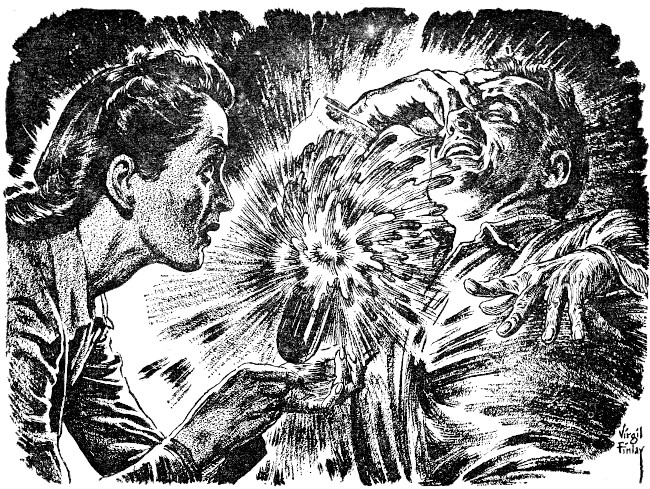
"John.... Oh, God! ... the virus!"
"I'm afraid it is," I said quietly. I felt let down; finished; the same way I had when I watched the wounded die in the Aid Station and I couldn't help. Only this time I was the patient. Oh, I wasn't going to die, or even be very sick, but no man likes to think that he can never have a son to follow him, and I knew, beyond doubt, that in another week I'd be completely sterile.
I'd never seen Pat cry before and it brought me out of my daze. I went to her and took her shoulders in my hands and there, right in front of the Chief I told her, "Darling, I can't kiss you now, but I want you to know I love you and this will make no difference at all. It wasn't your fault."
She couldn't speak. I looked at Hallam. He sat there staring at the bomb in her hands.
"I think I can guess what has happened," he said, "but how?"
Quickly Pat sketched the story while I washed my face as well as I could. She finished and he stared into space. A few seconds later he put his big hands on the table and hunched to his feet.
"We still have to analyze the contents of this thing to see what kind of virus is in it ... if there is. We might as well get started on the preliminaries. No sense in isolating ourselves any more. It's likely we'll all get the disease now." He looked at Pat's tear-stained face and said kindly, "Why don't you two go home for a rest before the day staff gets here. I can handle the beginning of this job myself."
CHAPTER 6
It wasn't far to Pat's apartment. The APC's were working and the ache in my head had gone, replaced by a soreness over the actual bruise. I drove slowly, reluctant to part with her now, to lose the sense of closeness we shared. Elation over our night's work, mixed with sadness for the future, had combined to bring us together more than we had ever been before. She said nothing, but her nearness to me and the hand laid gently on my leg were evidence enough of her feelings. At the stoplights I glanced at her, trying to gauge her thoughts. Her gaze was fixed on some nebulous point beyond the windshield; her face was still, frozen in its expression, almost as if she were a wax model.
Burrard bridge went by and I turned to the left, down a side street. The car rolled to a stop in front of a large modern apartment building. I shut off the engine, got out, and opened the car door for her. We walked up the steps together. She reached in her bag for the key.
"Don't bother coming back to the lab today," I said, turning to go. "Hallam can take care of it this morning and I'll go back later this afternoon and give him a hand."
She looked up in surprise. "You're having breakfast with me." It was not a question but a statement of fact.
"You're too tired, baby," I protested, but feebly. I hated cooking for myself and she knew it.
"I am a little tired," she admitted as she opened the door, "but bacon and eggs will pep us up. I want to talk to you."
Pat's apartment, a bachelor suite on the fourth floor, consisted of a bed-sitting room partly divided by an ornamental screen, a kitchenette and bathroom. Off the sitting room area, a tiny balcony with french doors overlooked English Bay. I strolled over to see the view. The fog was still hanging in patches to the shoreline but above the cottony masses it was a beautiful day and the mountains across Howe Sound sparkled icy white and blue in the distance. I felt a lift looking at them. Pat had removed her raincoat and hat. Now she turned from putting them in the closet to look critically at me, hands on her hips.
"Go take a shower and change clothes while I'm cooking breakfast," she said. "You look scruffy after that judo exhibition. Besides, I want to kiss you and you need a shave and you're covered with virus."
I came back, more comfortable in a clean shirt and slacks I'd left there on a previous occasion. She was sitting at the small dining table, looking over the morning paper. As I watched her read, concentrating on the epidemic story, I examined that kissable mouth, the strong straight nose, the thoughtful eyes. She wasn't the most beautiful woman I'd known but she was loyal, intelligent and good, clear through. Somewhere deep inside, a small ache began and grew. I hadn't thought much about marriage as we had agreed to let our friendship ripen into something better, if it wanted to. Now, as I watched her there, waiting for breakfast with me, I knew I was tired of our present relationship. It wasn't enough that she was my friend and, on one recent occasion, my mistress. I wanted her for a wife.
I was wondering how a childless marriage would work out when she looked up.
"Breakfast's ready any time you are," she said softly.
I went to her and raised her up. Then, slowly, without passion, I kissed her full on the lips. Her eyes were wide open and once more I saw the tears coming.
"John, don't ... not now!" she whispered and turned away to start rattling around with the plates and the eggs and bacon.
We sat near the window over our coffee and cigarettes, looking out at the blue sky and scudding white clouds. The wind had dissipated the water vapor so that no wisp of fog was left. The little waves in the bay tumbled and sparkled in the light and a small tug burst through them importantly, steaming along like a short fat woman heading for the bargain counter.
"It's so beautiful, so peaceful out there," Pat murmured. "I can't believe we're in the middle of the greatest war in history."
"Well, if the number of casualties is any indication, it makes even atomic warfare look mild by comparison."
We had heard the news as we ate. The situation in Asia was rapidly approaching the catastrophic. In fact it was probably beyond redemption already in China, since the normal news channels had collapsed. All India was in a state of panic with hordes of people fleeing in any direction that seemed to promise escape. Southeast Asia was in an uproar, with riots and revolutions as reports of the inexorable advance of the measlepox filtered down to the people. In Africa, Egypt was already in the grip of the fatal disease. It was, as Pat said, not at all surprising, since Soviet technicians and supplies had been the mainstay of the country ever since the United Arab Republic was formed. The great desert barriers of Soudan and French Africa were holding temporarily, but it was merely a question of time before some poor devil, his fevered brain seeking escape, blundered to the forests of the Congo or the Cameroons, to the high country of Ethiopia and Kenya, and set fire to the rest of the continent. Only South America and Australasia were still normal, if one could call normal the state of total mobilization and preparedness that was being ordered in practically every land which had sea or air contacts with the rest of the world.
In North America there was no measlepox. All the major cities of the east were reporting hundreds of thousands of cases of flu and it was rapidly spreading to the southern and inland areas.
"They must have had agents on the East Coast too!" Pat said as she listened to the announcer enumerating the cities and the estimated numbers of sick.
"I imagine so ... a lot of them," I said. "Some of the spread must be due to natural infection too. There wouldn't be enough agents, and they couldn't carry enough virus to do all this."
"How do you think they got started over there?" Pat said. "They don't have the handy excuse of a fishing fleet, do they?"
"No, they don't. I imagine they use submarines especially equipped with tanks full of virus solution, or perhaps crystals, which could be mixed and loaded into aerosol bombs as required."
"But you said submarines might make our government suspicious."
"I did, but that was when the epidemic first started out here. It has been going on for some time now, in the west, and if you'll remember the broadcast, there were cases reported in Detroit, Chicago and St. Louis about the same time as in the coastal cities of the east. People will naturally think it has spread overland by air travel or train and won't be too concerned with what shipping is out in the Atlantic. The Red Fleet has been maneuvering frequently off Newfoundland for the past six or seven years so it shouldn't cause too much comment."
"If only they knew what was really happening to them!"
"I imagine the U.S. and Canadian governments do have our reports by now but they'll have to watch how the news is released. If they're not careful there could be a panic, with people evacuating the cities and spreading the disease. It takes time to organize police and military units for quarantine guards."
"How bad is it likely to be?" she asked.
"That's hard to say. The 1918 flu killed twenty million people and attacked about fifty times that number. Since then, ordinary flu epidemics have been reported with up to fifty percent of the people involved. The Asian flu of 1957 affected up to seventy-five percent in some areas. But this stuff isn't pure flu and so there may be absolutely no immunity. Probably the only thing that will prevent people from getting it is not to be near someone else who has it. In the old days that was possible, but with the population we have now, and the rapid communication between towns, it is much easier to spread an epidemic than it was fifty years ago. My guess is that eighty or ninety percent of the population will get it."
"John," Pat said thoughtfully, "How long is it likely to be before you start having symptoms?"
"You mean all of us, don't you?" I said. "After all, that spray must have splashed a bit and both you and the Chief may have got enough to infect you."
"Well, yes, if you put it that way."
"Oh, about four days," I guessed, "or, perhaps a day more or less. We aren't quite sure of the incubation period yet, and there's always a chance of a mutation with a shorter period if a synthetic virus is liable. We don't know that either."
"It's practically certain you'll be sterile, isn't it?"
"I'm afraid so," I said ruefully.
"What about convalescent serum, wouldn't it help?" she asked hopefully.
"If I got a big enough and strong enough dose, it might. There isn't any ready yet. I asked Hallam just before we left this morning. If it isn't injected early it may modify the disease but probably wouldn't prevent it completely. I might still be sterile. It doesn't always work anyway."
"What about me?"
"Last night, before I went to bed, Dr. Hallam got a report that very few women had shown symptoms of sex gland involvement. The biopsies taken by Bruce Thompson from the ovaries of women who have had the flu showed only minor changes that Smith could detect. That isn't absolute proof that everything is all right, of course. It will take time to find that out."
"What about miscarriages in infected women," she persisted.
"They checked that out too. There have been occasional cases, but no more than you are likely to see with any heavy fever. That ferret may have been an exception. Perhaps it's a peculiarity of the ferret's reaction to the virus. It may prove to be a rare complication in people. Of course we don't know yet if the children of infected mothers will be born deformed in any way, as they often are in German measles. This virus may have no such power."
"Well, that's a chance I'll have to take," she said.
"What do you mean?" I queried. "You'll likely have the flu by next week and you don't even know if you're pregnant yet. You couldn't possibly tell so soon."
"I know that—and that's the reason I wanted to talk to you.
"You and I have been letting things ride along for some time now. I've enjoyed it and I have no regrets. But it's time to stop; to make up our minds." She looked straight at me. "Do you love me enough to marry me?"
I got up and went to her. I put my arms around her and this time my kiss was not quiet.
"Silly question," I whispered against her cheek. "I was getting tired of being just the boy friend. We'll go and get the license right now. We can get married as soon as the three day waiting period is over."
She looked up at me and said, "You wait here. I'll be ready in a minute."
I sat down and lit another cigarette. Three puffs later I heard her speak behind me.
"I'm ready, John."
I looked around and came to my feet with a gasp. Then I took her into my arms.
"Pat ... my Pat! God, but you're lovely!" I smoothed back her hair and tilted her face to see her. "Darling, why are you doing this?"
"This is our wedding day, John. If we wait for a legal marriage it will be too late ... you'll probably have the flu. I slept with you on the boat because I wanted your child and I was afraid of the flu. Now I'm sure you'll get it. This is our last chance." She moved away from me and took my hand.
Later, as we lay quietly together, I said teasingly, "What's it going to be? Boy or girl?"
"I really don't care. I only hope he'll have a few playmates to keep him company. An only child in a family is bad enough. I don't want him to be lonely."
I pulled her over to me and held her tightly. Her tears were warm against my neck.
CHAPTER 7
Tired, rumpled, but elated, Dr. Hallam met us as we came out of the dressing rooms the next morning.
"My theory was right. The bomb was full of virus," he said, his face lighting up happily for an instant. Then, as the thrill of discovery faded, grimness clouded his eyes. "At least now I can prove what we are up against, thanks to you two."
Clinging to my arm, Pat looked at me and sighed, "Thanks to John! But the cost was high."
"Maybe that price won't have to be paid. They've been working all night in Serology, since I determined that the virus gave the same reactions as the flu virus, to concentrate immune globulins from convalescent sera. They just sent up a hundred c.c.'s." He indicated a packet on the table.
"John can take the first dose right now."
"That's fine," I said, "and I certainly appreciate it, but why should I get the serum when other doctors on the outside, treating flu patients all day long, are not getting it. That's hardly fair."
"Democratically speaking, it should be distributed by lot," Hallam said, "but there's no time to argue the point. If it will ease your conscience any, you're getting it, not because of favoritism, but because you, and Pat and I too, are the subjects of the first controlled experiment on human beings with the new virus. We know exactly when we were exposed to it; we know that you, at least, received a very heavily concentrated dose, and if this globulin proves effective then we can start issuing it in large quantities. The word has already gone out through the Public Health Service, to collect blood and process the serum. By the time we find out if it protects us, it will be in bottles ready for issue all over the country. It's a terribly expensive and cumbersome way compared to using a vaccine, but we have no alternative. They haven't yet got an antibiotic that will attack the flu virus. But we're wasting time! C'mon, drop those pants and take your medicine."
Later, as we sat gingerly on the hard chairs around the dining table, Hallam outlined his plans.
"We won't work with antisera at all. The Routine Lab can handle that. What I want to do up here is to produce something that will give active, permanent immunity ... not just passive immunity that has to be repeated every week."
"You mean to produce a vaccine?" Pat asked.
"That's one way. We could try killed virus, formalin treated, something like the method Salk used for the polio vaccine. But that too can be done in the Public Health Labs or by the big drug companies. They have all the equipment set up for it."
"It takes at least three months from isolation of virus to production of vaccine ... and another three or more until everybody can get a shot."
"Right-o, John. It must be done of course, but I'm going to tackle the problem in another way. Maybe we can shorten the time."
"How will you do it?"
Hallam turned to Pat. "I don't say we can do it. We shall try. If we could alter the virus enough, by physical or chemical treatment, to knock out only the sterility effect, we could let people have the flu. Then it would be necessary only to produce a limited amount of the new virus and start it going all over the country."
"That would eliminate all the processing of killed virus, sterilization and so on," Pat said excitedly.
"And everybody who had the virus would produce more and spread it, faster than the drug companies could make it," I added.
"Precisely ... if it works," Hallam said. "That's what we will concentrate on. Biochem is analyzing the structure of the virus. They are going to advise us when they get the nucleoproteins sorted out. We may be lucky. Sometimes substituting a methyl group by hydrogen or changing the positions slightly will make a tremendous difference in properties of the molecules. It will have to be rather a hit and miss program. There isn't time to work out the full formula of the virus. By the way, have you seen the paper this morning?"
"Not yet," Pat said.
"They have a new name for it now—Sterility Flu, or S-Flu for short."
"Yeah, short for flu but long for sterility," I muttered.
"Maybe the sperm cells will regenerate after a few months," Pat said hopefully.
"I wouldn't put any down payments on a baby carriage if I were you," I said, as we moved towards the workrooms.
It was the third morning after the fight on the docks. Pat had finished injecting an enormous dose of concentrated human serum into my left buttock and was giggling at my choice selection of swear words when the phone rang. I answered struggling with my pants at the same time.
"Cope here," it said. "Is that you, John?"
"Yes Harry, how are you?"
"I'm afraid I've caught the flu, laddie." He was obviously trying to sound unconcerned. "I've got a fever and all the aches and pains that go with the ruddy stuff. I wanted to tell the Old Man I shan't be working for a day or two."
"Damn it, that's a shame," I said. "Look Harry, why don't you come up here and let us give you some serum, it might forestall the complications."
"Might as well, I suppose, but isn't it too late, really?"
"Too late for the flu, of course, but maybe not too late for the orchitis."
"Right-o," he sounded resigned. "I'll see you in half an hour."
"Wait!" I had the receiver halfway down before I remembered. "Better bring Polly along too. If she hasn't got the flu now, she probably will have."
"Will do," he answered and cut me off.
Pat heard us talking but Hallam was away and would have to be told later. Nowadays he was seldom available, being constantly in conference or on the telephone talking to specialists in preventive medicine or virology from other parts of the Americas or Europe. For the moment, Vancouver was the center of attention of the western world. Most of the NATO countries by now were battling full scale epidemics of their own and wanted to know what we had found out about the disease.
All over the province the schools, theaters and all public meeting places had been closed. All main routes of travel were under police and military control and only the most essential transport was allowed on the highways, the rails, or in the air. The same precautions were soon put into effect across Canada. The United States was under martial law, with the National Guard in complete control in each state. Communities which had not yet reported cases of S-Flu were isolated for their own protection and supplies were sent to them by military convoy. The guards and truck drivers were men who had already had the disease and were no longer infectious as far as anyone could tell. Even so, they were not allowed to come close to the isolated ones who unloaded the supplies with the greatest care after the truck drivers had got out and moved away. In spite of the most stringent precautions, the disease still broke through into some of those areas, and, as the weeks passed by, the uninfected zones were reduced to such locations as small hamlets in the eastern and western mountains, little whistle stops on the prairies and, in the southwest, some of the desert communities.
When the truth about the S-Flu became known, many families in the cities tried to barricade themselves in their homes. Some had already been exposed to the virus and hunger drove others out, only to catch the disease. Later, when the public health services were better organized, the same isolation techniques used on whole villages were used wherever a family was found untouched. Even in the worst areas a few were known. There were, of course, the cranks and selfish ones who couldn't bear to see others escape their own fate, but as a rule the people responded well. They knew, finally, it was either that or race suicide.
Ten days after exposure the three of us were in fine condition, although my behind felt as if a porcupine had attacked me, from all the injections of serum.
As I complained to Pat, "You women are lucky. You have a bigger target for all these damn needles."
Two weeks went by without a sign of S-Flu and, once more, when it seemed definite that we had escaped, we were locked up again in the Lab. Under the military orders covering all uninfected persons, we had to be isolated, but, as we were still working with the virus, the Research Building was the obvious place. To me, there was only one thing really wrong with the situation. In all the rush and excitement of our research, we had not yet taken out our marriage license, so, not being completely brazen, we had to take to our separate rooms and beds again, with the Chief as chaperone to our physically consummated but legally unlawful union.
I said to Pat when we were locked up, "That does it! Now, if you really are pregnant, all the women will condemn you as a fallen sister while envying you for being with child ... besides wondering whose child."
She chuckled. "A most unusual situation, and one I intend to exploit to the fullest extent."
"Do you think you are pregnant?" I said hopefully. "You ought to be, I'm plum wore out trying."
"Well, I'm not ready to take up knitting yet," she joked, "but there are encouraging signs."
All across the continent, virus laboratories were working continuously and almost exclusively with the S-Flu. A number of experiments using convalescent serum were in progress but, as it was not known exactly who had been exposed to virus, and when, the results were hard to evaluate. Now we had proof. We three had been exposed to virus at a known time and yet, two weeks later, there we were as healthy as ever. When the news was published, every blood bank in the country was swamped with volunteers. At first the convalescent serum was given only to the males ... a dramatic reversal of the laws of chivalry ... but the women did not complain. They knew that without fertile men there could be no children and to most of them such a world seemed empty indeed. Gradually, as supplies increased, all non-infected persons living in contaminated areas received weekly doses which, though much less than I had had, were found to give sufficient protection in most cases. It was still not known if there were any ill effects on unborn children so pregnant women were also included in the schedule. Where injections were given, and no new cases reported, the quarantine was lifted after a while, but where the disease had never reached, the population was still isolated, awaiting the day when a permanent vaccine would be available. Sporadic outbreaks of the disease were still to occur, months and even years later, among those who had never had it, but at last the major epidemic was over. The discovery, at the Medical Center of New York, of a protective vaccine, eventually made isolation unnecessary.
Long before that happened, the restriction on our movements was lifted. Only those in the uncontaminated areas were confined to their own locality. The rest of us, provided we took our weekly serum shots, were let loose.
"Now I can make an honest woman out of you," I joked as we walked out of the Lab and breathed gratefully the cool damp air of early winter.
"You don't need to darling," Pat said. "If I am pregnant there's at least a million women envying me right now. When it was easy to get pregnant it was proper to do it only in holy wedlock, as they say, but moral standards are changing already. To be pregnant is an honor, illegitimately or otherwise. I imagine before long there will be a lot of husbands looking the other way or condoning artificial insemination if they can have sons thereby."
"You still want to get married, don't you?"
"Of course, sweetheart," she squeezed my arm, "but I want a proper wedding, not a civil ceremony, and we haven't time for it now."
Late one afternoon shortly before Christmas we were sitting contentedly in front of the fire in Pat's apartment when the front door buzzer sounded. She pressed the speaker button.
"Hello, who's there?"
"It's Hallam. I've brought you a visitor. May we come up?"
"Certainly, come right in."
A few moments later they walked through the opened door.
"This is Inspector James of the RCMP," said Hallam, introducing a tall, thin, grey-haired man in civilian clothes.
"Won't you sit down?" Pat indicated chairs by the fire.
"How about a drink?" I said to the Inspector.
"If you're having one."
"We were going to. Dr. Hallam likes Scotch and water. With a name like yours you might like the same."
"That will be fine, thank you."
I brought their drinks and poured our usual gin and Italian vermouth for Pat and myself.
"Inspector James has been in charge of the investigation into the virus warfare theory," Dr. Hallam began. "He knows your stories already but something new has come up and he wanted to talk to you." He settled back in his chair and looked over at James.
Inspector James took his cue. "Since Dr. Hallam proved that the aerosol bomb contained virus, we have been trying to track down all possible agents, and our maritime division has been searching for the ship off our coast. We have been in constant contact with the FBI and the US Coastguard, and through them, with the US Armed Forces. As far as we can determine, one group of saboteurs inoculated the Vancouver area, the Interior of British Columbia and the Pacific Northwest. Then they disappeared."
"You actually traced some of them?" Pat asked.
"No, I'm afraid we didn't," James said ruefully. "We base our conclusions on indirect evidence, stories like those Dr. Macdonald found in the public health reports, you know, aerosol bombs triggered off accidentally and so on. The epidemic pattern in BC is now following a more natural course so we believe the agents left ... probably they were recalled right after that fight you had."
"There might still be some undercover agents left," I guessed. "Natural epidemics tend to die out, even as virulent as this one is. However, if they give it a boost from time to time, they might get eighty or ninety percent of the population. Anything less wouldn't be too damaging, we could make up the population deficit in a few years."
"We thought of that, Doctor, and we are continuing the search. However, the main party of agents appears to have left. Some days after your fight, routine air patrols noticed what could have been the Japanese fishing boat off California. Not long afterwards, San Francisco, Los Angeles and San Diego had their first outbreaks. Unfortunately our governments had not yet given the order to find and arrest all agents. By the time that order was given, the ship had disappeared. We presume it stayed out at sea. The epidemics in Mexico originated in Monterey, Vera Cruz and Mexico City, which makes us think they were started by saboteurs operating from the Atlantic side."
"Last week there was the beginning of an epidemic in Medellin, Colombia, and then in Guayaquil, Ecuador, which appeared separately from the already established disease in Rio de Janeiro, Buenos Aires and other eastern cities of South America. Our consulates and the United States embassies in those countries had been warned and passed the word on to our Latin American friends." He paused to drink his Scotch and then continued. "The countries concerned have been searching their coasts for any sign of strange vessels but without success until yesterday."
"You mean they found the boat?" I interrupted hopefully.
"I believe so," he said. "Ecuador, as you know, owns the Galapagos Islands, well off the coast, and for many years a favorite out-of-the-way retreat for all sorts of people. Now Ecuador claims fishing grounds a great distance off her coast and around the islands. This has led to a lot of international incidents and sometimes to confiscation of fishing boats stopped inside these limits by Ecuadorean gunboats and charged with poaching. Well, these annoying rules proved very useful yesterday. A spotter plane found a black cannery ship flying a Japanese flag in the waters off the Galapagos. That vessel is now anchored in the main harbor—I forget the name—under the guns of a patrol boat."
"Wonderful," Pat breathed. "What about the crew?"
"I haven't any information about them but I do have a request from the Department of State of the U.S.A. that you fly down to Ecuador and, with their consular officials, and I suppose the Ecuadorean authorities, go to the Galapagos to see the ship and crew. This is necessary because it must be kept secret. We don't want the Communists, if that's who they are, to get suspicious. This must look like a simple arrest for poaching, at least for the present."
"Do both of us go?" I said.
"That was the intention, since you both saw the men and the boat," the Inspector smiled, "and of course all expenses will be paid."
"Oh boy!" I looked at Pat. "Christmas this year is going to be a summer vacation ... the one we didn't get."
We flew south to Quito in one of the fast new jets of the Canadian Pacific Airlines and from there to the Galapagos in a much less comfortable Ecuadorean Air Force transport plane. The air-strip on Baltra Island, so busy during World War II, lay neglected and forlorn among the lava blocks and scrub. From it to the Governor's house on Chatham Island, we rode first by motor launch and then in a rusty old jeep, probably another relic of that war or subsequent lend-lease.
"I wish I could see a tortoise," I said, clinging desperately to the struts of the canvas top as we bounded through clouds of dust from the jeep ahead.
"They're probably all in zoos now," Pat said, mopping cautiously at her face where the makeup was slowly melting in the steamy tropical heat. "You couldn't see one anyway in this dust."
It was a little cooler on the screened-in porch of the residence. The Governor, a fat little man who looked like the caricature of a Mexican snoozing under a tree, fussed around all the important visitors. With obvious pride he produced cold drinks from what was probably the only refrigerator on the island. I took a long draught of beer, settled back with a sigh and looked out over Wreck Bay.
"Hey! There's the fishing boat." I sat up again excitedly and pointed it out to Pat. The officials exchanged nods and smiles. It was the boat ... the first test of identification was over. An hour later we went aboard although there was nothing to see that could be of use in solving the case. All the tanks intended for holding fish were empty and had been flushed with sea water. One tank held fish when the ship was captured, probably as camouflage. There was a well-equipped laboratory but that had been explained away as necessary for marine biology research. There was absolutely no clue. No trace of aerosol bombs or other apparatus for holding the virus had been found.
Ashore again, we were taken to see the prisoners, watching them through peepholes as they exercised in the small jailyard. Almost at once Pat shook me and tried to point through the little peephole before she realized how silly that was.
"Did you see that tall man on crutches?"
"Yes, it's the one I tossed on the deck."
"And there's the second man, and ... look over to the right there, by the wall! That's the leader, I'm sure of it!"
"Wait till he comes closer," I said, "but I think you're right."
The crew members were circling around the yard, getting exercise under supervision of the guards. As they came closer to our hiding place there was no doubt. Yellow-hair and his pals were there.
One by one, the three Slavs were called in to stand before us. The blond leader was first. I thought his eyes widened a little when he saw me. There must certainly have been despair in his heart when he realized that they were not being held as poachers, but his control was admirable.
"Do you know these people?" The question was in English.
"No."
"You never saw them before?"
"No."
"What about that night at Horseshoe Bay," I broke in.
"I don't know what you are talking about."
It was useless, and had been from the start. All three men stuck to the same story. They were White Russians in the pay of a Japanese fishing company, partly as laboratory workers and partly for their ability to speak several languages.
We went back to the Governor's house feeling defeated. This was an anticlimax. The only points in our favor were that we had recognized the boat and three crew members immediately, and our descriptions of the men, given in Canada, corresponded quite well with their present appearance. Unfortunately, I had washed the fingerprints off the aerosol bomb in the shower, and with them, the only material evidence of the Russians' connection with the S-Flu. Or was it? I was thinking over the problem as we sat down to a late lunch.
While we ate both the Ecuadoreans and Americans questioned us politely but thoroughly. As they explained to us, the question of identity was extremely important. We were the only witnesses that the captured Russians had actually possessed a virus-filled aerosol bomb and on that one fact might rest the future of the world. Where they had come from was by no means certain. The ship's papers, and those of the crew indicated Hakodate as their port of origin but the Japanese embassy in Quito had indignantly repudiated them, insisting that no such ship was registered in Hokkaido. There was nothing to link them with the USSR, which had not bothered, so far, to answer the first discreet inquiries.
"Did the Russians tell you where they came from?" I asked.
"From Hokkaido," the American military attache said.
"No, no, I mean recently. Where has the ship been sailing."
"They claim they've been following currents across the Pacific, looking for new fishing grounds."
"Then they were not near British Columbia?"
"Not according to their stories, nor to the ship's log."
"There's a couple of ways we might check that. The Russians went ashore in B.C. Maybe they'll have pollen grains or dust in their clothes that could be traced to that part of the world."
"It's a possibility. We'll look into it."
"And then there's my sloop. We scraped along the side of the fishing boat and some paint must have come off. I haven't had time to repair it. At least that might prove we have met before, if the paints are similar, which would make our bomb warfare theory much more credible."
"It certainly would. We need all the evidence we can get."
"What are you going to do with them?" I asked the senior American officer after lunch.
"We have practically convinced the Ecuadoreans that these people are really saboteurs, but naturally nobody is going to say anything about that. Our Latin friends are past masters of the art of 'mañana'—I think they could give the Russians and Chinese lessons in procrastination. They have agreed to hold the ship as long as they can on the poaching charge. If neither the Japs nor the Soviets claim it, that could mean indefinitely. I think it's too late to do much good," he concluded thoughtfully. "The epidemic is already out of control down here. The health services are too small and the distances too great, to say nothing of the lack of education of many of the people, ever to stop a pandemic without outside help. We in the States used to send aid but this time we have our own hands full."
"It sounds pretty hopeless."
"It is. Thank God the measlepox isn't here too or this continent would go back to the jungle."
Back in Quito I stood with Pat on the balcony of our room. We were both quiet, pleasantly tired. In another few days we would have to return to the northern hemisphere and winter, but here, under the summer moon, it was almost impossible to imagine. I looked over the railing down the narrow street with its high-walled houses. In the cool air the faint sound of music and singing carried up from the town. Apparently the flu couldn't dampen all the liveliness of these people.
"If I had a guitar I'd get down there in the street and serenade you," I said playfully, my arm around her slim waist.
"If you could sing, I wouldn't mind," she retorted.
"Doggone it, already you sound more like a wife than a mistress," I complained. "Where have all those romantic ideas and that passionate lovemaking gone?"
She batted her eyes at me. "Why don't you take me inside and find out."
CHAPTER 8
In the early part of the new year, work piled up increasingly. Under instruction from the Minister of Health of British Columbia, the Virus Research Laboratory was turned over to federal control. In addition to our attempt to modify the S-Flu, we were engaged in highly secret research on the synthesis of viruses, in cooperation with the National Research Council of Canada and its American counterpart. Pat was still working although sometimes she was extremely tired and I was worried about her. The work was so secret that, instead of marrying me and settling down to being a housewife, she had stayed on at the Lab at the Chief's urgent request. She and Polly, besides being the best technicians in the hospital, were the only ones who knew the whole story of the virus war. Hallam knew by now that we were living together constantly but we all realized that there was no time for a honeymoon and the legal ceremony didn't seem very important under the circumstances.
A few weeks after our return from Quito the Chief had been called to Ottawa. On his return Pat invited him to our apartment for dinner. Polly and Harry made up the party. A couple of cocktails before dinner loosened our tongues and even Harry, who had been rather morose since the flu caught him, was able to laugh at the Chief's fund of good stories. Polly was her loquacious self again, I noted. Having the flu shortly after Harry hadn't bothered her much, but Harry's evident depression had.
After a heaping plate of lasagne and a large slice of fresh apple pie, Hallam sat back and loosened his belt with a sigh of repletion.
"It may be bad manners," he admitted with a smile, "but if I don't, I'll explode."
I offered him either a Drambuie or Australian port to go with his cigar. It was difficult choice as he loved both. The port won, for patriotic reasons, he said, and he tippled and puffed for a few minutes in complete contentment.
"You know, if I'd been ten years younger I'd have proposed to you myself." He winked at Pat. "The only trouble is that I wouldn't have been able to decide whether to keep you in the Lab or have you stay home to cook."
For a moment there was silence as we watched the fire. Then the Chief took a deep breath and let it whistle out of his nose.
"You're waiting to hear what happened down East, I imagine."
We all nodded and he continued. "When I arrived in Ottawa I checked with the Minister of Health but he wouldn't tell me anything. The following morning we flew to Washington where we were to attend a top secret conference headed by Prime Minister Macpherson of Canada and President Johnson of the United States." He paused. "Johnson, you remember, was the dark horse Democrat who swept the country after the moderate depression of the late fifties and the consequent decline in popularity of the Republicans."
"Anyway," he resumed, "the senior members of the Canadian cabinet and corresponding members of the United States Executive and Congress were to be there, as well as the military heads and observers from the British Commonwealth countries which had representation in Washington. The next morning, in the underground military headquarters which had been prepared for thermonuclear warfare, we assembled at our appointed desks. With their usual love for conferences, the Americans had made elaborate preparations, and we all had name tags and name plates on our desks, as well as microphones and loudspeakers so we could identify and hear anyone in the room. With very little preamble, both heads of state were introduced. The President was the first to speak. I'll try to give it to you as he said it."
"Gentlemen," the President began, "for one hundred and fifty years our two governments have been at peace and for the greater part of that time we have cooperated amicably on major problems. Since World War Two, that cooperation has continued with such projects as the Saint Lawrence Seaway, the DEW line, the various military highways, coordination of defense plans and military maneuvers, so it seems natural that we should cooperate now, in what I honestly believe is the greatest threat we have ever faced. The Prime Minister and I have already talked this over and he agrees with me that, because of the peculiar nature of this world war ... and I have no doubt that it is war ... we can make no public announcements at present, nor should we retaliate in ways which will cause greater harm to our people than they have already suffered." He paused briefly. "Let me make that concept clear.
"As most of you know by now, sterility flu is a synthetic disease agent introduced into the democratic nations by agents of the USSR. The evidence for this seems conclusive, especially as our own agents have succeeded in getting to us a few samples of the vaccines used to inoculate the school children and the members of the military services of that country. These vaccines were in use before ... I emphasize ... BEFORE sterility flu was reported in the western world. Our scientists tell me they contain protection against the S-Flu and probably, though this is not yet proved beyond doubt, against the so-called measlepox which is killing millions of people in Asia and Africa. We have indirect evidence that these same vaccines were also used to protect large numbers of Soviet civilians, adults that is, but not all of them. It has been extremely difficult and dangerous for our agents to obtain enough samples for testing as the vaccines are closely guarded and the whole manufacturing process is of the utmost secrecy. Apparently the dictatorial clique has decided to sacrifice a large number of unwanted human beings in the interests of Communism, under the guise of breeding a better race by elimination of undesirables. By sacrificing part of their own population they hope to persuade us that they, too, are innocent victims of world-wide pandemics. With this diabolical plot they hope to avoid the inevitable retaliation that would follow an open act of war such as a hydrogen bomb attack."
There was murmuring through the assembly. Many of the lawmakers had not known all the facts before the conference and none had seen the attack develop as we had.
"The credit for the discovery of this plot goes to Dr. Hallam of Vancouver, Canada, who is here in this room. He first suspected it and one of his associates, an American and former member of the United States Army Medical Corps, had the courage and good fortune to capture the first piece of vital evidence which proves this theory. It was an aerosol bomb, in the hands of men posing as recent immigrants to North America. By an extraordinary coincidence, and shrewd deduction, this gentleman was able to point to the ship that brought these men ashore. In fact his boat was in collision with the vessel as was subsequently proved by comparing paint scars and analysing the chemical composition of the paint from the two vessels. This gave us enough evidence to put our agents in Russia to work, with the result I have mentioned. If it were not for Dr. Hallam's deductions about the nature of the disease, and the early use of anti-serum, we should today be in an almost hopeless situation.
"As a result of this bacteriological, or rather virus warfare, we estimate that at least eighty percent of the population of India, China, the East Indies and Africa has died or will die from measlepox. There is no natural immunity. Our reports show that it has gained in virulence and shortened its incubation period as it spread and the mortality is reported as one hundred percent of those it attacks. Only pneumonic plague has ever equalled its deadliness and that died out after a while. The great increase in density of populations and in transportation facilities in the past fifty years, plus the artificial stimulation to further spread, has made this disease far more horrible. As you know already, all travel off this continent is now halted and nobody is allowed to enter by sea until a compulsory quarantine period outside the three mile limit has passed. Air traffic is under military orders. All troops and dependents overseas in threatened areas such as Korea, are already evacuated to quarantine zones in safe territory. A few members of advisory groups are staying behind, on a voluntary basis, to help our allies. Other garrisons, for example in Okinawa, are ready to leave."
There was a mixed reaction to this information, obvious in nods or shakes of heads.
"I realize this may leave our bases open to occupation by the enemy," the President continued, "but such would be open aggression and I do not believe they will risk it, especially if they think we are beaten already; they will be expecting to take over in their own good time." He stopped to drink from his water glass. "In the West we have a different problem. The enemy, hoping we would not be unduly alarmed by what seemed little worse than an epidemic of colds, infected us with sterility flu. The plan was to sterilize most of our male population before we became alert to the danger. It almost succeeded.
"I have the latest report from our public health authorities. It is estimated that eighty percent of the population of the United States and Canada has had, or will have, the S-Flu. Some twenty-five million people, both male and female, who are known to have escaped the disease, are at present protected either by weekly injections or by isolation, and we are searching vigorously for others. We hope in a few months time to have a vaccine which will give lasting protection. The combined police forces of both countries are searching night and day for the agents who, we suspect, are hiding in our cities, fanning the flu to fresh vigor whenever it shows signs of abating. If twenty percent do escape, since most of the females apparently do not become sterile, the future of our countries therefore will depend on the twenty million uninfected males. However, probably half of these are either too old or too young to be of use for procreation at this time. That leaves us with only ten million potential fathers north of the Rio Grande."
He paused to let this sink in and the buzz of conversation broke into excited comment. Tempers were getting short and here and there fists pounded the desks to emphasize a point. The chairman rapped for order and the President resumed as the noise died.
"The situation in Central and South America is worse. They do not have adequate facilities to protect their populations. Evidence is now coming in that S-Flu has also been let loose along with measlepox in the Orient so that those who escape the one and live may well have been sterilized by the other. The European countries have closed their borders in an attempt to keep the measlepox out. They are already overwhelmingly affected by the S-Flu.
"To sum up, except for the immunized master race of the USSR, the peoples of the world are either dead, dying or sterile. If ten percent escape one or the other fate we will be lucky. It might be considered that the war is already won, and so it is in the dying Orient, but we, although we are sterile, are still eager to fight ... and fight we must if we are to save America and democracy for our children."
A roar of cheering drowned his attempt to continue. Senators, soldiers and members of parliament were up on their feet, yelling, cursing, banging desks or releasing their anger in any way they could find.
"Give them the Hell bomb," yelled one.
"Send over our planes," a portly congressman screamed.
"Kill them all, the monsters."
"It was terrific," Hallam broke off his recitation to comment. "I was sure several of those old cobbers would have a heart attack, they were so mad. Then somebody cut off the microphones and the noise became bearable. Finally the President managed to get their attention and we all sat down again and listened."
"Your response is most heartening," the President resumed, "and just what I expected. However I want to make one point clear now. I, and Mr. Macpherson agrees with me, do not believe that the H-bomb or any other ordinary form of war is the answer to this for two reasons.
"Firstly, we have only a small fertile population left on which to rebuild our nations. The radiation effects of nuclear warfare might well turn those children of the future into misshapen monsters. We would have revenge at the cost of self destruction. Secondly, this is still an undeclared war. The Reds are probably counting on victory and do not know that we are aware of their villainy. They will not expect a counter-attack as long as we pretend ignorance. It is up to us to deliver one that will catch them too by surprise. If we succeed we turn what appears to be inevitable defeat into victory. At the same time we must direct our efforts into other channels and find ways in which to maintain our strength in manpower as well as in machines.
"For our first task—that is, the winning of the war, I believe we must remember the old saying, fight fire with fire. Our best hope is in utilizing our own scientists to produce biological or chemical weapons which will do to the Communists what they have done to us. For the second task I believe we will need new laws and new concepts of human behavior. We will have an opportunity, unequalled in history, to determine the future quality of our citizens. Let us go to this task full of confidence in our ability and thankful the Creator has allowed us another chance."
"After the President spoke," Hallam continued, "there was an explosion of applause, cheering, hand-clapping, shouting, whistling. It was long minutes before Mr. Macpherson could get their attention. He pledged Canada's full cooperation. In turn, the Commonwealth observers promised to get the help of their governments. Finally, committees were formed and the details of the President's broad concepts hashed out. Not every problem was settled right then, of course; that will take months, but the preliminary decisions were made."