Front matter (continued 3)
Reading edition
"That's about the size of it," Hallam drained his glass, "except for what we are to do. Since we have been working on the S-Flu, we are to keep on, but with a different goal. We now have to build up a virus of our own with either a sterility factor or lethal properties and a very short incubation period."
"That's what the President meant by turning their weapons against them," Pat said.
"That is part of it," Hallam agreed. "It is axiomatic that this new virus must be far enough from the old one that there is little or no cross immunity, so that the vaccine the Reds took will not protect them."
"A tall order," I said glumly, "and while we try to do it, we hope the Commies will sit still, convinced that we are not suspicious of them."
"Like any murderers," Hallam said, "the Russians have to wait to see if the police suspect them. In the meantime, if they are smart, they won't draw suspicion on themselves by trying to profit from their crime. If my reasoning is correct, they may sit tight long enough for our surprise counter-attack to work."
"You said there were several committees, didn't you?" Pat questioned him. "Have you any idea what other plans were made?"
"There are many lines of attack open," the Chief replied. "The Departments of Agriculture of our countries have been working on B.W. for some time, as it concerns plants and animals. If we could ruin Russian crops or kill their animals it might force them to capitulate from starvation. The weather experts are studying ways of doing the same thing by droughts, storms and so on. And of course the physicists think of such things as causing radioactive clouds over Siberia. The trouble is, we don't want to make the Reds suspicious too soon, or give them an excuse for starting all-out atomic warfare, or even so-called conventional war. Our people are close to extinction now, with only ten million breeding males. It seems like a lot but unless they are protected, we are finished."
"What's to be done about this sterility problem?" Polly spoke up.
"There's bound to be a lot of discussion and some bitter arguments on that," Hallam smiled at her. "There are about thirty million women of childbearing age in the United States and Canada, of whom roughly twenty million might be from sweet sixteen to a very desirable thirty or so," he grinned at the girls as he talked and they laughed.
"O.K. that's us," Polly said, "the or-so gals."
Hallam continued, "And only ten million more or less desirable but presumably still potent males from say eighteen to fifty or so." He saw Pat's mischievous smile and added, "Yes, that's me." He went back to his thesis. "Only five million of these would be of compatible age to marry the younger women, assuming nobody is married right now. If we could forget age differences, it means one man to every three women of childbearing age. The problem is much more complicated, as you can imagine, since many of these fertile men are already married and many more women, who could bear children, are married to sterile males. If we were Muslims or old-time Mormons, it might be possible to start harems of fertile people but with our present customs that's impossible."
"Rough on the sterile males," I said smugly, "but mighty nice for the rest. What are we going to do—wear a badge or something?" I stopped in sudden realization; Harry had had the flu. He sat there silently, his face impassive. The only thing to do was to carry on.
"Get that smirk off your face," Pat ordered. "You aren't a free agent any more."
"Sometimes I envy you real bachelors, Chief," I said, and sighed deeply in mock despair.
Hallam chuckled and then said seriously, "If we sit and do nothing the population will drop off drastically as the old folks die but eventually, in a normal situation, the race would renew itself. It might be a good thing too, we have too many people now, except for one thing ... we need continuing manpower to beat the Communists."
He stopped to consider his next point. "To me, the logical solution is legal artificial insemination, voluntary of course, with sperm from carefully selected donors. In that way we would have less of a population drop and, I believe, improve the quality of the race; but it's a highly controversial question from scientific, legal and religious points of view. The committee will take some time and a lot of hearings before making even tentative decisions."
He stopped, and for a moment we were silent, thinking about our problems. Pat spoke first, "I keep remembering how we became aware of the S. factor ... I mean when that ferret aborted. I wonder if we could use that as our weapon. If all the farm animals and women in Russia were unable to conceive, or miscarry when they did, it would do the trick ... and it's a lot harder to determine whether a female is sterile than it is in a man."
"You have a possibility," I admitted. "Sometimes it's better to hit an enemy with a variation of his own favorite trick than to have an entirely new approach. If we could do that, we might fool the Reds into thinking something had gone wrong with their own S-Flu virus, such as another mutation. The difficulty is to avoid cross-immunity. We might do better to alter the measlepox so it would turn on them and kill them."
"Then you have lost the element of uncertainty that made the S-Flu so valuable a weapon," Polly said. "They could rally in time to stop it."
"A very good point." Harry spoke for the first time.
Again there was silence. I got up quietly to refill the glasses. Harry was staring at the fire; his face in the flickering light seemed tired and sad. I caught Polly watching him and saw the look of concern in her face and the faint wrinkle of perplexity between those artistically darkened eyebrows. The Chief was sunk down in his chair, in a daze partly of thought and partly of satiety. Absently he lifted his glass for a refill and then, looking through the deep red port to the firelight, he said to the room,
"The U.S. Navy is sending a special research team out to Formosa and the Army one to Japan, to study measlepox. Years ago they established well equipped research laboratories in those countries. The Canadian government wants one to go to Hong Kong."
Pat threw a quick glance at me but said nothing as he went on.
"They asked me for suggestions and I told them I'd take the team, but the Premier put his veto on that. He won't let me go. I objected to married men because it's likely to be dangerous work, at least until we get enough of the Russian vaccines to inoculate our men."
"When do they go?" I said.
"The advance parties should leave in a fortnight."
"Somebody should go from here, and since you can't go, that means me."
I had no wish to be a hero but there is a certain pride in a man. Our laboratory was the biggest, and I thought the best, virus research center in Canada. Somebody obviously had to do the dirty work if we were to be saved from destruction. Sooner or later the measlepox would invade the Americas or be brought in deliberately by the Reds. To paraphrase the old saying, as they wouldn't "let George do it," and as George was my boss, I was next in line.
The Chief was nodding his head in reluctant agreement as these thoughts ran in my head.
"Hold on a minute, there," Harry had come out of his trance and the sadness in his face was replaced by the excited, determined look of the volunteer, the man with an ideal. "This job is mine, it has to be!"
Polly was staring at him, her mouth half open, her drink stopped on the way to her lips. She put it down and spread her hands in appeal.
"I declare, the man's just naturally crazy," she said to Pat.
"They both are," Pat muttered angrily.
None of the men paid any attention.
"Why so, Harry?" Dr. Hallam asked.
"Sir, I've never said much about my parents except that they were medical missionaries in China and that I grew up there before the Second World War. You knew that, didn't you?"
The Chief nodded in agreement.
"Well, there's one point in my favor. I speak several Chinese dialects and can work without an interpreter. If we go to the mainland I know my way about, too. And I know enough virology to do field work."
Hallam nodded again. "That's true enough."
"But that's not all. I have a personal score to settle with the Reds and by God, here's my chance!" He leaned forward and almost spat the words right into Hallam's astonished eyes. Seeing Harry get angry was something like seeing an iceberg suddenly spout fire.
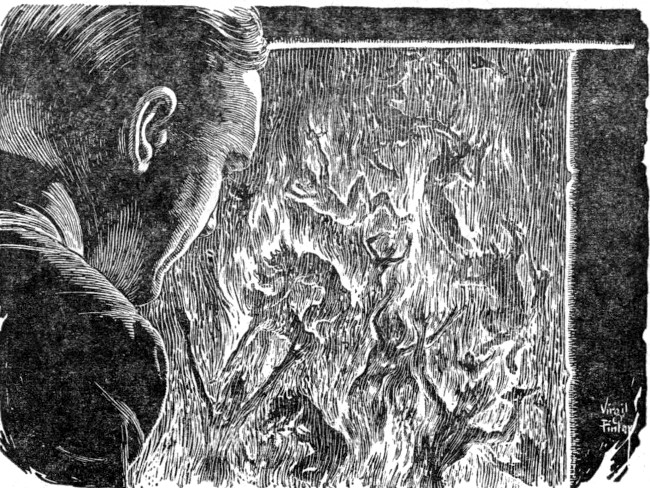
"I told you that my parents were missionaries in China. What I didn't tell you is that they never got out!"
He stopped. The rush of angry words from his flushed face died away into the room. In my mind they echoed again. "They never got out ... never got out ... never." We waited. The soft rustle of the flames seemed loud as their shadows wavered on the circle of still faces, all eyes were riveted on Harry.
More quietly now, his face once more almost its impassive self, he went on.
"They stayed with the Chinese Nationalist Forces all through the world war and afterwards, when the Communists took over, they were lost. When I was demobbed from the British Army I went to Hong Kong but I couldn't trace them and I couldn't get back into China. Some of the refugees I met thought they'd been executed for aiding the anti-communists ... mostly their own converts to Christianity, but there was no proof. That's why I came over here to work when I ran out of money. Vancouver is the closest main port to the Orient and I hoped I might keep in touch while I made a living. Now I know they are almost certainly dead ... and I want a chance to do something to beat those Red pigs."
His voice rose again on the last sentence and he looked straight at the Director. Hallam had sunk deep into his chair, again, his eyes shaded behind the heavy rims of his glasses.
"I see ... I see now," he murmured. "Yes, you must have your chance."
I looked over at Polly. Her eyes were wet and her lower lip looked suspiciously tight. She said nothing as Pat put a warm arm around her shoulders.
Harry was staring again at the fire. He was not here. Somewhere in China, or maybe nowhere in this world, was the red hell he saw in the flames.
CHAPTER 9
The Ides of March, as I like to call the month, were upon us. Once in a while the sun peered through the heavy clouds, sliding its pale beams between their tumbling banks to reach the soggy earth. Then came a night of rain, of heavy wind and thrashing trees; a faint rumbling of thunder over the sea and the mountains. I woke up and lay listening to the water as it dripped on the balcony while Pat, in troubled sleep, muttered and moved beside me. I woke again to a bright, cloudless sky, a perfect spring day.
After the routine checking of our animals and cultures, Dr. Hallam called a halt.
"Pat, you're tired," he said. "I think you're going stale."
"I'm slowed to a walk. It must be spring fever."
"It's spring all right," I said. "Look at that beautiful sunshine. It's time to shuck off the long woollies and take a big dose of sulphur and molasses."
"What a horrible thought," Pat grimaced, "Did you ever taste it?"
"I sure did," I said. "My mother was the old-fashioned castor-oil-is-good-for-you type. She thought I needed a tonic to get the sap running every spring."
"The sap can run again ... right out to Stanley Park," Hallam grinned, "and take Pat with you. She needs a rest and some fresh air. I'm going to play golf. We'll start again tomorrow."
We had reached a lull in our experiments. It was the obvious time for a break.
I drove slowly through the park until, in a grassy enclosure not far from Brockton Point, we found the seclusion we wanted. In midweek, at that time of day, we had the place almost to ourselves. I put down a ground-sheet, opened the car blanket on it, and we lay down. The mild sea breeze rustled soothingly in my ears and brought with it the faint splashing of the tide against the jumbled boulders of the shore. A deep sea ship hooted at the Lion's Gate bridge and, like an echo, the answering call gave it clearance to pass. For a moment more I lay still but the bustle of life around me was too strong to allow relaxation and I sat up to look out over the harbor. I turned to Pat as she lay quietly beside me. The wind had settled her dress closely to her parted legs. I followed the clean lines upward, and when I got to her eyes I saw that she had been watching me. They sparkled with amusement.
"Like what you see, huh?" she teased me.
"Love it, darling," I replied and leaned over for a kiss.
She broke it off before I was through and as I backed away I saw the slight frown that deepened the lines above her nose.
"What's the matter?"
"Nothing much, I hope. A slight pain in my stomach." She used the word in the ordinary sense.
"Whereabouts?"
"Low down above the pubis. It's gone now."
I laid my hand on the lower part of her belly and palpated it softly. There was no rigidity, no unusual mass.
"Does that hurt?" I probed deeper.
"No, it's a little uncomfortable, that's all."
I thought momentarily of the various possibilities and then dismissed it. The day was too lovely to spoil with a clinical discussion.
"Something you ate, no doubt." I smiled at her and lowered my mouth to touch her full red lips gently, once again.
She pushed me away. "That's enough. This place is too public."
I studied the bold contour of her nose and concluded that it was too large for true beauty ... the French influence, no doubt, in her Louisiana heritage. Her attractiveness was in her expressions more than in physical structure, I decided, but the mouth was perfect, no doubt about that, and her grey eyes as clear as a mountain pool filtered through limestone. I snuggled close to her, contentedly, and was beginning to doze in the fresh warmth of the springtime air when I felt her body tighten. I opened my eyes and rested on one elbow, watching her.
"What is it baby, the pain again?"
"Yes, it's crampy now ... something like a bad period," she twisted a little.
"Is it that time of the month again?"
"It could be. I've been having odd periods, very slight flow. I thought I might possibly be pregnant. It's been that way since I seduced you in December."
"That wasn't seduction, baby. That was merely anticipating the inevitable."
I began to question her seriously. There was little doubt in my mind after a few minutes that, if she wasn't pregnant, she was not behaving as a normal woman should. While we talked the pain returned, cramping and severe. She went white and pressed her hands to her belly in search of relief. That ruined the day. I took her home immediately.
"Take your clothes off and lie on the bed. I want to examine you," I said when we got there.
When I had finished there wasn't much doubt. She was about three months pregnant and threatening to abort. I left her in bed while I washed my hands. Then I came back and told her. For a moment she tried to be brave but then the tears came and I held her tight while her sobs shook us both.
"I've been afraid something might happen," she said finally, after I'd wiped off her wet face with a towel.
I sat on the edge of the bed. "Why?"
"You know I've been working with female ferrets, infected from the original one that aborted, trying to find out if that virus was a mutant from the S-Flu."
"Yes, I know that."
"I've passed it through quite a few females now and it's been showing definite differences. A week ago, I transferred it again and the ferrets got sick. I was working with one three days ago and it got loose and jumped on my shoulder and sneezed and clawed me as I tried to get it down and put it back in its cage."
"You had your suit on, didn't you?"
"Of course I did, but after I came out of the shower I noticed a little dampness. I checked the suit and found a defective shoulder seam where the helmet joins on. I suppose the ferret's claws opened it up. With all that movement I could have sucked some infected air into the suit."
"I don't know. With a separate air supply it doesn't seem too likely unless the claws carried virus inside like a hypodermic injection. It didn't scratch you, did it?"
"A little bit, I think, but it was on a place where I couldn't see it. I washed it with disinfectant later."
"Oh my God, what next?" I exclaimed. "But you've been having some irregular bleeding before this. Maybe it would have happened anyway. You don't have any signs of the flu?"
"I feel a bit stuffy and aching as if I were getting a cold."
"Well, we'll see. You rest here while I figure out what to do."
The fact that this might be the mutation we were looking for didn't penetrate just then. All I cared about was that Pat was sick and I had to take care of her, if possible, without a scandal. I was standing beside the bed, my mind racing over the various possibilities when she groaned and whispered, "John, the pain is really bad now. I think I'm bleeding too."
I got her a couple of codeine tablets and then dialled the Chief. This was one situation I couldn't handle myself, for obvious reasons, and I needed someone with understanding and discretion.
He was there in less than fifteen minutes, fortunately having just returned to the club house when I called. He heard my report. He checked Pat himself. She was well along now and we both agreed that there was no chance of stopping the miscarriage.
"Have you been close to many other people in the last three days?" he asked her, looking very disturbed.
"Nobody but you and John, as far as I know," she gasped between spasms of pain.
It was probably true. We three were working on the secret problems in isolation during the day. Polly and Harry helped us with the procedures that had to be done in the main lab and so were not in direct physical contact with us. We seldom stopped work until long after the day workers had left the Lab and were there in the morning before them. We didn't go out for meals during the day as we had all we needed on the top floor. I could see Hallam was concerned about the disease getting loose. If the vaccine we had was no protection from this new mutation, and if Pat had a case of flu it obviously wasn't, then this new disease could raise hell among the people and maybe finish what the Reds had started.
"We can't stay here, and we can't take her to a hospital," the Chief decided. "We mustn't let this new virus get out. I'll have to take care of her myself in the Research Lab. There are some instruments there and we can get more if we need them." He looked down at Pat. "I'm no obstetrician, my dear, but I think we can see you through this if you agree."
Pat smiled tiredly. "You're a doctor, and a good one. Do what you think best."
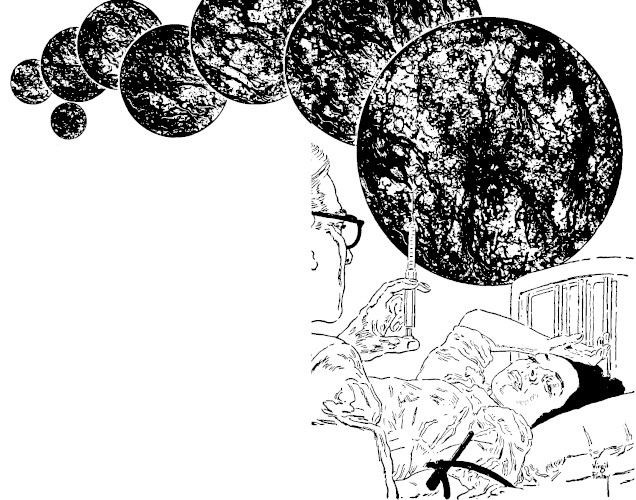
I had to agree even though it frightened me. I'd seen dozens of similar cases in my earlier days as a young interne but my imagination was too active where my own loved ones were concerned. The main danger was sudden hemorrhage but we could easily get blood sent up to us. Otherwise nature would probably take care of things in its own way. By now it was after rush hour and the Lab would be empty. Once more we let ourselves into the building and went up to the top floor, using the elevator for Pat's sake. She could hardly walk by now, even with our help, and it was a struggle to get her to her room. Once there we stripped the bed down. I prepped her and draped her for delivery and the Chief gave her intravenous demerol and a capsule of seconal. Then we waited.
An hour later it was over. She had aborted spontaneously, and, as far as we could tell, completely. With the assistance of a small dose of ergot we had controlled the bleeding and the uterus was small and firm. I checked her pulse and blood pressure. There was no sign of shock. She lay there quietly after I had changed the linen and, as I pulled the covers over her, she took my hand.
"I'm so sorry, John," she said weakly. "I guess I wrecked my own plans for having your baby when I got careless with that ferret. Now I'm probably sterile."
She began to cry silently, the big tears rolling slowly on to the pillow.
I stroked her damp hair back from her forehead and kissed her eyes gently. "Maybe you aren't sterile," I said hopefully, "and even if you are it doesn't matter. I love you, and I'll always love you, whether we have children or not."
"I wonder how many years we'll have to spend cooped up in here?" I said, half-seriously to Dr. Hallam later that night. Pat was sleeping soundly under the influence of a capsule of sodium amytal he had given her. We had cooked a steak dinner and now we sat, weary but relieved, over our coffee.
"Lord alone knows," he said. "We'll have to stay here now until we see if you and I are going to catch this thing and what the effects will be. I hope for the sake of our research project we do get it, although I'm not happy about being a guinea pig. Even if it proves to be a suitable weapon we still have to come up with a cure for it, or rather a vaccine to prevent it, so our own people and our allies are protected."
"Why include the allies?" I said, merely for the sake of argument. "Won't that increase the risk of the Reds learning our plans?"
"It will, unless we take a calculated risk. I believe we should manufacture vaccine and stockpile it, not to be issued until the disease is actually causing epidemics in Russia. Then we can fly the vaccine all over the world and let our friends use it. Some people may catch the disease, but not too many. We might even offer some to the Russians, to allay their suspicions, making sure it's too late to help much."
"But don't you think they'll get wise?"
"Of course! But if we do it right I believe they won't dare to use open aggression any more than we are doing."
"This kind of undeclared war could go on interminably, as the Cold War seemed to do back in the Fifties," I said gloomily.
"It probably could," Hallam agreed. "Our one hope is to effect a change in leaders, or at least in policy, in Russia. Maybe, just maybe, new leaders will arise who will work with the democracies for a world system of government."
"A faint hope," I said, "but I'll go to bed now before that cheerful thought yields to glum reality."
I checked Pat before I turned in. She was resting well and I thought she looked a little less feverish. Her head felt cooler and her pulse was about normal. Sadly, thinking of her loss and mine, I closed the door behind me.
Pat's recovery was rapid and uneventful. The following morning she got up and had coffee with us. In a couple of days she was getting around well although the Chief wisely insisted she rest for long periods and absolutely refused to let her work in the Lab. Part of her restless energy she expended on preparing tasty meals for us until we both began to grumble about our expanding waistlines. There was no sign that the new disease had ill effects other than what she had already suffered. Whether or not she was sterile was a question that would have to wait. I had no intention of putting it to the test for a good long time. To work for the cause of science was all very well but I could see no point in sacrificing my love to it.
The new virus was christened FS for female sterility and we re-named the old one MS for male sterility. The new one was easy to grow. It thrived on fertilized eggs, in ferrets, hamsters, mice and monkeys; in every animal we could find. With passage through numerous generations it became more virulent until, in its final form, it caused abortion in all pregnant animals. Invariably, after recovery of the animals, our pathologists were unable to find any developing eggs in their ovaries. Because of their short breeding cycle we worked mainly with hamsters, those fat little relatives of the guinea pig. Even the amazing fertility of the hamster was stopped by the FS virus.
"It looks as if we have the answer for the Russians," I said exultantly after we had tallied our results some weeks later.
"I'm not so sure, John, not so sure at all," Hallam said thoughtfully.
"Why is that, Sir?"
"Have you ever thought of the consequences of sterilizing every mammal on earth, and perhaps the birds and other animals too?" he asked. "This FS virus is powerful. If we start another pandemic it could get away from us. It might increase in power still more, though God knows it's bad enough. And obviously we can't inoculate every animal of all the species it may affect even when we find the vaccine to counteract it. We'd have to build another Noah's Ark and take it out in the middle of the ocean to be sure we could save them from extinction."
"We have a Noah's Ark now," I suggested. "We could isolate the Americans from Asia, Europe and Africa. Australia and New Zealand could do the same. We are doing it for the measlepox right now until there is enough vaccine to go around."
"That's true, although it wouldn't be difficult for the Russians to smuggle the virus ashore. They might do it if they thought they were licked. The dying soldier often tries to drag his enemy down with him."
"But aside from all that," he continued, "I still don't like it. Men have wiped out some of the most beautiful and interesting creatures of this earth. The passenger pigeon is gone. The bison is a curiosity in National Parks. The trumpeter swan is in danger and the California condor is on its last lap. I don't believe this world was created just so man could ruin it, and I don't want to go down in history as the most ruthless destroyer of all time. Oh, I know I'll be expected to give this discovery to our politicians. The discoverers of the atomic bomb and H-bomb did just that and their consciences have bothered them ever since. There is a greater loyalty in this world than loyalty to one's country ... it is loyalty to the human race. I believe in the Golden Rule. Call it Christian logic if you wish. We have already disturbed the balance of Creation in this world as a cancer disturbs the human body, and, like a cancer, when we destroy too much of the world we too may die."
"But the Russians don't live and let live," I objected. "Are you willing to let them take over the world and perpetuate communist doctrines?"
"It's a thought I do not like," he said very quietly, "but all through history "isms" have grown and then have died as time passed. This "ism" too could pass. Perhaps Gandhi was right. Passive resistance won in India and although the Reds are much more cruel than the British ever were, even they can't go too far. Remember the East German revolt and the Georgian riots after the denunciation of Stalin? Remember the horrors of Hungary? Our agents report increasing unrest in Russia itself. The people are sick of repression and terror. Demands for moderation are even printed in their papers. The Far Left is slowly moving back to the middle of the road. We should go to meet it instead of edging farther and farther to the Right, into the nightmare world of Hitler and Mussolini."
"Then what are we to do? Do you want to destroy the virus?"
"I don't know. After all, you and Pat are involved in this and may not agree."
"I know the politicians would want us to give them the information," I said. "I'll never forget in the States during the row over the H-bomb and Oppenheimer, how some pompous ass of a senator got up and said he thought scientists should stick to science and leave decisions of ethics and national policy to those who knew best—meaning himself and those like him. Democracy is a wonderful thing but I can't see how getting elected makes any man a sage. I honestly doubt if the ordinary politician is as competent to judge the effects of a scientific discovery as the scientists themselves are."
"What about democracy and the will of the majority?" Hallam countered.
"You have me there," I admitted. "I suppose if we adhere strictly to that idea there should be a vote on whether or not to use this new weapon, which, of course, would lose us the element of surprise. But again, what does the ordinary man know about such things. To come right down to it ... how often has there been a nation-wide vote in any democratic country on whether or not to get into a war?"
"I know of none," Hallam answered, "which means of course that essentially, in times of stress, decisions are made by a few, or even by one man. And that brings us full circle. Shall we make the decision now?"
"I feel somewhat like the old country doctor who taught me obstetrics," I said. "Whenever he was in doubt about a delivery he sat down, lit a big cigar, and waited. Nature usually took care of things for him."
"A smart idea," said the boss. "We'll work—and wait."
CHAPTER 10
Towards the end of April the Canadian research team left for Hong Kong. Now that intercontinental air traffic had ceased, Sea Island was quieter than usual, but even so, the roar of engines warming up in the cold dawn made it difficult to hear. Out on the tarmac the big RCAF jet transport rolled ponderously behind its tractor, wings drooping like a great eagle hovering over its nest. It glided silently to the loading area and we moved, a small knot of people, to where we could watch and wait for the word to embark.
"I hope Hong Kong will be warmer than this, Harry," I said, shivering deeper into my trench coat as the cold dawn wind crawled up my sleeves and down my neck.
"April is usually very pleasant," he said. "It's after the winter and before the rains."
"I was there a couple of times after the Korean War. I imagine the Kowloon side is cut off now. Used to be some nice shopping centers there."
"I don't suppose there'll be much left," he replied. "The area has been isolated for months. Everybody who could get away has gone. I expect it will be more like a prison camp than a tourist resort."
"Well, it shouldn't be too bad," I grinned at him. "Some of those Chinese girls with the high split skirts were mighty nice looking."
"Hush up now, you hear?" Polly said. "Don't you be giving him ideas."
"I don't need to Polly, he's been there before."
"Don't pay any attention to John," Pat said. "His mind's in a rut."
"Can you think of a better one?" Hallam asked.
"Oh, you men!" Polly snorted contemptuously.
"The luggage is all loaded, Doctor," a young RCAF officer had come up and reported to Cope. "We're ready to go now."
"Thank you," Harry said and turned to the Chief. "I'll let you know what happens, sir."
"Take care of yourself, boy," Dr. Hallam said as they shook hands.
We turned away, leaving him alone with Polly. In a few minutes she rejoined us, chattering brightly in her usual animated fashion until the plane moved out to the runway and Harry could no longer see us. Then her composure cracked and she cried. Pat and I took her to our place where the two girls buzzed around making breakfast and keeping themselves busy until the shock of parting had worn off a bit for Polly. Over our second cup of coffee she started to talk about it.
"It's a strange thing to say but I'm glad Harry's gone. I just know he never would have been happy with me if he hadn't done it."
"Why do you think that?" I asked.
"He never did tell me much about his people ... no more than he told you-all. I knew he was holding out on me but it wasn't any of my business. These English people don't brag much about themselves and their families. Anyway I knew he felt real bad when he got the S-Flu because as soon as he knew he was sterile he tried to tell me to go find somebody else. He seemed to think because he couldn't give me children I wouldn't want him. I told him I didn't hanker to marry a stud horse but it didn't do much good. I guess having no mother and father and then losing his chance to have kids of his own made him feel low. Maybe this will get it out of his head and he'll be OK," she paused, "that is, if he ever comes back. Somehow I feel deep down that he won't."
"Oh, don't be silly, Polly," Pat shut her up. "You got up too early this morning. Here, have some more hot coffee."
With the coming of spring across the cold northern continents, the big counter-offensive had begun. For years the agricultural scientists had prepared for such an occasion and now they went into action. Naturally it was all top secret but we were among the privileged few, since the border-line between the world of plant pathology and the diseases of man and animals had grown increasingly vague. It was essential that we know of their work and they of ours. Many of the original discoveries in virology had been made by botanical scientists and the first virus to be crystallized, the tobacco mosaic, was a disease confined to the plant world.
Since the Geophysical Year of 1958 and the advent of the space satellites, the meteorologists had made tremendous advances. Using information derived from the weather globes circling the earth, with their data on sun-spots and radar maps of storm centers, plus the mass of information now available through the weather stations in the polar regions, at sea and on land, the weather predictors had become extremely accurate. With seeding techniques, electronically controlled, they had made a start at changing the weather, although, up to now, little of this had been done because of a lack of international agreements. Now they were free to try out their ideas. It was interesting to follow in the newspapers the results of their work, and even more interesting to see how the peoples of the world tried to explain the various events. The great pandemics raging across the earth had resulted in a rush to the churches and the rise of all sorts of weird sects, prophets and calamity howlers. This frantic search for security renewed itself when the new wave of disaster began. To avert suspicion, for a while at least, and also because these great forces could not easily be localised, our NATO allies had to suffer with the Communists. Only the heads of the British Government knew, and they, with their usual courage, had agreed to endure, with the promise of American aid.
The first attack was a weather offensive. Using the jet streams which flowed swiftly to the east, swarms of tiny balloons were released by planes from the American Navy supercarriers in the Atlantic, and from the bombers of the Strategic Air Command cruising in the stratosphere above them. By the use of timing devices these deadly little toys destroyed themselves and dropped the new electronic seeders into the moisture-filled clouds rolling from the Atlantic across Europe. The wettest spring in recorded history was the result. Fields were almost untillable and the hay and grain crops that were planted were never harvested. The wet weather favored the growth of fungus and the rusts and blights so carefully cultivated by our agronomists and seeded into the winds that blew over Europe and Asia, thrived on what remained of the harvest. Further to the east the winds, now emptied of their moisture, sucked water from the steppes of Siberia, where the great new collective farms ordered by Khrushchev had torn up the grasslands. Dust storms scoured off the topsoil. No plants could grow. No animal could survive, lacking both food and water. The greatest migration in living memory was the result. The trek of the Okies out of the dust bowl of the early thirties was a mere trickle compared to the flood of refugees that poured east into Russia or south, down into the desert lands of the Middle East and over the Himalayan barriers. Many died before they got to the borders of India and the other Islamic lands. Many were killed by the reinforced border guards determined to prevent the spread of disease and famine in their own ravaged territories.
Of course the Communists retaliated, or perhaps it was in part the result of our own interference with nature. That fall, early frost hit the West Coast and blizzards screamed down from the Arctic over the plains. Our grain crops were ruined and much of our late fruit and vegetables. And now the "Folly of the Fifties", as one presidential candidate had called the price support programs, paid an unexpected dividend. From every cave and warehouse, from dumps and silos and refrigerator rooms, the stores of grain and potatoes, butter and meat, poured out by truck and train. Convoys of food ships had already left for the NATO countries. The terrible death toll of the measlepox made available sufficient food for the rice eaters of the Indian subcontinent from their existing supplies, since the weather war had had little effect in those regions. Africa, its own population decimated by the same measlepox disease, was left to its rich resources.
The Reds were not yet beaten. Desperate for food, they gambled boldly. The Soviet premier himself appealed to the United States and Canada for aid, in a shrewd psychological move. He knew we did not want to announce to the world that we were at war. It was doubtful if even our own people would believe it. World opinion would be likely to turn against us and uninformed or unbelieving governments, side with the Communists to isolate us. We had to help them, at least in appearance. In spite of tremendous losses the Soviets still outnumbered us and, if pushed too far, might start the long-awaited march into the vacuum left by the dying populations of Asia and the evacuation of our bases, daring us to start an all-out war.
The counterstroke was a masterpiece. Supplies of flour and other prepared foods were rushed, in great fleets of ships, to the European ports of the Russian Empire. Every pound of flour, every ton of meat, every cask of butter had been treated with the new tasteless and odorless contraceptive compound which our scientists had recently discovered. We never knew if the Russians found out why their women were not getting pregnant ... the rate of conception drops off in starvation in any case. It did not matter. They had two choices, to eat or to die.
In June, six weeks after he had left Sea Island, we heard again from Harry. Of course Polly had had letters, but purely personal ones as Harry had been much too busy to do more than write, "I love you, wish you were here" notes. Now, finally, he gave us some news. Polly came bursting into the coffee room one morning waving a sheaf of electron pictures in one hand and a bundle of closely written pages in the other.
"I got a big letter from Harry this morning," she said to the three of us around the table. "Would y'all like to hear the news?"
"Aw, Polly, I don't want to hear that mush," I kidded her, "Why don't you sell it to True Love Confessions magazine?"
"You shut your big mouth, man, and open your ears."
"Go ahead Polly. Never mind funny boy here," Pat said.
"Harry says they have a big lab set up in the main hospital in Victoria ... that's the city on the island, Hong Kong itself, and they're working shifts, twenty-four hours a day, to try to attenuate the measlepox virus."
"Brother! What a job!" I exclaimed. "One mistake and you've had it."
"Too right, you have!" the Chief said feelingly, his long forgotten Australian slang coming to the surface.
"They had to get out of Kowloon, he says because the refugees sneaked through the barriers into the New Territories and spread the disease. It was terrible because there were about three million people crowded in there. Now most of them are dead and the police patrol all around the island, day and night, to keep others from landing. He says almost all the British, except soldiers, have left. They send them to some small island first and then, if they haven't got any disease, they can go home to England. The research team is behind barbed wire and almost nobody is allowed in or out—but their quarters are comfortable."
"Hot and cold running maids, I suppose," I said.
"If you were there they'd be running, all right."
"Shut up, John. Go on Polly," Pat said and pinched my arm.
"They haven't succeeded in weakening the virus yet and if they kill it with formalin or one of the usual methods it won't work as a vaccine."
"What ways have they tried?" Hallam said.
"He doesn't say. There's one thing I don't like," she said thoughtfully. "He has an idea that if they went into China they might find survivors of the pox in areas where the disease has almost died down and get some serum from them, or perhaps find that the measlepox is weakened in those areas and could be used."
"It's too bad our agents didn't get enough vaccine for testing," I said. "It would have saved exposing our men to that sort of danger."
"One of his ideas is to give volunteers serum from recovered cases and then let them get the measlepox."
"You mean like giving children gamma globulin shots after they've been exposed to measles so they'll get just a mild case of the disease and be protected for life?" Pat asked.
"That's the general idea," the Chief said. "Then, too, he might want to look at the animal population in the area. There's a theory that cowpox was originally smallpox that got into cattle. Now if you get cowpox, as milkmaids in England often did many years ago, on their hands, you probably won't catch smallpox. That's how the legend arose that milkmaids had lovely complexions. They didn't get smallpox and so their faces weren't scarred like most people in the eighteenth century. Jenner got the original idea for vaccination from that. The same thing might apply to measlepox. If he could find a mild form of it in some animal we could use that as a vaccine. We try to do this in the Lab by inoculating animals. Harry wants to go out into the devastated areas and see if nature has done it for him."
"That may be soon, Doctor," Polly said, "but I'll bet he's also hoping to pick up news of his folks."
"Could be," Hallam agreed, "but they are very small pins in a terribly big haystack, if still alive."
"That crazy man," Polly murmured. "I know he'll kill himself yet. If he doesn't get the pox the Reds will catch him."
"There's not too much danger from the Chicoms right now," I said. "The way they are dying out, the border guard must have holes in it big enough to take a division of troops through, let alone a small reconnaissance party."
In the early summer of 1963 Pat had completely recovered from her miscarriage. The Chief and I had suffered nothing more than mild colds from the FS-flu. We had set up new experiments to see if we could temper the destructiveness of the virus with the intention of confining its effects to the human race.
"I have no compunction about using it on the human race," Hallam said. "The human being has free will and should be prepared to take the consequences of his follies and work out his own salvation."
I had to agree.
One late summer day when the tests were running smoothly he said to me, "John, I think you should take Pat out of here for a month. There's no point in isolation now we are all recovered, and you need a rest."
"What about you?" I said.
"I'll take a break after you get back. Besides, I want you to do a little experimenting on your vacation."
I wondered out loud what was coming next.
"Well," he smirked, "this is a good chance for a honeymoon and you might find out for me how permanent the sterility effects of the original FS-flu are."
I couldn't think of a more pleasant experiment.
The United Church ceremony was a quiet one. Both Pat and I felt that, having been married before and having subsequently made fools of ourselves, we didn't want much fuss this time. The ceremony was quiet but the party that followed certainly was not. Dr. Hallam had recently moved into a penthouse apartment in the swanky new Lion Heights district overlooking Howe Sound and the Straits of Georgia. From the church it was a quick run out to his home, followed all the way by the hooting automobiles of half the Laboratory staff and a good crowd from the Hospital itself.
From the corner living room of the apartment there was a magnificent view south to Point Grey and the University. Off to the southwest, in the haze of late afternoon, the Olympic mountains glimmered faintly across the water and the dark silhouette of the Island cut the western horizon. To escape for a moment from the uproar, I had moved out onto the rooftop garden and, with my arm around Pat, watched the slow ending of the day. Behind us the french doors opened as Hallam joined us. The buzz of talk and laughter, heightened by the cocktails, broke the quiet of our thoughts and died again as he closed the doors behind him.
"This really is a lovely spot," Pat said to him. "Will you pardon a woman's curiosity and tell me, isn't it terribly expensive?"
Hallam grinned. "It would be except that I'm part owner of the building and get a cut rate."
We stood there quietly, absorbed in the view, then Pat took Hallam's arm. "Let's go in now," she said. "We will have to leave soon."
The noise came at us in waves as we opened the door. Little knots of people were all over the rooms, talking, laughing, eating, moving about and re-forming new groups.
"They obviously don't need us," I whispered to Pat. "Let's get out of here." I winked at the boss and he shook both hands to us, prizefighter fashion, as we slipped out.
The Ferguson glided into the driveway without the motor running as I tried to escape. A roar of hand-clapping, cheers, jeers and yells broke out above. It was too late for them to catch us so they waved and shouted words of tipsy wisdom. A few ribald male remarks were stifled by feminine hands and the last howls and shrieks faded back up the hill. At the bottom I stopped and removed the inevitable tin cans and old shoes, brushed off all visible confetti and moved on towards Horseshoe Bay. The sloop was ready. While I started the motor and cast off, Pat changed into slacks and sweater in the cabin and then got busy making sandwiches and coffee. I set our course around Bowen Island, heading for the Sunshine Coast and the long winding fiords that split the timbered ranges.
It was hours later. At Pat's suggestion I had gone below for a rest and then had relieved her while she did the same. We wanted to get well away from the big city and the ocean traffic before we stopped. About two o'clock she wandered up from below. The moon was high now and in the clean cool light we were close to shore. Here the coast was deserted and, as we skirted a rocky point, a small cove appeared, the entrance barely large enough for the yacht. The moon, going over to the west, shot its light through the gap to show a sandy beach dimly outlined at the farther side.
"John, let's look in there. It seems a likely place to stop."
I cut the motor and glided through the entrance, trusting the smooth unbroken surface to cover enough depth for the boat. The million pinpoint lights of our phosphorescent track died away as we slowed. The bowsprit almost overhung the sloping beach when I dropped anchor.
"Plenty of depth here," I said quietly, reluctant to break the silence. "It should be a good spot to spend the night."
Sheltered by the northern arm of the cove, the remains of an old cabin hugged the rising slope. In front of it, in the little clearing, a few old fruit trees, branches broken with age, spotted the grass. The small stream that probably had tempted this early settler ran at one side of the cleared land, the water spreading out to glitter over the stones and sand of the beach before losing itself in the dark salty bay.
"What a wonderful place for a swim," Pat whispered, her eyes enormous in her shadowed face.
The air was still warm, with enough breeze to discourage any mosquitoes.
Quickly Pat stripped and stood there proudly, waiting for me. To keep her hair dry she had put on a white bathing cap and, in that pale light, she shone like some strange shaven statue from an old Egyptian tomb. She moved and the illusion disappeared. Naked, I reached for her and pulled her close. For a moment she clung to me and then, teasingly, she pushed me away and dived over the side. The water was cold and the chill of it on my skin soon relieved the tension the sight of her body had aroused in me. For a while we swam and splashed in the shallows, then I loaded the dinghy with towels and blankets, threw in a flask of rum with some cokes to dilute it and we went ashore. Her hand in mine, we walked around the tiny cove, the sand coming up pleasantly between our toes and the cool salty water sparkling on our skins. I brushed it out of my hair and Pat shivered as the fine spray hit her bare skin.
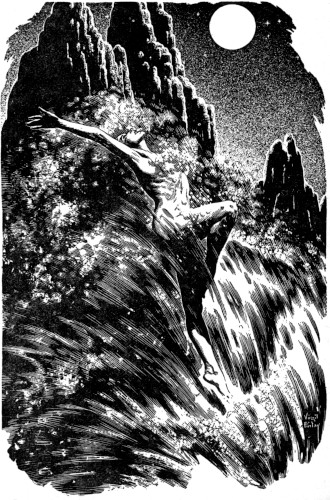
"Better get warmed up," I said, and led her back to the clearing.
There, from a deep pool dug in the stream by that early settler, I poured fresh water over her and rubbed vigorously with my hands to get off the salt and warm her up. The throbbing aching torment of my desire returned. She moved closer, her tongue wet on my lips.
In the soft grey glow of late moonlight, her face, twisted for a time by the agony of her passion, was smiling calm and her eyes looked up at me serenely. I rolled away from her and pulled the blanket over us. She cuddled into my shoulder and slept.
CHAPTER 11
The sunny days slid by as we explored farther and farther north. The weather held fair all that month except for a few quick showers that washed the warm decks and cooled the quiet air. There was little good sailing weather but we didn't worry. There was fishing enough, swimming enough, and loving enough to fill the days and nights.
In a deep side channel of Louise Inlet, I was trolling one day in the fourth week. Pat held the tiller and the engine, throttled back hard, barely puttered along. Then, above the noise, the sound of a more powerful engine rose and gained rapidly in intensity. Around the bend from the main channel an amphibian swung into view and banked to glide down over us. It banked again, full circle, and the pilot let down and taxied up behind our boat. I stopped the engine and waited. The small door on the passenger side opened and a bare head stuck out. I recognized that full, cheery face.
"For the love of Pete! It's the Chief," I yelled above the motor.
Pat nodded, not too happily. Her woman's intuition was probably working overtime. A short time later we anchored inshore. The Boss and his grim-looking pilot climbed aboard.
"Lord, we've had a time finding you two," Hallam sighed. "This is Colonel Jones, United States Air Force."
I raised my eyebrows at Pat. Neither the man's flying suit nor the plane's markings had shown any indication of their military nature.
"How do you do sir," I said, as I shook his hand. "Are you up here on a vacation?"
"Strictly business, I'm afraid," he said crisply.
"Business? With whom?"
"With you." The lips opened and shut in his face like a ventriloquist's dummy.
He was strictly business, I thought. "With me?" I turned to Hallam. "What have I done now?"
He didn't smile at my feeble joke. "It's not what you've done, John, it's what they want you to do. Colonel Jones is from the CIA."
"Oh oh, the cloak and dagger boys," I thought. "Trouble coming up." Out loud I said, "We might as well sit down and be comfortable while we talk. Pat, how about some beer?"
The Colonel was obviously impatient but he tried to swallow his irritability with his beer.
"It's nice being a civilian at times," I was thinking. "I don't have to take any more guff from the brass. This guy's obviously a West Point type in a hurry and it must gall him to have to wait on my royal pleasure. He wants something. Let him wait for it!"
It was a rebellious thought but I'd been prodded painfully by his classmates on occasion in the past. I couldn't resist getting a little of my own back.
"All three of you are cleared for Top Secret," Jones said. "I checked before I came out here."
I took a long drag at the bottle. "What about yourself, Colonel?" I smiled thinly at him.
Silently, stone-faced, he showed his credentials. Pat frowned at me. She thought I was being unnecessarily cool to a guest. Rivalries in the service meant nothing to her.
I grinned at him and the tension eased. "The old routine, Colonel. I wouldn't want to foul up with a security officer watching me."
The stern exterior cracked as he relaxed. "I hate to butt in on your vacation like this. I had no choice. We have a deadline to meet."
"Sounds familiar," I murmured. "Submit a complete report, in five copies, based on information you'll get tomorrow, to reach headquarters not later than yesterday. Well, give us the bad news."
"First let me give you an estimate of the situation as we see it. That will put you in the picture."
"You mean I'm being framed?" I joked.
He actually smiled. "The weather and biological offensive against the Reds are now at their height," he began, "and are proving most successful. We anticipate they will exhaust their food reserves very soon and will be desperate for more. If they ask us, we will give them some this winter, under certain conditions." (He was referring to the use of the contraceptive drug in that food, as I learned later.) "That will give them a respite, which we can't very well avoid, and the war is expected to continue on into 1964. By early summer, some eight months from now, we estimate that continuation of our offensive will drive them to the wall, since we will then inform them that we cannot give them any more supplies from our store. It is then that we can anticipate the hidden war breaking out into the open. Even if they retaliate in weather and bacteriological warfare, they must know we can win because our hoarded supplies will keep us going while they starve. They have to plan a knockout blow and yet our G-2 people believe they will not use atomic power. They won't use it because of its dreadful after-effects on future populations. Even the so-called clean bombs must affect many survivors and, in an already decimated world, they cannot afford to have contaminated survivors from which to rebuild the race. Also, they are sure that we won't use it if they don't. Now, as far as we can foresee, that leaves only one other way to achieve the knockout ... by the use of nerve gases."
"But we have nerve gases too."
"Yes, of course. However, we have information from our agents in Russia that, as a last desperate chance, they will fire their intercontinental missiles, plus shorter range rockets from their submarine fleet, at every major population center and key military target in the U.S.A. and Canada. Probably, in addition to nerve gas, the missiles will be loaded with various deadly bacterial toxins and bacteria, and quite likely new viruses of even greater lethal power than the measlepox, able to attack and kill people in as short a period as twenty-four hours. We also believe that, in the temporary paralysis of cities, military posts and air bases achieved by the nerve gases, they will attempt to land airborne or rocket-borne troops to capture and hold our main centres. As you know, we are not mobilized because there isn't supposed to be a war on. Their plan might be fantastic enough to succeed."
"Who dreamed all this up?" said Pat, skeptically.
"It's no dream," the Colonel said. "There's a strong moderate element in Russia today, mainly in the Armed Forces and the new managerial classes, that is sick of dictators and war. They have contacted us and are ready to revolt when the Reds are a bit more disorganized and the people still more starved and discontented."
"Where do I come in?" I said.
"You are still a Lieutenant Colonel in the army reserve."
"That's right."
"The President himself, on the advice of his counsellors, asks that you volunteer for special duty. As there is no declared state of emergency, you cannot be recalled. In fact if you don't want to leave Canada he can't force you to. He simply requests that you volunteer."
"That's all lovely, and very sweet of the old boy," I said sarcastically. "Why me?"
"On the Imjin River, in North Korea, there is a large plant which is very busy manufacturing those deadly viruses I talked about. The Russians have quietly taken over the country, and in fact the whole of China, since probably there are less than fifty million healthy Chinese alive today. The crowding into communes in the Fifties really facilitated the spread of the measlepox we hear. We think the Kremlinites want to keep an eye on them; probably want to sterilize with the S-Flu, those left by the other diseases. To have such a dangerous factory well away from their own homes and close to their enemies in Japan, as well as reasonably convenient to the submarine pens around Vladivostok, are other likely reasons for its location there. Whatever the reasons, the factory is there. Now, by good luck, the senior virologist is one of the moderates who is heartily sick of all this killing."
"Hear, hear," the Chief said. "I know exactly how he feels."
The Colonel nodded and went on. "He has agreed to give us the biochemical formulas of the viruses plus methods of growth, how to make the vaccine against them, and finally a sample of each culture to work with. We believe that if we have that information ... and also we hope to sabotage their installation ... we can defeat the attack before it ever starts. We plan to destroy their nerve gas centers at the same time and aid the rebellion," he concluded, "but that doesn't concern us here."
"I still don't see what I do," I said, although I had an uneasy suspicion.
"You were a paratrooper, weren't you? And you served in Korea."
"Yes, a long time ago," I admitted grudgingly.
"And you are a virologist?"
"You know that."
"You also speak some Japanese, Korean and Chinese."
"I wish I'd never admitted it."
"We want you to parachute into North Korea with a Special Forces Group, go to this plant, get the necessary information and sample viruses. The information cannot be written down for security reasons and because of this and the dangerous nature of the viruses we feel that only a man of your qualifications can be trusted to handle it."
"That's what I was afraid of," I said.
"Will you do it?"
"In the name of heaven, Colonel!" I exploded. "Twenty minutes ago all I had on my mind was catching a fish for supper and now you want a snap decision that may cost me my life."
"I'm sorry, Doctor," his face froze again, "but we haven't much time."
"The hell with deadlines," I growled. "I'm not on active duty now and no damn chairborne Pentagon pencil pusher is going to impose a time limit on me. Let him get out and do it himself if he can't wait."
"Unfortunately you are the best qualified," he said stiffly.
"Yeah, unfortunately for me," I sneered. "How is it the guys best qualified for the dirtiest jobs don't seem to be best qualified for promotion too?"
"John, please!" Pat put a hand on my shoulder.
"Sorry Colonel," I choked down my anger. "You hit some raw nerves with that best qualified remark."
"I'm sorry too, Doctor. We know you've already done more than your share. Perhaps if you think it over for a while, you'll want to help us."
"How do you propose to go about it," Hallam said to Jones.
"Colonel Macdonald, or a substitute, will have to renew his airborne training and get into first class physical shape. There will also be language school to brush up on his Korean and Japanese, with some basic Russian."
"Why Japanese?"
"It was the official language in Korea until after World War Two and many of the older people can speak it. What he misses in Korean he might be able to pick up in Japanese."
"How long will this take?" Pat said.
"About six months. Then there will be a month of special preparations for the attack itself. After that we wait for the right weather and the psychologically correct moment. The idea is to delay until the last possible moment before the Reds are ready to attack us and pull the rug out from under them. We hope the confusion and loss of morale will be so great that the partisans or maquis or whatever you want to call them will be able to rise and overthrow the communist regime."
"Adding all this up," I said, "I gather you expect the special training to start in about two weeks from now."
"That's right," Colonel Jones said. "That's why we need an answer soon."
"I have one week left of my vacation before I return to Vancouver. I'll let you know then."
"Thank you. I'll leave all the necessary information with Dr. Hallam at his office." Jones got up, bent slightly in Pat's direction and again to me, while he gave us a formal handshake. He climbed over the side and got into the amphibian without a backward glance.
"I wish I hadn't had to do this," the Chief said hurriedly as his big hands reached out for ours. "Try not to let it ruin the rest of your vacation. God bless!" He squeezed and my hand tingled until long after his great frame had vanished into the cabin of the flying boat.
After they had gone Pat cooked the fish I'd caught and we sat down to eat and talk things over. I hadn't committed myself in any way. My days as an eager beaver soldier were long gone and I was remembering the old army saying, "Never volunteer for anything." Pat had been unusually quiet. I knew she would go along with any decision I made but it is still not an easy thing for a woman to sit still while her man is thinking of committing what might turn out to be suicide.
"Want a drink?" she asked, getting out the bottles before I could answer. She mixed us a rum collins, taking the last of the ice from our little refrigerator.
"Well, what are you thinking?"
"I'm thinking just how much hell the next eight months will be."
"Hell for both of us, darling," she said. She leaned across the narrow table to kiss me. "I'm glad you want to do it. It may not win the war but you'd never be happy again if you didn't try."
I didn't relish the idea at all but I knew she was right. I'd always been a volunteer. It was too late to change. I heaved up off the bench and went on deck. The stars were out now and high overhead an Alaska-bound plane hummed by, its green and red lights winking.
"Red light ... green light ... GO," I thought and remembered again the quivering anticipation as I stood in the door of the C-119 watching for a little green button to flash on. I shivered with old remembered fears and I felt Pat's arms go around me from behind as she kissed the back of my neck. I think she sensed my trouble. She knew how I had sweated out jumping and the long strain of combat duty.
"Come down below, sweetheart, it's bedtime. Come and let me help you forget. There are so few nights left."
I rolled over in the soft sandy ground and pulled hard on the risers to spill the air out of my parachute. The breeze was dying. The spotted cloth wavered, flapped, and the canopy collapsed. I got to my feet, hit the box and stepped out of the slack harness. Slowly I straightened the canopy, folded it over my arms down to the back pack and tightened the straps over it. I picked the whole thing up and zipped it into the carrying bag. The trucks were waiting across the drop zone. I heaved the heavy bag up across my shoulders with the handles on each side of my neck and started towards them. My first jump was over. I was tired ... tired... tired and quietly proud. The first one was past. I was a paratrooper again.
"How was the jump, Colonel?" A small black haired officer of about my own age came up behind me. Captain Balakireff, the son of White Russian refugees and lately of Shanghai, China, spoke with a faint accent. His thin lips and hollow cheeks reminded me of the ascetic saints on a Russian ikon. He should be wearing a beard, I thought.
"Pretty good, Blackie. It's been a long time."
Trudging beside him through the loose sand, a tall blond and thick chested Lithuanian Captain called Makstutis grinned down at me. "Need a hand with that pack, Doc," he said, completely unconscious of the difference in our ranks.
"No thanks Mak. I may not be in shape but I'm not that decrepit."
Closer to the trucks Lieutenant Pak On, a native born Korean imitation of Balakireff awaited us. With him was Lieutenant Kim Cho Hup, a living embodiment of the Chinese god of happiness with his round smiling face and the figure to go with it. For all his weight, the result probably of too much feasting on his Hawaiian island home, Kim was quick and tough, a veteran of the early days in Korea with the 25th Division.
These four, all war veterans and career men formed, with me, the officers' component of a Special Forces team. With us, as we assembled around the trucks were twenty-five enlisted men. All were Orientals, a few native born, but mostly Hawaiian sons of immigrants. They too were Special Forces volunteers, qualified both as paratroopers and rangers. Each had a specialty, weapons, demolition, signal, engineer, medical, and each could take over at least one other job in an emergency. They had to be fluent in one of three languages, Korean, Japanese or Mandarin Chinese.
We jumped as a team in two sticks, led by the Slavic officers. As senior officer I acted as jump-master in training although in the actual attack I was to be protected rather than to command. The operations plan was simple. We were to drop in North Korea in high mountain country near our objective. The three whites would masquerade as Russian officers. We hoped to pass as inspectors or medical health officers touring the country with a North Korean Army escort. As the Russians had taken control in China and North Korea, we should be able to get by, at least for a while, considering the disorganized state of that plague-tortured peninsula. A rendezvous with the agent who had contacted the enemy virologist would be arranged. From then on it was up to us. Afterwards we were to be evacuated by submarine from a pre-designated spot on the coast.
We climbed into the trucks. As they rolled down the road back to our quarters, I pulled Pat's latest letter from my pocket and skimmed once more through its well remembered pages. Because of the danger she was no longer working with the research project but was helping Polly on the electron microscope.... Polly had heard from Harry.... He was in Formosa training with the Americans and Nationalist Chinese for a landing on the Chinese mainland ... he had sold them on the idea.... Polly was worried of course.... She was too ... would I please be careful ... she loved me and missed me so much ... she wanted me to come home safely.
I folded the letter and put it away. I'd be coming home all right! On that I was determined. No damned disease, no stupid Communist fanatic was going to stop me!
The emphasis on pure physical conditioning changed although we continued our long marches and strenuous exercises. Now we worked constantly in Russian or Korean uniforms, used enemy equipment and talked Russian or Korean. It was hard at first but gradually I achieved a basic knowledge sufficient to deceive a casual observer.
A week before Christmas General Rawlins, the Special Forces commander, called me into his office. He came around his desk as I saluted.
"You're looking fit, Macdonald. The instructors tell me your team is progressing very nicely."
"Thank you sir."
"In view of their reports I am letting you and your men off for Christmas and New Years. Air transportation will be arranged as far as possible. Warn your men again about security regulations. See the Chief of Staff for the details." His normally stern face cracked into a smile and he stuck out his hand.
"Merry Christmas," he said.
The day following my return to Vancouver was Christmas Eve. Polly and Pat and I drove out to have dinner with Dr. Hallam in his hill-top apartment. We found him dressed in a white chef's cap and apron busily sugaring the top of a ham. In a moment the girls found aprons of their own and began to get in his way. I got busy with the brandy bottle and the egg nog.
"How's the research project coming, sir?" I asked as we sipped our drinks.
"We have a variant of the FS-flu now that sterilizes only monkeys. It may be the weapon we're looking for." He paused and looked mischievously at Pat. "Did you know, by the way that the original FS virus does not cause permanent sterility in primates?"
I caught the glance and her look of dismay.
"Primates? You mean humans too?"
He nodded. I turned to Pat.
"Then you aren't sterile? You didn't tell me you had a biopsy."
This time Hallam laughed outright. "How many months have you been away soldier?"
"My God! Pat ... you're pregnant!"
She came to me. "Yes darling. I am. I didn't want to tell you because I might miscarry again: but I went to Ray Thorne and he says I'm doing just fine."
"Oh baby," and I pulled her into my arms. "What a wonderful, wonderful Christmas!"
It was after dinner. We sat around the fireplace in silence. To one side the Christmas tree, with its tinsel streamers and glass ornaments, threw back a shower of sparks in answer to the flames. The coffee was finished and I savored the last drop of Drambuie slowly, letting it bite my tongue with its pungent sweetness.
"I wonder where Harry is," Polly spoke as she looked into the fire, absently twirling the liqueur glass in her fingers.
"Have you had any news?" I asked.
"I got a letter this morning," she replied and added after a pause. "They left for the Chinese mainland a week ago."
The wood crackled on the hearth and the room was silent again. I thought of the bare brown hills of China; of the squalid mud huts like those I had known in Korea; of the lice and fleas, the filth and bitter cold; of the snow that sprinkled the stunted brush and dusted the stubbled rice paddies. I thought too of the death that lingered in those dank and sweaty rooms, black holes of fear and despair.
"God help them," I said fervently and added a little prayer for myself in the days to come.
Polly began again. "He wrote the letter on the assault landing craft and sent it back with the Navy. Apparently they had not managed to perfect a vaccine before they left Formosa so the party is unprotected against the measlepox. They hope to find enough survivors on the mainland to collect anti-serum, provided they can keep away from Red patrols."
"It's a shame they couldn't have waited another couple of weeks," the Chief spoke up.
"Why so?" Pat asked.
"I got news this morning that our agents in Russia have sent out more of the vaccine, stolen by the partisans, I suppose. It should be available in a day or so and some of it will be rushed out to the research teams for their protection."
"Maybe they'll send another team with vaccine after the first," Pat suggested.
"I surely do hope so," said Polly, "I'm real worried about that man."
CHAPTER 12
The ache of parting was still gnawing at my belly like a peptic ulcer when Blackie picked me up at the airfield in a jeep.
"My goodness, Colonel, I'm relieved to see you."
"Why? What gives? I'm on time."
"Yes sir, but the operation has been advanced, you see. We leave for Japan in the morning."
"In the morning? Oh, no!" I snorted in disgust. "Isn't that typical."
The week after our landing in Japan, we moved out again with full GI equipment. Our enemy clothing and arms went along in sealed wooden boxes as cargo, not to be opened again until D-day. Ostensibly, we were replacements for the Korean Military Advisory Group on our way to South Korea. We landed at Kimpo Air Base, near Seoul and then moved out by truck up the road past Uijongbu into the wooded hills south of the defense line near Kumwha. In the twelve years since I had come down that road for the last time, the mud and thatched villages had been rebuilt. Now the measlepox had ravaged, once again, the stoical population. Only a few were left, the few who perhaps had fled to the mountains and stayed there starving but afraid until the pestilence had killed and passed on. So it was back to a familiar land I came—a land of silent hills; of hardwood trees standing bare and cold above the brown earth and the dead brown leaves of the Kudzu vine; a land of little streams that thawed in the sheltered spots as the February sun rose higher in the cold dry air.
We trained over the steep hills, marching up faint trails where the woodcutters once had gone. In all that wild land there was silence—the silence of the four-footed animals who, unknown to us except by some chance meeting, watched our slow approach. The long nights shortened into March and then through April. Still we waited. Rains had come now, the spring rains, forecasting the steamy monsoon of July. In the steep valleys grass showed green and the maroon-petalled anemones had already conceived. At last the cherries were in bloom. It was time to go.
The troop-carrying convertiplane dropped vertically down on the freshly prepared landing strip shortly after dark. As soon as we were loaded it took off, wavering slightly under the hammering blast of the jet engines, and then went up, sidling over the dark trees that encircled the strip, and drifting down the valley like one of their lately fallen leaves. It swung west to go out over the Yellow Sea and then circle back into North Korea. Our rendezvous was farther to the east in the wild country close to the railway that ran up the east coast from Wonsan to Hungnam. Perhaps we could lose the radar in those steep valleys. It would have been suicide to attempt it from the east, across the Sea of Japan, right into the Siberian tiger's mouth.
An hour later we were approaching the drop zone. There would be a moon before midnight to help us make contact, but now it was dark, better for concealment but difficult for recognition of our landing area. The plane slowed, the red light came on. The pilot must have picked up the signal from our agent.
"Get ready!" I shouted. The men shifted their packs and moved their feet to get the weight distributed.
"Stand up! Hook up! Check your equipment!" One by one I called the time-honored signals, the ritual so necessary before the jump. By now the air crew had the door open and I looked out. Even with my eyes accustomed to the darkness I could see little but the dark mass of hills below us and the rough black line where they met the horizon. Above, the stars were bright. To the east a faint paleness marked where the moon was hiding. I looked down again and now a tiny green light winked up at me. It was the dropzone and the all-clear signal. The aeroplane passed on and then came back to make its run.
"Stand in the door!" I yelled. My hand holding the static line shook slightly and my thigh muscles were tight with cold and adrenalin.
"GO." The red light had changed to green and the first men were out. Shuffling from the rear the rest followed swiftly and seemed to drop on to each other's shoulders as they went through the door. The last man went by. I stepped behind him and in the same smooth motion went on out. The rush of air twisted me and a momentary black cloud blotted the stars as the tail assembly passed over. The roar faded and I floated, weightless and almost mindless, like a baby in the womb, while my mental clock ticked the slow seconds. "Three thousand, four...." The snapping of elastic and the rush of risers behind my head stopped in a sliding jerk. I looked up. Above me a black circle swayed. It was complete; no torn canopy to worry about. Alive now, I looked around full circle. Faintly I saw two parachutes below and in front of me as I glanced back the way we had come. We were dropping quickly into a steep valley, the others at a lower level where it widened somewhat. I could see outlines of the terraced rice fields coming up to meet me. In that warm, wet air I could have made it standing. The chute collapsed without a protest. I struck the quick release and stepped out of the harness. "Pretty soft," I was thinking. "I hope the rest is like this." Where the hillside joined the terraces I found a trail that paralleled the line of our jump. I followed it down hill.
An hour later, we were all together. The slow speed of the plane, the low jump altitude and the lightness of the wind had kept the sticks from scattering. Nobody was seriously hurt. We buried the parachutes in an overhanging bank under the Kudzu and began our march down the path. As the protected one I was now about the middle of the file. The moon was rising and the light was strong in treeless areas. We kept to the blackness of the shadows as much as possible and made a reconnaissance before crossing any open space. Our progress was slow. It must have been another hour when the line stopped advancing. A short time later a whispered message came back, "Send the Colonel up front."
When I got there, Blackie and Pak were talking Korean to a small man dressed in the ragged coat and baggy pants of a peasant. Pak introduced him.
"This is Lee Sung. He has the password and knows all about us."
I took the small limp hand Lee Sung extended. "I am Colonel Macdonald, the Doctor. What do you want us to do now?"
"I have a place where you can stay," he replied in excellent English, with an accent that seemed familiar, though blurred with lack of use. "We should go there immediately."
We followed him a short distance on the same trail and then turned up a side valley where the cultivated land rapidly rose in steps and narrowed to a point at the little stream which had watered the crops. There we found the remains of a small village. Hidden behind a row of thatched mud huts that faced the fields with eyeless walls, a narrow courtyard opened abruptly to the main house. Overhanging wooden beams and tiled roof had protected the white paper walls of the recessed front porch from the weather. It was the house of a rich farmer, rich for Korea that is, and still intact.
"This is where you stay," said Lee.
Makstutis took command. "Kim, set out your perimeter guard and get the men settled down. No lights; no smoking; no talking. I'll take a look around."
"Yes, sir," Kim moved them away. I followed Lee, Blackie and Pak onto the verandah of the house, stepping quietly on the wooden planks. Sliding aside one of the paper and wood panels, we bent our heads and entered. Crouched over a shaded flashlight, Lee traced a map laid on the grass mat floor of a small side room.
"Here's where we are now. Here's the Imjin River and the village of Song-dong-ni. The virus factory is less than a mile this side of the village." He indicated the spot. "It's about twenty miles from here over the hills."
"What are the trails like?" Blackie asked.
"There's a small trail, a bit slippery in wet weather, that climbs the ridge behind this house. It joins a wagon road that runs down the next valley and then you cut over the watershed to the Imjin by another trail. That one is good in all weather."
"Is it travelled much?"
"Not now. The villages over there were wiped out by the plague. I doubt if there is anybody left."
"How do we go about contacting the Russian who's going to give us the virus?"
"He's not a Russian, Colonel, he's a Pole. His name is Anders and he is the senior virologist at the factory. He is a keen botanist and it's his custom to wander alone over the hills almost every day collecting specimens. He carries a burp gun in case he should meet bandits although there's little chance of that nowadays. However, it is a good thing to remember in approaching him that all strangers are suspect. I try to catch him on these walks of his, so it's a matter of chance and may take a day or two to arrange a meeting. In the meantime, may I suggest you and your white officers keep out of sight as much as possible. Your oriental soldiers can pretend to be living here temporarily while searching for bandit gangs."
"What about food?"
"The farmer who owned this village had a well stocked store room. You will find it at the back of the house. There is plenty of rice, root vegetables, pots of kimchi ... you have eaten kimchi I presume ... and other preserved foods."
"What about the measlepox, doctor?" Blackie asked.
"I doubt if the food was contaminated. Besides we had one shot of that Russian vaccine before we left. It's a small risk."
"I envy you Colonel. My only protection is to run away," Lee said wryly.
"How did people survive?" I asked.
"After they became aware of the danger some took to the hills and some small villages escaped. They kept strictly to themselves and killed anyone who attempted to force his way into their area. I have a small fishing vessel at Wongpo. I took it out to sea and stayed there by myself for several weeks."
"Then you have no family?"
"No, my father was an exile in England during the Japanese occupation. I grew up and went to college there. We came back to our ancestral home after the World War. He and my mother died very soon afterwards. The Communists let me stay, mostly because they think I am sympathetic to their viewpoint and I have made myself useful to them. An agent has no business with a family anyway," he concluded grimly.
We talked on for some time, clearing up the details of our plans. It was uncomfortably close to dawn when he left.
CHAPTER 13
I had a headache—a sonofabitch of a headache to put it bluntly, and my eyes felt as if some gremlin had got in behind them and was squeezing hard on the eyeballs. It had started as a mild frontal pain when I was talking to Lee and I put it down to the tension of the jump and the subsequent march to our present camp. I'd felt a little chilly too when we got here but the nights were still cold in the hills and we cooled off quickly after exercise. I was sure the aching in my back was due to the pack I had carried, about seventy-five pounds of machine gun ammunition, grenades and some medical supplies for emergencies. But it wasn't going away and I felt lousy. I was feeling damned sorry for myself as I went to sleep. Seconds later it seemed, my eyes were wide open again and throbbing.
"Damn it, this won't do!" I muttered, and unzipped the light sleeping bag we carried. "Lord, I'm hot!" I searched the aid kit shakily. Finally I located the APC's, communist version, and then decided to check my temperature. It was 40° Centigrade, right on the line. I translated that into the more familiar Fahrenheit ... 104°. The bar of mercury, slaty grey in the early light, shimmered and wavered as I tried to hold the thermometer still.
"Hell's teeth! What a time to get sick."
I went over the various possibilities, forcing myself to concentrate, to think as clearly as I could. It was too soon to tell. It could be malaria, or meningitis, typhoid or typhus.... I'd had shots for those two. What about dengue? Or old friend influenza? My mind was wandering now. "Too soon to tell," I said, and I swallowed the APC's. "Too soon to tell ... too soon to tell ... to tell. tell. knell. hell. The silly rhymes echoed down long empty corridors to my ears. I knew I was burning up and getting delirious ... it felt like being drunk. Drunk? I'm not drunk ... I never get drunk now ... nothin' to drink, drink, drink, nothin' to drink and I'm hot. Oh God, my head! Must tell Blackie I'm sick. I have to tell Blackie. I HAVE to tell Blackie!" It was important I knew and then I couldn't remember what was important. I had to have water. I tried to stand up.
There was a murmuring somewhere nearby but I couldn't locate it. It persisted like a buzzing fly and I was annoyed. My head still hurt and my eyes ached and I ached all over and I was hot and sticky and thirsty and weak and that damned noise wouldn't go away. Wearily I decided I'd have to do something about it. I tried to lift my head but couldn't make it. I tried again and felt myself lifted. Ahead of me a face wavered and then stabilized.
"Colonel Mac, Colonel Mac, can you understand me? Colonel Mac...."
I blinked blearily at him. I squeezed gritty eyelids together and tried again. It was Sergeant Jimmy Lee, my aidman. "Lee what is it?" My mouth was dry and it was hard to talk.
"Sir, we don't know what's the matter with you. Can you tell us?"
I shook my head and it tried to fall off. Lee propped me up again.
"You've been out of your mind for three days now and running a hell of a fever. I sponged you and gave you APC's. I even gave you a shot of penicillin when we thought you were going to die." His young face screwed up with worry.
"I've still got the fever, haven't I?" I muttered weakly. "It feels like it."
Makstutis came into focus beside Lee. "It's down some, Doc, but your face was red as a tomato and your eyes are still all bloodshot. Your urine was bloody too. Now you've got little red marks, kinda like bruises, on your skin."
"Eyes all bloodshot ... little red marks." Somewhere a circuit snapped shut in my head. "God Almighty! I've got Songho Fever."
"Songho Fever? What's that, Doc?"
"It's called Epidemic Hemorrhagic Fever in the States, and it hit a lot of G.I.'s around the Iron Triangle in the Korean War."
Jimmy wasn't too young to remember. He had been in on the tail end of that fight.
"You must have picked it up around Kumwha," he said. "There's nothing you can do for it is there?"
"No more than you are doing now, unless the Reds have something we don't know about." I sipped the water someone brought and lay back.
Blackie had come in when he heard I was conscious. "Lee Sung is back," he said. "Maybe he could get something from Anders, or better still, get Anders to see you."
"I couldn't walk two minutes, let alone twenty miles."
"By Golly, we'll carry you," said Blackie. "Don't you worry Colonel." I fell asleep again with his comforting hand on my shoulder.
The trek across the ridges was rough. I can't remember much of it except the feeling of falling when the improvised stretcher tipped on the steep slopes or someone lost his footing. By now, one of our sergeants, another Korean War veteran named Lim On, was ill with what appeared to be the same disease and the morale of the unit was slipping. We had jumped a week ago and as yet had accomplished nothing. In a deserted, half-collapsed farmhouse about a mile from Song-dong-ni, they laid Lim and me down on piles of straw while most of the men bivouacked in small dugouts camouflaged in the woods beside the house. We waited for Lee Sung to get Anders.
He arrived the following afternoon. A tall man, he looked like a benevolent hawk, pale smooth hair, sharp nose, keen grey eyes. He stooped under the low lintel of the hovel and stood for a while in the semi-darkness of the tiny, paper-walled room until his eyes were adjusted. Then he came and dropped on one knee by my side.
"You are a very sick man, Colonel," he said slowly, in precise English.
"I think I have hemorrhagic fever," I said.
"There is little doubt," he agreed as his hands searched my neck and armpits for swollen glands. "See, the small blood spots on your abdomen, and your eyes. And what else have you noticed?"
I gave him the story, including what Makstutis had told me about the bloody urine.
He nodded his head. "Yes, it must be so. I cannot now prevent it, but I can help you to get well." He took a syringe and a bottle of solution from the small pack he carried. "Lee Sung told me. I brought serum. Every day you must take a dose, and the other man, too. I have no doubt he will have the same disease."
It was probably some sort of concentrated convalescent serum. I never did find out; but it seemed to help. There was no more bleeding and the fever dropped. Lim improved too and, fortunately, none of the others seemed to have caught it. I was still terribly weak and somewhat depressed but I was able to get around a bit by the end of our second week in North Korea.