Volume 1 — CHAP. VIII. WE SUCCEED IN TRAVERSING UGOGO.
Reading edition
Ugogo, the reader may remember, was the ultimate period applied to the prospects of the Exploration by the worthy Mr. Rush Ramji, in conversation with the respectable Ladha Damha, Collector of Customs, Zanzibar.
I halted three days at Ugogi to recruit the party and to lay in rations for four long desert marches. Apparently there was an abundance of provisions, but the people at first declined to part with their grain and cattle even at exorbitant prices, and the Baloch complained of “cleanness of teeth.” I was visited by Ngoma Mroma, alias Sultan Makande, a diwan or headman, from Ugogo, here settled as chief, and well known on the eastern seaboard: he came to offer his good services. But he talked like an idiot, he begged for every article that met his eye: and he wished me—palpably for his own benefit—to follow the most northerly of the three routes leading to Unyamwezi, upon which there were not less than eight “sultans” described by Kidogo as being “one hungrier than the other.” At last, an elephant having been found dead within his limits, he disappeared, much to my relief, for the purpose of enjoying a gorge of elephant-beef.
Ugogi is the half-way district between the coast and Unyanyembe, and it is usually made by up-caravans at the end of the second month. The people of this “no man’s land” are a mongrel race: the Wasagara claim the ground, but they have admitted as settlers many Wahehe and Wagogo, the latter for the most part men who have left their country for their country’s good. The plains are rich in grain, and the hills in cattle, when not harried, as they had been, a little before our arrival, by the Warori. The inhabitants sometimes offer for sale milk and honey, eggs and ghee, but—only the civilised rogue can improve by adulteration—the milk falls like water off the finger, the honey is in the red stage of fermentation, of the eggs there are few without the rude beginnings of a chicken, and the ghee, from long keeping, is sweet above and bitter below. The country still contains game, kanga, or guinea-fowls, in abundance, the ocelot, a hyrax like the coney of the Somali country, and the beautiful “silver jackal.” The elephant and the giraffe are frequently killed on the plains. The giraffe is called by the Arabs Jamal el Wahshí, a translation of the Kisawahili Ngamia ya Muytu, “Camel of the Wild,” and throughout the interior Tiga or Twiga. Their sign is often seen in the uncultivated parts of the country; but they wander far, and they are rarely found except by accident; the hides are converted into shields and saddle-bags, the long tufty tails into “chauri,” or fly-flappers, and the flesh is a favourite food. At Ugogi, however, game has suffered from the frequent haltings of caravans, and from the carnivorous propensities of the people, who, huntsmen all, leave their prey no chance against their nets and arrows, their pitfalls and their packs of yelping curs.
Ugogi stands 2760 feet above sea level, and its climate, immediately after the raw cold of Usagara, pleases by its elasticity and by its dry healthy warmth. The nights are fresh and dewless, and the rays of a tropical sun are cooled by the gusts and raffales which, regularly as the land and sea-breezes of the coast, sweep down the sinuosities of Dungomaro. As our “gnawing stomachs” testified, the air of Usagara had braced our systems. My companion so far recovered health that he was able to bring home many a brace of fine partridge, and of the fat guinea-fowl that, clustering upon the tall trees, awoke the echoes of the rocks as they called for their young. The Baloch, the sons of Ramji, and the porters began to throw off the effects of the pleurisies and the other complaints, which they attributed to hardship and exposure on the mountain-tops. The only obstinate invalids were the two Goanese. Gaetano had another attack of the Mukunguru, or seasoning fever, which, instead of acclimatising his constitution, seemed by ever increasing weakness and depression, to pave the way for a fresh visitation. Valentine, with flowing eyes, pathetically pointed to two indurations in his gastric region, and bewailed his hard fate in thus being torn from the dearly-loved shades of Panjim and Margão, to fatten the inhospitable soil of Central Africa.
Immediately before departure, when almost in despair at the rapid failure of our carriage—the asses were now reduced to nine—I fortunately secured, for the sum of four cloths per man, the services of fifteen Wanyamwezi porters. In all a score, they had left at Ugogi their Mtongi, or employer, in consequence of a quarrel concerning the sex. They dreaded forcible seizure and sale if found without protection travelling homewards through Ugogo; and thus they willingly agreed to carry our goods as far as their own country, Unyanyembe. Truly is travelling like campaigning,—a pennyweight of luck is better than a talent of all the talents! And if marriages, as our fathers used to say, are made in the heavens, the next-door manufactory must be devoted to the fabrication of African explorations. Notwithstanding, however, the large increase of conveyance, every man appeared on the next march more heavily laden than before:—they carried grain for six days, and water for one night.
From Ugogi to the Ziwa or Pond, the eastern limits of Ugogo, are four marches, which, as they do not supply provisions, and as throughout the dry season water is found only in one spot, are generally accomplished in four days. The lesser desert, between Ugogi and Ugogo, is called Marenga M’khali, or the Brackish Water: it must not be confounded with the district of Usagara bearing the same name.
We left Ugogi on the 22nd September, at 3 P.M., instead of at noon. As all the caravan hurried recklessly forward, I brought up the rear accompanied by Said bin Salim, the Jemadar, and several of the sons of Ramji, who insisted upon driving the asses for greater speed at a long trot, which, after lasting a hundred yards, led to an inevitable fall of the load. Before emerging from Ugogi, the road wound over a grassy country, thickly speckled with calabashes. Square Tembe appeared on both sides, and there was no want of flocks and herds. As the villages and fields were left behind, the land became a dense thorny jungle, based upon a sandy red soil. The horizon was bounded on both sides by gradually-thinning lines of lumpy outlying hill, the spurs of the Rubeho Range, that extended, like a scorpion’s claws, westward; and the plain, gently falling in the same direction, was broken only by a single hill-shoulder and by some dwarf descents. As we advanced through the shades—a heavy cloud-bank had shut out the crescent moon—our difficulties increased; thorns and spiky twigs threatened the eyes; the rough and rugged road led to many a stumble, and the frequent whine of the cynhyæna made the asses wild with fear. None but Bombay came out to meet us; the porters were overpowered by their long march under the fiery sun. About 8 P.M., directed by loud shouts and flaring fires, we reached a kraal, a patch of yellow grass, offering clear room in the thorny thicket. That night was the perfection of a bivouac, cool from the vicinity of the hills, genial from their shelter, and sweet as forest-air in these regions ever is.
On the next day we resumed our labour betimes: for a dreary and thirsty stage lay before us. Toiling through the sunshine of the hot waste I could not but remark the strange painting of the land around. At a distance the plain was bright-yellow with stubble, and brown-black with patches of leafless wintry jungle based upon a brick-dust soil. A closer approach disclosed colours more vivid and distinct. Over the ruddy plain lay scattered untidy heaps of grey granite boulders, surrounded and capped by tufts of bleached white grass. The copse showed all manner of strange hues, calabashes purpled and burnished by sun and rain, thorns of a greenish coppery bronze, dead trees with trunks of ghastly white, and gums (the blue-gum tree of the Cape?) of an unnatural sky-blue, the effect of the yellow outer pellicle being peeled off by the burning rays, whilst almost all were reddened up to a man’s height, by the double galleries, ascending and descending, of the white ants. Here too, I began to appreciate the extent of the nuisance, thorns. Some were soft and green, others a finger long, fine, straight and woody—they serve as needles in many parts of the country—one, a “corking pin,” bore at its base a filbert-like bulge, another was curved like a cock’s spur; the double thorns, placed dos-à-dos, described by travellers in Abyssinia and in the Cape Karroos, were numerous, the “wait-a-bit,” a dwarf sharply bent spine with acute point and stout foundation, and a smaller variety, short and deeply crooked, numerous and tenacious as fish-hooks, tore without difficulty the strongest clothing, even our woollen Arab “Abas,” and our bed-covers of painted canvas.
Travelling through this broom-jungle and crossing grassy plains, over paths where the slides of elephants’ feet upon the last year’s muddy clay showed that the land was not always dry, we halted after 11 A.M. for about an hour at the base of a steep incline, apparently an offset from the now distant Rubeho Range. The porters would have nighted at the mouth of a small drain which, too steep for ascent, exposed in its rocky bed occasional sand-patches and deep pools; Kidogo, however, forced them forwards, declaring that if the asses drank of this “brackish water,” they would sicken and die. His assertion, suspected of being a “traveller’s tale,” was subsequently confirmed by the Arabs of Unyanyembe, who declared that the country people never water their flocks and herds below the hill; there may be poisonous vegetation in the few yards between the upper and the lower pools, but no one offered any explanation of the phenomenon.
Ascending with difficulty the eastern face of the step, which presented two ladders of loose stones and fixed boulders of grey syenite, hornblende, and greenstone, with coloured quartzes, micacious schistes, and layers of talcose slate glittering like mother-o’-pearl upon the surface, we found a half-way platform some 150 feet of extreme breadth. Upon its sloping and irregular floor, black-green pools, sadly offensive to more senses than one, spring-fed, and forming the residue of the rain-water which fills the torrent, lay in muddy holes broadly fringed with silky grass. Travellers drink without fear this upper Marenga Mk’hali, which, despite its name, is rather soft and slimy, than brackish, and sign of wild-beasts—antelope and buffalo, giraffe and rhinoceros—appear upon its brink. It sometimes dries up in the heart of the hot season, and then deaths from thirst occur amongst the porters who, mostly Wanyanwezi, are not wont to practise abstinence in this particular. “Sucking-places” are unknown to them, water-bearing bulbs might here be discovered by the South African traveller; as a rule, however, the East African is so plentifully supplied with the necessary that he does not care to provide for a dry day by unusual means. Ascending another steep incline we encamped upon a small step, the half-way gradient of a higher level.
The 24th Sept. was to be a tirikeza: the Baloch and the sons of Ramji spent the earlier half in blowing away gunpowder at antelope, partridge and parrot, guinea-fowl and floriken, but not a head of game found its way into camp. The men were hot, tired and testy, those who had wives beat them, those who had not “let off the steam” by quarreling with one another. Said bin Salim, sick and surly, had words concerning a water-gourd with the brave Khudabakhsh, and the monocular Jemadar, who made a point of overloading his porters, bitterly complained because they would not serve him. At 2 P.M. we climbed up the last ladder of the rough and stony incline, which placed us a few hundred feet above the eastern half of the Lesser Desert. We took a pleasant leave of the last of the rises; on this line of road, between Marenga Mk’hali and Western Unyamwezi, the land, though rolling, has no steep ascents nor descents.
From the summit of the Marenga Mk’hali step we travelled till sunset—the orb of day glaring like a fireball in our faces,—through dense thorny jungle and over grassy plains of black, cracked earth, in places covered with pebbles and showing extensive traces of shallow inundations during the rains; in the lower lands huge blocks of weathered granite stood out abruptly from the surface, and on both sides, but higher on the right hand, rose blue cones, some single, others in pairs like “brothers.” The caravan once rested in a thorny coppice, based upon rich red and yellow clay whence it was hurriedly dislodged by a swarm of wild bees. As the sun sank below the horizon the porters called a halt on a calabash-grown plain, near a block of stony hill veiled with cactus and mimosa, below whose northern base ran a tree-lined Nullah where, they declared, from the presence of antelope and other game, that water might be found by digging. Vainly Kidogo urged them forwards declaring that they would fail to reach the Ziwa or Pond in a single march; they preferred “crowing” and scooping up sand till midnight to advancing a few miles, and some gourdsfull of dirty liquid rewarded their industry.
On the morning of the 26th of September, I learned that we had sustained an apparently irreparable loss. When the caravan was dispersed by bees, a porter took the opportunity of deserting. This man, who represented himself as desirous of rejoining at Unyamyembe, his patron Abdullah bin Musa, the son of the well-known Indian merchant, had been engaged for four cloths by Said bin Salim at Ugogi. The Arab with his usual after-wit found out, when the mishap was announced, that he had from the first doubted and disliked the man so much that he had paid down only half the hire. Yet to the new porter had been committed the most valuable of our packages, a portmanteau containing the Nautical Almanac for 1858, the surveying books, and most of our paper, pens and ink. Said bin Salim, however, was hardly to be blamed, his continual quarrels with the Baloch and the sons of Ramji absorbed all his thoughts. Although the men were unanimous in declaring that the box never could be recovered, I sent back Bombay Mabruki and the slave Ambari with particular directions to search the place where we had been attacked by bees; it was within three miles, but, as the road was deemed dangerous, the three worthies preferred passing a few quiet hours in some snug neighbouring spot.
At 1.30 P.M. much saddened by the disaster, we resumed our road and after stretching over a monotonous grassy plain variegated with dry thorny jungle, we arrived about sunset at a waterless kraal where we determined to pass the night. Our supplies of liquid ran low, the Wanyamwezi porters, who carried our pots and gourds, had drained them on the way, and without drink an afternoon-march in this droughthy land destroys all appetite for supper. Some of the porters presently set out to fill their gourds with the waters of the Ziwa, thence distant but a few miles; they returned after a four hours’ absence with supplies which restored comfort and good humour to the camp.
Before settling for the night Kidogo stood up, and to loud cries of “Maneno! maneno!”—words! words!—equivalent to our parliamentary hear! hear! delivered himself of the following speech:—
“Listen, O ye whites! and ye children of Sayyidi Majidi! and ye sons of Ramji! hearken to my words, O ye offspring of the night! The journey entereth Ugogo—Ugogo (the orator threw out his arm westward). Beware, and again beware (he made violent gesticulations). You don’t know the Wagogo, they are ——s and ——s! (he stamped.) Speak not to those Washenzi pagans; enter not into their houses (he pointed grimly to the ground). Have no dealings with them, show no cloth, wire, nor beads (speaking with increasing excitement). Eat not with them, drink not with them, and make not love to their women (here the speech became a scream). Kirangozi of the Wanyamwezi, restrain your sons! Suffer them not to stray into the villages, to buy salt out of camp, to rob provisions, to debauch with beer, or to sit by the wells!” And thus, for nearly half an hour, now violently, then composedly, he poured forth the words of wisdom, till the hubbub and chatter of voices which at first had been silenced by surprise, brought his eloquence to an end.
We left the jungle-kraal early on the 26th September, and after hurrying through thick bush we debouched upon an open stubbly plain, with herds of gracefully bounding antelopes and giraffes, who stood for a moment with long outstretched necks to gaze, and presently broke away at a rapid, striding, camel’s-trot, their heads shaking as if they would jerk off, their limbs loose, and their joints apparently dislocated. About 9 P.M. we sighted the much-talked of Ziwa. The Arabs, fond of “showing a green garden,” had described to me at Inenge a piece of water fit to float a man-of-war. But Kidogo, when consulted, had replied simply with the Kisawahili proverb, “Khabari ya mb’hali;” i. e., “news from afar;”—a beau mentir qui vient de loin. I was not therefore surprised to find a shallow pool, which in India would barely merit the name of tank.
The Ziwa, which lies 3,100 feet above the sea, occupies the lowest western level of Marenga Mk’háli, and is the deepest of the many inundated grounds lying to its north, north-east, and north-west. The extent greatly varies: in September, 1857, it was a slaty sheet of water, with granite projections on one side, and about 300 yards in diameter; the centre only could not be forded. The bottom and the banks were of retentive clay: a clear ring, whence the waters had subsided, margined the pool, and beyond it lay a thick thorny jungle. In early December, 1858, nothing remained but a surface of dry, crumbling, and deeply-cracked mud, and, according to travellers, it had long, in consequence of the scanty rains, been in that state. Caravans always encamp at the Ziwa when they find water there. The country around is full of large game, especially elephants, giraffes, and zebras, who come to drink at night; a few widgeon are seen breasting the little waves; “kata” (sand-grouse), of peculiarly large size and dark plumage, flock there with loud cries; and at eventide the pool is visited by guinea-fowl, floriken, curlews, peewits, wild pigeons, doves, and hosts of small birds. When the Ziwa is desiccated, travellers usually encamp in a thick bush, near a scanty clearing, about one mile to the north-west, where a few scattered villages of Wagogo have found dirty white water, hard and bad, in pits varying from twenty to thirty feet in depth. Here, as elsewhere in eastern Africa, the only trough is a small ring sunk in the retentive clayey soil, and surrounded by a little raised dam of mud and loose stones. A demand is always made for according permission to draw water—a venerable custom, dating from the days of Moses. “Ye shall buy meat of them (the Edomites) for money, that ye may eat; and ye shall also buy water of them for money, that ye may drink.”—Deut. ii. 6. Yet as thirsty, like hungry men, are not to be trifled with, fatal collisions have resulted from this inhospitable practice. Some years ago a large caravan of Wanyamwezi was annihilated in consequence of a quarrel about water, and lately several deaths occurred in a caravan led by an Arab merchant, Sallum bin Hamid, because the wells were visited before the rate of payment was settled. In several places we were followed upon the march lest a gourd might be furtively filled. To prevent exhaustion the people throw euphorbia, asclepias, and solanaceous plants into the well after a certain hour, and when not wanted it is bushed over, to keep off animals, and to check evaporation.
At the Ziwa the regular system of kuhonga, or blackmail, so much dreaded by travellers, begins in force. Up to this point all the chiefs are contented with little presents; but in Ugogo tribute is taken by force, if necessary. None can evade payment; the porters, fearing lest the road be cut off to them in future, would refuse to travel unless each chief is satisfied; and when a quarrel arises they throw down their packs and run away. Ugogo, since the closing of the northern line through the Wahumba and the Wamasai tribes, and the devastation of the southern regions by the Warori, is the only open line, and the sultans have presumed upon their power of stopping the way. There is no regular tariff of taxes: the sum is fixed by the traveller’s dignity and outfit, which, by means of his slaves, are as well known to every sultan as to himself. Properly speaking, the exaction should be confined to the up-caravans; from those returning a head or two of cattle, a few hoes, or some similar trifle, are considered ample. Such, however, was not the experience of the Expedition. When first travelling through the country the “Wazungu” were sometimes mulcted to the extent of fifty cloths by a single chief, and the Arabs congratulated them upon having escaped so easily. On their downward march they pleaded against a second demand as exorbitant as the first, adducing the custom of caravans, who are seldom mulcted in more than two cows or a pair of jembe, or iron hoes; the chiefs, however, replied that as they never expected to see white faces again, it was their painful duty to make the most from them.
The kuhonga, however, is not unjust. In these regions it forms the customs-dues of the government: the sultan receives it nominally, but he must distribute the greater part amongst his family and councillors, his elders and attendants. It takes the place of the fees expected by the Balderabba of the Abyssinians, the Mogasa of the Gallas, the Abban of the Somal, and the Ghafir and Rafik amongst the Bedouin Arabs, which are virtually assertions of supremacy upon their own ground. These people have not the idea which seems prevalent in the south, namely, that any man has a right to tread God’s earth gratis as long as he does not interfere with property. If any hesitation about the kuhonga be made, the first question put to the objector will be, “Is this your ground or my ground?” The practice, which is sanctioned by the customs of civilised nations, is, however, vitiated in East Africa by the slave-trade: it becomes the means of intrusion and extortion, of insolence and violence. The Wagogo are an importing people, and they see with envy long strings of what they covet passing through their territory from the interior to the coast. They are strong enough to plunder any caravan; but violence they know would injure them by cutting off communication with the markets for their ivory. Thus they have settled into a silent compromise, and their nice sense of self-interest prevents any transgression beyond the bounds of reason. The sultans receive their kuhonga, and the subjects entice away slaves from every caravan, but the enormous interest upon capital laid out in the trade still leaves a balance in favour of the merchants. The Arabs, however, declaring that the evil is on the increase, propose many remedies—such as large armed caravans, sent by their government, and heavy dues to be exacted from those Wagogo who may visit the coast. But they are wise enough to murmur without taking steps which would inevitably exacerbate the evil. Should it pass a certain point, a new road will be opened, or the old road will be reopened, to restore the balance of interests.
At the Ziwa we had many troubles. One Marema, the sultan of a new settlement situated a few hundred yards to the north-west visited us on the day of our arrival and reproving us for “sitting in the jungle,” pointed out the way to his village. On our replying that we were about to traverse Ugogo by another route, he demanded his Ada or customs, which being newly-imposed were at once refused by Kidogo. The sultan, a small man, a “mere thief,”—as a poor noble is graphically described in these lands,—threatened violence, whereupon the asses were brought in from grazing and were ostentatiously loaded before his eyes: when he changed his tone from threats to beggary. Kidogo relenting gave him two cloths with a few strings of beads, preferring this slender disbursement to the chance of a flight of arrows during the night. His good judgment was evidenced by the speedy appearance of the country-people, who brought with them bullocks, sheep, goats and poultry, water-melons and pumpkins, honey, butter-milk, whey and curded-milk, an abundance of holcus and calabash-flour. The latter is made from the hard dry pulp surrounding the bean-like seed contained in the ripe gourd: the taste is a not unpleasant agro-dolce, and the people declare it to be strengthening food, especially for children; they convert it into porridge and rude cakes.
This abundance of provaunt caused a halt of four days at the Ziwa, and it was spent in disputes between the great Said and the greater Kidogo. The ostensible “bone of contention,” was cloth advanced by the former to the porters—who claimed as their perquisite a bullock before entering Ugogo—without consulting the hard-headed slave, who wounded in his tenderest place of pride, had influence enough to halt the caravan. The real cause of the dispute was kept from my ears till some months afterwards, but secrets in this land are as the Arabs say, “Like musk, murder, and Basrah-garlic,” they must out, and Bombay, who could never help blurting forth the tacenda with the dicenda, at last accidentally unveiled the mystery. Said had deferred taking overcharge of the outfit from Kidogo till our arrival at the Ziwa, and the latter felt aggrieved by the sudden yet tardy demand, which deprived him of the dignity and the profits of stewardship. Sickness became rife in camp, the effect of the cold night-winds and the burning suns, and as usual when men are uncomfortable violent quarrels ensued. Again the officious Wazira, shook the torch of discord by ordering Khamisi, an exceedingly drunken and debauched son of Ramji, to carry certain bundles which usually graced the shoulders of Goha, one of the Wak’hutu porters. When words were exhausted Khamisi drew his blade upon Goha and was tackled by Wazira, whilst Goha brought the muzzle of my elephant-gun to bear upon Khamisi and was instantly collared by Bombay. Being thus “in chancery” both heroes waxed so “exceedingly brave—particular,” that I was compelled to cool their noble bile with a long pole. At length it became necessary to make Kidogo raise his veto against the advance of the caravan. He did not appear before me till summoned half-a-dozen times: when he at last vouchsafed so to do I dragged rather than led him to the mat, where sat in surly pride Said bin Salim, with the monocular Jemadar, and I ordered the trio to quench with the waters of explanation the fire of anger. After an apparently satisfactory arrangement Kidogo started up and disappeared in the huts of his men; it presently proved that he had so done for the purpose of proposing to his party, who were now the sole interpreters, that to Said bin Salim, an ignoramus in such matters, should be committed the weighty task of settling the amount of our blackmail and presents with the greedy chiefs of Ugogo. Had the mischievous project been carried into execution, we should have been sufferers to some extent: lack of unanimity however caused the measure to be thrown out. A march was fixed for the next day, when the bullock, on this occasion the scape-grace, broke its tether and plunged into the bush: it was followed by the Baloch and the porters, whose puny arrows, when they alighted upon the beast’s stern, only goaded it forwards, and at least threescore matchlock balls were discharged before one bullet found its billet in the fugitive. The camp of course then demanded another holiday to eat beef.
The reader must not imagine that I am making a “great cry,” about a little matter. Four days are not easily spent when snowed-up in a country inn, and that is a feeble comparison for the halt in East Africa, where outfit is leaking away, the valuable travelling-time is perhaps drawing to a close, health is palpably failing, and nothing but black faces made blacker still by ill-humour and loud squabbles, meet the eye and ear. Insignificant things they afterwards appear viewed through the medium of memory, these petty annoyances of travel; yet at the moment they are severely felt, and they must be resented accordingly. The African traveller’s fitness for the task of exploration depends more upon his faculty of chafing under delays and kicking against the pricks, than upon his power of displaying the patience of a Griselda or a Job.
On the 30th September, the last day of our detention at the Jiwa, appeared a large caravan headed by Said bin Mohammed of Mbuamaji, with Khalfan bin Khamis, and several other Coast-Arabs. They brought news from the sea-board, and,—wondrous good fortune!—the portmanteau containing books which the porter, profiting by the confusion caused by the swarm of bees, had deposited in the long grass, at the place where I had directed the slaves to seek it. Some difficulty was at first made about restitution: the Arab law of “lakit,” or things trove, being variable, complicated, and altogether opposed to our ideas. However, two cloths were given to the man who had charge of it, and the Jemadar and Said bin Salim were sent to recover it by any or all means. The merchants were not offended. They consented to sell for the sum of thirty-five dollars a strong and serviceable but an old and obstinate African ass, which after carrying my companion for many a mile, at last broke its heart when toiling up the steeps from whose summit the fair waters of the Central Lake were first sighted. Moreover, they proposed that for safety and economy the two caravans should travel together under a single flag, and thus combine to form a total of 190 men. These Coast-Arabs travelled in comfort. The brother of Said Mohammed had married the daughter of Fundikira, Sultan of Unyanyembe, and thus the family had a double home, on the coast and in the interior. All the chiefs of the caravan carried with them wives and female slaves, negroid beauties, tall, bulky and “plenty of them,” attired in tulip-hues, cochineal and gamboge, who walked the whole way, and who when we passed them displayed an exotic modesty by drawing their head-cloths over cheeks which we were little ambitious to profane. They had a multitude of Fundi, or managing men, and male slaves, who bore their personal bag and baggage, scrip and scrippage, drugs and comforts, stores and provisions, and who were always early at the ground to pitch, to surround with a “pai,” or dwarf drain, and to bush for privacy, with green boughs, their neat and light ridge-tents of American domestics. Their bedding was as heavy as ours, and even their poultry travelled in wicker cages. This caravan was useful to us in dealing with the Wagogo: it always managed, however, to precede us on the march, and to monopolise the best kraals. The Baloch and the sons of Ramji, when asked on these occasions why they did not build a palisade, would reply theatrically, “Our hearts are our fortification!”—methought a sorry defence.
By Kidogo’s suggestion I had preferred the middle line through the hundred miles of dreaded Ugogo: it was the beaten path, and infested only by four Sultans, namely: 1. Myandozi of Kifukuru. 2. Magomba of Kanyenye. 3. Maguru-Mafupi of K’hok’ho; and 4. Kibuya of Mdaburu. On the 1st October, 1857, we left the Ziwa late in the morning, and after passing through the savannahs and the brown jungles of the lower levels, where giraffe again appeared, the path crested a wave of ground and debouched upon the table-land of Ugogo. The aspect was peculiar and unprepossessing. Behind still towered in sight the Delectable Mountains of Usagara, mist-crowned and robed in the lightest azure, with streaks of a deep plum-colour, fronting the hot low land of Marenga Mk’hali, whose tawny face was wrinkled with lines of dark jungle. On the north was a tabular range of rough and rugged hill, above which rose three distant cones pointed out as the haunts of the robber Wahumba: at its base was a deep depression, a tract of brown brush patched with yellow grass, inhabited only by the elephant, and broken by small outlying hillocks. Southwards scattered eminences of tree-crowned rock rose a few yards from the plain which extended to the front, a clearing of deep red or white soil, decayed vegetation based upon rocky or sandy ground, here and there thinly veiled with brown brush and golden stubbles: its length, about four miles, was studded with square villages, and with the stately but grotesque calabash. This giant is to the vegetable what the elephant is to the animal world:—the Persians call it the “practice-work of nature”—its disproportionate conical bole rests upon huge legs exposed to view by the washing away of the soil, and displays excrescences which in pious India would merit a coat of vermilion. From the neck extend gigantic gnarled arms, each one a tree, whose thinnest twig is thick as a man’s finger, and their weight causes them to droop earthwards, giving to the outline the shape of a huge dome. In many parts the unloveliness of its general appearance is varied by the wrinkles and puckerings which, forming by granulation upon the oblongs where the bark has been removed for fibre, give the base the appearance of being chamfered and fluted; and often a small family of trunks, four or five in number, springs from the same root. At that season all were leafless; at other times they are densely foliaged, and contrasting with their large timber and with their coarse fleshy leaf, they are adorned with the delicatest flowers of a pure virgin-white, which, opening at early dawn, fade and fall before eventide. The babe-tree issues from the ground about one foot in diameter: in Ugogo, however, all those observed were of middle age. The young are probably grubbed up to prevent their encumbering the ground, and when decayed enough to be easily felled, they are converted into firewood. By the side of these dry and leafless masses of dull dead hue, here and there a mimosa or a thorn was beginning to bear the buds of promise green as emeralds. The sun burned like the breath of a bonfire, a painful glare—the reflection of the terrible crystal above,—arose from the hot earth; warm Siroccos raised clouds of dust, and in front the horizon was so distant, that, as the Arabs expressed themselves, “a man might be seen three marches off.”
We were received with the drumming and the ringing of bells attached to the ivories, with the yells and frantic shouts of two caravans halted at Kifukuru: one was that of Said Mohammed, who awaited our escort, the other a return “Safari,” composed of about 1,000 Wanyamwezi porters, headed by four slaves of Salim bin Rashid, an Arab merchant settled at Unyanyembe. The country people also flocked to stare at the phenomenon; they showed that excitement which some few years ago might have been witnessed in more polished regions when a “horrible murder” roused every soul from Tweed banks to Land’s End; when, to gratify a morbid destructiveness, artists sketched, literati described, tourists visited, and curio-hunters met to bid for the rope and the murderer’s whiskers. Yet I judged favourably of the Wagogo by their curiosity, which stood out in strong relief against the apathy and the uncommunicativeness of the races lately visited. Such inquisitiveness is amongst barbarians generally a proof of improvability,—of power to progress. One man who had visited Zanzibar could actually speak a few words of Hindostani, and in Ugogo, and there only, I was questioned by the chiefs concerning Uzungu “White-land,” the mysterious end of the world in which beads are found under ground, and where the women weave such cottons. From the day of our entering to that of our leaving the country, every settlement turned out its swarm of gazers, men and women, boys and girls, some of whom would follow us for miles with explosions of Hi!—i!—i! screams of laughter and cries of excitement, at a long high trot,—most ungraceful of motion!—and with a scantiness of toilette which displayed truly unseemly spectacles. The matrons, especially the aged matrons, realised Madame Pernelle’s description of an unpleasant female—
“Un peu trop forte en gueule et fort impertinente;”
and of their sex the old men were ever the most pertinacious and intrusive, the most surly and quarrelsome. Vainly the escort attempted to arrest the course of this moving multitude of semi-nude barbarity. I afterwards learned that the two half-caste Arabs who had passed us at Muhama, Khalfan and Id, the sons of Muallim Salim of Zanzibar, had, whilst preceding us, spread through Ugogo malevolent reports concerning the Wazungu. They had one eye each and four arms; they were full of “knowledge,” which in these lands means magic; they caused rain to fall in advance and left droughts in their rear; they cooked water melons and threw away the seeds, thereby generating small-pox; they heated and hardened milk, thus breeding a murrain amongst cattle; and their wire, cloth, and beads caused a variety of misfortunes; they were kings of the sea, and therefore white-skinned and straight-haired—a standing mystery to these curly-pated people—as are all men who live in salt water; and next year they would return and seize the country. Suspicion of our intentions touching “territorial aggrandisement” was a fixed idea: everywhere the value attached by barbarians to their homes is in inverse ratio to the real worth of the article. Hence mountaineers are proverbially patriotic. Thus the lean Bedouins of Arabia and the lank Somal, though they own that they are starving, never sight a stranger without suspecting that he is spying out the wealth of the land. “What will happen to us?” asked the Wagogo; “we never yet saw this manner of man!” But the tribe cannot now forfeit intercourse with the coast: they annoyed us to the utmost, they made the use of their wells a daily source of trouble, they charged us double prices, and when they brought us provisions for sale, they insisted upon receiving the price of even the rejected articles; yet they did not proceed to open outrage. Our timid Arab, the Baloch, the sons of Ramji, and the porters humoured them in every whim. Kidogo would not allow observations to be taken with a bright sextant in presence of the mobility. He declined to clear the space before the tent, as the excited starers, some of whom had come from considerable distances, were apt under disappointment to wax violent; and though he once or twice closed the tent-flaps, he would not remove the lines of men, women, and children, who stretched themselves for the greater convenience of peeping and peering, lengthways upon the ground. Whenever a Mnyamwezi porter interfered, he was arrogantly told to begone, and he slunk away, praying us to remember that these men are “Wagogo.” Caravan after caravan had thus taught them to become bullies, whereas a little manliness would soon have reduced them to their proper level. They are neither brave nor well-armed, and their prestige rests solely upon their feat in destroying about one generation ago a caravan of Wanyamwezi—an event embalmed in a hundred songs and traditions. They seemed to take a fancy to the Baloch, who received from the fair sex many a little souvenir in the shape of a kid or a water-melon. Whenever the Goanese Valentine was sent to a village he was politely and hospitably welcomed, and seated upon a three-legged stool by the headman; and generally the people agreed in finding fault with their principal Sultans, declaring that they unwisely made the country hateful to “Wakonongo,” or travellers. Fortunately for the Expedition several scions of the race saw the light safely during our transit of Ugogo: had an accident occurred to a few babies or calves, our return through the country would have been difficult and dangerous. All received the name of “Muzungu,” and thus there must now be a small colony of black “white men” in this part of the African interior.
At Kifukuru I was delayed a day whilst settling the blackmail of its Sultan Miyandozi. Said bin Salim, the Jemadar, and Kidogo called upon him in the morning and were received in the gateway of a neat “Tembe,” the great man disdaining to appear on so trivial an occasion. This Sultan is the least powerful of the four; he is plundered by the Warori tribes living to the south-west, and by his western neighbour, Magomba; his subjects are poorly clad, and are little ornamented compared with those occupying the central regions, where they have the power to detain travellers and to charge them exorbitantly for grain and water. Yet Miyandozi demanded four white and six blue shukkahs; besides which I was compelled to purchase for him from the sons of Ramji, who of course charged treble its value, a “Sohari” or handsome silk and cotton loin-cloth. In return he sent—it appeared to be in irony—one kayla, or four small measures of grain. The slaves of Salim bin Rashid obliged me with a few pounds of rice, for which I gave them a return in gunpowder, and they undertook to convey to Zanzibar a package of reports, indents, and letters, which was punctually delivered. An ugly accident had nearly happened that night; the Wanyamwezi porters managed to fire the grass round a calabash tree, against which they had stretched their loads, and a powder-magazine—fortunately fire-proof—was blackened and charred by the flames. A traveller cannot be too careful about his ammunition in these lands. I have seen a slave smoking a water pipe, tied for convenience of carriage to a leaky keg of powder; and another in the caravan of Salim bin Sayf of Dut’humi, resting the muzzle of his musket against a barrel of ammunition, fired it to try its strength, and blew himself up with several of his comrades.
On the 3rd October we quitted Kifukuru in the afternoon, and having marched nearly six hours we encamped in one of the strips of waterless brown jungles which throughout Ugogo divide the cultivated districts from one another, and occupy about half the superficies of the land. The low grounds, inundated during the rains, were deeply cracked, and my weak ass, led by the purblind Shahdad, fell with violence upon my knee, leaving a mixture of pain and numbness which lasted for some months. On the next day we resumed our journey betimes through a thick rugged jungle and over a rolling grassy plain, which extended to the frontier of Kanyenye, where Sultan Magomba rules. The 5th October saw us in the centre of Kanyenye, a clearing about ten miles in diameter. The surface is a red tamped clayey soil, dotted with small villages, huge calabashes, and stunted mimosas; water is found in wells or rather pits sunk from ten to twelve feet in the lower lands, or in the sandy beds of the several Fiumaras. Flocks and herds abound, and the country is as cultivated and populous as the saline nitrous earth, and the scarceness of the potable element, which often tarnishes silver like sulphur-fumes, permits.
At Kanyenye I was delayed four days to settle blackmail with Magomba, the most powerful of the Wagogo chiefs. He was on this, as on a subsequent occasion, engaged in settling a cause arising from Uchawi or Black Magic; yet all agree that in Ugogo, where, to quote the “Royal Martyr’s” words,
“Plunder and murder are the kingdom’s laws,”
there is perhaps less of wizardhood and witchcraft, and consequently less of its normal consequences, fiscs and massacres, than in any other region between the Atlantic and the Indian Ocean. “Arrow-heads” employed every art of wild diplomacy to relieve me of as much cloth as possible. I received, when encamped at the Ziwa, a polite message declaring his desire to see white men; but—“the favour of the winds produces dust”—I was obliged to acknowledge the compliment with two cottons. On arrival at his head-quarters I was waited upon by an oily cabinet of Wazirs and elders, who would not depart without their “respects”—four cottons. The next demand was made by his favourite wife, a peculiarly hideous old princess with more wrinkles than hairs, with no hair black and no tooth white, and attended by ladies in waiting as unprepossessing as herself: she was not to be dismissed without a fee of six cottons. At last, accompanied by a mob of courtiers, who crowded in like an African House of Commons, appeared in person the magnifico. He was the only Sultan that ever entered my tent in Ugogo—pride and a propensity for strong drink prevented other visits. He was much too great a man to call upon the Arab merchants, but in our case curiosity had mastered state considerations. Magomba was a black and wrinkled elder, drivelling and decrepid, with a half-bald head from whose back and sides depended a few straggling corkscrews of iron gray: he wore a coat of castor-oil and a “Barsati” loin-cloth, which grease and use had changed from blue to black. A few bead strings decorated his neck, large flexible anklets of brass wire adorned his legs, solid brass rings, single and in coils, which had distended his earlobes almost to splitting, were tied by a string over his cranium, and his horny soles were defended by single-soled sandals, old, dirty, and tattered. He chewed his quid and he expectorated without mercy; he asked many a silly question, yet he had ever an eye to the main chance. He demanded and received five “cloths with names,” which I was again compelled to purchase at an exorbitant price from the Baloch and slaves, one coil of brass wire, four blue cottons, and ten “domestics;” the total amounted to fifty shukkahs, here worth at least fifty dollars, and exhausting nearly two-thirds of a porter’s load. His return present was the leanest of calves; when it was driven into camp with much parade, his son, who had long been looking out for a fit opportunity, put in a claim for three cottons.
Magomba before our departure exacted from Kidogo an oath that his Wazungu would not smite the land with drought or with fatal disease, declaring that all we had was in his hands. He boasted, and with truth, of his generosity. It was indeed my firm conviction from first to last, that in case of attack or surprise I had not a soul except my companion to stand by me: all those who accompanied us could, and consequently would, have saved their lives;—we must have perished. We should have been as safe with six as with sixty guns; but I would by no means apply to these regions Mr. Galton’s opinion, “that the last fatal expedition of Mungo Park is full of warning to travellers who propose exploring with a large body of men.” For though sixty guns do not suffice to prevent attack in Ugogo, 600 stout fellows armed with the “hot-mouthed weapon” might march through the length and breadth of Central Africa.
During our four days’ detention at Kanyenye, I was compelled to waste string after string of beads in persuading the people to water the porters and asses. Yet their style of proceeding proved that it was greed of gain, not scarcity of the element, which was uppermost in their minds; they would agree to supply us with an unlimited quantity, and then would suddenly gather round the well and push away the Wanyamwezi, bidding them go and fetch more beads. All the caravan took the opportunity of loading itself with salt. Whilst the halt lasted, my companion brought in a fine-flavoured pallah and other antelopes, with floriken, guinea-fowl, and partridge. Neither he nor I, however, had strength enough, nor had we time, to attack the herds of elephants that roam over the valley whose deep purple line separates the table-land of Ugogo from the blue hills of the Wahumba to the north. And here, perhaps, a few words concerning the prospects of sportsmen in this part of Africa, may save future travellers from the mistake into which I fell. I expected great things, and returned without realising a single hope. This portion of the peninsula is a remarkable contrast to the line traversed by Dr. Livingstone, where the animals standing within bow-shot were so numerous and fearless, that the burden of provisions was often unnecessary. In the more populous parts game has melted away before the woodman’s axe and the hunters’ arrows: even where large tracks of jungle abound with water and forage, the note of a bird rarely strikes the ear, and during a long day’s march not a single large animal will be seen from the beaten track. It is true that in some places, there is
“—— enough Of beastes that be chaseable.”
The park lands of Dut’humi, the jungles and forests of Ugogi and Mgunda Mk’hali, the barrens of Usukuma, and the tangled thickets of Ujiji, are full of noble game,—lions and leopards, elephants and rhinoceroses, wild cattle, giraffes, gnus, zebras, quaggas, and ostriches. But these are dangerous regions where the sportsman often cannot linger for a day. Setting aside the minor considerations of miasma and malaria,—the real or fancied perils of the place, and the want of food, or the difficulty of procuring water, would infallibly cause the porters to desert. Here are no Cape-waggons, at once house, store, and transport; no “Ships of the Desert,” never known to run away; in fact there is no vehicle but man, and he is so impatient and headstrong, so suspicious and timorous, that he must be humoured in every whim. As sportsmen know, it is difficult to combine surveying operations and collection of specimens with a pursuit which requires all a man’s time; in these countries, moreover, no merely hunting-expedition would pay, owing to the extraordinary expense of provisions and carriage. Thus Venator will be reduced to use his “shooting-iron” on halting days, and at the several periods of his journey, and his only consolation will be the prospect of wreaking vengeance upon the hippopotamus and the crocodile of the coast, if his return there be entered in the book of Time. Finally, East Africa wants the vast variety of animals, especially the beautiful antelopes, which enrich the lists of the Cape Fauna. The tale of those observed in short: the horns of the oryx were seen, the hartebeest and steinbok, the saltiana and the pallah,—the latter affording excellent venison,—were shot. The country generally produces the “Suiya,” a little antelope with reddish coat and diminutive horns, about the size of an English hare, the swangura, or sungula, an animal somewhat larger than the saltiana, and of which, according to the people, the hind only has horns; and at K’hutu my companion saw a double-horned antelope which he thought resembled the “Chouka-singa,” (Tetraceros Quadricornis) of Nepaul. The species of birds, also, are scarcely more numerous than the beasts; the feathered tribe is characterised by sombreness of plumage, and their song is noisy but not harmonious, unpleasant, perhaps because strange, to the European ear.
On the 8th October appeared at Kanyenye a large down-caravan headed by Abdullah bin Nasib, a Msawahili of Zanzibar, whose African name is Kisesa. This good man began with the usual token of hospitality, the gift of a goat, and some measures of the fine Unyanyembe rice, of which return-parties carry an ample store: he called upon me at once with several companions,—one of them surprised me not a little by an English “good morning,”—and he kindly volunteered to halt a day whilst we wrote reports and letters, life-certificates, and duplicate-indents upon Zanzibar for extra supplies of drugs and medical comforts, cloth and beads. The asses were now reduced to five, and as Magomba refused to part with any of his few animals, at any price,—on the coast I had been assured that asses were as numerous as dogs in Ugogo—Abdullah gave me one of his riding-animals, and would take nothing for it except a little medicine, and a paper acknowledging his civility. Several of the slaves and porters had been persuaded by the Wagogo to desert, and Abdullah busied himself to recover them. One man, who had suddenly deposited his pack upon the path and had disappeared in the jungle during the noonday halt, was pointed out by a woman to Kidogo, and was found lurking in a neighbouring village, where the people refused to give him up. Abdullah sent for Magomba’s four chief “ministers,” and persuaded them to render active aid: they seized the fellow, took from him his wire and his nine cloths, appropriated four, and left me five wherewith to engage another porter. The deserter was of course dismissed, but the severity of the treatment did not prevent three desertions on the next day.
The 10th October ushered in an ugly march. Emerging betimes from the glaring white and red plains of Kanyenye, dotted with fields, villages, and calabashes, we unloaded in a thin jungle of mimosa and grass-bunches, near sundry pools, then almost dried up, but still surrounded by a straggling growth of chamærops and verdurous thorns. The bush gave every opportunity to the porters, who had dispersed in the halt, to desert with impunity. In our hurried morning tramp, want of carriage had caused considerable confusion, and at 2 P.M., when again the word “load” was given for a tirikeza, everything seemed to go wrong. Said bin Salim and the Jemadar hurried forwards, leaving me to manage the departure with Kidogo, who, whilst my companion lay under a calabash almost unable to move, substituted for his strong Mnyamwezi ass a wretched animal unable to bear the lightest load. The Baloch Belok was asked to carry our only gourd full of water; he pleaded sickness as an excuse. And, when the rear of the caravan was about to march, Kidogo, who alone knew the way, hastened on so fast that he left us to wander through a labyrinth of elephants’ tracks, hedged in by thorns and brambly trees, which did considerable damage to clothes and cutis.
Having at length found the way, we advanced over a broad, open, and grassy plain, striped with southwards-trending sandy water-courses of easy ascent and descent, and lined with a green aromatic vegetation, in which the tall palm suggested a resemblance to the valley-plains of the Usagara Mountains. As night fell upon us like a pall, we entered the broken red ground that limits the flat westwards, and, ascending a dark ridge of broken, stony, ground, and a dense thorn-bush, we found ourselves upon a higher level. The asses stumbled, the men grumbled, and the want of water severely tried the general temper.
From this cold jungle—the thermometer showed a minimum of 54° F.—we emerged at dawn on the 11th October, and after three hours’ driving through a dense bush of various thorns, with calabashes reddened by the intense heat, and tripping upon the narrow broken path that ran over rolling ground, we found the porters halted at some pits full of sweet clear water. Here the caravan preserved a remarkable dead silence. I inquired the cause. The Coast-Arabs who accompanied us were trying an experiment, which, had it failed, would have caused trouble, expense, and waste of time; they were attempting to pass without blackmail the little clearing of Usek’he, which lay to the south of the desert-road, and they knew that its Sultan, Ganza Mikono, usually posted a party upon the low masses of bristling hill hard by, to prevent caravans evading his dues. As no provisions were procurable in the jungle, it was judged better to proceed, and the sun was in the zenith before we reached the district of K’hok’ho. We halted under a spreading tree, near the head-quarter village of its villanous Sultan, in an open plain of millet and panicum-stubbles. Presently Kidogo, disliking the appearance of things—the men, rushing with yells of excitement from their villages, were forming a dense ring around us; the even more unmanageable old women stared like sages femmes, and already a Mnyamwezi porter had been beaten at the well—stirred us up and led the way to an open jungle about a mile distant. There we were safe; no assailant would place himself upon the plain, the Coast-Arabs were close at hand, and in the bush we should have been more than a match for the Wagogo.
The Baloch, fatigued by the tedious marches of the last two days, had surlily refused their escort to our luggage, as well as to ourselves. When the camp was pitched, I ordered a goat to be killed; and, serving out rations to the sons of Ramji and the porters, I gave them none, a cruel punishment to men whose souls centered in their ingesta. The earlier part of the evening was spent by them in enumerating their grievances—they were careful to speak in four dialects, so that all around might understand them, in discussing their plans of desertion, and in silencing the contradiction of their commander, the monocular Jemadar, who, having forsworn opium, now headed the party in opposition to the mutineers. They complained that they were faint for want of meat—the fellows were driving a bullock and half a dozen goats, which they had purchased with cloth, certainly not their own. I had, they grumbled, given them no ghee or honey, consequently they were obliged to “eat dry”—they knew this to be false, as they had received both at Kanyenye. We had made them march ten “Cos” in our eagerness to obtain milk—they were the first to propose reaching a place where provisions were procurable. The unmanageables, Khudabakhsh, Shahdad, and Belok, proposed an immediate departure, but a small majority carried the day in favour of desertion next morning. Kidogo and the sons of Ramji ridiculed, as was their wont, the silly boasters with, “Of a truth, brethren! the coast is far off, and ye are hungry men!” On the ensuing day, when a night’s reflection had cooled down their noble bile, they swallowed their words like buttered parsnips. I heard no more of their plans, and in their demeanour they became cringing as before.
The transit of the K’hok’ho clearing, which is also called the Nyika, or wilderness, is considered the nucleus of travellers’ troubles in Ugogo. The difficulty is caused by its Sultan, M’ana Miaha, popularly known as Maguru Mafupi, or Short-shanks. This petty tyrant, the most powerful, however, of the Wagogo chiefs, is a toothache to strangers, who complain that he cannot even plunder à l’aimable. He was described to me as a short elderly man, nearly bald, chocolate-coloured, and remarkable for the duck-like conformation which gave origin to his nickname. His dress was an Arab check round his loins, and another thrown over his shoulders. He becomes man, idiot, and beast with clockwork-regularity every day; when not disguised in liquor he is surly and unreasonable, and when made merry by his cups he refuses to do business. He is in the habit of detaining Wanyamwezi caravans to hoe his fields, and he often applies them to a corvée of five or six days during the spring-time, before he will consent to receive his blackmail.
We were delayed five days at K’hok’ho to lay in provisions for four marches, and by the usual African pretexts, various and peculiar. On the afternoon of arrival it would have been held indecent haste to trouble His Highness. On the first morning His Highness’s spouse was unwell, and during the day he was “sitting upon Pombe,” in other words, drinking beer. On the second he received, somewhat scurvily, a deputation headed by Said bin Salim, the Coast-Arab merchants, and the Jemadar. Two Wazagira, or chief-councillors, did the palaver, which was conducted, for dignity, outside the royal hovel. He declared that the two caravans must compound separately, and that in my case he would be satisfied with nothing under six porters’ loads. As about one-twelfth of his demand was offered to him, he dismissed them with ignominy, affirming that he held me equal to the Sayyid of Zanzibar, and accordingly that he should demand half the outfit. The third day was spent by the Coast-Arabs in haggling with the courtiers before His Highness, who maintained a solemn silence, certainly the easiest plan; and the present was paraded, as is customary on such occasions, in separate heaps, each intended for a particular person, but Her Highness, justly offended by the flimsiness of a bit of chintz, seized a huge wooden ladle and hooted and hunted the offenders out of doors. After high words the Arabs returned, and informed me that things were looking desperate. I promised assistance in case of violence being offered to them,—a civility which they acknowledged by sending a shoulder of beef. The fourth day was one of dignified idleness. We received a message that the court was again sitting upon Pombe, and we too well understood that His Highness, with his spouse and cabinet, were drunk as drunk could be. On the morning of the fifth day, a similar delaying process was attempted; but as the testy Kidogo, who had taken the place of the tame Said, declared that the morrow should see us march in the afternoon, the present was accepted, and the two or three musket shots usual on such occasions sounded the joyful tidings that we were at liberty to proceed. The unconscionable extortioner had received one coil of brass wire, four “cloths with names,” eight domestics, eight blue cottons, and thirty strings of coral beads. Not contented with this, he demanded two Arab checks, and these failing, a double quantity of beads, and another domestic. I compromised the affair with six feet of crimson broadcloth, an article which I had not produced, as the Coast-Arabs, who owned none, declared that such an offering would cause difficulties in their case. But as they charged me double and treble prices for the expensive cloths which the Sultan required, and which, as they had been omitted in our outfit, it was necessary to purchase from them, I at length thought myself justified in economising by the only means in my power. The fiery-tempered Coast-Arabs left K’hok’ho with rage in their hearts and curses under their tongues. These men usually think outside their heads, but they know that in Ugogo the merest pretext—the loosing a hot word, touching a woman, offending a boy, or taking in vain the name of the Sultan—infallibly leads to being mulcted in cloth.
I was delighted to escape from the foul strip of crowded jungle in which we had halted. A down-caravan of Wanyamwezi had added its quotum of discomfort to the place. Throughout the fiery day we were stung by the Tzetze, and annoyed by swarms of bees and pertinacious gadflies. On one occasion an army of large poisonous siyafu, or black pismire, drove us out of the tent by the wounds which it inflicted between the fingers and on other tender parts of the body, before a kettle of boiling water persuaded them to abandon us. These ant-fiends made the thin-skinned asses mad with torture. The nights were cold and raw, and when we awoke in the morning we found some valuable article rendered unserviceable by the termites. K’hok’ho was an ill-omened spot. There my ass “Seringe,” sole survoice of the riding animals brought from Zanzibar, was so torn by a hyæna that I was compelled to leave it behind. I was afterwards informed that it had soon died of its wounds. The next mishap was the desertion of the fifteen Wanyamwezi porters who had been hired and paid at Ugogi. These men had slept in the same kraal with the somnolent sons of Ramji, and had stealthily disappeared during the night. As usual, though they carried off their own, they had left our loads behind, that they might reach their homes with greater speed. They would choose a jungle road, to avoid the danger of slavery, and living the while upon roots and edible grasses, would traverse the desert separating them from their country in three or four days. This desertion of fifteen men first suggested to me that my weary efforts and wearing anxiety about carriage were to a certain extent self-inflictions. Expecting to see half the outfit left upon the ground, I was surprised by the readiness with which it disappeared. The men seemed to behave best whenever things were palpably at the worst; besides which, as easily as the baggage of 50 porters was distributed amongst 100, so easily were the loads of 100 men placed upon the shoulders of 50. Indeed, the original Wanyamwezi gang, who claimed by right extra pay for carrying extra weight, though fiercely opposed to lifting up an empty gourd gratis, were ever docile when a heavier pack brought with it an increase of cloth and beads.
However, the march on the 17th October had its trifling hardships. My companion rode forward on the ass lately given to us by Abdullah bin Nasib, whilst I, remaining behind and finding that no carriage could be procured for two bags of clothes and shoes, placed them upon my animal the Mnyamwezi bought at Inenge, inasmuch as it appeared somewhat stronger than the half-dozen wretched brutes that flung themselves upon the ground apparently too fagged to move. I had, however, overrated its powers: it soon became evident that I must walk, or that the valuable cargo must be left behind. Trembling with weakness, I set out to traverse the length of the Mdáburu Jungle. The memory of that march is not pleasant: the burning sun and the fiery reflected heat arising from the parched ground—here a rough, thorny, and waterless jungle, where the jasmine flowered and the frankincense was used for fuel; there a grassy plain of black and sun-cracked earth—compelled me to lie down every half-hour. The watergourds were soon drained by my attendant Baloch; and the sons of Ramji, who, after reaching the resting-place, had returned with ample stores for their comrades, hid their vessels on my approach. Sarmalla, a donkey-driver, the model of a surly negro, whose crumpled brow, tightened eyes and thick lips which shot-out on the least occasion of excitement, showed what was going on within his head, openly refused me the use of his gourd, and—thirst is even less to be trifled with than hunger—found ample reason to repent himself of the proceeding. Near the end of the jungle I came upon a party of the Baloch, who, having seized upon a porter belonging to a large caravan of Wanyamwezi that had passed us on that march, were persuading him, half by promises and half by threats, to carry their sleeping mats and their empty gourds. The strict and positive orders as regards enticing away deserters which I had issued at Inenge, were looked upon by them, in their all-engrossing egotism, as a mere string of empty words. I could do nothing beyond threatening to report their conduct to their master, and dismissing the man, who obviously stood in fear of death, with his tobacco and hoes duly counted back to him. Towards the end of that long march I saw with pleasure the kindly face of Seedy Bombay, who was returning to me in hot haste, leading an ass, and carrying a few scones and hard-boiled eggs. Mounting, I resumed my way, and presently arrived at the confines of Mdáburu, where, under a huge calabash, stood our tent, amidst a kraal of grass boothies, surrounded by a heaped-up ridge of thorns.
Mdáburu is the first important district in the land of Uyanzi, which, beginning from Western K’hok’ho, extends as far as Tura, the eastern frontier of Unyamwezi-land. It is a fertile depression of brick-red earth, bisected by a broad, deep, and sandy Fiumara, which, trending southwards, supplies from five pits water in plenty even during the driest season. It is belted on all sides by a dense jungle, over whose dark brown line appeared the summits of low blue cones, and beyond them long streaks of azure ridge, beautified by distance into the semblance of a sea. We were delayed two days at this, the fourth and westernmost district of Ugogo. It was necessary to lay in a week’s provision for the party—ever a tedious task in these regions, but more especially in the dead of winter—moreover, the Sultan Kibuya expected the settlement of his blackmail. From this man we experienced less than the usual incivility: by birth a Mkimbu foreigner, and fearing at that time wars and rumours of wars on the part of his villanous neighbour, Maguru Mafupi, he contented himself with a present which may be estimated at nineteen cloths, whereas the others had murmured at forty and fifty. However, he abated nothing of his country’s pretentious pride. A black, elderly man, dressed in a grimy cloth, without other ornament but a broad ivory bracelet covering several inches of his right wrist, he at first refused to receive the deputation because his “ministers” were absent; and during the discourse about the amount of blackmail, he sat preserving an apathetic silence, outside his dirty lodging in the huge kraal which forms his capital. The demand concluded with a fine silk-cotton cloth, on the part of his wife; and when “ma femme” appears on such occasions in these regions, as in others further west, it is a sure sign that the stranger is to be taken in. As usual with the East African chiefs, Kibuya was anxious to detain me, not only in order that his people might profitably dispose of their surplus stores, but also because the presence of so many guns would go far to modify the plans of his enemies. His attempts at delay, however, were skilfully out-manœuvred by Said bin Salim, who broke through all difficulties with the hardihood of fear. The little man’s vain terrors made him put the ragged kraal which surrounded us into a condition of defence, and every night he might be seen stalking like a troubled spirit amongst the forms of sleeping men.
At Mdáburu I hired two porters from the caravan that accompanied us; and Said bin Salim began somewhat tardily to take the usual precautions against desertion. He was ordered, before the disappearance of the porters that levanted at K’hok’ho, to pack their hire in our loads, and every evening to chain up the luggage heaped in front of our tent. The accident caused by his neglect rendered him now quasi-obedient. Moreover, two or three Baloch were told off to precede the line, and as many to bring up the rear. The porters, as I have said, hold it a point of honour not to steal their packs; but if allowed to straggle forwards, or to loiter behind, they will readily attempt the recovery of their goods by opening their burdens, which they afterwards abandon upon the road. The Coast-Arabs, in return for some small shot, which is here highly prized, assisted me by carrying some surplus luggage. Amongst other articles, two kegs of gunpowder were committed to them: both were punctually returned at Unyanyembe, where gunpowder sells at two cloths, or half a Frasilah (17·5 lbs.) of ivory per lb; but the bungs had been stove in, and a quarter of the contents had evaporated. The evening of the second day’s halt closed on us before the rations for the caravan were collected, and seventeen shukkah, with about a hundred strings of beads, barely produced a sufficiency of grain.
From the Red Vale of Mdáburu three main lines traverse the desert between Ugogo and Unyamwezi. The northernmost, called Njia T’humbi, leads in a west-north-westerly direction to Usukuma. Upon this track are two sultans and several villages. The central “Karangásá,” or “Mdáburu,” is that which will be described in the following pages. The southernmost, termed Uyánzi, sets out from K’hok’ho, and passes through the settlements known by the name of Jiwe lá Singá. It is avoided by the porters, dreading to incur the wrath of Sultan Kibuyá, who would resent their omitting to visit his settlement, M’dáburu.
These three routes pass through the heart of the great desert and elephant-ground “Mgunda Mk’hali”—explained by the Arabs to mean in Kinyamwezi, the Fiery “Shamba” or Field. Like Marenga Mk’hali, it is a desert, because it contains no running water nor wells, except after rain. The name is still infamous, but its ill-fame rests rather upon tradition than actuality; in fact, its dimensions are rapidly shrinking before the torch and axe. About fifteen years ago it contained twelve long stages, and several tirikeza; now it is spanned in eight marches. The wildest part is the first half from Mdáburu to Jiwe lá Mkoa, and even here, it is reported, villages of Wakimbu are rising rapidly on the north and south of the road. The traveller, though invariably threatened with drought and the death of cattle, will undergo little hardship beyond the fatigue of the first three forced marches through the “Fiery Field;” in fact, he will be agreeably surprised by its contrast with the desert of Marenga Mk’hali.
From east to west the diagonal breadth of Mgunda Mk’hali is 140 miles. The general aspect is a dull uniform bush, emerald-coloured during the rains, and in the heats a network of dry and broom-like twigs. Except upon the banks of nullahs—“rivers” that are not rivers—the trees, as in Ugogo, wanting nutriment, never afford timber, and even the calabash appears stunted. The trackless waste of scrub, called the “bush” in Southern Africa, is found in places alternating with thin gum-forest; the change may be accounted for by the different depths of water below the level of the ground. It is a hardy vegetation of mimosas and gums mixed with evergreen succulent plants, cactaceæ, aloes, and euphorbias: the grass, sometimes tufty, at other times equally spread, is hard and stiff; when green it feeds cattle, and when dry it is burned in places by passing caravans to promote the growth of another crop.
The groundwork of Mgunda Mk’hali is a detritus of yellowish quartz, in places white with powdered felspar, and, where vegetation decays, brown-black with humus. Water-worn pebbles are sprinkled over the earth, and the vicinity of Fiumaras abounds in a coarse and modern sandstone-conglomerate. Upon the rolling surface, and towering high above the tallest trees, are based the huge granitic and syenitic outcrops before alluded to. The contrast between the masses and the dwarf rises which support them at once attracts the eye. Here and there the long waves that diversify the land appear in the far distance like blue lines bounding the nearer superficies of brown or green. Throughout this rolling table-land the watershed is to the south. In rare places the rains stagnate in shallow pools, which become systems of mud-cakes during the drought. At this season water is often unprocurable in the Fiumaras, causing unaccustomed hardships to caravans, and death to those beasts which, like the elephant and the buffalo, cannot long exist without drinking.
On the 20th October we began the transit of the “Fiery Field,” whose long broad line of brown jungle, painted blue by the intervening air, had, since leaving K’hok’ho, formed our western horizon. The waste here appeared in its most horrid phase. The narrow goat-path serpentined in and out of a growth of poisonous thorny jungle, with thin, hard grass-straw, growing on a glaring white and rolling ground; the view was limited by bush and brake, as in the alluvial valleys of the maritime region, and in weary sameness the spectacle surpassed everything that we had endured in Marenga Mk’hali. We halted through the heat of the day at some water-pits in a broken course; and resuming our tedious march early in the afternoon, we arrived about sunset at the bed of a shallow nullah, where the pure element was found in sand-holes about five feet deep.
On the 2nd day we reached the large Mabunguru Fiumara, a deep and tortuous gash of fine yellow quartzoze sand and sunburnt blocks of syenite: at times it must form an impassable torrent, even at this season of severe drought it afforded long pools of infiltrated rain-water, green with weeds and abounding with shell-fish, and with the usual description of Silurus. In the earlier morning the path passed through a forest already beautified by the sprouting of tender green leaves and by the blooming of flowers, amongst which was a large and strongly perfumed species of jasmine, whilst young grass sprouted from the fire-blackened remnants of the last year’s crop. Far upon the southern horizon rose distant hills and lines, blue, as if composed of solidified air, and mocking us by their mirage-likeness to the ocean. Nearer, the ground was diversified by those curious evidences of igneous action, which extend westward through eastern Unyamwezi, and northwards to the shores of the Nyanza Lake. These outcrops of gray granite and syenite are principally of two different shapes, the hog’s back and the turret. The former usually appears as a low lumpy dome of various dimensions; here a few feet long, there extending a mile and a half in diameter: the outer coat scales off under the action of the atmosphere, and in places it is worn away by a network of paths. The turret is a more picturesque and changing feature. Tall rounded blocks and conical or cylindrical boulders, here single, there in piles or ridges, some straight and stiff as giant ninepins, others split as if an alley or a gateway passed between them, rise abruptly and perpendicularly almost without foundationary elevation, cleaving the mould of a dead plain, or—like gypseous formations, in which the highest boulders are planted upon the lowest and broadest bases—they bristle upon a wave of dwarfish rocky hill. One when struck was observed to give forth a metallic clink, and not a few, balanced upon points, reminded me of the tradition-bearing rocking stones. At a distance in the forest, the larger masses might be mistaken for Cyclopean walls, towers, steeples, minarets, loggans, dwelling houses, and ruined castles. They are often overgrown with a soft grass, which decaying, forms with the degradation of the granite a thin cap of soil; their summits are crowned with tufty cactus, a stomatiferous plant which imbibes nourishment from the oxygen of the air; whilst huge creepers, imitating trees, project gnarled trunks from the deeper crevices in their flanks. Seen through the forest these rocks are an effective feature in the landscape, especially when the sunbeams fall warm and bright upon their rounded summits and their smooth sides, here clothed with a mildew-like lichen of the tenderest leek-green, there yellowed like Italian marbles by the burning rays, and there streaked with a shining black as if glazed by the rain, which, collecting in cupfuls upon the steps and slopes, at times overflows, coursing in mimic cataracts down the heights.
That march was a severe trial; we had started at dawn, we did not, however, arrive at the Mabunguru Fiumara before noon, and our people straggled in about eveningtide. All our bullet-moulds, and three boxes of ammunition, were lost. Said bin Salim, the Jemadar, and three other men had followed in the rear, driving on the “One-Eyed Fiend,” which, after many a prank, lay down upon the ground, and positively declined to move. The escort, disliking the sun, abandoned it at once to its fate, and want of provisions, and the inordinate length of the marches, rendered a halt or a return for the valuable load—four boxes of ammunition—out of the question. An article once abandoned in these deserts is rarely if ever recovered; the caravan-porters will not halt, and a small party dares not return to recover it.
The 22nd October saw us at Jiwe la Mkoa, the half-way-house of Mgunda Mk’hali. The track, crossing the rough Mabunguru Fiumara, passed over rolling ground through a thorny jungle that gradually thinned out into a forest; about 8 A.M. a halt was called at a water in the wilderness. My companion being no longer able to advance on foot, an ass was unloaded, and its burden of ammunition was divided, for facility of porterage, amongst the sons of Ramji. After noon we resumed our march, and the Kirangozi, derided by the rival guide of the Coast-Arabs’ caravan, and urged forward by Kidogo, who was burning to see his wife and children in Unyamwezi, determined to “put himself at the head of himself.” The jungle seemed interminable. The shadows of the hills lengthened out upon the plains, the sun sank in the glory of purple, crimson, and gold, and the crescent-moon rained a flood of silvery light upon the topmost twig-work of the trees; we passed a dwarf clearing, where lodging and perhaps provisions were to be obtained, and we sped by water near the road where the frogs were chanting their vesper-hymn; still far,—far ahead we heard the horns and the faint march-cries of the porters. At length, towards the end of the march, we wound round a fantastic mass of cactus-clad boulders, and crossing a low ridge we found at its base a single Tembe or square village of emigrant Wakimbu, who refused to admit us. The little basin beyond it displayed, by “black jacks” and felled tree-trunks, evidences of modern industry, and it extended to the Jiwe or Rock, which gives its name to the clearing. We were cheered by the sight of the red fires glaring in the Kraal, but my companion’s ass, probably frightened by some wild beast to us invisible, reared high in the air, bucked like a deer, broke his frail Arab girths, and threw his invalid rider heavily upon the hard earth. Arrived at the Kraal, I found every boothy occupied by the porters, who refused shelter until dragged out like slaughtered sheep. Said bin Salim’s awning was as usual snugly pitched; ours still lay on the ground. The little Arab’s “duty to himself” appeared to attain a higher limit every stage; once comfortably housed, he never thought of offering cover to another, and his children knew him too well even to volunteer such a service to any one but himself. On a late occasion, when our tent had not appeared, Said bin Salim, to whom a message had been sent, refused to lend us one half of the awning committed to him, a piece of canvas cut out to serve as a tent and lug-sail. Bombay then distinguished himself by the memorable words,—“If you are not ashamed of your master, be ashamed of his servant!” which had the effect of bringing the awning and of making Said bin Salim testily refuse the half returned to him.
Jiwe la Mkoa, or the Round Rock, is the largest of the many hogs’-backs of grey syenite that stud this waste. It measures about two miles in extreme diameter, and the dome rises with a gentle slope to the height of 200 or 300 feet above the dead level of the plain. Tolerable water is found in pits upon a swamp at its southern base, and well covered Mtego or elephant traps, deep grave-like excavations, like the Indian “Ogi,” prove dangerous to travellers; in one of these the Jemadar disappeared suddenly, as if by magic. The smooth and rounded surface of the rock displays deep hoof-shaped holes, which in a Moslem land would at once be recognised as the Asr, or the footprints of those holy quadrupeds, Duldul or Zu’l Jenah. In places the Jiwe, overgrown with scattered tufts of white grass, and based upon a dusty surface blackened by torrent rains, forcibly suggested to the Baloch the idea of an elderly negro’s purbald poll.
We encamped close to the Jiwe, and in so doing we did wrong: however pleasant may be the shadow of a tall rock in a thirsty land by day, way-wise travellers avoid the vicinity of stones which, by diminished radiation, retain their heat throughout the night. All caravans passing through this clearing clamour to be supplied with provisions; our porters, who, having received rations for eight days, which they consumed in four, were no exceptions to the rule. As the single little village of Jiwe la Mkoa could afford but one goatskin of grain and a few fowls, the cattle not being for sale, and no calves having been born to the herds, the porters proposed to send a party with cloth and beads to collect provaunt from the neighbouring settlements. But the notable Khalfan bin Khamis, the most energetic of the Coast-Arabs in whose company we were travelling, would brook no delay: he had issued as usual three days’ rations for a long week’s march, and thus by driving his porters beyond their speed, he practised a style of economy usually categorised by us at home as “penny-wise and pound-foolish.” His marching was conducted upon the same principle; determining to save time, he pushed on till his men began to flag, presently broke down, and finally deserted.
At Jiwe la Mkoa the neck of the desert is broken: the western portion of Mgunda Mk’hali has already thinned out. On the 23rd October, despite the long march of the preceding day, Khalfan proposed a Tirikeza, declaring that the heavy nimbus from the west, accompanied by a pleasant cold, portended rain, and that this rain, like the “Choti Barsat” of India, announces the approach of the great Masika, or vernal wet season. Yielding to his reasons, we crossed the “Round Rock,” and passing through an open forest of tall trees, with here and there an undulating break, now yellow with quartz, then black with humus, we reached, after about three hours, another clearing like Jiwe la Mkoa, which owes its origin to the requirements of commerce. “Kirurumo” boasted of several newly built Tembe of Wakimbu, who supplied caravans at an exorbitant rate. The blackness of the ground, and the vivid green of vegetation, evidenced the proximity of water. The potable element was found in pits, sunk in a narrow nullah running northwards across the clearing; it was muddy and abundant. On the next day the road led through a thin forest of thorns and gums, which, bare of bush and underwood, afforded a broad path and pleasant, easy travelling. Sign of elephant and rhinoceros, giraffe and antelope, crossed the path, and as usual in such places, the asses were tormented by the Tzetze. After travelling four hours and thirty minutes, we reached a new settlement upon the western frontier of Uganzi, called “Jiweni,” “near the stones,” from the heaps of block and boulder scattered round pits of good water, sunk about three feet in the ground. The Mongo Nullah, a deep surface-drain, bisects this clearing, which is palpably modern. Many of the trees are barked previous to felling, and others have fallen prostrate, apparently from the depredations of the white ant. On the 25th, after another desert march of 2 hrs. 20′ through a flat country, where the forest was somewhat deformed by bush and brake, which in places narrowed the path to a mere goat-track, we arrived at the third quarter of Mgunda Mk’hali. “Mgongo T’hembo,” or the Elephant’s Back, derives its name from a long narrow ridge of chocolate-coloured syenite, outcropping from the low forest lands around it; the crest of the chain is composed of loose rocks and large detached boulders. Like the other inhabited portions of Mgunda Mk’hali, it is a recent clearing; numerous “black-jacks,” felled trees, and pollarded stumps still cumber the fields. The “Elephant’s Back” is, however, more extensive and better cultivated than any of its neighbours,—Mdáburu alone excepted,—and water being abundant and near the surface, it supports an increasing population of mixed Wakimbu and Wataturu, who dwell in large substantial Tembe, and live by selling their surplus holcus, maize, and fowls to travellers. They do not, like the Wakimbu of Jiwe la Mkoa, refuse entrance to their villages, but they receive the stranger with the usual niggard guest-rites of the slave-path, and African-like, they think only of what is to be gained by hospitality. Here I halted for a day to recruit and to lay in rations. The length of the stages had told upon the men; Bombay had stumped himself, several of the sons of Ramji, and two of Said bin Salim’s children were unable to walk; the asses, throwing themselves upon the ground, required to be raised with the stick, and all preferred rest even to food. Mboni, one of the sons of Ramji, carried off a slave girl from the camp of the Coast-Arabs; her proprietor came armed to recover her, swords were drawn, a prodigious clash and clatter of tongue arose, friends interfered, and blades were sheathed. Khalfan bin Khamis, losing all patience at this delay, bade us adieu, promising to announce our approach at Unyanyembe; about a week afterwards, however, we found him in most melancholy plight, halted half-way, because his over-worked porters had taken “French leave.”
We resumed our march on the 27th October, and after a slow and painful progress for seven hours over a rolling country, whose soil was now yellow with argile, then white with felspar, then black-brown with humus, through thorny bush, and forest here opening out, there densely closing in, we arrived at the “Tura Nullah,” the deepest of the many surface drains winding tortuously to the S. W. The trees lining the margin were of the noblest dimensions; the tall thick grass that hedged them in showed signs of extensive conflagration, and water was found in shallow pools and in deep pits beneath the banks, on the side to which the stream, which must be furious during the rainy season, swings. When halted in a clear place in the jungle, we were passed by a down caravan of Wanyamwezi; our porters shouted and rushed up to greet their friends, the men raised their right hands about a dozen times, and then clapped palm to palm, and the women indulged in “vigelegele,” the African “lulliloo,” which rang like breech-loaders in our ears.
On the next day we set out betimes through the forest, which, as usual when nearing populous settlements, spread out, and which began at this season to show a preponderance of green over brown. Presently we reached a large expanse of yellow stover where the van had halted, in order that the caravan might make its first appearance with dignity. Ensued a clearing, studded with large stockaded villages, peering over tall hedges of dark green milk-bush, fields of maize and millet, manioc, gourds, and water-melons, and showing numerous flocks and herds, clustering around the shallow pits. The people swarmed from their abodes, young and old hustling one another for a better stare; the man forsook his loom and the girl her hoe, and for the remainder of the march we were escorted by a tail of screaming boys and shouting adults; the males almost nude, the women, bare to the waist and clothed only knee-deep in kilts, accompanied us, puffing pipes the while, with wallets of withered or flabby flesh flapping the air, striking their hoes with stones, crying “Beads! beads!” and ejaculating their wonder in strident explosions of “Hi! hi!—Hui! ih!” and “Ha!—a!—a!” It was a spectacle to make an anchorite of a man,—it was at once ludicrous and disgusting.
At length the Kirangozi fluttered his red flag in the wind, and the drums, horns, and larynxes of his followers began the fearful uproar which introduces a caravan to the admiring “natives.” Leading the way, our guide, much to my surprise,—I knew not then that such was the immemorial custom of Unyamwezi,—entered uninvited and sans ceremony the nearest large village; the long string of porters flocked in with bag and baggage, and we followed their example. The guests at once dispersed themselves through the several courts and compounds into which the interior hollow was divided, and lodged themselves with as much regard for self and disregard for their grumbling hosts as possible. We were placed under a wall-less roof, bounded on one side by the bars of the village palisade, and the mob of starers that relieved one another from morning till night made me feel like the denizen of a menagerie.
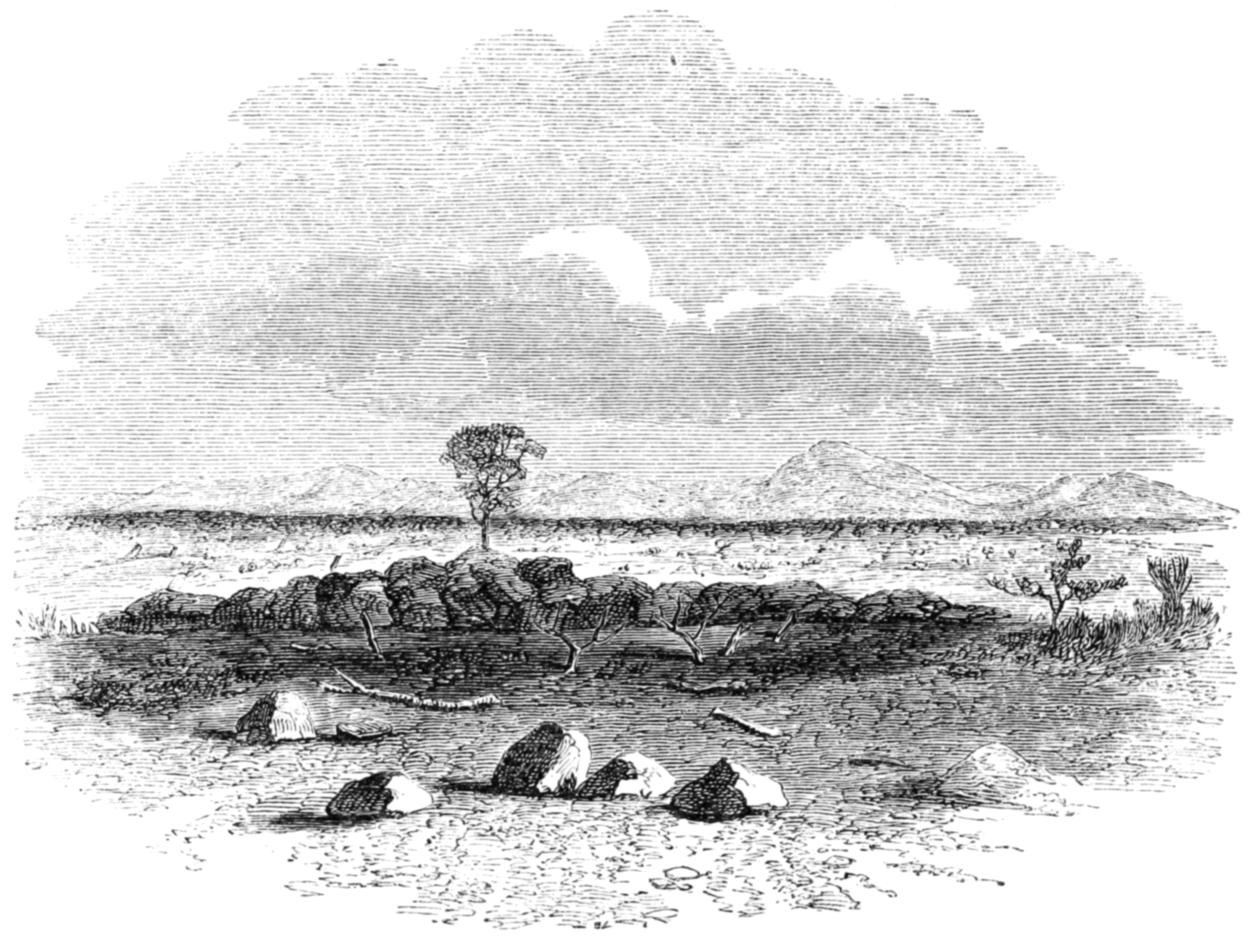
Usagara Mountains, seen from Ugogo.