Volume 1 — CHAP. VI. WE CROSS THE EAST AFRICAN GHAUTS. (continued 2)
Reading edition
The great labour still remained. Trembling with ague, with swimming heads, ears deafened by weakness, and limbs that would hardly support us, we contemplated with a dogged despair the apparently perpendicular path that ignored a zigzag, and the ladders of root and boulder, hemmed in with tangled vegetation, up which we and our starving drooping asses were about to toil. On the 10th September we hardened our hearts, and began to breast the Pass Terrible. My companion was so weak that he required the aid of two or three supporters; I, much less unnerved, managed with one. After rounding in two places wall-like sheets of rock—at their bases green grass and fresh water were standing close to camp, and yet no one had driven the donkeys to feed—and crossing a bushy jungly step, we faced a long steep of loose white soil and rolling stones, up which we could see the Wanyamwezi porters swarming, more like baboons scaling a precipice than human beings, and the asses falling after every few yards. As we moved slowly and painfully forwards, compelled to lie down by cough, thirst, and fatigue, the “sayhah” or war-cry rang loud from hill to hill, and Indian files of archers and spearmen streamed like lines of black ants in all directions down the paths. The predatory Wahumba, awaiting the caravan’s departure, had seized the opportunity of driving the cattle and plundering the villages of Inenge. Two passing parties of men, armed to the teeth, gave us this information; whereupon the negro “Jelai” proposed, fear-maddened—a sauve qui peut—leaving to their fate his employers, who, bearing the mark of Abel in this land of Cain, were ever held to be the head and front of all offence. Khudabakhsh, the brave of braves, being attacked by a slight fever, lay down, declaring himself unable to proceed, moaned like a bereaved mother, and cried for drink like a sick girl. The rest of the Baloch, headed by the Jemadar, were in the rear; they had levelled their matchlocks at one of the armed parties as it approached them, and, but for the interference of Kidogo, blood would have been shed.
By resting after every few yards, and by clinging to our supporters, we reached, after about six hours, the summit of the Pass Terrible, and there we sat down amongst the aromatic flowers and bright shrubs—the gift of mountain dews—to recover strength and breath. My companion could hardly return an answer; he had advanced mechanically and almost in a state of coma. The view from the summit appeared eminently suggestive, perhaps unusually so, because disclosing a retrospect of severe hardships, now past and gone. Below the foreground of giant fractures, huge rocks, and detached boulders, emerging from a shaggy growth of mountain vegetation, with forest glens and hanging woods, black with shade gathering in the steeper folds, appeared, distant yet near, the tawny basin of Inenge, dotted with large square villages, streaked with lines of tender green, that denoted the water-courses, mottled by the shadows of flying clouds, and patched with black where the grass had been freshly fired. A glowing sun gilded the canopy of dense smoke which curtained the nearer plain, and in the background the hazy atmosphere painted with its azure the broken wall of hill which we had traversed on the previous day.
Somewhat revived by the tramontana which rolled like an ice-brook down the Pass, we advanced over an easy step of rolling ground, decked with cactus and the flat-topped mimosa, with green grass and bright shrubs, to a small and dirty khambi, in a hollow flanked by heights, upon which several settlements appeared. At this place, called the “Great Rubeho,” in distinction from its western neighbour, I was compelled to halt. My invalid sub. had been seized with a fever-fit that induced a dangerous delirium during two successive nights; he became so violent that it was necessary to remove his weapons, and, to judge from certain symptoms, the attack had a permanent cerebral effect. Death appeared stamped upon his features, yet the Baloch and the sons of Ramji clamoured to advance, declaring that the cold disagreed with them.
On the 12th September the invalid, who, restored by a cool night, at first proposed to advance, and then doubted his ability to do so, was yet hesitating when the drum-signal for departure sounded without my order. The Wanyamwezi porters instantly set out. I sent to recal them, but they replied that it was the custom of their race never to return; a well-sounding principle against which they never offended except to serve their own ends. At length a hammock was rigged up for my companion, and the whole caravan broke ground.
The path ran along the flank of an eminence, and, ascending a second step, as steep but shorter than the Pass Terrible, placed us at the Little Rubeho, or Windy Pass, the summit of the third and westernmost range of the Usagara Mountains, raised 5,700 feet above the sea-level. It is the main water-parting of this ghaut-region. At Inenge the trend is still to the S.E.; beyond Rubeho the direction is S.W. Eventually, however, the drainage of both slope and counter-slope finds its way to the Indian Ocean, the former through the Mukondokwa and the Kingani, the latter through the Rwaha and the Rufiji Rivers.
A lively scene awaited my arrival at the “Little Rubeho.” From a struggling mass of black humanity, which I presently determined to be our porters, proceeded a furious shouting and yelling. Spears and daggers flashed in the sun, and cudgels played with a threshing movement which promised many a broken head. At the distance of a few yards, with fierce faces and in motionless martial attitudes, the right hand upon the axe-handle stuck in the waist-belt, and the left grasping the bow and two or three polished assegais, stood a few strong fellows, the forlorn hope of the fray. In the midst of the crowd, like Norman Ramsay’s troop begirt by French cavalry—to compare small things with great—rose and fell the chubby, thickset forms of Muinyi Wazira and his four Wak’hutu, who, undaunted by numbers, were dealing death to nose and scalp. Charge! Mavi ya Gnombe (“Bois de Vache”) charge! On! Mashuzi (“Fish Fry-soup”) on! Bite, Kuffan Kwema (“To die is good”) bite, Smite, Na daka Mali (“I want wealth”) smite! At length, when
“Blood (t’was from the nose) began to flow,”
a little active interference rescued the five “enfans perdus.” The porters had been fighting upon the question whether the men with small-pox should, or should not, be admitted into the kraal, and Muinyi Wazira and his followers, under the influence of potations which prevented their distinguishing friend from foe, had proved themselves, somewhat unnecessarily heroes. It is usually better to let these quarrels work themselves out; if prematurely cut short, the serpent, wrath, is scotched, not slain. A little “punishment” always cools the blood, and secures peace and quiet for the future. Moreover, the busy peacemaker here often shares the fate of M. Porceaugnac, and earns the reward of those who, according to the proverb, in quarrels interpose. It is vain to investigate, where all is lie, the origin of the squabble. Nothing easier, as the Welsh justice was fond of declaring, than to pronounce judgment after listening to one side of the question; but an impartial hearing of both would strike the inquiring mind with a sense of impotence. Perhaps it is not unadvisable to treat the matter after the fashion adopted by a “police-officer,” a certain captain in the X. Y. Z. army, who deemed it his duty to discourage litigiousness and official complaints amongst the quarrelsome Sindhi population of Hyderabad. The story is somewhat out of place; though so being, I will here recount it.
Would enter, for instance, two individuals in an oriental costume considerably damaged; one has a cloth carefully tied round his head, the other has artificially painted his eye and his ear with a few drops of blood from the nose. They express their emotions by a loud drumming of the tom-tom accompanying the high-sounding Cri de Haro—Faryad! Faryad! Faryad!—
“I’ll ‘Faryad’ yer, ye”——
After these, the usual appellatives with which the “native” was in those days, on such occasions received, the plaintiff is thus addressed:—
“Well, you—fellow! your complaint, what is it?”
“Oh, Sahib! Oh, cherisher of the poor! this man who is, the same hath broken into my house, and made me eat a beating, and called my ma and sister naughty names, and hath stolen my brass pot, and—”
“Bas! bas! enough!” cries the beak; “tie him”—the defendant—“up, and give him three dozen with thine own hand.”
The wrathful plaintiff, as may be imagined, is nothing loath. After being vigorously performed upon by the plaintiff aforesaid, the defendant is cast loose, and is in turn addressed as follows:—
“Well, now, you fellow! what say you?”
“Oh, my lord and master! Oh, dispenser of justice! what lies hath not this man told? What abominations hath he not devoured? Behold (pointing to his war-paint) the sight! He hath met me in the street; he hath thrown me down; he hath kicked and trampled upon me; he hath—”
“Bas! enough!” again cries the beak: “tie him—the plaintiff—up, and see if you can give him a good three dozen.”
Again it may be imagined that the three dozen are well applied by the revengeful defendant, and that neither that plaintiff nor that defendant ever troubled that excellent “police-officer” again.
On Rubeho’s summit we found a single village of villanous Wasagara; afterwards “made clean”—as the mild Hindu expresses the extermination of his fellow-men—by a caravan in revenge for the murder of a porter. We were delayed on the hill-top a whole day, despite the extreme discomfort of all hands. Water had to be fetched from a runnel that issued from a rusty pool shaded by tilted-up strata of sandstone, at least a mile distant from camp. Rain fell daily, alternating with eruptions of sun; a stream of thick mist rolled down the ravines and hollows, and at night the howling winds made Rubeho their meeting-place. Yet neither would the sons of Ramji carry my companion’s hammock, nor would Said bin Salim allow his children to be so burdened; moreover, whatever measures one attempted with the porters, the other did his best to thwart. “Men,” say the Persians, “kiss an ass for an object.” I attempted with Kidogo that sweet speech which, according to Orientals, is stronger than chains, and administered “goose’s oil” in such quantities that I was graciously permitted to make an arrangement for the transport of my companion with the Kirangozi.
On the 14th September, our tempers being sensibly cooled by the weather, we left the hill-top and broke ground upon the counterslope or landward descent of the Usagara Mountains. Following a narrow footpath that wound along the hill-flanks, on red earth growing thick clumps of cactus and feathery mimosa, after forty-five minutes’ march we found a kraal in a swampy green gap, bisected by a sluggish rivulet that irrigated scanty fields of grain, gourds, and water-melons, the property of distant villagers. For the first time since many days I had strength enough to muster the porters and to inspect their loads. The outfit, which was expected to last a year, had been half exhausted in three months. I summoned Said bin Salim, and passed on to him my anxiety. Like a veritable Arab, he declared, without the least emotion, that we had enough to reach Unyanyembe, where we certainly should be joined by the escort of twenty-two porters. “But how do you know that?” I inquired. “Allah is all-knowing,” replied Said; “but the caravan will come.” Such fatalism is infectious. I ceased to think upon the subject.
On the 15th September, after sending forward the luggage, and waiting as agreed upon for the return of the porters to carry my companion, I set out about noon, through hot sunshine tempered by the cool hill-breeze. Emerging from the grassy hollow, the path skirted a well-wooded hill and traversed a small savannah, overgrown with stunted straw and hedged in by a bushy forest. At this point massive trees, here single, there in holts and clumps, foliaged more gloomily than churchyard yews, and studded with delicate pink-flowers, rose from the tawny sun-burned expanse around, and defended from the fiery glare braky rings of emerald shrubbery, sharply defined as if by the forester’s hand. The savannah extended to the edge of a step which, falling deep and steep, suddenly disclosed to view, below and far beyond the shaggy ribs and the dark ravines and folds of the foreground, the plateau of Ugogo and its Eastern desert. The spectacle was truly impressive. The vault above seemed “an ample æther,” raised by its exceeding transparency higher than it is wont to be. Up to the curved rim of the western horizon, lay, burnished by the rays of a burning sun, plains rippled like a yellow sea by the wavy reek of the dancing air, broken towards the north by a few detached cones rising island-like from the surface, and zebra’d with long black lines, where bush and scrub and strip of thorn jungle, supplanted upon the watercourses, trending in mazy network southwards to the Rwaha River, the scorched grass and withered canes-stubbles, which seemed to be the staple growth of the land. There was nothing of effeminate or luxuriant beauty, nothing of the flush and fulness characterising tropical Nature, in this first aspect of Ugogo. It appeared what it is, stern and wild,—the rough nurse of rugged men,—and perhaps the anticipation of dangers and difficulties ever present to the minds of those preparing to endure the waywardness of its children, contributed not a little to the fascination of the scene. After lingering for a few minutes upon the crest of the step, with feelings which they will understand who after some pleasant months—oases in the grim deserts of Anglo-Indian life—spent among the tree-clad heights, the breezy lakes, and the turfy valleys of the Himalayas and the Neilgherries, sight from their last vantage-ground the jaundiced and fevered plains below, we scrambled down an irregular incline of glaring red clay and dazzling white chalk, plentifully besprinkled with dark-olive silex in its cherty crust. Below the descent was a level space upon a long ridge, where some small villages of Wasagara had surrounded themselves with dwarf fields of holcus, bajri, and maize. A little beyond this spot, called the “Third Rubeho,” we found a comfortless kraal on uneven ground, a sloping ledge sinking towards a deep ravine.
At the third Rubeho we were delayed for a day—as is customary before a “Tirikeza”—by the necessity of laying in supplies for a jungle march, and by the quarrels of the men. The Baloch were cross as naughty children, ever their case when cold and hungry: warm and full, they become merry as crickets. The Kirangozi in hot wrath brought his flag to Said bin Salim, and threatened to resign, because he had been preceded on the last stage by two of the Baloch: his complaints of this highly irregular proceeding were with difficulty silenced by force of beads. I remarked, however, a few days afterwards, when travelling through Ugogo, that the Kirangozi, considering himself in danger, applied to me for a vanguard of matchlockmen. The sons of Ramji combined with the porters in refusing to carry my companion, and had Bombay and Mabruki not shown good-will, we might have remained a week in the acme of discomfort. The asses, frightened by wild beasts, broke loose at night, and one was lost. The atmosphere was ever in excesses of heat and cold: in the morning, a mist so thick that it displayed a fog-rainbow—a segment of an arch, composed of faint prismatic tints—rolled like a torrent down the ravine in front: the sun, at noon, made us cower under the thin canvas, and throughout the twenty-four hours a gale like a “vent de bise,” attracted by the heat of the western plains, swept the encamping ground.
Sending forward my invalid companion in his hammock, I brought up the rear: Said bin Salim, who had waxed unusually selfish and surly, furtively left to us the task; he wore only sandals—he could not travel by night. Some of the Baloch wept at the necessity of carrying their gourds and skins.
On the 17th September, about 2 P.M., we resumed the descent of the rugged mountains. The path wound to the N.W. down the stony and bushy crest of a ridge with a deep woody gap on the right hand: presently after alternations of steep and step, and platforms patched with odoriferous plants, it fell into the upper channel of the Mandama or the Dungomaro, the “Devil’s Glen.” Dungomaro in Kisawahili is the proper name of an evil spirit, not in the European but in the African sense,—some unblessed ghost who has made himself unpopular to the general;—perhaps the term was a facetiousness on the part of the sons of Ramji.
It was a “via mala” down this great surface-drain of the western slopes, over boulders and water-rolled stones reposing upon deep sand, and with branches of thorny trees in places canopying the bed. After a march of five hours, I found the porters bivouacking upon a softer spot, and with difficulty persuaded four of the sons of Ramji to return and to assist the weary stragglers: horns were sounded, and shots were fired to guide the Baloch, who did not, however, arrive before 10 P.M.
On the 18th September, a final march of four hours placed us in the plains of Ugogo. Leaving the place of the last night’s bivouac, we pursued the line of the Dungomaro, occasionally quitting it where boulders obstructed progress, and presently we came to its lower bed, where perennial rills, exuding from its earth-walls and trickling down its side, veiled the bottom with a green and shrubby perfumed vegetation. As the plain was neared, the difficulties increased, and the scenery became curious. The Dungomaro appeared a large crevasse in lofty rocks of pink and gray granite, streaked with white quartz, and pudding’d with greenstone and black horneblend; the sole, strewed with a rugged layer of blocks, was side-lined with narrow ledges and terraces of brown humus, supporting dwarf cactus and stunted thorny trees; whilst high above towered stony wooded peaks, closing in the view on all sides. Farther down the bed huge boulders, sunburnt, and stained by the courses of rain-torrents, rose, perpendicularly as walls, to the height of one hundred and one hundred and twenty feet, and there the flooring was a sheet or slide of shiny and shelving rock, with broad fissures, and steep drops, and cups, “potholes,” baths, and basins, filed and cut by the friction of the gravelly torrents, regularly as if turned with the lathe. Where water lay, deep mud and thick clumps of grass and reed forced the path to run along the ledges at the sides of the base. Gradually, as the angle of inclination became more obtuse, the bed widened out, the tall stone-walls gave way to low earth-banks clad with gum-trees; pits, serving as wells, appeared in the deep loose sand, and the Dungomaro, becoming a broad, smooth Fiumara, swept away verging southwards into the plain. Before noon, I sighted from a sharp turn in the bed our tent pitched under a huge sycomore, on a level step that bounded the Fiumara to the right. It was a pretty spot in a barren scene, grassy, and grown with green mimosas, spreading out their feathery heads like parachutes, and shedding upon the ground a filmy shade that fluttered and flickered in the draughty breeze.
The only losses experienced during the scrambling descent, were a gun-case, containing my companion’s store of boots, and a chair and table. The latter, being indispensable on a journey where calculations, composition, and sketching were expected, I sent, during the evening halts, a detachment consisting of Muinyi Wazira, the Baloch, Greybeard Musa, and a party of slaves, to bring up the articles, which had been cache’d on the torrent bank. They returned with the horripilatory tale of the dangers lately incurred by the Expedition, which it appeared from them had been dogged by an army of Wasagara, thirsting for blood and furious for booty:—under such circumstances, how could they recover the chair and table? Some months afterwards an up-caravan commanded by a Msawahili found the articles lying where we had left them, and delivered them, for a consideration, to us at Unyanyembe. The party sent from Ugogo doubtless had passed a quiet, pleasant day, dozing in the shade at the nearest well.
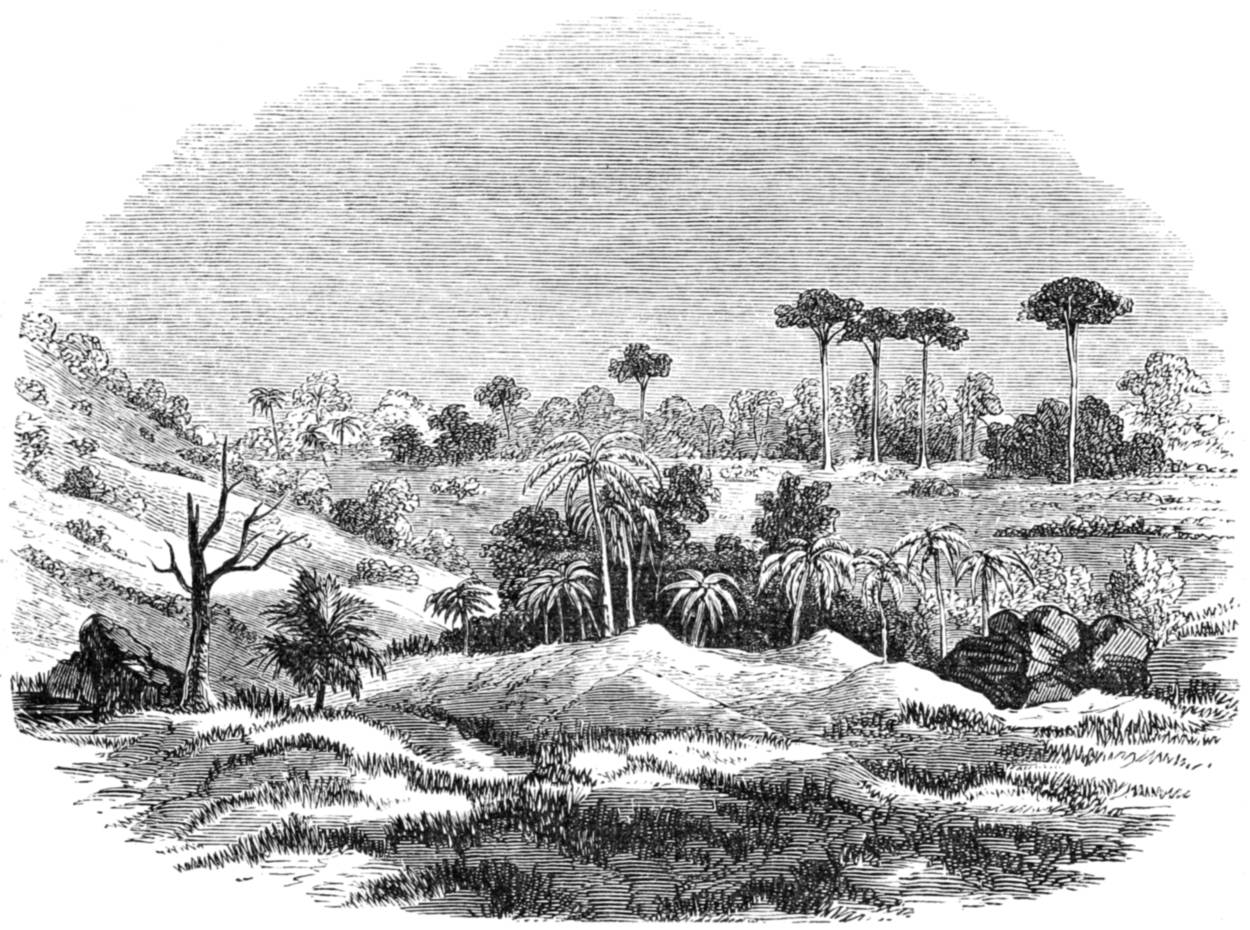
Maji ya W’heta, or the Jetting Fountain in K’hutu.