Volume 1 — CHAP. III. TRANSIT OF THE VALLEY OF THE KINGANI AND THE MGETA RIVERS. (continued 2)
Reading edition
The same attractions which draw caravans to Zungomero render it the great rendezvous of an army of touters, who, whilst watching for the arrival of the ivory traders, amuse themselves with plundering the country. The plague has now spread like a flight of locusts over the land. The Wak’hutu, a timid race, who, unlike the Wazaramo, have no sultan to gather round, are being gradually ousted from their ancient seats. In a large village there will seldom be more than three or four families, who occupy the most miserable hovels, all the best having been seized by the touters or pulled down for firewood. These men—slaves, escaped criminals, and freemen of broken fortunes, flying from misery, punishment, or death on the coast—are armed with muskets and sabres, bows and spears, daggers and knobsticks. They carry ammunition, and thus are too strong for the country people. When rough language and threats fail, the levelled barrel at once establishes the right to a man’s house and property, to his wife and children. If money runs short, a village is fired by night, and the people are sold off to the first caravan. In some parts the pattering of musketry is incessant, as it ever was in the turbulent states of Independent India. It is rarely necessary to have recourse to violence, the Wak’hutu, believing their tyrants to be emissaries, as they represent themselves, from His Highness the Sultan, and the chief nobles of Zanzibar, offer none but the most passive resistance, hiding their families and herds in the bush. Thus it happens that towards the end of the year nothing but a little grain can be purchased in a land of marvellous fertility.
As has been mentioned, these malpractices are severely reprobated by His Highness the Sultan, and when the evil passes a certain point remedial measures are taken. A Banyan, for instance, is sent to the coast with warnings to the Diwans concerned. But what care they for his empty words, when they know that he has probably equipped a similar party of black buccaneers himself? and what hope can there be of reform when there is not an honest man in the country to carry it out? Thus the Government of Zanzibar is rendered powerless;—improvement can be expected only from the hand of Time. The Wak’hutu, indeed, often threaten a deputation to entreat the Arab Sultan for protection in the shape of a garrison of Baloch. This measure has been retarded for sound reasons: no man dares to leave his house for fear of finding it a ruin on his return; moreover, he would certainly be shot if the touters guessed his intention, and, even if he escaped this danger, he would probably be sold, on the way to the coast, by his truculent neighbours the Wazaramo. Finally, if they succeeded in their wishes, would not a Baloch garrison act the part of the man who, in the fable, was called in to assist the horse against the stag? The Arabs, who know the temper of these mercenaries, are too wise ever to sanction such a “dragonnade.”
The reader will readily perceive that he is upon the slave-path, so different from travel amongst the free and independent tribes of Southern Africa. The traffic practically annihilates every better feeling of human nature. Yet, though the state of the Wak’hutu appears pitiable, the traveller cannot practise pity: he is ever in the dilemma of maltreating or being maltreated. Were he to deal civilly and liberally with this people he would starve: it is vain to offer a price for even the necessaries of life; it would certainly be refused because more is wanted, and so on beyond the bounds of possibility. Thus, if the touter did not seize a house, he would never be allowed to take shelter in it from the storm; if he did not enforce a “corvée,” he must labour beyond his strength with his own hands; and if he did not fire a village and sell the villagers, he might die of hunger in the midst of plenty. Such in this province are the action and reaction of the evil.
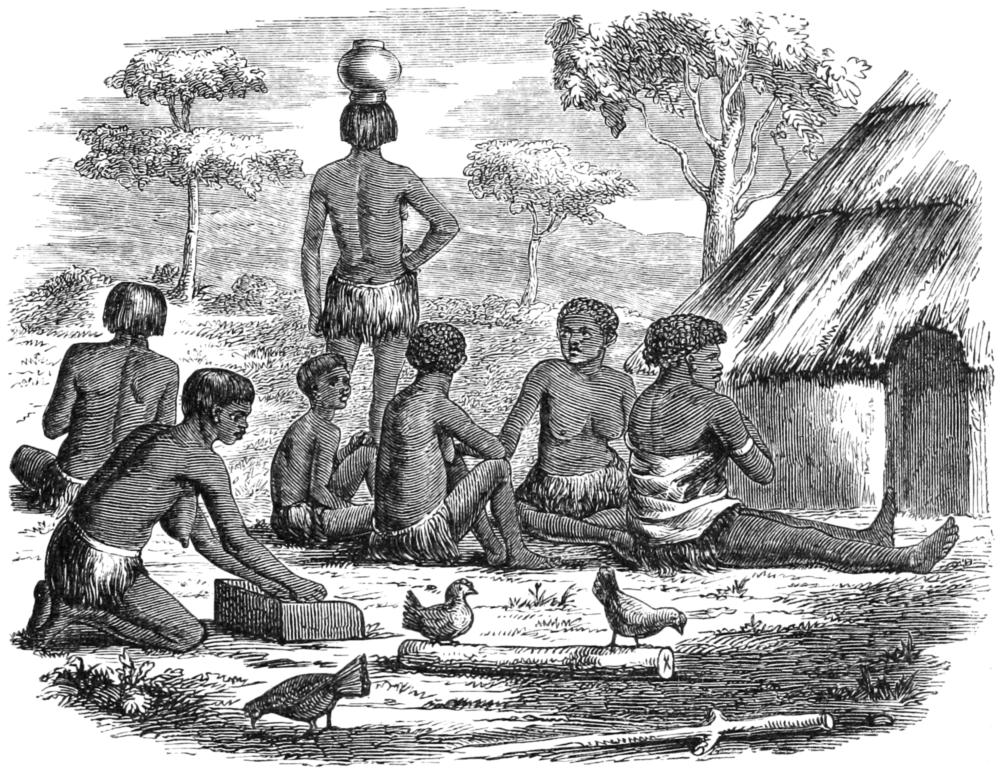
Party of Wak’hutu Women.