LAKE DWELLINGS. PART I. (continued 3)
Reading edition
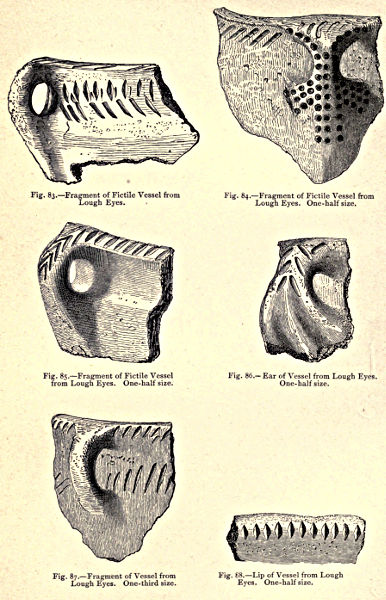
Plate XVIII.
Fig. 83.—Fragment of Fictile Vessel from Lough Eyes.
Fig. 84.—Fragment of Fictile Vessel from Lough Eyes. One-half size.
Fig. 85.—Fragment of Fictile Vessel from Lough Eyes. One-half size.
Fig. 86.—Ear of Vessel from Lough Eyes. One-half size.
Fig. 87.—Fragment of Vessel from Lough Eyes. One-third size.
Fig. 88.—Lip of Vessel from Lough Eyes. One-half size.
Fragments of Pottery, from No. 3 Crannog, Lough Eyes.
(Discovered by W. F. Wakeman.)
Numerous fragments of fictile ware, of which five rims are given as specimens, were in No. 5 crannog, in the same locality (plate XIX., figs. 90, 91, 92, 95, 96); and fragments were found in No. 6 crannog, of which four examples are given (plate XIX., figs. 89, 93, 94, 97).
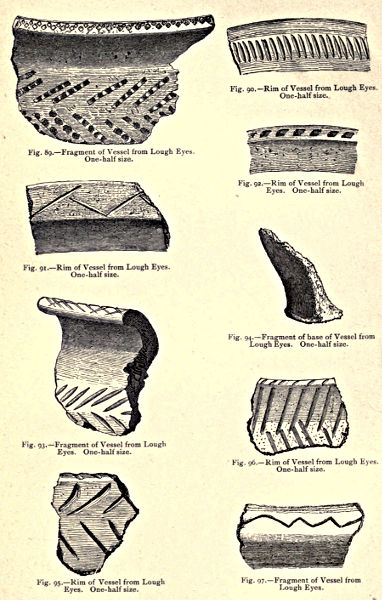
Plate XIX.
Fig. 89.—Fragment of Vessel from Lough Eyes. One-half size.
Fig. 90.—Rim of Vessel from Lough Eyes. One-half size.
Fig. 91.—Rim of Vessel from Lough Eyes. One-half size.
Fig. 92.—Rim of Vessel from Lough Eyes. One-half size.
Fig. 93.—Fragment of Vessel from Lough Eyes. One-half size.
Fig. 94.—Fragment of base of Vessel from Lough Eyes. One-half size.
Fig. 95.—Rim of Vessel from Lough Eyes. One-half size.
Fig. 96.—Rim of Vessel from Lough Eyes. One-half size.
Fig. 97.—Fragment of Vessel from Lough Eyes.
Fragments of Pottery, from No. 5 and No. 6 Crannogs, Lough Eyes.
(Discovered by W. F. Wakeman.)
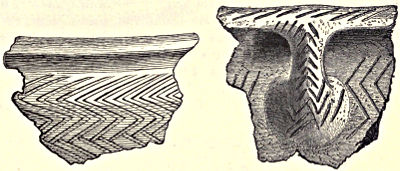
Fig. 98.—Fragment of Fictile Ware, Lough Eyes. One-half size.
Fig. 99.—Fragment of Fictile Ware, Lough Eyes. One-half size.
Figs. 98 and 99 represent fragments of fictile ware also from Lough Eyes. Fig. 98 has evidently been a deep-lipped vessel, and its “herring-bone” ornamentation is almost identical with the pattern that prevails most upon burial urns, and closely resembles that figured upon the vessel found in “One Man’s Cairn,” at Moytirra, county Mayo, as represented in Wilde’s Lough Corrib, p. 235: the same style of decoration is a characteristic of early bronze celts and other remains of the prehistoric period. Fig. 99 presents the same style of ornamentation. It was apparently an eared vessel, of reddish-drab colour.
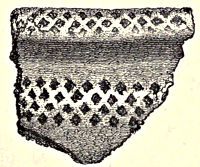
Fig. 100.
Fig. 100 has evidently formed portion of what was a well-finished vessel. So far as at present known, its style of ornamentation is extremely rare, being identical with that seen upon portion of a decorated leathern shoe found in the crannog of Dowalton loch, Wigtonshire, and of which a representation is given at p. 49 of Munro’s Ancient Scottish Lake Dwellings. The fragments of vessels found in Lough Eyes were all hand-made, and well burnt, whilst the action of the fire would seem to have been greater on the interior than on the exterior. The material used was the sandy clay of the district, or perhaps the grit may have been added in order to give greater consistency to the paste. In most of the specimens there are distinct traces of this sand, and in the ruder examples particles of white stone of the size of very small peas project from the surface. The colour varies from light drab to a very dark brown, almost black, whilst some few are of a reddish hue—but all are unglazed. Many fragments of pottery have from time to time been disinterred from the site of the crannogs in the lake of Drumskimly, county Fermanagh: one of them is figured in the Journal Royal Hist. and Arch. Asso. of Ireland,[118] in connexion with a vase evidently of Pagan origin, from the “Bar” of Fintona, near Trillick, county Tyrone.
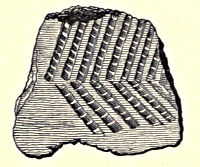
Fig. 101.—Stamped pattern on fragment of Fictile Ware from Drumskimly.
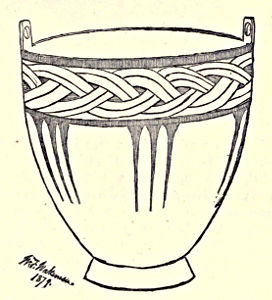
Fig. 102.—Carved Wooden Vessel found at Cavancarragh.
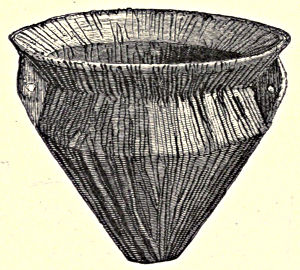
Fig. 103.—Wooden Vessel from Ballydoolough Crannog.
The term “Lestar” comprises vessels of various shapes, and of all kinds of material, although it is more generally applied to those made of wood—several have been found in crannogs. In a bog, occupying what in distant ages appears to have been the site of a small lake, on the lands of Cavancarragh, county Fermanagh, implements of flint, a fine bronze spear-head, and a beautifully-shaped wooden vessel, were discovered, all buried under peat. Now, according to the theory of some geologists, a peat formation of such depth as covered them would, according to circumstances, take from six hundred to one thousand years to accumulate, so that the articles found might be referred back to any period from the thirteenth to the ninth century; and at about this latter period, it is remarked, with regard to the ornamentation observable on the wooden vessel, that a similar style prevailed in the MSS. and on stone work of that era, still extant. The vessel was made of oak, the bottom alone being alder: when first exhumed it was entire, and had a cover; the original form seems to have been one of unusual beauty, and the height about fifteen inches. The lid, now unfortunately lost, is described as slightly convex, with a knob-like handle in the centre, the ornamental work on it similar to that of the vessel itself. On the dark shading round the rim, and between the interlacing ornamentation, both of vessel and lid, traces were apparent of some kind of pigment, or enamel, with which the surface of the wood had been overlaid. In the crannog of Ballydoolough, county Fermanagh, a vessel of wood was discovered in an entire state, but from long saturation reduced almost to a state of pulp. The engraving (about one-fifth the real size), gives a good idea of it. In process of drying, the vessel soon lost all shape, and became strangely twisted and distorted. On comparing this woodcut with a vase found in a small stone chamber at Knocknecoura, near Bagnalstown, county Carlow, and now in the Museum, R.I.A., a striking resemblance in form is observable; the latter vessel is, however, more ornamental. To find in a grave an urn of almost exactly the same shape as a vessel undoubtedly used to hold food, suggests the idea that the so-called sepulchral urns in cairns and graves need not be viewed as necessarily intended to hold human ashes, or the cremated bones of sacrifices. Might not the object of their position have been to supply the warrior with food on his way to the Happy Hunting Grounds of Tirnanog? A willow platter, 15 inches by 14 (fig. 104), was found in the crannog of Ballinderry. It did not split much in drying, and is in a very good state of preservation: one handle, however is defective, the other is 2¾ inches in length by 4 in breadth. The dimensions of fig. 105 are as follows: extreme length from handle to handle, 31⅛ inches; length inside, 25¾ inches; extreme breadth across the rim, 21⅛ inches. It is not so well preserved as its confrere from Ballinderry, as it rent in drying, but has not become either warped or twisted like the great majority of wooden utensils exhumed from peat.
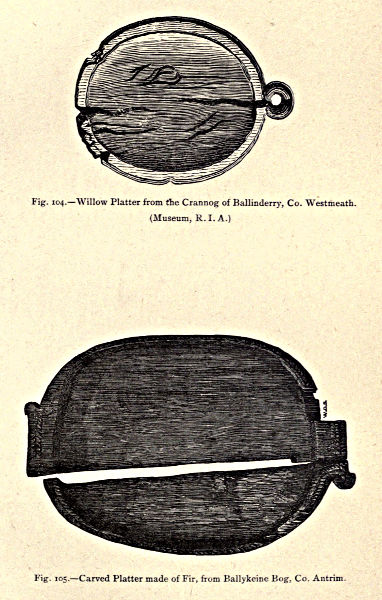
Plate XX.
Fig. 104.—Willow Platter from the Crannog of Ballinderry, Co. Westmeath. (Museum, R. I. A.)
Fig. 105.—Carved Platter made of Fir, from Ballykeine Bog, Co. Antrim.
Wooden Platters.
“Meadar,” or “Mether,” is the Irish designation for a species of drinking cup, so called, it is said, because it was employed to contain “mead.” It seems to have been commonly made of yew, was quadrangular at the lip, and round at the bottom. It was usually provided with two or more handles for the purpose of passing it round from hand to hand. There was a curious cup of this description in one of the crannogs of Lough Rea, county Galway, too much decomposed, however, to be dug out in an entire state; and at Lagore, near Dunshaughlin, was a four-sided drinking vessel, composed of horn, and very small, being only 2½ inches in height; it resembles one discovered in the parish of Tamlaght O’Crilly, county Derry.[119] The use of the Mether appears to have been universal in Ireland, and continued to a late period, whilst judging from the great depth at which it is found buried in peat, its antiquity must be extreme. In drinking out of the Mether, it was not the side, but one of the four corners that should be applied to the mouth. It is related that when Lord Townsend’s term of the Irish Vice-royalty had expired, he carried over to England, on his return, two large methers, which were always produced at his dinner parties. His guests generally applied the side of the vessel to the mouth, therefore seldom escaped without a drenched neck-cloth, vest, or doublet, and the host (after enjoying the joke), if an Irishman chanced to be present, called upon him to teach the Saxons the mether drill.
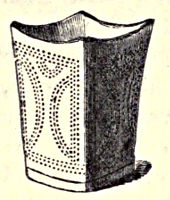
Fig. 106.—Mether, or Drinking Cup, from Tamlaght O’Crilly.
Dean Swift, in his translation of “O’Rourke’s Noble Feast”—a poem written about 1720, in the Irish language—thus alludes to this species of drinking cup—
“Usquebaugh to our feast, in pails was brought up, An hundred at least, and a madder our cup.”

Fig. 107.
Wooden Mallet from Lisnacroghera.
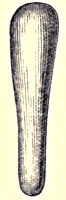
Fig. 108.
Wooden Peg from Glencar.
The object here represented (fig. 107), is a wooden mallet, 1 foot 7 inches in length, found about fifteen feet below the original surface of the crannog of Lisnacroghera.[120] Fig. 108, about 10½ inches in length, may be also a mallet, but was more probably used as a peg to keep some part of the framework in position. It rested on one of the beams of the western crannog in Glencar, county Sligo.
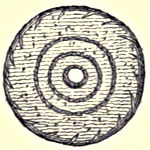
Fig. 109.
Bone Spindle Whorl from Ardakillen.
The MS. Book of Ballymote contains an ancient Irish poem, which states “It was Tigearnmas first established in Ireland the art of dyeing cloth of purple, and many colours.” This monarch is alleged to have lived, A.M. 2816(?), therefore in Ireland the arts of weaving and dyeing are of remotest antiquity. Some bright red colouring matter (realgar?), rolled up in a piece of birch bark, was discovered in one of the crannogs of Loughrea, county Galway;[121] orpiment, a yellow sulphuret, probably used in dyeing, was found in Cloneygonnell;[122] and, whorls, or little discs, popularly called by the peasantry “fairy mill-stones,” are found in great numbers; of these fig. 109 is a good example. The whorl was supposed to be simply a weight, used to aid the rotation of the stick fixed to a ring on the spindle: it can be seen in Egyptian, Greek, and Roman sculptures, and wall paintings, and Schliemann in his excavations at Hissarlisk found thousands of these objects. It has been suggested that a curious ovoid piece of hard polished bone, found at Ardakillen, may have been utilised in weaving, for the purpose of keeping the threads, or cords in their proper places; its longest diameter was 2½ inches, and it was perforated with ten holes of slightly different sizes.[123] Investigation has led to the belief that flax was cultivated in Egypt more than forty centuries ago, and was thence brought into Europe; it was discovered in the oldest lake dwellings in Switzerland, of the kind which is native to the Mediterranean countries; the term lin—the root of the English word linen,—is to be traced in nearly every European language: in spoken Irish it is leen, i.e. flax. The art of spinning, being of a sedentary nature, was exclusively allotted to women, which is supposed to explain the fact of such a number of whorls being found on the site of crannogs, where this peaceful occupation was carried on. In the present day, the province of Ulster seems to have monopolized an industry that may be traced back to the primitive inhabitants of the lake dwellings of Ireland.
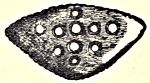
Fig. 110.
Ovoid piece of polished Bone from Ardakillen.
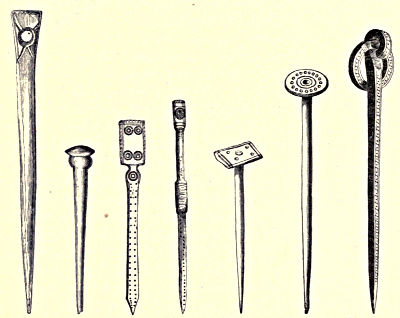
Fig. 111. Fig. 112. Fig. 113. Fig. 114. Fig. 115. Fig. 116. Fig. 117.
Figs. 115, 116, and 117 are Bone Pins with attached Heads, from the Crannog of Ballinderry.
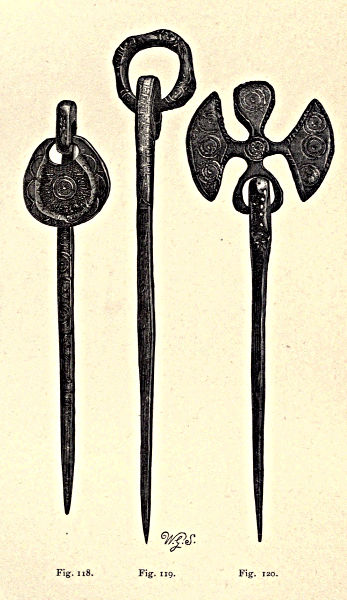
Plate XXI.
Fig. 118. Fig. 119. Fig. 120.
Scribed Pins from Ballinderry Crannog.
Articles of the Toilet, etc., or of Personal Adornment.—In crannogs, pins form one of the most numerous handicraft “finds;” they are fashioned of bone, wood, bronze, iron, and gold: great variety is observable in their shape and design: indeed there are few articles on which the crannog artificer has bestowed more pains than on these cloak or dress fasteners. At Lagore, pins of bone occurred absolutely in hundreds—the great majority were of very plain character, something like skewers—flat-headed, and perforated with one hole; some of the richer examples were singular in design—their heads presenting grotesque human figures, or carvings of beasts; a few of them terminated in plain bulbs, or in a series of graceful mouldings: but whether in bone, wood, or metal, the designs and style of ornamentation are very varied, and so minute in some instances is the decoration, as only fully to be descried by the aid of a magnifying glass. Fig. 111, of simple form, is here represented full size; it is ornamented with diagonal lines; the head is perforated, but the ring (if it ever contained one) has disappeared.[124] Fig. 112, found at Grosses Island, on the Shannon, is large, and dark in colour, it is 9 inches long, and 2½ inches thick at the head: it seems too large to be classed as a mantle pin. Fig. 113 is of less simple outline. The shank of fig. 114 is formed like a knife-blade, with a rise near the top, probably intended as a catch to secure it in the garment which it fastened. Fig. 115 is 3½ inches long, and has an oblong head of bone, with four indentations, one in each corner; it rests upon a shoulder cut in the shank. Fig. 116, 4½ inches in length, has a circular head 1 inch in diameter. Fig. 117 is another highly decorated pin, square in the shank, and 5½ inches long, with a looped head, through which is passed a ring. Fig. 118 (plate XXI.) has an acus 4¼ inches long, ornamented with the “dot-and-circle,” and the front of its flat discoid pendant has an inscription of oghamic character surrounding a dot and double circle, enclosed within an ornamented border—

Ogham on fig. 118.
The loop at the head is not continuous. In fig. 119 (plate XXI.) the acus is 4⅞ inches long, with an irregular oval ring as pendant, ornamented with the dot-and-circle. The acus has a swelling in the middle, which at one side has the dot-and-circle, and on the other a runic-like scoring—
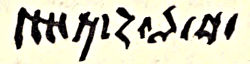
Scoring on fig. 119.
Fig. 120 (plate XXI.) has an acus 3¾ inches long, it bears a pendant carved in the shape of a Maltese cross, ornamented on both sides with the dot-and-circle. The acus has an ogham-like scoring on one face—

Scoring on fig. 120.
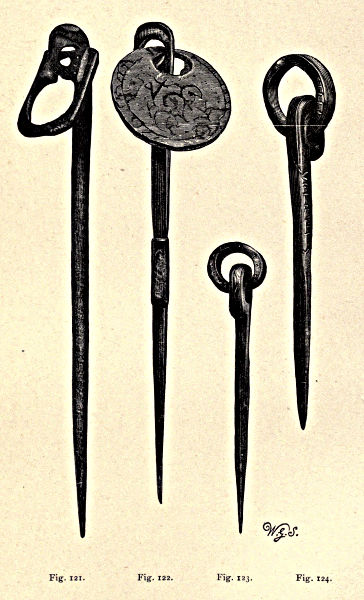
Plate XXII.
Fig. 121. Fig. 122. Fig. 123. Fig. 124.
Scribed Pins from Ballinderry Crannog.
In fig. 121 (plate XXII.) the acus is 7⅝ inches long, flattish, and ornamented by cross notchings, which seem merely ornamental, although at one side the character N is repeated many times; the pendant is somewhat rectangular in form, and perforated with a round opening—its rim ornamented with dots and lines. Fig. 122 (plate XXII.) is a pin 5⅜ inches long, with a large flat pendant, rudely and irregularly decorated in front. The acus has no ornament, but about its centre there is a square enlargement to keep it firm when inserted in the dress, and this projection has ogham-like scribings on three of its faces. Fig. 123 (plate XXII.) has an acus 3 inches long, with a small circle as a pendant, ornamented with dots; one side of the acus has a herring-bone pattern, the other bears scores—

Scoring on fig. 123.
Fig. 124 has the acus 3½ inches long, and a circular ring for pendant; the ring has scoring on one face—

Scoring on ring of fig. 124.
One side of the acus is ornamented with the dot-and-circle; on the other (shown in the cut) is a runic-like scoring—
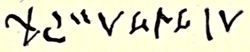
Scoring on acus, fig. 124.
There are cracks, or openings, in the rings at the head of each acus, by means of which the pendants may have been introduced; but these cracks are possibly the result of wear or straining, and it may be that both pendant and acus were originally carved out of one piece, like Chinese chains of ivory rings. From the same “find” came a pin with acus 4¾ inches long, having a flat discoid pendant of considerable size, both acus and pendant ornamented with the dot-and-circle; also a plain bone pin 2¼ inches long, with a hole at the head for a wire ring; another plain bone pin 3 inches long, with a flat head unpierced for ring or pendant; and a pin of yew, 2¼ inches long, with a round head.[125]
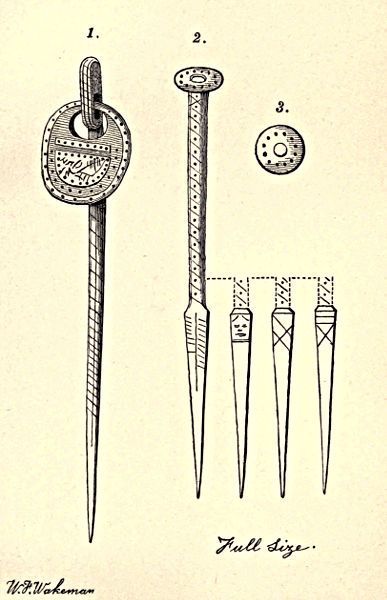
Plate XXIII.
Scribed Pins from the Crannog of Ballinderry.
The scorings on these pins, though mostly mere ornament, seem in some cases greatly to resemble Ogham and runic characters, but Professor Stephens, of Copenhagen, to whom photographs of the runic-like scribings were submitted, could not decide that they were actually runes; and again, other examples of bone pins from Ballinderry, preserved in the Museum, R. I. A., bear seemingly well-marked Ogham scorings, yet Professor Rhys and Sir Samuel Ferguson were unable to interpret them.[126] The pin given, plate XXIII., fig. 1 (full size), bears ogham-like scorings on the front of its disc, no doubt originally intended to convey a meaning, but up to the present no key has been discovered by which they can be read; it is possible they were intended as a charm of some kind. Fig. 2 (plate XXIII.) was not in the Academy when Wilde compiled his catalogue: the head of this pin is of stone, said to be agate, secured to the bone stem, seemingly, by a small wedge of bronze. Near its termination, the pin assumes an acutely quadrangular form, each face bearing an ogham-like set of scorings; these may possibly also have been talismans. Pins of bone, as well as of bronze, have been frequently found with rings of that metal attached to them, of a more or less ornamental type, but sometimes consisting of a mere piece of wire. Fig. 125, from Lisnacroghera, represents a rude ring of this nature; and quite recently a bronze pin, with similar attachment, was picked up from the bed of Drumcliff river, county Sligo. A pin of unusual form, and ornamented with two human heads, fig. 126, was brought to light in the crannog of Loughravel; the material is dark-coloured bronze, cast in the required form, but finished off with a chasing tool. In fig. 127 the ring, with which most pins are decorated, assumes the form of a coin, or flattened disc with a notch at top to allow it free play in the loop. In some specimens the disc of the coin is smooth and plain, but in others, as that here represented, it is highly ornate. Fig. 128 shows a rude plain specimen of the penannular pin, decorated in the inferior enlargements.[127] Fig. 129 from Lagore, has a head of singular fashion, and the bronze ornament claims special notice “on account of the analogy of type which it presents as compared with the remarkable silver pins found at Largo, in Fifeshire,” and with the “Hammer-headed pins” in the Museum, R.I.A. Fig. 130,[128] of similar form, is ornamented on its semicircular plate; the ground had originally been filled in with enamel, as were probably the front terminations of the tubes. It was found near a crannog in Craigywarren bog, parish of Skerry, county Antrim. Fig. 131, from Lagore, is unique; its entire length is 3 inches, and it has three rings passing through apertures in the elongated head, which is the only part here represented; its inferior extremity is decorated with a cross-like ornamentation.[129] Fig. 132, from Ballinderry, is a plain pin, with a wheel-like head, having a small hole in the neck, through which a ring passed.[130] Crannogs and street cuttings are the principal localities from which the small pins, figs. a, b, c, d, e, f, g, h have been procured, they vary in length from 2¼ to 7½ inches; fig. d is from Ardakillen.[131] All the articles figured in plate XXIV. were found at Lagore, and now form part of the Petrie Collection in the Museum, R.I.A. Nos. 1, 2, 3, and 4 are of iron, of which material very few ornamental objects have been found in Irish crannogs. No. 1 is remarkable as presenting a fine example of the torque pattern. Nos. 2, 3, and 4, in form strongly resemble brooch pins of bronze, which there is every reason to believe belong to an extremely remote period. The bone pins, Nos. 5, 6, 7, 8, 9, 10, and 11, are faithful representations of the leading varieties of that article, as found in Irish lake dwellings, and indeed in some pagan tombs. Nos. 1, 2, 3, 4, 5, and 6 (plate XXV.), are believed to represent wooden pins for the hair. No. 1 remains in a perfect state: the mouldings upon its lower and thinner end were doubtless intended to keep the article in its proper place, and prevent its slipping from the “back hair” of some long-forgotten beauty. No. 2 is unfortunately imperfect, but it is of interest on account of the boldness of the mouldings by which its head is decorated. No. 3 is perhaps the most remarkable pin composed of wood which has been recorded as found in a crannog: its decoration consists chiefly of varieties of the divergent spiral, highly characteristic of early Celtic art. No. 4 may possibly have been a hair-pin, but it was more probably used as a bodkin. Nos. 5 and 6, with serrated edges, seem well designed for the purpose of securing the hair in position. Pins of this kind were probably used in pairs, attached together with a string. No. 7 is a nondescript piece of wood, with two perforations; and No. 8 represents a handle, probably belonging to a very small wooden vessel. No. 9, shaped like one half of a wheel, is cut out of the solid, and appears to have been very carefully worked. It is almost impossible to form an opinion as to the character of this object: possibly it may have formed portion of the head of a cross: if so, it is the only relic of that kind hitherto reported to have occurred in a crannog. Nos. 10 and 11 are noticed by Wilde as seal-like articles. The former of these is solid; but the latter, from its thicker end to the moulding, is hollow.[132]
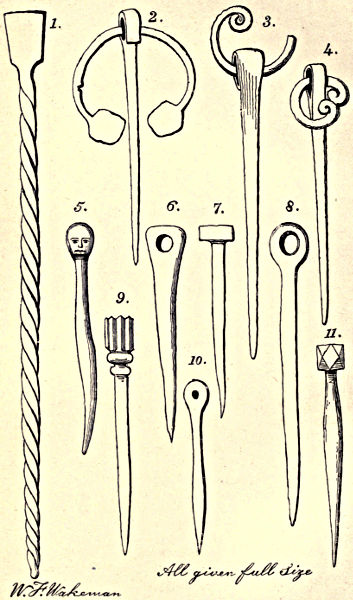
Plate XXIV.
Iron and Bone Pins from Lagore.
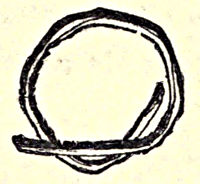
Fig. 125.—Bronze Wire Ring from Lisnacroghera. Full size.
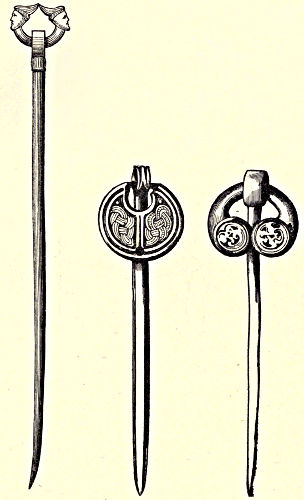
Fig. 126. Bronze Pin, with human heads, found in the Crannog of Loughravel. Full size.
Fig. 127. Flattened disc-headed Pin from Ballinderry. Full size.
Fig. 128. Penannular Bronze Pin from Lagore. Full size.
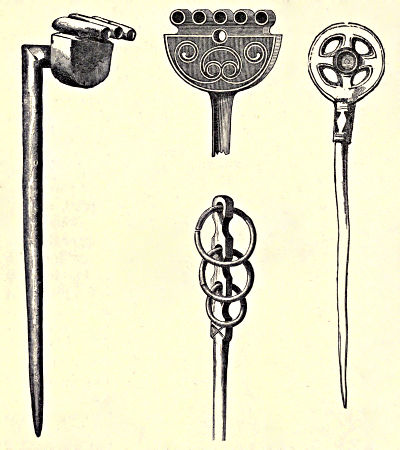
Fig. 129. Fig. 130. Fig. 131. Fig. 132.
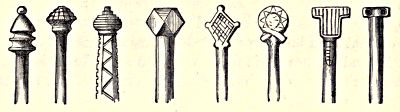
Fig. a. Fig. b. Fig. c. Fig. d. Fig. e. Fig. f. Fig. g. Fig. h.
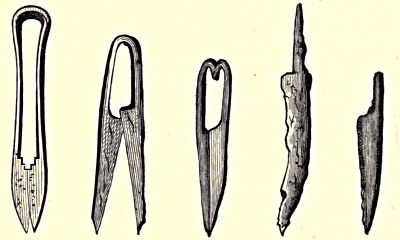
Fig. 133. Fig. 134. Fig. 135. Fig. 136. Fig. 137.
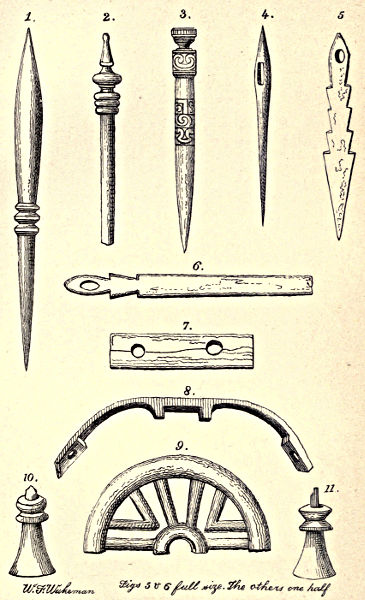
Plate XXV.
Articles of Wood.
Shears composed of iron, and doubtless used for all the purposes of modern scissors, are common in Irish crannogs. Some from Lagore are of graceful form, resembling articles of the same class found in Roman settlements: the one represented, fig. 133, is of very large size, 8½ inches in length. Figs. 134 and 135 differ but little from fig. 133, and they all resemble the implements commonly used for shearing sheep in the present day. Figs. 136 and 137 are small iron knives, with tangs for insertion into horn or wooden handles; at Lagore, where these articles were found, great numbers of blades, some not exceeding three inches in length, were discovered.

Fig. 138.—Bone Comb from Ardakillen.
Of combs, the most numerous specimens are from the crannogs of Ardakillen, Ballinderry, Lagore, and Cloonfinlough: in some, brass teeth have been substituted for those of bone that had given way, showing that, at the time the repairs were made, that metal was easily procured and worked. Strangely enough, the most usual decoration consists of a series of dot-and-circle patterns. The same style of ornamentation was observed upon many of the combs found in the lake habitations of Switzerland, and amongst the waifs of Roman settlements in Britain. In the remains of such articles, in Irish and in Scottish lacustrine sites, there is a striking resemblance; indeed the bone combs, figured in Munro’s work, are identical with many existing Irish examples. Although the material is usually bone, yet specimens formed of wood are not uncommon: the great majority of combs discovered in Irish crannogs are highly artistic in design—the handle portion sometimes presenting animal forms. Sir John Lubbock says: “It is somewhat remarkable that, while even in the stone period we find fair drawings of animals, yet in the latter part of the stone age, and throughout that of the bronze, they are almost entirely wanting, and the ornamentation is confined to various combinations of straight and curved lines and geometrical patterns;” and this he believes will eventually be found to imply “a difference of race between the populations of Western Europe at these different periods.”[133] The comb, fig. 138, was procured from the crannog of Ardakillen, near Strokestown, county Roscommon. It is restored from the fragments, and in its original state was (as delineated) about 10 inches long, and 1¾ wide, it is now shrunk to a length of only 5½ inches. The toothed portions are in separate pieces, and by this contrivance the pectinated portion, if worn or broken, could easily be replaced. The comb, fig. 139, is the finest specimen of its class preserved in the Museum, R. I. A., it is 2½ inches long, and 1¾ deep. The three pectinated portions are held together by flat sides, decorated with scrolls and circles. The top shows a triple openwork ornamentation: the side pieces are grooved at one end, for the purpose of receiving the clasp of a metal tooth placed in substitution of one that had been lost. Fig. 140, of the same class, is a specimen of a short, one-sided, highly decorated comb, 2¼ inches long, by 1⅜ deep. It is formed out of a single piece of bone, is of graceful outline, and decorated upon the sides with a number of dotted lines and circles. The three elevated rivets projecting above the toothed portion, fastened metal plates which had been attached to the comb, either when it was originally made, or after it had been broken and mended.[134] Fig. 141 is also formed out of a single piece of bone, ornamented with a dot-and-circle pattern; it was found in the same crannog. A third variety of comb, being double-toothed, is of a type so modern, that it seems to call for no special description.
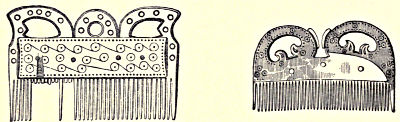
Fig. 139.—Bone Comb from Ballinderry.
Fig. 140.—Bone Comb from Lagore.
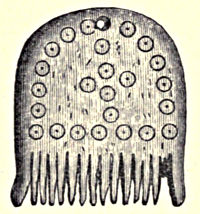
Fig. 141.—Bone Comb from Lagore. Two-thirds real size.
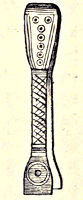
Fig. 142.
Bronze Tweezers from Ballinderry.
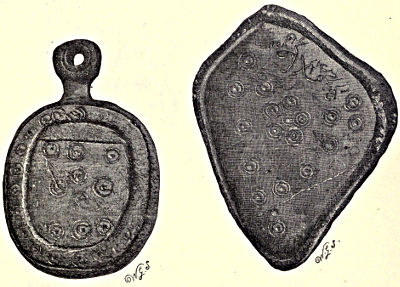
Fig. 143.—Stone Pendent Amulet from Ballinderry Crannog.
Fig. 144.—Nodule of Clay-slate from Ballinderry Crannog.
Save combs, very few articles for the toilet have been brought to light in Irish crannogs, compared with the numbers found in other countries: the accompanying engraving represents, however, what appears to be tweezers, 3 inches long, made of bronze, and decorated on the external surfaces with dot-and-circle pattern.[135] This, and the two following articles, are from Ballinderry. Fig. 143, a pendant or amulet, ornamented with dots in circles (as represented in the engraving), is carved out of soft stone, and the inscription which it bore is so much defaced as to be now undefinable. It is 3 inches long, including the handle, or loop, for suspension, 1¼ inch wide, and about ⅝ inch thick. The inscription is at top, separated by a line from the ornamentation in the central part: the back is plain. Fig. 144 is a flattish nodule of clay-slate iron ore: at one side, dots, each with two concentric circles in the shape of a double cross, scribed on it, surrounded by a border of similar ornamentation; on the other face, there are a number of the same circles, irregularly disposed (as shown in fig. 144), and, at one side of it, a runic-like scribing. The stone measures 3 inches by 2½, and is about 1½ inches thick. It is, to a certain extent, polished.[136]
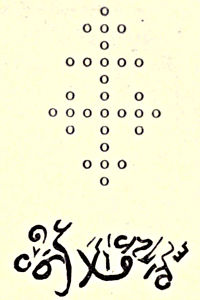
Ornamentation on fig. 144.
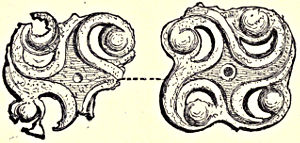
Fig. 145.—Bronze Amulet, or Ornament, from Lisnacroghera.
Fig. 145, found in the crannog of Lisnacroghera is a small bronze object, considered by W. F. Wakeman to have been an amulet: “the figures which it bears are curvilinear examples of a symbol known to antiquarians as the swastica. There can be little or no question as to the eastern origin of this form of cross.”[137]
From the tenacity with which craftsmen adhered to ancient designs or patterns, it is difficult to assign even an approximate date to many remains of articles suitable for personal decoration; however, any brooch, pin, or other object, upon which interlacing tracery is displayed, should not be referred to a period antecedent to the introduction of Christianity into Ireland.
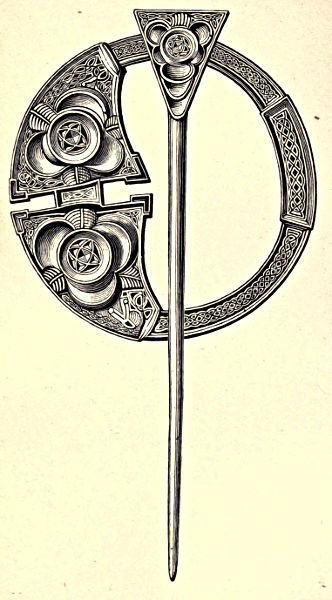
Plate XXVI.
Bronze Brooch from Lagore.
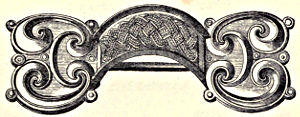
Fig. 146.—Hinge Brooch of Bronze from Ardakillen.
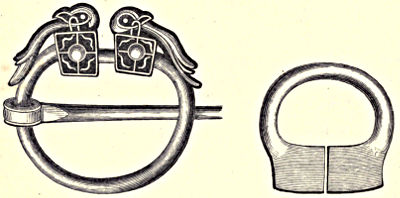
Fig. 147.—Bronze Fibula from Lough Ravel.
Fig. 148.—Penannular Ring, or Brooch, from Lough Ravel.
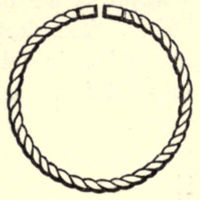
Fig. 149.
Penannular Ring from Ardakillen. Two-thirds real size.
Of bronze articles connected with personal adornment, few can equal in design and workmanship the hinge brooch from Ardakillen, here represented; it is considered to be of great antiquity. The decoration on the enlarged ends partakes of the “Celtic trumpet pattern,” while the central connecting curved strap, with a raised intertwinement, like that seen on some sculptured crosses, and in the illumination of ancient MSS., would appear to have been cast. The thin ornamented plate in front is fastened by eight rivets to a stout flat plate behind, which also overlaps the edges of the strap; its flat pin is hinged at the back.[138] The very remarkable brooch, represented full size, plate XXVI., was obtained by Petrie[139] soon after the first opening of the Lagore crannog. The original discoverer stated that it was enclosed in an ancient case or box of yew—this has unfortunately been lost. The material of which the brooch is composed, is fine golden-coloured bronze, so lustrous that, in places which have been rubbed or exposed to friction, it is difficult to decide whether the article had not been originally gilt. The pin is 6⅝ inches in length: the diameter of the ring 3⅝ inches. The deeply set compartments, or panels, some thirteen in number, into which the ring is divided, contain ornamentation in what is generally designated the Celtic style: these designs, various in character and admirably executed, remain as sharp as when originally made. It is decorated on the front only. The ring, as is usual, expands on one of its sides, so as to fill up nearly one-half of the circle. The head of the acus is secured to the ring by a boldly projecting loop. The thickness of the plate forming the ring is about a quarter of an inch; the edges are plain. Another bronze brooch,[140] in use amongst the crannog dwellers of Lagore, is smaller than that shown on plate XXVI. The ring measures but 2 inches in diameter; the head of the acus contains a series of circular concentric mouldings, the intermediate spaces being deeply sunk; in the centre is a cavity which formerly contained a setting. The ring is continuous, and one of its sides expands, exhibiting circles (similar to those ornamenting the head of the pin), in one of which a fine setting of amber still remains; the other is now empty. There is no trace of enamel having been used on this brooch. A beautiful bronze fibula, or brooch, found on the site of the crannog of Lough Ravel, is here reproduced (full size), from the engraving in the late Ulster Journal of Archæology. This brooch, and one of silver from the same locality, are distinguished by their peculiar bird-head ornamentation on the superior extremity. From the same crannog came the penannular ring or brooch (fig. 148); and, from Ardakillen, a small penannular ring (fig. 149), of most curious torque pattern; indeed, penannular rings of bronze, of various sizes, sometimes highly decorated in very primitive style, are of not unfrequent occurrence in Ireland: they are supposed by some writers to have been used as a kind of money; others have pronounced them to be finger-rings, or bracelets, according to their size; similar objects are met with in gold, and, like their bronze prototypes, have greatly puzzled the learned in antiquarian matters. At the crannog of Lisnacroghera were found two penannular rings, formed of very thin, golden-coloured bronze. They are hollow, and consequently extremely light, so that they could scarcely have served as money: and the smallness of their diameter, which is only 1⅜ inches, shows that they could not have been bracelets. The following articles are also from Lisnacroghera. Fig. 151, a bronze stud—use problematical. Fig. 152, a plain bronze rivet. The circlets of bronze, figs. 153, 154, 155, may have been either the rings of brooches or pins, or perhaps buckles which had lost their tongues. Fig. 155 still retains traces of red enamel in its chevron, or wavy ornamentation.[141]
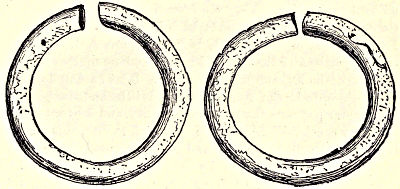
Fig. 150.—Hollow Bronze Penannular Rings from Lisnacroghera.
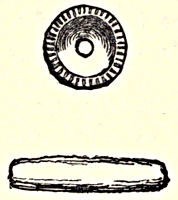
Fig. 151.—Bronze Stud.
Fig. 152.—Bronze Rivet.
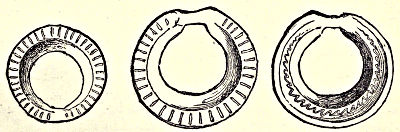
Fig. 153. Fig. 154. Fig. 155.
Bronze Circlets.
Touchstones would appear, from their make, to have been worn about the person, several being pierced with a hole, seemingly for attachment of a string. Sir W. Wilde remarks that they have been found both flat and four-sided, and with and without perforation. They are formed generally of black Lydian stone or of jasper, either material being suitable for gold-testing. Lydian stone, or black chert, is “an impure flint, found in the central portions of the carboniferous limestone of Ireland, and at the base of the Kilkenny coal formation. It is of a dull dark colour, approaching to black; is more opaque, brittle, and stone-like, than flint; never possesses the same translucency, and does not so readily chip into conchoidal fragments: but, next to flint, it is one of the hardest of the siliceous rocks, and hence was used occasionally for forming tools and weapons by the inhabitants of those districts where flint was rare. Lydian stone, ‘Lapis Lydius,’ or, ‘Lapis Hibernicus,’ as it was denominated by the old Dutch writer De Boot, so long ago as 1647, is the true touchstone of the ancients.”
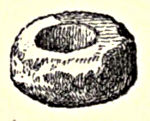
Fig. 156.
Pipe-clay Crucible.
Few ornaments of silver, and still fewer of gold, have been brought to light in crannogs, the antiquities of which consist mainly of the more homely class of bone, bronze, and iron articles for personal adornment; yet numerous gold ornaments have doubtless been discovered, but remained unrecorded, from fear of detection on the part of the finder, before the Treasury Minute respecting “Treasure Trove” came into operation. Antique articles of gold have been turned up in the bogs of Ireland, and in various parts of the country. Is it likely that the inhabitants of “island fortresses” should alone be devoid of the precious metal, especially as in them have been found both small earthen crucibles—so diminutive as to have been useful only for gold or silver smelting,—and also small pipe-clay cupels for refining purposes, like those used in the present day for the assay of gold and silver? Fig. 156 represents a pipe-clay crucible from the crannog of Lagore, 2 inches broad, and 1 inch high. A well authenticated instance of the discovery of the precious metal in a crannog, was that of “several gold pins,” at Loughtamand, county Antrim;[142] and, in the autumn of 1870, a beautiful, almost unique, specimen of early Irish art came to light on the site of the former lake dwelling of Lough Ravel, county Antrim. The accompanying woodcut is the size of the original. This silver brooch, or fibula, represents two bird-headed serpents joined together: both sides of the ornament are alike; the silver is slightly thinner than a shilling piece; the pin is missing. In the design there seems to be a resemblance to some of the initial letters in the “Book of Kells,” and other early Irish MSS., so that its probable age is not later than the tenth century.[143]
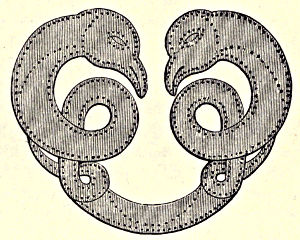
Fig. 157.—Silver Brooch from the Crannog of Lough Ravel.
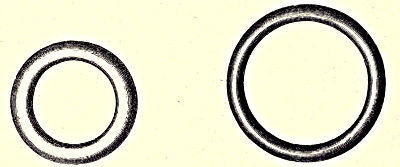
Fig. 158.—Stone Ring. One-third size.
Fig. 159.—Stone Ring. One-half size.
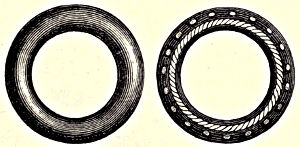
Fig. 160. Jet Bracelet, or Ring. One-quarter size.
Fig. 161. Glass Bracelet, or Ring. One-third size.
Figs. 158 and 159 are good examples of stone rings, the former 2½ inches in the clear; the latter, 2¾ inches. Fig. 160, drawn one-fourth the real size, is a bracelet of jet, from Lough Eyes, restored from the fragments; and fig. 161, restored from existing remains in the Museum, R.I.A., is of blue-coloured glass, decorated with spots and a cable pattern.
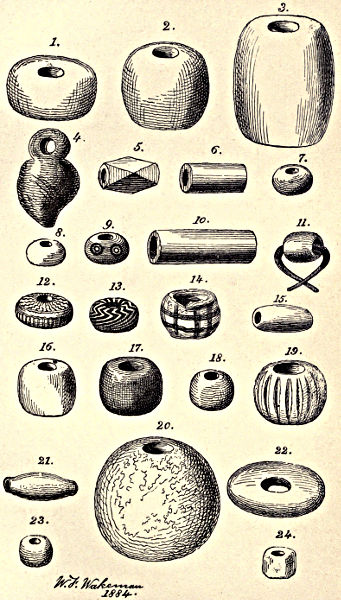
Plate XXVII.
Beads, composed of various materials, from Ardakillen, Lagore, Ballinderry, Drumdarragh, Cloonfinlough, and Lough Eyes.
Beads of stone, bone, jet, earthenware, and wood, occur in crannogs; also beads of amber, of which many are in modern use amongst the peasantry as prayer-beads. O’Flaherty, in his Iar Connaught, states that amber was procured in more or less quantities on the coast of Galway. Ornaments of glass, from the most simple and unpretending plain blue bead to that studded with settings of enamel or vitreous paste, so varied in colour and of so much beauty in outline that they might be worn at the present day, are still met with in crannogs, as well as in pagan sepulchres. Blue appears to have been the favourite colour, but some are pale green, white, yellow and red, with spirals and decorations of varied colours; whilst others have a dark groundwork, and are studded with fragments of red, green, yellow, blue and white enamel. All the beads figured in plate XXVII. are drawn full size. No. 1, formed of stone, presents an average specimen of its class. No. 2 is from Lagore, where a considerable number, but of smaller size, occurred. No. 3, composed of bone, is probably the largest bead of that material found in any crannog: usually, they are scarcely the size of an ordinary pea. No. 4 is a pendant of black opaque glass; it probably formed the centre of a necklace. One resembling it, but composed of stone, may be seen in the Petrie Collection, R.I.A. No. 5 is a small bead of blue glass; its form is one of rare occurrence. No. 6, of plain cylindrical outline, was accompanied by several others of the same class: in colour it is a dull green. No. 7, a small globular bead of glass: colour deep blue; and No. 8, of similar shape, is composed of opaque white glass, or porcelain. No. 9 is a beautiful bead of green glass, presenting in dark-blue the dot-and-circle pattern; the spaces between the dots and their surrounding circles are pure white, so that a very pleasing effect is produced. No. 10 is an unusually long bead, of material similar to No. 6. No. 11 is a curious bead, through which passed a piece of bronze wire, which probably formed the loop of a pin. No. 12 is formed of dark-green glass, relieved by yellow ornamentation, as shown in the representation; and No. 13 is of dark-blue opaque glass, or paste, with chevrons of white glass, or enamel, passing round it. No. 14 is formed of white glass, or porcelain, ornamented with a pattern in black, and the opening for the string unusually large. No. 15 is composed of very light-coloured blue glass; and No. 16 of pure crystal. No. 17, formed of jet, was accompanied by fragments of bracelets of the same material. No. 18, apparently formed of fine clay, its colour what artists call Venetian red, is in the Petrie Collection. No. 19 is, undoubtedly, most curious, not on account of its form or design, which is common, but in regard to its being made of lead—perhaps the only example of a bead of that material discovered in Irish crannogs. No. 20 is a fine specimen of the amber bead, so often discovered in connexion with very early remains. No. 22 is also an amber bead, of rather unusual form, being almost flat, like a wheel. Nos. 23 and 24 were picked up by W. F. Wakeman, from the shores of one of the crannogs of Lough Eyes, but at a time subsequent to the publication of his Paper on that locality.[144] The collection of glass and enamel beads in the Museum, R.I.A., contains one of long cylindrical form, composed of blue, white, and yellow enamel; it is ¾ of an inch long, is decorated with a blue and white band round each extremity, and has yellow spots on the centre: it is of the same character as No. 41, represented by fig. 162. No. 21, one of the most beautiful beads in the collection, fig. 163, measures half an inch in the longest diameter, and is composed of clear glass, with bright yellow spirals of opaque enamel covering its sides. No. 27, represented by fig. 164, is an opaque bead of glass, light-green in colour: the aperture is rather large, so that it may have been used as a necklace, or pin-bead; it is grooved in melon-form. Two beads, composed of green glazed-ware, and also of melon-shape, may be seen figured at page 178, in Munro’s Scottish Lake Dwellings. Nos. 20, 21, and 27, Museum, R. I. A., are from the crannog of Lagore.
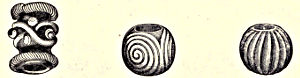
Fig. 162. Bead from Lagore.
Fig. 163. Bead from Lagore.
Fig. 164. Bead from Lagore.
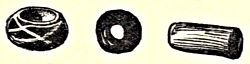
Fig. 165. Fig. 166. Fig. 167.
Beads from Lisnacroghera.
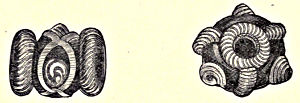
Fig. 168. Fig. 169.
Beads from Lough Ravel.
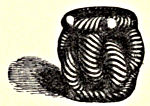
Fig. 170.
Glass Bead from Ballintlea.
The three following beads here described are from the crannog of Lisnacroghera. Fig. 165, of opaque blue glass, very dark in colour, but relieved with white streaks of the same material, crossing each other obliquely. Fig. 166, of ordinary blue glass, quite plain; and, fig. 167, an elongated cylindrical bead of amber.[145] In Wilson’s Prehistoric Annals of Scotland, and in Keller’s Ancient Lake Dwellings of Switzerland, may be seen representations of beads, greatly resembling one from the crannog of Lough Ravel, county Antrim, as shown in fig. 168. Fig. 169, from the same locality, is somewhat similar, but the yellow, raised and rope-like decoration which encircles it does not form an integral part of the glass; it has been produced by laying the colour on the surface, instead of its being fused into the glass. The bead, fig. 170, although from the lands of Ballintlea, near Timahoe, Queen’s County, is of the same class as many discovered in crannogs. At top and bottom it exhibited indications of friction, showing it had been strung with others as a necklace, or some article of personal adornment. It is formed of sea-green glass, moulded to represent interlaced cords, the strands composed of threads of white glass; round the upper and lower rims there are small knobs of opaque yellow glass. That these beads are of native Irish manufacture is extremely probable, as, in two instances at least, lumps of blue glass in an unfashioned state have been discovered in connexion with crannogs, which also yielded beads of exactly the same colour and material. The majority of the beads present internal evidence of the manner in which they were made: “the glass has at first been in the form of a rod, then a portion, when in a soft state, was bent into the form of a bead, and sufficiently heated to cause the ends to unite.… When the ornamentation is composed of a spiral rod, it has been laid on in the same way, and the line of junction can be made out in every case.”[146]
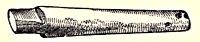
Fig. 171.—Bone Harp Pin from Ardakillen. Half-size.
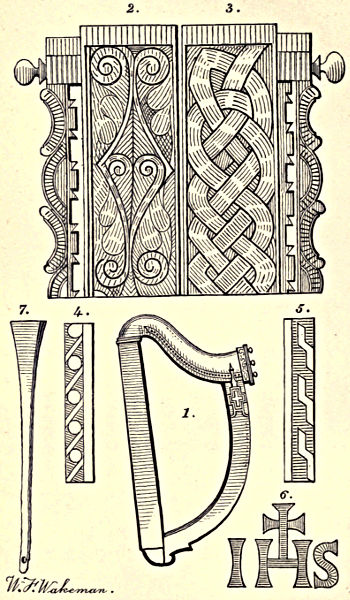
Plate XXVIII.
Harp, from the Crannog of Ballinderry. Woodwork restored.
Music.—It has been remarked that, in order to form a just estimate of the character of any particular people, it is necessary to investigate the pastimes and amusements most prevalent amongst them; war, and other contingent circumstances may place men at different times in different points of view, but when we follow them into the retirement of their homes, we are most likely to see them in their true state. In crannogs few musical instruments have come to light, owing probably to the perishable materials of which they were usually composed, yet enough remain to prove that, in time of peace, the sweet sound of the harp, and in war, the hoarse bray of the trumpet, resounded over the waters of the lakes. Portions of ancient harps have not unfrequently occurred in crannogs, but no fairly perfect example has as yet come to light. Some harp pins are formed of bronze, and several of bone were found at Ardakillen. In the Museum, R.I.A., there are upwards of twenty harp pins, the majority obtained from crannogs: they vary in length from 2⅛ to 4⅛ inches, are square in the head, and perforated in the smaller extremity, for holding the wire string. In the accompanying plate XXVIII., is figured (1) an Irish harp as restored: it stands at present 37 inches in height, all the metal portions were discovered in the crannog of Ballinderry, county Westmeath, and the proportions and form of the modern woodwork were regulated by the size and form of the original metal work; the thirty-five pins show the number of strings that were formerly attached. Although the style of decoration is of a very early character, yet as the letters I.H.S., surmounted by a cross, appear engraved on a brass plate in front of the instrument, the work cannot be older than the sixteenth century. Nos. 1, 2, 3, 4, and 5, convey a clear idea of the kind of ornamentation on the metal fittings, and No. 7 (from Drumdarragh crannog) represents a harp pin of the usual kind.
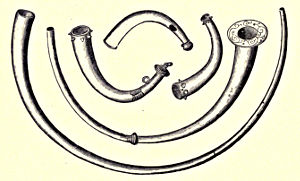
Fig. 172.—Trumpets in the Museum, R.I.A.
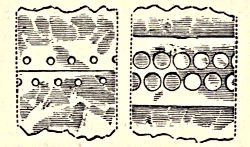
Fig. 173.—Showing riveting of Trumpet. Full-size.
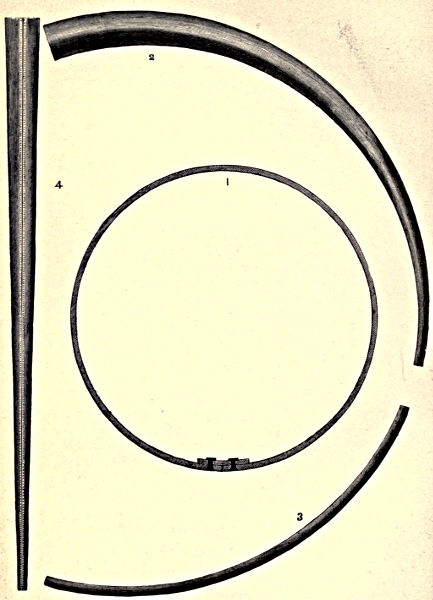
Plate XXIX.
BRONZE TRUMPET, NOW IN THE MUSEUM OF THE ROYAL IRISH ACADEMY.
Found in the Co. Down, A.D. 1809.
Figures 2 and 3 side view of Trumpet, scale one and a-half inch to a foot; Fig. 4 shows the joining of the plate, and of the two lines of rivets of Fig. 2; Fig. 3 is similarly rivetted.
Fig. 1 section of fig. 2 at larger end, full size, showing strap and rivets.
In 1809, at Ardbin, parish of Annaghclone, county Down, both joints of a very large and perfect curved bronze trumpet, or bugle-horn, were disinterred from a peat bog that had been a sheet of water about the middle of the last century. As conclusive proof of there having been a crannog in this former lake-bed, a stratum of burnt oak, a canoe scooped out of a single tree, together with four short paddles, were dug up from the peat. Of the trumpet, the remains—minutely described in the Newry Magazine for 1815—are now in the Museum, R. I. A., and in the accompanying engraving (fig. 172) the outside trumpet is a representation of this instrument. As may be observed, from comparison with the various other horns in the Museum, it is by far the largest of that collection, and is probably (as asserted by Wilde) the finest of its kind discovered in Europe. The trumpet is given on a larger scale in plate XXIX.: “it measures 8 feet 5 inches along the convex margin, and consists of two portions, each formed of very strong sheet bronze of a yellowish red colour, and joined along the seam.” It is 3½ inches wide at the open of the large end, and ⅝ at the upper; the small tube has parallel sides, and is about the size of the small extremity of the larger. By what means the two were joined together, or whether a mouth-piece was attached to the small extremity, is unknown, yet a variety of loud martial tones can be produced by the lower fragment. “The riveting of the edges in this instrument is the most perfect thing of its kind yet discovered, and is well exhibited in the accompanying cut, drawn the natural size from portions of its external and internal surfaces. The bronze strap which covers the joining on the inside is studded with small circular-headed studs, riveted on the outside, as shown in the lower section of the cut. There is no strap externally; and the perfection of the riveting has long been a subject of admiration to the curious, there being as many as 638 rivets in the lower portion.[147] By what means they were introduced throughout, or what description of mandril was employed for riveting them upon, is still subject of speculation.”[148] To judge from its size, this kind of war trumpet should give no uncertain sound. It is stated by Polybius, that on the continent “the parade and tumult of the Celts terrified the Romans, for there was amongst them an infinite number of horns and trumpets,” &c. And in describing the Celtic Gauls, Diodorus Siculus says, “they have amongst them trumpets peculiar as well to themselves as to other nations; these by inflation emit an hoarse sound well suited to the din of battle.”
Chess, &c.—In early Irish MSS. frequent mention is made of chess as a favourite amusement of the Celtic people; and in “The Dialogue of the Ancient Men”—a valuable tract contained in the Book of Lismore—there is a curious passage relating to a game of chess, the players being Finn Ban Mac Breasel, son of the king of Leinster, and Guaire Goll, one of Fionn Mac Cumhail’s chess-bearers; the wager was three ounces of gold, and the players quarrelled as usual. The passage is here given as a record of the prevalence of this game at a remote period: “And these two played for three days, and Guaire did not win one game during that time. And he threw down his wager, and insulted and abused the other man, and he said ‘he was not a servant in service, nor a vassal in vassalage, nor a hero in heroism;’ and Finn Ban raised his fist, and gave Goll a blow that brought three front teeth out of his upper jaw, and they fell together on the back of the chess board.” Another anecdote in proof of the prevalence of the game may be found in O’Curry’s Manners and Customs of the Ancient Irish; in it the scene is also laid in the pagan age, but anterior to the time of the famous Finn Mac Cumhail—[149] “It was a century before the Incarnation, that Eochaidh Airemh was monarch of Erinn, and his queen was the celebrated Edain, a lady remarkable not only for her beauty, but for her learning and accomplishments. One day that Eochaidh was in his palace at Teamair (according to this ancient story), a stranger of remarkable appearance presented himself before him: ‘Who is this man who is not known to us, and what is his business?’ said the king. ‘He is not a man of any distinction, but he has come to play a game at chess with you,’ said the stranger. ‘Are you a good chess-player?’ said the king. ‘A trial will tell,’ said the stranger. ‘Our chess-board is in the queen’s apartment, and we cannot disturb her at present,’ said the king. ‘It matters not, for I have a chess-board of no inferior kind here with me,’ said the stranger. ‘What do we play for?’ said the king. ‘Whatever the winner demands,’ said the stranger. They played then a game, which was won by the stranger. ‘What is your demand now?’ said the king. ‘Edain, your queen,’ said the stranger, ‘but I will not demand her till the end of a year.’ The king was astonished and confounded; and the stranger, without more words, speedily disappeared.” It is clear that chess is a game of great antiquity,
“Age cannot wither it, nor custom stale Its infinite variety.”
From the crannog of Lagore was obtained a thin stone or slab of squarish form, measuring about 14 inches on either side. It presented upon its upper surface a number of squares as on a chess-board.[150] The material for this purpose, however, varied considerably, for in the “Annals of Clonmacnoise” it is stated that when Muirchertach of the leathern cloaks (who lived in the middle of the tenth century) carried off the body of Cerbhall, king of Leinster, he caused a chess-board to be formed out of his bones. Instances of utilizing the osseous remains of a dead adversary were, in ancient times, not uncommon. The old Vikings, in imitation of their gods, quaffed their ale out of goblets composed of the crania of their enemies.
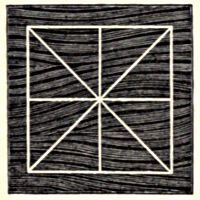
Fig. 174.
In Irish lacustrine sites a number of discs, formed apparently of deer’s horn, or bone, have been frequently met with; these articles, as a rule, are ornamented on one side only with the dot and circle pattern, such as appears upon combs and other objects of bone; many were found at Lagore, Cloonfinlough, Ballinderry, &c., and they resemble one from the Loch of Forfar, figured in Munro’s Ancient Scottish Lake Dwellings. The term “whorl” has been very generally applied to these discs, the supposition being, that their use was to aid in the rotation of the distaff or spindle. Some Irish archæologists, however, have suggested the idea of their being rather draughtsmen, or counters for a game; and English antiquarians have pronounced a similar opinion with regard to ivory discs discovered in that country. The latter suggestion certainly carries with it a great degree of probability; and although the game of draughts as now played cannot claim great antiquity, yet there were other pastimes in which little stones, shells, or nuts were employed by the ancients; but, as the arts of man progressed, “stones and shells were laid aside, and ivory counters became their substitute.” Croften Croker in his tour through Ireland early in the present century observed two peculiar games then almost universal amongst the peasantry; one of them was played on lines usually marked on a board with chalk, as shown in fig. 174. “Each player is provided with three counters (small black and white pebbles or shells) which are simply deposited on the board in turn; the game is won by getting these three counters in a straight line. The centre point is considered the most advantageous, and is always taken by the first player: when all the counters are deposited, moves are made from one point to the next should it be unoccupied, and so on until a careless move on either side decides the game, by allowing the adversary to form his three counters in a row.” The unperforated discs ornamented on one side only it may be fairly surmised had served either in draughts or in games of that nature. Fig. 175 represents a specimen of this class found in a “souterraine” at Drumcliff, county Sligo, in company with calcined bones and traces of iron remains; it seems to be identical in style, size, and material with those found in crannogs, as for example fig. 176, from the crannog of Cloonfinlough, ornamented with a border of circles with dots in the centre surrounding four groups of similar circles: each group consists of four circles. Fig. 177, from the same locality, is plainly decorated with five circles arranged in a cruciform pattern. Both these articles are stained a dark-brown colour.[151]
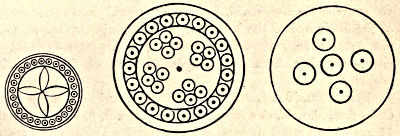
Fig. 175.—Unperforated Bone Disc from Drumcliff, Co. Sligo. One-half size.
Fig. 176. Fig. 177. Unperforated Bone Discs from Cloonfinlough. Full size.
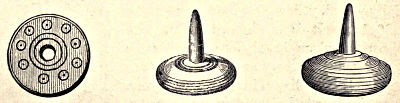
Fig. 178.—Perforated ornamented Bone Disc from Lagore. One-half size.
Fig. 179. Fig. 180. Perforated Bone Discs, with Spike, from Lagore. One-half size.
With regard to the perforated discs, it should be borne in mind that they were of the same size as the unperforated, were decorated with similar designs on one side only, and that it is almost incredible so much trouble should have been bestowed on the ornamentation of an object intended to serve merely as a spindle whorl, as for example on the accompanying examples from Lagore. The more natural inference seems to be, that these discs were employed in some game—say chess—the perforations being intended for reception of the upper parts, marking the distinctive character of the various pieces used in the game. Nos. 10 and 11, plate XXV., may possibly have been these distinctive upper portions. An object similar to fig. 180 is described in the Catalogue of the Museum, R.I.A., as a “whorl,” in which a portion of the lower end of the bone spindle still projects; but might it not equally be supposed to represent a chessman—possibly a pawn—judging from the simple outlines of its projecting portion?
Plate XXX., Nos. 1, 2, 3, 4, from Lagore, and now in the Petrie Collection, R.I.A., are all perforated. Nos. 5, 6, 7, 8, 9, 10, and 11 are discs formed of bone or horn, varying in thickness from ¼ to ⅛ of an inch; No. 6, however, is scarcely ¹⁄₁₆ of an inch. All these are unperforated, therefore could not have been used as “spindle-whorls.” No. 11 is quite plain, the other specimens are ornamented, but only on one side; all the above are of bone; Nos. 12 and 13—both of them composed of stone and perforated—also came from some of the crannogs in the neighbourhood of Strokestown, and the latter is a good specimen of the so-called “whorl” commonly found in the northern counties, where hundreds of them have been discovered in a great variety of places, in carns, crannogs, plough lands, &c.
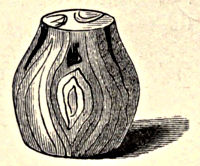
Fig. 181.—Stone Chessman, in the British Museum.
Fig. 181, from Cloonfinlough, is, it is believed, a unique specimen of a stone chessman, rounded in the body, diminishing towards the top, and flattened at both extremities. It is 1³⁄₁₆ inch in height, ¾ inch in diameter, and is polished; the material beautifully veined, yellow, pale brown, and white.
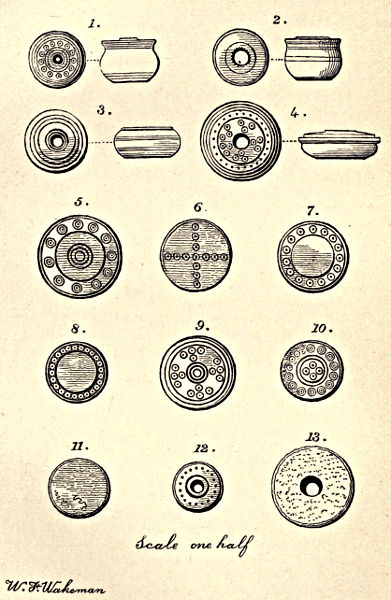
Plate XXX.
Stone and Bone Circular Discs from Crannogs.
Ogham.—It is a disputed point, with regard to Ogham inscriptions, whether the signs represent a very ancient alphabet, or are merely a mediæval invention, or cipher. Some allusions to be found in old Irish MSS. refer them to ante-Christian times; but it may also be observed, that in similar writings frequent mention is made of a man’s Ogham name as being scribed on a stone raised in commemoration of him; such name must therefore be inferred to differ from that by which he was ordinarily known. Now, if Ogham be viewed as a cipher, dating only from the early monkish period of Christianity, the Ogham name may mean simply what in the present day would be termed the name in Religion. It is, however, immaterial for the present purpose to which category Ogham characters be assigned, for in either case they belong to the metallic age, as probably no race in the stone age had attained the art of communicating ideas by means of an alphabet. Even in the present day, when seeking to civilize barbarous tribes, it is found essential, for the purpose of imparting information, to adapt their languages to an alphabet. Ogham may be briefly described as an arrangement of strokes, or indented lines or notches cut on the arris, though sometimes found on the flat of the stone or other material, when a straight line is substituted for the arris. The letter is denoted by the length of the stroke or notch, its position, whether above or below the arris or line, or appearing both above and below, and likewise the number of strokes or notches grouped together. Oghamic scribings have been found on a stone in the crannog of Ballydoolough, and on bone pins and other ornaments in the crannogs of Ballinderry and the Strokestown group. Ogham appears to have been employed not only for mortuary inscriptions carved on pillar-stones erected over celebrated warriors, but also, in the same manner as we now use the Roman alphabet, for communication by messengers, &c. On one occasion a celebrated mythical Irish hero, named Cuchullain, when traversing a forest saw an inscribed pillar-stone, and hung round it a verse in Ogham character, carved by him upon a withe.[152] The MS. from which this anecdote is quoted was compiled about the year 1106. The same hero is elsewhere represented as sending information to Meave, queen of Connaught, by means of cutting or scribing on wands; the son of a Scottish chief is described as cutting Ogham characters on a spear. The date of the latter incident is assigned to the commencement of the Christian era. Another instance is mentioned, partaking however more of the nature of a regular letter. In A.D. 408, Corc, son of the king of Munster, was driven by his father into exile; he fled to the court of Scotland; but, before appearing in the king’s presence, an Ogham inscription on his shield was discovered and deciphered by a friend, who thus saved the prince’s life, the inscription being to the effect that, should he arrive at the Scottish Court by day, his head was to be cut off before evening, and if by night it was to be cut off before morning.[153]
It is almost needless to add, that all Ogham mortuary scribings are in very antique language, thereby adding considerably to the difficulties attending any attempt at translation of these archaic inscriptions. The Gaelic of to-day, where it yet lingers, is to the ancient dialect much what modern English is to the Anglo-Saxon of olden times. The oldest lettered characters of the Irish lake dwellers are Ogham or runic-like markings on stones, amulets, pins, and brooches. An important “find” at Ballydoolough consists of a block of hard reddish sandstone, measuring 2 feet 1 inch in length, by 4½ inches in breadth, and 6 inches in depth. On it are well-marked Ogham characters, and these, when read by the light of the Ogham alphabet, would seem to spell the word BALHU.
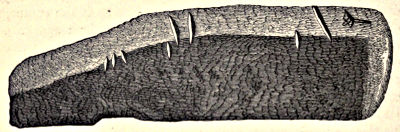
Fig. 182.
Ogham found at Ballydoolough Crannog.
In the comparison of Irish and Gaulish names by Professor Adolph. Picket[154] is found the Celtic name “Balanan” (Balanu), which seems very like that on the stone. At the thicker end of this stone, just before the commencement of the Ogham, a slightly-marked cross of peculiar form may be traced;[155] and the accompanying illustration represents, full size, a fragment of an ornamented stone, from Ardakillen, inscribed with Ogham-like scores.
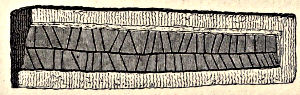
Fig. 183.—Scribed Stone from the Crannog of Ardakillen. Full size.
Money.—The precious metals, shaped for purposes of traffic, at once stamp crannog “finds” with a modern, or at least with an historic date. Very few coins, however, have come to light; the most numerous are of the reigns of Mary and Elizabeth, some of them being forgeries. In the crannog of Cloonfinlough the coins varied in date from one of the Emperor Hadrian to a specimen of the brass money of James II. One coin was discovered under such strange circumstances that it claims special mention:—In the lake adjoining the glebe house, in the parish of Aghnamullen, county Monaghan, there are two islands, and about the year 1850 one of them was for the first time ploughed, and many curious antiquities turned up. In 1863, the rector then in possession, while seated on the island, and peering into the water, observed what to him appeared a button on the leaf of a water-plant growing up from the bottom of the lake; on pulling the leaf, this proved, however, to be an ancient coin—a half groat of the reign of Edward III. The natural growth of the aqueous vegetation had thus lifted to the surface of the lough some of its buried treasures.[156]
Strange as is this incident, it is surpassed by one related in connexion with the discovery of a silver penny of King John. It appears that upon preparing a fish of the bream species, taken in Dalkey Sound, the coin referred to was found in its stomach, and as it is on record that some time during the reign of John, a ship containing a large sum of money was sunk close to the place where the fish was captured, it is but reasonable to suppose that the coin in question had formed a portion of the lost treasure.
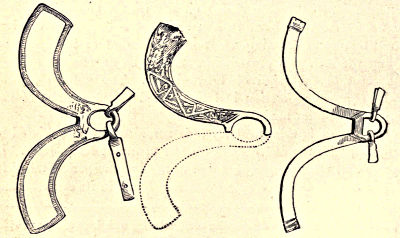
Fig. 184.—Cheek-pieces of Bits.
Horse Furniture.—At Ballinacarriga, near Moate, county Westmeath, the peaty mould of a lake, now almost dried up, has at various times yielded numerous objects of interest. One of them (plate XXXI.) is thus described by Alderman Day, F.S.A.:—“It somewhat resembles in shape the wooden forepart of a cavalry saddle of the present day, but here the likeness ends; this piece of horse furniture is covered with interlaced knot-work of the choicest kind, similar to the well-known ornamentation upon our ancient Irish crosses. The timber composing it is yew, which fortunately was preserved by being deposited in the peaty mould of the lake bottom. The centre of the pommel is pierced by a very Moorish-looking horse-shoe ornament, and both sides of the timber are carved in compartments, no two of which are alike in their filling up of scroll and net-work. Even the top of the pommel, of both near and off side, differs in the pattern of the ornament. The points of the pommel at both sides are pierced with two holes, where the mark of the fong is apparent, by which the forepart was secured to the lateral boards which formed the seat of the saddle, and both points are grooved for the reception of these boards.” Bridle-bits, or cheek-pieces, were discovered in Loughran Island, in the river Bann: of these, one is quite plain, and the other remarkably slender; it measures 6 inches across—the two metal rein-straps still remain on the posterior loop. The third, fig. 184, represents a fragment merely, of one that had borne ornamentation.
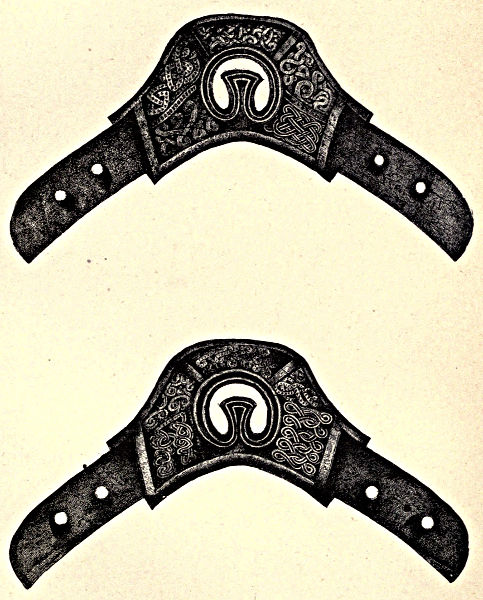
Plate XXXI.
Forefront of Ancient Irish Saddle. Back and Front view.
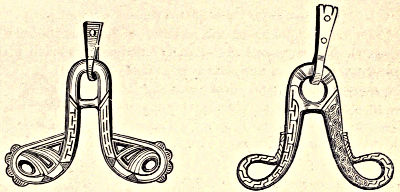
Fig. 185.—Cheek-pieces of Bits from Lough Faughan and Ardakillen. Two-thirds real size.
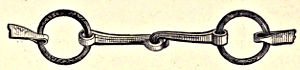
Fig. 186.—Iron Bit from Lagore. One-fourth real size.
Fig. 185 represents cheek-pieces from the crannog of Lough Faughan, and from Ardakillen. The bit proper, by which cheek-pieces of this class were connected, appears to have been almost invariably composed of iron. A perfect specimen with bronze mountings is represented in Shirley’s History of County Monaghan. An example of the iron bit which is supposed to have succeeded that composed of bronze and iron is here given. It came from Lagore, as did also several flat pieces of iron, which there is reason to believe had been attached as ornaments to some article of horse trapping. They measure 3 inches or so in length, by about ¾ of an inch in breadth, and are most curiously decorated in enamel of various colours, the patterns being geometrical interlacing figures in the style known as Opus Hibernicum; at the time of their discovery, they presented the only examples of enamel on iron which had then been noticed, and some of them may now be seen in the Petrie Collection of the Museum, R. I. A. It is not known when enamel was first used in Ireland. Some writers refer its invention to the Gauls, on the authority of a passage from Philostratus (who lived about the commencement of the third century), to the effect that the barbarians bordering on the ocean knew how to spread colours upon hot metal so as to become on the cooling of the material as hard as the substance over which they were laid. Fig. 187 represents a small plate of iron, covered with a rich pattern in enamel—vermilion, yellow, and black; and fig. 188 is an ornament of mixed metal supposed, like the preceding, to belong to a piece of horse furniture: it is inlaid with red, brown, and yellow enamel, and “exhibits also specimens of a remarkable glass-mosaic in chequered work of blue and white, encrusted in cavities chiselled out on the face of the metal. This kind of ornament is found occasionally on ancient Irish works in metal, it bears much resemblance to some antique ornaments discovered with Roman remains, and it occurs on the curious bronze basin found in the bed of the river Witham near Lincoln.”
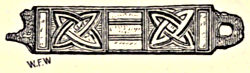
Fig. 187.—Enamelled Plate of Iron from Lagore. One-half size.
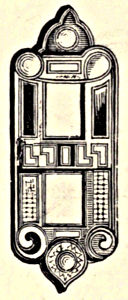
Fig. 188.—Inlaid Ornament of Mixed Metal from Lagore. Two-thirds real size.
Miscellaneous Articles.—It would be impossible to classify all the articles brought to light on lacustrine sites; indeed the use to which some of them were, or could be, applied must now be purely conjectural, so widely do the habits of life in the present advanced state of society differ from the rude and primitive existence of the lake dweller. To the representation of objects, whose use could not now be defined with any degree of accuracy, have been added—since the work went to press—a few plates of miscellaneous articles that fell under the writer’s observation in the interval. They are of interest, as throwing still further light on the details of the lake dwellers’ ordinary pursuits.
Amongst the debris of crannogs have been found several designs carved upon the polished surface of the larger bones of mammalia. Sir W. Wilde observed that clear, sharp, and accurate impressions might be made from some of these carvings in the same way that proofs are taken from a woodcut. In some instances the pattern is elaborately finished, and would answer equally well “as a design for the panel of a stone cross, the decoration of a doorway, or cornice of a round tower, a compartment of a brooch pin, the capital of an early ecclesiastical archway, the illumination of a MS., or the graving of a piece of warlike furniture.” An example of this kind of decoration is shown on plate XXXII., fig. 1; it is the leg bone of a deer, 8½ inches long, highly polished, and covered with carvings; its precise use is as yet conjectural. Figs. 3, 4, 5, are fac-similes of the embossed patterns on this bone.
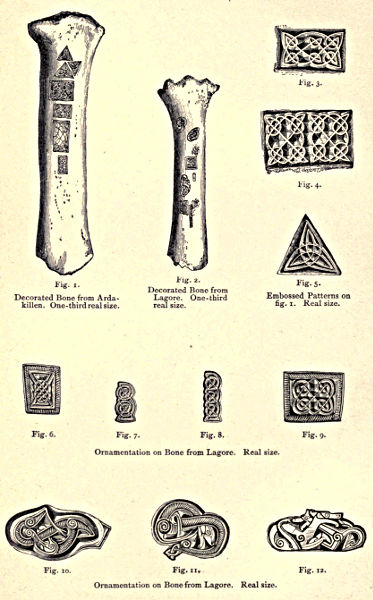
Plate XXXII.
Fig. 1. Decorated Bone from Ardakillen. One-third real size.
Fig. 2. Decorated Bone from Lagore. One-third real size.
Fig. 3. Fig. 4. Fig. 5. Embossed Patterns on fig. 1. Real size.
Fig. 6. Fig. 7. Fig. 8. Fig. 9. Ornamentation on Bone from Lagore. Real size.
Fig. 10. Fig. 11. Fig. 12. Ornamentation on Bone from Lagore. Real size.
Decorated Bones from the Crannogs of Ardakillen and Lagore. Use unknown.
Another carved leg bone of a deer (plate XXXII.), fig. 2, is stained a dark brown colour, probably by lying in peat; its polished surface shows how much it had been handled. Upon the surface of this bone there are various devices traced with a graver or other sharp tool. Figs. 6, 7, 8, 9, represent these (full size), and figs. 10, 11, 12, are characteristic of Celtic animal ornamentation.
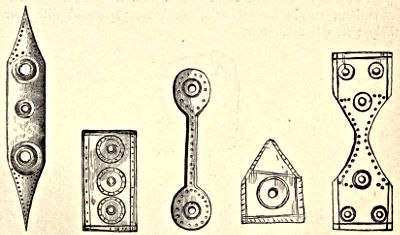
Fig. 189. Fig. 190. Fig. 191. Fig. 192. Fig. 193.
Plates of Bone, decorated, use not known.
In the Museum, R. I. A., there are eight thin plates of bone, varying in length from 1 to 5½ inches; they are of every variety of shape—square, triangular, irregular, but the majority oblong. In some respects they resemble in form, size, and ornamentation, the class of small stone articles supposed to have served as toys, amulets, or in some kind of game. According to Wilde, however, their more probable use was either for the decoration of small caskets, or for dress fasteners. They are generally perforated in several places, and the foregoing illustrations display great variety of outline. Their outer surface, smooth and convex, was more or less decorated with a number of circular indentations and dotted lines. Most of the specimens were found in the crannogs of Ballinderry and Ardakillen.
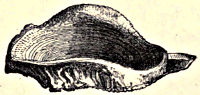
Fig. 194.—Rude Bone Spoon found at Clooneygonnel. Two-thirds real size.
Spoons formed of thin cuticular horn are not of unusual occurrence. The specimen represented, fig. 194, is one of two such articles found in the crannog of Clooneygonnel, and shaped out of the concave epiphyses, or joint surfaces of the vertebræ of some large mammal. A wooden handle had probably been originally attached to it.[157] Fig. 195, from Ballinderry, is a curious, rudely formed object of bone, perforated with four holes; its use unknown.[158]
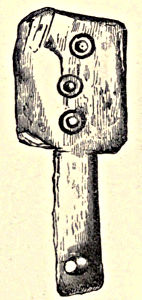
Fig. 195.—Spatula-shaped Bone from Ballinderry.
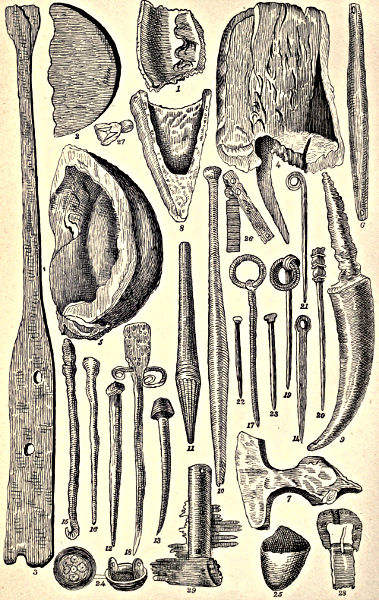
Plate XXXIII.
Miscellaneous Articles found in Crannogs.
Plates XXXIII. and XXXIV. contain representations of miscellaneous crannog “finds” from Randalstown and Lough Guile, county Antrim, and Ballykinler, county Down: when not otherwise specified the articles are from the first-named locality. Plate XXXIII., 1, a piece of pottery (¼ size) that seems to have formed part of an earthen vessel; it is coarse, strong, well made, and graceful in design; other fragments were met with, and judging from the appearance of fire on the outside of one, it had been used for cooking purposes. 2. A remarkable object of granite (½ size); two of similar form were found at Ballykinler crannog. 3. A paddle or oar made of oak, its length 3 feet 7 inches by 4½ inches in breadth. 4. A wooden scoop; total length 12 inches, the handle 4 inches, thickness 1½. 5. A wooden vessel found with a canoe; its diameter 7 inches, depth 3, and thickness 1 inch; it would be adapted for baling out a boat. 6 seems to be a netting needle (½ size); it is made of iron. 7. A battle-axe; length from face to end of projection at back 7 inches, length of face 5½ inches, breadth 1 inch at the one end, and at the other 1½ inches. 8. Iron sock of a plough; length 7½ inches, greatest breadth 4 inches; it terminates in a point.
The following objects are all drawn one-half size:—9. A knife, the only specimen met with at Ballykinler crannog, having a handle. The haft is of goat’s horn, and the blade like a penknife of large size; it does not seem applicable to any ordinary domestic purpose, but it may have been used for bleeding or operating on animals. 10. A wooden instrument—of which two were found—made of soft, long-grained wood of the pine kind; they might have been used for coarse knitting. 11. An instrument of similar wood, use unknown. 12. There were several like No. 12, formed of soft wood; they might have served as fastenings for mantle or hair. 13. An instrument of bone, neatly made and polished, which might have been used as a pin. 14. A pin, made of a close-grained, hard, white wood, probably holly; several of these were brought to light. 15. An article of iron, use unknown. 16. A pin of iron; several of these were found. 17, 18, 19, 20, 21, 22, 23, are pins of bronze. There were a great number resembling No. 17, also several of No. 19. 24. A large button made of bronze; the eyes are not fastened in but cast. 25. A crucible, seemingly of foreign manufacture, and unused; but several were met with greatly calcined. 26, 27, 28, seem to be fastenings for leather or other garments; they are of very thin bronze. 29 is a comb made of bone and riveted with iron (found at Ballykinler crannog).
Plate XXXIV., 1, is a pointed and socketed iron instrument from Ballymena. 2, drawn about half-size, is evidently a lamp of late, or perhaps mediæval form, composed of iron, and the workmanship good; it had an upright handle pierced by an oblong hole, with another hole in a projection at end of handle. A gentleman saw a lamp of this class in use near Carrickfergus in the year 1840, as also in the islands off the coast of Ulster. 3 is a canoe paddle made of oak, and about 3 feet in length; 4 is of stone, and was found in a crannog in the county Down; 5 is a “spindle-whorl” (so called) made of jet, and having indentations on it for a thong or string; 6 is a flint knife (full size); the form is rather unusual, flint knives being generally straight; 7 is a full-size representation of the smallest of two bronze knives; the other differs from it in being 1 inch longer, and the shape not so curved; it should however be observed, that these two articles are supposed by some authorities to be modern forgeries. 8 is a bronze instrument about 6 inches long, and very sharp at the point; the metal and workmanship being similar to the knives, it therefore may also be spurious. 9. A lozenge-shaped “spindle-whorl” of jet. This and the three preceding are said to have come from Lough Guile. 10 is a stone, natural size, perforated with two holes crossing at right angles, and at each end a hole going a short way in. It is suggested that it may have been the axis of a small wheel, “the arms being inserted through the holes in the body of the stone, while it worked on two projections inserted into the holes at the ends.”[159]
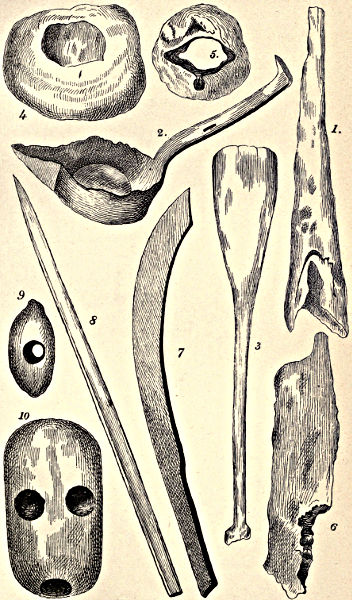
Plate XXXIV.
Miscellaneous Articles found in Crannogs.
A pair of scales were found at Loughtarmin, and several at Lagore. At the latter place were also a number of sewing-needles, composed of various materials: the majority were of bone, about six or eight of iron, and four or five of bronze. Those made of metal were comparatively small and fine. Needles of the same kind have been met with in the great crannogs of Ardakillen and Ballinderry.
At Lagore was found a bronze object, use unknown, fig. 196. In one part it is ornamented with a beautiful chased design, once probably enamelled. In the same crannog there was a square iron pipe, 2½ inches in length, to which a long hook was attached.
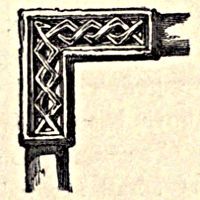
Fig. 196.—Bronze Object found at Lagore. Full-size.
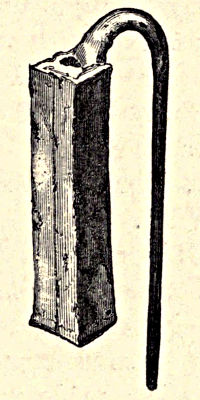
Fig. 197.—Iron Pipe with Hook, from Lagore. Full-size.
All the articles figured on plate XXXV. were found in the crannog of Cloonfinlough, and are now in the British Museum. No. 1 (one-fourth real size) represents a leaf-shaped dagger, skean, or knife, of an extremely early type; it is a characteristic specimen of its class. Similar weapons have, in Ireland, frequently occurred in company with socketed celts, paalstaves, spear-heads, and other implements of the so-called “Bronze Age.” The handle is very small, perforated for insertion of a rivet, and probably the haft had been originally prolonged by the addition of a piece of bone, horn, or wood, secured to the bronze by means of the rivet. No. 2 (full-size) is an eo or brooch of bronze of a not unusual design, having a long pin and broad flat ends, with a sunk lozenge in each, filled with a hatched pattern. This form of dress-fastener must have remained unchanged during many ages, for whilst it seems to have been common in the later “Iron period,” it has also occasionally been found under circumstances which point to much earlier days and usages. One example was discovered in a cinerary urn amongst calcined bones. No. 3 (full-size) is a pin of bronze with a crozier-like termination, ornamented with a series of minute indentations, arranged without any regular pattern. A number of these objects have been discovered in Christian cemeteries in Ireland—as at Clonmacnoise and the Arran Islands. No. 4 (full-size) is a very small arrow-head of iron; traces of a rivet hole are yet discernible. No. 5 (one-third real size) is a ring made from the crown of a stag’s horn, and polished on the interior; its use unknown. No. 6 (one-third real size) represents a double-bladed axe-head; similar implements occurred at Lagore and at Drumdarragh; they belong to the late “Iron period,” and vary greatly in dimensions. No. 7 (one-third real size) is a single-piece shoe of leather, joined at the heel and toe; at each side is a slit for a thong or strap to be brought over the instep. Articles of this kind were used amongst the Irish down to a very late period. Some specimens, highly decorated in early Celtic style, have been figured by Wilde.
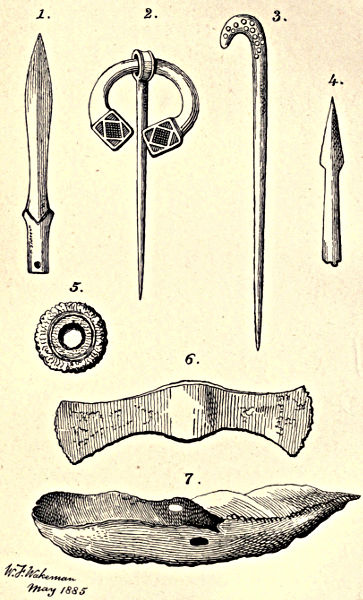
Plate XXXV.
Objects of various Materials from the Crannog of Cloonfinlough, and now in the British Museum.
Fishing Implements.—It is probable that on account of the smallness of their size, many bronze fishing-hooks may have been overlooked by searchers amongst crannog sites, though a number of specimens formed of iron occurred amongst the relics of ancient Dublin during the excavations made many years ago in Christ Church-place, and Fishamble-street. Several implements of iron, evidently designed for the capture of fresh-water prey, have been found on the sites of crannogs, and may now be seen in the Museum, R. I. A. Plate XXXVI. No. 1 is the head of an eel-spear, one of several exhumed from the debris of the Ardakillen crannogs; no trace of the handle remained. The implement consists of nine barbed prongs (the wings of the heads nearly touching each other) set in an oblong-shaped socket, composed of extremely thin iron plates or bands, that measure in width 5½ inches, in depth 2¾ inches, and are of sufficient strength to receive and secure the prongs; these average somewhat less than a quarter of an inch at their greatest diameter, which occurs near the head. The socket in its various parts is secured together by a number of rivets, irregularly set; from it descends a shaft measuring 4¾ inches. It is at first quadrangular, but midway assumes a cylindrical form, resembling sockets of crannog spears of the later “iron period,” and like them secured to wooden handles by a rivet. The implement presents altogether a rough and bizarre appearance. No. 2 is a smaller example of an eel-spear, with socket, and having only eight barbed prongs. No. 3 is another form of fish-spear, or gaff. It measures 9½ inches in length, and is furnished at its pointed head with two long narrow barbs designed for holding. Unlike the spear and arrow-heads used in war, or in the chase, this implement was secured to its wooden shaft by a tang. Nos. 4, 5, 7, and 8, are darts or spear-heads of the same class. Save in size, they differ very slightly from No. 3, but are considerably eroded by the moisture of the bog-stuff in which they were embedded. No. 6 is a highly-finished head of the fish-spear class, though at first sight it might almost be taken for an arrow-head. Its barbs were, however, evidently intended to hold any substance into which they might be struck; the tang is solid and octangular, and just at the point where it joins the head there are three rather deep transverse notches. No. 9 is an ordinary iron fish-hook.
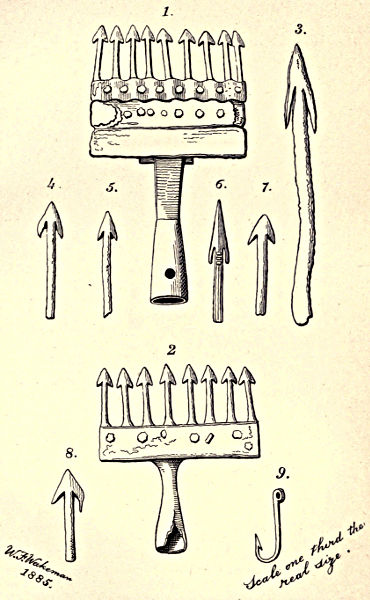
Plate XXXVI.
Fishing Implements of Iron from Crannogs. Nos. 2, 3, 4, 5, 6, 7, and 8 from Ardakillen or Strokestown Crannogs. No. 9 from Lagore. All one-third real size.
Historical Notices of Crannogs.—According to Keller, Swiss “Pfahlbauten,” or pile dwellings, attained their highest development about fifteen hundred years B.C. This statement he founds on the absence in them of traces of winter corn, hemp, and domestic fowl (unknown to the Greeks till the time of Pericles). These lacustrine sites appear to have been abandoned about, or perhaps before, the commencement of the Christian era; whilst on the other hand, although we have no account of the first erection of crannogs in Ireland, and must therefore consider their origin to date back from prehistoric times, yet we have undoubted proofs of their continued use down to the close of the seventeenth century; although now where
“… swells the wave All other sounds are still, And strange and mournfully sound they; Each seems a funeral cry O’er life that long has past away, O’er ages long gone by.”
In Connaught, next after Ulster, the greatest number of lake dwellings have been discovered, but a list of them could have only temporary value, as further explorations might greatly change, or even reverse, the numerical superiority of the crannog sites in Ulster. It is only of late that Munster can be said to be embraced within the lake-dwelling area, whose ambit now includes the entire kingdom. From the present stand-point, the northern province, however, seems to have been facile princeps the home of the lake-dweller. Its population, even to the close of the seventeenth century, followed a life of rude and primitive character. The waters of the Erne, its tributaries and lakes, stretched for a distance of nearly sixty miles; the counties of Monaghan and Cavan of the present day formed then a district of low wooded hills, interlaced with a perfect net-work of bogs and lakes, through which ran but one road—that by Carrickmacross in the barony of Farney—whilst the Few mountains, at that period wooded, served to complete a “scientific frontier” of nature’s own formation. The term “Lake Country” has often been applied to the county Fermanagh: indeed the whole territory would seem at no very remote date to have been a watery maze. Upon almost every side may be observed either marshes that had once been lakes, or else sheets of water varying in size, from what may be termed lakes to mere lakelets; and at a period when the whole neighbouring country was one mass of wood these inland loughs served as tolerably secure retreats. At the time of the Anglo-Norman invasion of Ireland castles on terra firma seem to have been but lightly esteemed by the northern chieftains, for the conqueror of Ulster had erected many strongholds to secure the subjugated territory, more especially in the country of Mac Mahon, who “with solemn protestations vowed to become a true and faithful subject, whereupon de Courcy gave him two castles with their demeanes to hold of him. Within one month after this Mac Mahon brake down the castles, and made them even with the ground. Sir John de Courcy sent unto him to know the cause: his answer was, that he promised not to hold stones of him, but the land.” Later on one Thomas Pettiplace, in answer to an inquiry from the Government as to what castles or forts O’Neil was possessed of, in a letter of the 15th May, 1567, states:—“For castles I think it be not unknown unto yr honors he trusteth no points thereunto for his safety, as appeareth by the raising (razing) of the strongest castles of all his countries, and that fortification that he only dependeth upon is in sartin ffreshwater loghes in his country, which from the sea there come neither ship nor boat to approach them; it is thought that there in ye said fortified islands lyeth all his plate, wch is much, and money, prisoners, and gages, wch islands hath in wars before been attempted, and now of late again by ye Lord Deputy Sr Harry Sydney, wch, for want of means for safe conduct upon ye water, it hath not prevailed.” Of the unsuccessful attack on the crannog or stockaded island, to which allusion is thus made, the account forwarded by Sir Henry Sydney to Elizabeth, dated Drogheda, 12th November, 1566, is here given:—“On Thursday, the 17th of the last September, I, your Highness’ Deputy, accompanied with the Earl of Kildare, the Marshal Francis Agarnde and Jaques Wingefelde, with the rest of the captains and soldiers of your Highness’ army—each man in his calling as willing to serve your Majesty as ever I saw men—issued out of this town of Drogheda, and encamped in the confines of the English Pale and O’Hanlon’s country, at a place called Roskeaghe, where we were forced to remain, for sundry necessary things not come as then out of the English Pale, four nights. So, on the 21st of the same month, we removed and marched towards Ardmach, and in the way, having occasion to encamp hard by a logh, in which was an island, and in the same, by universal opinion and report of divers of that country, a great quantity of the rebels’ goods and victuals kept, only without guns, as it was thought, not greatly strong as it seemed, being but hedged about, and the distance from the main not being passed five-score yards, the army coming timely to the camp, divers soldiers were very desirous to attempt the winning of it, which was granted to them, I the Deputy making choice only of such as could swim; nevertheless there was prepared for them a bridge which floated upon barrels, whereupon they went but disorderly, for many more went than were appointed, among whom Edward Vaughan, a gentleman of Wales, who being none of the army, but come over to serve this journey, as many more gentlemen and others of that country and the marches of the same did, was one who, unwitting to me your Highness’ Deputy, being gone from the place where the bridge did lie, to stay the shot of the army, least they should hurt their followers, with divers others not appointed, stepped upon the bridge and rowed away, which overcharge of men caused the bridge more to sink than else it would, and yet not so much but that it floated still and carried them over, but in such sort as the fireworks conveyed with them miscarried, so they were able therewith to do nothing. They found the place better manned than it was thought, and they of better courage than before that time the like men had ever shewed themselves in the like place. They found the hedge so bearded with stakes and other sharp wood, as it was not without extreme difficulty scaleable, and so ramparted as if the hedge had been burned—for doing whereof the fireworks failed—without a long time it was not to be digged down. Yet some scaled to the top, whereof Edward Vaughan was one, who being pushed with a pike from the same, fell between the hedge and the bridge, and being heavily armed—albeit he could swim perfect well—was drowned, and two others hurt upon the rampart and drowned; one other slain upon the bridge with a shot; a man of mine, the Deputy, slain upon the main with a shot; and Anthony Deringe, a servant of the Earl of Leycester’s, stricken through the thigh without perishing any bone, and is perfectly recovered; the rest, unhurt, returned upon the bridge to the land. We write of this trifle thus largely to your Most Excellent Majesty least some malice or ignorance might inform the same contrary to the truth; and as many of us as were at the journey by these our letters affirm this to be the truth, and the whole truth, of that fact.”
Extracts that here follow, from notices of crannogs contained in native annals,[160] trace back their existence in Ireland during a period of over a thousand years from the seventeenth century.
After the surrender of Charlemont, Sir Phelim O’Neil “retired to a fortified island called Raghan (? Roughan) Isle, and was there captured in February, 1653, by William Lord Charlemont.”[161]
A small lake situated somewhat to the north-west of the village of Desertmartin has given title to the barony of Loughinsholin, lying south of the city of Londonderry; it was so named from Inis Ua Fhloinne (O’Lynn’s Island), a stockaded dwelling near its eastern margin. The lake itself is now known as Lough Shillen. The oak piling that formerly surrounded the island was removed for firewood, leaving a mere bank covered with reeds and low bushes. In Father O’Mellan’s Journal (written in Irish) of the rebellion of 1642, he mentions two attacks on the island by the English, in the years 1642, 1643; and again in 1645, its final abandonment and destruction by fire on the part of the Irish, owing to inability to hold out from want of provisions. He states that on the “27th April, 1642, the Coleraine detachment (i.e. the English) came upon Cormac O’Neill, son of Fedhlim Oge, at Rayleagh, and robbed and killed his people, namely the Clann William; thence they proceeded to Lough-inis-olyn, and to Moneymore, until the two forces were near one another. They collected a great deal of spoil, and the creaghts fled to Dungannon. After plundering far and near, the English returned to Lough-inis-olyn. They sent Rory Ballagh O’Mellan to demand the island from Shane O’Hagan, son of John, son of Edmond Oge. It was refused them. They then fired three shots from a cannon, which they had with them, and departed from the place, returning to their homes laden with spoil.”
Again, on “August 25, 1643, Inis-O’Luin was garrisoned by Shane O’Hagan. The enemy came and called on them to surrender, which they refused to do. They then stopped up a stream which ran out of the lake, and turned the course of another into it, so that they contrived to flood the island. The garrison kept watch in the island house, and one of their men was killed by a cannon ball while on watch. However, they refused to surrender the island on any terms. One man in attempting to swim away had his legs broken. The enemy at length departed.” The latest entry occurs under date 7th March, 1645, when “The people of O’Hagan burned Inis-O’Lynn, for want of provisions, and followed the general eastwards.”[162]
The crannog of Mac Navin,[163] county Galway, was taken in the year 1610; it is previously mentioned under date 1601. G. H. Kinahan, who searched for but could find no trace of this crannog, imagined its site must have been somewhere in the large alluvial flat and bog that extends south of the townland of Crannagh, in the parish of Tynagh, county Galway. This supposed site lies about four miles E.N.E. of the crannog of Ballinlough. The difficulty experienced in identifying the site is the more remarkable as the descendants of the sept of Mac Navin still reside in the locality, and the crannog was inhabited up to a very late period.[164] In 1603, after the subjugation of Leitrim by the Crown, “O’Rourke was obliged to remain with a small force in the woods, in the remote glens and on the islands in the lakes in his country;” whilst the same year Hugh Boy O’Donnell was conveyed by his adherents to the retirement of a crannog, to be healed of his wounds. This retreat, called “Crannog-na-n-Duini, in Ross Guill, in the Tuathas,” was situated in the parish of Mevagh, county Donegal, between Redhaven and Sheephaven. In 1599 the crannog of Lough Gur, county Limerick, was taken from the “Queen’s people” by the Earl of Desmond, then in rebellion against Elizabeth. Sir George Carew relates that the Lord President of Munster, who reconnoitred the crannog for the purpose of its recapture in the following year, i.e. 1600, observed two small islets (the crannogs) and one large island; this latter “he found to be a place of exceeding strength, by reason that it was an island encompassed with a deep lough, the breadth thereof being, in the narrowest place, a caliver’s shot over. Upon one side thereof standeth a very strong castle, which at this time was manned with a good garrison, for there was within the island John Fitz Thomas with two hundred men at the least.”[165] “After much parade in the preparation of ordnance to reduce Lough Gur, its surrender was purchased for sixty pounds from Owen Grome, who had been entrusted with its defence.”[166] There yet lingers here “the reflex of a legend past,” for it is supposed that beneath the waters of the lake lie enchanted the grand old castle of the Desmonds, the great earl himself, his beautiful countess, and all the retinue that surrounded him in the days of his splendour. “In one of the lakes is a small island, rocky and wooded, which is believed by the peasantry to represent the top of the highest tower of the castle, which sank under a spell to the bottom.”[167]