LAKE DWELLINGS. PART I. (continued 2)
Reading edition

Fig. 7.
Section of roadway in firm ground.
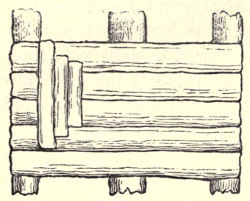
Fig. 8.
Plan of roadway, showing repairs.
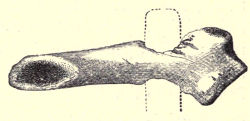
Fig. 9.
Axe-head of Bone.
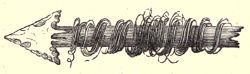
Fig. 10.
Flint Arrow-head, Shaft and Thong still adhering.
Kitchen Middens and Refuse Heaps.—The most usual site of the kitchen midden, or collection of refuse thrown out of the dwelling, is at the entrance to the crannog, where was formerly the landing-stage or gangway leading to the shore; and what more natural than that prehistoric housekeepers should take the easiest method of getting rid of refuse by merely throwing it out of the door, a practice followed, on terra firma, by many of their descendants in Ireland at the present day. The accumulated mass of bones (invariably found in a broken state for extraction of the marrow) is in some instances immense; it is estimated that at Dunshaughlin, in Meath, about two hundred tons were sold for manure, three hundred tons were exhumed from the kitchen midden of one of the lake dwellings in Loughrea, county Galway, and fifty tons from that of Ardakillen, county Roscommon; the bones in the heaps have, evidently, in some instances, been gnawed by dogs after their owners had extracted the marrow, for which dainty the Irish appear to have had a peculiar relish, judging from their proverb, Ma bhris tu an cnamh char dhuighail tu an smior, i. e., though you have broken the bone, you have not sucked out the marrow: equivalent to saying, “you have done the most difficult part of the work, though you have not completed it.” Refuse heaps may be said to form also a perfect mine of antiquities, for every “cast” article of household gear was thrown into them; hence, the objects though numerous are generally fractured. After bones the next most frequent “find” consists of fragments of fictile ware. It has been remarked that if the former site of a crannog becomes again exposed to the light of day, by the gradual cutting away of the peat under which it lay buried, perhaps during centuries, then many objects calculated to excite the interest of archæologists might be turned up from time to time without attracting particular notice, and thus no means would be left to form even an approximate estimate of the date of the crannog; but if careful examination be made of a kitchen midden, exposed to view by the simple drainage of water from the site, then the antiquities discovered afford tolerably correct and safe data from which to calculate the age of the structure.
Canoes.—Some crannogs appear to have been veritable islands, the only means of communication with the land being by canoes; of these, in Irish and Scottish waters alike, remains have been frequently found near the dwelling, in some instances alongside the landing-stage, as if sunk at their moorings.[67] A canoe formed by hollowing out the trunk of a tree seems to have been almost universally the first attempt at boat-building, and to effect this, a people even in the rudest state of existence would possess sufficient ingenuity. Canoes are so universally found associated with crannogs, that their discovery in lakes and bogs in Ireland has been considered an indication of the existence of lacustrine dwellings in the immediate vicinity; but it may be safely concluded that, unless implements or articles of stone or bronze are found with “dug-outs,” they do not of themselves carry us back to prehistoric times, nor do they necessarily indicate the great antiquity commonly attributed to them. Canoes have been found of the oldest type known, and yet containing articles of iron of very modern form; therefore, it may be surmised that a people of primitive habits like the lake dwellers clung tenaciously to old customs, and their models remained unchanged during many ages. Irish single-piece canoes may be roughly divided into three classes or varieties—(1) the first, generally either sharp or rounded at both extremities, averages twenty feet in length, and about two in breadth, some however have been discovered square at both ends. Again, some are flat-bottomed and others round: the inside depth varies according to their state of preservation; (2) the second kind is generally of much greater length; one found, measuring forty feet, was round in the bow, but square in the stern, which was formed of a separate piece, let into a groove within a few inches of the extremity: this make is altogether more heavy and clumsy than the preceding; (3) the third variety is trough-shaped, and has been appropriately designated “the portable canoe”; the length is from eight to twelve feet; it is square at both ends, round in the bottom, and having projecting handles at either extremity, apparently for the convenience of carrying it from lake to lake. All alike seem to have been hollowed out of a single tree, probably in the fashion described by Captain Speke, in his Travels in Central Africa, wherein he says the negroes fell a large tree, lop off the branches, shape the timber, then cover its upper surface with wet mud, as it lies on the ground, and set fire to it, burning out the core, and finishing off with roughly-constructed hatchets the part unconsumed by fire.[68] In Lough Owel, county Westmeath, in the immediate neighbourhood of a crannog, a very large canoe was found in company with two of smaller size. The prow was in shape like a curved beak; it might be expected that the principle of the curve would have been carried out in its after end, but, whilst the entry is spoon-shaped, the stern is square, and a hollow but shallow groove cut at the very end was formerly filled by the stern board. This canoe was round in the bottom; twenty-four holes were drilled through the sides, and the same number through the floor. A canoe twenty feet nine inches long, four feet seven inches broad, and one foot eight inches deep, was found at Derryhollagh, county Antrim; another in the lake of Moynalty was twenty-four feet in length.[69] One unearthed at Ardakillen measured forty feet in length, by four feet across the bow,[70] whilst another in Drumaleague Lough, county Leitrim, was only eighteen feet long by twenty-two inches broad—not formed for speed, certainly—being square at stem and stern. A canoe at Cahore, in Wexford, was twenty-two feet in length, two-and-a-half feet across amidships, and eleven inches in depth (plate IV. fig. 1). At a place called Cornagall, about six miles from Cavan, was found one more than half consumed by the conflagration which had destroyed the crannog itself; in the bottom of this boat lay a complete set of tools, belonging to an ancient craftsman who had lived at a period subsequent to the adoption of iron tools.
In consequence of the low level of the Boyne in the summer of 1837, workmen engaged in taking gravel from the river, near the obelisk erected to commemorate the period
“When James and William staked a Crown, And cannons they did rattle,”
discovered a well-preserved “single tree” canoe, which was for many years after exhibited as a curiosity in Liverpool, but finally presented to the Royal Irish Academy. The length of this canoe is eighteen feet nine inches, it averages two feet ten inches in width, is twenty inches high in the side, and has three circular and artificial apertures in the bottom, as shown in the illustration[71] (plate IV. fig. 2.) Three canoes were found at Toome Bar; the one figured (plate IV. fig. 3), is hollowed out of a single piece of oak, the length, fifteen feet, with projecting beaks at prow and stern; it is twenty inches wide, fourteen inches deep, and is flat-bottomed; it lay “from six to eight feet below the surface, in a bed of sand and Lough Neagh clay.”
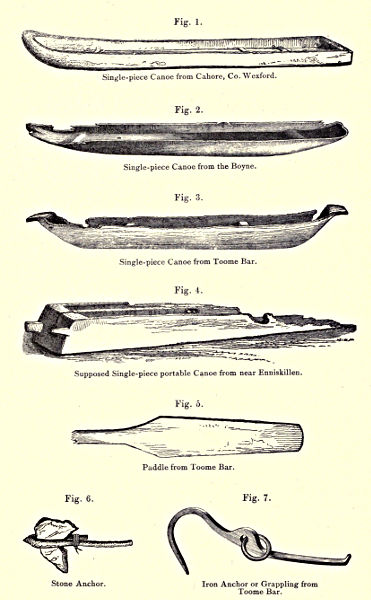
Plate IV.
Fig. 1. Single-piece Canoe from Cahore, Co. Wexford.
Fig. 2. Single-piece Canoe from the Boyne.
Fig. 3. Single-piece Canoe from Toome Bar.
Fig. 4. Supposed Single-piece portable Canoe from near Enniskillen.
Fig. 5. Paddle from Toome Bar.
Fig. 6. Stone Anchor.
Fig. 7. Iron Anchor or Grappling from Toome Bar.
Single-piece Canoes, Paddle, and Anchors.
The discovery of an ancient canoe beneath the waters of Lough Erne was made in a somewhat romantic manner. A steamer plying upon that lake attempted, in consequence of the unusual height of the water, to make a short cut, but grounded on a bank, and in so doing pushed upwards her ancient sister into the light of day. The “dug-out” thus found is of oak, eight feet in length, by one foot five and a-half inches in breadth, its internal depth is seven and a-half inches, the sides averaging about an inch and a-half in thickness. In shape it differs from any other canoe in the Museum, Royal Irish Academy, and, taken as a whole, conveys the idea of the elongated bowl of a table spoon; it also presents a peculiar characteristic, in that a number of holes at almost regular intervals, in sets of three, have been pierced through its floor; there are three sets of these holes, each about an inch in diameter; they cross the boat in threes, at right angles with a line drawn through the middle from end to end.
During the operation of changing a line of road about a mile and a-half from Enniskillen, the antique figured (plate IV. fig. 4), was exposed to view. Its position was almost equidistant from Lough Erne and Lough Rossole. Owing to the smallness of its proportions as regards beam, objections have been raised to its claim to be classed as a canoe, and it has been suggested that it was perhaps a brewing vat for manufacture of some kind of drink. Impossible to say what the original length of this square and hollowed block of oak may have been, but the remaining portion measures about fifteen feet: the sides and bottom are thin, the depth is one foot, the breadth at its remaining end only one foot three inches; that end, however, is seven inches thick, and from it, on the exterior, two handles cut out of the solid block project, as shown in the drawing.[72] The great difference between the thickness of the sides and end may be accounted for by the presence of the handles, as they would need to be attached to solid timber if required for use as lifting agents; the diameter of these handles is about three inches, the length six inches, and at the end, between the handles, there is a hole by which this antique could be drained. If it be really a canoe, the handles would prove most serviceable for the purpose of transportation from one lake to another, and for the chase of wild fowl on lake or river, would meet the requirements of the primitive sportsman. A groove cut upon the interior of what may be termed the remaining portion of the gunwale, seems as if intended for reception of a covering in the style of an Esquimaux canoe, and, owing to the extreme narrowness of the supposed craft, this arrangement would be absolutely necessary for the safety of the occupant.[73] A portable single-piece oaken canoe or trough of similar description, twelve feet in length, by three in breadth, and furnished with handles, was found in the bog of Ardagh, parish of Maghe-Ross, and is figured in Shirley’s Dominion of Farney.
The foregoing furnish specimens of the three classes into which canoes may be divided; in all, about fifty have been found in Ireland.[74] Owing to the preservative properties of peaty matter, the wood of some of these canoes was in a fairly sound state when dug up: one of the largest and most perfect found in connexion with the Strokestown crannogs, was cut up by a “grim utilitarian” for roofing material, and the best canoe belonging to the Ballinderry crannog was split into firewood.
Paddles.—For the purpose of propelling a canoe paddles were essential, and of these numbers have been discovered: there are several in the Museum of the Royal Historical and Archæological Association at Kilkenny, as also in the Museum of the Royal Irish Academy, Dublin. The paddle, two feet seven inches long, by five and a-half inches across the blade, as represented (in plate IV. fig. 5), was found in the immediate neighbourhood of a crannog site at Toome Bar, on the Lower Bann. It is the largest of two from the same locality; both are imperfect, the handle of each being fractured in the same spot, so that the original length cannot be ascertained; but as they were not more than half an inch thick, they could only have been employed in propelling a very light craft, perhaps a portable canoe.[75]
Anchors.—For the purpose of holding a canoe stationary an anchor is requisite, but of these not more than three have as yet been discovered. The one figured (plate IV. fig. 6) is of stone. The shank must have been of wood, lashed to the stone. There was with the canoe discovered in the Boyne what bore the appearance of a kind of wooden anchor. At Toome Bar was found an anchor or grappling instrument twenty-one inches long, but being formed of iron it should be viewed as comparatively modern (plate IV. fig. 7).
Curach.—There is yet another kind of boat, the curach, that must have been employed by these lake dwellers; of it, however, on account of the perishable materials of which it was composed, no remains have as yet been exhumed. We may all recollect, when reading English history in our childhood, the description given of the primitive Celtic boat, constructed of basket-work and covered with skins, in which the Picts and Scots are said to have invaded Britain in crowds, and of which the Britons themselves made use: this is frequently referred to by old classical writers. Herodotus mentions boats of this kind as existent in his time on the Tigris and Euphrates; similar skiffs are used on those rivers at the present day; boats of analogous construction are employed in some parts of India; they are propelled by paddles where the water is deep, and poled over the shallows. Nothing can be more simple than the construction of these skiffs; only two materials are requisite, and they the most accessible in the country, i.e. bamboo and hides. When Cæsar had constructed boats in Spain, after the manner learnt by him in Britain, it is said that “the keels and ribs were made of light timber, the rest of the hull being woven together with basket-work, and covered with hides.”[76]
“The bending willow into barks they twine, Then line the work with spoils of slaughtered kine. … On such to neighbouring Gaul, allured by gain, The bolder Britons cross the swelling main.”
Pliny says:—“Even now, in the British channel, they (the boats) are made of osiers, covered with hides sewn together.” Solinus, describing the rough sea between Britain and Ireland, says that the natives “sail in ships made of osiers, which they surround with a covering of hides.” Adamnan, in his life of St. Columba, refers to a voyage made in a curach by St. Cormac. The curach is said to be still in use on the Severn,[77] and on some parts of the coast of Ireland, in shape and build similar to those of thousands of years ago; at the same time it may be affirmed that few persons of the present generation could declare they have seen the true curach, that term having been now transferred to boats covered with coarse tarred canvas, and which differ widely both in form and method of construction from their ancient prototype. The curach seen by W. F. Wakeman in use on the river Boyne so late as the year 1848 is thus described by him:—A regular frame of willow ribs, generally laid in pairs, and extending along the sides and floor, formed the skeleton of the future boat, which was in the form of the bowl of a spoon, a little broader towards one end than the other; about eight feet in length, but very nearly circular. The extremities of the ribs for a depth of about eighteen inches from what would now be called the gunwale, were set in a very thick, strong, and closely-woven band of wicker-work, above which the ends of the rods slightly projected. Midships was a thwart of ash or oak pierced with four holes, two near either end, through which were rove thongs, composed of twisted osiers connecting the seat, or thwart, with various portions of the above mentioned band, so as to bind the work together. The frame was then covered over on the outside with skin, untanned, of the horse or cow; and the result was the completion of a boat well adapted for the requirements of fishermen.[78] The raw hide of a newly slain animal, properly extended presented a ready means of constructing a boat, and became to the early inhabitants of the British Islands what the birch-tree bark is to the American Indian. In the sculptures from Nineveh a similar use of the hide is observed, as a means of crossing rivers, but the application is less ingenious, being merely a skin inflated with air like what is called on some parts of the Irish coast a “stookey,” and with which, not unfrequently, fishermen, so late as the year 1860, floated their nets and lines; the skin of a dog or any other animal served the purpose.[79]
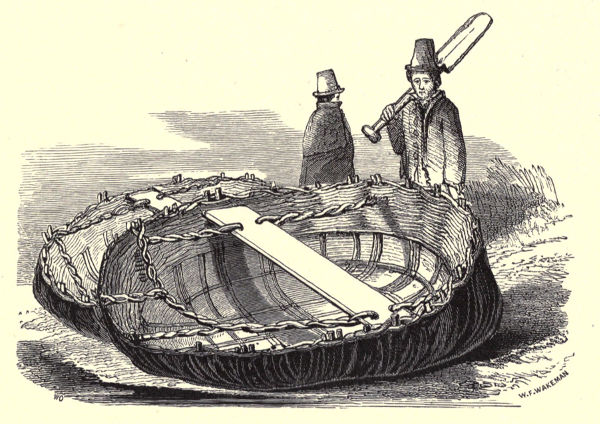
Plate V.
Curach, as used on the Boyne, 1848.
Ingenuity of Lake Dwellers, Clothing, &c.—It has been remarked that the brains of most savages and the skulls of most primitive races are larger than, in theory, they ought to be; often rather larger than the brains and skulls of the average masses of the great cities of the present day; but this need not cause surprise, if the life of intelligent interest passed by the savage child be taken into consideration. From the tenderest age he was observant of all the devices practised by his parents for procuring clothing, food, means of defence, in short, all the essentials of existence; the natural result of his wild life was health and strength; indeed, on the principle of the survival of the fittest, it could only be the robust who lived through the hardships and climatic exposure incidental to a savage life. The lake dweller was no exception to this rule, for his ingenuity would be most fully exercised in endeavouring to procure the means of sustenance for his family. It is easy to imagine the various daily occupations needful in his struggles for existence. Timber from the forest supplied him with materials both for his dwelling and for fuel; the skins of wild animals furnished him with clothing, he shaped them with a sharp flint flake, and sewed them with thongs, using as needle the pierced bone of some bird or small mammal. In early Irish history mention occurs of skin or leather garments: when Muircheartach MacNeill made his celebrated circuit of Ireland, A.D. 942, it is stated that his soldiers were clad in long leather cloaks. We are not left to mere conjecture regarding the manner in which the men of these primitive times protected themselves from the inclemency of the weather. In the year 1821 the body of a man, about six feet in height, with dark, reddish-coloured hair, short beard, and teeth in a good state of preservation, was found ten feet below the surface of a bog, on the lands of Gallagh, near Castle Blakeney, county Galway. The head, legs, and feet were bare, but the body was covered with a deer-skin tunic reaching to the knees and half-way down the arms; in front it was laced and fastened by thongs of the same material. The mantle was, unfortunately, much injured in the disinterment, but a few fragments of it still hung together; portions of the seams sewed with fine gut of three strands still remained; “the regularity and closeness of the stitches are most remarkable, as shown by the accompanying cut, in which a portion of one of the joinings is represented double the natural size. This closure was effected by what is termed the looped stitch, similar to that used in working a button-hole, so that by having each stitch knotted the chance of ripping was lessened.”[80] The age of the Irish mummy (if we may apply that term to the body here described) is considered by some to date back at least 2000 years.
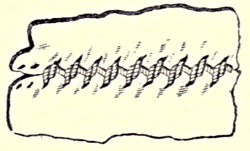
Fig. 11.
Fragment of Deerskin Garment.
A bed of growing peat is endowed with marvellous powers. It seems to act like the ancient Egyptian process of embalming on the bodies of men or animals that have become accidentally entombed in it, preserving them for centuries after their contemporaries have, by the ordinary laws of nature, totally disappeared, and organic substances, such as butter, seem also to feel its influence. Peat may bear comparison with ice, the well-known preservative properties of which were strikingly illustrated by the discovery on the shores of Lake Oncoul, in Siberia, of a carcass of the Elephas primigenius, or mammoth (supposed to have become extinct in the Pleistocene period) in a perfect state, and so well refrigerated that, when thawed, the dogs of the neighbourhood devoured its flesh. Again, in 1846, the summer in Siberia had been unusually hot; the frozen marshes which extend along each side of the river Indigirka were thawed, and a perfectly preserved carcass of a mammoth floated down the stream. This monster had most probably met his death centuries before by sinking into the deep snow of the morasses, was frozen over, and thus remained until the exceptional summer heat melted his icy prison.
Stone, Bronze, and Iron Ages.—We know that the learned have divided the period man has inhabited the globe into what may roughly be called three Ages—the Stone, the Bronze, and the Iron. Ancient mythology presented us with another, ycleped the Golden, when our planet was supposed to be a paradise, and man lived in a state of perpetual happiness; it is to be feared that the idea of a golden age, either past or to come, is purely mythical. Future archæologists may, perhaps, be tempted to apply the designation “Steel” to the present or now commencing epoch, in order to distinguish it from the mere “Iron Age.” Improved methods of manufacture are now-a-days causing steel in some degree to supersede its parent metal, iron, even as iron superseded bronze. Excavations on the site of crannogs have demonstrated clearly the fact that some of them have had a continuous existence throughout the three ages of Stone, Bronze, and Iron. Classification of the earth’s history into those three ages does not, however, imply a defined and distinctive period when stone, bronze, or iron alone was in exclusive use, though there may possibly have been a time in which only stone and bone were available. When the empires of the Tigris and Nile were in their prime, the northern littoral of Europe was inhabited by a race using implements of bone and stone, but these regions were in the Bronze Age[81] at the period when the Phœnicians had attained the zenith of their power. According to some writers, the inhabitants of the Baltic littoral had not till early in the Christian era discarded bronze and stone for iron. Although weapons of bone or flint were certainly of an earlier age than bronze and iron, yet it is more than probable that flint, bronze, and iron may have been in use at one and the same period, and even in the same locality, down to a period long subsequent to the Christian era. To this day the Esquimaux use bone implements, but they also employ iron, so that in remote countries a stone age might be said still to exist, the few iron implements in possession of the wild tribes being acquired by recent contact with western civilization. In Ireland there is no fixed line of demarcation between the stone, the bronze, and the iron age; there was an overlapping and co-mingling as the better and more useful metal gradually superseded its predecessor. Thus a stone instrument, by itself, would be a most deceptive guide in determining the state of civilization of the inhabitants of the site on which it was discovered, because stone implements are also found associated with articles both of bronze and iron. “Like the three principal colours of the rainbow,” writes Mr. Evans, “these three stages of civilization overlap, intermingle, and shade off, the one into the other; and yet their succession, as far as Western Europe is concerned, appears to be equally well defined with that of the prismatic colours, though the proportions of the spectrum may vary in different countries.” Petrie, the well-known Irish antiquary, was the first to claim for a large class of iron remains the position of an interesting connecting link, which they are now allowed to hold, between the bronze manufacture of a remote age and the industrial achievements of comparatively modern days. At the period of the first discovery of the remains of Irish lake dwellings, archæologists looked upon objects of iron found in lakes, or in their immediate vicinity, with very little interest, for it was considered that they could not have held out against the corroding influence of water for a lengthened period; therefore iron was supposed to stamp lacustrine habitations with a mediæval or even modern impress. The belief was then very general that the inhabitants of Erin of the prehistoric period, having existed generation after generation as manufacturers of flint and stone weapons, had gradually, through some unknown channel, become acquainted with gold, silver, and bronze, and that this latter metal, down even to the advent of St. Patrick, was used almost exclusively in the manufacture of weapons of war, small ornaments for personal adornment, and objects of domestic use. Articles of stone, bone, wood, bronze, and iron have been discovered in strange medley: swords, spear and javelin heads, axes, daggers, knives, hones, querns, shears, tweezers, chains, combs, pins, brooches, beads, horse trappings, cauldrons of hammered bronze, lumps of iron slag, &c.—in short, every conceivable object, from the rudest flint implement to highly-finished silver ornaments.
The accidental discovery of the great historical crannog of Lagore, in the county Meath, already referred to, presents the first, and probably the most important, treasure-trove of earliest iron implements. In A.D. 848 an Irish chief, with his Danish allies, plundered this island fortress and burnt it; whilst in 933, nearly a century later, the place again suffered a similar fate at the hands of another marauder. Nothing more was heard of it till the date of its disinterment, about the year 1840. The latest period, therefore, to which the majority of the antiquities so plentifully found within and around this stronghold may be referred, is somewhere between the eleventh and earliest half of the tenth century. This approximate date is about the historic limit in which the so-called “Iron Age” may be allowed to have reached back in Ireland. How long it had previously existed there must be matter of conjecture; but it is almost incredible that its natives should have been far behind their neighbours in the art of metallurgy; and we know that Cæsar[82] found the Britons acquainted with the use of iron. It can only be surmised that, at some very remote period, bronze as the prevailing material gave way to iron, but the period of transition may probably be counted by centuries.[83]
Weapons and Tools.—In nearly all Irish crannogs, more especially in the larger sites, weapons of war and of the chase have been discovered in abundance, consisting chiefly of arrow- and spear-heads, swords, daggers or skeans, knives, and axe-heads. The numerous fragments of artificially fashioned bone found in and around crannogs plainly demonstrate how much that material was utilized by their inhabitants; many tips of the antlers of deer contained in the collection of the Royal Irish Academy and in that of the Royal Historical and Archæological Association, have evidently been sawn from the original branches, and employed in forming handles for swords, knives and daggers; some are ornamented, whilst others are pierced with a hole at one extremity, having evidently been fabricated for a distinct purpose, for spear- or javelin-heads, &c.; these were attached to handles or shafts, by means of the sinews of animals, or thongs of skin. Amongst primitive races the transition from tool to weapon is slight; the same article must, in many cases, have served the double purpose. Arrow- or spear-heads have been found of bone, horn, flint, bronze, and iron; they are usually of small size. Figs. 12 and 13, from Lough Ravel, county Antrim, represent (half-size) flakes fashioned into arrow- or spear-heads. Fig. 14 is a flake of basalt (full-size) from Toombridge, in the same county. Fig. 15 is a flint implement from the recently discovered crannog of Lisnacroghera.[84]
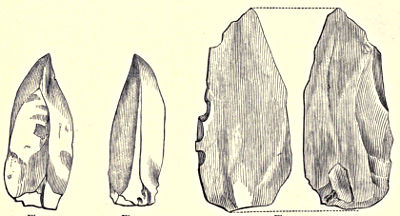
Fig. 12. Fig. 13. Flint flakes from the Crannog of Lough Ravel. Half-size.
Fig. 14. Flake of Basalt from Toombridge. Full-size.
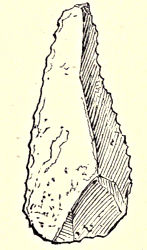
Fig. 15.
Worked Flint from Lisnacroghera. Full-size.
Plate VI., No. 1 is a flint implement, probably a knife. No. 2—A well-worked flint, most likely used for the same purpose. No. 3—A flint “scraper,” that appears to be somewhat injured at one end. No. 4 represents what antiquaries style a “core” of flint. It is in fact the remains of a block, from which flakes have been struck for the purpose of forming them into arrow-heads, knives, &c., &c. No. 5 is a specimen of the hammer-stone so frequently discovered in the refuse heaps of Irish crannogs. They are usually abraded at the extremities, as if from long use, and similar articles occur in the shell mounds of our coasts, having probably been used for breaking crustaceæ. No. 6 is an ordinary stone hatchet. No. 7 represents a wooden object which has all the appearance of having been used as the handle of a stone-hatchet. It is here given ⅛ of the real size. The aperture, supposed to have been made for the reception of a stone celt, measures in length, 3⅜ in., but the shrinking of the wood in drying renders it impossible to say what its original breadth may have been. The dotted line is introduced to show how the cutting instrument was most probably placed. No. 8 may have been either a dagger or a spear-head; it is of bone; a rivet-hole indicates that a handle was at one time attached. No. 9—A knife of bone, the handle and blade in one piece. It measures 8 in. in length, and the haft portion, as shown in the illustration, is ornamented with a series of squares enclosing a rude pattern composed of dots. No. 10 is a very curious little article formed of bone, and not untastefully decorated in the same style as the socket portion of the iron spear-head, as shown in plate IX., fig. 6. It was evidently a scoop, and would be serviceable in the extraction of marrow from bones of deer, or other animals used as food by the lake dwellers. Nos. 11 and 12 are rude unornamented knives, in a single piece each. It is not easy to guess what articles of this kind could have been employed to cut, but so early as the times of stone chambers, knives of bone were in requisition.[85]
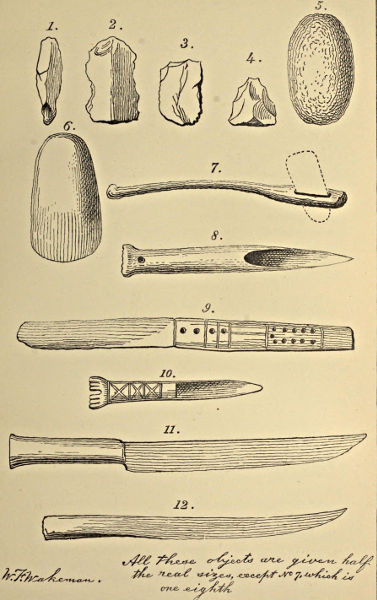
Plate VI.
Flint, Wood, and Bone Implements from Crannogs.
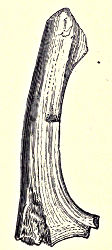
Fig. 16.
Axe-head of red-deer’s Horn from Lough Eyes. Quarter-size.
Fig. 16, from Lough Eyes, represents the horn of a red-deer converted into a weapon; its weight is considerable, and there can be little doubt that it had served as a rude battle-axe; its broader end had been fined to a cutting edge, and a notch shows where a leathern thong or sinew was lashed for attachment of the axe-head to the handle into which it had been set in the manner of a stone or flint celt. This antler, together with the bone axe-head from Ballykillen, are the only specimens of that special class of weapon; but both spear-heads and daggers formed of bone have been found at Ardakillen, Ballinderry, and other crannogs. In the Swiss “Pfahlbauten” it was only the handle of the axe that was composed of horn, the cutting portion being flint or stone, inserted into the shaft at its thicker end.[86]
Swords, whether of bronze or iron, are almost invariably of small size, and double edged. There is usually a central rib to the blade, but in some instances fluting occurs. The ordinary crannog sword may be described generally as of two kinds, the one increasing in breadth from the handle to the end, which terminates in the form of a triangle; the other is shorter, with a broad straight-edged blade obtusely pointed. Their handles were composed of bone or horn, and sometimes wood was used. There was no hilt or guard, properly speaking, though the handle usually somewhat overlaps the edges of the blade, while it recedes in a curve tending in a direction opposite to that of the pommel.
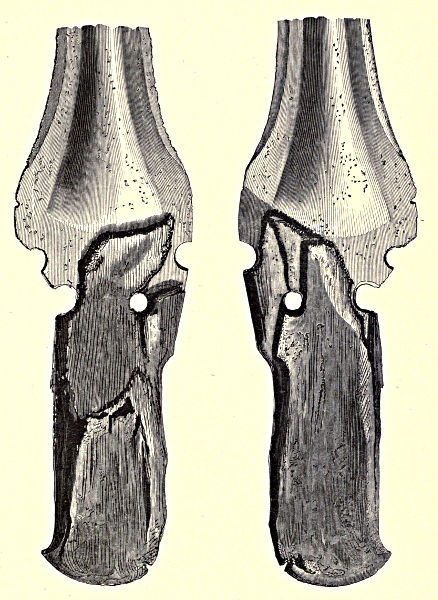
Plate VII.
Hafted Bronze Rapier Sword, showing both sides. Full size.
In April, 1864, a sword-blade of bronze, with the haft still attached, was found adjoining a lake containing a small artificial island, in the townland of Galbally, county Tyrone. The extreme length of blade, 25 in.; breadth at tang, 1¾ in.; weight, 13¾ ounces. The handle (both sides of which are represented in the accompanying plate) is of bone, probably cetacean; its length, 3½ inches; weight 1 ounce; thickness, ⅝ of an inch. The smallness of the handle is very remarkable, taking into consideration the popular idea of the great stature and strength of Erin’s ancient inhabitants.[87] A well-preserved iron sword, with bronze mountings to the handle, was found in the crannog of Lisnacroghera. The blade tapers gradually to a point from about midway down its length, with a central ridge. The bronze mountings of the sword-handle are four in number. “Of these, one is at the pommel, another hoods as it were the butt of the blade, two others are intermediate, and very probably do not now occupy their original position, one of them certainly being movable. It is, therefore, impossible to judge of the space which had been left for reception of the swordsman’s hand. It may be observed that the edges of all these fittings had been serrated or milled, but no other attempt at decoration appears upon them. The blade measures in length 14¾ in., the handle 5 in.”[88]
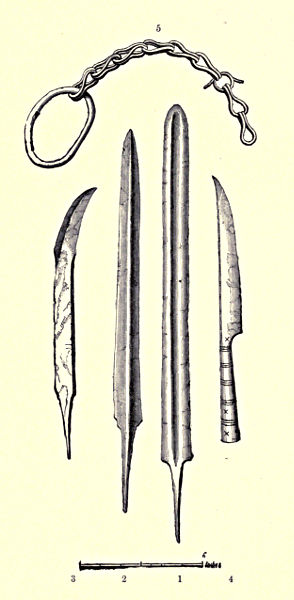
Plate VIII.
Iron Weapons and Manacle from Lagore.
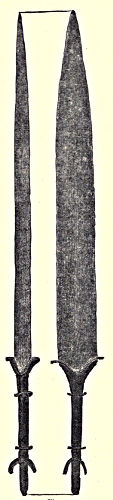
Fig. 17. Iron Sword from Lisnacroghera, about ⅖ real size.
Plate VIII. presents good examples of iron swords, two of them double-edged: (1) the one measures 22¼ in., including the strig or tang that passed through the hilt; the blade is 18½ in. long and 1⅜ in. wide, with a broad shallow groove or channel along its entire length; the other double-edged sword (2) measures 15¼ in., and the blade is formed with a central ridge. No. 3 somewhat resembles an oriental weapon, the blade being curved towards the point; the length is 13¼ in., width 1 in., and the curved portion alone has a cutting edge. No. 4 is a peculiar, single-edged weapon of diminutive size; the blade measures 8 in., and the entire length is only 13 in., including the cross ornamented socket into which the haft was fixed.
With these articles an iron ring was found (5) having a portion of chain still attached; it is seemingly part of a manacle. In ancient Irish writings mention is made of “golden” fetters, and no doubt the “golden” swords,[89] also noticed in old poems as having been used by the Dalcassians, were so described on account of the yellow colour of the bronze of which they were composed; a fine example of neck fetters may be seen in the Royal Irish Academy, with a chain of considerable length and strength attached.[90]
No. 1, plate IX., is an iron sword, with bronze mounting at handle, measuring 25¾ in. in length; the breadth of blade is 1½ in.; and the handle 3½ in. long. This was considered by Petrie to be the finest specimen of its class then found. No. 2 may be also considered a very characteristic specimen of the ordinary crannog sword; its length is 23 in. including the handle, which measures 4 in. No. 3 exhibits a beautifully executed bronze fitting which separated the handle from the blade; the ornamentation of the bronze is a fine specimen of the “trumpet pattern.” The total length is 21½ in. No. 4 is characteristic of the shorter crannog sword or dagger; total length 14¼ in.
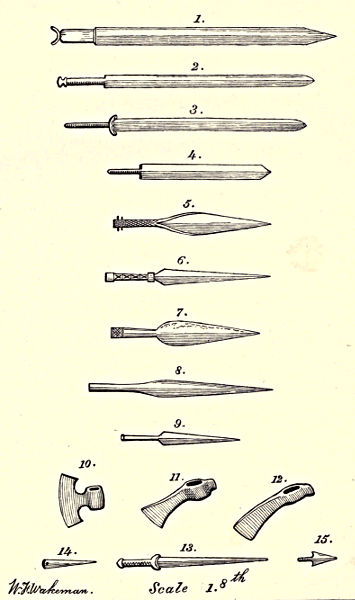
Plate IX.
Weapons of Iron from Crannogs.
Few darts or spear-heads have been found of bronze, but the iron examples are very numerous, often of beautiful form and highly ornamented; they vary in length from about 6 to 18 inches. No. 5 represents a spear-head of iron in a wonderful state of preservation, and retaining two rivets, by which it was attached to the handle. The socket is ornamented with an elegant pattern in lines obliquely crossing each other, but the work is too fine to admit of being properly shown on the scale here given; length 13⅛ in. No. 6. A spear-head, its socket strengthened by two bronze ferrules, is very curiously ornamented with a number of small crosses, separated from each other by fillets; there are apertures for four rivets which do not now remain; possibly they were of wood; length 14½ in. No. 7. A spear-head, interesting on account of the ornamentation on its socket, as also from its general contour, which resembles that of some of the finest known bronze examples; length 13⅛ in. No. 8. An extremely slender spear-head from Ballinderry, where it was found with a good many others; length 16 in. No. 9. A spear- or javelin-head; the form is very slender: entire length 9 in. No. 10 is a well-preserved and interesting axe-head of iron, its cutting edge well steeled. It measures 4½ in. at the edge, and 3¾ in. from edge to back. Axe-heads of this peculiar form are to be seen in Scotland, sculptured on early monumental stones, probably of the Pictish age. No. 11 is an axe-head of the form most commonly found in Irish crannogs; it measures 7 in. in length. No. 12 was found with the last described; it measures 7½ in. This form of axe-head, although of rather rare occurrence in Ireland, is common on the Continent. No. 13 is an iron dagger, no doubt in use contemporaneously with the swords just noticed. The handle is of bone or horn, and it is valuable as an illustration of the style of hafting early iron weapons of the sword and dagger class. No. 14 is a point formed of iron, and containing a socket. It was most likely an arrow-head. No. 15 is a very beautifully formed arrow-head from Lough Gur; length 3¼ in. From the size of the socket the shaft must have been extremely slender.[91] Arrow-heads of this kind are rare in Irish crannogs.
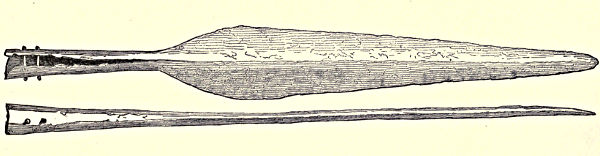
Plate X.
Iron Spear-head, from Lisnacroghera, side and edge view. Half size.
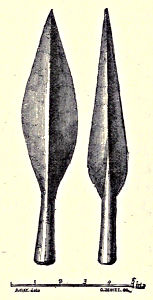
Fig. 18. Iron Spear-heads from Lagore.
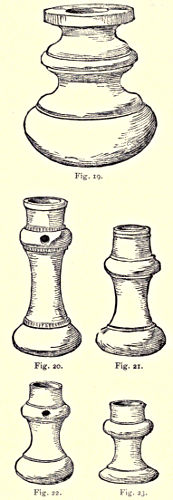
Fig. 19.
Fig. 20. Fig. 21.
Fig. 22. Fig. 23.
Spear Butt-ends of Bronze from Lisnacroghera. Two-thirds natural size.
The two spear-heads from Lagore, (fig. 18), are in fine preservation and very sharp; their length 10 in. In the crannog of Lisnacroghera, a magnificent spear-head of iron was discovered, of which a front and side view (half-size) is given, plate X. Spear-heads of this class have been commonly met with in the larger lacustrine sites, but this specimen is invested with a peculiar interest, from its being found in company with a number of bronze objects, whose use up to the present was unknown to antiquarians. It is now certain they were the butt-ends of spear-shafts—indeed two were discovered with the ends of their shafts still remaining in them. The mode in which one—and probably others also—had been attached to the handle is thus described by Canon Greenwell:—“The end of the shaft is split, and into the split is inserted a wedge of iron, so that when driven home, the wedge expanded the end of the shaft, and kept it firm in the butt.” In Anderson’s Scotland in Pre-historic Times one is described as having been found in Orkney. Like its Lisnacroghera fellows, it differs from the generality of Irish remains of its class, in the possession of a rich moulding bisecting the neck, but in all other particulars the style is identical. All the specimens of this class here figured were obtained by Canon Grainger from the crannog of Lisnacroghera. To one bronze butt was attached the whole of the shaft, 8 feet in length, furnished at top with a beautifully designed loop of bronze (see plate XI), and upon it was displayed a perfect Greek fret, with provision for the reception of enamel. From the same locality was procured also the highly interesting fragment which forms the central object of plate XI. It is portion of a spear-shaft retaining its bronze ferrule, and the rivet, also of bronze, by which the head was secured; this band or ferrule, being exceptionally beautiful, has been drawn as if rolled out. Adjoining the edges are slightly projecting fillets, enclosing a space through which runs a graceful wavy pattern in relief. The hollows were doubtless enamelled, as in the case of similar ornamentation on some bronze remains in the same “find.” The space between the fillets or bands is occupied by a singular design, and this design, all but the circular bosses, four in number, may be described as in low relief. The intervening spaces, like those of the fillets above and below, at one time contained coloured enamel. Altogether the style of this object represents as it were a combination of classic and Celtic ornamentation. The smaller and even more classic-looking ferrule to the left of plate XI. has already been noticed (ante, p. 64); the figure to the right (plate XI.) represents a bronze rivet of curious form, with well-sunk depressions on one of its sides, like those seen on a cog-wheel.[92]
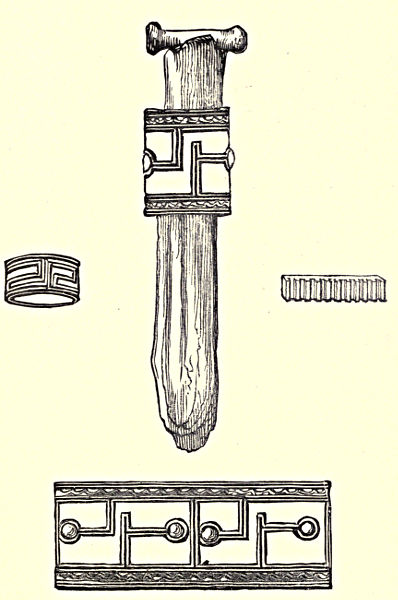
Plate XI.
Portion of Spear-shaft, with ferrules and rivet of Bronze. Full size.
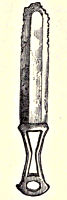
Fig. 24. Bronze Dagger from Lagore.
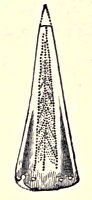
Fig. 25. Bronze Skean from Loughran Island.
The distinguishing characteristic of the bronze dagger or skean from Lagore (fig. 24) consists in its openwork handle forming one piece with the blade. The weapon is 9¾ inches in length; the handle, 3⅛. The blade, 1⅜ inches in width, is flat, with broad bevelled edges. Fig. 25, found at Loughran Island, in the Lower Bann, is 4⅞ inches in length by 1¾ in width. It is a thin, flat, angular-shaped dagger blade, decorated on the surface of the mid-rib with a series of dotted lines, and pierced at the broad end by four small rivet-holes.[93] Daggers or skeans of bone, as well as of bronze and iron, have been frequently found in Irish lake dwellings, and knives formed of flint are not uncommon. The iron knives found in the crannog of Ballinderry, and now in the Museum of the Royal Irish Academy, resembled those figured in Munro’s Ancient Scottish Lake Dwellings.[94]
At the time the Catalogue of the Museum of the Royal Irish Academy was compiled by the late Sir W. Wilde, although some objects of bronze, supposed to have been ornaments on leather or wooden dagger sheaths, are mentioned by him, yet he was unable to point to any example composed altogether of bronze. Since that period, however, three sword-sheaths of that metal have been discovered in the crannog of Lisnacroghera, county Antrim. Their workmanship is exquisite. They bear traces of enamel, and one of them contained a sword of iron so firmly attached to it by corrugation that any attempt to withdraw it must have involved the mutilation or utter destruction of the bronze in which it was encased.
The decoration of the sheath, plate XII, No. 2, is very remarkable; the distinctive peculiarity being its spiral character, a perfect specimen of those combinations of involved circles and curvilinear lines, supposed to be characteristic of early Celtic art. Some portions of the sheath, near its end, still retain settings in enamel, the colour of which, though now faded, must have been rich vermillion. Enamel of the same hue and material once occupied the little saucer-like depressions which occur on the terminating snake-suggesting head. One of the circles (that had been, doubtless, intended to represent eyes) shows that it had been so filled, as were, probably, the little raised bosses, two in number, that may be observed at the opposite extremity. The interior of what might be styled the crescent-shaped patterns, nine in number, which occupy the chief plane of the sheath, as also the minor spirals of their adjacent spaces in the general figure, exhibit a design suggestive of basket-work. It is now impossible to determine whether the sheaths had been formed by casting, or were beaten into shape from a plain sheet of copper. It is evident that for the production of the ornamentation a graver had been used. The lines are sharply and deeply incised, and appear to have been intended for the reception of enamel of a black shade, some traces of which appear here and there. The enamel on the sheath “was, in all probability, niello, a composition of silver, copper, sulphur, and lead, the nigellum of ancient writers. It was not so hard or lasting as the ordinary enamel of glass or vitrified paste, some examples of which may be seen on several early ecclesiastical remains. The art of enamelling in niello is of the very highest antiquity; it was practised by the Egyptians. Specimens of it, of various ages, even of modern times, are numerous, and it appears to have been known to the Anglo-Saxons, as a ring of Bishop Ethelwulf (ninth century) is ornamented with it.”
Although the decoration of the third sheath is similar in style, yet some of its features are peculiar, especially the dot and circle pattern along one of the edges, and which appears to have extended from handle to extremity.
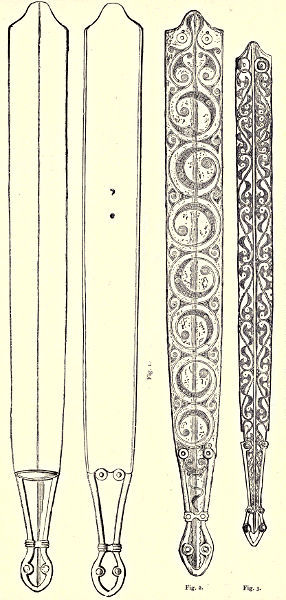
Plate XII.
Fig. 1.—Sides of Bronze Sheath, containing an Iron Sword.
Figs. 2 and 3.—Sides of Bronze Sword Sheaths, from the Crannog of Lisnacroghera.
Fig. 26 represents an object supposed to have been an ornamental termination of the pommel of a sword; it is of bronze, richly decorated with bands of white and red enamelled designs in a chevron or wavy pattern. The form is oval, and upon the upper rim are representations of two birds. Early Irish decorative art is characterised by bird-like forms, and figures of this kind are to be seen on early MSS. and on articles of the toilet or of personal adornment.[95]
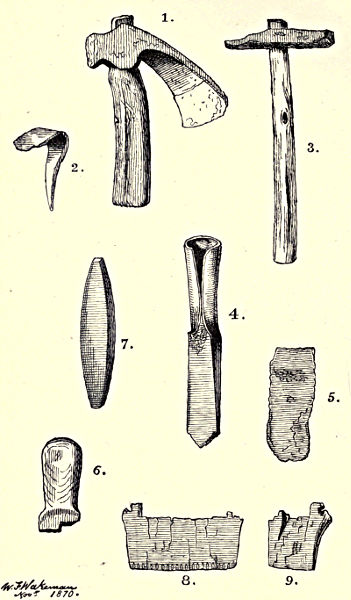
Plate XIII.
Iron Tools, &c., found in the bottom of a “dug-out” at Cornagall.
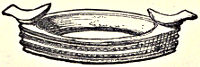
Fig. 26. Bronze enamelled object from Lisnacroghera. Full size.
In a small lake called Cornagall (the Hillock of the Dane or Stranger), about six miles from Cavan, there is an almost circular artificial island, thirty yards in diameter, its crannog nature, attested by rows of oaken stakes fencing its margin, showing above the summer level of the lake. In August, 1869, the water being then particularly low, a log of timber that bore evident traces of manual labour was ascertained to be the end of a “dug-out” embedded in soft, boggy matter. It proved, however, to be only a fragment, the other portion having been destroyed by fire, as evinced by the charred appearance of the remains: the large quantity of charcoal, half consumed sticks and chips visible on the margin of the crannog indicated its destruction also by that element. A set of iron tools lay on the floor of the canoe thus discovered, all here represented one-third their real size. The following is a brief description of them:—
Plate XIII., No. 1, is an adze in a perfect state: the metallic portion consists of soft iron, well steeled to a considerable distance from its cutting edge. No. 2 is an adze, scraper, or implement of the same class, but differing from the former in that it shows no perforation; its narrow-pointed end had evidently been intended for insertion in a wooden handle: the edge being broken, it is impossible to determine whether it had been steeled. No. 3 is a hammer of iron, the handle of oak, split at its upper extremity for the insertion of a wedge, which still remains. No. 4 is a celt or chisel—a somewhat similar object (from Lagore), but considerably broader, is preserved in the Museum of the Royal Irish Academy. Nos. 5 and 6 represent a thin, knife-like piece of iron and a wooden handle, originally, perhaps, portions of one implement; the wood, hollowed for reception of the blade, is perforated for the insertion of a rivet, which no longer remains. With the iron tools in the canoe was found a remarkable object, composed of oak, use unknown; it is curiously notched upon one of its sides, near the edge. Figs. 8 and 9 represent two views of it.[96]
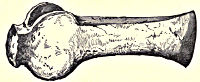
Fig. 27.—Iron Axe-head from Lagore.
Fig. 27, an iron axe-head, from Lagore, is seven inches in length, massive, and of considerable weight; the cutting edge singularly narrow. A great number, made of stone, have come to light; and all that are composed of iron are well steeled round the cutting edge. Axe-heads are of great diversity of form.
A front and side view (fig. 31) is given of an iron adze, six inches and a-quarter long, from the crannog of Lisnacroghera, as were also the three objects of iron here represented (figs. 28, 29, 30), the uppermost, probably a knife, and having a hole through what appears to have been the haft end. The other two articles are said to be the remains of a saw, and the long fragment, perforated in four places, is supposed to be the strengthening bar attached to the piece of wood into which the back of the saw had been inserted.
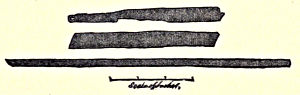
Figs. 28, 29, 30.—Iron Objects from Lisnacroghera.
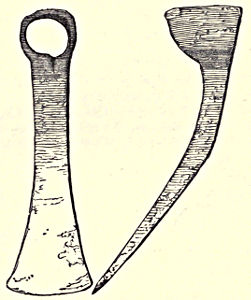
Fig. 31.—Front and side-view of Iron Adze from Lisnacroghera.
Hones.—Hones and sharpening stones are very commonly met with in crannogs; they plainly denote that at some period during their habitable existence the occupiers possessed metallic weapons or tools. The Cornagall “find” presents two specimens of whetstones; one is given (plate XIII. fig. 7); the material dark-grey in colour, almost black, extremely hard, and close-grained; they are symmetrical in form, and partake greatly of the character of the so-called touchstones. Fig. 32 is a perforated example.
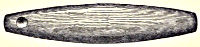
Fig. 32.—Whetstone.
Armour.—Amongst crannog “finds” no well-authenticated remains of defensive armour have been recorded, with the exception of a fragment of chain armour from Inisrush, and the ancient “golden bronze” shield from Lough Gur. The armour found on the site of the crannog in Lough Annagh is not here taken into consideration, it being evidently seventeenth century work.
In the townland of Monea, about five miles from Enniskillen, county Fermanagh, in a small but deep lake,[97] there is a very fine circular crannog, about seventy-five feet in diameter, composed almost entirely of timber, and surrounded with remains of staking; a complete examination of the site was not possible, owing to the thick mass of roots and fibres thrown out by the trees with which it was studded. Upon digging into that portion of the shore offering the greatest facility, there were discovered several fragments of bones of the Bos longifrons and other animals, quantities of charcoal, some iron slag, and the remains of the curious iron helmet here figured, which must, however, be viewed as of comparatively modern date. The helmet is entirely devoid of ornamentation, is acutely conical in shape, and no traces of nasal or cheek pieces remain. A casque, very similar to this, was found in the river Nore, near Borris-in-Ossory, Queen’s County, and is preserved in the Museum of the Royal Irish Academy.
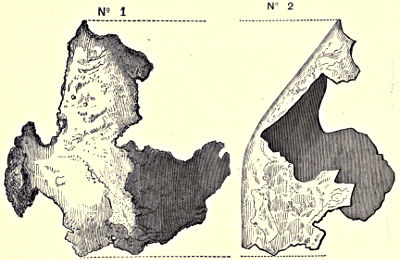
Fig. 33.—Iron Helmet found in the Monea Crannog, front and side view.
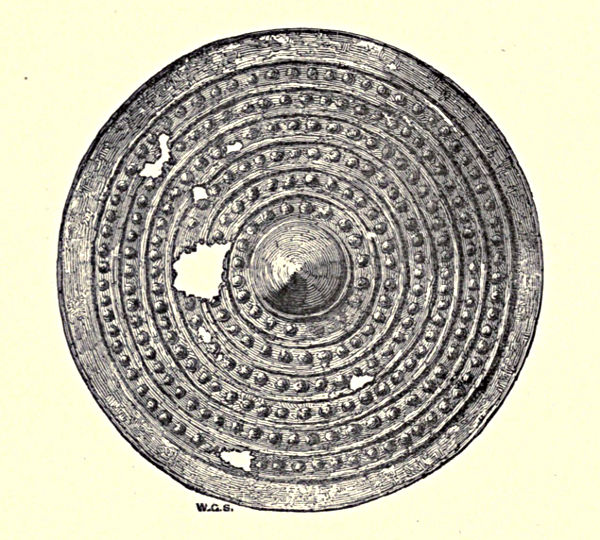
Plate XIV.
Front View of Bronze Shield from Lough Gur. Diameter 28 inches.
The shield, of which the accompanying plate gives a correct representation, was found in the bog close to the banks of Lough Gur, County Limerick; and near it were the head and antlers of a Megaceros Hibernicus. This shield is a disc of bronze, slightly convex, and strengthened by a series of six concentric circles formed of hollow bosses, about two hundred in number, surrounding the central umbo. It appears to have been carried slung on the shoulder, the slinging loops being fixed so as to form bosses on the obverse equal in size to those contained in the circle: it was furnished with a very small handle, interiorly traversing the umbo. The rim is an inch three-quarters in width; the diameter, two feet three and three-quarter inches. The holes with which the shield is pierced are not proofs of warfare; it was the discoverer—a boy with a fishing gaff—who inflicted the injuries in bringing his novel spoil to land.[98] The Rev. James Graves considered the looseness of the rivets at the inside loops for the strap by which the shield was carried, to be proof that some material, most probably the hide of an animal, had originally formed an inner lining, as the thin bronze being in itself incapable of withstanding the impact of a fishing-gaff, could afford little real protection against even ordinary weapons of warfare. The coating of sheet bronze may be viewed rather as ornamentation than as rendering the shield more impenetrable; or it may have been but a variety of the arrangement of studs or circles of bronze affixed to bucklers of wood or leather—
“Whose brazen studs and tough bull-hide Had death so often dashed aside.”
In the Museum of Antiquities at Edinburgh may be seen a bronze shield of like character.
In the Crannog of Lisnacroghera was discovered, with many warlike weapons, a disc of thin bronze, its centre from one-third its circumference descending into a hollow, at the base of which is an aperture: the ornamented side, as here portrayed, must have been intended to be the front, as the other side is quite plain. “Can it be the centre of a shield, other portions of which were composed of less durable materials? Certain it is, that thin circular plates of bronze, displaying similar depressions, have been found both in England and in Ireland, and are supposed to be connected with the mounting of shields.”
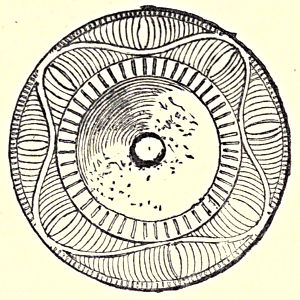
Fig. 34. Disc of Bronze from Lisnacroghera.
The first figure to the left, plate XV., represents an object of the same class, but slightly smaller, and not so much ornamented. To the right are two views of another article, which presents all the appearance of an umbo. On the same plate (XV.) are four bronze rings: one of them is formed of two very thin plates, secured together by rivets of the same material; the three remaining rings are solid, and of a class which some antiquaries suppose formed a kind of defensive armour. It is imagined that they were attached pretty closely together to portions of the ancient warrior’s garment; and it is worthy of remark that in the collection of the Academy a number of such rings, or objects very like them, may be seen looped together by bronze fastenings.[99]
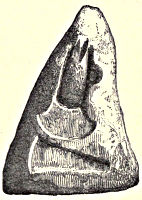
Fig. 35. Stone Mould from Lough Scur.
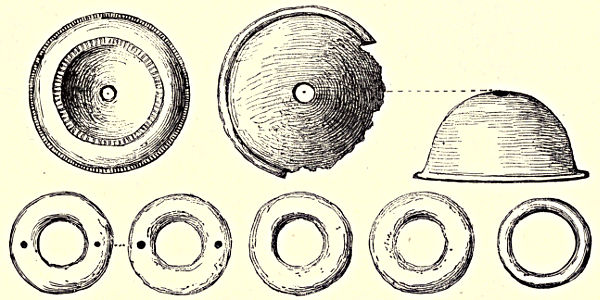
Plate XV.
Boss-like Objects, and Rings of Bronze, from Lisnacroghera. Full size.
Stone moulds, evidently employed in casting celts, weapons, tools, and other articles of bronze, have been brought to light. Fig. 35, discovered in the Crannog of Lough Scur, county Leitrim, is a triangular block of coarse white sandstone 7½ inches long, 5¼ wide, and 3½ thick, having both sides indented for castings. On the side here presented are moulds for a plain celt three inches long, and another celt four inches long, with cross strop and ring for attachment to the shaft. Castings taken from this mould “delivered” implements closely resembling several in the Museum, R. I.A.[100] At Lough Ramor, county Cavan, a very curious block of sandstone was found, having a mould on three of its faces: the one here represented is for a broad arrow-head, with side rings. Upon the obverse is one for a small spear and leaf-shaped arrow; on the right side is another arrow-mould.[101]
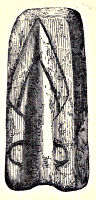
Fig. 36.
Stone Mould from Lough Ramor.
Vegetable Remains.—The ancient Irish set great value upon the hazel plant, a fact demonstrated by the frequent mention made of it in their best and oldest MSS.; the numerous round stones met with in crannogs are supposed to have been used for breaking the nuts; their shells form the most considerable portion of vegetable remains in the kitchen middens, where beech nuts also are present; and it is known that within historic times the Irish kept large herds of swine that fed on masts in the woods, for then
“The forests cast their fruits in husks and rind.”
Grain (species not stated), and various kinds of wild fruit, have been discovered; walnuts at Lough Nahinch, cherrystones at Ballinlough.[102]
Hammer-stones.—It cannot be doubted that in a few instances the round stones, sometimes designated “sling-stones,” have been artificially worked, but the great majority must be looked upon simply as water-worn pebbles that had been utilized as hammer-stones. Many of the egg-shaped specimens are more or less frayed or chipped at their extremities; and similar stones, used, as is supposed, for breaking crustacea, are common in the “shell mounds” on the coast, as also amongst the “kitchen middens” of ancient settlements that abound within the sand dunes of the north-western littoral of Ireland. A large flat stone implement, with circular termination, rough sides, and polished edges, was found in the crannog of “The Miracles,” county Fermanagh. It measured about eleven inches by three, and was one inch thick. Its flat end shows marks of wear, as if used for a pounding instrument. A stone exactly similar was found in a “kitchen midden” at Ardnahue, county Carlow, which had all the appearance of having been grasped in the hand for use, hence the edges polished from constant friction.[103]
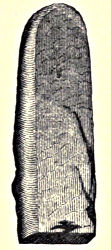
Fig. 37.—Stone Implement from the Crannog of “The Miracles.”
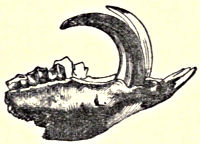
Fig. 38.
Lower Jaw of Sus scrofa.
Mammalia.—Amongst animal remains, those of the Sus scrofa are very numerous. This species of wild swine lived in the woods and marshes, was long-faced, and had great length of tusks.
The accompanying illustration represents a lower jaw of this ancient Irish pig, procured from the crannog of Lough Gur, county Limerick; it is of a yellowish-brown colour, a hue that pervades all the animal remains from that locality.
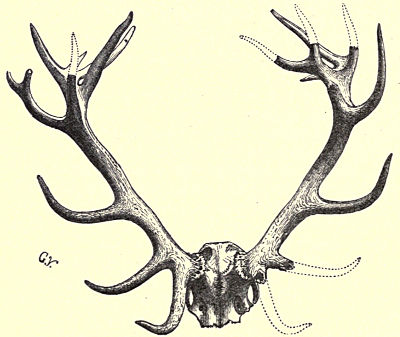
Fig. 39.—Head and Antlers of Cervus elephas.
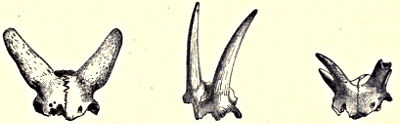
Fig. 40. Fig. 41. Fig. 42.
Crania of Goats.
Bones of the red deer (Cervus elephas) are extremely plentiful in lacustrine sites. It is the wild animal most frequently mentioned in early Irish history, and of which there were many until a comparatively modern epoch: so late as 1752 they abounded in the barony of Erris, county Mayo, and some few exist still in Killarney. The head and antlers here shown came from the crannog of Ballinderry, county Westmeath. The horns in this specimen are still attached to the cranium, and there were originally seven tines on the right, and eight on the left side. Bones of the Magaceros Hibernicus, or Irish big-horn, of the wolf and fox, of a small breed of horse, and of the ass, have been also met with. The remains of sheep belong to the horned class. There are several specimens of the four-horned variety of the goat (fig. 42), but those of the ordinary kind are more numerous: figs. 40 and 41 are from Dunshaughlin. Amongst the vast collection of animal remains on the site of this crannog were heads of canine animals: of the largest of these the accompanying cut gives a faithful representation. “It is nearly eleven inches in length, measured from the end of the occipital ridge to the alveolar process at the roots of the upper incisors, and is principally characterized by the magnitude of the crest.”[104] The profile view of the outline, and the prolonged muzzle, rather lead to the belief of its having belonged to the true Irish wolf-dog of former times, a large long-coated hound, of an iron-grey colour.
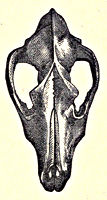
Fig. 43.
Cranium of Wolf-Hound.
According to the best authorities, there were in Europe in early times four great types of oxen: first, the Bos priscus, or Urus, the great Auroch, that even in classic times roamed through the forests of Germany; and its bones have been found in Swiss lacustrine sites: it was of great size, had long upright horns, a narrow forehead, high frontal crest, projecting orbits, and a warm shaggy coat, reddish-brown in colour. The second type, the Bos primigenus, was found by the Romans amongst the wilds of Europe; it had long, slightly-curved horns, set on at right angles to the head, but turning forward at the extremities, and spreading to a breadth of nearly five feet from tip to tip. The third variety, the Bos trochocerus had a very narrow head, and long cylindrical horn-cores rising high above the level of the back of the occiput, then curving forwards and inwards. The fourth type, which is almost peculiar to Ireland, has been denominated Bos longifrons, the long-fronted or small fossil ox—somewhat of a misnomer it must be confessed, because, properly speaking, it should be denominated Bos latifrons, from the exceeding breadth of forehead and face, in which particular it differs in an especial manner from the three former.
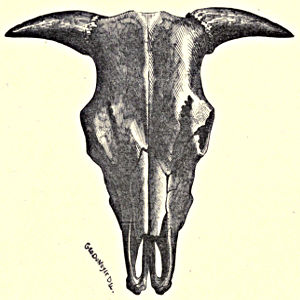
Fig. 44.—Cranium of domesticated Bos longifrons.
Specimens of the crania of four distinct breeds of cattle from crannogs are here given as described by Wilde, who named them very appositely: 1, the straight-horn, or Drom-adharach; 2, the crumpled-horn, or Crom-adharach; 3, the short-horn, or Gearr-adharach; 4, the Hornless, or Maol. Of the first type (Fig. 44), which was found at Dunshaughlin, Wilde states that there are none now existing in Ireland of this race, evidently domesticated descendants of the ancient wild Bos longifrons. The cranium is “broad in the face, flat on the forehead, nearly level between the horns, with but slight projecting orbits, short thick slugs or horn-cores rising but little above the occipital crest, and turning slightly inwards, like some of the best short-horned bulls of the present day. It is eighteen inches long in the face, and nineteen from tip to tip of horn-core.”
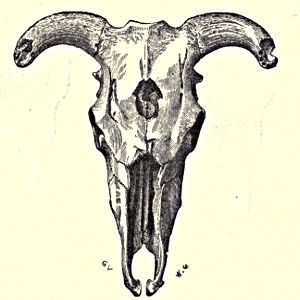
Fig. 45.—Cranium of the Crom-adharach, or Crumpled-horn Ox.
Fig. 45 represents a cranium of the Crom-adharach or Crumpled-horn, which, judging by its remains, appears to have been the most numerous variety. This magnificent head of a bull of the race is “in point of size as fine a specimen as has yet been found: it is twenty-three and a-half inches long, and eight inches across the forehead, which has been broken in by some blunt instrument, probably in slaughtering. The horn-cores are not so large at the base, but more than twice as long as those of the “straight-horned” race; they are curved considerably inwards, so that the tips of the horns, when perfect, must have approached much nearer than their bases. Each horn-core was, when perfect, about eleven inches long.” This head, together with many similar crania, came from the crannog of Lough Gur, county Limerick.
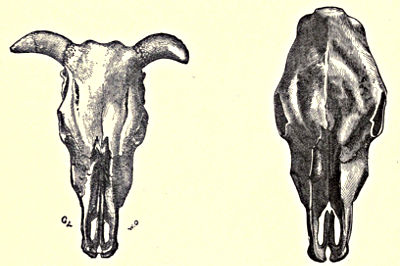
Fig. 46. Cranium of the Gearr-adharach, or Short-horned Ox.
Fig. 47. Cranium of the Maol, or Hornless Ox.
The third class, or “short-horn”, had long narrow faces, with exceedingly small horn-cores curving abruptly inwards. The cranium of one specimen (female) measured seventeen inches in length of face, six inches across the forehead, and eleven inches from tip to tip of horn-core. Fig. 46 gives a good illustration of this breed, which was abundant. The fourth class, the Maol, or Myleen (the hornless or bald), differs in nothing from those of the present day, save that it appears to have been of smaller size than its modern representative. The average length of face is about seventeen inches, by about eight inches across the orbits. Almost all the heads of this variety presented by Wilde to the R. I. A. came from the crannog of Dunshaughlin: they exhibit a remarkable protuberance or frontal crest.
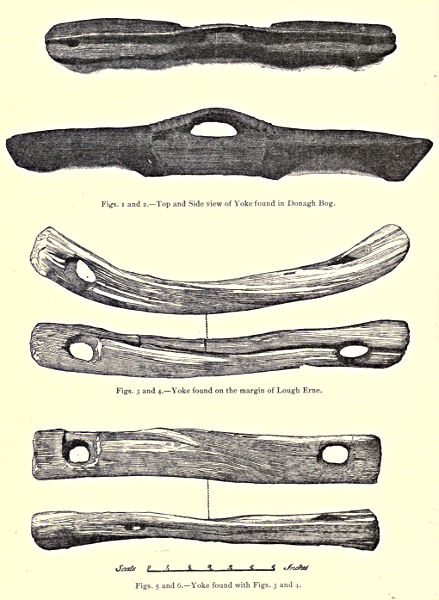
Plate XVI.
Figs. 1 and 2.—Top and Side view of Yoke found in Donagh Bog.
Figs. 3 and 4.—Yoke found on the margin of Lough Erne.
Figs. 5 and 6.—Yoke found with Figs. 3 and 4.
Wooden Yokes found in Donagh Bog and on the margin of Lough Erne.
In Switzerland, at Robenhausen, a settlement of the Stone Age which had been buried under a bed of peat, it is stated by Keller that horizontal layers were discovered of a foreign substance, from two to ten inches thick, ascertained on analysis to be composed of the fæces of cattle. May not some of the dark strata on crannogs be composed of like matter? for there is documentary evidence that the Irish chiefs kept cattle on their islands in time of war. The Lord Treasurer Winchester, writing to announce the decease of Shane O’Neill to the Lord Deputy, says, that “he ought to inspect Shane’s lodging in the fen, where he built his abode, and kept his cattle and all his men,” &c., &c. This “abode” is known to have been a crannog.
Butter.—The custom of burying or hiding butter in bogs is probably of very ancient origin, but, like many old customs, was carried down in Ireland to a very late period. Thomas Dineley, in a diary of his visit to Ireland in the reign of Charles II., states that the Irish used “Butter layd up in wicker basketts, mixed with store of … a sort of garlick, and buried for some time in a bog.” Sir William Petty mentions “butter made rancid by keeping in bogs.” The custom is thus described in the Irish Hudibras:—
“Butter to eat with their hog Was seven years buried in bog.”
The Faröe islanders had a similar practice with regard to tallow. Bog butter, or mineral tallow, is usually met with in single-piece wooden vessels, like long firkins.
Yokes.—For beasts of burden, the yoke was in use from the earliest ages, but any that have been hitherto discovered, whether double or single, appear too small for cattle of species still existent; however, the old race of domesticated kine in Ireland may have been smaller in size than those of the present day. Probably the first yoke that attracted notice was the one described and illustrated by Wilde in his Catalogue of the Museum of the Royal Irish Academy, for it was not until a comparatively late period that the attention of antiquaries was directed towards this class of remains, usually found covered by a considerable depth of bog. A good idea of their general appearance is conveyed by the accompanying illustrations (plate XVI.) representing two yokes of wood that were discovered under eighteen feet of peat in Donagh, county Monaghan, in the year 1867. Fig. 2 is drawn on a somewhat larger scale than fig. 1. Figs. 3 and 4 represent yokes found by turf-cutters about the year 1874, deeply buried in a bog abutting on Lough Erne. One of them was composed of oak. Figs. 5 and 6 are specimens curiously contorted, twisted, and split, the result of over-hasty drying.[105]
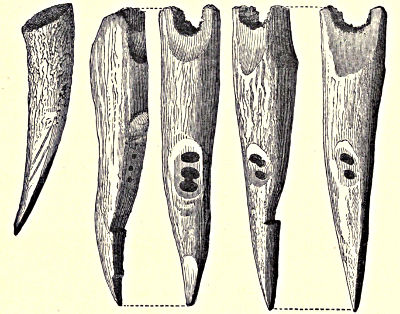
Fig. 48. Fig. 49. Fig. 50. Fig. 51. Fig. 52.
Piscatory Implements or Arrows and Spear-heads.
Piscatory Implements.—In the crannog of Drumgay, county Fermanagh, there were implements for forming the meshes of nets. They consisted of nine pieces of deer’s horn, varying in size from six to little more than three inches in length. Four of them are curiously fashioned. Similar objects, composed of the tips of deer’s horn, have frequently occurred in crannog “finds,” and, during excavations made about the year 1851, in Christchurch-place and Fishamble-street, Dublin, many like specimens were discovered. There can be little doubt that they were used for making fishing lines or nets: indeed one of the discoverers having procured some thread, at once proceeded to illustrate his theory by the manufacture of a fishing line. The suggestion has also been offered that they may have been arrow or javelin heads. From vegetable fibre the crannog dweller made nets with which he obtained an ample supply of fish from the waters around him, and sink-stones, used for either fishing lines or nets, are by no means a rare “find.” Quoit-like discs of sandstone, pierced with a hole to attach them to the bottom rope of a net, are not uncommonly employed, even in the present day, in remote localities. A bronze fishing-hook picked up from the bottom of a lake is here figured, and in plate XXIX., vol. ii., of Keller’s work, there is a representation of one closely resembling it. In 1845 there was found in Lough-na-Glack, county Monaghan, a bolt or missive of bronze, 16½ inches in length, evidently used for spearing fish, and of which two illustrations are given in Shirley’s History of the County Monaghan. The thong or string attached to this weapon, and by which it was hauled back after projection, was called in Irish fuainemain. The name is in the present day applied by the herring fishermen of the south of Ireland to the bolt-rope of their fishing-nets.
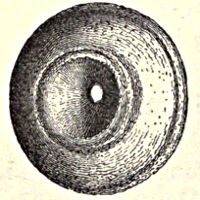
Fig. 53.—Sink-stone. Half-size.
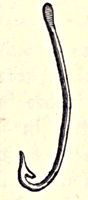
Fig. 54.—Bronze Fishing-hook. Full-size.
Household Economy.—In crannogs vessels of iron have been brought to light, also many cooking utensils of bronze; some, as may be noticed, of remarkable shape. Cauldrons both of large and small dimensions, hammered out of single sheets of copper, are numerous.[106] Plate XVII., No. 1 is a cup composed of “soapstone,” discovered with other remains, now scattered and lost, in the crannog of Drumsloe, near Ballinamallard, county Fermanagh. Articles hollowed out of stone are somewhat rare in Ireland, but more than one fine specimen occurs in the collection of the Royal Irish Academy. A very perfect example similar to that found at Drumsloe, and represented at page 114, fig. 87, in the Catalogue, was brought to light in the river Shannon, and a portion of another may be seen in Canon Grainger’s interesting Museum at Broughshane, county Antrim. These curious vessels, though formed of stone, are usually found with objects belonging to a supposed late iron period. Cups strongly resembling them have been exhumed in connexion with the so-called “Picts’ Houses” in Scotland, and in some of the Lake Dwellings of that country.[107] No. 2 is a cauldron-like vessel of thin, hammered bronze, measuring 22½ inches in diameter by six inches in depth: it was found with many other objects of interest in the crannog of Cloonfinlough. On its upper side it presents a rim or lip measuring one inch in breadth, strengthened by four small plates, fastened to the vessel by bronze rivets, and placed at about equal distances from each other. No. 3 represents the upper portion of what had been a very large cauldron, with rivet-holes indicating the points where staples had been fixed for reception of rings, or the ends of a handle. The bronze, beaten to extreme thinness, of which this specimen is composed, seems to be of very early character. No. 4, a shallow bowl of oak, about twelve inches in diameter, exhumed, with other remains, from the crannog of Breagho, county Fermanagh, was quite perfect when first laid bare, but on exposure to the atmosphere it split into several pieces. No. 5, found in the crannog of Cloonfree, county Roscommon, is a beautiful little vessel hollowed out of a single piece of wood, and tastefully mounted with bronze fittings, but the scale on which it is drawn is too small to admit of the delicacy of its ornamentation being properly displayed. No. 6 represents an artistically formed ladle of extremely thin bronze, measuring in all 11½ inches, the internal diameter of its bowl being five inches. This ladle was discovered by turf-cutters in the bog of Bohermeen, county Meath, in close proximity to a large number of pointed stakes and other remains of timber, doubtless portion of the framework of a crannog; but in 1848—the date of its discovery—very little was known about lake dwellings, and few particulars of the “find” can now be chronicled. This vessel was bought at the time by W. F. Wakeman, and by him (together with a beautiful bronze pin found with it) presented to the late well-known antiquary Petrie, amongst whose collection, deposited in the R. I. A., it may now be seen. In the same Museum are several similar vessels, turned up during drainage operations in various parts of the country. They are supposed by some writers, but apparently without sufficient reason, to be of Roman origin: in Ireland, however, they are usually discovered in connexion with remains of purely Celtic type, and it is not known that in any instance classic decoration occurs upon an Irish example, although in Munro’s Ancient Scottish Lake Dwellings, a bronze vessel (fig. 13. p. 45) of similar style is ornamented in undoubtedly late Roman art. No. 7 is a “coffee-pot”-shaped utensil of bronze, discovered in the crannog of Rooskey, parish of Killevan, county Monaghan, in June, 1876. It is seven inches in height, by four in breadth at the centre. The sketch is from a photograph of the original, kindly supplied for this work by Dr. Gillespie, of Clones. The spout branches into two, each terminating in the form of a monster’s head; the legs are finished like claws, and the animal ornamentation on the concentric rings or bands encircling the body of the vessel furnishes distinct evidence of very late Celtic art. The handle no longer remains. This is the only example recorded as having been as yet met with in an Irish crannog, although bronze articles of the same class are not uncommon—at least six others may be seen in the Museum, R. I. A., all from different localities, found either in bogs or in the beds of rivers. A similar example, save that it does not possess a dual spout, is figured at p. 24, Ancient Scottish Lake Dwellings, and thus is established another point of resemblance between the crannog remains of the two countries, although Stuart in his Notices of Scottish Crannogs remarks, that hardly any mention is made of the bronze dishes, pots, or “coffee-pot” vessels, amongst the relics of Irish crannogs which are so frequently found in those of Scotland. Characteristic examples from Lagore of iron remains of a domestic character are No. 8, evidently a flesh-fork, which measures, at present, 13¼ inches from end to end; and No. 10, a knife, measuring eighteen inches.
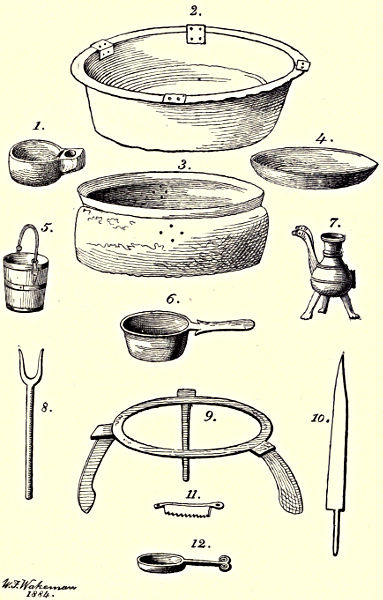
Plate XVII.
Culinary Utensils, Implements, &c., stone, bronze, wood, and iron.
It will be seen that the majority of crannog culinary articles are more or less rounded at their base; thus when placed over a fire they would require to be suspended or have a support to steady them. No. 9, from the great crannog of Lough Gur, county Limerick, is composed of very fine iron, which had evidently been smelted with wood charcoal; it is admirably adapted for the purpose of sustaining a pot or other vessel over a fire of peat or wood, but it is a comparatively modern article.
Bones of deer and other animals found in connexion with Irish crannogs frequently bear marks of a saw, and No. 11, from Lagore, represents an instrument of this class, measuring six inches in length. It was, no doubt, secured by rivets to a back or handle of wood, but the rivets no longer remain. Saws of this kind, some larger, some smaller, have constantly accompanied crannog implements of iron. No. 12, also from Lagore, is, seemingly, a ladle or miniature frying-pan, scarcely eight inches in length.
In the Museum of the Royal Irish Academy there is a beautiful thin saucer-shaped vessel, hammered out of a single piece of bronze that has been cleaned to show the rich red golden colour of the metal.
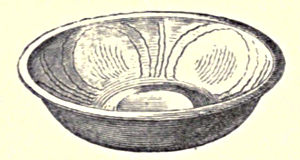
Fig. 55.—Saucer-shaped Vessel of Bronze from Cloonfinlough. About one-fifth real size.
It is 7¾ inches in diameter, the rim pierced with two small holes as if for suspending it, and decorated externally with a number of indentations.[108] The crannog of Lisnacroghera furnished a vessel of fairly graceful form, composed of extremely thin bronze; but it is unprovided with either handles or holes for suspension.
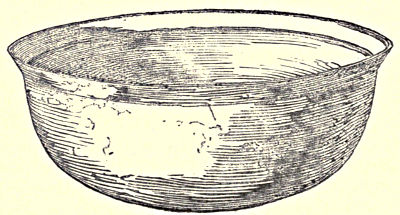
Fig. 56.—Bronze Vessel from Lisnacroghera. Slightly over six inches in diameter.
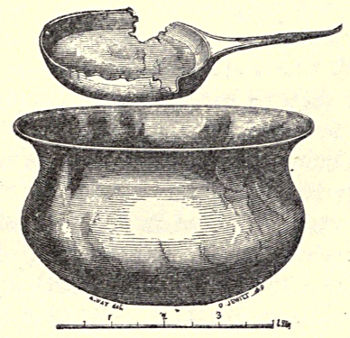
Fig. 57.—Bronze Vessel and Iron Ladle from Lagore.
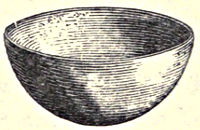
Fig. 58.—Iron Vessel from Lagore. One-tenth the real size.
A bowl or vessel of bronze measuring 5¼ inches in diameter and three inches in height, together with an iron ladle, were amongst the numerous objects procured at Lagore,[109] also another vessel 9⅞ inches in diameter, formed of thin iron.
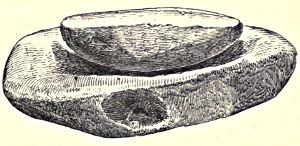
Fig. 59.—Grain-rubber. About one-tenth the real size.
Querns, or hand-mills, both of ancient and modern type, either in a perfect state or else more or less broken, have been found in most crannogs. “Grain-rubbers, for triturating corn, are, perhaps, the most primitive implements used in the manufacture of cereal food. Each consisted of a flag or flat stone slightly hollowed upon the upper surface, so as to hold the parched grain, and a convex rubber, or mullet, which was passed backwards and forwards with the hand, and thus bruised the corn into meal. Querns are evidently the next step in food-making machinery.… Although there are several varieties, the most simple and natural division of them is twofold. The first is that in which the upper and lower stone are simply circular discs from twelve to twenty inches across, the upper rotating upon the lower by means of a wooden handle, or sometimes two, inserted into the top, and fed or supplied with corn by an aperture in the centre, analogous to the hopper, and which may be termed the ‘grain-hole’ or eye. In this quern the meal passed out between the margins of the stones. The upper stones are usually concave and the lower convex, so as to prevent their sliding off, and also to give a fall to the meal.” The second variety is usually styled a pot-quern, and has a lip or margin in the lower stone, which encircles or overlaps the upper, the meal passing down through a hole in the side of the former. Most of this variety are of smaller size than the foregoing, which is evidently the more ancient and simple form, as well as that which presents us with the greatest diversity. The upper stone in the pot-quern was turned, as in the first-named kind, either by one or sometimes by two wooden handles. This kind of quern was denominated “bró.” The word, used in the signification “to grind,” occurs in Proverbs, chap. xxvii., v. 22: “Though thou shouldest bray a fool in a mortar among wheat with a pestle, yet will not his foolishness depart from him.”
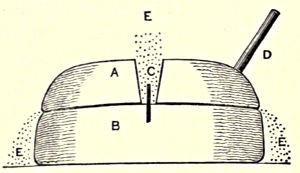
Fig. 60.—Section of ordinary Quern. About one-fourteenth the usual size.
A gentleman in Ireland, who at the commencement of the present century saw a quern at work, describes it as having the upper stone (fig. 60, A) about twenty-two inches in diameter, its under surface considerably concaved; the lower stone (B) was convexed, so that an easy descent was afforded for the meal (E) when ground. In the centre of the upper stone was a circular hole nearly three inches in diameter, and through it the quern was “fed,” as it is called, i. e. supplied with fresh corn (EEE) as fast as the bran and flour fell from the sides of the machine. Within about two inches of the edge was set an upright wooden handle (D) for moving the upper stone, which rested in equilibrio on a strong peg or pivot (C) in the centre of the lower stone. There were generally two women employed in the operation. They sat on the ground facing each other, the quern between. One of them with her right hand pushed the handle to the woman opposite, who again sent it to her companion, and in this manner a rapid rotatory motion was communicated to the upper stone, whilst the left hand of the operator was engaged in the “feeding” process. The corn, previously dried over a slow fire, when arrived at a certain degree of crispness, was taken up to be ground. This preparation prevented the raw taste perceptible in meal from modern mills. Little cookery was required. The ordinary way of using it was to mix the meal in its raw state with milk, to the consistency of thick porridge, and it was then eaten without any other accompaniment, the simple mixture being called “a crowdie.” A quern is evidently the primitive kind of mill referred to in the Scriptures, where it is said “two women shall be grinding at the mill:” and Shakspeare makes Puck to “sometimes labour in the quern.”
Fig. 61.—Upper surface of Quern from the Crannog of Drumsloe. About one-ninth the real size.
In the centre of the crannog of Drumgay, county Fermanagh, there was a large block of stone punctured with a cross, and another resembling it was discovered many feet deep, in the centre of the pagan carn of “The Miracles,” in the same district. Similar figures are inscribed or punched upon rocks and upon the sides of natural, or partly artificial caves, as at Loch na Cloyduff, The Lake of the Dark Trench or Diggings, and the “Lettered Cave,” in the cliffs of Knockmore, “Great Knoll,” county Fermanagh. Within the precincts of well-authenticated pagan tumuli, as at Dowth, cross patterns have been found, accompanied in several instances by “scorings,” at present unintelligible. On the base of a sepulchral urn, preserved in the Museum of the Royal Irish Academy, the cross is displayed, and the figure of a cross within a circle occurs on an urn discovered at Broughderg, county Tyrone. Mr. Albert Wray has described some spoon-shaped objects of antique bronze, all decorated with the figure of a cross similar in design to the symbol as observable upon the earliest Irish quern-stones. The bronze articles in question exhibit a style of workmanship which has invariably been associated with pre-Christian times in both Britain and Ireland; whilst in the latter country discs and thin plates of gold belonging to the same period have been found presenting a cross-like ornamentation. At Drumgay, at Lough Eyes, at Roughan, and at Drumsloe, the Ridge of the Host, were cross-inscribed querns. Drumsloe lake, now almost drained, is situated within a short distance of Ballinamallard county Fermanagh. Interesting objects, now dispersed or lost, have been there from time to time turned up on the site of a crannog, the traces of which are now nearly obliterated, and the curious quern or bró, of which the accompanying cut is a facsimile, is one of the few remaining relics authentically connected with the locality. The quernstone measures one foot six inches in diameter.[110]
Fig. 62.—Upper surface of Quernstone from Roughan Lake. One-eighth the real size.
Fig. 63.—Quernstone from Lough Eyes. About one-tenth the real size.
About the year 1839, upon lowering the level of the water for drainage purposes in Roughan lake, near Dungannon, county Tyrone, an island artificially formed was exposed to view. On it were numerous fragments of pottery and bones, a bronze pin, a few bronze spear-heads, together with a quern. The illustration (fig. 62) represents the top stone, which is eighteen inches in diameter, and two and a-half inches thick; it is formed of sandstone, the ornamentation being in high relief. The hole or socket for reception of the handle is in one of the arms of the cross, and goes quite through the stone.[111] Portions of a highly decorated quernstone, restored in the accompanying illustration (fig. 63), were found in one of the crannogs in Lough Eyes. On “Bone Island,” in the lake of Drumgay, several fragments of quern-stones were collected. Two of those obtained were inscribed with a cross-like ornamentation, one of them presenting a most unusual style of crannog geometrical decoration.
Fig. 64.—Quernstones with Cross and Geometrical Decoration. About one-twelfth the real size.
On pottery at Ballydoolough, a cross pattern was observable, as also on a comparatively modern iron article at Cloonfinlough, and there was in a crannog in Argyleshire a Greek cross, with crosslets as a pattern, or ornamentation, burnt into a piece of oak.[112] The “Croix gammée,” or Swastika, occurs on sculptured stones in Scotland, and appears on a mosaic pavement in the recently discovered Roman villa in the Isle of Wight. In Keller’s Lake Dwellings of Switzerland,[113] a cross within a circle is represented: it was found at Auvernier, and had seemingly been an article of personal adornment. Layard, in his work entitled Nineveh and Babylon, states that he found what is now called the Maltese and Irish cross in such connexion as led him to identify it with the sun. In these ancient sculptures the cross was often inserted within a circle, which, having neither beginning nor end, was considered to be the emblem of eternity, and may be so observed in Assyrian sculptures. Dr. Schliemann, in his Troja (p. 167), gives a representation of a curious copper or bronze ring, about the size of an ordinary napkin ring, but very heavy. It has five compartments, each ornamented with a cross marked by openings cut in the metal. Amongst the whorls found by Dr. Schliemann, numbers are ornamented with and . The same sign is found in Pompeii, and amongst the ancient heathen population of Yucatan and Paraguay. “Later still, it was even adopted by the Christians as a suitable variety of their own cross, and became variously modified geometrically.” In No. 1 crannog, in the lake of Drumgay, there was a very peculiar cross-sculptured stone, two feet in length by three inches in thickness. It is seemingly of no great antiquity, and was most probably intended for a tombstone to be placed in the neighbouring cemetery of Devenish.


Fig. 65.
Sculptured Stone from No. 1 Crannog, Lake of Drumgay. About one-eighth the real size.
Human Remains.—There have been, as yet, few instances of the discovery of human bones in crannogs. At Dunshaughlin, in Meath, at Ardakillen and Cloonfinlough, in Roscommon, the people appear to have met with a violent end, and there is no reason to believe that the remains are very ancient. The lake dwellers of Switzerland had cemeteries on the mainland, directly opposite their habitations, and it is probable that the Irish disposed of their dead in the same manner, but up to the present this subject has not been investigated.
Fireplaces on the Shore.—Numerous fireplaces on the shore adjoining crannogs were discovered at Drumkeery lough, and at Lough Eyes. In the immediate vicinity of the latter were traces of gins or traps for catching game. In the neighbouring bogs labourers have, at various times and in different localities, met with stakes planted in the original surface soil, in a vertical position, and sharpened to a point, seemingly by a clean-cutting metallic tool. Since fixed in their original position the peat had grown so much that it is now, on an average, about five feet above the pointed ends. It has been often surmised that stakes planted thus were in some way connected with the trapping of deer and other wild animals.[114]
Pottery.—Dr. Schliemann rightly designates fragments of pottery as the cornucopia of archæological science; it is always abundant, and it possesses two qualities—those, namely, of being easy to break, and yet difficult to destroy, which render it very valuable in an archæological point of view. Investigation has shown that the inhabitants of crannogs had in use a description of fictile ware, distinctly characteristic in style, graceful in form, and well manufactured, admitted by English archæologists to be superior to that possessed by the Britons or early Saxons. It is known that the primitive people of Ireland possessed the art of constructing excellent fictile ware for mortuary purposes of fire-hardened clay; they could therefore manufacture every-day culinary vessels of the same material. An immense quantity of pottery has been found in connexion with many crannogs, by which means facilities are afforded for comparing ordinary domestic vessels with the urns and vases of an undoubtedly prehistoric and pagan period. The great majority of specimens of crannog pottery present designs marked upon them, similar in style to the ornamentation observable on the walls of sepulchral cairns and the vessels deposited in them, on golden or bronze ornaments, on implements, and on the surface of rocks, all of which are usually acknowledged to date from prehistoric times.[115] Mr. Rau states that the fictile vessels discovered by him amongst the debris of Indian relics on the left bank of the Cahokia Creek, on the Mississippi, opposite St. Louis, resemble the ancient Irish fictilia, “more especially those found in crannogs and kitchen middens.” One fragment showed punctured and impressed ornamentation of the class so usual on Celtic urns. Mr. Graves observes that the arts of primeval peoples may be illustrated by comparison with those that prevail under similar conditions of civilization existing in or near our own times. Thus in India cromleac builders raise their megalithic monuments on hills. In the Hebrides, cloghans, i. e. mortarless stone-built and roofed habitations, similar to those strewn over the western littoral of Connaught, and also lake dwellings in various parts of the world, are even still occupied.
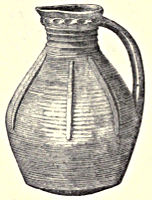
Fig. 66.—Pitcher from Lough Faughan. About one-seventh the real size.
From the crannog of Lough Faughan, Co. Down, was procured the pitcher No. 9, Museum of the Royal Irish Academy; also another pitcher, 13 inches in height, and 32 in girth, of a description of pottery so light as only to weigh 5 lbs. 10 oz. It figures as No. 10 in the collection of food implements. Externally it is dark in colour, and being partially glazed, is, therefore, not of very ancient date: it is so rounded at the bottom that it cannot stand upright: about the neck, and for some distance down the sides, it is tastefully decorated, and the handle is peculiar in form.[116]
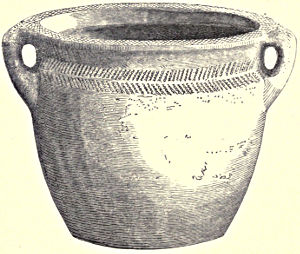
Fig. 67.—Fictile Vessel from Ballydoolough, restored.
The accompanying engraving (fig. 67), a good specimen of another class of fictile ware, represents, in a restored form, one of the finest of the crocks found at Ballydoolough. In colour it is light-yellowish red; it measures three feet two inches round the mouth, and is tastefully ornamented on the rim and sides. This decoration had been evidently impressed upon the soft clay before the vessel was burnt, and the pattern conveys the idea of such antiquity that, if found in a tumulus, it would be referred to a prehistoric age.
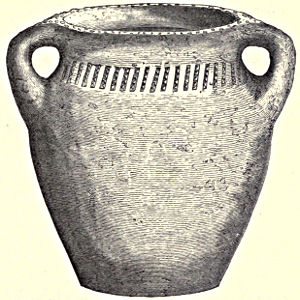
Fig. 68.—Fictile Vessel, Drumgay Crannog, restored. Quarter size.
A large fragment of fictile ware was discovered on one of the crannogs in the lake of Drumgay; it was of size sufficient to enable a restored representation (fig. 68) to be made of a vessel that had been in use by the former inhabitants of the crannog for culinary purposes.
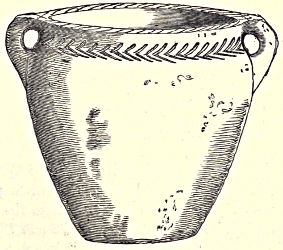
Fig. 69.—Restored Vessel from Lough Eyes. One-fourth the real size.
The following illustrations (figs. 69 and 70) represent two of the vessels found in the crannog in Lough Eyes, county Fermanagh, carefully restored from fragments discovered on the sites. With the remains of these vessels were numerous flat discs formed of the same kind of clay, and that would seem to have been their covers or lids.
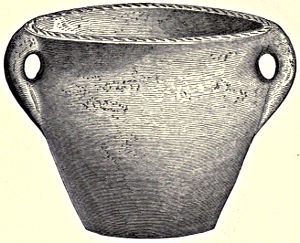
Fig. 70.—Restored Vessel from Lough Eyes. One-fifth the real size.
Fig. 71.—Baked Clay Pot Cover from Lough Eyes. One-fourth the real size.
For the escape of steam during the process of boiling, a simple provision is observable in several of these earthen pots. In the neck of the vessel, just below the point where the lid would be supported, is a small circular hole (see figs. 72 and 73). The aperture occurs in numerous fragments, but it is not now possible to determine whether this class of vessel, when entire, was invariably perforated.[117]
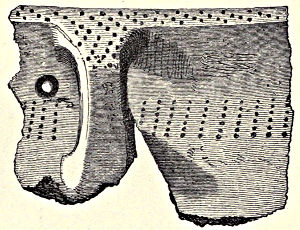
Fig. 72.—Portion of a Perforated Vessel from Lough Eyes. One-half the real size.
Fig. 73.—Portion of a Perforated Vessel from Lough Eyes. One-third the real size.
Fig. 74.—Portion of Fictile Vessel found on Ballydoolough Crannog. One-half the real size.
About 140 fragments of earthen vessels were discovered in the Ballydoolough crannog—none, however, in an entire state; but several pieces of the same article being found to fit together, a restoration giving a correct idea of the perfect vessel was easily attained. Fig. 67 (see ante, page 92), has been thus reconstructed. The next engraving (fig. 74) represents a fragment of what must have been a very large vessel, ornamented on the side with a chevron, and on the rim with an oblique pattern; it is composed of very hard-baked clay, dark in colour.
Fig. 75.—Portion of Fictile Vessel found on Ballydoolough Crannog. One-half the real size.
Fig. 76.—Portion of unornamented Vessel.
A third fragment (fig. 75) partakes of the character of the last described. The decoration is more elaborate and the punctured design or chevron slightly different. Many of the indentations are of semicircular form, and not angular or semiangular, as in most of the other crocks. The material is very hard, like fig. 74, and of a dark colour. Fig. 76 is portion of a large, straight-lipped vessel, that measured originally over three feet in circumference round the rim; it is unornamented, and formed of hard, well-baked, darkish-coloured clay.
Fig. 77.—Rim Ornament of Fictile Ware.
Fig. 77 is the only pattern of its kind found at Ballydoolough. It is drawn half-size. Whether this specimen and fig. 76 were originally furnished with ears it is now impossible to say. Figs. 78 and 79, drawn one-half the real size, represent portions of vessels. The larger fragment bears upon its ear, or handle, two figures somewhat like a St. Andrew’s cross; on the smaller there is only one.
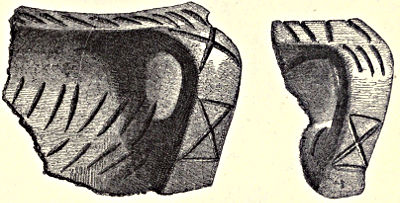
Fig. 78. Cross inscribed Pottery.
Fig. 79. Cross inscribed Pottery.
Fig. 80, drawn half-size, exhibits a bold but rude chevron pattern.
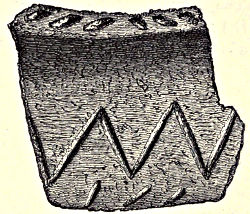
Fig. 80.—Portion of Fictile Vessel found at Ballydoolough Crannog.
There were thirty-five distinct patterns on the various fragments unearthed, yet the locality was not thoroughly explored. Specimens of the pottery from Ballydoolough were forwarded to Mr. Albert Wray, a well-known authority on such subjects, and he would not refer them to a very early age, or to that in which the use of bronze was prevalent. The mode of ornamentation appeared to present a slight resemblance to the “Cuerdale Hoard,” which is sometimes ascribed to the ninth century. W. F. Wakeman, however, is of opinion that amongst the numerous designs found upon the crannog vessels there is none suggestive of the work of Christian times in Ireland, unless the cross-marked fragments be considered as such, chevrons and circular depressions being all expressive of Pagan ideas of ornamental art.
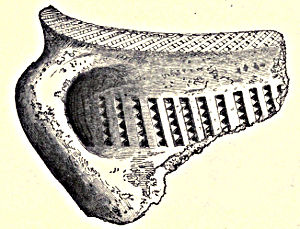
Fig. 81.—Portion of Fictile Vessel, with Ear, Drumgay Crannog. One-half size.
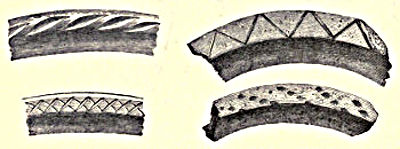
Fig. 82.—Rim Ornaments of Fictile Vessels, Drumgay Crannog. One-half size.
On “Bone Island,” in the lake of Drumgay, were several fragments of earthen vessels. The one represented in the annexed cut, drawn half size, is a portion of what had been a large and well-formed vessel with ears. The top of the rim is ornamented with a pattern. The diameter of the vessel at the mouth is about eleven inches; the neck is short, and the sides are decorated with indented lines about an inch in length, placed diagonally. There were also several fragments of fictile ware consisting of unimportant portions of rims decorated as shown in the accompanying representations. One pattern is a simple chevron. The accompanying illustrations represent characteristic examples of the pottery found in abundance on No. 3 crannog in Lough Eyes, county Fermanagh (plate XVIII., figs. 83 to 88).