SUCCESSIONAL CROPPING IN SMALL GARDENS. By A. C. Curtis.
Reading edition
Comparatively few realise the continuity and quantity of good green vegetables that can be raised from a small plot of garden ground, therefore it seems well that a few pages should be devoted to a simple description of successions cropping, which is the basis of success for the small garden.
First the gardener must remember that if he propose to take crops continuously out of the earth that earth must be continuously supplied with soluble plant food. Therefore heavy dressings of fat, well-matured stable manure, must be dug in as often as possible, and lime must be applied freely every third year.
Lime is best given, after the ground has been trenched, at the rate of as much as half a pound to the square yard. It may either be in the form of ground chalk, or, better, slaked lime. We prefer to buy quicklime in sacks, and to make heaps of it over the ground, about a bushel of lime to a heap. Earth is turned over these heaps, and they are left to slake for a fortnight. At the end of that time the heaps are scattered evenly over the bed, and it is all forked in. A fortnight later it will be quite safe to sow.
Lime applied in this way destroys all sorts of insect and fungoid pests, including club. It acts chemically on the constituents of the soil, releasing valuable plant food in a soluble form, and itself, though very slowly soluble, is invaluable for many crops, especially peas and beans.
Deep digging at every possible opportunity is absolutely essential to success where heavy cropping is pursued. And in dry weather the steady use of the Dutch hoe where possible is invaluable both in keeping weeds down and in preserving a friable moisture-holding top to the soil.
In making his plans for the year’s work the gardener will at first consider what vegetables are desired by his household, and in what probable quantities; he will not strive for unduly early, or late crops, especially if he employ but one man a day or two a week, but he will try to have a useable amount of vegetables in hand, the year round, not wasting his ground either by excess or undue thrift of any one crop.
Taking a small plot of ground of about one-tenth of an acre as our text, it will be the simplest way to describe one form of successions cropping which should freely supply a household of at least six people with vegetables the year through. But not with main crop potatoes, these are better and cheaper field grown, and it is a waste of ground and labour to grow them.
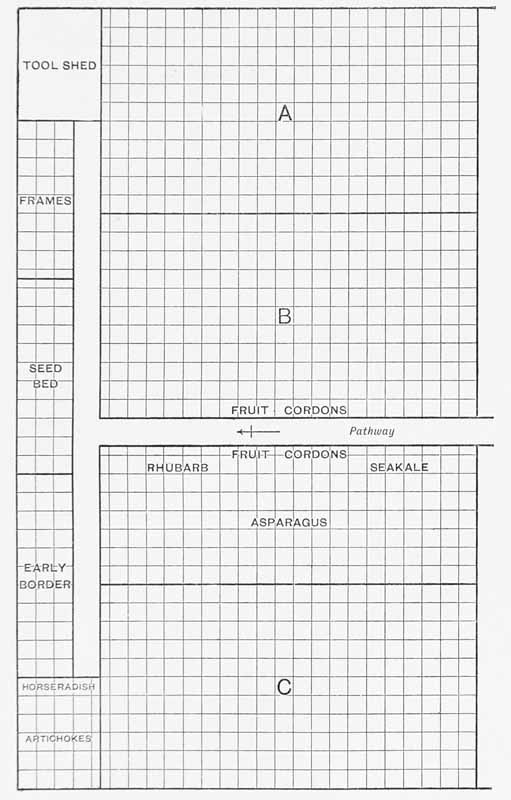
Plan I.—A small Kitchen Garden of about 1/10 Acre
(From “The Small Garden Useful”)
Scale.—The ground divided into 2-foot squares
Plan I describes itself, and it will be seen to be divided into three main plots for successions cropping, each forty-one by twenty-two feet, and lettered A, B, and C. The cropping of these plots should be so arranged that year by year the scheme for one plot may be moved forward to the next, ensuring a different class of subject being grown on the ground in successive seasons, resulting in the least exhaustion of the ground. Of course in a garden of this size this is rather a counsel of perfection, difficult to reach, yet where the rule has to be broken, deep digging, manure and lime are used to minimise the evil.
This succession may be expressed in a formula:
First year A B C
Second year C A B
Third year B C A
Supposing that our scheme of successions cropping has already been in operation, it must be remembered that the ground at the beginning of the year will be pretty fully occupied, and we shall point out the crops already in possession of the various plots as we discuss them month by month. Taking then Plan I as the text, we will proceed to briefly discuss the year’s routine, beginning with New Year’s day.
TABLE OF SUCCESSIONAL CROPPING
Each plot 22 × 41 feet. The rows of plants = 41 feet.
Plot Crop Planted or Sown Gathered Followed by Crop Planted or Sown Gathered Followed Next Season by
A Onions (6 rows) 2–3 8–9 Spring Cabbage (4 rows) 8–9 4–7 Runner Beans
Parsnip (1 row) 3 10–3
Salsify (1 row) 4 10–3 Early Potatoes
Carrots (2 rows) 4 8–9 Endive and Chicory 8–9 11
Beet (2 rows) 4 8–9 11–2
Celery (2 double rows) 6 10–3
Lettuce (between) ... ...
B Broad Beans (2 double rows) 12–3 6–7 Turnip 7 8–9 Onions
Dwarf Peas and 2–3 6–7 Couve Tronchuda 7 11–1
Spinach (between) 2 rows Savoys 7 11–12 Parsnip
Broccoli 7 3–4 Salsify
Kidney Beans and 4 7 Carrots
Lettuce (1 row) Chicory 7–8 11–2 Beet
Dwarf Peas and 4 7 Late Spring Broccoli 7 4–5 Celery
Lettuce (2 rows) Endive 8 10–11
Peas (2 rows) 5 7–8 Leeks 5 10–3
Leeks between Lettuce 8 9
C Runner Beans (1 row) 4 7–10 Broad Beans
Early Potatoes (7 rows) 3 6–7 Cauliflower (1 row) 5 9
Broccoli (1 row) 5 9–10 Peas
Brussels Sprouts (5 rows) 5 10–2
January
Plot A.—Contains kale, spring broccoli, and leeks, a six-foot breadth of ground where savoys and couve tronchuda stood must be cleared and trenched and heavily manured as early in the month as possible, as onions are to come here, a good dressing of lime and soot forked into the top spit will do good. Nothing more can be done in this plot during the month, beyond blanching chicory which still stands in it.
Plot B.—Contains Brussels sprouts; if not already done during December, the ground from which runner beans and cauliflower and broccoli came last autumn, must now be trenched and manured, and a dressing of superphosphate of lime, two ounces to the square yard, should be forked into the top spit. If the weather be propitious two double rows of broad beans may be sown across this ground now.
Plot C.—Contains spring cabbage, parsnips, salsify, and celery, probably a row or two of chicory also, and may be conveniently left for a month or six weeks until all but the first are cleared away.
Permanent Crops.—Seakale and rhubarb should have a few crowns of each covered up with fern or clean straw for blanching and to induce early growth.
February
Plot A.—If the onion bed was made last month, no further digging can be done here, but the onion ground must be prepared now, if the weather was impossible in January.
Plot B.—This is a good month to plant broad beans if they are not already in, but if the weather is bad leave them till March, there is no sense in setting beans to rot in sodden soil. The Brussels sprouts must now go, and as they and the early potatoes have pretty well exhausted the ground, and have well paid for their manure, trench the ground well, and give a good dose of manure and lime also; either as superphosphate, two ounces to the yard, or as lime pure and simple if it has not been given for a couple of years.
About the end of the month a sowing of dwarf peas may be made, if the weather be open. They should go thirty inches from the broad beans, and we know no better sort than the Little Marvel. Place eighteen-inch wire netting along the row at the time of sowing, and run a row of spinach fifteen inches on the hither side of the peas. Continue to blanch chicory.
Plot C.—By the middle of the month the crops still in this ground must be cleared away. The few roots of salsify and parsnip left should be stored in sand in a dry place, and the celery laid in in the open, where the cook can easily get to it. Immediately this is done the ground must be trenched and heavily manured, as it is to bear two exhausting crops without any further help. In addition we like to fork kainit into the top spit, an ounce to every square yard, and find that if done in February, this does not interfere with the early growth of the potatoes, but helps them and the Brussels sprouts very mightily later on.
Frames.—Make up the hotbed about the middle of the month.
Seed Bed.—Sow a little early lettuce, radishes, and if there be good conditions it may be worth while to sow early peas in the early border, besides spinach, at the beginning of the month.
Permanent Crops.—Cover more seakale, and finish putting pots or boxes over the rhubarb. Tidy up the asparagus, and give a top-dressing of five pounds kainit and fifteen pounds of superphosphate to a bed the size of that in the plan.
March
Plot A.—Plant or sow the onions in rows a foot apart as early in the month as possible. As the kale and early spring broccoli are used clear them quickly off the ground, and trench a six-foot breadth of ground next the onions, one and a half spits deep only, being most careful not to bring any old manure up to the top spit. At the bottom of the trench put a small dressing of manure and a dusting of kainit, and fork it in before returning the earth. Towards the end of the month sow one row of parsnips next the onions; as parsnips are not in very great demand, this should be sufficient. Before sowing in this, and all, newly trenched ground, tread it well to consolidate it and make it firm, choosing a dry day for the purpose.
Plot B.—Two rows of early peas may be sown this month, one row sown as soon as the next earlier peeps through. The rows should be of Little Marvel or some similar dwarf and early kind, placed thirty inches asunder, and spinach should be sown between the rows.
If the broad beans are not in sow them at once.
Plot C.—Keep the ground hoed between the spring cabbage, and give them a slight sprinkle of nitrate of soda in showery weather.
Plant seven rows of early potatoes (such as May Queen) about the 20th, the rows should be about thirty inches apart, the potatoes a foot in the row.
Permanent Crops.—Earth up the rest of the seakale. Dig a slight dressing of old manure into the artichoke ground and replant.
Frames.—Sow tomatoes, leeks, Brussels sprouts, Autumn Giant cauliflower, autumn broccoli, lettuce (both dwarf and main crop), cucumber, vegetable marrow, mustard and cress, and if there is a frame to spare, sow forcing carrot, radish, and a sprinkle of forcing lettuce.
April
Plot A.—Sow salsify, one row, and two rows each of beet and carrots; more can be sown of the last two if desired; these should all be a foot apart.
Plot B.—Sow one row of kidney beans about the middle of the month, sow dwarf second early peas (such as dwarf Marrow-fat) as soon as the previous sowing shows up, prick out lettuce between the rows, about thirty of a sort at a time.
Plot C.—Earth up the potatoes as they require it. Clear up the two middle rows of spring cabbage, and open out a trench in the way of a celery trench, fork in a handsome dressing of old manure and return the earth to within five inches of the level of the ground, in preparation for the Scarlet Runner beans.
Frames.—Sow celery early in the month. Sprouts, cauliflower, broccoli, and leeks should be pricked out into boxes and gradually hardened off. Plant out lettuce from the frames. Pot up tomatoes. Towards the end of the month plant a couple of cucumber plants out, one under each light of the frame. Repot vegetable marrows.
Seed Bed.—Sow winter and spring brassicas about the 7th. Make successions sowings of lettuce and radishes.
May
Plot A.—Keep weeded; thin the parsnips to six inches, the other roots to single plants.
Plot B.—Sow the two last rows of peas (such varieties as “Ne plus ultra” or Continuity) five feet apart, about ten days between the sowings, plant leeks out, between these rows in a shallow trench, with some old manure forked in at the bottom. Plant out more lettuce.
Plot C.—Earth up the potatoes early in the month for the last time, and the same day put out one row each of cauliflower and autumn broccoli between the rows, and five rows of Brussels sprouts, the plants should be thirty inches apart.
Frames.—Prick out and harden off celery. Repot tomatoes and vegetable marrows. The tomatoes should be now moved to the glass-roofed tool-shed, keep them near the glass, and put the strongest out in large pots or boxes to remain there.
Seed Bed.—Prick out the winter and spring brassicas, just a few plants more than will be required. Sow radish and lettuce.
Permanent Crops.—Thin out the seakale shoots.
June
Plot A.—Finally thin carrots, salsify, and beet. The late Queen broccoli will now be done with, clear it off, and make two celery trenches eighteen inches wide at the top, and four feet apart, plant out double rows of celery in them and set lettuce between.
Plot B.—Clear spinach and lettuce away as they are done with.
Plot C.—Set stakes to the runner beans.
Frames.—Plant vegetable marrows out early in the month. Put the tomatoes out along fences or the edges of sunny paths about the 14th.
Seed Bed.—Sow chicory, lettuce, radish, and a pinch of endive.
July
Plot A.—Keep weeded, water celery, and look out for celery fly.
Plot B.—Clear off broad beans and early peas the moment they are done. Sow two rows of turnip, and put out couve tronchuda, savoy, kale, purple sprouting broccoli, early and late spring broccoli, as soon as room can be made for them. A row of chicory can either be sown or pricked out in this plot this month.
Plot C.—Dig the whole crop of potatoes without waiting for the haulm to die down, somewhere between the 10th and 20th, store the potatoes and tread the ground round the brassicas.
Seed Bed.—Plant out lettuce and sow more. Sow endive and chicory, and about the 24th sow flower of spring cabbage.
August
Plot A.—Towards the end of the month the onions may be ready to harvest; if so, get them up, also the carrots and beet, though the last may have to wait till September. Follow the onions with spring cabbage, and the carrots with chicory, planted out, and endive. The celery will probably be ready for a first slight earthing up.
Plot B.—Clear the latest peas away, and immediately follow them with endive, chicory, and lettuce from the seed bed. As soon as established give the lettuce a slight dressing of nitrate of soda, it makes all the difference to the quality of autumn lettuce; the endive also will be improved by similar treatment. If desired a sowing of turnips may be made here at this time.
Plot C.—Keep this plot and the rest of the ground clear of weeds; use the Dutch hoe.
Seed Bed.—Sow more spring cabbage, endive, and Tripoli onions.
September
Plot A.—Harvest onions, carrots, and beet, if not already done. Follow the onions with spring cabbage, the roots with endive and chicory. Continue to earth up the celery, in many seasons the final earthing may be done by the end of this month.
Plot B.—Earth up the leeks with the hoe.
Plot C.—Keep this and the other plots well weeded.
Frames.—Fill one frame with lettuce and endive.
Seed Bed.—Prick out a few more dwarf lettuce and a few endive. Blanch endive, a few at a time.
October
Plot A.—Finish earthing up all celery.
Plot B.—Keep weeded; blanch endive.
Plot C.—Keep weeded.
Frames.—Fill a second frame with endives.
November
Culture has now ceased for the growing crops, beyond keeping them weeded. Endive must be blanched, and the frames kept open as far as the weather will permit. Begin to blanch chicory, clean up rhubarb, seakale, and asparagus, and mulch the plants.
December
Plot B.—The turnips will be off the ground, so will the couve tronchuda and savoys before the end of the month, if possible trench the onion bed for next season. Clean up all weedy corners. Continue to blanch chicory and endive.
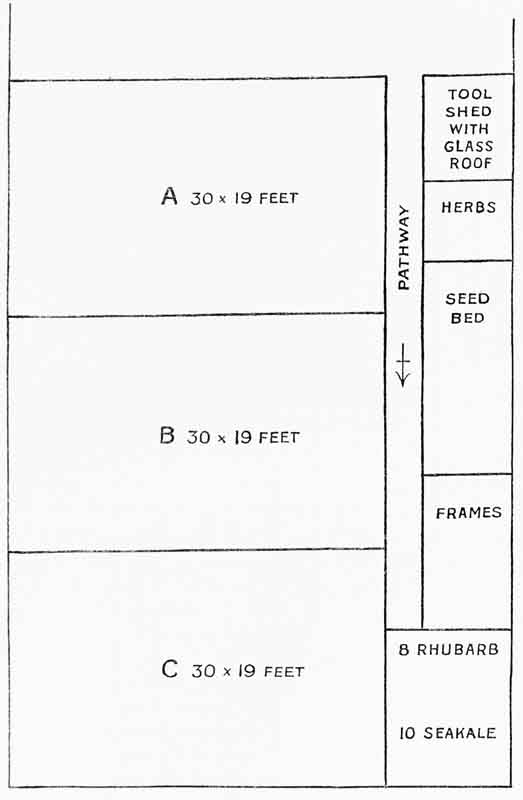
Plan II.—Small Kitchen Garden of about 1/20 Acre (57 × 40 feet)
This, or a slightly modified scheme, will be found to hold good for a smaller plot of ground, even in such a small plot as is sketched in Plan II the same methods will obtain. In this plan the asparagus has been sacrificed, so have artichokes, but the latter could be substituted for seakale, if desired. Beyond some cramping of the ground the plots will carry nearly as many, though shorter, rows as in the larger scheme. Possibly in Plot A the same number of rows could be grown by slightly contracting the space between the celery trenches, and by allowing only nine inches between the rows of root crops. This is perfectly sound practice if only care is taken to thin the plants so that those in adjacent rows do not come opposite each other, but opposite the centre of the intervals between their neighbours.
In Plot B one row of peas would have to be sacrificed, and in Plot C one row of potatoes and one of Brussels sprouts must go, but there will be plenty of vegetables for a family of four, and probably enough potatoes to last till Christmas.
This scheme of successive cropping will be found to be sound roughly south of the Trent, but for northern and colder districts it would have to be modified. With some modification as to the time of sowing, Plots A and C would broadly stand as arranged, but Plot B would have its times of sowing much later, the peas would have to be at least three feet six inches apart, to make room for the winter and spring greens, which would have to go out between the rows before the peas were off the ground, and it is probable that all brassicas for winter and early spring would be better sown in a cold frame.
But when all is said, this is only one of several possible schemes, and every gardener as he learns his subject will be able to adapt it to his special soil, climate, and household needs.