George Manville Fenn
Reading edition
"The Khedive's Country"
Chapter One.
Man’s oldest pursuit was undoubtedly the tilling of the soil. He may in his earliest beginnings have combined therewith a certain amount of hunting while he was waiting for his crops to grow, and was forced into seeking wild fruits and turning up and experimenting on the various forms of root, learning, too, doubtless with plenty of bitter punishment, to distinguish between the good and nutritious and the poisonous and bad.
As a matter of course, a certain amount of fighting would ensue. Wild animals would be encountered, or fellow savages would resent his intrusion upon lands where the acorns were most plentiful, or some tasty form of fungus grew. But whether from natural bent or necessity, as well as from his beginnings recorded in the ancient Book, he was a gardener, and the natural outcome of gardening was, as ideas expanded, his becoming a farmer.
The world has gone rolling on, and many changes have taken place, but these pursuits remain unaltered. The love of a garden seems to be inborn; and though probably there are children who have never longed to have one of their own, they are rarities, for of whichever sex they be, the love of this form of nature still remains.
There are those who garden or farm for pleasure, and there are those, of course, who, either on a large or small scale, cultivate the soil for profit, while the grades between are innumerable. But here in England, towards the end of such a season as we have had—one that may be surely termed a record—one is tempted to say, Where does the pleasure or the profit come in?
Certainly during the present period, or cycle, or whatever it may be termed, the English climate is deteriorating. Joined to that assertion is the patent fact that the produce of the garden and farm has largely gone down in price through the cheapness of the foreign imports thrown upon the market, and the man with small or large capital who looks forward to making a modest living out of the land, without any dreams of fortune, may well pause before proceeding to invest his bawbees, and ask himself, Where shall I go?
Thousands have debated this question for generations, with the result that the Antipodes have been turned into Anglo-Saxon farms; Van Diemen’s Land has become another England, with its meadows, hedgerows, and orchards; New Zealand, the habitat of tree-fern and pine, has been transformed. Even the very surface has changed, and the land that in the past hardly boasted a four-footed animal is now rich in its cattle; while Australia, the dry and shadowless, the country of downs, has been made alive with flocks, its produce mainly tallow and wool till modern enterprise and chemistry rendered it possible for the frozen mutton to reach England untainted after its long voyage across the tropics to our homes.
To keep to the temperate or cold regions, the name of Canada or the great North-West springs up as does the corn which fills our granaries; while the more enterprising cultivators of the soil, who have had souls above the ordinary plodding of the farmer’s life—the fancy tillers, so to speak—with the tendency towards gardening, produced our sugar from the West Indies and British Guiana, and tobacco and cotton from the Southern States, long ere the Stars and Stripes waved overhead; while, to journey eastward, the gardens have flourished in India and Ceylon with indigo, spices, and coffee; and later on, wherever suitable slopes and terraces were found, the Briton has planted the attractive glossy-leaved tea shrub, until the trade with China for its fragrant popular produce has waned.
There are plenty of lands of promise for the cultivator, unfortunately too often speculative and burdened by doubt. They are frequently handicapped by distance, extremes of climate, and unsuitability to the British constitution. As in the past, too, imagination often plays its part, and the would-be emigrant hankers after something new, in spite of the cloud of possible failure that may hover on his horizon.
There is, of course, a great attraction in the unknown, and untried novelty is always tempting. But, on the other side, there is the old and safe, the cultivation of a land which in the past has been world-famed for its never-failing produce, its mighty granaries, and its vast fertility, that can be traced back for thousands of years, whose soil, far from becoming exhausted, is ever being renewed, and which at the present time is undergoing a transformation that will make its produce manifold.
Of course, the country which contains these qualities is the familiar old land of Egypt, the dominion of the Khedive, which, in spite of its wondrous fertility, has had little attraction for the earnest cultivator of the earth. It has been the granary of the world for ages; but its cultivation has been left to its own people, who have gone on with their old-time barbaric tillage, leaving Nature, in her lavish bounteousness, to do the rest.
In every way wonderful changes are coming over Egypt, where for countless ages the policy of the people seemed to be devoted entirely, as far as the vegetable world was concerned, to the growth of food, or such fibrous plants as proved their suitability for the manufacture of the light clothing they required. Any attempt to permanently beautify the country by taking advantage of its fertility, and commencing the planting to any great extent of that which was so lacking in the shape of trees, was left in abeyance till the coming into power of the great ancestor of the present Khedive, Mehemet Ali. This thinker, of broad intellect, made some beginnings in this direction, and later on Ismail Pacha gave a great impetus thereto by enlisting the services of a clever French gardener, who, fully awakened at once to the possibilities of climate and land, and with ideas running very much in favour of landscape gardening, began to introduce and encourage the growth of shade trees, a complete novelty in a country where the ideas of the people seem to tend towards placing their dwellings in the full glare of the sun.
Gardens began to spring up, trees were planted in suitable places, and the start having been once fairly made, the love of imitation led to the establishment of a taste or fashion, and planting has now gone on to such an extent that there are those who are ready to assert that while the face of Egypt is becoming changed, the presence of the rapidly-growing and increasing trees is having its effect, through the attraction and formation of clouds, upon the meteorology of the country. If this continues, as it may, to a vast extent, the fertility of Egypt will no longer be confined to the narrow strips on either side of the Nile, but its deserts may become physical features of the past.
The idea of those in olden times was to pile up huge erections and to let what came spontaneously grow as was its wont. Now the enlightenment of the new rulers and the leavening of Western civilisation are working wonders. That to which Ismail Pacha gave such a fillip is being fostered and advanced by the present Khedive, and, the ball being well set rolling, his people are finding out that nearly everything that loves moisture and sunshine will grow prodigiously. It takes time, of course, but many of the beautiful shade trees that have been planted have in forty years reached a height of eighty feet, and become rich in their heavy foliage. The varieties of the eucalyptus, not always the most beautiful of trees from their greyish leafage and want of shadow, are still a wonderful addition to a dry and thirsty land. Considering their original habitat in Australia, it was a foregone conclusion that they would do well here, and they have proved to be most rapid of growth.
Then there is the magnificent Flamboyer des Indes, and scores of other beautiful children of Nature, which only required care and fostering in their tender years to prove their liking for their new home. Endless are the trees that, once given a start, leave behind their scrubby, starved appearance, and become in maturity well able to care for themselves and beautify the prospect on every hand.
Acacias, with their perfumed blossoms; the deep green shady sycamore, that good old favourite like the plane of the Levant; the feathery tamarisk, and scores of ornamental trees, flourish well; while, combining the ornamental with the useful, there is the fine, slow-growing old mulberry, with its rich juicy fruit, and its suggestions of the soft straw-coloured or golden yellow rustling silk; for if ever there was a country favoured by Nature, in its dryness and absence of rain, for the prosperity of the caterpillar of the silkworm moth, it should be Egypt, where enterprise and a sensible use of capital ought to leave Asia and Turkey in Europe behind.
Leaving trees and turning to flowers, gardens in Egypt can be made, and are made, perfect paradises in the meaning of old Gerard and Parkinson; for the country is a very rosery, where the modern decorative sorts bloom well in company with the more highly scented old-fashioned kinds largely cultivated for the distillation of that wonderfully persistent essential oil, the otto or attar of roses.
Here the lover of a garden and of exotics can dispense with conservatory or the protection of glass, and, giving attention to moisture and shade, make his garden flush ruddily with the poinsettia, and may also find endless pleasure in the cultivation of some of the more beautiful varieties of the orchid family, which here in England demand the assistance of a stove.
Perhaps the most attractive time for the visitor from England, who has thoughts of settling in this country, to see it at its best is when the Nile is rising to its height, bringing down from Equatorial regions its full flow of riches and the means of supplying the cultivator with that which will reward him for his labours beneath the torrid sun.
At this time the crops are approaching maturity; the vast fields of maize have been passing through the various stages of green, waving, flag-like leaf, and hidden immature cob, with its beautiful, delicate tassel, prelude of the golden amber or black treasure that is to come and gladden the eye of the spectator in every direction. The grassy millet, or dourra, is equally beautiful in its wavy-wind-swept tracts; the cotton crops are gathering strength prior to the swelling and bursting of the silky boll; and the majestic sugar-cane towers up in its rapid progress, till the whole country is smiling in preparation for the gladsome laughter of the harvest that is to come, for it has been a busy time. The fellaheen, in their thousands, have been occupied in that wonderful irrigation which has been the careful distribution through meandering canal, straight-cut dyke, and endless little rill, of the lurid thick water of the Nile, laden with its rich plant-sustaining fertility, to the roots of the thirsty plants, and stimulating them beneath the ardent sunshine into a growth that is almost startling. In other parts the same waters are being ingeniously led to the cultivated lands that are being made ready for the more ordinary grain crops—the wheat, the homely barley, and the Egyptian bean, the food of man and beast alike; while in a country where grassy down and ordinary meadow, such as form the pasture of sheep, oxen and kine at home, are unknown, tract upon tract is annually sown with Egyptian clover, lentils, and similar crops—ready for immediate use as cattle food in which the animals can graze bit by bit as far as their tethering lines will permit—for cutting and stacking up green in the form of ensilage, and consumption when the crops are past—or for hay.
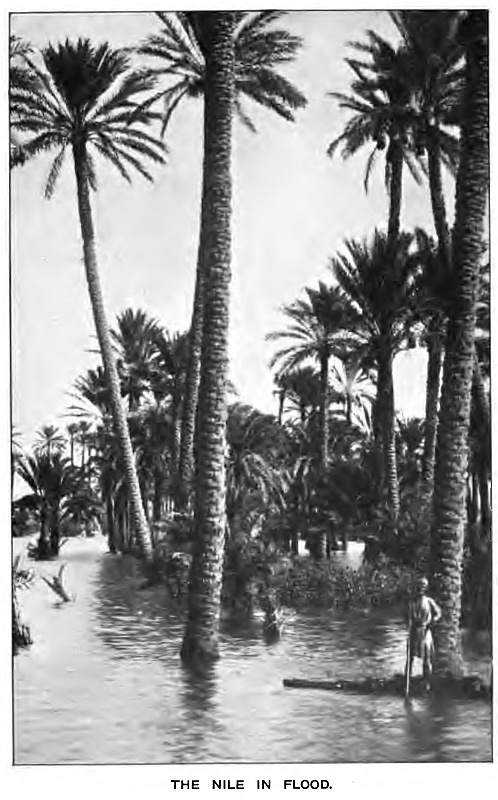
The granary of the world, the vast store-house for nations: people have gone there to buy, but not to till; and yet it presents so many qualities that the wonder is that it should have been so long neglected; while now, in its state of transformation through the opening of the great dam and the cutting and forming of miles more irrigating canal, there is no bound to what may be done in the future. The time seems to be approaching when Egypt will no longer be spoken of as a narrow strip of fertile soil running from north to south and bordering the Nile, for its future seems to be that the barren sand far back from its banks will be turned into fertile land, adding its produce of corn and cotton to the store-house of the world.
As is well-known, vast tracts of Egypt are by nature sterile; but upon these barren primaeval sands there has been superimposed for uncountable ages the alluvium of the Nile, so that, as an old writer says, Egypt itself may be looked upon as the gift of one of the mightiest rivers of the world. He speaks of the Nile as being the father of this country, bounteous in its gift, a strange, mysterious, solitary stream which bears down in its bosom the riches of the interior of Africa, carrying onward from far away south the fertility of the luxuriant tropics, and turning the sterile sand into the richest soil of the world. It is this richness of the south that has changed the Delta from an arid waste into a scene of matchless beauty.
One gazes upon it from the summit of one of the pyramids or some high citadel, over cities and ruins of cities, palm grove, green savannah, palace and garden, luxuriant cornfield, and olive grove. Far distant, shimmering in a silvery haze and stretching away into the dimness of the horizon, lies the boundless desert, now being rapidly reclaimed, consequent upon the great barrage experiments for the supplying of the many winding canals with the fertile waters of the parent river. And of these still growing distributors of life, these bearers of commerce, the numbers are almost beyond belief. They are the veins and arteries of the country, depositing as they do the rich soil which furnishes abundance, and then acting as the waterways upon which, in due time, the harvests are borne throughout the length and breadth of the land.
There is a great discrepancy in the reports as to the number of these canals, and statements made and chronicled a few years back are not of much use as statistics at the present day; while the completion of the great dam will give such an impulse to their formation that the mileage, even if properly estimated now, will be useless as a basis ten years hence.
One traveller, in his ignorance of the country, estimated the number of these irrigating water distributors as only ninety, while another of about the same date gives Upper Egypt alone six thousand. Probably, though, in this instance he included every branch and branchlet that led the water amongst the cultivated lands.
The water of these canals, renewed as it is by the annual risings of the Nile, goes on steadily changing, wherever it is led, the primaeval sand of the desert into rich deep soil, after the fashion, but on a grander scale, of the ingenious way in which portions of fen and bog land in north Lincolnshire and south Yorkshire have been transformed into fertile farms. As compared to what is going on in Egypt, this process is trivial in the extreme; but by man’s forethought and ingenuity many a peat bog and waste that aforetime grew nothing but reed and rush has been made, by draining and leading upon it the muddy waters of the Ouse, Trent, and their tidal tributaries, into rich and prosperous farms, producers of the necessities of life. These warp farms, as they are termed, stand high in favour with the cultivators of the soil. They have taken years to produce, perhaps, and the process has consisted of but one treatment.
In Egypt, on the contrary, this depositing of the rich mud goes on year by year, adding fresh soil and additional fertility each season; and the possibilities of increase are almost without limit; while the drainage produced by the falling of the Nile, the sandy subsoil, and the wonderful evaporation of this sunny, almost rainless land, entirely preclude the newly fertilised tracts becoming sour and stale.
Those interested should know somewhat of the constituents of this Nile mud, which is brought down from the south to be deposited, it must be borne in mind, upon sand which in the course of cultivation will naturally, as it is mingled with the mud, render it open, porous, and highly suitable for vegetable growth. A rough analysis proves that quite half of the deposit is argillaceous, or clayey earth, one fourth carbonate of lime. These constituents alone should be sufficient to gladden the heart of any farmer or gardener, without counting the iron, carbonate of magnesia, and silica.
So many of our agricultural outposts are only to be reached by long and tedious journeys across ocean and then inland. Egypt is, of course, in Africa, but only a few days’ journey from our own shores. The sea transit is short and frequent; and the country, the ancient mysterious land of the Dark Ages, is rapidly being opened out by rail. The climate, in spite of the heat, is one of the finest in the world, and its healthiness is proverbial; while, best of all for the would-be adventurer, it is under an enlightened rule, beneath which progress and civilisation are flourishing more and more.
Chapter Two.
Reports from the highest quarters supply abundant statistics of the great advantage already manifested by the completion of the Nile Barrage. The increase of land available for culture through the conservation of the water that has always run to waste, and the augmented powers supplied for irrigation by holding up such vast bodies of water, have resulted in returns that are striking in the extreme, and this after so short a time has elapsed since the sluices were completed and the great dams put to the test. The value of land and rentals have gone up, water has been utilised at earlier dates than were customary of old, and everything points not only to stability but to a future for Egypt such as could not have been dreamed of a score of years ago. In connection, therefore, with its future prospects from an agricultural point of view, and the encouragement given by the Government to those who are disposed to enter upon a business career in this favoured country, so as to bring to bear experience, the knowledge of culture, and the use of improved implements to add vastly to Egypt’s produce, a short sketch of what has been done by one whose faith in the delta as a vast agricultural centre has always been strong, will not here be out of place.
We allude to the efforts made by his Highness the Khedive in acquiring and reclaiming tracts of land in the neighbourhood of Cairo and turning them into fertile farms.
A trip to one of these nearest to Cairo struck a visitor directly as being hall-marked by the stamp “Progress,” for it was reached by a little model railway which skirts his Highness’s estates. After leaving the station, a short drive brings the visitor almost at once to a series of scenes indicating careful management and model farming, though there is much in it that is novel to an English eye, consequent on its being contrived to suit the exigencies of an Eastern country where but little rain is known to fall.
One of the first objects reached upon entering the cultivated land was the great granary or store, composed of spacious erections of but one storey high, low-roofed, and enclosing a large central square. In some of these buildings were stored up sacks of corn, while in others lay large heaps of the newly picked cotton, of whose cultivation more will be said elsewhere.
The land around this highly cultivated domain is very fertile, and the air exhilarating; and at present it is letting at the rate of 10 pounds per feddan, which represents the Egyptian acre, something larger than our own. This is the present price, for enterprise so far has done little upon this side of Cairo in the shape of market gardening, although the district is only twelve minutes by rail from the centre of this important city, and one hour’s distance for a walking horse and cart.
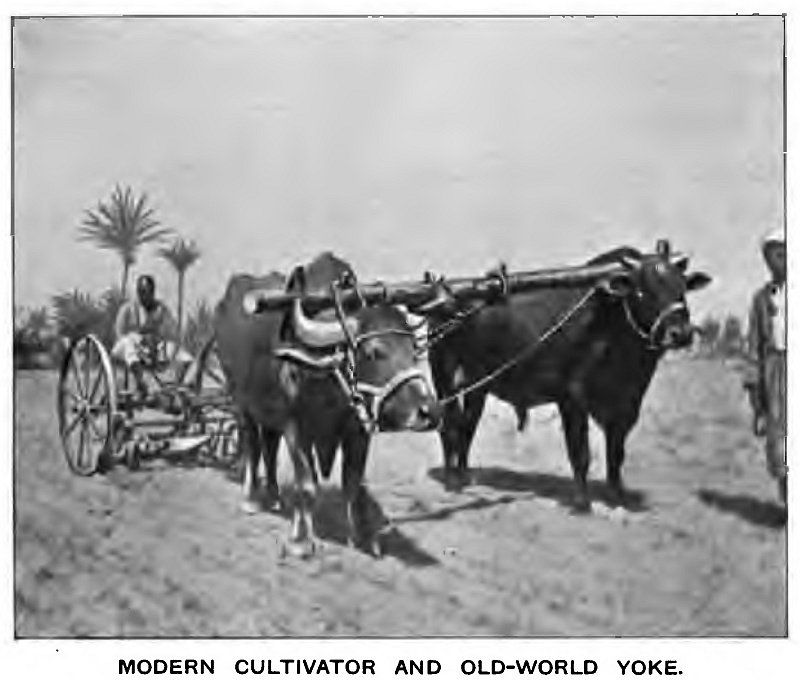
Attached to the building above referred to were well-erected ranges of cattle-sheds, not occupied for fattening purposes, but for the culture of the farm, this culture being carried on not by horses, but by oxen—buffaloes and ordinary bullocks—which are regularly used, as at one time in Old England, yoked to the plough, harrow, or roller, and on some of the high grounds which are let by his Highness, for turning the water-wheels, though on the model farms steam power only is used for the purposes of irrigation.
These sheds are built in the same fashion as the granary, a noteworthy point in connection with the big, sleek, well-fed occupants being that instead of, as in English fashion, standing in one long row with their backs to the visitor, they are ranged in ranks, fifty-six in all, sideways to the spectator, facing so many feeding troughs, and each provided with its tethering halter and a sliding iron ring attached to an iron bar, giving freedom to each animal to stand or lie down at its pleasure without any risk of self-inflicted injury.
As a specimen of the model-farm-like erection of these buildings, it may be stated that the feeding troughs are of solid masonry, made impervious and clean by an inner lining of zinc. No partitions are used to separate these draught cattle, but by the arrangement of the haltering they can be kept at such a distance that no two could come into contact. Everything was beautifully clean, the great animals being amply supplied with dry earth for litter, its disinfecting qualities being admirable from a cleanly point of view, and valuable for the purposes of the farm.
One of the principal foods for cattle upon the farm is Tibn, as it is called by the Egyptians—chopped or bruised straw, made more nutritious, according to the needs of the animal in feeding, by the addition of beans or barley; and in the progress across the place a huge stack of this chaff-like provender was passed, some ten feet high, but totally unprotected from the weather by thatch. The reply to questions by the manager was simple in the extreme, yet in itself a chapter on the beautiful nature of the climate. The reason why the stack had no protecting thatch was that there was no need, the rain was so trifling, and when the wind and its habit of scattering stacks was mentioned, the inquirer was told that it did no harm.
In passing one enclosure sheep were encountered—a class of farming, as stated elsewhere, little affected on account of the absence of grass downs and ordinary grazing fields; but these were in a healthy, flourishing state, well fleeced, with a fine white semi-transparent-looking wool, indicating relationship to the Angora breed, specimens of the latter being seen later on in fold.
Some of the fields had been devoted to the growth of cotton. This had lately been picked and transferred to the great store, the wood of the beautiful plant so stored being yet upon the ground waiting for transfer to the stacks for fuel purposes, it being utilised for the steam engines used upon the farm, especially for working the water-raising machinery so extensively needed in this occasionally thirsty land.
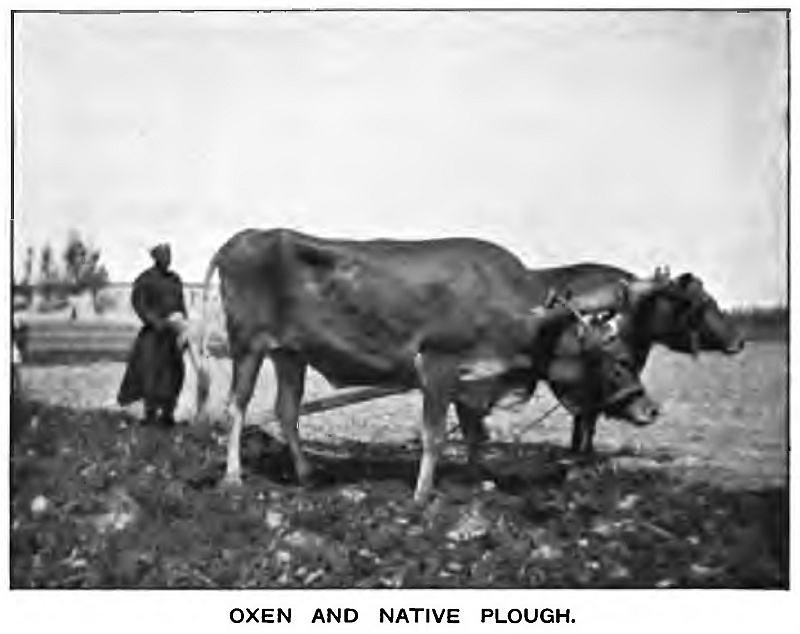
Farther on an implement was being used in preparing fields for irrigation; and as in its simplicity of construction it was dragged over the great enclosure, it drew up the well-tilled, friable soil into ridges or slightly raised portions whose object was to regulate the flow of irrigating water equally all over the field, so that when it was flooded no portion should get more than its due share, one part being swamped while another would be comparatively dry. Simple in the extreme in its construction, as the illustration shows, the implement was thoroughly efficient in the way in which it did its work, with but slight exertion on the part of the sluggish oxen by which it was drawn.
All this was novel, yet paradoxically old-world and strange, but in the next field there was a combination of the old and new—a pair of oxen used as in Saxon times, and down to not so many years back even near London, patiently plodding along beneath their yoke and drawing an emanation from our Eastern counties in the shape of a Ransome and Sims’ harrow, light and effective, apparently as much at home and progressing as easily as if on a Suffolk farm.
There was a familiarity about these fields which took off the dead monotony of the level, for they were surrounded by good-sized, well-grown trees, whose aspect betokened health and a suitability of climate, while on a nearer approach they showed their foreignness to the soil, proving to be a variety of the well-known Siberian crab, or cherry apple, beloved of boys, but here grown in such bulk as to suggest being used for crushing and utilising in some special way.
One thing that strikes the European in Egypt, when passing beyond the more carefully cultivated portions near the city, is the absence of trees other than the indigenous palms; but here, in these newly-reclaimed portions, much has been done, as already mentioned, in the way of planting. For instance, the approaches to a range of buildings in connection with this farm were studded with acacias, ornamenting what proved to be the pigeon houses which are such a regular adjunct to an Egyptian cultivator’s home. Their occupants bear a strong resemblance to our own blue rocks, or wood pigeons. Another building was the dairy farmhouse, well-built, simple, and most suitable; while in the neighbouring fields the cows were pasturing after the economical plan carried out in our Channel Islands—where each milk-producer is not allowed to wander through and waste the precious herbage at her own sweet will, but is tethered to a stake—while the calves had an enclosure to themselves. Here were many examples of experiments being tried to improve the breed, the favourite animal being a cross between the Swiss—Fribourg—and native; and in this cross-breeding only those proved to be advantageous are retained. Such as do not show some marked advance upon the native stock, either for breeding or the production of milk, are sold.
One very fine sire was close at hand—a Swiss bull with a noble head and short curved horns, fine and long of coat, which about brow and neck formed itself into short, crisp curls like those that cluster upon the brow of the classic Hercules. This grand animal greatly resembled, save that it was much larger, one of the choice and jealously guarded patriarchs of a Jersey cattle-shed; while his home-like aspect was added to greatly by the familiar ring in the nose, which is not considered necessary for the native animals.
A little farther on were those rather uncouth-looking, heavily-horned animals, the buffaloes, which run side by side in Egyptian estimation with the ordinary cattle for all practical purposes. The improvement in their breed is also studied by the addition of fresh blood and the choice of sires remarkable for special qualities. One particularly good specimen was pointed out, distinguished by the heavy hump forward, a fine beast lately brought from the Soudan.
There are two distinct breeds of buffalo utilised in this country—the productions of Upper and Lower Egypt, those from the latter district being reckoned the better.
In this portion of the farm and around the buildings fruit trees were plentiful, diversifying the scene and adding greatly to its attractiveness, and looking novel to a visitor from Europe, who saw an abundant growth of the Seville or bitter orange, and the cool, greeny-grey picturesque olive of Southern Europe and the East.
Among other fruit trees seen here were some bearing long pods, called chiar shambar by the natives. The fruit of these trees, which is long and green, but which turns black soon after picking, seemed at a distance like a huge bean, suggesting that the fruit was akin to the carob or locust bean, this idea being emphasised by the sweet glutinous pulp in which the seeds were buried. This pulp is pleasant to the taste, but slightly bitter, and is largely used by the natives boiled up with water, as a drink on account of its medicinal qualities.
Taken all in all, the visit to the Khedive’s farm was most attractive, and pregnant with proofs of the fertility of the well-tended land, for on every side were examples of the successful culture of many of the agricultural products treated of in detail from the notes of the student-like superintendent, who has all in his charge.
The place, as before said, may be regarded as a model and example of what can be done with land that has been looked upon for ages as so much desert, when all that was required was industry, application, and the ingenuity necessary for extending the action of the Nile flood. Nature has always been ready to do the rest.
The Khedive has another tract of farm land, which he purchased some time back, about two kilometres from the estate just described, at Koubbeh. This is Mostorod, where he has a simple-looking villa. On the way here one of the first things that attract the attention of an Englishman is that home-like contrivance so often missing in foreign countries—a hedge dividing the fields from the roadway and separating them from each other. These were unknown before the time of Abbas Helmi the Second, and what may be done in time to come in the surroundings of farms by means of the simple, well cut back hawthorn remains to be proved. Here the shrubby growth, chosen for its neat form and comparatively rapid development, is the bitter orange.
At Mostorod many of the surroundings are marked by the energetic proceedings of the practical farmer. Here steam is at work, like the patient slave it is, forming the motive power in one case for raising water for all farming purposes, in another setting in action the mills, which rapidly turn out and clean the meal ground from wheat and Indian corn.
Buildings are here containing the various grains and seeds; others are the storehouses for one or other of the three pickings produced in the cultivation of cotton; and at the entrance of every building, just inside the door, there is a pitch pine wood frame, with its glass covering, and a paper on which is a record of the amount and nature of whatever is brought in or taken out of the building in the shape of corn, cotton, seed, or whatever may be stored.
Here, in opposition to much that is modern, there is a large, old-fashioned Egyptian stable, very thick of wall. The building is divided into two chambers, connected and lit from overhead, the light coming through the roof of wood and rafters thickly thatched with reeds.
These rafters are supported by thick round columns formed of the ancient, sun-dried brick for which Egypt has long been famed. Near by something of the old-world fashion of the place was visible in a typical grinding mill such as may be seen in common use in pretty well every village. It had a chamber to itself, and differed little from those which might have been seen in England fifty or a hundred years ago, set in action by an often blindfolded horse, but here worked by a bullock.
Ornamentation is not wanting at Mostorod, for the villa has its garden brightened by fruit trees, and the pillar-stemmed palms, with their leafy crowns, are frequent objects in the transparent, sunny air.
Close at hand is the village on the Khedivial estate. In it the streets are narrow and the houses of one height, thoroughly waterproof, and of the familiar construction, of sun-dried bricks covered with white plaster, and, being of an earlier date in the improvement the Khedive is striving for in the poorer class dwellings, not to be compared with the spick and span new houses he has lately had erected at Mariout, not far from Alexandria.
Hard by this village is a very large barn or stack yard with more native pigeon houses, the whole of the surroundings being extremely quaint and picturesque.
Again, a short distance onward stands the native village of Mostorod, with its attractive little mosque and a tomb erected to the memory of a saint.
The Ismailia Canal supplies water to the Koubbeh and Mostorod estates, and in this neighbourhood is a good deal of very valuable agricultural land, some portions of which are let to the fellaheen for three months in a year, so as to enable them to grow a crop of maize.
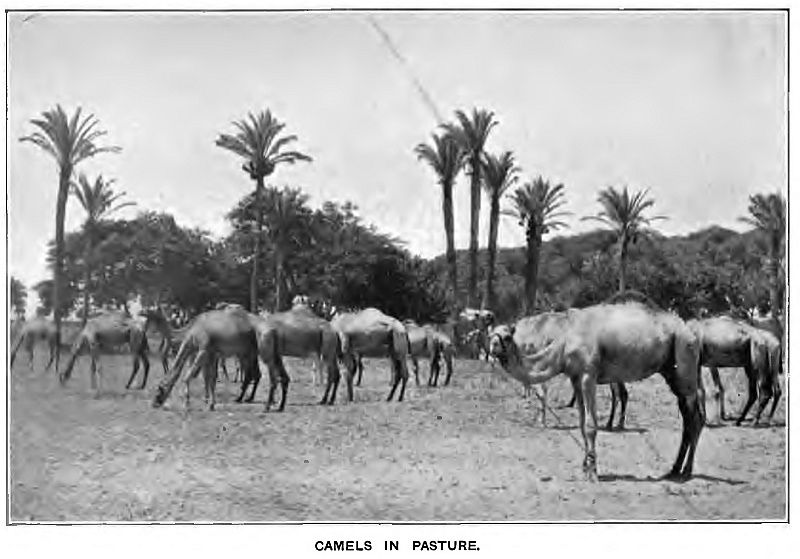
Hereabouts, tethered in the clover fields, a herd of the Khedive’s camels are pastured, many of these being bred for carrying purposes, others (the slighter of build) for riding and speed. The scene is attractive from its verdure, but comparatively treeless, though it is worthy of mention that two solitary weeping willows do their best to adorn the landscape—a plain with the suggestions of home in the shape of lapwings, or birds bearing a very strong resemblance, which fly up here and there.
This estate is close to Heliopolis—the ancient On—where almost the only suggestions of the City of the Sun are the sunshine and a great square piece of white stone, bearing hieroglyphs, and in perfect preservation, while in the distance stands up in solitary state the far-famed Obelisk.
Chapter Three.
“Words, words, words!” quoth Hamlet, and the reader of this sketch of the possibilities in the way of cultivation offered by the Khedive’s dominions may be disposed to contemptuously say the same. But in the following pages it is proposed to give proof of what may be done in an ordinary way by one who is gardener for pleasure and health, supplier of ordinary produce to the market, or farmer upon a larger scale, without looking for a moment upon the vast increase that is bound to follow the wider and wider distribution of that life of such a land—abundant water, not merely for irrigation, but in this case charged year by year with the rich fertilising mud of the vast equatorial regions regularly borne down by the Nile in flood.
Among the first questions an intending settler might ask respecting the country that he intends to make his temporary or future home would naturally be, “What is the place like? What sort of seasons are they?”
Egypt is a country which may be said to be blessed with four seasons. There is that which begins in July with the inundation of the Nile, when for about two months the whole country of the Delta may be likened to a vast lake dotted with islands represented by the towns and villages. Naturally, then, the air is moist, and mornings and evenings have their mists. In the second season, answering to our winter and early spring, we have cold nights; but the days are hot, and the vegetation is rapid and luxuriant. The third, corresponding to our spring, is the least attractive; while the fourth, which continues until the rising of the Nile, is in the highest degree delightful.
Everyone has praised the Egyptian nights—cloudless skies, an intensely bright moon, so bright that at harvest time, for reasons in connection with the shedding of the grain, it is the custom amongst the farmers and cultivators of the soil to take advantage of the coolness and light to commence garnering their crops at midnight. So bright is the moon in this extraordinarily clear atmosphere that the peasantry who sleep in the open air are careful to shade their eyes from the rays, which are often said to produce a more painful effect than those of the sun.
These pages contain the experience of long years of patient study of the cultivation of Egypt, of that carried on by the native, who for ages past has looked to the soil for his sustenance. And of his practical knowledge, that which is valuable has been adopted; while experiment, experience, and the effects of modern cultivation have run with it side by side.
Every gardener and farmer knows, however enlightened he may be and fond of the modern ways of doing things, that it is not wise to look slightingly upon old-fashioned customs. Experientia docet is a well-known maxim, and the experience taught often by generations of disappointments is worthy of all respect.
Men go on cultivating and growing certain things which excite the contempt of a stranger, but too often he lives to learn that there was good reason for the practice, hence, animated by the spirit of respect for the old, while striving to introduce the new and improved, the notes and descriptions herein contained may be depended upon as being thoroughly practical and well worthy the attention of every cultivator who has at heart the future of the Delta and the higher irrigated lands of Egypt.
Further, it may be presumed that every reader is fully acquainted with the fact that lower Egypt possesses a climate without extreme variations of temperature; that winter is hardly known but as a name; and that, though changes have taken place of late years, probably from increased cultivation and planting, the rainfall is extremely small. And yet the fertility of Egypt is proverbial, and due to this annual flooding of the lands by the Nile, which—after the fashion, already referred to, of the northern midlands of England, where so many acres have been flooded and drained after a lengthened deposit of mud, or “warp,” as it is termed—become rich in the extreme. The warping in Yorkshire and Lincolnshire is an artificial and protracted process, carried out once only; the warping of the land of Egypt is natural, and repeated year by year; while as soon as the water has run off, the coating of mud, rich in all the qualities of fertility, is ready to bear, after the merest scratching of the soil, its abundant one, two, or even three crops in a year.
Here are possibilities, then, for the cultivator who is ready to bring to bear all the appliances of modern science, the discoveries of practical agricultural chemistry, and, above all, the mechanical and ingenious inventions so admirable in a flat, open country, unbroken by hedge or tree.
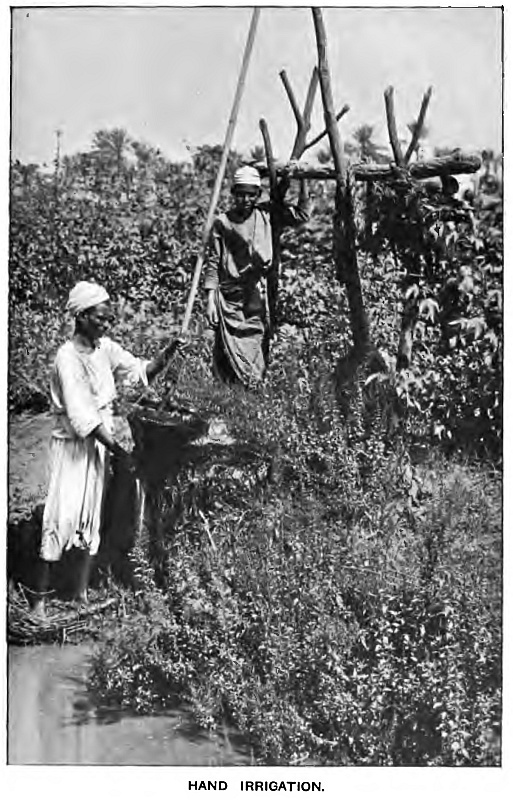
Among the minor objects familiar to the tourist in his journey up the Nile are the various means of raising water for the irrigation of the crops. These have been, and still continue to be in many places extremely primitive, for, as before stated, the fellaheen in their conservative fashion are prone to cling to the inventions of their forefathers. Hence they may still be seen laboriously at work with their shadoofs, sakiehs, and other water-wheels worked by hand or mule power, raising the fertilising fluid to a sufficient height to be discharged and flow of itself, spreading over the patches of land requiring irrigation.
But these clumsy contrivances are giving place in the newly-reclaimed and cultivated parts of the Delta to modern machinery, urged by motive power, notably by steam, though to a great extent advantage is taken of the wind; for it is a common thing to see in the landscape the circular disc-like object, as noted at a distance, formed by a windmill with its many fans, or “vans,” standing at the edge of some canal or by one of the many wells that have been dug upon the higher grounds.
For though tract after tract may be desert, presenting nothing but coarse growth and sand ready to drift before the wind, there is not much difficulty in finding water, notably in the wide plateau known as Mariout, spreading out in the direction of the Libyan Desert from Alexandria. Here the sinking of wells results in the finding of water at depths varying from twenty to forty feet, and boring to a greater depth would doubtless produce a fuller supply, for in so flat and porous a land, within easy measurable distance of the great inland sea, there is every probability that an inexhaustible supply is within touch. And nowadays the various ingenious contrivances of the mechanical engineer are always ready, and at small cost, to supplement during the dry times the abundant supply offered by the great river. Of course, this deals solely with the higher grounds that are not reached without mechanical help by the dam-supplied network of canals that already veins the country, and projects for the increase of which are, since the opening of the great works at Assiout and Assouan, either under consideration, or already planned.
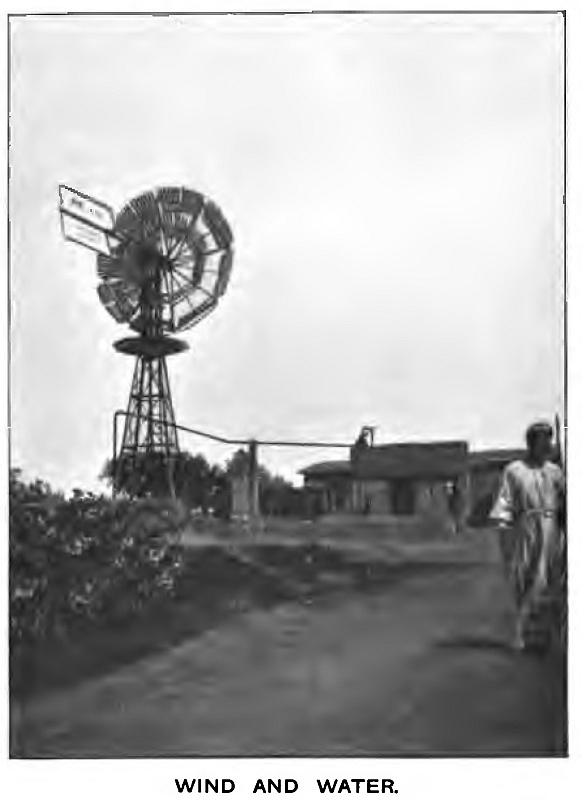
The slow, clumsy hand labour of the shadoof and the awkward cattle-worked sakieh, or earthen pot surrounded water-wheel, is now being superseded in the larger tracts of cultivation by such ingenious pieces of mechanism as the centrifugal pump, worked by steam, and so contrived that it can be utilised on the bank of river or canal, and with a suction tube turned down at any angle, so that it can be lowered into any of the common wells that are sunk in all directions. The portable steam engine used in connection therewith is one of the grandest slaves of civilisation, playing its part on the large farms for traction, threshing, straw chopping, or other of the many necessities of cultivation. By means of these centrifugal pumps after the middle of November on large estates the water has to be forced into the service (estate) canals.
A ten-horse power engine, driving a ten-inch pump, will irrigate the same number of acres in twelve hours, lifting the water five feet, the cost of raising water being two shillings per acre. The small occupiers of land sometimes raise their supply from wells and canals by means of Persian wheels or Archimedean screws.
Chapter Four.
At Cairo when the Nile commences its annual rise, for the first few days its tint seems to be green; but the general tone during the inundation is of a dirty red, of course due to its being thickened with the mud brought down from the south. During this rising, irrigation can be sent freely flowing over all cultivated lands, as the river continues about the level of the banks till the middle of November.
In simple language, irrigation means the turning of desert into richly fertile producing land. A great deal has been said and done, but everything points to the fact that, however great and productive a garden Egypt has been for countless years, it is still almost, as it were, in its infancy. The erection of that stupendous piece of engineering, the Assouan Dam, has already had effects that have surpassed the expectations of its projectors; and writing upon this subject, Sir William Willcocks, a gentleman whose knowledge of the position is of the highest value, points out a series of facts that are almost startling in their suggestions. He draws attention to the fact that there are still two million acres of excellent land waiting to be reclaimed after the simple fashion herein described, and then requiring to be irrigated to the full extent needed—that is to say, perennially.
These are large figures to deal with, but Egypt is a vast country, and its powers of production almost beyond belief; but everything is bound up in the one need—water supply; and it is this furnishing of life to plants, and enabling them to find it latent, as it were, in the far-spreading plains that are as yet but sand and dust, that is taking the attention of our great engineers.
Here they find room to exert their powers. It is only a year ago that we had the inauguration of the first great stride; and now we are told that the thirsty country asks for more. To fully carry out the perennial irrigation that shall fertilise the two million acres still waiting, “the country requires one milliard of cubic metres of water per five hundred thousand acres”—that is to say, four times that quantity. At the present time, with the height to which it has been already erected, the Assouan Dam holds up and supplies one milliard of these cubic metres of water in all, a sufficiency for five hundred thousand acres of agricultural and garden land. It is proposed to raise it twenty-one feet higher, with the result that its holding powers will be so vastly increased that the supply will be doubled, and hence be sufficient for another five hundred thousand acres. But even then there will be a milliard acres still waiting for a supply of water to the extent of two milliards of cubic metres of water for themselves. Whence is this supply to come?
The engineers are ready with their answer, and only ask for the capital, not to float some mad scheme, but to spread bounteously the rich water which turns, as above said, the desert into fertile land.
The plan, or project, is to form a huge reservoir in the Wady Rayan, which will with ease supply the water needed at a cost of about two million pounds—a large sum of money, but ridiculously small in comparison with the results. There is, however, a drawback in connection with this reservoir—a weakness, so to speak, which alone would render its value questionable, for while in April and May, during the flood time, its supply would be enormous, it would fall off very much in June, and furnish but very little in July.
But now in connection therewith we find the truth of the old proverbial saying, “Co-operation is strength.” Alone it would be weak, but if made now and worked in connection with the Assouan Reservoir it becomes strong, and the two being tapped in turn as the need arose, the combination would have tremendous results, one reservoir so helping the other that sufficient water could be depended upon to keep up a perennial supply.
To give Sir William Willcocks’ words:
Let us now imagine that both reservoirs are full of water, and it is April 1st. The Wady Rayan Reservoir will be opened on to the Nile and give all the water needed in that month, while the Assouan Reservoir will be maintained at its full level. In May the Wady Rayan Reservoir will give nearly the whole supply, and the Assouan Reservoir will give a little. In June the Wady Rayan Reservoir will give a small part of the supply, and the Assouan Reservoir will give the greater part. In July the Wady Rayan Reservoir will give nothing, and the Assouan Reservoir will give the whole supply required. Working together in this harmonious and beautiful manner, these reservoirs, which are the true complements of each other will easily provide the whole of the water needed for Egypt.
Now, this raising of the Assouan Dam to the height proposed means an expenditure of five hundred thousand pounds, and the time for the completion of this addition and raising of the works two years, at the end of which period, as we have seen, its power for irrigation will be doubled; while to make the additional reservoir, and enable it to discharge its vast extra supply at the cost named, will take three years; four years will then be required to bring the water to its proper height—seven years in all; so that in that time full arrangements can be made for the perennial irrigation of the whole of Egypt.
Huge sums of money these to spend or put into the soil, two millions and a half sterling; but let us see what there is to be said on the credit side.
Take one point alone. The increase in the cotton crop of Egypt would be most extensive, and its value enormous. Then there is the land itself. Here we have so many extra acres, only partially irrigated, but which by this raising of the supply of water will be changed from partial supply land into constant—that is, each acre will be enabled to tap the reservoirs at all times of the year, according to the cultivator’s need, with the consequent rise in value of the land of thirty pounds per feddan, or acre; and that means, according to Sir William Willcocks, an increase in the wealth of Egypt to the extent of sixty million pounds.
From one bold stroke! Sixty million pounds for the expenditure of five. Not bad, this, for the engineers. But still, it is but the beginning of what may be done in the Khedive’s country, for it is full of suggestions to be carried out by an enterprising people for the making of the native and those of our own country who are prepared to look far ahead. The amount of land to be reclaimed is enormous; and what land! For countless ages the Nile has flowed down, bringing with it its fertile mud, depositing some by the way, carrying other some out to sea, to be lost in the depths of the Mediterranean; but still, as time rolled on, adding to, and raising higher, the huge Delta through which the various mouths made their way; so that in these lowest portions of Egypt the depth of rich soil must be enormous.
Here lie the lakes and canals of olden formation, shallowed and choked with mud, and rendered almost impassable for transit, but only waiting for the engineers to contrive modern works, the result of survey and level, feeding canals and the forming of reservoirs to supply irrigation water for freeing the land of its salt, making easy the navigation of the district, and simplifying the conveyance of its grain and other crops.
All this development is awaiting enterprise and capital low down in the Delta. But the engineers have not stopped near home and the Khedive’s capital; they have cast their eyes afar across that vast extent of barbarism, the re-conquered Soudan, where, bordering upon the Nile, it is often “water, water everywhere, and not a drop” for the crops to drink.
Sir William Garstin has been busy here, surveying and examining what can be done towards and beyond Khartoum. Here rich tracts of fertile land are lying on both sides of the Blue Nile, to the extent, roughly speaking, of some three millions of acres. This land of Upper Egypt is as rich in its capabilities as that of the Delta; but it has qualities which the latter does not possess, and is more suitable for the production of excellent cotton, which can be sown as a flood crop and reaped in winter, an advantage which the seasons will not permit in Egypt.
Here, again, then, is an opening for enterprise and capital in the future, for it must not be forgotten that the Suakin-Berber Railway, well in progress, opens up this part of the country, one which some of these days will be brought well in touch with Liverpool and the northern manufacturing towns, as the cotton-growing capabilities of Upper Egypt extend.
Chapter Five.
In a country which depends upon floods and their deposit for its fertility, one of the first questions likely to be asked by a practical man is, What about the drains? He knows perfectly well, from reading and report, that the evaporation of the waters that have for the time being turned vast tracts of land literally into swamps must be enormous, but at the same time some plan for carrying off the superabundant moisture must be in force. Let him learn at once that in Egyptian agriculture there are no underground tiled drains in use; but open ones are formed upon land that requires improving, such as the rice fields and those which, when cultivation has commenced, are found to be impregnated with salts, while a great deal is done by the Government, under whose direction large main cuts are dug to drain off the water on low-lying lands.
On the rich soils water may be lying to a depth of four inches after a flood, but it is so readily absorbed that in six hours none will be left on the Surface; but infiltration from irrigation canals sometimes damages the crops alongside, and in such a case as that a small catch drain will prevent further mischief.
With regard to irrigation, two systems are carried out, the one peculiar to Lower Egypt, the other being utilised in Upper. In Lower Egypt the canal is used for the supply of water to the crops. In Upper Egypt the manner adopted is technically termed the “basin system.”
In this latter method embankments are formed to enclose tracts of land well within reach of the Nile flood, which may contain from two thousand to forty thousand acres, according to the means of, or facilities offered to, the agriculturist. Afterwards the proceedings are exceedingly simple. When the inundation is at its greatest height, openings are made and the water is allowed to flow from the river till the sandy surface is covered to a depth of six feet. Then the matter, suspended in the muddy waters, is slowly deposited and goes on sinking till November, when openings are made into canals, and the water is allowed to slowly drain off and make its way back into the river, when the surface of glistening mud that is left is considered ripe for cultivation, and according to the season may measure perhaps four inches in depth.
As soon as the water is gone, the farming operations begin, and in the simplest and probably the oldest form. There is nothing more to be done in these cases, no ploughing or harrowing; but wheat, barley, beans, clover, linseed, and lentils are sown broadcast by the patient labourers, the sowers often sinking knee deep in the mud as they slowly plod or almost wade to and fro. The next proceeding is the burying of the seed, which is generally effected by drawing a large beam of timber over the muddy surface, though at times, when the consistency is greater, the seed is covered in by hand-hoeing. That is all, and the agriculturist leaves the rest for the time being to the efforts of the sun. Germination soon begins, and rapid growth succeeds in the moist mud; while these crops do not need or receive any further irrigation except from rain, which may fall two or three times in the course of growth.
But there are times when no rain at all will come to help the crops, which, however, seem to suffer very little, from the simple fact that the thorough saturation of the subsoil by the flood, and the constant gentle evaporation going on, make up to a certain extent for the want of genial showers, and the failure seems to be confined to the straw alone, which is shorter than if its growth had been influenced by the dropping clouds.
The floods of European lands are, of course, only occasional, accidents due to a prevalence of storm waters, which the regular rivers and the artificial drainage of the country have not power to carry off; while generally they last but a short time, and instead of being beneficial are destructive. The Nile flow is in every respect the reverse. Instead of being occasional and of short duration, it is a part of Nature’s routine, and perfectly wondrous in its regularity; while in place of being temporary, as in the floods of our own islands, we have here a lasting overflow.
Again, a flood in the British Islands, where the rivers burst their banks and spread over meadow-land and arable fields, leaves the soil soured, sodden, and obnoxious to the plants which are still alive, whole crops and plantations being often swept away, while those that remain are on the high road to perishing from rottenness.
In Egypt the subsoil of sand is ready to absorb, and the ardent sun to rapidly dry, the surface of the mud as soon as the flood sinks, after its stay of months; while the rapidity of growth soon makes up for the, so to speak, dormant state of the cultivated ground that has been flooded, and, as aforesaid, the water departs, leaving its fertilising riches behind. Then, as stated, follows without further tilling the sowing of the crops, which result in abundant growth. This annual regularity is only marred by the extent of the inundation, which is calculated and divided by the Egyptians into high flood, mean flood, and poor flood, according to how far the waters extend when they leave their natural bed.
It is calculated that in the first case, when the Nile has reached its highest point, it has risen to thirty-three feet; in the second case, the mean flood, thirty feet; and in the third, or poor flood, twenty-three feet above its bed. As a matter of course, the higher the flood the wider spread is the inundation, and the deeper the deposit of fertile mud left upon the land when the river has returned to its ordinary limits.
Stay-at-home people are accustomed to look upon Holland as the land of canals, and the face of this carefully cultivated country is monumental as a specimen of a nation’s industry in cutting waterways for the double purpose of draining and traffic, while its drains are as admirable as they are great. Wide tracts of land have been turned from sandy wastes and swamps into fertile meadows and carefully cultivated fields by the Dutch engineers, who have also left traces of their handiwork upon the east coast of England in the drainage of the fens.
But, leaving the supposed canals of the planet Mars to the imaginations of astronomers, it is safe to say that Egypt bears off the palm for works of this description. The ancients knew of their value, and enormous cuts were made by the help of slave labour, and were left to survive the rolling away of centuries, and where not duly cared for, and filled up by the drifting sand, have lain ready to be cleared out, deepened and brought into use again. These have been added to, till at the present time it can be said that the system of canals connected with the main river for the purposes of portage and for perennial irrigation cannot be equalled anywhere in the world.
The barrage of the Delta is of incalculable value, since by closing the sluices the head of water is raised and irrigation made more easy, while the works of this description lately carried out upon the Nile at Assiout and Assouan conserve immense bodies of water, which have formerly flowed regularly down to the sea, carrying with them millions of tons of fertilising mud or warp, with the equatorial washings of the rich, untrodden land. This solution of plant-making soil has gone on downward towards the sea from untold ages, forming by degrees the vast Delta, beside that which was lost to the service of man, merely choking up and making shallow the many watercourses into which the Nile waters have been broken up, and altering the positions of ancient ports and maritime cities now distant from the sea.
Chapter Six.
A good old English gardener once said, “You can’t grow things well without plenty of manure,” and this the Egyptians found out years ago. They have the great advantage of the fertile mud deposited by the river, but to bring it to its highest state of production land seems to ask for the crude form of animal plant food as well as the vegetable and mineral.
It is to be presumed that there must be a great deal of vegetable fertilisation swept down by the Nile in a decayed state from the forests and swamps of Central Africa, but Egypt itself is no land of forests and that wondrous help to vegetation, leaf mould, may be said to be entirely absent, while the ordinary animal excreta so carefully collected in most civilised countries for application to the land is sadly wanted and neglected here for farm and garden purposes. It is carefully collected, it is true, and dried; but here, in a country where wood is exceedingly scarce, it is used for fuel.
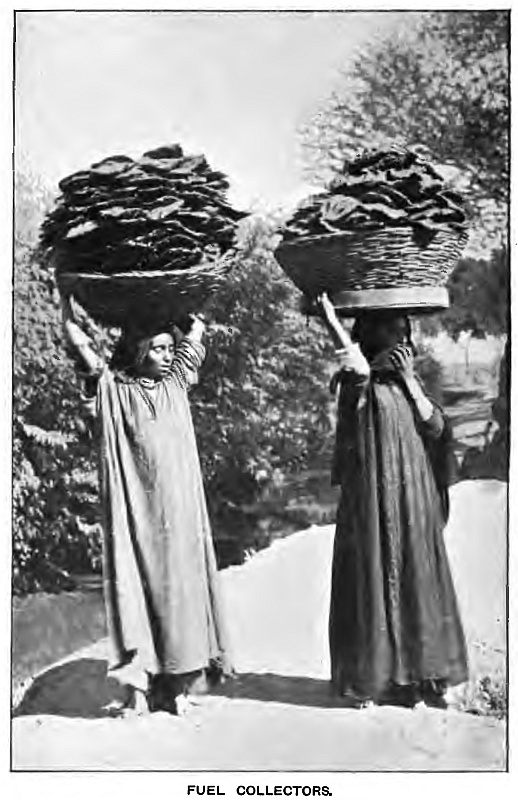
As a rule, the resulting ashes are regarded as of little worth, whereas they contain, in a mineral form, so many of the constituents of vegetable life that, if preserved, they would be most valuable. In fact, the fellaheen look upon the ashes in the same light as they are regarded here in England, if they are thought of at all, as a coarse ingredient to mix with a clayey soil to lighten it in the place of sand. But in these islands there is the excuse that for the most part they are coal ashes and wanting in fertilising powers. Where they are wood or vegetable ashes the English cultivator has long known their value from the extent to which they are impregnated with potash. Still, there can be no doubt that the ash of the Egyptian fuel, though not returned to the earth in a well-thought-out and business-like way, does play its part to some extent in restoring exhausted soil.
The term “farmyard manure” is common of application, but an English farmer would look at it in amazement and not know his good old friend again, for the Egyptian farmyard manure seems to have been invented by the sanitarians of our dry earth system, being composed of desiccated Nile mud which has been carefully spread over the floors of the cattle-sheds as litter wherever bullocks, cows, horses, sheep, etc., are kept.
In this fine, dry state, the once mud, now earth, is remarkably absorbent and sweetening; most healthy, too, for the animals, who are not seen here trampling nearly knee deep in the soon-made foetid swamp of a country crew-yard. Moreover the earth is frequently removed—to be kept lying in the manure heap for about a year to mature, when it is considered ready for use, and the cattle enclosures and sheds of a farm are remarkably wholesome and clean.
This dry mud is one great source of plant food for the farm, but it is largely supplemented by what the Egyptians term coufri, or sabbakh. This is not always available, and depends upon the position of the farm; but there are parts of the Delta where, to all appearance, the tract being reclaimed or taken up for bringing into cultivation is so much level, or nearly level, land, with a mound or slight elevation here and there where the winds have drifted the sand apparently to a considerable depth. Except to the eye of the experienced there is nothing to show that flourishing cities and villages have existed there in the past; but many of these slight elevations are the sites where teeming populations once existed, and all has gone back, with some few exceptions—dust to dust. The exceptions are where the spade of the fellah comes upon the remains of a tomb or priestly edifice, these, as is well-known, being the lasting part of man’s work, which are being discovered constantly even now, with their builders’, sculptors’, and painters’ handiwork looking, when the sand has been removed, almost as fresh and uninjured as if they were the traces of two or three generations back instead of having been buried many centuries ago.
These solid remains, or ruins, may be comparatively few; but in all probability have been surrounded by an enormous population, whose houses, originally built of the sun-dried Egyptian brick, have in the course of time gone back, like everything animal that surrounded them, to a rough earth ready for the worker’s spade, which digs up from an almost inexhaustible mine—with nothing to tell of the past but a few broken shards—a splendid fertiliser for the farm.
But this coufri manure requires discrimination in its use, too strong an application being likely to prove hurtful to a crop, seeing that analysis shows that its plant-feeding qualities are due to the salts it contains—sometimes as much as 12 per cent, of salt, soda, ammonia, saltpetre, phosphates, and the like.
The value to an English farmer of such a mine of artificial chemical manure as this may be conceived, and it would make the eyes brighten of one here who strengthens his land by applications of marl, or else has to content himself with a top dressing of chalk from some pit sunk in a corner of his holding.
Fairly plentiful still in Egypt, there must, of course, be a limit to this supply. The taking up of land is going steadily on, and consequently the remains of city after city have been and are being rapidly used up, thus necessitating the establishment of plans upon a practical basis for the restoration of land which should not be exhausted by heavy crops without the cultivator making a proper return. One of our students of agriculture, in a public address, deals largely with the necessity for the dissemination of a practical knowledge of the needs of the land. He speaks of the great waste of fertilising matter in the way in which the refuse stalks of two of the greatest crops of the Delta—cotton and sugar-cane—are burned in the furnaces of engines, for which purpose they are most valuable when it is taken into consideration that fuel wood is a rarity and coal a luxury of exorbitant price.
But after burning, so ignorant have the people been, that the tons upon tons in the aggregate of this rich ash from the engine fires which consume the refuse of the enormous crops of sugar-cane annually grown, have been looked upon as comparatively valueless, in spite of the fact that the ash contains almost all that is required for the growth of so exhaustive a crop, and it has been either cast away or sold for a trifle, to be used up in the manufacture of bricks. He adds, in words full of pregnant meaning, that even the fertile alluvium of the Nile Valley cannot long sustain this treatment without exhaustion, in spite of the much that is done by the feeding off and ploughing in of the leguminous crops, which play a great part in giving back what has been taken away.
Farms here, too, are often found with a large dovecote, as alluded to in the description of the Khedive’s estates; for the Egyptian cultivator has a fine substitute for the guano of the Peruvian Chincha Islands in that of the pigeons which are kept in flocks for the sake of this strong fertiliser. Undoubtedly they must take severe toll from the crops, whether green or fit for harvesting, though perhaps this is counterbalanced by the fact that the birds must gain a good subsistence upon the grain that would be wasted or go back to the soil, so much being shed at ingathering time in consequence of the heat.
This carefully-saved fertiliser is used by the Egyptian for applying to vegetables and such productions as water melons and other plants of the gourd family, which depend much for their size on stimulation.
The application of special commercial manures to Egyptian crops may be said to be still in the experimental stage. On the richest and most fertile soils they are not required, but on the poorer soils their effect is very apparent. For the cotton crop, superphosphate and nitrate of soda, in the proportion of 3 to 4 hundredweights superphosphate to 1.25 hundredweight nitrate of soda, mixed and applied to an acre, give a profitable return in an increased yield of cotton. Other manures, such as potash, have been tried, but did not prove satisfactory. Sulphate of ammonia and nitrate of soda give good results on poor land if applied to the wheat crop. As not more than half enough farmyard manure can be produced on large estates for fertilising the various crops, attention will be turned to chemicals should they prove to be profitable after exhaustive experiments.
Chapter Seven.
After what has been written about the water navigation of this country, a few words may be said respecting the means of conducting the land traffic. In the past the great river and its Delta mouths, supplemented by the canals, formed the main roads for the conveyance of produce. Now the iron track has begun to make its way, and the long creeping trains of trucks and carriages may be seen gliding over the plain, drawn by the mighty power of old George Stephenson’s invention, though in this hot country the familiar trail of soft whitish grey vapour is often wanting, dying out at once as it does in the rays of the ardent sun. In addition, Egypt is being treated as Britain was some two thousand years ago by the Romans, who well grasped the value of a good trunk road, and while those were formed for military purposes and the holding in check of the subject race, these in connection with the Khedive’s peaceful rule and for the advance of agriculture are devoted to the carrying of produce from market to market, or to some railway station, and this, too, at much less cost than in the olden days, when most of the grain was borne from the place of its growth upon camel back, or slung in bags on either side of the patient, vigorous, and handsome donkeys which are raised in this country.
A correspondent of the Morning Post writes:
While Upper Egypt is nowhere more than a fertile strip, bordered by two deserts, the comparatively large area of the Delta, its intersection by a multitude of canals, and the absence of a large system of metalled roads, have long rendered necessary an improvement of communications in the interest both of the fellaheen and of the European or Levantine landowners. Agricultural roads offer but a partial solution of the difficulties caused by these conditions; donkeys, mules, and camels are still highly useful, and will long be extensively used for the transport of commodities over a short distance, or in cases where time is no object to the transporter; but it is unnecessary to dilate on the defects of animal compared with mechanical transport. Branches of the Nile and the canals which in the maps cover the Delta with such a network of blue lines are also of great value, but the number of canals which are perennially navigable is limited, and the canal barge is nowhere renowned for speed, while sailing boats cannot use certain canals at all in the dry season, and their use of others is often attended by the risk of grounding.
En passant, Mr Wallace mentions a singular fact in connection with the making of the trunk roads. In Europe we are accustomed to see them kept as level as is consistent with the cost of making, and raised above the level while provided with proper drains to carry off the too abundant water. Here it has been found that to give the road much rise above the surrounding levels is a mistake, in consequence of the large amount of salt the unredeemed districts contain. The salt rises to the surface, forming an efflorescence as in the American plains, and especially in the stiff lands it has a tendency to interfere with the ways of nature, where the particles adhere together, causing them to fall apart in the shape of dust, which is one of the objectionable features of an Egyptian road.
Anyone who has read about Egypt will recall matters full of suggestion of likely difficulties regarding the keeping open of a road, while those who have travelled through the country have much to say about the prevalence of dust. How many discoveries in the past have been made of wondrous relics that have lain buried for ages covered in deeply—and preserved—by the drifting dust or sand! And, with regard to this drifting, attention has been drawn by Mr Wallace, in his agricultural address, to a singular physical fact in connection with the shifting of the sand. This might be expected to follow, on the whole, the course of the prevailing winds, and be carried mainly in their direction; but there are singular variations, probably due to local waves or currents of air near the surface of the earth.
In one considerable portion of the land of Goshen the sand is swept from south to north, while in another part, along the west bank of the Nile, at the north of Cairo, its direction is from east to west. But a great deal of the raising and drifting of the finer portions of the earth is dependent upon whether the wind be moisture-laden or the reverse. If the air be moist, a breeze blowing at the rate of, say, four miles an hour from the north will have no effect upon the deep dust, while one from the arid south, possessed of about half the other’s force, will raise the almost impalpable soil in clouds.
But, as elsewhere, now that Egypt is awakening from her long slumber, the sand is giving way to the soil.
The correspondent of the Morning Post gives some very terse and exhaustive accounts of the railway system now extending through the Delta, and dwells upon the fact that the agricultural light railways—similar to the one mentioned earlier in these pages, made by the Khedive to his estates near Cairo—have been a distinct success, and he goes on to say that:
The broad-gauge State railways of the Egyptian Delta may be roughly compared with the sticks of a fan. Converging at Cairo, the headquarters of the railway administration, and the goal of the provincial lines, the railways diverge to Alexandria, to Dessouk in the north of the Delta, on the Rosetta branch of the Nile, to Damietta, to Salahieh in the north-east, and to Ismailia. Several lines link the important towns on these branches; for example, Mansourah is connected with the Salahieh line, and a railway along the coast connects Alexandria and Rosetta; but large areas, notably in the crowded Menoufieh Province, in Beherah, and in the north-east of the Delta, lacked facilities for rapid transmission of goods and passengers to the larger towns served by the State lines until the advent of the agricultural railways. It would be unnecessary and unprofitable to enumerate all the agricultural lines which have been constructed in the last few years. Their distribution may be understood if, returning to the fan metaphor, they are regarded as threads running between and generally connecting the diverging sticks of the fan of State lines.
So successful have these lines been that applications have been made for permission regarding the construction of fresh railways to extend in various directions for over another three hundred miles, most of these being in the Menoufieh Province, where desert land is being reclaimed. Mr Gunn’s report gives the mileage covered since 1896, when the concessions were granted:
In 1897 there were fifty-four miles of railway open, in 1899 430 miles, and in 1902 673. Within a year or two there will be at least one thousand miles open for traffic.
And, by the way, one of the principal uses made of these lines of rails is for the conveyance of the ancient deposits of sabbakh or coufri from district to district—the rich fertiliser to the comparatively barren lands—the old-world traces of civilisation to the new, to parts of Egypt which have been written down for ages as desert, but which are now found to become great suppliers of produce that can be easily consigned to the many markets opening up at home and abroad.
Chapter Eight.
Without doubt the Delta is a splendid region for settlement for any young agriculturist who possesses health, energy, and a natural tendency towards those industrious habits peculiar to the successful men of our country, who have always been willing to metaphorically and really take off their coats and do whatever is necessary by way of example. To succeed in Egypt we must take it for granted that he possesses moderate means, or, say, very moderate means, just sufficient to make a small commencement by hiring; or, far better, by the purchase of land, which can now safely be done with good legal security and at a price that before long will in all probability bound upwards to double or even quadruple its present figure. But the thoroughly good sterling advice of the authority already quoted—advice similar in nature has often been before given to intending settlers in Australia—is that a year at least should first be spent in gaining a knowledge of the country, while learning a sufficiency of the common language to enable a man to direct the labourers who will be under him in their field work. And, what is of equal importance, the intending settler, however great may have been his experience, should be ready to cast aside prejudice in favour of his own preconceived opinions, and studiously take note of why this or that course is followed out by old cultivators; he must learn that amidst a great deal of chaff that he may cast aside there are many grains of good sound wheat—otherwise, excellent dearly bought bits of experience. Festina lente is a grand old Roman proverb, and the newcomer to Egypt will gain in the end by not being in too great a hurry to start.
Unlike the British farmer, the agriculturist in Egypt has at hand an abundant supply of labour. Housed in the mud huts or sun-dried brick houses adjoining the estates, the labourer is at all hours ready to respond to the demand. He receives one or two acres of land let at a reduced rental; he is a day labourer only, and can absent himself at pleasure to attend to his craft. His wage varies from sixpence to tenpence per day of ten hours in summer and eight hours in winter. He provides his own food.
In disposition this peasant is contented, good-natured, not resentful, and of good physique. He is also very untruthful, unreliable at his work, lazy, cunning, and unconscionable as to the quality and quantity of the task he is put to—in short, a thorough eye-servant. He requires constant supervision, when he will do good work under a trying sun. He promises fair, but performs badly. If he commits a fault and is questioned as to how it happened, one can invariably depend upon his telling an untruth. When working on his own plot he is most diligent, but his methods are not always the best, and he does not get the full benefit from the soil, owing to want of intelligence as to the rules of good husbandry. On a large estate, should extra hands be wanted for a special occasion, a hundred to two hundred men can be had on one night’s notice being given—a delightful state of affairs in cases of emergency, though here the farmer does not often suffer from his hay or corn crops being unharvested through the redundance of rain.
A large percentage of the fellaheen are perfectly illiterate, which accounts for their want of readiness to take up the initiative. They have no thirst for knowledge and love in agricultural matters to keep running in the old rut. Exactness, tidiness, and pride in his work are qualities very rarely found in a fellah. Slovenliness in the performance of duties is characteristic of the paid day labourer, and to a lesser degree when working on his own account. In Britain, for instance, where do we find the breeder of stock who excels his neighbours except in the shrewd farmer who, at great trouble and study, and by patient experimenting, attains to success? Not only so, but he is like the leaven which leaveneth the whole lump by raising the standard of a district. The apathy of the fellah is shown in the lack of breeding in horses, cattle, and sheep in Egypt, which is due to want of selecting suitable sires, care in rearing, and the like.
The soil responds to thorough tillage in a marked degree, but too little care is bestowed upon this question of cultivation, as the fellah is prone to scamp his work and leave part of his land solid—that is, not thoroughly stirred. When exposed to the sun the soil cracks and opens into fissures, sometimes as wide as five inches. The fellah is often, too, careless in providing a good bed for the seed, and irregular germination is the result. If the land is judiciously watered and timeously ploughed in a friable condition, it can be brought to a fine tilth without much extra trouble. As it is all soil—nothing in the shape of a bad subsoil exists, as in some parts of Great Britain—deep cultivation is thoroughly beneficial, bringing, as it does, unexhausted soil to the top. Generally in the preparation of the land for the cotton crop, with its deep-searching roots, a depth of twelve inches is attained.
Doubtless much of the apathy of the labouring man amongst the fellaheen is due, as in the case of the rice-feeding Hindoo, to his being to so great an extent a vegetarian. With him the staff of life consists principally of an exceedingly hard kind of bread, baked almost to biscuit, and composed of maize, or dourra, the small-grained millet; and the result of the fellaheen housewife’s efforts in this kind of food preparation necessitates dipping or soaking in water before the bread can be partaken of at a meal.
But in such a splendid garden land as Egypt, where cultivated produce attains maturity at so rapid a rate, and where with careful management and such a spring and summer-like climate two or even three crops of vegetables can be obtained in a year, it may easily be supposed that the peasant can provide himself with a constant supply of green food; and he certainly takes advantage of his position, indulging freely in the ordinary vegetables common in the gardens of the West, and supplementing them with the delicious green maize so popular with the American people.
This latter grain is one of the staple foods, when it has come to maturity, of the inhabitants of the Delta. It is ground into a coarse flour, and mingled with a small proportion of barley; while in addition, to give flavour and a slight stimulus to the digestive organs which are brought to bear upon one of the hardest grains in assimilation, a small portion of the peculiar clover-like, many-seeded plant, fenugreek, is added.
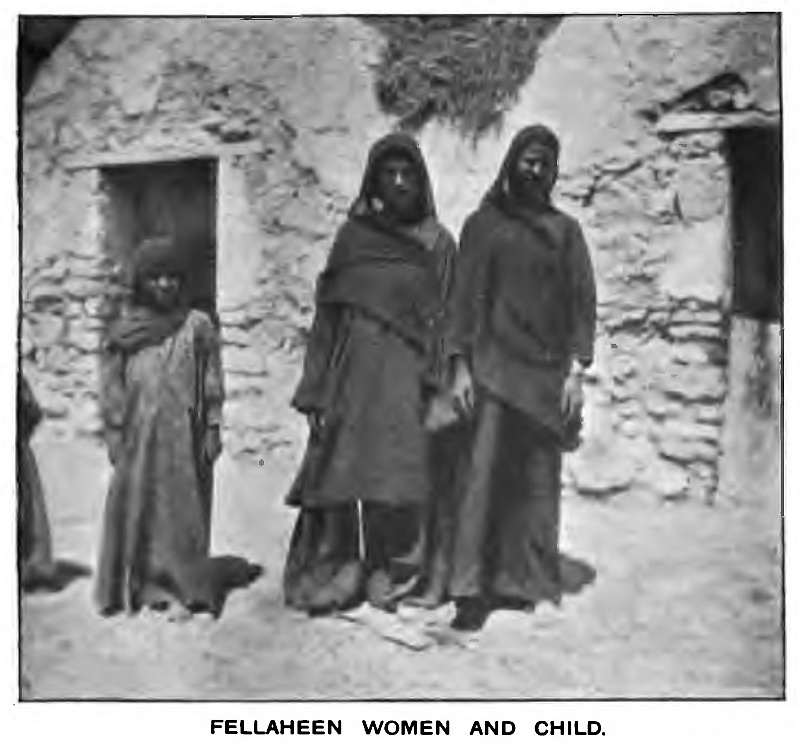
Maize gives place to a great extent in Upper Egypt to millet or dourra amongst the poorer orders; but the better-class work-people, who earn much higher wages than the agricultural labourer, are now taking to the general use of wheaten bread.
Although the ordinary fellah partakes of so simple a diet, and may be wanting in energy, loving as he does to glide through life in the same old groove that was formed by his forefathers, he is a well-built, healthy, muscular individual, and is not to be beaten by any coolie as a worker under a torrid sun. Much of his work consists of raising water for irrigation, and if statistics could be produced as to the number of gallons that he sends trickling amongst the roots of the crop, or moistening the land previously in their preparation, ordinary figures would almost fail. Suffice it to say that it is immense. Even now he clings often of necessity to the old, old shadoof—that which is represented in the engraving—which, in spite of its Egyptian name, is only our old friend of the suburban brickfield, a long pole balanced upon a post in scale beam fashion, with a bucket at one end of the pole, a weight at the other, equal to that of the water which is raised from somewhere below for pouring into a receptacle, ready to be dipped again, perhaps, and sent higher by means of another shadoof farther up.
The worker of this primitive water distributer, in his cotton robe, is one of the commonest objects seen upon the banks. The photograph well depicts the sturdy fellah at his task. In addition, there is the old-world sakieh, a much more complicated affair; for here, in the past, primitive ingenuity turned its hand to mechanical construction, and produced after much toil the manual labour-saving and ox- or buffalo-enlisting water-wheel, working after the fashion of one of our river dredges, but clumsy of the clumsy, and having, in place of the metal scoops, so many earthenware pots, held in their places to the periphery of the water-wheel by as many cords, as will be seen in the engraving. Still, it is effective in its way, and the yoked oxen which supply the motive power that turns the heavy wheels raise vast quantities of water year after year. The sakieh is quaint, old-world, and picturesque, and it has served its purpose so well, for who can say how far back in the past, that it never seems to have occurred to the lower order of Egyptian mind that any improvement could be made. That has been left to the West, and now that under the present progressive forward movement of Egyptian agriculture European, and especially British, water-raising and distributing machines are being utilised, the fate of the sakieh seems to be that sooner or later it will merely live to be spoken of as a curiosity, only seen in some artist’s representation of the past.
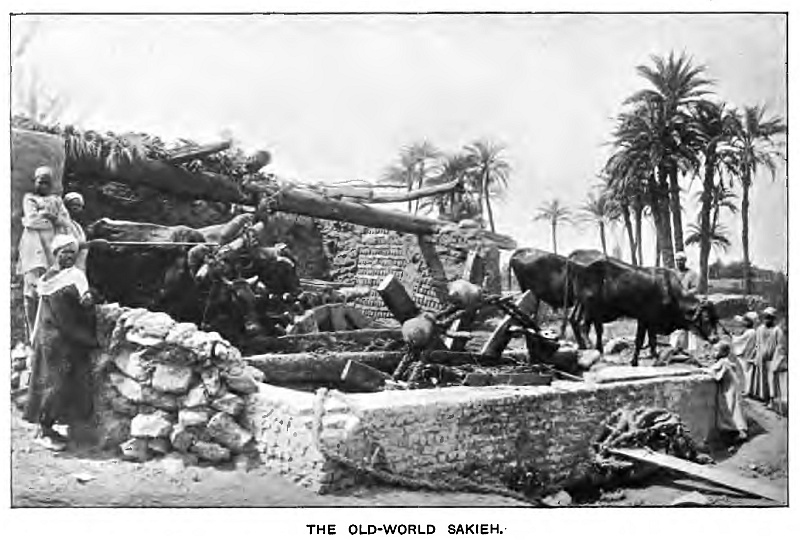
The fellah’s habitation has not varied with the years; as in antiquity, so now. The primitive clay hut is simplicity itself. As it is figured in the quaint tomb pictures, so it is to-day in the suburbs and villages—its furniture a wooden chest or two, its cooking utensils a few earthen pots. But his hut is principally his sleeping place, for his life is pretty well passed beneath the broad canopy of heaven. He rises with the dawn to begin his day’s work at the plough, or to handle his heavy hoe. At another time the demands of the crops for water or for the mud-laden fertilising contents of the great stream, take him to the shadoof or to guide the bullock or buffalo turning the water-wheel.
As elsewhere, the fellah’s wife is the soul of his humble home. She toils busily and patiently through the duties of her little domestic centre, cares for her elders, cooks, and finds time to feed the cattle and collect the sun-dried fuel from off the parched soil, to come back marching homeward, strong and statuesque, bearing the piled-up basket upon her head; while it is she who, while her lord is busily lowering and raising the shadoof, descends knee deep into the river or canal to fill the great, heavy, amphora-like earthen pot and then bear it back to her home, classically picturesque in her drapery as she balances the clumsy vessel upon shoulder or head, and bears the life-giving fluid onward with a steady, easy swing. It is she who makes the dourra, or maize bread, and shapes and stitches the cotton clothing, which is the only wear of all her circle. Unlike her sister of the city, she does not shrink so much from the gaze of the other sex, but still to some extent keeps up the tradition; though wearing no veil she will hold up a portion of her drapery at the coming of the passer-by, or perhaps only place her hand before her mouth.
Woman-like, in spite of her menial toil, she believes in personal care, and her long black hair is carefully dressed and glistens with Palma Christi oil. She paints, too, as of old, the marks appearing upon her chin and forehead, while a string of attractive glass beads decorates and hangs suspended from her neck.
The olden Egyptian costume is that principally affected by the fellah. It consists of a closely-fitting cap of felt or cotton and a long robe of the latter material, deeply dyed of an indigo blue. Shirt and drawers are of the same material, while in some cases a young buck amongst his people will adorn himself, like Joseph of old, in a vest of many colours, borrowed from the Arab, the Persian, or the Turk. As above intimated, the fellah believes in a life of leisure, and finds it rather difficult to make the first start at his daily toil.
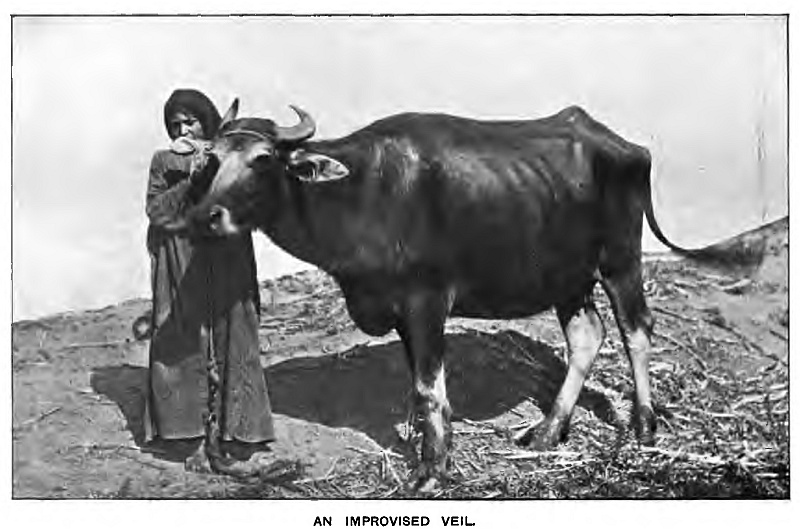
In the olden days the lot of the fellah was not quite so happy as it might have been. He suffered from enforced labour, and does not seem to have had much chance of appeal. But he had one notable thing in his favour, for a river when in flood is subject to having huge portions of its banks undermined and swept away in a state of muddy solution; and, as was frequently the case, the peasant cultivator, who for the sake of the irrigation had his holding as near the bank as he could contrive to get, was often a great sufferer, being in the possession before the flood of a considerable strip of cultivated land, while after the inundation it was a minus quantity, leaving him to begin life again. Here, however, the law of the land was very equitable upon his behalf, giving him liberty to go either up or down stream to select an equal quantity of the land he had lost that was new and unappropriated, and no one said him nay.
And now, thanks to the just and easy state of the Government, the native working Egyptian is far better off with regard to his condition than he appears to have been at any time in the past. Prosperity surrounds him, and the lesser holders of land, say of from four to ten feddans or acres, rapidly grow well-to-do and distance the larger proprietors. The extent now of the land under cultivation is vastly in excess of what it was. The people are growing more energetic—those of the better class—and are learning fast, while the spirit of emulation is increasing amongst them as they waken up to what modern civilisation will achieve. Their Government, too, is working hard on their behalf, a college having been established at Ghizeh for the purpose of instructing the sons of native landowners and of the working fellaheen class in more advanced agriculture, fitting them in the knowledge necessary for the prosecution of agriculture according to the best forms, the proper rotations of crops, selections of fertilisers, natural and chemical, and, above all, stockbreeding and all that has been learned of late in connection with the dairy.
In brief, much as has been said of the Egypt of the past being the garden of the world, it bids fair to become in the future so great a contrast that old Egypt will pale into insignificance in the bright light of the new.
Chapter Nine.
Horses.—There are no heavy horses used here, such as the Shire or Clydesdale, as the ploughing is done by oxen. The Arab horses—or they might be classed as ponies—measure from fourteen to fourteen and a half hands high. They are not of great substance, but light in the bone, leggy, narrow-chested, though sure-footed and hardy.
Horse breeding is not attended with much success, as regards the production of high-class stock, and re-mounts for the Army and Police have to be purchased in Syria. The stories one reads while at school about the Arab and his steed receive a rude shock when one witnesses the unmerciful way in which the Arab overloads and whips his horses. They are not true horsemen, a fact which is apparent in their methods of training horses to harness.
The Government has supplied stud horses to various districts to try and improve the breed. On the farm horses are used for carting, etc. They are fed on barley and broken straw (tibn), the former a bad form of provender for the horse, unless its harshness be ameliorated by crushing.
Cattle.—The work-bullocks are strong, docile animals, and do the ploughing, threshing, raising water, etc. One pair is yoked to a plough. Four pairs are sufficient to work a farm of one hundred acres. Their daily feed is nine pounds of beans and twenty-five pounds of straw. The beans are split, and are eaten uncooked.
Most estates have to purchase their oxen, as very few cows are kept for breeding purposes. The fellaheen keep one or two, and rear the young bulls. Where the soil is richest the cattle are best. In summer the fellah allows his young stock to get into poor condition, and this has an effect on their growth. He has—amongst many other things—still to learn about early maturity. Within recent years work-bullocks have risen enormously in price, owing to more butcher’s meat being consumed by the fellaheen and the European visitors. The price of a pair of good bullocks is 45 pounds at the age of four years. These cattle resemble those of the Channel Islands, but are larger. They are very often deficient in depth of rib and chest measurement, hollow-backed, and narrow across the loins, as well as leggy, and they show want of strength of forearm. These are some of the defects which may be eradicated by care in selecting, mating, etc.
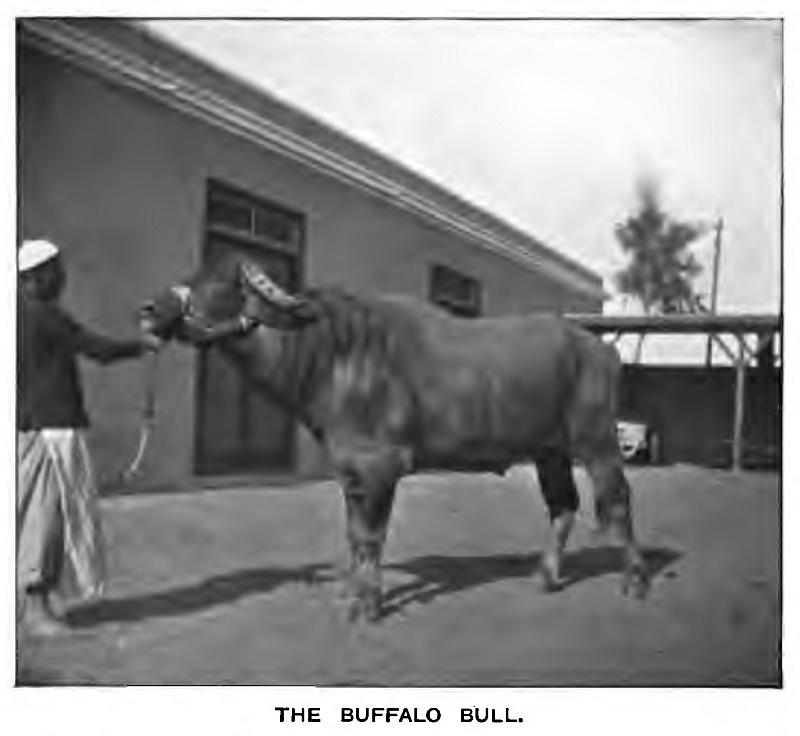
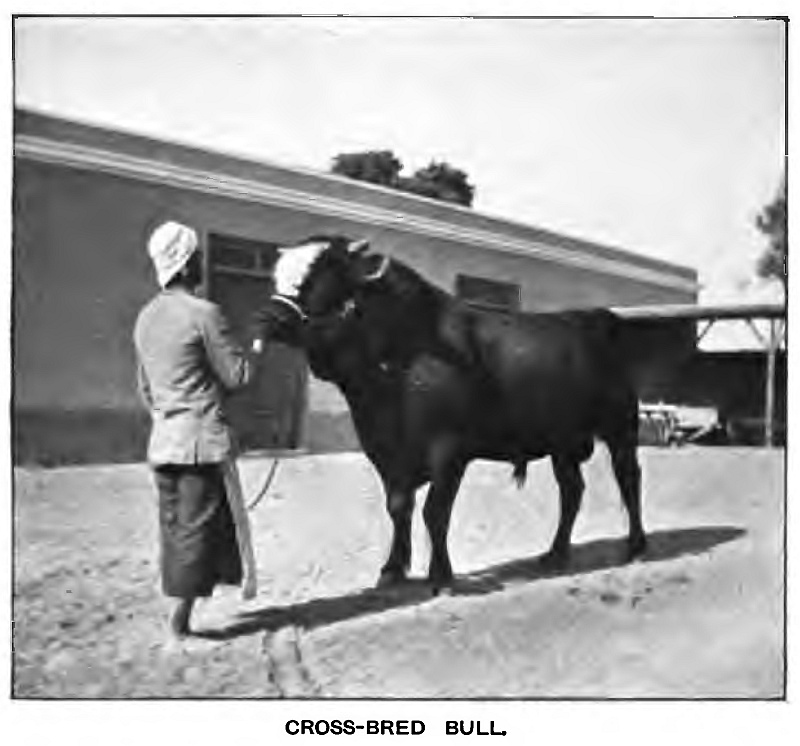
Cows are kept and bred from by the fellaheen, who rear the young bulls, while, as we have seen, the cows are used for ploughing. They are not a breed of deep milkers, but the milk is rich in butter fat, 5 per cent, being common; and sixteen pounds of milk will give two pounds of cream, or one pound of butter, which is in demand at from 1 shilling 6 pence to 2 shillings per pound.
Crossing with European bulls has been tried lately, with a measure of success. Some idea of the characters of these animals may be gathered by comparing the illustrations representing both buffalo and ordinary bull with the experimental cross-bred animals reared upon the Khedivial farms. It has been found that crosses between Fribourg bulls (Swiss) and native cows improve the milking qualities and also produce an animal with better points of breeding, without diminishing the usefulness for draught purposes. Fine specimens are to be seen at the present time upon the Khedive’s farms. A practice common to the country is that when the cow is milked her calf is tied up beside her and allowed afterwards to partake of its share. If this rule be not observed, the cow will not give up her milk.
Buffaloes.—Large specimens of these peculiar and useful animals have been bred upon the Khedive’s stock farm, great enterprise having been exercised for the purposes of improvement both as draught animals and for dairy purposes. One of the sires is a magnificent bull lately brought by his Highness’s orders from the Soudan. Both bulls and cows are yoked for farm labour in the fields, while the latter, as dairy stock, are in great favour, their milk being richer in butter-producing qualities than that of the ordinary dairy cow of Europe. Eleven pounds of buffalo milk will churn one pound of butter, but the quality is not so good, being pale in colour, and oily. The yield of milk per twenty-four hours is about thirty pounds.