George Manville Fenn (continued 2)
Reading edition
Donkeys.—Unlike the despised donkey of England, the ass of Egypt is one of the most useful of animals. It is a hardy, patient burden-bearer, but very often ill-treated, notwithstanding its good services. It is employed on the farm for carrying manure in bags slung across the back, and is largely used for the saddle. A well-bred, generously treated donkey is often of a goodly size.
Mules.—These are employed for carting, raising water, and other farm work. They are very strong and useful.
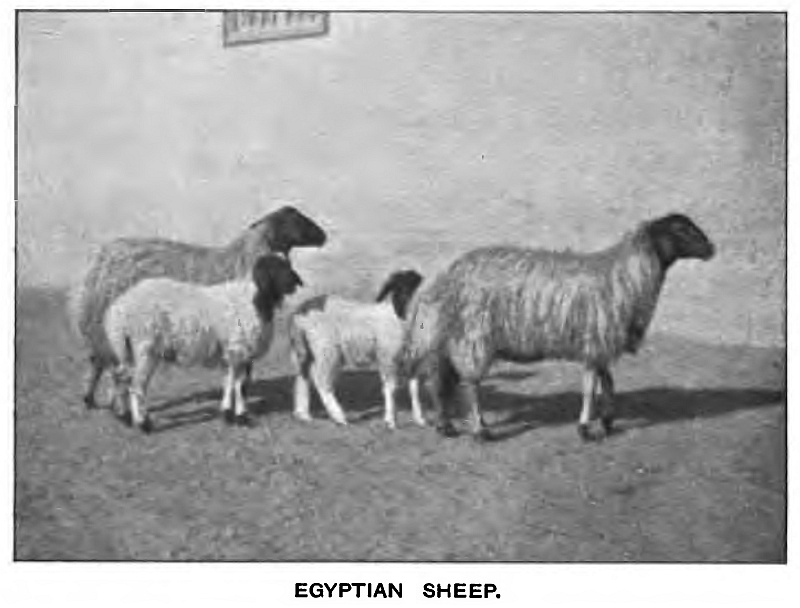
Sheep.—Egypt is not a pastoral country, and but scant attention is paid to these animals. They are considered a sort of by-product. When attention is paid to them, however, they yield excellent profit. The ram lambs at five months sell at from sixteen to twenty shillings. No care is bestowed on selection, and breeding from “weedy” rams renders the stock deficient in quality. The duties of the shepherd are light, as the flock is always under his eye at pastures. A very good idea of the Egyptian sheep can be gathered from the illustration.
But the time is rapidly approaching when all this may be changed; for sheep-farming may be looked upon from its double advantage of their increasing popularity for food purposes and their value for the extension of a system of animal manuring, and thus supplying, by feeding off crops, one of the great wants of the country. To a great extent the poor class Egyptian has been a vegetarian, but, with the increase of riches and prosperity in the country, Mr Wallace in his address speaks of the growing demand for animal food, especially mutton; while he reminds his listeners that one of the ways in which an Arab honours his guest is by furnishing his feast with a whole roast lamb.
The Prophet Mohammed, in his sanitary laws to his followers, teaches them to partake of mutton, in his wisdom and knowledge of its superiority to the flesh of the ox, which is considered unclean, pointing to the fact that even in his day cattle were known to be affected with some form of tuberculosis, which might possibly be eaten and thus imparted to the unfortunate partaker of the unwholesome food.
A special choice of site for sheep-farming is necessary, as a matter of course; but portions of the country may easily be selected where they can be kept with advantage—in the Nubarea, for instance. For not only is the land itself undergoing change in its nature, but politically as well. Under the present form of government and the protection to the cultivator which has been the natural result, the farmer is becoming freed from the risks of the past; for, unfortunately, in consequence of a certain inborn notion that has existed among the native Egyptian that everything he covets may be annexed, it has been found absolutely necessary by the grower of sheep to keep an exceedingly sharp eye over his tempting flocks, which have had to be dealt with as if they were in an enemy’s land. Driven into folds at night, this has not been sufficient; for as there is a want here of that breed of savage dogs fostered for their protection by the Albanian shepherds, the Egyptian shepherd has to be supplemented by watchmen ready to stand sentry over the flocks by night.
Sheep feeding progresses well during the time of the growing crops; but as these pass away, that form of farming and feeding which may be looked upon as quite modern in its application has proved most advantageous to the keeper of sheep: we mean the plan which agitated the public mind to so great an extent a decade or two back—ensilage—when our country rang with reports of experimental building of costly silos, or the sinking in suitable places of cement-lined tanks in which the newly-cut crops of green cattle food were piled or stacked, rammed down for preservation, and made into what one facetious writer stigmatised as “cattle jam.” The idea of the inexperienced was that this treatment of the green grass or clover would result either in rotting or fermentation, with spontaneous combustion to follow, as in the case of a too hurriedly made hay or corn rick in a moist harvest time. But the operations of Nature are as wondrous as they are puzzling, and it was found in our own country that the crop preserved in its silo could be kept for a reasonable length of time, and then cut out in an appetising state, ready for the cattle in a season of scarcity.
Answering so well in Europe, with its frequent rains and superabundant moisture, it is bound to be successful in comparatively rainless Egypt, where the clover can be cut at the exact necessary period and kept ready for use as required—a fact which is likely to give a great impetus to sheep-raising in such a pastureless country as the Delta.
Chapter Ten.
There is every probability of a small capitalist, one who might begin with almost nothing besides so much land and a sufficiency to tide himself over the first few months, making a fair success by the establishing of a poultry farm. In England we are favoured every year with reports of the trials that have been made in this branch of farming; and as a rule it seems that bad weather, the cold, and the cost of keeping, run away with most of the profits. Indeed, the writer’s experience points to the fact that few as yet have made a satisfactory living by keeping fowls in this rainy island, while up to the present day our supplies are kept up by the chickens and eggs taken into market from ordinary farms, or collected by hucksters from the cottages over wide districts.
This applies as much to France as to England, for we are indebted to the former country for millions of the eggs with which the metropolis is supplied.
In Egypt, where there is plenty of room and abundant sunshine, fowls might be much improved by the choice of suitable kinds, while some management would be required as to the means of feeding, though one suggestion may be made that, if adopted, ought to prove of great assistance to the fowl and egg farmer.
There is one peculiarity in the growing of grain in Egypt, and this is noticeable in the harvesting, the heat of the sun being so great that the corn of various kinds ripens with such rapidity that if much of it be not cut down and carried in the comparative coolness of the night much of it is shed in the fields and is wasted. Here is a great opportunity for the poultry farmer, or the farmer who merely keeps a few fowls in connection with his general cultivation; for at such times, in a country where double crops prolong the harvest, great numbers of poultry in kinds would be self-feeding, and far superior in quality to many that are brought into the Cairene and Alexandrian markets.
Still, at the present time the occupation has been much improved, for not only are the native markets supplied, but exportation of eggs is on the increase. Far off as Egypt may be, the metropolis is to some extent supplied with its produce, but to nothing like the extent that should be the case, for the London egg merchants will not buy “mummies,” which is the cant term for Egyptian eggs, save for about two months in the year, when the European supplies are scarce.
This fact—one which is well worthy the attention of poultry farming aspirants—is entirely the fault of the Egyptian grower, for the London merchants’ complaint is perfectly justifiable. It is this—that the Egyptian eggs are exceedingly small, and so badly packed for transit by those who seem thoroughly ignorant of the proverbial fact that “eggs are eggs,” that the breakage is enormous, while the entire loss falls on the agents.
Similar complaints used to be made regarding the eggs imported into Europe from Morocco and Algiers, but here those connected with the trade have woke up to their shortcomings and introduced better fowls—the layers of larger eggs—and have also given greater attention to the packing of this exceedingly brittle merchandise. Hence the result has been most satisfactory, and the trade has rapidly increased. Egypt being, then, in much the same latitude as Morocco and Algiers, there is no reason whatever why the former country should not improve its production of poultry so as to vastly increase the demand by raising the quality of its supplies.
Physiologists seem very much behindhand in accounting for the terrible destruction which comes upon countries from time to time. Africa, the ancient home of plagues, is only now recovering from that frightful devastation which affected grazing animals, the wild as severely as the domesticated. From south to north this great portion of the globe was swept by the Teutonically-named Rinderpest. Cattle of all kinds, and the droves of antelope-like creatures which roamed the wilds, perished almost like vegetation before the hot, sweeping blast of a volcano or forest fire. And, though little known outside, Northern Africa has had a trouble that seems to have been special to domesticated birds, a fact which shows that poultry farming in Egypt is not all couleur de rose, and that he who would venture upon such a pursuit enjoys no immunity from risks, but must take his chance with the vegetable and fruit growers who, like those in other countries, have their difficulties to face.
One visitation was productive recently of terrible devastation amongst fowls. This was not the familiar “gapes” of the British poultry-yard, but is described as a kind of cholera, so bad that villages have been losing their entire stock, with the natural consequence that the market prices of poultry and eggs have greatly increased—charges, in fact, having doubled and even trebled. Experiments have been tried in the investigation of the disease and the manner of treating it, but so far the only successful way of dealing with the trouble seems to have been by isolation.
But there appears to be every probability of the disease proving only of a temporary nature, and that the production of poultry will be as easy, simple, and remunerative as of old; for, as may easily be understood, poultry farming is bound to be of vast importance in a hot country. Every traveller recalls what a staple food a so-called chicken is in the West Indies; while in the vast plains of India almost every native cottage has its fowls to meet the demand of an enormous consumption. Of the quality the less said the better. The aim of the possessor of a poultry-yard in Western Europe is to produce a plump, square, so-to-speak, solid fowl, broad and full of breast. The Indian bird seems to have been gifted by Nature—in merciful consideration of its being, like most gallinaceous birds, short and hollow of wing and a bad flier, and also of its having to run for its life to escape immolation and consumption—with an abundance of skinny leg, and it never seems to have occurred to the ryot that he might improve the breed.
Even in civilised Egypt there is much to be done in this direction, and an ample field is open to the poultry farmer to improve the quality of the fowl, with success attending him if he will be content to go watchfully to work and make his experiments upon a sound basis, without being too ready to look with contempt upon the experience-taught native ways.
One thing is worthy of remark for the benefit of the would-be poultry farmer, and that is in connection with the marketing, for it is almost a rule that no one in Egypt buys a dead fowl. In Western Europe, of course, the common practice is to send the fatted chickens for sale plucked and neatly trussed. In Egypt it is different, from the fear lest it should have died from natural causes. The result of this style of vendition is the repellent way in which poultry are hawked about the streets of the town, raising feelings for the need of more prevention-of-cruelty-to-animals establishments, though it would be hard work to interfere with a custom which has a good deal of reason on its side, for, waiving the possibilities of purchasing a bird that may have been killed by accident, or possibly have died from disease, climatic reasons must be taken into consideration. Egypt is at times intensely hot, and, whatever may be the fancies of epicures in connection with game, the gourmet has yet to be found with a preference for having his chickens “high.”
Still, as aforesaid, there is something repellent in the way in which the doomed birds are treated. In England a Prevention officer soon summons the huckster who overcrowds his poultry in a crate and does not supply them with food or water; but in Egypt it is one of the common objects of the streets to see a bunch of fowls tied together by the legs and swinging from the vendor’s hand, wearily curving up their necks so as to get their heads in the normal position, while every now and then a case may be found where the seller finds that he requires refreshment and callously throws his load upon the ground, while in Eastern fashion he takes his seat at a café to sip his cup and smoke a cigarette.
Chapter Eleven.
In such a climate as has been described Egypt offers every inducement for the planting of fruit trees that are likely to flourish under its ardent sun. Attempts have been made, and with fair success, but the raising of fruit has not reached that state of excellence warranted by fertility and the conditions of the climate. Examination very soon shows the reasons for this lack of prosperity, which is clearly the fault of the Egyptian gardener in his want of system, his easy, careless indifference, and his clinging to the old-fashioned way of planting a fruit tree, namely, placing it in a hole in the ground and leaving it to itself.
The first things that strike observers in visiting Egyptian gardens are the overcrowding of the trees, the neglect of precautions to keep them free from weeds, and in many cases the marked absence of pruning dealt out judiciously by one who knows a fruit tree and its needs—plenty of light and air, the removal of cross growth, and the fostering of bearing wood, here frequently injured by rank growth.
Then, again, the Egyptian gardener is as obstinate and conservative as his prototype in the western counties of England, who leaves his ancient apple-trees of the orchard to grow one into the other and become covered with grey lichen, while he religiously avoids the replacing of old and unprofitable trees by young ones.
The result of experience is—and the knowledge of what the land will do makes it certain—that in the following out of this defective system may be traced the want of quality, flavour, and quantity of some Egyptian fruits.
Of these it must be remembered that the settler and commencer of their cultivation would have to deal with several that are new to him in the way of growing, as well as those of the cooler parts of Europe.
Egypt suggests to the reader the ancient civilisation, with its pyramids, temples, and other monuments of its old-time grandeur, the great river, and, above all, the desert; but to come back from these to the simple and ordinary pursuit of gardening, the settler would be able to surround himself, as in California and Florida, but without the bitter disappointments produced by frosts, with several varieties of the golden apples of the Hesperides—oranges, to wit—the sweet, the bitter, the deeply tinted blood orange, and the mandarin. All of them grow well in Lower Egypt, and produce beautiful and profitable crops of fruit, as may be judged by the following. The sweet and mandarin trees will bear, upon a good average tree, from three hundred to four hundred oranges each—that is to say, good, sweet, juicy fruit, and these will sell readily wholesale at about two shillings per hundred; while, in the way of drawbacks for one who expects to make an income from his sales, it will be found here that, just as at home, the tree that in one season bears an exceptionally heavy crop is rather shy in its production in the next.
The words that follow deserve to be written in italics for the benefit of those who know the ravages and foulness that come upon an orange tree in company with the varieties of scale. There are no insect pests, neither, as has been intimated, are there frosts to destroy the bloom.
À propos of this bloom, there is a practice pursued in Egypt which may seem strange to an English gardener, but which adds largely to the profits of the orange grower, and is doubtless beneficial to the tree, relieving it as it may from the strain of overbearing. When the bitter orange is in full flower the trees are shaken, and more than half of the blossoms are sold for the purpose of distillation. The essence produced is used for mixing with drinking water, or for flavouring beverages, while the price received for the petals is about two-pence-halfpenny per pound.
In addition to the oranges, which are in season from November until March, and keep fruiting in beautiful repetition, lemons of several varieties are grown, and are marketable at the same time of year. These are a most popular fruit among the Egyptians, largely utilised as a kind of seasoning in the preparation of cooked dishes, and also much prized for the making of summer beverages in this hot and thirsty land. These are even better friends to the gardener growing for the market than oranges, for they are sure croppers, and command a good price.
Abundance may be written with regard to summer fruits, the list numbering apricots, pears, plums, peaches, apples, grapes, figs, the custard apple, pomegranate, melon, and banana. Of these, bananas, apricots, pomegranates, and figs may be classed as the most profitable fruits of the summer season. But people accustomed to the English Moorpark and Gros Pêche apricot, which, when well-grown upon a south wall or in an orchard-house, is one rich bag of reddish amber, deliciously flavoured honey-like juice, would be much disappointed in the abundant apricots which are produced upon standard trees for the Egyptian market. They are finely flavoured, but small, hard, and fibrous; and an experienced cultivator of fruit trees states that it is very probable that the deficiency in quality and the reason that so far it has not thrived to perfection is, paradoxical as it may sound, that it matures too quickly, which is another way of saying that the climate is too fine for it. Still, there is every reason to believe that skilful management and choice acclimatisation, or the raising of new sorts, may result in the production of finer apricots than those now grown in England, where in some parts a manifest deterioration has been in progress, so great that growers are destroying their apricots and replacing them with fruit trees more suited to our sunless climate.
Some years back a novelty made its appearance in the Alexandria district. This was a veritable plague of Egypt, though undoubtedly a visitant from abroad. It was a banana disease, which in its inroads played great havoc amongst the plantations. Scientific examination was brought to bear, and the cause was found to be a parasitic nematode which attacked the roots of the plant.
Fortunately the trouble was local, and the infection limited in its area, while at the present time many of the plantations are free from the pest.
With regard to peaches, the way is open to the enterprising and clever cultivator, for with such a constant supply of sunshine much ought to be done in the way of growing this queen of fruits. Many of us here in England, who have to trust to trees laboriously trained against a wall, or spread out and tied in to wires at the cost of many a back and neck ache, beneath the sloping glass of an orchard-house, have read with watering mouths of the standard trees of the United States, where the fallen peaches are gathered up in barrowfuls and considered of no account.
Abundance rules there, and possibly it may be that this is due to the intensely hot summers of the States and their frigidly cold winters; for this seems to be the nature of the climate in the country from which the peach sprang and took its Latin name, Persica; for there, following upon the summer heats, winter comes down from the mountains intensely cold.
This balance is wanting in Egypt, where, so far, peaches have not proved to be a success. The trees grow well and bear fruit that is fairly large in size, but does not possess the fine aromatic, juicy flavour of a well-matured English peach grown upon a wall and only protected during the time of frost, those raised under glass, save in size and appearance, never approaching the open-air fruit.
The Egyptian peaches are hard and fibrous, as well as wanting in the piquant bitter almond flavour so much esteemed. Possibly the selection of better kinds may make a great change in the hands of careful cultivators, but in common fairness it is right to say that the successful production of this favourite fruit in Egypt is open to doubt.
So far, too, another stone fruit, the plum, is not extensively grown, while the plums produced in the Egyptian garden cannot compare with those imported from Europe. But this fruit is not such an aristocrat among the luscious beauties of the garden as the exacting peach, and there is nothing to prevent, either in soil or climate, a finer quality being grown in the Delta.
What is needed is the selection of new and suitable varieties, accompanied by careful watching of results; in fact, the intelligent management of a good experimental gardener, not one akin to that of Egypt, who selects with extreme conservatism the easiest way to his desired ends. He consequently devotes his time to those fruits which flourish easily and well. His attention has been given principally to the growing of the citrus family, to the exclusion of such fruits as pears and plums, which are imported from Syria and Turkey. In fact, in spite of the possibilities of the Delta, how great is the want of enterprise may readily be seen when it is stated that the value of the imports of fruit may amount to many thousand pounds per annum.
Unfortunately, our two most home-like and familiar fruits—apples and pears—do not succeed here, the climate being far too hot. Pears have a very small share of the land, and the fruit is not of the best quality. But while it is doubtful about the apple, this doubt ought not to extend to the pear, which is a lover of heat, and, as regards the better sorts, delicate and tender in its constitution. There can be no doubt that if a careful selection of some of the best French and Belgian varieties were introduced, a fair meed of success would be the result, for it seems almost contrary to reason that such kinds as the fragrant Doyenné de Comice and Glou Morceau, which fail as standards in the inclemency of an English season, and crack and speck if they are not protected by a wall, should not succeed in Egypt if they are given a fair trial.
Not that there is much need for experiment in a country which can grow its grapes gloriously in the open air, the vines not asking for the help of glass. Some half dozen varieties are produced in Egypt, and flourish well under treatment of the simplest kind. The cultivation of the vine extends over the whole of the province of Fayoum. In this latter district a white grape, called after its habitat the “Fayoumi,” is the favourite in the market, and it is the earliest that ripens. The berries are medium sized, but the flavour is excellent and the fruit very juicy.
There is little question of training or trellis work, for, somewhat after the fashion of the vineyards in France, the vines are grown as bushes of about two feet high; and the result, though not the production of the bunches of the Vale of Eshcol, is still abundance.
Two varieties are grown in the Delta and Cairo districts, namely “Roumy”—a kind derived from Greece—and “Shawishi.” Here, as opposed to the cultivation in the province of Fayoum, the vines are mostly trained on lattice work so as to form what the old gardeners called a pergola, or covered way. Both these varieties are heavy croppers, bearing bunches whose berries are of a greenish red, while the flavour is very good.
Egypt is a land of vines and vineyards, much space being given to the cultivation of the grape, though not for the purposes of carting to the winepress, the Moslem religion being antagonistic to the grape’s fermented juice. Each district has its favoured kind, and in that of Alexandria and along the shore of the Mediterranean the vine is abundantly grown close to the ground, the soil being pure sand.
There is a peculiarity in the cultivation here, for V-shaped trenches are cut to a depth of from six to nine feet. Then vine shoots are planted in the bottom of the trench, where the young rootlets they put forth are within reach of water. Vegetation is rapid, and the canes gradually cover the slopes on either side, while in two years the vines begin to bear.
The bushes receive no irrigation from above, only depending upon the so-called winter rains, which are fairly frequent near the sea, and, as has been shown, gaining their support from beneath the sand at the bottom of the trench. But though no irrigation is brought to bear, these ground vineries require annually an application of manure if the best results are to be obtained.
As the land of the Delta is practically level, it affords scarcely any opportunities for the growth of the grape vine upon sunny slopes, this being the only instance in Egypt where grapes are grown with this exposure, while these slopes are all artificially made.
As regards insect pests, they may be almost classed as nil, and the grower will not hear of thrip and scale, mealie bug, or red spider, so that the cultivation is conducted under the most favourable conditions; but the ubiquitous sparrow is even there, and, unless means are taken to scare away or destroy him, his ravages amongst the sweet berries are great.
Here, too, as may be supposed where grapes are produced to so great an extent, the thinning of the berries is not resorted to, and consequently they are not so large as might be expected from the heat of the climate and the favourable conditions under which they are grown, nor is the flavour so fine as that of the beautiful bunches so carefully tended and watched under glass in an English vinery; but they command a ready sale at about twopence per pound when the fruit is ripe, from the beginning of June.
Chapter Twelve.
That delicious European fruit, the strawberry, by nature a dweller in cool and Alpine regions, was not known in Egypt till within forty years ago. Planted as an experiment by someone familiar with its qualities, it seems to have passed rather an unfavourable time in popular estimation; but it is now gradually gaining in favour, and the area under cultivation is steadily extending.
The fruit is ripe in November, and finds a ready sale at tenpence per pound; while, if the cultivation is good and well-managed, the return to the planter may be reckoned at forty pounds for the produce of an acre.
To an Englishman familiar with the strawberry and its growth, one knowing the botanical character of the plant and the love of its roots for a rich clay land, it seems surprising that it should flourish so well in the sandy soil of Egypt. But, of course, this is explained by the yearly deposit of rich silt, or warp, the result of the annual floods.
Fortunately for the grower, he is not troubled as in England by woodland birds, the Eastern crops suffering very little from their ravages, while the plant enjoys almost an immunity from the attacks of insect plagues.
In the goodly list of luscious fruits we now come to figs—not the overgrown, sickly fruit that only ripens under very favourable circumstances in England, but the rich saccharine bag of embedded seed that we know best in its dried and pressed form as the common fig.
Its cultivation is spread over the whole Delta and the Fayoum, where its milky, succulent stems and dark green leaves flourish thoroughly well. The trees, as a rule, grow to a height of nine or ten feet, are well branched, and find great favour with the native gardener, for they possess the admirable qualities of requiring not much attention, very little manure, and no pruning. Joined to this, the trees are very prolific, and the luscious fruit finds great favour with the people.
Another popular fruit which grows without much attention save irrigating, and that to a very moderate degree, is the prickly pear.
Here in England the melon is looked upon as a delicacy. Gardeners vie one with the other in its production, and seedsmen push forward this fashionable fruit by advertising their own special specimens of prize kinds, and these may be almost classed as legion.
In Egypt the varieties are roughly divided into two, the sweet and the water melon, and they both flourish wonderfully. They are sown in February and March, and thrive best in light loam, while their period of growth extends to about four months.
In their rapid development they attain to a goodly size. For instance, a water melon may reach the weight of thirty pounds, while from a marketing point of view, taking large and small together, so as to strike an average, the wholesale price may be placed at fivepence per melon, and the cultivator of an acre of land devoted to this produce may reckon on receiving from forty to sixty pounds—pretty satisfactory for the four months of growth and the land ready for planting with some other crop suitable to the season, for the grower has no dreary months of winter to intervene.
The cultivation of the sweet melon is similar to that of its relative, but the fruit is finer in flavour and the plants not so prolific. Consequently the grower’s receipts are much smaller, a fair computation of the returns from an acre being from about thirty to forty pounds. There is another disadvantage, too, in the growth of this fruit. It must be consumed within some ten days after being fully ripe, whereas the sturdy water melon will keep good for over a month. In spite of the good qualities of the melon, its ease of growth, and the market requirements, nothing like sufficient are grown, the demand being supplied by the importation of large quantities from neighbouring countries.
This popular fruit is always looked upon as deliciously refreshing and fine in flavour, but it may be mentioned here how much climate has to do with the quality of the fruit. Some years ago a friend, after a prolonged stay in Egypt, presented the writer with a few seeds of the Egyptian melon. These were planted here in England and nursed up under glass with all the care that good gardening and watching could bestow. Everything was done to the exotic plants that a certain amount of experience in growing melons could supply, and a couple of them flourished exceedingly—under glass, be it remembered, in a heated house—blossomed, and bore several fine large green fruit, whose increase was watched and maturing waited for, but in vain.
Presumably there was a certain amount of fragrance and ripening, for the fruit changed colour and gave forth the familiar odour; but the anticipations of enjoying a delicious Egyptian melon were not fulfilled. A good ripe vegetable marrow would have put either of them to the blush.
Pumpkins, big and gourd-like in growth—pastiches, as they are commonly called—are most abundant in the early winter months, and are largely brought down the river from Upper Egypt in barges or feluccas with graceful lateen sails. They form a pleasant addition to the food of the poor, while in their growth, favoured as they are by a hot sun, rich soil, and a sufficiency of moisture, their increase is almost fabulous, and anyone of curious taste and plenty of patience, aided by a powerful magnifying glass, might in all probability be gratified by seeing the creeping growth of the watery vine and the steady swelling out of its heavy earth-supported fruit.
Another fruit upon our list is the pomegranate, of late years made familiar upon the barrows in the London streets, and looking when cut open something like an unwholesome blood orange that has aborted and taken to growing an enormous excess of pips embedded in jelly within a hardened peel.
In spite of the enterprise which has brought the fruit here, it seems hardly likely to bring the shippers much reward; but it is extensively grown in Egypt, is in great demand, and very profitable.
To continue with unfamiliar fruits, we may next name the great date palm, which may be looked upon as the most common tree to be found in Egypt, growing as it does all over both the upper and lower regions, as well as on the sandy shores of the Mediterranean Sea. No wonder that it is so largely planted, for its fruit is everywhere consumed by the people as a portion of their food.
The tree begins to bear five years after planting, and should take the record as a profitable friend of man, for under favourable conditions it will go on bearing for a hundred years or more, while a good tree will bear, on an average, over a hundredweight of fruit, which is disposed of amongst the people at the popular price of one penny per pound.
The fruit ripens in September, and where the trees are selected, are of the best variety and well attended to, the profits are very good, especially if they are planted in a garden, where their tuft of leaves, raised high upon their tall, smooth stems, throws so little shade that the ground beneath can be profitably planted with other crops, such as the ordinary domestic vegetables of our own country, haricot beans, peas, spinach, etc.
“The large, dark, red-skinned, hard date,” a friend writes from Cairo, “has long been plentiful, and forms one of the staple foods of the populace. But to-day—i.e., mid-October—the soft, small luscious date was served at table. This is a most delicious fruit. It tastes for all the world like caramel toffee, though of course much softer. These dates are wonderfully cheap. They do not, however, keep more than twelve hours after picking, and then begin to ferment and taste like beer. They are most plentiful, and there is, no doubt, much waste. I should think that a strong spirituous liquor could be distilled from them.”
Other fruits may be mentioned, such as the quince, loquat, lotus, and that favourite of farther east, the delicious mango; but these are not extensively cultivated, and may very well be excluded from a list of fruits that might be profitably grown for market purposes. The wonder is that the mango has been neglected, comparatively, up to now. Still, the Egyptians are waking up to its value, for during 1903 there has been in Cairo a very plentiful supply of this luscious fruit, which bears some semblance in the eating to a very rich and juicy apricot, resembling it also in colour.
The old saying of the Anglo-Indian who makes it a favourite, in spite of a slight suspicion of turpentine in its flavour, is doubtless well-known to the reader—that which suggests that the best way of combating the superabundant juice and its gushing ways is to sit in one’s bath when partaking of the fruit.
In summing up the prospects of fruit growing in Egypt, Mr Wright states that he has no hesitation in saying that the conditions for gardening in Egypt are certainly far more favourable than in such an uncertain climate as that of England, where in one night so much blossom may be destroyed by frost; while in Egypt one never hears of such a thing as a total failure of crop.
Chapter Thirteen.
To take a stride now from the delicious and attractive to the homely and useful, but at the same time more general and profitable growing crops of Egypt, let us turn to the gardener’s mainstay—his vegetables.
Here the first thing that strikes a visitor to this semi-tropical land is the familiarity of many of the garden crops—some, to use an old-fashioned term, grown out of knowledge; others perhaps wanting in the qualities of the home country.
Most familiar of all—certainly the most homely and extensively grown, with great profit, is the cabbage, in three varieties—the White Drumhead, the Red Drumhead, and the Savoy. Here a little unfamiliarity steps in, and that is in the usage, for the cabbage in Egypt is utilised by the people as a salad as well as for cooking.
From a gardener’s point of view the head is not so large and hard, the vegetable not forming a solid heart as it does in England. But this may be accounted for by want of sufficient manure and attention—good gardening, in short—and perhaps the climate is not wholly to blame.
The cauliflower flourishes fairly well under similar cultivation to the cabbage, but being more delicate requires greater attention; differing from the latter, the heads are well formed, but it is necessary to shade them when coming to perfection, the clean, white growth being liable to be damaged by the too ardent sun.
Good cauliflowers command a ready sale at better prices than are to be had in London as a rule, the average cost being from twopence-halfpenny to fivepence per head.
Another very familiar crop is seen largely in Egypt—the leek. This is a profitable vegetable, which grows to a good size, is easily cultivated, and realises a total per acre of about fifteen pounds. The carrot, too, is largely grown—in two varieties, the native and the Greek. The native kind is sown in September, and is ready for lifting in January; while the Greek variety, sown in the same month, is also used for the production of a summer crop in February. A deep soil is necessary, while its sandy nature in Egypt is most suitable for this root, and when carefully cultivated a fair return may be expected.
One of the most extensively grown vegetables, a very general favourite almost everywhere except in England, is the garlic. It does well in Egypt, often in plots of as much as two acres, and has the advantages of not requiring great care in cultivation, nor much water; while an average crop will yield of the silvery bulbs enough to be valued at about fifteen pounds per acre.
The onion, again, proves itself to be a most thriving inhabitant of this Eastern country, growing hard, firm, clean-skinned, and healthy. In this sunny clime it is extensively grown, and not merely for home use. The kind most popular is the red Spanish onion, and it is cultivated both in Upper Egypt and Lower, there being this peculiarity of difference, namely, that the Spanish onion grows to a larger size in the south, while the flavour of those grown in the Delta is superior.
A few words will not be out of place respecting the cultivation of this vegetable in Upper Egypt, where it is grown most extensively as a farm crop for export. The seed is sown in the month of October, transplantation takes place in March, and, all going well, the crop is ready for lifting in June or July. After the transplanting no irrigation is required. The yield is approximately four to five tons per acre, and the market price two pounds per ton.
The next vegetable on our list when grown in quantity looks wonderfully familiar and home-like. It is the artichoke—not that of tuberous and sunflower-like growth, but the deeply cut, acanthus-like leaved ornamental plant of English gardens, with its majestic thistle-like purple head.
This is one of the best-paying garden crops, these heads being greatly in demand by Europeans, though not much sought after by the natives. In the culture it will be found that the growth is excellent for four years, when transplanting becomes necessary and should be resorted to.
Asparagus is decidedly one of the best-paying crops in Egypt, and naturally always in great demand by the Europeans who visit or pass through the country in ever-increasing numbers. The cultivation is the same good old-fashioned style practised in England, the beds being well prepared and generously treated with stimulants. All that is required to secure a fine crop is proper attention under skilled direction, for there are no drawbacks from frost, the grower never finding the sturdy greenish purple shoots of yesterday drooping over and destroyed by the morning’s frost.
Well treated, the beds will remain good for from ten to fifteen years, a very modest computation this, for if well-managed and not cut too hard, a good asparagus plantation ought to remain prosperous for twenty or thirty years. As the result of his generous treatment in the way of stimulants, the grower may expect to receive wholesale from two shillings to five shillings per hundred shoots, according to their size.
That easily-cultivated wholesome vegetable, spinach, is largely grown from September till January; while now may be added, most extensively raised, a vegetable new to Occidental eyes, in company with three more which have long periods of growth, well fitting one to succeed the other.
The first is a small-flowered mallow, whose period is from September to October—it is much relished by the poorer Egyptians as a cooked vegetable resembling spinach; purslane is another very easily-grown plant, whose period is from March to September; Jews’ mallow, too, is a vegetable greatly esteemed by the natives. This is cultivated, and also found growing wild in the fields. It is much in demand as a summer vegetable. Okra is another dish held in high estimation; it is not difficult to grow, and forms a good paying crop.
To return to the familiar vegetables of Western gardens, we have a great favourite in the shape of the haricot bean. This grows exceedingly well in Egypt, on condition of its being well supplied with water, while the rapidity of its maturing is marvellous, showing, as it does, the beauty of the Egyptian climate and the power of the sun, for it is fit to pick thirty days after sowing, and the land ready for another crop, a fact which seems almost incredible.
The next on the list of profitable vegetables is the ordinary broad bean, but this is not extensively grown, as it is only consumed by the upper class natives, the poorer people preferring the ordinary horse bean, which is grown as a winter crop. These beans are a very common article of food, and are bought by the peasantry, ready boiled, in most public places. They are also largely employed as provender for the working cattle. The roots of an arum and of the lotus, too, are largely consumed, and no wonder in the case of the latter in such a dreamy land; but the effects are not quite the same as the former Laureate described.
The turnip, so popular in England, finds little favour, though it is easily raised as a medium-paying crop, and, odd as it may sound, it is principally used pickled.
Colocass is generally grown upon the farm. The tubers are large, about the size of an English turnip. This is a splendid paying crop, which is largely consumed as a vegetable and forms one of the staple foods of the fellaheen.
The sweet potato is also a common vegetable here, but the name sounds foreign to an English cultivator. It is a plant with tuberous roots of a white colour, mostly eaten roasted, and, like the colocass, it is a favourite food of the farm labourer. The value of the produce of an acre may be estimated at ten pounds, and the duration of the crop is about four months.
The cucumber thrives very well in Egypt, and, of course, there is no necessity for the protection of glass. It is as popular as in England, but perhaps more utilised, lasting well through summer into autumn, and proves to be a very paying crop, provided it has a plentiful supply of water. This may also be said of the two varieties of vegetable marrow, the green and white, which are largely raised. The fruits are most popular when very young, and are much relished when treated as the cucumber is in England—that is to say, served as a salad, though it is cooked as well. This, like the cucumber, is a medium-paying crop. As for the latter, it has been a favourite object of culture, dating right back to the days of the Israelites. The allusion to the cucumber will be recalled, and all species of this family are cultivated with assiduity. Not that there is anything wonderful in this, for in a hot country fruits and vegetables of rapid growth, and which cause little trouble, are sure to be affected. We say rapid growth advisedly, for in favourable seasons the shoot of a cucumber may be almost seen to grow, achieving as it does, at times, a length of twenty-four inches in a day and night.
The ordinary salads and herbs of the English garden are easily raised, and form profitable crops, available summer and winter, and are highly esteemed. Among other plants we have poppies, madder, indigo, flax and hemp; while in the province of Fayoum one very charming form of gardening is practised, namely the growth of the rose tree, from which is prepared the rose water so popular all through the East.
As for flowers of all descriptions, where they are scarce it is the fault of the people, for many of our most brilliant kinds, especially the more tender, which are raised in our islands only with care, brighten the land and flourish everywhere like weeds.
Our ornamental hothouse growth, the eggplant, here forms a most important vegetable, which is extensively cultivated. It is similar to the aubergine, which is used in France and seen occasionally in Covent Garden Market; but the years glide by, and its bids for popular favour have met with but little success.
It is the reverse in Egypt, where its use is general, whether as a cooked vegetable, pickled, or in its raw state. It demands a rich, deep soil, and is raised in both varieties, white and black, for use in summer and autumn, and proves to be very profitable to the grower.
Chapter Fourteen.
Perhaps the most successful vegetable that has been introduced into England is the tomato. Forty or fifty years ago a punnet or two of the attractive vivid scarlet fruit might be seen in season at Covent Garden Market. They were known as “love-apples,” and probably were bought and consumed; but their growth into favour was very slow before becoming a fashion, and, with most people, an acquired taste. The tomato forms a summer production of the English market gardener, who is rivalled by the growers of the Channel Islands; and it is sent into market daily by the ton; while, when the inclemency of our climate renders firing absolutely necessary, the enterprising growers of the Canaries keep up the supply. Flourishing so well just off the west coast of Africa, it is only natural that the tomato should find a congenial home in the fertile East of the great Continent, and it is extensively grown with increasing success in Egypt.
As an example of the tomato being treated as a profitable crop, here is an instance of what has been done in the way of market gardening in the district of Alexandria, and may be done again by those persevering cultivators who are struggling to make a moderate living.
A father and two grown-up sons may rent a plot of land of, say, four acres in extent, the rent of which perhaps reaches ten pounds per annum, the gardener having to raise water for irrigation purposes.
The occupation of the land would commence on the first of August. The soil may be classed as pure sand, which naturally requires a liberal application of farmyard manure. The ordinary tillage having been carried out, the cultivator begins by transplanting seedling tomatoes about the beginning of September. Not being prepared to plant the whole of his four acres with tomatoes, he sows on another part vegetable marrows, which in this hot climate are ready for plucking in six weeks, the plants continuing to bear for a month; while directly this supply is finished another crop of marrows may be sown on the same land.
Meanwhile, the tomatoes are pushing forward to be ready by the first of January at a time when the price is generally good, though probably in no other vegetable is there so great a variance in the amount it will fetch, dependent, of course, on the scarcity or plentifulness of the crop.
It will be news, probably, for the British grower when he reads that the wholesale price of tomatoes in Egypt varies from one farthing to fivepence per pound. Perhaps he may open his eyes a little wider when he reads that a fair estimate of the gross return from growing tomatoes for the market supply of Alexandria will vary from ten pounds to fifty pounds or more per acre; and, of course, this is in the open ground, forming an almost immediate return, and with no preliminary outlay for glass houses.
But there are always drawbacks in gardening; and one of these, which may occasionally mar success, is caused on this land so near the sea by the fogs. These, if they attack this delicate plant, so famous here at home for developing aphides and fungoid diseases, like their unfortunate relatives the potatoes, destroy the leaves, blacken them, hinder the setting of the blossom, and generally reduce the crop.
Several men have been known to engage in this cultivation in the neighbourhood of Alexandria during the last five years, and apparently they have financially improved their position.
Leaving the aristocratic tomato and turning to its poor relative the potato, it might have been hoped that in such a hot, sandy land as Egypt, where thousands of acres offer the same facilities, and are made as rich and fertile as the famous warp-land potato tracts of north Lincolnshire and south Yorkshire, a home would have been found where it would flourish free from disease.
Unfortunately, the information to be given to the horticultural or agricultural grower upon this point is not good; in fact, quite sufficient to make the writer suggest that it should be a crop to be left alone.
Certainly potato growing is tempting; the cultivation is simple, the crops heavy and very profitable if—this is a very large “if,” and means so much, especially connected with weather and disease. Experience of long years employed in gardening and farming in Egypt suggests that if the cultivation of the potato is entered upon it is best to be grown on the farm or by large market gardeners.
Good quality potatoes, such as are marketed in England, are rarely found in Egypt. The crop is generally grown from “seed” imported from France and Italy, and a sandy soil is chosen. Two crops, however, can be taken from the land per annum. The first is planted in October, and should be ready for lifting in the beginning of February, a period of five months; the second, planted in February, is ready for harvesting in June—the duration of time for the crop to be on the land, one hundred and ten days. It sounds novel to a British grower to speak of a winter and a summer crop of potatoes, two crops in the year; but this is so, and the winter may yield three tons per acre, while the summer produces five to six; while the current price per ton returned to the grower is about seven pounds. As this is the most popular of vegetables, and the demand always so great for good, well-grown new potatoes, experiments have been tried for raising these in the neighbourhood of Cairo and sending them packed in boxes to arrive in England, when they would be eagerly bought up in the market as luxuries, at the beginning of March.
Here are the returns of the experiment. From fifteen to eighteen pounds per ton were realised; carriage, freight, and other expenses amounted to three pounds per ton, leaving a margin of profit over the price in Egypt of from five pounds to eight pounds sterling. Enough this to make the Delta worthy the name of a land of promise, and especially more so when it can be, and is, announced that it is a country where there is no potato disease. In exceptional cases, however, there is the drawback of cold weather, which retards the growth of the winter crop.
Another objection is that all the seed potatoes—and these are heavy of freight—have to be imported, as storing throughout the summer is impracticable.
It is only fair to say, however, on behalf of our good old mealy friend, the familiar object of every man’s table, that in his guise of a foreigner—an African—he will be much better if he is let alone and not subjected to the tricks of trade, which recoil upon and tend to spoil his character. For in the harvesting of the crop a bad practice has arisen with the Egyptian market gardener, who generally carries on his operations in the neighbourhood of some irrigation canal connected with the Nile, where he has, so to speak, abundance of conserved water always on tap ready to give his fields a heavy watering. This he bestows upon his potatoes just before turning them out of the ground, as he finds that it greatly increases the weight of the tubers; but it spoils their quality, and makes them what a Londoner calls “waxy,” and a north countryman “sad.”
One ought not to close one’s list of garden or farm productions without adding the names of a few so-called spices, or flavour-producing plants, which are always in steady demand and flourish well in the valley of the Nile. Among these are the capsicum, the green and the red, which are most easy of culture, and come to maturity rapidly with the same treatment as is accorded to the tomato. There is also the lesser kind, or chilli; the caraway famous for its seeds, the coriander, and dill; while as to the familiar mustard, it hardly asks for cultivation at all, but grows rapidly and ripens well, while the seed, when ground into the familiar condiment, is pungent and aromatic in the extreme.
As is well-known, a fine class of tobacco is grown pretty largely in the Delta. It is wanting in the strength of the kinds raised in the West Indies and the United States. It is excelled, too, in potency by the products of the East Indies; but it is of a very delicate flavour and much liked, though not so popular as that of Turkey in Europe and Asia. But this is partially due to want of usage on the part of smokers, who are not accustomed to the pungency and fine aroma which appertain to the Egyptian tobacco as compared with the Turkish. But the North African is remarkably good all the same, and flourishes splendidly, there always being abundance of sunshine at the picking time and excellent opportunity for haying the crop. For, after all said and done, a great deal of the aroma of tobacco depends upon the fermenting process it goes through in being dried and pressed, just as a well-made crop of grass, hay, or clover, is dependent upon the skill of the farmer and his choice of weather.
Chapter Fifteen.
Supposing an enterprising personage to have taken up a tract of the desert of, say, one hundred acres in Egypt, where divisions must not be looked for in the way of fence or hedge, but dependence placed upon the irrigating drain, it will be as well to give a list of the farm implements he would require, and their cost—always presuming that he is prepared to be content, certainly at first, with the ordinary contrivances of the country, which are rough, but very cheap.
Necessaries are given here, and nothing more; while the accompanying illustrations spread through the text afford a very good idea of the objects that will become familiar upon his pioneer land.
Four native ploughs, exceedingly rough in construction, for tickling the soil that is to laugh with a harvest, their cost about ten shillings each; a baulk wood, to be drawn by oxen, mules, or donkeys, over the yielding surface and act the part of a roller, six shillings; a ridging box, for preparing the land for potatoes or sugar-cane, two shillings; two scrapers, eight shillings; chains, six shillings; one lorry, five pounds; two box carts at four pounds each; two threshing norags at eight pounds each; total, thirty-two pounds ten shillings.
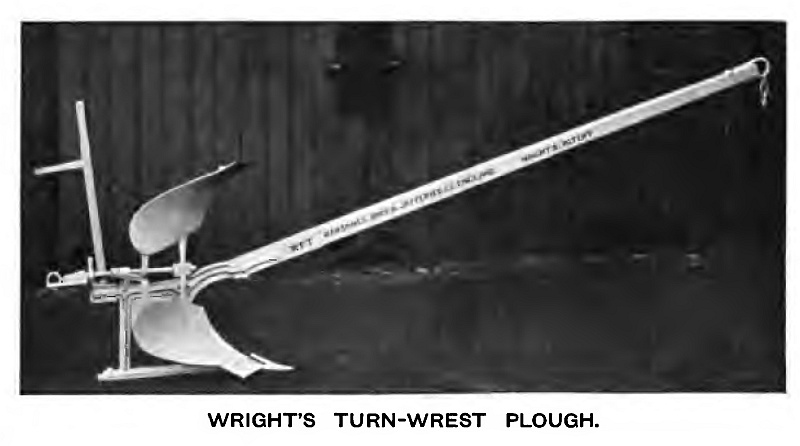
Of course, it is open to the man of enterprise to invest in the different ingenious contrivances of the British agricultural implement maker, such as the admirable invention the Patent Turn-Wrest Plough, invented by Mr Thomas Wright, whose experience in the cultivation of the Khedive’s land resulted in his bringing to perfection an implement exactly suited to Egyptian needs.
The list given above names all that is absolutely necessary in a country where the tiller of the soil is so munificently aided by the almost incessant sunshine and abundant water.
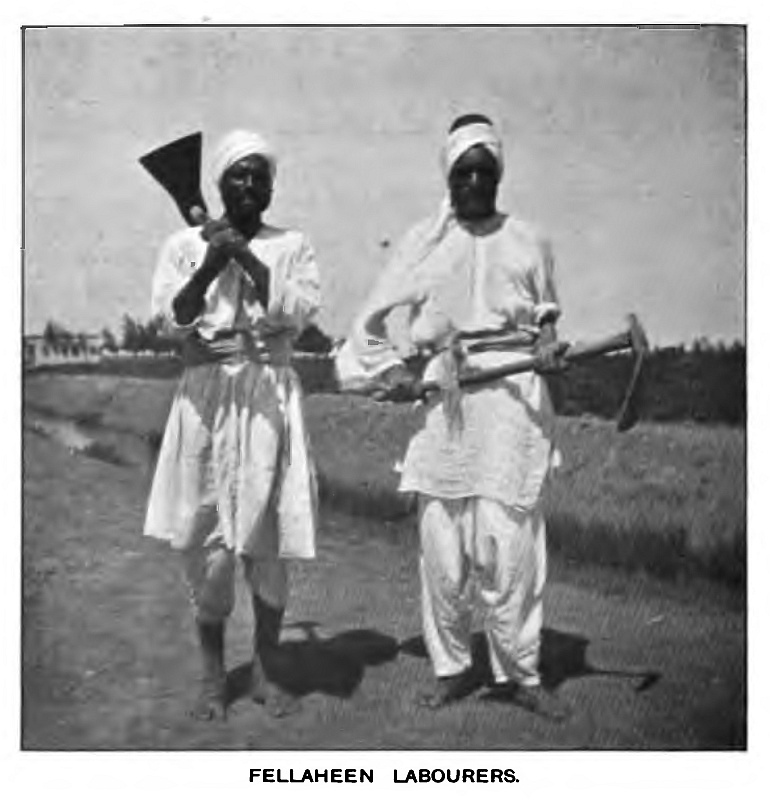
But the farm implement par excellence of the fellaheen, the tool which is to him what the shovel is to the British navvy, an instrument with which nearly everything in the way of moving the soil can be done, is the fas, the broad-headed hoe seen carried by the two fellaheen labourers in the engraving accompanying this chapter. It is one of the first inventions of the cultivator, and not so very far removed from its pierced flint representative occasionally turned up amongst the weapons and tools of primitive man; but when bronze, and later on iron, began to yield to the inventor, and the action of fire was utilised by the Tubal Cains of their day, the broad-headed hoe began to develop; and we have it spread, in a very similar form to that still used in Egypt, all round the world where men commenced to till the soil. For we see it to this day very similar in shape in those two vast agricultural countries, India and China, while in Egypt it is handled by the fellaheen labourer in a way which is beyond praise.
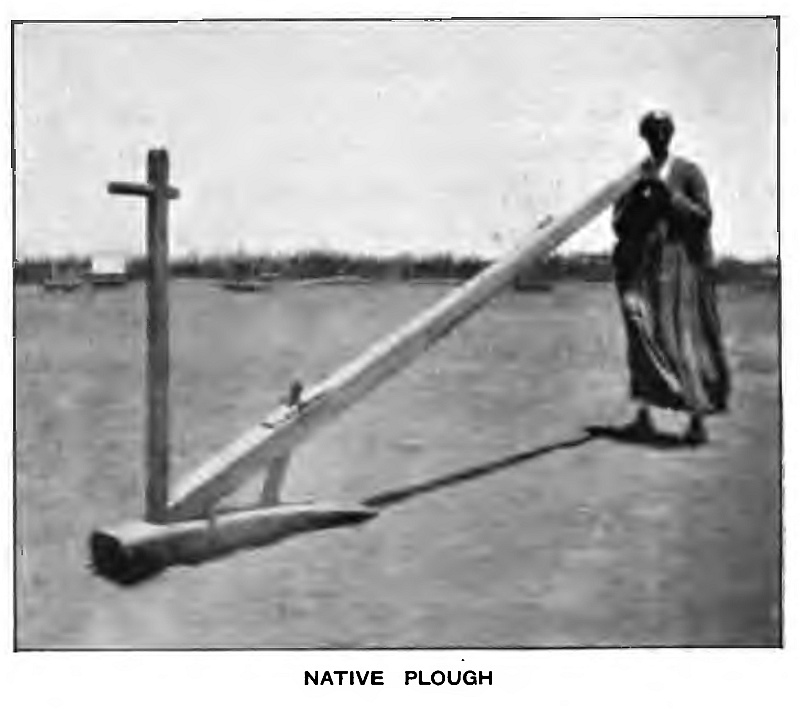
The native plough, as seen by the photographic reproduction, is a very primitive implement, the date of whose invention must be sought for by an examination of some of the characteristic gravings in marble to be found in the Egyptian tombs, where the pursuits of the old-time inhabitants are recorded in a style that is absolutely wondrous.
It consists of a pole of wood measuring about ten feet in length, which is strongly bolted to the sole or body of the plough. This soie, which measures three feet, is shod with a share resembling a pointed shovel. The end of the pole is attached by a rope to the yoke, which lies across the necks of the bullocks, buffaloes, or even camels—as seen in the case of the Norag, drawn round and round over the threshing-floor—which are utilised by the Egyptian cultivator according to his means, while the labourer guides the plough by the aid of an upright handle. This implement does not turn over the soil, and may be properly classed as a one-tined cultivator. There is a quaintness and old-world look, as shown in the photographs, in the mixture of forces, a huge buffalo bull being mated with a small native ox, a bullock with some fine-grown ass, while cows are frequently yoked together to help and drag the light plough. Whether horses of the type of our heavy, slow-going farm breed will finally work their way to the front remains to be seen; but at present they have hardly begun to oust the old-world yokes of strangely assorted beasts from the turning up of the soil. It is more probable, unless the fuel difficulty stands in the way, that the larger tracts will be further brought into cultivation by means of steam and the deep subsoil ploughs which do such an immensity of work in a single day.
As will be noted in the description, the modern native plough is single stilted, and it might be supposed in a country like this that such an implement had been in use ever since the plough’s invention; but as in many other records that have been unearthed, engraven in stone in the wonderful pictorial writings found in temple and tomb, we have proof that this was not always the case; for in the days of the agricultural King Ti, who is supposed to date back to the Fifth Dynasty, that is some five thousand years in the dim past, there is a representation of a plough in use with two handles, very much the same in shape as those brought out quite lately and known as the “American chilled,” these being guided in our own old familiar way.
The Baulk wood used as a harrow or roller is drawn by two bullocks, and answers its purpose in smoothing the very sandy soil fairly well.
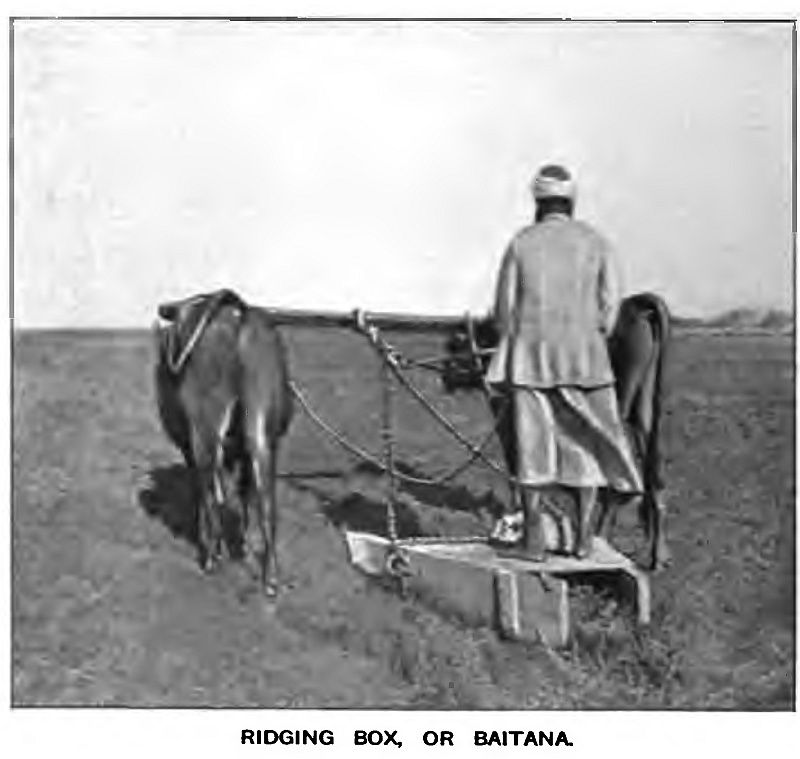
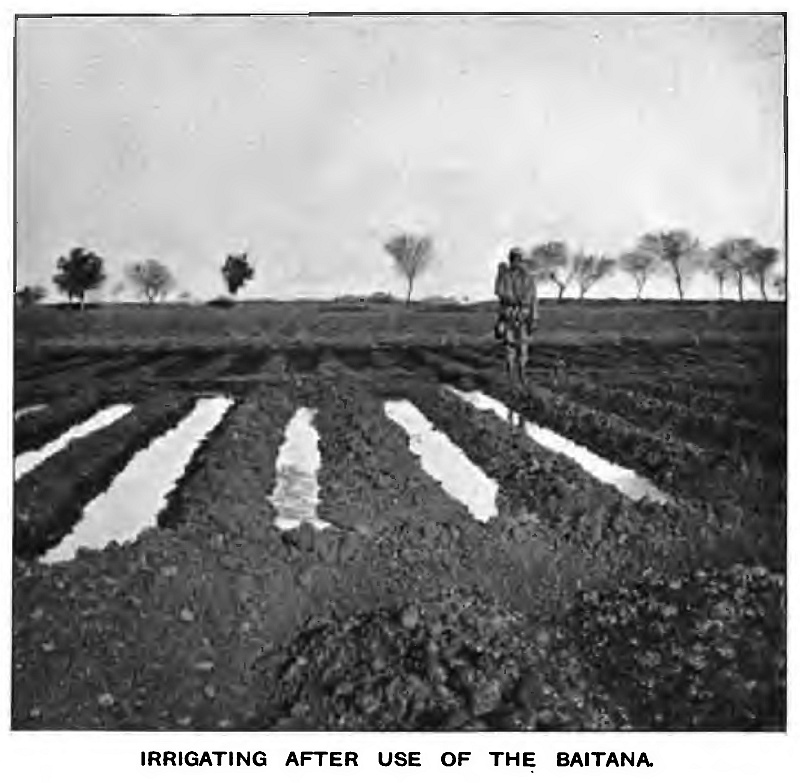
The Ridging Box, or Baitana, is used for raising low ridges on the flat to retain the water for irrigation purposes.
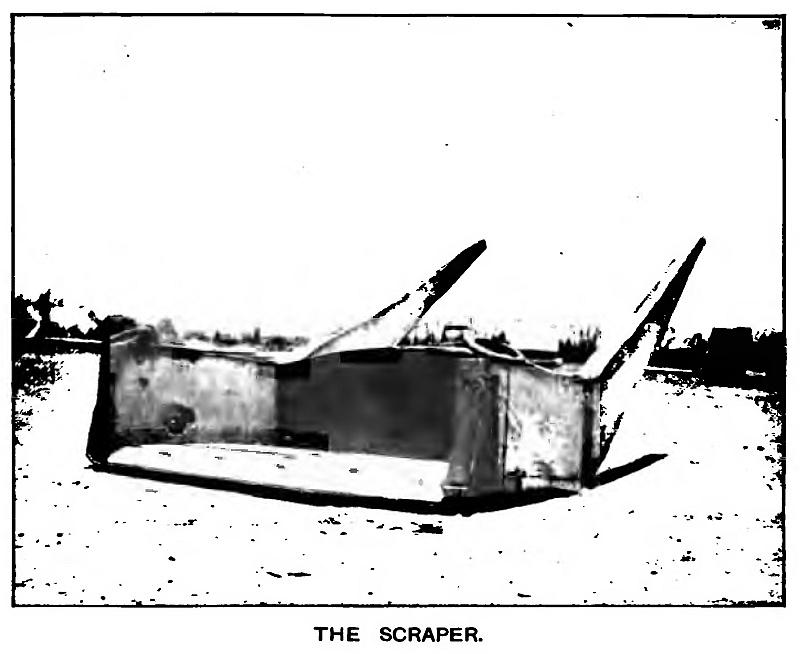
The Scraper is a box with two handles for levelling high land and earning the sand to lower portions.
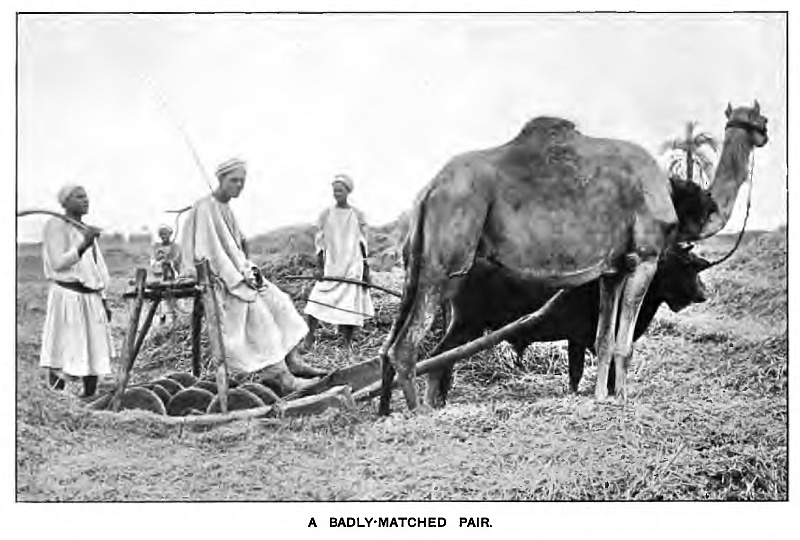
The Norag is a massive frame fitted with three or four axles, upon which are fixed steel discs twenty inches in diameter and with four or five discs alternately on each axle. This is drawn by a pair of bullocks over the cut grain till it is threshed out. This implement is, by long proof, most effectual in its action, for when drawn over the grain sheaves it acts in a two-fold way, loosening the ear, or, in the cases of some leguminous crops, the pods—and, of course, vastly helped by the treading of the oxen’s hoofs—so that the grain falls through right to the bottom and is covered by fresh quantities, sheaves, or the like, of the crop that is being threshed. Its second action is that the edges of the discs are constantly bruising and half cutting the straw or stalks, which in a dry season or from want of effective irrigation are often hard and woody. It must be understood that the straw is not used; as in England, for litter, but as the most important food for cattle, and this action of the Norag, with its sharp discs, so bruises and chops up the straw that it becomes softened in its harshness, and far better for the animals to which it is supplied for food. In fact, during the time when it is most supplied to the cattle, which is during the summer or least abundant season, it is a work of necessity to make it more attractive to the animals, this bruising and cutting bringing forth the flavour of such juices as still remain in the plant, making it slightly aromatic and certainly more palatable as food.
We in England have not been ignorant of the value in cattle feeding of endeavouring to give some zest to the coarser kinds of fodder which economy necessitates in the case of the British farmer. Poor hay, musty grain, consequent upon a bad harvest, and unsatisfying chaff, are eaten by unfortunate cattle, which, suffering as it were from Hobson’s choice of having that or none, eat the provender supplied without protest; but Nature resents it for them, and they show it in their poor condition. Of course, in the case of a well-bred horse the matter is different; he snuffs at and blows upon the untempting contents of his manger, and then turns away in disgust from that which his cloven-hoofed companions patiently chew.
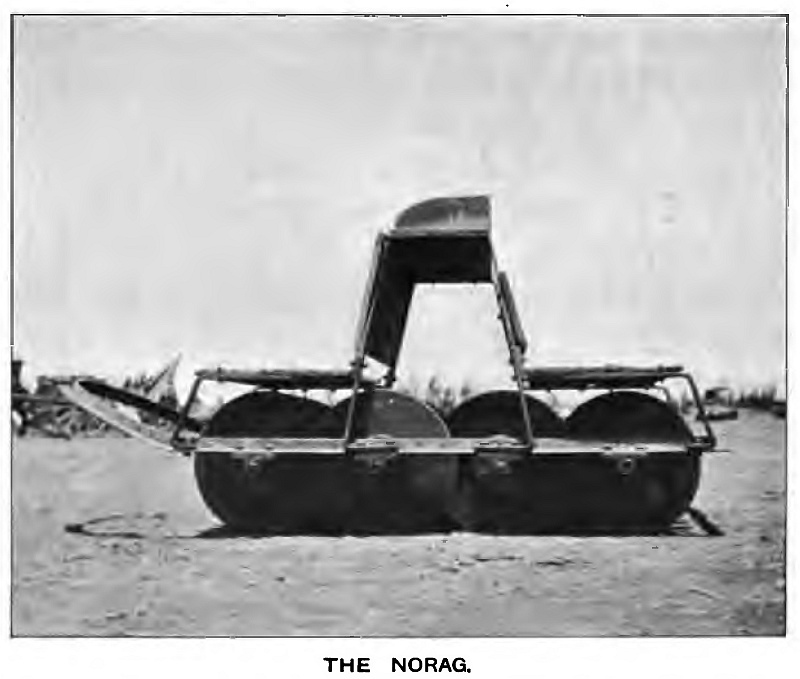
But in many a case this damaged grain, hay, or straw has been made attractive by a sprinkle of one of the savoury cattle foods that were invented and imitated some forty or fifty years ago, a portion of the ingredients in one kind consisting of the broken up and stickily sweet locust bean and the contents of its pod, with a dash of the bitter and aromatic fenugreek. But in Egypt, where the rain does so little towards injuring the straw or stalk, such musty fare seldom falls to the lot of the native cattle, while this chopped or bruised straw, the tibn already mentioned, is constantly prepared at the time of threshing by the action of the ingeniously constructed Norag.
No one can see the spot laid down for the reception of the harvest produce in Egypt—so much hard-beaten earth upon which the peas, beans, or grain of various sorts are thrown, ready for the oxen to drag over it this peculiar revolving wheeled or disked implement—without being reminded of the place where the plague was stayed—the threshing-floor of Araunah the Jebusite; nor can he help comparing the native plough, that simple scarifier, with antique agricultural tillers of the soil depicted on the most ancient sculpture or penned in olden manuscripts, as in use by ancient nations as well as by our Saxon ancestors. The ploughs of the West many, many centuries back are almost precisely the same as those we see in the Egypt of to-day, save in the cases where he who drives the plough has to deal with a hard and heavy earth crust far different to the light and sandy soil of Egypt, whose labourer guides a plough with one hand; for in one antique representation of ploughing the labourer steers the agricultural implement with his left and wields in his right a heavy axe, whose purpose is to break the clods prior to the passing of the implement he steers.
Ingeniously constructed, but that is all that can be said of the native threshing machine, for amongst the poorer class cultivators its manufacture is almost inconceivably rough, and clumsy in the extreme. No verbal description could compete with that afforded by the photo-engraving that accompanies these pages, depicting, as it does, the rough, effective implement, its attendants with their quaint forks and rakes, and, above all, the driver, who adds his weight to the farming implement and shoulders his very merciful speed-inducing wand for the benefit of his mixed yoke. This is, of course, an awkward team, but not infrequent; and the Egyptian farmer who first attempted this application of force must have been as eccentric as he was ingenious when he coupled on either side of such a rough pole a patient camel and a native bull.
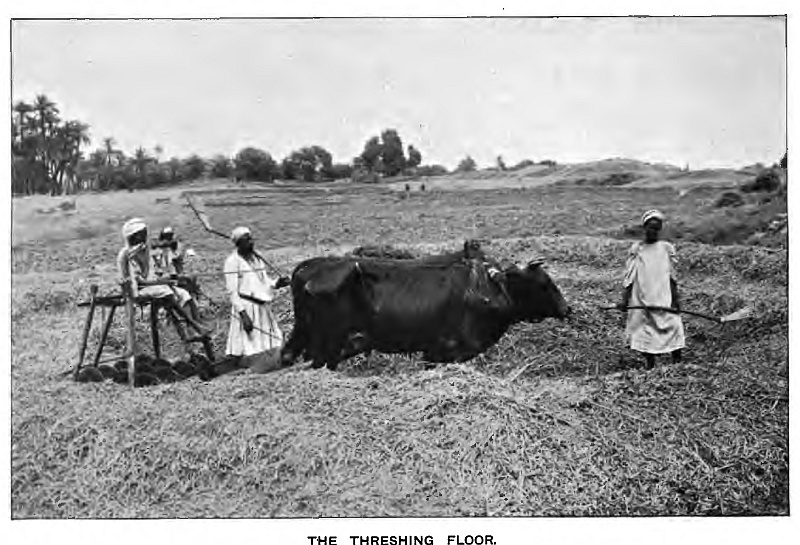
But somehow, and by a careful division of labour and adjustment of the yoke, the two patient beasts may be seen plodding on round and round the smooth, level, modern representative of the old Biblical threshing-floor. The more regular yoke attached to the Norag, which from its cutting and bruising qualities has been translated by the French “Hache paille,” or chop-straw—this bears astounding similarity to the “whop-straw” shared by the old-fashioned British bucolic with his flail—is seen in the other photograph of the pair of native cows, though very frequently it is drawn by a yoke of oxen, by the big, clumsy buffaloes, or even by a yoke consisting of one of each, the oxen taking the palm for their sturdiness and staying power. This mode of threshing and bruising and chopping the straw is carried out in a similar mode in parts of India.
Here though these old ways are giving place to the use of modern machinery, which is readily adopted by the Egyptian, who naturally does not find in the threshing machine the old failing complained of by the British farmer, to wit, that it bruised and broke up the straw, rendering it unfit to use as thatching or to make into the neat, pale golden trusses once so familiar in the market.
There is, however, an unpleasant feature in the native threshing in connection with the samples of corn. As may be supposed, when the threshing is at an end and the tibn stacked, or rather piled in a heap, leaving the grain to be shovelled up, no amount of winnowing and sifting can remove from it a certain amount of sullying brought about by the constant trampling of the oxen.
This has, in the past, acted inimically to the success of the fine, hard, dry, shot-like grain of Egypt in foreign markets; but in these days of advance not only has the bullock-worked European threshing machine made its way into the Egyptian fields, but it is no uncommon thing for the pleasant hum of the steam thresher to be heard where the ingenious machinery of England is carrying on its untiring labour of threshing out, winnowing, and filling its sacks of grain, as much at home as if it were upon some Yorkshire or Lincolnshire farm.
It will not be out of place, after dealing with the Egyptian tibn, to state here that experienced cultivators have found the advantage of carefully feeding their working bullocks so as to obtain for them the good, sound stamina which will be naturally followed by the best amount of work. This they find by sprinkling amongst the chopped straw or tibn supplied about one-third in weight of beans, not crushed or ground, but either whole or split; for it has been noticed that the draught animals flourish better upon this food than upon bean meal; while the process of splitting, Mr Wallace states, saves the bean from the attack of one of the Egyptian farmer’s minor plagues—the weevil; for, as if governed by some wondrous instinct in their preparations for the continuation of their species, and a desire to ensure for them good wholesome food upon which to feed, these creatures do not lay their eggs in damaged grain.
Of late years many of the European implements have been introduced—Ransomes’ threshers and straw—bruisers, one-way or balance ploughs, harrows, clod-crushers, horse-hoes, Norwegian harrows, spring-tooth cultivators, steam ploughs and cultivators, mowers, reapers, and binders, maize-shellers, seed graders, broadcast-sowing machines, and seed drills.
European ploughs, as they invert the earth, are naturally the most beneficial to the growth of the crop, as by bringing the under-soil to the surface to receive benefit from the sun and air, they greatly improve the root range of the plants.
Steam ploughing is gradually gaining in favour, owing to the scarcity of work-bullocks. A few of the large proprietors have recently purchased plants or entire gear. The scythe for cutting clover has been found, too, a great improvement upon the antique native fashion of pulling by hand, the saving of expense being seventy per cent. But a great drawback to the adoption of European implements is the aversion of the Egyptian farm labourer to any innovation, his want of intelligence in handling what to him appears complicated machinery, and his unwillingness to learn. Here, though, in common justice it must be said that he does not stand alone, for the experiences of the British farmer in most of our counties, and his battles with the pig-headed conservatism of his men, would form an amusing chronicle. The clumsy implement of his forefathers, invented, historians say, some five thousand years ago, is in the native’s eyes perfectly right, and could not be better; and he prefers to go on blistering or hardening his hands in what he looks upon as the good old ways, until he is forced to handle modern machines, and then by very, very slow degrees he begins to see, but not before he has broken many, or put them out of gear. But unfortunately the farm labourer is not the sole offender, as the history of the introduction of mechanism of any kind will tell.
Chapter Sixteen.
Much has been written about Egypt and its soil; but in giving here an account of its possibilities and prospects for cultivation in the ways of modern farming, some repetition is necessary. It is fair to say that the soil of Egypt is one of the richest in the world. It is alluvial, ranging from the heavy argillaceous to light loam. It varies, too, in its fertility, and in low-lying lands is frequently impregnated with salt. This is generally owing to want of drainage. When properly treated and flooded with water it soon becomes what is technically known as “sweet,” and available for the growth of crops.
Very rich soils are to be found in the provinces of Menoufieh and Charkieh, while those of Beherah are flat and generally low-lying; but the depth may range up to forty feet!
The preparation of the land for the various crops is not what may be termed difficult, although in the heavy black lands powerful draught oxen are required for the ploughs and other implements. But with irrigation at command, and abundance of moisture becoming more and more common in connection with the modern dams and canals, if the land be hard and baked it can be flooded with water as required, when it quickly becomes in a friable condition, and hence comparatively easy to break up.
In the Delta such conditions are never experienced as frequently are encountered upon the heavy clays in England, where the land becomes so hard that it cannot be tilled.
Possessing the qualities of richness, vast depth of soil, and a glorious climate, it is not surprising that with the steady developments of the Khedive’s country and the safety and security enjoyed under his enlightened rule, accompanied by the example he is setting in his experiments for the advancement of Egyptian agriculture, the price of land has risen enormously. Within the last few years one hundred pounds per acre is quite a common figure; but that which is unreclaimed can still be purchased for from fifteen to thirty pounds. This, of course, necessitates an additional outlay, which is, after all, quite a moderate sum, upon improvements, when it will yield a good return of profit.
The Egyptian agriculturist divides his year into three portions:
Summer, from April 1st to August 1st.
Nileh, from August 1st to December 1st.
Winter, from December 1st to April 1st. But it must be remembered that the Egyptian winter would be better named balmy spring.
As this little work is written primarily for those who take an interest in the progress of a favoured country, and who may possibly be looking towards the East with the eyes of investment, or for a future home where they may lead a Virgilian or bucolic life, it is proposed to give here a simple, business-like account of the various processes and preparations made for the growth and harvesting of the different crops sown in the above seasons:—
Winter Crops: Clover, barley, beans, and wheat.
Summer Crops: Cotton and sugar-cane, and also maize.
Nileh Crop: Maize alone.
Rotation.—A three years’ rotation is the one generally practised, although there is a tendency to limit it to two years.
It would be as well to consider the crops as they succeed each other, beginning with the cotton.
A great deal of interest attaches to the growth of cotton in Egypt. It was largely cultivated by the ancient Egyptians, and its products utilised, but after a time—it is impossible to say how long, possibly during the great changes that took place during incursions, conquests, or change of rulers—its growth died out to such an extent that a few generations back, as an article of utility, its cultivation had pretty well ceased, and cotton was scarcely known, save as a decorative shrub in the gardens of Cairo.
But during the reign of the Khedive’s ancestor, Mehemet Ali, a man of great foresight, full of determination for the advance of his people, he completely grasped the idea that Egypt was one of the most suitable of countries for the cultivation of the cotton tree, and that it ought to be produced in his dominions instead of dependence being placed upon importation from other lands.
In pursuance of this idea, he began to make experiments, testing it, so to speak, by forming plantations. These turned out so well that he proceeded to take further steps, and with great enterprise commenced the cultivation upon a large scale. Many thousands of the Egyptian acres were planted in the lower provinces, and to a far greater extent planting was carried on in the rich lands of Upper Egypt bordering on the Nile.
The little trees responded freely to the Egyptian cultivation; the rich, irrigated soil, yearly replenished by the sediment left by the floods, proved that the ancients were right, and wherever the land was deep the results were most favourable; while where a bad selection had been made, and the soil was shallow and inferior, the return of the pods, or technically bolls, was poor.
The method of its cultivation will be given in extenso farther on, but it will be as well to note here, in regard to the enterprise which turned Egypt into its present state as one of the great cotton-growing countries of the world, that the seed was originally imported from Brazil, though it is undoubtedly a native of Northern Africa; and at the present time the returns are very great.
The preparation of the land for the growth of cotton commences in January. The seed is sown from the middle of February till the middle of March, and the cropping harvested, or picked, about the end of November; while previous to the last picking of the soft woolly pods, clover seed is sown amongst the standing cotton trees.
This, so to speak, stolen crop provides a supply for horses, cattle, and sheep till the end of June; for it must be borne in mind that Egypt is not a land of fields and meadows enclosed by hedgerows; hence grazing for cattle is the result of foresight, and has to be provided as required.
On the land not sown with clover, and at the end of the cotton harvest, after the little trees have been uprooted, a crop of beans is sown, which becomes ready for harvesting in April; and now there is a period in which the agriculturist may take his choice of sowing what may be termed catch crops, or fallowing his land for five months. In this he is guided by position and the facility offered for the disposal of such easy crops as water melons or maize, which can be taken after beans.
It is at the end of October that he begins to think of his main crops, when wheat and barley are sown, to be harvested from the beginning of May to the end of June. Then follows the main crop of maize, which occupies the land from July 15th to November 15th.
Previous to the harvesting of this main crop of maize, clover is again sown, and from this one or two pasturings are obtained before the land is broken up once more for the succeeding important crop of cotton, this completing the rotation.
The sugar-cane has not been given a place in this rotation, as it is principally grown in Upper Egypt for the manufacture of sugar, while we are dealing with the rich lands of the Delta and the farming there. But we may here remark that the Egyptians are as fond of the green sugar-cane as an article of diet as the blacks of the West Indies, who may be seen munching its luscious saccharine at all times and seasons.
There is something more in this among the Egyptians than the gratification of a sweet palate, for it is eaten largely from the great faith of rich and poor alike in its tonic qualities. “Gasab,” or as they pronounce it in Cairo “’asab,” is considered to be one of the greatest restorers for those who from weak health or excess are what we call in modern phraseology “run down”—perhaps as pleasant, plentiful, and economical a medicament as could be used. It is a common sight for the European to see the poor, patient, overladen, and underfed donkeys coming into Cairo every morning heavily laden with the juicy caries that have been grown in the neighbouring fields.
It will be observed in the above rotation that a crop of clover precedes and succeeds the cotton.
We now proceed to a technical statement of the treatment of an Egyptian farm; not merely a description of farming in Egypt, but of the management of a farm based upon the careful observations of one who has passed many years in the Delta and has made the cultivation and cropping of its peculiar soil a thorough life study. In fact, the tracts of land under his superintendence offer themselves as specimens worthy of copying by all who seek to make the land of Egypt profitable and well paying in return for the capital, large or small, that may be invested there. This being said, we at once plunge again in medias res, and, at the risk of being too formal and technical, recapitulate the crops in their order. Cotton.
Followed by Clover, or Beans, or both.
Followed by Fallow, or catch crops of Maize or Water Melons.
Wheat and Barley.
Followed by three months’ fallow, or Maize, main crop, and catch crop of Sesame. Clover—“Fachl” on land after Maize and Clover “Miscowy” after Fallow. Then Cotton.
Chapter Seventeen.
We will take an estate of three hundred acres, and on inspection, say in the month of March, the crops occupying the land under the following rotation will be as under:—
Three Years’ Rotation. March.
100 Acres Cotton 50 acres Clover 50 acres Beans 80 acres Wheat 20 acres Barley
Two Years’ Rotation. March.
150 Acres Cotton 30 acres Clover 40 acres Beans 60 acres Wheat 20 acres Barley
Within the last few years there has been a tendency to increase the cotton crop and adopt the two years’ rotation; but it is not a good practice, as it tends to exhaustion of the soil, especially where there is a want of farmyard manure. The cereal crops also suffer from the consequent lateness of sowing.
Two crops off the same land per annum: Wheat, sown November 15th, harvested May 30th; maize, sown July 15th and harvested November 15th. Or clover, sown November 1st, first crop January 1st, 3 pounds; second crop March 15th, 3 pounds. Sow cotton in end of March. Ground clear, November. Probable gross return per acre, 24 pounds.
We might multiply instances where two separate crops can be grown on the same land in twelve months, such as maize followed by potatoes, etc.; but it may be safely stated that a very small area of a well-appointed farm is allowed to lie fallow, the land being continually under some crop or another.
A few remarks on the before-mentioned crops as to cultivation:—
Cotton is the principal crop in the rotation, and gives far the best monetary return, while at the present time reports from the Egyptian Soudan are beginning to speak very highly of the alluvial tracts between the White and Blue Niles as being more favourable to the growth of cotton than the lower portions of the Nile Valley, while affording ten times the area for the planting of this important staple that can be had in the lower portions of the Delta. In fact, matters seem to prove that Upper Egypt is going to develop into the finest cotton-growing country in the world.
The preparation commences in January, and generally three ploughings are required to bring the land into a proper tilth. The more thorough the cultivation the better for the crop. The land is then thrown into ridges measuring from crest to crest three feet. Then a pair of ridges is drawn across the longitudinal ridges, the distance between each pair of ridges (which form a waterway) being twenty-two yards. Between these pairs—i.e. eleven yards distance from each—a single ridge is made. This acts as a partition to stop the water. Six ridges are irrigated by allowing the water to flow from these cross-waterways, and the reason for confining the length of the ridges to eleven yards is to ensure the evenness of the irrigation as to height of water level, as the ground may have slight fall, and if the whole length of the ridges were to be watered at once the water would rise too high at the lower parts before the higher levels were properly soaked.
The sowing commences February 15th. Boys and girls drop the seed in clusters of, say, twelve seeds in set-holes made by a pointed stick on one side of the ridge, two-thirds from the bottom of the furrow, and at a distance of sixteen inches between each set-hole.
After “planting,” the ridges are watered, care being taken not to allow the water to rise to the level of the seed. Sufficient moisture for germination is derived from capillarity. The seeds shoot and the plants appear above ground in from ten to twelve days. Twenty-five days elapse, and then a light hand-hoeing is given, while after fifteen days more the plants are thinned, two or three being allowed to remain in each set-hole.
Immediately after thinning the young plants receive their first watering. After, say, twelve days a second hand-hoeing is given, and again after twelve days a third. Then comes the second watering, by means of trench and canal. After an interval of ten days another hand-hoeing is given, and this finishes the task, as the cotton trees have attained a height which precludes the possibility of using the implement.
At intervals of from ten to fifteen days six waterings are given. This brings the grower to the time—about September 10th—when the crop is ready for the first picking. Women, boys, and girls pluck the cotton from the trees. Eight to twelve of the workers may pick an acre per day, and they receive as payment one shilling per 100 pounds. At the conclusion of the picking the field is irrigated again, and after twenty-five days the second crop is dealt with. Another irrigation follows, time is given for development, and then comes the third and last picking.
The cotton trees are next cut close to the ground or pulled up by the roots, and are utilised as fuel.
An average crop on good land may produce 1,890 pounds of raw cotton, which on being ginned will yield 600 pounds of fibre. The raw cotton—i.e. in seed—is sold per 375 pounds at, say, 3 pounds. This will gin out, say, 105 pounds fibre and 205 pounds seed; so that the total worth of the crop may be estimated at 18 pounds, exclusive of the value of the wood, which may be placed at 4 shillings per acre. These figures are often exceeded where the cultivation is well attended to.
Cost of raising one acre of cotton in Egypt.
pounds s. d.
Three Ploughings 0 12 0
One Ridging 0 4 0
Dressing Ridges 0 2 0
Planting 0 0 10
Seed 0 5 0
Wages for Nine Irrigations 0 5 6
Six Irrigations by Pump 0 15 0
Three Irrigations by Free Flow 0 0 0
Three Cultivations by Hoe 0 7 0
Three Pickings 1 0 0
Pulling Trees 0 3 0
3 pounds 14 4
Farmyard Manure and Application 0 10 0
Total 4 4 4
The varieties of cotton grown in Lower Egypt are Mit-Afifi, Abbassi, Yannovitch; in Upper Egypt, Ashmouni.
Generally speaking, the quality of Egyptian cotton is of a high grade. Its fibre is long, fine, and at the same time strong.
Unfortunately this country has pests, not like the old Biblical plagues, but which give much trouble and do a certain amount of damage to the cotton crop. Among these are the cotton caterpillar and the boll-worm, the former being propagated from eggs deposited by a moth, which do great damage if allowed to hatch, by the larva feeding upon the plant. If the leaves upon which the eggs are deposited are pulled and burned, this mitigates the destruction so far as it is successfully carried out. The boll-worm bores into and feeds upon the heart of the young bolls, and thereby totally destroys them for the production of fibre. Up to the present no remedy has been found to prevent the ravages of these pests. The damage may amount to 20 per cent. Fogs and dews in the month of October also cause injury to the bolls.
Beans after Cotton.—This crop may be sown at any time during the month of November, the earlier the better. The beans may be either sown broadcast or dropped into the furrow, behind the native plough. The quantity of seed required is two and a half bushels. The land must be very moist, or an irregular germination of the seed will be the result. The crop receives the first watering thirty days after sowing, or immediately before flowering, and again when the beans have formed in the pod. Harvest will commence about the middle of April. Men, women, and boys pull the crop by hand, breaking the stalks close to the ground, sometimes uprooting them, but a small serrated hook is also used to cut the stalks. Six hands will reap one acre per day, and the payment is in kind, at the rate of one sheaf per thirty. The crop is then carted to the threshing-floor, spread out to dry, and threshed by the Norag; or, as modern implements are creeping into use, by a steam threshing machine made by one of the famous English firms.
This crop does not receive any manure, but requires a rich, heavy soil, when under favourable conditions a yield may be expected of from twenty-five to thirty-five bushels per acre—price per five bushels, 1 pound. Occasionally this crop is damaged by hot blasts—“Khamsin winds”—which shrivel the bean, especially if they occur when it is soft. We have also the pest of broomrape; and if badly infested by this weed, great destruction follows to the crop. Beans are the main feed of working bullocks, milch cows, and donkeys.
Catch crops, on land after beans.
Maize (summer).—Sown end of April, ready to be pulled after sixty days. This crop is consumed by the natives, who roast the cobs. Cost of raising one acre, 2 pounds 10 shillings, exclusive of rent. Gross value of crop may be approximately 10 pounds.
Water Melons.—Sown at the same date, ripe after eighty days. Cost of raising, 3 pounds 10 shillings. Probable value of the produce of an acre, 12 pounds. After these crops have been harvested the land is fallowed for three months. During the fallow it receives two or three ploughings, and is flooded with water to prepare it for sowing the cereal crops.
Egyptian Clover (Trifolium Alexandrinum).—After Cotton.—This crop may be termed the preserver of Egyptian agriculture, since, as previously alluded to, it provides pasturage for horses, cattle, sheep, camels, mules, and donkeys, for a period of seven months, and also taking into account its beneficial effects on the soil, restoring fertility by root residue containing nitrogen. Sown in the end of October amongst the standing cotton trees, the seed falls upon the newly irrigated soil and takes root, no covering being required. Sixty pounds of seed is sufficient for an acre. The first crop should be ready for pasturing at the beginning of January; second crop, seventy-five days; third crop, forty days; fourth crop, thirty-five days’ interval.
This variety is named “Miscowy,” and stands copious watering. The first and second crops contain about eighty per cent, of moisture. The third crop may be made into hay, and the fourth crop—part only—may be threshed to furnish seed. The gross weight of the four crops, cut green, may be estimated at thirty tons, or five tons of hay. The work-bullocks, cows, buffaloes, horses, etc., are tethered by a rope attached to their fore-legs and fixed to a peg driven into the ground, the cattlemen moving the animals forward as required. The cattle lie out at night while pasturing on the clover.
If the crop of clover is near a large town where dairymen require green pasture, the price per feddan, to be consumed on the land, may be put at 4 pounds, 3 pounds, 3 pounds 10 shillings, 3 pounds 10 shillings for the four crops, or a total of 14 pounds. Growers are sometimes troubled by attacks of cut-worms, which ravage the young shoots of clover; but flooding with water often destroys the pest. There is also the parasitic weed Dodder (Cuscuta Trifolii), which occasionally does damage to the crop. The cost of five bushels of clover seed varies from one pound 10 shillings to 3 pounds 10 shillings, according to supply and demand. The variety “Fachl” clover occupies a separate place in the rotation, and will be treated later.
Wheat.—Varieties: Common wheat, Bocchi, and Indian. The Bocchi, a white wheat, is extensively grown. The third, a reddish wheat, has recently been introduced from India, and gives good crops. Egyptian wheats are hard, but are deficient in albuminoids. Unfortunately, care is not taken in selecting the seed, and many samples are badly mixed with red and white varieties. The crop is sown on fallow land after clover and beans. The land, previous to sowing the seed, has received a watering. Fifteen to twenty days after, the seed—two and a half bushels—is sown broadcast, and is ploughed in by the native plough. The sowing is very often imperfectly performed, the distribution of the seed being very irregular. The next process is rolling by drawing a baulk of wood (see illustration), three yards long, over the land; then ridges are made seven yards apart to regulate the even distribution of water.
Somewhere about twelve days after the sowing the shoots appear above ground, when the “braird” is about four inches high. Occasionally there is an attack of “grub,” or cut-worm; but the damage is never serious, a watering destroying the pest, and some seed sown on the blanks caused by the worm soon make good the damage. Rolling with a press roller has been found to materially stop the destruction. Eighty days after sowing, or when the crop has attained a height of two feet, it receives its first watering; forty days afterwards its second and last. Sixty days after the final irrigation the crop will be ripe for harvest. The method of harvesting—reaping—is by small hand hooks, men, women, and boys turning out to work at midnight, reaping till seven a.m., subsequently gathering the unbound sheaves into rows, and afterwards gleaning, finishing up about nine a.m.