George Manville Fenn (continued 3)
Reading edition
The foremen then distribute to the reapers one sheaf for thirty-five, as payment in kind. The reason for reaping the crop by night is that, if performed in the daytime, while the heat is great, the grain would shed, the dews at night preventing this loss. Reaping by self-binders has been tried, but the shedding of grain was excessive, as they could only be worked in the daytime; while the farm labourer was not qualified to work such a complicated machine. Labour is so cheap that it is not necessary to resort to labour-saving machinery. The sheaves (unbound) are transported from the fields to the threshing-floor by camels, carts drawn by oxen, or mules. The sheaves are then placed in a circle measuring twenty yards in diameter. Four, five, or more pairs of oxen, each pair attached to a Norag, circle round on the top of the grain, and when it has been threshed out and the straw cut and bruised by the revolving discs and the feet of the oxen, it is thrown into a heap in the centre. Fresh sheaves are added to the circle as they arrive. When all the grain has been threshed the next process is the winnowing by throwing the cut straw and grain into the air vertically by means of a five-pronged wooden fork. The cut straw, Tibn, is carried by the wind to a distance, while the grain falls near to the operator.
The payment to the winnower is at the rate of fourpence per five bushels. Threshing and finishing machines, made in England, similar to the one illustrated, are used on all the large estates, and perform the work quicker and cheaper than the Norag, and of course they are much cleaner, the straw not being trampled and defiled. They are complicated, owing to the fact that the straw must be chopped and rendered soft to the touch, as the oxen will not eat it when it is not bruised—a serious matter, this, in a country where cattle are almost entirely fed upon straw. It might be argued that, as in England, the wheat and other stalks might be cut up by machinery into chaff; but the explanation is simple. The haulm or stalk of cereals in a hot country like Egypt grows harder and more woody than that of colder climates, and when simply cut up into chaff the product is so harsh that the unfortunate animals find that it soon produces soreness of the mouth, and reject it in consequence as being unfit for food. The sample of grain after being threshed by the Norag is often, however, mixed with particles of earth, as some of the crop has been pulled up by the roots. But as most of the wheat is consumed in the country the people do not object to a dirty sample.
The total value of one of these crops may be taken at nine pounds 10 shillings per acre. The cost of raising one acre of wheat, ploughing, labour, watering, up till harvesting, may be estimated at one pound 10 shillings, and the yield may be thirty-five bushels grain and one and a half tons straw. The weight of grain per imperial bushel is sixty-four pounds, and the price per five bushels one pound. Algerian and Italian wheats have been tried, and the results have been fairly encouraging. English varieties have also been experimented with, but invariably have resulted in failure through bad germination.
Barley.—The native variety, Baladi, is mainly grown. The head is four-rowed, and about two and a half inches long. It is sown in November and December. Seeding, the same as for wheat. Seed, two bushels per acre. First watering, sixty days after sowing; second and last watering, fifty days after the first. Harvest commences April 15th. Reaping the same as for wheat. Cost of raising one acre, one pound 5 shillings. Yield of a good average crop, sixty bushels grain and one and a quarter tons straw. The weight of grain per bushel is fifty-seven pounds, and the price ten shillings per five bushels. Total value per acre, 7 pounds 10 shillings. The barley is fed to horses mules, donkeys, and camels, while the natives make it into bread after mixing it with wheat in equal proportions. Egyptian barley grown in the Delta is not good for malting purposes, the grain not being “plump.” In 1893, by way of experiment, a few foreign varieties were grown in Egypt, principally with a view to providing a good malting sample.
Scotch Chevalier barley gave the best results. A sample from the crop of 1895, grown from seed raised in the country, was awarded the first prize for barley grown out of England at the Brewers’ Exhibition, London.
The yield was not so heavy as with native barley, being as eight is to twelve; but it furnished more straw. The money value in England was Chevalier, 1 pound 9 shillings, as compared to 17 shillings for native barley; but the European barleys are more difficult to grow, and if not reaped before becoming dead ripe the heads break off and fall to the ground.
Barley is grown on the Libyan Desert (Mariout), west from Alexandria, and is entirely dependent on the rains in winter. It is sown by the Bedouins in October—to await the rains which may fall in November or December—and also after a rainfall. As the Bedouin is not an agriculturist, he scatters one and a quarter bushels per acre, and scratches the ground by the aid of a small plough, to which is yoked a camel or donkey.
This soil is of a rich yellow colour, sandy loam, fine level tracts of it extending to a thousand acres or more. To obtain a good supply of water, wells are dug to a depth of forty feet or so, and the supply is fairly good. Perennial irrigation can be resorted to by means of these wells.
If the rains are propitious, the Bedouin may reap crops of barley, with extremely varied returns, running, as they do, from two and a half to twenty bushels per acre, the price received on the spot being 15 shillings per five bushels. Ninety per cent, of the barley goes to England for malting.
Next come, in the rotation,
Maize (Nileh).—Main crop on land after cereal crops. Sown end of July. Seed, about one bushel per acre, dropped in the furrow by a boy immediately behind the plough. First watering, twenty-five days after sowing; second fifteen days after; third twelve days, fourth twelve days, fifth ten days, sixth eight days, and seventh eight days, seven irrigations being necessary in this dry and thirsty land for the production of the crop. One cultivation is given by hand hoe after the first watering. The maize grows quickly, attaining to a height of seven feet, and occupies the ground one hundred days. Cost of raising, two pounds 6 shillings. Yield per acre, fifty bushels; value, 8 pounds 10 shillings.
Maize is a most important crop in Egypt, as upon this grain the natives depend for the bulk of their food. Ground into flour and mixed with Fenugreek seed, it is baked into bread. Five varieties of this grain are grown, but the best kinds are known by the natives as “Baladi,” “Biltani,” and “Nab-el-Gamal.” As Indian corn is a surface feeder a liberal application of farmyard manure is necessary to secure a full crop. Harvest begins in the middle of November. The stalks are cut and carted to the threshing-floor. Then the cobs are pulled from the stalks and spread out to dry for thirty days, when they are put into the granaries. To separate the grain from the cobs, hand shellers are employed, or it is beaten out by sticks.
For a catch crop on land after wheat and barley, Sesame may be sown in the beginning of June. There are two varieties, the Red and the White. Six pounds of seed will sow one acre, broadcasted and ploughed in by the native implement. The duration of the growth is five months. The crop receives one hand-hoeing and five waterings. It is harvested in October before it becomes dead ripe, to prevent the shedding of seed. Sesame is grown for the sake of the oil, which it yields to the extent of over fifty per cent. This oil is used for domestic purposes, especially by the upper class Egyptians. The production of seed per acre is about twenty-five bushels, valued at 13 pounds.
In some parts of Upper Egypt a great deal of land is sown with the Dourra (Holcus douta), which is largely consumed by the peasantry, forming, as it does, one of their staple foods. It is a very useful and suitable plant. It is sometimes eaten like maize or Indian corn in a green state, being previously roasted on the fire, or green like sugar-cane. Its pith, when dried, is used as starch; while the leaves make excellent provender for cattle.
We now have to consider the last crop in the rotation, namely clover preceding cotton. As part of the land after wheat and barley has remained fallow, and advantage has been taken to level, clean, and flood with Nile water rich in deposits, “Miscowy” clover is sown broadcast, when the surface of the land is covered with three inches of water. As the water sinks into the soil the seed germinates upon the surface, which is now composed of fine silt. Sown in the middle of September, the first crop should be ready for cutting or pasturing about November 5th. During the period of growth the crop has received three waterings. Immediately after the clearing a watering is given, and the second cutting should be ready in seventy days. After eating off, the land is ploughed for the cotton crop.
“Fachl” clover is stronger in the stem than that known as “Miscowy,” and grows as a tall, luxuriant crop. It is sown amongst the stalks of the maize in the end of October, the land having previously been watered, and by the time the maize is ready for cutting, the clover has attained a height of five inches. The crop should be ready for cutting about the middle of January. Generally it is disposed of by the acre—to be cut and removed from the land, and sold in bunches to be fed to carriage horses, precisely as the green tares and clover are brought into London in bunches during the spring time of the year. The value of one cutting is 5 pounds per acre. Unlike the “Miscowy” variety, the “Fachl” only yields one crop, as the roots fail. The land is then broken up for the crop of cotton. This finishes the three years’ rotation.
Chapter Eighteen.
It will be interesting to add a few remarks on a system of cultivation which is practised on tracts adjoining the Desert. The land has been purchased at a price of, say, 17 pounds per acre, and the next proceeding has been to level it—by the free use of the Cassabia, or scraper, which, in roughest preparation, is drawn over and over the sand and guided something after the fashion of a plough—and then bringing it into communication by canalising with the nearest distributor of the Nile water, while in this country of exceedingly cheap labour the cost of these preparations for cultivation may be set down at about 10 pounds per acre.
This done, the purchaser has the option of carrying on the cultivation himself, or letting it to the fellaheen, who will take it readily and pay a rent of 4 pounds per acre or feddan.
The fellah now crops his land as follows, and the reader will notice the variation in the products the native causes his fields to bring forth.
He begins with:
Earth Nuts (Arachidis).—Sown from April 1st till July 1st. Duration of crops, six months. Water every five days till high Nile, when no water is required. Yield per acre, sixty bushels, value 10 pounds.
Sesame.—Yield, fifteen bushels; value, 7 pounds.
Chick Peas.—Sown from April 1st to July 1st. Duration of crop, six months. Yield per acre, thirty bushels; value, 6 pounds.
Maize (Oswego).—Sown March 15th till April 15th. Duration of crop, seven months; value of crop, 9 pounds.
Potatoes.—First crop planted October. Duration, three and a half months. Yield, three and a half tons; 17 pounds 10 shillings.
Potatoes.—Second crop planted February 15th. Duration, three months. Yield, three and a half tons; 17 pounds 10 shillings.
Lupins.—Sown November 1st. Duration of crop, seven months. Average yield, fifteen bushels; 2 pounds 8 shillings.
Clover, barley, beans, Syrian maize, and henna, a dye plant.
To begin with, the land is here generally pure sand, but after flooding with Nile water, which is often available without pumping—i.e. free flow—the sand gets mixed with the Nile mud and a good soil is rapidly formed.
Sugar-Cane.—This, one of the most interesting products of the Eastern soil, beautiful in form, and attractive in every stage, from its early green growth through the tasselling, or flowering, up to the time when the swelling cobs are changing from their attractive green to golden yellow, amber, and brownish or purple black, is cultivated both in Upper and Lower Egypt. It is grown in two varieties, the native and the Greek, and the colour of the ripened canes forms a gradation, passing from light yellow through striped red and yellow, and red.
The cultivation is, as stated, principally carried on in Upper Egypt—for the manufacture of sugar. If it is planted in the Delta it is for sale to the natives, by whom it is consumed raw, and by sucking the juice. The farmer who plants his land with sugar-cane begins by thoroughly well preparing the soil, and ridges it as if he were about to plant potatoes, these ridges measuring about thirty inches from crest to crest.
The canes are cut into lengths of one yard, placed in the furrow, and covered with the soil. Planting commences in February, the ridges being watered immediately after, and the young shoots appear after twenty days. The crop is watered every fifteen days, and at longer intervals after the Nile has risen. The land is hand-hoed three times, and the cane should be ready for cutting in December and January. The value of an average crop sold standing—in Lower Egypt—may range from 20 to 25 pounds per acre. Then the trashings covering the ridges are burned, a watering given about the beginning of March, and the old roots sprout again, when there is a second crop, and again the following year by repeating, a third crop from the one planting. The third crop is not so profitable, as the roots become exhausted. The sugar-cane requires a liberal dressing of manure each year. The yield of trashed canes may run from six tons the first year, five tons the second year, and four tons the third year, and the percentage of sugar may be estimated from fourteen to fifteen per cent.
Chapter Nineteen.
Rice is extensively cultivated in the districts of Rosetta, Damietta, Fouah, and Facous; but it is the opinion of a very excellent authority that rice cultivation and the growth of this grain, which is seen at its best in the swamps of Asia, will gradually die out of Egypt and become a thing of the past. For, given ample water and a level of mud in which the planter may thrust in the plant in its early green state of blades, an abundant crop is pretty sure; but now that Egypt is becoming more and more in a state of transition, with good drainage extending, and modern applications at work for the proper washing and purifying of a soil that is impregnated with salt and soda, this country will no longer be the paddy field of yore, and the culture of rice may well be relegated to the mud swamps of the countries farther east.
There is no cause for regret here, for, in comparison with those easier of production, rice is far from being one of the best crops that can be sown. Among farmers and gardeners there is a term known as sickness of the land, marked by a want of vigour in its productions; and in Egypt this may be produced by the want of that great sustainer of plant life, decaying vegetable matter, or the impregnation of the soil with some form of salt, soda in the main.
With the improved farming now going on, the natural soil, which was once ready enough in its production of rice, is rapidly changing its character, constant tillage, the flooding and washing which carry out the efflorescing salts, and the constant addition of vegetable manures, aided by one or two crops of clover, being the agents which are working this alteration.
There are five varieties of rice grown in Egypt, namely Sultani, Fino, Sabeini, Indian, and Japan. In regard to quality, the Fino occupies the first place.
The sowing commences in the middle of April, and continues till June. The crop occupies the land from three to six months, according to the variety grown. The rice for seeding is put into water for twelve days, then taken out and drained for two more. It is subsequently emptied out of the sacks on to a floor and covered with hay, to remain four days till heating and germination take place. Then the seed is sown on the land, which is covered with four inches of water, this being drained off after three days, leaving the seed for twelve hours exposed to the sun. Then water is allowed to flow on to the plot once more, and a portion to drain off, the surface at this later stage always having a covering of from four to five inches in depth, so that the irrigation is always fresh. This is continued during the growth of the crop.
The harvesting is in October and November, and the yield of an acre may average fifty bushels of Paddy, which, when shelled, or husked, will give twenty bushels of clean rice, valued at 6 pounds 10 shillings per twenty bushels. The straw may be estimated at a ton per acre, and be valued at one pound per ton.
Rice is one of the chief foods of the Egyptian, and it is an excellent crop to grow on newly redeemed land, provided that water is abundant; for the soil is impregnated with salt, and after a few crops have been taken off the land becomes “sweet,” in consequence of the perpetual flooding. It can then be cropped with clover and cotton, but requires much labour in the way of weeding, transplanting to fill up blanks, and attention to irrigation. After paying rent and working expenses the margin of profit is not great. The size of the plots ranges from half to one and a half acres. The patches are encircled by drains or ditches, which discharge into the main irrigating system.
Chapter Twenty.
If armed with the little enterprise and capital necessary for making a commencement in farming or growing fruit and vegetables in Egypt for the market, a cultivator would find that land could be obtained within easy reach of the great towns of the Delta—Cairo and Alexandria—at a very moderate price; but it is only right to add that this price, consequent upon the great irrigation schemes in progress, is still rising by leaps and bounds. For the soil, where reachable by the flood waters of the Nile, now conserved and carried in every direction by irrigation canals, is practically inexhaustible, and, as previously stated, is often of great depth.
The land is to be purchased with proper titles and registration, giving the necessary security to an alien who is desirous of making his home in the Delta, or rented, if preferred, at a moderate consideration, including water for irrigation. The country is well policed, there is freedom from contact with the inhabitants of the surrounding desert, and a cultivator would have to deal with a quiet, docile people, fairly industrious—that is to say, lovers of work after the fashion of the calm, placid Moslem, who takes life as it is, and seems to make it one of his tenets that there is no need to hurry.
He possesses none of the hurry and rush of Western civilisation; but, on the other hand, he is patient, ignorant, fairly teachable, and willing to work for exceedingly moderate daily payment. The supply of this labour under a kindly, solvent, and honestly paying master is abundant and never fails.
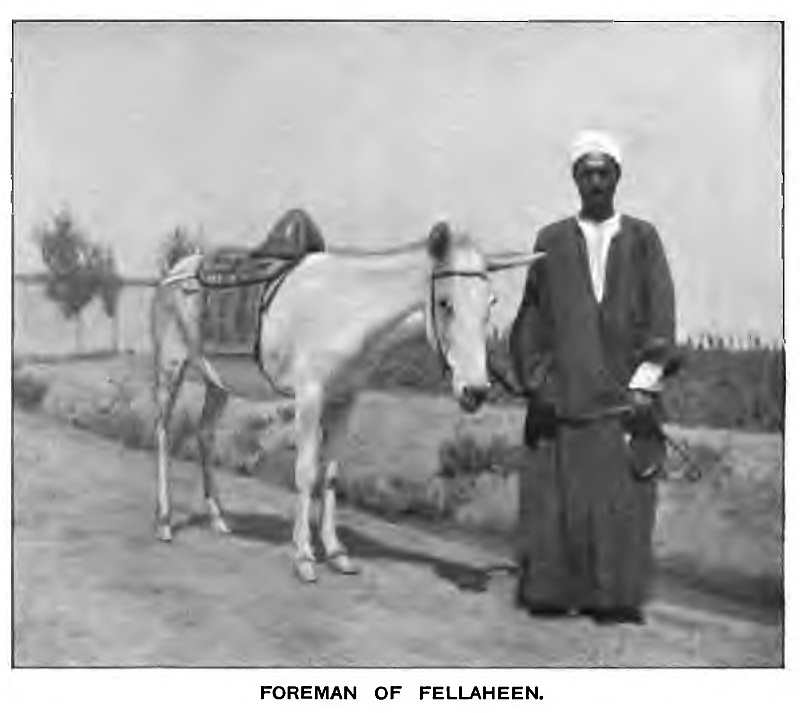
The illustrations of the fellaheen farm labourers and their wives are typical of the class of people with whom he would have to deal, and if the new adventurer objected to the class of hut they occupy, and had lofty ideas about model dwellings and the introduction of lighter implements in place of the clumsy, adze-like hoes with which they are armed rather than furnished, the advice given to him would be to follow that of the old Latin proverb, “Festina lente,” and go by degrees in that, as in most of the other matters of culture, for it takes time to alter custom and change old-fashioned routine.
It may be here added that all great advance and reversals of custom should be cautiously attempted with the land. Still Nature is easier to deal with than man, and less likely to resent alteration when attempted by a practised hand.
As a whole, for the encouragement of those who wish to try the experiment in a foreign land, let them understand that farming in Egypt is child’s play compared to that in Great Britain. There are no wet hay and cereal harvests, there is neither snow nor frost to damage the crops, no high winds, no floods, no ground game to do mischief:
In the season of hay-making, with no possibility of a drop of rain falling, the fellah makes the worst of all hay by allowing it to be burnt to an indigestible fibre—would that he had a training in the uncertain climate of Great Britain! The wheat is harvested when dead ripe. Part may be cut, and part may be allowed to remain for six weeks without deterioration. A contrast this to the harvests in bonnie Scotland, where the corn has lain sodden until it has rotted away in the deplorable weather of the year 1903.
There is a good old proverb that is applicable to most things—certainly to farming in Egypt. It is that “the less there is to do, the worse it is done.” Verily it is so here. Nature is most kindly, and with ample moisture, abundant fertilisation, and plenteous sunshine, she does pretty well half of the fellahs’ work thoroughly well, while their half to complete the operations is carried out with a careless indifference to success that is deplorable. The people’s wants are few, and now that under a generous rule they have liberty and payment for the work they perform, they seem quite content to plod on in easy slothfulness. Sufficient for the day is the evil thereof, so why wear themselves out by toil and the struggle for things better than those which surround them?
All this in connection with the possibilities of this country raises the question, Can the practice of Egyptian agriculture be improved?
The answer of one who has toiled amongst the people for years, whose work has been that of reclaiming tracts of desert land, making endless experiments as to the best suited crops for Egypt and the best ways of producing them, is: Emphatically, yes!
The End.
|
Chapter 1
| |
Chapter 2
| |
Chapter 3
| |
Chapter 4
| |
Chapter 5
| |
Chapter 6
| |
Chapter 7
| |
Chapter 8
| |
Chapter 9
| |
Chapter 10
| |
Chapter 11
| |
Chapter 12
| |
Chapter 13
| |
Chapter 14
| |
Chapter 15
| |
Chapter 16
| |
Chapter 17
| |
Chapter 18
| |
Chapter 19
| |
Chapter 20
|