PART II.
Reading edition

85.—LAUNCHING A SHIP.
After the carpenters have completed the hull of the vessel, the necessary preparations for launching are commenced as follows:—
Get an anchor on each bow; get the cables on board and bend them to the anchors; range and bitt the cables; bend the buoy ropes, and see everything clear for letting go the anchors.
It will then be necessary to get four stout hawsers on the spar deck, two on each side; bend one to the other, and have them coiled down clear for running. This being done, pass the ends of two hawsers out forward, through the warping chocks on each bow; pass the ends aft, one on each side, and make them fast to some secure place, on their respective sides of the launching slip, as clear of the ways as possible. Stop the bights of the hawsers with a single rope-yarn up along the ship’s sides, so as not to interfere with the ways, or interrupt the progress of the carpenters while knocking away the shores previous to launching.
Have men stationed to attend to veering the hawsers and cables when the ship is off the ways, and also to letting go the anchors, if necessary. Have a few buckets of water ready to throw on the bitts, to prevent any danger that might occur from fire while veering the hawsers and cables.
The ways being well greased, and the necessary preparations for launching completed, all the blocks and wedges by which the ship was formerly supported, are driven out from under her keel, until the whole weight gradually subsides upon the sliding ways, or cradle; a few shores, or stanchions, remain, by which she is retained on the stocks until the period for launching arrives, which is generally at high water; they are then cut away, and all obstructions removed, with the exception of the dogshore (a representation of which is given in the Plate). The word is given “to launch”—the dogshore is then knocked away, which causes her to advance down the inclined plane into the water.
If the ship should hang after the dogshore is removed, it will be necessary to apply screws under the fore-foot, which will cause her to move immediately along the ways. The ways generally extend a sufficient depth under the surface of the water to float the vessel when she arrives at the extreme ends.
When the ship is off the stocks “veer away roundly,” and do not attempt to check her until she begins to deaden her way, then check her “handsomely” with the hawsers so as not to part them; if, however, they should part, let go an anchor immediately; if that should not bring her up, let go the other anchor, and veer gradually on both cables until she is brought up.
Note.—When a ship is to be launched it is always customary to hoist the ensign, jack, and pennant; the jack forward, ensign aft, and the pennant amidships. Flagstaffs are erected for that purpose previous to launching, as represented in the Plate, where you see a ship of war ready to be launched from the stocks.

86.—CUTTING OUT STANDING RIGGING.
Lower Rigging.—Measure the distance from the larboard side of the mast-head to the foremost dead-eye in the starboard channels, which distance set off on the floor of the rigging loft and stick in a marlinespike at each extremity. The shroud stuff being stretched, stop one end to one of the marlinespikes; take the bight round the other and back again: this is the first pair of shrouds; pass it round again, outside at each end, for the second pair, and continue in this manner until one gang of rigging is completed. Mark the length of the eyes straight across at the opposite end, to the one stopped to the marlinespike; cut at the latter in an angular direction (so that the after-legs will be a little longer than the forward ones), and the inside pair will be the first pair of shrouds. Hitch a piece of spun-yarn round each shroud, in the centre of the eye, making knots on it according to the number of the shroud, commencing the inside pair with one knot. The mark for the length of the eye gives the place for the eye-seizing; the round of the rope giving their place on the mast-head. (Old fashion.)
The proportion for the eye is the round of the mast-head above the bolsters; I have also seen the breadth of the seizing added (some allow five squares of the mast-head, which is the best rule), supposing it would lay fairer on the side of the bolsters than too close to the mast-head. This precaution is hardly necessary, as the rigging will stretch sufficiently in pulling up to bring the seizing down, no matter how much it may have been stretched before being warped round for cutting.
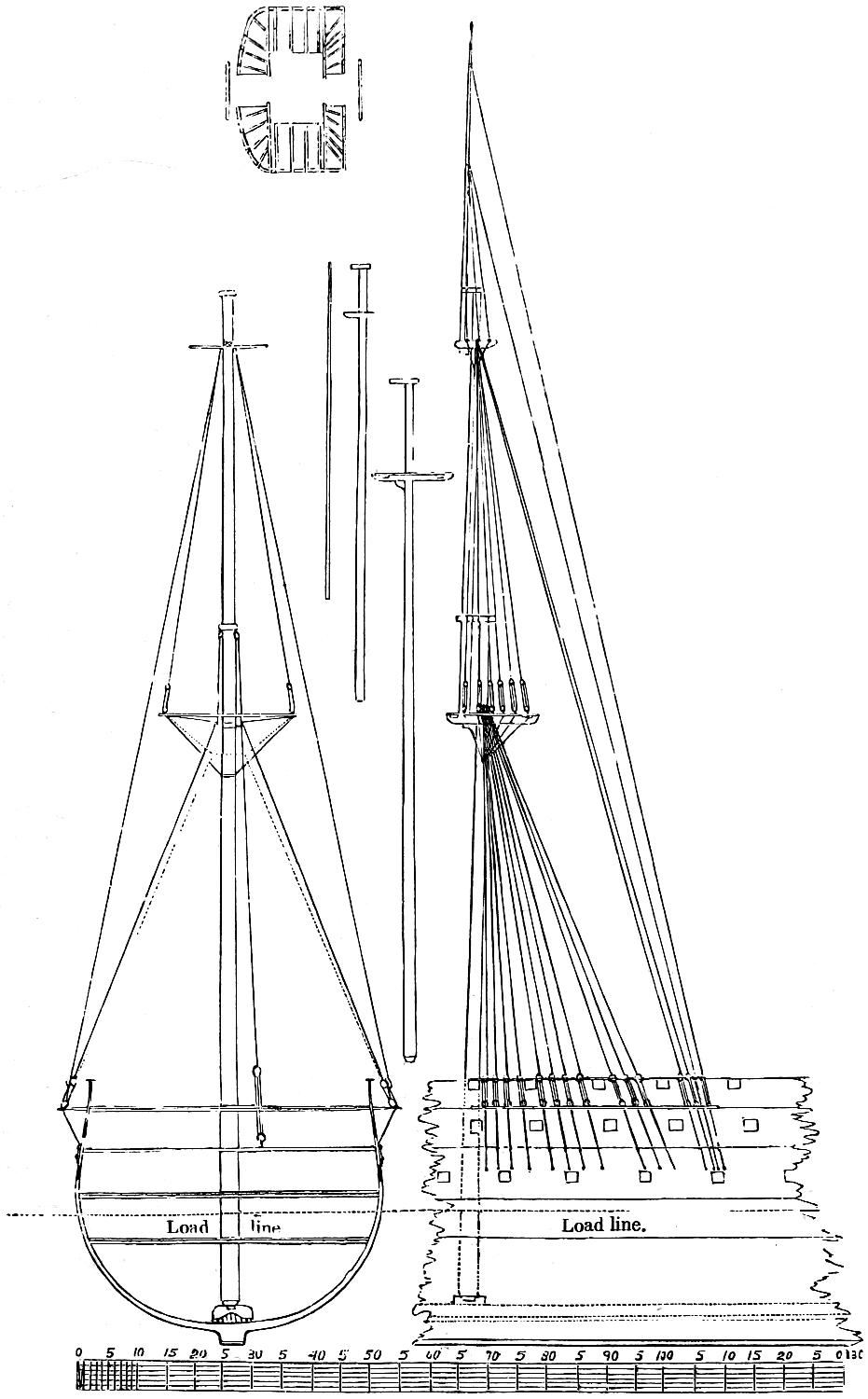
Sketch of a draft for cutting rigging.
Rigging cut on the above old plan, causes great waste in squaring off the ends, after fitting the eyes, previous to turning-in the dead-eyes. I would therefore recommend (if not in a great hurry) a more economical plan. Get the shroud-warp on a stretch, or rather one end of it, long enough for one pair of shrouds; mark off the distance for the required service, and when completed—being wormed, parceled, and served, while on a taut stretch—measure the length with a tape-line, from draft of first pair of shrouds, No. 1 starboard; when measured and chalked the required length, “come up the stretch,” and cut at the chalk-mark; middle the shroud at the centre of the service, and lay it on the loft floor. Continue fitting, and cutting, in this way until you get the number of shrouds required for the gang, allowing each pair of shrouds to lap over the diameter of the rope at the eye, as they are laid on the loft floor; alternately making due allowance at the ends, before cutting, for the carry aft, or the jump of a port, if required. (See Plate.)
Note.—In measuring the length of the shrouds, some prefer the distance from the opposite side of the mast-head to the partners, added to half the breadth of the deck, from the mast to the side.
In parceling, begin at each end where the service is to leave off, and parcel upwards to the middle of the eye, where commence serving downwards on each leg. The eye seizings are round ones, and when put on, the whole eye is neatly covered with parceling. A half-sister block is sometimes put between the two forward shrouds, for the lower boom topping lift to lead through.
87.—TOPMAST AND TOP-GALLANT RIGGING
Is cut in the same manner. In fitting the topmast rigging, always seize-in a sister-block between the two forward shrouds, for the topsail lift and reef tackles. The swifters are generally served the whole length.
The eyes of the top-gallant rigging are made to fit exactly around the cylinder; if there is an odd topmast, or top-gallant shroud, on each side, they are either fitted with a horse-shoe eye, or go together with a cut splice.
88.—BREAST AND STANDING BACKSTAYS.
These may be cut by the same rule; the eyes of the breast backstays are fitted in different ways. They are sometimes spanned together, making a square, the size of the mast-head; sometimes they have an eye like the shrouds, made to fit close; and others have a small eye seized in the bight, and lashed round the mast-head. The eyes of the standing backstays are fitted like those of the shrouds.
89.—CAT HARPEN LEGS, AND FUTTOCK SHROUDS.
Take one-third the breadth of the top, and lay of that distance from the eye-seizing, down upon the shrouds, each side; draw a line across which will represent the cat harpens, and measured on the scale, will give their length; splice in eyes at each end; worm, parcel, serve, and leather them. The distance from the extremity of the top and this line upon the shroud, will give the length of the futtock shrouds, which must have a hook and thimble in their upper ends, and a thimble in their lower ends.
90.—FORE-AND-AFT STAYS.
Measure from the after parts of the mast-head to where the stays set up, and to this distance add the length of the mast-head, for collars.
Collars for stays are the length of their respective mast-heads. The mousings are raised once-and-a-half the size of the stays, and at a distance equal to twice the length of the mast-head from the mousing. A Flemish eye is worked on the end, and the stay rove through it; or they may be fitted with lashing eyes, in which case each leg is the length of the mast-head; the service is continued the length of the eye below the mousing, the collars leathered, and the hearts turned in with the lay of the rope. Stays are wormed, parcelled, served, and leathered in the wake of all nipps, such as the bees, bullock-blocks, and sheave-holes.
91.—CUTTING LOWER MAST HEAD-PENDANTS.
The forward pair should be twice the length of the mast-head—the after pair twice-and-a-half; thimbles are spliced in the ends, and they are wormed or spanned together, so as to form a span to fit the mast-head.
92.—BOBSTAYS.
The bobstays are cut twice the length from the collars, on the bowsprit, to their respective holes on the cutwater. They are wormed, parceled, and served the whole length, and leathered in the nipp, after which they are rove through the holes, spliced together, and the dead eyes turned in, in the wake of a splice.
93.—BOWSPRIT SHROUDS.
The length from the bowsprit to the eye-bolts in the bows; a dead-eye or heart is spliced into one end, and a hook and thimble in the other.
94.—JIB AND FLYING JIB GUYS.
Take the distance from the boom-end to the bows, making a small allowance for reeving through the straps on the spritsail yard. They are generally fitted with a cuckold’s neck over the boom end, and set up with dead-eyes to the bows. The cuckold’s neck is served or covered with canvass. The guys in the wake of the spritsail yard are leathered. The martingales must be cut, and fitted to the manner in which they are rove.
95.—CUTTING RUNNING RIGGING.
The greater part of the running rigging may be cut as it is rove, making due allowance for the hands to clap on. The length and size may also be got from the rigging table for all classes in the navy (see rigging tables). The most proper way to ascertain the length of a rope is from the draft, or rigging plan of the vessel you are employed upon, making the proper allowance for leading out, &c., &c.
96.—RIGGING SHEERS, AND TAKING IN MASTS AND BOWSPRIT.
In cases where there is neither sheers nor wharf to have recourse to, in order to get the lower masts on board, it becomes necessary to get such spars as can be procured, and erect a pair of sheers on board for that purpose.
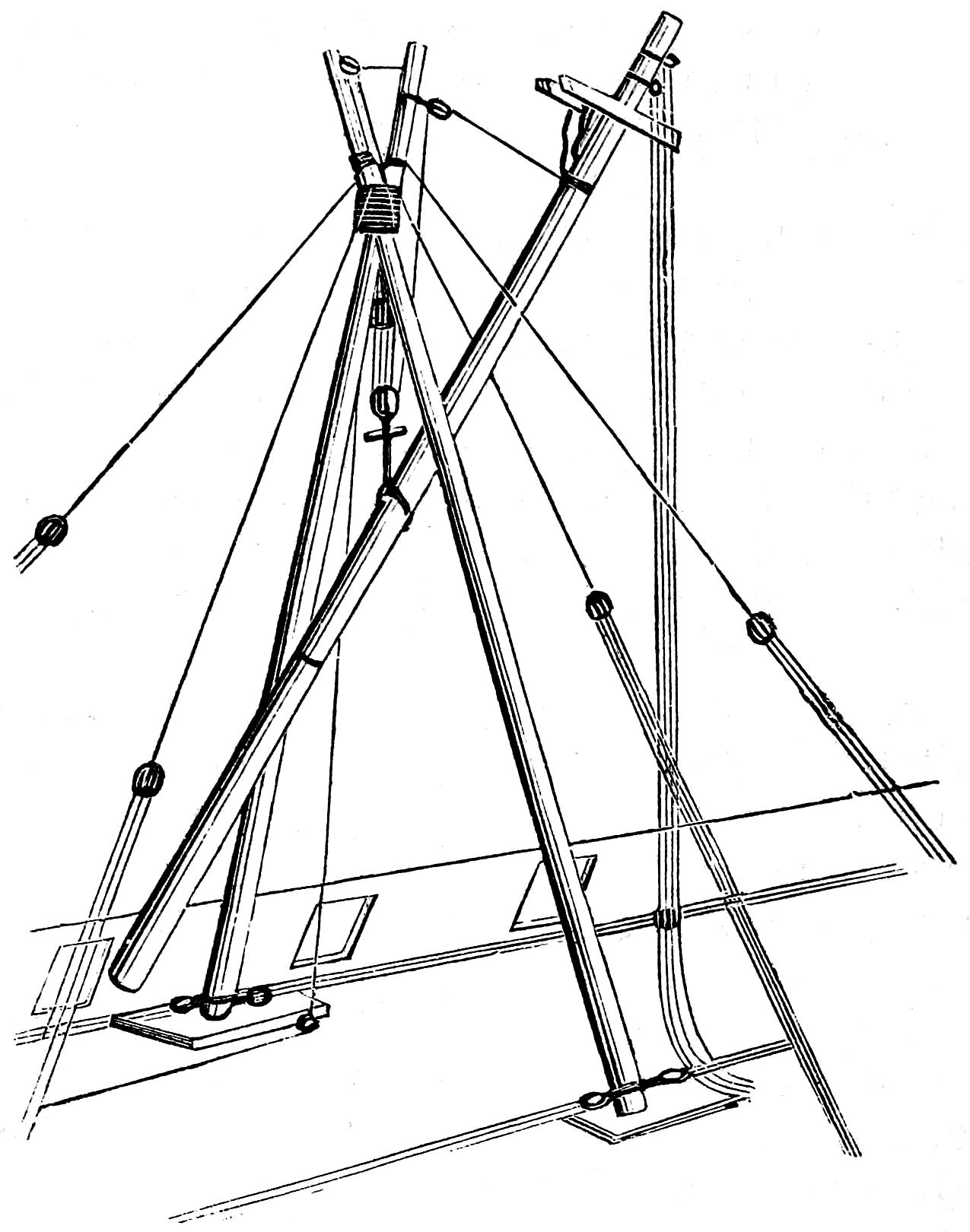
In doing this proceed as follows:—Take in a sufficiency of ballast to steady the ship, and shore the decks from the skin up, particularly abreast of the partners. Sling skids up and down the sides; reeve the parbuckles, and bring the sheer legs alongside, with their small ends aft; parbuckle them on board, raise one leg over the capstan, and their heads or after ends resting either on the taffrail, the break of the poop, or a spar placed in the most convenient spot, the more elevated the better. Square the heels exactly one with the other, so that when they come to be raised the legs may be found of equal height.
As near the after ends of the spars as may be considered necessary, when crossed, put on the head-lashing of new, well-stretched rope (figure-of-8 fashion), similar to a racking seizing, and cross with the ends. Open out the heels, carrying one over to each gangway, and placing it on a solid piece of oak or shoe, previously prepared for the purpose. Clap stout tackles on the heels, two on each, one leading forward, the other aft; set taut the after ones, and belay them. Lash a three or four-fold block, as the upper one of the main purchase, over the main lashing (so that it will hang plumb under the cross), with canvass underneath to prevent chafing; and in such a manner that one-half the turns of the lashing may go over each horn of the sheers, and divide the strain equally; also sufficiently long to secure the free action of the block. Lash the small purchase block on the after horn of the sheers, sufficiently high for the falls to play clear of each other, and a girtline block above all.
Middle a couple of hawsers, and clove-hitch them over the sheer heads—having two ends leading forward, and two abaft, led through viol blocks, and stout luffs clapped on them. These should be sufficiently strong to secure the sheers while lifting the masts.
The lower purchase block is lashed forward (perhaps round the cut-water), and the fall being rove, the sheers are raised by heaving upon it, and preventing the heels from slipping forward, by means of the heel tackles previously mentioned.
Sometimes a small pair of sheers are erected for the purpose of raising the heads of the large ones; in which case care must be taken to place them so as to allow the heads or horns of the other pair to pass through.
When the sheers are up, or nearly perpendicular, cleat the shoes, so as to confine the heels to their places upon them. They can then be transported along the deck by means of the heel-tackles and guys to the situation required, taking care to make them rest upon a beam, and to have the deck properly shored up below.
Finally, give the sheers the necessary rake by means of the guys, and set taut all the guys and heel-tackles. Also, five or six feet above the deck, on each leg, put two cleats, for the purpose of applying two stout lashings from them above, to the dead-eyes in the channels below, in order to give greater security; this being done, the sheers may be considered ready. (See Plate).
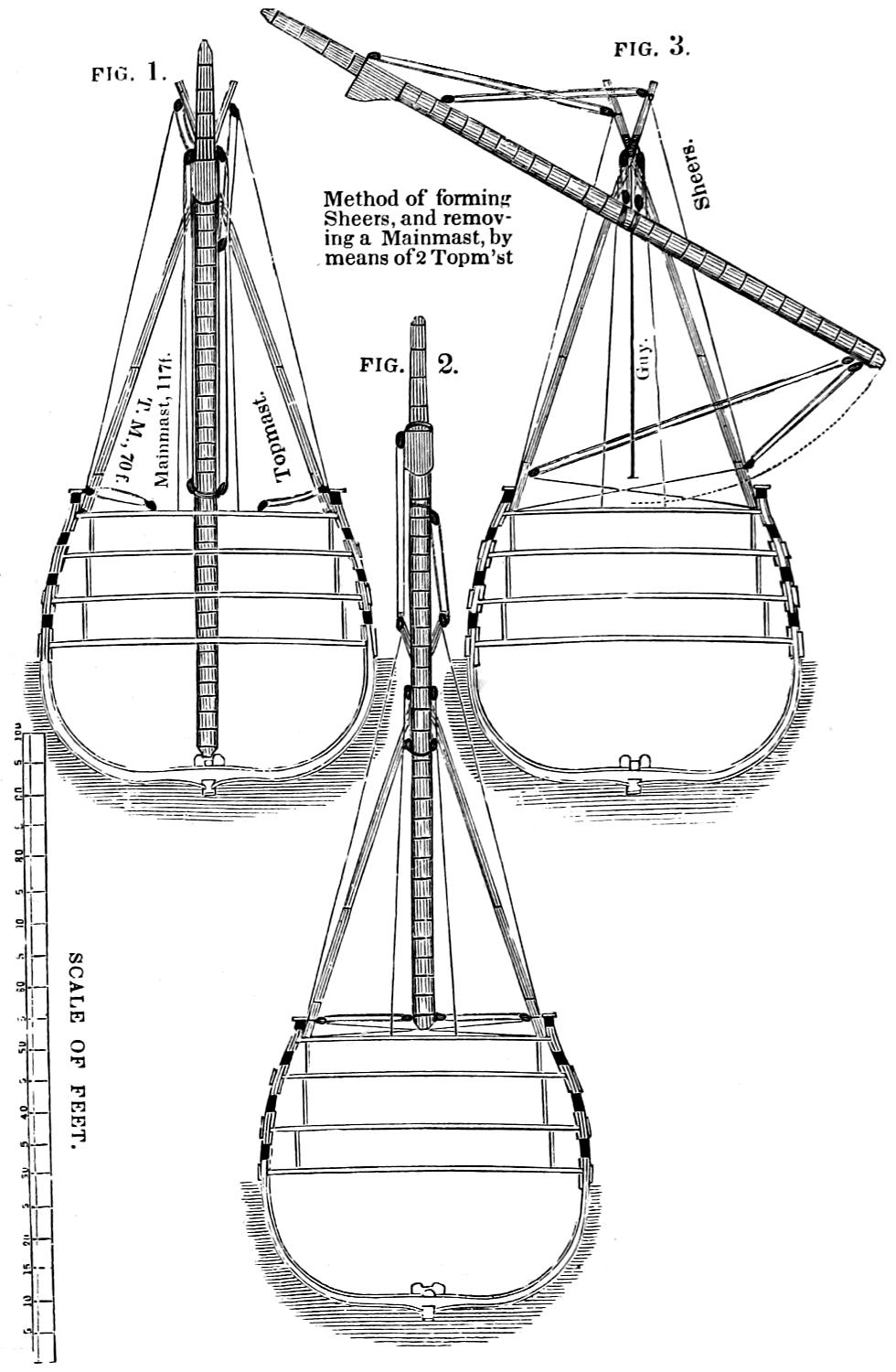
FIG. 1. FIG. 3.
FIG. 2.
Method of forming Sheers, and removing a Mainmast, by means of 2 Topm’st
Masting and Dismasting.
Note.—The skids which are slung up and down the sides, are for the purpose of keeping the sheer-legs clear of the channels, and from thence to the plank shear. Mats should also be placed over the quarter galleys to prevent injury.
Parbuckles are hawsers which are middled; the ends of which are taken through two ports which are about five or six ports apart, from outside, in; down over the rail, under the sheer legs; up again through snatch blocks, in the opposite water-ways, and luffs clapped on them. The counter parbuckles are used to ease the sheer legs down on deck, and are rove through the gun-deck ports. Mats should be placed in the wake of the chafe, where the parbuckle leads over the rail, or up through the gun-deck ports.
The parbuckling on board of heavy spars for sheers may be much facilitated at times, and injury to the ship avoided, by attending to circumstances, and getting them in at slack water, or over the bows or stern.
When a ship is confined to her own resources, the lower yards are the best spars for sheers; the heels (or yard-arms resting on the deck) being strengthened where they taper by a temporary fish, woolded on, and the woolding set up by wedges.
In a brig, the main yard and main boom are the best spars for sheers (if other spars are not available).
The shoes are made of either stout oak plank or beam timbers of pine, and long enough to extend over at least three beams, with a saucer in them for the heels to rest in; likewise, mortices or bolts in each end for lashing. The spare caps will be found very handy for placing the heels of the spars in, and the eye-bolts in them convenient for hooking the heel-tackles, and transporting along the decks.

97.—TO TAKE IN THE MIZEN-MAST.
Tow the mizen-mast alongside, with the head aft, and the garland[1] lashed on to the forward part of the mast, at the distance from the tennon to just above the spar deck partners; lash a pair of girtline blocks on the mast-head, and reeve the girtlines; bend the sheer-head girtline to the mast below the bibbs to cant it. Overhaul the main purchase down abaft, thrust the strap through the eyes of the garland, toggle it, and secure the toggle by a back-lashing. Take the fall to the capstan and “heave round;” when the heel rises near the rail, hook on a heel-tackle to ease it inboard. Get the mast fair for lowering by means of the girtlines, have carpenters attending below, wipe the tennon dry, and white lead both it and the step, “lower away,” and step the mast.
Pass a couple of straps around the mast; to each of these hook the double blocks of the pendant tackles—the single ones to the sides, and hauled taut; wedge the mast temporarily, “come up” the purchases, man the guy and heel tackles, wet the decks, and transport the sheers forward for taking in the main-mast.
The object of taking in the mizen-mast first is, because the breadth of beam is less aft than forward; and the heels of the sheers being spread more as they go forward, the head lashing consequently becomes tauter; moreover, if the mizen-mast was taken in last, the bowsprit must be got in first, and thus the advantage of securing the sheers to the foremast-head, when getting in the bowsprit, would be lost.
98.—TO TAKE IN THE MAIN AND FOREMAST.
Proceed in the same manner as in getting in the mizen mast. The garland for the small purchase should be lashed about the diameter of the mast, above the main purchase.
In taking in either of the masts, if the sheers should be found to be a few inches short, the difficulty may be remedied by manning the forward guy-falls, and bringing the sheers perpendicular to the deck. Some distance may also be saved by using no garlands and having the purchase blocks lashed to the mast. If in lowering there should still be a difficulty, chocks might be placed on the kelson until the tennon rested on them; then steady the mast by means of the small purchase and sheer-head girtlines, while the main purchase is unlashed, and lashed again on the mast sufficiently high to step it.
If the ship has a top-gallant forecastle, it would be well to step the mast forward of the sheer legs, for the brake of the forecastle comes abreast of the partners; and, in a case of this kind, it would be well to take in the foremast first.
99.—TO TAKE IN THE BOWSPRIT.
Transport the sheers as far forward as possible, or as the bows will permit; send a hand to the sheer-head, bend on the girtlines to the small purchase block to light it up, unlash it, and lash it again to the forward fork or horns of the sheers, pass a strap round the foremast-head, to which hook a large tackle, carry it well aft, and haul it taut, for the purpose of staying the mast. Lash a couple of large single blocks to the foremast-head, middle a hawser, and clove-hitch it over the sheer-head; reeve the ends through the blocks at the mast-head, down on deck, carry them well aft, and take a turn. Hook the after heel-tackles forward, and take the after-guys aft; pass a bulwark lashing round each heel, rake the sheers over the bows sufficiently for the main purchase to hang directly over the gammoning scuttle, and make all fast.
The bowsprit being brought under the bows, with the head forward, and the garlands lashed on, the main one a little more than one-third from the heel, the smaller one between the cap and bees, having guys leading from the bowsprit to the cat-heads, and a couple of straps round the heel for hooking the bedding tackles. Overhaul down the purchases and toggle them; “sway away,” attending it by the guys, until nearly perpendicular; hook on the bedding tackles, which are taken from the bitts on the main deck, and led up through the partners; wipe the tennon dry, and white-lead both it and the mortice; “lower away,” bouse upon the bedding tackles, and bring it into its place; come up purchases, guys, unlash garlands, and proceed to dismantle the sheers.
If the ship has a topgallant forecastle, you will be unable to take in the bowsprit with the sheers without the assistance of a derrick[2] on account of the brake of the forecastle, it not being prudent to step sheers on the top of it.
When the ship is masted, and alongside the yard, commence getting on board and stowing ballast and tanks; fit the rudder, gammon the bowsprit, fit and set up the bobstays and bowsprit shrouds; fit fore stay collars; get on board tops, caps, cross-trees, topmasts and topgallant masts, placing lower yards athwart ships, topsail and topgallant yards amidships; also, have ready tackles and luffs for setting up the rigging and staying the masts, top-blocks with lashings for top-ropes, and all the rigging at hand and in order.
100.—GAMMONING THE BOWSPRIT.
In rigging a stage under the bowsprit for this purpose, make use of two small spars, such as topgallant studding-sail booms, with their heels lashed to the head-rail, their heads frapped together, and slung from the bowsprit end, and boards laid across from one to the other.
The gammoning is of new, well-stretched rope, generally water-laid. One end of the gammoning being whipt, is passed through the hole in the cutwater, and over the bowsprit with a round turn, then clenched round the bowsprit close against the stop or cleats; the other end passes through the forepart of the hole in the cutwater, again round the bowsprit (but before the clinch), and again through the hole in the cutwater, abaft the first turn. All the succeeding turns go in the same way, laying forward on the bowsprit and aft in the cutwater, and all are passed inside of the first turns; by which means the outer turns on the bowsprit which bear the most strain are more preserved from chafing than the inner ones.
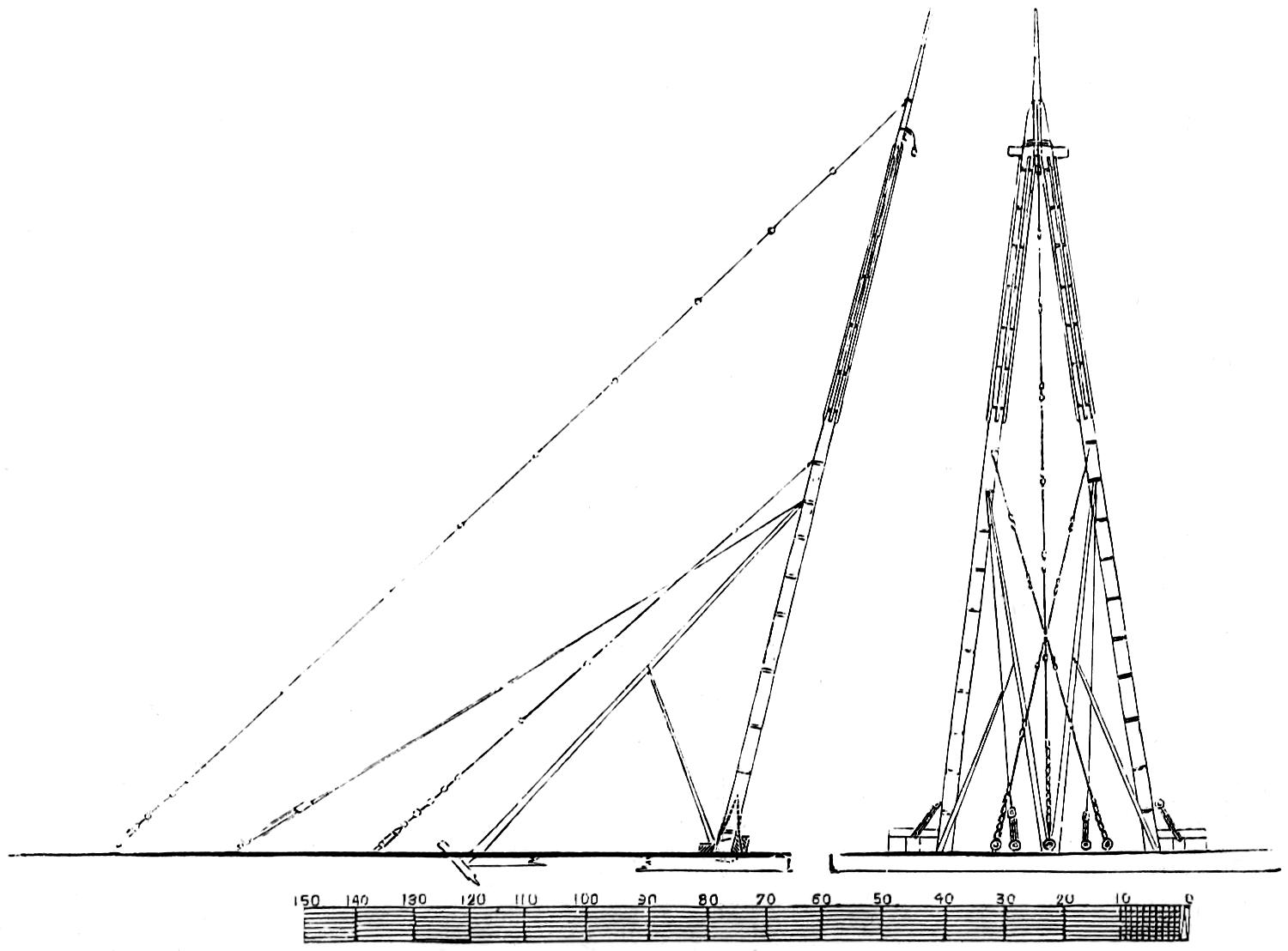
A Representation of the Masting Shears in the New-York Navy Yard, for the Masting and Dismasting of large ships.
The turns are then hove taut as follows:—A leading block is made fast to the holes for the bobstays by a strap long enough to admit of the pendant, which is then rove through it, leading straight through the hawse-hole to the capstan. In one end of this pendant an eye is spliced, through which a bight of the gammoning is passed, and retained by means of a toggle, while to the other end is hooked a long tackle, and the fall led to the capstan. As each turn is hove taut, it is, by some, nailed to the bowsprit, and by others, racked in several places, which is preferable to nailing.[3]
When all the turns are passed and hove taut, they are frapped together by as many crossturns as are passed on the bowsprit. The end is then whipped and seized to one of the turns.
In ships with two gammonings, the outer one is hove taut first, as it would otherwise slack the inner one.
Note.—Iron gammoning is now allowed for vessels of all classes in the service. (See Rigging Table.)
101.—FITTING RIGGING.
The shroud is hove well taut, with a tackle clapped on one end, and the other secured to a sampson post. It is wormed, parceled, and served a third down from the seizing; the swifter or foremost shroud all the way, except where the dead-eye is turned in. A sword mat is sometimes laced on the foremost shroud, which, I think, answers much better, as it can be taken off and the rope dried; and, from the different ropes I have seen rotted under the service, I feel convinced, the less on rigging, unless where absolutely necessary, the better.
In parceling the eyes, commence from each end of the service and finish in the centre, and pass several riding parts, as in breaking the shroud to form the eye, the service gets opened, which allows the wet to get in; and if the service is begun in the centre, doubled, and then passed toward each end, it will prevent the wet getting to the rope.
In forming the eye, take a good strand, knot both ends together, and lay it across both parts of the shroud; having brought them as close together as possible, pass both bights of the strand under the shroud clear of each other; then place a long bolt across, close to the strand on the upper side; take a round turn round the bolt with each bight of the strand on each side of the shroud, put a smaller bolt through each eye in the strand, and heave it round the long bolt, and as the turns accumulate on the bolt, both parts of the shroud come together; when quite close pass the eye seizing, the shroud being previously parceled in the way of it.
When there is an odd on each side, it is fitted horse-shoe fashion to fit the mast-head; parceled, and served over a third down the same as the other shrouds. I have seen the odd shroud put on the mast-head first (after the pendants), instead of last; and then the others put on in rotation: No. 1 starboard, No. 2 larboard, No. 3 starboard, &c., &c.
102.—FITTING MAST-HEAD PENDANTS.
The long leg, when two, should be a third of the shroud. The eye is formed the same as the shroud: wormed, parceled, &c. A thimble is spliced in each end, the ends put in once and a-half, marled down, and served over. The foremost leg is once and a-half the round of the rope shorter than the after one. The thimbles are well parceled before being spliced in.
Small ships have only one pendant on each side; when this is the case, the rope is cut to the proper length, the starboard pendant is spliced into the larboard, and the larboard into the starboard, with a cut splice forming an eye, or span, to fit the square of the mast-head; a thimble is spliced into each end, and they are wormed, parceled and served;—they are the same length as a long leg, when a pair on each side.
103.—LOWER AND TOPMAST STAYS.
Stays are four stranded, and are now both the same size, and lashed abaft the mast-heads. The legs are made for the collar in laying up. When sufficient length is laid up for the stay, from whence the collar commences to the end for setting up, two strands, one for each, are left sufficiently long to double back, and are then laid up as four strands, forming the lashing eyes and legs. The ends of the strands are then unlaid, the inside ones wormed into the lay of the rope; the other strands are divided, laid up, and worked in alongside the first strands; then some more yarns are twisted smaller and used as backing; some inside yarns from each strand should be wormed into the stay their whole length, below the crotch; the legs are then wormed, so as to completely fill the rope, commencing from the centre of the eyes for lashing, which should be well opened with a large setting fid, and worming carried into the stay as far down as the worming of the legs. The outside yarns of the legs are then marled down, over all, round the stay, tapering the ends. The legs are well parceled and served, and likewise the stay, sufficiently far down to take the lower yards, and covered with tanned hide.
The stays should be hove well out with purchases, and allowed to hang, pulling up occasionally. I have known a line-of-battle ship’s stays (cable laid rope) to stretch out twelve feet, and after a two month’s cruise were long enough to allow nearly two feet to be taken off the fore-stays.
Stays fitted with lashing eyes are decidedly preferable, as they are easier shifted; the collars not being so long the yards can be slung higher up, and consequently braced further forward.
In the merchant service the stays are also fitted on the bight, or two in one, as follows: the bight is put over the mast-head and both ends taken forward and set up in their respective places. Others again put the bight under the bowsprit and set them up abaft the mast head, with lashing eyes, putting on a seizing at the proper place to form the collar. This last plan would not answer for a ship of war.
104.—TO RIG THE FOREMAST.
White-lead the mast-head in the wake of the trestle-trees, over haul down the girtlines, bend on the trestle-trees and sway them on board; take out the after chock, wipe them dry, bend the girtlines to the forward part and stop the girtlines to the after part; bend the main girtline to the after part also; “sway away,” having a steadying-line forward to keep the trestle-trees from catching under the bibbs, for if they should be heavy, one man aloft will not be able to bear them off; when above the bibbs, send a hand aloft to slip the stops, one at a time, so as to let them come down gradually. “Lower away,” bouse on the after girtlines, and get the trestle-trees in their places; send aloft the after chock, ship and bolt it. Tar the mast-head in the way of the rigging; overhaul down the girtlines for the bolsters, which are tarred and parceled; sway them aloft and stop them; lash the girtline blocks to the after part of trestle-trees.
The rigging is then sent up by the girtlines in the following manner:—
Mast head pendants.—Foremost pair of shrouds, starboard side; foremost pair of shrouds, larboard side; second pair of shrouds, starboard side; second pair of shrouds, larboard side, and so on until all the shrouds are over, after which send up the stay, and last of all the preventer or spring-stay.
Placing the rigging.—The girtlines being overhauled down send aloft the lower pendants, which have got a long and short leg, fitted together with a span, or square, the size of the mast-head; the long leg is placed abaft, so that in case of the forestay being shot away, the pendant tackles can be hooked in them without being in the way of the fore-yard in bracing; while the leg being abaft, the mast affords them good security. As soon as the mast-head pendants are placed they ought to be lashed abaft, the tackles hooked, and the mast stayed by them. Overhaul down the girtlines, bend the mast-head one on the shroud, with a timber-hitch, or toggle, four or five feet below the seizing, and stop it to the centre of the eye; take the girtline from the after trestle-tree, and bend it half way down the shroud; “sway away,” on the lower girtline, and lift the weight of the shroud. When high enough, the stop in the eye is cut, and it will fall over the mast-head; the men on the trestle-trees placing it fair on the bolsters, beating it well down, with commanders, and observing to have the eye-seizing come as near the centre of the mast-head as possible. The larboard pair is got up in the same manner, and so on until all are placed. Reeve the lanyards, if prepared with a knot on the end; a double-wall and crowned is preferable, a mathew-walker being liable to capsize; the lanyard should be rove through the hole under the end of the shroud, because in setting it up, the strain comes on the shroud first, and keeps the dead-eye in its place; if put under the standing part, the strain coming on the end first, the dead-eye would slue round.
Setting up the lower rigging.—The rigging is often placed and then set up, but I would prefer (if time would permit) having it pulled up as placed. When the first pair on each side are over and placed, and the lanyards rove through both dead-eyes, clap a selvagee strap on each shroud well up; to this hook the single block of a luff tackle; the double, to a blackwall hitch in the lanyard; then take the lower blocks of the pendant tackles and hook them to both the falls of the luffs on each side; reeve the tackle falls through the leading blocks, and pull up, setting up both pair of shrouds at the same time, the men on the trestle-trees beating the shroud down as pulled up; when well up, place two pair more, and proceed in this manner until the mast is rigged.[4]
The advantage of pulling up a pair at each side, instead of singly, is evident from the fact that pulling up singly injures the seizing; as it is first dragged forward and then aft by the after leg, it is liable to slack the seizing, and perhaps snap the inside turns.
In rigging the lower masts, I have seen the after swifter go over first; a plan that is now adopted in small vessels. In staying the mast these swifters should be set taut, the mast being previously wedged, and the stays set steadily up. I have heard some old sailors dispute this plan, it being new, but for my own part I think well of it.
Note.—The trestle-trees might be got over without knocking out the after-chocks, by running up a derrick abaft the mast, well lashed abaft below the bibbs, having chocks placed between it and the mast, sufficient to admit of the free passage of the after chock of the trestle-trees. They are sometimes got on before getting in the mast, but they then bring in an additional and unnecessary weight upon the mast-head, and moreover, in lowering, catch over the shear-head.
N. B. The blocks for topmast stays should be put on after the second pair of shrouds (on foremast).
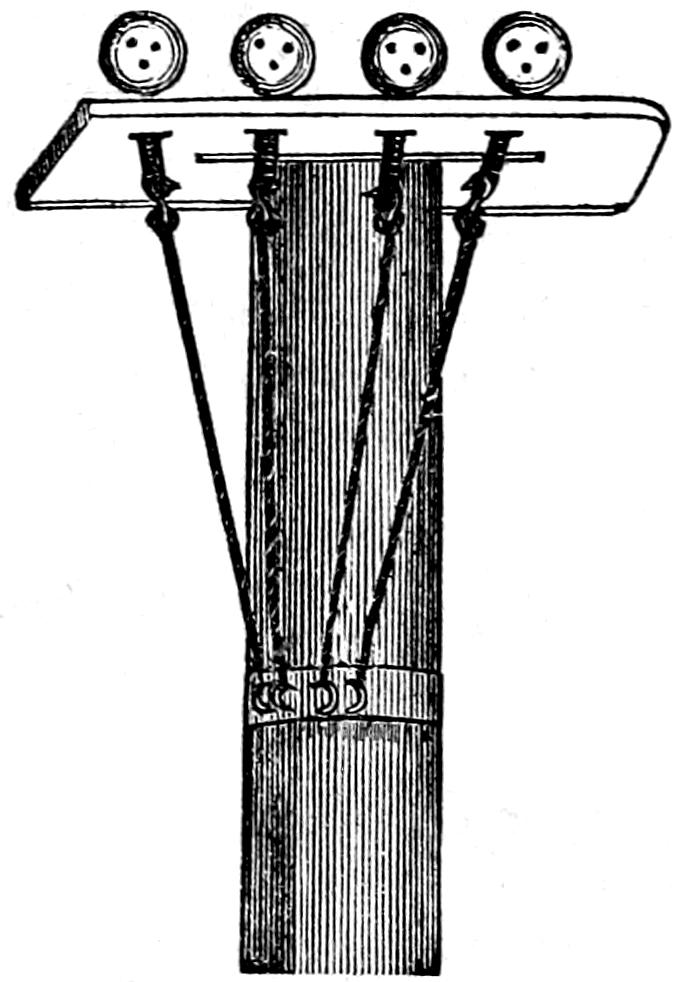
105.—FUTTOCK SHROUDS
Are now fitted, and hooked to the futtock plates in the top, and set up to an iron band round the mast. In small vessels these are iron, and set up with turnbuckles, or screws. Cat-harpens are seldom used, being considered unnecessary lumber aloft.
Note.—The futtock shrouds are hooked to their respective plates, with the points of the hooks in.
106.—TO RIG THE MAIN AND MIZEN-MAST.
Proceed in the same manner as directed for the foremast. The mainmast of a frigate has one more pair of shrouds than the foremast, and the mizen-mast three less. The mizen-mast has only one pendant on each side, fitted with a cut-splice, and a thimble spliced in each end. The rigging is placed the same as the fore or main; the mast is steadied into its place with a couple of long burtons, one to each pendant, and hooked to straps round the bitts, or to ring-bolts in the fore part of the quarterdeck bulwarks. If the stays are not ready for going up, the tackles can be hooked to a lashing round the mast, the pendants being wanted to pull up the rigging (for placing); the rigging is the same as the fore.
In setting up the main-stays, pass one under, the other over, around the cross-piece in the four bitts, for the purpose; clap the selvagee straps well up the stay, and two more near the ends; to these hook two luffs; to the falls of the luffs hook the lower blocks of main tackles; reeve their falls through leading blocks, in as direct a line with the stay as possible, and grease the bitts in the way of the stay.
In placing the main stays, in the manner mentioned above, there is sufficient space between the stays for a shot to pass through, which often prevents their being both cut away at the same time.
When the rigging is to be set up for a full due, the stays in the way of the bitts are well wormed, parceled, served, and covered with hide; and the ends of the stays, and all the lower rigging whipped, and covered with canvass caps (neatly fitted).
107.—TO RIG THE BOWSPRIT.
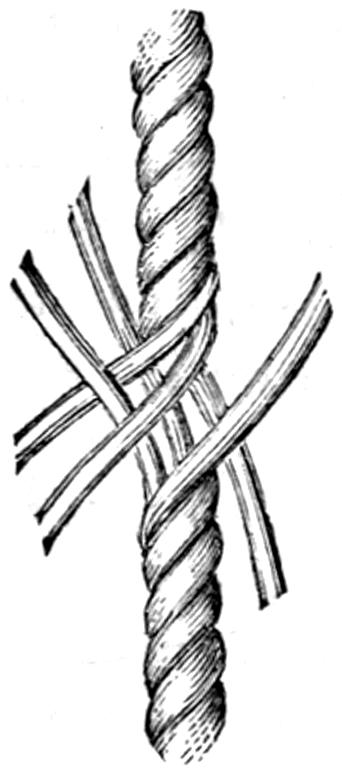
Bobstays.—The rope should be well stretched, wormed, parceled, and served, and in the way of the cutwater covered with leather; when none is to be had, pass two parts of parceling, the first against, the second with the lay of the rope; and serve with good stout spun-yarn, or four-yarn plait; then reeve them through the cutwater, splice both ends together, put the strands in once each way, marl down, and serve over. The hearts are then secured in their place (keeping the splice on the upper side) with a round seizing, with parceling under it. They are sometimes fitted to shackle to the cutwater, with iron plates let in flush with the wood, a bolt going through both plates, which is very snug and strong.
Bowsprit Shrouds are single pieces of rope. When cut the required length (a hook and thimble), the latter parceled, is spliced into one end, put in once-and-a-half, marled down and served over; a heart is spliced into the other. After being hooked to eye-bolts in the bows for the purpose, they are set up to their collars on the bowsprit.
A celebrated master (now a commander) in the navy, and a first rate seaman, never served the bowsprit rigging all over; it is, certainly, in my opinion, better not to do so, as the water can never lodge, which it may do, by getting in from broken service, which cannot be repaired at sea. They are now fitted one-third chain, on account of the chain cable chafing against them.
It is not unusual, in small vessels, to insert thimbles instead of hearts in the bobstays, bowsprit shrouds, and collars; covering the lanyards neatly afterwards, with canvass.
Placing the rigging.—Tar well the bowsprit; then put on the first forestay collar, first pair bowsprit shroud collars, first bobstay collar; second bobstay collar; second pair of shroud collars; spring-stay collar; and cap bobstay collar; then heave them close up, pass and heave well on with a rose-lashing.
The man-ropes are spliced, or hooked into bolts in the bowsprit cap, and in the other end an eye is spliced; ends put in once-and-a-half, and set up with a lanyard to an eye-bolt in knight-heads or stanchions, for the purpose; splices served over, and leathered in the nip.
The goblines[5] are either clove-hitched, or may be fitted with a cuckold’s neck around the end of the dolphin-striker, and set up to the bows, one on each side.
108.—GETTING THE TOPS OVER.
Whole tops.—Overhaul the girtlines for the cross-trees, white-lead the squares in the trestle-trees, and ship them. The girtlines being on each side of the mast-head are then overhauled down for the tops; one end is passed from underneath, and up through the hole for futtock plate and hitched to the standing part; the girtline can be rove down through one of the holes in the edge of lubber’s hole; the girtline stopped to the foremost edge, to holes bored for the purpose. A girtline is taken from the mizen-mast-head, and bent to the foremost part of maintop; bend on a tripping line to the pigeon hole leading from the foremast-head. Man the girtlines and “sway away;” when sufficiently high to allow the foremost edge of lubber’s hole to clear the mast-head, cut the stops and cant it over by the tripping line, and the top will hang in the girtlines, when it can be lowered, placed, and bolted.
I have seen girtlines bent from the foremost part of the fore-top to the bowsprit end; and from foremast to the forward part of the maintop; and from mainmast to foremost part of mizen-top, to assist in getting the tops over; but if they are properly slung it is not necessary.
The dead-eyes for the topmast rigging can now be hauled up, and put in their places in the top-rims: and also ship the top-rail, and stanchions in their respective places.
109.—GETTING HALF-TOPS OVER.
Unlash the girtline blocks from each side of the mast-head, and lash them on the foremost and after sides; send the end of the foremost girtline down abaft all, the other between the cross-trees.
If the starboard half is to be got over, place it on the deck with its upper side up, or on its edge with the upper side aft. Take the foremost girtline, reeve it down through the foremost hole, by lubber’s hole for the purpose, (or from aft forward, if on its edge,) take it underneath the top, and if the hole for the futtock plate will take it, reeve it up, (or from forward, aft, if on its edge,) and half-hitch it to the mast-head, or standing part; then take the mast-head part under the top, (if on its edge, to the foremost side,) and seize it well to the foremost corner with a piece of small rope, through a hole bored for the purpose. Take the after girtline, reeve it the same way through the after hole bored for the purpose in the after part of lubber’s hole; pass, and half-hitch it the same way as the fore one, and secure it with a good seizing of small rope, through another hole bored in the foremost corner. If the futtock holes will not take the girtlines, stop them with spun-yarn. The top should be so balanced in the girtlines, as to hang fair when the stops are cut. Reeve the other ends of the girtlines through the leading blocks; man them, and sway up the top with the after girtline; at the same time taking in the slack of the fore one. Have men stationed at the trestle-trees to bear off, cut the stops, and place. When the edge is clear of the cross-trees, cut the after stop and sway on both girtlines; and when the foremost corner is well up, cut the stops; the top will then hang in the girtlines, and can be easily placed. Shift the girtlines for the larboard half, get it up the same way, bolt and secure the top. Shift the girtlines on each side of the mast head, as they were before. A girtline from the mizenmast-head is sometimes bent to the foremost edge of the main-top, to assist in bearing off; (it can be dispensed with;) a rope’s end bent to the top and hauled well aft, will answer the same purpose. Half-tops may be swayed up, before the cross trees are sent aloft, and hung to the mast-head, one half on each side, swayed chock up; then send up the cross-trees, and bolt them to the trestle-trees; lower the half tops down on the cross-trees; place and secure them as before.
Note.—In cold weather it would be best to get the tops over before rigging the masts, in order to give the men a more secure place for standing while placing the rigging; and in this case a derrick rigged on the top would be the best way to get the rigging over in a heavy ship. (If the topmast is pointed and swayed about six feet above the lower mast-head, it will make a good derrick for getting the lower rigging over.)
110.—GETTING UP TOP-BLOCKS, &c.
Top-blocks are large single blocks, having iron straps, which are formed after being put round the block, into a large hook. Overhaul down the girtlines through lubber’s hole; bend one part through the sheave hole of the block, and stop it to the back part of the hook; hoist it up, and lash it to the mast-head around the hook, with a lashing long enough to allow the block to hang half-mast-head high. Through this block reeve a hawser; send the foremost end down through the square hole in the foremost part of the trestle-trees; the after end through the lubber’s hole through a leading block on deck, and round the capstan.
111.—GETTING UP THE TOPMAST.
Take two half-hitches through the fid-hole, with the foremost end of the hawser, and stop the hawser well round the hounds of the topmast with a good lashing. Man the capstan, and heave the mast up and down. Unbend the hawser, reeve it through the sheave-hole in the topmast; send a hauling line down through the trestle-trees for the end of the hawser, which haul up and clinch round the lower mast-head over the block. Overhaul the girtlines down before all, and get the cap into the top.
Note.—Pendant tackles may be used to a greater advantage than a hawser in pointing a topmast, when light handed.
112.—GETTING THE CAP INTO THE TOP.
Bend the foremost end of the girtlines, which were sent down before all, through the round hole in the cap, and stop them along to the after part of the square hole, keeping the bolts in the cap up.[6] Man the girtlines and “sway away,” bearing well off the fore part of the top. When high enough, lower, and place the round hole over the square hole in the trestle-trees. Sway the topmast well through and lash it securely to the cap; put a capstan bar in the fid-hole with a hauling line on the end, and heave the topmast up; when the cap is clear of the lower mast-head, haul on the line from the bar in the heel of the topmast, and it will slue the mast and bring the square hole of the cap over the lower masthead; ship the cap-shore, then lower the hawser, or tackle, and place the cap, beating it into its place. Land the mast, unreeve the hawser, unlash the top blocks, and hook them to their proper bolts on each side of the cap; reeve the hawser through one block, through the trestle-trees, through the sheave in the top-mast, up through trestle-trees again, and reeve the end through the foremost bolt in the cap on the opposite side of the block; before reeving it through, parcel it well; take two half-hitches on its own, or standing part, and secure the end with a round seizing of spun-yarn. Bring the hawser to the capstan, heave the topmast up and try the fit; (then lower away, get the topmast on deck, and try the other set); and then lower the mast for rigging. Secure the girtline blocks to eye-bolts in the cap, or to the topmast cross-trees.
Note.—The stop should be taken off the hounds of the topmast, directly it is pointed through the trestle-trees; and when getting on deck, after it is landed, single the hawser the same as when getting up and down, and stop it to the hounds; then have slip ropes on the heel to haul it forward or aft, whether fore or main, and place it on the chocks, for stowing on the booms. A fore-topmast is generally stowed with the head forward; a main with the head aft; both heads are sometimes stowed forward, a practice that is frequently adopted at the present day.
113.—TURNING IN DEAD-EYES.
If in the loft, get the length from the mast-head to the deck, from the draft, if the masts are not stepped, and place the dead-eye to that length, making due allowance for stretching in setting up. Turn the dead-eye in as near the end as possible, so that all parts of the shroud may be equally stretched, which will prevent its having a gouty end.
The principal caution is to keep the lay in the rope, as it prevents the wet getting in. If the shroud is to be wormed, and served in the wake of the dead-eye, the worming should not be hove in too taut, as breaking the shroud round the dead-eye would probably snap it.
The score being well tarred, the end of the shroud is taken underneath, round the dead-eye, inside standing, or mast-head part; a bolt is put in a hole of the dead-eye. Take a good strand, knot both ends together; it is then middled and crossed round the end of the shroud; both bights are taken round the bolt, one on each side of the dead-eye, and a smaller bolt put in each bight, which are hove round the large bolt in the dead-eye. As the turns accumulate, it heaves the shroud taut round. The dead-eye should be secured through one of the holes with spun yarn to the shroud before heaving, where the shroud is marked, for the lower part. When the dead-eye is turned in, in a loft, the shroud is hove in with a jigger, (or dead-eye machine).
When the shroud is hove well round, pass a good throat-seizing. When secured, take out the bolts, get a small jigger, hook one end to a strap round the end of the shroud, and the other to the mast-head part; take a good strand, knot both ends together, take it round the end and standing or masthead part; put a bolt in both bights, and heave it round, pulling up the jigger at the same time; this will bring the end taut up, as heaving on the strap brings both parts close together; then pass a round, or quarter seizing, and a smaller one on the end.
If the rigging is turned in on shore, keep the lay in the rope, and when sent out of the loft, to be placed on the mast-head, keep the ends inside, the shrouds being marked with a knot or a piece of spun-yarn, according to the number. The ends will lay aft on one side, and forward on the other; this is of importance and should be remembered.
Turning in dead-eyes, termed Cutter stay-fashion.—The dead-eye being placed to the mark, the end is passed round it as before, but instead of being secured with a throat-seizing, the end is passed round the standing-part and seized to the part round the dead-eye with a round-seizing, and another on the end further round the dead-eye. The same precaution as in the other way, keep the lay in the rope and end inside.
Note.—Worming and serving shrouds in the wake of the dead-eyes is not a common practice in all ships, but I would recommend it as a great preservative to the shrouds, if they were served at least six feet above the dead-eyes. I have known of many gangs of rigging condemned on account of the shrouds being magged and chafed in the wake of the dead-eyes and throat-seizing, for want of service, when all other parts of the shrouds were found to be good.
114.—GETTING TOPMAST CROSSTREES OVER.
Overhaul a girtline through the round hole in the cap; and if they are to go up from the starboard side, overhaul and send it down, and the after girtline outside the top; hitch that through the round hole in the cap, well out on the starboard foremost horns underneath, and secure the end with a good seizing of spun-yarn; the after one bend on in the same way, to the after starboard horn; then stop both girtlines well with spun-yarn, close to the trestle-trees, and also with two stops, on the larboard horns; “sway away;” having a guy from the deck to clear it of the top, as it goes aloft. When the upper, or larboard horns are well clear of the cap, take two rope’s ends from the larboard side of the top, and bend them to the larboard horns, and man them in the top—these are called “steadying lines,” and are used to prevent the crosstrees falling back, if a stop is cut too soon, and to assist in getting the crosstrees on the cap, and over the mast-head. “Sway higher,” cutting the stops, and hauling on the steadying lines. When the trestle-trees are as high up as possible on the cap, haul on the steadying lines, and cut the stops close to the trestle-trees on the starboard side, and the crosstrees will fall across the cap; then place the after hole between the trestle-trees, over the round hole in the cap—cast off the girtlines and steadying lines—white-lead the mast-head in the wake of the crosstrees, and sway the topmast through; beat the crosstrees well down on the mast-head; and when placed, sway the topmast a few feet higher for rigging. Pass a lashing through the fid-hole, and round the lower mast, to steady it.
The topmasts are sometimes fidded before rigging, to avoid the greater strain upon the top tackles. If a topmast has only one sheave (like a mizen topmast), it is a good precaution to reeve a hawser through the fid-hole, and haul it taut, as the mast goes aloft; unreeving it only when the mast is high enough for fidding, or previous to the squares entering the trestle-trees.
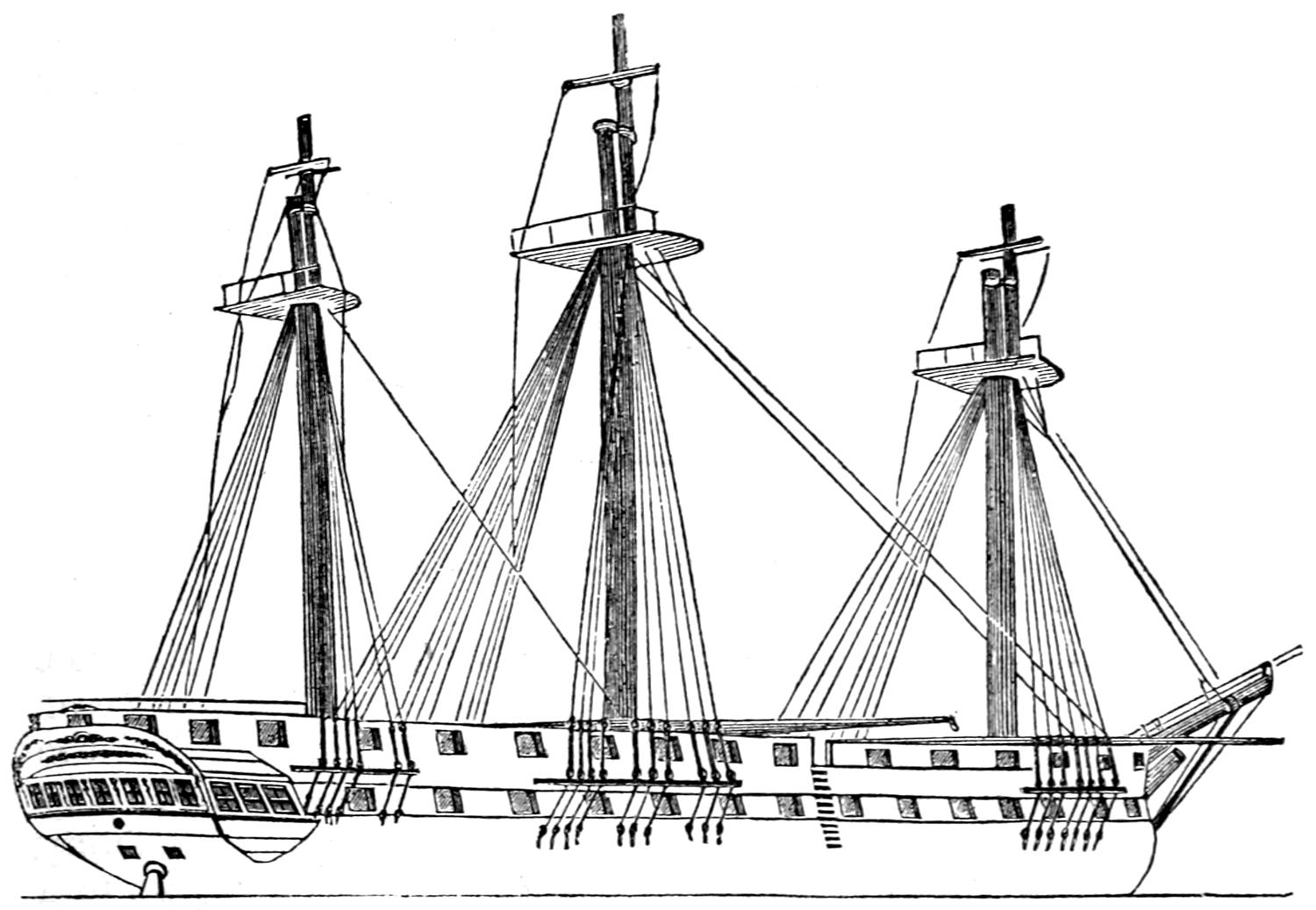
115.—PLACING TOPMAST RIGGING.
Tar the masthead in the wake of the rigging; send the bolsters aloft, and stop them. After the bolsters are on, put over first the mast-head pendants—then the span for ginn blocks; then follows the straps, with thimble in for standing part of the tyes—next, first pair of shrouds on the starboard side, then the larboard; and so on, until all are over; then lash the breast backstay (if single); if a pair, put them over the same as a shroud; next the after backstays; lash the stays, if fitted for it, if not, put them over the same as lower stays, with mousings. The collars of the stays go between the cross-trees, and lash over the after one. Some prefer chain spans. The most approved method is an iron plate, with a hook on each end, which lays across the trestle-trees.
116.—TO SEIZE-IN THE SISTER-BLOCKS.
There is a score on each side to take the shroud, and three scores for seizing—one on each end, and one between both sheaves. They are seized-in the length of the hanging block, from the eye-seizing, to prevent any risk of the reef-tackle and lift being jammed between the hanging blocks and the rigging—one seizing is passed round the shrouds, above the block, another below the block; and a small seizing put on each score, round the block and shrouds. The topsail-lift leads through the lower sheave, and reef tackle through the upper one.
The larboard block should be seized-in once the diameter of the shroud lower than the other, as, if both are seized alike (the starboard shroud going over first) they would not be square when the rigging is placed.
117.—BACKSTAYS, (BREAST,)
When in pairs, are fitted with eyes, the same as the shrouds, and served sufficiently far down to be square with the service of the topmast shrouds. They are also parceled and served in the way of the lower yards, when braced up. When there is only one backstay it is secured round the mast-head with a lashing passed round it, through an eye spliced in;[7] they are set up to a treble block in the channels. Through these blocks a fall is rove, the standing part being spliced into the strap of the double block, and then led from the treble block through a fair leader in the side, in on deck.
Note.—I have seen ships without breast backstays on any mast, and they carried sail equally well with those who had them; one was the Independence razee: her breast backstays were converted into standing ones, and set up a little further aft, or immediately forward of the proper standing backstays.
Breast backstays are generally pulled up in stays when the ship is head to wind, having a quarter-watch of topmen stationed by them. If they should be set up too taut, which may be the case, especially when the rigging is slack, they are likely to snap and endanger the mast by the sudden jerk; if not set up enough, they can be of no use, and are only an additional weight on the mast-heads, and a useless expenditure of rope. Their being set up to bear an equal strain with the rigging, will not occur with the greatest care once in a year, and I consider them particularly injurious on top-gallant-masts. A good stout standing backstay is the main support.
118.—STANDING AFTER-BACKSTAYS,

When in pairs, are fitted with an eye the same as topmost rigging. When an odd one on each side, they are fitted with a horse shoe. They are now fitted the same size as lower rigging.
The backstays are set up with a lanyard rove through dead-eyes, the same as shrouds, having service in the wake of the lower yards and tops.
119.—MAIN TOPMAST STAY
Is fitted of the same size as the standing backstay. A large clump block is strapped round the foremast head, over the eyes of the rigging, and immediately over the square hole in the after part of the trestle-trees. Through this block the main topmast stay is rove down, through the trestle-trees—has a thimble turned in the end, lanyard spliced and rove through it, and set up to a span shackle in the deck, abaft the foremast, for the purpose; or a large bull’s-eye hooked to an eye-bolt, and set up on the end.
The spring stay leads through a block strapped round the foremast above the cat-harpens, and sets up in the fore-top.
120.—MIZEN TOPMAST STAY
Is rove through a thimble strapped round the mainmast-head, over the eyes of the rigging; and when set up, is secured to its own part with round seizings. If preferred, it can be set up with a thimble turned into the end, and a lanyard rove through it; but this is not necessary. When the stays are well stretched, the thimbles can be spliced in, but it is not a good plan; for, should it be necessary to unreeve, the splice must be drawn, which will injure the rope. I have seen them fitted in this way, and pointed over for neatness,—but prefer their being turned in, and the end pointed or capped.
Note.—There is no mizen topmast spring-stay.
121.—GETTING THE TOPMAST CAPS ON.
The girtline blocks should be lashed well up to the topmast head. Overhaul down before all the foremost ends, and secure them to the foremost bolts in the cap; stop them to the centre ones, and also to the square hole in the after part; sway the cap up;—when well up, cut the after stops, sway higher, and the cap can be easily placed by the man aloft, and girtlines cast off.
If the cap should be very heavy, use a derrick; a capstan bar will answer the purpose.
Note.—Ship the capshore the same time you place the cap.
122.—MAST-HEAD MAN ROPES, &c., &c.
A piece of rope has an eye spliced in one end, and several overhanded knots made on the bight, at equal distances from each other. They should be long enough to reach a third down the topmast rigging, and seized round the mast-head close to the cap; one on each side is sufficient. They are absolutely necessary in large ships, and should be on all.
I have seen them in some very neat ships; and, when it is recollected the small space the men have for their feet when they get near the crosstrees, and the long mast-head, to get on the cap, it is certainly worth while to sacrifice something in the way of appearance to ensure the safety of a man’s life.
Some large ships have ladders with two steps, set up to the eyes of the topmast rigging, from the cap; also, spans and grab-ropes fitted, to go from the swifters abreast of the cap, which will be found very convenient for the topmen, when exercising sails. These may appear trifling matters to some, but ships fitted with them are generally ahead, when exercising in a squadron.
123.—TOP TACKLE PENDANTS, &c.
When cut to the required length, a thimble, well parceled, is spliced into one end, and the other pointed, with a becket in it. There are two to the fore, and two to the main topmasts. In the heel of each topmast there is a dumb sheave;—take one pendant and reeve it through the top block, hooked to the cap, through the trestle-trees, through the dumb sheave, or heel-block, through an eye-bolt in the foremost part of the cap, on the opposite side to the block; take two half-hitches, and secure the end to its own part, with a spun-yarn seizing; hook the top tackle block to the thimble in the pendant, and the lower one, to a bolt in the deck for the purpose; reeve the fall through a leader, and bring it to the capstan; heave well taut, and unreeve the hawser by which the mast was formerly hove up for rigging.
The other pendant reeves through the other top-block, through the sheave hole in the topmast, and clenched to the other eye-bolt in the fore corner of the cap; hook the blocks, reeve and bring the fall to the capstan, taking the other off, and manning it well. When no capstan, both falls must be well-manned by hand.
Top Tackle Falls and Blocks.—The upper block is double, strapped, which is made into a hook; the lower is also double, and should be iron-strapped, having a swivel; a single one is hooked near the double as a leading block; the fall is rove; the standing part hitched, or clenched, over the block; they are sometimes spliced in, and some have beckets.
To hook the double block, clap a single tail-block well up on the pendant, reeve a whip through it, hitch one end of the whip through one of the sheaves of the double block, hoist it up, and hook it to the pendant.
124.—PREPARING TO FID THE TOPMASTS.
Capshores should be stepped and secured, luff tackles clapped on all the stays and backstays. Lower blocks should not be hooked on to the lanyards, but to bolts in the deck, and eye-bolts or straps in the chains; capstans and falls manned, topmast rigging quite clear, and hove over the sides of the tops, and the topmasts hove up and fidded, mast stayed, rigging set up, &c.
125.—RATTLING THE LOWER AND TOPMAST RIGGING.
Cat-harpen legs and futtock shrouds are seized-on and set up; topmast stayed, rigging and backstays set up, lanyards secured as lower rigging,—then commence rattling down.
Girt the rigging with three fore and aft swifters—one by the shear rail, and the others at equal distances, as follows:—Make one end of a small rope fast round the foremost shroud, take a turn round the next, then the third, and so on, until all are taken in; then back the same way, and half-hitch it round the first. The swifter should be just taut, and not so as to bring the shrouds together,—the object being to make the ratlines a little tauter when let go. Sometimes swifters are not used, but the ratlines are never so square, or look well. Care should be taken that they are not too taut, for, when let go, all the strain will come on the seizing in the eyes of the ratlines, and they will be constantly snapping. Two swifters on each side are sufficient for the topmast rigging.
Spar the rigging down, with spare spars, such as studding-sail yards, boat’s oars, boat’s masts, handspikes, or anything light that will answer, and seize them to the shrouds on the outside, at equal distances, leaving sufficient space for three or four ratlines between each spar.
A coil of small well-stretched rope is placed on each side of the deck, two or three on a side when required to be done quick. Splice an eye in one end of the rattling stuff, seize it to the first shroud, and then commence clove-hitching on the second, and so on to the after, but one; then measure the distance from that to the last, cut it off, and splice an eye in the end. Beat the hitches well round each shroud, seize the end to the foremost one, and also the other eye to the after one, and rattle up, taking the shear of the rails. The hitches are formed on the outside, and at equal distances; in three or four places take a ratline to the after swifter;—these are called shear ratlines.
When it is necessary to rattle quick, take three ends up at a time. Fifteen inches is a good distance between the ratlines, and their places should be chalked off all the way up and down before commencing. Each man employed should have a measure within his reach, and care should be taken to make the ratlines on one side correspond in a parallel direction with those of the other. This can only be seen from the outside of the ship. Make the hitches neat, and the eyes small; few things tend more to a snug appearance.
If the rigging is to be blacked, after rattling down, it is best to leave the spars on until that is done, taking them off as you black down.
126.—FUTTOCK-STAVES IN TOPMAST RIGGING
Are iron bolts parceled and served; are seized to the shrouds the length of the hounds, down on the inside; seizings passed as in lower rigging.
Cat-harpen legs on topmast rigging.—Take the length from the starboard foremost shroud round the mast, and to the after one on the same side; get a piece of rope this length, splice an eye in each end, worm, parcel, and serve it. There are two on each mast. Seize the foremost end to the foremost shroud and futtock stave, take it round the mast and seize it to the after one; secure one to the larboard side in the same manner.
I have seen them go from the foremost starboard shroud, straight to the after larboard one, crossing abaft the mast. They are also fitted to set up with thimbles and a lanyard, abaft the mast. When this is done, both eyes are seized to the futtock staves on the starboard side, a thimble seized in the bight, and set up abaft the mast to the larboard one, with a lanyard fitted in the same way. (Vessels with chain topsail ties are fitted with iron bands, to go round the mast, with eyes for the topgallant rigging to lead through.)
127.—TO RIG THE JIB-BOOM.
Hoist the jib-boom on board by the hawser or tackle, which was left at the foremast head when getting on board the fore topmast, run the end out on the bowsprit, pointing it through the stays and bowsprit cap. Reeve the heel-rope, and sway the jib-boom out a foot or two beyond the cap. Reeve the jib-stay through the hanks, traveller if required, and then through the inner sheave-hole, in the boom end, martingale and necklace, and turn a double block in the inner end; reeve the lanyard or fall through this, and a single block bolted to the bows. To the traveler seize the jib downhaul blocks and traveling guys; tar the boom end, put a grommet over, to which seize the fore topgallant bowline blocks, one on each side.
Foot ropes.—There is one on each side of the jib-boom. They should be long enough when in their place to allow a man to stand navel-high along the boom, and are fitted as follows: take a piece of rope long enough to make both; cut it in the centre and splice one end into the other with a cut splice, forming an eye to fit the jib-boom end. Four or five overhand knots are taken at equal distances on the rope, from the eye, according to the length of the foot-rope; the knots are for the purpose of preventing the men from slipping. In each end splice a small eye, large enough to take a lashing, by which they are set up to bolts in the bowsprit cap. An eye is sometimes made by taking a round turn round the boom end, and two seizings passed. Also with a span, horse-shoe fashion, and neatly covered with canvass.
Note.—Turk’s-heads worked through the strands, may be substituted for knots on the foot-ropes, if time will permit.
128.—JIB-BOOM MARTINGALE STAY
Is a short rope, with an eye in each end to fit the jib-boom, and end of the dolphin-striker. The eyes are well served, and covered with canvass or leather. The martingale is wormed, and a small twine seizing (snaked) put on round the worming at equal distances between the eyes; three, or four, according to the length, which must depend on the way the dolphin-striker is intended to stand, or rake. It looks best when perpendicular to cap or jackstaff.
Chain is sometimes used for the purpose, as also for back-ropes; and is found to answer well, it not being liable to stretch.
129.—JIB-BOOM GUYS.
There is one pair on each side; an eye is made to fit the boom end by passing a round seizing, when in their place; both ends are rove through thimbles on each yard-arm of spritsail yard (when crossed). Then brought in and both ends set up to bull’s eyes in the bow, or fitted with tackles.
Placing the rigging on the jib-boom.—First, the foot-ropes; next, the martingale stay, and guys. In some ships, an iron grummet is fitted with an eye on top and one underneath, neatly leathered, and put over the boom-end first. The martingale stay is hooked to the underneath eye, the jib-tack and downhaul to the upper one.
130.—MARTINGALE BACK-ROPES
Are pendants, middled and served in the centre, the round of the dolphin striker, both parts crossed and secured with a throat seizing. The service should be long enough to take in the seizing. In the ends splice a single or double block; another single one is strapped into a bolt in the bow for the purpose, or fitted in a strap with a hook and thimble (hook moused). A gun tackle, or luff-purchase, is then rove, the standing part of the fall spliced round the pendant, in after end of the block, rove through the one in the bow, over the head rails, back through the one in the pendant, and through a fair leading sheave, in the forecastle bulwark. These falls, after being pulled up, are racked together outside the bulwark. If belayed on the forecastle, they should be seized to their next part, so as not to be let go by mistake.
131.—PLACING THE RIGGING ON A DOLPHIN-STRIKER.
Back-ropes first, and next the martingale; below this rigging, in the end of the dolphin-striker, are two or three sheaves, and one close above it, large enough to admit the jib-stay, which is rove through it; flying jib-stay in the next sheave, and flying martingale stay under all, which will show two ropes leading from each boom end, to the dolphin-striker.
132.—GETTING THE JIB-BOOM OUT.
The flying jib-boom iron is driven on; the heel rope manned (if rigged), and the boom hauled out. The heel strap is placed in a score in the heel for the purpose, and both bights lashed together; then another lashing passed round the strap, between the boom and the bowsprit, and the strap well frapped together. The heel being well secured, set up the back ropes and guys.
Note.—Rigging to be placed same as jib-boom.
133.—SENDING UP TOPGALLANT MASTS.
The topgallant top blocks being hooked, we will suppose the long mast rope is to be rove, from the starboard side of the topmast-cap; take the end through the square hole in the fore part of the trestle-trees, half-hitch it through the fid-hole, and stop it round the hounds, and the royal mast-head; send the hauling part through lubber’s hole, and through a leading block or sheave on deck. The topgallant rigging is fitted on a sheet-iron cylinder or funnel, attached to the jack cross-trees (by an order from the former Navy Commissioners), leathered and painted on the outside, and tarred on the inside; put on the grommet or strap for the main royal stay[8] to reeve through, then put on the topgallant and flying jib-stays, starboard and larboard shrouds, breast and standing backstays, and secure them over the funnel; overhaul the girtlines down on deck, and bend them on to the rigging, around all parts, about the length of the mast-head below the jack, and a good stop through the funnel; hoist the funnel up and place it, with the rigging on, over the hole in the cap, and take the stays forward and reeve them.
Man the mast-ropes and “sway away,” having men stationed to bear off and place the rigging or funnel. When pointed through the funnel, place the royal rigging and truck, reeve the signal halyards, and attach the conductor; “sway higher,” land the mast on the top or forepart of lower mast-cap, and, if required, reeve the short mast rope; reeve the pointed end through a block hooked to the cap on the larboard side, or the sheave, then through the trestle-trees, through the sheave-hole in the topgallant-mast, up through the trestle-trees, and secure the end to the foremost bolt in the cap, with two half-hitches, and seize the end; to the thimble in the other end, hook the double block of a burton; hook the single one to a strap round the trestle-trees; send the burton fall on deck through lubber’s hole, and lead it through a single leading block, and haul it taut; unreeve the long mast rope, and fid the mast; when the fid is in, the mast rope can be unrove, if wished.
Reeve the ends of the shrouds through the horns of the cross-trees, between the topmast rigging, over the futtock staves, and turn a thimble in each end; strap another round a futtock plate, inside the dead-eyes of top-mast rigging; if there is none placed in the top, splice a lanyard into that in each shroud, and take two or three turns through each, stay the mast, and set the rigging and backstays up.
In setting up the backstays the single block of the jigger, which is hooked to the thimble, is hooked to a blackwall hitch, in the lanyard, and when set up, expend the lanyard through the thimbles, and seize the ends. On both shrouds on each side clap on small jiggers, hook the double blocks to straps on the shrouds, the single to Blackwall hitches in the lanyards, and set up and secure the same as the backstays.
The fore topgallant stay reeves through the outer sheave-hole in the jib-boom, and through a bull’s-eye hooked to the bows, and when set up, is seized to its own part.
The main topgallant stay is rove through the middle sheave in the after chock of the fore topmast crosstrees, or through a block strapped around the fore mast-head, and set up in the fore top.
The mizen topgallant stay is rove through a bull’s-eye in the after part of the main cap, and set up in the main top.
134.—ROYAL RIGGING.
There is one breast, and after backstay on each side, seized as the after backstays on topgallant masts. The breast backstay or shroud, is pulled up with a gun tackle purchase;[9] the after leg has a thimble turned in, and sets up in the after part of the chains, with a lanyard.
Royal stays.—As there is no funnel (although it would be a great advantage to have one), splice an eye in the stay to fit the mast-head, cover it, and serve over the splice. It goes on next to the grommet, then the shroud and backstays, spanned together.
The fore royal stay is rove through the outer sheave-hole in the flying jib-boom end, and pulled up through a fair leader on the forecastle.
The main royal stay is rove through a thimble stopped around the foretop gallant mast-head, through another strapped round the eye of a shroud, and when set up is seized to its own part.
Mizen royal stay reeves through a sheave in the after part of the main topmast trestle-trees, through a thimble strapped round the eye of a main shroud, and seized to its own part.
135.—SHORT AND LONG TOPGALLANT MAST-ROPES.
Short mast ropes have a thimble spliced in one end, and the other end pointed. They are rove when the mast is rigged, and are used for fidding. They should be sufficiently long (when the mast is landed on the top or cap), after being rove through the block and sheave in the heel of the mast, and clenched to the cap, to allow the thimble to hang clear of the cat-harpen legs.
If the topsail-yard is crossed, the mast is landed on it, for rigging; if the topgallant-mast should be too long to allow its being landed on the yard, the mast rope must be lengthened accordingly.
Long mast ropes.—Ropes are often fitted for the purpose; but the topgallant yard rope is generally used. I have seen them fitted as follows, and they answered very well:—
The rope is rove, and stopped to the topgallant-masthead, and royal sheave-hole, leaving a long end over the upper stop, to hitch to the bolt, before cutting the stops. To prevent the rope slipping, rack both parts together above the sheave-hole in the heel of the mast.
136.—TO RIG THE FLYING JIB-BOOM.
Sway it on board and point it through the iron at the jib-boom end. A tail block is put on the neck of the iron, or on the jib-stay, close down to the boom. Through this block reeve the heel rope, one end taken in on the forecastle, and the other bent to the heel of the boom. A rope is bent to the heel of the boom to serve as a guy; sway the boom out a foot or two for rigging. Put over the foot ropes, fitted as the jib-boom, the inner ends seized to the jib-boom end, inside the iron. The martingale, when single, is secured round the boom end, clenched, spliced, or with a running eye, rove through a sheave in the dolphin-striker, and in on the forecastle, on the opposite side to the royal stay. When double, a single block is strapped round the boom end, and the standing part spliced round the dolphin-striker; hauling part as when single.
Guys.—One on each side spliced into each other, forming a cut-splice to fit the boom end. The other end rove through thimbles, strapped round the spritsail yard, through fair leaders in the bulwarks, and pulled up on the forecastle, or set up on the bows.
Man the heel rope and get the boom out; the heel is placed in a step formed on the fore side of the bowsprit cap, for the purpose, and secured with a lashing, rove through the end, and passed round the jib-boom. Set up the martingale, stay the fore topgallant and royal mast, (fore and aft,) by the stays and backstays; and if the spritsail yard is crossed, reeve the guys, turn in thimbles, and set them up.
137.—SPRITSAIL LIFTS
Are single; have an eye spliced in one end to fit the yard-arm; splices served over are taken over the jib guys, rove through the bull’s-eye in the cap, and set up on the forecastle. Blocks are sometimes strapped into the bolts, but it is quite unnecessary. Bolts are often driven into the fore side of the cap, and the lifts led through; when this is done, they are generally set up there with lanyards and thimbles, spliced into the end, which answers every purpose.
138.—SPRITSAIL BRACES.
A single block is strapped into a bolt in the cheek of the foremast on each side. The brace has an eye in one end, to fit the yard arm; the other is rove through the single block, on collar of fore-stay, and another single block is spliced into the end; a luff tackle purchase is rove with it, and a double block on the deck, one sheave answering for a leading one.
They are sometimes rove double, but the practice is getting out of date.
139.—STRAPPING THIMBLES FOR GUYS ON SPRITSAIL YARDS.
The thimbles are double-strapped and secured, after being placed round the yard, and in the score of the thimbles, with a round seizing passed between the thimble and the yard; the splices laying in the upper side of the score in the thimbles. Some fit grummet straps, or a short-long splice, in the strap for neatness.
The use of double straps is to allow the thimbles to lay fair with the yard for the jib guys to lead through; if single, they would stand fore and aft.
140.—CROSSING A SPRITSAIL YARD.
The yard being rigged, prepare for crossing as follows:
Clap a good selvagee strap well up, on the fore topmast stay; to it hook a snatch or leading block large enough to take a hawser; reeve it and timber-hitch it round the starboard quarter of the spritsail yard, (if got out on the starboard side,) stop it along to the larboard quarter, and half way out on the larboard yard-arm. Overhaul down the lifts and braces, and sway out, keeping the larboard yard-arm under the bowsprit; when clear on the larboard side, put over the brace, or block, and lift, and haul out; when nearly out, or before clear of the head rails, put over the starboard brace or block and lift; haul on the hawser, starboard lift, and brace, and cast off the stops. When sufficiently out, pass the parrel, take a turn or hold well on the end; hook the tye, and square the yard. Cast off the hawser and unreeve it; reeve the jib-guys through their thimbles on the spritsail yard, turn in dead-eyes or blocks, and set them up to others on the bows; set all up taut and square the yard.
141.—TWO HALF SPRITSAIL YARDS.
Two half spritsail yards, made like dolphin-strikers, are secured to the bowsprit with jaws, (or an iron band fitted round the bowsprit, with a double goose-neck hinge,) to cant or turn in any required direction. When the half spritsail yard is carried it is rigged as follows:—
The fore guys are made of well stretched rope, and equal in strength to the jib guys together, each fitted with an artificial eye to fit the jib-boom end and half yard-arm. They should be wormed with small rope, parceled and served, or covered in the eyes; four stranded rope is preferable, it being not so liable to stretch as three.
The after guys are fitted with an artificial eye in one end, to fit the yard arm, and a thimble spliced into the other. They are the same size as the fore guys, and wormed in the same manner. If made on purpose, and four-stranded, the thimble is kept in the bight with a round seizing.
The jumper, or lower guy, is fitted the same as the after, only shorter; the length of this depends on the drop intended to be given to the yard arm, which should never be less than the spritsail yard, when well braced up, or, in other words, canted.
The jumper is put on the yard arm first, then the after one, next, the foremost, and over the jib-boom. The after one is set up to a bolt by the cat-head, well down; the lower, to an eye-bolt in each side of the cutwater, well out.
For a frigate, the guys are eight-and-a-half-inch, and wormed with twenty-one thread stuff. Four-stranded rope, if made on purpose, can have the eyes formed when laying up in the rope walk. Some fit forward and after guys all in one.
142.—WHISKERS.
Whiskers are iron outriggers from the cathead, with sheaves in them for the guys to reeve through, and set up to the fore chains, the same as when rove through the spritsail yard. This plan is much in use in small vessels, but the boom is supported almost entirely by the martingale, as the guys being considerably above the boom, and its always topping up, when the sail is set on a wind, the more wind the greater the strain on the martingale; and should the guys be not carefully pulled up, the boom must depend on the martingale entirely for support.
143.—TO GET ON BOARD AND RIG LOWER YARDS.
Overhaul the hawser from the lower mast-head, bend on to the slings of the yard, and get them nearly up and down; clap selvagees on the quarters, to which hook the pendant tackles. As it comes on board, cut the stops, easing away on the pendant tackle, and bousing on the other, until the yard is athwart-ships; place chocks in the hammock nettings for the yard to rest on; slue them fair, and lash them; come up the tackles, cast off the hawsers, and place a shore under the middle of the yard to prevent its springing. Measure the yard, tar and leather the slings, fit a saddle for the D thimble, which lash on with a piece of well stretched rope, heaving each turn taut with a Spanish windlass, and fitting the score of the D thimble. Cover all with leather, and fit the straps for the preventer slings, &c., &c., &c.
Note.—The iron sling-bands are now used instead of the old fashioned D thimble.
Chain is now generally used, and allowed to all ships in the service for the slings (proper), rope ones being used as preventers. (See Rigging Table.)
144.—TRUSS STRAPS.
A large thimble with the score well parceled, is seized into a double strap, which is made by splicing both ends together, and served over; the thimble secured in the strap with a round seizing, the splice laying in the score. The strap should be long enough to go round the yard in the quarter, both eyes lashing together on the fore side. There are two on each yard. One thimble is seized inside the truss pendant, the other outside; and one in the round of the pendant higher up than the other.
145.—TRUSS PENDANTS[10]
Are wormed, parceled, and served; an eye is spliced in one end large enough to take the pendant when rove through it; in the other an artificial eye is made, large enough to take the single block for truss fall. The pendant should be rove through the small eye before the artificial one is made, boused well taut round the yard, the eye being kept underneath, and one pendant higher than the other. Reeve the upper pendant through the upper thimble, and lower pendant through lower thimble. Being rove in this manner, they will lead perfectly clear of each other.
Hide rope is preferable for pendants, but the iron patent truss is now allowed to all vessels, up to a second class frigate inclusive. (New regulation).
146.—QUARTER BLOCKS—LOWER YARDS.
Quarter or topsail sheet blocks are large single blocks, with double straps; the block seized in with a round seizing, and secured round the yard, (inside the cleat, one on each side,) with a rose-lashing passed through both bights on the top of the yard. Before the lashing is passed, the block should be hove up with heavers, and the eyes of the strap brought as close together as possible. This is done with a good strand passed through both, and hove up with a Spanish windlass. Vessels carrying chain topsail sheets, have iron blocks fitted to the iron bands in the slings of the yard for that purpose. (See Rigging Table).
147.—CLEW GARNET BLOCKS
Are single; seized into a single strap, with an eye spliced in each end, and are secured round the yard with a rose-lashing, the same as the topsail sheet blocks, just outside the cleats. Some ships have all the rigging inside the cleats, which is much neater.
Note.-Iron bound blocks are allowed to all classes of vessels in the navy, by the new regulation, for this purpose.
148.—LIFT BLOCKS—LOWER YARDS
Are single, seized into a single strap, with a round seizing; the strap being long enough to go over the yard arm, after the block is seized in. If both ends are spliced together, the splice should lay in the score of the block, or upper side; but a grummet will answer equally as well, and look snugger.
149.—FOOT ROPES AND STIRRUPS.
The foot ropes are cut once-and-a-half the length of the yard, (excepting lower yards). An eye, to fit the yard arm, is spliced in one end; and a small one, to take a seizing, in the other. The splicing served in the way of chafing (one-third) midship part.
Stirrups are short pieces of rope spliced round the foot rope; eyes spliced in the opposite ends, to go over the jackstay-bolts; splices served over. They are sometimes unlaid at one end and made into plait, and secured to the yard with flat-headed nails, having a small piece of hide or leather placed under their heads before being driven into the yard. Going over the jackstay bolts is preferable; and some seize it to the neck of the bolt, or staple. They hang on the after side of all yards.
Some vessels have their foot ropes fitted to go abaft the mast, and seized to the parrel, which answers a very good purpose, especially in vessels with raking masts, as it gives the men a better opportunity to stand.
150.—JACKSTAYS.—BENDING AND REEFING.
Take a piece of rope of the proper size,[11] cut off the length of the yard, splice an eye in each end, to fit the yard arm, sufficiently taut to require being driven on. Cut in the centre, and splice a thimble in each end; put the strands for splicing in once-and-a-half, marl down, and serve over. If two jackstays on each arm, (which should always be the case when the sail is reefed to one), the large one, before splicing the thimbles in, is rove through the eye-bolts on the yard for the purpose; this is the reefing jackstay. The bending one is fitted the same way, and after being put over the yard arm, is seized to the neck of the bolts on the after side.
This plan has been generally adopted, as it was found much easier to reef, than when fitted with only one jackstay; there being always difficulty and delay in getting the points between the jackstay and the yard, when the sail was bent to it. When only one jackstay, it is rove through the eye-bolts.
Note.—Iron bending jackstays are now allowed for all vessels in the navy.
151.—BRACE BLOCKS.—LOWER YARDS.
The straps should be fitted sufficiently taut to require being driven on the yard arm. Two thimbles are fitted, one within the other, called lock thimbles. Take a piece of rope, of the proper size, and cut it long enough to go round one thimble and the yard, when spliced together; worm, parcel and serve it, and pass a round seizing round this strap, close to the thimble. Grommet straps are preferable, if time will permit.
The block is a large single one, with two scores. For the strap take a piece of rope the required length, and splice both ends together; worm, parcel, and serve it; reeve it through the thimble already strapped, and pass both parts round the score of the other thimble; then place both bights in the scores in the brace block, keeping the splice in the after end of the block; pass a round seizing between the block and thimble, crossing it both ways, as in a double strap.
Cross-jack brace-blocks are single, and strapped the same as lower ones. A double block is secured to the after shrouds in the main rigging, the same as main preventer brace blocks. When reeving the cross-jack braces, one end of the brace is clinched, spliced, or half-hitched, and the end seized, just below the block; then rove through the block on the yard, through the inside sheave in double block, and through a fair leading sheave in a rack, in the side or a leading block. I have seen blocks strapped into bolts on the main-mast, for the brace and bowline, which answered well. The brace block should be put on the yard, sufficiently far in to be inside the topmast backstays, when braced up.
Note.—These braces should be well below the yard, as it always tops up on the wind, which slacks the weather leech; this is partly the reason a mizen-topsail never stands well.
152.—PLACING THE RIGGING ON LOWER YARDS.
Sling bands in the centre, and also on both sides, close to the topsail sheet block, the truss pendants, then truss straps; if the rigging is all within the cleats, a clue garnet block is lashed on each side; if not, they are lashed one on each side, close outside. I have seen them both ways, but inside is preferable.
Tar well the yard arm, close to the cleats and slings, in the wake of the rigging, first jackstay; if two, the bending one, and set it up amidships with a lanyard. Then the foot ropes; after going over the yard arm, and rove through the stirrups, they are lashed together, with a lanyard rove through both thimbles, and are secured with a good seizing to the strap of quarter block. Then the brace, and lift blocks. Rolling tackle straps on the inner quarter of yard, with the eye abaft burton straps on the outer quarter yard-arm, eye on top of yard.
If the stirrups go over the jackstay bolts, they should be put over before the jackstay is rove.
The cross jack-yard has no jackstay, head earings, or yard tackle straps; and the brace blocks, instead of going over the yard-arm, are put on some distance inside of the sheave hole for the mizen-topsail sheets, on the forward side of the yard.
153.—GETTING UP JEER-BLOCKS, AND REEVING JEERS.
Secure two single whip blocks to the after bolts in lower cap. Send the two foremost ends through lubber’s hole down on deck; bend them through the shell of the block, with two half-hitches, and seize the end. Stop them along each leg of the strap, the larboard whip to the larboard leg, and the starboard whip to the starboard leg; then stop both legs together with a seizing of spun-yarn in the bights—the hauling part of the whips being through lubber’s hole and through a leading block on deck; man them and hoist the blocks into their places. When clear of the top, cut the stop in the bights, haul on the whips, and they will bring the strap into its place, on each side of the mast-head. Then cut the upper stops, on the whips; take a turn and pass the lashing in the bight, securing each end to their next part. When secured, let go, and take off the whips.