PART II. (continued 2)
Reading edition
Reeving jeers.—The standing part is clenched round the strap of the upper block, rove through the one on the yard, up through another sheave in upper block, and so on, until all rove full. The hauling part is rove through a leading sheave, in fore or main bitts, or through leading blocks. When heaving up, they are either brought to the capstan, or manned by hand.
The jeer blocks are now generally fitted with hooks, as they can be got up and down much quicker. At the present day, few ships are seen to carry their jeers up in their proper places.

154.—LOWER LIFT BLOCKS
Are double; an iron plate is bolted across the upper side of the main or fore cap; it is in the form of a crescent, with the hollow side toward the topmast. In each end of the crescent, or horn, an eye is turned and a thimble put in it. Instead of the eyes being turned, I have seen two eye-bolts driven through the crescent and cap, and secured underneath with a nut; a thimble is also put in the eye-bolt, and the blocks strapped in.
The cross-jack lift blocks are single, one on each side, and can be fitted as the fore or main, or (a chalk) abaft the mast-head, if preferred, for neatness.
155.—REEVING LOWER LIFTS.
Clench one end round the yard outside all, then take the other end up and reeve it through the foremast sheave in the double block in the fore or main cap, then through the block on the yard, through the other sheave in the double block, and through lubber’s hole on deck; well up this part, splice a lizard for jigger tackle, or use tails selvageed on the end. The upper block of the jigger can be spliced or turned in to the lift, if preferred.
The cross jack lifts go over the yard arms with an eye spliced in the end to fit them. The other end is rove through the block at the cap, and is set up with two thimbles and a lanyard in the top; one thimble being turned into the end, the other strapped to the eye of one of the lower shrouds.
156.—MAIN BRACES—ON BUMKIN, &c.
A single block is seized into a double strap, with a round seizing crossed both ways; the strap is then put over an iron outrigger, or bumkin on the quarters, fitted for the purpose. The standing part of the brace being parceled, is rove through another bolt in the bumkin, and spliced into it or clenched; the other end rove through the block on the yard arm, from out, in through the block in the bumkin, and through a sheave in the bulwarks (abaft), for the purpose.
Double blocks are sometimes put on the bumpkin, instead of single ones, and also two sheaves inserted in the bulwarks instead of one, both ends of the brace rove, and led in-board—a great facility in working ship.
157.—FORE BRACES
Are clove-hitched, and the end seized aft on the collar of the main stay, below the splice; the other end taken forward and rove from in, out, through the block on the yard, through a single block strapped into a bolt in the cheek of the main-mast, with a thimble in it, close up to the trestle-trees; then rove from forward aft, through a sheave in the main fife-rail.
The brace is often middled, and clove-hitched in the bight on the main stay, and both ends taken forward and rove as before. Some have a hole bored in the bibs, or cheeks of the mast, instead of clove-hitching it around the main stay.
158.—CROSSING THE LOWER YARDS.
The jeers being rove, reeve the pendants and falls, hitch the pendants around the quarters of the yard, splice in the lanyard of the D thimble, and take the yard tackles forward to keep the yard clear of the mast. The lifts and braces being rove, man the lifts and jeer falls, “sway away,” and when the yard comes abreast of the futtock staves, pass the lashing of the D thimble, parcel it well, over all, frap all parts together, and cover all with canvass; reeve the truss pendants, turn in the blocks, reeve the falls, haul taut the tresses, and square the yard by the lifts and braces.
159.—TO GET ON BOARD THE TOPSAIL YARDS.
A large single block is lashed to the topmast-head, through which a hawser is rove; overhaul it down forward and hitch it to the slings of the yard, stop it along the yard arm, and sway it on board. Cast off the hawser, middle the yard and prepare it for rigging.
160.—RIGGING TOPSAIL YARDS. (FORE AND MAIN.)
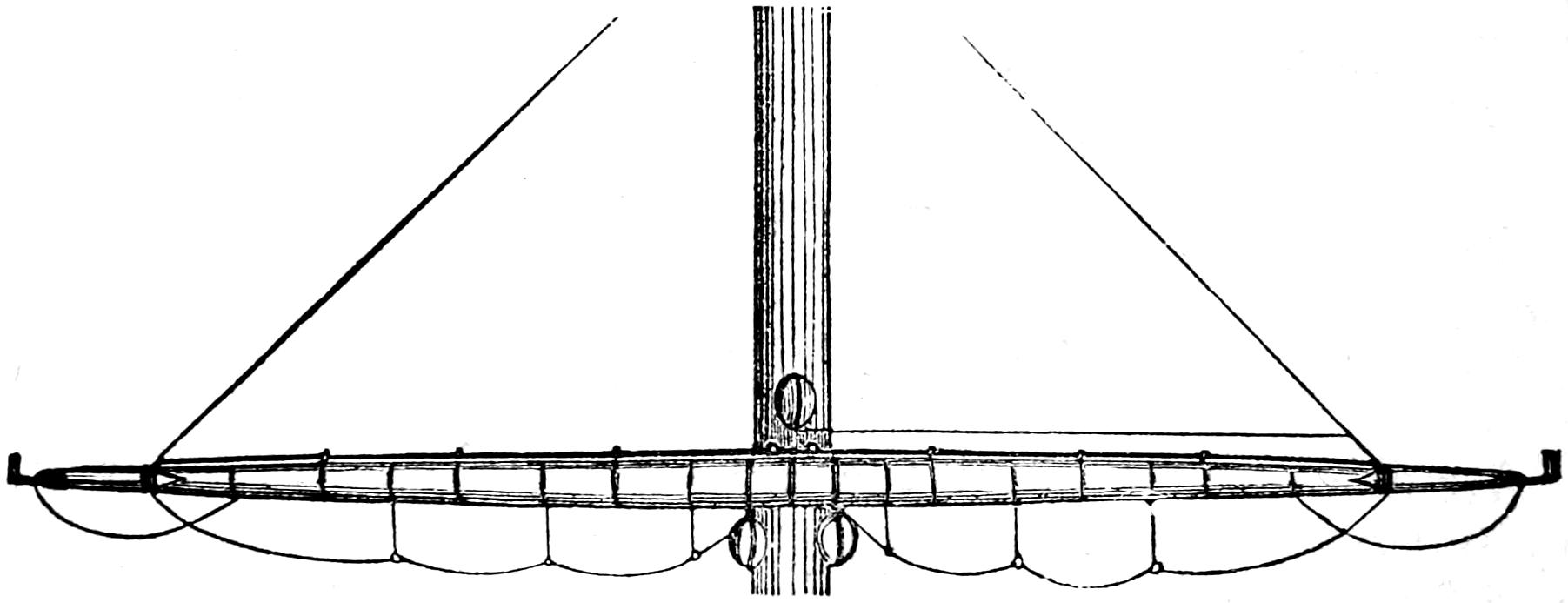
The jackstays, after going over the yard arm, are rove through the eye-bolts or staples, and set up a-midships with a lanyard and thimble spliced in.
Foot ropes round the yard abaft, on their opposite quarters, as follows:—splice the lanyard into the eye in the end; take it over the yard, and round on the fore side, underneath through the eye; again back round the yard on the fore side, through the eye, and back the same way, until sufficient turns are taken to secure it. Then take a half-hitch from the lower edge of the eye, round all parts of the lashing; pass it round before; reeve through the eye on the upper side, take two half-hitches round all, and secure the end.
Tye blocks are now generally iron-strapped, and bolted into straps round the yard for the purpose. If fitted with rope, they must have double straps, and secured round the yard, on the upper foremost quarter, with a rose-lashing. If they are single blocks, two on each yard.
Quarter blocks are double blocks, iron strapped, and secured in the same way as tye blocks. Much time is saved by having them fitted in this manner, as in shifting yards, the topgallant sheets, and topsail clewlines need not be unrove, which must be the case if rope-strapped. If rope-strapped they are seized into a single strap, and lashed on top of the yard with a rose-lashing.
Parrel.—Take two pieces of rope, one longer than the other; the long one of sufficient length to go round the mast and yard on each side; the short leg to go round the mast, and lash to the long leg on each side. An eye is spliced in each end, are wormed, parceled, and served; both marled together and covered with leather. A round seizing is passed around both, close to the eye of the short leg, on each side. The long leg is taken round the yard, brought round on the fore side, and secured to the short leg with a lashing of small rope, passed through both eyes. The other eyes are lashed together when the yard is across.
Brace blocks are strapped in the same way as fore or main yard.
Flemish horse is a short piece of rope spliced round a thimble, which is on the neck of the pacific-iron,[12] it has an eye spliced in the other end, and when the yard is rigged, is secured the same as a foot rope, just inside the brace block, two or three feet, according to the length of the yard. They should be long enough to allow a man to stand on them to pass an earing, &c. They are sometimes fitted to lower and top-gallant yards, for the convenience of reefing, &c.
Jewel-blocks are single blocks, seized into a strap put over a thimble on the neck of the pacific-iron, outside the thimble for the Flemish horse. Some fit them to go over the yard arm. Others fit them with sister hooks, to hook to the pacific iron.
Straps.—Half way out, on each yard arm, a strap is fitted long enough to allow a thimble to be secured in it, with a seizing passed between the yard and thimble,—this is called a rolling tackle strap. Also, straps are put on the yard, with thimbles seized in the same way, inside the lift, to hook a burton to; but a selvagee strap is generally used for that purpose.
161.—THE MIZEN TOPSAIL YARD
Is rigged nearly the same as the others, but the brace blocks are on the fore-side, and the Flemish horses generally spliced into bolts in the ends of the yards, with round thimbles in them. There is seldom more than one tye-block on this yard, and no jewel blocks.
162.—PLACING THE RIGGING ON TOPSAIL YARDS.
Tar the yard arms; first the jackstay, foot ropes, brace, and lift block; if no lift block, the lift; Flemish horses, and jewel-blocks. The quarter blocks should be lashed so as to hang clear of the cap, when the yard is down. See that the boom irons go on, and a small cleat, or saddle, inside of the sheave hole, about two feet on each yard-arm, to keep the topgallant sheets clear of the yard. Also reefing cleats on yard-arms, outside the lift.
163.—CROSSING THE TOPSAIL YARDS.
Reeve a hawser through one of the hanging blocks; send one end down before all, the other through lubber’s hole, and through a leading block on deck. Take a round turn, and timber-hitch the hawser round the slings of the yard; stop it along the larboard yard-arm, if got up on the starboard side; if got up on the larboard side, the contrary. Overhaul well down to main or fore rigging, the starboard lifts and braces; the larboard into the top, and stop them ready for rigging. Man the hawser, and “sway away.” When the upper yard arm is clear of the top, put over the brace and lift, (or block,) and “sway higher;” rig the lower yard arm, take in the slack of the lifts and braces, then cast off the stops on the upper yard-arm, and when the yard is well up, take two or three turns with the parrel-lashing; bouse well up on the starboard or lower lifts, overhaul the larboard, and the stops being cast off, the yard will fall across. Secure the parrel; square the yard by braces and lifts, and cast off and unreeve the hawser.
Note.—In large ships the lifts and brace blocks are generally placed on the yard arms before the yard is sent aloft. The braces are rove when the yard goes up. I would also recommend double yard ropes in heavy ships in crossing topsail yards; also to use the burtons.
164.—FITTING FLY-BLOCKS FOR TOPSAIL HALLIARDS.
The blocks spliced into the tyes are so called. They are large flat blocks; some double, sometimes single, and often one double and one single to each. The tyes are sometimes spliced taut round them; but this way is bad; as the rope stretches, the blocks cant, and are split. Also a long-eye is sometimes made in the end of the tye, and the fly block kept in its place by a round seizing passed close above the block. The block in general use is seized into a strap, leaving sufficient space above to splice the tye in; or a thimble spliced into the end of the tye, and the fly block strapped with a pair of sister hooks, to hook to the tyes. Either of the latter ways are preferable to the former.
When the yard is on the cap, these blocks should be square with the top rails. Before turning in and setting up for a full due, an iron traveler is put on the topmast backstay, which is seized to the fly-block,—it prevents the block from striking or injuring the top when lowering; it also keeps the turns out of the halliards. There is sometimes a traveling jackstay fitted for this purpose.
Reeving Topsail Halliards.—When rove double, a single block is strapped into, or hooked, to a swivel bolt in the after part of the chains; one end of the halliards is spliced into the upper part of the strap of this block, or bent into a becket put there for the purpose, and the end seized. The other end is then rove through one of the sheaves in the double block in the tye, then through the sheave in the single block in the chains, through the other sheave in the double block, and through a leading block on deck.
The Mizen Topsail Halliards have only one tye. The standing part is clenched or half-hitched to the strap, with the thimble, at the mizen-topmast head, and a single block spliced or secured in the end. Another single block is strapped into a swivel bolt in the mizen chains, and the halliards rove as with two single blocks; the fall rove through a leading block or cheek. (Some ships have a treble fly block).
165.—RIGGING TOPGALLANT YARDS.
They are got on board like the topsail yards. Leather the slings, seize-on the D thimble, parrel, and quarter blocks, rolling tackle straps,—tar the yard arms—foot ropes the same as topsail yards—stirrups one to each foot rope—iron jackstays secured to the yard with staples, fitted the same way as rope. (Iron sling-bands are allowed by the new regulation.)
The lifts are single; an eye is spliced to fit the yard-arm; the other end is rove through the thimble, or bull’s-eye, or a half sister-block in the topgallant-rigging; a thimble turned into the end, and a lanyard spliced into it, and set up to another thimble strapped round a futtock plate inside the dead-eye in the top, or set up on the end.
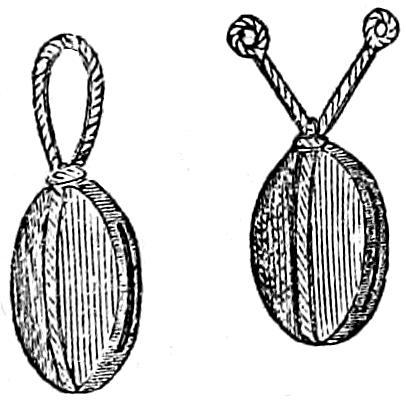
Braces.—A single block is seized into a single strap, having an eye to fit the yard-arm. If a single brace, an eye is spliced to fit the yard-arm, and the lift and brace marled together.
The quarter-blocks are double; are seized into a single strap, an eye being spliced in each end;—they lash together on the top of the yard—the foremost sheave for top-gallant clewline, after one for royal sheet.
Parrel.—A long and short leg. Take a piece of rope, cut it the required length, and splice the ends together round the yard. In one bight seize a thimble, with a round seizing; the other one round the yard; pass a round seizing close to the yard, round the parrel on the after side; splice a lanyard into the thimble, and fit a short strap the same way on the other quarter. These straps are sometimes served, and often covered with leather,—they go inside the cleats. Grommets can be worked if preferred, and dispense with the thimbles, as they are likely to injure the mast. Jaws are also recommended. The patent iron parrels are now in use in the navy, but are found not to answer for ships of war.
Tripping beckets are fitted one on each yard-arm; work grummet straps on quarter of yard, seize a thimble in with a round seizing passed between the yard and thimble. A grommet is put on the yard rope, to fit the yard-arm, when getting ready for crossing. Also, a lizard; a small piece of rope with a thimble spliced in one end, the other whipped. It goes on the yard rope before being bent to the yard.
When ready for going aloft, the yard rope is bent on, and the yard stopped to the lower rigging; the main on the starboard side, fore and mizen on the larboard side.
Note.—Royal yards, opposite sides, to the topgallant yards.
166.—TOPGALLANT BRACES.
Fore.—If double, the standing part is clove-hitched round the first and second shrouds of the main topmast rigging; or crotch of the stay, through the block for the brace, through another single tail block, secured to the first and second shrouds (the same as, and under the standing part), through lubber’s hole, and through a fair leading sheave on deck.
They are often led forward from the blocks in the topmast rigging, through a leading block strapped round the eyes of the fore rigging, or after part of the top, and through fair leading sheaves on the forecastle. In ships of war, I prefer them abaft. The block in the topmast rigging is fitted as follows:—
A single piece of rope is spliced round a single block, having a tail about three or four feet long; clove-hitch this tail round the first shroud, then round the second, and seize the end. I have seen a round turn taken round the first, and a clove-hitch round the second; either plan will do, but if neatness is studied, clove-hitch round the second and third; this will bring the block under the rigging, and out of sight. If rove single, the block is secured the same way—an eye made in the end of the brace to fit the yard-arm; the other end rove through the block on deck, as before.
A whip is sometimes put on the brace, the block spliced in close up to the cat-harpens, which answers very well. One end of the whip is spliced into a bolt on deck, the other led through a fair leading sheave or block.
Main.—The main topgallant braces are fitted the same as the fore, with the exception of leading. The standing part is secured in the same manner to the foremost, or second and third shrouds of mizen-topmast rigging; the hauling part before all, through lubber’s hole, and through a sheave in the rack, or a leading block, to the side abreast of the mizen-mast.
Mizen.—The mizen topgallant braces are single. An eye is spliced in one end to fit the yard-arm. The other end is rove through a single block; seized into a single strap, and secured to an eye-bolt on each side of the main cap, and through lubber’s hole on deck. I have seen these braces led through blocks in main topmast rigging, in harbor, where appearance has been much studied.
167.—CROSSING TOPGALLANT YARDS.
One man stands on the topmast cap; two on the crosstrees (one on each side), one of the latter shoves off the grommet, and rigs the upper yard-arm; the man on the opposite side bears off,—one man stands in the topmast rigging to put on the lower lift and brace; another stands on the topsail yard, ready to bear off; the lower lift should be well manned in the top.
When the order “sway out of the chains,” is given, the man standing on the fore part of the top bears the yard rope off, to clear the yard-arm of the top—when clear, “sway away.” When the yard-arm is clear of the crosstrees, the grommet is shoved off, the upper lift and brace is put on, and the order “sway higher” is given; then the lower lift and brace is put on, and the lift hauled well taut. The man on the cap has the parrel-lashing in his hand, ready for passing; he reeves a turn, and on the order, “sway cross,” he hauls on the lizard. The lower lift is boused on, and the yard falls across; the braces are hauled taut, and the yard squared.
When a ship is going to sea, the lifts and braces are stopt to the jackstay, and the topgallant yard ropes toggled for halliards, or half-hitched over the upper block. To toggle the halliards: Strap two single blocks, with single straps, leaving an eye below the seizing, in one, to take a small lashing; in the other to take the bight of the topgallant yard rope. Lash the block with the small eye, to the eye of a lower shroud, and reeve the yard rope through it. To the strap of the other block secure the toggle with a nettle lanyard.
Note.—Separate halliards may be fitted to dog on to the yard rope, with a double-tailed lizard, and hook the lower block to an eye-bolt in the top, which answers a better purpose.

168.—ROYAL YARDS
Are fitted the same as topgallant yards, and rigged the same, with the exception of the quarter blocks, which are single. In small vessels they have no jackstay, the sail being bent to the yard. Topgallant sails are often bent the same way, but jackstays keep the sail much better up on the yard. Some prefer a wooden batten nailed to the yard. Iron jackstays are now used for all vessels in the navy. (New Regulation.)
Fore Royal Braces.—Two blocks fitted in one strap, as span blocks, are lashed round the main topgallant mast-head; the blocks standing on the foremost quarter, on each side. Between the after part of the fore topmast trestle-trees, a piece of wood with two sheaves, the same size, and a large one in the centre, is secured.[13] The braces are single, an eye is spliced in one end to fit the royal yard-arm; the other end rove through the span-blocks, back again through the sheaves in the fore topmast trestle-trees, and into the fore top.
The blocks are often strapped separately, and seized into the strap with a round seizing, leaving room for a seizing to be passed through the strap, and round the eye of the topgallant stay, before going on the funnel, one on each side. This will not look so neat as span blocks, and are not so easily taken off and put on. The blocks for royal braces are often seized on the topgallant stay, with the idea of clearing the foot of the main royal.
Main royal braces are fitted in the same manner as the fore, and led through single blocks on mizen-topgallant mast-head, and back into the main top; or through lubber’s hole in the mizen-top on deck. The latter is decidedly the best plan, as they can be much better attended to when under the eye of the officer of the watch, than when left to the topmen.
Mizen royal braces are fitted the same as the others, and lead through sheaves in the after ends of the main topmast crosstrees, and into the top.
Crossing royal yards.—They are crossed the same as the topgallant yards. When they are rigged aloft, the topgallant masts should be fitted with jacks for the men to stand on, not only to expedite the crossing, but also for the safety of the men. They are made of iron, and put on the topgallant mast immediately over the hounds; the jack is made round to fit the mast, and is put on before the funnel, if used. The horns on each side are of a proportioned length to the mast; an eye is turned in the end of each horn, for the royal rigging to reeve through, and set up as before. When no royal rigging, the breast backstay should be rove through the eye, and set up in the top with a gun tackle purchase, fitted between the two after dead-eyes.
Royal rigging is quite unnecessary, in my opinion, except in large vessels—the breast and standing backstay is sufficient.
Royal sheets are either toggled or bent to the clews, rove through sheaves, in the yard-arms, and through the after-sheave in quarter block, on the topgallant yard; through leading thimbles on the topmast rigging, and into the top, or on deck.
169.—ROYAL AND TOPGALLANT GEAR.
When the topgallant and royal yards are sent on deck, the topgallant sheets are stopped to the topmast-head, and hauled taut on deck. I have seen them in harbor stopt to the tye-blocks close down to the yard. The former is decidedly the best plan, as they are always ready for bending; the clewlines and bowlines, are also stopped at the mast-head.
The lifts and braces are taken outside the topgallant rigging, and the eyes stopt to the rigging at the topmast-head, before all;—hauled taut on deck, and in the top.
Royal gear is stopt at the topgallant mast-head, and hauled taut on deck, or in the top.
170.—SPANKER-BOOM, TRYSAIL-MAST, AND GAFF.
The spanker-boom, trysail-mast, and gaff, may be got on board by the yard and stay-tackle. Put the hoops on the trysail-mast, and stop them; sway away by a pendant tackle, and point the mast through the after chock of the trestle-trees; lash its head to the mizen mast-head; leather the boom in the wake of the crutch; seize on sheet-blocks, and reeve the sheets; tar the boom, put over the foot-ropes, which are set up, just outside the taffrail; boom-guys, which go with a gun-tackle purchase to the quarters. Hook the topping lift to an iron span around the boom; ship and key the boom; seize on a cleat to belay the outhaulers to; then leather the jaws of the gaff, fit throat, and peak-halliard blocks, brail blocks,[14] vangs and blocks,—reeve throat and peak-halliards, hoist up the gaff, and haul taut the vangs.
The spencer gaff may be rigged nearly in the same manner.
Chocks should be fitted to go in between the lower and trysail mast-heads. Copper the mast, in the way of the jaws.
171.—SPANKER-BOOM SHEET AND GUYS IN ONE.
Into a bolt, with a thimble in each quarter, strap a double block with a single strap; then seize into two grommet-straps, worked round the boom, (wormed and covered,) two single blocks, one on each side, just outside the taffrail, or crutch. Secure these blocks in their straps, with a round seizing passed between the block and the boom. The rope for the guys is middled and cut; then an eye, or cut splice made to fit the boom end. Take the larboard guy, and reeve it through one of the sheaves in the double block on the quarter, through the single block on the boom, through the other sheave in the double block, through a fair leader in the side, and pull it up on deck. The starboard one is rove in the same manner, through the block on the starboard quarter.
172.—SPANKER-BOOM TOPPING-LIFTS.
A cheek with a sheave in it, is bolted on each side of the mizen trestle-trees, under the rigging; instead of this cheek, a single block is often strapped into a bolt, with a thimble in it. On the boom outside the taffrail, is an iron hoop, with an eye-bolt on each side, and thimbles in them. Parcel the thimbles in the outside bolts, and into them splice the topping lifts; the other end reeve down through the cheeks on the trestle-trees, or block, and splice a parceled thimble in the end, for the purpose of hooking the jigger-tackle.
173.—A BRIG OR SCHOONER’S MAIN-BOOM.
There being so little boom projecting over the stern, guys are unnecessary. On each quarter, strap a double block, and one on each side of the boom, in separate straps: through these reeve the sheet,—the standing-part from the strap of the quarter-block, and hauling part through one of the sheaves of the quarter-block. In working with the watch they are found very useful; one man can ease over, while two more can take in the slack. A boom-tackle is fitted with a pendant, to hook forward to an eye-bolt outside, and used when necessary. (Also crotch-ropes).
174.—REEVING PEAK-HALLIARDS.
The standing-part is spliced into an eye-bolt underneath, or bottom of the block; then the other end rove through the inside block on the gaff, from forward, aft; then through a sheave in the double block, through the outer block on the gaff, from forward, aft, and down through the sheave in the double block, and through a leading sheave in the bitts, or block on deck.
You may dispense with one block, and splice the standing-part round the gaff.
175.—REEVING THROAT-HALLIARDS.
The standing-part is spliced into the single block, which is hooked to the gaff, up through the double block under the top, down through the single block, up again through the other sheave in double block, and through a leader, opposite to the peak-halliards.
176.—TO FIT SINGLE VANGS.
Middle the required length of rope, and seize a cuckold’s-neck in the bight to fit the gaff-end, and lead one end on each side. The cuckold’s-neck should be neatly covered with canvass, and two snug seizings put on each quarter of the neck, showing two parts of the rope on the top of the gaff, and one underneath. Paint the eye the same color as the gaff.
177.—DOUBLE VANGS.
Seize into each bight of a long grommet strap, a single block, and secure the strap round the end of the gaff, outside the rigging cleats, with a lashing passed round the strap underneath the gaff, and over each block. Splice the standing part of the fall into a bolt; reeve the other end through the block on the gaff, and through a single block strapped into a bolt, also in the bulwarks. Blocks fitted in this way are called span-blocks. This is decidedly the best plan, as the purchase can be of use until hauled close down on deck. Pendants are now seldom used.
178.—FITTING GAFFS WITH CHEEKS, OR BRAIL-BLOCKS.
Close to the jaws, outside the single blocks for the throat-brails, secure two double blocks, strapped in the same manner as the outer blocks used for the peak-brails. The peak-brails, after being rove through the outer blocks, are led through the double ones in the jaws, and on deck through leading blocks.
Gaffs are also fitted with cheeks, instead of blocks; and sheaves cut in the jaws for the throat-brails, and fair leaders; which is the approved plan at present, and is very neat. Some ships in the service have their gaffs fitted to hook to an iron band, with a hook in the end of the gaff, instead of jaws. Others travel up and down an iron groove or railway, fitted to the lower mast (using no trysail-mast). Others again use a wooden batten nailed to the mast; some an iron jackstay, and some a rope one. The try-sail masts are preferable, in a gale of wind.
179.—GETTING UP A GAFF.
Pass the jaw rope; man the throat and peak-halliards, the former best, and sway the gaff up; when high enough, rack the halliards with spun-yarn to their own parts aloft, and the halliards can be hauled up, and coiled in the top out of the way. Steady the gaff amidships, by the vangs.
Note.—All gaffs should be peaked, or elevated to an angle parallel with the mizen-topmast stay.
180.—LOWER STUDDING-SAIL OR SWINGING-BOOMS.
The lower swinging-booms have goose-necks fitted on one end, which in line-of-battle ships and frigates, hook to the foremost part of the fore chains, to iron straps fitted for the purpose. They are got in their places when brought alongside, with a burton from the foremost shroud, and another on the after backstay. One-third from the outer end, an iron band is fitted, to which the rigging is hooked. When secured for sea, they are got close into the side and lashed to a bolt for the purpose. When in harbor, in large ships, they are sometimes hooked to eye-bolts in the bends, which bringing them lower down, cause the boats, when moored, to ride easier. A small Jacob’s-ladder is fitted to the fore chains, and sets up to the boom close into the side; also one or two seized on the boom some distance out, for the men to get into their boats with.
The fore guy is hooked to the boom, the other end taken forward and rove through a single block strapped in a bolt in the bowsprit cap, and led in on the forecastle. It is sometimes rove through a block on the spritsail-yard, and is of great use in getting the boom from the side; if no spritsail-yard, blocks can be fitted round the outriggers, or whiskers.
The after guy is hooked to the boom, and the other end led in through a sheave in the side; in large ships, on the main deck, close before the gangway port; in flush-deck vessels through the bulwarks. In large vessels they are rove double.
The topping lift is hooked to the boom the same as the guys.
The topping lift block.—Take a single block, large enough for the rope to be rove in; seize it into a single strap, wormed and served, leaving a small eye beyond the seizing, to take several parts of small rope. Seize this block on to the second shroud (if only one swifter forward), half-way between the futtock-stave, and seizing of the eye, passing sufficient turns to secure it well. When seized in this way there will be more space between the shrouds, than if seized closer up, which will allow the topping lift to work clearer, and cause no chafing. I have seen this block seized to the eye of a shroud well up, but prefer the former.
The lizard.—On the topping lift put a large-sized thimble; round this thimble splice a piece of rope about five fathoms long; for a large ship a piece of three-inch rope would be large enough. Reeve the topping lift between the first and second futtock shrouds, through the block, and send the end between the shrouds on deck.
A luff-tackle purchase is often fitted to the topping lift, half-way up the fore rigging.
Hoist up ship and key the boom; put on single blocks for forward and after guys, reeve, hook, and haul taut the topping lift.
Note.—Several ships in the service have span blocks fitted across their fore cap, and a clump block, or bull’s-eye, fitted on each fore yard-arm, abaft the lift block. The topping lift is rove through the block on the cap, then through the one on the yard-arm, to the boom; which does away with the lizard, and when the boom is alongside, at sea, the topping lift can be unhooked from the boom, and triced up with the rest of the studding sail gear, under the fore yard. This method is much approved of in large ships.
181.—LOWER STUDDING SAIL OUTHAUL, BLOCK, &c., &c., &c.
Seize a single block into a double strap, leaving an eye to fit the boom end, wormed and served. Then take a piece of six-thread stuff, and pass several turns round the strap and the bolt, and hitch it round all parts.
Topmast studding-sail tack-block.—Take a single block the required size, strap it with a good piece of rope, leaving a tail long enough to clove-hitch round the boom, and seize to the bolt in the end. This block is often strapped round the boom, and kept in its place with a bolt in the end of the boom, or a hole bored for the purpose. Sheaves are sometimes cut, but they are bad, as the least slue in the boom takes away whatever purchase the sheave would give.
Lower studding-sail halliard block, &c., &c.—Seize a single block into a single strap, leaving an eye to fit the boom taut. A small cleat should be nailed on the boom, to prevent the block slipping in, or the strap secured with a bolt. When the halliards are rove, a single block is hooked to the burton pendant, or lashed. The pendant is sometimes fitted with a block spliced in one end, and secured to the mast-head, over the rigging, with a lashing passed through an eye spliced in the other, and round the mast-head. This is quite unnecessary, as the block lashed or hooked to the pendant, answers the same purpose.
Reeving the halliards.—Reeve through the block to the pendant, before the rigging, then through the block on the boom Send the hauling part through lubber’s hole on deck, and through a leading block.
The boom brace is spliced round the boom between the blocks. A single block is spliced in the end, half-way between the boom; when the yard is square, reeve a fall. The standing part, when the sail is set, is clove-hitched round the foremost shroud of the main rigging; the other end through a leading tail block to the same place. Small ships are not allowed boom braces.
For inner halliards, use the fore clew-jigger, hooked to the forward part of the top. When the sail is not set, and the boom rigged in, the inner halliards are also used to trice the gear up; it is then stopped with yarns snugly to the jackstay, and the ends of the gear coiled inside the futtock-shrouds, being previously stopped together.
182.—TOPMAST STUDDING-SAIL SPAN BLOCKS, HALLIARDS, &c.
Seize two single blocks into each bight of a strap, long enough to go across the topmast cap; allowing the blocks to hang clear on each side. Take a piece of small rope, and pass a lashing round the strap, over both blocks, under the cap, and then seize the blocks to eye-bolts in the cap.
To make the strap, take a piece of rope of sufficient size and length; worm and serve it, splice both ends together, and secure the blocks in their places with round seizings. Through these blocks reeve the halliards; first through the span blocks down, take the upper end and reeve it down on the foreside of the topsail yard, through the block on the neck of the boom-iron; the other end is sent down abaft the foremost crosstrees, before the topmast rigging, through lubber’s hole on deck, and through a leading block. When not in use at sea, the bending end is hitched round the clew of the topsail, and the hauling part hauled up in the top. In harbor they are generally unrove, and the span-blocks taken down.
The downhaul is bent to the sail and made up in it.
Sheets are also bent to the sail and made up.
183.—TOPGALLANT STUDDING-SAIL BOOMS, &c.
Tricing lines—Are single. A single block is seized on to a shroud, close up, and a fall rove through it; one end is bent to the boom, the other sent into the top. When in harbor, a thimble should be fitted a few feet above the topsail yard, on the foremost shroud, and the tricing line rove through it. As everything is generally done in a hurry, trying who will be first, the booms are hardly ever properly secured, if lowered, after loosing to dry, and the men running out on the yards with the booms swinging about, frequently occasion accidents.
Topmast studding-sail boom.—When no boom brace is allowed and no lower studding-sail set, carrying the topmast studding-sail, blowing fresh, a brace can be put on, without rigging the boom in, as follows:—Take a belaying-pin, or anything that will answer for a toggle, and secure it to the lower studding-sail halliards, with a clove-hitch round the toggle, hauling the parts well taut; haul the toggle close to the block on the boom, and belay; and it will answer equally as well as a brace. The inner end of the halliards should not be let go, for in case the lower studding-sail requires to be set, the end can be hauled in, the toggle taken out, and the halliards overhauled for bending.
Note.—Should the boom top up much, and require a martingale more than a brace, toggle the halliards the same way, and bouse it well taut through a leading-block, perpendicular to the boom.
184.—GETTING STUDDING-SAIL BOOMS UP.
All studding-sail booms have two holes in the inner end, for a heel-lashing, and strap for the in-and-out-jigger, and sometimes a sheave in the other end for the tack. Take a piece of rope long enough for the heel-lashing; make a knot (a wall and crowned), in one end; reeve it through the hole in the boom end, haul through to the knot, and whip the other end; with the latter take two half-hitches, a little inside the sheaves, or outer end, and seize the end to the boom. Take a tail-block and half-hitch it half-way out the fore or main topsail yard, according to the boom required to be got up. Through this block, reeve a rope as a whip, (if a heavy boom, it should be a double one,) bend one end to the span, made with the heel-lashing, so as to balance the boom; the other reeve through a leading block on deck. Stop the hoisting part to the boom end by the sheave, and sway away. When high enough, cut the stops at the boom-end, and the boom will hang in the whip, on a line with the yard; point it through the boom-iron,—cast off the whip and span, and secure the heel-lashing, rigging boom out to square mark.
185.—TOPGALLANT STUDDING-SAIL GEAR.
If blocks in the topgallant rigging, the halliards are rove through them; one end is led into the top, abaft all, the other through the jewel-block on the yard-arm. Jewel blocks are single blocks, seized into single straps, having an eye to go over the bolt in the topgallant yard-arm. A small toggle is secured to the strap with a knittle lanyard. The eye in the strap is put over the bolt, and the toggle put in—the upper end of the halliards are rove through this block, on the foreside of the topgallant yard. When the sail is not bent, the studding-sail halliards are overhauled down, and hitched to the foremost shroud ready for bending. The jewel-blocks are always taken off, when getting ready to send the yards down, and an overhaul knot made on the end of the halliards, to prevent them from unreeving from the blocks. Whenever the order is given to “unbend the topgallant gear,” the jewel-blocks must be taken off.
Tacks.—Sheaves are sometimes cut in the boom ends, but as they hardly ever answer well, and generally cause delay, and likewise require more men to get the tack out, blocks are decidedly preferable. Tail-blocks are best, as they can be so easily taken off and put on. Clove-hitching round the boom, and the end secured to the eye-bolt, is preferable to having a hole bored in the boom for the tail to reeve through, as it only weakens it, and is not necessary. The tack is rove through this block, and when the sail is to be set, the inner end is bent to the clew of the sail; the outer end led to the after part of the top, where it is hauled out, and generally belayed to a shroud or cleat.
Note.—Belaying either the halliards or tack to the rigging is bad, as they are constantly coming up. Cleats should be nailed on the after part of the top for the tacks. Two small tail-blocks, one on each side, secured to the after futtock-plate, for leading blocks, are of great use in getting the tacks out.
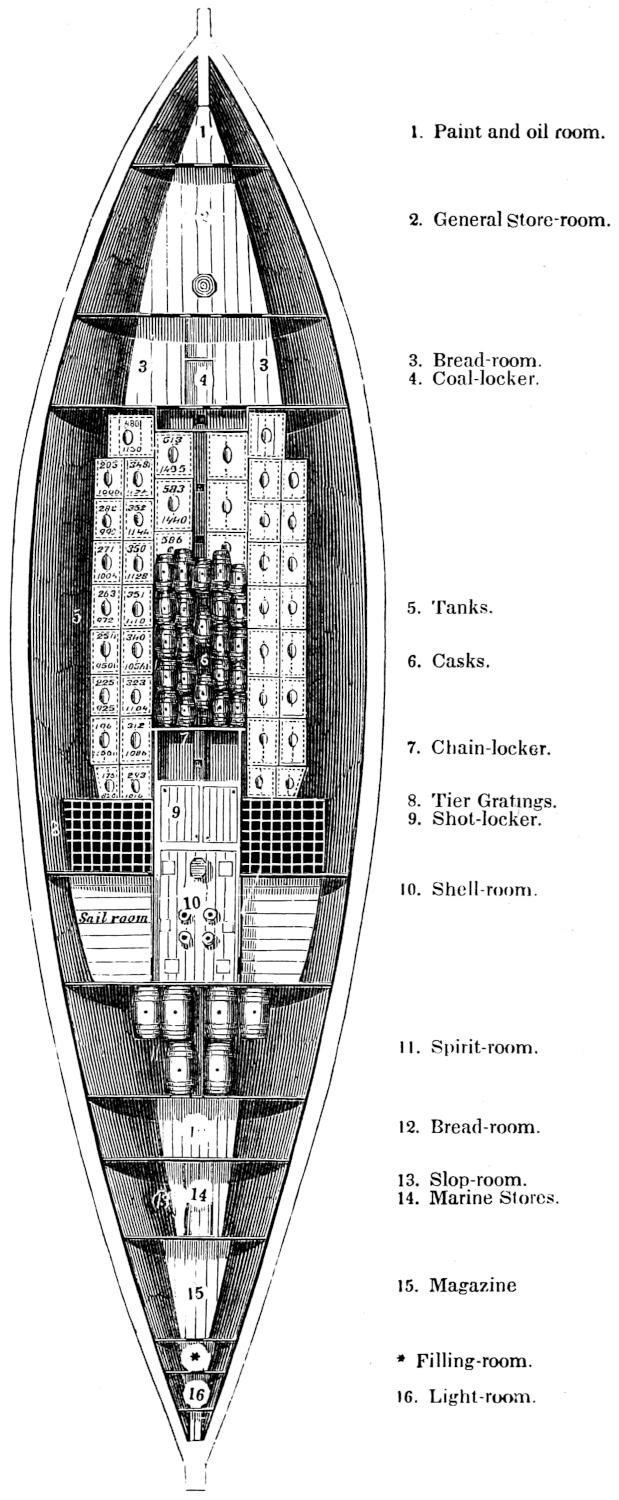
1. Paint and oil room. 2. General Store-room. 3. Bread-room. 4. Coal-locker. 5. Tanks. 6. Casks. 7. Chain-locker. 8. Tier Gratings. 9. Shot-locker. Sail room 10. Shell-room. 11. Spirit-room. 12. Bread-room. 13. Slop-room. 14. Marine Stores. 15. Magazine. * Filling-room. 16. Light-room.
A Representation of the Internal Arrangements and Stowage of the Hold of a First-Class Sloop-of-War, U. S. N.
186.—STOWING-HOLD AND SPIRIT-ROOM. (BALLAST AND TANKS).
See that the limbers are clear from chips or dirt, and place the limber boards. Clean, sweep, and white-wash the hold; place hoop-poles athwart-ships for dunnage, as near to each other as possible, so that each pig of iron will rest at least on two of them. The rust should be well beaten off the ballast, and each pig white-washed. As the stowing of a ship’s hold and ballast, depends so much on her build, it is not possible to lay down any precise rule; it is, however, recommended to preserve a strict line of level in the position of the tanks. To effect this, and to produce the desired uniformity of surface, the stower must commence the stowage from the midship stanchions in the hold, and work outwards regularly towards the direction of the wings. The slightest irregularity of surface in the tops of the tanks may be the means of throwing out the general stowage, and ultimately causing a considerable deficit in the quantity of water which the hold is calculated to contain.
A short, though rather a rough way of calculating the weight of ballast required, is to allow one ton of ballast, for ten of tonnage for each class of vessels.[15]
Winging the ballast tends to make a vessel roll, and building up a-midships to keep her steady. Without venturing on details, it may be remarked that the plan of keeping the ballast in the body of the ship, and clear of the extremities, seems to be most generally approved of; while at the same time care should be taken to keep her on, or parallel to the line of flotation, designated by the builder. The ballast in the spirit-room, should be a continuation of that in the hold. Make a draft of the ballast, indicating the exact number of pigs, the position they occupy, and their exact weight.
Previous to getting on board the water tanks, a plan of stowing them may be easily arranged by means of rough models of them in wood, which a carpenter can easily make. In getting the tanks from the store, attention should be directed to the lid-sockets, which if not properly lined with fearnought, will allow much of their contents to escape in rolling; as also to the obtaining the proper quantity of keys, and see that they are short enough to work between the deck and tanks, if the vessel is a small one. White-washing tanks inside, is found by experience to be highly useful in keeping the water pure. The screws for letting off the water require very careful treatment; for they are apt, if once started, never to be so tight again; and after being three or four years in use, the nuts decay, rendering the keys useless. If the water cannot be turned off from the tanks by the proper mode, there seems to be no other way of getting rid of it, in a case of necessity, but by forcing a hole in the bottom with a crowbar.
The tanks should be stowed during the time the ship is rigging.
Note.—By a late order, the valve in the bottom of all water tanks is stopped up, and the screw taken out. Those that are now made new, have no screw. There is also an alteration in the lids for the better.
187.—STOWING CASKS.
Strike down their beds, place and whitewash them; then commence stowing the casks at the after bulk-head in the hold, observing to have the largest casks in the kelson tier, and the gauges of the cask on each side of the kelson, to correspond. Be careful that the bung-holes are all up, the bilge free, and head clear.
After completing the first tier, go on with the second, placing hanging beds between the casks, and stowing barked wood in all the breakages. As the tiers approach the wings, let the size of the cask diminish.
188.—STOWAGE OF PROVISIONS, NAVAL STORES, &c.
Stow the beef on the larboard side, and the pork, starboard side; with the flour, rice, and beans in the wings; chocking all fore and aft with wood. The casks in the spirit-room are stowed in the same manner, with the exception that the stowage is commenced forward, instead of aft. Whiskey, molasses, and vinegar are always stowed in casks. The liquors of the medical department, and purser’s stores, are generally stowed in the spirit-room. Dry provisions should not be stowed under the wet, and should be placed in such a manner, that when required, they may be got at without disturbing all the hold.
Make a draft of the lower, and riding tiers, and spirit-room, with the guages of all the casks on the draft; the number of barrels, boxes, &c., with the kind of provisions they contain.
The shot and wads may also be got on board, and stowed in their respective lockers.
189.—STOWING CHAIN CABLES.
The chain cables are got on board through the hawse-holes,[16] and paid down the main hatchway, into their respective lockers. They are from ninety to one hundred and eighty fathoms in length, and are slip-shackled, or lashed to the kelson.
Note.—See table of allowance of chain cable for class, &c.
190.—TO GET ON BOARD AND STOW THE HEMP CABLES.
Hemp-cables are one hundred and twenty fathoms in length, two are now allowed to all vessels, from a ship of the line, to a third class sloop of war, inclusive. The cables are taken from the rope-walk, and coiled upon a car having a large hole in its bottom, and after being transported to the vessel, or lighter at the wharf, the upper end of the coil is passed down through all the flakes, and through the hole in the bottom of the car, then coiled away again in the lighter. By dipping the end in this manner, grinds or kinks are prevented, and the cable is got into the lighter, with only one turn in it.
The lighter being towed off to the ship, haul under the bows; place mats in the sides and sills of one of the forward ports; get the cables in on deck, and French-flake them fore and aft. They are now with the same number of turns in them, as when they left the rope-walk. See that the tiers are clear, and that the gratings are properly placed for the cable to lay on. Pass the end of the spare one below, and coil away with the sun, on the starboard side of the tier; make the coil as large as possible, taking care not to have too many flakes in a sheave, as the inside strands of the inner ones would be injured, by breaking in.
Pass the ends of the starboard one on the larboard side, and the larboard on the starboard side. Clinch them around the main-mast, or to the beams, coil them away with the sun, letting the ends remain out, to be pointed or tailed if necessary. Join the pointed ends with a short splice, worming the tails along the cable. The upper ends are crowned in the following manner, viz.: clap a seizing round the cable about two fathoms from the end, and unlay it to the seizing. With the three inner strands form an artificial eye; cut off the three next ones and woold their ends; with the three outer ones, form a crown, worm the ends along the cable, and clap on seizings in proportion.
The stream cable and messenger are coiled away in the tier of the spare cable. The hawsers, if possible, should be stowed in such a manner, that the end of every one could be passed up together if required.
191.—CATHEAD STOPPERS.
When not fitted with the slip, or patent stoppers, a good piece of rope, in proportion to the size of the anchor, has a stopper-knot in one end, then rove through the cathead, and hauled taut. It should be well wormed, parceled, and served in the way of the cat-heads, and sufficiently far towards the end, to take the ring of the anchor. The end should have a becket put in, and pointed over. Take a piece of small rope, and splice it into the inside yarns of the stopper, the same as a tail, or knot the yarns together; then marl down, and point over. The becket should be made large enough to take a good hauling-line, for the purpose of hauling the end of the stopper in-board, after being rove through the ring of the anchor.
192.—SHANK PAINTER.
A piece of chain is secured to the side; a large thimble, well parceled, is put into the last link; round this thimble splice the piece of rope intended to make the tail of the shank-painter; it is the same sized rope as the cathead stopper. The other end is pointed, with a becket in.
Note.—The patent iron slip or trick-stopper, is now generally used in the service, by those who can procure them. They are not allowed by the regulation, but quite a number of ships have them fitted.
193.—FISH-DAVIT GEAR.
The davit is stept into a shoe in the fore-chains, for the purpose. A double block is seized into a double strap, leaving an eye to fit the davit-head; both parts of the strap are marled together. Another double block is seized into a double strap, having a large hook[17] and thimble, to take the arm of the anchor. Take a large single block, seize it into a single strap, leaving an eye to fit the davit-head; it will lay the opposite way to the double one, and allow the hauling part of the fall to lead fore and aft along the gangway; or up aloft through a leader to the fore pendants.
Back rope.—To the back of the hook, clove-hitch and seize the end down, of a piece of rope, long enough to lead to the fore chains, or into the head, when the fish-fall is overhauled. This is taken forward when hooking the fish. Cat-back is used for the same purpose—i. e., hooking the cat.
Guys, bolts, rigging, &c.—In the fore and after side of the davit, bolts are driven. The fore-guy is a piece of stout rope, long enough to reach from the davit, when stepped, to the after side of the cat-head, leaving room for lashing. The after-guy is another piece of rope, long enough to reach the after part of the fore-chains, and both fitted as follows:—splice a hook and thimble in one end, into the other splice an eye, and into this eye splice a lashing.
Get a jigger on the foremost swifter, and hoist the davit into the step or shoe. Hook the guys to the bolts in the davit-head, and set them up to the cat-head, and after part of the fore-chains. Put over the double block, then the single, and reeve the fish-fall. Take two tackles, clap a good strap round the foremast, hook the double block to this strap, and the others to selvagee-straps round the davit-head. The strap round the foremast should be in a direct line with the davit-head when perpendicular. These tackles will answer for topping-lifts, and will be found much better than the old-fashioned topping-lifts for stowing anchors.
Note.—I would recommend the iron davit, in preference to the wooden one, on account of its being more durable, much neater, more convenient for stowage and also requires less gear.

194.—GETTING ON BOARD, AND STOWING ANCHORS.
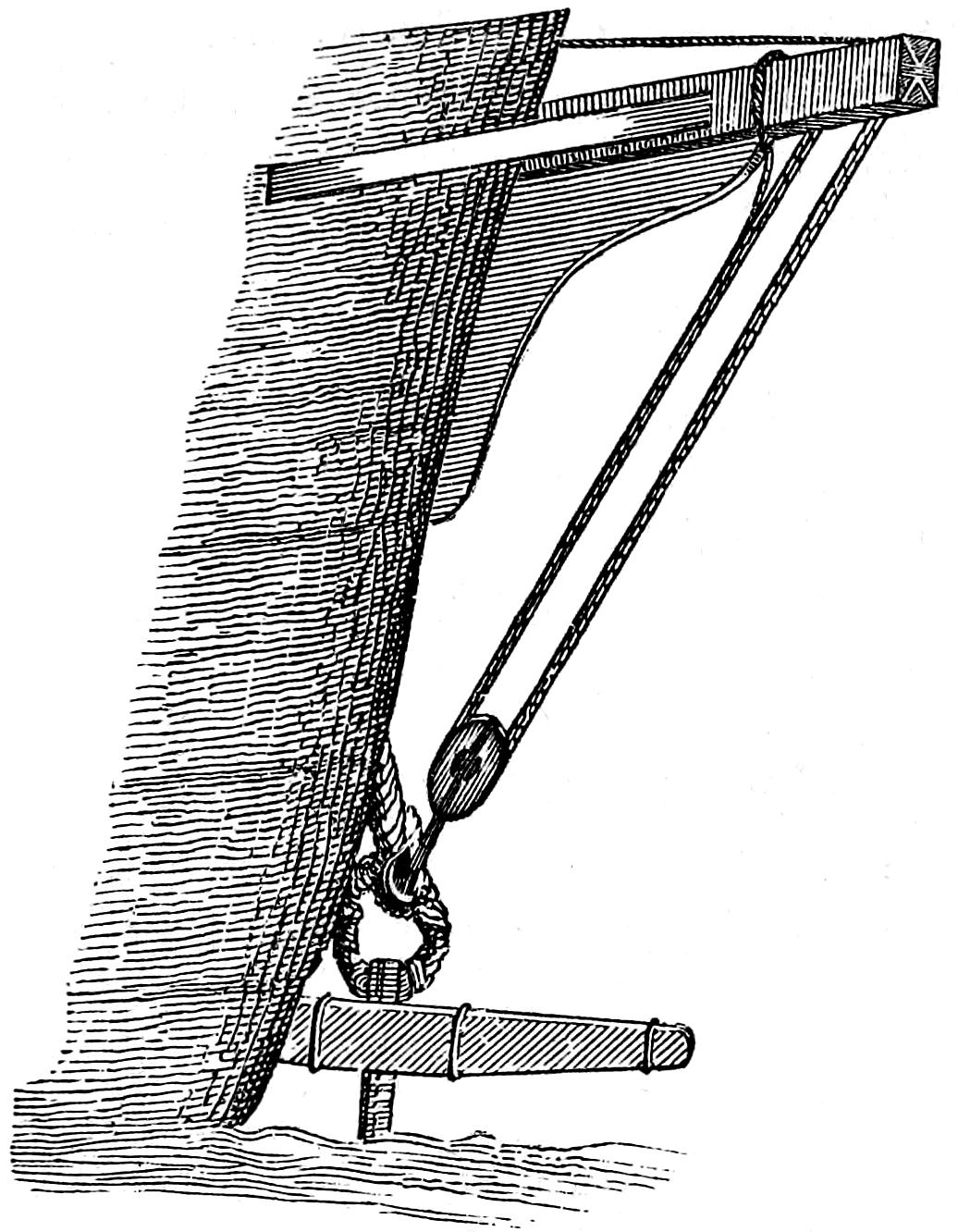
The fish-davits being rigged, reeve and overhaul the cat and fish-falls, get the anchors into a lighter, and tow them under the bows; pass up the stream-cable, and clench it to the ring of the bower-anchor; hook the cat, and run the anchor up to the cat-head. Pass the stopper, hook the fish, and pass the shank-painter. Unbend the stream-cable, and bend it to the waist-anchor, then drop the lighter aft, and secure her under the berth of the anchor. Brace the fore yard in, and the main yard up as much as possible; top them up a little, hook a stout tackle to act as a rolling-tackle, and bouse the lifts and trusses well taut. Pass a lashing round the slings of the yard, to ease the trusses. Hook both top-burtons to the yard-arm, and set well up the opposite breast-backstays. Pass a strap round the topmast, just above the lower cap. Hook the double block of a stout pendant-tackle to this strap, and the single one is hooked just without the place where the bull’s-eye for the pendant is to be lashed; haul well taut the lifts, burtons, and pendant-tackles alike—reeve whips, and get up the triatic-stays. The bull’s-eyes for the pendants are lashed sufficiently far out on the yards, to allow the anchor to clear the ship’s side. Reeve the pendant up through it, and clench the end to the lower mast-head; have a thimble in the lower end, to which the purchases are hooked. Have a thwartship-tackle in readiness, to bouse the anchor to the gunwale; lash the lower block of the main-purchases, to the crown of the anchor, having guys from each fluke to keep it steady. The fore purchase-block is lashed to the ring.
Rack the topsail-tye aloft, and hook the lower block of the fore-topsail halliards to a stout strap, passed round the shank of the anchor amidships, then lashed above the middle of the upper arm of the stock. “Sway away;” when high enough, haul over on the stay and thwart-ship tackles, and get the bill of the anchor upon the gunwale. A cleat is nailed on the lower part of the stock, a lashing passed under it, and round the timber-head in the after part of the forecastle-bulwark for the purpose; another lashing from the same place to the upper arm of the stock, and frap all together. A shore is fitted from the side, on which the anchor rests, and a lashing passed round the shank through a span-shackle bolt in the side for the purpose; the inside fluke rests on a bill-board on the fore end of the chess-tree, or after part of the fore chains. Some ships stow their anchors further forward than others. The anchor being secured, unbend the stream cable, and unlash purchases.
Drop the lighter round on the other side of the ship—shift over the purchases, secure the yards, and get up the other bower and waist-anchors in the same manner. When done, pass the stream-cable below, and coil it down in the tier.
Note.—Belaying cat-head stopper. After being boused well taut with a jigger, take as many turns as the rope will allow, over the timber-head on the forecastle bulwarks, and seize it well to its own part with spun-yarn. The shank-painter is set taut and belayed in the same manner.
195.—BENDING THE CABLES.
A rope is rove through the ring of the anchor, the end led in through the hawse-hole, and bent to the cable with a timber-hitch, three or four fathoms from the end, and stopt along to the end of the cable. Haul out on the ring-rope, and when there is sufficient of the end through the ring, cut the stops, unbend the ring-rope, and form an inside clinch, having it smaller than the ring of the anchor. The bends are put on opposite to each other, and a small bend put on near the end to secure it. Render the cables as far as possible through the clinch, and stop them together to prevent chafes, &c.
Note.—The chain cables are shackled to the rings of the anchors; then bend the buoys and buoy-ropes.
196.—TO RANGE AND STOPPER THE CABLES.
Before ranging the cables, they should be bitted, which is done as follows:—When the cables are bent, haul up sufficient slack to form a bight abaft the bitts; throw the bight which is thus formed, over the head of the bitts (and in case it is to be weather bitted, take another turn round the cavil). In ranging, get a tail-block over the hatchway, through which reeve a rope; overhaul down, and hitch to the cable. Take the running part close out to the side, bouse on the rope, and flake the cable fore and aft the deck. Clap on deck and bitt-stoppers, before and abaft the bitts; put on rounding at the range, if hemp, which is intended to veer, and also have cable mats in readiness, to be used as may be required. If a hemp-cable, a small range forward of the part bitted; if chain-cable it merely requires bitting; ranging is unnecessary.
Note.—When the anchor is let go, veer from the locker through the compressor—(i. e., supposing it to be a chain.)
197.—STOPPERS, &c., &c.
The trip-stoppers.—Both ends are made fast to eye-bolts under the after part of the fore-channels. The score in the end of the waist-anchor stock rests in the bight, and is used to trip the anchor clear of the ship’s side, when let go.
Deck-stoppers are hooked to bolts in the deck. They have a knot worked in the end, with a lanyard fast to it. The lanyard is passed round both the stopper and cable, abaft the knot, and then wormed along the cable, forward of it. (See claw-stopper).
Ring-stoppers are ropes middled; the bights are passed through the deck-bolts, the ends rove through the bight, and dogged along the cable.
Bitt-stoppers are tailed and rove through the sampson-knee forward of the bitts, then taken over the cable abaft the bitts, under again, and wormed along the cable forward. A tackle may be hooked to this, and used for veering.
Dog-stoppers are very long, and are used in the tiers. One end is clenched round the main-mast, and the other wormed along the cable.
The wing-stoppers are similar, but are clenched around the orlop-deck beams in the wings.
198.—COMPRESSORS, OR COMBING-STOPPERS.
For hemp-cables they are very long, and are tailed. Two holes are bored through the deck, abaft the after beam of the hatch; one end of the stopper is rove downwards through one of the holes, passed under the cable, and rove up again, through the other hole. Both ends are then dogged round the cable taut, so as to nip it against the beam.
The compressor for chain-cables is an iron elbow, one end of which is bolted to the forward beam of the hatch underneath, and intended to work on the bolt. The elbow goes round the cable, having an eye in the other end, to which a luff-tackle is hooked; which being hauled on, stoppers the cable effectually.
199.—PUTTING ON NIPPERS.
Nippers should be from three to five fathoms in length, and made of the best rope-yarns. They are used when heaving up the anchor, and are passed as follows:—Lay the messenger on the cable, and begin two or three fathoms abaft the hawse-hole; two round turns are first taken with the end of the nipper, round the messenger, and held by a boy, then round both. The other end is wormed round the cable, as the first was round the messenger. When the strain becomes heavy, racking, and even round turns may be used, having also small heavers, and selvagees to secure the ends; taking care to have dry ones to use when the anchor is up and down.
Note.—Some ships have done away with the nippers altogether, and use nothing but the selvagee and heaver. Each nipper-man provides two selvagees, and one heaver; also an iron pin of proper size to put through the links of the chain-cable, to prevent the muddy chain from slipping through the strap.
200.—IRON CLAW-STOPPERS, AND CLEAR-HAWSE SHACKLES.
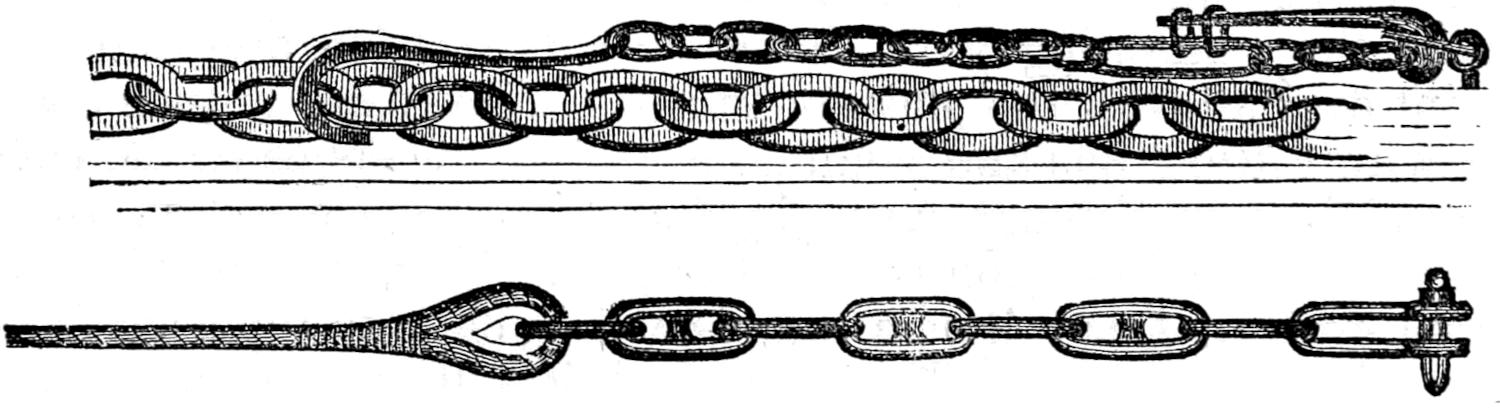
These are used for chain-cables, instead of rope-stoppers, and are found very convenient, and more durable than rope. They are allowed to every ship in the service by the new regulation, and are fitted as follows:—A piece of chain four feet long, is fitted with a devil’s-claw in one end, and a slip-hook in the other; a slip-ring also in the long link in the chain, for the end of the slip-hook.
201.—TO CUT, AND PASS A MESSENGER.
The length should be equal to twice the distance from the after part of the capstan, to the roller in the manger, and add four times the circumference of the capstan-band; this is sufficient for splicing in the eyes and taking turns. The messenger is passed with three round turns, and then the eyes lashed with the lanyard, figure-of-eight fashion. The part which is brought to the cable is undermost.
Note.—Some messengers are fitted with a strap and toggle instead of a lashing; this plan is much quicker than the old way. The size of the strap, ought to be one half the size of the messenger; in length it should be once the circumference of the capstan on the bight. Instead of splicing the two ends of the strap together, make a spritsail-sheet knot with the six strands, reeve one bight of the strap through one eye of the messenger, the other bight through the other eye, and toggle them together.
To dip a messenger.—Cast off the lashing, slack up the turns, and pass the eye up or down, as necessary, between the turns and capstan. Render the turns through each other, and pass the lashing again.
202.—SPLICING ROPE-CABLES.
Cut off the ropemaker’s fag-end, and unlay the cable sufficiently far for splicing. Take the inside yarns and lay them up into three strands, equal to the piece of rope intended for the tails, and splice these small strands and tails together. Take the outside yarns and make them into three-yarn plaits or knittles, then marl the remaining yarn down over the splice and tail, and point over all with the plaits or knittles. The cable is then opened with setting fids and commanders, and the splice made, each strand boused through with jiggers; the ends are put in twice on the tier, and once on the anchor part. Take a good piece of small-rope, and pass it as a round-seizing, close to the splice, and cross it on all sides. When finished it will look square; and pass another, with smaller stuff, close to the ends. Worm the ends into the lay of the cable, and pass three or four spun-yarn seizings, at equal distances round them and the cable, to keep them in the lay—make the seizings, and whip the ends of the tails. The size of the seizing, and number of turns, depend on the size of the cable.
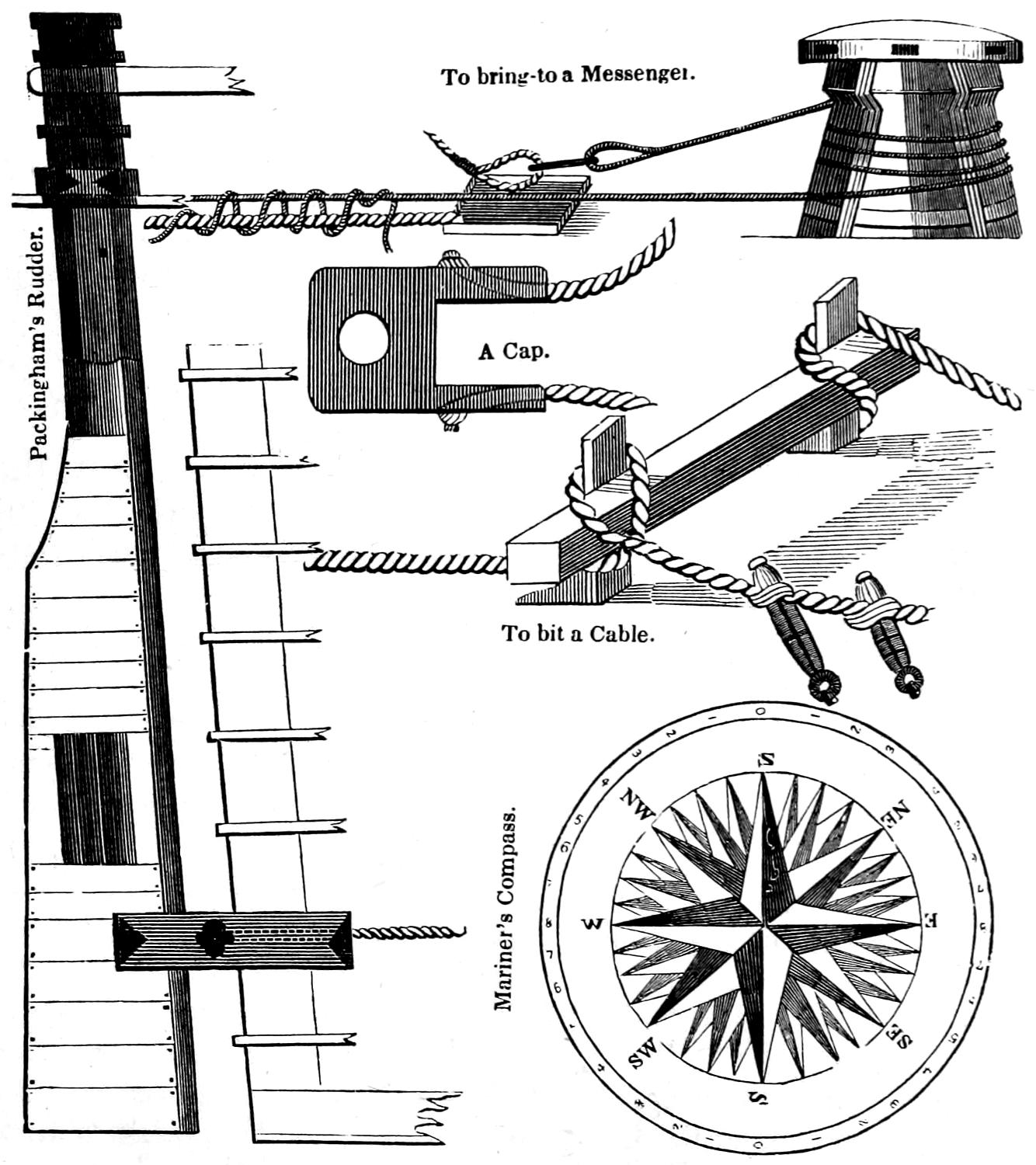
Packingham’s Rudder. To bring-to a Messenger.
A Cap.
To bit a Cable.
Mariner’s Compass.
Packingham’s Rudder, &c., &c.
Bends.—The small rope used as seizings in clinching, are so called. The end of the cable for clinching to the anchor should be wormed with good strands, and backed with good spun-yarn, and the end capped. The worming should be long enough to form the clinch, and the cable well tarred before and after its being done. The lay of the cable opens in clinching, and being wormed, it prevents the wet getting into the heart of the rope, or lodging. To pass the bends, have a good piece of rope of the length and size required; bring both parts together, leaving one end a third longer than the other; then pass it round both parts of the cable, and put both ends through the bight. Pass the under turns with the short end, the upper or riding-turns with the long one. Stop both ends well with spun-yarn to their next parts, and cross the whole seizing or bend, with sennit; pass the sennit on the bight, and secure both together with a reef-knot.
203.—TO SHIP, AND UNSHIP A RUDDER.
Have the rudder brought under the stern, hung to a scow. Bore a hole through the beam or carling over the rudder case—drive an eyebolt up through it, and fit a washer and forelock. Strap a large single block[18] with hook and thimble, and hook it to the eye-bolt; reeve a top-pendant through the single block, down through the rudder-case, and hitch it to an eye-bolt, which is temporarily fitted into the rudder-head. Clap a deck-tackle on to the other end of the pendant; have heel-ropes leading forward on each side, after being rove through their respective holes in the rudder. Man the deck-tackle fall, and hoist away. When the rudder is high enough, guy it fair with the heel-ropes; see the pintles fair for entering the gudgeons,—lower away, and fit in the wood-lock. Come up the pendant, unreeve the heel-ropes—take the bolt from the rudder-head, also the one from the beam or carling above—ship the tiller, and reeve the wheel-ropes.
To unship it.—Fit the bolts, single block, pendant and deck-tackle as before, unreeve the wheel-ropes, unship the tiller, knock out the wood-lock, and “sway away.” When the pintles are clear of the gudgeons, lower away, and secure it to the scow or lighter—tow it on shore, and parbuckle, or hoist it out of the water or scow.
204.—GETTING THE GUNS ON BOARD.
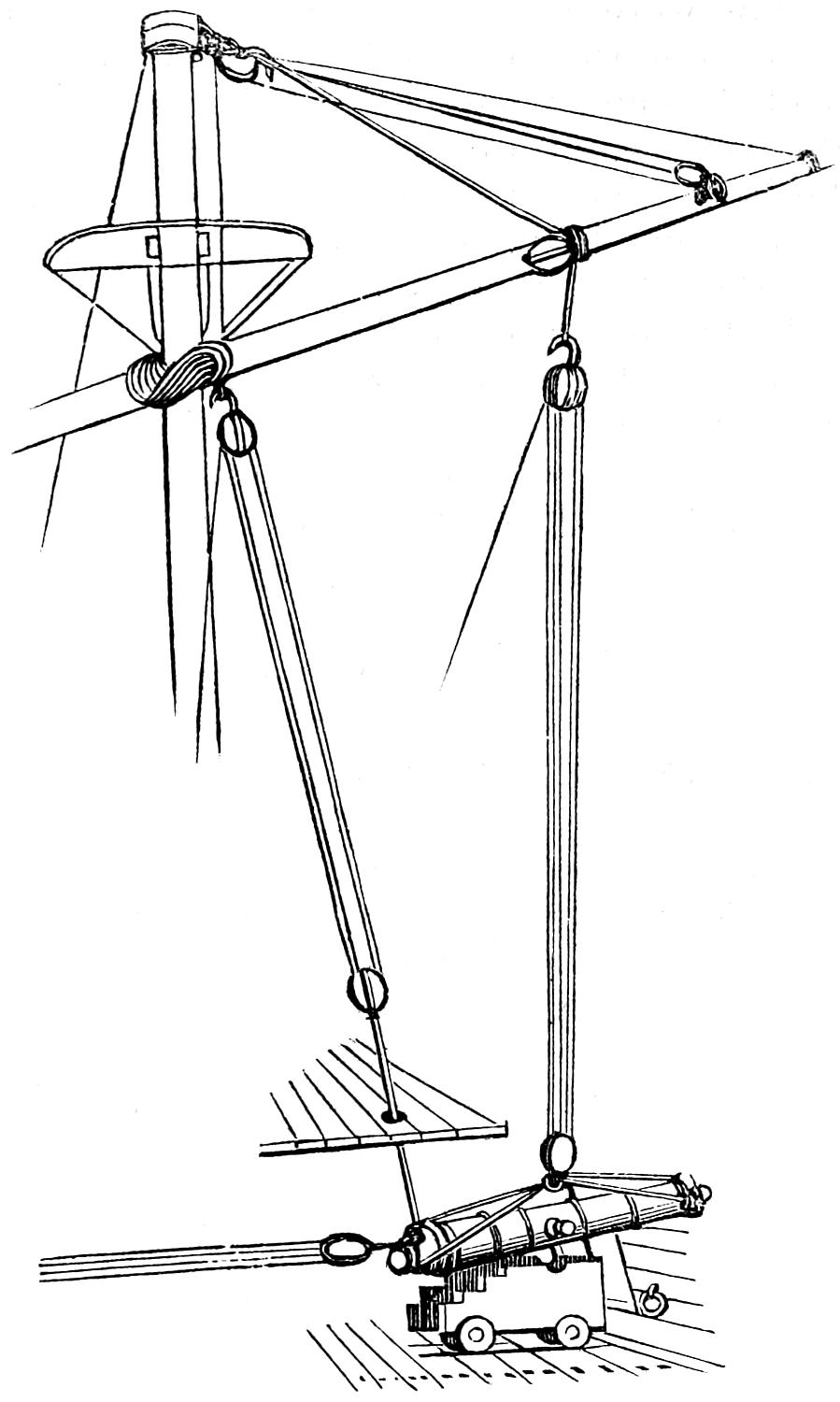
The gun-carriages and all the equipments belonging to the guns are brought alongside in lighters, and hoisted in with the yard & stay. Get them on their respective decks, and reeve the purchase for getting the guns on board.
Securing the main-yard.—To the bolts in the lower cap, hook the double blocks of two burtons. The single ones are hooked to selvagee-straps, round the yard, close to the lifts, and the falls sent on deck, through leading-blocks. Bouse well taut the main-lifts and burtons together, and belay. Then pass a good lashing round the main-yard in the slings, and main-mast, to keep the yard steady, and support the trusses, they being previously boused well taut.
Take the top tackle-pendant, and reeve it through a top-block, secured well to the yard with a good lashing, passed round the hook, on the outside quarter; take the pointed end over the cap, pass it between the head of the mast and heel of the topmast, take two half-hitches on its own part, or that from the yard, and secure the end with a round-seizing of spun-yarn. Get a single whip upon the main-yard, close to the lashing, bend one end to the hook of the top-tackle fall-block; hoist the block up and hook it to the thimble in the pendant. Through this and the other top-tackle fall-block, reeve a fall; clench one end (the standing part), round the main yard close to the block; the other end, when rove full, through a leading block on deck, by the bitts.
The garnet-purchase is a pendant, with a thimble in the upper end, which is hooked to the main-pendant-tackle; the other end is rove down through holes bored in the deck for the purpose, and a stout hook and thimble spliced or turned into the end. The garnet should be long enough to go on the lower-deck, and the holes bored perpendicular to the centre of the port through which the guns are to be got on board. The slings are made of breaching-stuff, twice the length of the gun, the ends spliced together, and the strands put in twice each way; seize an eye on the bight, large enough to go over the breach of the gun; put over the eye, and put the slings along the upper part of the gun, lashing them with a piece of rope round all, just forward of the trunnion; put the other end over the muzzle, and in toggle. Lash the purchase-block to the bight of the slings, and also bend on a hawser to weigh the gun, in the event of parting the purchase. “Sway away;” drop the lighter from under the gun, and when the breach is as high as the port, hook the garnet and also an a-thwartship-tackle to the breech-ring; haul on the tackle and bring the gun in through the port—run a carriage under—lower away; place the trunnions fair, and clamp them; come up the purchases, and transport the gun to its port. The lower and main-deck guns are got in in the same way. The cannonades are taken over the rail; a toggle is put in the muzzle, one bight of the slings over the cascable, the other over the muzzle, and back-lashed to the toggle; the stay or purchase-block is lashed on midships of the slings, and the stay or pendant-tackle to the same place; consequently the gun will come in square. Have the bed and slide ready, place it fair, and drive in the naval-bolt. Ship the screws, beds, and coins; reeve the breeching, hook side and train-tackles; see the guns square in the ports, and secure them.
The main-deck guns might be taken in over the rail, and struck down the main-hatch; but I prefer their being taken in through the port, if plenty of men.
Note.—The reason for having additional security on the main-yard is, because in getting in the guns, the strain is altogether on the yard; while in getting up the anchors, the strain is divided between two yards. The burtons are sometimes frapped in with the main-lift, between the yard and cap; but I prefer their not being done so, as they will all render fairer, when the strain comes on them. It is customary to top the main-yard up; but I saw a line-of-battle ship’s guns got in without it, and as it brings a greater strain on the slings and trusses, it should not be done to so great an extent as is the practice.
Caution.—When the garnet-purchase is raising the breech to the level required to place the gun in its carriage, care must be taken that the main-purchase be not lowered by a turn, but that the men on the fall “walk back” with a steady step.
When the gun is lodged in its carriage, it is removed to its proper port, and another carriage is rolled to the receiving port, ready for the reception of the next gun, and so on.
205.—FITTING SHACKLE-BREECHINGS.
If it be required to fit the breechings on this recently improved plan, it will be necessary to taper and point both ends of the rope preparatory to splicing or turning-in a shackle on each extremity. The shackle should be turned-in and secured to each end of the breeching by two separate seizings, one close to the shackle, and the other towards the pointed end of the rope. They are frequently spliced into a thimble and then shackled, which I think is much neater.[19]
By this simple and serviceable method, the breeching may be shifted in a few seconds, it being no longer necessary to reeve it through the ring at the breech. An opening is now made in the cascable, which admits the introduction of the breeching on the bight; and the cascable fitted with a hinge or snatch, and sometimes a bolt going through the cascable, confines the breeching, and prevents it jumping out on the recoil of the gun.
206.—TRIATIC STAYS.
A double block is strapped into a pendant, a hook and thimble spliced into one end; a single block is strapped with a hook and thimble, a fall is rove, the standing-part bent into a becket in the strap of the single block; sometimes the double block is strapped, and the pendant spliced in over the seizing. A good strap with a thimble seized into it, is fitted to the strap of the lower block. A piece of rope is spliced round the strap of the fore-stay block, and the other end, when cut to the required length, spliced round the strap of the main-stay block, and seized. This is called the span, and is generally the length between the fore and main-hatchways. The main-stay hooks to a strap with a thimble in it, from round the main-mast-head on the fore side; the fore from one abaft, fitted in the same manner. The main one generally comes down alongside the slings, the fore one between the trestle-trees, abaft. The pendant and tackle are sometimes fitted separate, to hook, and are easier stowed away.
Note.—In case of emergency, these pendants may be taken round the mast-head, and hooked to their own parts. I have known some ships to use them this way altogether.
207.—HOISTING IN SPARS.
Overhaul down the fore and main-yard tackles, fore and main-stays, and lead their falls to the opposite side of the deck the spars come in at. Hook burtons to the lower caps (double blocks), single ones to selvagees round the lower yard-arm, close inside the lifts. Send the falls on deck, and pull up the lifts and burtons together, and trusses; brace the fore-yard in, and hook on to the spars. They should be always hoisted in as stowed.[20]
If the spars are too long to come in abreast, between the fore and main-masts, such as topmasts, hook the main-stay to the strap round the foremost end, and fore-stay to the after one; then hook the yards to separate straps made of pieces of stout rope knotted together, or good selvagees, according to the weight of the spar. Man the yards and walk them up; when clear of hammock-nettings, haul on the main-stay, ease the fore and main-yards, keeping the spar square, and get the foremost end inside the rigging; then ease the main-stay, and get the spar in its place on the booms. Small spars can be got in with the main-yard, a double whip on main-stay, or single guy if required.
208.—STOWING BOOMS.
The spars on the starboard side are stowed as follows, viz.: Main-topmast, head aft; main-topgallant, (mast-fishes) half-yard, main topmast studding-sail booms, and jib-boom. On the larboard side—fore-topmast, head forward; fore-topgallant-mast, mast-fish, half-yard, fore topmast studding-sail booms, flying-jib-boom, &c.
There are several small spars which are equally divided, to make the booms as snug and neat as possible. A great deal of room can be gained by stowing them amidships in one pile, and the boats on each side. As the spars are stowed, they should be numbered on each end, also a list taken, and painted on the foreside of the boom-boards; by so doing it will save much time and trouble to find any spar that may be required; as I have seen all the booms unlashed before a spar was found.
The booms are lashed to span-shackles in the deck for the purpose. A few small spars should be kept out, to drive under the lashing, to set all taut. When stowed they are covered with tarpaulins, or matting made for the purpose. When the spars are all in, square the yards.
Note.—It is becoming the general practice, to stow both topmasts with their heads forward. Many ships stow all their spars amidships in one pile, with the exception of the fore and main-topmasts, which are stowed outside of the boats; spare main-topsail yard on the larboard-quarter, the fore on the starboard-quarter, in the chains, and spare jib-boom across the stern, secured underneath the stern-davits.[21]

E. PLURIBUS UNUM
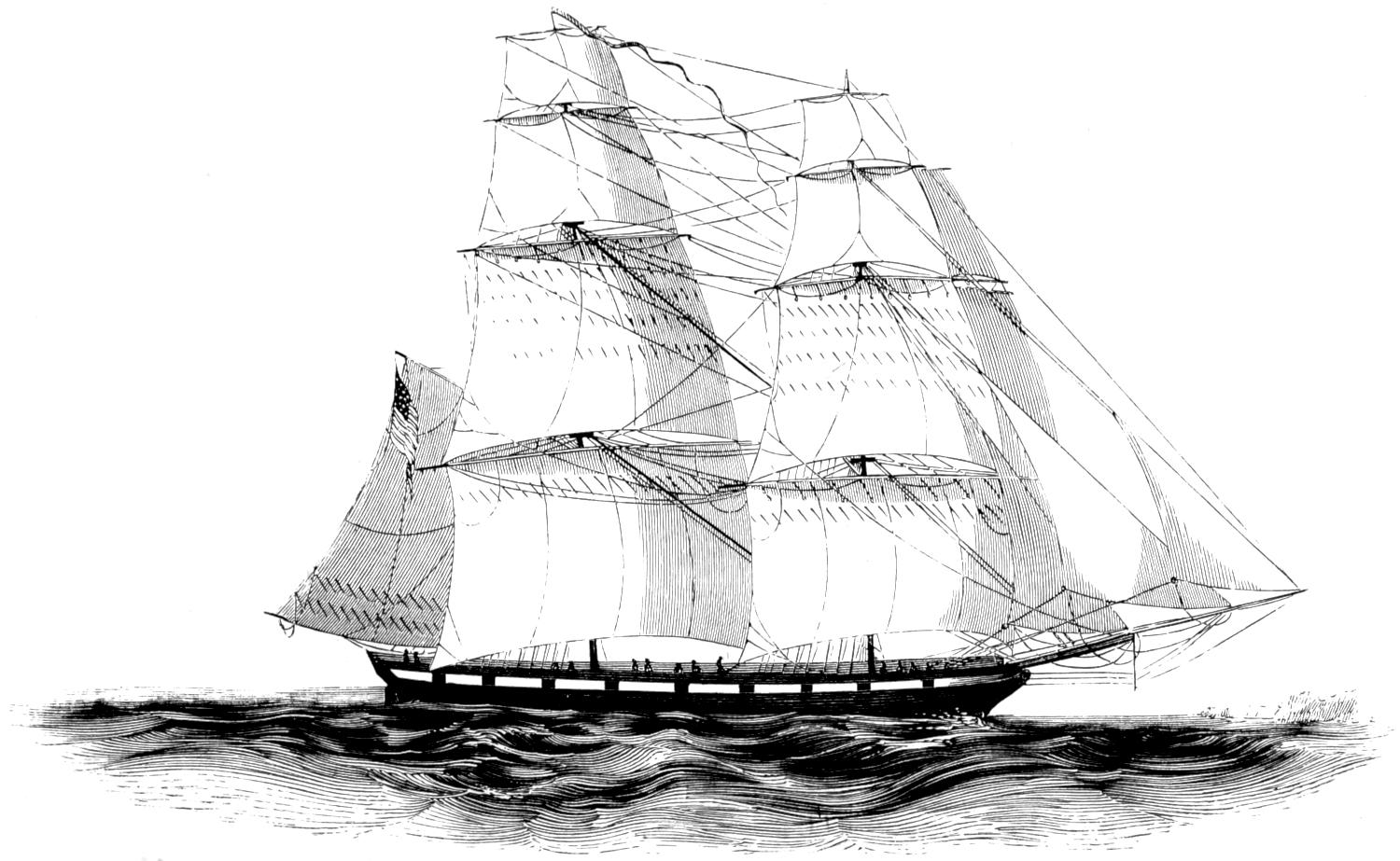
Brig-of-War, under full Sail.