AMERICAN-IRISH HISTORICAL SOCIETY. (continued 2)
Reading edition
45IN MEMORY OF
JOHN SULLIVAN.
Born Feb. 17, 1740.
Died Jan. 23, 1795.
Erected by the State of New Hampshire upon the
site of the Meeting-house under which was
stored the gunpowder taken from
Fort William and Mary.
The tributes paid to Sullivan’s worth on this occasion by every one of the speakers were ungrudging and hearty. Professor Murkland said: “This may never become a large community, but it will always be exalted by its association with John Sullivan, lawyer, soldier, statesman, and judge.
“The plain granite shaft, inadequate as it may appear, will yet serve, when we shall have been forgotten, to recall the life of one who served his country so bravely and so well that he made slander dumb and malice impotent.”
Gov. John B. Smith said: “It is no invidious distinction to say that of all the New Hampshire men of the Revolutionary period Sullivan was not only peer, he was preëminently chief. His life is a part of the country’s history, and now, by virtue of my office (an office I am all the more proud to hold because John Sullivan filled and honored it), I accept these grounds from the town of Durham, and this monument from the committee in behalf of the state.”
O’Meara said:
“Your deeds for all the land that hold your fame
Shall link you now to love New Hampshire’s name,
While throbs high manhood round her glistening hills—
While patriot gleam or pristine glory thrills.”
Dr. Quint said: “To John Sullivan, the man who in all the American provinces was the first to take up arms against the king, New Hampshire erects this monument of native granite.”
Professor Hadley said: “Washington’s never-failing trust and ever-affectionate respect are of themselves sufficient to prove their possessor’s title clear to proud historic praise; and Sullivan’s name does belong of right to that choice list of eminent commanders which bears such other names as Greene and Knox, Steuben and Stark.”
46Senator Chandler said: “John Sullivan was one of the finest characters of the Revolution. A great general, and as a lawyer, a legislator, a statesman, a governor, and a judge, ranked among the very greatest men of the Revolutionary period. The luster in our annals of the gift to our early glories, bestowed by Ireland in sending to us the family of Sullivan, will never be obliterated or forgotten.”
Senator Blair said: “There is no sphere of public life in which he was not eminent, nor of private life in which he was not influential and beloved. The whole list of Revolutionary worthies does not furnish one name which, on the whole, shines more resplendently in all the great department of public service than that of John Sullivan.”
Hon. Henry M. Baker said: “The influence of such a life never dies. Seldom is it the fortune of any one to serve his country in such diverse yet responsible positions as General Sullivan held and honored. Still more rare to discharge every duty with such great energy and ability.”
Gov. Frederick Smythe said: “Wherever the rights of man are recognized, and so long as government by the people shall endure, the name of John Sullivan must be one of the imperishable, of those who were not born to die.”
Col. Daniel Hall said: “Sullivan is worthy of lasting commemoration as one of the most serviceable of the men it was New Hampshire’s great honor to contribute to the cause of American Independence.”
Secretary of State Stearns wrote: “Sullivan was a born leader of men, and preëminently a man for Revolutionary times. He was not a slave to ancient forms and customs, ruthlessly trampling upon the traditions of his time. He boldly assaulted the conservative barriers that confined the people of New Hampshire within the pale of accustomed usage.
“He early declared for a free government for a free people. In the march of events, when the people reached his early standpoint, the Constitution of 1776 was drafted on the line of his suggestions.”
“It is a century since the life of Sullivan was ended, and the qualities of his character and the magnitude of his work were submitted to the generous estimate of his fellow-men. His fame with the lapse of time suffers no impairment. A brilliant and an accomplished civilian, a distinguished lawyer, a matchless orator, a brave and an able general, a senator, a magistrate, and a governor, he bore his accumulating honors with modesty, and served the state which he loved with the restless power of a vigorous and versatile mind. The study of his life is instructive. Through the vista, obscured by a century, we read the story of his time in the light of the undimmed luster of his achievements.”
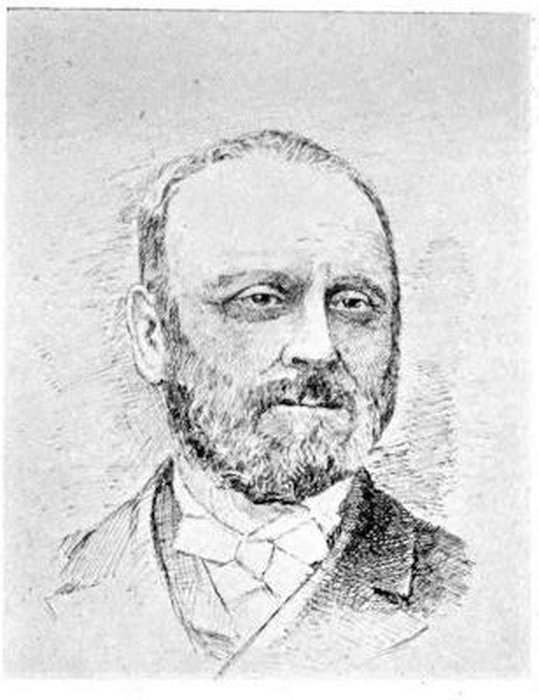
REV. GEORGE W. PEPPER Ohio
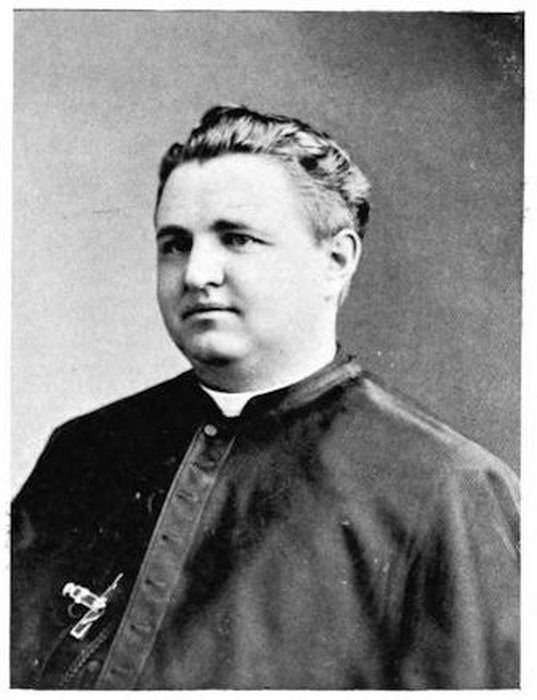
VERY REV. ANDREW MORRISSEY Indiana
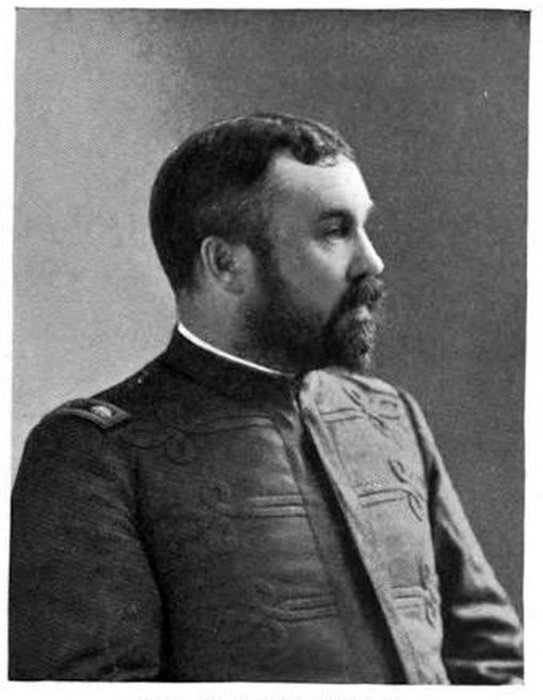
COL. O’BRIEN MOORE West Virginia
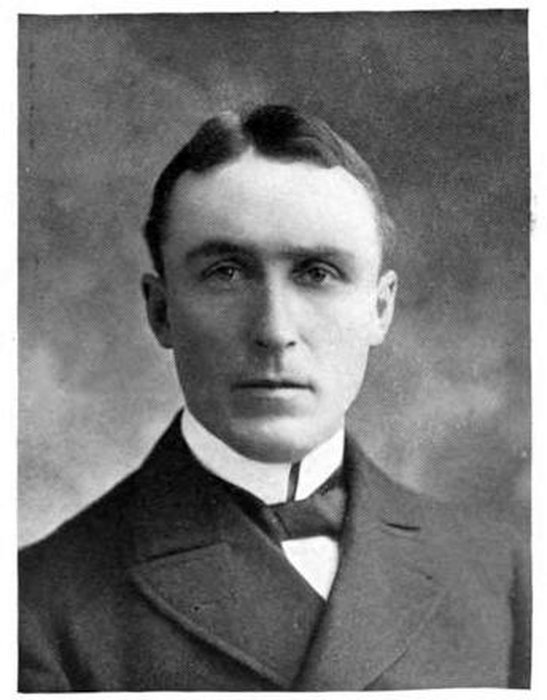
JOSEPH T. LAWLESS Virginia
VICE-PRESIDENTS
47With tributes like these from the men who were associated with John Sullivan in the struggle for independence, as well as from their descendants who participated in the dedication of the monument to his memory, we, who are members of the American-Irish Historical Society, can well be proud of the character and the services of Maj.-Gen. John Sullivan.
Edward J. Brandon, Esq., city clerk of Cambridge, read the following paper:
On a certain April morning, one hundred and twenty-two years ago, Samuel Adams prophetically remarked, “What a glorious morning is this!” and, as I stand here, I cannot restrain the feeling that the shade of that illustrious and honored American makes use of the expression with much greater emphasis to-day.
For the accomplishments of his country during the past four generations, her marvelous strides in acquiring and attaining a potent position among the world’s nations, the tremendous development of her magnificent natural resources, the genius and perseverance displayed by her children, the prosperity and importance of her institutions, the advance of her people in culture, the triumph of her principles of democracy, with its lesson to the world that “the people can be trusted with their own,” are surely causes for congratulation and satisfaction. And all this reality dates from an incident comparatively slight in the world’s history, but which is an important epoch in the story of America.
The period of resistance by the Colonies to British tyranny antedates April 19, 1775, by many years, but the culmination of a series of oppressive acts was realized on that day, and in the exciting events preceding and following the fight at Concord and Lexington, the town of Cambridge acted well its part, and contributed its blood and treasure to the common weal.
All Cambridge knows and feels a glow of patriot’s pride in the Declaration of Independence of the people of Cambridge, made months in advance of the Declaration of the Continental Congress, when the town instructed its representative that if the Provincial Congress should for the safety of the Colonies declare them independent of the Kingdom of Great Britain, “we, the said inhabitants, 48will solemnly engage with our lives and fortunes to support them in the measure.”
In all the preliminary work of the period Cambridge was active and conspicuous, and the animosity aroused by the opposition of her citizens doubtless inspired the hatred of the retreating soldiery of Britain, and caused the shocking brutality which has been told and so often retold. But the history of the time records all these events, and it is needless for me to recite them.
The British troops landed at Lechmere Point on the night of April 18, and marched across the marshes to the Milk Row Road in Charlestown, now Somerville, thence by Beech Street and the present Massachusetts Avenue to Menotomy, Lexington, and Concord. Captain Thatcher and his Cambridge men were among the first to rally for the public safety, and the militia of Cambridge improved the opportunity to attest its loyalty to principle. The muster roll shows that they marched on the alarm, and did service as far as Concord.
Paige, Cambridge’s historian, tells us that from Lexington line to Beech Street the passage of the British troops in retreat was “through a flame of fire.” Despite the fact that the conflict of this day is generally known as Concord Fight or Lexington Battle, the carnage in Cambridge was greater than in any other place, greater than in all others combined; for, according to Rev. Samuel Abbott Smith, in his address at West Cambridge, “at least twenty-two of the Americans, and more than twice that number of the British, fell at West Cambridge.”
Of the fierceness of the conflict we can to-day present ocular proof. The large number of bullet holes in the house then owned by Jacob Watson, some of which may be seen at this time, is one indication of the amount of fighting done in Cambridge; while the spoliation of Cooper’s Tavern in Menotomy and the Memorial stones all along the line of march teach the heat and bitterness of the strife. In our ancient burial ground, by which Lord Percy’s battalion marched to the relief, will be found a neat granite monument over the remains of John Hicks, William Marcy, and Moses Richardson, and in memory of these and of Jason Russell, Jabez Wyman, Jason Winship, buried at Menotomy—men of Cambridge who fell in defense of the liberty of the people.
These things are the inspiration which the Cambridge boy and girl breathe at every step, impelling influences to love of country and fearlessness in her defense.
49The Journal of the Provincial Congress estimates the loss of property in Lexington at £1761, in Cambridge at £1202, and in Concord at £274.
But when we consider these exciting events of that memorable day and read the stories of individual heroism, we feel a particular pride that our race was permitted to be a factor in the great result. It would be to us a matter of sincere regret if Ireland, who had contributed so much that was noble and sublime to the military history of other nations, had been deprived of the opportunity to manifest her sympathy by active participation in the “Lexington Fight.” More especially as the feeling of the people of Ireland was well known to Britain and Britain’s rulers, as is evident from the records of the House of Parliament in 1775, where it is of record that Governor Johnstone, in the debate at the opening of the session used these words:
“I maintain that the sense of the best and wisest men of the country is on the side of the Americans; that three to one of the people of Ireland are on their side; that the soldiers and sailors feel an unwillingness to service; that you will never find the same exertion of spirit in this as in other wars. I am well informed that the four field officers in the four regiments now going from Ireland have desired leave to retire or sell out.”
Again, Mr. George Washington Parke Custis, the adopted son of Washington, says that Ireland contributed men to the Continental Army at the rate of 100 to 1 of any nation before the coming of the French. General Lee—Light Horse Harry—said that one-half of the Continental Army was derived from Ireland. It is an undoubted fact that two hundred and fifty soldiers served in the Revolutionary War who bore the Christian name of Patrick. It is also undoubted that the rolls of the soldiers who served at Bunker Hill contained over one hundred and fifty typical Irish names. Verplank referred to the services of Irishmen in the Revolutionary War in these words: “Both in that glorious struggle for independence and in our more recent contest for American rights, England’s penal laws gave to America the support of hundreds of thousands of brave hearts and strong arms.” I might repeat many more instances did the time permit. Sufficient to say that the opportunity was accorded to Ireland’s sons to do glorious work in the first conflict of the Revolution.
Cullen says: “The Irish came into the full light of colonial history at Lexington and Concord. The cry of Paul Revere roused them to 50take their share in the defense of the common cause. Among them was Hugh Cargill, the Ballyshannon man. To his prompt response Concord owed the safety of her records.”
Rev. Mr. Maccarty is heard from in Worcester on that eventful morning of April 19, 1775. Lincoln’s history of Worcester states that as the minutemen were paraded on the green, under Capt. Timothy Bigelow, a fervent prayer was offered up by Rev. Mr. Maccarty, after which they took up their line of march.
“Another prominent name in the accounts of Concord and Lexington is Dr. Thomas Welsh, who was army surgeon to the patriots. He it was who met brave Dr. Joseph Warren as he rode through Charlestown at about 10 o’clock on the morning of that April day.”
With the evidence of participation indisputable, cannot we of Irish lineage feel the glory of this day as our own right, purchased by the self-sacrificing effort of our predecessors?
And can we not, in fullest measure, in dwelling on the great and famous events of April 19, 1775, exclaim with America’s noble son, “Thank God, I also am an American!”
Cullen (pp. 86, 88) gives the following names found on the rolls of minutemen at that period:
Joseph Burke,
Richard Burke,
Daniel Carey,
Joseph Carey,
Peter Carey,
Patrick Carroll,
Joseph Carroll,
Cornelius Cockran,
Daniel Connors,
William Connors,
James Dempsey,
Philip Donahue,
Joseph Donnell,
John Donnelly,
Andrew Dunnigan,
John Farley,
Michael Farley,
John Flood,
William Flood,
John Foley,
Matthew Gilligen,
Richard Gilpatrick,
James Gleason,
Daniel Griffin,
Joseph Griffin,
John Hacket,
Joseph Hacket,
John Haley,
John Kelly,
Patrick Kelly,
Peter Kelly,
Richard Kelly,
Stephen Kelly,
Daniel Lary,
John McCarty,
Michael McDonnell,
Henry McGonegal,
John McGrah,
Daniel McGuire,
Patrick McKeen,
John McMullen,
John Madden,
Daniel Mahon,
James Mallone,
John Mahoney,
John Murphy,
Patrick Newjent,
Patrick O’Brien,
Richard O’Brien,
Daniel Shay,
John Shea,
John Walsh,
Joseph Walsh.
Joseph Smith, Esq., of Lowell, read the following paper on “The Irishman Ethnologically Considered.”
51It is almost as hopeless a task to define an Irishman as it is to give the dimensions of a perfume; for the Irishman is as evasive and delusive, as pervasive and variable in type and character as the sweetness rising from the glowing bed of flowers.
If this society is to have a logical and reasonable plea for existence, if its title of American-Irish is to mean anything, we must reach some solid basis upon which to build our fabric; we must agree upon an acceptable definition of what is an Irishman.
This is what I shall try to do rather than attempt to show the ethnical components that enter into the Irishman. I have gone past the point in my speculations and theories on the Irishman where I place much stress upon the racial elements that go to make the Irish nation. We must start with these facts—the race and the nation are two distinctly different things; the terms Celtic and Irish are not synonymous.
I will state, so as to avoid the polemics of ethnology, just a few facts upon which all people are agreed, to explain why I attach so little importance to the merely racial elements that go to make up a nation. The islands of Ireland and Great Britain were at one time peopled by the one race which was known variously as the Celtic, Cymric, and Gaelic. By emigration, conquest, settlement, slavery, and intermarriage, and all those causes that mix races, Dane, Norse, German, Norman-French, Dutch, French, Walloon, and Flemish were mingled and intermingled with the original race, the constituent elements varying with time, place, and circumstances. So we have to-day in Ireland, Scotland, Wales, and England four distinct peoples different in characteristics, temperaments, thought, and methods, peoples made up practically from the very same elements. As the different sections of Great Britain are separated by purely artificial frontiers, they do not differ as profoundly as do the people of Ireland from those of the neighboring island. We observe in this republic people who claim a direct descent from English and other stocks producing a people as widely separated in thought, ideals, and physical appearance, and other distinctive features from the stock of the old countries as the Russian is from the Spaniard.
It is clear to me that there are other and more potent elements that make and differentiate peoples than mere racial admixtures.
The Irish, though speaking the English tongue and living under laws foreign to the instincts of the people, are a nation apart from the English, hating intensely the tie that binds them, out of sympathy with English ideas, ambitions, religions, and methods; and yet 52they are both the product of the same racial elements, the alleged preponderance of the Celt in the Irish being largely a matter of doubt and speculation.
What is it, then, that makes this tremendous difference in the two nations? What were the forces that were at work to produce from the same ingredients such profoundly different results? That is the question we must answer; and in answering it we will reach the basic idea of this society. Let me try and answer it in my way, and endeavor to show as simply as possible what an Irishman is.
There are in England as well as in America, among that class that for lack of a better term we must call Celtophobes, those who have an original if unsatisfactory and unscientific way of answering this question which adds to the accumulation of their stolen laurels and seems to afford them much satisfaction. If an Irishman break the record in science, art, literature, or any department of human activity, he is at once classed as an Englishman in England, an American in America; if, however, he merely break the Decalogue, the law, a bank, or his mother’s heart, he must perforce be an Irishman. This differentiation will not do for us, however.
There are some things we must remember, for our work has to bear the closest scrutiny and the most searching criticism.
The characteristics which we deem essentially Irish are not distinctly Irish; they are merely more widely distributed among the Irish. Wit, humor, poesy, melancholy, loyalty to faith and fatherland, patience under trial and hardship, daring in adventure, valor in battle,—these are found in all lands, among all peoples, though the Irish have displayed them so conspicuously in all the centuries that some, aye, many of our own people have come to regard them as exclusively theirs. While good blood will tell and bad, we must look to other things, we must consider other causes than race and blood, if we are to understand the workings of a mysterious Deity and learn how he makes nations and differentiates peoples.
The crude ore lies in the mines of the hills all over the earth, potential in its possibilities, yet heavy, dull, inert, awaiting the day when man shall dig it from its hiding place, try it in the fires of the furnace, beat it on the anvil and transform it into the polished rail that ties together the ends of civilization, that will shape it into the massive engine that carries the fruits of industry and commerce to the uttermost parts of the world, that moulds it into the type and press that spreads intelligence and frees the soul, and that fashions it into the sword that frees the slave. And as the ore, so is man; 53he must be tried in the fires to be re-made for the work he is to do. The elements lie everywhere; circumstances and conditions weld and mould him into nations. He may creep on into the centuries dull, heavy, oppressed, carrying the thrall of the master, content that he shall eat and drink and sleep in the peace of ignorance, content that his master shall do his thinking and fighting, heedless who the master is, for the hands of all are heavy; taking his religion and his lot from him who rules and starves him.
Others there are who have lived for centuries watching the tide of civilization and the higher life sweep by them, too hotly engaged in the struggle of life and death to snatch the prizes as they go by. Such a land for the long centuries has been Ireland. Seven hundred years has Ireland felt the edge of the sword, and for seven centuries she has shown the naked breast and empty hand to the oppressor, beaten but unsubdued.
Into the fires of hate and oppression, into the hell of battle and persecution, into the inferno of famine, misgovernment, robbery, torture, and all the evils that cold, deliberate malice and wickedness could invent, Celt and Saxon, Norman and French, Dane and Norse, Englishman and Scotchman were thrown, to be fused and mingled, that, in the cooling, God might draw from the ashes the Irishman.
In all those long dark centuries his courage never failed, his hope never dimmed, his faith in God never faltered; he never acknowledged the right of might; he accepted nothing from the man who boasted himself the conqueror of him who is to-day unconquered; he believed the day would come, and it is coming, when the forces of evil would sink beneath the scorn of the world.
In this terrible school the Irishman was made; here was learned the infinite patience of his kind; here was bred that mental alertness, that wit and humor, tinged with the melancholy the world calls typical; here he drank into his blood the courage and flame and battle, that marches him to death with a song and a laugh; here every fiber and tissue of his elemental parts were made over, and upon the green sod, that blood-soaked soil, he preserved the virtues of the man who lives with God and nature.
THIS IS THE IRISHMAN.
The man born on Irish soil, breathing Irish air, drinking in the beauty of the hills and vales and streams and loughs of Ireland, listening to whispering winds of Irish seas, hearing the story and 54legend of the Irish days long gone, his heart and soul responding to the hopes of those around him, be his father English or Norman, Scotch or Welsh, Dane or Norse, French or Dutch, that man will grow into an Irishman. This is the verdict of history; this is the experience of seven centuries. Let them come from where they will, those who plunge into the Irish Lethe emerge on the other bank Irishmen, better betimes than the son of the older race, more Irish than the Irish.
Conditions, climate, environment are more potent than blood; they are the instruments with which God works. The normal man born on Irish soil and growing to manhood on it is an Irishman. Carry him to the most remote quarter of the earth, and he is still Irish, and his children even to the tenth generation.
On May 4, 1897, the sad tidings reached the society of the death of Admiral Meade, the President of the society. He was born in New York City, 1837; appointed midshipman Oct. 2, 1850; first sea service in sloop-of-war Preble, 1851; warrant as master and commission as lieutenant, 1858; lieutenant-commander, 1862; was a commander in 1870; commissioned captain in 1880; became a commodore in 1892, and rear-admiral in 1894; admitted to the society at its organization, Jan. 20, 1897, and chosen President-General of the same, being the first to hold the office.
The Meade family has been to a wonderful extent identified with the growth and development of our national life. A glance at the societies of which Admiral Meade was a member, will show the active and heroic part this family has taken in every movement since the settlement of the land.
1. The Order of the Founders and Patriots of America, 1607–57, 1775–83. (Councillor of New York Society.)
Period 1607–57.
Ancestors. 1) Vincent Meigs, 1583–1658.
2) John Meigs, 1st, 1612–72.
3) John Meigs, 2d, 1640–91.
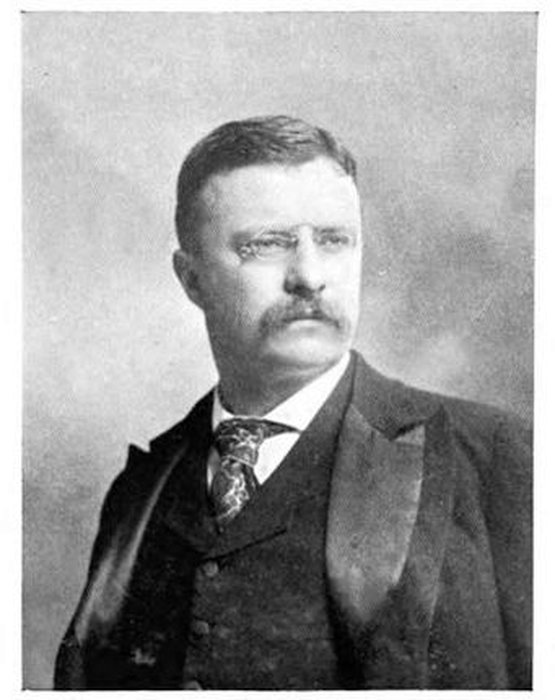
THEODORE ROOSEVELT New York City
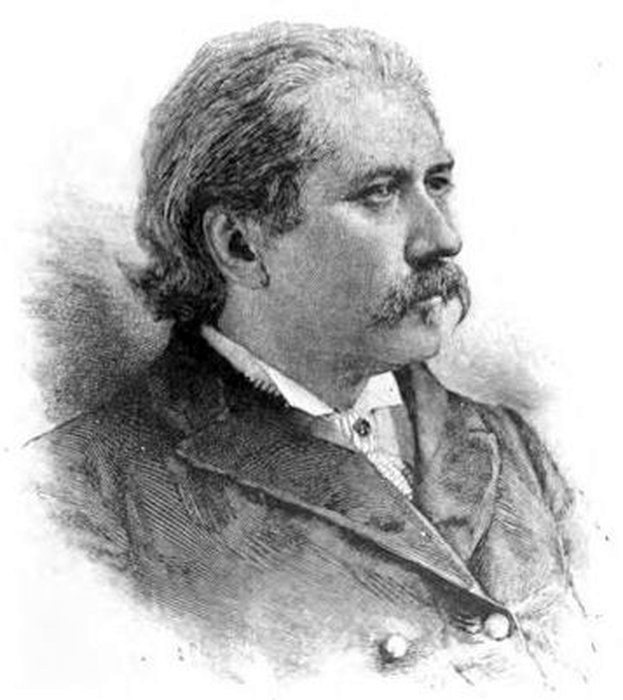
PATRICK WALSH Georgia
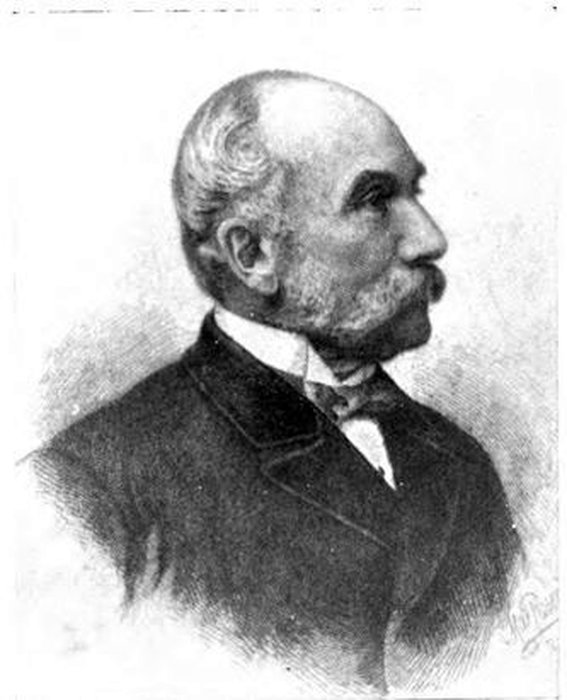
THOMAS ADDIS EMMET New York City
55Vincent Meigs and his son John, 1st, were emigrants to Connecticut in 1637–38, and in 1639 were among the founders of Guilford, Conn. John Meigs, 2d, was one of the patentees of Guilford mentioned in the Charter granted by James II to the town, May 25, 1685.
Period 1775–83.
The patriot progeny of the above-named who made their mark in the War of Independence were four brothers (sons of Admiral Meade’s maternal great-great-grandfather, Return Meigs, of Middletown, Conn., born 1708, died 1770) as follows:
1) Col. Return Jonathan Meigs, of the 6th Connecticut line, born 1740, died 1823. He was with Montgomery at Quebec, having crossed the wilderness with Arnold, and he commanded the expedition against Sag Harbor, May 21, 1777, which destroyed the British vessels’ defenses and stores. He was one of the four colonels that led the forlorn hope at the storming of Stony Point, July 15, 1779, under General Wayne. He figures as one of the best and most reliable soldiers of the Revolution.
2) Maj. Giles Meigs.
3) Capt. John Meigs.
4) Josiah Meigs, of Yale College. (Eighteen years of age when Revolution broke out.)
2. The Society of Colonial Wars, 1607–1775.
Admiral Meade was the Deputy-Governor of the District of Columbia Society.
Ancestors. 1) Maj. Simon Willard, born 1605, died 1676. (Son of Richard Willard, of Horsemonden, Kent, Esquire.)
Simon Willard emigrated from England to America in 1634, and in 1635 was one of the founders of Concord in the colony of Massachusetts Bay; deputy to the General Court, 1636–54; assistant to governor and a councillor from 1654–76; commander-in-chief of the expedition of the United Colonies against Ninigret, Sachem of the Nyantics, 1655; led the heroic relief against the Indians at the battle of Brookfield; commanded the Middlesex Regiment of Massachusetts troops in King Philip’s War; a magistrate of Salem.
562) Capt. Janna Meigs, born 1672, died 1739. (Son of John Meigs, 2d, of Guilford.) Served in the Queen Anne Wars as lieutenant and captain of the Guilford Company; deputy to the General Court of the Province of Connecticut in 1717–26.
3. The Military Order of Foreign Wars of the United States of America.
War of Independence.—War with Tripoli.—War of 1812.—War with Mexico.
Admiral Meade was Vice-Commander-General for Pennsylvania.
Hereditary member by right of his father, Richard Worsam Meade, 2d, who served as a lieutenant in the U. S. Navy, during the Mexican War, on board of the U. S. frigate Potomac, Captain Aulick, at Vera Cruz.
Incidentally it may be said that Richard Worsam Meade, 1st, was naval agent of the United States abroad, during the War of Tripoli and War of 1812, and that George Meade (father of R. W. Meade, 1st) was a prominent agitator against the Stamp Act of 1765, and was one of the signers of the non-importation resolutions of merchants of Philadelphia, Oct. 25, 1765, and though a man of wealth, served as a private soldier in 3d battalion of Col. Cadwalader’s regiment. He gave £2000 sterling to the fund for Washington’s suffering army at Valley Forge. Was a member of the Philadelphia “Associators” during the Revolutionary War. Left the city when the British army came in and did not return until Washington’s troops reoccupied it.
4. The Military Order of the Loyal Legion of the United States, 1861–65. Pennsylvania Commandery.
Joined 1866, No. 187 on general roll.
5. The Grand Army of the Republic, 1861–65.
Commander of Lafayette Post, No. 140, Department of New York. Reelected December, 1896, for a second term.
6. The California Pioneer Society of New York City, 1849–50.
An ex-President of the society, 1893–94.
577. The New England Society in the city of New York. Life member.
8. The American Catholic Society of Philadelphia.
9. The Christ Church Historical Society of Philadelphia.
10. The National Geographical Society of Washington, D. C.
11. The Society of Naval Architects and Marine Engineers, New York City. A Vice-President of the society.
12. The Navy Mutual Aid Society. An ex-President, having held the office five years.
13. The Society of Graduates of the U. S. Naval Academy, Annapolis, Md. Class of 1850.
Admiral Meade is also a lineal descendant of John Benjamin (gentleman), who came over from Wales, England, with Governor Winthrop in 1630, and settled at Cambridge, Mass. His son John removed to Connecticut. Admiral Meade’s great-great-grandfather, Col. John Benjamin, of Stratford, served in the War of Independence and received a British musket ball in his shoulder at the battle of Ridgefield. His brother, Col. Aaron Benjamin, of Stratford, was with Montgomery in the expedition to Quebec, and in the battles of White Plains, Princeton, Monmouth, Germantown, Fort Mifflin, Stony Point, and at Valley Forge. He was more than one hundred times under fire. At Stony Point, it is said, he was the second man to enter the fort. He was lieutenant and adjutant during the greater part of his service.
The Admiral is also a lineal descendant of John Hopkins, of Hartford, Conn., who came to America in 1630. This John Hopkins is now alleged to have been one of the children (by first wife) of Stephen Hopkins, who came over in the Mayflower, 1620, and was the fourteenth signer of the compact of the Plymouth colonists. It is alleged (see the Signers of Mayflower Compact, by A. A. Haxtun) that John Hopkins (of Hartford) having a harsh stepmother, was left behind with his dead mother’s relatives in England, but followed his father to America in 1630, being then only seventeen years of age.
58Another line of descent is through Thomas Coates, who came over with William Penn in 1682. The descendant of this Thomas Coates was William Coates, of Philadelphia (a colonel in the Revolution), and the great-great-grandfather of the admiral.
Summing up the various strains of blood, here is the result:
Irish.—Meade, Butler.
English.—Meigs, Willard, Hopkins, Austin, Worsam, Stretch, Hosmer, Hamlin, Wilcox, Judd, Fry, Backus, Beckley, Sharpe, and Bronson.
Welsh.—Benjamin.
French.—Jacques.
Religions. Catholic.—Meade.
Church of England.—Worsam, Butler, Austin, Richard Willard.
Non-Conformist or Puritan.—Meigs, Simon Willard, Hopkins, Hosmer, Benjamin, Wilcox, Hamlin, Judd, Fry, Backus, Beckley, Bronson, and Sharpe.
Quaker.—Coates.
Huguenot.—Jacques.[2]
At the funeral of Admiral Meade, the society was represented by Messrs. Edward A. Moseley, J. R. Carmody, J. D. O’Connell, and Capt. John M. Tobin. The honorary bearers were: Rear-Admiral John G. Walker, Commodore Charles S. Norton, Admiral George Dewey, Commodore Norman H. Farquhar, Commodore Winfield S. Schley, Capt. A. S. Crowninshield, Capt. Charles O’Neil, U. S. N., and Col. Charles Heywood, United States Marine Corps. Eight stalwart seamen bore the body. A battalion of marines from the Washington barracks, under command of Capt. E. B. Robinson, and a delegation 59from Lafayette Post of New York City, escorted the body to Arlington, preceded by the United States Marine Band.
The following letter was subsequently received:
1100 Vermont Ave.,
Washington, D. C., May 7, 1897.
My Dear Mr. Moseley:—Your kind and sympathetic note of the 5th was most gratefully received, as was also the beautiful emblem of your society, which now rests on my father’s grave. On behalf of my mother and sisters, as well as myself, I want to thank you, individually, and the American-Irish Historical Society, for the touching tributes you have paid his memory. We shall not forget how much this crushing blow has been lightened by the sympathy of my father’s associates in the organizations of which he was a member.
Respectfully and sincerely yours,
(Signed) Richard W. Meade, Jr.
The council of the society, at its September meeting, was entertained by the Rhode Island members at a banquet in Pawtucket, at which Hon. Hugh J. Carroll presided. Mr. Thomas Hamilton Murray delivered the following address of welcome on that occasion:
Gentlemen of the Council of the American-Irish Historical Society,—We are glad to have the honor of your visit, and we hope that your stay in Pawtucket will be pleasant to you and profitable to the great movement in which you are engaged.
The organization you represent seeks to write an unwritten chapter of American history, an essential chapter which has been too long ignored. Yet, until this chapter is written and its prime importance recognized, American history as published will be radically defective.
Every American, therefore, no matter what his ancestry and no matter what his creed, must wish you Godspeed in your patriotic labors.
While supplying this missing chapter in American history, you are at the same time helping to supply a missing chapter in Rhode Island history.
The Irish chapter in the history of Rhode Island has its roots away back in the days of Roger Williams. But it is little known by this generation. In the old colonial days men of Irish blood figured 60prominently in this land of refuge. Like Williams and his colleagues, they found here a haven of peace, found rest and freedom.
Many soldiers of Irish birth or extraction battled during King Philip’s War, 1675–76, in defense of the homes and lives of the settlers. Not a few of them participated in the Great Swamp Fight in Southern Rhode Island, and settled here when that war had ended. We may mention as an interesting fact that an Irishman, Robert Beers, was killed by the Indians in 1676 within a few miles of where you meet to-night.
Another Irishman, Charles Macarty (McCarthy), was one of the founders in 1677 of our town of East Greenwich. The town of Warren in this state was named in honor of an Irishman, Sir Peter Warren, whose deeds of valor no word of ours need chronicle.
Irish Rhode Islanders are heard from in the capture of Louisburg, and there the bones of some of them repose to this day.
The Revolution found among its most ardent supporters in Rhode Island men of Irish lineage. The Blacks, the Dorrances, the Sterlings, the Larkins, and a host of other people of Hibernian origin are evidence of this.
General Knox, a member of the Boston Charitable Irish Society, was here during the early part of the Revolution; Gen. John Sullivan, son of the Irish schoolmaster, commanded the Rhode Island Department for a considerable period, and was in command of the patriot forces at the siege of Newport and the battle that ensued. His brother James, the Governor of Massachusetts, received in after years the degree of LL.D. from Brown University.
You see, therefore, gentlemen, that Rhode Island is rich in historic material for your society. The shaft needs but be sunk to bring the treasures to the surface. Your coming here on this occasion helps to sink it.
We Rhode Islanders are very proud of our little state. That much of the Irish chapter in the history of this state is but little known we acknowledge and regret.
Yet some of it we do know. We recall many noble men that Ireland has given us—Berkeley, McSparran, Brown, Jackson, and the rest. We recall the Irishman Wilson, who was head of one of the first free schools opened in Providence, and of those other Irish schoolmasters here at an early day—Kelly, Reilly, Knox, Phelan. May their memory be in benediction!
We know, too, that Irish blood was not wanting in the veins of Perry and of Burnside. At least two of our governors could truthfully 61claim an Irish ancestry on the one side or the other, and at least three of our secretaries of state. We know that at the founding of Rhode Island College, now Brown University, the first funds for the institution came from Ireland, generously contributed by Irish men and women.
We are aware that many people of Irish extraction have married into families of other extractions, some of these families representing the oldest in the state. Thus we learn from the colonial and state records that a Mahoney wedded an Olney, that a McGowan married an Angell, that a McCarthy married a Maxson, that a Connor became the wife of a Robinson, a McLoughlin the wife of a Steere, a Murphy the husband of a Pitman. We see, moreover, that Prudence Mathewson became Mrs. Kelley, that Harriet Thayer became Mrs. Patrick Brown, that Rachel Aldrich wedded David Flynn.
Patrick Cunningham, the records show, was married in Providence to Mary Goddard; Sally Mahoney became the wife of Asa Capron. The records further show the marriage of persons bearing the following names: Heffernan and Coggeshall, Flanagan and Cornell, Riley and Sabin, Fallon and Cook, Connor and Odlin, Burke and Greene, Kenney and Chadwick, Mulholland and Hooper, Hurlihy and Thorp, Carroll and Slater, O’Brien and Newcome, McGee and Perkins, Donohue and Sutleff, Egan and Wilson, and a long list of others.
I have already referred to the Olney name. I take it up again. Thomas Olney came from England in 1635, and was one of the original thirteen proprietors of Providence. His descendants are widespread. Some of them were married as follows: Benjamin Olney to Mary McFadyan, Sylvester Olney to Eliza McLaughlin, Sylvanus Olney to Joanna W. Gorman, Frances M. Olney to J. P. Mahan, George E. Olney to Mary E. Gilpatrick, Thomas D. Olney to Mary A. Dunagan, Bradley Olney to Dora Fitzgerald, William N. Olney to Mary Oday (O’Day), Amanda Olney to Jerry Mackay, Louis B. Olney to Kitty Sheehan, Hattie M. Olney to Casper McManus.
This indicates that the process of assimilation has been progressing in Rhode Island for many generations, and that Irish blood courses to-day through the veins of thousands of the old Rhode Island stock.
These things we know, but there are many other facts just as important we do not know.
We depend upon you, gentlemen, and the society of which you are the official representatives, to unroll the drapery so that our knowledge may be greatly increased.
Again we say, welcome to Pawtucket!
62Addresses were made by Joseph Smith, of Lowell; James Jeffrey Roche, of Boston; and Thomas B. Lawler, of Worcester.
On May 15, 1897, Hon. Edward A. Moseley, of Washington, D. C., was chosen President-General of the society, to fill the vacancy caused by the death of Admiral Meade.
A committee of three Washington members of the society was appointed to wait upon Mr. Moseley and officially notify him of his selection. This committee consisted of Mr. J. D. O’Connell of the U. S. Treasury Department; Paymaster Carmody, U. S. N., and Capt. John M. Tobin.
The committee had waited upon Mr. Moseley as instructed, and Chairman O’Connell thus presented the matter:
Mr. Moseley,—Complying with the directions of the Council of the American-Irish Historical Society, we have come to announce to you, in their name, your selection as President-General of the society.
To be the bearer of such information is generally a pleasant duty; and it would be a pleasure to us in this instance, were it not for the bereavement felt so keenly by every member of our society because of the death of its first President-General, the late Richard W. Meade, Rear-Admiral of the United States Navy—illustrious in name and lineage and in the annals of his country.
It is a great honor to you, sir, to have been selected by the unanimous voice of our council to the highest office in our society, in immediate succession to such an illustrious man. Nevertheless, we hope that under your administration the society is destined to grow with the growth and strengthen with the strength of the Republic, and that it will eventually achieve the glorious object of its institution, namely, to prove to the civilized world, and especially to the “English-speaking peoples,” that there is no distinction of blood or race among the colonists and their descendants who peopled this part of the continent from Great Britain and Ireland; that they and the succeeding and ever-increasing waves of immigration, up to and long after the Revolutionary War, were all people of the same mixture of blood—Celtic and Germanic; the Celtic—and in that the Irish Celtic—then predominant, as it still continues to be in every region of the globe where the English language is spoken; predominant also on every ocean where floats our own flag, and the flag of “our kin beyond the sea,” which bears the insignia of the “three kingdoms”—a flag we do not now respect, and never shall while it is the emblem of tyranny in any land or on any sea.
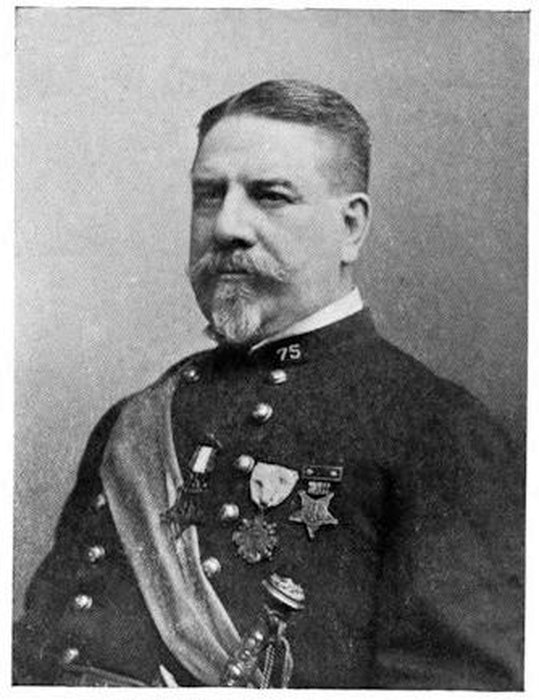
GEN. JAMES R. O’BEIRNE New York
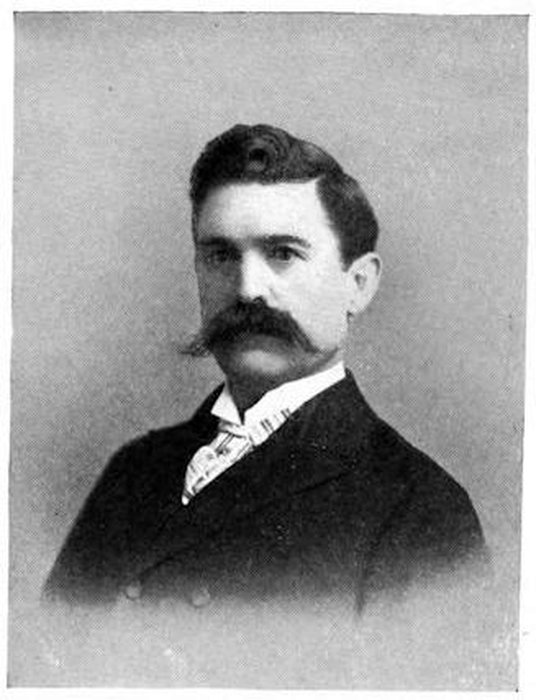
M. J. HARSON Rhode Island
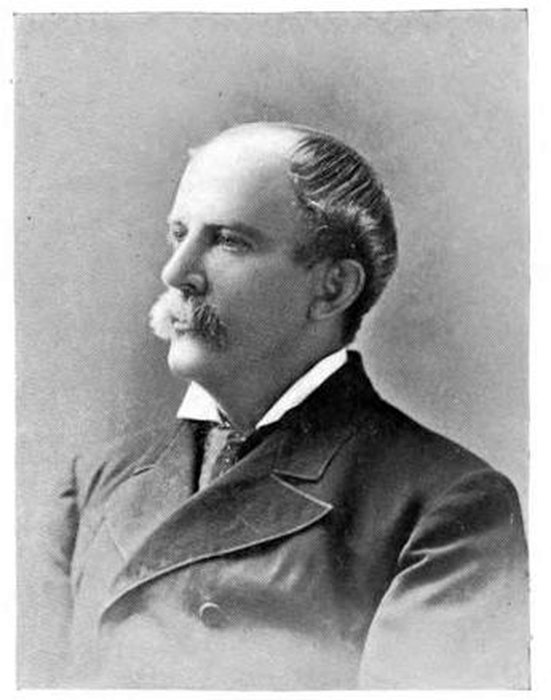
GEN. M. C. BUTLER South Carolina
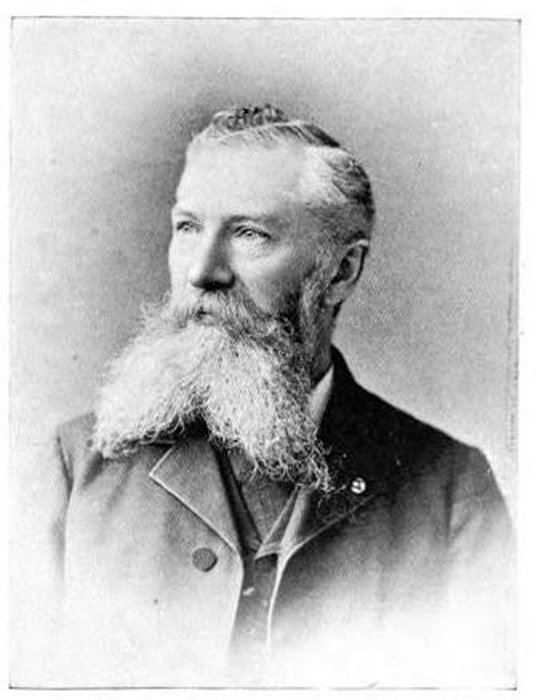
GEN. ST. CLAIR A. MULHOLLAND Pennsylvania
VICE-PRESIDENTS
63
The President-General’s Reply.
President-General Moseley replied as follows:
Gentlemen,—Deeply appreciative as I am of the honor conferred upon me by your tendering me the position of President-General of the American-Irish Historical Society, I feel that the compliment is greatly enhanced by my having been selected to fill the place so recently made vacant by the death of one of our most illustrious fellow-citizens, the late Rear-Admiral Richard W. Meade, of the United States Navy.
Honored by all true patriots for the loyalty, courage, and professional ability which so eminently distinguished him in his country’s hour of trial, and throughout his whole career, no more fitting representative of the Irish people, to whose history our society is devoted, could have been chosen as its first President-General, than Rear-Admiral Meade, who bore a name renowned as well in the army as in the navy of our country.
While fully conscious of my being all too unworthy to occupy a position which my predecessor so adequately filled, yet, as I am most earnestly and heartily in sympathy with the objects of the American-Irish Historical Society, and willing to share in its labors and responsibilities, I cannot but accede to your wishes, whatever misgivings I may have as to my ability to fulfill your expectations.
My descent from Irish ancestry, of which I am justly proud, and also from the English and Welsh, not only enables me to regard myself as among typical Americans in respect of origin, as well as aspirations and pride of country, but renders me fondly sympathetic with the aims and purposes of this American-Irish Society.
The main purpose of the American-Irish Historical Society is to elucidate the history of the Irish element in our people and the extent of the contributions to our development and civilization since the earliest colonial period,—a rich and greatly neglected field for historical research.
The society intends to demonstrate the fact that this element has not been given the credit which is its due by the writers of American history, and to prove by authoritative records that from the earliest days of the settlement of this country up to the present day, it has 64done its part towards establishing and maintaining this great Republic, and in developing its greatness in every field of its achievements.
But it is not solely to chronicle the deeds of Irish ancestors, or their descendants, and our contemporaries that we have organized an historical society.
Ownership, or the right of possession, as well as pride of descent, tend to make one a better citizen. We, therefore, desire that as our young men grow up they may feel that they inherit the right of ownership in our great country; that their ancestors have done their part towards the up-building of the grandest nation upon earth—a part not surpassed by any other element of our people, and therefore that they should always exercise the right of citizenship as a sacred trust transmitted to them for the glory and welfare of their country.
Of all those who by immigration have helped to people our country, the Irish have come imbued with the most intense feeling of loyalty towards our institutions, and it may be safely asserted that, since our independence of English rule was proclaimed, every true Irishman has felt, on landing in America, that the American shore was not a foreign shore for him. To perpetuate this feeling is the crowning object for which the society is organized.
Again sincerely thanking the society, through the committee, for the honor conferred upon him, President-General Moseley assured them that he would discharge the duties of the office to the very best of his ability.
In answer to the subjoined call the third meeting was held Nov. 16, 1897.
Office of the Secretary-General,
Pawtucket, R. I., Nov. 1, 1897.
Dear Sir:—You are hereby notified that the third meeting of the American-Irish Historical Society will be held at Young’s Hotel, Boston, Mass., on Tuesday evening, Nov. 16, 1897.
There will be a business session of the society at 6.30 P.M., followed, at 7.30 o’clock, by a dinner and post-prandial exercises of an interesting nature.
The after-dinner features will include:
(1) An address by the presiding officer.
(2) The reading of letters from distinguished members of the society unable to be present.
65(3) A paper by Mr. Dennis Harvey Sheahan, of Providence, R. I. (ex-clerk of the Rhode Island House of Representatives), on “The Need of an Organization such as the A. I. H. S., and its Scope.”
(4) A congratulatory letter from His Excellency Elisha Dyer, Governor of Rhode Island.
(5) An address by Mr. John Mackinnon Robertson, of London, author of The Saxon and the Celt.
(6) A communication to the society from Hon. Joseph T. Lawless, Secretary of State, Virginia.
(7) A paper on “The O’Briens of Machias, in the Revolution,” by Mr. H. W. Chaplin, of Boston, Mass., who is a descendant of the O’Briens.
Invitations to attend the dinner have been extended Rear-Admiral Belknap, U. S. N.; Dr. John Sullivan, a descendant of Gen. John Sullivan of the Revolution; and President Andrews, of Brown University. President Andrews’s work on American history is well known, and his patriotic address recently, before the Twentieth Century Club, will not soon be forgotten.
It is earnestly desired that every member of the society who can possibly be present at the coming meeting will attend and help make the event the great success it so richly deserves.
Fraternally, and in behalf of the Executive Council of the Society,
Thomas Hamilton Murray,
Secretary-General.
The third general meeting of the American-Irish Historical Society was held at Young’s Hotel, Boston, on the evening of November 16, about seventy members being in attendance. Gen. James R. O’Beirne, Vice-President for New York, presided at the business session. Secretary-General Thomas Hamilton Murray made his official report, saying:
The society is steadily growing in membership, and is receiving an excellent class of active workers. Many of these new accessions are gentlemen of national reputation. Before the year closes it is expected that between five and six hundred members will have been enrolled. Since the founding of the organization last January, three members have died. They were Postmaster Coveney, of Boston; Rear-Admiral Meade, who was the first President-General of the society; and Lawrence J. Smith, of Lowell, Mass.
66Twenty-eight states, the District of Columbia, and two foreign countries are now represented in the society’s membership. Since the last gathering of the organization the council of the society has held a number of meetings, and has materially furthered the movement.
The organization has enlisted widespread attention, and requests for genealogical information, historical data and facts relating to early Irish settlers in this country have been received almost daily. Several of the society’s members are of Revolutionary stock, and some are descendants of officers who served under Washington. Some of the members, too, trace their American ancestry back to a period anterior to King Philip’s War.
Since the last meeting an excellent article descriptive of the society and its purposes has been contributed to the Granite State Monthly, of Concord, N. H., by the Treasurer-General, John C. Linehan. A committee of Washington members of the society now has in preparation a diploma of membership and a seal. This committee will probably be ready to submit its designs at the next meeting. The members at the national capital have extended the society a cordial invitation to hold its coming meeting in that city, and have, in fact, already begun preparations for the event, under the direction of President-General Moseley. Gen. James R. O’Beirne, on behalf of the New York members, has also tendered the organization an invitation to meet in the near future in that city.
The last meeting of the society’s council was held in Pawtucket, R. I., as the guests of the members in that place and Providence. The meeting was very profitable to the cause. Several new members were obtained for the organization; and the entertainers’ hospitality was unbounded. The council has been invited to attend similar gatherings in Worcester, Lawrence, and other cities. This indicates the interest aroused. Massachusetts has at present the largest representation in the society; then follow in order Maine, New Hampshire, New York, Rhode Island, and Pennsylvania.
At the conclusion of Mr. Murray’s report a committee of three was appointed to take suitable action on the death of Lawrence J. Smith, of Lowell, Mass. The committee consists of Joseph Smith, Lowell; Thomas B. Lawler, Worcester; and Capt. P. S. Curry, Lynn.
William McConway, of Pittsburg, Pa., presented a check for $50 to the society.
67It was voted to hold the next meeting of the society in New York City.
The business session then adjourned, and the company proceeded to dinner.
Hon. Thomas J. Gargan presided; and seated on his right and left were John Mackinnon Robertson, of London; Admiral Belknap, U. S. N.; Gen. J. R. O’Beirne, New York; Hon. P. A. Collins, Boston; Col. John C. Linehan, Concord, N. H.; Rev. Edward McSweeney, Bangor, Me.; James Jeffrey Roche, of Boston; Thomas B. Lawler, of Worcester; and Joseph Smith, of Lowell.
Around the tables were noted: the Revs. William P. McQuaid, Boston; John Harty, Pawtucket, R. I.; J. H. Lyons, Boston; Dr. W. D. Collins, Haverhill, Mass.; Dennis H. Sheahan, Providence, R. I.; Stephen J. Casey, Providence; Osborne Howes, Boston; Humphrey O’Sullivan, Lowell, Mass.; J. F. Brennan, Peterboro, N. H.; Representative John Jolly, Alderman Thomas O’Brien, and Hugh J. Lee, Pawtucket, R. I.; Daniel Donovan, Timothy Donovan, and P. S. Curry, Lynn, Mass.; Hon. Joseph H. O’Neil, Dr. William H. Grainger, Dr. P. J. Timmins, M. A. Toland, Edward A. McLaughlin, M. J. Jordan, Dr. P. F. Gavin, Charles E. S. MacCorry, Joseph P. Flatley, Jeremiah W. Fogarty, all of Boston; Edmund Reardon, Capt. J. F. Murray, and Edward M. Manning, of Cambridge, Mass.; James Cunningham and Frank W. Cunningham, of Portland, Me.; and many others.
After dinner a short but stirring speech was made by the presiding officer, Hon. Thomas J. Gargan, who said in part:
It cannot be otherwise than interesting to analyze the materials entering into the warp and woof of our democratic fabric. We are a nation receiving emigrants from almost every country on the face of the globe. We are endeavoring to amalgamate people of different races, languages, and religions into a homogeneous mass, eliminating all that is vicious, and so refining what is good, hoping to evolve the best type of manhood and womanhood to be found in the coming century.
Doubtless the descendants of each race making contributions to 68our population will perform their share of the work in tracing their early settlements and their efforts in up-building the Republic. Our share of the work is to examine the data and preserve the records of the Irish and their descendants, and their contributions to the settlement of the original Colonies, the founding of the nation, the upholding of the Union, and the maintenance of democratic institutions.
Proud of our ancestry, yet loving the United States and loyal to our citizenship, we desire a fair share of credit for what they have accomplished. We respect the Germans, the French, the Italians, and the genuine Scotchman; but for that masquerading misnomer, the Scotch-Irishman, who claims no ancestry and no country as his own, we have only contempt; and he will go down to posterity as he deserves, “unwept, unhonored, and unsung.”
A distinguished man has said “the Irish have fought successfully the battles of all countries but their own.” They have also contributed their full share to the civilization and progress of all English-speaking people. That they possess brilliant qualities is not denied; but it is charged that they lack steadiness of purpose. I think a careful and critical study of the history of this country will refute this assertion.
To assert that they have imperfections is but to say they are human. For much of their humanity, I say God bless them. I wish there was a little more humanity in the world in our day.
We of this society are only asking that they may be spoken of and written of impartially, truthfully. “Nothing extenuate, nor set down aught in malice.” We will accept our share of just criticism. The malice and insolence of ignorance have unfortunately held the platform too long. It is our duty to endeavor to refute errors with clear statements of cold facts. For such purposes this society was organized; and it is very gratifying to be able to announce that in ten months since its organization we have already a list of nearly five hundred members coming from almost every state in the Union, representing some of the most distinguished men and families of the Republic. I congratulate you, fellow-members, on this signal success.
Mr. Gargan then introduced Mr. John Mackinnon Robertson, of London, author of many striking books and pamphlets, but most widely and favorably known to members of the Society and Irish-Americans generally by his masterly work, The Saxon and the Celt. Mr. Robertson is a tall, handsome man of forty, with dark hair, moustache and beard, and a well-modulated 69voice, which without effort reached the furthest part of the room. He gesticulates very seldom, and uses none of the tricks of the practiced orator; but he held his audience in rapt attention throughout his whole discourse, evoking applause and laughter at frequent intervals. He is a firm believer in the ultimate and not far distant triumph of Home Rule; and his advice to the American friends of the cause had the merit of novelty at least.
Mr. Robertson’s Address.
Mr. Robertson expressed the satisfaction with which he found himself at a union of an Irish society whose purpose was the systematic and dispassionate study of a department of the history of the race. The new movement was the more hopeful, seeing that it proceeded on democratic lines. It was said that war could not be carried on by a committee. If the military gentlemen present would forgive him, he would confess that he wished it could not be done in any other way, either (laughter); but he was sure that historical research could very well be so carried on. In so far as the Nationalist movement had of late years lost headway, it could fairly be said that it was because of an imperfect application of the spirit of democracy in its ranks. A great man was at once one of the greatest boons that could befall any cause, and one of the greatest dangers, because where the great man was all in all, the powers of the lesser men were undeveloped, and their faculty of coöperation was in a measure destroyed. The Nationalist movement had been shattered somewhat as the party of Cromwell was shattered at his death; but it would find the cure which, in the old case, had not been forthcoming (applause). Every development of democratic methods would make for reconstruction.
Above all, the present movement was full of promise, because it was essentially scientific in its aim.
Dennis Harvey Sheahan, of Providence, R. I., read the following paper on “The Need of an Organization such as the American-Irish Historical Society, and its Scope”:
70The history of a country is dear to the heart of the lover of that country. By the aid of historical study we learn of the origin, growth, and development of a race of people; their customs, religions, laws, governments; their accomplishments and what they have contributed to the economy of the world. The historian points out the past to the present and future. He puts aside the veil that has gathered about the dim past, opens up to the gaze of the bright present the panorama of human achievement, and blazes the way for his successor in the rosy future.
What the clergyman learns from the theological disputations of the past, the poring monk has gathered together; what the physician now acquires with comparative ease is furnished him by the knowledge garnered from the experience of his brethren from the time when man learned that pain and aches affected his being; what the lawyer gains from precedents is a guiding light which sheds its rays upon problems of jurisprudence that the legal lore of the past generations has taken from the leaves of experience; what formulæ the scientist is able to demonstrate he owes to the observations of men who, through the ages, have chronicled the phenomena of nature; the statesman is able to meet the crises of the present by being informed as to other crises in governmental affairs.
The citizen of a republic who neglects to learn the fundamental principles upon which rest the laws of the land, who does not know how the country was developed and maintained, is as a blind man, and is not able to bring to the exercise of his suffrage the amount of intelligence that the country has a right to require from him.
This obligation comes to us in a twofold capacity. We, as citizens of this great Republic, should study the history of our country from a patriotic standpoint, while as Irishmen, or descendants of that race, it should be not only a duty but a pleasure to learn of the deeds of Irishmen in America.
Therefore, an organization such as the American-Irish Historical Society, if it had no other raison d’être, would accomplish a patriotic purpose if it served only as an incentive to the study of the deeds of Irishmen in America.
It has become almost a maxim in historical matters that the history of events cannot be accepted as facts until the generation which lived at the time said events occurred has passed away.
The passions, influences, and conditions which generate, shape, and control events lend a coloring to their recital which, deep-lined or faint as painted by the writer at the time, are toned down or made 71stronger by the historian of a future generation who, unmindful of passions, influences, or conditions, and with an eye single to the preservation of history by means of the truth, makes past occurrences stand out in their true light.
Deeds that have received but a passing mention from writers whose minds were biased are rescued from an unmerited insignificance and placed high in the Temple of Fame, while highly extolled acts, given an undue prominence by a partisan writer, are consigned to a merited oblivion by the historian of a later but more impartial epoch.
It is not often true of history that the stone which was rejected by the builder becomes the corner stone of the edifice.
A member of the Society of Friends who desires to familiarize himself with the history of his sect in New England would find but little of the truth in the writings which have come from such intellectual dyspeptics as Cotton Mather and his disciples. But in the unwritten history of Quaker persecutions that have become legendary, by the purity of their lives, by their nobility of character and their Christianizing influences, the pioneers of that faith stand out in bold relief in the religious history of Puritan New England, with its dark background of scourging, mutilation, banishments, and hangings.
By analogy, how can the Irish-American race expect that the history of Irishmen in New England can be presented in just proportion to the true merits of the case?
In fact, who has heard much of Irishmen in New England until the present generation? As in New England, so throughout the Colonies. The Virginia Cavalier was not less hostile to the Irish than the Massachusetts Puritan.
Should the American-Irish Historical Society go out of existence to-night, it would have already accomplished a grand mission in this: that it has brought forth from obscure records the deeds of Irishmen in America, and has laid the foundation for the erection of an historical monument to Irishmen that, with its base laid in colonial times, and still being constructed, challenges the respect and admiration of all lovers of American history.
The work of this society has been thus far practically confined to research of New England records. This research has been fruitful of good results.
Among other things we learn of the Irish as brickmakers of Rehoboth and settlers in Salem and Lynn in early colonial times.
72Again, we learn that the Irish in the Granite State had become so numerous in colonial times that the General Court of Massachusetts passed a law prohibiting the “wild Irishmen of New Hampshire” from coming across the state line, lest they should drive out the people of the older colony. As long as that state shall last the glory and the fame of the Sullivans and their contemporaries of the Irish race will remain illustrious.
The history of Irishmen in Maine will be dwelt upon in the address of one of the gentlemen who is to follow on the program.
This research has extracted from the records of Rhode Island the influence of the Irish schoolmaster, McSparren, in moulding the intellectual development of that colony; it has called attention to the work of Bishop Berkely in the promotion of education there, and what is to me, personally, exceedingly pleasant information, that Brown University, my beloved Alma Mater, in its infancy was succored by the contributions of worthy people residing in Ireland.
The work of presenting to the world the achievements of Irishmen in America, in its just proportion to the achievements of men of other races in the colonization, struggle for independence, and the creation of a republic, the development of that republic from a theory into a concrete nation, and the perpetuation of that nation, is a duty not only to the men whose deeds are to be chronicled, but also a debt which we owe to ourselves, which we should cheerfully assume.
The labor involved in this from its very nature is such as can only be performed by an organization such as the American-Irish Historical Society.
The true status of the Irish in America, notwithstanding the fact that their brain and brawn have been interwoven in the woof and web of our nation’s fabric, has never been fully appreciated, by reason of the prejudices which have been associated with anything that bore an Irish name. This prejudice, in no small part, arose from misconception and misunderstanding of the Irish nature, temperament, and characteristics. There is a brand of bigotry that is sometimes designated as inborn. In the case of a bigot whose bigotry is congenital, it is well to follow the scriptural injunction to reason not with a fool lest he grow wise. But in the case of those persons who, by reason of misconception or want of acquaintance with Irishmen, cannot properly estimate our race, yet whose minds are broad enough to cherish the worth of a man when demonstrated, and whose patriotism counts every man a friend who has contributed 73to the glory of his country, an impartial history of the deeds of Irishmen in America would effectively serve to displace any prejudice.
What lover of the human race, animated by that noble sentiment of Terence, “I am a man, and I think nothing human foreign to me,” can fail to appreciate the sturdy virtues of the Irish people in America, their patient industry, their obedience to constituted authority, their domestic constancy, their desire to provide homes for their families and education for their children?
What patriotic American can fail to be moved by emotions of gratitude when he learns among other facts that the Irish in Ireland assisted with food and provisions the struggling settlers of Boston in a time of dire distress; that Irishmen of Philadelphia contributed large sums of money to the famished Revolutionary heroes at Valley Forge; that George Washington considered himself honored in being elected a member of an Irish society; that nine of the signers of the Declaration of Independence were men of Irish blood; that on the field of war, and in the council chamber of the nation, as well as in the administration of national, state, and municipal affairs, from the time of our earliest history to the present time, men of that race have given their lives and property to the nation’s cause? The work of this society thus far in this direction gives promise of either destroying the prejudices that have hitherto existed against the Irish people, or removing the venom from the fangs of bigotry.
To my mind the most urgent need of a society of this nature is the means it affords of preserving Irish history in America. It would be a great misfortune if the history of the Irish people in America, at present fragmentary at best, yet gathered together under favorable conditions and after the most careful and painstaking labor, could not find some secure lodgment.
What more suitable abiding place than the cabinet of the American-Irish Historical Society, from whence it could find its way into the private and public libraries, not only of our own country, but of the civilized world?
This society in the short time it has been in existence has accomplished so much in its chosen field as already to have demonstrated quite clearly its scope. From the publications issued by its members, notably the work of our Secretary-General in Massachusetts and Rhode Island, General Linehan in New Hampshire, Senator Walsh in Georgia, Hon. Joseph T. Lawless in Virginia, and others, our society has already contributed a fund of rich historical value to the history of this country. It would suffice to cite this labor to show the scope.
74The thought has occurred to me that it might be well, however, to suggest a specialization of this work and to provide avenues for its dissemination. The society should pursue the line of procedure already mapped out by extending its membership to every state in the country. Membership should be selected from men of scholarly attainments devoted to historical research. This membership should be so catholic as to include men of all religious denominations and nationalities.
Apropos of this I beg leave to call attention to the great work done and being done by German scholars in the study of Celtic, to illustrate the probable value of assistance that might be rendered to us by men of other nationalities. The society should coöperate with the movements in the other states, looking to the establishment of record commissions, and in states where such movements have not been set on foot, to labor to create such movements. In addition to this the products of the research of the society should be edited, and when preserved in book form copies of these should be distributed to other historical societies and placed in public and private libraries. Volumes could be printed from time to time, a number of which could be placed on the market for sale, thereby defraying the expenses of publishing the same.
With such an inviting field of labor spread out before us, this society not only supplies a long-felt want, but also a means of inspiration. Each member can contribute to the common fund of historical data, and the sum total of these contributions will go to make up a work of great value.
The need of such an organization as the American-Irish Historical Society being demonstrated, and its scope clearly defined, all that remains to be done to perpetuate its success is to continue in the work already so auspiciously undertaken.
The following letter was read from President Andrews of Brown University:
President’s Room, Brown University,
Providence, R. I., Nov. 10, 1897.
My Dear Mr. Murray:—Your American-Irish Historical Society meeting is sure to be a most interesting one, and but for the condition of my health and the numerous engagements for this month to which I am already pledged, I should certainly attend. As it is, I can only send you this testimonial of my interest in your organization 75and in the important phase of our American history which it is designed to investigate and expound.
The society can, and no doubt will, perform a most valuable work. The researches concerning the men whom I call the Irish Pilgrim fathers—the earliest representatives of the Irish race in New England—which you, yourself, sir, have so well begun, ought to be carried to the utmost attainable completion.
In early southern history Irishmen were a factor of the utmost importance. The Irish settlers and settlements in North Carolina and early Kentucky furnish an attractive subject for historical study, which, I believe, has never yet been adequately dealt with.
The American-Irish Historical Society will certainly prompt some of the numerous and brilliant youth of Irish descent, now coming forth from American colleges in such numbers, to turn their studies in the direction named.
Yours with sincere esteem,
E. Benj. Andrews.
The Friendly Sons of St. Patrick, who were in session in New York on the previous evening, sent the following:
New York, Nov. 15, 1897.
To the American-Irish Historical Society.
Gentlemen:—The Friendly Sons of St. Patrick of New York, an association of Irishmen and Irish-Americans coeval with the founding of this government, sends to you its heartiest fraternal greeting through your representative, Mr. Lawler. We fully appreciate the great value of the work you have undertaken—a work that involves the preservation of the record and achievements of men of Irish blood in the building and preservation of the American Republic.
The record of our race on this continent is glorious with patriotism and self-sacrifice; it is a record of honest toil, of love of freedom and religion, of devotion to God and country.
In preserving an authentic account of these achievements, the American-Irish Historical Society is performing a work of justice to the Irish race and an invaluable service to American history.
With every wish for your success, we remain fraternally yours,
Morgan J. O’Brien,
President, Friendly Sons St. Patrick, by John J. Rooney.
76Hon. P. A. Collins and Gen. J. R. O’Beirne dissented, courteously but firmly, from the proposition that justice is to be won from England by patience and a campaign of education. Recalling Parnell’s first visit to Boston, General Collins told with impressiveness how Wendell Phillips attended the great meeting, in order, as he said, “to look upon the man who had made John Bull listen.” We must make John Bull listen, was the theme of General Collins’s eloquent address. Though he had come unprepared to speak, he was in excellent form and showed no diminution of his old-time vigor and clearness of expression.
General O’Beirne, whose erect, soldierly figure and noble countenance “showed him no carpet-knight so trim, but in close fight a warrior grim,” spoke with burning words of the cause that is defeated but not lost, and never can be lost while Irishmen preserve their racial character. History for seven hundred years has shown their undying fortitude, and he predicted that it would record the same through all the years to come, whether Freedom come soon or late.
Admiral Belknap, U. S. N., Rev. Edward McSweeney, of Bangor, Me., and other gentlemen made brief impromptu remarks, and the meeting adjourned after passing a vote of thanks to Mr. Robertson for his entertaining discourse.
New Members Admitted.
The following new members were admitted: His Excellency Elisha Dyer, Governor of Rhode Island; Hon. Joseph T. Lawless, Secretary of State, Virginia; Hon. Elisha W. Bucklin, ex-State Auditor, Pawtucket, R. I.; Hon. Wauhope Lynn, New York City; Recorder Goff, New York City; Hon. W. F. Reddy, Richmond, Va.; Col. James Armstrong, Charleston, S. C.; Col. C. C. Sanders, Gainesville, Ga.; Mr. Edward Fitzpatrick, staff of the Courier-Journal, Louisville, Ky.; Hon. John F. Finerty, editor the Citizen, Chicago, Ill.; Mr. M. J. Dowling, secretary National Republican League, Renville, Minn.; Mr. Michael Walsh, LL.D., Ph.D., editor Sunday Democrat, New York City; Mr. James D. Power, Washington, 77D. C.; Capt. John Flannery, Savannah, Ga.; Hon. Matthew O’Doherty, Louisville, Ky.; Mr. Edward L. Hearn, South Framingham, Mass.; Capt. John J. Coffey, Neponset, Mass.; Mr. Stephen J. Casey, Providence, R. I.; Mr. John B. Kehoe, Portland, Me.; Mr. Anthony J. Philpott, Boston, Mass.; Mr. William Lyman, New York City; Dr. Daniel I. O’Keefe, Jamaica Plain, Mass.; Dr. Thomas J. Dillon, Roxbury, Mass.; Dr. James E. Keating, Portland, Me.; the Rev. J. Phelan, Rock Valley, Ia.; Capt. Thomas J. Hogan, Portland, Me.; Mr. Thomas J. Lane, East Boston, Mass.; Mr. John Ahern, Concord, N. H.; Dr. Edward J. McDonough, Portland, Me.; Mr. Hugh J. Lee, Pawtucket, R. I.
Mr. Thomas B. Lawler, of Worcester, presented the following New York gentlemen as candidates for the society, and they were all admitted:
Hon. Joseph F. Daly, Hon. Morgan J. O’Brien, Hon. Frederick Smyth, Hon. E. F. O’Dwyer, Hon. Thomas S. Brennan, Col. William L. Brown, Dr. Charles J. Perry, Dr. Constantine Macguire, Maj. John Byrne, F. C. Travers, M. A. O’Byrne, John Crane, J. M. Fitzpatrick, D. P. Murphy, Jr., Robert E. Danvers, Stephen J. Geoghegan, James P. Campbell, Daniel O’Day, John J. Rooney, Laurence Winters, William Cranitch, James G. Johnson, William F. Clare, Edward J. McGuire, Daniel F. Colahan, Edward D. Farrell, William M. Penney.
On Feb. 1, 1898, the following invitation was issued to the members:
Dear Sir:—You are hereby notified that the annual meeting of the American-Irish Historical Society will be held at the Hotel San Remo, New York City, Thursday evening, Feb. 17, 1898.
The San Remo is owned by a member of our society (Mr. Michael Brennan) and is located at Central Park West, Seventy-fourth and Seventy-fifth Streets. It is easy of access and excellently adapted to a gathering such as we have in view.
There will be a business session of the society at 7 P.M., at which the annual election of officers will take place. At 8 o’clock the society and guests will proceed to dinner.
Gen. James R. O’Beirne, Vice-President of our society for New York State, will preside.
78The delegation from the New England states will include the Hon. John C. Linehan, State Insurance Commissioner of New Hampshire; the Hon. Thomas J. Gargan, Boston, ex-President of the Charitable Irish Society (founded 1737); James Jeffrey Roche, LL.D., editor of the Boston Pilot, and other prominent gentlemen.
At the business session an amendment to Article XII of the Constitution will be offered. This article at present provides that the executive council of the society shall consist of ten members (in addition to the general officers). The proposed amendment, if passed, would change the language to read “not less than ten, nor more than twenty.”
During the post-prandial exercises Mr. Joseph Smith, secretary of the Police Commission, Lowell, Mass., will read a paper on “American History as it is Falsified.”
Fraternally,
Edward A. Moseley,
President-General.
Thomas Hamilton Murray,
Secretary-General.
The annual meeting of the American-Irish Historical Society was held on Thursday evening, 17th inst., at the Hotel San Remo, New York City. A large and representative gathering was present. Six states,—New Hampshire, Massachusetts, Rhode Island, Connecticut, New York, and New Jersey,—sent delegations. Fifteen states were represented by letters expressing congratulations and good wishes.
President-General Moseley, of Washington, D. C., was unable to be present owing to a press of duties as secretary of the Interstate Commerce Commission, but his annual address was read to the society by Gen. James R. O’Beirne, Vice-President for New York. It was an eloquent production.
The society made its headquarters for the occasion at the San Remo, a magnificent house, owned by a member of the organization, Mr. Michael Brennan. It is situated at Central Park West and Seventy-Fifth Street, and is one of the finest hotels in the world. The banquet hall where the annual dinner of the society took place is located on the tenth floor and was lighted by over a thousand incandescent electric lamps. The scene was one of great brilliancy.
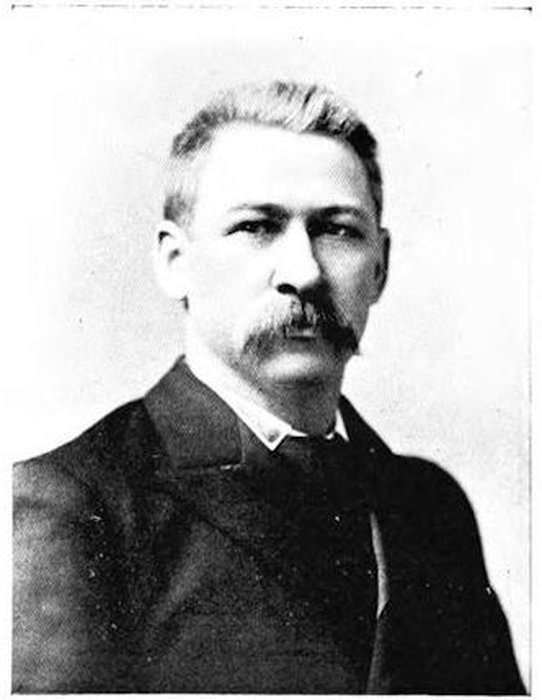
T. E. A. WEADOCK Michigan
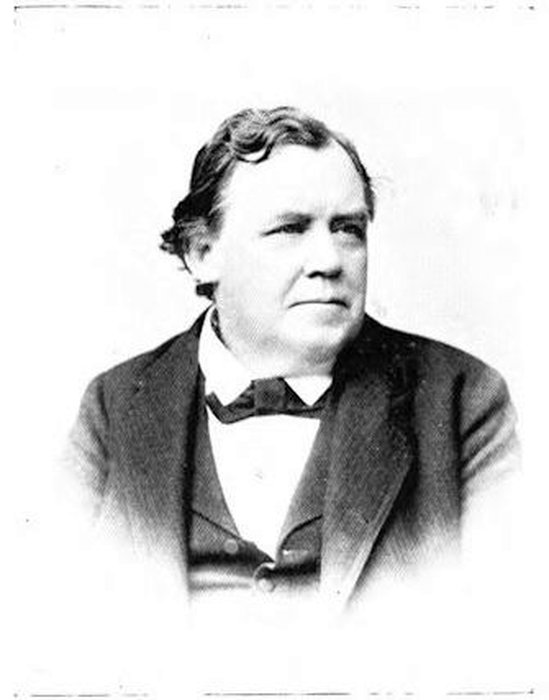
IGNATIUS DONNELLY Minnesota
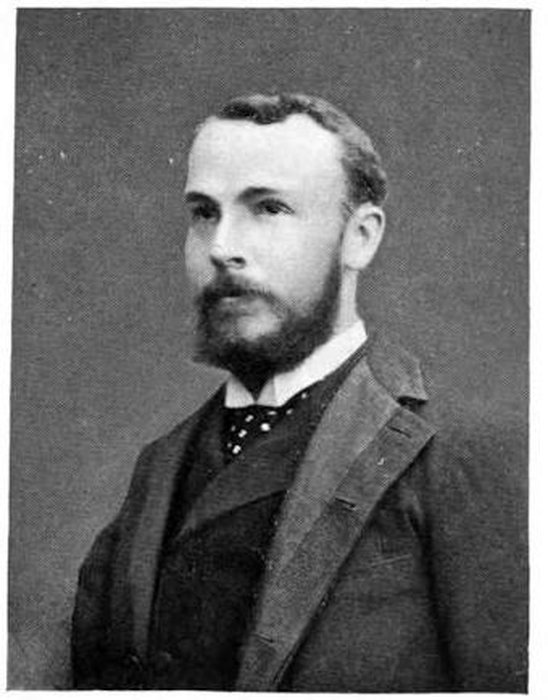
JAMES E. LOWERY Colorado
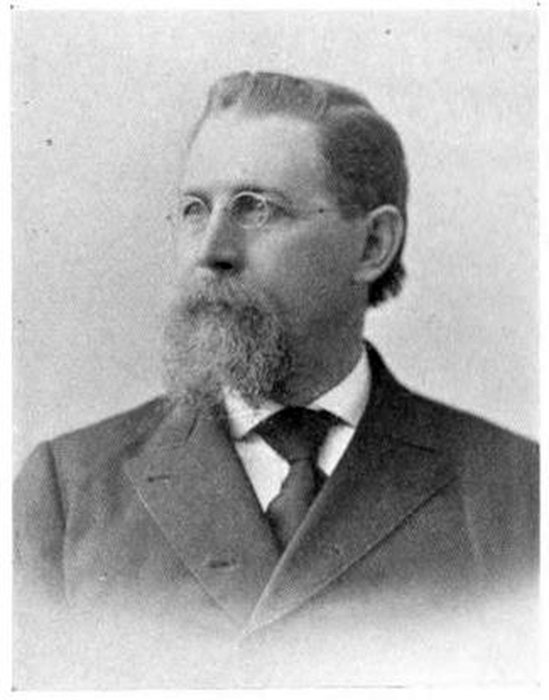
JAMES CUNNINGHAM Maine
VICE-PRESIDENTS
79Among the early arrivals were: Hon. John C. Linehan, Concord, N. H.; Hon. Thomas J. Gargan, Boston, Mass.; Mr. James Jeffrey Roche, editor of The Pilot; Mr. T. B. Fitzpatrick, of Brown, Durrell & Co., Boston; Mr. Joseph P. Flatley, Boston; Mr. Joseph F. Swords, Hartford, Conn.; Dr. Thomas Addis Emmet, grandnephew of the Irish patriot, Robert Emmet; Mr. Thomas B. Lawler, Worcester, Mass.; Hon. John D. Crimmins, New York; Mr. Frank C. Travers, New York; Capt. E. O’Meagher Condon, Washington, D. C.; Mr. Stephen J. Geoghegan, New York; Thomas Dunn English, Newark; and many others.
The business meeting and annual election took place at 7.30 P.M., and was held in the grand ballroom of the San Remo, which was comfortably filled.
General O’Beirne called the assemblage to order. Secretary-General Murray read the records of the previous meeting held by the society in Boston, and the same were approved.
It was announced that since that meeting three members of the society had died. They were: Hon. Owen A. Galvin, Boston; Hon. Charles B. Gafney, Rochester, N. H.; and Hon. John Cochran, New York City.
Committees were appointed to take suitable action on the deceased members.
The committee on audit, appointed to examine the books of the Treasurer-General, consisted of Judge Wauhope Lynn, New York; Mr. T. B. Lawler, Worcester, Mass.; and Mr. Michael Brennan, New York. The committee reported the books as displaying excellent system and arrangement, and the accounts of receipts and expenditures as being in an eminently satisfactory condition. The report was unanimously approved and adopted.
The society then proceeded to the election of new members, and some thirty were admitted from New York, Virginia, Texas, and other states. Among these new members is the Rev. Dr. McComb, a Presbyterian minister of New York City.
The proposed amendment to Article XII of the Constitution was adopted. It provided for an increase of ten in the make-up 80of the council of the society. The new members elected to the council under this provision comprise: Hon. Morgan J. O’Brien, a Justice of the New York Supreme Court; Hon. John D. Crimmins; Mr. Joseph F. Swords, Hartford, Conn.; Dr. Thomas Addis Emmet, New York; Mr. Stephen J. Geoghegan, Mr. Francis Higgins, Hon. James S. Coleman, and F. C. Travers, New York City.
In addition to the foregoing, the annual election resulted as follows: President-General, Edward A. Moseley, Washington, D. C.; Secretary-General, Thomas Hamilton Murray, Pawtucket, R. I.; Treasurer-General, Hon. John C. Linehan, Concord, N. H.; Librarian and Archivist, Thomas B. Lawler, Worcester, Mass. These are all reëlections.
After the transactions of some routine matters the business meeting adjourned.
A short time later the line was formed and marched to the banquet hall, which was handsomely decorated. In the rear of the presiding officer’s chair was a glory of flags in which the star-spangled banner and the Irish tricolor predominated. American and Irish flags of small size were also distributed adown the tables, mingled with flowers and potted plants. Overhead the effulgence of a thousand electric lights served to add further brilliancy to the scene.
In a bower composed of huge palms and smaller plants was stationed an orchestra which discoursed sweet music during the repast. The company around the board represented, without exaggeration, several million dollars. Catholics and Protestants were there, Democrats, Republicans, and Independents. It was a remarkable gathering in many ways, and was indicative of the strength and representative character already attained by the society.
General O’Beirne presided, and seated on his right and left were Dr. Thomas Addis Emmet, Hon. Thomas Dunn English, Hon. John D. Crimmins, Hon. Thomas J. Gargan, James Jeffrey Roche, Joseph Smith, Judge Wauhope Lynn, Hon. John C. Linehan, F. C. Travers, V. P. Travers, John Crane, and T. B. Lawler.
81Also present were noted: Commissioner Coleman, New York; Capt. E. T. McCrystal, of the Sixty-Ninth Regiment, New York; Dr. T. F. Harrington and Dr. George Leahey, Lowell, Mass.; Commissioner McSweeney, New York; W. F. Foley, Houston, Texas; John J. Rooney; and about one hundred others.
The menu card was especially designed for the occasion and elicited much favorable comment. During the evening a copy of the first Yearbook of the society was presented to each member present.
A feature of the evening was the rendition by the orchestra of “Ben Bolt,” out of compliment to the author, Dr. Thomas Dunn English, who was present. He is now about eighty years of age, and tears glistened in the old man’s eyes at this thoughtful tribute. The post-prandial exercises were opened by General O’Beirne who, after a stirring address on the objects of the society, read the annual address of the President-General, which was frequently applauded. He then successively introduced the speakers of the evening, who were Dr. Emmet, Dr. English, Mr. Gargan, Colonel Linehan, Captain Condon, Judge Lynn, and a number of others.
A great feature of this part of the program was an able paper by Mr. Joseph Smith, on “American History as it is Falsified.” He said:
Some Ways in which History is Falsified.
When the American-Irish Historical Society was organized a year ago in Boston, it declared its purpose to be the investigation into, and the recording of, the influence of the Irish element in the up-building of the American nation. We said then that the work and contributions of the Irish race on this soil had received scant recognition from the writers of American history; and we announced that whether that omission sprang from carelessness, ignorance, indifference, or design was not so important as the imperative necessity of remedying such a state of affairs in the interest of historical accuracy and racial fair play. For the past year our society has been in its formative stages; in the coming years I have ample faith that numbers, 82funds, earnestness, and enthusiasm will enable us to do our work effectively.
American history is being rewritten; the legendary and sentimental method of writing it is growing in disfavor; a scientific age demands the truth, and under its insistence new data are coming to light and old myths are passing away. It is beginning to dawn on American minds that this republic is the child of Europe and not of England; that old man of buckram—the Anglo-Saxon—is having a hard time with that new man of straw—the Scotch-Irishman; and when science gets the latter on the dissecting table there won’t be much left of him but rags and papier-maché.
To-night I will try to direct your attention to “Some Ways in which American History is Falsified”; and by falsification I do not mean so much the deliberate perversion of facts as I do the false effects produced by evasion, distortion, wrong point of view, and the physical and mental limitations and defects of writers, which in their results are quite as mischievous as those produced by perversion and design.
I will for my purposes group my object lessons under four heads, illustrating each with a writer passing current as an historian.
1. Mental Invalidism. The disease of certain literary doctrinaires whose natural defects have been aggravated by education and fixed by training. Prof. John W. Burgess, of Columbia University, is a fine type of this arrogant school of dogmatism.
2. Legend and Sentiment. The exploitation of legends, inherited ideas, race and family myths, made current and passing into literature by the efforts of those whose faith in folklore as historical data is profound, and to whom facts and documentary evidence are unimportant. Senator Henry Cabot Lodge, an amateur historian, is the high priest of this cult; he is the custodian and incense swinger of the deified Puritan, the marvel and fountain of the graces of the modern age.
3. Imagination. The school of writers who add to the gayety of nations, who make history from their own inner consciousness, and who record it as they imagine it ought to be, not as it is. Under this head comes that humorless horde of scribblers, the Scotch-Irish littérateurs, and the intellectual giant of Tennessee, Judge Temple, author of Covenanter, Cavalier, Puritan.
4. Carelessness and Credulity. Writers who accept any evidence stated with solemnity and the air of authority, but who subject it to no tests to ascertain its verity and genuineness. Under this head I 83take exceptions to the statements made by Prof. John Fiske in a recent work, a writer hitherto regarded as safe and reliable.
I will now devote a few minutes to a work entitled Political Science and Constitutional Law, written by Prof. John W. Burgess, of Columbia University, and designed to be a text-book for that and other educational institutions.
Mr. Burgess is a rampant type of what a coldly critical and remorselessly correct writer, John M. Robertson, of London, calls a Celtophobe—a Celt hater. The learned Professor asserts dogmatically that the Celt never has, never can, and never will amount to anything nationally or politically; and that all law, order, and scientific government have sprung from and are due to what he calls the Teutonic races. Professor Burgess is a product of German training and education, and his views have received the cordial endorsement of such a calm and dispassionate authority as the London Times. The careful writer in stating his theory will fortify it with facts and figures and marshal his authorities before proceeding to erect a fabric on it; but Professor Burgess isn’t that kind of a man. He states his theory with an air of profound conviction and authority and goes ahead. His theory, like a good many other fabrics “made in Germany,” looks well, is calculated to deceive the unwary and unthinking, but under very ordinary scrutiny proves to be very commonplace, shoddy.
Let me show you a few of the gems from his treasury:
“Only the Teutonic races have produced national states.... The National State is thus the most modern and most complete solution of the whole problem of political organization which the world has as yet produced; and the fact that it is the creation of the Teutonic political genius stamps the Teutonic races as the political nations par excellence, and authorizes them in the economy of the world to assume the leadership in the establishment and administration of states.”
This brilliant outburst winds up a series of equally impressive statements. Just what the Professor means by National States and political nations I do not know, nor am I sure he knows himself. At any rate, he appears to lay down a doctrine very delightful to these governments which bully nations and steal territories, if not quite so agreeable to those bullied and plundered.
Now listen to his views on the unfortunate Celt; they have the old familiar ring of anti-Irish hysteria, for which familiarity has bred Irish contempt.
84“Personal attachment in small bodies to a chosen Chief is the peculiar political trait of the Celtic nations.... The effect of such a political character has always been the organization of the Celtic nations into numberless petty military States, in each of which individual rights have been ignored; between all of which civil war has been the permanent status; and against which foreign force has been continually successful.... Violence and Corruption have always marked the politics of Celtic nations.”
Let us stop for a moment to analyze this tremendous blast from Columbia University, remembering that Germany and England are Professor Burgess’s ideal Teutonic nations.
From the time of the Roman retrocession from England until the landing of William the Norman at Hastings, that unfortunate land was in the hands of one of the dullest, most unimaginative, worst-governed, and worst-governing races history mentions—the Saxons—for six hundred years; it had become a congeries of warring, military chieftainship, in which civilization was almost obliterated, learning had disappeared, religion was at its lowest ebb, life and property had no safety, the people were enslaved, and the coast harried by foreign and victorious foes. The advent of a strong conqueror—a mixed Celt and Norseman—changed all this, hammered England into a strong military kingdom, connected her with the civilization that has made the world what it is—the Latin—and did in six years what the pure Teutonic race had signally failed to do in as many centuries.
Prior to the historic event known as the Reformation, Germany had as much peace as her neighbors—which wasn’t much—and all she had she owed to her intercourse with the Latin South, to her touch with the civilization and religion of Rome. After that event Germany was torn into factions, military chiefs sprang up, petty military states were made, violence and corruption were the rule, civilization retrogressed, the people were degraded and the land devastated. Germany was without unity; her mercenaries were for sale to the highest bidder; she was terrible only to her children, the prey of foreign forces, with civil war a permanent status. The advent of Napoleon was a blessing; he hammered a lot of petty principalities out of existence and formed two or three monarchies out of the bewildering many. The fall of Napoleon saw Germany a confederation, much after the fashion of pre-Reformation days, with Austria on top. Again came wars and dissensions, and finally the strong conqueror who united Germany against a common foe and made her what she is to-day. 85Germany, I take it, is the highest political expression of the Teutonic race, according to the dictum of Professor Burgess. What is it?
A military despotism of the most mediæval type, governed by an autocrat of doubtful sanity, whose person is more sacred apparently than that of the Deity; a land whence the people fly to seek safety, peace, liberty; a government that is a constant threat to the peace and civilization of the earth and that embodies all the reactionary principles a free people hate.
One does not expect the German professor, his disciple, or the mole in the earth to see what is going on in the sunlight.
If we turn to Ireland we see nothing but violence, corruption, and plunder in the methods of the Teutonic race ruling there; and we observe improvement in Irish affairs only with the decrease of English influences and the increase of Irishmen in Irish affairs.
It is a favorite axiom of the Teutonic writer of the Burgess type, wherever English and German rule is a failure, that the people ruled are unfit for government. Did it ever occur to them that the shoe is on the other foot—they are unfit to govern?
The unfitness of the English to govern Ireland is historic; it was exhibited in America, as some may recall; it is notorious in India and round the earth. The best-governed possessions of England are the lands where Englishmen are least in evidence. Germany in Africa is producing the usual harvest of Teutonic “genius”—depopulation and devastation.
But Mr. Burgess has a theory, and he does not propose to hamper it with facts. He asserts that the government—the political organization—of Spain, Italy, and Portugal are the results of Teutonic genius. This will probably be news to the world; but if the debility, decay, and general rottenness of those kingdoms are the result of Teutonic genius, the sooner they try the genius of the negro and the Chinaman the better for them. He covers whatever political good may exist in Greece, Bulgaria, and Roumania by attributing it to the impecunious German princes now adorning the rickety thrones in those lands. The idea is original, but not impressive. Why not attribute the political condition of Scandinavia to the presence on its throne for ninety years of Bernadotte, the French (Celtic) military adventurer, and his wife, the daughter of the Irish merchant Cleary, and their children? The logic is as good, or as bad, in one case as the other.
But why go on with this tissue of professional rubbish?
86Nations are made what they are by climate, environment, peace, war, and economic and industrial conditions. Groups of men learn as does the individual, in the school of experience. Nations have no genius for anything; the botch work we call government to-day at its best is hardly a manifestation of genius. Nations may have temperaments, the product of experience, but only the individual has character.
Professor Burgess is merely a mental invalid, an hysterical Celtophobe. He either forgets the existence of Rome and Greece, or he fails to understand the value of civilization and human experience; he is a kind of literary phonograph, repeating the slanders and absurdities which a school of race egotists have raised to a cult. He is a decidedly unsafe man to educate a coming generation of Americans, for the writer of solemn and dogmatic nonsense is unfit to train the American youth. Certainly no self-respecting man of Irish-Celtic blood should permit his children to attend a university where they are taught that the perpetrators of ages of outrage and wrong are divinely selected beings, chosen “to assume leadership in the establishment and administration of States.”
If we desire that sort of rubbish taught, it is just as easy to secure professors at Bloomingdale as it is at Columbia.
The legendary and sentimental makers of history seem to thrive best in New England; and a fine type of the cult is the so-called “scholar in politics,” Senator Henry Cabot Lodge, of Massachusetts and Nahant. There is in China a religion whose principal tenet is the worship of ancestors, the placation of ancestral manes. This religion is called Tavism; and possibly the purest type of Tavist, outside of China, is the junior senator from Massachusetts.
Mr. Lodge is firmly convinced that the Puritan represents the perfect type of man; that the history of the world began in 1620; that the Puritan derived most of his excellence from being of English blood; and that, while Puritans were Dutch, French, Scotch, and even Irish, the lack of English blood somehow made them incomplete. While the ordinary English Puritan was a wonderful personage, the one who landed in Massachusetts was a genuine marvel, but when he settled around Boston and Nahant, he began to ooze genius and take on wings and halo. To this legend is added, sometimes by direct statement and sometimes by implication, the intelligence that all the great and good things that make this republic different from and superior to other lands are due to the miraculous powers of the Puritan. He is the creator of human freedom, the 87father of religion, liberty, and tolerance, the founder and originator of free schools, and the reputed author of so many ideas totally at variance with his narrow creed that were he to rise from his bed of clay in New England into the sunlight of to-day, he wouldn’t know himself.
This is the school of historical incubation of which Mr. Lodge is the high priest. Mr. Lodge has many admirable qualities; but his mental vision is defective, strabismal, and his ancestral credulity amazing. I am satisfied that Mr. Lodge would not knowingly do an unjust, intolerable, or dishonorable thing; but he is so en-webbed in tradition and so steeped in myth and legend that his rôle of historian is a decided misfit. How else can we account for the absurd theories he has exploited and the conception of historic events he has fathered in literature?
Anybody who has even read his history of the Thirteen Colonies will learn that the success achieved in building them up was due to the Puritans; and one is convinced that had some wandering vagabond from Massachusetts been cast away on the coast of Spanish-America, the Latin Republics south of us would now be the model governments of the earth and probably be called “Anglo-Saxon” nations. Everything that makes for success he attributes to the Puritan; and he does it with such a solemn, awe-stricken lack of humor that the irreverent are moved to Homeric mirth.