VII ROME
W. G. (William George) Waters translation
Here they raised difficulties as in other places concerning the plague raging at Genoa. We went to lodge at the “Bear,”71 and stayed there the following day also, and on the 2nd of December we hired apartments in the house of a Spaniard in front of Santa Lucia della Tinta.72 We were well accommodated in three fine chambers, a living room, a larder, a stable, and a kitchen, for twenty crowns a month, the host finding in addition a cook and fire in the kitchen. Here the apartments are as a rule furnished somewhat better than in Paris, inasmuch as they use much gilded leather in the upholstering of all houses of consideration. We might have had lodging at the “Vaso d’Oro” hard by at the same price, furnished with silk and cloth of gold such as kings use, but M. de Montaigne objected, first because the chambers had no separate entrances, and next because the magnificence of this furniture was not only useless in itself, but liable to give great trouble in keeping it from hurt, each bed being of the value of four or five hundred crowns. At our lodging we made a bargain for a supply of linen, as we should have done in France, but of this, as is the way of the country, they were somewhat sparing.
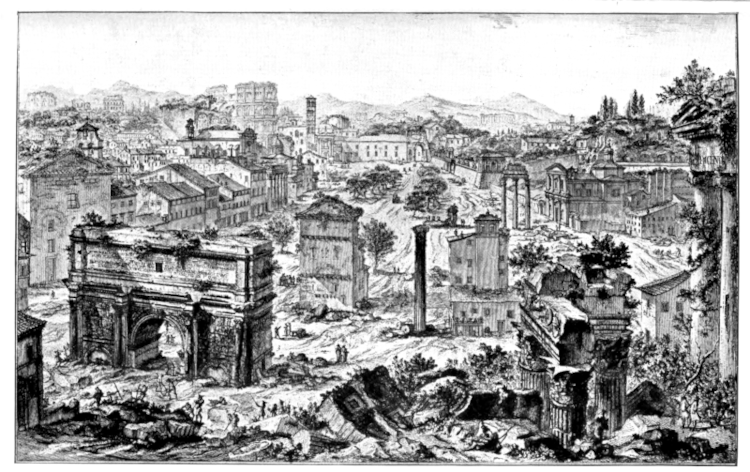
THE ROMAN FORUM FROM THE CAPITOL
From Piranesi’s Views of Rome
To face p. 74, vol. ii.
M. de Montaigne was annoyed to find such great number of Frenchmen in Rome,73 so great that almost every person he met in the streets addressed him in his own tongue. He found novelty in the sight of so mighty a court, thronged with prelates and churchmen, and declared that Rome was far fuller of rich men and coaches and horses than any other city he had ever seen, and that the seeming of the streets in various ways, and notably in the crowds of people, reminded him more of Paris than of any other place. The present city is placed along either bank of the Tiber. The hilly quarter, where the ancient city stood, and whither M. de Montaigne went every day to walk and to survey the site, is now divided between certain churches, and rich houses and gardens belonging to the cardinals. He found clear evidence to show that the configuration and slopes of the hills had altogether changed since ancient times. He judged from the height of the ruins, and was fully assured that in certain places we were walking over the roof-ridges of houses still intact; indeed it is easy to see by the state of the Arch of Severus that we now stand more than two pikes’ length above the ancient level, and that we walk on the tops of the old walls, which the rains and the coach wheels occasionally bring into sight.
M. de Montaigne would not admit that liberty existed in Rome equal to that enjoyed in Venice, and would advance by way of arguments the facts that houses were so insecure against robbers that people who might bring home with them a large amount of property usually determined to give their purses in charge of the bankers of the city so as not to find their strong boxes rifled, which mishap had befallen many; that it was by no means safe to walk abroad by night; that in this month of December the General of the Cordeliers had been suddenly deprived of his office and imprisoned because in his preaching, at which were present the Pope and the cardinals, he had censured the sloth and luxury of the prelates of the Church, and this without mentioning names and simply using commonplace remarks on the subject with a certain harshness of voice; that his own boxes had been searched by the tax-officers on entering the city and turned over even to the smallest articles of apparel, while in the other towns of Italy the officers had been satisfied by the presentation of the boxes for search; that in addition they had seized all the books they found there with the view of inspecting them, over which task they spent so much time that any one in different case might well have given up the books as lost. Again the regulations were so extraordinary that one of these books, the “Hours of our Lady,” having been printed at Paris and not in Rome, was looked at with suspicion, as were certain books against heretics by German doctors who, in argument, happened to make mention of the errors of their opponents. At this juncture he congratulated himself over his good fortune in that, having no premonition of the search which awaited him, and having passed through Germany where forbidden books abound, he had not brought away with him a single one of these, notwithstanding the curious interest which often possessed him with regard to divers of them. Certain gentlemen from Germany informed him that had any such volume been found, he would have paid the penalty by losing all his books.
On Christmas Day we went to hear the Papal Mass at St. Peter’s, M. de Montaigne being accommodated with a seat from which he could behold at his ease all the ceremonial. They used certain particular forms; to wit, they read the Gospel and the Epistle first in Latin and then in Greek, a custom followed also on Easter Day, and on the feast of St. Peter. The Pope himself74 let divers others communicate, and with him officiated the Cardinals Farnese,75 Medici,76 Caraffa,77 and Gonzaga. In taking the cup they use a certain instrument to prevent danger of poison.78 It seemed strange to M. de Montaigne that, at this mass and at others beside, the Pope and cardinals and other prelates kept seated with heads covered and talked together the while. The whole ceremony indeed was marked by splendour rather than by devotion. Touching the beauty of the Roman ladies, M. de Montaigne affirmed that this was not notable enough to raise the reputation of this city beyond all others; moreover that, as in Paris, the most remarkable beauty belonged to those who made a market of the same.
On December 29th M. d’Abein,79 our ambassador, a learned gentleman and a longstanding friend of M. de Montaigne, advised him to go and kiss the feet of the Pope. M. de Montaigne and M. d’Estissac went in the coach of the ambassador, who, after he had been granted an audience, caused them to be called by the Pope’s chamberlain. According to custom, only the ambassador was with the Pope, who had by his side a bell which he would ring when he might wish any one to be introduced. The ambassador was seated, uncovered, at his left hand; the Pope himself never uncovers before any one, nor can any ambassador remain covered in his presence. M. d’Estissac entered first, then M. de Montaigne, then M. de Mattecoulon, and last M. d’Hautoy. After taking a step or two into the chamber, in a corner of which sits the Pope, the incomer, whoever he may be, kneels and waits for the Pope to give him benediction. This done, he will rise and advance to the middle of the room, but a stranger rarely approaches the Pope by going direct across the floor, the more ordinary practice being to turn to the left on entering, and then, after making a détour along the wall, to approach his chair. But when the stranger has gone half the distance he must kneel again on one knee, and, having received a second benediction, next advances as far as the thick carpet spread out some seven or eight feet in front of the Pope. Here he must kneel on both knees, while the ambassador who presents him kneels on one, and moves back the Pope’s robe from his right foot, which is shod in a red shoe with a white cross thereupon. The kneeling stranger must keep himself in the same posture until he is close to the Pope’s foot, and then bend down to kiss it. M. de Montaigne declared that the Pope raised the point of his foot a little. They all kissed it one after the other, making room for each other after the ceremony was done. Then the ambassador covered the Pope’s foot, and, having risen to his seat, said what seemed necessary on behalf of M. d’Estissac and M. de Montaigne. The Pope, with courteous expression of face, admonished M. d’Estissac to cultivate learning and virtue, and M. de Montaigne to maintain the devotion he had always exhibited towards the Church and the interests of the most Christian King: whatever service he could do them they might depend on, this being an Italian figure of speech. They said nothing, but, having been blessed again before rising as a sign of dismissal, they went back in the same order. Each one retreats as it seems best, but the ordinary custom is to go backward, or at least sideways, so as always to look the Pope in the face. As in entering, each one kneels half-way on one knee for another benediction, and again at the door for the last.
The Pope in speaking Italian betrays his Bolognese descent, the idiom of this city being the worst in Italy; and besides this, his speech is halting by nature. In other respects he is a very fine old man, of medium height, and upright, with a face full of majesty, and a long white beard. His age is over eighty, and for his years he is the most healthy and vigorous man possible, troubled neither with gout nor colic nor stomach complaints nor oppression of any kind. By nature he is kind, caring little about affairs of state, a great builder, and in the last-named capacity he will leave a memory highly honoured in Rome and elsewhere. In almsgiving he is somewhat excessive. Amongst other proofs of this, [it may be recorded that he is wont to help any girl of the lower orders in furnishing her home on her marriage, and report says that he shows the same liberality in ready money.]80 Besides this, he has built colleges for the Greeks, the English, the Scots, the French, the Germans, and the Poles, endowing each one with a perpetual revenue of ten thousand crowns, over and beyond the vast cost of building. This he has done to bring back to the Church the sons of the nations aforesaid, who were corrupted by evil opinions hostile to her. There the pupils are lodged, fed, clothed, and taught, and provided with everything without the expense of a single quattrino of their own on any account. Vexatious public duties he readily lets fall on the backs of others, and shrinks from troubling himself therewith. He gives as many audiences as are demanded. His replies are brief and decisive, and it is loss of time to oppose them by fresh reasoning. Nothing will move him from a decision which he believes to be a just one; and even for his own son,81 whom he loves passionately, he will not stir a finger against his idea of justice.82 He gives advancement to his relatives, but without trenching upon the rights of the Church, which he preserves intact. He has done magnificent work in public buildings and in remodelling the streets of the city. In sooth, it may be said that his life and doings call for no special remark, neither in one nor in the other respect, but that his leaning is strongly towards good.
On the last day of December these two83 dined with M. le Cardinal de Sens, who is more strict in his observance of Roman ceremonies than any other Frenchman. The Benedicite and the graces were very long, and were said by two chaplains, who responded one to the other as if they were saying the office in church, and during the repast a paraphrase in Italian of the gospel of the day was read. Both before and after dinner they all washed their hands, and to each one a napkin was served for use at table. Before the guests who sat beside or facing the host—as a mark of special honour—they placed the large silver trays with salt cellars, made like those which are put before guests of worship in France. Upon these trays was a napkin folded in four, and on the napkin was laid bread, a knife, a fork, and a spoon, and over all another napkin for use at table, the one first-named being left undisturbed. After the guests had seated themselves another plate of silver or earthenware would be placed beside the silver tray aforesaid, and this the guest would use during the repast. The carver gives a portion of whatever is served at table to all those seated, who never touch the dishes with their hands. Moreover, the dish set before the host is rarely shared by any of the guests.
To M. de Montaigne they served drink as they usually served it at the ambassador’s house whenever he dined there; that is, they brought him a silver basin in which was a glass with wine, and a little bottle about the size of those used for ink full of water. He took the glass in his right hand, and in his left the bottle, from which he poured as much water as he desired into the glass, and then replaced the bottle in the basin. When he drank the servant who waited on him held the basin below his chin, and afterwards replaced the glass in the basin aforesaid, such ceremony being observed only in the case of one or two sitting near the host. After the grace the table broke up at once, and the chairs were arranged along one side of the hall, where M. le Cardinal made them sit after he had seated himself. Two churchmen, finely clad, and bearing in their hands certain instruments of a kind I had never seen before, now appeared; and, having knelt down, they recited a church service of some kind or other. The cardinal said nothing to them, but as they rose to depart, after having finished their service, he slightly moved his cap. A short time afterwards he took his guests in his coach to the Consistory Hall, where the cardinals were assembled for vespers. The Pope came also, and robed himself there to attend the service; the cardinals did not kneel at his benediction, as the people did, but acknowledged it with a profound inclination of the head.
On January 3rd, 1581, the Pope passed beneath our windows, and before him went some two hundred horses belonging to personages of the court, of one robe or the other. Close beside him was the Cardinal dei Medici, who conversed with him covered, and took him to his house to dinner. The Pope wore a red hat, a white garment, and a red velvet cowl, as is the habit. He was mounted on a white hackney, harnessed with red velvet, and with fringe and lace of gold. Though he was nearly eighty-one, he mounted without any aid, and every fifteen paces or so he gave his benediction. After him came three cardinals, and then some hundred men-at-arms, each with lance on thigh, and fully armoured save the head. They had in readiness also another hackney with like equipment, a mule, a handsome white courser, and a litter. Also two robe-bearers with valises at their saddle-bows.
On January 11th, in the morning, as M. de Montaigne was leaving the house on horseback to go to the bank, he met Catena,84 a famous robber and banditti chief, whom they were taking away from the prison. This man had raised a panic all through Italy, monstrous tales of murder being told about him; notably concerning two Capuchins, whom he forced to deny God, and promised to spare their lives on this condition. But he slew them afterwards without any motive either of gain or of vengeance. M. de Montaigne halted to behold the spectacle. Over and beyond the escort customary in France, they let precede the criminal a huge crucifix draped with black, at the foot of which went a great crowd of men wearing cloaks and masks of cloth, and these were said to be of the chief gentlefolk of Rome, a confraternity sworn to accompany criminals to execution and corpses to the grave. Two of these—or two monks in similar garb—helped the condemned man into the cart and preached to him, one of them letting him kiss continually a picture of our Lord. This they did so that those in the street might not see the man’s face. At the gibbet, which was a beam upon two posts, they held this picture before his face till he was thrown off the ladder. He died as criminals commonly do, without movement or cry; a dark man of thirty or thereabout, and after he was strangled they cut his body in four quarters. It is the custom amongst these people to kill criminals without torture, and after death to subject the body to very barbarous usage. M. de Montaigne remarked that he had written elsewhere how deeply people are moved by the cruelties practised upon dead bodies,85 and on this occasion the crowd, who had not felt any pity at the hanging, cried out in lamentation at every stroke of the axe. As soon as he was dead divers Jesuits or other churchmen went up to a high place and cried to the people on all sides that they should take to heart this example.
We remarked in Italy, and especially in Rome, that very few of the churches have clocks, there being fewer in Rome than in the meanest French village. Also very few images are to be seen, save those made recently, several ancient churches being quite bare thereof. On January 14th M. de Montaigne saw the execution of two brothers, formerly servants of the Castellan’s secretary, who some days ago slew their master by night in the palace of Signor Jacomo Buoncompagno, the Pope’s son. Their flesh was torn with pincers and their hands cut off, in front of the aforesaid palace, and after this mutilation they put over the wounds the bodies of capons which they had killed and cut open just before.86 This execution took place on a scaffold, where the criminals were first knocked down with heavy wooden clubs, and then their throats were cut; it is, so the report goes, a form of punishment used in Rome from time to time, but some held that it had been specially appointed for this misdeed, for that the criminals had killed their master in like manner.
As to the bigness of Rome, M. de Montaigne declared that the space which the walls enclose, more than a third thereof being void, and the site of old and new Rome as well, would equal an enclosure made round Paris to take in all the faubourgs. But, reckoning the bulk of the two cities by the number and closeness of the houses and inhabitants, he deemed that Rome would fall short of Paris by one-third. In number and grandeur of public places, and in beauty of streets and palaces, Rome seemed far superior.
He found the cold of winter little less bitter than that of Gascony. About Christmas there were sharp frosts and the wind was intolerably cold; and after that it frequently thundered, hailed, and lightened. In the palaces the suites of apartments are large, one room after the other, and you may have to pass through three or four rooms before you come to the chief saloon. In certain houses where M. de Montaigne dined in ceremony the buffet was not set in the dining-room, but in one adjoining, whither the servants would go to fetch drink for whomsoever might call for it; there too was displayed the silver plate.
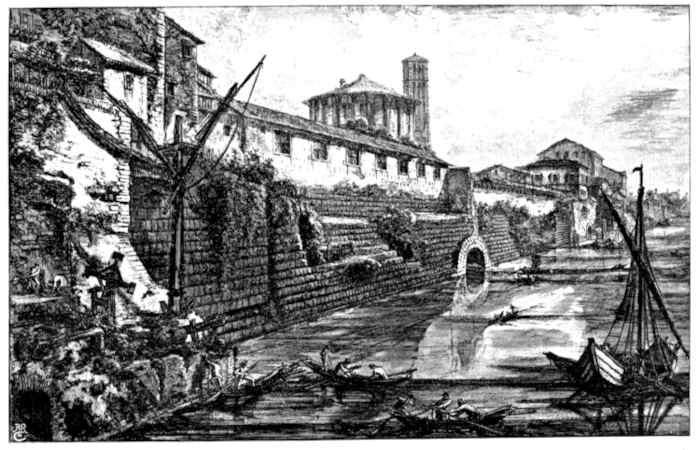
CLOACA MAXIMA
From Piranesi’s Views of Rome
To face p. 94, vol. ii.
On Thursday, January 26th, M. de Montaigne went to see the Janiculum Hill beyond the Tiber and the curiosities of that part; amongst others a great fall of masonry from the old walls which had happened a few days before, and the view of the whole of Rome, which can be surveyed more clearly from this spot than from any other. Thence he went down to the Vatican to inspect the statues set in the niches of the Belvedere, and the fine gallery,87 now almost completed, which the Pope is adorning with paintings of all parts of Italy. He lost his purse and all therein, and deemed this must have happened while he was giving alms—as he did twice or thrice; the weather was very rainy and unpleasant, and, instead of returning his purse to his pocket, he must have thrust it into the slashing of his hose. At this time he diverted himself entirely in studying Rome. He had at first engaged a Frenchman as guide, but this fellow took himself off in some ridiculous humour, whereupon M. de Montaigne prided himself on mastering by his own efforts the art of a guide. In the evening he would study certain books and maps, and next day repair to the spot and put in practice his apprenticeship, so that in a few days he could have shown his guide the way.
M. de Montaigne affirmed that he could now see nothing more of Rome than the sky under which it lay and the area of its site; that all the knowledge he possessed thereof was of an abstract and contemplative nature, a knowledge in no way to be apprehended by the operation of the senses; that those who affirmed that they might at least behold the ruins of Rome, affirmed too much. The ruins of a mechanism of such terrible power suggested to his own mind reverence and respect rather than comprehension. What he saw was nought but a sepulchre. The world, resentful at her long domination, first broke and shattered all the portions of this marvellous whole, and then, horror-stricken at this spectacle of death, ruin, and disfigurement, entombed the ruins themselves. As to these minor indications of her overthrow which yet lie upon her bier, they have been preserved by fate as a testimony to that immeasurable greatness which all these centuries, all these conflagrations, all these repeated alliances of the powers of the world, have failed to destroy entirely. But it was almost certain that these defaced fragments which survived were those of the least merit, for the rage of the enemies of this immortal renown would surely have prompted them to destroy in the first instance all that was most lovely and most noble. He declared that the buildings of this bastard Rome, which were now being joined on to the ancient masonry (what though they sufficed to kindle the admiration of the present age), reminded him exactly of the nests the martins and crows were building in the roofs and on the walls of the French churches which the Huguenots had destroyed.88
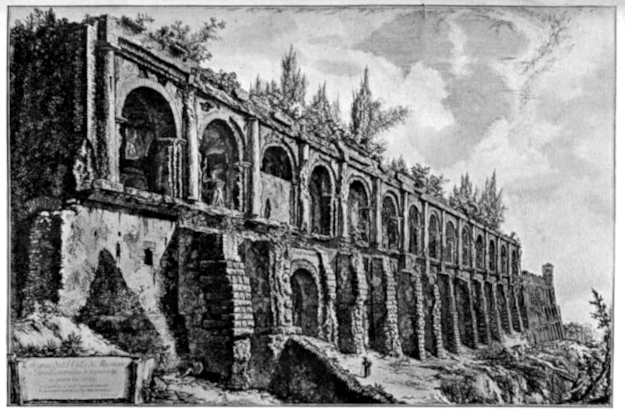
THE VILLA OF MECÆNAS
From Piranesi’s Views of Rome
To face p. 98, vol. ii.
Again M. de Montaigne was persuaded, considering the space occupied by this vast tomb, that the present age failed to realise its full extent, and that the greater part of the sepulchre itself must be buried. As to this, one has only to consider the base off-cast of a great city; how out of the fragments of broken tiles and pots from ancient days, a mound has been heaped together of so vast a size that it equals in height and breadth several natural mountains (he compared this mound as to height with the hill of Gurson, and judged it to be double the width).89 It seemed to represent an express decree of the Fates to make plain to the world how they had conspired to render this city glorious and paramount; to bear witness to its grandeur by so strange and extraordinary a token. He declared it was hard to understand—considering how narrow was the space occupied by some of the hills, and notably by the most famous, the Capitol and the Palatine—how such a large number of buildings could be there bestowed. Looking only at the remains of the Temple of Peace by the side of the Forum Romanum (of which one may still behold the recent ruin, like that of a vast mountain broken up into divers ugly crags), it was apparent that two such edifices could hardly have found room on the entire summit of the Capitol, where there were twenty-five or thirty temples, besides several private houses. But in sooth the various conjectures which have been adopted for the delineation of this ancient city possess scarcely any verisimilitude, seeing that the very site thereof has changed its contour beyond measure, and that certain of its valleys have been filled up. To wit, in the lowest-lying spots, as, for instance, in the Velabrum, which, on account of its situation, received the sewage of the city, and had a lake in its midst, there is now to be found a hill as high as the other natural hills adjacent thereto.90 All this has come about by the accumulation of the ruins and fragments of the huge buildings, the Monte Savello being nought else than a portion of the theatre of Marcellus. M. de Montaigne did not deem that an ancient Roman would recognise the site of his city were he to behold it.
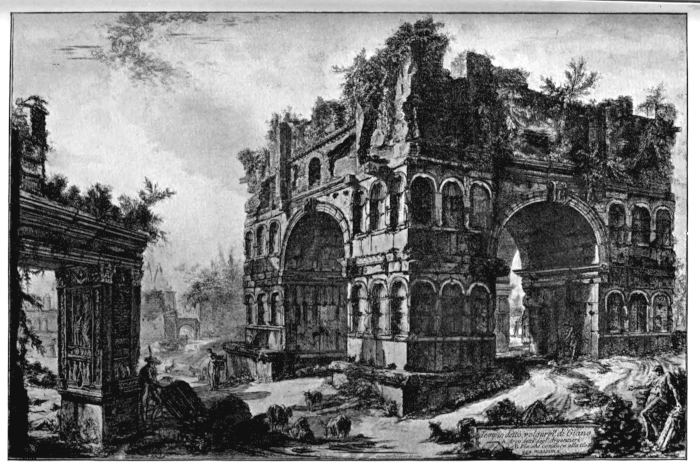
TEMPLE OF JANUS
From Piranesi’s Views of Rome
To face p. 98, vol. ii.
It would often happen to one digging deep in the earth to come upon the capital of a lofty column which still stood on its base far below; and builders were wont to seek for their erections no other foundations than some mass of ancient masonry, or on arches such as are commonly seen in cellars, or on some old wall or substructure existing on the site. And upon the very wrecks of the ancient buildings, as they fall to ruin, the builders set out casually the foundations of new houses, as if these fragments were great masses of rock, firm and trustworthy. It is evident that many of the old streets lie more than thirty feet below the level of those now in existence.
On January 28th M. de Montaigne had colic, which, however, did not interfere with his customary movements, and passed one rather large stone and some small ones. On the 30th he witnessed the most ancient religious ceremony that still subsists amongst men—to wit, the circumcision of the Jews—and gave most attentive and profitable attention thereto. He had already visited their synagogue one Saturday morning, and heard their prayers, when they sang in irregular wise certain portions of the Hebrew Bible suited to the occasion, after the manner of the Calvinist churches. They are cadences of similar sound, but the discord is excessive by reason of the mixing together of voices of all ages, for even the youngest children are of the party, and all understand Hebrew but indifferently. They are no more attentive to their prayers than we are, for they talk of other things during their service, and exhibit little reverence for their mysteries. At the entrance they wash their hands, and inside they count it a curse to remove their headgear, but they do reverence, as their worship ordains, by bowing and kneeling. On the shoulders or on the head they wear certain pieces of linen decked with fringe; but to describe these details would take too much time. After dinner their doctors give instruction by turns upon the passage of the Bible for the day, speaking in Italian, and next an assistant doctor selects one of the hearers, or sometimes two or three in succession, to hold argument with the one who has been teaching upon the subject of his discourse. It seemed to M. de Montaigne that the man we heard displayed great eloquence and mental power in arguing his case.
But as to the circumcision itself, this ceremony takes place in the private house, the lightest and most convenient chamber thereof being chosen for the purpose. In this particular case, because the dwelling itself was ill suited therefor, the ceremony took place in the lobby by the door. As with us a godfather and a godmother are provided for the child, whom the father names, and the circumcision is performed the eighth day after birth. The godfather seats himself on a table with a pillow on his lap, and the godmother brings to him the child and then withdraws, the child being swaddled after our own fashion. The godfather then loosens the bandages below, and the assistants and the one whose duty it is to perform the operation all begin a chant and continue to sing during the operation, which takes about a quarter of an hour. He who officiates need not be a rabbi, and any one of them, whoever he may be, will be anxious to discharge this duty, because they hold that frequent bidding to such a function is a great blessing: nay, they will pay to be called in, offering here a vestment and there something else useful to the child. Moreover, they believe that any one who may circumcise a particular number of children will enjoy a certain privilege after death, to wit, that the parts about the mouth will never be eaten by worms. On the table where the godfather sits they forthwith lay out plentiful provision of all instruments necessary for this operation, and in addition to these an assistant holds in his hands a phial of wine and a glass. There is also an earthen brazier, at which the operator first warms his hands; and then the child, with the swaddling bands unloosed, is presented to him by the godfather, who holds it in his lap with the head towards himself. The operator then takes hold of the part and pulls forward the skin thereof with one hand and with the other thrusts back the fleshy substance and fixes a silver instrument on the skin. This instrument, kept close to the flesh within, holds the foreskin in proper position and prevents any injury to the other parts from the act of cutting. This done, he cuts off the skin and buries it at once in some earth, which along with other apparatus of the mystery is beside him, ready prepared in a basin, and then with his bare nails proceeds to remove any other particle of skin which may be left on the flesh. This operation is one requiring considerable skill and is somewhat painful, but it is quite free from danger and the wound is almost always healed after four or five days. The children cry as ours cry when they are baptized. As soon as the operation is done, the bystanders hand forthwith to the operator some wine, who, after having taken some of it into his mouth, sucks the bleeding flesh and then empties his mouth, repeating this act thrice. Then they give him in a wrap of paper red powder, which they call dragon’s blood, and with this he dresses and covers the wound, and then binds up the same neatly with linen cut for the purpose. He is offered a glass full of wine which, according to report, he blesses by the words he speaks over it, and then drinks a mouthful. He next dips his finger in it and thrice lets the child suck some drops of wine therefrom. This glass they send as it is to the mother and the women of the family who are in some other part of the house, that they may finish the wine that remains. Then another, a third person, takes a silver instrument, made round like a tennis ball, with a long handle thereto, and pierced with little holes like our perfume boxes, and holds it first to the nose of the operator, next to the child, and last to the godfather. They believe that the odours therein help to strengthen and purify the soul for devotion. The operator meantime bears the stains of blood on his mouth.
On the 8th and on to the 12th M. de Montaigne had symptoms of colic and passed some stones, but without any great pain. This year, by the Pope’s permission, greater liberty was given for the Carnival festivities than for many years past, but even now we found them of little account. Along the Corso, a long street of the city which gets its name on this account, they start a race, now of children, now of Jews,91 and now of old men naked, who ran from one end of the street to the other; but the onlooker sees nothing of the sport, save when they run past where he may be posted. There are also races of horses, ridden by young boys, who urge them on with whips, and of asses and buffaloes driven along by the goads of horsemen in the rear. In all the races a prize is offered, called el palo which is given in the form of pieces of velvet or cloth. In a certain part of the street where the ladies can best see them certain nobles run the quintain, mounted on fine horses, and make a graceful show, for the nobility of this country commonly show greater knowledge of horsemanship than of aught else. The scaffold which M. de Montaigne caused to be erected cost three crowns, and was placed in an excellent situation in the street.
At this season all the fair gentlewomen of Rome let themselves be seen freely, for in Italy they do not go masked as in France, but with all the face uncovered. As to anything like rare and perfect beauty, M. de Montaigne declared it was no more to be found here than in France; and that, except in three or four cases, he found none that was remarkable. But taken as a whole the women’s faces are more agreeable, and fewer ugly ones are to be seen than in France. The head is far more becomingly dressed than with us, and the parts below the girdle also, but the French ladies have more care to the figure, for here the girdle is worn too loose, somewhat as our ladies who are with child wear it. Their countenances are stately, gentle, and sweet. In raiment they are incomparably more sumptuous than our ladies, everything being covered with pearls and jewels. Whenever they go abroad, whether in a coach or to a festivity or to the theatre, they keep apart from men: nevertheless in certain dances they mix freely enough, and find full opportunity of conversing and touching hands. The men on all occasions go clad very simply in black or Florentine serge, and are somewhat darker in skin than we are. I cannot say why they do not use their titles of duke, count, and marquis, when they have full right thereto, seeing that their appearance is somewhat ordinary. Otherwise they are most courteous, and as gracious as they can be, in spite of what is asserted by the baser sort of Frenchmen, who never find any gentility in those who resent their turbulence and insolent carriage. In every way we do our utmost to win a bad name, nevertheless the Italians nurse their ancient affection and reverence for France, which secures respect and welcome for all who deserve the same ever so little, and bear themselves without offence.
On the following Thursday he went to a feast given by the Castellan for which vast preparation had been made, notably an amphitheatre very artistically and sumptuously disposed for the sport of tilting, the courses being run in the evening before supper. The amphitheatre was erected in a square barn, a section, oval in form, having been set out in the centre for the purpose. Amongst other curious devices the floor was painted with the utmost despatch with certain designs in red. This floor had previously been covered with plaster, then they laid thereupon a piece of parchment or leather with designs according to their taste cut out of the same, and lastly they painted this with a brush dipped in red paint so as to leave on the plaster under the openings the design they wished for. So rapid was their work that they might easily have decorated the nave of a church in two hours. At supper the ladies were served by their husbands, who stood by them and gave them to drink and whatever they might ask for. On the table were many roast fowls, their plumage having been restored to them to give them the look of living birds, capons cooked whole in vessels of glass, good store of hares, rabbits, and birds in pies with feathers as if alive, and the tables admirably laid with linen. The ladies’ table, which was laid for four courses, could be removed in portions, and below the first service was a second one of sweetmeats ready prepared.
They use no masks for visiting one another, but they wear them, of a very cheap sort, when they walk about the town in public or go to meetings for running at the ring. On Carnival Monday two rich and well-appointed companies of gentlemen met for the sport aforesaid with a wealth of superb horses such as we cannot equal.
Having given leave of absence to the one of my followers who has up to this time written this journal in admirable fashion, I feel that, albeit it may irk me somewhat, I must needs continue the work with my own hand, seeing that it is so far advanced.
On February 16th, as I was returning from service, I saw in a small chapel a priest, fully robed, engaged in healing a man possessed, who was melancholic and apparently in a trance. They kept him kneeling before the altar, his neck being bound with some sort of cloth by which they held him fast. The priest recited in his presence many prayers and exorcisms out of his breviary, charging the devil to quit the body of this man;92 then he addressed his discourse to the patient, speaking sometimes to the man himself and sometimes to the devil in his body, railing at him, dealing the poor wretch heavy blows with his fist, and spitting in his face. To these commands the patient made divers meaningless replies: now for himself, telling how he was affected by the operation of his malady; now for the devil, acknowledging his fear of God and the powerful working of these exorcisms against him. After this performance, which lasted some time, the priest, by way of preparation for the final attack, withdrew to the altar and took in his left hand the pyx which held the Corpus Domini, and in his right a lighted candle, which he held upside down so that it might melt and consume away, saying certain prayers the while, and ending with threatenings and denunciations against the devil, uttered in the loudest and most authoritative voice he could put forth. As soon as the first candle had burnt itself out close to his fingers, he took a second and then a third. He next put back the transparent vessel containing the Corpus Domini, and returned to the patient, speaking to him as to an ordinary man and releasing him from his bonds. He then delivered the patient over to his friends, and directed them to take him home.
The priest assured us that this devil was of the most noxious sort and very obstinate, and that his expulsion would prove a difficult task; moreover, he recounted to ten or twelve gentlemen who were present divers histories concerning this science of exorcism and his common experience thereof, notably how the day before he had cast out of a certain woman a great devil, who in leaving her had caused her to vomit from her mouth nails and pins and a bit of his hairy skin. And when her friends told him that she was not yet quite herself, he replied that this was because of another sort of spirit, easier to deal with and less malicious, who had taken possession of her this same morning. This kind (for he knew the names and the divisions and the minutest differences) was very easy to exorcise. But I saw no further proof of his skill. The man who had been under treatment gave no other facial sign than grinding his teeth and twisting his mouth when the Corpus Domini was put before him; he muttered, indeed, several times the words Si fata volent, for he was a notary and knew a word or two of Latin.
On the first day of March I went to the service at the Sistine Chapel. At the high altar the priest who said mass stood beyond the altar with his face turned towards the people, no one being behind him. On this occasion the Pope was present, for he had some days before excluded therefrom the nuns who had hitherto been wont to be present, so as to make more room. In their place he installed, by a most excellent regulation, the poor folk who beg about the city. Each one of the cardinals gave twenty crowns in aid of the movement, and very liberal alms were given by other private persons. To their hospital the Pope has given five hundred crowns a month.
In Rome there is a vast amount of private devotion, and many confraternities in which are manifest striking testimonies of piety, but it seems to me that in general there is less devotion than in the better ordered towns of France. They set more store here on ceremonies, in which they go to great lengths. Here I may write what I will with a free conscience, so I will give two illustrations of my meaning. A certain man was with a courtesan, lying in bed and enjoying the full liberty of the situation, when, at the twenty-fourth hour, the Ave Maria sounded, and the girl sprang out of bed and knelt down on the floor to say her prayer. Shortly afterwards he was with another, when suddenly the good mother (for these girls are always in the hands of some old bawd whom they call mother or aunt) knocked at the door and, having entered in a transport of rage, tore off from the girl’s neck a ribbon from which was hanging a little image of Our Lady, so that it might not be contaminated by the sinful act of the wearer. The young girl showed herself exceedingly penitent, in that she had omitted her customary practice of first removing this image from her person.
The ambassador of the Muscovite93 was present at this service, clad in a scarlet mantle, a long coat of cloth of gold, and a hat of cloth of gold made in the shape of a nightcap and trimmed with fur, under which was a smaller cap of cloth of silver. This is the second ambassador of Muscovy who has been sent to the papal court, the other having come here in the time of Paul III. Report said that this man’s mission was to stir up the Pope to interfere in the war which the King of Poland was waging against his master. His plea was that the Muscovite ruler must needs sustain the first onslaught of the Turk, and that, should he be weakened by fighting Poland, he would be unable to undertake war elsewhere, thus leaving open a wide breach through which the Turk might enter and attack us all. The Muscovite also offered to make certain concessions in the religious controversies at present pending between himself and the Roman Church. The ambassador had lodging with the Castellan, as had the other in Pope Paul’s time, and was maintained at the Pope’s charges. He resisted stiffly to conform to the usage of kissing the Pope’s foot, consenting only to kiss his right hand, and remained obstinate until it was pointed out to him that even the Emperor was not exempt from this ceremonial duty, the instances of kings being insufficient to convince him. He could speak no language other than his own, and had come unaccompanied by an interpreter, and with only three or four men in his train. It is said he was in great peril as he journeyed in disguise through Poland. In his country there is such great ignorance of external affairs, that he took to Venice letters from his master addressed to the High Governor of the Signiory of Venice; and, being asked what might be the meaning of this style, replied that in Muscovy they believed that Venice was under the command of the Pope, who sent thither governors, as he did to Bologna and other cities. God knows in what mood the Magnificoes must have listened to such ignorant discourse. Both to them and to the Pope he brought presents of sables, and of furs still more rich and rare, to wit, skins of the black fox.
On the 6th of March I went to see the library of the Vatican, which is contained in five or six rooms all communicating one with the other. There are many rows of desks, each desk having a great number of books chained thereto. Also, in the chests, which were all opened for my inspection, I saw many manuscripts, of which I chiefly remarked a Seneca and the Opuscula of Plutarch. Amongst the noteworthy sights I saw was the statue of the good Aristides,94 with a fine head, bald and thickly bearded, a grand forehead, and an expression full of sweetness and majesty. The base is very ancient, and has his name written thereupon. I saw likewise a Chinese book writ in strange characters, on leaves made of a certain stuff much more tender and transparent than the paper we use, and because this fabric is not thick enough to bear the stain of ink, they write on only one side of the sheet, and the sheets are all doubled and folded at the outside edges by which they are held together. It is said that these sheets are the bark of a certain tree, as is a fragment of ancient papyrus which I saw covered with unknown characters. I saw also the Breviary of Saint Gregory in manuscript, which has no date, but the account they give of it states that it has come down from one hand to another from Saint Gregory’s time. It is a missal not unlike our own, and it was taken to the recent Council at Trent as an authority for the ceremonies of our Church. Next, a book by Saint Thomas Aquinas, containing corrections made by the author himself, who wrote badly, using a small character worse even than my own. Next, a Bible printed on parchment, one of those which Plantin95 has recently printed in four languages, which book King Philip presented to the Pope, according to an inscription on the cover. Next, the original manuscript of the book which King Henry of England wrote against Luther and sent fifty years ago to Pope Leo X.96 It contains a subscription and a graceful Latin distich, both written by his own hand:—
“Anglorum Rex Henricus, Leo decime, mittit Hoc opus, & fidei testem & amicitæ.”
I read both the prefaces, one to the Pope and the other to the reader. The king claims indulgence for any literary shortcomings on the score of his military occupations, but the style is good scholastic Latin. I inspected the library without any difficulty; indeed, any one may visit it and make what extracts he likes; it is open almost every morning. I was taken to every part thereof by a gentleman, who invited me to make use of it as often as I might desire.
Our ambassador quitted Rome just at this time without having ever seen the library, and he complained because pressure had been put upon him to beg this favour of Cardinal Charlet,97 and that he had never been allowed to inspect the manuscript Seneca, which he desired greatly to see. It was my good luck which carried me on to success, for, having heard of the ambassador’s failure, I was in despair. Thus it seems all things come easily to men of a certain temper, and are unattainable by others. Right occasion and opportunity have their privileges, and often hold out to ordinary folk what they deny to kings. Curiosity often stands in its own way, and the like may be affirmed of greatness and power. In the library I saw also a manuscript Virgil98 in an exceedingly large handwriting, of that long and narrow character which we see in Rome in inscriptions of the age of the Emperors somewhere about the reign of Constantine, a character which takes somewhat of Gothic form, and misses that square proportion which the old Latin inscriptions possess. The sight of this Virgil confirmed a belief which I have always held, to wit, that the four lines usually put at the opening of the Æneid are borrowed, since this copy has them not. Also a copy of the Acts of the Apostles, written in very fair Greek golden character. The lettering is massive, solid in substance, and raised upon the paper, so that any one who may pass his finger over the same will detect the thickness thereof. We have, I believe, lost all knowledge of this method.
On March 13th an old Antiochan patriarch, an Arabian, and well versed in five or six of the languages of those regions, and quite ignorant of Greek or of the other tongues we use, a personage with whom I had become very intimate, gave me a certain compound for the relief of my gravel, and written directions for the employment of the same. He bestowed it for me in a little earthen pot, where I might keep it ten or even twenty years, and assured me that I might anticipate a complete cure of my distemper by the first dose I should take. In case I might lose the writing he gave me, I will set down his instructions here. The drug should be taken at bedtime after a light supper; a piece the size of two peas should be mixed in lukewarm water, after having been crumbled in the fingers. This will make five doses, one to be taken every alternate day.
One day I dined with our ambassador at Rome, where Muret99 and other learned men were of the company. I spoke concerning the translation of Plutarch into French, and controverted those who esteem it less than I do. I maintained at least that, in passages where the translator may have missed the exact meaning of Plutarch, he has given instead one verisimilar and in accurate combination with what is writ before and after. To show me that I was hereby claiming too much for this work, they brought forward two passages; one (the criticism of which they assigned to a son of M. Mangot,100 a Parisian advocate, who had just quitted Rome) was from the life of Solon—somewhere about the middle—in which the translator says that Solon claimed for himself that he had given freedom to Attica, and had removed the boundary stones which divided inherited plots of land. Here he had made a mistake, for the Greek word in question101 is rather used to denote certain signposts which were wont to be set up on lands which were pledged or under bond, so that buyers might be forewarned that these were mortgaged. The word which the translator employed has none of the meaning of the original, inasmuch as it would lead the reader to infer that the lands alluded to were not separate freeholds, but were held in common. The Latin of Estienne comes nearer to the truth.102 The second passage was one near the end of the treatise on the “Nurture of Children.” This the translator gives as follows: “The observation of these rules is rather to be desired than advised.” But his critics now affirmed the real meaning of the Greek to be: “That thing is more to be desired than to be hoped for.” The same proverb may be found elsewhere under different form. In place of this clear and intelligible meaning the translator has substituted one which is weak and foreign. Wherefore, accepting their presupposition of the true sense of the passage in question, I professed myself entirely of their opinion.103
In Rome the churches are inferior to those of the generality of the large towns of Italy; indeed, speaking generally of Italy and Germany, the churches will rarely be found to equal those of France. At Saint Peter’s, at the door of the new church, are to be seen certain flags draped as trophies, bearing inscriptions which tell that they are ensigns captured by the king from the Huguenots, but these inscriptions do not say where or when. Near to the Gregorian Chapel, where may be seen attached to the wall a vast number of ex votos, there is a small square picture, wretched and badly painted, which represents the battle of Moncontour. In the hall, in front of the Sistine Chapel,104 or upon the partition wall, are several paintings of memorable events touching the Holy See—for instance, the sea fight of Don John of Austria; also a representation of that Pope who trod under foot the head of the Emperor when he came to entreat pardon and to kiss the Pope’s feet; but on the same is no trace of the words which according to history were spoken by each one of them. There are two other pictures which accurately represent the wounding and the death of the Admiral of Chatillon.
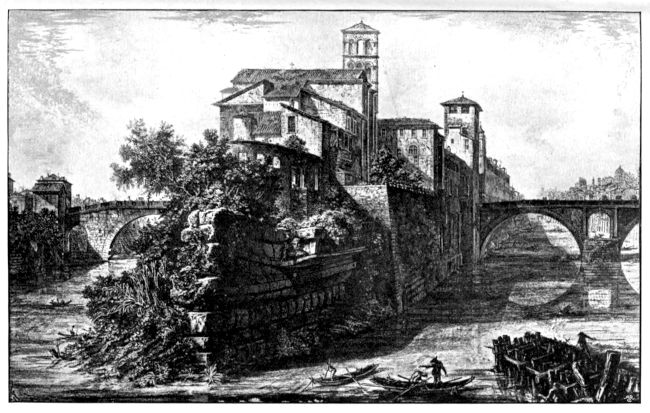
ISLAND ON THE TIBER
From Piranesi’s Views of Rome
To face p. 126, vol. ii.
On March 15th M. de Monluc105 came to me at daybreak, and we set about the execution of the plan which we had made the day previous to go to see Ostia. We crossed the Tiber by the bridge of Our Lady, and left the city by the Porta del Porto, anciently called Portuensis, and thence we followed a rough road through a region only moderately productive of wine and corn. Having gone about eight miles and once more struck the bank of the Tiber, the road descended into a vast plain of meadow and pasturage, at the end of which stood formerly a large town. Of this some fine and stately ruins may yet be seen on the shore of the Lake of Trajan, which is itself an overflow of the Tyrrhenian sea, and was in ancient times navigable for ships, but now very little seawater finds its way thereinto, and still less into another lake a little above it, which they call the Arch of Claudius.106
We might have taken our dinner with the cardinal of Perugia, who was residing there.107 In sooth there is nothing anywhere to equal the courtesy of the gentlefolk of these parts, and of their dependents. The cardinal aforesaid sent word to me by one of my servants who had passed by his house that he has some cause of complaint against me, in that I had not called upon him, this servant having been taken for refreshment into the cardinal’s pantry; the cardinal had no acquaintance with me, and in this case was only showing the hospitality he was wont to give to strangers of any mark. On my part I heard that the day would hardly be long enough to allow us to complete the round I wished to make, seeing that I had gone many miles out of my way in order to get a sight of both banks of the Tiber. Here we crossed in a boat over a small branch of the Tiber to the Sacred Isle, a good Gascon league in length, where we found plenty of grazing land and divers ruins and columns of marble, which are abundant in all the parts about Porto, where stood the ancient city built by Trajan. Every day something of the kind is dug up by the Pope’s workmen and sent to Rome. When we had crossed this island we found we had still the Tiber to pass, and, as we had no means of transporting our horses, we were just thinking of retracing our steps, when, by good luck, we espied on the opposite bank M. de Bellai, M. le Baron de Chasai, M. de Marivau, and certain others. Whereupon I crossed the stream and made an arrangement with these gentlemen that we should exchange horses. Thus they returned to Rome by the road by which we had come out, and we took theirs, which led direct to Ostia.
Ostia,108 fifteen miles from Rome, is situated by the ancient channel of the Tiber, for this stream has changed its course somewhat, and is receding still more every day. We breakfasted in haste at a mean tavern, beyond which we could see La Rocca, a small castle strong enough in itself, but now bare of a garrison. The Popes, and notably the present one, have built along this coast high towers or look-outs, about a mile apart, to guard against the raids often made by the Turks, especially in the vintage season, and the capture of men and cattle. By the discharge of a cannon from these towers they advise one another so rapidly that the alarm is sped to Rome forthwith. Round Ostia are the salt works, situated in a wide marshy plain into which the sea flows, and these supply all the States of the Church.109 This road from Ostia to Rome, the Via Ostensis, abounds in vestiges of its ancient splendour, such as causeways and ruins of aqueducts; moreover, all along it is set with mighty ruins, and for two-thirds of its length it is still paved with those large black squares of stone which they used formerly as pavement. In looking at this bank of the Tiber it is easy to believe that of old the road all the way from Rome to Ostia ran past the habitations of men. Amongst other ruins we saw, about midway and on our left, a very beautiful tomb of a Roman prætor with an inscription quite perfect thereon. In Rome, the ruins, as a rule, only manifest themselves to us by the massive solidity of their construction. The ancients built thick walls of brick, and these they lined either with strips of marble or some other white stone, or with a kind of cement, or with thick tiles set thereupon. This outside crust, on which the inscriptions were written, has almost everywhere been ruined by the lapse of years, wherefore we have now but little knowledge as to all these matters. Inscriptions still remain where the walls were originally built in solid fashion.
The approaches to Rome in almost every case have a barren and uncultivated look, whether through the unfitness of the soil for cultivation, or whether, as seems more likely, through the absence of husbandmen and handicraftsmen in the city. On my journey hither I met divers troops of villagers from the Grisons and Savoy on their way to seek work in the Roman vineyards and gardens, and they told me they gained this wage every year. The city is all for the court and the nobility, every one adapting himself to the ease and idleness of ecclesiastic surroundings. There are no main streets of trade; what there are would seem small in a small town, palaces and gardens take up all the space. Nothing is to be seen like the Rue de la Harpe or de Saint Denis; I always fancied I must be walking in the Rue de Seine or on the Quai des Augustins at Paris. The aspect of the city differs little whether the day be a feast or a working day. Services go on all through Lent, and the crowds are just as great on a working day as any other, the streets being full of coaches, prelates, and ladies at this season.
On the 16th of March, after our return to Rome, I was taken to make trial of the Roman hot baths at St. Mark’s, which have the best repute. I underwent a treatment of moderate strength, and, though I went alone, met with all possible respect. The usual custom is to take a lady as companion, who like yourself will be rubbed by the men in attendance. I learned here the composition of the unguent used for removing hair from the skin. It is made of two parts of quick lime and one of arsenic, blended with lye, and will have effect in less than a quarter of an hour after application. On the 17th I was troubled, not insupportably, with colic for five or six hours, and afterwards passed a large stone the shape of a pine kernel.
At this season we had roses and artichokes as well, but the heat, according to my judgment, was not excessive. I wore the same clothes as I wear at home. We got less fish than in France; their pike is a useless beast, and is reckoned poor man’s diet. Soles and trout are rarely seen, but the sea barbel are very good and much larger than at Bordeaux, albeit dear. John Dorys and mullets, larger and less firm than ours, are very costly. The oil is so good that I never feel that irritation of the throat which always troubles me in France when I have partaken generously of it. Here you may eat grapes all the year round, and even up to this date fine bunches may be seen hanging on the trellises. The mutton is worthless and is in no esteem.
On the 18th the Portuguese ambassador did homage to the Pope for the kingdom of Portugal, on behalf of King Philip. This same ambassador represented on other occasions the late King of Portugal, and likewise those states of King Philip with which he was at variance.110 On my way back from Saint Peter’s I met a certain man who gave me an interesting account of two occurrences. The first was that the Portuguese had done their homage in Passion week, the service being held in the church of Saint John at the Porta Latina; and the second, that in this very same church, several years ago, certain Portuguese had established a very strange confraternity. These were men who joined themselves in matrimony, using the mass and the same religious ceremonies as we use at our weddings, taking the sacrament together, and reading our marriage service. Then they went and lived together after the fashion of married folk. These fanatics declared that the marriage ceremony alone rendered lawful the union of man and woman, and that their own form of union would become equally lawful should it be sanctioned by the ceremonies and mysteries of the Church. Nine or ten Portuguese belonging to this execrable sect were burnt.111
I witnessed the homage done by Spain for the kingdom of Portugal. A salvo of artillery was fired from Saint Angelo and from the palace, and the ambassador was escorted by trumpets and drums and the Pope’s archers. I did not go inside to be present at the speech-making and the other ceremonies. The Muscovite ambassador, who sat at a decorated window to behold the procession, remarked that he had been brought there to witness a great gathering; but in his country, when men spoke of troops of horses, they had in mind twenty-five or thirty thousand, wherefore he made light of the show before him. This I heard from a gentleman who was sent to converse with him through an interpreter. On Palm Sunday, in a church where I went for vespers, I saw a child seated in a chair beside the altar clad in a long gown of new blue taffetas, bareheaded, crowned with olive branches, and holding in his hand a lighted candle of white wax. This boy was about fifteen years old, and had just been discharged by the Pope’s order from prison, having been sent there for killing another boy. At Saint John Lateran they showed me some transparent marble.
On the next day the Pope visited the seven churches.112 He wore boots of flesh-colour, with a cross of lighter-coloured leather upon each boot. He always takes with him a Spanish horse, a hackney, a mule, and a litter, all equipped in the same fashion, but to-day the horse was lacking. His esquire, with two or three pairs of gilded spurs in his hand, awaited him at the foot of Saint Peter’s Stairs; but he put the spurs aside and asked for his litter, in which were hanging two red hats of the same sort.
This evening they brought back to me the volume of my Essays, castigated and brought into harmony with the opinions of the monkish doctors. The Maestro del Sacro Palazzo could only pronounce judgment on them from the report of a certain French monk, for he himself was ignorant of our language; but he was so fully satisfied with the explanations I gave him of all those passages to which exception had been taken by the Frenchman, that he left to me the task of correcting, according to my conscience, everything which might appear wanting in good taste. In return I begged him to follow the advice of the censor of my book, and I avowed that in certain matters—for instance, in my use of the word Fortune113 in discoursing on heretical poets; in my apology for Julian;114 in my remark that when a man prays he ought for the time to be free of all vicious inclinations; in certain statements that it is cruelty to inflict upon men greater pain than is necessary to kill them; that children should be brought up to examine all sides of a question;115 and in many others—I did not admit I was in error. Moreover, in certain additional instances, I denied that my critic had caught my meaning. The aforesaid Maestro, who was a man of parts, completely exonerated me, and was anxious to let me see that he set small value on these emendations; moreover, he argued very ingeniously on my behalf against another man, an Italian, who was opposed to me. They kept back my copy of “The History of the Swiss,” translated into French,116 simply because they had found out that the translator was a heretic, though his name did not appear anywhere in the volume. It is wonderful what a wide knowledge they have of men and foreign lands, and the most singular part of it was they told me the preface of the aforesaid book was condemned.
This same day at the church of Saint John Lateran, in place of the ordinary penitancers who may be seen doing their office in most of the churches, Monsignore the Cardinal of Saint Sixtus117 sat in a corner, and with a long rod, which he held in his hand, touched the heads of all the men who went by, and of the women also, but these he regarded with a smile and a courtesy of manner apportioned to their consequence and beauty.
On the Wednesday in Holy week I visited the Seven Churches with M. de Foix118 before dinner and spent about five hours in making the round. I know not why some people should profess to be shocked when they hear this or that prelate accused of vicious practices, when these practices are well known. This very day, in the churches of Saint John Lateran and of Santa Croce in Gerusalemme, I saw written in a most prominent place the history of Pope Sylvester II.119 in which the worst is recorded of him. The circuit of the city from the Porta del Popolo to the Porta de S. Paolo, which I made several times, can be accomplished in three or four hours going at foot pace. That part which lies beyond the river may easily be traversed in an hour and a half. Amongst other pleasures which I enjoyed in Rome during Lent, mention must be made of the sermons. There were many excellent preachers, for instance the renegade rabbi who preached to the Jews on Saturday afternoons in the church of the Trinità. Here was always a congregation of sixty Jews who were bound to be present. This preacher had been a famous doctor amongst them, and now he attacked their belief by their own arguments, even out of the mouths of their rabbis and from the words of the Bible. He had admirable skill and knowledge of the subject, and of the languages necessary for the elaboration of the same. There was another who preached before the Pope and cardinals, named Padre Toledo, a man of extraordinary ability in depth of learning, in appositeness of expression, and in mustering of his arguments, and a third who preached at the church of the Jesuits was distinguished for the beauty of the language he used, the two last being members of the Jesuit society.
It is wonderful how great is the part occupied by this College in the Christian economy, and my belief is that never before has there existed any confraternity which has risen to such eminence, or which may sway so powerfully the destinies of the world, supposing that it should be able to prosecute its designs in the future. It occupies well-nigh the whole of Christendom; it is a nursery of men distinguished in every department of high affairs, and the institution of our Church which the heretics of our day have most to fear.
One of the preachers declared that people nowadays use their coaches as places whence they spy upon their fellows. The habit which the Romans most affect is that of walking about the streets, but as a rule they only rouse themselves to issue forth for the sake of sauntering along from one street to another, without design of going anywhere in particular, one or two of the streets being especially affected for this purpose. In sooth, the chief pleasure to be got from this practice is the sight of the ladies, and especially the courtesans, who exhibit themselves behind their lattices with such refinement of trickery that I have often wondered at the address they display in attracting men’s eyes. Often I have got down from my horse and induced some of these ladies to admit me, and have wondered how it was they contrived to make themselves appear so much handsomer than they really were.120 They have the art of letting a beholder distinguish them by whatever trait of theirs is most seemly; they will let you see only the upper part of the face, or the lower, or the side, veiling and unveiling according to the particular style of countenance, so that an ugly woman is never to be seen at a window. Each one takes her position there for the purpose of saluting and bowing to her acquaintances, who, as they go by, throw up many a glance. An extra privilege, granted to any gallant who may have paid one crown or four for passing the night in a house of this character, is that he is allowed to salute his inamorata in public the next day. Many ladies of quality also show themselves, but it is very easy to perceive that these are of totally different carriage and fashion. This phase of life is best seen from horseback, a usage which is followed by poor wretches like myself, or by young men riding great horses, which they manage with much skill. People of quality never go abroad except in coaches of the most costly sort, and, in order to have a clear view upwards, the roofs of the coaches are fitted with small windows. It was to these windows that the preacher aforesaid alluded when he spoke of the spying which went on in coaches.
On the morning of Holy Thursday the Pope, in pontifical garb, accompanied by the cardinals, repaired to the second platform of the great portico of Saint Peter’s bearing a lighted torch in his hand. Then a canon of Saint Peter’s, who stood on one side of the balcony, read in a loud voice a bull written in Latin by which men of an infinite variety of sorts and conditions were excommunicated; amongst others the Huguenots were specially named, and all those princes who keep hold on any of the lands of the Church, an article which caused loud laughter from the Cardinals Medici and Carafa, who stood close to the Pope. The reading of this bull lasted a good hour; for when the canon had finished reading an article in Latin, the Cardinal Gonzaga, who stood on the opposite side—uncovered like the canon—would repeat the same in Italian. When the reading was done the Pope cast the lighted torch down amongst the people; and, whether out of jest or not, Cardinal Gonzaga threw down another, three torches having been kindled. This having fallen amongst the people caused a vast disturbance below, every one scrambling to pick up a fragment of the torch, and giving and taking shrewd blows with fist or cudgel. During the reading of this sentence the balustrade of the portico in front of the Pope was covered with a large piece of black taffetas; but, the excommunication having been pronounced, they folded up this black covering and disclosed one of a different colour, whereupon the Pope gave his public blessing.
On these days they exhibit the handkerchief of Saint Veronica. This is a countenance wrought in needlework, of a dark and sombre tint, and framed after the fashion of a mirror. It is shown with great ceremony from a high pulpit, five or six paces in width, and the priest who holds it wears on his hands red gloves, while two or three other priests assist him in displaying it. No spectacle provokes such great show of reverence as this, the people all prostrate themselves on the ground, the greater part of them weeping and uttering cries of pity. A woman, whom they declared to be possessed, made a great uproar at the sight of this effigy, and began to screech, and twist her arms, and throw them about. The priests moved round the pulpit and exhibited the effigy, now from one side and now from another, and at every fresh display the people who beheld it cried out aloud. On these same occasions they show to the people likewise with equal ceremonies a lance head enclosed in a crystal vessel. This display is made several times during the day, and the crowd which comes to witness the same is so vast that, as far as the eye can reach from the pulpit aforesaid outside the church, there is nought to be seen but an endless crowd of men and women. Here is the true papal court; the pomp of Rome and its chief grandeur lies in the outward show of religion: and it is a fine sight in these days, this unbounded ardour of the people for their faith.
In the city a hundred or more confraternities are to be found, and almost every gentleman is a member of some one of these: some of them are open to strangers, and our kings of France belong to that of the Gonfalon. Each particular society is wont to exercise, and especially during Lent, certain functions of religious fellowship, and on this special day they walk about in companies clad in linen gowns, each company wearing its particular colour, white, red, blue, green, or black, almost all with their faces covered. The most striking sight I ever saw here or elsewhere was the incredible number of people spread abroad through the city this day, busy with their devotions, and especially those belonging to the aforesaid confraternities. For, in addition to the great crowds seen during the day round about Saint Peter’s, the whole city, as night approached, seemed to be on fire on account of the procession of these confraternities towards Saint Peter’s, each one bearing a lighted candle—almost always of white wax—in his hand. I am sure that at least twelve thousand torches must have gone by the place where I stood; for, from eight o’clock till midnight, the street was filled with the procession, marshalled and regulated in such excellent order that, though there were many different companies coming from different places, the ranks were never broken or the progress stayed. Each confraternity had a fine choir of musicians, who sang as they marched. In the midst of the ranks went a file of penitancers to the number of five hundred, who scourged themselves with cords, and left their backs all raw and bloody. This is a riddle which still baffles me, but there is no denying that they were bruised and wounded in cruel fashion, and that this self-torture and flagellation went on without ceasing. Judging by the aspect of their faces, the assurance of their gait, and the steadfastness audible in their discourse and visible in their countenances (for I heard several of them speak, and many uncovered themselves in passing through the street), it would never have suggested itself to me that they were engaged in a painful and irksome task. Amongst them were youths of twelve or thirteen years of age, and right in front of me was one, very young and fair in seeming, over whose wounds a young woman lamented sore; but the boy, turning towards us, said with a laugh, “Enough of that; what I do I do for your sins and not for my own.”121 Not only was there absent all appearance of distress or violence, they even went about their flagellation with an appearance of pleasure, or at least of nonchalance, so marked that they might have been chattering about other matters, laughing, bawling about the street, running and leaping when there was so great a crowd that the procession fell somewhat into confusion. Along with them went certain men carrying wine, which was offered to them now and again, and some of them took a mouthful thereof, and sometimes sweetmeats were given. The winecarriers often took wine in their mouths and then blew it out and moistened therewith the lashes of the scourges, which were of cord, and were wont to become coagulated with the blood drawn to such an extent that it was necessary to moisten them in order to separate the thongs. They also blew the wine over the wounds of some of the victims. The appearance of their shoes and breeches suggested that they were people of mean condition, and that the majority of them had sold themselves to this service. Moreover, I was told that they were wont to grease their shoulders with a certain preparation, but the wounds I saw were so natural, and the scourging was so lengthy, that assuredly no medicament could benumb them to pain. And with regard to those who may have hired them, what profit would they get were this exhibition nought but trickery? Certain other peculiarities of this function may be noticed. When the people in procession arrive at Saint Peter’s the only function they attend is the exhibition of il Viso Santo, and as soon as one company has seen it, it passes on and makes room for another. On this day great liberty is granted to all womankind; for, through the night, the streets are filled with ladies nearly all going on foot. Nevertheless the city has the air of having greatly mended its manners, especially in respect to the relaxation aforesaid, all amorous glances and manifestations being suppressed.
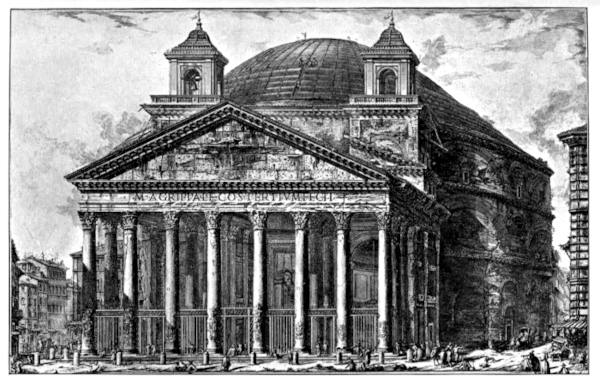
THE PANTHEON
Reproduced from Piranesi’s Views of Rome
To face p. 156, vol. ii.
The church of Santa Rotonda makes the fairest show at this season on account of its illumination. Amongst other devices a vast number of lamps, hung from the top to the bottom of the church, are kept in constant motion. On Easter eve I saw at Saint John Lateran the heads of Saint Paul and Saint Peter, which have still some flesh upon them, and are coloured and bearded as in life.122 The face of Saint Peter is fair, somewhat elongated, with a ruddy, almost sanguine tint on the cheeks, and a forked grey beard, the head being covered with a papal mitre. That of Saint Paul is dark, broad, and fatter; the head altogether being larger and the beard thick and grey. They are kept high up in a place devised for them, and the exhibition is made in this wise. The people are summoned by the ringing of bells, then a curtain, stretched before the heads, is let down, and they may be seen side by side. They are left visible long enough to let the spectators say an Ave Maria, and then the curtain is drawn up again. Afterwards they are displayed afresh in the same way, and then for a third time. This exhibition takes place three or four times during the day. The place where they are kept is about the height of a pike from the ground, and a heavy iron grating is in front of them, through which the spectator must peer in order to see them, several candles being lighted outside the grating, but it is difficult to discern clearly the particular features. I saw them three or four times, and found the skin shiny and something like the masks we use.
On the Wednesday after Easter M. Maldonat,123 who was then at Rome, inquired of me what might be my opinion of the ways and habits of the city, especially with respect to religion. It happened that our views agreed exactly, to wit, that the common people were beyond comparison more devout in France than in Rome, while the contrary might be affirmed of the richer classes, and especially of those about the court. He told me that whenever he heard men maintain that France was altogether given over to heresy—and especially when the disputants were Spaniards, of whom there were great number in his society—he always answered that more truly religious men might be found in Paris alone than in the whole of Spain.
In bringing boats up the Tiber they tow them with three or four pairs of buffaloes. I know not how others find the air of Rome, but I myself found it very pleasant and healthy. The Sieur de Vielart told me that since he had been there he had lost all tendency to headache, an observation which goes to confirm that held by the Romans themselves: that the air is bad for the feet, but good for the head. Nothing is so adverse to my own health as listlessness and sloth, and in Rome I was never without occupation, which, though it may not have been always so pleasant as I could have wished, yet served to keep me from tedium. For instance, I visited and inspected the antiquities and the vineyards, which here are gardens and pleasure places of extraordinary beauty. There I learned how susceptible to the touch of art were these rough, rocky, and unlevel spots of ground, for the artificers here have contrived to win from them a graceful effect, impossible to imitate in our level country, and to turn these irregularities to advantage with the utmost skill. Amongst the most beautiful of these gardens are those of the Cardinals d’Este at Monte Cavallo, and Farnese at the Palatine; of Cardinals Orsini, Sforza, and Medici; of Papa Giulio and of Madama; those of the Farnese and of Cardinal Riario in Trastevere, and of Cesio outside the Porta del Popolo.124 All these beautiful spots are free and open to any one who may desire to enter therein, or even to pass the night there with some chosen companion whenever the owners chance to be away, and they are scarcely ever in residence. Then there are always sermons to be listened to at all seasons, or disputes in theology; or again diversion may be found with some courtesan or other, but in this case I found one disadvantage, to wit, that these ladies charge as extortionately for the privilege of simple conversation (which was what I sought, desiring to hear them talk, and to take part in their play of wit) as for the supreme favour, and are just as niggard thereof. All these recreations kept me free effectually from melancholy, which is the death of me, and of irritability, with which I was troubled neither without doors nor within. Thus I found Rome a very pleasant place of sojourn, and I might go on to show that, if I had penetrated more deeply into the inner life of the place, I might have been still more pleased; for I must admit that, though I used all possible care and ingenuity, I only gathered acquaintance with the public aspect of the city, the same that she shows to the meanest stranger.
On Low Sunday I witnessed the ceremony of the bestowal of alms on certain young maidens. On this day the Pope had, in addition to his ordinary equipage, twenty-five horses led before him, decked and covered with cloth of gold, and most richly caparisoned, and ten or twelve mules covered with crimson velvet, all these being led by his lackeys on foot. Then came the Pope’s litter, also covered with crimson velvet. The Pope himself rode on his mule, and before him went four men on horseback who carried each one a cardinal’s hat, set on the top of a staff which was covered with red velvet and gilt about the handle and the top. The cardinals who followed rode also on mules and wore their pontifical garb, the skirts of their robes being fastened by pins to the mules’ bridles. The maidens numbered a hundred and seven, each one being accompanied by an elderly kinswoman, and when the mass was finished they left the church and marched in a long procession. Having re-entered the church of La Minerva—where this function takes place—they passed one by one through the choir and kissed the feet of the Pope; who, after blessing them, gave them each from his own hand a purse of white damask containing a note on his bankers. It was understood that all these girls have found husbands, wherefore they come to ask for a dowry, which is fixed at a sum of thirty-five crowns apiece, in addition to the white robe costing five crowns, which they wear at their wedding. Their faces were covered with linen veils, with no opening save holes to look through.125
I was speaking lately of the advantages of Rome, and will now add, in reference to this matter, that I find it, of all towns in the world, the one most filled with the corporate idea, in which difference of nationality counts least; for, by its very nature, it is a patchwork of strangers, each one being as much at home as in his own country. The authority of its ruler lies over the whole of Christianity.126 By his own will he, as the supreme arbiter of right and wrong, can compel the obedience of strangers in their own lands, just the same as if they were denizens of Rome. Considerations of birth have no weight in the promotion of men to high office in his court. The freedom given under the government of Venice, and the conveniences of traffic, attract thither vast numbers of foreigners, but they are nevertheless like men in a stranger city; while here foreigners will be found in special offices carrying emolument and responsibility, for Rome is the home of all those connected with the Church. As many or perhaps more strangers may be seen in Venice (where the multitude of these far exceeds anything of the sort in France or Germany), but not nearly so many resident or domiciled foreigners. The common people are no longer affronted by the sight of a man dressed in French, or Spanish, or German fashion, and nearly every beggar who begged alms of me spoke my own tongue.
However, I sought in every way and used all my five natural senses to win for myself the title of Roman citizen, if only for the ancient renown and religious association clinging to the position attached to this citizenship. I found the task a difficult one, nevertheless I accomplished it without having availed myself of any man’s favour, or indeed letting the matter come to the knowledge of any Frenchman. I enlisted the Pope’s interest, which was brought to bear by Filippo Murotti, the major-domo, who had always been extraordinarily kind to me, and had taken special trouble in this particular affair.127 Certain letters, bearing the date 3o Id. Martii 1581, and relating to the business, were sent off and reached me on April 5th. They were in full official style, in the same form and friendly expression as those sent to the Seigneur Giacomo Buoncompagno, Duke of Sora, the Pope’s son. This title is now altogether a vain one, nevertheless I felt much pleasure from the possession of the same.
On April 3rd I left Rome early in the morning by the Porta San Lorenzo, Tiburtina. The road I took was fairly level, and ran through a country which was for the most part fertile cornland and sparsely populated, like all the approaches to Rome. I crossed the Teverone, anciently the Anio, first at the bridge of Mammolo, and second by that of Lucan, the old name of this bridge being still retained. On this bridge are divers ancient inscriptions, and the chief of these is still easily legible; moreover, two or three Roman tombs are yet standing along this road. Few other antiquities are to be seen, and on the Via Tiburtina itself only a very little of the ancient pavement in great blocks. After a journey of fifteen miles, I arrived in time for dinner at Tivoli, the ancient Tiburtum.
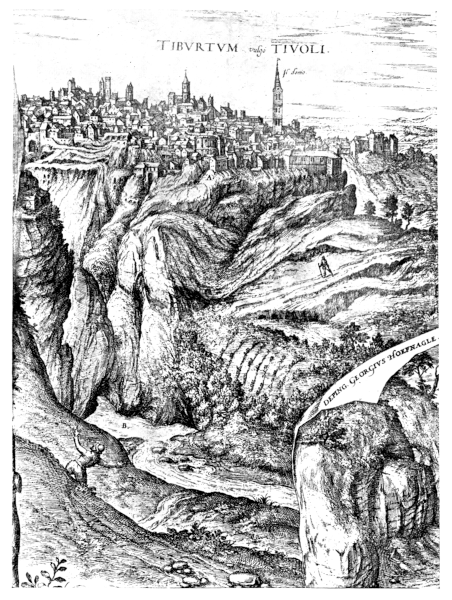
TIVOLI
From Civitates Orbis Terrarum
To face p. 166, vol. ii.
This town lies at the foot of a range of mountains, the houses being built along the somewhat steep ascent of the lower slopes. On this account the site and the prospect therefrom are magnificent, forasmuch as the view extends over a boundless plain, and includes the great city of Rome. It faces the sea, the mountains stand in the rear, the stream of the Teverone flows through it and, close by, takes a marvellous leap, descending from the mountains and disappearing in a chasm of the rocks some five or six hundred paces below. Afterwards it reaches the plain, where it follows a course greatly varied, and joins the Tiber a little above the city. In Tivoli is to be seen the famous palace and garden of the cardinal of Ferrara, a most exquisite piece of work, but unfinished in several parts and likely to remain so, as the cardinal now owning it has stopped all operations.128 I looked at everything minutely, and I would attempt to set down here some representation thereof, if so many books and illustrations had not been already published. This outburst of a countless number of jets of water, turned on or off by a single appliance manipulated at some distant point, I had seen elsewhere during my travels, notably at Florence and Augsburg, as I have already recorded. Here real music is produced from a sort of natural organ, which always plays the same tune, by the means of water which falls with great force into a round vaulted recess where it disturbs the air and forces it to seek an exit, and at the same time supplies the wind necessary to make the organ pipes sound. Another stream of water turns a wheel fitted with teeth, which are set so as to strike in a certain order the keyboard of the organ, and the sound of trumpets is also counterfeited by the same agency.
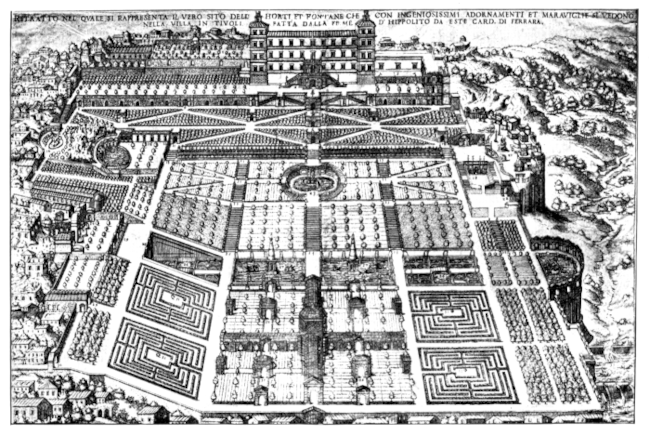
THE VILLA D’ESTE AT TIVOLI
To face p. 166, vol. ii.
In another place one may hear the song of birds, which is produced by small bronze flutes, such as are seen at feasts, and give a sound similar to that produced from those little earthen vessels full of water into which children blow with a mouthpiece. This is worked by mechanism like that used in the organs; and by another device an owl is made to appear on the top of a rock, whereupon all the harmony ceases at once, the birds being terrified at his presence. Then the owl retires and they sing again. Thus they may be brought forward and made to retire in turn as long as any one likes. Elsewhere a noise like the report of a cannon is produced, and again other sounds, less loud and very frequent, like the fusilade of arquebusiers. This is made by the sudden falling of water into certain pipes, the air therein, by struggling to find a vent, causing this noise. These same inventions, or something like to them, working by the same natural causes, I have seen in other places.
There are many pools or reservoirs edged all round with stone balustrades, on the top of which are set divers high columns of stone, distant one from the other about four paces. From the summits of these pillars the water spouts forth with strong impetus, not upward, but down towards the water in the basin. All the jets, being turned inwards and facing one another, discharge the water into the tank with such velocity that, when the threads of water collide in the air, they let descend into the basin a thick and continual mist. The sun falling upon the same produces on the surface of the basin, in the air, and all round about, a rainbow so marked and so like nature that it in no way falls short of the bow seen in the sky. I saw nought to equal this elsewhere.
Under the palace itself are several vast cellars and ventilating chambers, artificially made, which give out a cooling vapour and temper the air in the basement, but this portion of the palace is still imperfect. In this villa I observed many statues of great merit, the most notable being two nymphs, one dead, and the other asleep; a Pallas with divine attributes; a replica of the Adonis which is in the palace of the bishop of Aquino; a wolf in bronze; a boy extracting a thorn, like the one in the Capitol; the Laocoon and the Antinous, after those in the Belvedere; the Comedy, also of the Capitol; and the Satyr of the country villa of Cardinal Sforza; a copy of a recent work, the Moses, from the tomb in S. Pietro in Vinculo, and of the beautiful woman who is at the feet of Pope Paul III. in the new church of Saint Peter’s. These same statues, indeed, gave me greater pleasure than any others in Rome.129
Pratolino was certainly built in rivalry with this place. In the richness and beauty of the grottoes Florence is far superior, but the gardens of the cardinal of Ferrara surpass Pratolino in abundance of water. As to the various diverting artifices produced by water-work, they are about the same, what though the Florentine designer may have produced a more elegant effect in laying out and ordering the ground. This palace certainly has the advantage in antique statues, and in the house itself. The Florentine erection, in the beauty of its site, and in the view over the adjacent country, is vastly superior to that of the cardinal of Ferrara. I should, however, have nothing but praise for the natural surroundings of the villa at Tivoli were it not that by ill-luck all the water therein, except that flowing from a fountain in a little garden high up, of some which is brought into one of the apartments of the palace itself, is the water of the Teverone, a branch of which the cardinal has manipulated and cut therefor a special canal for his own use. If this water were only clear and good to drink, instead of being turbulent and dirty, this place would stand beyond all comparison, especially with regard to the great fountain and its adjuncts, which in construction and aspect is the most exquisite work to be seen in this garden or in any other place. At Pratolino, on the other hand, all the water comes from springs, and is brought from afar. For the reason that the Teverone comes down from mountains still higher than those of Tivoli, divers of the people of the neighbourhood make what use they list of the river water, wherefore the cardinal’s handiwork seems less noteworthy, because others have done the same thing.