VII ROME (continued 2)
W. G. (William George) Waters translation
On the morrow I departed after dinner, and passed by a vast ruin on the right-hand side of the road, which is by report six miles in extent. This was formerly a villa, and known as the prædium of the Emperor Adrian.130 The road from Tivoli to Rome crosses a rivulet impregnated with sulphur. The banks of the stream are all white therewith, and the stench may be smelt half a league away, but no medicinal use is made of the water. In this stream may be found divers little substances compounded of the scum of the water, which are so much like our medicinal powder that few could tell the difference, and the people of Tivoli make out of this same material all sorts of medicaments, two boxes of which I bought for seven sous and six deniers. In Tivoli are divers antiquities, two terminal images of a very ancient shape, and the remains of a temple with several columns still perfect, which legend declares to have been the temple of the ancient Sibyl. However, on the cornice thereof there may still be seen five or six large letters; but this inscription seems to have been left unfinished, for the stonework beyond them is still intact. Whether any other letters preceded these I know not, as on that side the wall is ruined. All that are now visible run as follows: Ce ... Ellius L. F. What may be their signification I cannot say.
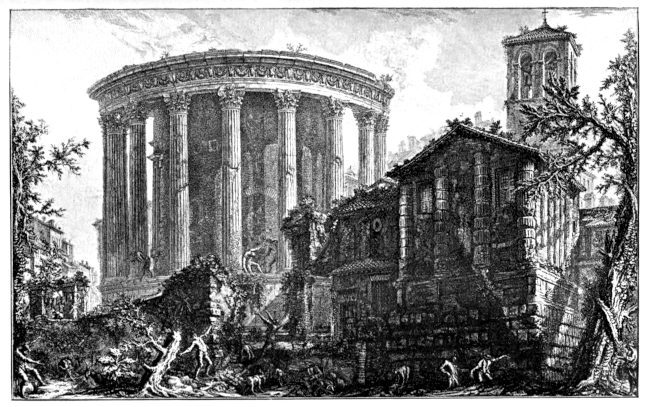
THE TEMPLE OF THE SIBYL AT TIVOLI
To face p. 174, vol. ii.
In the evening we arrived at Rome after a journey of fifteen miles. I travelled in a coach without any tedium or discomfort, a rare experience with me. The people here pay more careful heed to one particular usage than in any other place; that is to say, for the sake of health they find out the different characteristics of the various streets and quarters of the city, and even of the suites of apartments in their houses. This consideration is held to be of such high importance that they always change their residence according to the seasons. Even those who live in hired dwellings maintain at great cost three or four houses, so that they may shift at the proper season according to the advice of their physicians.
On the 15th of April I went to take leave of the Maestro del Sacro Palazzo131 and his associate. They begged me “to pay no regard to the censures which had been passed upon my book; censures which, as certain Frenchmen had informed them, contained many ignorant statements: they declared that they honoured my purpose, my affection towards the Church, and my ability: that they rated my good breeding and conscientiousness highly enough to allow me at my own discretion to cut out of my book with my own hand, at the next reprinting of the same, any passages which might seem too plain spoken, and amongst others those remarks about Fortune.” It seemed to me that they were not ill pleased with me: moreover, to justify their careful examination of my book and their condemnation of the same in divers particulars, they instanced several contemporary books, written by cardinals and ecclesiastical personages of high repute, which had been censured for blots of a like character, the good name of the author and the book itself having been left quite scatheless thereby. They ended by begging me to give the Church the benefit of my eloquence (these are their usual mots de courtoisie) and to make my abode with them in this peaceful and untroubled city. Both of these men were of high authority and competent for the cardinalate.
We tasted artichokes, beans, and peas about the middle of March.
In April it is light at what they call ten hours,132 and, as I well believe, at nine when the days are at their longest.
It was at this time that I made the acquaintance of a certain Pole, who had been the most intimate friend of Cardinal Hosius.133 This man presented to me two copies of a book which he had written with great care concerning the cardinal’s death. The pleasure of a sojourn in this city becomes vastly greater by usage. I never breathed air more pleasant or more healthy to my temperament.
On the 18th of April I went to view the inside of the palace of Signor Giov. Giorgio Cesarini, which contains countless rare antiquities, the most noteworthy of which are the authentic busts of Zeno, Possidonius, Euripides, and Carneades, according to the very ancient Greek inscriptions which are thereon. I saw also portraits of the fairest Roman ladies of the present day and of the owner’s wife, the Signora Clælia Fascia Farnese, who, though she may not be the most beautiful, is assuredly the most amiable lady in Rome; or, for all I know, in the whole world.134 This nobleman boasts descent from the race of the Cæsars, and by this right carries the banner of the Roman nobility. He is a rich man, and he bears for arms the column with the bear attached thereto, and above the column an eagle with outspread wings. The vineyards are amongst the most beautiful features of Rome, and these are in season in midsummer.
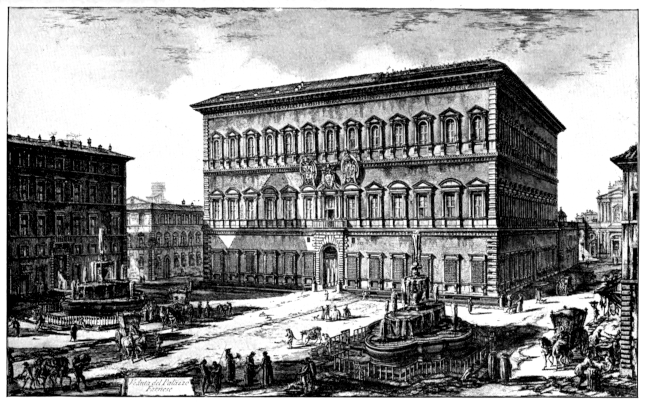
PALAZZO FARNESE
Reproduced from Piranesi’s Views of Rome
To face p. 178, vol. ii.