VI THE ISLAND-FOLK: THEIR WAYS AND CUSTOMS
Reading edition
HERE in Scilly, where so many of the place names are Celtic and there is certainly some Celtic blood, one would expect to find abundant traces of folk-lore and superstition. But these are very few, and any that remain are fast dying out.
The people have been educated out of any old fancies they may have had, for education, as is well known, has a way of killing imagination. If it would but kill only the hurtful superstitions, and leave the wayward play of fancy, and the poetical way of looking at things!
It used to be said that once the fairies danced on Buzza Hill; but if so they must have fled when the windmill was built, for they have never been heard of since. And this is the only vestige of a fairy-tale that clings about the islands.
Just a few old fancies linger amongst the older folk. Thus, a cat lying in front of the fire with its tail turned to the north is said to be a sure sign of a gale of wind.
And there are weatherwise proverbs among the fishermen, such as
“Southerly wind and fog; Easterly wind, all snug”;
and “You may look for six weeks of weather in March” is a hit at the variable character of that month.
A few of the ancient customs also linger. Up to the last century the old feast known as Nikla Thies was still celebrated when the last load of grain was brought in, and they “used to dance and polka till all was blue, to the tune of ‘Buffalo Girls.’” But now hardly any grain is grown in the islands.
At Christmas there used to be the “goose-dancing” (i.e., “guise-dancing”) in masquerade, when “the maidens dressed up for young men, and the young men for maidens, and danced about the streets.” This custom is still kept up in a modified form.
Midsummer night was celebrated by the lighting of bonfires and the letting off of crackers. When the shipbuilding was in full swing there was abundance of material for amusement in this direction. Tar-barrels would be set afire and rolled blazing along the streets, and lighted torches swung round on chains, high above the heads of those who carried them.
The custom of going limpeting on Good Friday still exists, but more for the sake of the fun of securing the limpet before he glues himself tight than for the sake of eating him when cooked, as no amount of boiling could make him palatable.
“Tough and elastic, like a piece of india-rubber, and if you don’t mind, when you’re trying to bite it, it will fly back in your face and give you a black eye.” So limpet-eating was described to me by one who had tried.
The crowning of the May Queen, which takes place every May Day, is a very old custom in Scilly. The May-pole is now set up in the “Park” of Hugh Town, and the children dance round it dressed in white and garlanded with flowers.
There are still people who seem to think that the Scillies are almost desert islands, where it is not easy to obtain good food and lodging. But this is very far from the truth, for in Hugh Town there are two comfortable hotels—Tregarthen’s, with its garden of tropical plants, at the foot of Garrison Hill; and Holgate’s, overlooking St. Mary’s Pool, at the other end of the town. There are besides a number of good boarding-houses, and “apartments to let,” and one can also stay at some of the flower-farms.
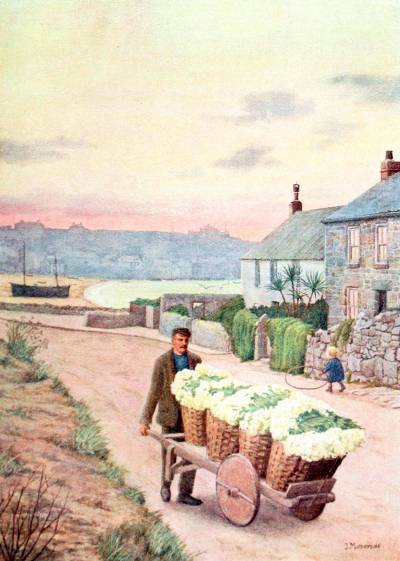
A FLOWER-BARROW, HUGH TOWN
G. H. Lewes writes amusingly of his experiences in the matter of food in 1857:—
“Beef is obtainable, by forethought and stratagem, but mutton is a myth. Poultry, too, may be had—at Penzance; and fish—when the weather is calm, which it never is at this season. But market there is none.
“Twice a week a vegetable-cart from ‘the country’ (which means a mile and a half distance) slowly traverses the town, and if you like to gather round it, as the cats and dogs do round the London cat’s-meat man, you may stock yourself with vegetables for three days.”
His landlady appeared to think him most unreasonable because he objected to doing without meat for an entire day.
“Spiritually-minded persons, indifferent to mutton, may disregard this carnal inconvenience, and take refuge in the more ideal elements of picturesqueness, solitude, and simplicity; and I cannot say that the inconvenience weighed heavily in the scale against the charms of Scilly—the more so as an enlarged experience proved the case not to be quite so bad as it seemed at first.”
Nowadays things are very different; but still if you decide to board yourself, “forethought” if not “stratagem” is required for obtaining meat, which in part comes from Penzance, and is exhibited for sale on the ground-floor of the Town Hall—the only “butcher’s shop.” Once in the fishing season I followed a group of Lowestoft fishermen all the way down the street, and could tell from their talk that they were in search of the butcher’s. “Not one in the whole blessed place!” I heard them say in astonishment, which was not lessened when they were presently directed to the Town Hall.
In Woodley’s time the “gentry” used to bespeak the different portions of an animal before it was killed, so that the farmer was insured against risk; just as nowadays in Egypt the would-be purchaser of camel-flesh will chalk out in white his private mark, on neck or thigh or shoulder, of the living beast, to show which is the joint he desires to have when it has become meat.
Fresh fish is to be had when there has been a good catch, and is hawked round in sixpenny strings. Milk and new-laid eggs seem to be obtainable to any extent. Cornish cream, alas! with the advent of the separator, is threatening to disappear.
I must not forget to mention one article of food which shows decided originality—a twopenny loaf of bread, one half of which is brown and the other half white!
In the old days the people lived almost entirely on scads (i.e., horse-mackerel), dried and salted, and potatoes; and this gave rise to the couplet—
“Scads and taties all the week And conger-pie on Sundays.”
There is a story that a pilot was once asked “What is the population of Scilly?” Now this was before the days of compulsory education, and he had not the faintest idea what “population” meant; but he was not going to confess ignorance to a stranger, so he made a random shot at the meaning, and replied, “Scads and tates, sir!”
To this day there are islanders who say they would not exchange a good conger-pie for a round of beef, and who regret that scads are no longer caught. They are rich, oily fish, and used to be caught in great quantities in the Cove of St. Agnes, which was hauled in turn by the inhabitants of St. Mary’s, St. Agnes, and Bryher, while the men of St. Martin’s and Tresco would spread their seines out amongst the eastern islands. Ling and conger were also caught, and dried on the stone hedges, or salted for winter use.
When smuggling was rife in the islands, intemperance was common; but nowadays things are changed for the better. This is in spite of the fact that no licences are required for selling beer and spirits. Anybody who likes may keep an inn, with the permission of the Governor. The same rule applies to the keeping of dogs, carriages, and men-servants, the selling of tobacco, and the carrying of a gun: licence duties do not exist.
No notes on Scilly would be complete if they failed to take account of the character of the people, for their kindness, courtesy, and ready good-humour add much to the attraction of the islands. Tribute has been paid to them by many an old writer, and so far as I can learn, by report and by experience, everything that has been said in their praise is true to this day.
“I doubt not,” writes Heath, “but every stranger that visits the islands will see honour, justice, and every social virtue exercised among the inhabitants ... though there is never a lawyer and but one clergyman in all the islands.”
Troutbeck quotes this sentence fifty years later (but without a word of acknowledgment, as is his way), merely changing “one” clergyman to “two,” to suit the altered times. He says elsewhere, “The present islanders are commonly civil to strangers.” It would be quite as true to say they are uncommonly civil!
Doctor Borlase in 1752 speaks of “the civility natural to these islanders,” and Woodley tells the same story.
Then there is the testimony of G. H. Lewes in 1857: “Not an approach to rudeness or coarseness have I seen anywhere.”
Woodley most unreasonably accuses them of curiosity, but what respect should we have for the members of any small community who did not take a friendly interest in each other’s concerns? I am quite sure that by the time Woodley had finished collecting material for his book of 338 pages he must himself have acquired a terrible character for asking questions!
The desire for local bits of news must have been very much fostered in the islands by the difficulty there used to be in obtaining any from the outside world. It is said that Queen Elizabeth had ascended the throne for several months before the news of the death of Queen Mary arrived in Scilly! Nowadays the telegraph keeps them well in touch with everything that is going on, and acquaints them with the state of the markets for their produce.
I think the most prominent trait in the Scillonian character is a cheerful kindliness of disposition, which makes the visitor feel on his first arrival he is welcome, and soon makes him feel quite at home. This kindliness is shown in many little ways, even when there would be much excuse for contrary behaviour. A visitor and his wife were once trying to scale a stone hedge—with no evil intent, but all the same it was trespassing. An islander who was working in the field, instead of stopping them, offered to take off the top stones of the wall, “to make it easier for the lady,” and to replace them when they were safely over. That is true Scillonian courtesy!
I have seen a tourist rush with his camera through a field of daffodils, crying to the owner and his men, “Please keep on picking and take no notice of me!” And they have done it, when anywhere else he would have been requested, either politely or forcibly, to keep to the footpath.
Another characteristic is the delightful Celtic leisureliness. One kindly housewife only voiced the general feeling when she said, “Where’s the need of hurry? What is not done to-day will be done to-morrow.” We had sought shelter in her cottage from the torrents of rain and were terribly interrupting her spring-cleaning; yet she not only insisted on drying our clothes, but came and entertained us in her best parlour with stories of the wrecks, and soothed our scruples with the words I have quoted.
An American girl-visitor once noticed this trait. “You haven’t learnt to hustle here,” said she to her boatman. “If the islands belonged to us we’d soon make things spin.”
“Could you hustle the tide in and out?” was the quietly humorous retort. “Or could you hustle the fish into the nets, and the lobsters into the pots?” And what a blessing it is that Nature cannot be hustled, but will take her own time over her own work, however much money-grubbing man may try to hurry her up: it is but little he can do, with all his forcing-houses and schemes for premature development!
Scillonians have no lack of humour—that saving sense of humour which helps one over the roughnesses of life, little and big, and turns each tumble on life’s journey into an occasion for a smile at one’s own expense.
There are no “yokels” or “boors” in Scilly, such as one meets in parts of rural England, who are rude or tongue-tied if one asks them a simple question. They have a delightful way here of saying “Please?” with a special intonation, if you say something to them which they do not quite hear or understand. It sounds very pretty from the little children.
The children, on the whole, are quite charming and very friendly without being rude or troublesome. They used to crowd round sometimes when I was painting, but they never got in the way. Occasionally they would plant themselves in the middle distance under the impression that my eye was like a photographic lens, and that so long as they came within the field of vision they must infallibly appear in the picture!
In the spring they make chains and garlands of daffodils and narcissi, with which they deck themselves: for to them these are the commonest of common flowers, and on a par with buttercups and daisies.
Honesty may almost be taken for granted in the islands. Heath’s statement is still true: “There are no robbers, housebreakers, or highwaymen.” For there is no real poverty, and no one who has not got a character to lose. Once when visiting St. Agnes we were advised to leave our luggage by a lonely road-side while we went round to look for rooms. “We are all honest people on St. Agnes,” they told us, “so it will be quite safe.” And so it was.
They have been accused by one or two writers of being grasping and exorbitant in their charges, and altogether too fond of money; but I can only say that I have never seen the slightest sign of this, and I have had strong evidence to the contrary. But I have been told that if you rub them up very much the wrong way they will take it out of you by raising their charges.
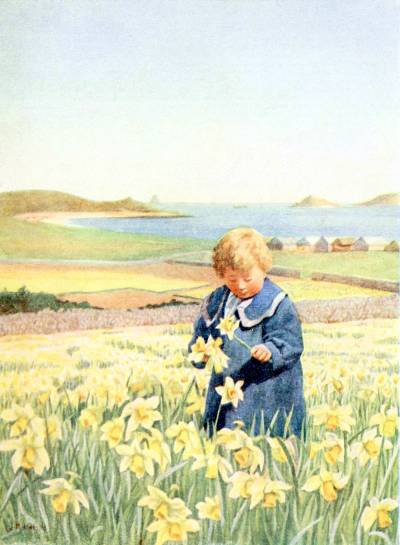
DAFFODILS ON ST. MARTIN’S
“Neatness of dress,” says Woodley, “particularly on the Sabbath day, is in many instances carried to an extreme, especially amongst the younger females.” And he describes how those who on one day have been scrambling, shoeless and stockingless, over the rocks, gathering and drying ore-weed for kelp, may be seen on the next day dressed in white, with straw hats and flying ribbons. I have always thought that neatness of dress had no extreme, but represented the Aristotelian mean between slovenliness and excess of finery! So in my eyes this statement is one of unmixed praise. A local wag once made a hit at this excessive love of “neatness” by parodying the lines I have quoted above. He chalked up on the pier:—
“Scads and taties all the week And a green veil on Sundays.”
The days of scads and tates and scrambling for seaweed have now been long past; but prosperity does not seem to have spoilt the islanders any more than adversity. They keep their simplicity, and kindliness, and freedom from vulgar display.
There is a delightful spirit of toleration in the little islands amongst the members of the different religious denominations. Those represented are Church of England, Wesleyan, and Bible Christian, with a sprinkling of Plymouth Brethren. But all those who profess and call themselves Christians seem to have learnt better than their fellows on the mainland the art of sinking their religious differences.
A simple and kindly soul, whose acquaintance I made, gave homely expression to the feeling which seems to be general; and I will repeat the words as nearly as possible as I heard them:—
“This is the way I looks at it. Heaven is like that Castle on the hill; there’s a many ways of getting there, and no two of us will ever go quite the same way. Why, to begin with, we don’t start from the same point.
“But this much I do know: you won’t get there any sooner by throwing brick-bats at your neighbour who’s coming along another road; and if you begin to do that, you may be pretty certain you’re off the track yourself.
“If only we’d all take hold on Christ and follow close to Him, we shouldn’t go far wrong then; and we’d be so busy loving our neighbour we’d quite forget he didn’t think just the same as us.
“I’m a Church-body myself; I was born a Church-body, and I mean to remain one till I die; but I don’t see that’s any reason for thinking hard things of the chapel-folk just because they likes to go to heaven another way.”
A crude confession of faith, do I hear you say? But you will admit that through it breathes a spirit of love and kindliness. And more—that it embodies, in homely words, a great spiritual truth; for is it not only by many different ways, and yet by the one Way, that we can all arrive at our goal?
The islands were for many years, as we have seen, under the abbots of Tavistock, who held spiritual jurisdiction under the bishops of Exeter. But not a single bishop ever set foot on them until 1831!
In a letter written by John Grandison, Bishop of Exeter, to the Pope, in the reign of Edward III., he says that no bishops in person ever visited these islands, but were wont to depute friars for that purpose.
Bishop Phillpotts of Exeter came in 1831, and again in 1838 to consecrate the new church on St. Mary’s. The islands since then have come under the diocese of Truro.
Troutbeck, writing of St. Mary’s in 1794, says: “The clergyman who officiates has neither institution nor induction to this benefice, nor visitation nor a licence from the Bishop of Exeter, but holds his preferment at the will of his patron, the Lord-proprietor. Formerly he was the only clergyman upon the islands; and children were brought from the off-islands to be baptized, often at the risk of their lives; but as the Society for Promoting Christian Knowledge has sent an assistant minister who resides at Tresco, and visits all the off-islands occasionally in fine weather, the inhabitants are not only benefited by his instructions and exemplary conversation, but freed from the inconveniences under which they formerly laboured.”
The other off-island churches were only supplied by native fishermen, who were appointed by the agent to read prayers and sermons agreeable to the doctrines of the Church of England.
Bryher is now the only inhabited island on which there is no resident clergyman; but a service is held every Sunday afternoon, and one evening during the week by the clergyman from Tresco. On Sunday mornings and evenings there is a service in the chapel, conducted by one of the fishermen-farmers, at which, I was told, Spurgeon’s sermons are read. “We’ve been having them forty years, and we aren’t tired of them yet.”
I inquired whether the attendance was greater at the church or at the chapel.
“Well, you see, it’s like this: the people as goes to church is the people as goes to chapel; and the people as don’t go to both don’t go anywhere at all. Church and chapel aren’t ever open at the same time, so there’s no rivalry.”
We once told a little girl on St. Agnes we were going to see the church. “Oh, but you must go and see the chapel too,” said she. I fear she would think it mere blind prejudice on my part that I have included views of two churches in this series, and not a single chapel!
Woodley writes that in his day the people would repair to the meeting-house in the morning, to church in the forenoon and afternoon, and again to the meeting in the evening.
Tresco is the only inhabited island on which there is no chapel. For many years the chapel-meetings were held every Sunday afternoon in the Church-room, with the approval of the Bishop of Truro, as well as of Mr. Augustus Smith, the Governor, who gave his consent willingly on condition that those who attended should be regular at Church in the morning and evening. The Plymouth Brethren now meet there in each other’s cottages.
John Wesley visited the islands in 1743. His followers have a large chapel and a resident minister at Hugh Town, and meeting-houses at Old Town and Holy Vale.
The Bible Christians have chapels on St. Mary’s, St. Martin’s, and St. Agnes, and three ministers, who do duty on each island in turn.