V DESCRIPTIVE AND ARCHÆOLOGICAL
Reading edition
HOW many islands are there? That is a difficult question to answer until we know how big a rock must be in order to be dignified with the name of island. One writer tells us there are over 300, another says nearly 200, a third has counted 140 on which grass will grow, and a fourth makes his estimate (how, I know not) as low as 17. Three hundred must include a great many “blynd rokkettes,” as the old chronicler Leland delightfully calls the little barren rocks.
One point at least is certain, that nowadays there are only five islands which are inhabited: St. Mary’s, Tresco, Bryher, St. Agnes, and St. Martin. Sixty years ago there were six, but Samson has since been vacated.
There is reason to suppose that some of the islands were formerly joined together, and that they have been separated by the encroachment of the sea. Even now at low water of a spring-tide it is possible to walk from Samson to Bryher, from Bryher to Tresco, and from Tresco to St. Martin’s, across the sand-flats, if one does not mind the risk of getting wet; and to wade across Crow Bar between St. Martin’s and St. Mary’s. Ruins of houses and stone walls have been found six feet under the sand, the walls descending from the hills of Bryher and Samson, and running many feet under the level of the sea towards Tresco; and it is said that there was once a causeway from the abbey church at Tresco across the downs to the church on St. Helen’s Isle.
There is a tradition that long ago the islands were all connected with the mainland, and that they are the only remnant of a tract of land called Lyonnesse, which contained 140 churches, but over which the Atlantic now rolls. On the spot where now the water swirls round the dangerous “Seven Stones,” there is said to have stood a city called the City of Lions, and that region is even to-day known to fishermen as Tregva—the “town” or “dwelling.”
The story goes that when King Arthur, of glorious renown, had fought his last fight and lay dead on the field of battle, his followers fled in confusion, pursued by Mordred, the rebel knight; and the course they took brought them to the extreme west of Cornwall.
“Back to the sunset-bound of Lyonnesse— A land of old upheaven from the abyss By fire, to sink into the abyss again; Where fragments of forgotten peoples dwelt, And the long mountains ended in a coast Of ever-shifting sand, and far away The phantom circle of a moaning sea.”
Pursuers and pursued were still pressing on when suddenly there arose a mighty tempest. The earth rocked, heaved, and was rent; and in between the two bands of warriors burst an angry flood of surging waters, swallowing up Mordred and his men before they had time to escape. But Arthur’s followers were marvellously preserved; the sea did not overtake them. Like the Israelites of old, they saw the destruction of their enemies while they themselves stood in safety on dry ground. And that ground was Scilly, all that is left of the lost land of Lyonnesse, over which the sea still swirls and eddies with unabating violence.
In the names of two of the eastern islands of Scilly, Great and Little Arthur, are found a reminiscence of the followers of the “Flower of Kings,” who are said to have lived and died on the islands where they had been so strangely (and mercifully) cut off from the rest of their kind.
So runs the legend, which sober, unromantic people spend their efforts and waste their breath in trying to disprove. They prefer to think that the sea between Scilly and Cornwall is called in Cornish Lethowsow (i.e., lioness) on account of its violence and turbulence, and that King Arthur’s followers escaped by boat—or not at all!
There is a tradition of the house of Trevilian that one of their ancestors had great possessions in Lyonnesse, and saved himself at the time of the inundation by swimming to shore on a white horse; in memory whereof the crest of the family is still a white horse.
Whether or not these stories have a foundation of truth, no one can say; but there is certainly a general resemblance in character and formation between Scilly and the Land’s End.
The whole of the islands are composed of granite, which is seen cropping up everywhere through the soil. Huge blocks and boulders of it lie scattered all along the coast, many of them of weird and fantastic shapes. The strangest have been given special names, more or less appropriate. On the peninsula of Peninnis, St. Mary’s Island, there is the “Tooth,” a slender conical rock 30 feet high; also the “Pulpit,” with its flat sounding-board, a fine specimen of horizontal decomposition.
Then there is the remarkable “Giant’s Punchbowl” on St. Agnes, consisting of two large masses of rock—the “Bowl” itself, and the base on which it stands. The base is over 10 feet high, the Bowl more than 8 feet, and the entire height of the top of the Bowl from the ground is nearly 20 feet. The Giant could have indulged in a hogshead of punch at a time, for that is the capacity of the natural basin. In former days the Bowl was a “logan-stone,” and could easily be rocked by two or three men with a pole, but now it rests on its base at two points.
Another strangely shaped rock on St. Agnes is known as the “Nag’s Head”; but there certainly never was on sea or land a horse with a head of that shape, whatever other strange beast it may resemble. It is thought to have been worshipped in ancient times, for there is a circle of stones round it.
It is not a hard rock, this island granite, and is easily worn away by the action of the wind and water. At many points the sea has eaten out large caves in the cliffs, and bellows in them, with the sound of thunder, in rough weather.
The wildness and grandeur of the coast scenery form a great contrast to the peaceful farms lying but a short distance away. The flowers are sheltered from the boisterous winds where necessary by high hedges of euonymus, veronica, and escallonia. Evergreen shrubs are naturally chosen, for at the time when they are most needed no others are in leaf. The escallonia and veronica grow with great luxuriance, and send forth a glow of bright pink bells and purple spikes against the dark background of their glossy leaves. Of trees the islands can make but little boast; they are too much exposed to the violence of storms. The only really large trees are at Holy Vale and Newford on St. Mary’s, and there are no others of any size, except in the gardens.
Dracæna palms flourish particularly well, and when one sees a group of them against the deep blue of the sea it is difficult to believe that one is still in the British Isles, and not on the shores of the Mediterranean.
Duke Cosmo III. of Tuscany says that the only trees he saw growing in 1669 were apple and cherry-trees, planted by the then Governor, but that thick stumps of oak were found in many places in digging the ground. So it seems that the islands were once better wooded than they are now. The tradition of an Abbey Wood on Tresco confirms this supposition.
Apple and other fruit-trees are often seen growing in the midst of the flower-fields; or, to put it the other way round, the orchards are often thick with daffodils.
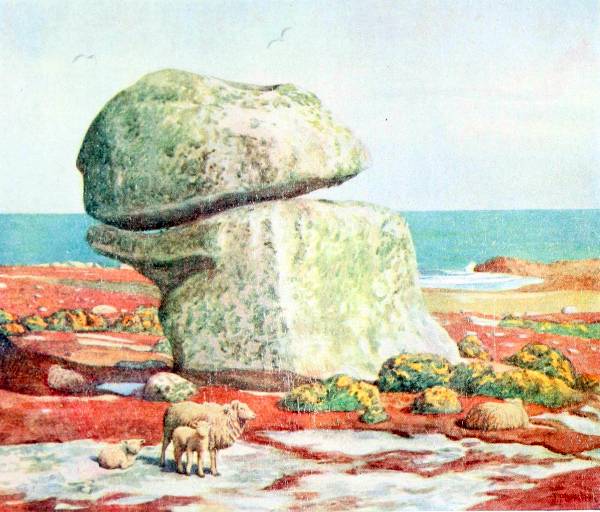
THE GIANT’S PUNCH-BOWL, ST. AGNES
Geraniums and fuchsias reach a great height, climbing to the eaves of the houses, and sometimes blossoming all the year round. It is said that an islander once replied with indignation to a stranger’s tactless comment on the scarcity of wood, “Indeed, we can heat our ovens with our geranium-faggots!” Any one who knows the Scillonians and their sense of humour will guess there was a twinkle in his eye as he said it.
Marguerite-daisies also grow into large woody shrubs, in perpetual bloom, and are often seen bordering the fields of daffodils.
In his Observations on the Ancient and Present State of the Isles of Scilly, published in 1756, Dr. Borlase strongly recommends the planting of “shelters of Elder, Dutch elm, Sycamore, and the like, in clumps and hedgerows,” for he notices that everything which rises not above the hedges does very well; “but to tell you the truth,” he continues, “the true spirit of planting either has never reached here, or has been forced to give way to more necessary calls.”
It may be that the fine trees at Holy Vale owe their origin to this advice, and certainly it has been followed so far as the hedges are concerned.
The highest hill in the islands is little more than 160 feet above the sea-level; but when, as in the case of St. Martin’s Head, the hill rises to this height straight from the sea instead of by gradual degrees, there is no lack of grandeur and impressiveness, especially from the seaward side.
Scilly has not a single river; and no wonder, for where would there be room? But neither does it abound in brooks and rivulets. I can only recall one tiny stream. The islanders depend for their water on wells, and on the rainfall, and only in very exceptional seasons do they run short. There are fresh-water ponds on St. Mary’s, Tresco, Bryher, and St. Agnes, but most of them are near enough to the sea to have been spoiled occasionally in times past by the entrance of the waves and spray during storms. In the summer of 1909 the ponds on Bryher and St. Agnes dried up for the first time within the memory of man.
The inhabitants of St. Mary’s are wont to say that though they have no rivers they have two bridges! One of these spans the fosse of Star Castle, and the other is thrown across a corner of the beach to make a short cut to the lifeboat-house.
In spite of the scarcity of trees and the absence of streams and rivers, I cannot agree with Parson Troutbeck, who writes: “Here, upon the whole, the poet would have a bad time of it, and might sigh alike for the purling stream and the shady grove.” I fear I should feel but scant respect for any poet who found cause for sighs and regrets in Scilly.
And this is a paradise without even a serpent, for the islands are as destitute of snakes and vipers as is the blessed isle of Saint Patrick. Hence arose an old saying that when the Almighty had finished creating Ireland there were a few handfuls of mud (sic!) left, which, being cast into the sea, became the Scilly Isles. I think this saying must have originated with an Irishman—and that is the only excuse I can find for it!
Rats there are, whose ancestors are said to have all arrived in a ship from Shields. And in Troutbeck’s time there were cockroaches—such cockroaches! His very description of them makes one shudder! “A large sort of flies, sometimes several inches long, but not so large here as in some other places; esteemed great curiosities and scarce known in any other part of the world.”
Fortunately these “curiosities” seem not to be so much in evidence now.
The Scillonians are a mixed race. They are thought to be descended partly from the ancient Iberians, that small and swarthy people, of whom so little is known and so much conjectured. No doubt they have also much Celtic blood in their veins, but they have never had any distinctive language, like others of the “Celtic fringe,” and the English that they speak is remarkably pure. Their descent has likewise been traced from the Scandinavians who once frequented the islands; and doubtless other strains as well have mingled with their blood.
There is a tradition that a ship of the Armada was wrecked off the coast of St. Agnes (at how many points of the British coast is there such a tradition!), and it is said that some of the Spaniards who escaped with their lives made that little island their home. According to the old chronicler Leland, St. Agnes was entirely depopulated somewhere about the beginning of the sixteenth century, the five families who lived there being all drowned on their way back from a marriage feast at St. Mary’s; so it is possible that if the Spaniards landed here they found a free field.
The present inhabitants of St. Agnes are a fine race, but quite distinct in character from the rest of the islanders; and I have heard it said that when they get excited or angry “you can see the old Moor coming out as plainly as anything.”
St. Martin’s men are tall and fair and handsome, and seem to show signs of Scandinavian descent.
That a purer English is spoken on the islands than on the mainland has been explained by the fact that a Bedfordshire company of soldiers was left behind in garrison here during the Commonwealth, and in time was completely forgotten. The soldiers intermarried with the island women when they had given up all idea of being recalled. I do not think that any one who has ever heard the true Bedfordshire twang could credit this story as an explanation!
But there is little doubt that fresh blood has been introduced into the islands by such intermarriages. Duke Cosmo III. of Tuscany was driven by contrary winds to put into St. Mary’s Harbour in 1669, and he reports that “corn of late began to be scarce, in consequence of the increase of the population produced by marriages of the soldiers of the garrison with the islanders, but this has been remedied for some years past by forbidding them to marry!”
The isolation of the islanders led in past times to intermarriage between the same families again and again, but the results do not appear to have been as unfortunate as might have been expected.
There is this result, on the off-islands especially, that the same surname is repeated over and over again, so that nicknames have to be resorted to, to distinguish one man from another. On St. Agnes every man is a Hicks, unless he is a Legge. On Tresco, Bryher, and St. Martin’s, Jenkins, Pender, Ashford, and Ellis are the typical names.
It happened once on St. Agnes at the signing of the parish books that the names of the four signatories (the churchwarden, the two overseers, and the auditor from London) were all the same—Hicks!
There are traces of prehistoric man in nearly all the islands—kitchen-middens, with heaps of limpet-shells and other refuse, and great numbers of sepulchral barrows of the Neolithic and Bronze Ages.
At the foot of Hellingy Downs on St. Mary’s the remains of a primitive village have been discovered, with the foundations of many circular huts, some of which have now been washed away by the sea. There was a kitchen-midden close by; and an ancient stone hand-mill, about four thousand years old, and some very crude pottery of the same period, were unearthed from among the foundations.
When digging near Garrison Hill, St. Mary’s, some of the islanders have come across layers of limpet-shells four feet in depth; and on the desolate island of Annet, now sacred to sea-birds, there has recently been found a midden with quantities of the peculiarly shaped and unmistakable pharyngeal bone of the wrasse, as well as the inevitable limpet-shells, showing that in this case prehistoric man had endeavoured to vary his diet. Dr. Borlase, the antiquarian, thus describes the barrows:—
“The outer ring is composed of large stones pitched on end, and the heap within consists of smaller stones, clay, and earth, mixed together. They have generally a cavity of stonework in the middle, covered with flat stones; but the barrows are of various dimensions, and the cavities, which, being low and covered with rubble, are scarce apparent in some, consist of such large materials in others that they make the principal figure in the monument.”
These funeral mounds were formerly called “Giants’ Graves,” and it was believed that terrific storms would follow their disturbance. Dr. Borlase got into some trouble with the people because his investigations were followed by a storm which ruined their crops. And yet, unfortunately, many of the stones have been removed by the inhabitants from time to time for building purposes. The present pier on St. Mary’s is said to be partly built with stones from these old sepulchres.
Dr. Borlase found “no bones, or urns, but some strong unctuous earth which smelt cadaverous.” Other searchers have been more fortunate. On the Gugh of St. Agnes barrows have since been opened, containing coarse earthen pots with cinders and ashes inside, sepulchres no doubt of the Bronze Age when cremation was the usual practice. In recent times Mr. Bonsor opened another, of very great interest, on the same peninsula. Inside were urns and skeletons in layers, one above the other, the same grave having been used apparently by two different peoples, those who cremated their dead and those who followed the later custom of inhumation. The later generations seem often to have turned out the earlier.
One of the most perfect kistvaens or cists in Cornwall was found by Mr. Augustus Smith in a tumulus on the northern hill of Samson in 1862. It contained the lower and upper jaw of a man, and the remains of human teeth, all of which had been subjected to the action of fire.
On the top of the hill above the Clapper Rocks, on the east coast of St. Mary’s, is a barrow which was opened by Mr. Bonsor in 1903, and in his opinion it is the finest specimen in the West of England. Altogether in Scilly there must be nearly a hundred examples, and no doubt many have been destroyed. The built graves lined with stones are thought to be of earlier date than those formed of only one large block. Very often there is a double circle of stones round the mound, an inner and an outer, the covering slabs being in some cases eight or nine feet long.
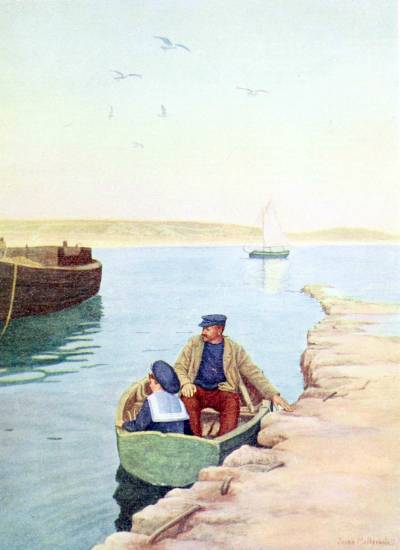
ST. MARTIN’S PIER
On the summit of nearly every hill these desolate green barrows are to be seen, reminding us of that far mightier barrow, the “great and shapely mound” to Achilles, “raised on the high headland, so that it might be seen from afar by future generations of men.”
For long the islands have been identified with the Cassiterides, or tin-producing islands, mentioned by ancient writers. But there does not seem to be sufficient evidence to prove this indisputably, and experts are not satisfied that tin was ever worked in Scilly. Not only so, but they go farther, and prophesy that it never will be—in fact, to parody the Spanish proverb, that it would require a gold-mine to work a tin-mine in the islands!
There has been much heated controversy on this subject of late; but then, there were warm discussions concerning the tin trade as far back as the second century B.C., so what can be expected nowadays? When there are many different opinions, put forward by as many different writers, all learned and all firmly convinced that the “other fellow’s a fool,” what course is left for the unlearned multitude, after hearing all that has to be said, but to retain an “open mind” on the subject? To prove my open-mindedness, I will not omit to quote the story about the Cassiterides which has usually been taken to refer to the Islands of Scilly.
Strabo, who lived at the end of b.c. and the beginning of a.d., tells us that the inhabitants of the Cassiterides obtained from their mines tin and lead, which they used to barter for earthen vessels, salt, and instruments of brass; that the Phœnicians found commerce with them so lucrative that they kept it a secret from all the world, but the Romans sent vessels to follow a trader on his voyage. To deceive them, he ran his ship ashore elsewhere, and the whole crew nearly perished. For this public-spirited act he was rewarded from the common treasury, besides receiving the value of his lost ship and cargo.
But, according to Strabo, the Romans found out the trade at last. Publius Crassus (whoever he may have been) sailed across to the islands, ascertained that tin was near the surface, and indicated the route for the benefit of traders, “although the passage was longer than that to Britain.”
If we do not admit the identity of Scilly with the Cassiterides, we have no proof that the Romans had dealings with the islands before their occupation of Britain.
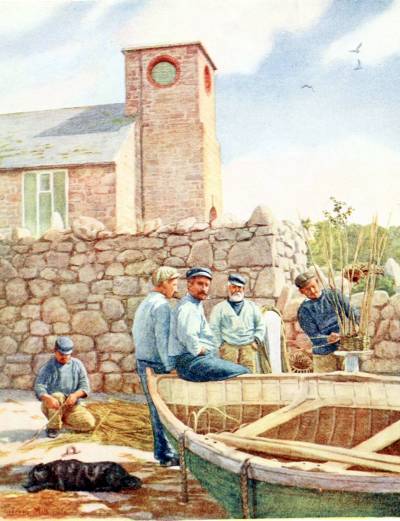
CRAB-POT-MAKING BY ST. AGNES CHURCH
The origin of the name “Scilly” is wrapped about with mystery. Not that there is any lack of suggestions; on the contrary, there is such a plethora of them that one feels no “forrader” after having heard them all.
One learned writer says with confidence, “The islands take their name from the old Silurian inhabitants to whom they served as a last refuge.” Other ideas are that the name is derived from “Sulleh,” a British word meaning “rocks consecrated to the sun,” or from a Cornish word signifying “divided.”
The inhabitants themselves seem to favour most the notion that the conger-eels, locally called “selli,” have given their name to the islands.
There are other suggestions; but as to which of the many is the most probable we must leave antiquarians and topographers to fight it out between them, and when they are all agreed we may conclude we have arrived at a certainty of the truth; and that is, perhaps, only another way of saying that we shall never know!
Most of the names of places in Scilly are Cornish, but the principal islands were named after the saints to whom their churches were dedicated. Tresco was at one time called St. Nicholas, from the Benedictine Abbey which used to be there. The harbours of Old and New Grimsby on Tresco may, like their namesake in England, owe their name to the visits of the Northmen who were here in the tenth century.
The most common Cornish words found in the place-names of Scilly are:—
Bre, a hill, as in Bryher, formerly called Brefar.
Carn, a pile of rocks, as in Carn Friars, Carn Near, etc.
Creeb or Creb, a crest, as in Crebawethan, the Creeb Rocks, etc.
Innis, an island, as in Peninnis, Innisidgen, Iniscaw.
Men or Min, a rock, as in Menawethen, Menavawr, Mincarlo, etc.
Pen, a head, as in Peninnis.
Porth or Per, a bay, as in Porth Cressa, Permellin, Perconger, etc.
Scaw, an alder, as in Tresco, Iniscaw.
Tre, a homestead, as in Tresco, Trenemen.
Vear, great, as in Rosevear, Holvear.
Vean, little, as in Rosevean, Cove Vean.
Unfortunately, the islands have no coat-of-arms; but if they had, it ought to be all “or” and “azure”; for those are the “tinctures” that seem to represent them best. An azure sea lying under an azure sky; golden gorse and golden daffodils; rocks turned to gold in the sunlight, bordered with golden sand, or covered with golden lichen. Even the fishermen and farmers put on azure! especially those on St. Agnes, whose blue linen blouses are quite distinctive of the island.