IV THE FLOWER INDUSTRY
Reading edition
IT is barely thirty years since first the sweet flower-fields began to cover the islands; but it is possibly nearly a thousand years since the original bulbs were introduced.
There are several reasons why it is thought likely that Scilly owes her semi-wild narcissus to the Benedictine monks, who brought some with them, so it is supposed, from the South of France, and planted them on this alien soil to which they have taken so kindly.
For although several varieties of the polyanthus narcissus have been found growing wild, it is in or near the gardens and orchards that they have always been most plentiful. A narcissus similar to the Scilly White has grown round St. Michael’s Mount from time immemorial; and it has been noticed that elsewhere also they have seemed to spring up in the footsteps of the old monks.
The Scilly White bears a very close resemblance to the Chinese joss-flower, which is held as sacred; and it would be a strange coincidence if here in England we have cause to associate it with consecrated ground.
It was long before Scillonians discovered what a gold-mine lay hidden for them in these simple flowers. On the other hand, it may be that they found the gold-mine as soon as it existed, for it is only comparatively recently that flowers have become as remunerative and as popular as they are to-day.
The pioneers of the flower industry were Mr. William Trevellick of Rocky Hill and Mr. Mumford of Holy Vale, who sent two boxes of flowers, gathered from the gardens and orchards, to Covent Garden Market, and received for them a sum of money far exceeding their expectations.
From that time onward they began to grow flowers systematically for the market, and, encouraged by their success, others soon followed their example.
In 1883 the Governor made a special journey through Holland, Belgium, and the Channel Islands for the purpose of making observations on the flower industry. He saw that Scilly was well able to forestall the Continental supplies, and accordingly he made extensive purchases of bulbs, and has ever since been one of the largest growers.
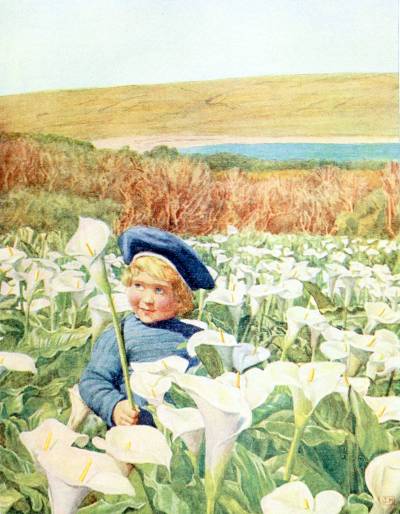
A FIELD OF ARUMS
At first only those kinds that were already well known in the islands were cultivated—Scilly Whites, Soleil d’Ors, Grand Monarques, Pheasant Eyes, and the Yellow Daffodil; but now many of the newest and most valuable varieties may be seen.
It is no sinecure to be a flower-farmer nowadays. The heaviest work is, of course, during the harvest; but transplanting the bulbs, clearing the ground, and trimming the shelters keep the farmers very busy during the summer; and those who force bulbs in glass-houses have hard work to get everything done before the winter sets in.
The bulbs increase very rapidly in the ground, and are now exported as well as blossoms. Some sorts need to be transplanted and divided every few years; but Scilly Whites may be left in the same place for twenty years without, apparently, taking any harm.
The dead leaves of the bulbs are raked off in summer when they are dry and sere, and are used as fodder for the cattle instead of hay. They were originally used for litter, to supply the scarcity of straw; but it was noticed that the cattle ate their bedding with great gusto, and seemed to flourish on it, although the green growing leaves are poison to them. So now ricks of lily-leaves may be seen side by side with the hay-ricks.
Every one who has a yard of ground to spare grows flowers. The harvest sometimes begins as early as the middle of December, and is not over until June, but the real press of the work is during February and March. Then every “steamer-morning,” that is to say every other week-day, from six o’clock to half-past nine you may hear a continuous rattle and rumble of carts, barrows, and trucks, laden with wooden boxes of flowers, making their way to St. Mary’s Quay. They come from all parts; from the large fields by Old Town, from the sheltered valleys “back of the country,” from the sunny slopes of Porth Hellick, from the little gardens on Garrison Hill. The off-islands also send their share; Tresco, St. Agnes, and St. Martin’s in flat-bottomed barges towed by the steam-launch that brings their mails, while heavily laden sailing-boats put in from Bryher, until one wonders how it is possible that all these contributions can ever be stowed away in the hold of the “Lyonnesse.”
The children of St. Mary’s have three weeks’ or a month’s holiday from school during the busy season, the boys for picking flowers and the girls for tying. Sometimes the girls will beg for leave to go into the fields for a change; but it is backaching work, and wet work too, very often. The men and boys usually wear leggings to protect themselves from the long, dripping wet leaves.
As soon as they are picked the flowers are put in water in the glass-houses. The bunching and tying is chiefly done by the women and children, and is paid for at the rate of threepence for a hundred bunches. A quick worker can make fifteen to twenty shillings a week. Some of them tie them in their own homes, and you may see cartloads and barrowloads of flowers, in boxes or baskets, being delivered at the cottage-doors loose, and fetched again later on, neatly tied, twelve in a bunch, and ready for packing. The flower-houses on the day before the steamer leaves are a sight to behold—banks of daffodils and narcissi, wallflowers and anemone fulgens, tier upon tier. Afterwards they are packed in shallow wooden boxes, each containing three, five, or six dozen bunches; and at busy times the lights of the houses burn far into the night, showing that packing for next day’s steamer is still going on within. And the tap, tap of the hammer of the box-maker is constantly heard at all hours throughout the flower-season.
The weather is of course a very important factor in the success or failure of the flower crop. A wet summer may prevent the bulbs from ripening; a strong gale in early spring may ruin thousands of flowers. The salt spray in a storm is swept right across the islands, spotting and blackening the blossoms so that they are unfit for the market; and although at a little distance a field may look delightful, it may prove on examination to be worthless, full of damaged flowers. So it is easy to understand why the growers prefer to pick the buds half-blown than to run the risk of their destruction.
There is a great difference between year and year in the abundance of the harvest. To give two examples: In the season 1908-9 there was no great show of flowers, but picking began about the middle of December, and went on continuously for four or five months. Prices kept up particularly well, owing to late frosts in the Riviera, and Scillonians were well content. They were proud to boast of having supplied the Battle of Flowers at Nice when the French gardens were under snow, in spite of the heavy protective duty that has to be paid. The following season, 1909-10, was quite a contrast. It was a record year for quantities, but the harvest began much later. The flowers came on with a rush in February, and all kinds seemed to be in bloom at the same time, and to bloom as they had never bloomed before. They were, in fact, too plentiful. “There’s a boolk o’ flowers,” as one man put it, “but they ain’t fetching no such tremendous price.” It was thought that the floods in Paris also helped to bring down the prices, for people were in no mood for buying flowers there, and the surplus supplies were shipped to England.
Every one in Scilly was kept hard at work from morning to night, and even so it was impossible to keep pace with the flowers. Usually, as I have said, they are picked in bud to save them from sudden storms, and put in water in the glass-houses, where they will open under better protection and more quickly than out of doors. But this month of March they opened faster than they could be picked. It was a race between the animal kingdom and the vegetable; and the vegetable won! Wallflowers also were coming on apace, and had to be neglected until the masses of daffodils and narcissi had been attended to.
This exceptional crop was attributed to the warm, dry summer of the year before, which had ripened the bulbs to perfection, and made the fields thus bring forth “an hundredfold.” Bad weather kept back or spoilt the earlier flowers, and so complicated matters by concentrating the bulk of the work for the season more than ever into two short months.
Three times a week at the height of the harvest, fifty tons of flowers were leaving St. Mary’s Quay for Penzance, en route for London, Liverpool, Manchester, Glasgow, and other of our large cities. Fifty tons! That means, roughly speaking, three and a half million blossoms; and so we may reckon that at least one and a half million of flowers were being picked in Scilly every day!
And yet the islands did not look despoiled. Far from it. The fields were a glorious sight, sheets and waves of silver and gold, representing to their owners the silver and gold of hard cash.
But such a wealth and abundance of flowers is of less advantage to the grower than to the purchaser. So many tons poured into the market in the course of a single week bring down prices with a run. “More than double the usual crop and less than half the usual price” is not a satisfactory state of affairs, for there are all the expenses of picking, tying, and carriage to be considered; and the cost of sending to London is no trifle—something like £6 a ton. An additional charge is the 10s. per ton which is paid to the Governor on all flowers that leave the islands, to recoup him for the lengthening of the pier twenty years ago. Prices were so reduced that the narcissus Soleil d’Or would only fetch 2s. for 36 bunches, when the year before they had been 5s. 6d., and Princeps had fallen to the same price from 4s. 6d.
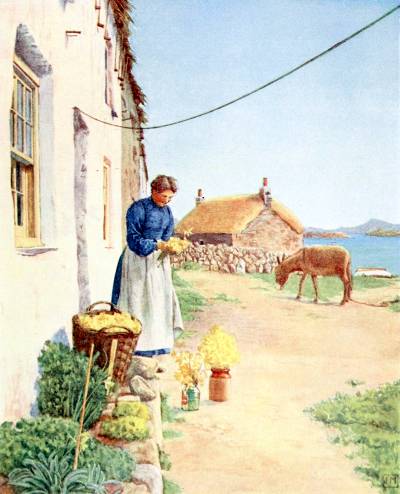
A COTTAGE FLOWER-GROWER, TRESCO
But what a year it was for seeing the fields! I must say it again even if you are tired of hearing it. You must not imagine squares of flowers, flat as pancakes, prim and orderly and uninviting such as you see in Holland. In Scilly no two fields are alike, and it is difficult to find one that is flat and uninteresting. They cover the slopes facing to the west and south; very often they run down almost to the edge of the sea, with only a low stone hedge to divide them from the shore. What would Wordsworth have felt, I wonder, to see these waves of dancing daffodils? Perhaps he would have preferred the scattered groups and clusters that spring up of themselves in the hedges by the wayside, or even on the beach itself.
For the wise Scillonian soon discovers which of his bulbs are the best and most profitable; and, weeding out from his fields those that promise least, he “heaves them to cliff,” where, if they light on any sort of soil, and out of reach of the waves, they will blossom even at the water’s edge, till some unusually high tide washes them away. In the meantime they delight the eye of the passer-by with unexpected splashes of gold, drops from the gorgeous seas that cover the island-flanks.
So lovely are the flowers that one would like to imagine the industry as “roses, roses all the way”; but of course that cannot be the case. Besides the drawbacks I have mentioned already—damage to crops from sudden storms, and gluts in the market from excess of supply—there are other risks to run. It has happened that in rough or foggy weather the off-islanders have sent quantities of flowers to St. Mary’s by the launch, and they have been duly stowed away in the hold of the “Lyonnesse.” The weather has got worse and worse, and it has been considered unsafe to make the journey to Penzance. But the flower-boxes are in the hold, and there they have to stay; and eventually they reach their destination on the mainland. By that time their contents are dead and worthless, and so the grower has lost his flowers, his time, and his trouble, and yet he must pay the carriage, and for the return of the empty boxes if he wants them.
To any one who has paid a visit to Scilly during the flower-season, the always-welcome sight in the London streets of the first daffodils of the season will be more than ever welcome; for these children of the spring will recall the blue seas and sunny skies of the flower-islands where they were reared.