THE PALACES OF TRADE.
Reading edition
It were well if not only William B. Astor, Stephen Whitney, the heirs of Peter Stuyvesant (of blessed memory), and others who own real estate in this city, and likewise all mayors, common councilmen, and others in authority, were endued with more taste, with a higher regard to the general interest, and a juster sense of the matters that pertain to a good administration, so that it might be said in after times that the beneficence of the Creator (who in things natural has done more for ours than for any other city), had been seconded by the pious wisdom of the creature, and Manhattan pointed to as in all respects the metropolis of the world. Why not? If the very stones in the streets of London, Paris, and Vienna, were turned to pure gold, they would not purchase for those cities advantages that should be compared with such as we already possessed by our beautiful island—a giant mosaic, set in emerald, studding the bosom of Nature.
Whatever may be said by our excellent neighbor, the minister of the dingy-looking red brick meeting-house round the corner, it is not less a work of piety to create any work of beauty—a beautiful house, or shop, or poem, for example—than to teach a class in the Sunday school,—which doctrine may be incidentally fortified from Jonathan Edwards's Theory of True Virtue, and more directly from the best philosophies of later years. It is ordered that the dignity of human nature shall in a great degree be dependent upon a sympathetic association with what is admirable. It was Hazlitt, we believe,—certainly it was some one who appreciatingly recognized the highest earthly ministry,—who said it was impossible to entertain an angry feeling in the presence of a lovely woman's portrait,—which, done fitly, is the highest accomplishment of art. Whatever is beautiful or sublime has the same purifying and ennobling tendency. The beggars do shrewdly who sit in front of Stewart's. The same person who would give a shilling there, would as likely as not steal a penny from the hat of the blind man round the corner, where those detestable red bricks so outrage every principle known to a builder fit to handle the trowel. There is nothing more offensive than this custom of making of different materials the various fronts of the same edifice. It may be allowable to construct the rear of a house, or a side that is to be built against speedily, of a cheaper stone; but to make the face upon one street of marble, and the face around the corner of brick, as in the case of Stewart's store, and the Society Library, is an outrage as ridiculous as it would be to make alternate gores of a woman's skirt of Petersham and Brussels lace. Bricks are very respectable; we say nothing in their dispraise; but to any man of taste, an edifice is much more beautiful built entirely of bricks than it is with but one of two exposed parts of marble; and let us say to the affluent merchant to whom New-York is indebted for the structure just mentioned, that until he paints his bricks on Reade-street, so that they correspond as nearly as may be with his fronts on Chambers-street and Broadway, his store will indicate but a shabby gentility, an unnatural association of tow cloth and satin, copper and silver, poverty and riches, which should blush in the face of the most inferior exhibition of consistency. With the abolition of this strong contrast, the observer who goes down Broadway will contemplate with delight the classical air of this most imposing Palace of Trade that has yet been erected in the cities of the United States. How easily Broadway, for the money that its piles of brick and stone will have cost in ten years, might be made the most splendid street in Christendom, by a mere observance of the principles of taste and unity!
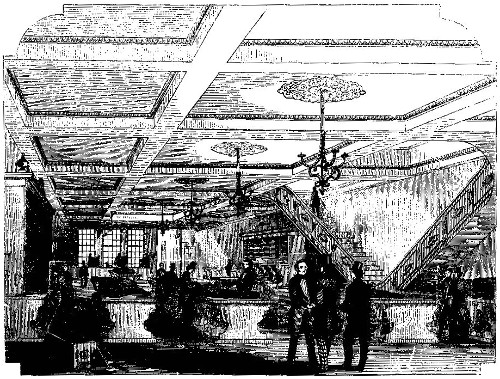
PRINCIPAL HALL OF PETERSON & HUMPHREY'S CARPET HOUSE.
In a little hamlet of five or fifteen hundred inhabitants, great buildings are out of place. In a city like ours, every thing should be in keeping, and the predominant principle should be the gigantesque. If the lot-holders from Bowling Green to the New Park would but consider the matter, with intelligent reference not only to the glory of the city but to their own profit; if each separate square were built as if it were one edifice (as, without any blending of property, it might be very easily), though these squares were all of plain brick, and no more costly than the well-known row of stores in William-street, what an imposing spectacle they would present! But if one block were like the Astor House, the next like Stewart's (except only the Reade street front), the next a row of free-stone, the next one of brick, the next one of granite,—here a Gothic, there a Byzantine, then a Corinthian, then, if you please, as plain a front as that of the New-York Hotel—with here and there a church, library, lyceum, or art gallery, of a style less suitable for shops or dwellings,—and there would be nothing in the world to compare with Broadway. But this running of democracy into the ground, this whim of every vulgar fellow who owns a front of twenty feet, that he must illustrate his independence by building on it in his own peculiar way, is baulking Providence, and for the full cost of magnificence confining us to tricksy meanness. Two or three years ago rose the chaste and simple front of 349 Broadway, in a row of decayed brick shops, which, it was hoped would give place to an entire range in imitation of the initial structure. But since then, the owner of a couple of adjoining lots—a Connecticut man probably—has caused to be put up two stores of a different style, not of half the value of continuations of the less expensive edifice which they join. If instead of this patchwork, now planted here for half a century, there had been an extension of uniform stores from corner to corner—though either Beck's or the building we have mentioned had been the model—the single splendid edifice would have been a pride and boast of the city, and the separate stores would have been of much greater value than the best can be now. It is as revolting (and much more vexatious, for its publicity) as the worst case of Saxon and Congo amalgamation. A magnificent pile has been erected in Wall-street on the corner west of the Exchange; but some person, ignorant, it is to be hoped for his soul's sake, of the true obligations of morality applicable in the case, has built, at the same time, at the same cost, of the same height, and without any conceivable justifying reason, an utterly incongruous basket of offices, as if for the special purpose of vexing the eyes of men who have instincts of decency.
THOMPSON'S SALOON.
The imposing edifice on the corner of Broadway and White-street, of which a view is presented on a preceding page, is one of the improvements of the city made during the last year. In the great carpet-house of Peterson & Humphrey are offered the productions of the best looms in the world, in a variety and profusion probably unequalled elsewhere in America. The principal saloon is like a street, and it is almost always thronged with people.
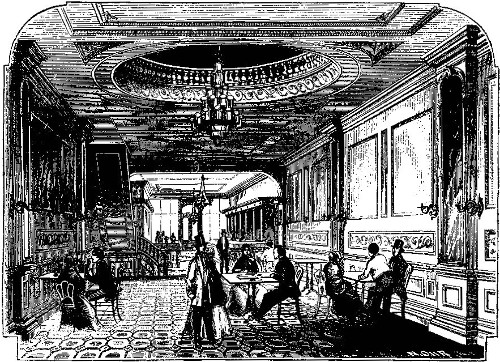
Not far from the store of Peterson & Humphrey—at 359 Broadway—is the new and beautiful building erected by the well-known confectioners, Thompson & Son. This was opened to the public but a few weeks ago, and it is the most splendid establishment of the kind in America. The several sales during the last three quarters of a century of the ground upon which it is built, illustrate the rapid increase of value in real estate in this city during that period. The lot formed a part of the De Peyster farm, and was called pasture ground. On the death of Major De Peyster, the farm was divided, and this lot, then thirty-two feet wide, was on the 13th of December, 1784, sold for £100 New-York currency; in 1789 it was sold for £150; in 1805 for $1500; in 1820 for $4000; in 1825 for $11,000; and in 1850 it was bought by Mr. Thompson for $60,000, and he has expended $50,000 in the erection of the building with which it is now occupied, and which is twenty-eight feet wide, one hundred and ninety feet deep, and sixty-two feet high. It is built in a very rich style, of Paterson stone, similar to that used in Trinity church. The architects were Field and Correja, and the decorations in fresco are by Rossini. Mr. Thompson, senior, has been a quarter of a century in the business for which he has erected this new edifice, and in which he has accumulated his fortune. In 1820 there were but one or two houses of the kind in New-York, and these were of limited capacity and in every way inferior to Taylor's, Weller's, or Thompson's, of the present day. These are among the most luxurious and comfortable resorts for ladies and gentlemen who visit the city but for a part of a day, or who have not time or inclination to go to houses in distant parts of the town, to lunch or dine, or for those who come down Broadway to do shopping, and need a resting place, or enjoy an exchange for gossip.
PRINCIPAL SALOON AT THOMPSON'S.
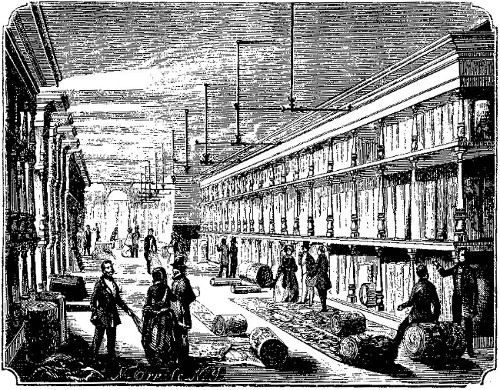
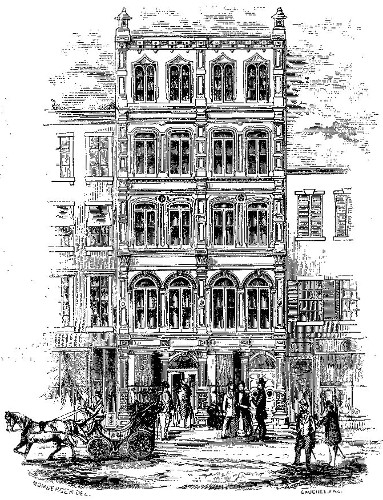
The next of the Palaces of Trade recently erected in the city, for which we have now room for any description, is the great silk house of the well-known merchants, Bowen & McNamee, constituting one of the most attractive features of the lower part of Broadway. It is built of white marble, and the style of architecture is Elizabethan, and peculiarly elaborate and effective. The building is thirty-seven and a half feet wide, one hundred and forty-seven deep, and four stories high; and each story consists of a single unbroken hall, lined with the richest English, German, French, Italian and Indian goods. The architect was Mr. Joseph C. Wells, and his plans were used in all the minutest details of ornament and furniture. It is regarded, we believe, as the greatest triumph of its kind of which our commercial metropolis has to boast; indeed in magnificence of design, beauty of execution, and perfect adaptation to its purposes, there is nothing superior to it, probably, among the buildings devoted to trade in all the world.
It was said by Jefferson that the genius of Architecture would never make her abode in America; but the new edifices in New-York, of which we have described some prominent specimens, may lead others to a different conclusion. And we are of opinion that the progress of this country, in the last quarter of a century, has been less conspicuous in any thing else than in this noble art, little as it is now understood, much as it is still disregarded. In some recent speculations on the subject, the Tribune observes:
"There is no American architecture, unless the Lowell factories may be regarded as such. Our churches are small and imperfect imitations of a miscellaneous Gothic, and our exchanges, colleges, lyceums, banks and custom-houses affect the Greek, with as much propriety as our merchants, professors and clerks would indue themselves with the Athenian costume. There is no hope of the churches and banks. They are nothing if not Gothic and Grecian. We shall not discuss the probable character of our architecture. It is clear that New-York will build brick houses, and in blocks. But beauty costs no more than ugliness, and although every man has the right to build a house of that appearance which best pleases himself, yet every citizen is bound to have at heart the beauty of the city. He cannot escape it. His pride compels it; and therefore every man who builds a house ought to consult, to some extent, the general effect of his building, and as he would not paint it blue or black, he should no less consider its form than its color.
"Cheapness and convenience will, of course, be the first principles in our building, beauty and picturesqueness will be secondary. The point is to combine these without much compromising either. At present our cities are the unhandsomest in the world. The street architecture is monotonous and heavy. The houses, compared with those of other capitals, are low, but they are not light. Paris and the Italian cities have always a festal air. Vienna is brilliant. Even grim old Rome seems waiting to be gay. You do not immediately see the reason of this. The houses are high, the streets narrow, shutting out the sky, and the swarms of passengers do not explain the charm. But if you look narrowly you will see that the difference of effect produced, arises, not so much from any essential architectural superiority; because the mass of building in any city is of about the same general character—but that it is due to the "broken and various lines which every where meet the eye, relieving the heavy gravity of the smooth fronts which with us are entirely unrelieved. Sometimes, indeed, a street is built with regard to its architectural beauty, as the Rue de Rivoli, in Paris, of which the harmony is uniformity and not monotony. One side of this street is the garden of the Tuileries, and the other is like a prolonged palace front. The northern side of the Boulevards des Italiens is truly picturesque, but for directly the contrary reason—the infinite variety of line presented.
BOWEN & McNAMME'S SILK HOUSE.
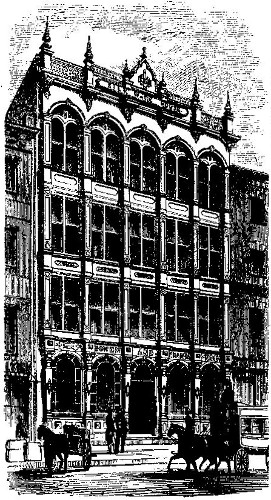
"It is to these lines of gallery and balcony which break and lighten the mass of building, that we must look for a hint of very feasible improvement. If any city reader wishes an illustration of this fact, let him observe how the iron verandah upon the Collamore House redeems the otherwise bald, dead weight of that building. Then let him cast his eye up Broadway to the long front of Niblo's Hotel—unrelieved and blank—and consider the cheerful effect of a continuous gallery along each story, or separate balconies at every window, as on the beautiful Chiaja at Naples. On the other hand let him ask his Metropolitan pride how it would like a street of such edifices as the City Assembly Rooms on the site of Tattersalls? So, also, in dwelling-houses, the balcony which is now confined to the parlor floor might occasionally be carried up through the other stories, and this, in narrow streets, with a peculiarly happy effect, as is seen in such streets of foreign cities, where the style, if elaborated in lattices and bay-windows, becomes romantic and poetic.
"Greater variety in the mouldings of doors and windows, and in the designs of porticoes, might easily be obtained, with an infinite gain of grace to the city. The Broadway Theatre illustrates this, for it is certainly one of the most impressive buildings upon that street. The question, it must be remembered, is not one of art, so much as of picturesqueness and effect. The galleries and balconies, &c., are only a subterfuge. If an edifice is intrinsically beautiful and well-proportioned, it claims no such accessories, as Stewart's building, which, although a simple square mass, yet from the admirable proportion, rather than the material, is as stately and imposing as many a foreign palace. But where there is no regard—as is the usual case—to the dignity or propriety of form, there we must take advantage of an alleviation, and obtain lightness, gayety, and variety as we best can.
"There is, however, one point peculiar to American, or more properly to New-York building, which calls for the determined and constant censure of every man who values human life. We mean the flimsy style of building arising from the frenzied haste with which we do every thing. This has long been our reproach. Scarcely a year passes that we do not record some disaster of this kind, often involving a melancholy waste of life. 'Is it strong?' is a question constantly asked of a new building, and a question which, in any civilized community, it should be as unnecessary to ask, as whether the public wells are poisoned.
"We know many who will not pass under buildings now going up or recently erected. A friend walked down Broadway one morning, while a building was in course of erection on the site of the present Waverly House, and returning in the afternoon found that it had all tumbled down. Our readers have not forgotten the frightful fall of a block in Twenty-first street last spring. One is curious to know if nothing is ever to be done—if the city means to take no security for the lives of the citizens in this matter. It would be very easy to prevent this flimsy building, and even were it very difficult it should be effectually done. This, too, is a matter in which every citizen is interested.
"Stores and Warehouses have their own proprieties. Warehouses properly avoid even the appearance of lightness. They are devoted to heavy storage. No life, save of bales and boxes,—and not of the contents of bales and boxes—is associated with them. Security is the first and only thing we demand of them, provided the structures are not painfully disproportioned. So with Prisons. In fact, in architecture, the ornament must depend upon the use, must be developed from the use. For the same reason that balconies become a dwelling-house they disfigure a warehouse. Stores again should partake, in their appearance, of the intrinsic character and associations of shops. When shop-keeping becomes royal, it should be royally housed, as in Stewart's building.
"The theme unravels itself endlessly. It is one of those common interests of constantly recurring importance which it is always worth while to talk about. Because there is no American architecture, there is no occasion for making our buildings mere piles of brick and mortar, punctured here and there for light—and because we are a commonsense, go-ahead people, there is no need that our houses should offend the eye; but—for that reason—great need that they should please it.
"Lorenzo of Florence was the magnificent, not because he was rich, but because he knew the use of riches."
Despite all drawbacks, our city is growing wonderfully in splendor as well as in size; and perhaps no previous season has promised so many improvements in Broadway, uptown, or by the different parks, as the present. Surpassing already any metropolis in the world in the number and magnificence of our hotels, we are to have in occupancy within a few weeks the splendid St. Nicholas and the gigantic Metropolitan, besides half a dozen of inferior pretensions, which will yet surpass the best in other cities; and new churches, and galleries, and public halls, are talked of, in number and capacity, as in beauty, sufficient for all the possible contingencies of a great capital, increasing in wealth, and power, and beauty, with such unexampled rapidity. The power and magnificence of New-York have been built up by her merchants, whose private enterprise, public spirit, and intelligence and taste, are especially conspicuous in the new edifices devoted to trade, of which we have given descriptions.
INTERIOR OF BOWEN & McNAMEE'S SILK HOUSE.