Book 10 — Ladies Fashions for April.
Reading edition
LA VIVANDIERE
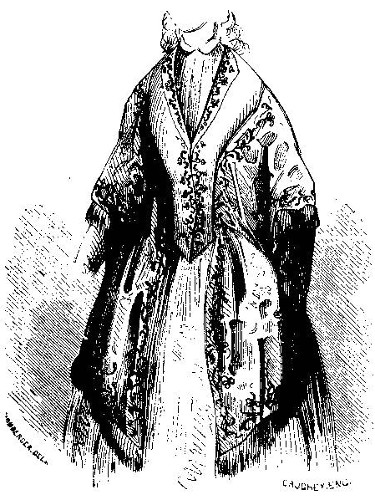
The spring has brought to the several departments of fashion the usual amount of changes, but at our last advices there were many points of some consequence undecided, as for example, the length of dresses, which some authorities make greater than ever in recent years, and others less, by a few inches. Among the chief novelties we notice La Vivandiere, which, with various styles of the gilet, or waist, has been introduced into New-York by Bulpin of Broadway. The waistcoat will remain in vogue. The Parisiennes, who had begun to turn it into ridicule, still patronize it; and the provinciales need not fear to adopt it. But some conditions are necessary in order to render it becoming and stylish. The figure of the wearer should be thin, tall, and sylph-like; all others should avoid the style. Rounded, white shoulders appear to much more advantage in toilette Pompadour than in toilet Louis XIII. The corsage Louis XIII., and the waistcoat accord so well together that they are scarcely ever separated. However, some bodies a basquines are made to be worn without the waistcoat. They are then trimmed with velvet or ribbon bands, which cross the chest and fasten with buttons; the chemisette being composed of frills of English point or Valenciennes, separated by embroidered insertion.
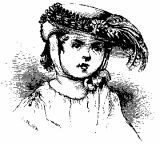
INFANT'S STRAW BEDFORD HAT.
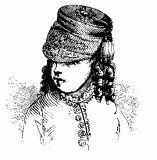
THE BATEMAN CAP.
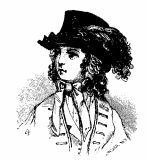
THE CLEMENTINE RIDING HAT.
THE ST. NICHOLAS CAP.
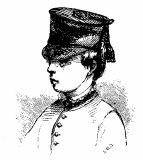
BOY'S STRAW BRUSSELS HAT.
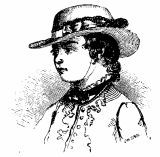
MISSES LEGHORN HATS.
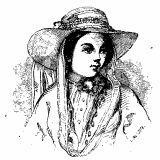
The recent fine bright weather has brought out many very elegant spring bonnets. The most fashionable are of Leghorn, which, during the approaching season, is likely to recover the favor it enjoyed some years ago. The shape of new Leghorn bonnets is elegant and becoming—the brim is wide and circular, and the crown gently sloping backwards. The bavolet at the back is made of the Leghorn itself, instead of being composed of silk or ribbon, as in bonnets of straw or other materials. The favorite style of trimming Leghorns is with fancy straw, tastefully intermingled with velvet or ribbon, of some dark rick color. On one side may be placed a small ostrich feather, of the color of the Leghorn, or shaded in the hues of the bird of Paradise. As the season advances, flowers will be employed for trimming these bonnets. Genin has introduced a great variety of new and fanciful styles from the recent Paris modes, for children, and for ladies' riding dresses. They are of Leghorn, felt, and beaver, all of which will be in vogue through April, and they are generally very tasteful and elegant.
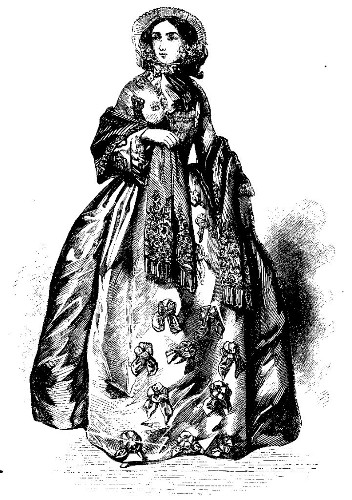
In the above figure we have a Promenade or Carriage Costume, of rich figured silk; the sleeves open at the ends, with under sleeves of white muslin; with a Leghorn bonnet, trimmed with fancy straw and violet-colored ribbon, tastefully intermingled; on one side a Leghorn colored feather, waving spirally. Under-trimming, loops of narrow ribbon in various shades of violet; and gloves of pale yellow kid. The taffetas d'Athenes is appropriate for ball dresses, and obtains generally; the ground is white, blue, or pale pink, brochees in silk of all colors in wreaths, or bouquets, forming undulating festoons round the bottoms of the triple skirts. The upper skirt is flowered over in small designs to the waist, as is also the body and sleeves. The taffetas flore has a white ground, covered with small bouquets of wild field flowers. The taffetas rose has wreaths of large roses, brochees in white silk round each skirt, and rose-buds over the top skirt and body. This toilet should be accompanied with a coiffure, of a wreath of white roses, fixed behind by a bow and long floating ends of satin ribbon, forming an elegant evening toilette for a bride. The manteaux, with hoods, continue in fashion; they are generally made of cloth. The mantelet-echarpe has been cited for its elegance and taste. It is more dressy than the manteaux, marking the waist, and descending in front in square ends. Sorties de bal, are very fanciful. Some of white cachemire, trimmed with beads, silk, and jet, with magnificent lace or deep fringe. Others of white or pink satin, edged with ruches of guipure lace, or rouleaux of marabouts. They have hoods and large Venetian sleeves.