Front matter (continued 4)
Reading edition
The termites, at least the majority of them, work in the darkness, under the earth; the ants both above and below.
Like the termites, they build, at least in tropical countries, the most remarkable edifices,—domes under which their chrysalides enjoy the warmth of the sun without being injured by its scorching rays. But these are not fortresses; the ants have no need of them; for in the tropical regions they are the sovereigns and tyrants of all other beings. The exterminating carabi, the invading necrophori, which play among us, as insects, the rôle of the eagle and the vulture, scarcely venture to make their appearance in the burning latitudes where the ants hold sway. Everything which lies on the earth's surface they immediately devour. Lund, in his Mémoire sur les Fourmis, says that he had scarcely time to pick up a bird which he had seen drop. The ants were already on the spot, and had seized upon it. The sanitary police is performed by them with an implacable and energetic exactitude.
The great ants of the South are much more savage than our European species; and feeling themselves sovereigns and mistresses, feared by all, dreading none, they march forward imperturbably, without suffering any obstacle to divert their course. If a house stand in their way, they enter, and all that is alive within it—even the enormous, venomous, and formidable spiders, ay, and small mammiferous animals also—is devoured. Men give place to them. And if you cannot quit your house, you have reason to fear their invasion. Once, at Barbadoes, a long column was seen defiling for several days in formidable numbers. All the earth was black with them, and the torrent poured forward straight in the direction of the houses. They were crushed by hundreds, without heeding their losses; myriads were destroyed, but they continued to advance. No wall, no ditch, was of any service; water even could not arrest their progress: for it is known that they construct living bridges, by fastening on to one another in clusters and garlands. Fortunately, the plan was adopted of sowing the ground in advance of them with numerous tiny volcanoes, small heaps of gunpowder, which were fired at intervals beneath them, and exploding, swept away whole files, and dispersed the rest,—covering them with fire and smoke, and blinding them with dust. This scheme proved successful. At least, the ants turned aside a little, and moved in a different direction.
Linnæus calls the termites the scourge of the two Indies; and we might equally well bestow this appellation on the ants, if we considered only the havoc they commit among the labours and cultivation of man. In a few hours they strip a large orangery, denuding it of every leaf. In a single night they devastate a field of cotton, manioc, or sugar-cane. Behold their crimes! Their virtues? they destroy to a still greater extent all things that might prove hurtful to man, and but for them certain countries would be uninhabitable.
As for our European species, I cannot see that they do the slightest harm, either to man, or to the plants he cultivates. Far from it, they deliver him from an infinity of little insects. I have frequently seen long files of them, with each carrying in his mouth a very small grub as a contribution to the food stores of the republic. Such a picture should ensure them the benedictions of every honourable agriculturist.
The mason-ants, which work in and entirely under the earth, are difficult to observe. But the "carpenters" may be easily followed, at least in the upper part of their constructions. The cupola of their edifice being subject to dilapidation, they are constantly under a necessity of repairing and re-excavating it. With the small amount of soil which they make use of, they mix the leaves and spines of the fir, and the catkins of the pine. If they meet with a bent; twisted, and knotty twig, it is a treasure; they employ it as an arcade, or, better still, as an ogive; for the pointed arch is the most solid. The numerous avenues which lead to the surface spread out in radii like a fan; they start from a concentric point, and extend to the circumference. The mass of the edifice is divided into low but spacious apartments. The largest is in the centre and under the dome; it is also the most elevated, and destined, apparently, for public communications. There, at all hours, you will find a knot of busy citizens, who, by the rapid contact of their antennæ (a kind of electric telegraph) seem to relate to one another the news, and exchange opinions or mutual directions. It is a kind of forum.
There is nothing more curious than to observe the various occupations and movements of this great people. While some, as purveyors, go in search of grubs, hunt insects, or collect materials, others, sedentary in their habits, attend entirely to domestic cares and the education of the young. An immense and an incessant occupation, if we may judge from the continual movement of the nurses round the cradles. Let but a raindrop fall, or a single sunbeam penetrate, and a general stir takes place, a general removal of all the children of the colony, and this with an ardour which never wearies. You may see them tenderly taking up the big children—which weigh as much as themselves—and transferring them from stage to stage, to rest them in a convenient position.
This scale of heat, extending over forty degrees, what is it but a thermometer?
But more remains. The cares of alimentation, of what one might call "suckling," are much more complicated than among the bees. The eggs must receive a nourishing humidity from the mouth of the nurses. The larvæ take the beakful. And the young one which has worn through its husk and become a nymph, would not have strength enough to emerge from it if the attentive guardians were not at hand to open the husk, release the little tenant, and initiate it into the light. In the artificial ant-hills, which we have procured for the sake of closer examination, we have even succeeded in observing a circumstance which Huber regrets he had been unable to discover.
Some light movements which the infant communicates to its swaddling-clothes give warning that its hour is come. We took great pleasure in watching the nurses seated upon their hind limbs like little motionless, upright fairies, plainly discerning under the silent veil the first yearning for liberty.
As in every superior race, the young comes into the world weak, and frail, and incapable of effort. Its first steps are so infirm that at every movement it falls upon its knees. It requires, as it were, to be kept in leading-strings. Its great vitality is only shown by an incessant demand for food. Therefore, when the heat is great, and numerous swaddling-husks must be opened daily, the new-born are all lodged in the same part of the city.
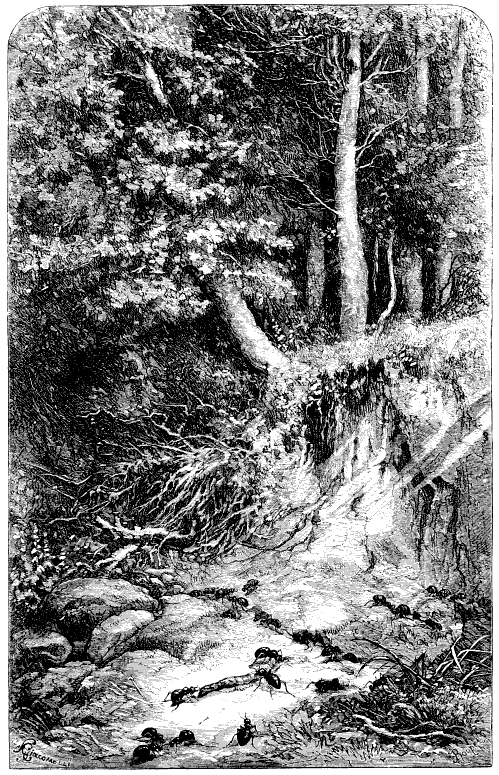
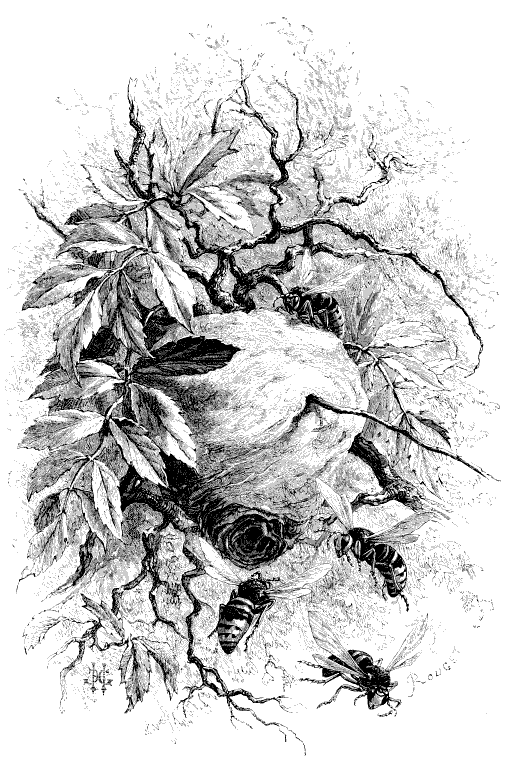
NEST OF RUSSET ANTS.
One day, however, I saw a young ant thrust forth its head, still somewhat pale, at a gate of the city, then step across the threshold, and march along the summit of the ant-hill. The escapade, however, was not long permitted. A nurse encountering the fugitive, seized it by the top of its head, and conducted it gently towards a neighbouring entrance.
The child resisted; it suffered itself to be dragged along, and on the way coming in contact with a small piece of wood, profited by it to stiffen itself, and exhaust its conductor's strength. The latter, always keeping its temper, let go for a moment, executed a flank movement, and then returned to the charge, until its nursling, tired out, was compelled to yield obedience.
As soon as the young are strong enough, they have to be brought acquainted with the interior labyrinth of the city, the suburbs, the avenues which lead to the outer world, and the neighbouring roads. Then they are trained to hunt, are accustomed to provide for themselves, to live hap-hazard and upon little or any kind of food. Temperance is the basis of the whole commonwealth.
The ant, not being fastidious, but accepting all descriptions of food, is from this very cause the less anxious, restless, and selfish. It is very wrong to call it a miser. Far from being so, it seems solely intent upon multiplying in its city the number of its co-partners. In its generous maternal care of those whom it has not begotten, in its solicitude for those little ones of yesterday which to-day become young citizens, originates a feeling quite novel and very rare among insects,—that of fraternity. (See the works of Latreille and Huber.)
The obscurest and most curious point of their education is, undoubtedly, the communication of language, which reminds the observer of the forms of freemasonry. It enables them to transmit really complicated directions to their legions, and to change in a moment the march of a whole column, the action of an entire populace.
This language principally consists in the touch of the antennæ, or in a light collision of the mandibles. They urge (or perhaps persuade) by blows of the head against the thorax. Finally, they sometimes carry off the auditor, who makes no resistance, and transport him to some designated place or object. In this case, which undoubtedly is both difficult to believe and explain, the convinced auditor unites with the other, and both together carry off other witnesses, which in their turn perform upon others—the number continually increasing—the same operation. Our parliamentary phrases, "to carry away the crowd," "to transport the hearer," are by no means mere metaphors among the ants!
To this lively gesticulation they join many other scarcely explicable movements,—such as cavalcades, in which they march mounted one upon another, exchanging gay defiances and light blows upon the cheeks. Then they rear themselves upright, and contend by couples, seizing upon a leg, a mandible, or an antenna. Naturalists have spoken of these as their pastimes, but I know not what to think. Among so busy, and obviously serious a family, this gymnastic exercise has perhaps a hygienic object which we do not understand.
We had so well managed our prisoners that they had become habituated to their new domicile, and toiled under our eyes as they would have done in their own city. They rebuilt for themselves a small town in miniature, with gates whose number they carefully augmented, especially on very hot days, for the purpose of giving air to their little ones, whom they took care to place near the openings.
In the evening they conscientiously proceeded, according to their invariable custom, to shut up the gates, as if always afraid of some nocturnal invasion of idle vagabonds. A spectacle of deep interest, which we frequently took occasion to enjoy in front of the great swarming ant-hills.
Nor could there be a more varied picture; on all sides, and at great distances, you might see them coming in long files, each bearing some little article,—one a long straw, another a pretty pine nut-cup, or (according to the country) a black needle-like leaf of the fir-tree. These, like little woodcutters returning at close of day, brought back imperceptible bundles of twigs; others, which seemed empty-handed, were but the more heavily loaded, having just taken prisoners some wood-lice, which they carried home for the evening meal of the little ones.
At the approaches of the City, the points where the ascent commenced, it was a pleasure to see the vigour, the zeal, and the ardour with which they dragged up such heavy materials. If one let go, exhausted, two or three others succeeded. And the joist or beam, full of animation, and apparently alive, gradually ascended. Skill and foresight supplied the want of strength. If checked at any particular point, they turned and advanced in a somewhat different direction, ascending a little higher than was necessary; then they let down the weight exactly over the opening which they wished to conceal; a quick light movement made the mass pirouette, and it fell into its place.
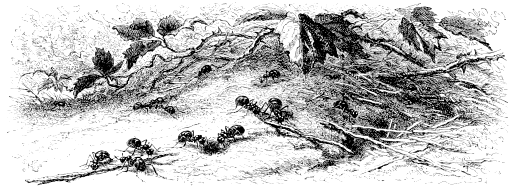
Numerous problems in statics and mechanics were solved by a felicitous audacity and with a great economy of effort. By degrees all was secured. The vast dome, embracing with a soft and delicate curve a great nation of workers in its lawful repose, offered nothing to the sight, neither door nor window, and appeared to be a simple heap of tiny fragments of fir. Do I mean that all slumbered in full confidence? It would be wrong to think so. A few sentinels wandered to and fro; at the lightest touch of a switch, or the rustle of a leaf, the guards would issue forth, perambulate the exterior of their city, and when reassured would re-enter, but, undoubtedly, to continue their watch, and remain upon duty.
The most surprising scene at which any one can be present is a marriage of ants.
Of all follies, as everybody knows, the worst are those of the wise. The honourable, economical, and respectable republic accordingly presents (one single day yearly, it is true) a prodigious spectacle—of love? of madness?—we do not know, but certainly of vertigo, and to speak plainly, of terror. M. Huber saw in it the appearance of a national holiday. What a holiday! And what a scene of intoxication! But no; nothing human can give an idea of this boiling effervescence.
I watched it on one occasion, between six and seven o'clock in the evening. The day had been one of heavy showers and warm gleams of light. The horizon was lowering, and yet the air calm. It was Nature's pause before resuming her storms of rain.
Upon a low sloping roof I saw descend quite a deluge of winged insects, which seemed stunned, confused, delirious. To describe their agitation, their disorderly movements, their somersaults and shocks to arrive more quickly at the goal, would be impossible. Many rested, and loved. The greater number whirled round and round without stopping. All were so eager to live, that their very eagerness proved an obstacle. This feverish desire produced a feeling of alarm.
A terrible idyllic poem!
It was impossible to make out what they wished. Were they enjoying a festival of love? Were they devouring one another? Right through this distraught multitude of fiancés who had lost their senses passed other and wingless ants, which threw themselves without mercy on the most embarrassed individuals, bit them, and treated them so severely, that we thought we could see them crunching the lovers. But no! They wanted nothing more than to force them to obey, and to recall them to their senses. Their vivid pantomime was the counsel of prudence translated into action. The wingless ants were the wise and irreproachable nurses, who, having no children, bring up those of the others, and bear all the burden of the toil and management of the city.
These virgins maintained a surveillance over the amorous and slothful, and rigidly inspected the marriage-festival as a public act, which, every year, renews the nation. Their natural fear was lest the winged fools should be wooed and won elsewhere, and create other tribes, without any thought of the parent community.
Numbers of the winged ones submitted, and allowed themselves to be carried below towards their country and virtue. But many tore themselves away, and flew afar, obedient only to the dictates of love and caprice.
It was an astonishing vision, a fantastic dream, which can never be forgotten.
In the morning nothing remained as a memorial of the excesses of the preceding evening, except the fragments of some severed wings, in which no one could have divined the trace of a unique soirée d'amour.
III.—THE ANTS: THEIR FLOCKS AND THEIR SLAVES.
CHAPTER III.
THE ANTS:—THEIR FLOCKS AND THEIR SLAVES.
When I learned for the first time, from the pages of Huber, the strange and prodigious fact that certain ants keep slaves, I was greatly astonished—as everybody has been by this singular revelation—but I was especially saddened and wounded.
What! I turn aside from the history of man in search of innocence. I hope at least to discover among the brute creation the even-handed justice of nature, the primitive rectitude of the plan of creation. I seek in this people, whom I had previously loved and esteemed for their laboriousness and temperateness, the severe and touching image of republican virtues—and I find among them this thing without a name!
What a joy, what a triumph for the partisans of slavery, for all the friends of evil! Hell and tyranny, laugh ye, and make merry! A black spot is revealed in the brightness of Nature.
I had flung aside Huber, and no book had ever seemed to me more hateful. Pardon, illustrious observer! your grandfather and your father had enraptured and charmed me. The first of the clan—Huber, the great historian of the bees—has inspired with new warmth the religion of man, and lifted up his heart. But Huber of the ants has broken mine.
It was, nevertheless, a duty to resume my perusal of his work, and examine it more attentively. An immoral, a Machiavellian, and a perverse insect is worthy of investigation.
But, in the first place, let us make a distinction. A portion of these pretended slaves may only be cattle.
It is enough to look at the ants, thin to an excess, brilliant, and varnished, to conclude that they are the driest and most parched of beings. Their singular acridity has been established by chemical researches, and science has contrived to extract the mordant formic acid from their bodies. Sometimes, when they are in peril, they hurl it at their enemies like a venom. Not a few species employ it in drying, blackening, and almost burning the trees where they establish their abodes. Is not a substance so corrosive for others equally dangerous to themselves? I should be tempted to think so, and to this extreme acridity should attribute their greediness for honey and other lubricating substances. I submit my hypothesis to the consideration of the scientific.
The ants of Mexico, in a specially favoured climate, have two classes of workmen,—one charged with the duty of seeking provisions; the other, inactive and sedentary, entrusted with the work of elaborating them, and making out of them a kind of honey for the common nourishment.
The ants of our temperate climates, for the most part incapable of making honey, satisfy their imperative need of it by licking the honey-dew found upon certain grubs, which, without labour, by the mere fact of their organization, extract saccharine juices from all species of plants. The transmission of this honey to the ants is effected quietly, and, as it were, by mutual agreement.
It operates by a kind of titillation or gentle traction, such as we exercise upon the cow. These grubs, placed at the extreme limit of animal life—viviparous in summer, oviparous in autumn—are very humble creatures, and prodigiously inferior in intelligence to the ants. The magnifying-glass reveals them to the observer as always bent, and always engaged in feeding. Their attitude is that of the cattle. They are, in truth, the milch-cows of the ants; and that they may always profit by them, the latter frequently transport them to their ant-hill, where they live together on admirably good terms. The ants take great care of the grubs, superintend the incubation, and nourish the adults with their favourite vegetables.
In situations where great difficulty would be experienced in transporting and installing them, they empark them on the ground by throwing up around their field of pasture a fence of twigs and cylinders of earth. This may justly be termed the grazing-field, the chalet of the ants; which repair to it at certain hours to milk their herds, and sometimes carry their young thither for the easier distribution of the food. I am frequently present, especially in the evening, at these Dutch-like scenes, which have hitherto found no Paul Potter among the ants to depict them.
Observe that these grubs, whether transported to the ant-hill or emparked on their favourite feeding-ground, possess the inestimable advantage of having their safety guaranteed by the redoubtable republic. The "lion of the grubs" (as a small worm is called), and other wild beasts, if they dared approach the herd, would feel very cruelly their strong mandibles and burning formic acid.
So far, then, we have no reproach to make; the grubs are cattle, and not slaves. The ants do exactly what we do; they make use of the privilege of superior beings, but exercise it with more gentleness and management than does man.
But we now come to a more delicate consideration. There are two kinds of ants, of a tolerable size, but otherwise of no peculiar distinction, which employ as servants, nurses, and cooks, certain small ants endowed with more skill and ingenuity.
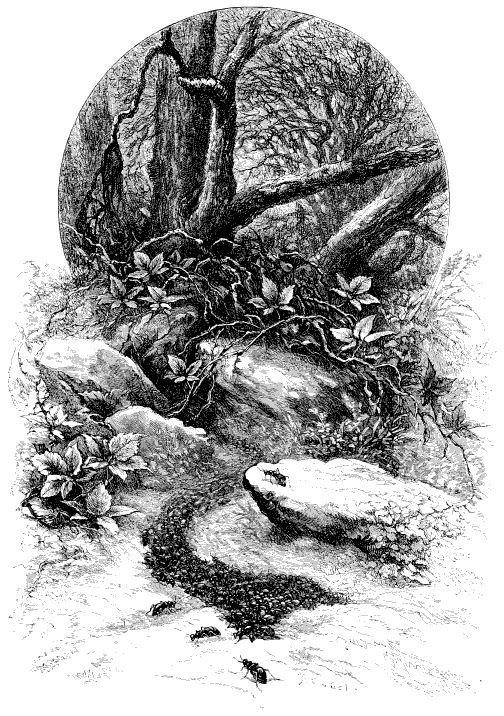
This strange fact, which ought apparently to change our ideas of animal morality, was discovered early in the present century. Pierre Huber, the son of the celebrated observer of the manners and habits of bees, walking one day in a field near Geneva, saw on the ground a strong detachment of reddish-coloured ants on the march, and bethought himself of following them. On the flanks of the column, as if to dress its ranks, a few speed to and fro in eager haste. After marching for about a quarter of an hour, they halt before an ant-hill belonging to the small black ant, and a desperate struggle takes place at its gates.
A small number of the blacks offer a brave resistance; but the great majority of the people thus assailed flee through the gates remotest from the scene of combat, carrying away their young. It was just these which were the cause of the strife; what the blacks most justly feared was the theft of their offspring. And soon the assailants, who had succeeded in penetrating into, the city, might be seen emerging from it loaded with the young black progeny. It was an exact resemblance of a descent of slave-dealers on the coast of Africa.
The red ants, encumbered with their living booty, left the unfortunate city in the desolation of its great loss, and resumed the road to their own habitation, whither their astonished and almost breathless observer followed them. But how was his astonishment augmented when, at the-threshold of the red ants' community, a small population of black ants came forward to receive the plunder, welcoming with visible joy these children of their own race, which, undoubtedly, would perpetuate it in the foreign land.
This, then, is a mixed city, where the strong warrior-ants live in a perfectly good understanding with the little blacks. But what do the latter? Huber speedily discovered that, in effect, they do everything. They alone build; they alone bring up the young red ants and the captives of their own species; they alone administer the affairs of the community, provide its supplies of food, wait upon and nourish their red masters, who, like great infant giants, indolently allow their little attendants to feed them at the mouth. No other occupations are theirs but war, theft, and kidnapping. No other movements in the intervals than to wander about lazily, and bask in the sunshine at the door of their barracks.
The most curious circumstance is, that these civilized helots really love their great barbarous warriors, and carefully tend their children, gladly and cheerfully perform their tasks of servitude, and, more, encourage the extension of their slavery and the abduction of the little blacks. Does not all this wear the appearance of a free adhesion to the established order of things?
And who knows but that the joy and pride of governing the strong and tyrannizing over their tyrants, may be for the little blacks an inner liberty—an exquisite and sovereign freedom—far superior to any pleasure they could have derived from the equality of their native country?
Huber made an experiment. He was desirous of observing what would be the result if the great red ants found themselves without servants, and if they would know how to supply their own wants. He thought, perhaps, that the degenerate creatures might be inspired and uplifted by the maternal love which is so strong among the ants.
He put a few into a glass case, and with them some nymphs. Instinctively they began to move them about and to cradle them after their fashion; but soon discovered (big and robust as they, nevertheless, were) that the weight was too much for them; they accordingly left them on the ground, and coolly abandoned them. In truth, they abandoned themselves. Huber put some honey for them in a corner, so that they had nothing to do but to take it. Miserable the degradation, cruel the punishment with which slavery afflicts the enslavers! They did not touch it; they seemed to know nothing; they had become so grossly ignorant and indolent that they could no longer feed themselves. Some of them died from starvation, with food before them!
Huber, to complete the experiment, then introduced into the case one black ant. The presence of this sagacious helot changed the face of things, and re-established life and order. He went straight to the honey; he fed the great dying simpletons; he dug a hole in the ground, placed in it the eggs, prepared the incubation, watched over the nymphs (or maillots), and restored to life and happiness the little people, who, becoming industrious in their turn, seconded the efforts of their nurse. Felicitous influence of genius! A single individual had re-created the city.
The observer then understood that with such a superiority of intelligence these helots might, in reality, wear the chains of servitude very lightly, and perhaps govern their masters. A persevering study proved to him that such was, indeed, the case. The little blacks in many things carry a moral authority whose signs are very visible; they do not, for example, permit the great red ants to go out alone on useless expeditions, and compel them to return into the city. Nor are they even at liberty to go out in a body, if their wise little helots do not think the weather favourable, if they fear a storm, or if the day is far advanced. When an excursion proves unsuccessful, and they return without children, the little blacks are stationed at the gates of the city to forbid their ingress, and send them back to the combat; nay more, you may see them take the cowards by the collar, and force them to retrace their route.
These are astounding facts; but such as they are, they were seen by our illustrious observer. He could not trust his eyes, and summoned one of the greatest naturalists of Sweden—M. Jurine—to his side, to make new investigations, and decide whether he had been deceived. This witness, and others who afterwards pursued the same course of experiments, found that his discoveries were entirely accurate.
Yet—shall I dare to confess it?—after all these weighty testimonies I still doubted. Let me say, I hoped that the fact, without being absolutely false, had not been correctly observed. But on a certain occasion I saw it—with my own eyes saw it—in the park of Fontainebleau. I was accompanied by an illustrious philosopher, an excellent observer, and he too saw exactly what I saw.
It was half-past four in the afternoon of a very warm day. From a pile of stones emerged a column of from four to five hundred red or reddish ants, precisely the same colour as the wing-cases of the gnat. They marched rapidly towards a piece of turf, kept in order by their sergeants or "pivot-men," whom we saw on the flanks, and who would not permit any one to straggle. (This is a circumstance known to everybody who has seen a file of ants on the march.) But the novel and astonishing thing to me was, that gradually those who were at the head drew near to each other, and advanced only by turning; they passed and repassed the whirling crowd, describing concentric circles; a manœuvre evidently fit to produce enthusiasm, and to augment energy,—each, by contact, electrifying himself with the ardour of all.
Suddenly the revolving mass seemed to sink and disappear. There was no sign of ant-hills in the turf; but after a while we detected an almost imperceptible orifice, through which we saw them vanish in less time than it takes me to write these words. We asked ourselves if it was an entrance to their domicile; if they had re-entered their city. In a minute at the utmost they gave us a reply, and showed us our mistake. They issued in a throng, each carrying a nymph on its mandibles.
From the short time they had taken, it was evident that they had a previous knowledge of the localities, the place where the eggs were deposited, the time when they were to assemble, and the degree of resistance they had to expect. Perhaps it was not their first journey.
The little blacks on whom the red ants made this razzia sallied out in considerable numbers; and I truly pitied them. They did not attempt to fight. They seemed frightened and stunned. They only endeavoured to delay the ravishers by clinging to them. A red ant was thus arrested; but another red one, who was free, relieved him of his burden, and thereupon the black ant relaxed his grasp. In fine, it was a pitiful scene for the blacks. They offered no serious resistance. The five hundred red ants succeeded in carrying off nearly three hundred children. At two or three feet from the hole, the blacks ceased to pursue them, abandoned all hope, and resigned themselves to their fate. All this did not occupy ten minutes between the departure and the return. The two parties were very unequal. It was evidently a facile abuse of strength,—very probably an outrage often repeated,—a tyranny of the great, who levied a tribute of children from their poor little neighbours.
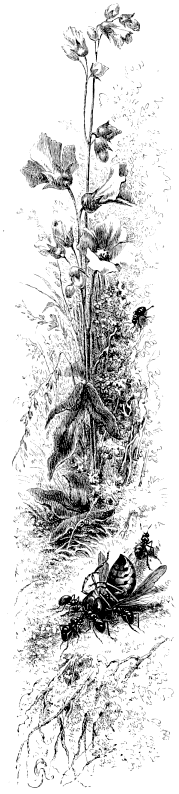
Let us now endeavour to understand this shocking and hideous fact. It is peculiar to certain species; it is a particular incident, an exceptional case, yet related on the whole to a general law of the life of the ants. Their societies are founded on the principle of the division of labour, and the speciality of functions. The ant-hill, in its normal state, comprehends, as we know, three classes:—
1st. The great multitude, composed of laborious virgins, who confine themselves to the love of the children of the commonwealth, and perform all the work of the community;
2nd. The fecund females, feeble, soft, and, unintelligent; and,
3rd. Some little shrivelled males, who are born only to die.
The first class is, in truth and reality, the people. But in this people you find two industrial divisions, two great bodies of workmen. The one executes all the more arduous tasks, such as the transportation of heavy burdens, and the far and perilous hunt after provisions,—and, at need, carry on war. The other, nearly always at home, receives the materials, superintends the domestic economy, and undertakes the principal duty of the republic,—the education of the young.
The two corporations, that of the purveyors and warriors,—that of the nurses and tutors,—are, in every tribe, of unequal size, but identical in species, colour, and organization.
Between the big warriors and the little industrials the moral equality seems perfect. If there were any difference, we should say that the class of the little ants, who build up the city and train up the people, is the more important, the life, genius, and soul of the state; the one which of itself could, at need, constitute the republic.
M. Huber has discovered two species (the red-brown and red) who do not possess this essential class, this fundamental element of the ant communities. It would not surprise us if the accessory or warrior class were wanting. But here, in reality, it is the basis which we find deficient,—the vital foundation,—the raison d'être. We are, therefore, not so much astonished at the depraved resource by which these red ants subsist, as at the monstrous lacuna which compels them to adopt it.
There is a mystery in the matter which we cannot at present explain, but which would probably be cleared up if we could arrive at a knowledge of the general history of the species, its changes, and migrations. Who does not know the modification effected in animals, both externally and internally, in their forms and their manners, by the displacements they undergo? Who, for example, would recognize the brother of our bull-dog—of the St. Bernard—of the giant dog of Persia, which could strangle lions—in that abortion, the Havannah dog, so weak and frail, that even in a torrid climate Nature has clothed it with a thick fleece, which conceals it, and converts it into an enigma?
The animal, when transplanted, may become a monster.
The ants also may have had their revolutions, their moral and physical changes, in proportion, as the globe, everywhere becoming inhabitable, has favoured their migrations. Several species, in the beautiful American climates, have preserved the honey-making industry; our own are ignorant of it, and are compelled to have recourse to the grubs; thence arises an art and a progress,—the art of breeding, preserving, and pasturing cattle.
Some species may have advanced, others retrograded. And it is thus I should explain the kidnapping habits of the red ants. Probably they belong to expatriated and demoralized classes—fragments of decayed communities which have lost their arts,—and which could not live but for this barbarous and desperate method of slavery. They no longer possess the artistic and teaching class, without which all peoples perish. Reduced to a military career, they could not live two days if they did not take unto themselves souls. Therefore, that they may not perish, they carry off the little black souls, which tend them, it is true, but also govern them. And this not only in the city itself, but in its external relations,—deciding or adjourning their expeditions, and regulating their campaigns; while the red, far from regulating the affairs of peace, do not seem even to comprehend them.
Singular triumph of intelligence! Invincible power of genius!
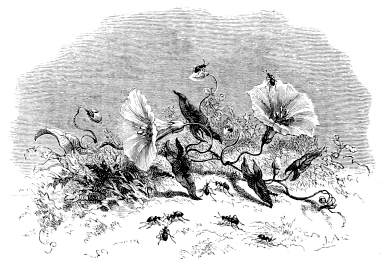
IV.—EXTERMINATION OF THE COMMUNITY.
CHAPTER IV.
THE ANTS:—CIVIL WAR—EXTERMINATION OF THE COMMUNITY.
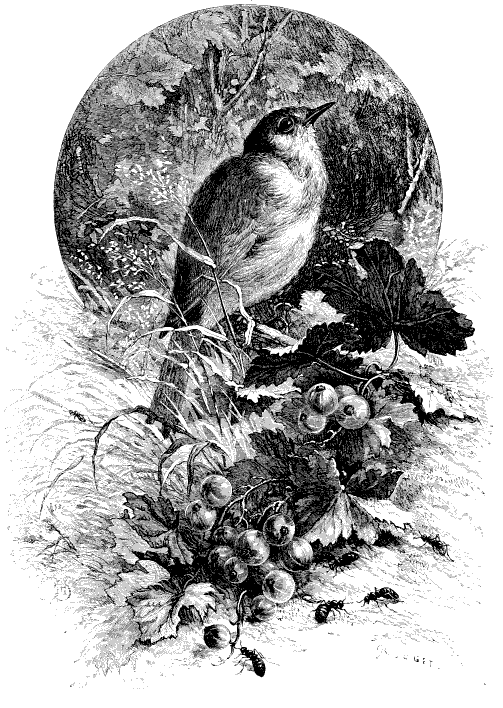
It is the tyrant's punishment that he could not, even if he would, easily deliver his captive. So long as my nightingale sings, I know that he cares little for his cage, and I bear his captivity lightly; but when the time of song has gone by, I share his melancholy, and the question again and again recurs to my mind, "How can I release him?" He no longer knows how to fly; in truth, is almost without wings. If I set him free, he would perish before he had gone two steps. The liberties which he takes at Paris in a large chamber, and here, at Fontainebleau, in a small garden, are, really, of but little importance. He does not profit by them; almost always remains concealed in a gooseberry-bush, dreaming and listening.
The strains he hears,—the lively songs of the warblers, the voices of love and, maternity,—augment, I believe, his sadness; so much so, that here, in the open air, under the blue sky, enjoying a relative degree of freedom, he loses his appetite, and will eat no longer.
We bethought ourselves of giving him his natural diet, and of feeding him with the insects on which he lives in the woods. But here is another difficulty. Who would not shrink from hunting after and carrying living victims to be devoured? We preferred to give him insects in futuro, the eggs of insects, and inert sleeping nymphæ. We carried on a traffic in them at Fontainebleau, where our aristocratic pheasants, a feudal race, do not deign to eat anything but ants' eggs.
On the evening of the 8th of June, there was brought to me from the forest a great clod of earth, mixed with dry twigs, and especially with tiny débris of the Northern trees, such as the needles of the firs, or little prickly leaves resembling thorns.
In the midst, the inhabitants pell-mell, of every size and grade, eggs, larvæ, nymphæ, diminutive artisans, great ants, which seemed to be warriors and defenders; finally, a few females which had just assumed their wedding garments, the wings which they wear for the moment of love. Thus it turned out to be a very complete specimen of the republic, varied, but well distinguished by one identical sign,—all this brownish-coloured populace having on their corselets a dull red spot. As for the classes and professions of the ants, they were easily characterized by their very habitations, notwithstanding the general confusion. They were carpenter-ants, of the species which prop the upper stories of their buildings with timber framework.
Though their situation was so completely altered, my ants were in no wise prostrated. They continued their different tasks, of which the principal was, to protect the eggs and nymphæ from the action of a too powerful sun.
The general commotion had flung them out of their subterranean cradles, and exposed them on the surface. The little ants busied themselves actively in rectifying the disorder. The great ones went and came, and circled about a great earthen vase which contained the dismembered fragment of the republic. They marched with a firm step, and recoiled before no obstacles. We could not frighten them. If we placed in their way any impediment,—a bit of twig or our finger,—they crouched upon their loins, manœuvred with great address their tiny arms, and patted us like a young kitten.
In their revolutions around our vase, they encountered upon the sand some ashy-black ants which had taken possession of our garden, and constructed underneath its soil a large establishment. The latter do not have recourse to timber, but build in masonry,—cementing the earth with their saliva, and drying and seasoning it with their formic acid.
The spot was rendered peculiarly agreeable to them by its rose trees, apple and peach trees, which furnished them with abundant herds of gnats, that they might extract honey-dew for themselves and their little ones.
The rencontre was not very friendly. Though among the big carpenters were some ants of a sufficiently diminutive stature, they wholly differed from the black through their long legs and the red-spotted corselet. They were pitiless. Perhaps they suspected the blacks had been sent out as spies, to explore the ground, and lay snares for the emigrant colony which had just been disembarked. At all events, the big carpenters slew the little masons.
The act was followed by terrible and wholly unexpected results. Our vase was unfortunately placed near an apple-tree covered with those woolly grubs which are the despair of the gardener and the joy of the ants. Our masons had just taken possession of the precious sugary herd, and encamped themselves in the very roots of the tree, within reach of the invaluable booty. There they were, under the ground, a complete nation, an infinite number.
The massacre took place about twelve o'clock. At a quarter past eleven, or a little later, all the black legions were warned, aroused, erect, and ascending from their subterraneous habitations, poured out through every gate. The sand was hidden beneath the long black columns; our paths were all alive. The sun, shining full upon the little garden, stimulated and burned up the multitude, which only quickened their pace. Living always underground, they have necessarily a very susceptible brain. The furious heat, and especially their fear lest the invading giants should pounce upon their families, impelled them to confront death unflinchingly.
And a death which seemed certain; for each of the big carpenters, as far as size and thews were concerned, was well worth eight or ten of the little masons. At the first collision we saw a big ant fall upon a brown dwarf, and annihilate it at one blow.
The masons, however, had the advantage of numbers. But what of that? Suppose the front ranks were checked in the assault, and perished,—then the second, then the third,—if the army, still advancing, did but furnish the enemy with new victims? Such was our apprehension. All our fear was for the little aborigines of our garden, disturbed by that invasion of a foreign people which we had brought upon them,—a people ill-bred and brutal, which, without any provocation, had marked their first arrival by slaughtering the inhabitants of the country.
But it must be acknowledged that we had compared only the material forces of the two armies, and had not taken into account their moral strength.
We recognized at the first onset an astonishing amount of skill and intelligence on the part of the little blacks. By sixes, they seized upon one of their gigantic opponents, each holding and neutralizing a claw; then two leaped on its back, and firmly grasped its antennæ, until the giant, bound in every limb, was reduced to an inert body. It seemed to lose its senses; to grow dull and stupid; no longer to be conscious of its enormous superiority of strength. Others then rushed to the attack, and, without incurring any danger, stabbed him above and below.
The scene, regarded from a near point of view, was frightful. Whatever admiration the little ones merited for their heroic courage, their fury made one shudder. It was impossible to see without a feeling of pity these poor garotted giants, dragged miserably to and fro,—fired at from right and left,—floating as in an open sea on these billows of rage and impetuosity,—blind, powerless, and incapable of resistance,—like lambs beneath the butcher's knife.
We longed to separate them. But how was it to be done? We were in the presence of infinity. A man's strength was nothing when tested against such multitudes. We might have proceeded to the extremity of a universal deluge,—a moment's noyade[P]—but even this would have proved insufficient. They would not have let go their death-grasp; and when the torrent had flowed by, the massacre would have continued. The sole remedy, and an atrocious one—worse even than the evil—would have been to have burned alive, with a wisp of flaming straw, the two contending hosts, the conquerors and the conquered.
We were particularly struck by the fact that, after all, it was only a very few of the big ants that were garotted and captured; and that if those which remained free had fallen upon the assailants, they might easily have wrought a frightful carnage, their action being so rapid, and one blow inflicting death. But no such idea occurred to them. They ran hither and thither in a panic of fear, and rushed into the very throes of danger, into the thickest press of the hostile masses. Alas, they were not only vanquished, but seemed to have lost their senses! While the little ants, feeling themselves at home, on their native soil, showed so firm a front, the gigantic foreigners,—without any stake in the ground,—a desperate fragment of an annihilated city,—wholly ignorant of the country whither they had been transplanted,—recognized that everything was antagonistic to them, that a snare was hidden at every step, that no refuge was open to their scattered forces. Ah, woful condition of a people whose fatherland has perished, and who have lost their gods!
Yes, I excuse them. We ourselves were almost terrified at the sight of those legions of death,—that formidable army of little black skeletons which had all escaladed the earthen vase, and in that confined region, choked and burning, crowded and furious, mounted one upon another. As the discomfiture of the giants became a thing assured, horrible appetites were revealed among the blacks. An opportune moment arrived. It was a dramatic stroke! In their mute but terribly eloquent pantomime, we heard this cry: "Their young ones are fat!"
The gluttonous army of the lean threw themselves on the children. The latter, belonging to a superior race, were sufficiently heavy; and more, their oblong nymph-like envelope, round and smooth, offered no points of vantage. Two, three, four little blacks, by combining their efforts, succeeded, though not without difficulty, in carrying a single one of these up the smooth sides of the earthen vase. Then they came abruptly to a terrible resolve,—to seize upon the maillots, to bear off the naked children. It was no easy matter, for the little one clung stoutly, and its interwoven limbs were, so to speak, soldered together; in such wise that this violent and sudden development could only be effected by severe wounds,—in fact, by quartering them. The black ants then carried them off, torn and palpitating.
At the commencement of this kidnapping of children, we had expected to see some such spectacle as a razzia of slaves, which is only too common among both men and ants. But we now understood that something more was meditated. In drawing them cruelly from their outer coat, which is to them the very necessity of life, it became too evident that their captors cared very little whether they lived or did not live. It was for their flesh they seized them; as a tender prey for the young ones they had left at home, the fat children being delivered up alive to the furious appetites of the lean!
To understand the horror of the scene, you must know the true nature of the large eggs of the ants,—improperly called eggs, but in reality their nymphs or chrysalides,—diminutive organized ants which, under a thin veil, strengthen their tender, delicate, and still soft existence. They remain in this envelope for the purpose of accomplishing a progress of successive solidification and colouring.
The very fine and wonderfully soft web which they weave for themselves is, as we know, of a dull white, lightly shaded with a delicate yellow, which, when stronger, turns into a nankeen tint. Open it shortly before the emergence of the perfect insect, and you find a being of exactly the same colour, all folded and rolled up in itself like the human embryo in its mother's womb. When stretched out, the aspect of the future ant is easily recognized, but it singularly differs from it in character: the head is quite innocent; lift up the antennæ, which, in this condition, resemble ears, and the young white head reminds you of that of a little white rabbit. The eyes alone,—two black points,—marked with sufficient prominency, indicate the next stage of colouring. For the rest, there is nothing to forewarn you that this little, weak, and denuded animal, so touching and so interesting, will become in a few days the black being so full of energy, so keen with life, so fierce in blood, which will traverse the earth in a fury of labour and burning activity.
One comprehends that in this stage of existence the milky and succulent nymphs of the ants will prove a very appetizing dish for the bird, and for the infinite number of creatures which hunt them greedily.
I have dissected only one nymph in the last days of its nymph-period, and when near its time of hatching. But that one was sufficient. The sight (seen through a lens of twelve times magnifying power) was very painful. The being was completely formed, and already black on the belly, yellow on the corselet. The head was intelligent, like that of an old ant, but pale, and changing from yellow to black. Still weak and heavy, and seized, as it were, with vertigo, it rolled from right to left, and from left to right, with a singular effect of somnolence and pain. You might have supposed it to be saying: "Ah me! so soon! Why hast thou called me so cruelly, before the proper hour, from my soft cradle to the harsh drudgery of life? But it is all at end for me!" It struggled nevertheless to confront the unknown chances of its novel situation, and to disengage its trammelled limbs. The antennæ were already perfectly free, and stirred about in their anxiety to discern the new world; this cerebral organ revealed very plainly the disquietude and agitation of the brain. Its greatest perplexity arose from its failure to release its two arms (or anterior limbs). It laboured violently to do so. They were glued to the body by an indescribable something which might be called a pale blood, and one sweated to see the poor little creature, already prudent and timid, unable to complete its offensive arrangements, and to extricate (apparently to snatch or pluck away) its two bleeding arms.
I have explained this at some length, in order to make the reader understand the passionate interest felt by the ants in the little balls which, to our eyes, seem so insignificant. Beneath its soft and transparent tissue they feel the infant palpitating under its two touching forms,—the creature, denuded and innocent, which dreameth still—the creature already formed and intelligent, perceiving everything, but incapable of self-defence, and, before it sees the light, disturbed by all the fears and agitations of existence.
The most painful shock for the young of the insects is the sudden cold; at least, the nudity, the exposure to the air and light. This is so antipathetic and painful to them, that in certain species it is the source of their arts and their most ingenious devices. The eggs and nymphs of the ants in their tiny transparent swaddling-robe,—and still more the larvæ which are deprived of it,—feel with an excessive sensibility every atmospheric variation. Hence the delicate and continual attentions of their nurses in carrying them from place to place, in translating them from one to another of the well-contrived steps of their thirty or forty stories, in protecting their dear little chilly charge from cold, damp, or excessive heat. A degree more or less means for it life or death.
It is a cruel and tragical change for these children of love, spoiled hitherto with excessive indulgence, and tended with greater care than any princess, when they are abruptly deprived of their garments,—stripped, with blows from pincers, teeth, and claws,—and despoiled by the hands of the executioner. Suddenly exposed to the burning sun, dragged hither, pushed thither, rolled over all the roughnesses of a coarse sandy soil,—sensible, infinitely sensible, in their new condition of nakedness, to the shocks, blows, and rude somersaults which their violent enemies do not spare them!
In towns captured by a furious enemy, it has happened that the tombs of the dead have been desecrated. But here, we behold the exhumation of the living,—the despoiling of innocent and all vulnerable creatures, poor bits of skinless flesh, to whom the very lightest touch had been a sufficient agony!
This immense execution upon the population and their young was hurried over so rapidly, that at three o'clock in the afternoon nearly all was ended; the city was sacked and depopulated in every corner, and its future beyond all hope of a resurrection.
We thought that some fugitive might still be lurking in concealment; that perhaps the conquerors would abandon the desert if we transported them, with the destroyed city, into a paved coach-yard outside the garden; that then would awake in them the remembrance of their family, to whom, moreover, they could carry nothing more to be devoured. Our expectation was realized.
On the morning of the 10th of June we saw them scattered along all the roads which led towards their dwelling-place, at the other end of the garden. But the destiny of the vanquished seemed accomplished. The dead and silent city was nothing but a cemetery, where, with the exception of a few scattered bodies, could only be seen some dead wood, some old pods of Northern trees, and their gloomy aiguilles (pines and once-green firs), not less dead than the city itself.
I confess that such a vengeance, so disproportionate to the act which was its cause or pretext, excited in me a strong feeling of indignation, and my heart, changing sides, was completely alienated from those little black barbarians.
So, observing that some of them, still implacable, were promenading among the ruins, I sent them rudely flying over its walls (that is, the edges of the vase). In vain it was gently pointed out to me that these blacks had been provoked, that they had shown the greatest courage, having braved so great a peril that their destruction might almost have been predicted. They were cruel and savage but heroic tribes, like the Iroquois, the Hurons, the revengeful heroes who formerly peopled the forests of the Mississippi and Canada. These reasons were good, but did not calm me. I felt too keenly the enormity of the crime. Without wishing to annihilate them, I confess that if these ferocious blacks had chanced to come under my foot I should not have turned aside.
The unfortunate empty vase continually reminded me of what had occurred, and held me as by a spell. On the evening of the 11th we were still seated on the ground before it, with our chin in our hand, completely absorbed in thought. Our gaze plunged into its depths. We persisted in longing for a sign of life to appear upon its perfect immobility, a something which might still say that all was not finished. This firm resolve seemed to have the potency of an evocation, and as if our desires had recalled to daylight some miserable spirit of the widowed city, one of the victims which had escaped made its appearance, and hurried headlong away from the field of death. And we perceived that it carried a cradle.
Night came, and it was in a completely strange locality, surrounded by enemies. A few holes, which one might mistake for places of refuge, were precisely the mouths opening into the Inferno of the blacks. The unhappy fugitive, with its misfortune increased by the burden of its infant, ran distractedly, and without knowing whither. I followed it with my eyes and heart, until the darkness concealed it from me.
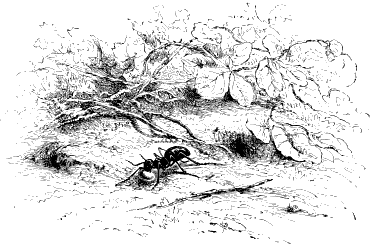
V.—THE WASPS.
CHAPTER V.
THE WASPS: THEIR FURY OF IMPROVISATION.
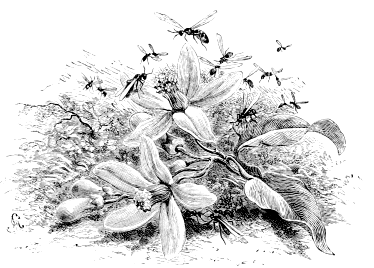
When the wasp on a summer's day enters at the window, with its loud, aggressive, and menacing zou! zou! zou! everybody is on his guard. The child trembles, the mother suspends her work, even the husband lifts his eyes: "Insolent, impudent intruder!" and he arms himself with a handkerchief.
Meanwhile, the superb insect, having flown into every corner, and cast around the room a rapid and scornful glance, departs with a loud noise, not condescending to notice the unfriendly welcome accorded to him. His only reflection has been this: "A paltry house! Not a fruit, not a spider, not a fly, not the smallest bit of meat!"
Then he makes a descent on the shop of the country butcher: "Butcher, my custom is yours. I am desirous of dealing with you. Do not hesitate, foolish miser. Cut me a good slice of meat, and I will pay you for it; I will kill all your flesh-flies. Let us agree to be friends. We are both born to kill."
The slow dull animals of the genus Man are much scandalized at the proceedings of the wasp. It acts, it does not talk. But if it deigned to speak, its apology would be simple. A word would suffice. It is the being on whom Nature imposes the terrible destiny of suppressing time. We speak of the ephemera which lives a few hours: the period is sufficient for a creature that does nothing. The true ephemera is the wasp. In a brief six months' summer (not more than four months of full activity) it has to accomplish, not only the cycle of the individual life—to be born, to eat, to love, to die—but, what is far more onerous, the cycle of a prolonged social life, the most complicated which any insect is required to perform. What the bee leisurely elaborates in several years, the wasp must realize immediately. Much more than the bee! For the latter makes its honeycombs in a completed house (the hive, the hollow of the rock, the trunk of a tree); but the wasp must improvise without as within, the ramparts of the city no less than the city itself.
Four months to create everything, to make and unmake a people, and a people of lofty organization!
Learn, ye idle races which mutter that in fourscore years ye have no time, learn to despise it. It is a purely relative affair. There is never any time for the flat-bellied snail, were it to crawl through centuries. There is always time for heroic activity, firm will, and resolute energy.
The wasp dies. Its city of thirty thousand souls, improvised by a revolution, as by a thundering stroke of genius and courage, subsists as a testimony to its labours. Solid, eminently substantial, conscientiously wrought, and seemingly intended for eternity!
Let us note the starting-point.
A miserable fly, which in winter has survived the destruction of its race, issues all a-dust from its hiding-place. Thank Heaven, it is the spring-time! Does it seek to enjoy the sun? No, it will not allow itself a day's repose. What is its first duty? To love with a rapid and burning love, to go straight to its goal, to seize and take up as it passes that vital force which will create an entire people. Love on the wing,—no delay,—everything made to bear on the great social aim!
Savage and alone, with its idea and its hope, this mother of the future commonwealth creates in the first place its citizens, some thousands upon thousands of labourers. You have already learned that among insects every worker is a female. These too are workers, but the harsh necessities of toil suppress in them their sex. They love with a lofty devotion. The austere virgin looks for no other spouse than the community.
The chain of ardent labour is continued from the mother to her daughters. Her task was to beget: it is theirs to build. The fury of improvisation is the same in them, however, as it was in her. According to the region and the climate, the tribe, the species, and the work vary. Here they will excavate underground the cave in which they construct their edifice, isolating it from the soil, and preserving it from damp. There they suspend it in the air, and build it of strong coarse pasteboard to defy the heaviest rains. To make this paper or pasteboard, they hasten to the forest, where they select some thoroughly prepared wood, which has been long soaking, and has been already steeped by Nature just as we steep flax. Then within, with a strong sharp tooth (for theirs are not the graceful probosces of bees intended to kiss flowers), they gnaw, and tear, and loosen, and sever the rebellious filaments, pound them into pulp as we do the linen rags, and knead them with a heavy tongue. After the paste has been mixed with a viscous and adhesive saliva, it is spread out into thin layers. With teeth closed like a press, the work is completed. The elementary substance of the pasteboard is prepared.
A second industry now commences. The paper manufacturer is transformed into a mason. It has not the beaver's tail to serve as a trowel, but with the American wasp a sort of palette on the leg serves the same purpose. The operation is not the same here as in Guiana. The mason of Cayenne, having built up the walls, has only to suspend to them a succession of floors or platforms, following in that dry hot land the type of our human habitations. But the European mason, working with pasteboard, in a damp climate, where even in the summer heavy rains are frequent, adopts a different plan: a house within a house, a hive completely isolated from the envelope which encloses it. This is the most successful device for an ardent and chilly people, whose life-flame needs careful guarding.
As it is without, so it is within. As the house, so too the inhabitant. We men are not yet sufficiently acquainted with the influence exercised upon our moral dispositions by our habitations. This duplication of walls, this potent envelopment of a people so completely shut up under its strong twofold enclosure, largely contributes to the unity of the commonwealth.
Observe another singularity: shall we call it a trivial one? No; to the serious observer it is of importance. The city has two gates; its people enter by the one, and pass out by the other, so that no confusion can take place, and no collision between the ingressing and egressing crowds. This plan is adopted by all people who economize time, and wish to transact their business expeditiously. In London, the rule is the same as with the wasps: on the one side those who are coming, on the other those who are going; each person keeps to the right; these take one footpath, those another. No such impediment is met with in the Strand as the idlers of our Rue Vivienne, who incessantly convert themselves into a serious obstacle, and swim laboriously in the confusion they create.
But to return to our subject.
What is the object of these constructions? Is this robust being, endowed with such an intensity of vital force, more afraid of the air than numbers of delicate insects,—than the nervous spider, which has only a house of thread, or even lives under a leaf? Therein lies the lofty mystery of life for the higher insect. It is this which stimulates the universal genius of the ant either above ground or under ground. It is this which inspires the activity, the persevering toil and economy of the bee. What, then, is it? The love of the future,—the yearning to perpetuate and eternize that which one loves. All their love centres in their offspring.
To love the child and the future; to toil in view of time and of that which as yet is not; to exhaust their vitality and die of work, that posterity may have less cause to labour,—a noble ideal, assuredly, of society, wherever it may be. One can well understand it in those who have time before them, and a life to make use of, like men and bees. But that this insect which has no time, which perishes in the evening, should love the time that will never be its own, should immolate its little life for the sake of the life that is to come, should devote to the child of to-morrow its solitary day, is a sacrifice peculiar to the wasp: it is original and sublime!
There is not a minute to lose; and the mother incessantly increases the burden. Besides the female workers, she produces some few males who do not work, whose little and very brief function scarcely prevails as an excuse for their inactivity. Among those tragical and serious insect-races, Nature, as if to divert herself a moment by a comical distraction, has made the poor little males ordinarily squat and obese, innocent little Falstaffs, who are guarded like a seraglio of unimportant servants. The caricature is complete in the case of the male bee, which, alleging that it neither knows how to glean abroad nor to build at home, passes the time in humming before its bee-hive (like our young cigar-smoking idlers).
Among the wasps life is so tense, burning, and keen, that the very males, slothful as they may be, dare not abandon themselves to complete indolence. Yonder ladies, who do not jest, and who have stings of which the males are deprived, might look upon their idleness sourly, and stir them up with dagger-thrusts. So they have conceived the idea of working without work; they have the air of doing something,—a small part of the domestic labour, cleaning, and sweeping. If any one dies, the ceremony of interment provides them with a pretence; with the effort of carrying a slight weight they sweat and groan, and several put their shoulders together. In a word, they are very ridiculous. And I am confident that their terrible companions laugh at them.
Theirs truly is an onerous undertaking. Twenty or thirty thousand mouths to feed, is a very extensive household. If they were only gifted with the prudent activity of bees, their community would perish of famine. What they need is a violent, furious, murderous rapidity,—all the appearances of an immense gluttony,—all the love and devotion which Sparta had for the art of thieving. But the secret of their power, which is plainly discernible in them if we observe them but a moment, is their magnificent insolence, their superb contempt for all other beings, and their firm conviction that the whole world is their inheritance. If we consider, it is true, their wonderful energy, compared with which lions and tigers are mere races of sheep,—and their prodigious yearly effort of improvisation,—and, finally, their absolute devotion to the public welfare,—we shall not find in all nature creatures relatively of greater power, nor which possess a clearer right to value themselves highly.
Our modern minds, however, find a difficulty in admiring the violence of the antique virtues. Their boundless love of the commonwealth is pushed to an almost criminal excess. Who has not marked with how ferocious an ardour they hunt the bees! Yet certain species of wasps can make honey; but only in fine climates, which, knowing no winter, allow the wasps an interval of peaceful labour. Here the case is different. Their life, cut short in six months, compels them to resort to measures of cruel simplicity. Honey is needed for their children. Thereupon they attack the bee, and take it prisoner; with their pliable body, whose waist is a mere thread, they so curve the extremity as to stab the prisoner underneath with their deadly sting; when thus stricken, the wasp saws it with three strokes of its teeth, and leaves the head and corselet to palpitate for some time longer, while the belly, filled with honey, the barbarian carries off as a gift for its young.
It feels no remorse. The death of others apparently does not cause a pang to this creature, which knows that it too will die to-morrow.
What do I say?
Our virgins of Tauris do not wait until Nature lays upon them her heavy hand and the ignoble leaden shroud of winter. They have borne the sword; they will die by the sword. The republic ends in a general massacre. The children, recently, ay, and still, so dear, are slain; dilatory children whom cold and want would kill to-morrow; their sisters, aunts, and affectionate nurses securing them at least the advantage of dying by the hands of those who love them. This latter gift, a speedy death, is freely bestowed on numerous unfortunates who had no thought of soliciting it,—on little useless males, even on young workers who were born late, and cannot boast of a constitution sufficiently strong to resist the winter.
Let it not be said that the heroic race of wasps is ever seen to request the humiliating hospitality of the smoky roofs of man, and, for the sake of living a little longer, to expose its melancholy remains in the shambles of a spider's web! No, children! No, sisters! Die! The republic is immortal. Some one of us, favoured by the yearly miracle and great lottery of Nature, will be called upon to recommence the entire work. And if but one remains, it is enough. Should the world perish, a single true heart would suffice to re-create it.
VI.—THE BEES: A TOMB AT PÈRE-LACHAISE.
CHAPTER VI.
"THE BEES" OF VIRGIL.
All modern writers have triumphed over the ignorance displayed by the poet Virgil in his fable of Aristæus, who draws life out of the womb of death, and causes his bees to spring from the entrails of immolated bulls.[Q] But, for myself, I have never laughed at it. I know, I feel, that every word of this great sacred poet has a weighty value, an authority which I would designate as that of an augur and a pontiff. And the fourth book of the Georgics, particularly, was a holy work, issuing from the inmost recesses of the heart. It was a pious homage rendered to sorrow and to friendship; an eulogium on the proscribed Gallus, Virgil's dearest friend. This eulogium, undoubtedly, was struck out by the prudent Mæcenas; and Virgil then substituted his Resurrection of the Bees: a song full of immortality, which, in the mystery of Nature's transformations, embodies our highest hope, that death is not a death, but the beginning of a new life.
Would he have descended to the empty pleasure of inserting a popular fable in that consecrated portion of his poem which had been occupied by his friend's name? I will never believe it. The fable, if it be one, must necessarily possess some serious foundation, and a truthful side. We are not dealing here with the worldly poet, the urbane singer, like Horace, the elegant favourite of Rome. It is not the charming improvisatore of the court of Augustus, the gay and indiscreet Ovid, who betrays the loves of the gods. Virgil is the child of Earth, the pure and noble figure of the old Italian peasant, the religious interrogator, the reverently simple interpreter of the secrets of Nature. But he may be mistaken in his words,—that he may have ill-applied the names,—this is not impossible; but so far as the facts are concerned, it is an entirely different matter: whatever he describes, I firmly believe he saw.
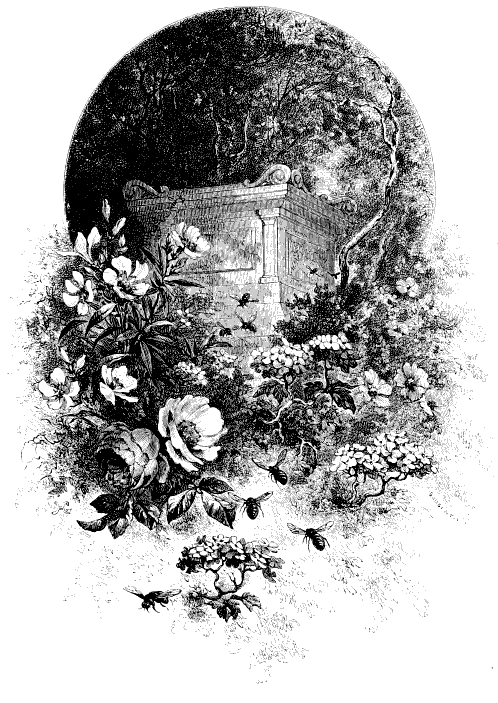
An accident threw me into the way of understanding the poet's intention. On a certain memorable day, my wife and I repaired to the cemetery of Père-Lachaise, to visit before winter the burial-places of my family, the tomb which reunites my father and his grandson. This latter had been born to me in the very year which terminated the first half of the present century, and I had named him Lazarus in my devout hope of the Awakening of the Nations. I had imagined that I saw upon his countenance a gleam, as it were, of the strong and tender thoughts which throbbed in my heart at that last moment of my teaching. Oh, vanity of human hopes! This flower of my autumn, which I yearned to animate with the potent vitality that had been of too tardy development in myself, disappeared almost in the act of birth. And there was no help but to deposit my child at the feet of my father, who had already been four years dead. Two cypresses which I then planted in that ill-omened nook of clay have acquired in the brief interval an extraordinary growth. Two, nay, three times taller than myself, they clothe their vigorous branches with a young, rich foliage which ever points towards heaven. If, with an effort, you lower them, they rear themselves again, in all their pride and strength, flourishing with a marvellous pith, as if they had drank from the earth where I planted them the precious treasure of my past and my unconquerable aspiration.
While revolving these thoughts I ascended the hill, and before arriving at the tomb, which is situated in the upper alley, I made this observation,—that though I had on so many occasions frequented this melancholy and beautiful spot, having been in earlier life the most assiduous visitor of the dead, I had scarcely ever seen any insects in the Père-Lachaise. Hardly even at the great epoch of the flowers, when everything is covered with bloom, and numbers of the old deserted sepulchres are embowered in roses, I had not remarked that animal life abounded there as it abounds elsewhere. Very few birds, and very few insects. Why? I could not say.
While making this reflection, we had finished climbing the hill; we stood in front of the tomb. And there, with admiration, with a species of astonishment, I found a surprising contradiction of what I had just been saying.
About a score of very brilliant bees hovered above the little garden-plot,—which was narrow as a shroud, stripped of bloom and bare of flowers, and saddened by the influence of the season. In the whole cemetery remained only the last autumnal flowers,—some withering and half-leafless Bengal roses. The spot where we stood, full of new buildings, masonry, and plaster, was an Arabia Deserta. Finally, on the tomb, towards the head of the grandfather, flourished only a few sickly white asters, and over my child the cypresses. It must needs have been that these asters, in their cold clayey soil, nourished either by the whispers of the air or the spirits of the earth, treasured up a modicum of honey, since the little gleaners resorted thither for their harvest.
I am not superstitious. I believe in but one miracle, the constant miracle of the Providence of Nature. I experienced nevertheless how powerfully the mind may be affected by a lively surprise of the heart. I felt an emotion of gratefulness at the sight of the mysterious little creatures animating this solitude, whither, alas! I myself came but rarely. The increasing absorption of my work, in which day pressed upon day,—the palpitating flame of the forge where one forges more and more quickly, in the doubt whether one will be living to-morrow,—all this kept us further from the tombs than in the days of our dreamy youth. I was much affected by seeing my place supplied. In my absence the bees peopled and vivified the spot, consoled, and perhaps rejoiced my dead. My father may have smiled on them in his kindly indulgence; they may have been the happiness and first delight of my child.
Selfish motives could not have led them thither; there was so little for them to take. Nevertheless, when we suspended to the cypress-boughs the garlands of immortelles we had brought with us, they were curious enough to ascertain if there was any treasure in the new flowers. The hard, prickly corolla soon repulsed them, and sent them back to the faded asters. I felt very sad, and said to them:—"Late, very late, my friends, you come, and to the tomb of the poor! Why am I not able to recompense you with a banquet of friendship, which should sustain and warm you during the first cold breezes, already blowing on these icy heights, so exposed to the northern wind!"
As if they had understood me, their movements afforded an exact reply. Some I saw, with their little limbs skilfully bent forward, rubbing their backs in the sun; they longed to absorb into every vein its genial radiance. They made the most of that brief hour when the sun revolves too quickly; one scarcely feels it before it has gone! Their significant gesture plainly said:—"Oh, what a cold morning we have had! Let us make haste! In less than an hour commences the equally inclement evening, the frozen night,—nay, who knows? the winter! and then our death is at hand."
They were still full of life, however; marvellously trim and bright,—I may even say radiant,—under their illuminated wings, all shot with gold. I never saw more beautiful insects; insects more clearly inspired by a higher life. One thing embarrassed me; namely, that they were too handsome, and too shining, inasmuch as they did not wear their industrial attire, their velvety coat, their pincers, and their brushes. And, finally, I discovered another circumstance: that they had not the four wings of the bee, but only two.
I perceived my mistake. It was these insects which had deceived Virgil. Like myself, he thought them bees, and so he erroneously called them. Réaumur confesses that for a moment even he was deceived by them.
But the fact related by Virgil is not inaccurate. We can understand how keenly it would impress the minds of the ancients, and how they would see in it a type of resurrection. They seem the daughters of death. Of the three ages of their existence, they spend the first in morbid and deadly waters, fatal to all other creatures, which permit the escape of the residuum of life in dissolution; with ingenious tenderness, Nature there preserves them, maintains them alive, and enables them to breathe in the very midst of death.
Their second period is passed under the earth,—in the shades,—where they sleep their chrysalis-like slumber.
But when once they have quitted the place of sepulture, they are fully compensated for their previous abasement; a light aërial life, exempt from the bee's incessant toil, and glorified by golden wings, such as the latter never boasts of, is bestowed upon them, with the gift, moreover, of gentle manners. Innocent, and without stings, they live their season of love under the sun and among the flowers. Far from blushing at their origin,—these noble Virgilian bees!—they do not disdain the flowers of the cemetery, they keep company with the dead, and for the living collect that honey of the soul,—the hope of the future!
VII.—THE BEE IN THE FIELDS.
CHAPTER VII.
THE BEE IN THE FIELDS.
"When the plant attains to the flower, the climax of its existence,—when it assumes its symmetrical outlines, its perfumes, its colours, and a certain degree of animal irritability,—it emerges from its condition of isolation, and connects itself more closely with the great Whole. But it remains fixed in one place, without any reciprocation of love. The animal, on the contrary, is movement itself, and manifests its joy in living by its capricious mobility. Then the captive plant casts a glance of amicable confidence on the animal's life of freedom, offers it the abundance of its substance, and for sole reward expects that it will achieve its fecundation.
Then, too, as an elder brother might do, theanimal assists the plant, and affords it in its dependent state the succour of liberty. But, for this purpose, the animal must be completely free, I would say winged, bound up with the vegetable life which was its kindly nurse. Behold the insect, love's messenger and mediator to the plants, their propagator, and the zealous instrument of their fertilization.
"With a maternal care, the plant provides a place in its own body where the insect's egg may be developed. It nourishes the young larva which as yet is incapable of action, but which, in due time, emerging from its vegetation in the egg, will move freely to and fro, and seek its own sustenance. The creative fecundity of the plant easily replaces whatever the insect has extracted from it; and thus both animal and plant harmoniously attain to the climax of existence.
"The animal, from its low sphere of nutrition, rises to a more elevated sphere, the pure need of motion, and the pursuit of love. The plant, it is true, does not soar so high; but its flower is a bright dream of a higher state of being,—a dream which, though fugitive, proceeds, by means of its fruits, to secure the conservation of the species. The blossoming plant and the winged insect reach, as if by concert, an analogous development, manifested by their colours, their beautiful symmetrical forms, and their refinement of substance. Papilionaceous flowers, for instance, might almost be called insects-become-plants.
"This harmonic existence marches forward with the same rhythm as the moments of the day. Each flower to whose juice an insect is assigned expands at the hour when its life is most intense, and shuts at the hour of its repose. Thus they feel their unity; love attracts them one towards the other. Here the plant plays the part of the female, the fixed basis of creation, absorbed in nature. The insect resembles the tiny male who frees himself from earth and curvets in the air; recalled, nevertheless, by the plant to the oneness of the terrestrial whole. It is a winged anther, which diffuses life among the flowers."[R]
What the wind accomplishes hap-hazard, flinging abroad in capricious showers the generative elements, the insect performs through love,—the direct love of its species, the indirect and confused love of the amiable auxiliary which welcomes and nourishes it, which will hereafter nourish also its eggs and continue its maternal work. Its action, therefore, is not external and superficial, like that of the wind; it is internal and penetrating. The ardent, curious insect will not suffer itself to be checked by the light and trivial obstacles with which vegetable modesty surrounds the threshold of its mysteries; it boldly dashes aside the veil, and enters into the inmost economy of the flower. It seizes, it pillages, and it carries away, assured that all it does will be approved. The flower, in its powerless expansion, rejoices only too keenly in the deeds of these thievish liberators, who will transport its desire whither it would fain transport itself. "Take," she says, "and take yet more!" The insect then exhausts its utmost effort; each of its hairs becomes a tiny magnetic dart, which attracts and wishes to attract. Would that it might be enveloped in these points, and over all its surface (like the lightning conductor) concentrate this treasure of vegetable electricity! Such is its aspiration. An aspiration realized in the higher insect, in the bee, which bristles everywhere with a magnetic apparatus,—the bee, predestined by the tools peculiar to it, both to its little individual industry of honey-making, and to the grand, general, universal industry of the fecundation, of plants.
It is an admirable creature, and what the great physiologist has just said of the loves of the flower and the insect applies particularly to it; except with this notable distinction on the part of the bee, that it robs the flower only of that noble luxuriance of life which it lavishes upon love. The bee does not establish its cradle in the plant that the young may thence derive its sole sustenance, and gradually devour its nurse. Instead of depositing its egg, and exposing it to the hazards of the vegetable existence, as the butterfly does with its future caterpillar, the bee economizes the plant, and, without attacking it, borrows from it the precious materials which its art works up into palaces of alabaster, amber, or of gold, where its children will in due time repose.
The innocency of the bee is one of its lofty attributes, no less than its miraculous art. Its sting is simply a defensive and indispensable weapon, not against man-with whom, of its own accord, it does not wage war—but against the cruel wasps, its terrible enemies. The bee, on the other hand, injures none. It does not live by death; its inoffensive life does not demand the sacrifice of other lives. It stimulates innumerable existences; it vivifies and fecundates them. There is no uncultivated desert, no wild, bare region which it does not animate,—where it does not infuse fresh vigour into the languishing vegetation, urging the plants to bud, watching over and inspecting them. It reproaches them with their slothfulness; and as soon as they open to the influence of love-these poor dumb virgins!—it establishes between them the requisite interpreters, carries off in its murmurs their pollen and perfume, and harmonizes the aromas which are their blossoms of thought.
This process begins in the month of March. When an uncertain but already potent sun reawakes the sleeping sap, the tiny flowers of the fields, the wild violet, the Easter-daisy of the sward, the buttercup of the hedgerow, the precocious gillyflower, expanding, perfume the air. But their expansion lasts only for a moment. Barely open at noon, by three o'clock they fold themselves up again, and veil their shivering stamens. In this brief interval of gentle heat you may see a little wan-looking creature, completely clad but very chilly, which also ventures to unfurl its wings. The bee quits its city, in the knowledge that the manna is ready for it and its little ones.
A little matter then, it is true, but most cradles are empty at this epoch. The great fecundity of the mother bee still lurks concealed in her bosom. The regular and rapid incubation, which might suffice to create a world, will not commence until a much later period,—the sunny time of May.
How admirable is this agreement! Most of the shivering flowers, like the shivering bee, wait a more equable season before they bare to the sun their corolla, too delicate to endure the caprices of April.
It is pleasant to watch the intercourse between these charming creatures. The docile flower inclines and yields to the insect's unquiet movements. The shrine which it had closed against the winds, and the inquisitive glance, it opens to the beloved bee, which, impregnated by it, speeds afar on her message of love. The delicious precautions which Nature has taken to veil from profane eyes the mysteries enacted therein, do not delay for a moment the audacious seeker, who is completely at home, so to speak, and has no fear of being considered an intruder. One flower, for example, is protected by a couple of petals which join together in the form of an arch (as, for instance, the iris on the border of the waters, which in this manner defends from the rain its delicate little lovers). Another, like the sweet-pea, dons a kind of helmet, whose vizor must be lifted by its suitor.
The bee takes its stand at the bottom of these recesses worthy of the fairies, covered with the softest tapestry, under fantastic pavilions, with walls of topaz, and roofs of sapphire. Paltry comparisons these, for they are borrowed from dead gems, while the flowers live, and feel, and desire, and wait. And if the happy conqueror of the little hidden kingdoms,—if the imperious violator of their innocent barriers, the insect, mingles and confuses everything, they readily whisper its pardon, overwhelm it with their sweetnesses, and load it with their honey.
There are favoured localities, and there are happy hours, where and when the bee, while gathering its harvest, accomplishes—chaste toiler!—myriads of marriages. On the coasts, for example, and in the immediate neighbourhood of the savage sea, where one would hardly expect to meet with such pacific idyls, should there be but one shadowy, secure, and warm recess, Nature never fails, in the warm and humid mildness of that maternal retreat, to create a little chosen world; and there the flower distils to the bee its sweetest nectar,—there the bee assuages the impetuous yearning of the flower.
Genial, bland, and still is the hour which precedes the evening. Caressed by the last rays of the sun, whose warmth it preserves within its bosom, besprinkled in its corolla by the light and already radiant mist, the flower becomes conscious of two lives and a twofold electricity; it is urged to love, and it loves! The stamens blaze forth, and scatter abroad their cloud of incense. Then at that charming and sacred hour let the mediatrix come; let the Samaritan bee appear! Let her collect the sweet odours dispersed by the evening breeze; let her redivide them with wise forethought, giving here and taking there! The blossoms are no longer solitary; through the agency of the bee, the meadow has been converted into a society where all understand and all love each other, initiated into the hymeneal rites by their friendly little high-priest.
It is not a less important duty for the bee to rise at an early hour and be present at the moment when the flower—which has slumbered under the penetrating dew (exhaled by its divine master, father, and lover, the sun)—awakes, and recovers its consciousness. Struck by the sympathetic beam, it no longer resists; it gives up the softened essence of its choicest sweetness; it becomes, as it were, a tiny fountain, which distils honey drop by drop. Opportunely comes the bee; its work here is very nearly completed: the sweet treasure, finely prepared in that hour of perfection, will entail but little labour. It bears it off to its children: "Eat; it is the soul of the blossom."
But in the noonday heat will she remain inactive? The burning sun and dry air have withered up the blossoms of the plain. But those of the woods, sheltered by the fresh cool shades, present their cups brimming over; those of the murmurous brooks, and silent and deep marshes, are then instinct with vitality. The forget-me-not dreams, and weeps tiny tears of nectar. Even the white water-lily, in her pale virginity, yields a rare treasure of love.
"Night does not injure the bee, but cold is extremely harmful. Such is her conscientiousness, that, in order to avoid losing a day's labour in our brief summers, she takes too little heed of the sudden returns of winter, of the sharp caprices of the north wind, which sometimes visit us on the finest days. Insects of inferior intelligence, but also less industrious, perfectly understand the secret of escaping its influence. In their prudent idleness they say to one another, 'Tomorrow! Let us keep holiday!' And they patiently wait for one, or two, or more days, until the wicked spirit of the north has abandoned its evil mood. But those who have charge of souls, and a large family to maintain,—those who know that a mild winter may chance to keep their offering awake, and, accordingly, famished, will hesitate before they take a single day's repose.
"And, therefore, on the cold mornings of a June not less bleak than March, they do not fear to rush boldly into the fields. But they are more valiant than robust; the cold catches them, and I have known them drag their limbs to my windows, faltering and half-paralyzed. They have made no attempt to escape; they have suffered themselves to be taken prisoners. They were in a scared condition; still bearing the signs of their courageous and indefatigable work, impregnated with the dust of flowers, and their little, baskets loaded and overloaded with pollen. They seemed to say:—'We are no sluggards. On the contrary, in the cold hours of morning, when many are still asleep, we have already completed a day's work. But, alas, the times are so hard, and the north wind is so keen! Behold us half-frozen. A moment's hospitality, I pray you.'
"Who would not respect the misfortune of such blameless and over-eager workers? I lent them not only a roof, and the warmth of an apartment closed to the wind and open to the sun, but immediately improvised for them a friendly repast. Where? At the bottom of a sugar-basin.
"The chilly creatures, having revived at a genial beam their lost warmth, and restored to a good condition all the little electric world of hairs with which they bristle, began the exploration of their temporary prison, and were agreeably surprised to find the crystal a dining-hall. With a good appetite, seating themselves at the table, they attacked a fragment of sugar, and sucked up with their proboscis all the sweetness they could find. When they had finished their repast, and were completely restored, were fluttering to and fro, demanding the way out, I set them free, without causing them to lose one moment of a day already far advanced. With a rapid flight, charmed by the noonday sun, they returned to their occupations, distinctly humming:—'Farewell, madam, and many thanks!'"
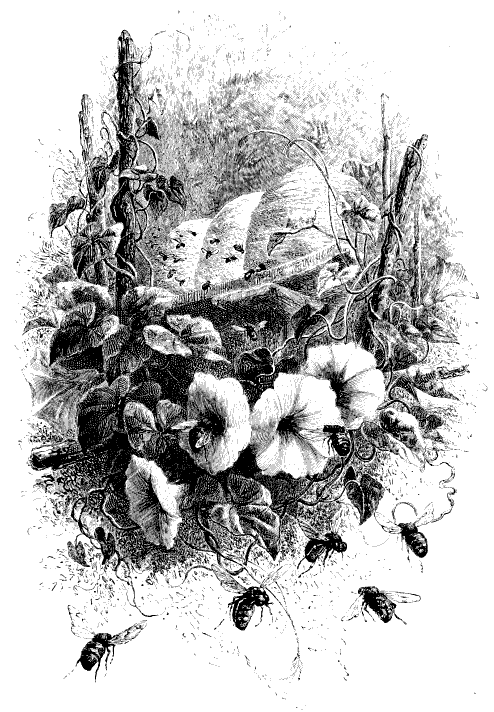
VIII.—THE BEES AS ARCHITECTS.
CHAPTER VIII.
THE BEES AS ARCHITECTS: THE CITY.
If the wasp's nest resemble Sparta, the bee-hive is the veritable Athens of the Insect World. There, all is art. The people—the artist-élite of the people—incessantly create two things; on the one hand, the City, the country,—on the other, the Universal Mother, whose task it is not only to perpetuate the race, but to become its idol, its fetish, the living god of the community.
The bees share with the wasps, the ants, and all the sociable insects, the disinterested life of aunts and sisters,—laborious virgins, who devote themselves entirely to an adoptive maternity.
But from these analogous peoples the bee differs in the necessity it is under of creating a national idol, the love of which impels it to work.
All this has been long misunderstood. It was at first supposed that this State was a monarchy, that it possessed a king. Not at all; the king is a female. Thereupon one is driven to say, This female is a queen. Another error. Not only does she not govern, or reign, or control, but in certain conjunctions she is governed, and sometimes even placed in private confinement. She is at once something more and something less than a queen. She is an object of legal and public adoration; I should say legal and constitutional, for this adoration is not so blind but that the idol, in some cases, as we shall see, may be treated very severely.
"Then, at bottom, the government will be democratic?" Yes; if we take into consideration the unanimous devotion of the people, the spontaneous labour of everybody. No one commands. But, nevertheless, you can clearly see that in every higher work an intelligent body of the élite, an aristocracy of artists, takes the lead. The city is not built or organized by the entire people, but by a special class, a kind of guild or corporation. While the mob of bees seeks the common nourishment abroad, certain much larger bees, the wax-makers, elaborate the wax, prepare it, shape it, and skilfully make use of it. Like the medieval freemasons, this respectable corporation of architects toils and builds on the principles of a profound geometry. Like those of the old days, they are the masters of the living stone. But our worthy bees are far more deserving of the title! The materials which they employ they have made, have elaborated by their vital action, and vivified with their internal juices.
Neither the honey nor the wax is a vegetable substance. Those little light bees which go in quest of the essence of the flowers bring it back already transformed and enriched by their virginal life. Sweet and pure, it passes from their mouth to the mouth of their elder sisters. These, the grave wax-makers, having received the aliment vivified and endowed with the charming sweetness which is, as it were, the soul of the race, elaborate it in their turn, and communicate to it their own peculiar life,—solidity. Wise and sedentary, they work up the liquid into a sedentary honey, a honey of the second quality, a kind of reflected honey. This is not all: the substance twice elaborated, and twice penetrated with animal juice, they incessantly moisten with their saliva, when using it so as to render it softer for working, but more tenacious afterwards.
Was I wrong, then, in saying that this construction is truly one of "the living stones"? There is not an atom of the materials which is not three times impregnated with life. Who shall say of yonder hive whether the flower or the bee has furnished the greater part? The latter has certainly contributed an important share. Here, the home of the people is the people's substance and visible soul; from themselves they have extracted their city, and their city is, in truth, themselves. Bee and hive, it is one and the same thing.
But let us observe them at work.
Alone, in the centre of the still empty and to be created hive, the learned wax-maker advances. From beneath its wings it delicately extracts a thin slab of wax, and conveys it to its mouth, where it is well kneaded and pounded, and drawn out into the shape of a ribbon. Eight strips are in this wise furnished, wrought, and absorbed; and the result is eight little blocks, which the bee lays down as the first beams of the future edifice, the foundations of the new city.