Front matter (continued 2)
Reading edition
That in such a cradle the child should live commodiously,—that from its own body it should draw out a silky covering to line its plastic prison,—that finally, when sufficiently strong, it should issue forth under the influence of the heat,—this is self-explanatory, and we admire without being astonished. But what really excites our wonder is, that the mother,—a butterfly, or perhaps a beetle,—after the numerous changes through which she has passed, after her numerous sloughings, transitory slumbers, and metamorphoses, should remember, for her offspring's behoof, the place or plant where formerly she herself was nourished, and grew, and took her point of departure! It is a marvel which confounds the mind. Those creatures apparently the most heedless—the fly, or light-headed butterfly—at the moment when approaching death brightens them with the radiance of love, collect, as it were, their thoughts, and seem to revive their recollections. Then, without lapse or error, they flee away; and lo! the plant which was their own early residence, their birthplace, and their cradle, shall again become their home, and protect their offspring!
All at once they show themselves prudent, foreseeing, and skilful. To obtain an entrance to this asylum, they practise unknown arts and display incredible address. How is this? What happens? Sometimes their weapons of war, diverted to other uses, become instruments of love; sometimes new and hitherto concealed apparatus,—frequently of an extremely complex character,—make their appearance; and yet all for this solitary act, for this single day.
A curious book has been written on the mechanism and infinitely varied instrumentation with which insects are provided for the discharge of the maternal duty. Their implements are often charming from their precision, delicacy, and subtlety. It will suffice to particularize that of the rose-bush aphis,—so well described by Réaumur, as a saw whose two blades act in an inverse direction, and whose teeth are each a set of teeth.
O unheard-of power of Love! Whether this divine workman prepares for them their tiny tools, or whether he inspires them to fashion their own by the effort and vehemency of the burning maternal desire, it matters not: you see them duly fabricated, and acting when wanted in a wholly unexpected manner.
It is a simple task for the tribes of sociable insects which labour with the assistance and protection of a numerous republic; but it is infinitely arduous and painful for the solitary mothers, who, without auxiliary, spouse, or friend, undertake enormous enterprises, and frequently raise constructions which might be the work of giants,—such as the nest of the mason-wasp. One is lost in astonishment at the amount of patience and strength of will required for so colossal an edifice.
This excessive toil ages the mother in a few days. She wears herself out, yet does not enjoy the fruit. Frequently the elaborate cradle serves for another. Too frequently a usurping stranger seizes upon it, profits by the meritorious work, and establishes there its progeny, which will not only consume the provision of the rightful tenant, but feed also on the unfortunate tenant himself!
Who will not bestow a glance of pity on this great work, and a result of such uncertain character?
In the burning days of July, when the narrow belt of forests surrounding Fontainebleau concentrated upon it the summer heats, we were astonished at the incessant and continuous labour, despite the indolence of the season, of a solitary bee which was ever going and coming. Her indefatigable journeys always brought her near some vases of camelias and rose-bays. I saw her, still fair and shapely, of a beautiful brown mingled with black, returning, at regular intervals of about five minutes, with woven fragments of leaves, which she introduced through a deep aperture into the soil of the vase where she had made her nest.
For three days she worked with undiminished ardour. There were no signs that she took the least food: constantly at her work, she appeared to have already abandoned all care for her own life.
Her preoccupation was so great and her activity so eager that we were able to approach her very closely. Nothing frightened her; so that we could establish ourselves at our ease near her little nest, and observe her with as much patience as she herself brought to her work.
On the fourth morning we found the opening closed, and we saw her no more. She had completed her task. Exhausted, but rejoicing at its conclusion, she had retired undoubtedly to some obscure recess to await her destiny.
We proceeded delicately to loosen the soil around the sides of the vase, in order to examine into what she had done.
At the bottom, resembling in shape a couple of thimbles, lay two cradles, and in these cradles two little ones. All the care had been for them: so many young, so many cells.
Each was composed of six-and-twenty fragments of leaves. Réaumur, in a similar nest, counted but sixteen. Six of these fragments, which closed up the entrance, were perfectly round,—a remarkable fact, if we bear in mind that the instrument which achieved the work was by no means appropriate to it. Yet they were as accurately finished off as if done by a punch.
The other portions of leaf, cut into ovals, and carefully placed one upon another in due accordance with the contour of the nest, resembled so many roofs designed by the indefatigable mother as a protection against the wind and rain. At the bottom lay a little honey; the last and tender legacy of the mother, bequeathed by her to those whom she had abandoned for ever.
We shall enjoy the satisfaction of seeing them weave their winter shelter. It will be pleasanter for them under our roof than at the bottom of the vase. The mother's intentions will be carefully carried out. Adopted, tended, and removed to Paris, the nymphs of Fontainebleau will take, one fine morning in spring, their flight above our windows, and, as young bees, will be able to gather, if not the honey of the heather, at least that of the Luxembourg.

V.—THE ORPHAN: ITS FEEBLENESS.
CHAPTER V.
THE ORPHAN: ITS FEEBLENESS.[H]
We have told the easiest and pleasantest story to relate, the story of the privileged creature for whom its mother has duly provided, and who is nourished and clothed by her efforts. But many—in truth, the greatest number—enter life destitute and necessitous. They fall naked into the great world.
Poverty the audacious, necessity the ingenious, the severe internal travail of hunger and desire, stimulate and develop the energetic organs which come to their assistance.
What organs? The great Swammerdam, the martyr of patience, was the first to distinguish them. With a piercing eye, examining the newly-hatched egg,—that dubious foundation!—he seized the opening lineaments of life, and marked in them the profound and decisive characters which make the mystery of the insect. He saw the little creature, with its gelatinous body, push forward its mandible or jaws,—a distinct and complete organ, placed in front of the mouth, and visibly intended to nourish and protect the still feeble being.
Behind this active apparatus he detected on the sides of the body a passive apparatus, a series of tiny mouths or valves (the stigmata) which await the air, and open to receive it.
Ingenious precautions! The orphan born completely naked, and launched into life unprotected to undergo the most toilsome metamorphoses, is rendered competent for the task only by eating greedily from the moment of its birth, absorbing and devouring! It must eat always and everywhere, even in the least respirable atmosphere, and in unhealthy and deadly places. It is for this reason nature has endowed it with a slower, and, if I may so speak, a more suspicious circulation and respiration, than that of the superior creatures which live only in pure air. In these creatures, as in man, the blood continually flows to meet the air and be vivified by it. In the insect, on the contrary, the protecting apparatus which guards its lateral mouths are disposed in such a manner as to be able always to moderate, sift, and, if need be, exclude, the invading atmosphere. One is overcome with surprise by the infinite variety of the combinations designed for this end, the numerous mechanical and chemical arts of the most complicated character. To receive and yet not receive, to breathe without breathing, to preserve the control of what must nevertheless be a passive function, to trust and yet mistrust, to surrender and yet protect, is the difficult problem which life here proposed to itself, and of which it has found innumerable solutions. To give air to a grub! Behold, arrogant humanity, which callest thyself the centre of all things, the most laborious effort that has engrossed the powers of nature!
Its circulation resembles that of the embryo in the bosom of its mother. But how much less favourable the condition of the insect! The fœtus is in immediate contact with the world through the soft maternal medium. The motherless insect embryo does not swim, like the other, in a sea of milk. It is cradled in the rude mould of the universal life; it travels therein at great peril, on the rude earth, from shock to shock.
This fact the moderns have recognized,—the insect is an embryo. But who would suppose that this very circumstance would doom it to death? How rude a contradiction! An embryo launched into the thick of the fray, to be the victim of all—of birds, and even of insects. An embryo armed, it is true; and nothing is stranger than to see the soft grubs brandishing their threatening jaws, while their feeble body, deprived of all defence, is exposed on every side.
Flight offers them but few chances; their best protection is night. And therefore they shun the light,—they live as they can under the ground, in the wood, or at least beneath the leaf. If this be true of the larvæ, the grubs, of what we call worms, we may say the same of the insect. For its first period (that of the larva) endures a considerable time, though its life as a nymph, and finally its third period, last but a very brief while. Numerous species (May-bugs, stag-beetles, and the like) have three to six years of a tenebrous existence, and only three months under the sun.
Even the insects which live longest in the sun, like the bees and the ants, work willingly in obscurity; are partial to the shadows of their hives and ant-hills.
We may assert as a general rule that the insect is the child of night.
Most insects shun the day. But how can they avoid the air? Even in hot countries, the contact of the variable atmosphere with a live nude body, whose epidermis is not yet hardened, becomes infinitely painful. In our severe climates, each breath of air must produce the sensation of piercing arrows, of a million of fine needles. What would it be, O Heaven, for a poor human fœtus to issue, after a week or a fortnight, from its mother's womb, and instead of peacefully undergoing the transformations which strengthen it, to be subjected to them in a naked condition and in open day? What would be its sensations on quitting its soft asylum, and falling into the cold air? Yet such must be those of the insect, when, soft, feeble, assailable, and penetrable everywhere, still almost floating and gelatinous to the eye, it experiences the cold, and the wind, and the shock of so many painful accidents.
Certain clothed species are a little better protected. Some are lodged in the heart of a fruit. Others (bees and ants) form a protecting community; but the immense majority are born solitary and naked.
Some of our readers, always well clothed and warmed, will say, I am sure, that cold is an excellent thing, which stimulates the appetite and strengthens the frame. But those who have been poor will very well understand my preceding observations. For my part, recollections of my childhood convince me that cold is, in all truth, a punishment; you cannot get accustomed to it; its prolongation does not render its effect less severe. How keen a joy I felt (in rigorous winters) at each thaw which released me from my agitated, terrified, and uneasy condition, and secured the happy re-establishment of the internal harmony!
I do not deny, however, that cold may not be a powerful tonic, which sharpens and braces up the mind, and draws from it fresh efforts of invention. Cold, as well as hunger—and perhaps hunger especially—is the great stimulus of the arts; hunger weakens, cold strengthens.
It is the powerful inspirer of infinite swarms of those chilly creatures which seek before all things, as soon as they are born, the means of covering themselves. They are not in want of food; nature has everywhere prepared for them an ample banquet. All the vegetable kingdom, and a great part of the animal, are at their disposal; they might live tender and indolent, as the child sleeps at its ease on the maternal placenta which nourishes its slothfulness. But the cold irritates them; the cold damp air deadens and paralyzes their entrails; finally, the light wounds them. They can enjoy no repose until they have secured a shelter. In the lowest grade of life the smallest grub becomes an artist, and by weaving, and spinning, and carving has soon contrived a robe, and, as with a second skin over her too sensitive epidermis, has covered her suffering nakedness. Happy she who finds herself placed at the outset on a prepared soil, a cloth of warm wool, a fine fur: she does not fail to make in hot haste, according to our human fashion, a pretty paletot fitted to her figure; which, nevertheless, she leaves a little loose, like economical mothers for their young growing children, in whose case the garb too large to-day will be tight and well-fitting to-morrow.
Those who on their birth come in contact with chill green leaves, and their lustrous glaze, are still more industrious. They practise arts which astonish the observer. Some raise enormous masses with imperceptible cables, and by mechanical processes analogous to those which were employed in removing and rearing the obelisk of the Place de la Concorde. Others cut out figures purposedly irregular, which the seam afterwards fits into its harmonious ensemble.
Every industrial corporation may be found represented in this little world: tailors, weavers, felters, spinners, miners, and the like. And in each corporation you meet with species working each after its peculiar fashion, by the various processes appropriate to it.
The tailors work from a pattern. They mark out on the leaf a suitable piece; which they remove, and lay upon another leaf; tack it, cut out a second on the first model, and stitch them together. This done, with their scaly head they flatten the ribs, just as the tailor smooths down the seams with his iron. Then they line this coat, which they carry about with them, with the very finest silk.
Others work in mosaic, others in marquetry and veneering. After having woven the robe, they disguise it by artistically gluing to it a variety of surrounding materials. The aquatic insects, for example, embellish theirs with moss, lentils, mussels, or little snails.
The miners erect galleries between a couple of leaves, and roam about in them, constructing places of exit and ingress in their subterranean abodes.
The labour is great. But among all the species an admirable justice prevails. Whoso works hard while a child, does little when an adult; and vice versâ. The bee, which in the larva state is richly fed by its parents, and always carried about and cradled, is destined hereafter to an exceedingly laborious life.
On the contrary, another insect which, as a grub, has toiled, and woven, and spun, will having nothing to do in its later life but whisper love-phrases to the rose. I am speaking of Sir Butterfly.
For the great majority, hard work is for infancy, for the larva or the grub; work twofold and excessive. On the one hand, the constant, urgent, and pressing search after the food craved for by an immense internal need; the necessity of recruiting and renewing its energies, of restoring the inherited organs, and developing new ones.
The existence of these poor motherless creatures is divided between two severe conditions: toil, and growth through disease.
For their moultings, or sloughings, are, in effect, a disease.
The painful moment having arrived for the little creature to change its clothing, a clothing which clings to its flesh, it is seized with illness, abandons its leaf, and creeps languidly to some solitary asylum. If you saw it in such a soft, inert, and withered condition, so different from its natural state, you would say it was on the point of death. And many do, indeed, succumb at this laborious crisis.
Passive, and suspended to a branch, it waits until nature shall complete its work,—until its epidermis be detached from the second skin beneath, recalling it to all the energies of life.
It is then that you see the garb, which was formerly so brilliant, dry up and harden like a thenceforth useless thing, carried hither and thither by the wind.
But before it will yield and separate, the invalid, despite of its weakness, must twist in every direction, and writhe, and swell, and contract, and employ all the efforts of a being in its strongest moments.
At length it has conquered; the old sheath is rent; and I see the insect free, but bathed in sweat.
Do not touch it yet, for the slightest pressure will wound. Of this it is aware, and lies perfectly motionless. It is pale, and almost swooning; it must wait patiently, before beginning to move, till its skin is less sensitive and its limbs are much firmer. Soon, fortunately, it will be invigorated by its food; it feels a terrible hunger, which restores its strength and prepares it for another sloughing. Such is its destiny. It is condemned to deliver itself continually in a series of accouchements, until it finally attains its latest transformation.
If either the exertion or the pain inspire it with a transient gleam of thought, it would say, on each painful occasion: "Now it is ended! I have finished my task; I will rest in peace; this is my last change." To which Nature would respond: "Not yet! not yet! Thou art not yet engendered. What art thou? Nothing but a larva, a mask which is about to fall."
What! A mask! and yet it wills and toils, strives and suffers, and sometimes seems more advanced than will be the being produced from it! So much industry and skill imprisoned in a skin which will immediately dry up and be blown away by the breeze!
However this may be, it is seized one morning by an undefinable kind of irritability and disquiet,—by a mysterious impulse which excites it to undertake a new task. You would say that within itself another self exists, moving, and stirring, and following up a distinct purpose, and yearning to become—what? does it know? This I cannot assert; but after awhile you may see it acting, and acting sagaciously, as if inspired by a perfect knowledge. Its presentiment of the slumber which will shortly seize upon it, paralyze its forces, and surrender it helplessly to all its enemies, incites it to the sudden display of a novel activity. "Let us work well! Let us work quickly! For soon I shall sleep soundly."
VI.—THE MUMMY, NYMPH, OR CHRYSALIS.
CHAPTER VI.
THE MUMMY, NYMPH, OR CHRYSALIS.
Let us respect the childhood of the world. Let us pardon the early ages for the consolations and hopes which they drew from the strange drama represented by the Insect, the thoughts of immortality which grave Egypt founded upon it. This drama tranquillized more hearts and wiped away more tears than all the mysteries of Canopus or the revels of Eleusis.
When the mourning widow, the eternal Isis, ever reproducing herself in eternal anguish, was snatched from her beloved Osiris, she reposed her hope of a future reunion on the sacred beetle, and hushed her sobs.
What is death? What is life? What is the awakening, or what the slumber? Do you not see this little miracle, this dumb confidant of the grave, which makes us the mock of destiny? It sleeps in the egg, and afterwards sleeps again in the nymph. It is thrice born; and it dies thrice—as larva, nymph, and beetle. In each of these existences the larva or mask is the prefigurement of the succeeding existence. It prepares, begets, and hatches itself. From the most repulsive sepulchre it emerges sparkling. On the dust it shines; on the gray Egyptian plain, in its season of aridity, it shimmers, and eclipses everything. Its jewelled wing mirrors the all-powerful sun.
Where was it? In the foul shadow, in night and death. A deity has summoned it forth, and will yet do much more for this beloved soul! Sweet, tender ray! The hope was surely founded upon justice, on the impartial love of the Creator of all life.
Accordingly, the widow draws from its death the brilliant pledge of the future, and gives utterance to this woman's cry:—"Merciful Heaven! do for my husband and for me what thou hast done for the insect. Do not grant less to man; do not grant to my best-beloved less than thou accordest to this brother of the gnat!"
Has modern science swept away the ancient poesy? Has it completely eliminated the miraculous from nature?
The inaugurator of this science, Swammerdam, has discovered that the grub already contains the nymph; nay more, even the butterfly. In the grub he has detected the rudiment of the wing and proboscis of the future being.
This is not all. Malpighi saw the nymph of the silkworm in its virgin slumber, already furnished with the attributes of its coming maternity,—containing the eggs which, as a butterfly, it would fecundate.
And yet again, this is not all. Réaumur, in the oak-grub, in a grub scarcely a few hours old, found the eggs of the future butterfly. In other words, the infant insect, at that very stage when the grub itself, as Harvey points out, is simply a mobile egg, already possesses eggs and children.
It is the identity of three beings. It seems as if there could be no intermediary deaths; one single life is continuously carried on.
All this seems clear, does it not? The ancient mystery has perished? Man has discovered, in its fulness, the secret of things?
Réaumur does not think so; Réaumur himself, who has guided us so far. In recording his observations he does not appear satisfied, and confesses "that they still leave very much to be desired."[I]
In truth, it is a thing to confound and almost to terrify the imagination, to think that a grub, at the outset no bigger than a thread, should include in itself all the elements of its moultings and metamorphoses; should contain its triple, and even octuple envelopes; nay more, the sheath or case of its nympha and its complete butterfly, all folded up one in another, with an immense apparatus of vessels, respiratory and digestive, of nerves for feeling and muscles for moving! A prodigious system of anatomy! first traced out in complete detail in Lyonnet's colossal work on the willow-grub. The twofold monster, endowed with a strong grub-stomach for the destruction of innumerable hard leaves, will possess ere long a light and delicate apparatus for extracting the honey of flowers. And yet the clothed creature, which contains in its organism a complete silk-manufactory, will almost immediately sweep away the complex system.
One knows the gentle manœuvres by which nature conducts the young of the higher animals from the embryonic existence to the independent life, adapting the old organs to new functions. Here, this is not done. It is not a simple change of condition. The destination is not merely different, but contrary, with a violent contrast. Therefore, instruments fitted for an entirely novel existence are required, and the abolition and definitive sacrifice of the primitive organism.
The revolution, which for all other beings is so well concealed, is here entirely thrown open. And we are enabled to scrutinize with our eyes this astonishing tour de force in numerous grubs which undergo the great change in the light of day, suspended to the branch of a tree by a silken cable.
The effort is worthy of our admiration and pity. To see yonder nymph, short and feeble, soft and gelatinous, without arms or paws, contriving, by the skill with which it expands and contracts its rings, to escape from the heavy and rough machine which it was at first, flinging aside its limbs, setting free its head, and—one hardly dares to record the fact—throwing off its body, and rejecting many of its principal internal organs!
This little body, when it has thus escaped from its long heavy mask (living, nevertheless, but a moment since, a life full of energy), will dangle, and grow dry, and skilfully ascend to its silken fastening. There it prepares to fix itself in its new "Me" as a nymph, while its former "Me," tossed about by the wind, is speedily driven I know not whither.
All is, and ought to be, changed. The legs will not again be the legs. It will need lighter organs. What can the child of the air, which can balance on the point of a blade of grass, do with those coarse short feet, armed with hooks, vent-holes, and so many heavy implements?
The head will not be the head; at least, the enormous apparatus of mandibles will disappear, and also that of the muscles by which they were energetically moved. All is thrown aside with the mask. A colossal change! From a masticator the animal becomes a sucker. A flexible proboscis emerges.
If anything in the grub appeared of a fundamental character, it was the digestive apparatus. Ah, well! this basis of its being is no more. The absorbing throat—the powerful stomach—the greedy entrails,—all are suppressed, or reduced nearly to nothing. What would they avail the new being which, in certain species of butterflies, dispenses with sustenance, has no mouth but by agreement, and is so completely freed from digestion that frequently it has not even an inferior orifice? It abandons without difficulty its thenceforth useless furniture, and expectorates the skin of its stomach!
This is grand and magnificent,—no spectacle is grander! For life at such a point to change, to dominate over the organs, to rise victorious, so entirely free of the ancient Ego! To those who have revealed to us such a prodigy of transfiguration, from the bottom of my heart I say, "Thanks!"
How marvellous the security in this being which abandons everything, which unhesitatingly dismisses its strong and solid existence, the complicated organism which just now was itself, its own individuality! We call it its larva, its mask; but why? The personality seems at least as energetic in the vigorous grub as in the delicate butterfly. And, therefore, it is most indubitably its individual being which it courageously leaves to shrivel up and perish, to become—what? Nothing reassuring, nothing but a little, soft, whitish substance.
Open the nymph soon after it has spun its cocoon: in its shroud you shall find nothing but a kind of milky fluid, wherein you see, or fancy you see, certain dubious lineaments. After awhile you may, with a fine needle, separate these I know not what,—and figure to yourself that they are the limbs of the future butterfly. A frightful lacuna! For many species a moment occurs when nothing of the old any longer appears, and nothing of the new as yet has come. When Æson, cut in pieces, was thrown, in order to rejuvenate him, into the caldron of Medea, you would have found, on groping there, the limbs of Æson. But here there is nothing parallel.
Trustfully, nevertheless, the mummy surrounds its body with its bands, docilely accepting the shadows, the inertness, and the captivity of the sepulchre. It feels in itself a force, a raison d'être, a causa vivendi,—a reason for living still. And what reason? What cause? The vitality accumulated by its previous toil. All that, like a laborious grub, it has accumulated, is its obstacle to death,—its incapability of perishing,—the reason why it will immediately live again; and not only live, but with a light and tender existence, whose facility is proportioned exactly to the efforts which it makes in its anterior condition of life.
Admirable compensation! When penetrating so deep down into life, I expected to encounter certain physical fatalities. And I found justice, immortality, and hope.
Yes, antiquity was right, and modern science is right. It is death, and yet it is not death; let us call it if you will partial death. Is death ever otherwise? Is it not a new birth?
Throughout my life I have remarked that each day I died and was born again; I have undergone many painful strugglings and laborious transformations. One more does not astonish me. Many and many times I have passed from the larva into the chrysalis, and into a more complete condition; the which, after awhile, incomplete under other relations, has put me in the way of accomplishing a new circle of metamorphoses.
All this from me to me, but not less from me to those who were still me, who loved me, or made me, or, so long as I lived, whom I made. These, too, have been, or will be, my metamorphoses. Sometimes, a certain intonation or gesture which I detect makes me exclaim:—"Ah! this is a gesture or a tone of my father." I had not foreseen it, and if I had foreseen it, it would not have occurred; reflection had changed all; but, not thinking of it, I employed it. A tender emotion, a holy impulse seized me, when I felt my father thus living in myself. Are we two? Were we one? Oh! it was my chrysalis. And I—I play the same part for those who shall follow me, my children, or the children of my thought. I know, I feel, that besides the bases which I derived from my father, my ancestors and masters, besides the inheritance of artist-historian which I shall bequeath to others, germs existed within me which were never developed. Another, and perchance a better, man was within me, who has not arisen. Why were not the loftier germs which might have made me great, and the powerful wings of which I have sometimes felt myself possessed, displayed in life and action?
These germs, though put aside, remain to me; too late for expansion in this life, perhaps, but in another,—who knows?
An ingenious philosopher has remarked that if the human embryo, while imprisoned in the maternal bosom, might reason, it would say:—"I see myself endowed with organs of which here I can make no use,—limbs which do not move, a stomach and teeth which do not eat. Patience! these organs convince me that nature calls me elsewhere; a time will come when I shall have another residence, a life in which all these implements will find employment. They are standing still, they are waiting. I am but the chrysalis of a man!"
VII.—THE PHŒNIX.
CHAPTER VII.
THE PHŒNIX.
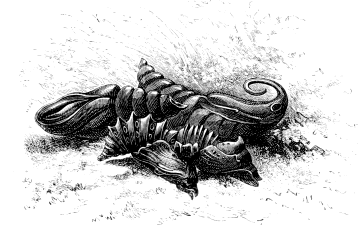
The drama is complete. From the gray or blackish mummy which just now lay before you dried and shrivelled, you see the new creature, the resuscitated, the phœnix, blithely escaping, to shine resplendent in all the glory of youth.
The very reverse of our destiny: commencing with bright and butterfly days, in later life we crawl and languish; while the insect commences with years of gloom, and from a long life of obscurity emerges into the youth in which it dies glorified.
Let us be present at this departure. The warm breath of spring has awakened the plants; its banquet is prepared. More than one flower, awaiting it, secretes its honey. It delays, because to-day that impenetrable envelope which ensured its safety becomes for a moment its obstacle. Enfeebled and fatigued by so great a transformation, how shall it break through the too solid cradle which threatens to suffocate it?
Some species—as, for example, the ants—experience so great a difficulty, that the captive, probably, would never effect its release but for the opportune assistance of some power which, from without, hastens to extricate it, to deliver it (so to speak), and separate it from the trammels of its swaddling-clothes. Fortunate difficulty! which creates the bond between the two ages, attaches the liberator to the child she has delivered, and herself begins its education and society!
But, for the majority of insects, the liberator is no other than Nature. This mother, inexhaustible in tenderness and invention, gives to the little one the key which will open the barrier, pierce the prison, and introduce it to daylight and liberty.
"What key?—and how?" say you. "How can this soft and fluid being contrive to seize upon a firm, compact tissue, frequently doubled and immured by the alluvial accumulation of a protracted winter?"
The circumstance embarrasses us greatly, but Nature is not troubled. Means of the utmost simplicity suffice her; she eludes, and sports with, the difficulty. The butterfly of the silkworm, for instance, at the critical moment finds a file—where?—in its eye! This eye, with numerous facets, has a fine diamond point, which files through and severs the silken prison.
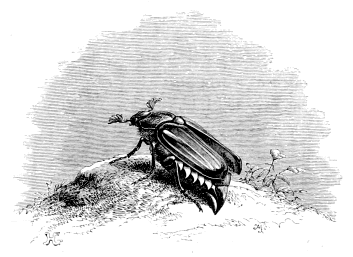
Another, the cockchafer, shut up underground, suddenly discovers that it is a perfect mechanician. Of its whole body it makes a lever. Its posterior extremity furnishes it with a strong-pointed auger. It sinks solidly, anchors, and makes fast. From this point d'appui it derives an enormous force, and with its robust shoulders uplifts the heavy clod, enlarges the aperture, finds at length the light, extends its unwieldy apparatus of wings and wing-cases, and flies as a gnat.
Another deformed (or shapeless) miner, the mole-cricket, would never reach the surface if, to reascend from the depth of the earth, it had not two enormous hands, or rather two powerful rakes, which open up its way. Though hideous, it is not the less sensitive to the influence of spring, but it takes the precaution of never exposing its strange figure save to the doubtful rays of the moon. Its plaintive cry singularly affects the female; she yields to it, and makes her appearance, but to return again into the night and confide to the protecting shade the hope of her posterity.
A frail aquatic insect, the gnat, on this important day assumes the daring mission of the navigator. It makes fresh use of its demitted envelope, and turns it into a bark. In this it stands upright, extends its new wings for sails, glides along the wave, and very frequently without shipwreck reaches the shore; where, when dried, the same wings will bear it off to the chase and the pursuit of pleasure. In an hour it appears a complete master of all these novel arts. It is the peculiarity of love to know without having been taught.
Love is winged. Mythology is perfectly in the right. This is verified in the proper sense and without metaphor. In one brief moment, Nature displays a restless anxiety to fly towards the beloved object. All creatures rise above their own level, all mount towards the light, on the pinions of desire. The internal fire is also revealed in glowing colours. Every one decorates his person, every one wishes to please.
The butterfly apparently looks upon you with the great velvety eyes which adorn its wings. Beetles of every species, like mobile stones, astonish by their brilliant reflexes, their burning vivacities. Finally, from the bosom of the shadows bursts the flame of love, naked and unveiled, in flashing stars!
At such a moment it accomplishes the strangest transformations, and from the humblest masks issue, in violent contrast, the superbest individuals.
A dull larva of the morass, which lives only by stratagem, becomes the brilliant amazon, the agile winged warrior, called Demoiselle (libellula). It is the only creature of its tribe which expresses the complete liberty of flight, holding the same rank among insects as the swallow among birds. Who has not followed with attentive gaze its thousand varied movements, its turns, and returns, and the infinite circles which it makes with azure and emerald wings on the meadow or over the waters? A flight apparently capricious; but not really so, for it is a chase, a rapid and elegant extermination of myriads of insects. What seems to you a pastime, is the greedy absorption with which this brilliant creature of war feeds its season of love.
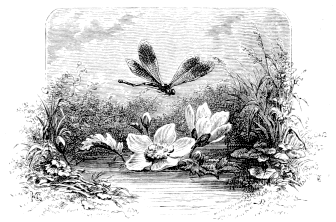
Do not believe that these riches are simply the gifts of genial climates; that these glittering festal garments which they assume to love and die in are only the sheen of the sun, the all-powerful, decorator, which with its rays intensifies the enamel and gems we admire upon their wings. Another sun—a sun which shines for the whole earth, even for the ice-regions of the pole—profits them far more considerably. It exalts in them the inner life, evokes all their powers, and, on the given day, calls forth the supreme flower. Yonder scintillating colours are their visible energies which become speaking and eloquent. It is the pride of a complete life, which, having attained its climax, displays its energy in triumph, wishes to expand and diffuse; it is the tradition of desire, the imperious prayer and urgent appeal to the beloved objects.
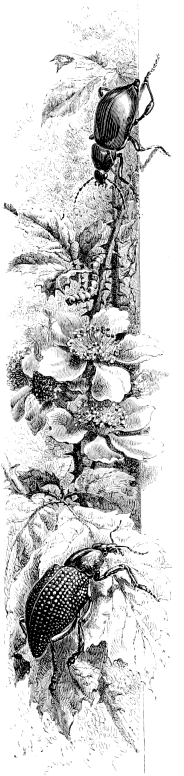
In pale and temperate climates, you will meet with those brilliant liveries which one would think belonged to the tropics. Who, under our gloomy and variable sky, has not seen the sparkling Spanish fly? Even in the fatal deserts where summer beams but for an instant, as if in despite of the sun,—in despite of the poor and naked earth,—love supports some beings of a sumptuous splendour, of opulent raiment and rich decoration. Miserable Siberia sees the princes and great lords of the Insect World simultaneously displaying their grandeur. The tyrannical Russian climate cannot prevent enormous beetles, pitiless hunters, fiercer than Ivan the Terrible, from appearing in green, black, violet, or deep blue morocco, shaded with purple sapphires. While some, usurping the ancient copes consecrated to the czars and the porphyrogeniti, stalk to and fro in robes of purple, broidered with Byzantine gold.
In our neighbouring Siberias, I mean our lofty mountains,—under the hailstorms, for instance, of the Pyrenean glaciers,—without being discouraged by their rude blows, fly noble insects, of exquisite appearance, the rosalia in a mantle of pearl-gray satin, spotted with black velvet.
Among the lofty Alps, at the Grindelwald,—the formidable descent where that glacier comes to us, and you may touch its aiguilles, and its keen breath freezes you—I once admired a timid but touching protestation of love. Among some miserable birches, martyr trees, which undergo an eternal chastisement, a poor little plant, elegant and delicate, persists in flowering, with a rose-hued blossom, but a violet rose, not unworthy of the mournful region. The brother of this tragical rose is a very tiny insect which, all feeble as it is, mounts higher than any other species, and is found shivering among the lofty snows of Mont Blanc. There, above you, is only the heaven, and, beneath, the vast shroud of ice. The poetic creature has assumed exactly two tints: the celestial blue of its wings, incredibly delicate, seems lightly kindled with the white powder of the hoar-frost. The storms and avalanches which overthrow the rocks awaken in it no sensations of terror. Under the breath of the terrible giant, in his ice-bristling beard and formidable frown, it, the little one, flies daringly, as if conscious that this king of the everlasting winters would hesitate to destroy the last winged flower of love which, in his realm of death, preserves for him a reflection of heaven.

MISSION AND ARTS OF THE INSECT.
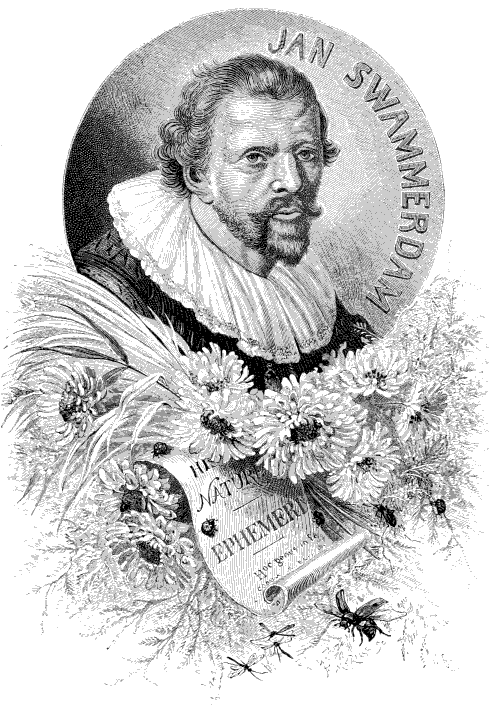
I.—SWAMMERDAM.
CHAPTER I.
SWAMMERDAM.
What was known of the Infinite prior to 1600? Nothing whatever. Nothing of the infinitely great; nothing of the infinitely little. The celebrated page of Pascal, very frequently cited upon this subject, is the frank astonishment of a humanity so old and yet so young, which begins to be aware of its prodigious ignorance, opens its eyes to the Real, and awakens between two abysses.
No one forgets that in 1610 Galileo, having received from Holland a magnifying lens, constructed the telescope, elevated it in position, and saw the firmament. But it is less generally known that Swammerdam, seizing, with the instinct of genius, on the imperfect microscope, directed it to the lower world, and was the first to detect the living infinite, the world of animated atoms! These great men succeeded one another. At the epoch of the famous Italian's death (1632) was born the Hollander, the Galileo of the infinitely little (1637).
An astounding revolution! The abyss of life was unfolded in its profundity with myriads upon myriads of unknown beings and fantastic organizations of which men had not even dared to dream. But the most surprising circumstance is, that the very method of the sciences underwent a total change. Hitherto men had relied upon their senses. The severest observation invoked their testimony, and they thought that no appeal could lie from their judgment. But now behold experiment and the senses themselves, rectified by a powerful auxiliary, confess that not only have they concealed from us the greater part of things, but that, in those they have laid bare, they have every moment been mistaken!
Nothing is more curious than to observe the very opposite impressions produced by these two revolutions upon their authors. Galileo before the infinite of heaven, where all appeared harmonious and marvellously ordered, felt more of joy than of surprise; he announced his discoveries to Europe in a style of the greatest enthusiasm. Swammerdam, before the infinite of the microscopic world, seemed overcome with terror. He recoiled before the spectacle of Nature at war, devouring her very self. He grew perturbed; he seemed to fear that all his ideas and beliefs would be overthrown: a melancholy and singular condition, which, added to his incessant labours, shortened his days. Let us pause awhile to dwell upon this creator of science, who was also its martyr.
The eminent physician Boerhaave, who, a hundred years after Swammerdam's time, published with pious care his "Bible of Nature," gave utterance to a surprising observation, which sets one a-dreaming:—
"He had an ardent imagination of impassioned melancholy, which raised him to the sublime."
Thus, this surpassing master in all the works of patient inquiry, this insatiable observer of the most minute details, who pursued Nature so far into the imperceptible, was a poetic soul, a man of imagination, one of those mournful spirits who groan after nothing less than the infinite, and die because they fail to conquer it.
His was a remarkable combination of mental endowments which, at the first glance, seem opposed to one another: a love of the great, and a taste for the subtlest researches; a sublimity of aim, and that obstinacy of analysis which would subdivide the atom, and yet never cry, "Hold, enough!" But, in reality, are these qualities of so contradictory a nature? By no means. Men whose hearts are filled with the love of Nature will declare that they harmonize admirably. Nothing great and nothing little. For the lover a simple hair is worth as much as, frequently more than, a world.
He was born in a cabinet of natural history; and his birth decided his destiny. The cabinet, formed by his father, an apothecary of Amsterdam, was a pell-mell, a chaos. The child wished to arrange it, and drew up a catalogue of it. A modest ambition led him from point to point, until he became the greatest naturalist of the century.
His father was one of the zealot collectors who then became common in Holland—insatiable treasurers of diverse rarities. It was not with pictures—though Rembrandt was then in his glory—it was not with antiquities, that he filled his house. But all that the ships brought back from the two Indies of minerals, plants, fantastic and extraordinary animals, he acquired at any cost, and heaped up in piles. These marvels of the unknown world, contrasting by their splendour and tropical magnificence with the gloomy climate which received them and the pale sea of the North, aroused in the young Hollander's mind a lively curiosity and a passionate devotion to Nature.
A very good Dutch painter has drawn a charming picture of the young Grotius: a universal scholar at twelve years of age, surrounded by folios, maps, charts, and all the appliances of learning. How much I should have preferred that the same artist—or rather the all-powerful magician, Rembrandt—had revealed to us the mysterious study, that brilliant chaos of the three kingdoms, and the young Swammerdam endeavouring to grasp the grand enigma!
The crowds and prodigious movement of Amsterdam favoured his solitude. The Babylons of commerce are for the thinker profound deserts. In that dumb ocean of men of mercantile activity, on the border of sluggish canals, he lived almost like Robinson Crusoe in his island. Isolated even in the midst of his family, who could not comprehend him, he seldom emerged from his cabinet, and descended on the fewest possible occasions into the paternal shop.
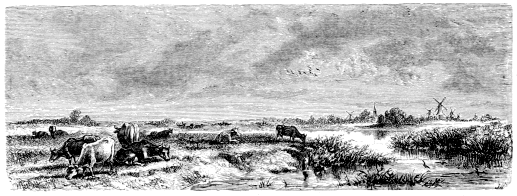
His sole recreation was to go in search of insects in the little soil which Holland offers above the waters. The melancholy meads, covered with Paul Potter's herds, possess, in the moist warmth of the summer, a great variety of animal life. The traveller is much impressed when he sees the crane, the stork, and the crow, elsewhere hostile, reconciled here by the abundance of their food, which they frequently hunt in company on terms of perfect accord. Hence the landscape acquires a peculiar charm. The cattle assume an air of placid security which they do not elsewhere exhibit. The summer is short, and early assumes the gravity of autumn. Man and Nature—all appears of a pacific character, harmonized in a great moral sweetness and remarkable seriousness of mood.
Enthusiastic collector as his father was, he grieved to see the youth of Swammerdam thus employed. It had been his ambition to make of his son a renowned minister who should shine in controversy, and an eloquent preacher. But his son seemed daily to grow more dumb. The chagrined father lowered his views from glory to money. In that golden city, so feverish and so diseased, no career is more lucrative than that of a physician. But here arose another difficulty. Swammerdam threw himself heartily into his medical studies; but on condition that he created them—as yet they did not exist. Therefore, the basis on which he desired to rest them was the preliminary creation of the natural sciences. How cure the sick man unless you understood the healthy? And how understand the latter without studying side by side the inferior animals which translate and explain disease? But can one see into such delicate mysteries with the eye alone? Does not the feebleness of the sense of vision lead us astray? The serious creation of science would suppose a reform of our senses and the creation of optics.
A veritable creation! Look at the microscope. Is it a simple spy-glass? To the eyes which the instrument possessed, Swammerdam added two arms, one of which bears the glass and the other the object. He himself says, in reference to his more difficult investigations, "that he had attempted to obtain the assistance of another person, but that such assistance proved, in fact, an obstacle." It was for this reason that he organized a dumb man of copper, a discreet servant ready for every work; thanks to whom the observer disposes of supplementary hands and numerous eyes of different degrees of power. In the same manner as the birds expand or contract their visual organs, either to grasp objects in a whole or to scrutinize with searching glance the smallest detail, Swammerdam created the method of successive enlargement; the art of employing lenses of different sizes and varying curvature, which permit the observer to see en masse, and to study each separate portion, and finally to survey the whole for the purpose of properly replacing the details and reconstituting the general harmony.
Was this all? No. To observe dead bodies, time is required; but then time robs us of them. Death, which seemingly conduces to study by its immobility, is deceitful; it fixes the mask for a moment, and the object beneath melts away. Now came a new creation of Swammerdam's. He not only taught us to see and investigate, but he devised means for our permanent investigation. By preservative injections he fixed these ephemeral objects; he compelled time to halt, and forced death to endure. The Czar Peter, who, a long time afterwards, saw in the dissecting-room of one of Swammerdam's disciples the beautiful body, supple and fresh, of a little child, with its exquisite carnation tint, thought that the rose was living, and could not be prevented from embracing it.
All this is soon said; but it was long to do. How many attempts! What miracles of patience, of delicacy, of skilful management! In exact proportion as one descends the scale of littleness, the insufficiency of our means proves more and more embarrassing. We can touch nothing without breaking it. Our large fingers will hold no more: they cast a shadow, they throw obstacles in our way. Our instruments are too coarse to seize upon such atoms; therefore we refine them. But then how can we put the invisible point in an invisible object? The two terms in sight avoid us. Only one single passion—the unconquerable love of life and Nature, the undefinable, indescribable tenderness, a feminine sensibility directed by a masculine, scientific genius—could succeed in so great an aim. Our Hollander loved the tiny creatures. He dreaded wounding them so much that he spared the scalpel. He avoided as far as he could the steel, and preferred the firm but nevertheless the delicate ivory. He fashioned in it infinitely small instruments, sharpened by aid of the microscope, which would not work rapidly, and compelled the student to make his observations with due patience.
His tender respect for Nature found its reward. While still a youth, and a simple student at Leyden University, he had two strong holds upon her in her highest and lowest manifestations. He was the first to see and understand the maternity of the insect and the human maternity. The latter subject, so delicate and yet so grand—in which he laboured conjointly with his master at Leyden—I put aside: let us dwell upon the former. He dissected and described the ovaries of the bee: found them in the pretended "king;" and proved that she was a queen, or rather a mother. In like manner he explained the maternity of the ant; an all-important discovery, which revealed the true mystery of the superior insect, and initiated us into the real character of these societies, which are not monarchies, but maternal republics and vast public nurseries, each of which raises up a people.
The most general fact in the life of insects, and the great law of their existence, is the Metamorphosis. Changes which in other creatures are obscure, are in them exceedingly conspicuous. The three ages of the insect appear to be three creatures. Who would have dared to assert that the grub, with its heavy luxuriance of digestive organs and its great hairy feet, was identical with a winged and ethereal being, the butterfly?
He dared to say, and by the most delicate anatomy he demonstrated, that the larva, the pupa, and the butterfly represented three conditions of the same individual, three natural and legitimate evolutions of its life.
How did learned Europe welcome this novel science of metamorphoses? That was the question. Swammerdam, young and without authority, without any position in the academy or university, lived in his cabinet. Scarcely anything of his works was published during his life, nor even fifty years afterwards, so that his discoveries might circulate and advantage all, rather than himself and his fame.
Holland remained indifferent. Eminent professors in the University of Leyden were opposed to him; and took umbrage at the fact that a simple student placed himself by his discoveries on a level with them, or even above them.
The miserable and necessitous condition in which his father left him was not calculated to recommend him greatly in a country like Holland. In his costly labours he was supported by the generosity of his friends. At Leyden it was Van Horn, his professor of anatomy, who defrayed all his expenses.
At this epoch two illustrious academies were founded,—the Royal Society of London and the Académie des Sciences of Paris. But the former, specially inspired by the genius of Harvey, a pupil of Padua, turned its gaze towards Italy, and addressed its inquiries to the distinguished and very accurate observer, Malpighi, who furnished at its request the anatomy of the silkworm. I know not why the Englishmen turned aside from Holland, and did not also interrogate the genius of Swammerdam.
He was honoured only in France. It was here, in the neighbourhood of Paris, that he made the first public demonstration of his discovery. His friend Thévenot, the famous traveller and publisher of travels, collected around him at Issy different classes of savants, linguists, orientalists, and, before all, inquiring students of Nature. Such was the origin of the Académie des Sciences. One might justly say that the revelation of the illustrious Hollander inaugurated its cradle.
A Frenchman rescued from the hands of the Inquisition the last manuscripts of Galileo. A Frenchman also—Thévenot—supported Swammerdam with his purse and credit. He was desirous of establishing him at Paris. On the other hand, the Grand-Duke of Tuscany invited him to Florence. But the fate of Galileo was too strong a warning. Even in France there was little safety. The mystic Morin was burned at Paris in 1664; the very year in which Molière performed the first acts of his "Tartuffe." Swammerdam, who was then residing there, might have been present at both spectacles.
He himself, notwithstanding his positivism, showed very singular tendencies towards mysticism. The more deeply he entered into details, the more eagerly did he long to reascend to the general source of love and life; an impotent effort which consumed him. Already, at the age of thirty-two, excessive toil, chagrin, and religious melancholy brought him to the grave. From his early years he had suffered from the fevers so common in Holland, that land of swamp and morass, and had not paid due attention to them. He studied with his microscope every day from dawn till noon; the remainder of the day he wrote. And for his studies he preferred the summer days, with their strong light and burning sunshine. Then he would remain, with his head bare that he might not lose the smallest ray, frequently until deluged and bathed in sweat. His eyesight grew very weak.
He was already in a feeble condition when, in 1669, he published in a preliminary essay the principle of the metamorphosis of insects. He was sure of being immortal; but so much the more in danger of dying of hunger. His father thenceforth withdrew from him all assistance. Swammerdam by his discoveries (as of the lymphatic vessels and hernias) had very considerably promoted the progress of medicine, and even of surgery; but he was not a physician. From a spirit of obedience he had attempted to practise: he could not continue, and fell ill. He was now without a home. His father shut up his house, retired to live with his son-in-law, and bade Swammerdam provide for himself, and lodge where he would. A wealthy friend had often solicited him to reside with him. When expelled from the paternal roof, he made an effort to seek out this friend and remind him of his offer; but he remembered it no longer.
Misfortunes now accumulated upon his head. Poor and infirm, and dragging himself along the streets of Amsterdam with a large collection which he knew not where to store away, he received another terrible shock—the ruin of his country. The earth sunk under his feet.
It was the fatal year of 1672, when Holland seemed crushed by the invasion of Louis XIV. Assuredly his fatherland had not spoiled Swammerdam; but nevertheless it was the native home of science, of free reason, the asylum of human thought. And lo! she sank, engulfed by the hosts of the French; engulfed in the ocean which she had summoned to her assistance. She lived only by committing suicide. Did she live? Yes; but to be thenceforth no more than the shadow of her former greatness.
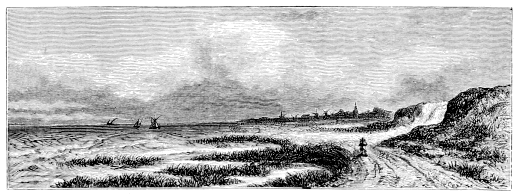
The infinite melancholy of such a change has had its painter and its poet in Ruysdaël, who was born and who died in Swammerdam's time, and, like him, at the age of forty. When I contemplate in the Louvre the inestimable picture which that Museum possesses of him, the one leads me to think of the other. The little man who followed the gloomy route of the dunes at the approach of the storm reminds me of my insect-hunter; and the sublime marine picture of the palisade in the red-brown waters, chafing so terribly, and electrified by the tempest, seems a dramatic expression of the moral tempests which poor Swammerdam experienced when he wrote "The Ephemera"—"among tears and sobs."
The Ephemera is the fly which is born but to die, living a single hour of love.
But Swammerdam did not enjoy that hour; and it seems as if he spent his too brief life in a state of complete isolation. At the age of thirty-six he was already drawing near his end. The depths of imagination and universal tenderness in his nature could not be alimented by the barren controversies of the age. In this condition there accidentally fell into his hand an unknown work,—a woman's book. This sweet voice spoke to his very soul, and somewhat consoled him. It was one of the opuscula of a celebrated mystic of that age, Mademoiselle Bourignon.
Poor as was Swammerdam, he undertook a pilgrimage to Germany, where she resided, and went to see his consoler. He found in the journey a very real assistance in escaping at the least from his contention with the savants, his rivals, in forgetting every collision, and in remitting to God alone his defence and his discoveries.
He longed to withdraw himself into a profound solitude. For this purpose it was necessary he should dispose of the dear and precious cabinet on which he had spent his days, in which he had enshrined his heart, and which had at length become a portion of himself. He must tear himself from it. At this cost he calculated that he would obtain a revenue sufficient for his wants; but the very loss and separation he longed for he could not undergo. Neither in Holland nor in France could buyers be found for the cabinet. Perhaps the wealthy amateurs, who think of nothing but empty éclat, did not find in it the glittering species which give us a child's pleasure. The great inventor's collection offered things more serious: the logical order and arrangement of his discoveries; that eloquent and living method which had guided his genius to new achievements. Alas! it perished, scattered abroad.
Having been for a long time ill, in 1680, either through weakness, or a disgust for life and men, he shut himself up, and would not go out any more. He bequeathed his manuscripts to his faithful and life-long friend, whom, when dying, he himself styled the "incomparable,"—the Frenchman Thévenot. He died aged forty-three.
What really killed him? His own science. The too abrupt revelation wounded and seized upon him. If Pascal saw an imaginary abyss opening before him, what would happen to this Dutch Pascal, who saw the real abyss and the limitless profundity of the unexpected world? It was not a matter of a decreasing scale of abstract greatnesses or of inorganic atoms, but of the successive envelopment and prodigious movements of beings which are the one in the other. For the little we see, each animal is a tiny planet, a small world inhabited by animals still more diminutive, which in their turn are inhabited by others very much smaller. And this, too, without end or rest, except from the powerlessness of our senses and the imperfection of optical science.
All men now began to fathom, and incessantly toil in, that infinity which the hand of Swammerdam had opened up to them. From that time Europe laboured therein with diverse aims. Leuwenhoek, precipitating himself upon it, discovered and conquered new worlds. The Italian positivist, Malpighi, showed perhaps the highest boldness. He proved that the insect has a heart—a heart which beats like man's. One has not far to go to endow it also with a soul. Swammerdam, who was living then, was terrified by the fact. He drew back affrighted from the declivity; he wished to keep his footing, and was fain to doubt the existence of the heart.
It seemed to him that the science to which he had given the first impulse, which he had launched on the flood of his discoveries, was conducting him to something great and terrible which he shrank from seeing: like one who, adrift on the enormous sea of fresh water which dashes headlong in the Niagara Falls, perceives himself impelled by a calm but invincible and mighty movement—whither? He will not, and he dare not, think!
II.—THE MICROSCOPE.
CHAPTER II.
THE MICROSCOPE:—HAS THE INSECT A PHYSIOGNOMY?
Armed with that sixth sense which man has achieved for himself, I can move forward, at pleasure, in any direction. It is in my power to track out, to reach, to compute the spheres, and gravitate with them in their vast orbits. But I feel much more strongly attracted towards the other abyss—that of the infinitely little. In its atoms I discover an intensity of energy which charms and astounds me. And I myself, what am I but an atom? Neither Jupiter nor Sirius, those enormous globes at so great a distance from, and possessing so little sympathy with me, will teach me the secret of terrestrial life. But these, on the contrary, surround and press upon me, injure me or lend me their assistance. If they are not of my own kind, they are at all events associated with me.
Ay, fatally associated.
And yet I cannot fly from them: swarms haunt the very air which I breathe,—what do I say? float in the fluids of my body. It is my interest to know them. But my sovereign interest is to escape from my deplorable and wretched ignorance, and not to quit this world until I have peered into the infinite.
Full of such ideas, I addressed myself to one of the philosophers of the present day who have made the greatest and most successful use of the microscope,—the celebrated Dr. Robin. Under his direction, I purchased from the skilful optician Nachet an excellent instrument, and planted myself before my window on a very beautiful day.
I have said it,—the microscope is much more than a mere magnifying glass. It is an aid, a servant who has hands to supplement your own—eyes, and movable eyes, which by their changes enable you to see an object at a suitable magnitude, and either in detail or as a whole. One perfectly understands the all-absorbing attraction which it exercises; however great the fatigue it causes, one cannot separate one's-self from it. Its début, as we have seen, was signalized by its slaying its creator, Swammerdam. How many workmen has it not since deprived, if not of life, at least of sight? The first of the two Hubers became blind at a comparatively early age. The illustrious author of the great work on the cockchafer, M. Strauss, is nearly so. Our pallid but enthusiastic Robin is already on the same descent, but pursues his studies without pause. The seduction is too potent. Who can renounce the truth, after once beholding it? Who can willingly return into the world of errors wherein men exist? Better not to see at all, than always to see things falsely.
Behold me, then, face to face with my little man of copper. I lost not an instant in interrogating the oracle. And its first and somewhat rough reply respecting the two objects I presented was:—
One was the human hand, white and delicate,—the left hand, the idler, and that of a person who did no work.
The other, a spider's foot.
To the naked eye the former object seemed agreeable enough; the other, a tiny, obscure blade, of a dirty brown, and somewhat repulsive.
In the microscope the effect was precisely the opposite. In the spider's foot, easily cleansed of a few downy spots, appeared a magnificent comb of the most beautiful shell, which, far from being dirty, by its extreme polish was rendered incapable of being soiled; everything glided off it. This object would seem to serve two ends: that of a very delicate hand, through which the spinner, in rising or descending, suffers its thread to glide; and that of a comb, with which the attentive labourer holds its stuff, while at work, in the required position, until the woven threads—more like a cloud—grow firm and strong, are dried by the air, and no longer fall back floating and wavy, but useless.
As for the human hand, the part exposed under the microscope seemed, even with the smallest lens, a vague and immense substance, incomprehensible through its very coarseness.
Even with a medium lens, of only twelve or fifteen times magnifying power, it seemed to be a yellowish, reddish tissue, coarse and dry, ill-woven,—a kind of wiry taffeta, in which each mesh was irregularly puffed up.
Nothing could be more humiliating!
This pitiless judge, pitiless even in its treatment of the flowers, behaves with terrible severity towards the human flower. The freshest and most charming will act wisely in not attempting the experiment. She would shudder at herself. Her dimples would deepen into abysses! The light down of the peach which crowns her beautiful skin with the bloom of delicacy would show like rough thickets, or rather like savage forests.
After my first experiment, I felt that the too truthful oracle not only altered our ideas of proportion, but of appearances, colours, forms—transfiguring everything, in fact, from the false to the true.
Let us be resigned. Whatever the organ of truth may tell us, I thank it, and I will welcome it though it declare me to be a monster. But such is not the case. If it change with some severity our notions of the surface, on the other hand it reveals to us worlds of truly unbounded beauty beneath it. A hundred things in anatomy which seem horrible to the unassisted sight, acquire a touching and impressive delicacy, and a poetical charm which approaches the sublime. This is not the place for discussing such a subject. But a mere drop of blood, of a brickdust-red by no means agreeable to the naked eye, heavy, thick, and opaque, if you look at it when dry, under the magnifying glass, presents to you a delicious rose-bloom arborescence, with delicate ramifications as fine and subtle as those of the coral are coarse and dull.
But let us keep to our insects. Let us select the most miserable—the wonderfully little butterfly of the clothes-moth, that dirty white butterfly which seems the lowest of created beings. Take only his wing. Nay, far less, only a little dust, the light powder which covers his wing. You are astounded at seeing that Nature, exhausting the most ingenious industry in order that this offcast of creation may fly at his ease, and without fatigue, has scattered over his wing, not dust, but a multitude of tiny balloons. Or, if you prefer it, so many parachutes, most convenient instruments for flight, which, when opened, sustain the little aeronaut without fatigue and for an indefinite period; which, as they are more or less expanded, enable it to rise or sink; and when folded up, permit of its remaining quiet. The least of the butterflies, thus supported, has a faculty of flight as unlimited as the noblest bird of heaven.
One grows keenly interested in these curious apparatus, which have anticipated our human inventions. One observes their strange and surprising modes of action, as one would observe the inhabitants of another planet, if he were miraculously transported thither. But what one most yearns to see, what one burns to detect, is some reflection from within, some gleam of the torch which is concealed in their inner existence, some appearance of thought. Have they a physiognomy? Can I seize in their strange visage any trace of an intelligence which, judging by their works, so closely resembles our own? Of the expression which touches me in the eye of the dog, and of other animals related to me, shall I detect nothing in the bee, the ant, in those ingenious beings, those creators, which accomplish so many things the dog cannot accomplish?
A clever man once said to me: "As a boy I was very partial to insects; I searched about for caterpillars, and made a collection of them. I was especially curious to look in their faces, but never succeeded. All that I could distinguish was confused, dull, melancholy. This discouraged me. I left off making collections."
I was but a child in this new study; that is, I was fresh to it, and curious. My special anxiety was to interrogate the countenance of the dumb little world, and to surprise there, in default of voice, the silent thought. Thought? At least, the dream, the obscure and floating instinct.
I addressed myself to the ant; an humble being in form and colour, but endowed with a prodigious amount of social instinct and of the educational capacity; not to speak of its quickness of resource, of the promptitude with which it confronts perils, and chances, and embarrassments.
I take then an ant of the commonest species—a neutral ant—one of the workers who are relieved from the wants of love, and in whom therefore the sex, diminished to a minimum for the advantage of labour, develops so much more powerfully its extraordinary instinct; who alone perform all the diverse trades of the little community, and are purveyors, nurses, architects, and inventors.
I selected a very fine, serene, and luminous day—not luminous with the glare of summer, but the calm radiance of autumn (1st September 1856). I was alone, in a state of perfect silence and repose, and in that complete forgetfulness of the world which is so rarely obtained. After the manifold agitations of the past and present, my heart for a moment was at peace.
Never was I more ready to hear the mute voices which do not address themselves to the ear, to penetrate in a calm and benevolent spirit the mystery of the little world which on every side surrounds us, and yet has hitherto remained out of our reach and apart from our communications.
Alone with my ant, armed with a tolerably good lens, with a magnifying power of twelve, I placed it delicately on a large sheet of fine white paper which covered nearly the whole table.
With the microscope I could have seen but a part and not the whole. A very considerable enlargement would also have exaggerated the merely secondary details—such as the scanty hairs with which the ant is provided. Finally, its mobility would not have suffered me to keep it in the focus of the microscope; but the lens, as easily shifted as itself, followed it in all its motions.
Not, however, without some difficulty. It was lively, alert, disquieted, and impatient to quit the table. I was looking at it in the middle of the sheet, when it was already nearly at the edge. I was obliged to etherize it a little, so as to stupefy it, and render it less uneasy.
It appeared very clean, and highly varnished. Though a neuter, and not a female, its belly was rather large, and was joined to the chest by two small swellings. From the chest the head, which was strong and nearly round, detached itself cleanly and distinctly.
This head, seen as it were en masse, resembled a bird's. But instead of a beak it had a circular prolongation, in which, on attentive examination, I detected the reunion of two tiny crescents joined at the point. These were its teeth, or mandibles, which do not operate like ours, from above to below, but horizontally and sideways. The insect employs its mandibles for the most widely different purposes; they are not only its weapons and instruments of mastication, but the tools it uses for every art, supplying the place of hands in masonry, plastering, carving, and in lifting and transplanting burdens which are frequently of enormous weight.
It was well for it that its body was wrapped in a complete coat of mail. The ether affected it but slightly, and only stupefied it. After a moment's immobility it partly recovered, and made a few movements like those of an intoxicated person, or as if it were affected with a fit of vertigo. It seemed to say, "Where am I?" and endeavoured to make out the ground where it was walking, the great sheet of white paper. It attempted a few tottering steps, tumbling first on one side and then on the other. It carried before it a couple of instruments which at first I took to be feet, but which I found, on more careful inspection, were wholly different.
They sprang from a point near either eye, and, like the eyes, were evidently instruments of observation. These antennæ, as they are called, long, delicate, yet robust, and vibrating at the slightest touch, are fleshy, articulated in twenty pieces, and disposed one in another. They form an instrument admirably adapted for feeling and groping. But it is useful in many other ways: by means of it the ants transmit in a second very complicated advices, as, for instance, when they change their course and retire, or suddenly take a wholly different road; evidently they have a language like that of the telegraph. This supposed marvellous organ of touch is more probably a species of hearing apparatus, and so mobile that it quivers at the slightest vibrations of the air, and feels every wave of sound.
The perfect accord of every movement of the delicate and subtle tactile and telegraphic apparatus, the strong head, in fine, which seemingly thinks, completed the illusion. Its attitudes, its gropings, its efforts to obtain a knowledge of the situation, showed precisely what we should have been under similar circumstances. Shakespeare's Queen Mab, in her nut-shell chariot, occurred to my mind. And more, the chronicles of the Hubers; those impressive and almost terrifying narratives which would lead us to believe that the ants are far advanced in a knowledge of good and evil.
It turned its back upon me obstinately, as if it dreaded to see its persecutor. It looked upon me as a horrible giant, and, despite its semi-intoxicated condition, made constant and energetic efforts to escape me, and place itself in security.
I brought it back very softly and cautiously. But I could not make it show me its face. Its antipathy and its terror, undoubtedly, were too powerful. I therefore decided to take hold of it with a small pair of pincers, and to keep it on its back, using as little pressure as possible. The pressure, though light, acting on the small lateral orifices (or stigmata) through which it breathes, was infinitely painful, to judge from the resistance it offered. With its minute claws and mandibles it held the pincers so firmly that I could hear the air vibrate with every motion. I hastily profited by the painful position in which I had placed my ant; I looked it in the face.
That which is most disconcerting, and gives it a peculiar appearance, are the teeth or mandibles placed outside the mouth, and springing, one on the right side, the other on the left, in a horizontal direction, so as to meet together: ours are vertical. These projecting teeth seem to offer battle, though, as I have said, they are also used for pacific purposes, and serve as hands.
Behind the teeth may be seen several little threads or palpi at the entrance of the mouth; which are, in reality, the little hands of the mouth,—feeling, and handling, and turning over whatever is brought there.
In front emerge the antennæ, the other hands; but these are set externally, are mobile and susceptible to an excess,—in a word, electric hands.
Behind the head, at the chest, commence the paws or feet, two in front of great dexterity, and rightly named by Kirby the arms.
An apparatus of such complexity, placed in the fore part of the body, cannot fail to obscure and overcloud its physiognomy. What would be the case with our own, if from our eyes and mouth six hands started, to say nothing of those which proceed from the shoulders, and of four others placed lower down?
The whole is intended for action and defence. The face which the insect shows is its resisting skull, its bony case, which cannot move. This frames, encloses, and fixes the eyes, which are also immovable; but, being exterior and multiple, motion is not necessary: those of the ant are divided into fifty facets, which reveal everything to it either in front or rear. Thus, then, its sight is admirable, but it cannot look. No external muscle sets the mask in motion. And, therefore, it has no physiognomy.
But, in compensation, its pantomime was extremely expressive,—I may even say, very pathetic. On discovering that it was so feeble and incapable of walking, it did exactly what prudent and sagacious man would have done, and attempted to recover its energies by the very means which we should have employed. It commenced a methodical friction of its entire body, from above to below. Seated like a little monkey, it skilfully made use of its arms or anterior feet in such a manner as to rub its back and side. Occasionally it returned to its head, took it between its two hands, as if it would fain have shaken it clear of the fatal intoxication which rendered it so little able to provide for its own safety. One would have said it was questioning itself, collecting its thoughts, and saying, as we do after a bad dream, "Is it true, or is it false?—Poor head!—Alas! what ails thee, then?"
At that moment I felt that we were living in two worlds, and that there were no means of understanding each other. How could I reassure it? My language, that of the voice; its, that of the antennæ. Not one of my words could obtain access to the electric telegraph which served as its organ of hearing.
The continuous bony case which envelops its body isolates the insect from us, and conceals us from the insect. It has a heart which beats like ours; but we cannot see its pulsations beneath its thick coat of mail. It does not even command that wordless language which touches us in so many dumb beings. It is wholly wrapped up in mystery and silence.
It breathes, or rather imbibes air, through the sides, not through the face or head. No palpitation or respiratory movement can be detected in it. Therefore, how should it speak, how complain? Of all our languages it has not one; it makes a sound, but does not possess a voice.
Is the fixed and immovable mask, thus condemned to perpetual silence, that of a monster or a spectre? No. After watching its movements, its numerous actions indicative of reflection, its arts so much more advanced than those of the larger animals, we are not unwilling to believe that in this head exists a personality. And from the highest to the lowest in the scale of life, we recognize the identity of the soul.
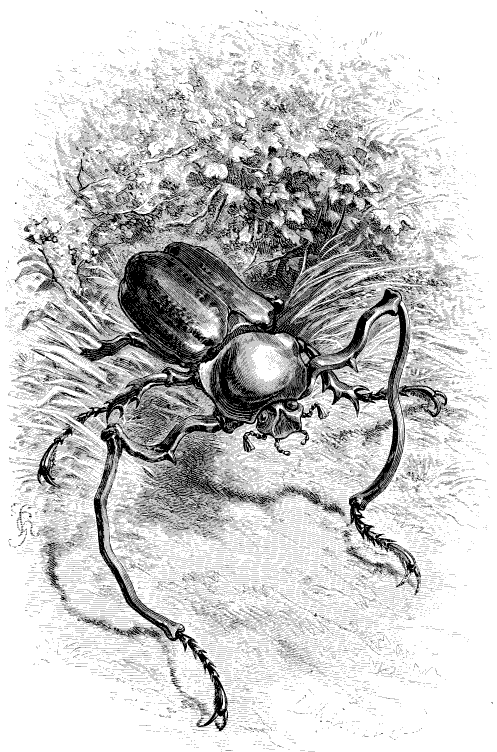
III.—THE INSECT, THE AGENT OF NATURE.
CHAPTER III.
THE INSECT AS THE AGENT OF NATURE IN THE ACCELERATION OF DEATH AND LIFE.
The insect has not my languages. He neither speaks by voice nor physiognomy. In what manner, then, does he express himself?
He speaks by his energies.
1st. By the immense destructive influence he exercises on the superabundance of Nature, on a swarm of lingering or morbid lives which he hastens to sweep away.
2nd. He speaks also by his visible energies, especially in the moment of love, his colours, his fires, his poisons (many of which are among our therapeutic agents).
3rd. He speaks by his arts, which might fecundate our human inventions.
This is the subject of our second book.
Let us first attack the point where he wounds us most, and seems the auxiliary of death: his immense, ardent, and indefatigable work of destruction. Let us contemplate him in history, and begin at the remotest epoch.
In answer to our littlenesses, our disgusts, our terrors, to the narrow and egotistical judgments which we bring to bear upon such subjects, we must recall the great and necessary reactions of Nature.
It has not advanced with the order of a continuous flood, but with refluxes and recoils back upon itself, which have enabled it to compass a perfect harmony. Our short-sighted survey, frequently arrested by these apparently retrograde movements, grows alarmed, takes fright, and misconceives the character of the whole.
It is peculiar to the Infinite Love, which is continuously creating, to raise every created thing to the Infinite. But in this very infinity, it stimulates a creation of antagonisms which shall reduce the extent of the preceding. If we see it produce monstrous destroyers, be sure that they are destined, as a remedy and a repression, to check some monsters of fecundity.
The herbivorous insects have had the task of keeping under the alarming vegetable accumulations of the primeval world.
But these herbivora exceeding all law and all reason, the insectivorous insects were created to confine them within limits.
The latter, robust and terrible, the tyrants of creation by their weapons and their wings, would have been the conquerors of the conquerors, and have driven to extremities the feebler species, if, above all the insect world and its weak powers of flight, had not risen on mighty wing a superior tyrant—the Bird. The haughty libellula was carried off by the swallow.
By these successive agencies of destruction, however, production has not been suppressed, but restrained, and the species balanced in such wise that all endure and live. The more a species is pruned, the more fertile it becomes. Does it exceed? Immediately the superabundance is equilibrized by the new fecundity which is given to its destroyers.
Ye men of this lingering epoch,—sons of the lean and sober West—brought up in the little, close, carefully tended, pared, and picked gardens, which you call "wide cultivation,"—enlarge, I pray you, your conceptions; extend them, and endeavour to imagine something greater than these petty corners, if you would comprehend anything of the earth's primitive forces; of the abundance and superabundance which she displayed when, soaked with warm mists, her bosom heaved with the glow of her first youth.
The hotter countries of our present globe still show something of this profusion, though in a pale decay. Africa, which over the greater portion of its area has lost its waters, preserves as a souvenir in its happier zones that enormous and swollen herb, or herbaceous tree, the baobab. The inextricable forests of Guiana and Brazil, in their labyrinthine chaotic confusion of wild plants which, without rule or measure, envelop and choke the colossal trees, corrupt them, and bury them in their débris, are but imperfect images of the great ancient Chaos. The only beings impure enough to endure its impurity and breathe its deadly exhalations, are great-bellied reptiles, unwieldy frogs, green caymans, and serpents swollen with filth and venom. And such would have been the inhabitants of earth. Unable to draw breath in the horrible suffocation, she could never have given forth that pure air in which man alone can live.
Accordingly, from on high pounced down the bird, and, plunging into the gulf, carried back to the sky on the tops of the lofty forests some one of these monsters. But its incessant struggle would have been vain against their abominable fecundity, if, from below, myriads of nibblers had not lightened the accumulation, cleansed the frightful lairs, and thrown open to the arrows of the sun the filth under which earth was panting. The humblest insects accomplished the gigantic work which made earth inhabitable: they devoured chaos.
"Small means," you say, "and great results! How could these little beings come to the aid of an infinity?" You would not cherish the doubt, if you had been ever a witness of the awakening of the silkworms, when, one morning, they are hatched with that vast hunger no abundance of leaves can satisfy. Their proprietor has supposed himself in a position to content them with a rich and beautiful plantation of mulberry-trees; but it counts for nothing. You supply them with forests, and they still ask for more. At a distance of twenty or thirty yards you hear a strange uninterrupted buzzing; a murmur like that of brooks incessantly flowing, and incessantly grinding and wearing out the pebbles. Nor are you mistaken: it is a brook, a torrent, a boundless river of living matter, which, under the grand mechanism of so many minute instruments, sounds, and resounds, and murmurs, passing from the vegetable life to that of insects, and softly but invincibly bases itself on animality.
To return to the primeval age. The most terrible destroyers, the most implacable assailants, which penetrated the lowermost rottenness of the great chaos, which at a higher level delivered the tree from the pressure of its parasites, and finally mounted to its branches, and brightened up the livid shadows,—these were the benefactors of species yet to come. Their uninterrupted work of unconquerable destruction reduced within reasonable limits the excess in which Nature was almost lost. They opened up splendid, free, and unencumbered spaces; and the monsters, banished from the gulf where they swarmed, grew more and more barren, and by that great revelation of the forest were exposed to the child of Light,—the Bird.
A profound agreement and genial fellowship were established between the latter and his protagonist, the child of Night, the Insect, which had thrown open the abyss, and delivered into his power the enemy. Consider, moreover, that in proportion as an exuberant nourishment fortified and exalted the insect, when its blood was intoxicated by so many burning plants, a ferocity previously unknown prevailed, and the fiercer and bolder species no longer limited themselves to undermining the retreats of the monsters, but attacked the monsters also. Stings, augers, cupping-glasses, trenchant teeth, sharpened pincers, an arsenal of unknown and as yet unnamed arms, came into existence, were elongated and whetted for assault upon the living matter. They were needed. They proved to be the lancet which cut the putrescent sore of the rising world. This latter had nourished and multiplied the feebly animalized myriads of torpid worms and pale-blooded larvæ, a ghastly and also the lowest life, which gained by passing through that burning crucible of keen existence, the superior insect-race.
I know nothing upon earth which seems stronger, firmer, more durable, and more formidable than those miniature rhinoceros-like cuirassiers, which traverse earth as quickly as the great mammal traverses it heavily and slowly. The carabi, the galeritas, the stag-beetles, which carry with so much ease armour far more formidable than that of the Middle Ages, reassure us only by their size. Here strength is relatively formidable. Were a man proportionally strong, he might take in his arms the obelisk of Luxor.
Vast energies of absorption, concentrating in these insects enormous foci of forces, translated themselves into the light by the energies of colour. To these, in species where life was more elevated, succeeded the moral energies. The superbly barbarous heroes, the scarabæi, were exterminated by the modest citizen-species, the ants and bees, in which the secret of beauty was harmony.
Such is the whole history of insects. But to whatever height our inquiries may conduct us, let us not mistake the point of departure, —the useful nibblers and miners, which have elaborated and prepared the globe.
Is their work terminated? By no means. Immense zones remain in what may still be called an ancient condition, condemned to a terrible and unwholesome fecundity. In the centre of America the richest forests of the world seem ever to repel the approach of man, who enters them only to die. His arms, enfeebled by fever, have not even strength enough to collect their treasures. If a tree fall across his path, it becomes an insurmountable obstacle to the indifferent adventurer. He turns aside, and you may trace his circuit through the tall herbage. Fortunately the termites do not recoil so easily. If they find themselves confronted by a tree, they do not avoid it, do not turn its flank. They attack it bravely in the front, set to work as many labourers as are necessary—millions, perhaps: in two or three days the tree is devoured, and the road open.
The great law of nature, and in these countries the law of safety, is the rapid destruction of everything decaying, languishing, stagnant, and therefore injurious; its ardent purification in the crucible of life. And that crucible is, before all things, the insect. We must not blame its fury of absorption. Who thinks of accusing the flame? The flame is worthy of reproach only when it does not burn. And, in like manner, that living fire, the insect, is created to devour. Necessity demands that it should be eager, cruel, blind, and of an implacable appetite. It can have no sobriety, no moderation, no pity. All the virtues of man and of superior beings would be nonsense which one cannot even imagine. Can you conceive of an insect with the sensibility and tenderness of the dog? which should weep like the beaver? which should nourish the aspirations and poetry of the nightingale? or, finally, the compassionateness of man? Such an insect would be incapable; thoroughly unfit for its profession as the anatomist, dissector, and destroyer—we may say, more justly, the universal medium of nature, which, precipitating death by suppressing long periods of decay, in this way accelerates the brilliant return of life. Thus disembarrassed and free, it says, with a savage pleasure, "No maladies, no old age! Shame upon all decay! Hail to eternal youth! Let every creature die which lives beyond a day!"
Observe that the furious eagerness of the winged insects, which seem to be the agents of death, is frequently a cause of life. By an incessant persecution of the sick flocks, enfeebled by hot damp airs, they ensure their safety. Otherwise they would remain stupidly resigned, and hour after hour grow less capable of motion, gloomier and more morbid in the bonds of fever, until they could rise no more. The inexorable spur knows, however, the secret of putting them on their legs; though with trembling limbs, they take to flight; the insect never quits them, presses them, urges them, and conducts them, bleeding, to the wholesome regions of the dry lands and the living waters, where, growing discontented, their furious guide abandons them, and returns to the pestilent vapours, to its realm of death.
In the Soudan, in Africa, a little insect, the Nâm fly, directs with a sovereign authority the migrations of the flocks. In the dry season it rages against the camel; it audaciously ventures into the ear of the elephant. The giant is resistlessly driven forward by its winged shepherds, to escape the fires of the south, and to seek the fresh winds of the north. On the other hand, the oxen, through its management, remain with their Arab master peacefully in the genial southern pastures.
The most terrible of insects—the great Guiana ants—are valued precisely for their devouring power. Without them, no effectual means would exist of thoroughly cleansing the homes of man of all the obscure broods which infest the shadows, and swarm in the timbers and framework, in the most imperceptible crevices. One morning the black army appears at the door of the house: an army of sanitary inspectors. Man retires, gives place to them, and evacuates his dwelling. "Enter, ladies; come and go at your pleasure; make yourselves quite at home." It would not be safe for the owner to remain, since it is a law with these scrupulous visitors to leave no living thing in the track of their march. In the first place, every insect,—the largest as well as the minutest,—and their eggs, however well-concealed, perish. Then the smaller animals—frogs, adders, field-mice;—none escape. The place is thoroughly cleansed, for the smallest remains are conscientiously devoured.
The great spiders of the Antilles, without piquing themselves on accomplishing a work of purification so terrible and so complete, labour nevertheless very industriously to secure the cleanliness of human habitations. They will not suffer any disgusting insect to exist. They are excellent servants—much cleaner than the slaves. Therefore men value them, and purchase them as indispensable domestics. Markets exist where spiders are regularly bought and sold.
In Siberia, the spider enjoys the consideration to which it can everywhere put forward so many claims. That region of the farthest North, whose very brief summer is not the less infested with gnats and flies, finds a benefactor in the useful insect which industriously hunts the swarms for man's advantage. Its consummate prudence, its superior ability, its prescience of atmospheric variations and climatic phases, have so exalted the idea which the Siberians have formed of it, that many of their tribes refer the creation of the world to a gigantic spider.
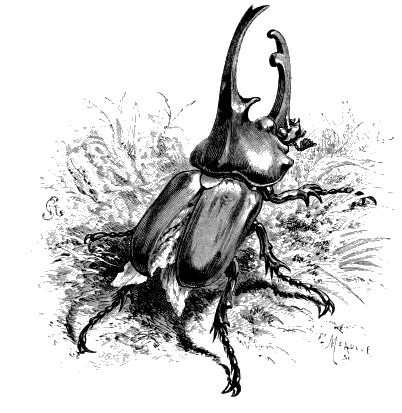
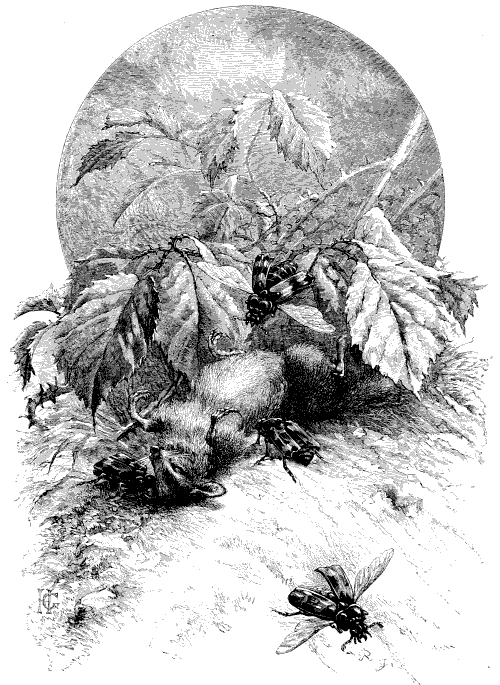
IV.—THE INSECT AS MAN'S AUXILIARY.
CHAPTER IV.
THE INSECT AS MAN'S AUXILIARY.
A hunter of small birds, in an ingenious academical memoir, gives utterance to the following paradox: "Their recent multiplication is the cause of the disease in the vine and the potato."
How should this be? The disease, which first broke out in September 1845, is produced, says the author, by microscopic animalcules and parasitical vegetation previously destroyed by the insects. But these insect-protectors of agriculture perished, devoured by birds, in 1844. The fatal law passed in the May of that year, for the protection of the birds, must have multiplied them to such a degree, that the insects, driven out and destroyed by them, could no longer afford to our plants the succour which defended them against their invisible enemies.
This hypothesis, supported with much wit and ability, and apparently grounded on facts and dates, rests wholly on one basis, and if it fails, crumbles to the ground.
It supposes that the birds have been efficaciously protected by the law, and that, in twelve years, they have been so able to multiply as to become masters of the field, the tyrants and exterminators of the useful insect-species, and that, in fine, the latter have unfortunately almost disappeared.
To this three replies may be given:—
1st. The birds have not multiplied. We must not go for the truth to the Bulletin des Lois (the Statute-book), but to fowlers and bird-catchers. And they reply:—"So many birds have been destroyed since the enactment of the law for their benefit, that in certain countries sport has actually become impossible, because there are no more to kill."