Front matter (continued 3)
Reading edition
In Provence, in the very localities where the gnats are insupportable (and the birds, therefore, most precious),—in the Camargue,—the sportsmen, in default of edible birds, now kill the swallows. They place themselves on the watch at the points where the winged legions pass in files, and slaughter several victims at one discharge.
2nd. The insects have by no means been destroyed by the birds. Ask of the agriculturists what species has disappeared. Let them search ever so keenly, and they will not find that a solitary species has diminished. On the contrary, in the years referred to we have seen them increase, and grow, and flourish, and nothing prevents them from making war at their pleasure on the invisible animalcules.
Not an insect-species is wanting; but, on the contrary, some careful observers tell us, in their books on Hunting or Natural History, that numerous species of birds will soon become extinct.
3rd. Birds are not, as the author of the memoir calls them, "unintelligent assassins." Far from this, they kill by preference the most injurious insects. The time at which they carry on a really murderous war is when they are feeding their young. But what do they feed them with? With very few insectivorous insects; the latter, armed and mailed—carabi and stag-beetles—covered with metallic scales, equipped with hooks and pincers, of an indestructible vitality, would be a horrible food for the young of the warbler, who, before such a provision, would assuredly take to flight. This is not the kind of aliment the sagacious mother seeks for her offspring; but soft and, as it were, milky insects, fat and succulent larvæ, fine little tender caterpillars,—all herbivorous, fructivorous, and leguminivorous animals; exactly those which do the greatest mischief in our fields and gardens.
Accordingly, the great labour of the bird against the insect precisely coincides with the labour of the husbandman.
For the rest, we are far from saying, as the author referred to makes us say, that the bird is the sole purifier of creation. One must be blind, and indeed senseless, not to see that he shares this mission with the insect. The action, too, of the latter is undoubtedly more efficacious in the pursuit of a world of living atoms, which the insect, whose eyes are microscopes, detects and pounces upon in numerous obscure corners, inaccessible to the bird. The bird, on the other hand, is the essential purifier of everything demanding long-sightedness and the power of flight,—as, for example, the frightful clouds of invisible animalcules which float and swim in the air, and therefore pass into our lungs.
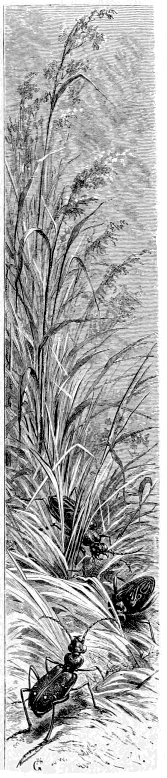
As a rule, the equilibrium of species is desirable. All are more or less useful. We willingly join with the author of the paper referred to in the wish that those insects which prey upon the smaller species might be specially distinguished and spared. The peasant destroys them indiscriminately, without knowing that by killing, for instance, the dragon-fly (or libellula)—the brilliant murderess which slays a thousand insects daily—he is helping the latter: becomes the auxiliary of the insects, the preserver and propagator of the enemies which devour his substance. The terrible cicindela does not fly so high, but with its crossed daggers, or rather the two scimitars which serve it for jaws, accomplishes a swift and almost incredible havoc among the smaller insects. Take care, then, and respect it. Do not listen to the child who is dazzled by the beauty of its wings, nor, to please him, impale on the needle-point your admirable insect-hunter, the efficacious auxiliary of the agriculturist!
The carabi,—immense warrior-tribes armed to the very teeth, and displaying an ardent activity beneath their heavy coats of mail,—are the true guardians of your fields; and day and night, without holiday or repose, protect your crops. They themselves never touch the smallest blade or seed. Their sole occupation is to capture thieves, and they ask for no other reward than the thieves' bodies.
Others toil underground. The innocent lobworm, which pierces and stirs up the soil, gets ready in a marvellously excellent manner the muddy and clayey earths which are deficient in evaporation. Others, in company with the mole, hunt far down in the depths the cruel enemy of agriculture, the horribly voracious larva of the destructive cockchafer, which, for three years, has been preying on the roots beneath the surface.
The insectivorous insects put forth undeniable claims to the protection of man, whose allies they are. But even among the herbivora there are useful destroyers of harmful plants. The useless, pungent, and in every sense disagreeable nettle, which scarcely a single quadruped will deign to touch, fifty species of insects, in fellowship with ourselves, labour to destroy.
A very beautiful class of insects, some rich in outward garb, and others in intelligence, are the Necrophori, which render us the important service of clearing away all dead matter from the soil. Nature, which finds them so useful, has treated them truly as her favourites, honouring them with splendid costumes, and making them both industrious and ingenious in the discharge of their functions. It is a remarkable circumstance that, notwithstanding their sinister office, they are far from being wild, but are very sociable if the need arises, and understand how to unite their forces, combine their energies, and act in concert. In brief,—these honest undertakers and grave-diggers are the brilliant aristocracy of the insect nation.
It is evident that Nature's ideas are not the same as ours. She loads the most useful with rewards, whatever the nature of their work. For instance, the Geotrupes, which clears away the dung, is clothed in sapphire in payment of its service. The celebrated Coleopteron of Egypt, the sacred Ateuchus of the tombs,[J] appears glorified with an emerald aureola.
Who shall describe all the services rendered by these scavengers? Yet we are not just in our dealings with them. It happened to me, one April, when I was about to transplant to my garden some dahlias which had passed the winter in the orchard, to discover that the humidity of the air of Nantes, and the compact and imporous clayey soil, had rotted the tubers. A bevy of insects were at work upon them, and usefully engaged in purging this shocking centre of dissolution. The gardener was very indignant, and ready enough to accuse them of the evil which they were endeavouring to remedy.
The enemy of damp gardens, the snail (Helix), is pursued by an insect,[K] the Drylus, which lies in wait for it, and, the better to hunt it up, mounts on its back, and makes it carry him, seizes a favourable opportunity, and on the snail re-entering its shell, enters also, lives with it and upon it. A snail lasts him about a fortnight. Then he passes on to another and a larger, and then to a third still larger. He requires three in all. In the third, as he is about to change into a pupa, the drylus makes the place clean, and, to sleep conveniently, seizes on the substantial house of the enemy which has nourished him.
There could be no more useful task than to enlighten the peasant on the distinction that ought to be made between insects useful to agriculture and insects which are noxious; or those which may be turned to advantage in various sciences,—and especially in Chemistry,—which, it is probable, will yet discover unexpected resources in beings endowed with so copious and intense a vitality. In this respect, a very honourable work of initiation has been undertaken by the eminent naturalist who has so skilfully organized the museum at Rouen. All his pupils have preserved a grateful recollection of their teacher; and it is to one of them I owe the following summary of an original and instructive lecture on the Insect as Food.
"A prejudice much to be regretted, and a ridiculous fastidiousness, has debarred our Western peoples from one of the richest and most exquisite sources of nourishment. What right have they who devour tainted game, and unclean birds,—what right have the lovers of the oyster, that slimy mollusc, to reject the nourishment supplied by the Insect World?
"Burgundy has the good sense to profit, without any feeling of silly disgust, by the excellent mollusc which peoples its vineyards,—I mean the snail,—which is very good with butter and salads, and a dish as wholesome for the chest as it is agreeable to the mouth and profitable to the stomach.
"A celebrated savant—Lalande—dared to take a step further in advance, and to venture upon the caterpillar, rising thus another step above our prejudices. It is to him we owe our knowledge of the fact that the caterpillar tastes like almonds, and the spider like hazel-nuts. He addicted himself to the latter, which he found more delicate."—I should think so. In every sense, the spider is a superior being.
"Many insects are so nutritious and savoury that they have been specially selected by ladies as a diet likely to renew their life, beauty, and youth. The Romans of the Later Empire recovered the ample outlines of the Cornelias of the Commonwealth by the use of the Cossus.[L] The sultanas of the East, of those voluptuous lands where love seeks the rounded, swelling figure, make their slaves bring them a supply of Blaps,[M] and idling in their gardens, to the music of leaping fountains, imbibe from the succulent insect an eternal youthfulness.
"In Brazil, the Portuguese extracts from the Malalis of the bamboo, when the tree wears its nuptial flower, a kind of fresh butter for the table; and eats the ants in sweetmeats, at the moment that their wings uplift them on the breeze like an aspiration of love.
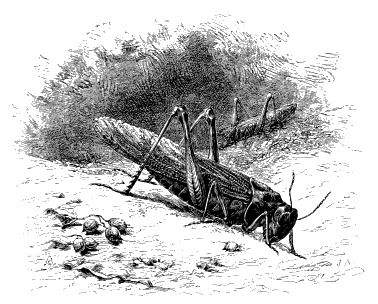
"But generally the insect, apart from its real value, has been hunted by the peasants whose tillage it destroyed. It plundered them of their food, and, in revenge, they themselves have fed upon it. The terrible locust, whose vast increase has so often imperilled the East, has been, on that very account, the more eagerly pursued and devoured by the Orientals. The story runs that the Caliph Omar, when seated at his family table, observing a locust alight there, read inscribed upon its wing:—'We hatch nine and ninety eggs; if we laid a hundred, we should devastate the world.'
"Fortunately the locust is the manna of Asia. Who does not know that the prophets, musing in the caves of Carmel, ate nothing else? The Mohammedan anchorites adopted the same régime. One day a person said to Omar:—'What think you of locusts?' 'That I would fain have a basketful.' Soon afterwards the supply failed him. It was with difficulty his servant found a single insect; whereupon he, delighted and grateful, exclaimed, 'Allah is great!'
"Even at the present day locusts are sold throughout the East, and are eaten in the café as a dessert and a delicacy. Ships are loaded with them, and they are bought and sold by the cask.
"Here, then, we have insects exceptionally nutritious and substantial. What prevents us from making use of them? What scruple hinders us from active and useful reprisals against them?"
At this part of his discourse, the orator found his audience, consisting mainly of intelligent Norman peasants, wrapped in deep attention, as at those points of the debates of the British Parliament when the accustomed cry arises of "Hear! Hear!"
He had foreseen such a moment; and having loaded his table with some of the insects most dreaded by agriculturists, he seized them, crunched them, and swallowed them gravely, with this strong speech, which will not be without fruit:—"They have eaten us: let us eat them!"
V.—A PHANTASMAGORIA OF LIGHT AND COLOUR.
CHAPTER V.
A PHANTASMAGORIA OF LIGHT AND COLOUR.
If the insect does not and will not speak to us, are we to suppose that it does not express the burning intensity of the life within it?
No living creature reveals itself more clearly; though only from itself to its kind, from insect to insect. They are bound up in themselves; are a sealed world, which has no outward expression, and no language except for its own members.
For all ordinary purposes, an electric telegraph exists in their antennæ. But the great, the eloquent language is manifested among them towards the close of their existence,—for one brief moment, it is true,—a moment announcing the approach of death, yet the grand festival of love.
They speak through the rare attractions with which they are invested,—through the wing, the flight, the airy existence,—through the fancy which possesses them (says good Du Tertre) of becoming birds. They speak through their brilliant hieroglyphics of colours and fantastic designs, their strange coquetry of extraordinary toilets. They speak in their very lustre, and some species reveal their inner flame by a visible torch.
They lavish with royal magnificence their last days. And wherefore should they economize, when to-morrow they die? Break forth then, O life of splendour! Sparkle, ye gold and emeralds, and sapphires and rubies! And let that incandescent ardour, that torrent of existence, that cataract of profuse radiance, be poured out in one common, rapid flood!
There is not space in our museums for the proper display of the prodigious, the unbounded variety of decoration with which Nature has, mother-like, sought to glorify the hymeneal of the insect and to emparadise its nuptials. A distinguished amateur having had the patience to show me in due succession genus after genus, species after species, the whole of his immense collection, I was astounded—in truth, I was stupefied—almost terrified by the inexhaustible energy—I was going to say fury—of invention which Nature displayed. I was overcome—I closed my eyes, and begged for a truce; my brain was dizzied and blinded, and became confused. But she, she would not let me go; she inundated and overwhelmed me with beautiful beings, with fantastic beings, with admirable monsters, with wings of fire, and cuirasses of emerald, clad in a hundred kinds of enamel, armed with singular apparatus—no less brilliant than formidable; some in embrowned steel, shot with yellow—others in silken hoods, embroidered with black velvet; these with fine dashes of tawny silk on a rich mahogany ground; those in pomegranate-coloured velvet lit up with gold; others in luminous, indescribable azures, relieved by jet-black beads; and others, again, bright in metallic streaks alternating with heavy velvet.
It was as if they wished to say:—
"We in ourselves are the whole of Nature. If she perishes, we shall enact a drama, and personate all her creations. For if you look for rich furry garb, behold us here in mantles such as a Russian czarina never wore. Do you wish for feathers? behold us radiant in plumage which the humming-bird cannot equal; or if you prefer leaves, we can imitate them so as to deceive your eye. Even wood—in fact, all kinds of substances—there is nothing which we cannot imitate. Take, I pray you, this little twig, and hold it in your hand,—it is an insect!"
Then I was fairly conquered. I made a humble reverence to a people so redoubtable; with a burning brain I issued from the magic cave; and for a long time afterwards the sparkling scintillating masks danced and whirled around me, pursuing me, and maintaining on my retina their wild, strange revel.
And yet I had seen them only in cases and in boxes, as dead as in nature they were ardent and restless. What would have been my impression if I had seen them alive, and in motion,—especially in the burning climes where they abound and superabound,—where everything is in harmony with them,—where the air, the water, the flora, impregnated with prolific flames, rival the keen ardour of the animal hosts in the madness of love, of production precipitated and incessantly renewed by impatient death?
The American forests of Brazil and Guiana are the formidable furnaces in which the great exchange of life is uninterruptedly carried on. The fantastic faëry of the vegetable kingdom is in accord with that of the animated forces. Savage, harsh, and plaintive cries—not songs—form the woodland concert. Strange voices of birds, in the woods and the savannahs, relieve each other,—hoarse and vibrating, but regular, as if to mark the hours. They are the clock of the desert. Some by day, others by night; and perfectly distinct also at each of the three periods of the day,—morn, and noon, and evening. They disquiet the traveller, inasmuch as they reproduce our human voices or sounds, and seem ironical or mocking. One cries, another whistles, another sighs. This strikes like an alarm, that like a hammer, while a third imitates the tones of a bagpipe. The vast plains re-echo the mighty voice of the cariama. And that of the serpent-conqueror, the courageous kamichi, harsh and strong, echoing over the marshes, makes the savage tremble, for he thinks he hears the spirits passing.
At evening, with the song of the grasshoppers, the croaking of the frogs, the shriek of the owls, and the lamentations of the vampires, mingles the howl of the apes; until a hiss, which seems drawn from a wounded bosom, silences all, and spreads a universal terror, because it indicates the presence of the sharp-clawed prowler, the swift jaguar.
In these forests there is nothing to reassure you. Yonder green and peaceful waters, whence ever and anon proceeds the sound of half-choked sighs,—you place your foot upon them, and with terror discover that they are solid! that the surface is composed of great alligators, with their greenish backs resembling breadths of moss or aquatic herbs! Let a living creature appear, and immediately they raise their heads and put themselves in motion; you behold the strange assemblage rise from the slime in all their horror! But is this all?—Even these monsters which reign on the surface have their tyrants over them. The piranha, or razor-fish, as swift as the cayman is unwieldy, severs with its saw-like teeth the latter's tail, and carries it off before it can wheel round. The cayman, nearly always, mutilated in this manner, would perish, if its cuirass did not prevent its enemy from dissecting it. The same terrible anatomist, with a flash of its scalpel, cuts down as it passes the bird which skims the waves. Aquatic birds which have been wounded by it are frequently caught. And what, then, of the quadrupeds? The most powerful are devoured. A horrible combat is waged without pause in the deep waters,—in the waters living and overflowing with life, but with death also,—where is realized to the letter a rapid and furious suicide of Nature,—Nature devouring in order to re-create itself!
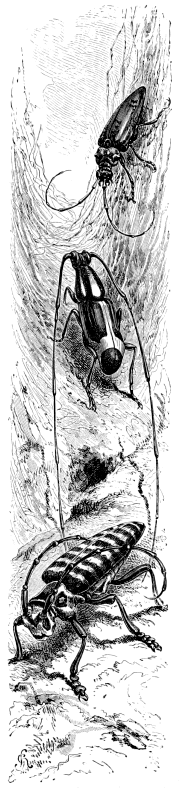
The insects in fury and beauty are worthy of this scene. The exalted vitality, revealed among the gadflies and the mosquitoes, by their thirst of blood, is shown in other species by their enchanting colours, their caprices of design, their singularities of form, which either astonish us or terrify. The Buprestis imperialis, proud of its green cuirass powdered all over with dust of gold, seems to have passed through the bowels of the metalliferous earth, and enriched itself on the way. The Buprestis chrysochlorus, of a yellower green, flutters to and fro like a mounted gem. The Arlequin of Guiana,—a gigantic mower, armed with tremendous antennæ and prodigious legs to traverse the innumerable obstacles offered by the tall herbage,—is marked with black commas on a yellow ground, with inexplicable hieroglyphs,—a being doubly strange and doubly enigmatic. It singularly reminds us of the texture of Indian stuffs, where, for the sake of harmonizing colours not usually brought side by side, the artist traces a number of wavy and broken lines, which soften and blend them into complete accord.
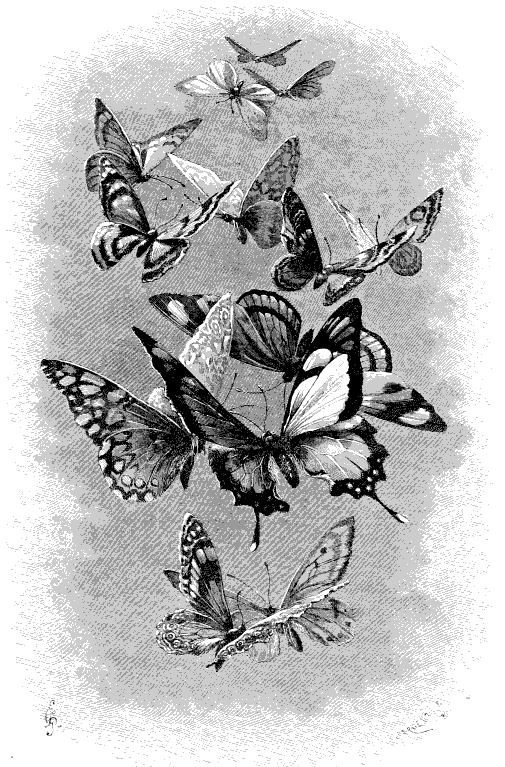
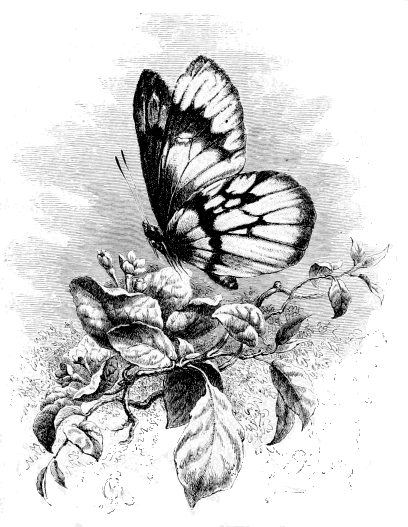
Those gentle and social insects, the butterflies, covering the banks with their winged tribes, transform the whole prairie into an enchanting flowery carpet. The butterfly of butterflies, the glorious butterfly of Brazil, of a rich azure lit up by shifting gleams, softly hovers, in the warm hours, above the waters crowned by the imperial dome of the blossomy forests. A pacific and splendid creature, it seems the innocent king of all the puissant nature. Others, scarcely less beautiful, follow in its train; and ever and ever more the glorious host, in floating azure, follows the current of the stream.
Such, then, are the tongues of Love; for the boundless rainbow of all these colours is simply its varied expression. And for what purpose, if love itself ought to appear without an intermediary?
Already, in our colder lands, the timid glow-worm, motionless under the hedgerow, suffers its little lamp to shine and guide through the night the lover to his love.
In Italy it moves to and fro, and its flame has acquired wings. I was much struck by it, at the hot springs of Acqui, in Piedmont, where sulphur everywhere prevails; the wild dance of the tiny lights seemed stimulated by the fires lurking in the entrails of the earth. In Brazil the very leaves overflow with phosphorus. How should aught be wanting for the illumination of the bridal-joy of the insect? That marvel, under the tropics, glitters everywhere and enchants everything. Two hundred species are known, which Nature has gifted with the poetic faculty of breathing forth flame, and charming their great festival with the poesy of light.
A graceful German lady, Mademoiselle Mérian, having been transplanted to these zones of fire, has related in naïve language the alarm which she experienced on seeing their insect wonders. The daughter and grand-daughter of excellent and laborious engravers, herself an artist and of well-informed mind, she has produced, in Latin, Dutch, and French, an admirable and picturesque work on the Insects of Surinam. The learned lady, in an exemplary life of misfortunes and virtues, had but one weakness (who has not one?)—the love of Nature. She quitted Germany for Holland, attracted by its unique and brilliant collections of the treasures of the two worlds. Then, as these did not suffice her, she visited Guiana, where she painted for several years. She combined in the same picture,—an excellent method,—the insect, the plant on which it lives, and the reptile which lives on the insect. Thoroughly conscientious, she sought out and posed her formidable models, of which, nevertheless, she was much afraid. Once, when the Indian savages had brought her a basket of insects, she was sleeping after her work. But in her chaste slumber she was disturbed by a strange dream. She thought she heard a harp, a melody of love. The melody grew inflamed; it was no longer a song, but an intoxication. All the room seemed filled with fire. She woke, and found her dream was true. The basket was the lyre, the basket was the volcano. She quickly saw that the volcano did not burn. The captives were fire-flies (fulgores); their song was an epithalamium, and their flame the flame of love.
In the tropical countries the stranger generally travels by night to avoid the heat. But he would not dare to enter the populous shadows of the forest-depths, were he not reassured by the luminous insects which he sees dancing and fluttering in the distance, and anon planted on the neighbouring bushes. He takes them for his companions, and fixes them in his shoes, partly to show him the path, and partly to keep off serpents. And when the morning breaks, he gratefully and carefully replaces them among the thickets, and restores them to their amorous work. There is a pretty Indian proverb: "Carry away the fire-fly, but return it to the place from which thou carriedst it."
Who can fail to be affected by their flame? It follows the movement of life, it flares and wanes in cadence with the ebb and flow of our respiration; it beats in exact accord with the rhythm of our heart. It expands or contracts in harmony with it, and the trouble of its emotion agitates also that tremendous torch.
What lies at the bottom? the visible desire, the effort to please and to be loved, translated in a hundred different manners by the eloquence of light. One, of an unrivalled blue, with a head of rubies, outvies with its scintillation the red-hot coal. Another, of a more melancholy cast, plunges into a sombre red. A third, of flame-coloured yellow, fading and passing into green, seems to express the languors, swoons, and storms of the violent loves of the South.
The ardent daughter of Spain, rendered more impassioned by the American sky, puts her hand on the creature of the flame, and seizes upon it as her own. She makes it a talisman, a jewel, and a victim. Burning, she places it on her burning bosom, where it must soon perish.
There is no purpose to which she does not turn it. By a triumph of audacious coquetry, linking the insects with silk, or imprisoning them in gauze, she wreathes the animated flames in glowing necklaces, and rolls them around her waist in girdles of fire. The queens of the ball are crowned with an infernal diadem of living topazes, of throbbing emeralds, which flicker or gleam (through suffering or love?). A brilliant but funereal decoration, of sinister magnetism, whose charm is enhanced by a sentiment of death. They dance; the waning flame associates its tender gleams with the languishing glances of a deep black eye. They dance; without end and without reason, without pity or remembrance of the amorous light dying and fading on their bosom, and having no power to say: "Replace me where you captured me!"
VI.—THE SILKWORM.
CHAPTER VI.
THE SILKWORM.
"The ideal of the human arts of spinning and weaving,"—said to me one day a Southerner (a manufacturer, but a man of imagination),—"the ideal which we always follow is a woman's beautiful hair! Oh, how far are the softest wools or finest cotton from approaching it! At what an enormous distance does all, and ever will all, our progress leave us! We drag ourselves onward, a long, long way in the rear, and enviously regard that supreme perfection which Nature daily realizes as a mere matter of pastime.
"That delicate, yet strong and tenacious hair, vibrating with an exquisite sonority which goes from the ear to the heart, and yet withal so soft, warm, luminous, and electrical—is the flower of the human flower.
"Men fruitlessly dispute respecting the merits of colour. What does it matter? The brilliant black contains and promises the flame; the blonde displays it with the splendours of the Golden Fleece. The sunny brown appropriates the very sun, makes use of it, blends it with its mirages, floats, and undulates, and incessantly varies in its streaming reflexes, now smiles with light, now deepens into gloom, always deceives, and, whatever we may say, deceives us most delightfully.
"The principal, the infinite effort of human industry, has combined all possible means for the improvement of cotton. Between the Vosges and the Rhine, the rare agreement of capital, machinery, the arts of design, and the chemical sciences, has produced those splendid Indian products of Alsace, to which England herself does honour by purchasing them. Alas! all this cannot disguise the original poverty of the ungrateful tissue which men have so richly embellished. If the woman who in her vanity clothes her form in these materials, and thinks her beauty heightened by them, would loosen her tresses about her, and unroll their waves over the indigent richness of our most sheeny cottons, what would occur? How they would be humiliated!
"Sir, we must own the truth; there is only one thing worthy of being placed side by side with woman's hair. Only one manufacturer can contend against it. That manufacturer is an insect,—the modest silkworm."
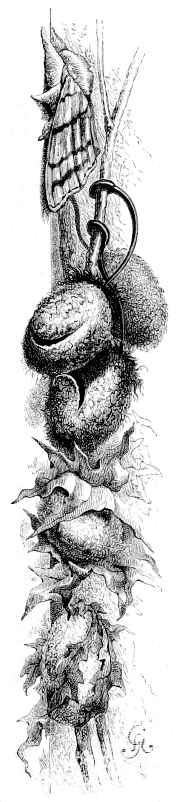
A peculiar charm attends the labours of the silkworm; it ennobles everything which surrounds it. In traversing our rudest provinces, the valleys of the Ardèche, where all is rocky,—where the mulberry and the chestnut seem to dispense with earth, to live upon air and pebbles,—where low stone houses sadden the eyes by their gray tints,—everywhere I saw at the door, under a kind of arcade, two or three charming brunettes, with ivory teeth, who smiled on the wayfarer, and continued spinning their silken gold. The wayfarer said to them in a low voice, as the carriage bore him away:—"What a pity, innocent fairies, that the gold may not be for you! That instead of being disguised with a useless colour, and disfigured by art, it does not retain its natural hue, and shine on the person of its beautiful spinners! How much better the royal tissue would become you than the grandes dames!"
A mere glance at the silkworm convinces you that it is no more a native of Europe than any other sweet thing. All that is soft and exquisite springs from the East. Our West, that hardy soldier, blacksmith, and miner, is good only to dig. It is good mother Asia, disdained by her rude son, who has bestowed upon him the treasures which seem to concentrate the essence of the globe. With the Arab horse and the nightingale, she has given him coffee, and sugar, and silk,—the revivifiers of existence and the true ornament of love.
When silk first arrived at Rome, the empresses felt that previously they had been no better than plebeians. They compared it, as far as its soft lustre was concerned, to the pearls of the Orient, paying for it, without haggling, the price of pearls and gold.
China esteemed it of such high value, that, to preserve the monopoly, she inflicted the penalty of death on any persons who dared to export the silkworm. It was only at the utmost peril, and by concealing it in a hollow cane, that men succeeded in carrying it to Byzantium, whence it passed to the West.
In the Middle Age, the age of indigence and barren disputes, when wool was the luxury of the rich, and the poor wore serge in winter, no attention was paid to silk, and its manufacture was exclusively confined to Italy.
It is the gold of the silkworms of Verona which, in Giorgione, at the mighty outcome of the Venetian art, and in the strong Titian, the master of masters, enriches with a ruddy radiance their beautiful blondes and brunettes, the sovereign beauties of the world.
On the other hand, in an age of decadence, when Spain and Flanders had waned, the melancholy artist who preferred to paint the beauty which years had marked,—the fading flower,—the fruit too early pierced and unnaturally ripened,—Van Dyck, clothed with white silk, like a consoling beam of moonlight, his languishing and drooping signoras. Under the soft folds of their satins they still trouble hearts with vain dreams and regrets.
The woman who possessed the secret of preserving her charms to the last decline of old age, whose cypher everywhere inscribed teaches us that Love can conquer Time, Diana de Poitiers, in her profound art, did exactly the opposite of what our imprudent ladies do, who, incessantly changing, as if to amuse the passer-by, leave no trace upon the soul, and produce no permanent impression. She permitted the Irises to delectate themselves with their fugitive rainbow; but, like the celestial Dian, always wore the same costume, black or white, and invariably of silk.
It was to please her that Henry II. wore the first pair of silk stockings, and the fine silken close-fitting vest, which indicated all the gracefulness of a muscular yet slender figure. We know how ardent an enthusiasm Henry IV., at a later period, showed in promoting the growth of the silk-manufacture, planting mulberry-trees everywhere,—along the highways, in the market-places, in the courts of his palaces, and even in the gardens of the Tuileries. Coloured silks, for decoration and furniture, and silks with flowered designs, were soon afterwards manufactured at Lyons, which provided all Europe with them.
Shall I say it, however? These coloured and ornamented silks do not by any means produce a great and profound effect. Silk in its natural state, and not even tinted, is in much more intimate sympathy with woman and beauty. Amber and pearls, the latter slightly yellow, with rich falls of lace, the latter not too yellow, are the only suitable accompaniments of silk.
For silk is a noble and in nowise pretentious attire, which lends a subdued charm to the exuberant liveliness of youth, and clothes declining beauty with its most tender and touching radiance.
A genuine mystery attends it which is not without attraction. Colour or gloss? Cotton has its peculiar gloss, and, when fitly prepared, often acquires an agreeable freshness. Silk is not properly glossy, but luminous,—with a soft electrical light, which harmonizes naturally with the electricity of the woman. A living tissue, it embraces willingly the living person.
Oriental ladies, before they foolishly adopted our Western customs, wore but two kinds of stuff: underneath, the real cashmere (of so fine a texture that a large shawl might be passed through a ring); and above, a beautiful tunic of silk of a pale blonde, or rather straw colour, with a gleam or flash of magnetic amber.
These two articles were less garments than friends,—gentle slaves,—supple and charming flatterers: the cashmere warm, caressing, and pliant, enfolding the bather lovingly when she emerged from her bath; the silk tunic, on the contrary, light and aërial, only not too diaphanous. Its blonde whiteness agreed most admirably with the colour of her skin; one might indeed have very justly said that it had imbibed that colour through its constant intimacy and accustomed tenderness. Inferior to the skin, undoubtedly, yet it seemed related to it; or rather it became in the end a part of the body, and, as it were, melted into it, like a dream which informs our whole existence, and cannot be separated from it.
VII.—INSTRUMENTS OF THE INSECT.
CHAPTER VII.
INSTRUMENTS OF THE INSECT: AND ITS CHEMICAL ENERGIES, AS IN THE COCHINEAL AND THE CANTHARIDES.
Have I insisted too much upon my theme? No; I have reached its very depths, its most important details.
Silk is not a particular, but a general view or aspect of it, for nearly every insect produces silk.
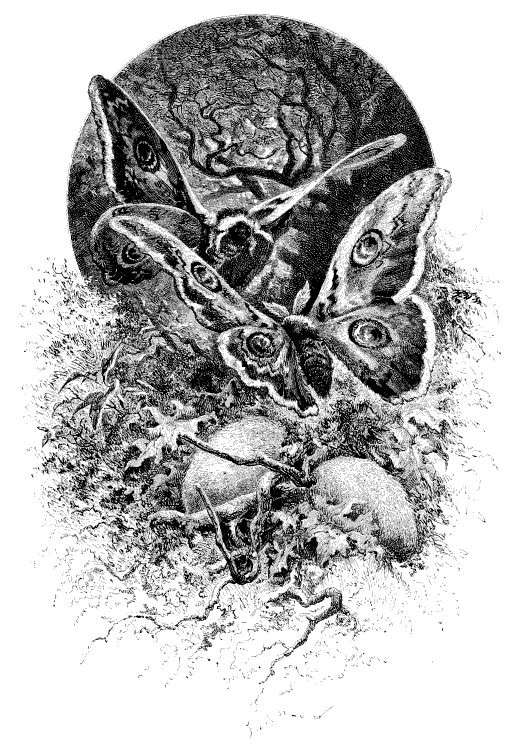
Hitherto we have dealt with only one kind of silk,—that of the bombyx, and indeed that of a species of bombyx which is not very fertile. Let us hope that the meritorious Society of Acclimatization will introduce here the Chinese bombyx (Attacus), which lives on the dwarf oak, whose strong and cheap silk might be used as clothing for the poor. All classes thenceforth might wear a material warm, light, impervious, solid; and not only so, but beautiful, brilliant, and noble. Such a change would be equivalent, in my eyes, to the general ennoblement and transfiguration of the people.
Réaumur long ago asserted that numerous chrysalides would furnish a beautiful silk. The spider would yield a substance both delicate and tenacious,—as witness the admirable veil of spider's silk preserved in the Paris Museum.
The delicate Arachne, whose light thread resembles a fleecy cloud,—which is nevertheless so strong, as it issues from the spinnerets,—Arachne is pre-eminently the spinner. But, as a general rule, the insect is the weaver, and wholly devoted to that feminine art. I was about to say, the insect is a woman.
In our vocabulary "feminine" means feeble; but in the Insect World it is the synonym of strength and energy. It is,—as is the case with maternity everywhere,—it is for the purpose of defending and nourishing the child, of provisioning the cradle in which the orphan will remain alone,—it is for this purpose specially that the insect is a warrior, and furnished with formidable weapons.
As far as concerns the instruments which pierce, and cut, and saw, the insect, in spite of all our progress, is perhaps a little in advance of man to-day. The instinct of maternity, the need of providing for its child—the future orphan—the protecting shelter of the hardest bodies, has evidently inspired it to make extraordinary efforts for the development and refinement of its tools. A few, in their fantastical character, have as yet no analogues in any of our factories.
Long before Réaumur organized the thermometer, the ants, for the protection of their delicate, hygrometrical, and susceptible eggs, divided their habitations into a series of thirty or forty stories,—lowering or raising the tiny creatures to the degree of warmth, dryness, or humidity, which the temperature of the day and of the hour of the day rendered necessary. Thus they formed an infallible thermometer, on which one might rely with as much certainty as on that of the philosophers.
In the comparisons between human and insect industry, the differences which we remark belong not so much to the methods as to the speciality of their wants and situation. The insect aptly varies the application of its arts. For example: the spider which, in its network-trap, improvised every day, lightens its work by a mixture of gluing and spinning, follows quite a different process in the important labour of fabricating the soft, warm, and durable cocoons which are intended to receive its young. The nest would seem to be partly spun and partly felted, like the majority of birds' nests.
We know that from the water-spider man derived the idea of the diving-bell; but it is not generally known that an ingenious Norman peasant has succeeded in imitating perfectly the operations of the larva of the syrphes, which, by means of an extremely prolonged respiratory apparatus, preserves a communication with the pure and wholesome air, even while working at the bottom of the most putrid waters.
It seems, then, that in the Insect World exist a complete pharmacy, chemistry, and perfumery. Have our sciences been sufficiently attentive to this fact? The potent vitality which gives an extraordinary force to the muscles of such tiny creatures, seems also to endow their liquids with active properties and burning energies which the large animals do not possess. Many, for defensive purposes, are gifted with caustic secretions—which they eject the moment you approach—or with fulminating powders. Others with poison, which flows as soon as the sting has been thrust in. Some possess, in addition, an art of magnetizing or etherizing their enemy; and others, like certain ants which work in damp, woody places, season their abodes by burning them, as it were, with potent formic acid.
The entire genus of the Cerambyx (or Long-horned Beetle) exhale a strong, rose-like odour, which is smelt at a distance, is lasting, and endures after the creature's death. Even among the Carnivora, ay, and among the Coprophagi, we meet with perfumed insects, or, at all events, with insects which, when in danger of being captured, endeavour to deceive you, or implore pity, by emitting agreeable odours.
Others shine with admirable colours. The deep reds of the Nopal Coccus have furnished the purple of kings.
By a skilful mixture, we also obtain from the cochineal the pre-eminently gay and radiant colour, carmine, with its innumerable tints and rosy shades.
A sovereign art with the insect is to carry on its sting, and concentrate at a particular point, the liquids which flow in the plant, in the living being. It is the very art of irritation. Its applications are innumerable in medicine and industry; tints, paintings, varied ornaments, a hundred fantastic and beautiful things come to us from the sting of the galls, the excrescences and gibbosities which they so skilfully raise.
The cochineal insect, while engaged in extracting by this process from exotic vegetables the envelope of solid green in which it will spend its prolonged period of rest, furnishes us with the red of reds, the scarlet of lake, which will colour varnishes, and wax, and a multitude of objects.
In health or illness, the stings of insects upon the living flesh are violent irritants for disturbing or re-establishing the course of life. In these there is nothing mediocre. A few, without sting, burn you by their internal acridity.
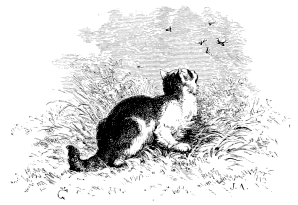
Who has not seen on the dusty plain, before the thirsty harvest, the cantharides, with its emerald enamel, abruptly crossing the footpath with a wild and agitated movement! Burning elixir of existence, where love transforms itself into a poison,—it is not with impunity that we make use of it medicinally. That medieval pharmacy, which was so dangerous to man, is not without peril, it seems, for the animals themselves. A very intelligent but eccentrically ardent cat, which I kept for a long time, among its other caprices of violence loved to hunt the cantharides. It seemed attracted by the acridity of the beautiful insect, as the moth is by the flame. It was an intoxication. But when, hunting it through the flowers, she had seized and crushed her dangerous victim, the latter appeared to take its revenge.
The inflammable feline nature, stimulated by the fiery sting, broke out in cries, in excesses of fury, in strange leaps and bounds. She expiated her orgie of fire by terrible sufferings.
But, on the contrary, another insect, the bamboo-worm, or malalis, provides you, if you first remove its head, which is a deadly poison, with an exquisite cream, the sweet and soporific influence of which, say the Brazilian Indians, lulls love asleep. For two days and nights, the young maiden who has tasted of it, crouching under the blossomy tree, feels all the more powerfully in her soul the depth of the virgin forests, and the mystery of those fresh glades which have never seen the sun, nor echoed to the step of man, nor known any intruder but the lonely great blue butterfly. And yet she is not alone: love quenches her thirst with the most delicious fruits.
VIII.—THE STUDY OF THE INSECT.
CHAPTER VIII.
ON THE RENOVATION OF OUR ARTS BY THE STUDY OF THE INSECT.
The Arts properly so called, the Fine Arts, should profit much more than the Industrial, by the study of insects. The goldsmith and the lapidary would do well to seek in them models and instruction. The soft insects, the flies, specially possess in their eyes truly magical irises, with which no casket of gems can bear comparison. In passing from one species to another, and even, if I mistake not, from one individual to another, new combinations may be observed. Remark that the flies with brilliant wings are not always the most richly endowed, as far as their optical organs are concerned. Take the dull, gray, dusty, odious horse-fly, which lives on warm blood; its eye, to the magnifying-glass, offers the strange faëry spectacle of a mosaic of jewels, such as all the art of Froment-Meurice has scarcely invented.
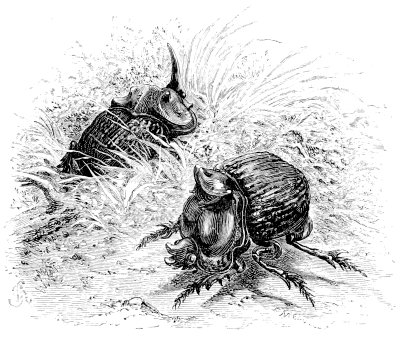
If you descend still lower, insects which do not live, like this fly, upon living but upon dead matter, ordure, and decomposition, astonish us by the richness of their reflections, which our enamel ought to endeavour to reproduce. The dunghill beetle, an ungainly black insect if we look only at the upper part of its body, is, underneath, of a deep sapphire-blue which no kingly diadem ever equalled! And what shall we say of the son of the dead, of the Egyptian scarabæus,—a living emerald, but far superior to that jewel in the gravity, opulence, and magic of its lustre? The imagination is impressed, and one does not feel astonished that a people so tender and devout, so in love with death, so full of the dreams of eternity, took for a symbol the little miraculous animal,—a burning jet of life springing from the grave!
A certain skill in examination, and a choice of day and of light, are necessary. You cannot properly study the insect of the tropics and that of our colder climates on the same day or at the same hour. The former should be examined only in favourable weather, under a pure sky and a strong sun,—a vivid and genial ray, analogous to the light which bathes it in its own country. The other, frequently uninteresting to the naked eye, but of great beauty under the microscope, may reserve its grand illuminating effects for the evening, or for artificial light. Little is promised by the cockchafer, at first sight so coarse and prosaic in appearance. Yet its scaly wing, when submitted to the focus of the microscope, and well lighted up beneath the little mirror, so that it is seen by transparency, presents a noble winter stuff, a dead leaf, where meander veins of a very beautiful brown. And in the evening it becomes quite another thing: the yellowish part of the scale has got the best of it, and in the light shines forth like gold—(a poor comparison!)—the strange, magical gold of paradise, which we dream of for the walls of the heavenly Jerusalem, or for the robes of light worn by saints and spirits before the Throne! A sun softer and tenderer than the orb of day, and one which, we know not why, charms and affects the heart.
A strange mirage! And yet nothing but a cockchafer's wing!
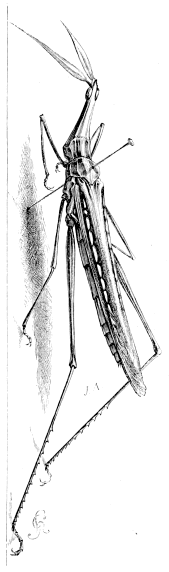
Perhaps it may next be an insect which neither by day nor night, neither to the naked eye nor under the microscope, could excite a feeling of interest; but if you take the trouble to lift up, with a delicate and patient scalpel, the laminæ which compose the thickness of its scaly wing, you will find there, in most instances, a variety of unexpected designs, sometimes vegetable curves,—sometimes airy ramifications,—sometimes angular striated figures, like hieroglyphics, which remind you of certain Oriental languages; and compose, in truth, a genuine necromancer's book, that can neither be referred to, nor compared with, any known form.
These singular characters, while strongly attracting the eye and disquieting the mind, are fully worthy of the interest they excite. What they express, and give utterance to, in their emphatic language, is the circulation of life. Some are tubes through which the air enters the wing, and distends it for flight; others are tiny veins where circulate the powerful liquids that endow the imperceptible organism with its colours and its energy.
The most attractive forms are living forms. Take a drop of blood, and submit it to the microscope. This drop, as it spreads, rewards you with a delightful arborescence,—with the delicacy and lightness of certain winter trees, when revealed in their actual figure, and no longer encumbered with leaves.
Thus, Nature's infinite potency of beauty is not limited to the surface, as antiquity supposed. It does not trouble itself about human eyesight, but labours for its own behoof, and on its own work. From the surface to the interior, it frequently increases in beauty as in depth. It invests with surpassing loveliness things which are absolutely hidden, and which death alone can unveil. Sometimes, as if to contradict and confound our ideas, it clothes in ravishing forms the organs which, from our point of view, accomplish the vilest functions. I am thinking of the exquisite beauty and delicate tenderness of that coral-tree which incessantly pours out the chyle of our intestines.
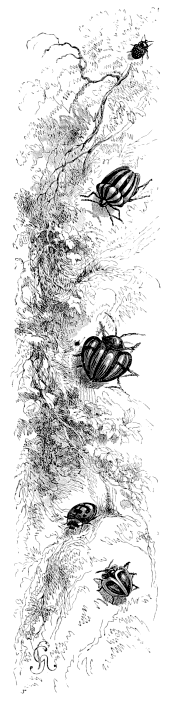
To return to the insects: beauty abounds in them both externally and internally. One need not search far in order to discover it. Take an insect, not very rare, which I constantly meet with on the sandy soil of Fontainebleau, in localities well open to the sun. Take—but not without precaution, for it is well armed—the brilliant cicindela. Even to the naked eye it is an agreeable object; but under the microscope it appears to be perhaps the richest and the most varied which art could study. These are truly surprising creatures! Each individual differs; all are enamelled, and decorated to an excess, without resembling one another. In each, if taken and separately studied, new discoveries may be made.
It is the ardent and murderous hunter of other insects, and endowed with formidable weapons,—having for its two anterior mandibles a couple of sickles which close in upon one another, and transfix deeply, on both sides, their unfortunate victim. Its rich and living aliment apparently communicates to the cicindela its glowing colours. Its entire body is embellished with them. On the wings, a changeful besprinkling of peacock's eyes. On the fore parts, numerous meanders, diversely and softly shaded, are trailed over a dark ground. Abdomen and legs are glazed with such rich hues that no enamel can sustain a comparison with them; the eye can scarcely endure their vivacity. The singular thing is, that beside these enamels you find the dead tones of flowers and the butterfly's wing. To all these various elements add some singularities, which you would suppose to be the work of human art, in the Oriental styles, Persian and Turkish, or as in the Indian shawl, where the colours, slightly subdued, have found an admirable basis; time having gradually lent a grave tone to their sweet harmony.
Frankly, is there aught approaching such a degree of excellence in our human arts? How great the necessity that, in their apparently fatigued and languid condition, they should gain life and strength from these living sources!
In general, instead of going straight to Nature, to the inexhaustible fountain of beauty and invention, they have solicited help from the erudition, the history, and the antiquity of man.
We have copied ancient jewels; sometimes those of the barbarous peoples which first procured them from our own merchants. We have copied the old robes and the stuffs of our ancestors. We have copied, especially, the painted-glass windows of Gothic architecture, whose colours and forms have been selected hap-hazard, and transplanted to objects utterly discordant and unsuitable,—as, for instance, to shawls!
If we were desirous of comprehending and rehabilitating these ancient windows, we might have taken a lesson from the enamels of certain scarabæi. Seen beneath the microscope, they present very analogous effects, simply because they possess the same elements of beauty. The thirteenth century glass-windows (you may see them at Bourges, and especially in the Museum of that city) were double. The light therefore remained in them, did not pass through them, gave them the magical effects of precious stones. And of a similar character are those insect wings composed of numerous leaves, between which you may detect, with the microscope, a network of mysterious hieroglyphics.
Gothic, so little in harmony with either our wants or our ideas, has passed out of our furniture, but it still lingers in the shawl-manufacture; a rich and costly industry, which, having once adopted the fantastic method of imitating in opaque wools those windows whose transparency was their special merit, can hardly emancipate itself from the bondage.
Men have not consulted women. In order to weave complex designs, heap up a medley of arches and oriels, and condemn our wives to carry churches on their backs, men have provided a heavy groundwork of the stoutest wools; the whole being despatched from London and Paris to be servilely woven by the Indians who have unlearned their own arts.
Our intelligent Parisian merchants, who have reluctantly followed in the path traced out for them by the great producers, may very well escape from these rich and heavy styles. Let some one lose patience, and turning his back on the copyists of antique absurdities, go to Nature herself in search of advice,—to the great insect collections and the conservatories of the Jardin des Plantes.
Nature, being feminine, will tell him that if he would fitly decorate his sister in the soft and airy tissue of the ancient cashmere, he must delineate thereupon—not the towers of Notre-Dame,[N] but a hundred charming creatures—that little, but, if you will, very common marvel of the cicindela, in which all styles are combined;—or the purple scarabæus glorified in its lily;—or the emerald chrysomela, which this very morning I found sensually reposing at the bottom of a rose.
Do I mean that you should copy these? Not at all. I should call these living creatures, in their robe of love, from which they derive all their charm, an animated aureola, which cannot be translated. We must be content to love and contemplate them, to draw our inspiration from them, to convert them into ideal forms, and new rainbows of colours, and exquisite posies of blossoms. Thus transformed, they will become, not what they are in Nature, but fantastic and wonderful,—as the child who pants for them sees them in its slumber, or the maiden yearning after a beautiful attire, or as the young pregnant wife when dreaming of them in her hours of longing.
IX.—THE SPIDER.
CHAPTER IX.
THE SPIDER—INDUSTRY—THE STOPPAGE.
Before we pass on to those insect communities with which the latter portion of this volume will be occupied, let us speak here of a solitary individual.
Higher, and yet lower, than the insect, the spider is separated from it by its organization, but connected with it by its instincts, wants, and food.
A being strongly specialized in two particulars, it is excluded from the great classes of the animal kingdom, and stands isolated, as it were, in creation.
In the fertile countries of the tropics, where game abounds, it lives with its fellows. Some are said to weave around a tree one immense net, common to all, whose avenues they guard in perfect agreement. Nay more: having frequent occasion to deal with powerful insects, and even little birds, they co-operate in the hour of peril, and lend each other, as it were, a helping hand.
But this gregarious mode of living is wholly exceptional, confined to certain species, and peculiarly favoured climates. Everywhere else the spider, through its organism and the fatality of its life, assumes the character of the hunter, of the savage, who, living upon uncertain prey, remains envious, mistrustful, exclusive, and solitary.
But remember that it does not resemble the ordinary hunter, who gets quit with his journeys, his exertions, and his activity. The spider's hunt costs it dearly, if I may venture to say so, and demands an incessant outlay. Every day, every hour, it must draw from its own substance the essential element of the network which is to provide it with food and renew that substance. Accordingly, it starves in order to nourish, and exhausts in order to recruit itself; it grows lean on the dubious hope of afterwards growing fat. Its life is a lottery, remitted to the risk of a thousand unforeseen contingencies. Hence, it cannot fail to develop into an unquiet creature, sympathizing but coldly with its kind, in whom it sees possible competitors,—in a word, it is a fatally egotistical animal. And were it not so, it would perish.
The worst of it is, as far as the poor creature is concerned, that it is profoundly ugly. It is not one of those which, ugly to the naked eye, are rehabilitated by the microscope. The overwhelming speciality of its career has the effect, as we see among men, of attenuating one limb, exaggerating another, and prevents anything like harmony: the blacksmith is frequently a hunchback. In the same manner the spider is pot-bellied. Nature has sacrificed everything to its function, its wants, and the industrial apparatus which will satisfy those wants. It is an artisan, a rope-maker, a spinner, and a weaver. Do not look at its figure, but at the product of its art. It is not only a spinner, but a spinning-mill.
Concentrated and circular, with eight feet around its body, and eight vigilant eyes in its head, it causes astonishment by the eccentric prominency of its enormous belly. An ignoble feature, wherein the careless observer reads the result of gormandising! Alas, it is just the contrary! This big belly is its workshop, its magazine, the pouch where the rope-maker carries in front of it the material of the thread which it winds and unwinds; but as it fills this pouch with nothing but its very substance, it enlarges only at the expense of itself, and by dint of extreme sobriety. And you shall often see it, though emaciated in every limb, retaining full and expanded the treasure which is the indispensable element of its labour, the hope of its industry, and its only chance of a future. A true type of the man of industry! "If I fast to-day," it says, "I shall eat perhaps to-morrow; but if my material runs short, all is over,—my stomach must rest and fast for ever!"
My first relations with the spider were nothing less than agreeable. In my poverty-blighted childhood, while I toiled alone (as I have said in my book on "The People") in the then ruinous and desolate printing-office of my father, the temporary workshop was in a kind of cellar, sufficiently well lighted,—being a cellar in the boulevard where my family resided, but on the ground-floor so far as concerned the adjoining street. Through a large grated window the mid-day sun obliquely lighted up the sombre case where I put together my little leaden letters. There, at the angle of the wall, I distinctly perceived a prudent spider, which, supposing the stray sunbeam would bring some imprudent fly for its breakfast, drew near my case. This sunbeam, falling not in its corner but nearer me, was a natural temptation to invite its closer approach. In spite of my innate disgust, I admired the progressive ratio of timid, slow, and prudent experiment by which it ascertained the character of him to whose mercy it virtually confided its very existence. It watched me closely with all its eight eyes, and propounded to itself the problem, "Is he, or is he not, an enemy?"
Without analyzing its figure, or very clearly distinguishing its eyes, I felt that I was observed and watched; and apparently this observation, in the long run, proved favourable to me. By the instinct of work, perhaps (which is very great in its species), it perceived that I was really a peaceful labourer, and that I was busy, like itself, in weaving my cobweb. However this may be, it abandoned its stratagems and precautions with a quick decision, as if adopting an adventurous and somewhat perilous step. Not without grace it descended upon its thread, and planted itself resolutely on our respective frontier—the edge of my case, favoured, at that moment, with a golden ray of the sickly sun.
I was divided between two sentiments. I confess that I did not relish so close an intimacy,—the figure of such a friend pleased me but little; on the other hand, this prudent and observant being, which certainly did not lavish its confidence, seemed to say to me: "Wherefore should I not enjoy a little of thy sun? So different in nature, we have nevertheless arrived together from our necessitous toil and cold obscurity at this sweet banquet of light. Let us take heart, and fraternize. This ray which you permit me to share, receive it from me, and preserve it. In another half century, it will kindle up your winter."
As the little black fairy said this in its own language, whispering low, very low—in fact, it could not be lower (for it is thus that fairies speak)—I marked the effect of it vaguely, and it slumbered in my mind. The circumstance, however, was recalled for a brief while some years ago; and again, after a long interval, it has been revived on this very day, when for the first time I record and explain it.
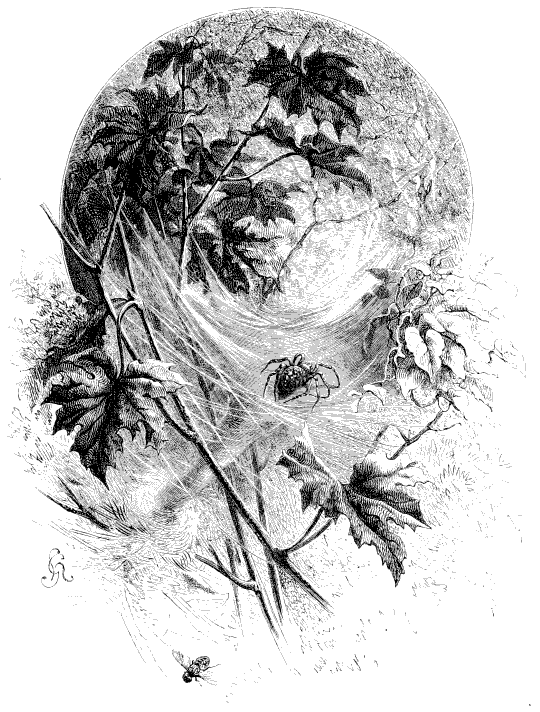
On the former occasion, after a domestic affliction, I was spending my holidays in Paris, and I went daily alone to walk in my little garden in the Rue des Postes. My family were in the country. Mechanically I remarked the beautiful concentric stars which the spiders had woven round my trees, and which they repaired and remade incessantly with a laudable industry, giving themselves immense trouble to preserve my small stock of fruits and grapes, and relieving myself from the importunity of flies and the stings of gnats. They reminded me of the black domestic spider which, in my childhood, had entered into conversation with me. These latter were very different. Daughters of air and light, always exposed, always before the eyes of men, without other shelter than the surface of a leaf, where they may easily be captured, they are unable to cultivate the reserve or diplomacy of my old acquaintance. All their work, is visible, all their little mystery open to the wind, and their persons at everybody's discretion; they have no other protection than what may be afforded them through compassion, or in consideration of a well-understood interest in the positive services which they render.
Those which suspend their nests to the branches of trees, like those which suspend them to our windows, display an evident design to place themselves in the wind, where a current of air may waft the insects to them, or in the path of a ray of light in which the gnat may float and whirl. The web does not fall vertically, for such a position would restrict it to one current; the spider, like an able seaman, gives it a great obliquity, and thus secures a couple of currents, or even more.
From the extremity of its belly, four screw-plates or tubercles, which can be drawn in or out (like telescopes), eject by their movement a very little cloud, that increases in size from minute to minute. This cloud is composed of threads of an infinite tenuity; each tubercle secretes a thousand, and the four, by combining together their four thousand threads, make the unique and tolerably strong thread of which the web is woven.
Mark well, that the threads of the intelligent manufacturer are not all alike, but of different strength and quality according to their destination. Some are dry for warping, others viscous for gluing. The tissues of the nest intended for the reception of the new-born are of a cottony material, while those which will enwrap the cocoon containing the eggs possess all the resistant power necessary for the safety of the latter.
When the spider has produced a sufficient quantity of thread to undertake a web, it voluntarily glides from an elevated point, and unwinds its skein. There it remains suspended, and afterwards reascending to its starting-point by the assistance of its tiny cordage, moves towards another point; and continues to trace in this manner a series of radii all diverging from the same centre.
The skein stretched, it is busied next in weaving the woof by crossing the thread. Running from radius to radius, it touches each with its tubercles, which fasten to it the circular border. The whole is not a compact tissue, but a veritable network, so geometrically proportioned that all the meshes of the circle are invariably of the same size.
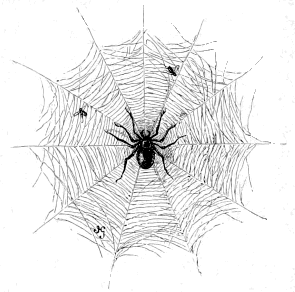
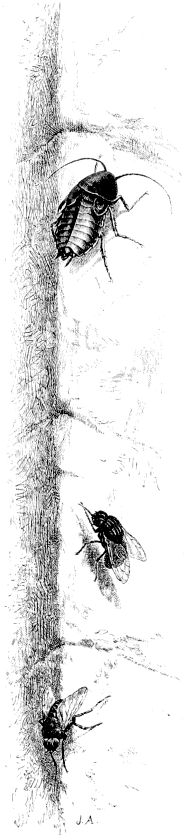
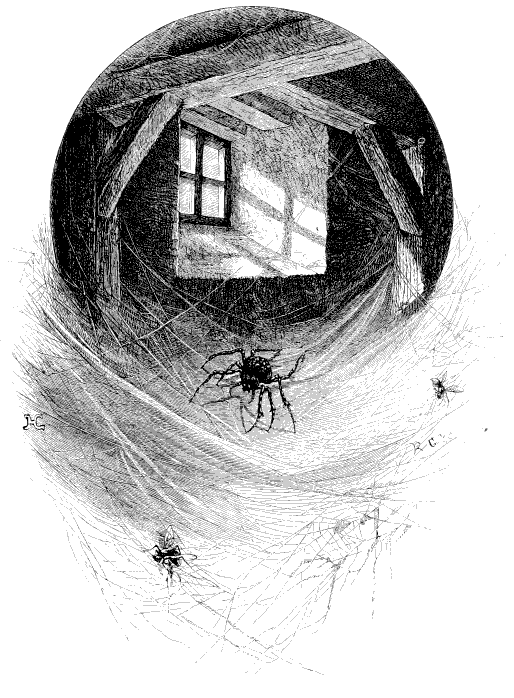
This web, woven out of itself, living and vibrating, is much more than an instrument; it is a part of its being. Itself of a circular form, the spider seems to expand within this circle, and prolong the filaments of its nerves to the radiating threads which it weaves. In the centre of its web lies its greatest force for attack or defence. Out of that centre it is timid; a fly will make it recoil. The web is its electric telegraph, responding to the lightest touch, and revealing the presence of an imperceptible and almost imponderable victim; while, at the same time, being slightly viscous in substance, it retains the prey, or delays and entangles a dangerous enemy.
In windy weather, the continual agitation of the web prevents it from giving an account of what transpires, and the spider then remains at the centre. But usually it keeps near its machinery, hidden under a leaf, that it may not terrify its victims, or fall a prey to any of its numerous foes.
Prudence and patience, rather than courage, are its characteristics. Its experience is too great, it has undergone too many accidents and misadventures, it is too much accustomed to the severities of fate, to indulge in any surpassing audacity. It is afraid even of an ant. The latter, often a mischievous individual, a restless and rugged rodent, and afraid of nothing, frequently persists in exploring the strange woof, of which it can make nothing. The spider accordingly gives way to it,—whether it fears the acid of the ant, which burns like aquafortis, or whether, like a good artisan, it calculates that a long and obstinate struggle will cost it more time than will the manufacture of another web. Therefore, without yielding to the slightest susceptibility of self-love, it allows the ant to strut about, and takes up its post a little further off.
Every animal lives by depredation. Nature is ever devouring itself; but the prey is not always sought and merited by a patient industry deserving of respect. No being, however, is so much the plaything of fate as the spider. Like every good workman, it has a twofold value: in its work and its person. An infinity of insects—the murderous carabus, or the libellula, an elegant and splendid assassin—have only their bodies and their weapons, and spend their lives joyously in killing. Others possess secure and easily defended asylums, where they have cause to fear few dangers. The field-spider has neither the one nor the other advantage. It is in the position of the respectable operative, who, through his small and ill-guaranteed fortune, attracts or tempts cupidity or insolence. The lizard from below, the squirrel from above, hunt the feeble hunter. The inert frog darts at it the viscous tongue, which glues it and renders it immovable. It is the felicity of the swallow, in her graceful circle, to carry off, without injuring, the spider and his web; and all birds look upon it as a great dainty or an excellent medicine. The nightingale, faithful, like all great singers, to a certain hygiene, prescribes for herself, as an occasional purgative, a spider.
Even if she be not swallowed up herself, if the instrument of her trade is destroyed, the consequences are the same. Should the web be undone blow upon blow, a somewhat protracted fast renders it unable to secrete a fresh supply of thread, and it soon perishes of hunger. It is constantly confined in this vicious circle:—
To spin, it requires food;
To feed, it must spin.
Its thread, for the spider as for the Parcæ, is that of destiny.
We once made the experiment of removing three times running a spider's web. Three times, in six hours, it replaced it, with admirable patience, and without abating one jot of hope. The experiment was a cruel one, and we now reproach ourselves for it. We meet with too many poor unfortunates, whom accidents of this kind have thrown out of work, and who are thenceforth too exhausted to resume their industry. One sees them, like living skeletons, attempting fruitlessly a different trade, in which they succeed but poorly, and mournfully envying the long legs of the field-spiders, which gain their living by incessant travelling.
When people speak of the eager gluttony of the spider, they forget that it must either eat a double quantity, or soon perish: eat to recruit its body, and eat to renew its thread.
Three circumstances contribute to wear it out: the ardour of incessant work, its nervous susceptibility—which is carried to an extreme—and its twofold respiratory system.
For it has not only the passive respiration of the insect, which receives, or submits to, the air introduced through its stigmata; it has also a kind of active respiration, analogous to the play of the lungs in the higher animals. It takes the air and masters it, transforms and decomposes it, and incessantly renews it. If you do but examine its movements, you feel that it is something more than an insect; the vital glow traverses its frame in a rapid circulation; the heart beats very differently from what it does in the fly or butterfly.
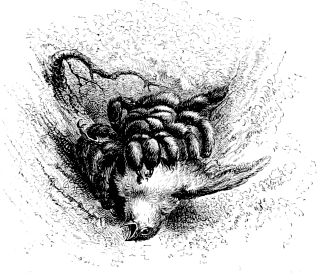
But its superiority is its peril. The insect braves with impunity the strongest odours and mephitic miasmas. The spider cannot endure them. Instantly affected by them, it falls into convulsions, struggles, and expires. I saw this incident one day at Lucerne. Chloroform, whose action the stag-beetle had endured for fourteen days without succumbing, immediately—at the first contact—overpowered the spider. Yet the victim was a large one, and I found it engaged in eating a gnat. I wished to experiment, and poured on it a single drop. The effect was terrible. Nothing more pitiful could be seen in a case of human asphyxia. It tumbled over, raised itself, and then swooned; all its supports failed it, and its limbs appeared disjointed. One thing was very pathetic—that in this supreme moment the fecundity of its bosom became apparent; in its agony, its tubercles sent forth their little cloudy woof, so that you might have believed it to be working even in death.
I felt oppressed, and in the hope that the fresh air would perhaps revive it, I placed it on my window-sill; but it was no longer itself. I know not how the effect was produced; but it seemed to have melted away, and nothing of it remained but its skeleton. The vanished substance had left but its shadow, which the wind bore away to the neighbouring lake.
X.—THE HOME AND LOVES OF THE SPIDER.
CHAPTER X.
THE HOME AND LOVES OF THE SPIDER.
The spider greatly surpasses all other solitary-living insects. It not only possesses its nest, its ambush, its temporary hunting-station; it has (or, at least, certain species have) a regular house, a house of a very complex description: a vestibule, and a sleeping-chamber, and a mode of egress in the rear; and, finally, a door which is a very triumph of art, for it closes of itself, falling back by its own weight.
The door! It is this which is wanting even in the grand cities of the bees and the ants; these industrial republics have never hitherto attained to so lofty a climax.
The ants have just reached the point at which most of our African tribes have halted. Every evening they shut up their dwelling-places with immense labour—renewed daily—and by a little, unsubstantial lattice-work, which does not relieve them from the necessity of planting sentinels. It is true, however, that these great, valiant, and well-armed peoples have no fear of invasion, and, like Lacedæmon, need neither walls nor ditches. Their proud intrepidity has set limits to their industry.
On the other hand, the poor artisan which lives by itself, and is always exhausted by the incessant toil of spinning and weaving, cannot rely upon its valour. It has need, in certain countries and under certain alarming conditions, of profound ingenuity, and has discovered this little miracle of prudence and combination, which eclipses both the savage and the insect. I do not refer to the great animals, none of which, except the beaver, are very industrious.
In the neighbourhood of Lucerne we for the first time saw the house of the spider (the Agelena). It was a kind of sheath, and very well made, with a vestibule facing the south, which expanded outward like a funnel. This exterior portion, forming a little sunny retreat, was the snare and the citadel. The lady of the house stationed herself quite at the bottom of the funnel; but behind this very bottom, at the lower extremity of the case or sheath, was constructed a back apartment, small and very secure, in a white substantial cocoon. In this she trusted so completely, that while we detached the silken cables which moored the entire edifice to the bush, she made no attempt to escape. We had neither destroyed nor damaged, but simply detached the dwelling, and on the day following we found it repaired and moored to the bush on every side. The exposure was no longer so favourable; but, undoubtedly, the workman, in an advanced season of the year (in September, and under the Alps), did not possess the resources for recommencing this grand summer-work.
In the Brazilian forests a little spider has its case suspended exactly in the centre of its web; and thither it hurries at the slightest approach of danger, and has no sooner entered, says Swainson, than the door suddenly closes behind it by a spring.
But the masterpiece of the genus is seen, especially in Corsica, in the laborious Mygale. Its residence is a kind of well, industriously walled round, with smooth and polished sides, and a double tapestry,—a coarse strong hanging on the earthward front, and a fine satiny hanging in the interior. The orifice of the well is closed by a door. This door is a disc, much larger at the top than at the bottom, and let into a groove in such a manner as to shut hermetically. The disc, which is not more than three lines thick, contains, nevertheless, thirty double woofs, and between the woofs intervene the same number of coats or layers of earth,—so that the entire door is really composed of sixty doors. Here, in truth, is a miracle of patience; but observe, too, the ingenuity,—all these doors of network and earth clamp into one another. The thread-doors at one point are prolonged to the wall, fastening the door to the wall as by a hinge. This door opens outwardly when the spider raises it to go forth, and closes by its own weight. But the enemy might eventually succeed in opening it. This has been anticipated. On the side opposite the hinge some small holes are worked in the door; to these the spider clings, and becomes a living bolt.[O]
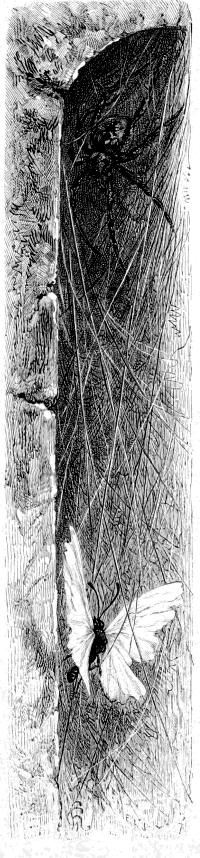
What would happen if this astonishing artisan, placed in peculiar and trying circumstances (like the bees under Huber's experiments), were called upon to vary its art and devise a novelty? Could it do so? Has it the intelligence, the resource, and, at need, the power of innovation which the superior insects display under certain conditions? It would be worth while to make the experiment. This, at all events, is certain, that the simple Epeiras (our garden-spiders) know very well, when deprived of the necessary space for extending their geometrical curtain, how to construct one of irregular design, decreasing in proportion to the restrictions of their area.
Experiments, moreover, are difficult. The spider is so nervous, that the fear which makes it an artist can also paralyze and utterly confound it. Its web alone gives it courage. Out of its web, everything makes it tremble. In captivity, having no web, it actually flees before its prey, and has not the resolution to confront a fly.
Its miserable condition of passive expectancy fully explains its character. To wait, while acting, running, fighting, is to cheat both time and hunger; but to remain there immovable, to be unable to stir from fear of alarming your prey, to watch it coming nearer and nearer but eventually escaping, and to suffer from an empty stomach! To be a witness of the endless, heedless dances of the fly, which, in the sunbeam, amuses and balances itself for hours without responding to the avid prayers of the tempter which whispers, "Come, little one! Come, my darling!" is a terrible punishment, a series of hopes and disappointments.
It pursues its gay measure, and thinks nothing of the sufferer.
The fatal inquiry, "Shall I dine?" returns, and lacerates its bowels. Then comes the more ominous reflection: "If I do not dine to-day, no more thread! And far less, then, may I hope to dine to-morrow!"
From all this results a suffering, restless, but prodigiously wary and attentive being, which detects not only the slightest contact, but the slightest noise. The spider is only too sensitive. A very little disturbance seems to overthrow its self-control. It apparently faints; you see it suddenly fall from its position, struck down by fear.
This sensitiveness, as you will readily believe, is especially displayed in the spider's maternal condition. However miserable and avaricious in its nature, it is tender, liberal, and generous towards its young. While the birds of prey—the winged hunters which have so many resources—drive away their young at a very early age, look upon them as greedy competitors, and force them by blows of their beaks to dwell afar from the domain which they reserve as their own, the spider is not contented with carrying its eggs in the cocoon, but, in certain species, nourishes them when living and greedy, guards them, bears them on its back; or else she makes them walk, holding them by a thread; if danger threatens, she draws in the thread, they leap upon her, and she saves them. If she cannot do so, she will perish. Some there are which, rather than abandon their offspring, will suffer themselves to be swallowed up in the gulf of the ant-lion. Others, of a slow species, which, when unable to save them, make no effort to escape, but allow themselves to be captured also.
Their nests are frequently masterpieces. At Interlaken, in Switzerland, I have admired their long soft tubes, warm in the interior, and well-lined,—externally, disguised with much skill by an artistic pell-mell of small bits of leaf, tiny twigs, and fragments of gray plaster, so as to melt perfectly into the colour of the wall supporting them. But this was nothing in comparison with a work of art which I have here at Fontainebleau.
On the 22nd of July 1857, I discovered in an outhouse a very pretty round basket, about an inch across, made of all kinds of materials, and, as it had nothing to fear from rain, without any cover. It was very gracefully suspended to a beam by some elegant silken threads, which I should call little hands, such as are possessed by the climbing plants. Within, brooding on its eggs with a constant incubation, might be seen a spider. It never stirred, except, perhaps, for a moment at night, in quest of food. Never was there any animal so timid. At the gentlest approaches fear made it fly, and almost fall. Once when we disturbed it a little abruptly, it was seized with such an excess of terror that it did not recover for an entire day. It sat for six weeks, and, but for these perturbations, would perhaps have remained much longer.
An admirable mother,—an ingenious and delicate artist,—before all things a female,—a female nervous and timid to the highest degree, this strange sensitive creature explained to me perfectly the very opposite sentiments with which the spider inspires us,—those of repulsion and attraction. We start away from it, and yet we draw near to it. It is so coarse, and yet, at the same time, so prodigiously sensitive! It breathes as we do. And the delicate tubercle which secretes its silk, like a milky cloud (as the microscope shows us), is the most feminine organ which exists, perhaps, in nature.
Alas, it is alone! Except a few species (mygales) in which the father renders some assistance to the mother, it expects no help. The male, after its moment of love, becomes, indeed, an enemy. Cruel consequences of misery! It perceives that its children are capable of furnishing it with food. But the mother, who is bigger than he, makes a similar reflection,—thinks that the eater is eatable,—and frequently crunches her spouse.
These atrocious events never happen, I am confident, in climates where ease and abundance do not deprave their natural disposition. But in our well-peopled countries, with game very rare, and competition of extreme violence, these unfortunates act towards one another like the wretched castaways on the raft of the Medusa.
A cruel tyrant, the stomach, dominates over all nature, and vanquishes even love. Passion, in an anxious and restless being like the spider, is very mistrustful. At the height of his devotion, the lean and feeble male dares only approach the majestic lady with a timid reverence and the utmost reserve. He advances, he retires, he watches; he seems to ask himself if he has at all succeeded in subduing the haughty creature. He resorts to the timid methods of a slow magnetism, and especially to an extreme patience. He puts little faith in the first signs, and does not willingly yield his confidence. And, finally, when the adored object shows herself sensible of his sincerity, and grows ardent in her expansion of soul, he does not so wholly trust in her but what he will escape, and fly with all his speed, at some sudden impulse, and under the influence of an indescribable panic.
Such is the terrible idyl of the dusky lovers of our ceilings. Among our garden-spiders less suspicion seems to exist. Nature softens hearts, and rugged industrialism itself grows smoother in rustic life. We see some upon our trees which behave tolerably well to their husbands, and do not too often remember that they are competitors in the chase. They permit them to reside in the same locality, although a little apart, and keeping them at a distance. A light partition separates them. The princess consents that he may live under her roof, and on the ground-floor, while she lives on the first story,—keeping him below and in subjection, so that he may not presume to think himself the king, but only the prince consort, and the husband of the queen.
Have they any sympathies beyond their own race? So some authorities have asserted, and I believe it. They are isolated from us far less than the true insects. They live in our houses, have an interest in knowing us, and seem to observe us. They pay great attention to voices and sounds, and have a marvellous perception of them. If they have not the insect-organs of hearing (which would seem to be the antennæ), it is because they are all antennæ. Their excessive vigilance, and the nervous irradiation which makes itself felt everywhere among them, endow them with the keenest receptivity.
Much has been said about the musical spider of Pellisson. Another and less-known anecdote is not less striking. One of those little victims which are trained into virtuosi before they are ripe of age,—Berthome, illustrious in 1800,—owed his astonishing successes to the savage confinement in which he was forced to work. At eight he astounded and stupefied his hearers by his mastery of the violin. In his perpetual solitude he had a comrade whom no one suspected,—a spider. It was lodged at first in a quiet corner, but it gave itself license to advance from the corner to the music-stand, from the music-stand to the child, even climbing upon the mobile arm which held the bow. There, a palpitating and breathless amateur, it paused and listened. It was an audience in itself. The artist needed nothing more to fill him with inspiration and double his energy.
Unfortunately the child had a stepmother, who, one day, introducing an amateur into the sanctuary, saw the sensible animal at its post. A blow from her slipper annihilated the auditory. The child fell swooning to the ground, was ill for three months, and died,—heartbroken!
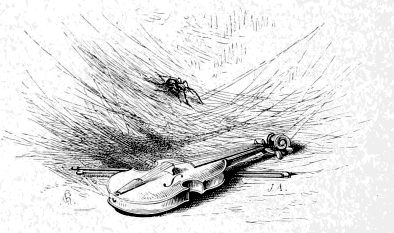

COMMUNITIES OF INSECTS.
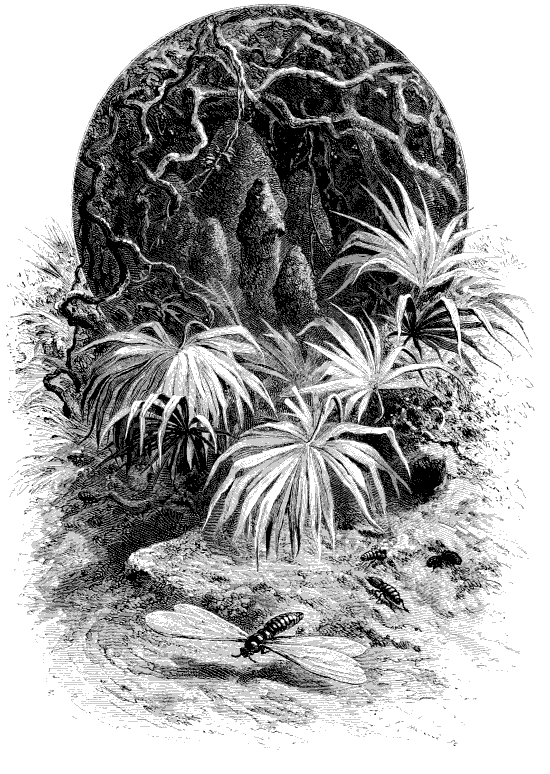
I.—THE TERMITES, OR WHITE ANTS.
CHAPTER I.
THE CITY IN THE SHADOWS: THE TERMITES, OR WHITE ANTS.
M. de Prefontaine (cited by Huber, in his work on "The Ants") relates that, when travelling in Guiana, he saw a party of negroes besieging certain fantastic edifices which he calls ant-hills. They did not venture to attack them except from a distance, and with firearms; having first taken the precaution, moreover, to dig a little trench and fill it with water, to check the progress of the beleaguered army and drown its battalions, if they adventured a sortie.
These edifices are not the habitations of Ants, but of Termites,—quite a different species of insect; which are found not only in Guiana, but in Africa, New Holland, and in the prairies of North America.
A host of travellers have described them. But the standard and most instructive authority is that of Smeathman, which now lies before us, enriched with excellent plates. The drawings are taken from the termite-hills of Africa.
Figure to yourself a mound of earth, about twelve feet high (some have been discovered measuring twenty), which, from a distance, might easily be mistaken for a negro's hut. Approach it, and you will at once detect that it is the product of a higher art. Its curious form is that of a pointed dome; or, if you like, of an obtuse and preponderating obelisk. For support, the dome or obelisk has four, five, or six cupolas from five to six feet high; and against these are propped up below some small bell-like structures, nearly two feet in elevation. The whole might well be taken for a kind of Oriental cathedral, the principal spire of which had a double cincture of minarets, decreasing in height; the said whole being of extreme solidity, and composed of a compact clay, which, when burnt, makes the best bricks. Not only may several men stand upon it without injury, but even the wild bull's station themselves on its summit as sentinels to watch, through the high grasses of the plain, that the lion or panther does not surprise the herd.
Nevertheless, this dome is hollow, and the inferior platform which supports it is itself supported by a semi-hollow construction formed by the junction of four arches (two to three feet in span),—arches of a very substantial design, being pointed, ogival, and in a kind of Gothic style. Lower still extends a number of passages or corridors, plastered spaces which one might call saloons, and finally, convenient, spacious, and healthy lodgings, capable of receiving a large population; in brief, quite a subterranean city.
A broad spiral passage winds and rises gradually in the thickness of the edifice, which has no opening, no door, no window; the vomitories are disguised and at a distance, terminating afar in the plain.
It is the most considerable and important work which displays the genius of insects; a labour of infinite patience and of daring art. We must not forget that these walls, which time has hardened, were very friable at first, and always crumbling. To raise this Titanic edifice to such a height, a continuity of effort was absolutely requisite, and a succession of provisional constructions, demolished one after the other when they had served their purpose. The masons commenced with the exterior pyramids, a foot and a foot and a half in height; then with those of the second rank. But the latter being solid and indurated, they intrepidly undermined their base to make room for the passages, the windows, and the spiral staircase. The same operation was carried out beneath the dome, which was excavated with great labour, and in such a manner that the great hollow vault, in conjunction with its lower platform, rested on the narrow vaults of the four arches forming the centre and foundation of the edifice.
Observe that this dome is self-sustaining, and that its substructions, strictly speaking, would amply suffice for its support; the lateral pyramids being only its not indispensable auxiliaries. Here, then, we find the principle of a true, honest, and courageous art, which, relying on itself and its calculations, requires no assistance from external supports, and needs neither props nor buttresses. It is exactly the system of Brunelleschi.
Who has carried the art to such a climax? We must own that it is the supreme of usefulness. The sharpened dome, the belfries or needles, are admirably arranged so as to resist the terrible rain-storms of the tropics. The dome keeps off the water, and assists it to flow away rapidly. If it cracked, the platform on which it leans would throw the water, as from a roof, on to the exterior enceinte, which would carry it to the ground. Hollow like a kiln, it quickly gets warmed, and absorbs the heat; duly communicating it to the subterranean passages to hatch the eggs, and promote the comfort of a race which, being wholly naked, prefers an elevated temperature.
It is a masterpiece of art, precisely because it is a masterpiece of utility. The beautiful and the useful admirably harmonize. Now one would wish to know who are these astonishing artists: we hardly dare to confess that they are the objects of our entire contempt.
Various names have been bestowed upon them; among others, that of termites: and again, that of wood-ants,—a designation not very accurate, for the ants are their enemies, and their body, being exceedingly soft, is exactly the opposite of the dry hard body of the ant.
They have been also called wood-lice; and they seem, in truth, a soft and feeble kind of vermin, which are crushed without resistance. Magnificent jest of God, who loves to exalt his humblest creatures! The Memphis, the Babylon, the true Capitol of the insects, is built—by whom? By lice! Though their luxury of jaws, and their four stages of teeth, make them admirable rodents, nevertheless, if we except their élite, the soldiers, they have no important weapons. Their teeth, made to gnaw, are powerless in combat. The destiny of the termites is plain; spite of the formidable names which have been given to their species (bellicosus, mordax, atrox), they are simply workers.
Every other insect is stronger than they are; or at least harder, better protected, and more completely armed. All, especially the ants, hunt them, and devour them by myriads. Birds greedily pursue them; the poultry-yards absorb them in frightful quantities. All (even man, who cooks them) find them of an agreeable taste; and the negro can never be satiated with them.
They work without seeing their work. They have no eyes, at least none which are visible. Very probably, the darkness in which they live destroys their ocular organs, as is the case with a species of duck found in the subterranean lakes of Carinthia. The rare species of termites which venture forth into the daylight have very conspicuous and perfectly formed eyes.
The darkness and the persecution to which they are exposed under the light, seem to have developed their singular industry. Against that world of day which shows them so bitter a hostility, they have built, as they have been able, this little world of the shadows, in which they exercise their arts. They issue forth only in search of food, and the gum and other substances of which they make their magazines.
Their attachment is extreme for these cities of darkness. They defend them obstinately. The first blow that is given each resists in his own fashion; the workmen plastering the interior with a kind of mortar which closes up the holes, the soldiers attacking the assailants and drawing blood with their sharp pincers, clinging to the wound, and suffering themselves to be crushed rather than let go. A naked man (like the negro) shrinks under these bites, grows discouraged, and is conquered.
If you still persist, if you penetrate, you admire the palace, its circuits, its corridors, its aërial bridges, the halls or saloons where the population lodge, the nurseries for the eggs, the caves, cellars, or magazines. But, above all, search to the centre. There lurks the mystery of this little world; there is its palladium, its idol, incessantly surrounded by the cares of an enthusiastic crowd. A strange and shocking object, which is not the less obeyed, and visibly adored!
It is the queen, or common mother, frightfully fecund, from whose body issues an uninterrupted flood of about sixty eggs per minute, or eighty thousand eggs per day!
You can conceive of nothing more fantastic. These strange creatures, which we compare to vermin, have nevertheless their moment of supreme poesy, their hour of love; for a moment their wings uplift them, and almost immediately they sink. The couples thus bereft, having neither refuge nor strength, and no means of resistance, are a prey for all the insects,—a manna upon which they straightway throw themselves. The working termites, which have neither love nor wings, endeavour to save a couple of the victims, welcome them,—weak, and fallen, and wretched as they are,—and make them monarchs.
They remove them to the centre of the city, and establish them in the saloon on which all the apartments and corridors abut. There they are revived, recruited, and nourished day and night; and the female gradually assumes an enormous size, until in body and stomach she is two thousand times larger than her natural condition,—though, by a hideous contrast, the head does not increase. For the rest, immovable, and therefore captive, the doors through which she entered have become infinitely too narrow to admit of the egress of such a monster. Accordingly, there she will remain, pouring out, until she splits asunder, that torrent of living matter which the termites day and night collect, and which, to-morrow, will be the People.
This soft and whitish-looking creature, a stomach rather than a being, is at least of the size of the human thumb: a traveller pretends to have seen one as large as a crab.
The bigger she is, the more fertile, the more inexhaustible, this terrible mother of lice seems the more enthusiastically worshipped by her fanatical vermin. She appears to be their ideal, their poetry, their ecstasy. If you carry them off, with a fragment, a ruin of the city, you may see them, under a glass shade, instantly set to work to build an arch for the protection of the mother's venerated head, to reconstruct her royal hall, which will become, if the materials be sufficient, the centre and basis of the resuscitated community.
I am not astonished, let me add, at the extravagant love which they show towards this instrument of fecundity. If every other race did not jointly labour to destroy them, this truly prodigious mother would make them masters of the world,—nay, what do I say?—its only inhabitants. The fish alone would survive; but the insect world would perish. It suffices to remember that the queen-bee takes a year to accomplish what the termite mother accomplishes in a day. Through her means they would swallow up Everybody; but they are feeble and savoury, and it is Everybody which swallows up them.
When the species of termites which live and dwell in the woods unfortunately approach near our habitations, there is no means of arresting their ravages. They work with a truly incredible vigour and rapidity. They have been known in one night to eat their way through the leg of a table, then through the thickness of the table itself, descending through the leg on the opposite side.
The reader can easily imagine the effect produced by such toil as this on the joists and framework of a house. The worst of it is, that a long time may elapse before their ravages are detected. We continue to rely upon supports which suddenly, one fine morning, crumble away; we sleep peacefully under roofs which to-morrow will cease to exist.
The town of Valencia, in New Grenada, undermined by the subterranean galleries these insects have excavated in the earth, is now literally suspended upon their dangerous catacombs.
We have ourselves seen, at Rochelle, the formidable beginnings of the ravages they executed in the timber-work of a quarter of the town where they were introduced by foreign ships. Whole buildings are found eaten up, though apparently sound,—all the wood hollowed and tunnelled, even to the banisters of the staircase: do not rest upon them, or they will yield and give way under your hand. These terrible nibblers seem willing, however, to confine themselves to one district of the town, and not to invade the remainder. Otherwise, this historical city, important still through its marine and its commerce, would be reduced to the condition of Herculaneum and Pompeii.
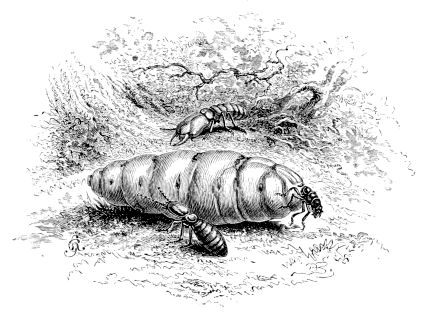
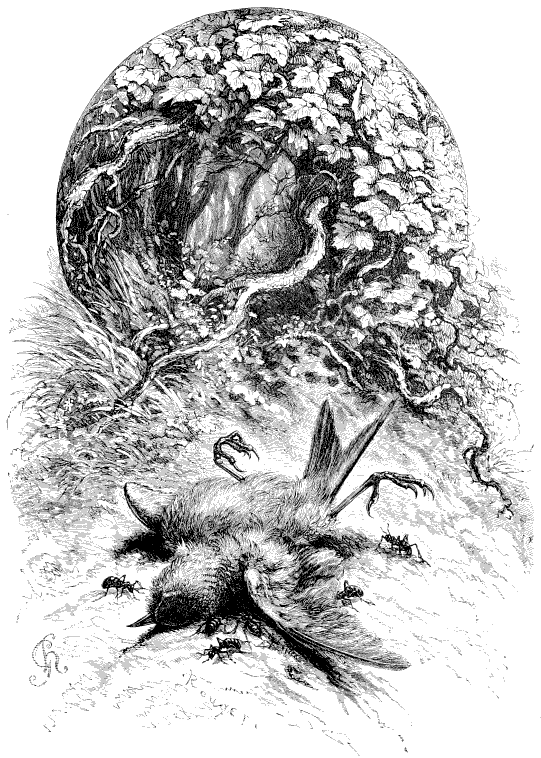
II.—INSECTS AT WORK.
CHAPTER II.
THE ANTS:—THEIR DOMESTIC ECONOMY—THEIR NUPTIALS.
The ants enjoy a superiority over all other insects, inasmuch as they are less specialized by their mode of life, their nourishment, and the instruments of their industry. Generally, they adapt themselves to all conditions, and work in all climates; nor in all Nature do more energetic agents in purification and cleansing exist. They are, so to say, the factotums of Nature.