PART II With the Incoming Tide (continued 3)
Reading edition
It was a fascinating experience to see these forgotten children of an unresponsive soil coming in touch with a civilization of which they had never dreamed; to see the struggle of emotions in their usually impassive faces, as they saw the evidences of European culture and wealth in the Northern cities through which we passed.
What fear crept into their hearts and drove the healthy blood from their cheeks when for the first time they saw the turbulent sea.
The ocean was vaster and the fear of it most real to us who sailed out of Bremerhaven in the steerage of the steamer Fulda; for we were the forerunners of a vast army of men which had scarcely begun to think of leaving its age-long bivouac. The Slav has never taken kindly to the sea, and the “More” held unconquered terrors.
It is difficult now to describe the incidents of that first landing in New York, for in rapid succession the experience has been so often repeated; and all the joys, fears and hopes which repeatedly I have shared with hundreds and thousands of men are so blended in my memory into one great wonder, that either analysis or description seems vain.
It is strange and yet natural, no doubt, that I remember the trivial incidents of that first landing. The attempt on the part of some of my Slovaks to eat bananas without removing the skins; their first acquaintance with mince pie, which they declared a barbarous dish; our first meal on American soil, in a third rate boarding-house for immigrants, and the injunction of one of the earlier comers: “Don’t wait for anybody, but grab all you can. In this country the motto is: ‘Happy is the man who can help himself!’”
I remember the lonely feeling that crept over us as we found ourselves like driftwood in the great current of humanity in the city of New York, and the fear we had of every one who was at all friendly; for we had been warned against sharpers. I remember our pleasure in the picturesque ferry-boat which carried us to New Jersey, its walking-beam seeming like the limbs of some great monster crossing the water.
Then crowding fast upon one another come memories of hard tasks in gruesome mines and ghostly breakers; the sight of licking flames like fiery tongues darting out at us, from furnaces full of bubbling, boiling metal; the circling camps of the coke burners who kept their night’s vigil by the altars of the Fire God.
There are memories of dark ravines and mud banks, choked by refuse of mill and mine; the miners’ huts, close together, as if space were as scarce on the earth as compassion for the stranger.
I remember the kindness of the poor, the hospitality of the crowded, the hostility of the richer and stronger, who feared that we would drive them from their diggings; and the unbelief of those to whom I early began preaching the humanity of the Slav—rough and uncouth, but human still, although he has scarcely ever had a fair chance to prove it.
Of the names of the various towns through which I passed, in which I worked and watched, I particularly remember four: Connelsville, Scranton, Wilkes-Barre, Pa., and Streator, Ill., all of them typical coal towns. In none of them were my people received with open arms, although they rarely met with organized hostility.
In Scranton and in Streator, they still remember our coming and our staying. Since then, I have repeatedly visited all these four places upon errands of investigation and interpretation.
I always dreaded going back to them; not only because it would revive painful memories of a very hard apprenticeship, but because I could not avoid asking myself if the optimism with which I have treated the problem of immigration, by voice and pen, would be justified.
What if the Americans in these cities should say: “We have lived with these Slavs for twenty-five years and more; we have been with them day after day, while you have flitted about the country. We know better than you do. We told you the ‘Hunkey’ was a menace when he came, and he is a menace still.”
I well know that my readers and my auditors have often criticised my optimism, and especially the sympathetic note with which I approach this problem, regarding which they are always more skeptical the more remote they are from it.
I have tried to modify my view of the problem by facing it in all its bearings; I have not shrunk from seeing the worst of it. In fact I know American cities best from that dark and clouded side. I know the Little Italies, the Ghettos, the Patches around the mines, the East Side of New York and the West Side of Chicago; although I have never been the full length of Fifth Avenue and have never seen the famous North Shore drive.
I am familiar with penitentiaries, jails, police courts and even worse places; for I wanted to know to what depths these leaden souls can sink, and I fear that I have more anxiety as to their nativity than their destiny. Yet, having seen the worst of the bad, I never lost my faith in these lesser folk and my optimism remained unclouded. One fear alone assailed me; that what my critics said to me and of me was true. “He is an immigrant himself, and of course it is natural that he should see the brighter side of the problem.” To me, that was the severest and most cutting criticism, just because I feared it might be true; yet I have honestly tried to see the darkest side of this question, both as it affected the immigrant and the country that received him.
I have listened patiently to jeremiads of home mission secretaries about these “Godless foreigners.” I have read the reports of Immigrant Commissions, and all the literature written the last few years upon this subject, and I am still optimistic, and disagree with much that I have heard and read. Many authors who have written regarding this question had no first-hand information about it. They knew neither the speech nor the genius of these new people; they had a fixed belief that all civilization, culture and virtue, belong to the north of Europe and that the east and southeast of that continent are its limbo; and they relied upon statistics, which at best are misleading, when used to estimate human conduct and human influences.
Typical of this class of literature is a recent pamphlet upon the subject, which, judging from the excellent biography appended, must be based upon extensive reading; yet the author comes to this conclusion: “Assimilation in the twentieth century is a very different matter from assimilation in the nineteenth. In many respects, the new immigration is as bad as the old was good.”[3]
There are several facts which this author has forgotten, as have those from whom he draws. First, the older immigrant is not yet assimilated. In the agricultural counties of Mr. Edwards’ own state, there are townships in which the English language is a foreign tongue, although the second generation of Germans already plows the fertile fields of Wisconsin; and there are cities where the Germans have thoroughly assimilated the Americans.
There are places of no mean size in Pennsylvania, which are as German as they were 200 years ago, and as far as the Irish everywhere are concerned, it is still a question what we shall be when they have done with us.
I venture to predict that the twentieth century immigrant will assimilate much more quickly and completely than the immigrants of the eighteenth and the early half of the nineteenth centuries assimilated.
Beside the fact that the process is going on much more rapidly than ever before, as I asserted, my theories are corroborated by Professor Ross, of the University of Wisconsin, whose book is suggestive if not conclusive. Speaking of the assimilation of the immigrant, he says:
“On the whole, those who come now Americanize much more readily than did the non-English immigrants of the seventeenth and eighteenth centuries. Not only do they come from lesser peoples and from humbler social strata, but, thanks to the great rôle the United States plays in the world, the American culture meets with far more prestige than it had then. Although we have ever greater masses to assimilate, let us comfort ourselves with the fact that the vortical suction of our civilization is stronger now than ever before.”[4]
Neither is any one prepared to prove that the “new immigrant is as bad as the old was good.”
It is very interesting that when authors and speakers quote statistics, as they usually do, to prove the criminal nature of the new immigrant, they do not differentiate between the older and the newer groups. If they did, and would let statistics determine the issue, they would find that the new immigrant is good and the old bad; yes, very bad.
The following tables, quoted from the Report of the Commission of Immigration of the State of New York, are worthy the close study of Mr. Edwards and the authors upon whom he has relied.[5]
Statistics Referring to Foreign-Born Offenders Committed to New York State Prisons and Penitentiaries During 1904.
Total Number of Prisoners Committed
Major Offenses. Minor Offenses. Total.
Aggregate3,67926,13629,815
Total white3,34524,96928,314
Native white2,26616,75919,025
Native white of native parentage1,22310,26611,489
Native white of foreign parentage7324,5005,232
Native white of mixed parentage2631,5051,768
Native white of unknown parentage48488536
Foreign-born whites1,0758,1589,233
Whites of unknown nativity45256
Negroes3301,1391,469
Mongolians...11
Indians42731
Foreign-Born White Offenders by Nativity
Major Offenses. Per cent. Minor Offenses. Per cent.
Austria484.52593.2
Canada686.34355.3
Denmark50.5280.3
England and Wales676.26558.1
France191.81191.4
Germany21219.71,13613.9
Hungary151.4831.0
Ireland14813.73,56943.9
Italy25523.76017.3
Mexico......60.1
Norway70.7460.5
Poland302.82322.8
Russia11911.03924.9
Scotland171.62202.7
Sweden141.31632.0
Switzerland40.4430.5
Other countries474.41712.1
Totals1,075100.08,158100.0
Paupers Admitted to Almshouses in New York State During Year 1904. by Nativity and Length of Residence in the United States.
All paupers admitted10,272
Per cent. of white paupers admitted:
Native44.0 per cent.
Foreign-born56.0 per cent.
Foreign-Born White Paupers Admitted in 1904, by Nativity
Country of BirthPer cent. Per cent.
Ireland54.3
Germany18.7
England and Wales6.4
Canada (including Newfoundland)4.3
Scandinavia2.0
France0.9
Scotland2.0
———88.6
Italy3.5
Hungary and Bohemia0.6
Russia and Poland3.3
Unknown4.0
——11.4
Grand total 100.0
What is more striking still is the following table which seems to prove that the new immigrant does not increase his percentage in the criminal column materially, in fact that there is a slight tendency to decrease it.[6]
Foreign-Born Offenders According to Years of Residence in the United States
Years Major Offenses. Per cent. Minor Offenses. Per cent.
Under one year363.3861.0
One year797.22292.8
Two years635.82973.6
Three years524.82853.4
Four years403.61772.2
Over four years82475.37,14387.0
Totals1,094 100.0 8,217 100.0
I am not trying to prove that the old immigration was worse than the new; I do not believe that these statistics prove it, in spite of their appearing to. But they do prove conclusively that statistics of this kind are absolutely unreliable in furnishing tests of the moral fiber of this or that group.
Far more reliable is the verdict of various communities after twenty-five years’ experience with the newer immigrant.
Take for example the city of Streator, Ill., which has steadily grown in size and in the number and variety of its industrial establishments; a development which could not have taken place without the new immigrant. There are certain unprofitable seams in the mines which the English-speaking miners would not have worked; even as there are less profitable veins which the Slav does not care to touch and which are being worked by Sicilians, new upon the scene.
It is true that out of the 500 Welsh miners there are only about fifty left; but the 450 were pushed up and not out and are in no position to complain. They have moved on to farms and have grown prosperous while some of the most lucrative business in the city is theirs.
It does seem a great pity that a skilled trade like mining should have passed into the hands of unskilled labourers; but for this, the invention of machinery is to blame, and not the foreigner. Had comparatively cheap labour been unavailable, the genius of the American would not have stopped until he had all but eliminated the human element, as he has done in many other trades in which unskilled foreign labour is not a factor.
Twenty-five years ago I “squatted” near mine No. 3 with my men from Scharosh. It was as wretched a patch as miners’ patches always are. We bunked twenty in a room and took as good care of our bodies as conditions permitted; so that when we went down-town we were cleanly if not stylish.
My men soon learned to drink whiskey like the Irish, swear like the English and dress like the Americans.
After twenty-five years the patches around the mines in Streator are practically gone, and the homes there are as good as the Welsh or English miners ever had. Some of the newer additions in that growing city are occupied entirely by Slavs and do them credit.
Nor has the Slav been content to remain in the mines; he, too, has begun to move out and up. He owns saloons and sightly stores in which his sons and daughters clerk, and it would take a very keen student of race characteristics to distinguish the Slavs from the native Americans.
“Do you see that young man at the entrance to the Chautauqua?” said Mr. Williams, its public spirited secretary.
“Racially, his father is as sharply marked a man as I have ever seen, and the son, a graduate of Harvard, looks as if his forefathers had all grown up in the salt air of the New England coast.”
Here in Streator were the people who have lived with the new immigrant a quarter of a century and more, and I have spoken to them three times, in my most optimistic vein; many a man and woman has said:
“You are right, they make splendid citizens.”
“They are good neighbours.”
“They are as human as we are, and they are proving it.”
This, in spite of the fact that in Streator as in Connelsville and in hundreds of industrial towns, they have been met with suspicion and have been treated with injustice.
“They are a great strain upon our political institutions,” said Mr. Williams, himself once a Welsh miner, pushed out of the mine by the Slav and now one of the leading citizens of Streator.
But Mr. Williams knows that the year I lived in Streator, when the Slav had no vote or influence, politics in that city were already corrupt and that the corrupters were native Americans, whose ancestors harked back to the Mayflower, and who were rewarded for their corruption by high political offices. In truth, when the Slav came to this country, there was nothing left to corrupt, in Scranton or Wilkes-Barre, in Connelsville or Streator; or, indeed, in all Pennsylvania and Illinois. The Slav now has some political power; but as yet he has not produced the “grafter.” I do not say that he will not; but when he does, small blame to him.
In one of the four cities which I have mentioned, I shared with a group of Poles the vicissitudes of the first few weeks in a boarding-house, a combination of saloon and hotel, common in Pennsylvania, and usually offering more bar than board.
One evening an American came among us; a splendid type of agile manhood. When my men saw him, they said: “This is a prince!” They did not know that he was a politician. He shook hands with every one of us, and I said to the men: “This is democracy!” Poor fool! I did not know that it was the day before election.
Then he marched the men to the bar, and said to the barkeeper: “Fill ’em up.” And as they drank the fiery stuff, no doubt they thought they were in Heaven, and forgot that they were in Pennsylvania. When the whiskey took effect, they were marched into a large hall, where other Poles, drunk as they, were congregated; speeches were made, full of the twaddle of political jargon which they did not understand, and when morning came, these Poles, so intoxicated that they did not know whether they were North Poles or South Poles, were marched to the voting-place and sworn in.
I have told this story in each of the four places referred to, and in the place where it occurred, a judge, who was among my audience, said to me: “Don’t tell that story again.”
“Why not? It is true,” I replied.
“Yes,” he said, “it is perfectly true; but you’d better save your strength. In this city, not only the foreigners, who are not citizens, vote; but the dead vote, long after they have become citizens of Kingdom Come.”
One of these same Poles recently took me through the Capitol of Pennsylvania at Harrisburg. With great pride he guided me from foundation to dome, pointing out those objects of interest which every stranger must see, as if they were the memorials of noble deeds of valour.
They consist of wood, painted to imitate marble, chandeliers of base metal, to be sold by the pound, at fabulous prices, and among many other spurious things, a safe, supposed to be fire-proof and burglar-proof, but which was not politician-proof, for an ordinary gimlet bored a hole into its corrupt heart.
What was distressing to me was not so much that the State paid millions for this veneered and varnished fraud, but that my Polish guide pronounced the word graft with evident relish and without fear or shame.
I do not doubt that the presence of the new immigrant is “a great strain upon our political institutions”; but not greater than the old immigrant was, and still is. This certainly is true of Pennsylvania; for there are counties in that state, into whose wilds the new immigrant has not yet penetrated, and where those who have been living off its fat acres since their birth—the sons of immigrants who came 200 years ago—hold their right of franchise cheap. I am told that in these counties nearly every vote can be bought for five dollars.
This may be idle rumour; but the fact remains and can be proved by any one who chooses to investigate, that Scranton, Wilkes-Barre, Connelsville and a hundred other cities and towns, are better governed now than they were before Slav, Latin and Jew came to live in their Patches and Ghettos. This is true in spite of our having tried to corrupt these new citizens from the very hour when they received their political rights, and that when they had no rights, we treated them with neglect and scorn.
The mayor of Greensburg, Pa., a man of the newer and better type of administrators, whose territory is completely environed by the coke regions and has an almost totally foreign population—says:
“They make reliable citizens. They can be trusted absolutely. Their worst enemy is drink; but when a foreigner comes before me and is fined, if he has no money and I let him go home, he will come the next day to pay his fine even if he lives ten miles from town. Yet in spite of the fact that the ‘Hunkey’ and the ‘Dago’ have helped build up Greensburg, and have enriched its citizens, they are still held in contempt by the majority of its people.”
This same official told me that a few years ago when the Italians celebrated their Independence Day, the High School boys of that city threw decayed vegetables at them and their national flag.
Without the slightest reserve I can say this: Wherever an enlightened official, like this mayor, or teachers of the public schools, ministers of the Gospel and business men, have come in real contact with the new immigrant, their verdict was entirely different from that of Mr. Edwards and many of the professional writers upon the problem which the foreigner represents.
There are some places in the United States where I have found the immigrant a menace, and one of them is in Pittston, Pa. There the Italian is really bad; there he is an Anarchist and a murderer. But in Pittston I discovered the really bad American, an Anarchist and a murderer; although he may be the owner of some of the mines or a high official in the town. In that city, every law which governs mining has been openly violated, and there is at least one mine in the place which is nothing but a deep hell-hole and is known as such by the men compelled to work in it. It is a mine in which anything may be had for a bribe and anything may be done without fear of punishment. In one of the last communal elections, the candidate for its highest office kept open house, with beer and “booze” in one of the miners’ shacks; young boys, not out of their teens, were allowed to drink to intoxication, and the candidate already mentioned was not an Italian or a Slav or a Jew; but an American, unto the tenth generation and a member of a Protestant church.
I do not rejoice in writing this or in telling it as I have had to tell it in the towns affected, and to the very men who have thus offended.
It is painful to me, because, after all, I do not feel myself so closely identified with the immigrant as with the American. While my sympathies are with the immigrant, they are much more with this, my country, and with that circle of the native born, whose ideals, whose hopes and whose aspirations have become mine.
I am not greatly concerned with immigration, per se; that is a subject for the economist, which I am not. It is for him, if he is skilled enough, to know whether we can afford to keep our gates open to the millions who come, or when and to whom to close them.
Narrowly, or perhaps selfishly, I am concerned for those who are here; that they be treated justly, with due appreciation of their worth, and that they may see that best in the American which has bound me to him, to his land and to its history; to its best men living, and to those of its dead who left a great legacy, too great to be squandered by a prodigal generation.
Knowing how great this legacy is, and yet may be for the blessing of mankind, I am pleading for this new immigrant. If we care at all for that struggling, striving mass of men, unblessed as yet by those gifts of Heaven which have blessed us, let us prove to these people of all kindreds and races and nations, that our God is the Lord, that His law is our law and that all men are our brothers.
XXIV FROM CHAOS TO COSMOS
WHILE passing through a pleasure park in one of the European capitals I met, quite by accident, my fellow passenger on the Italian steamer, the Puritan rebel; she who smoked cigarettes, drank cocktails, was divorced and had gone to the Old World in search of a more congenial moral atmosphere and a husband with braid and buttons. Now she was drinking the cup of unrestrained pleasure, and having nearly drained it, it was beginning to taste bitter. Officers and attachés, Grand Opera, frivolous plays and care-free crowds, were beginning to pall upon her and she was unmistakably homesick; although she did not confess to that last fact.
“I suppose,” she said, “you can’t get rid of Puritanism, when once it gets into your blood. It’s an hereditary disease.”
“And it is contagious,” I added.
“I thought,” she continued, “that at home we were small and narrow and that over here I should find a larger freedom; but you can’t turn around here, without finding the bars up—racially, religiously, socially and politically. The only unobstructed passage is the way to Hell.”
Hers were large, black, dreamy eyes and the shadows of disappointment passed over them. Then, to shake off the gripping seriousness from her mood, she said, with a forced smile: “I am going to see the Merry Widow to-night with my Captain. They are both inane. Meeting you has made me blue, I fear; you remind me of my father.”
She said this reproachfully, I thought; although she added: “Let us sit down and talk things over. My daughter and the maid are listening to the music and I have nothing to do until my Captain comes to meet me.”
“Now please listen to me,” I said when we were seated. “I was born over here, right in this city. My playground was this very park. I have tasted the best this city can offer a boy, as well as its worst.
“Listen,” I said again; for her eyes wandered to the gay crowds. “I also know your home city, and I wouldn’t give one block in Hartford, Conn., not speaking from the commercial standpoint, for this whole magnificent city, with its Cathedral, its Grand Opera, its royal castle, its officers and its Merry Widow. Do you ask why? Just watch this crowd and let me interpret it to you. Those boys now passing are Bohemians, apprentices; and they are talking Czechish to make themselves obnoxious to the Germans whom they hate and who hate them, more than your forefathers hated the devil.
“Do you see that Bosnian? Notice his smile as he sells a jack-knife to the Austrian soldier. His smile would be more genuine if he could knife this detested ‘Schwab,’ his enemy and the conquerer of his country.
“Those men with the needle-pointed moustaches are Magyars, and they hate the Slavs and Germans and every one else who will not speak their language.
“The officers with the red fez are Turks, as you know; just now they despise everything Austrian, and not without reason.
“The picturesque nurse maids, wheeling the babies, do not have those soldiers with them to protect Austria’s ‘infant industries’; they are Slovaks, aliens of the aliens, and the unprotected prey of the soldiers. The Jews here add to the chaos; for all these races hate them and they reciprocate in kind.”
“We have all these people in Hartford! What of it?” My companion impatiently interrupted my explanations.
“This,” I replied. “These people have lived for many hundreds of years, in chaos and confusion. Each in his little world, hemmed in by the pride of his race or the hate of other people. Each day the barriers grow taller and the hate grows stronger.
“I lived in it for a good many years, and it is an awfully little world one is locked into; yet it is as big and terrible as Hell. That being branded by the marks of your race, by the speech your ancestors have bequeathed you, by your blood or your religion, and isolated as if you were a leper, while your heart yearns for the larger fellowships—all that I have felt from my youth.”
“Haven’t you felt it in America, too?”
“Yes; but with a difference, a tremendous difference. There they may shut one from the social contact, but there remain the public schools, the libraries, the churches and settlements. And what schools you have in Hartford! I have been in schoolrooms there, in the first grade, where 90% of the children were of alien birth, and at a glance I knew their nationality.
“Italians, miniature old men and women, although scarcely seven years of age.
“Serious, little black-eyed Jews, with the burden of ages upon their bent backs.
“Polish boys and girls, with small foreheads, as if some tyrant had trampled upon their heads.
“Armenians, sad-looking, dark-skinned creatures, haunted by the remembrance of their village street, red from the blood of the slain.
“Syrian children, out of the very village in whose meadows the angels sang when Christ was born; but who have never known either peace or good will.
“I went to the second and third grades, and there it seemed as if the hand of a good angel had already passed over those marked and marred faces; I could almost hear the voice of the All-Father saying:
“‘I will blot out the transgressions which have been transgressed against you.’
“They looked like children who were beginning to live the real life of the child in a really human world, and were having a chance to grow into the human likeness.
“I have been to your High School, and there the marks were all but obliterated; there was ‘neither Jew nor Greek, neither Roman nor Barbarian’; they were all a new people.”
Now, my Puritan rebel was listening attentively enough; so I continued: “In America, something happens which cannot happen here. Over there, the fiber, the tissue, that mysterious fluid which we call life or soul, the very nerve cells change, under the benign influences of the heritage left by your fathers; that heritage which you despise—you”—I repeated, and I said it angrily; “you, who expatriate yourself for the sheen of braid and buttons, for Grand Opera and Viennese waltzes! You expatriate yourself

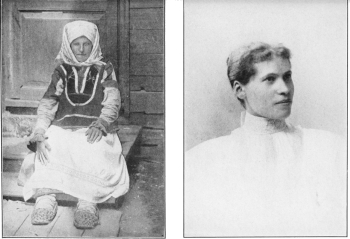
SLAVIC WOMEN
THE ONE WHO STAID AT HOME THE ONE WHO EMIGRATED
from a country where there is more idealism to the square inch than in all this country, in spite of its statuary, its music and its aristocracy.
“I’d rather live in Connecticut, the wife of a humble artisan, than here, the ‘consort’ of a Count or Duke.”
“You talk exactly like my father,” she repeated.
“Do I? I’m glad of it. I told you that Puritanism is contagious. Maybe I caught it from your father, and if I were sure that I have caught it, I would be sure of more moral fiber than you will get here, if you stay a hundred years.
“That Puritanism which you despise will make cosmos out of chaos; for in spite of its narrowness, there is in it the passion for humanity. It cries for justice, for freedom, for equality, even if it too often burdens itself with theological dogmas hard to understand and harder to believe.
“After all, the best thing in your country is, not that you give the weaker a chance to grow strong, and the broken the blessing of healing—the best of it is, that those of us who are just what we are, have a chance to help in the doing. It’s the work that a man or woman can do over there that counts.
“Yes, go back, crawl back, if necessary, to sober Connecticut; to its pure women and its undemonstrative men, who do not make meaningless compliments, after the fashion of your Captain; but who will at least think no evil of you and who will treat you with real courtesy, when there is need of courteous action.
“You want art? You fear you will miss it? They are doing something worth while at home, in bronze and marble; but they are doing more wonderful things in human flesh and spirit.
“I have seen wretched Italian children who came from where they make little fairies out of Carrara marble, yet they were crooked without and within; and I have seen them grow tall and beautiful and pure, by the grace of God and the passion of some noble woman. That, after all, is the supreme art.
“Music? You can have Grand Opera in New York composed of all the stars in the operatic firmament; yet I have heard music, sweeter, better and truer, sung by children in the Settlements.
“I have seen a Christmas at Hull House, in Chicago, which surpassed any Grand Opera. I am sure if angels come down to earth and care for our mundane pleasures, they must have struggled for a front seat there.
“Fifty children of nearly all the races under Heaven sang the songs of their home-land, all the way from those they used to sing under the dark pines of Norway’s farthest crag, down to those sung by Sicilian children beneath the palms of their ever sunny land.
“Together they sang those Heaven-born prophecies of ‘Peace on earth, good will to men’; and as I heard the blended voices of Jews, Catholics, and Protestants, Greeks, Italians and Syrians, I felt that the ancient prophecies are being fulfilled, at least in spots, on our then unknown continent.
“Go home. Learn to find pleasure in that classic art of making home. Learn how to find joy in giving children a chance to live and laugh, to look towards manhood and womanhood from a mountain top and not from a cage. Catch the rhythm of that new poetry which is now in the making; which speaks in its sonnets of justice, in its epics of war against all human wrong and in its lyrics of a sublimer and a larger love.”
“There comes my Captain!” said my victim, with a sigh of relief; “and I must go.”
Yes, there he stood; all braid and buttons, or just braid and buttons, a waxed moustache, a waxen smile and clicking spurs.
Gracefully he bowed as he offered his arm, in such a charming manner as could not be easily reproduced by any mere American. Thus they left me to my solemn musings, while the living tide swept by me, each drop in the great current antagonistic to the other. Unbidden there arose before me the ship, laden by human freight, leaving America, carrying representatives of these same races and nationalities alien and hostile to each other: Slavs and Magyars, arch foes of centuries’ standing; Northern and Southern Italians, looking with scorn at one another; Jews and Gentiles, Greeks and Bulgarians, Albanians and Montenegrins.
All of them had come out of the chaos wrought by ages of hate and centuries of warfare. But in America, many of them had learned to live together without scorn on the lip or hand on the sword-hilt.
The walls which separated them were weakened, if not broken down, and like blind men they felt for one another in the dark; sometimes missing the larger brotherhood, but often finding it.
The Pentecost of which prophets and seers have dreamt, which is to repair the ruin wrought in the human family by the building of its towers of Babel, cannot be so far away. The cosmos may yet come out of the chaos, and there is no spot of earth on which this creative act can be performed as well as in our America.
The land is vast enough and rich enough; no barrier of language divides the East from the West; the North and the South are almost one, after an internecine war; and in spite of our melting of metals and slaughter of cattle and growing of corn—in spite of souls made hard and unresponsive to anything but money—like the
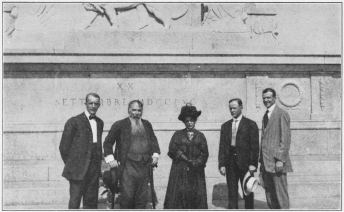
GENERAL AND MRS. RICIOTTO GARIBALDI AT THE FOOT OF HIS FATHER’S MONUMENT IN ROME “It is just like you Americans—you go to work to make your dreams come true.”
cash register we have invented; in spite of my Puritan rebel and her numerous company—in spite of all that, our land is still full of dreamers of dreams, who yet are awake and practical enough to make their dreams come true.
“It is just like you Americans,” said General Riciotto Garibaldi, to my “boys,” as they stood together at the foot of his father’s monument in Rome; while he listened to the story of their journeyings in the immigrants’ land, living in their huts in Hungary, Poland and Italy, learning their language and their ways, that they may know how to minister to their needs over here, and bind us to them and them to us. “It is just like you Americans. We Italians think about those things and make poetry; you go to work at a great dream to make it true.”
My faith in the dreams of the great dreamers has never wavered. I knew that the prophet’s vision was not a Fata Morgana, and that the words of the Son of Man came straight from the fountain of truth. Believing in them and believing in American manhood and womanhood, in their altruism and in their faith, and believing in the essential humanity of our crowding alien host—I believe that cosmos is being created and that chaos will disappear.
Finally, what we teach the immigrant by precept or by example, he will become. He will bequeath our virtues or our vices, not only to the next generation which will spring with virgin strength from his loins; but through thousands of invisible channels, he will send these blessings or curses to the ends of the earth.
The issues of the Kingdom of God in this generation are with America.
APPENDIX I CLASSIFICATION OF THE NEW IMMIGRANT GROUPS
THE new Immigrant groups which are more difficult to classify according to race, nationality and religion:
The Slavs
I. Western Slavs
Nationality
Nameor political divisionReligion
BohemianThe Kingdom of BohemiaRoman Catholic
or Czecha province of AustriaProtestant
MoraviansMoraviaRoman Catholic
a province of AustriaProtestant
PolesPolandRoman Catholic
divided by the European
powers into
The Russian province of
Poland
The German province of
Posen
The Austrian province of
Galicia
SlovaksA number of districts inRoman Catholic
Hungary chiefly in andProtestant
near the Carpathians
WendsSettlements in Germany,Roman Catholic
Prussia and SaxonyProtestant
2. Eastern Slavs
RussiansRussiaGreek Orthodox
{Little RussiansSouthern RussiaGreek Orthodox
{RutheniansGaliciaand
{RussniaksHungaryGreek Catholic
3. Southern Slavs
ServiansThe Kingdom of ServiaGreek Orthodox
some districts in
Southern HungaryGreek Orthodox
CroatiansCroatiaRoman Catholic
a province of Hungaryand
Greek Orthodox
MontenegrinsMontenegroGreek Orthodox
an independent principality
BosniansBosnia and HerzegovinaGreek Orthodox
andProvinces of AustriaRoman Catholic
HerzogoviniansMohammedan
DalmatiansDalmatiaGreek Orthodox
a province of AustriaRoman Catholic
SlovenesCarinthiaRoman Catholic
or GrinersCarnoliaProtestant
Provinces of Austria
BulgariansCzardom of BulgariaGreek Orthodox
Districts in Southern
Hungary
Eastern European Groups Non-Slavic
MagyarsKingdom of HungaryRoman Catholic
and Protestant
FinnsFinlandProtestant
a semi-independent
province of Russia
RoumanianKingdom of RoumaniaGreek Orthodox
Roman Catholic
LithuaniansDistrict in RussiaRoman Catholic
and Protestant
GreeksKingdom of GreeceGreek Orthodox
AlbaniansAlbaniaGreek Orthodox
a province ofRoman Catholic
Turkeyand
Mohammedan
Groups from the Ottoman Empire
ArmeniansAsia MinorArmenian Catholic Church
Gregorian Church
Protestant
Syrians Syria a province of Turkey Syrian church {Jacobite {Maronite {Ancient Syrian (Roman Catholic)
APPENDIX II NET IMMIGRATION TO THE UNITED STATES 1899-1908
THERE is much misapprehension in the popular mind, both as to the number of immigrants arriving in the United States, and those remaining for permanent residence.
Until 1907, all aliens arriving were enumerated; but of those departing, no record was kept.
The Commissioner General of Immigration arrived at the figures of net immigration given below, by estimating the departures according to figures obtained during four months in 1907, when the returning tide of immigration was normal.
The year 1908 shows an abnormally small increase, due to the industrial depression in that year, when the returning tide of immigration was very strong. The following tables show that a large number return every year, and I am inclined to believe that the estimated figures of the net increase are too high, and that the permanent increase of the foreign-born population cannot be calculated from this insufficient data.
The net gain in our foreign born population in the last ten years is estimated as 5,240,200 which is 68% of the total immigration.
Alien arrivals.
Year. Accepted immigration figures. Other alien arrivals. Total alien arrivals. Total alien departures estimated. Net immigration estimated. Ratio estimated net immigration accepted immigration figure.
1899 311,715 [7]45,000 356,715 172,837 183,878 59 per cent.
1900448,57265,635514,207206,351307,85669"
1901487,91874,950562,868209,318353,55072"
1902648,74382,055730,798220,103510,69579"
1903857,04664,269921,315247,559673,75679"
1904812,87027,844840,714332,019508,69563"
19051,026,49933,2561,059,755385,111674,64466"
19061,100,73565,6181,166,353356,257810,09674"
19071,285,349153,1201,433,469431,3061,007,16378"
Total 7,762,317 753,572 8,510,889 3,275,689 5,240,200
APPENDIX III INDUSTRIAL DEPRESSION AND IMMIGRATION
THE following table, giving the number of immigrant aliens admitted from June 30, 1907 to June 30, 1908, is of special interest, because it shows marked decrease during that period of industrial depression.
The figures are from the report of the Commissioner General of Immigration.
The increase in the number of those from Roumania is probably in Jewish immigration, following a period of renewed anti-Semitic disorders.
Should a change occur in the political status of the Russian Jews, a large decrease of that group of immigrants may be expected. While it is not likely to occur soon, Jewish immigration will also be retarded by the fact that the economic conditions in the Russian empire are growing better.
The greatest decrease may be expected from Austria-Hungary, where drastic emigration laws have been passed, and are rigorously enforced; especially against the Slavs, whose withdrawal in large numbers has imperilled agricultural and industrial enterprises in Hungary.
Immigrant Aliens Admitted, Fiscal Years Ended June 30, 1907 and 1908, Showing Increase and Decrease for Each Country.
Country of last permanent residence. 1907. 1908.Increase (+) or decrease (-)
Austria-Hungary 338,452 168,509 -169,943
Belgium 6,396 4,162 - 2,234
Bulgaria, Servia, and Montenegro 11,359 10,827 - 532
Denmark 7,243 4,954 - 2,289
France, including Corsica 9,731 8,788 - 943
German Empire 37,807 32,309 - 5,498
Greece 36,580 21,489 - 15,091
Italy, including Sicily and Sardinia 285,731 128,503 -157,228
Netherlands 6,637 5,946 - 691
Norway 22,133 12,412 - 9,721
Portugal, including Cape Verde and Azore islands 9,608 7,307 - 2,301
Roumania 4,384 5,228 + 844
Russian Empire and Finland 258,943 156,711 -102,232
Spain, including Canary and Balearic islands 5,784 3,899 - 1,885
Sweden 20,589 12,809 - 7,780
Switzerland 3,748 3,281 - 467
Turkey in Europe 20,767 11,290 - 9,477
United Kingdom:
England 56,637 47,031 - 9,606
Ireland 34,530 30,556 - 3,974
Scotland 19,740 13,506 - 6,234
Wales 2,660 2,287 - 373
Other Europe 107 97 - 10
Total Europe1,199,566 691,901 -509,353
APPENDIX IV SUGGESTED CHANGES IN IMMIGRATION LAWS
I. The examination of all emigrants at the port of embarkation.
Objections
(a) The maintenance of an expensive machinery which will be hard to direct and control.
(b) The possible objections of the governments concerned.
(c) The prospective emigrant will necessarily have taken the most serious steps; and rejection at the port of entry will not be a much greater misfortune than rejection at the port of embarkation.
(d) That it will be practically impossible for political offenders to leave their country.
II. “That in addition to the restriction imposed by the laws at present in force, the head tax of four dollars now collected, should be increased to ten.”[9]
Objection
This would increase the number of immigrants who come here without their families, and consequently would react upon the United States both morally and financially.
Suggestion
That the ten dollar head tax be collected from adults, and that the present tax of four dollars remain in force for children and possibly for mothers.
III. “That each immigrant, unless he be a political refugee, should bring with him not less than twenty-five dollars, in addition to the amount required to pay transportation to the point where he expects to find employment.”
There is no valid objection to this demand—and the vast majority of immigrants are able to meet it.
IV. “That immigrants between the ages of fourteen and fifty years should be able to read a section of the Constitution of the United States, either in our language, in their own language, or in the language of the country from which they come.”
Objection
The demand for such a test is not unreasonable, and is humane in that it exempts the young and the aged; but it does not take account of the fact that in most immigrant groups, the education of the woman has been neglected—and that the enforcement of such a law would have the same effect as that which relates to the increase in the head tax.
Suggestion
That the literacy test be not applied to the wives of immigrants.
INDEX
A, B, C, D, E, F, G, H, I, J, K, L, M, P, R, S, T, V, W, Y.
Albania, 300, 302, 305-307 Amerikansky Schtore, 108 Anarchist, 291, 322 Anti-Semitism, 286 Armenia, 351 Austria, 287 Bacon, Judge, 283 Baldwin, 302, 305-306, 309 Beisel, Conrad, 232 “Bessie,” 170 ff. Black Hand, 291 Calabria, 174 Campagna, 176 Cattero, Boche de, 248 Chautauqua, 305, 309 Chicago, 86, 87 Chorvat, Jan, 130 ff. Columbus, 244 Connecticut, 200, 353 Connellsville, 192, 331, 341, 344 Constitution of United States, 323 Cracow, description of, 112; hatred of Germany in, 113; Jews in, 113; political condition in, 114 Criminals, 322 Czechs, 212 Dalmatia, conditions in, 138; government, 139; America a blessing to, 147 Dowie, Charles A., 89 Edwards, R. H., 334, 336, 345 Ellis Island, 170 Emigrants, views of Americans, 82 ff.; effect of return of, 72-75 Fansher, Guy J., 308 Gabriel, 256 ff. Garibaldi, 357 “Gemeinschaft,” 222 Greensburg, Pa., 344 Grose, Howard N., 317 Harrisburg, 343 Hartford, 315, 349, 351 Harvard, 264-266, 340 Hazleton, 353 ff. Hungary, 260, 287, 295 Huss, 209 Hussite movement, 221 Introduction, letters of, 112 Italy, church of, 177; dark side of emigration from, 173; effect of emigration on Italy, 166; on wages, 174; on education, 175; on religion, 176; on women, 178; on economic conditions, 179; on purchase of land in, 174 Italians, bad, 195 Jamestown, 306-307, 310 Japanese question, 194 Jew, the, prevalence of persecution of, 260; Jewish feeling of superiority, 261; religious feeling alone does not account for prejudice, 262; Prof. Shaler’s comparison of Jewish and Gentile students, 264; Jewish incapacities, 267; the Orthodox, 272; nowhere indigenous, 275; characteristics, 279 ff. Kisheneff, 277 Kopaniczari, meaning of word, 93; savage appearance, 94; view of fires, 94; of cameras, 95; of medicine, 96 Kortia, 310 Lewis, H. S., 282 London County Council, 283 Lo Perfido, Luigi, 177 Luther, Martin, 210, 221 Matera, 177 Mayflower, The, 341 Medical science in Trenczin, 96, 97 Methodist Church, 176 Molocani, 187 Monastir, 307 Montenegro, Prince of, 153; minister of exterior of, 152; festivities of, 154; emigration from, 155; neighbours of, 156, 164; legend of origin, 158; national dress of, 160 Passover, Feast of, 262 Pennsylvania, 334, 342 Pietor, Ambrosius, 223 Pittston, Pa., 320, 345 Poland, best type of, 116; in miniature, 117; federation of, 122 Police, American, 49; Indianapolis, 251; Moscow, 250; St. Petersburg, 250 Polish labourer in America, 65 Polish nobleman, a, 119 Polish peasantry, American influence on, 118 Postal Savings Bank, 193 Ragusa, guslar of, 142, 149 ff.; returned emigrants in, 143; and Coney Island, 144; an evening in, 145 Roberts, Peter, 318 Rohacek, 134 Roosevelt, 297 Ross, Prof., 335 Rousseau, 241 Roy Sisters, the, 132 Ruskin, 241 Ruthenians, 78, 190, 207 Scanderberg, 306 Scharosh, 329, 339 Scranton, 163, 192, 200, 331, 341, 344 Shaler, Prof. N., 262, 266-267 Sicilians, 339 Skutari, 301, 305 Slavs, progress in social scale, 23; slow to emigrate, 93; lack of initiative, 118; future of, 120; characteristics of, 121, 205 ff.; numerical supremacy, 203; condition at home, 204; dangers in Slavic emigration, 211; industrial development impossible without them, 191; late product of civilization, 215; an Aryan people, 216; Southern group of, 217; Western group, Catholic, 218; priests among, 220; the reformation among, 221; speech, 77; conception of Slovaks, 190; ideas of drink, 201 Slovak, slowness of, 125-127; evangelistic effort among, 134; returned emigrants, 128, 136 Sonnenschein, 275 Spalato, 185, 248 “Stary Kray,” 24, 25 Stelzle, Charles, 317 Streator, Ill., 302-303, 309, 311-312 Syrian children, 352 Taft, President, 309 Taylor, Prof. Graham, 200, 284 Third class travel, 77, 79 Tolstoi, 241 Trenton, N. J., 195 Turk, M. H., 307-308 Vienna, University of, 296 Waag, the River, 124 Wages, 166 Wallachians, 78 Watchorn, R., 277 Welsh miners, 339 Wilkes-Barre, 192, 238, 331, 341, 344 Y. M. C. A., 258, 318, 323-324
Printed in the United States of America
HOME MISSIONS
JOHN T. FARIS Author of “Men Who Made Good”
The Alaskan Pathfinder
The Story of Sheldon Jackson for Boys. 12mo, cloth, net $1.00.
The story of Sheldon Jackson will appear irresistibly to every boy. Action from the time he was, as an infant, rescued from a fire to his years’ of strenuous rides through the Rockies and his long years’ of service in Alaska, permeate every page of the book. Mr. Faris, with a sure hand, tells the story of this apostle of the Western Indians in clear-cut, incisive chapters which will hold the boy’s attention from first to last.
JOSEPH B. CLARK, D.D. The Story of American Home Missions
Leavening the Nation:
New and Revised Edition. International Leaders’ Library. 12mo, cloth (postage 10c.), net 50c.
This standard history of the Home Mission work of all denominations in America, has been thoroughly revised and brought up-to-date.
MARY CLARK BARNES and DR. LEMUEL C. BARNES
The New America
Home Mission Study Course. Illustrated, 12mo, cloth, net 50c. (post. 7c.); paper 30c. (post. 5c.).
This, the regular text-book for the coming year is on the subject of immigration. The author is eminently fitted for writing on this theme as she has been a worker among immigrants, and has given much time to studying the problem.
LAURA GEROULD CRAIG
America, God’s Melting Pot
Home Mission Study Course. Illustrated, 12mo, paper, net 25c. (postage 4c.).
The subject chosen for study this year, Immigration, covers so wide a field that it was thought best to prepare a supplemental text book from an entirely different standpoint. The author has written a “parable study” which deals more with lessons and agencies than with issues and processes.
LEILA ALLEN DIMOCK
Comrades from Other Lands
Home Mission Junior Text Book. Illustrated, 12mo, paper, net 25c. (postage 4c.).
This book is complementary to the last volume in this course of study, Dr. Henry’s SOME IMMIGRANT NEIGHBORS which treated of the lives and occupations of foreigners in our cities. This latter tells what the immigrants are doing in country industries. Teachers of children of from twelve to sixteen will find here material to enlist the sympathies and hold the interest of their scholars.
BIOGRAPHY
DAVID LIVINGSTONE
The Personal Life of David Livingstone
By W. Garden Blaikie, D.D. Complete Authorized Edition, with Portrait and Map. International Leaders’ Library. Cloth, (postage 10c.), net 50c.
For fifteen years this book has remained the Standard Life of Livingstone. The book is of especial interest just now when all the world is observing the Centennary of Livingstone’s birth.
“After all the years that have intervened it still remains the most complete, authentic and inspired of all the biographies of Livingstone.”—The Bookman.
FRANCES WILLARD
Frances Willard: Her Life and Her Work
By Ray Strachey. With an Introduction by Lady Henry Somerset. Illustrated, 8vo, cloth, net $1.50.
A notable new life of the great temperance advocate written by an English woman from an entirely new standpoint. Mrs. Strachey, the granddaughter of the author of “A Christian’s Secret of a Happy Life,” had immediate access to Miss Willard’s letters, journals and papers, and the benefit of her grandmother’s advice and knowledge.
Israel Zangwill says of the book, “A masterpiece of condensation, an adequate biography of perhaps the greatest woman America has produced. Nobody can read this book without becoming braver, better, wiser.”
MRS. S. MOORE SITES
Nathan Sites:
With an Introduction by Bishop William F. McDowell. Oriental Hand-Painted Illustrations. 8vo, cloth, gilt top, net $1.50.
This is one of the notable books of the year. China looms large in current political and religious interest, so that this life story of one who for nearly half a century has been closely identified with social and religious reform in that country must have a large place in current literature. The book is more than ordinarily notable also because of its profuse and beautiful illustrations.
G. L. WHARTON
Life of G. L. Wharton
By Mrs. Emma Richardson Wharton. Illustrated, 12mo, gilt top, cloth, net $1.25.
A biography of a pioneer missionary of the F. C. M. S., written by a devoted wife who shared the experiences of her husband in a long service in India and Australia. It is a life of unusual interest and an important addition to the annals of modern missionary effort.
ROBERT E. SPEER, D. D.
The Foreign Doctor: “The Hakim Sahib”
A Biography of Joseph Plumb Cochran, M.D., of Persia. Illustrated, 12mo, cloth, net $1.50.
Dr. Cochran came to a position of power in Western Persia which made his life as interesting as a romance. He was one of the central figures in the Kurdish invasion of Persia, and was the chief means of saving the city of Uramia. In no other biography is there as full an account of the actual medical work done by the medical missionary, and of the problem of the use of the political influence acquired by a man of Dr. Cochran’s gifts and opportunities.
HENRY D. PORTER, M.D., D.D.
William Scott Ament Missionary of the American Board to China.
Illustrated, 8vo, cloth, net $1.50.
A biography of one of the most honored missionaries of the Congregational Church, whose long and effective service in China has inscribed his name high in the annals of those whose lives have been given to the uplift of their fellowmen.
MARY GRIDLEY ELLINWOOD
Frank Field Ellinwood Former Secretary Presbyterian F. M. Board
His Life and Work. Illustrated, cloth, net $1.00.
A charming biography of one of the greatest missionary leaders of the Nineteenth Century.—Robert E. Speer.
ANTONIO ANDREA ARRIGHI
The Story of Antonio the Galley Slave
With Portrait, 12mo, cloth, net $1.25.
“Reads like a romance, and the wonderful thing about it is that it is true. A fervid religious experience, a passion for service and good intellectual equipment were his splendid preparation for a great missionary work among his countrymen in America.”—Zion’s Herald.
GEORGE MULLER
George Muller, The Modern Apostle of Faith By Frederick G. Warne.
New Edition, including the Later Story of the Bristol Orphan Home.
Illustrated, cloth, net 75c.
“What deep attractiveness is found in this life of the great and simple-hearted apostle.”—Christian Advocate.
KINGSTON DE GRUCHE
Dr. Apricot of “Heaven-Below”
Illustrated, 8vo, cloth, net $1.00.
“No one who has read this book will ever afterwards repeat the threadbare objection, I don’t believe in missions.”—Continent.
A “Vade Mecum” on Immigration
The Immigrant
An Asset and a Liability
By FREDERIC J. HASKIN
Author of the “American Government”
Illustrated, 12mo., cloth, net $1.25
The wide-spread attention focused on this theme makes “THE IMMIGRANT, An Asset and a Liability” especially timely. No other book of this kind gathers into itself the consideration of so many phases of the subject and for this reason it admirably supplements the several text books on the topic. In brief, lucid replies it answers questions like these:
“Why do the immigrants come?”
“How do they come?”
“How are they treated at ports of entry?”
“What helps and what hindrances meet them?”
“Where do they go?”
“What are the relations of immigration and the white slave traffic?”
“Who is the padrone?”
“What is peonage?”
“How does the new immigrant live?”
“What of the future?”
Mr Haskin has succeeded to a remarkable degree in investing the subject of Immigration with intense interest. The story of the greatest human migration of all the ages is told in vivid, incisive and picturesque style. The three centuries of this great world movement are spread out before the reader like a panoramic parade of all nations. Accurate historical statement, philosophic presentation of the underlying principles and a judicial consideration of the ultimate influence on our country characterize this latest and in many respects most satisfactory and complete handbook.
FOOTNOTES: