PART I With the Outgoing Tide (continued 2)
Reading edition
“That’s not so, Brother,” came a voice from the farther end of the car, and I turned to see this valiant champion of ours. Had I been asked to give the place of his nativity, I should have put it in that Middle West of ours, which takes from her children all surplus flesh and puts in its place bone and sinew. His complexion was sallow, and the general expression of his face betokened sensitiveness, bordering on the abnormal. “I have been in America twenty years, and those years in Chicago, and I have met many good men. The good men don’t shoot and drink and gamble.”
It seemed strange language to my travelling companions; but to me it sounded familiar.
After the Chicago man had delivered his exordium, I had no difficulty in getting his story from him, and then I knew “whence this man had this doctrine.” Emigrating in his young manhood to Chicago, he had come in touch with Methodist missionaries, who befriended him and saved him from a life of intemperance and infidelity. Unfortunately, his awakened, religion-hungry soul became confused by the shibboleths of contending sects; he travelled and travailed all the way, from striving after a “Second Blessing,” to “Soul Sleepers,” “Seventh Day Adventists,” and Dowie’s religious movement, which at times looked like Opera Bouffe, but which ended in a great tragedy. I did not discover what form of faith was now holding the allegiance of his spirit; but as he told me that it was neither a church nor a sect, I surmised that he belonged to some church or sect whose chief doctrine is that it is neither.
Evidently the Spirit was upon him, some spirit at least; for he told me that he had been sent to Hungary to convert his brethren. Knowing how much the region from which he came needed some moral and religious quickening, I timidly offered him my hand and my good wishes; but he declined both. He “must not lean on the arm of flesh; so the Bible says.” The odour of tobacco offended his sensitive nostrils, and, turning to the butter and egg man, who was the chief offender, he pointed to his pipe, saying: “Throw that devilish thing away!” But a Slav and his pipe are not so soon parted, and the butter and egg man held firmly to his; although he smiled, not wishing to offend this prophet in Israel. Then the luckless man pulled his whiskey bottle out of his pocket and offered it to the ex-Dowieite, who took it, lifted it high in air, and made an eloquent temperance address, after which he threw the bottle out the window.
If, as a drowning man, he had refused a life-preserver, or had thrown diamonds into the sea, his Slavic brothers would not have thought him more reckless or insane. Palenka, as they call it, gives strength. Black bread and palenka have kept the hard-working Slav alive, have given him courage and cheer, and this crazy man had thrown the precious stuff away!
Yet he was so righteously indignant, so wrought up over his heroic task, that the peasants who had risen to remonstrate with him or to attack him, sank back into their seats; while over them all came a solemn silence, broken only by the grinding and jolting of the flat car-wheels.
This was the psychological moment for the prophet to declare his mission and preach to us all, and he did. It was a fervent message; one in which much truth and falsehood mingled, and if Dowie’s spirit hovered near, his satisfaction at hearing one of his disciples speak of the things for which he fought and on which he throve, would have been marred only by the fact that, for once at least, “Elijah the Second” was outdone. All the Dowie vernacular, translated into the realistic Slavic, was let loose by this apostle. Now it was the voice of some Old Testament prophet which spoke; and again it was as if a John pleaded for love’s sake. Then came a jumble of words and bitter invective, which, by comparison, caused the imprecatory Psalms to seem like the thirteenth chapter of First Corinthians.
No sooner had the preacher resumed his seat than the spell he had woven about his auditors was broken. The butter and egg man rose and demanded to be reimbursed for his wasted palenka, concluding his remarks by asserting that in America good people do drink whiskey, that everybody drinks, and that “they make you drink whether you want to or not.”
“Tak ye,” so it is, said a young man, who, as far as his clothing was concerned, might have just stepped out of an American Jockey Club. His voice was guttural and every sentence was punctuated by oaths.
“My father keeps a saloon in Hazleton, and the policemen and aldermen come there and drink, and at election time the burgess comes and ‘sets ’em up’ for everybody.”
While he spoke, he jingled the money in his pockets and kept his audience much interested by telling about his betting on horse-races, the intricacies of the game of poker, how much money his father made on liquor and what a high and mighty position was that of a saloon-keeper in Hazleton. He was going to Galicia to visit his grandparents, and he meant to show the slow town of Przemysl what it means to have a “hot time.”
At Hodonin, in Moravia, I had to leave the train; so I bade good-bye to the interesting company.
The woman from McKeesport said, as we shook hands, “America all right, and you bet I’m going back just as soon as I have seen to my property.”
With a contemptuous glance at the young Jew, the Moravian girl said: “Right she is! There’s nothing the matter with America, and when I go back, I bet you I’ll get an American husband!”
“Oh, yes! Of course. They are lying on the shelf waiting for you!” sneered the object of her contempt.
The sport tried to be kind in his good-bye words; but he used so many oaths that he became repulsive. When I remonstrated, he said:
“In America, everybody swear—no make trouble to say: good-morning your—Highness. See a man—slap him on shoulder and say: Hello—John—you—how dy? So long, then, you—old man, good-bye.”
The butter and egg man gripped my hand mightily, and as a parting word gave me this injunction. “Don’t let your old woman boss you;” then, glancing at our prophet, he added: “He little not all right.”
The Roumanian shepherd looked out the window and made no effort to take my proffered hand. His sallow face was drawn by pain, caused by something I dimly divined.
We were at the station, a station famous for a certain kind of sausage, whose odorous steam soon filled our nostrils. Taking several portions from the tray which a waiter held towards me, I gave them to the Roumanian peasant. Like a wild beast he fell upon the food, while into his pain-drawn face came a ray of human joy.
The prophet had difficulty in making up his mind about me. Reluctantly he stretched out his hand as I was leaving the car. When I grasped it, he querulously asked: “Have you received the Blessing?” and with great assurance I answered: “You bet.”
VI THE DOCTOR OF THE KOPANICZE
THE last people to feel the sweep of the tide which carried them to the United States and back again were the mountain folk in Eastern Europe.
The Slav is naturally a plainsman, and even in the lowlands, where he could not very well escape the force of world currents, he resisted them as long as possible, content to follow his plough for a meagre wage.
When at last the lure of the gold grew too strong for him to withstand its seductive beckoning, he went first from the great highways along the main branches of railroads, and from villages on the shores of rivers; until the ever-rising tide, with all its volume and all its good or ill, reached the mountains.
Where in straggling villages in the Carpathians the little mud-huts are detached, and scattered on top of the foothills in the midst of their stony fields, these form a Kopanicze; the individual hut is called a Kopanicza, and the inhabitants are called Kopaniczari.
They are the poor mountain folk, isolated from church and school, far from the highways of travel, and are among the most backward, most primitive, and most neglected of the Slovak people. Their isolation has often bred not only ignorance but sometimes lawlessness, and, even now, he who has no pressing business there, avoids these settlements.
Meeting a Kopaniczar on a lonely highway gives one a queer, creepy sensation. He is a raw-boned, clumsy creature, his body wrapped in a sheepskin coat, his head covered by a broad, felt hat, soaked in grease, his feet encased in woolen boots; all his garments of the most primitive home manufacture. He looks more ferocious than he is; for unless heavily under the influence of alcohol, which does not easily affect him, he is a good-natured human being. His superstition and his ignorance, however, coupled with his intemperance, make him often dangerous, as is seen by the following incident which took place last year.
A great many fires of incendiary origin occurred in one of the settlements, and as no satisfactory clue to the perpetrator was found, they were supposed to be the work of evil spirits. Fire in one of these settlements is especially disastrous; for as the huts are built of exceedingly inflammable material, everything is consumed. Such a house usually includes in its primitive possessions a horse or a cow, and when these are destroyed, it spells utter ruin.
One day a tourist came into this Kopanicze, the first of his kind who had ever ventured into that isolated region. Being a tourist, he naturally carried a camera, and as he levelled it upon the buildings, the peasants, conceiving the insane idea that he was marking their huts for destruction, ran out and beat him to death.
A boyhood friend of mine was appointed district physician in the upper Trenczin district, the most poverty stricken in Hungary, largely populated by these Kopaniczari. He was a Jew without powerful protection, and one way of getting rid of surplus Jewish physicians was to put them in charge of one of these regions, in which they were sure to be out of the way of some Gentile aspirant for a large and lucrative medical practice.
My friend had travelled the usual long and thorny road which a poor boy has to travel in striving after a university education. His parents, who were poor, laboured and begged and borrowed; while he tutored and borrowed and begged; yet he found himself still within two years of a diploma when his parents died.
Then he did the not uncommon thing; consulted a marriage broker, who found a marriageable maiden with a dowry, and parents willing to advance a portion of it; so that the young man could finish his education before he led the daughter to the altar.
In Hungary, a doctor’s diploma is a splendid asset in the marriage business, and had my friend been able to wait until he really had his, he could have commanded twice as much dowry and a handsomer maiden. Being poor, he shared the lot of all those unfortunates who have to make purchases on the instalment plan, be they plush albums, life insurance, or wives.
In spite of the materialistic way in which my doctor went about getting a bride, he was an idealist; and, consequently, doomed to have a hard time in this exceedingly practical world. When after his marriage he was sent to the Trenczin district, he found that the Kopanicze had as much use for a doctor as it had for a professor of psychology. Not that the people were never ill; on the contrary, infants born in the wretched huts, unless remarkably well prepared for the stifling air they had to breathe, for the hard rye bread soaked in alcohol, which often they had to eat, and for the poppy seed concoction which they were given to keep them quiet while their mothers were working in the fields—such infants, and there were many—went back into the unknown soon after they came out of it.
If they lingered, if any one lingered, before death overtook him, the witch was the first aid brought into requisition. To cure infantile convulsions, she would lay the baby on the threshold and cause a female dog to jump over it three times. A specific against typhoid fever was a vile compound made of the heart of a black cat, juniper berries, and alcohol; while if a child had eaten poisoned mushrooms, it was hit over the head until it either died or recovered.
Strange to say, and yet not strange, a fair proportion of robust infants, as well as hardened adults, survived such treatment, and even to this day there is a witch not far from the city of Vag Ujhely, who has some degree of national fame for her healing art.
If the witch failed to cure, the priest was sent for and the proper saints invoked for the healing. If the priest’s prayers failed to help—“What’s the use of sending for the doctor?” The undertaker was notified, and the grave-digger did the rest.
Unselfishly my friend tried to save these people. He preached the gospel of fresh air, and in passing through one of the settlements with him, some five years ago, I saw him break window after window (they were not made to open) that fresh air might at least once enter the wretched living-rooms. The result was a riot, and that night all his windows were broken; so that for once he had more air than he desired.
There was consumption in one settlement, and he provided sanitary cuspidors, proscribed by law; but he saw them used for culinary purposes instead!
Vainly, he lifted his voice against the use of alcohol; he had the innkeepers and the State against him. The State prefers to see its people rot from poison rather than lose its revenue.
In spite of all he did, he was regarded as the enemy of the community and not its friend; so having meddled much in business which was not his, he could not expect a promotion, and none came.
Five years ago he had accepted poverty, neglect, and the enmity of his neighbours as his lot in life. He had sunk into such a hopeless attitude that neither in dress nor in habits of living could one easily distinguish him from his ignorant neighbours. His wife was more disappointed than he was. Had she bestowed upon him such a dowry to live in the Kopanicze? She had expected to be the “Highborn Mrs. Dr. M——” and taste something of the forbidden fruits of Gentile society. Ordinarily, the physician breaks through the cast of race and faith; but here she was, despised even by the Kopaniczari, the lowliest of the lowly.
I left the doctor after that last visit, vowing never to see him again; for it was an uncomfortable experience, if not a painful one.
My studies last year carried me into this very region. Since I had left it, hundreds of men and women had gone to America and a large number had returned home. Here, indeed, was the proper field for observation, and the man to help me most, was my boyhood’s friend.
With difficulty I found his home; for it was new, the doctor’s wife was resplendent in fine clothing, and the doctor’s office, once full of dust and cobwebs, contained new cases with new surgical instruments, and, wonder of wonders! a dentist’s machine. I had to wait for the return of the doctor, who was visiting a patient, and had time to catch my breath; for having come a great distance by wheel and then finding such a surprise, proved quite overwhelming.
“What has happened here?” I asked him when he returned.
“One thing at a time,” he replied. “First let’s have some refreshments;” and as we drank the delicious raspberry soda which he prepared, he said: “If I wished to tell you in one word what has happened, I could do it by saying: Emigration.
“It seemed almost a miracle to see the first people leaving the Kopanicze; for neither they nor their ancestors had moved away since the great persecution in the sixteenth century brought them here from Bohemia.
“The letters they wrote, and which I had to read to their neighbours, contained such glowing accounts of America that others went, until nobody was left but the women, the children, the aged, the witch, and ourselves. We were at the point of starvation when the first money came from America, and with it nearly every husband, who sent it, wrote: ‘If there is anything the matter with the children, send for the doctor.’
“My first case was a scarlet fever patient. The child recovered; but the contagion had spread. The mother whose child I had saved told everybody that the witch with her machinations made no impression upon the fever; while the medicine helped. I was called to other cases. In most homes I am sure that after I left the witch was called also; but I did not care so long as the children were given my medicine.
“Soon I was called to other villages, and as the money kept coming from America, and the peasants gained confidence in me, my services were greatly in demand.
“Our old house, which nearly caved in over our heads, was replaced by this one. I still owe money on it, but I am sure I can pay the rest in a year.”
“What use do you make of this?” I asked, pointing to the well-known object found in every dentist’s office in America.
“Since the men have come back,” he replied, “filled teeth have become as fashionable as red waistcoats used to be, and I have had to learn dentistry. And there is more money in filling teeth,” he added with a shrewd smile, “than in giving pills.
“What do I think of the effect of emigration on the Kopanicze? It has driven out the witch, it has awakened a community which had slept for many centuries, it has done for these people in the twentieth century what the Reformation did in the sixteenth. And as for us, it has saved us from starvation.”
As I was about to go, I heard a peasant girl in the hall say: “I kiss your hand, Most Highborn Mrs. Dr. M——. Is the Most Mighty and Honourable Mr. Dr. M—— at home?” And the “Most Highborn Mrs. Dr. M——” answered triumphantly, that the Most Mighty and Honourable Mr. Dr. M—— was at home, but busy. A gentleman from America had come to consult him about his health; and I am sure that at that moment the “Most Highborn Mrs. Dr. M——” felt that her dowry had been well invested and that it was coming back with interest, through emigration to America.
VII “MOSCHELE AMERIKANSKY”
THE Hungarian town inhabited by Magyars, does not materially differ from the villages in which so many varieties and subjects of other races live. Such a town is merely a larger village, and, instead of one broad street flanked by straw thatched huts, there are at least four streets which terminate on the “square,” around which the dignitaries have built their more pretentious dwellings. Here also are the stores, usually kept by Jews, who are not indifferent to the economic movements of the people whose purveyors they are.
Twenty years ago, before emigration from the district of Nyitra had begun, the principal town in that district boasted but half a dozen stores so called, the largest and best of which could be discovered only by its tiny show-window, where, crowded in dire confusion, were a few articles of general merchandise. During all the years of my comings and goings I could never see any change in the articles displayed, nor even by a wild flight of imagination see any indication that a duster had lost its way among them.
It is not, however, of this store that I wish to tell, in spite of the fact that it now has a double show-window, and contains, among many other new things, a genuine American cash register.
The “Amerikansky Schtore” was once the meanest and smallest among all the stores of that village. No front door led into it, no show-window betrayed its existence, and certainly no sign-board gave a hint of what could be purchased within. It was then owned by “Uncle Isaac,” as every one called him. He made a living out of the store; but his life came out of the Talmud, and of course both were scanty.
Uncle Isaac’s father, Reb Ephraim, studied the Talmud, and his sainted grandfather, Reb Isaac, after whom he was named, left such a holy savour behind him that to this day his name is reverently uttered in prayer, as one who is surely near to God and can intercede for the children of this generation who study less Talmud and do more business.
Uncle Isaac’s forefathers, “God knows how far back,” kept this same store in the same way; for like the ring in Lessing’s fable it was to be left to the son who knew most about the Talmud, and, as a consequence, least about the business. The Talmud had to be studied, the store ran itself. Not that there was anything automatic about it in those days; but Uncle Isaac, true to the traditions of his forefathers, sold only those things which his forefathers had sold before him, namely; red earthen pots and big green bowls which he bought from the same family in the same town where the same peasant potteries flourished, from which his forefathers had bought their supplies of these same red pots and green bowls.
If a customer came to the store while the children were little and his wife was busy caring for them (for Uncle Isaac was blessed according to the promise made to Abraham) he had to wait until Uncle Isaac disentangled himself from the mazes of the Talmud. Then almost reluctantly he sold the pot or bowl, scarcely ever exchanging a word with his customer, who was usually a peasant, and of course a Gentile whose presence disturbed the pious atmosphere into which Uncle Isaac had wrapped himself.
If any of the townspeople came, he was more friendly; he had to be, and as was often the case in later days if they asked why he didn’t sell cups and saucers and wash-bowls, he would invariably shrug his shoulders as his blessed forefathers had shrugged their shoulders before him. This shrug was eloquent, and meant many things; but, above all, it meant: “Have I not bother enough to remember what Rasche’s (a celebrated Jewish commentator) comment upon Rambam’s (the abbreviation of another commentator’s name) comment was? How can you expect me to give my time to such things as buying and selling wash-bowls and cups and saucers?”
His children, three boys and three girls, were nurtured in this atmosphere. The sons began studying the Talmud when they were five years of age, and the daughters were initiated into the mysteries of the Kosher household before that age.
As the children grew, Uncle Isaac withdrew almost entirely from business and gave himself more and more to the study of the holy books. The oldest son, named after the sainted grandfather, went to Pressburg to study for the Rabbinate, living from the charity of the faithful, by whom the support of a pious youth is considered a great privilege.
The next son married into a rich but not pious family to whom his sacred learning was a very welcome asset. This left the business, such as it was, upon the shoulders of the youngest son, Moschele.
Moschele inherited less of his pious forefathers’ piety and much more of some remote ancestor’s business talents, and one day he came home from a distant market bringing with him a dozen cups and saucers and a wash-bowl and pitcher.
Had he brought home idols made of clay he could not have hurt his father more, and the whole town soon knew that Moschele—young Moschele whose eyes had already rested lovingly upon the blushing faces of young maidens—had received a beating from his father, who, in his fury, had broken the cups and saucers, throwing the fragments at the poor, defenseless head of the culprit. Uncle Isaac’s temper was equalled only by his piety, and the old man was beside himself.
Moschele was in the same mood, and decided to leave his old father with his red pots and green bowls and dry Talmud. I visited Uncle Isaac’s store many a time after this event. It was less a store than ever. The house itself was sinking into the surrounding mire, the thatched roof was falling in on one side and sliding off on the other.
“Where is Moschele?” I asked him on one of these visits. He lifted his weary head from the Talmud, and extricated from a pile of ancient manuscripts an envelope printed all over with English letters, which announced the business of Jake Greenbaum who kept the “finest General Department Store on Avenue B.” in New York. The letter in the envelope told of Moschele’s employment in the great city, and of his life there.
“Moschele, my Moschele, is in America!” And the tears began to gather in the old man’s eyes as he spoke.
“Who knows whether he eats Kosher, and whether he wears the sacred fringes upon his breast? How I wish I could see him before I go hence!”
I promised to visit Moschele upon my return to America, and the old man’s face beamed.
“Would you mind finding out whether he eats Kosher, and whether he wears the sacred fringes?”
I promised even that; but I did not find Moschele on Avenue B. He was up town, on the West Side, in one of the larger department stores, where he had entire charge of the crockery department. When I told him that I had seen his father, he plied me with questions. I told him the condition of affairs and urged him to return home to save his parents from utter poverty. He promised to go if his father would attend to the Talmud and let him attend to the business. I did not ask him if he wore the fringes and ate Kosher, I did not need to; for we lunched together and ham sandwich was the “pièce de résistance.”
Some eight years later, my journey took me once more through Uncle Isaac’s town. The rapid changes taking place in America seemed as nothing compared with those which I saw in this little spot in the Carpathians. There was actually a sidewalk, a cement sidewalk, the cement furnished by Moschele.
The old wooden pump upon which generations had expended their surplus strength and patience to coax up the water, had given place to an air pressure pump, sold to the town by Moschele.
In the old days, three coal-oil lamps furnished light for the miry street (when there was no moon), and now the town had an artificial gas plant, placed there and partly owned by Moschele. Even as in Florence, this or that or the other is by Michael Angelo; so in this far-away town, generations to come will remember that Moschele ushered in a new era, if not of art, at least of civilization.
It was well worth a trip across the ocean to have looked upon Moschele and Moschele’s store. First of all was the sign in big letters, “Amerikansky Schtore”; then the outer wall of a new building, covered by huge illustrations of the various things sold therein—a method of advertising made necessary because many of the peasants cannot read.
The store itself was full of all sorts of crockery and tin and graniteware, such as had never been seen there before. And oh! the wonder of it! Moschele had already sold one bath-tub, and carried four patterns in stock. “I have not seen such faith, no not in Israel.” He also sold building materials, and the yard was full of everything which could not be crowded into the store. That which especially marked the business as American, was the fact that one price was charged to all.
Uncle Isaac had withdrawn from the world and mourned the departure of the good old days. I found him sitting in a well-lighted, well-furnished room, clothed in finest broadcloth; for it was the Sabbath. Everything around him was new except the Talmud.
Was he happy? No, indeed!
“Where can a thing like this lead? Only to destruction!
“Who ever heard of such a thing as this before? Moschele rests neither by day nor by night; he prints bills and scatters them as if money were paper; he sleeps with an open window even in the winter, as if he wanted to heat all outdoors, and he has even travelled on the Sabbath!”
Then the old man broke down, hid his face in the Talmud, and wept. I think I comforted him; at least I tried to, and as I left him he breathed a prayer for his venturesome son who had deserted the Talmud, and the red pots and green bowls; who certainly was no longer in peril of poverty, but in peril of his soul.
One more year passed and in visiting this town, I immediately turned my steps towards the “Amerikansky Schtore.” I found its doors closed, and from within came sounds of bitter wailing and lamentation. I did not need to be told that the death angel had made his sorrow-bringing visitation, and my heart grew tender as I thought of the dear old man who would no more bend over the Talmud and mourn the departure of the good old times.
A Jewish house of mourning is sadder than can be described. Its atmosphere chills one to the bone, such an air of resigned hopelessness pervades everything. All is sackcloth and ashes; no sign of hope is visible and but little of it lies in the hearts of the mourners.
Entering the room, where the family sat upon the ground lamenting its dead, how great was my amazement to find that Uncle Isaac, instead of being the one mourned for, was the centre of the group of mourners; while the one missing was Moschele, the pillar of the household, the founder of the “Amerikansky Schtore.”
The old man stretched out both hands to me in mute welcome, and when I sat down beside him he told me the sad story which I shall try to give in his own words.
“Moschele is dead! What a blow! What a blow! I expected something terrible! I knew this couldn’t go on! He grew bolder and bolder, and richer and richer. Have you seen the new store? In all Hungary there is nothing like it. He was a genius; even his enemies admit that.” Then the old man fell into silence.
“But tell me how he died.”
“He went out from among us in the morning as strong and straight as an oak, and he was brought home felled to the ground as if struck by lightning. God’s ways are mysterious; but oh, my son, my strong, noble son! If only he had not departed from the ways of his fathers I might still have him.
“He went to the railroad; they had switched his car of goods where he could not get it—he was buying goods by the carload; nothing like this has ever been heard of before—and he wanted his car; so he helped the men to move it. Moschele wasn’t afraid of anything. The men pushed and Moschele fell over a switch and the car went over him.”
Here a paroxysm of grief silenced the old man and he swayed to and fro, weeping piteously.
And again I passed through the town, and this time I went to the God’s acre with Uncle Isaac, to visit the grave of his son. In weird confusion lay the gray and moss-grown stones. No care is bestowed upon the graves or upon the memorials of the departed; for the body is nothing, the spirit is everything and that is with God.
In the centre of the cemetery is a knoll, and upon its crest is a monument such as cannot be found anywhere in Hungary. It is in the shape of a sarcophagus, is hewn out of Vermont granite and is so heavy that it cost over 500 kronen to bring it from the station and put it in place. How much the stone cost no one knows except Uncle Isaac, who erected it for his son Moschele, who wanted everything he had to come from America—even his tombstone.
VIII “NOCH IST POLEN NICHT VERLOREN”
IT has always seemed to me wise to carry letters of introduction, especially when travelling to the East of Europe; often, too, I have found it still wiser to forget that I had them, for a letter of introduction sometimes blocks avenues of investigation, particularly when the problem in question involves the privileged or official classes.
This time in following the immigrant tide, I carried one letter which I was eager to deliver; it was given me by a personal friend in America and was to be presented to his mother-in-law in Poland. Not that I was overanxious to meet his mother-in-law, but because Polish women of the upper class are, as a rule, so superior to the men, so ready to talk and talk so well, that I promised myself a rather fruitful call. I did not meet the mother-in-law yet I was not disappointed.
Cracow looks dingy even to one who, like myself, is able to illuminate its sombre present in the light of its important if not glorious past. Coming, as I had come, by way of industrial German-Poland, with its glistening newness, from the
THE MARKET SQUARE IN CRACOW Here Poland mourns her glorious past, and the returned immigrant assures her of a glorious future.

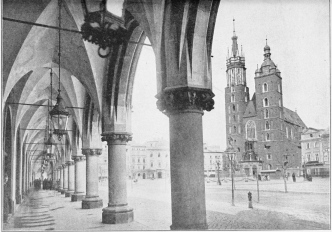
policemen’s helmets to the weather-vane of the new Rathhaus; out of its tense atmosphere of whirring wheels within wheels; out of its geometrically correct parks and new and ever growing building additions, Cracow looked to me as if it had fallen off this revolving planet and settled itself “Where the wicked cease from troubling, and the weary are at rest”—wherever that may be.
The only thing that had grown since last I saw the city was its hatred of the Germans. On the doors of many stores on the Rinok were large placards, which, literally translated, read: “The gentlemen travellers from Germany, who wish to come in here to do business with us, are politely requested to stay out.”
Everything else looked the same, only more dingy; even the Austrian officers who loaf around Havelik’s restaurant seemed to have lost something of their newness; for braid and buttons, two of the component elements out of which Austrian officers are made, were tarnished and worn.
The Jews’ quarter seemed more hopeless and wretched than ever. On the Kazimir were the same haggling crowds in the same small stores, and the same shambling Jews in black, greasy cloaks. In front of the Jesuit church stood the same twelve apostles, and I regret to say that they were just as shabby-looking as their unbaptized brethren.
Cracow, the freest portion of divided Poland, is certainly as wretched looking as Warsaw, where liberty dare not lift her head, and it cannot compare with any of the cities of German-Poland where the Prussian gendarme is trying, at the point of the bayonet, to cram German speech down the unwilling throats of Polish children.
Why, I asked myself, should this shabbiness, this negligence, this “run-down-at-the-heel” appearance prevail in all the Slavic cities from Belgrade to St. Petersburg, and from Cracow to Irkutsk? Why should this be so of every place, except where the German has stepped in with his iron heel or where the Magyar or the Jew is trying to make of the Slav what he is not and does not care to be?
I was tempted to take the first train out of Cracow, so painful to me was this condition of affairs; for I admire the Slavs, although I think I know their weaknesses. But the first train did not go until midnight, and I had nearly eight long hours on my hands. Then I remembered my letter of introduction. I found it with my passport and letter of credit, and looked at it again, to assure myself that it was right. Yes, it was addressed to the Countess So & So, and all the way to the house, I pictured to myself my friend’s mother-in-law. She would be rather rotund, for Slavic women incline that way, especially during the full moon of life. She would have gray hair, dark complexion, and a rather pronounced down on the upper lip. That seems to be the tendency of the Polish woman as she grows older; perhaps because of her great vitality.
Beneath the portal of a so-called palace, which was pervaded by an incredibly strong smell of whitewash, I presented my card to the porter, who looked somewhat contemptuously at the German name it bore. After long waiting I was guided to the very top story of the house, through clouds of falling mortar and showers of broken brick. The building seemed to be in the possession of masons and plasterers, and the noise they were making was as confusing as the dirt and dust their destructive hands were creating.
Two surprises awaited me. The first was, that in spite of the fact that the roof was partly torn off, and confusion reigned supreme, that top story contained some of the most lavishly appointed apartments I have ever seen. Pictures, statuary, and bric-à-brac, created by Polish genius, costly vases, rare flowers, exquisite rugs and furniture; and everything in perfect taste. If Cracow without seemed dingy and dead, here it was brilliant and alive. Thus had I pictured my Slav at his best—imaginative, creative, revelling in the beautiful, lavish of colour, yet creating harmonies. Everything around me seemed to breathe out life, and here I could understand the “Noch ist Polen nicht Verloren,” although in the street I had been ready to sing a requiem for the nation.
A hundred questions passed through my brain; questions which I would ask the mother-in-law when she appeared. Then came my second surprise. As I sat there thrilled by contending emotions, the curtain opposite me was thrown back gracefully and quickly, not at all as if a short, stout mother-in-law were behind it—and my eyes fell upon one of the most beautiful young women I have ever seen. This again was Poland at her best, if not Poland typified. Her eyes were burningly eloquent, yet showed a hidden pathos; her features looked as if chiselled by a master’s hand, yet, in the background, the crude touch was faintly visible. The welcome accorded me was genuinely cordial, yet tinged by the proper reserve.
“How is it,” I asked, after some conversation, “that you don’t look like a mother-in-law, and that you speak English as if you came from Boston?”
“Because,” she said, with the sweetest smile, “I am as yet only a sister-in-law, and I do come from Boston. That is, I lived there for years after my parents were exiled from Poland. I came back here after my marriage.”
This, then, was my chance to ask all manner of questions about the Slavs in general and the Poles in particular, and have them answered in the light of a rather unique experience.
“Why is Cracow a dead city?” This was certainly a perfectly familiar American question, and I received a characteristic answer.
“It is dead because it is ‘crying over spilt milk.’ Nobody is regarded as a patriot unless he talks about our past glory and blames some one in general and the Germans in particular, for the loss of that glory. We might do great things if we would just do them. We have the vision and the talent; but we wear ourselves out, saying what a great people we are and how superior to all other human beings; yet we accomplish nothing. Look at this house of ours, and you see Poland in miniature. I don’t know just how old it is, my husband can tell you; but when it was built, the work was poorly done, and every year it has to be repaired from the bottom up. In America, it would have been torn down years ago, and a new house built, to suit the needs of the times. Instead of that, my husband is spending a fortune trying to make it a fit place to live in, and he never succeeds.
“Yet that is the thing he enjoys. He can scold the workmen half the year for dragging their task along, and the other half year he scolds them for having done their work so poorly.
“You Americans enjoy being comfortable, we Poles enjoy being miserable. If the Polish men had half the energy of the American men, we would indeed be a great people, and Cracow would be a city worthy of our pride in it.”
I am not sure that I am recording the Countess’ exact words, for to see her talk was such an æsthetic pleasure, that I must have forgotten much of what she said; but I give the substance of her words.
“See what America is doing for our peasants!” she continued.
“They go there lazy and shiftless, they come back thrifty and industrious, and are rapidly taking the places of our decayed nobility. When they come back, they have what we Slavs have always lacked—initiative. I wish we could export to you all our stock of Counts.”
I suggested that she might try it as a business venture; for they would bring a good price in our matrimonial market.
“Oh, no!” she replied. “We would want them back. They have talent and devotion; they need only to learn to work, and America is the world’s great boss.”
At this point in the conversation the Count entered the room. The Countess had told me that her home was the type of Poland; she had not told me what I soon discovered, that her husband was the typical Pole, both physically and mentally.
He was a small man with unmistakable Polish features, which looked well worn; for being a Polish nobleman, he had travelled through life swiftly and indulgently. After scarcely five minutes’ conversation, he began talking about the sufferings of the Poles, and what they would do if it were not for those wicked Germans.
Then followed what was as nearly a family jar as I care to witness. My hostess opened wide her beautiful eyes, and, in most forceful Polish, gave her liege lord a piece of her mind.
“I am tired of your tirades against the Germans. I don’t admire their methodical ways, myself; but they are doing things.
“Go out of Cracow to the border and look across, and you will see order on that side and disorder on this. Step into a German train; it is clean and efficiently managed, while our cars, from the first-class to the third, are dirty and ill-lighted and the trains go by fits and starts.
“Go to the German towns, and you will find business flourishing; while ours stagnates. They don’t neglect art, either. Their music may be slower than ours, but it is art; their paintings may not be as brilliant as ours, but they are as artistic. Go to work! Do something worth while! Build from the foundations! Develop some backbone, some character, do better than the Germans, and then you may call them names!”
The sensitive nostrils of the husband grew wider and contracted again. He was furiously angry; but facing him was his Americanized wife, and he knew that “Discretion was the better part of valour”; so he permitted his anger to cool while he nervously bit the ends of his moustache.
“Yes,” he said, ignoring the Countess’ outburst; “there is a great future for us Slavs when we all get together. We were in Prague this summer, at the Slavic Congress, and everything between us was so harmonious that I have great hopes of a Slav Confederation. Then we will crush our German oppressors. What do you think of it?”
I analyzed the situation thus: “As yet, the Slavs lack racial consciousness. Each group, no matter how small, thinks itself different from the other, and often superior to it. Not only are they divided by small historic dissimilarities, but religious differences have obscured racial unity to such a degree that I have but little hope that their racial consciousness will soon ripen into tangible results.
“In the great game of politics, the Slav has given his soul as a pawn, with which popes and patriarchs have gambled. Poland’s national life has been lost, not so much by corruption from within, as because the Pole was used as a tool by the Roman Curia in the game of world politics she was playing, and playing unscrupulously.”
Ah! It was good to see the Countess’ dark eyes dancing from pleasure, while I thus analyzed the situation. I continued:
“The Slav either lacks sane pride in his race, or he has an overbearing conceit; he is either easily crushed, or he crushes, ruthlessly. Look at this daily paper. In Dalmatia, the Serbs break the windows of the Italians, and tramp madly through the streets proclaiming their superiority over the Latins. In Laibach, the Slovene does the same thing to the Germans. Tears down German business signs, shoots, and is shot in turn. In Prague, the Czechs are constantly bombarding the houses of the Germans, until martial law has to be declared. All this, to the detriment of the development of a rational, racial pride.
“And these same boisterous, roistering Slavs, to-morrow will cringe before their Magyar and German masters.
“Another thing is in the way,” I hastened to add; for I saw that my host was eager to talk: “The Slavs lack collective wisdom. Where there are three thinking Slavs, there are always three quarrels. People who wish to rule must learn to act wisely together; yet in the history of the Slavs this collective wisdom, this inability of one group to acknowledge the equality of the other, has been their greatest lack.
“The Russian revolution failed, even as the Polish revolution failed, and as the Czechs’ will fail, because they lack collective wisdom. It will take at least a hundred years,” I concluded prophetically, “before you Slavs will confederate.”
My host laughed nervously. “You are a false prophet. It will come in a decade. We will flow together like small rivers into a great stream. We Poles, of course, being the most cultured, the most civilized, and the best prepared to play the leading rôle, will be the stream into which all these lesser rivers will flow. In the great overture of Slavic union, the Pole will play the leading part.”
To reason with such a man was futile; so I drank my tea and looked at the beautiful lady opposite me, in whom the practical American and the idealistic Pole were so harmoniously blended. Perhaps in her person she was a prophecy of the great day to come.
The Count talked incessantly about Poland, its past, its powers, its enemies; but I was not listening.
From my silence he thought he had convinced me, and as I rose to go, he asked: “Have you not changed your mind about its taking a hundred years to federate the Slavs?”
“Yes,” I replied, “I have changed my mind. It will take two hundred years; unless”—and I looked at my fair hostess—“you bring back many more such Polish women from America.”
IX THE DISCIPLES IN THE CARPATHIANS
THE river Waag has a broad and beautiful valley in which to indulge its vagabond habits. Now it seeks a channel close to the Carpathian hills on one side, and again rushes far away towards the mountain wall, close to the Austrian border.
The Romans appropriately named the river “Waag,” the vagabond river, and it lives up to its reputation at all times of the year. One can scarcely find fault with its wandering propensities, for both shore lines are imposing and wildly beautiful; many of the little towns are castle-crowned, while each town and each castle has its myth and story, rivalling those of the Rhine in fantastic invention and equalling them in historic interest.
The river Waag, however, is not in Germany, where everything is prohibited, regulated, and subdued, even the turbulent rivers.
This is Hungary, the ill-mated spouse in that Austro-Hungarian alliance, in which quarrels are continual, and divorce, with alimony or without it, is threatened every day. Here rivers and races foam and rage; floods of hate beat against historic walls and there are no smooth channels for politics, education, or religion.
Struggle there is everywhere. Those who are too weak to fight, resist, and none, however small or unimportant, is ready to surrender.
Among those people with strength enough to resist, but not enough to fight, are the Slovaks, who live in wretched villages on both sides of the river. The villages grow more wretched as they climb away from the richer valley to the scant clearings in the mountains, where poverty, ignorance, superstition, and intemperance are the four walls which hem them in from the throbbing life of the century and shut them out from it. No one climbs the almost impassable highways except the Magyar gendarmes, who are the minions of the master race which has subdued the Roumanians, Ruthenians, and Germans within its borders, and is now hard at work to blot out the Slovaks, the feeble remnant of a once powerful people.
These gendarmes are but stupid tools in the hands of a stupid government. They erase the Slavic names of villages and paint over them Magyar names, not even remotely related to the original; they prohibit the Slovak language in the higher schools, fall savagely upon assemblies of innocent folk and disperse them by force of arms, annoy unsuspicious travellers and arrest nationalistic agitators and severely punish them. Then they believe that they have changed sluggish Slovak blood into the fiery Magyar fluid, obliterated age-long, historic memories, created in a day a new patriotism, blotted out a vernacular spoken in related languages and dialects by 100,000,000 of people and substituted for it one spoken by a warlike people, numbering not more than 8,000,000, and slowly emerging from Asiatic barbarism.
This they believe; but the fact is that no people were ever assimilated by force. Force begets resistance, and the most stupid Slovak, shut in by the four walls of his wretched isba, if he knows nothing else, knows that the Magyar is his enemy, and that the Magyar speech must not lodge in his memory and displace his mother tongue. Although he may have no knowledge of his historic past and no idea of the significance of the Slavic race of which he is a member, he does know that he must resist the Magyars, and resist, only where he cannot fight.
Two forces are at work which will soon turn this resistance into fighting. One of them is the unbearable and unreasonable methods used by the Hungarian government, and the other is that giant in the growing, the returned immigrant.
The Slovak immigrant comes back less rugged but more agile; for he has passed through trials by fire and by flood; he goes back less docile, for he has had no masters except those that directed his daily task; his mind is awakened, for he has read the uncensored news from the Fatherland; news coloured more or less by the not always scrupulous agitator; added to all this, the Slovak immigrant goes back conscious of his racial inheritance, for he was one of a great Slavic brotherhood, organized on this side the sea, carrying on, unhampered, its agitations against the historic Magyar foe. Above all, he goes back with a bank account, and money is power in business and politics alike.
Hat in hand, the Slovak used to wait patiently at the ticket window until the Magyar station agent deigned to notice him and sell him his third-class ticket; then, as if he were an ox being loaded for the stockyards at Budapest, the Magyar conductor would push him into a car crowded by his kind.
I have repeatedly seen Slovak men and women miss the only train that could take them to the market town or from it, because the proud Magyar official paid no attention to their repeated request for a ticket. Day after day I have witnessed the incivilities and even cruelties they had to suffer on the trains; but when the Slovak comes back, he knows that the railroad official is only a servant, his servant, and he treats him like one; he demands attention. Woe unto the bribe-taking conductor—and there are no others on the Hungarian railways—who pushes him into a car crowded to suffocation, while more than half the cars of the same class are almost empty, with only here and there a passenger, who is politely treated because he is a Magyar or because he has pressed into the conductor’s responsive hand the usual bribe.
The Slovak immigrant returns home somewhat of a rebel. The Hungarian government knows this, and were it not for the fact that he brings back money, and spends it freely, his emigration to America would be forbidden.
Recently a special police force has been created to watch every outgoing and incoming train, and every third-class passenger who has baggage enough to mark him as an emigrant is detained, rigidly examined, and if permitted to go to America at all, is sent via the Hungarian port of Fiume. On the way he is duly inoculated by the fact that he is an Hungarian subject and that as such he must return.
The stupidity and the illiberal spirit of the Hungarian government are nowhere more clearly manifested than in its relation to the religious movements which are American in their origin and which have been transplanted from the Alleghanies to the Carpathians. In the hands of a truly liberal government this new force might become a constructive and saving one to multitudes of people; instead, it is alienated, put on the defensive and limited in its usefulness.
When the Y. M. C. A. expedition, of which I was the leader, reached the valley of the Waag, to study the Slovak language and people, serious difficulties to the carrying out of our plans presented themselves. The towns have all become Magyarized by the gendarmes and a multitude of officials. To speak the Slovak language marks one an inferior and renders one an object of suspicion.
The village inns are merely dram-shops, kept and generally ill-kept by Jews, who are under the influence of the Magyars, and consequently look down upon the Slovaks. Even had it been possible for us to lodge in one of these inns, our friendly attitude towards the Slovaks would have forbidden it.
The gendarmes were alert and agitated from the moment we entered the valley, and when they learned the nature of our errand they were incredulous. “Who ever heard of anybody’s having a disinterested concern for the Slovaks? How could they believe that Americans, cold, materialistic Americans, would equip an expedition to study the needs of this downtrodden race, that it might be lifted up? Of course, we were nationalistic agitators sent out by the Slovanic Society of America, to arouse the half-awake Slovak into revolution.”
That which confirmed them in this suspicion was the fact that the only place where it was posible for us to lodge was the home of Jan Chorvat, Apostle of the Christian faith in the Carpathians, and suspected of being a revolutionary, because he preached to his countrymen in their native tongue; preached to them a Gospel broad enough to embrace all races and nationalities, strong enough to wean them from drink and free enough to loose them from the bonds of superstition and ecclesiastical tyranny.
The simple and perfect hospitality which Jan Chorvat and his wife offered us was the product of that faith. Without hesitation they moved into the basement and gave the upper rooms to their guests. The first night of our sojourn with them, our hearts were cheered, and we felt as if we were at home when we overheard their evening devotions. The words of an English hymn, “My Faith Looks up to Thee,” came in subdued tones through the thick walls of the room below. Then Jan Chorvat prayed, as only those can pray who walk consciously with God. The sentences which I could translate from the strange tongue knitted us into an unbroken friendship.
“I thank Thee, God, that Thou hast put it into the hearts of the American people to send these dear brothers across the sea, that they might learn to speak the tongue of my people so that they may serve them in the far-away land and inspire them to become sober and chaste; good citizens, good husbands, and good brothers.
“May these young brothers learn, above all, to love my people with the passion of Jesus, so that they will be able to lead them to the source of all redemptive power—Jesus Christ.”
Jan Chorvat and his wife, in their outlook upon life, in the strength of their convictions, in their passion for righteousness, would have fitted easily into the church of the Puritans anywhere on this side the sea, where Puritanism is still at its best. In his asceticism Jan Chorvat reminded us of John the Baptist, in the sweetness of his temper of the Beloved Disciple, and, in his zeal and passion for Christ, of the Apostle to the Gentiles.
Here was a Slovak who spoke English almost perfectly, who wrote his native language classically, who clung to a noble faith passionately; yet that which bound us to him closely and I must regretfully admit, most closely, was the fact that Jan Chorvat was what he was, because of certain religious influences emanating from America. These influences and ideals, which are slowly growing stronger, are being augmented and reënforced by returning immigrants who come home with a passion for their kinsmen, eager to redeem them from their individual and national sins.
The centre of this religious movement is in O Tura, one of those mountain villages isolated, but brought into the world’s current by mighty ideals; fit birthplace of a new hope.
Here a Protestant pastor ministered in the more or less stereotyped forms of the established faith, and, when he died, left three daughters, the “Roy Sisters,” to carry on his work for the people he loved. Hampered by a strict orthodoxy and a suspicious government, they hungered with their people and for them, unconscious of a larger faith and a better way; until so commonplace a thing as a religious newspaper, published by the missionaries of the American Board at Prague, found its way to them.
Our credulity has been so severely tested by the narratives of missionaries who hinged mighty consequences upon trivial causes, that here too one is assailed by doubt; until one reads Christina Roy’s little story: “How I came to the Light.”
In simple yet graphic language, she tells of her life in the parsonage, her father’s struggle against adverse conditions, her own budding ideals, and finally the important moment when for the first time she came in touch with the vital truths of Christianity as presented in the little Bohemian newspaper, Bethania. Upon so slender a thread travelled this mighty current which gave direction to her own life, which has enabled her to enlarge the vision of an oppressed peasantry, and which is now encouraging her and the noble group of men and women around her to attempt the almost hopeless struggle against intemperance.
Whether one agrees with the type of theology which these people preach or not, one can but feel that they are in touch with real spiritual forces, and that, by the test of character and of work accomplished, we who travel faster in the paths of what we call progress, are compelled to halt and admire.
The students who were the members of my expedition were nearly all recent college graduates and had left their schools with much of their traditional faith unsettled. Any doubts they may have had regarding the doctrine of the Incarnation, as it is commonly interpreted, were lost, when they saw the spirit of Jesus dominating the lives of simple peasants whose dull faces have become radiant, whose animal appetites have been controlled, and whose homes have become the abodes of peace and happiness.
To look into the faces of the “Roy Sisters,” of Jan Chorvat and his wife, and of hundreds of peasants who come to hear the Gospel preached in true simplicity, was a better definition of the doctrine of the Incarnation than any professor of theology can give.
The Atonement, as defined by our orthodox churches and which is such a stumbling-block to the rationalistic mind, lost all its mystery in watching another member of this group, John Rohacěk, at work among the gypsies; loving those whom no one loves, living with them in huts by the wayside and trying with a divine passion to lift them out of age-long Paganism into a wholesome relation to the doctrine: “Without the shedding of blood there is no remission of sin.”
Although John Rohacěk believes with all his simple soul that “Jesus paid it all,” he is willing and eager to shed his blood for God’s despised children, those most neglected of all, the gypsies. For them he has suffered persecution, imprisonment, hunger and thirst, in the true apostolic spirit; and although those American students may never be able to explain to themselves the meaning of the Atonement, they certainly will never be able to say that they have not seen the Atonement “at work.”
Here among the Slovaks, the seed sown by the American missionary at home and abroad has brought forth more vital fruit, perhaps, than on the home soil. Although these Slovak disciples have gone out to save only this one or that one, they are helping to save a nation and are lifting a race out of degeneration.
Nominally, Jan Chorvat was a teacher in the Slovak language to our expedition; and to learn the more effectually, my students often went with him on his tours from village to village. As they walked, he explained to them the grammar
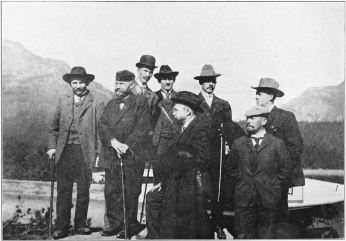
AT THE FOOT OF THE TATRA MOUNTAINS
and enriched their vocabulary. How much of the difficult Slovak language they will remember when they come to their task in Pennsylvania, I do not know; but they can never forget the lessons he taught them by his singleness of purpose, his devotion to his people, and his fearless approach to those who he thought needed his admonition. Those students will surely remember that “Though they speak with the tongues of men and of angels, and have not love, it profiteth nothing.”
The last day of our stay in Hungary brought us early to a village at the foot of the Tatra mountains, the village of Czorba. Leaving our uncomfortable third-class carriage in which we had spent the night, we were quickly revived by the ozone-laden mountain air, and by the marvellous sight which greeted our eyes. Here were the giant mountains of Hungary which she has proudly pictured highest on her escutcheon.
That which most quickened us, however, as a group of strangers, was the greeting extended to us by three men waiting in the early dawn. They had come many miles on foot to meet us, and carried huge loaves of rye bread and bottles of milk for our refreshment. They were to guide us to the top of the mountain. The three men belonged to three antagonistic races of Hungary, and we were Americans, a conglomerate of races; Teutonic, Semitic, and Celtic. Together we broke bread, prayed, sang, and exchanged thoughts about the vital things of life.
The man who appeared to be the leader of the group, the brightest and happiest of the three, the one with the largest outlook on life, was a Slovak who had found his vision and his happiness in America. He worked in a blacksmith’s shop in Torrington, Conn. Here some one with a passion for common men ministered to him and led him from drunkenness to sobriety, and from his coarse animal existence into fellowship with the divine. He returned home and is daily at his task of shoeing horses and mending broken ploughshares; but he never forgets that what carried him back among his people was his awakened passion for them.
At the forge, he preaches the gospel of sobriety, of industry, and of peace; and, as he welds broken iron, so he is trying to weld into union the three alien races that battle round the foot of the Tatra. The task is difficult, and it will be slow.
The stupid and materialistic Hungarian government is trying to accomplish this task by throwing people into prison, because they love their mother tongue, or do not lightly regard their historic inheritance.
The Slovak Christian will certainly accomplish more than the gendarmes for the unification of these alien peoples in Hungary; for the Gospel is more powerful than guns and bayonets.
As we parted from our new friends that last day, we sang: “Blest be the Tie that Binds.” The gendarmes, who were watching us, thought we were singing some revolutionary “Marseillaise,” and in that they were not mistaken; for there is nothing more revolutionary than the force which “Binds our hearts in Christian Love.”
X THE GUSLAR OF RAGUSA
IT is a long time since I first saw Dalmatia, on the eastern shore of the Adriatic. Her hills were denuded of verdure, monotonously barren and ashen gray, with a bit of Paradise here and there along the edge of the sea. In silence, her ancient cities mourned a turbulent past of which they were reminded by walls and palaces which the Romans built, as only the Romans knew how to build.
Although these walls have felt the force of Venetian battering-rams, of French, Turkish, and Austrian cannon-balls, they still stand, silent witnesses of a civilization which carried culture in the path of its conquest, and brought a certain kind of liberty to its captives. The Venetians took away these liberties, and, in exchange, gave the Dalmatians churches, whose graceful campaniles tower over the gray and solid Roman walls.
The French came and went; but, far as the eye can see, left nothing behind them.
Austria brought soldiers who are still there; nesting in the forts, commanding the mule-paths
COAST OF DALMATIA From here, come virile children, of the stony soil, to mine our coal and dig our trenches.
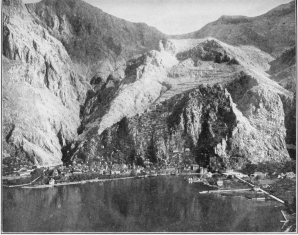
and seaways and hated by the native population, which is Slavic with a sprinkling of Italian, both races being antagonistic to the ruling power.
That Dalmatia has been badly governed, no one denies. It has been purposely kept out of touch with the mainland, the old motherland behind it, Croatia. Only by the sea had it access to other peoples, to whom it rarely went and who seldom came to it.
Of all Dalmatian cities, Ragusa is the proudest, even as it is the poorest. Once the seat of a virile republic, she sent out armadas for conquest, watched from her sea-girt walls the struggles between Venice and the Ottomans, and, by force of arms, helped to decide the destinies of nations.
Ragusa’s glory was short, but memory is long; although her harbour is choked and useless, her sea-wall in ruins, and her pavements grass-grown; still under marble porticoes half-sunk into the ground, sit the grandees of the city, smoking the Turkish czibuk and musing over those golden days when Ragusa called herself the “Queen of the Adria,” and fought with Venice for its supremacy.
On the corner of the Stradona and the Piazza, there stood all day long an old minstrel, who strummed monotonous strains on the gusla, while he sang the epics inspired by centuries of conflict. As he sang, the grandees smoked and mused; while the lesser folk cobbled opankee, embroidered garments after Oriental fashion, and wove tiny strands of silver into crude filigree.
The old guslar was minstrel, poet, and historian. It was he who told me marvellous stories of the time when in each of those palaces on the Stradone there lived a statesman-soldier, at war politically with one half his world and in social rivalry with the other half. The city’s gentlefolk were divided into the Salamanchesi and the Sorbonnesi; those who sent their sons to the University of Salamanca and those who sent them to the Sorbonne.
These divergent cultural currents kept the nobility apart and gave ample cause for petty quarrels; many a Ragusan Romeo’s love for his Juliet has furnished material for a romance and for a beautiful funeral.
Against these old walls and old traditions the immigrant tide has been beating for the last ten years, carrying away the grandee’s sons, numbers of whom are now digging coal in Pennsylvania, or waiting on table in some cheap restaurant in New York. Yet, whether he lives in a wretched boarding-house in a Pittsburg “Patch,” or accepts the modest tip his patrons give him, the son of a Ragusan grandee never forgets his nobility.
These immigrants, too, have gone home again, and make their presence felt, economically and socially. They have repaired the old palaces and brought money into circulation; but the old guslar, who stood on the corner of the Stradona and the Piazza, and whom I sought out after these ten years, had his story to tell.
“Yes, Signor, many have gone to America and have come back, and will go again; but, Signor, that must be a bad country, a wild country. They come home and walk carelessly up and down the Stradona, the finest street in the world, every house a palace—and they talk of it with disrespect!
“Why, Signor, they say that in America there are finer streets than this, and bigger houses, and they laugh at the Dogana, Signor—at the Dogana, where our Principes and our Consiglios made treaties with the great powers, where we received the ambassadors of the Sultan and of the Doges of Venice!
“Signor, they walk up and down the street with their heavy-soled shoes, talking loudly, and making such a noise that the grandees cannot take their siestas undisturbed.
“Yes, Signor, there are some of them here now. They came back a fortnight ago, a man and his two daughters. A good-for-nothing he is, Signor. Think of it! Ah, listen!” He paused abruptly. I listened. The sweet, harmonious quiet was rudely broken; the air, full of the fragrance of oleander blossoms, seemed suddenly vitiated; the Monte Sergio and the swaying palms beneath it, which made so marvellous a picture, seemed to drop with a crash out of their frame of sky and sea.
“Signor, listen!” And the old guslar trembled from anger and pain. It was the grinding of a phonograph which struck our ears. “Listen, Signor! That they bring out of America! Out of your barbaric country!”
True enough; they were the painfully familiar notes of “canned ragtime” at its worst.
“Signor, that man has come back with his two daughters. They can’t speak a word of their mother tongue; and oh, Signor! they walk up and down the Stradona without a duenna, they look boldly at the men, and they keep their jaws moving constantly, even when they do not speak.
“The father drinks, he drinks maraschino by the bottleful and he defiles the pavements of our ancient streets by his polluted spittle. You want to go to see him?” The guslar looked deeply hurt. He feared that the phonograph had lured me from him.
“No, I shan’t go until you play and sing for me.”
He took his gusla and moved his bow gently over its single string, while he sang of “Mustapha who came riding on a dapple gray stallion, with thirty Pashas as his escort. He struck a glass of wine from the hand of a Servian hero, who vowed that he would shed the black blood of the Turk,” which, after many monotonous verses, he did.
“Signor, I can’t sing very well—ah, there it is again!”
While he had been singing about Mustapha, who died so many years ago, the phonograph bawled lustily about “Tammany, Tammany,” which, unfortunately, is very much alive.
I made my peace with the guslar by putting into his hand a liberal fee; then I followed the sound of the phonograph which had been switched from “Tammany” to the song of “A nice young man, that lives in Kalamazoo.”
On the lower floor of a house in one of the small streets which divide the Stradona, I discovered the phonograph and its owner, a man neither of the nobility nor noble. His knowledge of America extended as far as Brooklyn and the Austro-Italian docks, near which he had established a boarding-house. Of course, he had come home rich, and only for a visit.
“Who could live in Ragusa after Brooklyn?”
He told me that he made a great deal of money selling liquor, and acknowledged that he sold it without a license. Besides that, the sailors brought over various articles for which he found a ready market. His case would not be worth recording were it not for the fact that he may be looked upon as a man who has been spoiled by his sojourn with us. I doubt, though, that there was anything to spoil; evidently, he was a man of poor breeding and low moral standards. In America, he had found an outlet for his evil tendencies, and a bad business which offered opportunities for lawlessness.
His daughters were more interesting than he; for they came back perfect strangers, into the environment which they had left as children. They had quite forgotten Italian and spoke Serbo-Slavic very poorly; while their English was typical.
“Golly! But Ragusa is a bum town!”
The Adriatic shore could not be compared with the sea they knew, bordered as it was by Coney Island.
“No, sir-ree! Give me Coney Island, and you can have this two for a cent, Gravoosa.” And I suppose, the peninsula of Lapad also, circled by palms and olives and set in a sea of turquoise blue.
When I mentioned the guslar, one of the girls said that he “might make a hit at Coney Island as a side-show.”
“Were there many Dalmatians in America?” I asked the father.
“You bet! They have gone from along the whole —— coast, and there is one —— little town near Lucin Piccolo where there is not an able-bodied man left. They’ll all come over when they get the —— money. The more come the better for me.”
His place was the centre to which they came and from which they radiated.
“What do they do in America?” I asked.
“Oh! any old thing. It all depends. There is one back here now.”
“He’s a regular big head,” interrupted one of the girls; “thinks he’s the whole cheese. He’s a newspaper man. I suppose he’ll be on the Stradona to-night.”
Every evening after sunset, all Ragusa wakens out of its day-dreams and is on parade in the Stradona.
Demure maidens come out from behind latticed windows, reflecting in their garments the sombre hues borrowed from Venice, and a riot of Oriental colours. They are dark-eyed creatures, these maidens, and their faces, as well as their garb, show the mixture of Latin and Slav; for this is the battling-ground of the two races, the persistent Slav being in the ascendency.
The youths followed at a distance; for propriety is one of the assets of Ragusan society.
Noiselessly they walked up and down over the grass-grown pavement, and, when one heard the heavy-soled shoe striking it, one recognized the stranger; and by that sign I knew the Ragusan-American newspaper man. A graceful, swarthy young fellow he was, upon whose face his new environment had already written its story.
His eyes had lost their melancholy look, for he had escaped the thraldom of the past and seemed like a man fully awake to the present. When we met, he looked at my shoes, I looked at his, and the contact was made.
Interesting, indeed, his story was, beginning with his running away from home, one of those ancient palaces on the Stradona. His assets were: money enough to take him to Triest, third-class, a large stock of inherited pride, and nothing else.
At that time there was no passenger service from Triest, but there were freight steamers and a chance to serve as steward to the officer’s mess. Three weeks of life on the sea and then New York. There he served his apprenticeship in the art of “getting along” by walking up and down Broadway, hungry and cold, sleeping in “Sailor’s Boarding Houses,” and finally in the police station.
At last came a turn in his fortunes, through getting work as a strawberry-picker in New Jersey, then working in a restaurant in Pennsylvania as waiter and cook. After much chance and change, he had become the owner of an Italian newspaper, whose chief object was to chronicle the happenings in the Fatherland, for the edification of his countrymen.
It had been a rough road, but it was worth the struggle; for it led to usefulness and into life. He thought that his countrymen always experienced unusual difficulties in America.
“The masses of them are illiterate to an alarming degree; bound by traditions, tribal in their social outlook, and serve as so much carrion for those birds of prey, the steamship companies’ agents, the padrone, the boarding-house keeper, the saloon, and the venal justice of the peace.”
Our national moral character he interpreted in the light or the experiences of his countrymen, and his judgment was not a flattering one. Yet he admitted that America is a blessing to Dalmatia. It has relieved bitter poverty, mentally awakened the people, and has broken down worthless traditions.
In Dalmatia, as elsewhere, the returned immigrant has sharpened the hunger for political liberties, and has intensified the struggle between the oppressed and the oppressor.
Wherever the government was aided by the reactionary church, the people left the church. This is especially true of the northern towns of the peninsula, between Zara and Triest.
“Yes, indeed! The returned immigrant causes much trouble, and I am no exception. I wound my parents by my democratic ways, and I have forgotten many of the niceties of their social life.
“Yes, it was I who hurt the guslar’s feelings by telling him that there are streets in New York finer than the Stradona, and houses bigger than the Dogana. Ah, yes; the returned immigrant causes both sorrow and annoyance. Just watch that man and his two daughters.”
There they were; the man from Brooklyn, garishly attired. His daughters walked proudly beside him, heedless of the fact that over those pavements generations of Ragusa’s great men had walked to victory or to death.
The Brooklyn man seemed quite oblivious of the fact that these people whom he passed so carelessly were the sons and daughters of nobles and heroes. He did not lift his hat to them or step aside to let them pass; his daughters occupied more than their share of space, with their gorgeous and exaggerated hats, and smiled encouragingly on the young men whom they met, although strangers to them.
Later, there was much discussion of these “Americans,” among those who spend the evening at the “Café Arciduca Federigo”; smoking, singing, sipping granite, and talking about the good old days, those quiet, dreamy days which they had spent on this matchless spot, watching the sea as it encircled with its phosphorescent splendour the Island of Lacroma, or when, beaten by the Bora, it lashed itself into fury against the ancient walls.
The young newspaper man told me much about the pride and poverty of his countrymen, of their love for this fair spot, of their moral standards, and their unbroken word.
The guslar, standing in front of the café, began tuning his Jeremaic instrument, looking wistfully, as he did so, at the stranger who had given him so liberal a fee. He needed but slight encouragement to begin his plaintive recitative. A few lines clung to my memory; for they fitted so well into my conversation with the young Ragusan:
“Go out and sing of right and truth, Of valour and of manly strife; Better far, thy tongue grow mute Than that thou sing of baser life For common gain.”
In the middle of a verse, he dropped his instrument hopelessly.
“Oh, Signor! These terrible Americans! Listen!”
The quiet of that matchless night was being assailed by the awful refrain of: “There’ll be a hot time in the old town to-night.”
“Ah, me, Signor! This will be my ruin! All the young men are at that man’s house drinking like beasts; they no more care for me, or for the heroic songs of their ancestors, and while they used to give me kreutzer, they now give me heller, if they give me anything.”
The old minstrel sighed profoundly and disappeared into the darkness, his gusla under his arm; while from the tin horn poured a medley of songs, the climax of which was: “A nice young man that lives in Kalamazoo.”
The sorrowful old man and his grief made me feel guilty, as if I were responsible for that terrible, torturing, unmusical outburst which disturbed the peace of the wonderful night.
After the guslar had left us, the newspaper man rowed me in his father’s barquetta across the shallow harbour, as far as the shadow cast by the gigantic palm trees on the shore. Every time his oars dipped into the water they brought to the surface a flame of fire; yet amid all the splendour of that night, I could think of nothing but the sad old musician.
Many months passed and I had quite forgotten the guslar of Ragusa. Again I was at the seashore; but it was the turbulent Atlantic—not the sunny Adriatic; Coney Island—not Lacroma.
Many confusing strains of music were in deadly conflict with one another; myriads of glowing lights encircled grotesque buildings of all descriptions; through streets given over to pleasure, crowded in one day nearly as many people as there are inhabitants in all Dalmatia.
I certainly did not think of Dalmatia, until I stood before an “Oriental Palace of Pleasure,” in front of which I saw the man from Brooklyn, resplendent in a gorgeous Oriental costume, “barking” to the multitude the sensuous pleasures which could be enjoyed within “for the small sum of one dime, only ten cents.”
When he paused for breath, I heard peculiar, strange, and yet familiar music. Following the sounds, I found on a balcony, in a blaze of electric lights, the guslar of Ragusa. When he finished playing, he too cried: “Tenee cenee, onlee tenee cenee! C-o-m-e een! Only tenee cenee!”
XI WHERE THE ANGEL DROPPED THE STONES
PRINCE NICOLAS of Montenegro does not remember me, and why should he? It was many years ago, and I was one of 20,000 guests who suddenly descended upon his little capital of 5,000 inhabitants, during its national festivities in honour of the Prince of Bulgaria.
Cetinje’s two modest hostelries, in which under normal conditions twenty strangers might have found crude comforts, were packed from cellar to garret with the entourage of the royal guest. The rest of us, mostly natives and a few strangers, roving about the odd corners of Europe, were sheltered in private homes, hospitably thrown open by Cetinje’s citizens, who still believe in hospitality as a virtue, which they practice on all occasions.
I did not know until the morning after my arrival that my host was the Minister to the Exterior. The Interior, being so small, needed no minister, I suppose. His house, a rude stone structure, was only a degree better than that of the peasant; the bed was softer than his, for it was not the stone floor. The food was practically the same; a monotonous diet of maize bread and mutton, the staple food of rich and poor alike, except that the peasant eats only the bread and sells the mutton.
To find that my boots were blacked by a relative of the Minister to the Exterior, and that by virtue of being his guest I was also to be a guest at the banquet given by Prince Nicolas in honour of his princely visitor, produced in me no little feverish excitement; revealing the fact that I was a mere mortal, and as much pleased by my aristocratic surroundings and the prospect of royal favour, as if I were not a student of social phenomena with a strong bias towards democracy.
It is of no consequence to chronicle these facts here, except that they led to a passing acquaintance with the Prince and his family. His youngest son was then a growing youth of exceedingly lovable character. At that time the Queen of Italy was a visitor in her father’s simple home. The Prince is a writer of some ability, and I was glad to be able to tell him that I was familiar with his contributions to Serbic literature.
The royal favour accorded me stood me in good stead; for not only could I watch the pageant and other festivities from a splendid vantage ground, but it proved very helpful in my journey through the principality, which I traversed from Nyegusi to Lake Skutari, and from the Albanian Alps to the Herzegovina.
The country seemed like a huge eagle’s nest, perched amid inhospitable mountains. Here all men were warriors, from the time they were weaned from their mother’s breast, until they sank into their rock-hewn graves.
The women reared the young, tilled the bit of precious soil found among a waste of boulders, and carried mutton carcases to the market at Podgoricza or Cattaro, the largest trading town in Dalmatia. On the return home, they brought coffee and spring water, the two luxuries of those arid mountain heights. These poor homes, although rarely better than stables, sheltered people full of heroism, hospitality, and primitive social virtues; as well as a passionate hatred for the “Schwab,” their Austrian neighbour, and the Turk, their ancient foe.
The men lived in anticipation of war, not much caring whom they fought; for peace meant a stagnant poverty, while war held glory and pillage.
It was the day of the farewell festivities for the Bulgarian Prince, that the peasant subjects of Prince Nicolas passed in review before their patriarch, who was the supreme judge and arbiter of their fate. The menials kissed the hem of his coat, while the heads of different tribes kissed his cheek. Each man in passing before his lord told his troubles openly, and waited for the word of cheer or of judgment.
With little variation they all told of utter poverty—the kind of poverty which meant that from the month of August until the next autumn, there would be no bread; for the crops had failed. There was no prospect of relief, the Prince himself being poor and in debt; and the country had no resources.
I proposed emigration as a remedy, and rather impatiently the Prince dismissed the suggestion, saying that every warrior was of value in this mountain fastness; soldiers were its one asset, and they might at any moment be needed by their godmother, Russia, if not by himself.
Soldiers we did not need, I told him; the war with Spain was over, and even during its progress, we had soldiers to spare; but if his men would learn to “turn their spears into” crowbars, and “their swords into” shovels (taking liberties with a prophetic utterance) they would find opportunity for work, if not for valour; for a good wage, but not for pillage.
I knew they would come and they did. An apostolic band of twelve men first; seventy and more, following; three hundred on the next steamer, after which a temporary check. The three hundred, having violated the contract labour law, were sent home.
Then, like a flood, too long held back, came thousands, scattering through the Alleghanies and the Middle Western plain, as far as the Missouri River, and into California, where a colony of many hundreds at Los Angeles is in Paradise; although first they went through many a purgatory.
Ten years, and ten times ten years, which in Montenegro’s past were more or less glorious, had left the country practically unchanged; except as the present ruler had tried to root out some of its latent barbarisms. Here Slavic traditions at their best were immovably intrenched, and here were the bulwarks against the best and the worst in our civilization.
Neither steam nor electricity, those destroyers of archaic simplicity, had yet entered the country, nor had our vulgarities of French dress and morals driven out the simple virtues or the picturesque national garb, worn by the Prince and by the peasant.
On all sides, Montenegro’s neighbours, the Albanians, Bosnians, Herzegovinians, and even her brother, Servia, in the lowlands of the old cradle home—had all yielded, in a greater or lesser degree, to Mohammedan influences. Montenegro alone remained an unsealed fortress, in which the crescent never supplanted the cross; nor did the horse’s tail wave from its flag-staff, on which once and forever had been unfurled the victorious colours—red, black, and white.
The dawn of the twentieth century found the principality still Homeric and patriarchal, but the brief years since its opening have been significant ones. During those years her sons for the first time left “their crags and unsealed passes” to go out upon so base an errand as seeking work across the Atlantic, later to return with the booty of a bloodless conquest.
About ten years after my last visit to Montenegro, I was again journeying towards it upon that serpentine road from whose every winding the truly matchless bay can be seen, receding with every turn, hemmed in more and more by the chalk cliffs which look like petrified clouds. Almost barren of verdure they are, but full of an awful majesty; until they blend with the bay, when one can see beyond them the blue Adriatic. The ships upon her bosom are moved by a gentle sirocco, while the islands on the Dalmatian coast, hidden in the shining green of the olive and the yellower tints of fig leaves, make patches of colour which seem to be floating away in the mist rising at noontime from the sea.
Suddenly one turns northward and faces gray stones, walls of stone, fields of stone—nothing but stone—and that is Montenegro. My peasant driver told me that when God made the earth, He saw that He had made it good, with the exception of the stones, of which there were too many. He called His angel Gabriel and told him to take a bag as large as the ends of the four winds and go down to earth, pick up the surplus stones and cast them into the sea.
The devil, who delighted in the stones and the trouble they would give humanity, flew after the busy angel.
When Gabriel had picked up all the superfluous stones on earth, and was about to drop them into the Adriatic, his Satanic Majesty took his pocket knife, cut a hole in the angel’s bag, and all the stones dropped on to that part of the earth where Montenegro is situated.
The peasant’s story accounts for the topsy-turvy position of the stones; now piled high as mountains, then solid walls of stone, and, again, huge boulders scattered about, with plenty of smaller ones between. There are some fertile spots, especially the famous Brda, where flocks find pasture; and there is an occasional field large enough for a horse to turn with its plough. Most of the country, however, is barren, and it is from this bleakest mountain region that the exodus to America has taken place.
At Nyegusi, as usual, there was an hour’s wait, and a chance to refresh the inner man with cheese and coffee. In this primitive hostelry one noticed the first evidences of the changes wrought. Nyegusi, the birthplace of the Prince, under the shadow of the historic Lovczin, has been more drained of its men in these times of peace than ever it was in time of war.
WHERE THE ANGEL DROPPED THE STONES AND NOW DROPS DOLLARS A typical landscape in a district of Montenegro, from which immigration has set in.
When last I passed through it, there stood before every one of the wretched stone huts a giant-like figure, attired in his native costume, which, according to Montenegrin standards, was worth a fortune, and did indeed represent its wearer’s wealth. Ancient and costly weapons protruded from his belt, generously wound around his portly body. Thus armed, he paraded up and down the rocky streets of Nyegusi, or lounged in the village inn, smoking cigarettes and drinking his raki, if he had the wherewithal.
At the time of which I write, the streets were deserted, save for the women, who bent beneath their heavy burdens of wood which they bring down from the ravines in the Lovczin mountain.
Old men sat wearily on the stone walls which surrounded their small fields, and every one told of a son who had gone “to Amerikee.”
One toothless woman could tell her age only approximately, by the number of sons she had borne; and there were eighteen. Ten of them were in America; the others had been killed in border warfare.
In this same town I met a mother of twenty-two sons, twenty of whom had lost their lives in battle. The two survivors were the innkeepers of Nyegusi. The inn itself was the same as when first I saw it, with its beaten earth floor, and walls bare, except for the icon, a splendid bit of Byzantine workmanship; but since I drank the excellent coffee there, ten years ago, more than 5,000 braves have been under its roof, bound for my own country or returning from it. Now the room is full of them, all homeward bound, spending money far too freely in drinking and gambling; two vices which, although taken with them from their mountains, they bring back in exaggerated form.