PART II With the Incoming Tide (continued 2)
Reading edition
The building over which his descendant, Gabriel, watches, is as safe as a fortress. There are only two things which this brave fears. One is the steam boiler which provides the building with heat. Steam is an unknown force in his native land, which even the fiery horse has not yet invaded; so, no matter how often Gabriel is instructed, no matter how often he is reassured, when the steam bubbles and hisses he flees for safety; and to this day, valves, screws, wheels, and radiators are terrifying mysteries to him.
Gabriel’s other dread is—women. Not that he dislikes them; on the contrary, you should see his face all aglow from pleasure when a woman looks at him, and yet “trembling takes hold upon him as upon the inhabitants of Philistia,” and he returns to his task as if beaten by an enemy, all discouraged and distraught.
Rightly used and wisely directed, men like Gabriel can become a power among us. Over the various nationalities of Southern Europe now coming here in great numbers, such men can wield an influence more potent, perhaps, for the peace of the world than the Hague Tribunal.
Nine men of nine nationalities grasped hands in that Young Men’s Christian Association lobby at Hazleton, Pennsylvania, and formed a circular chain like unto the chain formed by the ancient Slavic heroes when they swore fealty to old “Duchan.” Thus did we pledge our faith to this new country as we exhorted one another to patience, to justice, and to love.
In leaving Hazleton I was asked by one of its citizens, “What will these foreigners do to America when they get the power?”
My answer was, “They will help you save it, or they will aid you in destroying it. It is very much in your own power whether they shall be ‘leaven’ or ‘dynamite.’”
P. S. Gabriel has left Hazleton. He is now in New York, a valuable member of the Immigrant Department of the Presbyterian church, and they say that this Montenegrin is “leaven” and not “dynamite.”
XVIII THE JEW AND THE CHRISTIAN
OF all animals, man is the most brutal. Naturalists still disagree as to the reason for his cruelty, but whatever it be, he has not often stopped to ask himself the cause. He hates and smites and slays, simply because he hates.
It is true that man’s historic brutalities are hidden under the gloss of what he calls patriotism or preservation of the race; but if the average man were asked the cause for his own unbridled hate of other races, he could give no intelligent answer.
That race hatred is a primitive passion is no doubt true, that it is seemingly ineffaceable is also true; for neither education nor religion has obliterated it; indeed both, strange to say, seem to have intensified it. Even the religion of Jesus Christ, whose main endeavour was to break down the tribal prejudices and hate of races, has not only failed to accomplish its object, but in its historic manifestation has in many cases aggravated it.
Whatever the cause, be it the old tribal spirit, the ethnic motive or the opposing religious dogmas; whatever has been endured by one or other of the races and for whatever cause, the Jewish race has suffered for all causes, has suffered everywhere, has suffered long, and has not yet seen the end of its sufferings anywhere.
There is no country in which the Jews have been in any large numbers, where they have not endured and are not now enduring persecution. There is no country to-day of which we can say that the causes which led to their persecutions have been removed.
This is as true of Germany as it is of Russia, and as true of the United States as it is of Austro-Hungary.
Every fair minded Jew knows this, and because he knows it he would rather not talk about it or hear it talked about.
Every fair minded Gentile knows it, although perhaps he would not be willing to acknowledge it, even to himself.
Undoubtedly, there must be reasons for an attitude so universal, and before we can apply any remedy, it is necessary to analyze the disease.
First: The Jews have been able to maintain the tribal spirit during periods when it was breaking down all around them. The tenacity necessary for this and the extremely exclusive methods used, blocked every avenue of social approach and aroused the suspicion of their neighbours. Whether these neighbours were Egyptians, Assyrians, Romans, Greeks, Slavs or Teutons, they hated the Jews because they kept themselves separate.
The feeling of superiority which the Jew felt, soon degenerated into contempt for the Gentile and was fostered by the fact that the mass of the people with whom he came in contact was beneath him culturally, using the word in its broadest sense.
The Jew could read and write when his Gentile neighbours did not know the alphabet.
The Gentile bowed down to stocks and stones, to priests and Pope, while the Jew held his head erect and covered, even in the presence of Jehovah.
The people who thus voluntarily excluded themselves from Gentile society were finally kept aloof by law, and when their masters became their equals, and in some respects their superiors, the way of approach was effectually blocked; until now, the aversion of the Gentile for the Jew is fixed, and seems almost ineradicable, much as the Jew may wish to free himself from it.
Second: Religious prejudice is another vital factor leading to this antipathy between Jew and Gentile; although it is not the only one. It manifested itself early in some of the New Testament writings, grew more intense as the church began to overshadow the synagogue, reached its height during the crusades and is still a compelling force among the common people all over the world.
The myth that Jews used the blood of Gentile children for their Passover feast very early gained currency, and this, coupled with the fact that it is the anniversary period of Christ’s crucifixion and resurrection, has always made Easter time a season of brutal outrages against the Jews.
In reality, the Church has never been quite blameless in these fanatical outbreaks; although it is also true that Church dignitaries at all times have tried to shield the Jewish victims. In most cases, however, they have made no effort to put out the fire until after it was well started, and consequently were too late.
Yet I firmly believe that religious prejudice alone does not account for this feeling, because it exists in irreligious and religious people alike; among those who are quite indifferent to the fact that Jesus lived and who have but a vague and distant interest in His crucifixion.
The late Prof. Nathaniel S. Shaler of Harvard, one of the most broad-minded observers, after an exhaustive study of the subject, comes to these conclusions.[1]
“The greater number of those who have helped me in this inquiry note that there is, on contact with those who are characteristic Jews, a distinct and peculiar state of mind aroused by the intercourse. They are conscious that the feeling is other than that which they experience when they meet those of their own race; but there is, as might be expected, no clear agreement as to the precise nature of the impression.
“So far as I have been able to gather, the state is emotional and instinctive, being in effect the same as that which is always excited by contact of racially different men. To support and explain this primitive emotion, there is a natural effort to find some peculiarities of aspect or demeanour in the neighbour. As to what these idiosyncrasies are, there is a considerable difference of opinion. The greater number of the observers agree that there is a failure on the part of the Jews to respond in like temper to the greeting which they send them; they agree further that there is generally a sense of avidity, a sense of the presence of the seeking, in the Jew, for immediate profit, a desire to win at once some advantage from the situation, such as is not immediately disclosed, however clear it might be to an interlocutor of his own race. Several have stated that the offense came from a feeling that the Jew neighbour was smarter than themselves, having keener wits and a mind more intent on gainful ends. Others state that the Israelite spirit makes a much swifter response to the greeting the stranger gives them than the Aryan, and that the acquaintance is forced to such a degree as to breed dislike.
“This last noted feature in the contact phenomena of Israelites and Aryans appears to me a matter of much importance, especially as it accords with my own experiences and with observations formed long before I began to devise and criticise theories on this subject. As one of the Deans of Harvard University, I have been for ten years in a position where I have to meet from year to year a number of young Hebrews. It has been evident to me from the first that these youths normally respond more quickly to my greeting than those of my own race, and that they divine and act on my state of mind with far greater celerity. They are in fact so quick that they are often where I am, in my slower way, about to be, before I am really there. This would make them at times seem irritating, indeed, presumptious, were it not interesting to me from a racial point of view. To those who are in nowise concerned with such questions, this alacrity is naturally exasperating, especially when the movement is not only one of wits but one of sympathies.
“We all know how disagreeable it is to have the neighbour call on us for some kind of affectionate response, before we are ready to be moved, and how certain is such a summons to dry the springs which else might have yielded abundantly. In our slow, Aryan way, we demand an introductory process on the part of the fellow man who would successfully appeal to our emotions. Our orators know this, and provide ample exordiums for their moving passages; none ventures in the manner of the Hebrew prophet to assume that his hearers will awaken at a cry.
“In observations made for me by young men, students in Harvard College, and thus under my own eyes, so to speak, I have confirmation of the hypothesis that an important part of the difficulty of social contact between these diverse people is due to the difference in the way their minds work when they come together. It is an unhappy fact that the last wave of anti-Semiticism, that which led to the semblance of persecution in Germany and to the abomination of the Dreyfus incident in France, swept across the Atlantic and affected to a considerable extent the social position of the Jews in the United States. They became unwelcome in clubs, and in hotels; their daughters were not admitted to certain private schools; and in various ways the unhappy people were made to feel the ancient burden as in this country it had not come upon them before.
“Of this resurgence of dislike, the Hebrew students had some, though not a serious share. Thirty years ago, when the Jews began to be an appreciable element among the students of this university, there was no evidence whatever of dislike to them. They took their places among their mates with no reference to their race; that indeed seemed, so far as I could discern, to be quite unnoted. Following on the last European epidemic of hatred to the Israelites, there has developed among this body of students an evident dislike for their fellows of that race. The feeling is by no means universal or intense; it is condemned by the greater part of the leaders of opinion among these young men; yet it is sufficient to be noticeable and to awaken keen regret in all those who love the catholic and human motive which so long has inspired that school. One of my helpers in the effort to find the reason for this state of mind summed up his acute observations in the statement that when one spoke to the Jew kindly, ‘the fellow climbed all over you.’”
I agree with nearly all Professor Shaler says; but I am sure that there are two facts which he does not sufficiently emphasize. First: The anti-Semitic feeling was carried to Harvard on the wave which came from France during the Dreyfus trial. This is important; for it proves my point that race antipathies are contagious, and that it does not matter whether the contagion springs from an ethical or unethical source.
The psychological law for this lies in the now fairly well explored field of the “mob” and is a common phenomenon from which many races have to suffer.
The second point made by Professor Shaler is that which refers to the Jewish mind. That quick response which the Jews give, which is so obnoxious to the Gentile, was certainly not disagreeable to Jehovah; for if we trust Holy Writ, He often held converse with them and made the quick Jewish mind the vehicle of His thought.
This quality of the Jewish mind made an Amos hear the roaring of the Lord’s voice in the lonely wilderness; it made an Isaiah hear the call of Jehovah amid the din of the traffic of Jerusalem, and brought to the ears of a Paul the heavenly voice, on the road to Damascus.
This quality of the Jewish mind also betrays his “seeking for immediate profit” and explains the repulsion felt by Professor Shaler’s friends, and felt by American people in academic circles and out of them.
In my judgment the difference between the Jew and other commercial people lies largely in the fact that the Jew cannot so well conceal his desire to make profit. It is written upon his mobile face and conveys itself in the shrug of his shoulders and the upturned palms of his hands.
For that reason the Jew is not successful in those forms of business which demand that their commercial features be hidden. He does not make a good life insurance agent, for here one must assume the rôle of a benefactor; nor does he make a good book agent; for in that work one must seem disinterestedly interested in the entire family or sell the book as a great favour to a few cultured people in the community.
Although the Jew, especially in America, becomes a fairly clever gambler, he is a poor match for the Gentile in the game of poker, and for a long time to come he will have to keep out of games in which the mask one assumes determines their success; even as he will have to continue to do business in scrap iron and not in railroads, in pawn-shops and not in politics.
In my experience with Jewish tradespeople in America, I am convinced that the sense of immediate profit is no less present in the Gentile mind than it is in that of the Jew, and that the Gentile does not always completely conceal it.
There is at least one sphere out of which the Jew keeps his business more carefully than does his Gentile competitor, and that is the sphere of religion.
I have yet to see Jewish hymnals invaded by advertisements, as are those of some Gentile congregations, and although the Jew is a direct descendant of those traffickers whom Jesus drove out of the temple, he has managed to keep his synagogue much more free from commercialism than his critics have their churches.
In the great and solemn moments of life, he is not nearly so practical as the funny papers would have us believe. At the birth of a child, at the marriage feast and at the death-bed, he shows his natural idealism and gives, forgives and forgets.
All this is not quite so true of other commercial peoples, notably the Americans. The following instance may not be typical nor may it prove the rule, and would no doubt be attributed to a Jew, had it not occurred in the college town in which I live and where all the clothing dealers are Gentiles, if not Christians.
One of them was suddenly taken to a distant city to be operated on for appendicitis, and the next day a local paper contained the following advertisement:
“I have gone to Rochester, Minn., to have my appendix cut out. This will be a great cut, but it will not compare with the cut I am making in clothing at my store on the corner of X and Y Streets.”
After the operation, while the man hovered between the unknown places, a second advertisement appeared.
“I am having a hot time holding down a bed in this hospital; but it does not compare with the hot time my competitors will have in meeting my prices in clothing at my store, on the corner of X and Y Streets.”
My readers will agree with me that this “beats the Jews.”
The question of business standards is a very different matter, and that I wish to discuss in another chapter.
I have not set myself the task of playing the apologist for the Jew or for any of the groups of which I treat. I freely acknowledge that there are disagreeable qualities in the Jew which explain in a measure, at least, the prejudice aroused by him.
Foremost, I suppose, is the type which, when it is most pronounced, is apt to be unpleasant and unsympathetic.
The offenses against good taste in dress are marked in many of them; but that lies more in the air with which the clothes are worn than in the clothes themselves. They are usually such as fashion dictates, and not in all cases more extreme than those worn by many Gentiles. The love of display is to some degree common to both Jew and Gentile; but is more noticeable among Jewish women, because they cannot conceal their feelings as well as the Gentile woman can.
The Jewish woman who has “arrived” and knows it, wants the whole world to know it also; while the Gentile woman, especially the Gentile American woman, wears her first imported gown and diamonds as if her swaddling clothes had been made in Paris and her original baby pins encrusted with jewels.
Still more apparent is a certain arrogance, a most annoying characteristic, especially in a people which ought to have the quality of humility in a large degree. The Jew recognizes this in his fellow Jew if not in himself, and no one more deplores it.
He calls it Jewish chuzpa, Jewish “cheek,” and it is, perhaps, one of the greatest causes for the social barriers raised against him. It is found in the Jewish beggar and in the Jewish millionaire.
It is an ancient fault; for long ago, “Jeshurun waxed fat, and kicked.” It is a quality which leads many eminent Jews to acts of unwisdom, such as protests against Christmas exercises in the public schools; the resolution passed by a recent conference of Jewish Rabbis, that America is not a Christian country, and other acts equally unadvised.
This, also, has its causes, which are found among many peoples suddenly released from disabilities and given social and political rights.
In order to introduce my main theme, the relation of the Jew to the Christian, I have tried conscientiously to analyze the causes which obstruct the social contact between Jew and Gentile.
There are real antagonisms arising from the Jewish mind and habits, which are historic inheritances and cannot be easily overcome; but which have made it often a hard task for the Christian to be a real Christian towards his Jewish neighbour.
There are other barriers, however, and they exist first, in the historic development of Judaism and second, in the nature and content of historic Christianity.
The Jew is heterogeneous in cultural development. There are Orthodox Jews, wrapped in cabalistic mysticism, who have never moved an inch along the pathway of progress; to whom not only each word written in the law of Moses has divine origin and divine meaning, but to whom each word has as many meanings, as it has letters and dots and dashes. Upon these Jews, all the fetters of legalism are still rivetted, and to them, tradition and revelation are one and the same.
There are less Orthodox Jews who have progressed as far as the philosopher Mendelssohn led them a century ago.
There are nationalistic Jews to whom Zion is beckoning, and who hear the voice of the prophet bidding them “possess the land” and promising that “the ransomed of the Lord shall return and come to Zion, with songs and everlasting joy upon their heads” and that then, “sorrow and sighing shall flee away.”
There are modern Jews, who have forsaken the law and the ordinances, the Sabbath and the full moons, to whom the reformed synagogue is merely a connecting link with the historic past.
There are rationalistic Jews to whom Karl Marx is the Messiah, and the Socialistic commonwealth, Jerusalem; and there are just Jews, who eat Kosher food because they like it, to whom Mammon is the Messiah and their business the Holy of Holies.
To none of these does Christianity in its historic development appeal very strongly: First, because becoming a Christian means separation from the race; for heterogeneous as the Jews are in cultural development, so homogeneous are they in their racial consciousness. This is something which baffles analysis; it is the strongest example of race cohesion which we have. People who have lost national unity, who have diverged widely in religious beliefs and ceremonial observances, who are as far apart in culture as Greek and Barbarian, are still one as a race, and the man is Anathema who breaks the racial tie. It matters not whether he does it to escape persecution, to gain preferment, or from deep conviction; to his fellow Jews it is always apostasy.
That the broad-minded Jew may have a race consciousness which breaks through the ties of blood, they admit; but he must not become a Christian, even if to him Christianity is the only escape from the narrow tribal idea and from his own outgrown race consciousness, into the broader realm where he can say that he is a member of the human race, and as such is under the obligations of brotherhood to all men.
In the second place, Christianity in its ceremonies, its ecclesiastical practices and its theology, is repellent to all these Jews, from the extreme radical to the extremest Orthodox.
Anything which has even a semblance of idolatry, the slightest suspicion of Polytheism, must be obnoxious to the Jew; for he has been smitten by hail, drought and pestilence, and has been led into captivity because his unregenerate nature delighted in the worship of Baalim, and because he forsook Jehovah who dwelt between the Cherubim and the Seraphim.
Then, too, the methods used to win the Jew to Christianity have aroused his opposition. In the Old World, until comparatively recently, he was forced once a year to attend church and listen to a sermon preached with the avowed object of his conversion. Needless to say, it rarely, if ever, converted him.
The modern method as it manifests itself in Jewish Missions is no less repellent to him; although he is not forced to listen to the missionaries’ sermons. Naturally, the converted Jew, who is an official converter, is usually under suspicion, although that suspicion is not always justified.
With this question of race consciousness and habits, the Jew alone can deal, and he, unfortunately, is not always in the frame of mind required to adjust himself to the feelings of the Gentiles. He will therefore have to bear the consequences which lie in the social realm and may soon reach into the economic.
The task of historic Christianity in its relation to the Jew is not an easy one. It cannot unmake itself or readily adjust itself to his likes and dislikes in theology; nor can it recede from its endeavour to make propaganda for the faith which it believes should be universal.
I have the conviction that when Christ comes fully to His own in the church, He will also come to His own in the synagogue; certainly no sooner, and perhaps not much later.
When He emerges from the tangle of Greek philosophy, Roman legalism and Byzantine traditionalism—when “in deed and in truth” He becomes the Gentile’s Messiah, He will also become the Messiah of the Jew.
As a working basis for the right relation between Jew and Gentile, I wish to quote Rabbi Sonnenschein, formerly of Des Moines, Iowa, in words spoken by him to a colleague in the Christian ministry.
“I want to live so, that when you see me, you will say: ‘There goes Rabbi Sonnenschein, who is a Jew; yet he is a better Christian than I am.’ And I want you to live so, that when I see you, I will say: ‘That man is a Christian; but he is a better Jew than I am.’”
XIX THE JEW IN THE IMMIGRANT PROBLEM
THE Jew has nearly always been an immigrant and a problem. Nowhere is he accepted as indigenous; neither in Russia, where he has lived for centuries, nor in New York, where he will soon represent the bulk of population. He is as much a stranger on his home soil in Palestine as upon the rawest bit of ground staked into a city, in Wyoming or the Dakotas. His going is nowhere regretted at the time and his coming is not welcomed; while his remaining in a place leads to the development of prejudice, which has its root in various causes, already discussed. In a peculiar sense, his coming in large numbers is felt by the toiler and the trader; by the most antagonistic Gentile groups and by those Jews who came earlier, from some more favoured spot in the culture centres of Europe.
The religious development of the Anglo-Saxon people, influenced more often by the Old Testament than by the New, as well as their familiarity with the Bible, has kept the Jew who lives among them immune from the grosser consequences of Anti-Semitism.

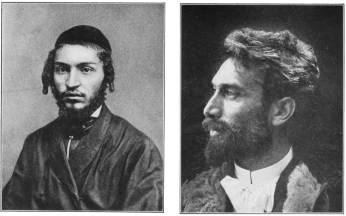
A JEW OF THE POORER TYPE A product of persecution and orthodoxy. A JEW OF THE FINER TYPE A Russian Jew; cultured, artistic and cosmopolitan.
Jehovah’s chosen people have often been regarded with peculiar interest by the Anglo-Saxons, if not always treated with marked favour; yet even among them, this feeling has gradually undergone a change, until, their coming has become a cause for special inquiry by the English Parliament and one of the chief difficulties of the whole immigrant problem, as it affects our cities.
I have had peculiar opportunities to note the development of these changes, and believe that the Jew has been too optimistic regarding his future in the United States; while the Gentile is too pessimistic as to the gravity of the Jewish problem.
A clergyman in the city of New York whose fame is international, who is in constant contact with the best type of Jews, startled me not long ago by saying that the Jewish problem in the city of New York was in a most acute stage. In analysing his own feelings, he said: “No matter what you do, you’re up against it; no matter how you prepare yourself to act the brother towards them, they won’t let you succeed. You can’t love them and you don’t dare hate them.”
Mr. Robert Watchorn, the ex-commissioner of immigration, told me that after an address in which he minimized the problem of immigration, a well-known citizen of New York came to him and said that in twenty years Kisheneff will have its counterpart on the East Side.
One of the most liberal Jewish rabbis in this country, whose addresses teem from the most extreme optimism as to the future of his race in America, will be amazed to hear that because he was invited to preach the baccalaureate sermon in a Western state institution of learning, a large number of the class absented itself from that service. In commenting upon it, I heard one of the number say to another, in unacademic, campus language: “Tough luck, boy. They’ve invited a Sheeny to preach our baccalaureate. It’s an insult to the class!”
The fact that twenty per cent. of the students at Columbia University are Jews, has led a number of Western boys to say to me: “We won’t go to Columbia. There are too many Jews there.”
No less brutally frank expressions I have heard in the shops in which I have worked, and in hotel lobbies where I have loitered; so that while I may not regard the Jewish problem as the most serious in the general one of immigration, I certainly regard it as one of the most sensitive to approach and one of the most difficult to solve.
I usually ask four questions regarding every immigrant group, and the answer determines, in my own mind at least, the desirability of its coming to the United States. The four questions are:
First, Do we need them? By that, I mean, will they perform some useful function which is necessary and which the earlier comers cannot or will not perform? This is entirely an industrial question and can be safely answered only by the economist, who knows the field in all its bearings.
My conviction, based upon no such accurate knowledge, is that we most need those groups which live by their muscle, rather than by their wits; the toiler, rather than the trader. If my theory is correct, this would exclude many Jews; although I am sure that they have performed many important functions in the industrial sphere, both in the realm of manual labour and out of it. Some such discrimination seems to me fair, for it would bar classes, rather than races, and would affect equally other commercial people, such as the Greeks, Armenians and Syrians.
Whether or not this first question is fundamentally sound, of one thing I am sure. Half the ill feeling against the Jews would vanish if they would give themselves in any large numbers to the mechanical trades and to agriculture.
Second, Does the group which seeks admission have the same economic ideals which characterized the earlier groups?
This refers to standards of living as well as to standards of making the living.
The Jew answers well to the first part of the question; in fact, better than the Latin or the Slav. Although he may be compelled to eat plain and coarse food, he craves the richer and daintier fare; if he has to live in a tenement on the East Side, he does it with an eye to a flat in Harlem; for the Jew has never ceased looking for the “land flowing with milk and honey,” or longing for the “flesh-pots of Egypt.” His standard of living is not low, but as some one has said: “elastic.” He may eat red herring to-day, but to-morrow he will eat carp with garlic sauce; that is, if he can afford it.
He will control his historic appetite in order to “get on,” and it is the subordination of health and decency to this desire which often makes him an economic problem, if not a menace.
But when he has attained, he is no miser. His children must have the best education, and his wife the most expensive clothing; he will save his children from the sweat shop if he can, and his wife whether he can or not. He is not willing to live off his children or on the town; although he is not always above living on his more fortunate brethren, whom he thus gives a chance to earn the divine favour by bestowing alms; he rarely sinks into pauperism.
The agencies which minister to pleasure, the theatre, the concert hall and vaudeville, would lose a fair share of their patronage if Jews were excluded from them.
The Jew is neither a total abstainer, nor is he intemperate, and his expenditure for alcohol, compared with that of the Irish, is about as one to a hundred. None dreads the coming of Jews into a neighbourhood more than the saloon-keeper, and some of the vilest localities in New York have been made fairly decent by the expansion of the Ghetto.
One of the most difficult questions to answer is, whether Jewish ideals of making a living accord with those which characterize the older groups. The popular judgment is that they do not. It is commonly charged that the Jew degrades the industries upon which he enters; that as a competitor he is unscrupulous and as an advertiser, dishonest. “Jewing down” is a phrase too well known in commercial life to need interpretation.
Whether it is the “quality of the Jewish mind” which has created this judgment, as Professor Shaler indicates, or whether it is the quality of his moral nature, I am not in a position to determine. All I can say with a sense of assurance is, first, that the business morality of the Jew not only compares favourably with other commercial groups which are coming to the United States, but is generally admitted to be higher than that of the Greeks and Armenians.
Second, That the so-called Jewish business ethics, which in reality are Oriental and not essentially Jewish, and are also prevalent on the continent of Europe, do not compare favourably with the straightforward business methods traditional in America.
Third, That the Jew has adopted these American standards in the lines of business which he controls, and that in every city he is counted among its most substantial and reliable business men.
Fourth, That although the methods used by large numbers of Jews in business are often questionable, as is often the business itself, they have a remarkably clear record in the sphere of high finance, and that it is most fortunate for the well-being of the Jews in America that the so-called “Captains of Industry” are a native product.
Roughly speaking, then, the charges that the Jew is an unfair competitor in the industries and in business may be true; yet if the case were put to a jury which could to some degree free itself from prejudice, the result would probably be a disagreement. What could not be easily denied is, that the sense of truth in the Jew from the east of Europe, notably from Poland, is low.
I quote Mr. H. S. Lewis of London, a Jew, and an unprejudiced authority.[2] “One is sometimes tempted to conclude in despair that the bulk of the Polish immigrants have no sense of truth whatever. No more painful spectacle can be witnessed than the hearing of a summons at an East-End police court, where the parties concerned are foreign Jews. Obvious perjury on the slightest provocation is committed in case after case. The comments of Judge Bacon at the Whitechapel County Court on this fact have been at times severely criticised by the Jewish press. His generalizations may have been too sweeping, being based on his experience of petty litigation, where the seamy side of life is necessarily prominent. At the same time, his remarks have been based on a substantial substratum of truth. It is the experience of most visitors among the foreign poor for charitable societies, that although absolute imposture is exceptional, falsehoods with regard to the details of cases are constantly met with.
“It is to this taint of untruthfulness that most of the other defects of the foreign Jews are to be traced. I fear that it cannot be denied that their standard of business morality is often defective. A statement of this kind may be regarded as unfair, and it is, of course, difficult to put it to any exact test. An illustration is, however, afforded by a return of convictions, periodically issued in the minutes of the London County Council, for the use of false weights and measures and kindred offenses. Judging by the names of the offenders, an altogether undue proportion of them appear to be foreign Jews.
“We meet also in East London with far too many cases where the Bankruptcy laws are evaded by persons who pass through the courts and reappear in business with suspicious celerity and without apparent loss.”
The testimony of Rev. Max Wertheim of Ada, Ohio, ought to have some weight—it concerns the Americanized Jew. He was a rabbi at Dayton, Ohio, and after passing through various religious crises, became a Baptist, and is now doing devoted work on a small salary. Naturally, he has not received the most generous treatment from his former co-religionists, and would hardly flatter them. In answer to my question whether he found any difference in business standards between his Jewish and his Christian flocks, he unhesitatingly said that there was no difference.
More weighty is the testimony which Prof. Graham Taylor gave recently before a Christian Brotherhood. “I know as good Christians among the Jews as among the churches.”
I am quite sure that basically there is no difference; although I should characterize some Jewish methods as mean, and those of some Gentiles as dangerous. In making this distinction, however, I realize that “wooden nutmegs,” high-bottomed fruit boxes, sun-kissed apples at the top of the barrel and gnarled ones at the bottom, as well as other tricks of the native trade, are mean enough; while the methods of the theatrical trust, the adulteration of foods and drugs, the white slave trade and other questionable forms of business engaged in by both Jew and Gentile, may be called both mean and dangerous.
It is also interesting to note that in the great industrial struggle the Jew is represented largely on the capitalistic side; but on the other hand, some of the strongest leaders in the labour unions and many of the Socialists of the rank and file are Jews; consequently the vox populi may condemn them for being both.
The third question is: Does the group possess ethnic qualities that will prevent normal assimilation, and therefore will increase race friction already dangerously strong?
Disagreeable as is the Jewish type when very pronounced, it is undergoing such rapid changes where the environment is favourable, that it does not present a serious barrier to assimilation. The issues of intermarriage are exceptionally good and the resultant types normal. Yet in spite of the vanishing type, the Jews are a peculiar people and will long remain so. Their historic inheritance and their religious traditions, no less than their attitude towards the Gentiles and the attitude of the Gentiles towards them, will naturally keep them a group apart. The hostile attitude on both sides ought not to be strengthened, and I believe that for a period at least, Jewish emigration from the east of Europe should cease. Not because I believe the Russian Jew inferior, but merely because he is numerous and the ethnic and cultural difference between him and the native is so marked as to aggravate an antipathy already intense; this the Jews themselves feel.
A Jewish merchant, who lives in a certain town in the Middle West, told me that strong Anti-Semitic feelings were aroused in the community by the arrival there of Russian Jews, and that as soon as they moved away the feeling vanished.
Another Jewish merchant told me that in visiting various places with a view to locating his business, his first inquiry was: “Are there any Russian Jews in the town?” He said that business for the Jew is better where there are no Russian Jews.
The feeling of the Americanized Jew towards this new immigrant was thus expressed by one of them: “We have to stand by them, but we wish they hadn’t come.”
My fourth question refers to the attitude of the groups towards our social and political ideals.
If the family ideal is the basis of our social and political life, it is certainly safe in the keeping of the Jew, who, if he errs at all in that direction, errs in making the well-being of the community or state, secondary to the well-being of his family.
In spite of the fact that divorce, according to the rabbinic law, is easily obtained, almost as easily as in some of our Western states, it is rarely resorted to. Sexual immorality, wife desertion and divorce, become more common among the Jews only under stress of changed economic and religious environment.
The criminal record of the Jew is still good; although he is under suspicion of merely being too shrewd to be caught.
In the so-called lesser and meaner crimes, such as receiving stolen goods and pocket-picking, he has almost a monopoly; while in burglary and murder his record is fairly clean.
At present there are no reliable statistics on this point, and there is much chance of juggling with figures, for friend and foe alike.
The report of the Commission of Immigration of the state of New York presents a table of foreign born white offenders in the state’s prisons in 1904, but unfortunately does not classify the Jews as such. However, if one took the entire number of criminals tabulated under the countries from which the Jews come, namely: Austria, Hungary, Russia and Poland, and counted all as Jews—a procedure manifestly unfair, even then the prison population of the state of New York contains over twelve per cent. more Irish than all the natives from these four countries, who of course are not all Jews, but represent different faiths.
In lieu of reliable statistics, therefore, I must trust to my own experience. I have found that grosser criminality among the Jews is a more abnormal phenomenon than among most of the newer immigrant groups. In my intimate acquaintance with a number of Jewish communities in Europe, I know some as large as 10,000 souls, where such crimes as theft, robbery and murder are never committed; yet where cheating, fraudulent bankruptcy and receiving stolen goods are not uncommon.
The Jew has done himself almost irreparable injury by his protest against the reading of the Bible, and Christmas exercises in the public schools and in his attitude towards Sunday laws. In both cases he has shown himself intolerant, and has alienated staunch friends whose help and sympathy he may need in the day of tribulation. As a citizen and patriot, he is everywhere giving evidence of his devotion; while in the struggle for the coming of a better day in the government of our cities and of the state, he has done his full share; indeed, among the newer immigrant groups, he has furnished to that cause by far the largest quota.
There are several points at which the Jew does not satisfactorily answer the questions I ask. He provides far too large a number of those, who, as a class, seem unnecessary at the present stage of our economic development; he presents too solid a differentiated group, will retard proper adjustment and increase existing race antagonisms. His attitude towards the manifestation of the religious spirit in our public schools, his intolerance towards certain religious practices which are fundamentally ethical and social, but not necessarily sectarian, will more and more alienate those Americans who have been most hospitable towards him and upon whose good will he is dependent, economically and socially, if not politically.
These, I think, are the sore spots of the problem; and if the Jew is as shrewd as he is painted, he will look to their healing; while if the American is as charitable as I think him to be, he will give the Jew full time for reconvalescence.
XX FROM FIFTH AVENUE TO THE GHETTO
IT has always been dangerous for the common mortal who was the spokesman of his kind to eat at the king’s table; for the tyrant at close range proved an admirable host and pleasant gentleman, whose tender meats and delicate wines covered a “multitude of sins.”
When, after having eaten lunch on the East Side for a week, one receives an invitation to luncheon on Fifth Avenue, even the most scrupulous may temporize, and I confess that, feeling highly flattered, I tossed my scruples to the winds and accepted the invitation.
The feast began for me, when my eyes rested on the splendid architecture of the palatial residence, its furnishings, marbles and pictures, which appealed to my artistic sense and almost reproduced the atmosphere of the refinement and culture of those lands in which they had their birth. In the winter garden where fountains played, and rare flowers nodded their bedewed heads, filling the air with fragrance, I forgot the squalor of the East Side and the darkness and dampness of that raw, February day.
With the luncheon I was less pleased; for frankly, I prefer noodle soup and Gulyas to French snails and terrapin.
To my plebeian palate the snails tasted like mucilage flavoured with garlic, and the terrapin like fricasseed Turkish towels.
Of more importance than the menu was my host, whose every word betrayed the consciousness of his power and his ignorance of those lesser folk, as whose champion he had invited me to be his guest.
“What can be done to stay the power of Socialism?”
“How can we keep out Black Hands and Anarchists?”
To him, immigrants, Socialists and Anarchists were synonymous terms. My speech was not yet dulled by the luncheon or my brain clouded by the smoke of his Havana cigars, and I gave him such plain answers as I might have given after lunching on noodle soup and Gulyas.
My words were as unpalatable to him as his snails and terrapin were to me; for I told him that Anarchists live in brown stone houses and that Socialism is being fed and nourished on Fifth Avenue. Our views were as far apart as our bank accounts, and to argue with him seriously would have been as useless as it would have been poor taste. He became more human as the luncheon progressed from its airy and aristocratic entrées to the more democratic and substantial roast beef and potatoes.
When we reached pumpkin pie, one of the few connecting links with his humble past, he had quite lost his critical sternness, and asked my advice upon so delicate a matter as how to give his wayward sons a grappling place for the upbuilding of character.
I suggested work in the Settlements; but he regarded them with suspicion, declaring that they are irreligious and a breeding place for Socialism. He listened with indifference to my defense of these institutions which I regard as among the most valuable agencies we have for the common good. I suggested some public service for the community or the state.
“Politics?” he asked quizzically; “it’s a dirty game. I want my boys to help me take care of the interests I have.”
I did not know what those interests were, nor did I care to inquire, and luncheon being over, I rose to take leave.
“Where are you going?” asked my host, rather abruptly.
“To the East Side,” I replied.
He wondered whether I was not afraid to go there, and when I told him that I felt safer in the Ghetto at night than I should feel two blocks west of his palace, he asked whether he might accompany me.
Knowing the free and easy ways of the Ghetto I assured him a hearty welcome; so we left his home together and took the car for Houston Street and Avenue B to attend the Gulyas banquet to be given by the “Bolsover Sick and Benefit Association,” in its hall on Houston Street.
Sunday afternoon is the day on which the East Side looks its best. Its squalor is temporarily hid beneath the festal garb of the rest day; the children are still clean after their weekly scrubbing, and the mothers sit on the stoops, gossiping and watching with the Old World timidity their agile flocks playing in the middle of the street, also fairly clean in comparison with its condition on the busier work days, when the refuse of push-carts and ash cans covers it.
My millionaire host evidently found pleasure in this human mass. He saw children who seemed happier than his own; for although they had fewer pleasures, they had no governess to dog their footsteps, no maid to keep them from exertion and no fear of microbes or bacteria.
Here in the Ghetto all the unrestrained child nature asserted itself, and being children they had no thought for the morrow and having been born in America, they were boisterously happy.
My host decided that after all humanity on Houston Street is not so different from that on Fifth Avenue. The women, especially the younger ones, were gowned as fashionably although less extravagantly; pony coats being the style on Fifth Avenue were also found on Houston Street, and most of the women who paraded both streets looked very much as if they belonged to the same herd.
Hats were as expansive if not as expensive in this hemisphere of the social world as in his own; while pride and social prejudice were common properties of both.
Our entrance into the lodge room, on the fourth floor, over a Kosher restaurant, was announced by the outer guard, after which a committee came out to meet us. Then pledging us to secrecy we were escorted to places of honour at the right and left of the Grand Master of the lodge.
The small room was completely filled by over one hundred members, and after the business under discussion was finished, we were duly introduced and addresses of welcome were made by officers and prominent members.
I doubt that my fellow guest ever listened to addresses which he enjoyed more than those he then heard, spoken in broken yet picturesque language; and I am sure he never before realized that such lofty sentiments lodged in such humble hearts and amid such forbidding surroundings.
These hundred and more men, we were told, were bound together in fellowship to help one another when unemployed, to support and nurse one another when sick, to pay the last honours to the dead and to protect the widows and the orphans.
And that was not all. It is the object of this lodge to work for mutual intellectual improvement, and although politics are tabooed, the lodge strives to develop noble, patriotic ideals among its members.
Of the men who spoke, I have known some from their childhood, and all of them since their arrival in the United States.
It will not break the pledge of secrecy to say a word about these men, typical immigrants from Hungary.
The Grand Master was born in a Jewish home in which the best traditions of the Hebrew faith were adhered to. I have been there many a time carrying messages from son to parent, and it was always a delight to meet the saintly old father and mother who have never ceased being homesick for their boy. He has gone through a hard school in America, from sweat shop to laundry; and now he is a letter carrier.
The Past Grand Master is a wood-worker who tried business, but failed and is now back at his bench.
Another is a metal worker, and his calloused hands prove that he obeys the Divine injunction, and earns his bread by the sweat of his brow.
The man who proposed our being made honorary members of the lodge had entered the University of Vienna, suffered moral bankruptcy and ran away to America. He is a cloak presser.
The man who seconded his motion is a waiter, the prodigal son of a rich father, brought low by his iniquities; but kept from utter ruin by the fellowship of these men.
I know the record of them all; good and bad records, like those of other groups of men; but every one of them is now earning his daily bread and is contributing something to the wealth and the weal of the great city.
My millionaire friend frankly confessed that he had never seen a “bunch” of men which impressed him more favourably than these—and well they might impress him; for they all looked like toilers. Labour had bent their forms, parched their skin and shadowed their eyes.
It was a long meeting, until far into the night. Several times the outer guard had announced that the Gulyas was ready; but not even the odour of its rich sauce which pervaded the building could stop the flow of eloquence, once set in motion, or curb the eagerness with which rival candidates battled for office.
At last the Grand Master smote his desk with his gavel for the last time and the “meetunk” was adjourned.
In proper order and ceremoniously, we were conducted to the basement of the Kosher restaurant. The steaming Gulyas was on the tables, beer and wine awaited the thirsty guests and the banquet began even before all the members of the Bolsover Association were fairly seated.
My companion looked askance at the bowls of Gulyas with its red gravy; but it wooed his appetite through his nostrils and he gained sufficient courage to take a piece of the well cooked meat with its dripping sauce. Then I saw him eat as I had not eaten of his French snails and terrapin. The members of the Society drank their modest measures of beer and Hungarian wine as toast followed toast.
It had been my privilege not long before to have a conference with President Roosevelt, and as I rose to toast the chief magistrate of the United States, I repeated a few of his trenchant sentences. “Elyen! Elyen!” the men shouted when I mentioned his name; and when I said that the President had expressed to me the hope that we strangers should so live that the country which gave us “sanctuary,” a place to work in and to live in, might be proud of us—the enthusiastic “Elyens!” seemed unending. After the banquet, the man who had successfully run for the secretaryship invited us to come into his home, not far away. My host, having had a taste of the East Side and wanting more, readily accepted the invitation.
We found this home in the second story of a tenement house on East Ninth Street. We entered through the kitchen, and in the one other room, living room, sleeping room and nursery combined, was the man’s wife with their three daughters. The youngest was in bed, the older one was reading, while the oldest was entertaining friends—two or three girls and a young man, her “steady company.” The room was crowded, but clean, and my Fifth Avenue friend sat down and looked at the novel picture before him.
The young people chatted about the recent ball of the Bolsover Sick and Benefit Association, of clothes and beaux; very much as they talk of balls and clothes and beaux on Fifth Avenue.
Refreshments were offered us, and then the father told of his good fortune in having been elected secretary of his lodge. Every one was delighted; but the younger daughter, this little Jewish child, said: “Papa, why don’t you run for president, once?”
He replied: “My child, don’t you knows that I gets paid for being secretary, and gets nothing for being president?”
Upon which, this child of the Ghetto faced her father half angrily, crying: “Why, papa, don’t you know that honour is more than money?”
We left the tenement house together and walked across to Broadway, all along that gaily lighted thoroughfare, illy named the White Way. Theatres and concert halls were being emptied, and we were jostled by the crowds. My friend spoke never a word until we reached the marble steps of his home. Then, pressing my hand, he said, with almost a tenderness in his voice: “Honour is more than money.”
XXI FROM LAKE SKUTARI TO LAKE CHAUTAUQUA
WHEN I told a group of friends that I was to speak to the Albanians of Jamestown, N.Y., one of them, who knew both her history and her geography uncommonly well, said, questioningly: “Albanians? Are those the people with white hair and pink eyes?” Then, realizing that Albinos and Albanians are not identical, and being genuine enough not to conceal her ignorance, she asked: “Do you mean the people from Albany, N.Y.?”
She may be pardoned for not knowing who the Albanians are, although they are one of the oldest European peoples, who have kept a corner of that continent turbulent, in the attempt to wrest from their master, the Turk, the right of political existence.
One cannot say that the Balkan would have been a peaceful nook had it not been for these Ghegs and Tosks, as the two main divisions of the Albanians are called; but certainly, the history of Turk, Greek and Southern Slav would have been different had it not been for the Albanians’ clinging tenaciously to ancient rights, and their many struggles against continuous oppression.
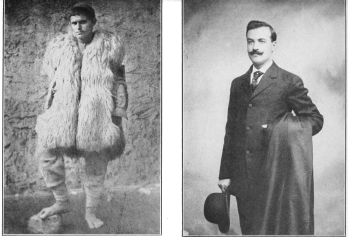
ALBANIANS
ON LAKE SKUTARI The most savage of the Balkan people. ON LAKE CHAUTAUQUA The newest of the Pilgrims, attending the Congregational church, Jamestown, N. Y.
The new régime in Turkey feels this Albanian iron in its veins, for one of the leaders in the new parliament is of this race, as are many of the most virile editors of Turkish newspapers. Both officers and privates in the army which wrought the overthrow of the Sultan are of these same people, who regard themselves as superior to the Turks and to whom no greater insult can be given than to call them by the name of their oppressors.
In my travels through the Balkan, I have often passed through some portion of Albania, which is a narrow strip of land along the Adriatic, between Montenegro and Greece, with much of its interior inaccessible. Its savage state was encouraged by Turkey, which maintained there a borderland against the power and ideals of the West.
Every village was an armed camp, every house a fortress. Tribal warfare never ceased; neither the holy seasons of the Church nor harvest time knew the blessings of peace. Every Albanian was a soldier or brigand and sometimes both, loyal to those to whom he had sworn loyalty; but the musket was law between him and the stranger, and the bullet its executor.
Trained for slaughter, the Albanians spurned common theft, but did not shrink from murder, for pillage or for revenge. The last time I saw them at home, was on the shores of Lake Skutari, retreating to their native mountains in the Albanian Alps, after having pillaged a Montenegrin village, one of the few prosperous enough to make a raid worth while. They were resting on a rocky hillside, and as I attempted to take a snapshot, they resisted religiously, good Mohammedans that they were, by emptying their rifles after me, doing no more damage than frightening my worn-out team into a gallop.
To say that the next time I saw them, was in the prayer-meeting room of a Congregational church, describes graphically the difference between then and now; for it was a docile, conventional looking company of men that I met; their fierce mustachios shaved or cropped, their muscular bodies clothed in the commonplace garments of our civilization. Their eager, black eyes alone spoke of the hot, Albanian blood in their veins not yet chilled in our cool, workaday atmosphere.
Neither Gheg nor Tosk ever had a chief like the one who led them that night in singing the “Shcipetari” song, the battle hymn of Albania; for he who wore the red skullcap of the chief and beat time as they sang, whose placid face was lighted by a deeper passion than their own, was an American,—Arthur Baldwin, Patent Attorney and lover of common folks.
One by one he had gathered them as they drifted into the city by the lake. “Dagos” they were called; homeless, neglected and treated with scorn. One after another they swore fealty to their new chief, until now every one of them acknowledges the sovereignty of his passion over them.
Half savage as the Albanian is, he has a fine feeling for womanhood. Woman is man’s fortress; for he is safe from the enemy’s bullets when in her company, and she may kill the man who has broken his troth with her.
While the men are loyal to Mr. Baldwin, they feel for Mrs. Baldwin a sacred awe, and well she deserves their reverence; for she has been mother and sister to these homeless youths and has taught them the English language by a method of her own.
Most of the Albanians in Jamestown, and many of those who have scattered east and west from there, carry with them Mrs. Baldwin’s letters, which are the English lessons for the week, combined with cordial greetings, a word of good cheer, and advice.
In the prayer-meeting room of that church of the pilgrims, these newest of the pilgrims sang that night their national hymn.
Ce me gne te Kollozhégut, Ch’u fillua Shocerija, Ce me gne te Kollozhégut Ch’u fillua Shocerija Ch’u fillua, brénda m’u ne Sofijé Per skoli nde, Shciperi. Ch’u fillua, brénda m’u ne Sofijé, Per skoli nde Shciperi. Burra, burra djéma, burra djém, Burra djém perpicuni. Burra, burra djéma, mbuhuni, Mbushuni mé dashuri. S’jémi Gréker as Bulgare, Jémi trima Shcipetare S’jémi Gréker as Bulgare, Jémi trima Shcipetare Dhente Zoti la me la, Afer ghér nde Pérendi, Dhente Zoti la me la, Afer ghér nde Pérendi. Burra, burra djéma, burra djém, Burra djém perpicuni. Burra, burra djéma, mbushuni, Mbushuni mé dashuri.
The music is savagely martial, although the words are commonplace; for the Albanian, like the rest of us, is thanking God that he is not as other people, especially the detested Greeks and Bulgarians.
After the singing, the men danced. Shades of the Puritan ancestors! Dancing in a prayer-meeting room! But inasmuch as these were semi-civilized people, the dance was decent and full of religious symbolism. The men swayed their agile bodies to the wild notes, bent the knee, then two by two joined hands, forming a cross; thus making their dance an act of worship.
Then I spoke to them of their mountain home and of this one; of their old tribulations and their new opportunities; of their old feuds and their new friendships. When I finished, they crowded around me and pressed my hand, because they had found one who knew them, their fierce nature and their unsurpassed devotion to their native land. I could not help thinking of their brothers who, ten years before, chased me along the shore of Lake Skutari with guns.
While I am sure that Mr. and Mrs. Baldwin would not desire praise for the work they are doing among these people, the methods they have used and the spirit which has animated them are so remarkable as to deserve emulation. Their basis of approach to the Albanians was undisguised and unadulterated friendship. They liked common folks. As other people on the shores of Lake Chautauqua liked automobiles or steam yachts of particular makes, so among folks, the Baldwins liked Albanians. Being their friends, they wanted to do them good, and what they most needed was ability to understand English; so they taught them English and with the new language they have given them the atmosphere of home and impressed upon them the need of character to save them from the new temptations.
Wiser than some others who have attempted to do good to strangers, they restrained their religious ardour and left Greek Orthodox and Mohammedan undisturbed in their faith, except as by their example they taught them that love is more effective than its symbols and deeds more vital than creeds. Neither have they tried to deaden the old patriotism; and the one great, starry virtue of the Albanian which is almost unparalleled, is his devotion to his country.
After I had spoken that night, I was escorted to a restaurant kept by one of them, and there over the steaming coffee we talked of Albania’s griefs and hopes.
Mr. Baldwin knew every nook and corner of the country and its history. He spoke of Albania as if he had been cradled among those far-away mountains, instead of on the placid plains of the Middle West. He deplored the fact that they had no schools in which their own speech was taught, that religion held them apart, through factions of Greek Orthodox, Roman Catholics and Mohammedans; and he talked of Scanderberg, their national hero, as if he were speaking of Washington or Lincoln.
Mr. Baldwin had invited me to Jamestown, to counsel with his men, who are doing the most menial tasks to earn money for Albania. At that time all was dark in Turkey, and a visionary alone could have held out hope for an autonomous Albania.
Practical American that I have become, I told them to save their money, start bank accounts and become prosperous Americans. They knew better; at least they had more faith. They were then training a man in an American college, for political and social leadership; a young Albanian noble, who spoke eight languages, had faith in God and man and, above all, in Albania.
Until long past midnight I talked of peace while they talked of war; I spoke of submission, while they talked of resistance; I thought I knew Turkey and the Turk, while they had faith in Albania and the Albanians. The recent developments prove that their faith was better than my knowledge.
When the Jamestown Albanians scattered as far east as Natick, Mass., and as far west as St. Louis, Mo., their old friends aroused interest in them everywhere. In Natick, Mass., a devoted pastor, Rev. Morris H. Turk, has matched the Jamestown work for these “twentieth century pilgrims” as he calls them. He has learned enough Albanian to lead in devotions, and has fitted out a chapel with chancel, altar and pictures.
“We began,” he says, “where the Greek Orthodox church left off. We secured some Albanian hymn-books from Monastir, and thus we were enabled to conduct a somewhat formal religious service, largely in the Albanian language. Socials, entertainments, receptions, picnics and other diversions supplement the religious and educational work done at Natick.
“The results have been remarkable. Two of the men are fitting for college, a dozen or more have blended completely into the parish life, and best of all, a hundred or more have had the uplift of friendliness and acquaintance with our American ideals.”
Mr. Turk is making a tour of Albania this summer for the express purpose of rendering his service to these people more effective; to see life from their view-point and to acquire a better knowledge of their difficult language.
Mr. Guy J. Fansher writes from Boston, where he has become interested in them: “Their love of country is very strong and, like the old Hebrew prophets in Israel and Judah, we find it necessary to carry on whatever religious work we may wish to do side by side with their love of country. This same love of country has been evidenced in their translating of the Orthodox Church ritual into the Albanian and using that in their church service monthly in a rented hall.
“I found the men apt to stay indoors too closely, so during the winter gave them work in gymnastics, using dumb-bells, basket-ball, etc. We had some flash-light pictures taken of these classes, which the boys were eager to buy and send home.
“The men are close readers of the daily papers, soon get interested in politics (were strong for Taft), get out naturalization papers as soon as possible, and are proud to be in America. They soon learn to dress in neat suits of brown which is very becoming to them with their dark skin and hair.
“The men seem to have good control of their habits, seldom drinking to excess; the cigarette is always with them, however; the social vice is not theirs to any great degree; they are neat about their rooms and do not crowd together as the Italians or Jews. These things have rather assisted our work among them; their exceeding shyness has been hard to overcome; they must be led, not driven.”
“They must be led, not driven,” and Mr. Baldwin adds: “They must be trusted, not suspected; loved, and not merely tolerated.”
The events in Turkey have surprised every one who has an interest in the Balkan question. The young Albanian noble, already referred to, is back in Albania, somewhere near Lake Skutari, helping shape the future of his country; for he is a leading member of the Albanian Committee.
On Lake Chautauqua his countrymen still work and pray and hope for an autonomous Albania, with schools and churches in which they shall be free to use their language and in which they shall have privileges commensurate with their sacrifices and with the burdens they have borne for Turkey.
Then they will sing in Kortia the song they sang in Jamestown, when we parted before the early dawn of a winter’s morning. It was a national hymn, which the Albanians have a right to sing, although they sing it under the crescent banner of Turkey; for it is a translation of our—“America.”
O Zot Ti fucimath, Ndihna si ghér tashi Te lutémi; Lardi tet’apeme Mé ghithe zémere: Per dashurimne T’ent Ce shoheme.
XXII THE PROTESTANT CHURCH AND THE IMMIGRANT
THE one institution in America most gravely concerned with the coming and staying of the immigrant is the Protestant church. Each ship-load of people from Southern and Southeastern Europe increases the already crowded Roman Catholic parishes, lays foundations for the perpetuation of the Greek Orthodox church in the United States and enlarges the tents of Israel whose camps encircle the dying churches.
The Protestant church, in our great cities, pointing to the decrease in her membership, as evidence of her peril, and bravely singing “Onward Christian soldiers, Marching as to war,” moves into the suburbs, away from the congested masses and among the attenuated few.
That the Protestant church has endured thus far, that its ideals are still dominant, that its preachers’ voices are still heard in the tumults of our Babels, is direct evidence that somewhere her foundations rest upon bed-rock and that the Christian faith and practice, as she understands them, are essential in the solution of the problems of our civilization. Because I believe this, I am not frightened by figures but am concerned with forces. It is not a question of the ability of the church to increase, but of her willingness to decrease, if necessary, in the attempt to communicate to these masses, from all races and religions, her passion for humanity and her devotion to the Divine.
I am not at all concerned regarding the inability of the Protestant church to adjust other men to her creeds or to adjust herself to theirs; but I am deeply concerned with her inability or unwillingness to make good her professions of democracy, and to relate herself in some vital way to these new citizens who are satiated by creeds, but are hungry for brotherhood; upon whom, like a curse, rest the damp and mould of tombs and chapels, but who have been untouched by the power of the living, redeeming Christ, as He has incarnated Himself in His followers.
So long as these people are within the sphere of Foreign Missions, in “Greenland’s Icy Mountains,” or some other remote and romantic place, they are the subjects of prayer and the recipients of gifts of men and money; but when drawn into the radius of one’s immediate neighbourhood, they become a peril which threatens everything, from the price of real estate to the foundation upon which the church rests. There is no question that in many cases the Protestant church is facing this problem in an admirable spirit; although very often expressing it in a way calculated to alienate rather than to attract. On the whole there is a growing desire to serve this new host of men, to help them adjust themselves more easily to their new environment and to make of them conscious human beings, consecrated Christians and efficient citizens.
There are to-day increasing numbers of Protestant Christians who have broken away from the old prejudice against the Roman Catholic church. It is not their desire to alienate faithful communicants from the church in which their individual and national life has root and being; but they recognize certain facts.
First, that in this new influx of immigrants there is an appreciably large number of men who have fallen heir to Protestant traditions, without fully realizing their spiritual inheritance and their moral obligations. To these, the American Protestant churches owe the duty of interpreting their common faith in its practical terms.
Second, the church realizes that numbers of men, more than are commonly supposed, among Roman Catholics, Greek Orthodox and Jews, are lost to their respective churches. Many of them revert to infidelity and Paganism, and the Protestant church is under obligations to interpret its faith in rational terms to these, who have been touched by the rationalism of our times.
One cannot believe that it is good for such men to be left under the influences of these reactions which may become dangerous to the well-being of the individual and of the State.
Third, the church finds itself surrounded by large masses of men, ignorant of our language, of the laws of health and of the land. They come from countries in which neither Church nor State has attempted to lift them out of ignorance and its attendant superstition; and whenever the churches in whose bosoms these people have starved in the Old World do not make amends here in the New, the Protestant church is called upon to lift them into a better knowledge of the nature of religion and into a better conception of human relations, both for her own sake and for the sake of the communities which she wishes to serve.
This she must do, even if it brings her under suspicion of proselyting; although with my knowledge of nearly all the agencies engaged in this task in the United States, I am convinced that the spirit in which this work is undertaken is not the spirit of the proselyter. Indeed, one of the growing weaknesses of the Protestant church in America is the loss of those deep convictions which make proselyting easy; while the number of those who have the courage zealously to pronounce their shibboleths is growing smaller every day.
The spirit of the following letter justifies its quotation, for it is an admirable example of the way in which one Protestant church is trying to meet the immigrant problem.
—— Avenue Congregational Church, Hartford, Conn., Pastor’s Study, December 17, 1907.
I am writing this letter to you as an office-bearer in the church and one who is influential in forming church sentiment and policies. It concerns the relation of our church to the Jews who are crowding into the streets about the church in ever-increasing numbers. The Standing Committee has earnestly and sympathetically considered the subject, as befits a matter of the first importance to our church.
The settling of these Jews close about us is easily the event of greatest importance in recent years in the field of this church. It would be folly, and in the end impossible, for us to look upon their presence with indifference. We must not drift in this matter. We must have, as a church, an intelligent and positive policy towards them. What shall it be?
Some of us have probably looked upon the coming of the Jew as a misfortune. Is he not also an opportunity? May we trace the providence of God in settling him about our very doors? I believe that we may. This faith grows in me, as one who believes that Christ is to be Saviour of all the nations.
A rabbi in Boston said recently, “The liberty and friendliness of America will put the severest strain upon Jewish exclusiveness that it has ever met. The persecutions of Europe have failed to dissolve our nationality: the kindness of America may succeed.”
In the light of this sentiment, which I share, and with a great confidence in the Gospel, I propose that we undertake definitely a Christian ministry to these Jews. I recognize that an attempt at immediate propagandism would probably be as ineffective as it would be unwise. I appreciate that probably few if any open conversions will reward our labours for many years.
What then shall we attempt? To impress upon them the spirit of the Gospel by living alongside them as Christians should: this first and chiefly. Let us do this in the hope that as their old-world superstitions and narrowness yield to the light of America, they will thus choose the Gospel instead of infidelity. Many of them are already choosing the latter.
How shall we begin? By treating the Jew as we want to be treated. In other words, by treating him not as a Jew, but as a man, each on his own merits. Recognize always that there are both good Jews and bad Jews, as well as good Yankees and bad Yankees. Make the acquaintance of both men and women: and of their children too. Give them a fair chance to show their quality. They are neighbours. They are interested in our schools. They are fellow citizens. These common interests give opportunity to know them and, if we will, their homes also.
Our government by its franchise and its schools welcomes them to an equal opportunity to show and to develop their character. The churches have not shown a like spirit. Shall the state be more Christian than the church?
This proposal of course includes our attitude towards the Italians and all other foreigners among us. I speak especially of the Jews because they are far the most numerous and most difficult to reach.
If a score or even a dozen of us should undertake to show them the spirit of brotherhood that is our Christian boast, and should seek to get our other church-members to do the same, it would not be a month before they would be feeling and speaking of our good will towards them. Meanwhile we can be watchful for opportunity for some special ministry to them or their children, a ministry which shall be welcome both to them and us. The habit of Christian neighbourliness outlined above will lay the foundation of mutual confidence and knowledge necessary for such a special ministry.
Have you faith and patience for such a long campaign? Will you quietly enlist for it and try to persuade others to do the same? If so, will you kindly tell me of it? We will undertake to keep one another informed of any news of progress.
You will understand why this letter and your talks with others about this subject should be confidential.
In the name of Him who was a Jew,
Your Pastor.
The Presbyterian church has given proof of the spirit of its intent by putting the department of Immigration in charge of Rev. Charles Stelzle, a splendid champion of the rights of labouring men, a man with the broadest social and religious outlook and a stranger to Pharisaic cant.
The Rev. Howard N. Grose, D.D., the home mission secretary of the Baptist church, and the men associated with him in the Home Mission Council of the Evangelical churches, seem to me to possess that broad outlook upon life, that appreciation of true values which render impossible their attempting any narrow, sectarian propaganda.
The action of the International Committee of the Y.M. C. A. in placing its work for “Young Men and Boys of Foreign Parentage” in charge of so competent an authority as Dr. Peter Roberts, the author of “Anthracite Communities,”—and the equipment by the State Committee of Pennsylvania of “The Expedition for the Study of Immigration” with its plans for a group of well trained college men as secretaries for immigrants, are additional evidences of the spirit which animates Protestantism in its relation to the immigrant.
There are, however, two fundamental mistakes which the Protestant church has made in her attempt to solve the problem she faces.
First, in the kind of results she tries to obtain.
Second, in the kind of men she has sent to represent her among the immigrants.
The American Protestant of the Evangelical type has carried his business into the church, but not always the church into his business. He expects in the church, results which can be tabulated under the head of profit and loss, just as he expects them in his counting-room.
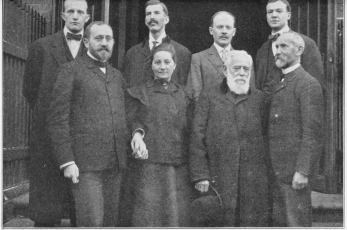
FACULTY AND AMERICAN STUDENTS AT THE MISSIONS-HAUS, KATTOWITZ The young men are members of the Pennsylvania Y. M. C. A. Expedition for the Study of Immigration. The school is strategically situated where three empires meet. It is non-sectarian and interdenominational; permeating the East with Christian ideas.
“Immediate results!” is the cry of the constituents of missionary enterprises, and the result is, that where they cannot be legitimately produced, conversions are simulated for loaves and fishes.
I do not mean to say that missionaries have not so preached and practiced the Christian faith, as to produce in their hearers a desire to adjust their own lives to these new standards; for I know of innumerable cases of this kind among all races and nationalities.
However, the stress laid upon “immediate results,” the praise and money lavished upon those who can produce them, the “showing off” of this or that kind of converted foreigner, the neglect of those who face real difficulties honestly, and cannot humbug those who support them, put severe temptation in the way of missionaries and often unconsciously taint their whole endeavour.
If the Christian religion expresses itself in unselfish devotion to the noblest cause,—the service which the immigrant needs must be performed without an eye constantly upon church records.
The Social Settlement is under no such strain, and its work is like “casting bread upon the water” without expecting it back, “buttered” after a few days.
For a long time and even for all time with some individuals and groups, the church must be willing to follow this Biblical example set by an institution which some ill informed people suspect of being irreligious.
The error which the church has committed in sending poorly prepared men to minister to these immigrants is in many cases as irreparable as it is inexcusable.
An ignorant priesthood is more bearable than an ignorant ministry, and when ignorance is coupled with insincerity, as it is in many cases, the wrong done to both parties is incalculable.
In their haste to “do something,” and in their eagerness to get quick results, nearly all Protestant churches have pushed into the ministry “converted foreigners,” many of whom misrepresent the church which sends them and become a stumbling-block to honest seekers after truth and an insult to the people to whom they are sent.
An example of this lack of wisdom is shown in one of the most interesting missions of a really valuable type, developed in West Pittston, Pa., by a devoted young American woman who, in a remarkable degree, won the confidence of the Lithuanians there. She lived and laboured among them and created a centre of influence which gave great promise of being permanent in its effect. Her work, however, was much too indefinite and slow for the “hustling” church which supported her; so a converted Lithuanian was employed, who in his eagerness to save souls told the people whom he gathered to hear him preach, that they would all be damned if they continued going to the Roman Catholic church. The result was what one might expect. The Lithuanians immediately forsook the mission and went to the prohibited church.
As a rule, the work to be done demands American born men and women who are imbued by the spirit of service, who have some linguistic talent and much consecrated common sense.
The converted foreigner, even if well trained, will be met with suspicion by many groups; for to them he is a traitor to their religion and to their national life, the two being inseparable to them.
No such objection can be made to the American worker, who, if he brings patience to the tedious task of winning confidence, if he has an honest desire to live unselfishly for the people of a neighbourhood, if he gives everything and expects nothing as a reward, may be assured that such service will be accepted and will work out its results in God’s own time.
If converted immigrants are sent among these people, they should have a long testing time; a tutelage and training which, while giving them a thorough equipment for their task, will not spoil them for the humble work it will involve.
There are but few theological seminaries properly equipped to train men for this great work, and still fewer in which there is sufficient spirit of democracy among teachers and students to receive “immigrants” and treat them like brothers.
In many small, industrial communities where the “immigrants” are a problem, its solution is merely a question of the attitude of the churches towards them.
Nothing can be more repellent than the attitude of the average Protestant Christian towards the immigrant of to-day. As a rule he is prejudiced, is grossly ignorant of the historic and religious background of the strangers and meets every one of them with suspicion.
At a recent Summer School of the Y. M. C. A. it was my privilege to teach a class of young college men numbering about 150. They were studying this problem, and the questions asked, a few of which I quote, prove the assertion just made.
“Do not three martyred presidents prove that the immigrant is an Anarchist and ought to be excluded?”
“Is it not true that ninety per cent. of the criminals in the United States are foreign born?”
“Do not foreign governments dump their rubbish of criminals and paupers upon our shores?”
“Is the Constitution of the United States safe in the hands of people who crucified Jesus?”
“Did not our forefathers come to fight for liberty, and do not these people come to despoil us?”
The questions asked displayed such animosity and such ignorance, that to print them all would seem like slandering our Western colleges and the churches in which these young men were reared.
The churches and the Y. M. C. A.’s have no small task in converting their membership to some Christian view-point of these, their neighbours; even if they cannot be converted to a spirit of brotherliness.
The following instance, while not typical, shows the attitude of Y. M. C. A. memberships in many industrial communities, towards the immigrant. An Association in Pennsylvania wished to enlarge its building and solicited funds in the shops of its own community. Slav and Hungarian day labourers subscribed $2,000, every cent of which was paid; which cannot be said of all the money subscribed by Americans.
Some of these foreigners were anxious to learn English, and one of the rooms in the building—not the best—was opened to them and a teacher procured. When one of these boys used some of the public conveniences in the building, the American membership notified the secretary that the “Hunkies” must not be admitted to the building; and they were not, in spite of the fact that they had helped pay for its erection.
While no other such gross injustice has come to my knowledge, I know of many Y. M. C. A.’s in which an Armenian or Greek would be excluded from such a thoroughly religious privilege as taking a bath.
Wherever a church or Y. M. C. A. has shown itself hospitable to the strangers it has had as many of their souls to keep as it has cared to have; but most of them prefer to save the foreigner by “absent treatment.”
The feeling of the strangers regarding the efforts which the churches are making on their behalf in so-called missions, which are often repellently unclean and devoid of any saving grace, is explained in the following letter, written by a graduate of Oberlin Seminary, a young Pole, whose spirit and intelligence the letter itself reveals.
Brecksville, Ohio, October 14, 1907.
Prof. E. A, Steiner, Grinnell, Iowa.
My dear Dr. Steiner:—Your plan for the solution of our foreign problem, as you indicated it in your articles in The Congregationalist of last year and as you outlined it to me in our conversation in Cleveland last week, is excellent; and I wish to tell you that I am in thorough sympathy with it. My own personal experience in the foreign work convinces me that the easiest, most economical, and most effective way of solving the foreign problem is through the American church and the American worker directly. This for the following reasons: First, mission work established for the foreigner strictly in his own tongue is not particularly acceptable to him, and to some it is even offensive. The foreigner regards himself to be a Christian, and, consequently, resents the idea of mission work done distinctly for his particular benefit in order to make a Christian of him. Second, a worker of his own nationality is looked upon by him with suspicion. As you expressed it, he is regarded a traitor, and is not to be trusted too much. When I was in the work, I had that experience over and over again; I felt that my countrymen, that is, a good many of them, when they found out that I was a Pole and not a Roman Catholic, had grave doubts as to whether it was safe for them to trust me. Third, by coming to the mission, the foreigner feels that he is committing himself too much all at once—something which he is very unwilling to do. Then, too, in the mission he is too conspicuous, and thus too much exposed to persecution from his countrymen. Fourth, our greatest hope is, not in the grown-up generation, but in the growing generation—the children and the young people; and these can be reached more easily through the American church than through a mission of their mother tongue, because they want to be regarded, not as foreigners, but as Americans. These difficulties would, to a large extent, be obviated if we tried to reach the foreigner directly through our American churches and other religious organizations and through American workers acquainted with the history of the different peoples, their characteristics, habits, and ways of thinking and looking at things, and to a certain extent with their language also, and in perfect sympathy with them. Of course, the work done at present by the mission ought not to be discontinued; it has its place and its value; but it ought to be supplemented by this better and, as I believe, more effective method which you have in mind and which you propose to our churches for adoption.
Sincerely yours, Paul Fox.
I do not quote this letter because it approves my plan; for I do not hold dogmatically to any one method. The work of saving men is desperately hard and there are a thousand ways of doing it.
More important than any plan is a right attitude; for in all human contact it is the spirit within the man or institution which counts, and not the precise method of approach.
Wherever an approach has been made in the right spirit towards the foreigners, they have responded in kind, and many Protestant churches have been enriched by their presence, by the ardour of their faith and their willingness to sacrifice for their convictions.
There is, as I have said before, no institution in the United States which will be so profoundly affected by the immigrant as the Protestant church. Without him she will languish and die and with him alone she has a future.
Already the Roman Catholic proclaims the conquest of America, and while that conquest is not complete, it soon will be, unless Protestantism wakens to the wealth of its heritage and its great opportunity; unless with a real sympathy and passion it teaches, preaches and practices the religion of Jesus.
The Protestant church need not rival the Roman Catholic church in building stately places of worship, or clothe herself in gorgeous vestments, or read ancient liturgies.
The immigrant comes from just such environment, and nothing that the Protestant church can do in this direction will be as beautiful and as impressive as that which he has left behind.
The one way and the only way in which she can enter into a successful rivalry with the ancient, Apostolic church, is in reviving the ancient, Apostolic passion for humanity.
Having quoted so many letters, I may perhaps be pardoned for quoting a small part of one written long ago, at a time when the church faced a crisis not unlike the one which she faces to-day.
“If there is therefore any comfort in Christ, if any consolation of love, if any fellowship of the Spirit, if any tender mercies and compassions, fulfill ye my joy, that ye be of the same mind, having the same love, being of one accord, of one mind; doing nothing through factions, through vainglory, but in lowliness of mind each counting other better than himself; not looking each of you to his own things, but each of you also to the things of others. Have this mind in you which was also in Christ Jesus: who, being in the form of God, counted it not a prize to be on an equality with God, but emptied Himself, taking the form of a servant, being made in the likeness of men; and being found in fashion as a man, He humbled Himself, becoming obedient even unto death, yea, the death of the cross. Wherefore also God highly exalted Him, and gave unto Him the name which is above every name; that in the name of Jesus, every knee should bow, of things in heaven and things on earth, and things under the earth, and that every tongue should confess that Jesus Christ is Lord, to the glory of God the Father.”
XXIII TWENTY-FIVE YEARS WITH THE NEW IMMIGRANT
IT is now twenty-five years since I landed in the United States with a group of Slovaks from the district of Scharosh in Hungary.
I followed them across the sea and watched this historic movement of the Slavs, who until then had remained practically dormant where they had been left by the glacier-like movement of their race, the pressure of the invader or the fate which governed Eastern European politics.