Front matter (continued 4)
Reading edition
He said—
"To you, who smoak so eesily, no dout it is no good, but I have never smoaked, and if I took a cigaret and went through with it, it might turn me off eating for some time."
This was true, but I pointed out a grate danger that Morris had forgotten.
"That is all right and I will of corse share my cigarets with you, and as there are twenty, that will be ten each," I said; "but I must seeriously warn you, Morris, that to a perfect beginer, like you, many things might happen besides merely a fealing against tongue sandwiches. You might be absolutely sick and then——"
"All the food in me would be wasted," said Morris in a very tragick tone.
He turned quite white at this idea. He said it would be madness to do anything to weaken his system at such a critikal time, and I said so too. Then he asked me to go and smoak further off, because the very smell made him feal rather strange after what I had told him.
I smoaked three cigarets bang off and they only made me hungrier than ever. Then the rain became rather bad and at four o'clock we entered the cavern. At least I did, but Morris stood at the door ready to run out and shout if by a lucky chance anybody came in sight on the edge of the qwarry. But nobody came and the next serious thing was that my voice began to get husky after so much shouting. Morris said it was the cigarets, but I told him it was owing to yelling all day every half-hour, which undoubtedly it was.
At six I went to sleep for some time in the cave and Morris did not wake me, because he said that I was gaining strength by it. When I woke it was getting darkish and I thort it would be a good thing to make a fire. Morris thort so too and we made one reddy with a lot of ded fern that Freckles had put long ago into the cavern. We took the paper that had rapped up our lunch, and put it under the fern, and covered it with my coat to keep it dry; and after dark we lighted it, and it made a good blaze for a minute but unfortunately went out owing to the rain.
The rain, in fact, began to pour steddily and it was a partickularly dark evening. Morris became a simple worm after dark. He took a small bite out of a sandwich and said his prayers from end to end every half-hour. I had only got my cake left now, and it seemed to me better to have one good meel and have done with it than keep messing about like Morris was. So I finished my cake and tried to go to sleep again.
We found that water came through the roof of the cavern in rather large quantities, and Morris had a new terror. He said—
"If we can't get out of the qwarry, then I don't see how water can get out, and so, if it rains more than a certain amount, the qwarry will get full and we shall be drowned."
Which showed what a footling state of mind Morris had got into.
Presently I sneezed and he said of corse that it was the beginning of pewmonia. Then he asked for a match to see the time and it was six minutes past ten. Then I shouted again at the cavern entrance without result.
He kept on asking for matches to see the time until there were only five left, and I said we must keep these for immergencies, and he said he supposed we must.
At last he went into a sort of sleep after shedding some teers and pretending it was a cold in his head. Then I lighted a cigaret and found much to my supprise that I was beginning to feal queer myself with a new sort of queerness quite new to me.
I woke Morris and told him that I was sorry to say I was ill; and he said he was undoubtedly very ill too and had been dreeming of his mother, which he only did when frightfully ill. He also asked me if I believed in ghosts and I said I thort I did. And he said he always did.
There were some awfully strange noises happening outside at this time, and I sakrificed another match and found it was neerly one o'clock. Then we went to the mouth of the cavern and listened to a peculiar creepy sound far off. The rain had stopped and a sloppy looking moon was coming up. Morris shivered.
"That might be the mournful yell of some wretched ghost," he said.
"It's owels," I said, but he did not think so. He thort it was too miserable for owels.
It came neerer and certainly was not owels.
Then a thort struck me.
"It's a resque party!" I said.
We shouted with all our might and screamed and yelled, and presently there was an ansering yell and we fealt that with any luck we were now saved. Soon toarches gleemed through the trees, and there were sounds of human feet and langwidge.
I said to Morris—
"We are now saved, Morris, and if you are not going to eat your piece of carraway seed cake, I should very much like to."
And he said—
"You can eat everything. I have such a fealing of thankfulness to be saved, that I couldn't eat for the moment, empty as I am. Besides there will be supper provided."
A man shouted above us and I heard the hated voice of Waxy West.
"Be you little devils down there?" he cried out.
"Yes, we are, Mr West," I answered him very loud. "We're doing no harm at all—merely waiting quietly to be resqued. We only came for draggon-flies, and the side of the qwarry gave way unfortunately, or we shouldn't have had to trouble you at such a late hour."
He growled in rather an unkind tone of voice, and we saw there were two other men with him. Then they began to make arrangements for the resque and one was told to go and get a rope.
"If ever I catch you in this place again, I'll break both your necks," said Waxy West; and though this was rather strong, it comforted Morris in a way, becorse it showed that West hadn't found his messages offering a handsome reward. If there had been any question of that, he would have been polite and kringeing; but he was just as usual.
We found out, after, that Matron had got in a funk and gone to the big house, where the people belonging to Merivale Grate Wood live; and the people had sent their keepers in all directions to save us.
These keepers got a rope and made knots in it and lowered it down, and told us that we must climb up it. And I let Morris go first, which he did; and then I went up, and the keepers saw us home.
I told Waxy West that I should mention the subject to my parints in India and that I hoped they might send at least a pound to him, and he said it wasn't likely, becorse he'd done them the worst turn any man could. And he said that if I wanted to reward him, I would never go into Merivale Grate Wood again; and I promised I wouldn't go in again for a full month. Which he evvidently didn't believe.
There was fritefully good tuck waiting for us at school, and the Matron, who had been blubbing, said a grate many rather unkind things while we eat it. But she promised not to tell Dr Dunstan and he does not no even to this day.
Morris didn't win the holiday competishun becorse, as he expected, both Slade and Thompson minor brort back draggon-flies. We might eesily have gone to the qwarry again, after the month I promised Waxy West was over, but nothing would tempt Morris to go, though I bought ten yards of good rope for my own use. However, he paid me sixpence for getting him back his killing-bottle and his butterfly-net and his caterpillar-box, which were forgot in the excitement of the resque; and that was all to the good.
RICHMOND AND THE MAJOR-GENERAL
No. X
RICHMOND AND THE MAJOR-GENERAL
The fellows talk such a lot of absolute piffle about what I did, and tell such a frightful number of regular right down lies about it, that I have decided to write out the whole thing myself from the beginning, that the truth shall be known. There is nothing like truth really, and it is the only thing that lasts, and I am going to tell the truth fearlessly, because honesty is the best policy, however hard it may be at the time.
Well, after I gave up preaching to the chaps at Merivale, owing to the row about Browne and Stopford and all the unpleasantness afterwards, I felt that my occupation was gone in a sort of way; and it so weighed on my mind that I was one of the first to get German measles and one of the last to recover. I was shut up in the hospital and had a great deal of time on my hands for thought, and the more I thought, the more I felt that my preaching gift ought not to be wasted like this. I tried preaching to myself once or twice, to keep my hand in, and I found that I was clean out of practice and couldn't work up to "thirdly and lastly" without getting regularly tied in a knot. Then I tried to preach to the matron, and she said it was morbid and told the doctor (for I heard her through the door) that I was very low and taking a most unhealthy interest in religion. After which I had a lot more most uncalled for and beastly medicine, and was isolated for three more days; because the doctor said it might be something else threatening. What was threatening really was my conscience. I was perfectly well and frightfully eager to be doing good in the world; and as it seemed simply useless to try to do any more good at Merivale, chiefly owing to that son of Belial called Stopford, I came to the terrific resolve of going. I decided to leave quietly. I thought on the last day of being isolated I would steal out into the world in a spirit of calm courage, and try to do good, and leave the rest to Providence.
I did nothing rashly, because it is well known that Heaven helps those who help themselves, and we must not throw all the burden on Providence, however much inclined we may feel to do so. We are given our talents to use, not to put under a bushel. I had ten shillings and a telescope, worth eight-and-six. I had nothing else but my volume of Skeleton Sermons. It seemed enough.
One is bound to be worldly-wise up to a certain point; and this is right and proper. If you have a mission, you must use the best means for carrying it out, and even money may be put to very proper purposes if it is spent with a high object. Besides, the labourer is worthy of his hire.
With my money I determined to use artificial means for getting as far from Merivale as possible. For ten shillings you can go an immense distance by train, though a half-ticket was no longer possible for me, as I was over twelve; but a train is far too public and I should have been discovered. Therefore I decided upon the simple plan of hiring a bicycle. The time was May and the evenings were long. Therefore I determined to hire the bicycle during the hour when everybody would be in chapel for evening prayer. Being isolated I could do this.
The eventful night was fine and warm. I slipped out unperceived, but I had taken the precaution not to wear my hat with the school colours, as that would have been instantly observed. So I went to my private box and took out my round bowler hat, which could not lead to detection. I then got over the hedge into the main road, because to have walked out of the gate by the lodge would have much decreased my chances of escape.
All went well. The people at the bicycle shop raised no difficulty, and for five shillings they let me have a machine for two hours—also matches to light the lamp. It was put into their minds to trust me, and I saw from the first that Providence was going to help me. The man even shortened the steps a little as I am unusually stumpy in the legs.
I gave him five shillings and set off. Pursuit would not begin till my supper was brought by the matron, and I had a clear hour before that time. Then I knew what would happen; because two terms before, young Watkinson, who was homesick, had run away and tried to walk from Merivale, in Devonshire, to Edinburgh, where his grandmother lives; but he had been taken by Mannering riding that way on his bicycle, two miles out of Merivale. So I knew that the masters on bicycles and policemen on foot would soon be after me, and I intended to avoid the main roads and spend the night in some harmless and wholesome cowhouse on a bed of sweet meadow hay. Then in the morning I should rise, get a drink of milk and a little bread-and-butter from some simple and kind-hearted housewife, and leave the bicycle with her to be returned by train to the bicycle shop at Merivale. What would happen after that I left entirely to Providence.
A telescope and a rather fat book are awkward things on a bicycle, and they bumped me rather heavily, one on each side, as I started. So after riding a few miles I dismounted, slung the telescope over my back and buttoned the Skeleton Sermons to my chest. Though not comfortable, they did not bump, and I went steadily on my way. At a quarter to nine I lighted my lamp and well knew that Mannering and Chambers had started, and that many telegrams, including one to my father, had probably been sent off by Dr. Dunstan from Merivale. For the first time I considered what view my father would take of my action, and I was bound to feel that he might not care much about it. My father, though a good father to me, has never trusted as much in Providence as I could have wished; which is curious, seeing that he is not only a clergyman but also a rural dean. He wants me to go into some lucrative business, but I never will, for I have no feeling for it. My father thinks that money is everything, and I know well it is not. He said to me once that you can always tell a gentleman by his neckties and the cigars he smokes. Which is childish, because many perfect gentlemen never smoke cigars at all.
I got rather depressed after dark—entirely owing to thinking about my father. I also got strangely hungry and was beginning to wonder whether I had better try for some supper anywhere, or just leave nature to settle that. Then a most serious and unforeseen thing happened and the hind tyre of the bicycle went off with a loud explosion, like a pistol. I dismounted instantly. I kept my nerve and quietly considered the situation. For a moment it looked as if Providence was against me, but I could not be sure of this yet. I wheeled the bicycle to a gate and sat on the gate and considered. Then, far down the road I had come, I saw a light and instantly perceived that another bicycle was approaching at quite twenty miles an hour. To drag my bicycle through the gate into the field, to shut the gate, extinguish the lamp, and crouch in the hedge motionless and silent, was the work of an instant. The bicycle flew past and the man on it grunted with little grunts. It was, in fact, the well-known grunt of Mannering—a sound he always makes at footer and hockey. So I saw that Providence was still with me and felt very much cheered; because, if the lyre had not burst, I should have been quietly riding along not thinking of Mannering, and he would have overtaken me and all would have been over.
My resolutions were soon made. I left the main road, which was evidently now no place for me, and wheeled the bicycle down a lane near a farm. I felt that it would be necessary to my health to eat something before sleeping, but cared little what it was, and decided that I would just take the fruits of the earth—corn or a few turnips, or anything. In the morning I should mention it to the farmer's wife and ask her to change my five-shilling piece. For the change from my ten-shilling piece, after paying for the bicycle hire, was a five-shilling piece.
I now became conscious of the fact that the bicycle was a hindrance rather than a help. To leave it behind was, therefore, the work of a moment. But first I took a leaf out of my pocketbook and wrote on it these words—
"Kindly return this bicycle to the shop of Messrs. Jones and Garratt, bicycle works, Merivale, and all will be well. The hind wheel is punctured. The finder will probably be rewarded."
To show, however, that I was not careless for the bicycle, I may say that I went on till I found a cowshed, so that the machine might be dry and not suffer from night dew or possible rain. It was not the sort of cowshed that I meant to sleep in myself, being evidently used purely for cows, and having no fragrant, clean hay or anything of the kind in it; but it was good enough for the bicycle; so I left it there and went on my way.
There are very peculiar and creepy sounds to be heard in the country at night, and I heard them all. Everything, in fact, is quite different to what it is by day. Especially the colours of things. There was a watery sort of moon, and it made all the leaves on the trees look as if they were cut out of dirty white paper. And it made gate-posts and tree-stems look as if they were alive. I got a curious sort of feeling about this time and lit a match and read a couple of Skeleton Sermons. This put me absolutely all right, and I went to seek some of the fruits of the earth. But May is evidently a bad time for that purpose. In fact, there were simply no fruits of the earth to eat anywhere, so I had to trust to young leaves. Beech leaves are all right in a way, but you soon have enough. That was all I could get, however, and I washed them down with a drink from a brook, but unluckily slipped in while filling my bowler hat with water. Then the thing was to find a comfortable place with sweet, snug straw; and I crept down to a farmhouse; and, hearing me creeping down unfortunately upset a dog so much that it barked steadily for half-an-hour and woke many other dogs for miles round.
At last I found a poorish sort of shed which had no sweet, fragrant hay but only a cart with sacks in it. The sacks had been used for guano. Still they were better than nothing, and I got into the cart and pulled the sacks over me, having first taken off my socks and hung them on the edge of the cart to dry. I slept, but not well, and when morning came I found myself deeply scented with guano and starving for food, but otherwise all right and still free. So I read a bit, and put on my socks, and set out boldly down a lane to the farm. But, after all, I did not go to this particular farm, because, instead of a motherly woman or some beautiful young girl standing at the door feeding chickens and pigeons, there were two men in a corner killing a pig, and the pig simply hated it; and to see this done on an empty stomach is very trying to the nerves. So I went hastily and boldly on, and at last found a quiet and humble cottage and a woman in it. I don't think she would have given me food for nothing; but when I said I would pay her a shilling for a breakfast, and showed her my five shillings to prove it, she met my views gladly and gave me three pieces of bread-and-butter, an egg, that was not laid yesterday, and some tea. Then she changed the five-shilling piece and gave me back four shillings.
Much refreshed and with nothing to trouble me but a cold in the head, doubtless owing to getting my feet wet, I went on my way. My idea was to get to Exeter and then boldly take my stand in the cathedral yard and try to begin doing good and arresting the careless passer-by, and leaving the rest to Providence. I did not know whether it might be possible to get to Exeter by lanes and footpaths over fields. Nothing happened except that I gave away two shillings in charity to a blind woman with four children. I also said a few encouraging words to her. And then, being now in the middle of a very lonely common covered with yellow gorse and white may, I came suddenly upon a man sitting under a bush smoking a cigarette. He was evidently not a happy man, being very ragged and with one laced boot and one elastic one. His hair was long, partly yellow and partly grey; his face was as brown as leather; and he had little rings in his ears. His clothes were faded and a good deal patched. He evidently did not mind what he wore. His eyes were blue and bright, but rather kind on the whole. There was a paper opened beside him. It was a bit of newspaper and contained bones and the sort of food you give to dogs. His nails were long and black, and some of his fingers perfectly yellow from smoking cigarettes.
I said—
"Good-morning! Can you kindly tell me the distance to Exeter?"
And he said—
"I'm going there myself after I've finished my breakfast. It's about ten miles from here."
I thought very likely that Providence had thrown this rather unsuccessful man into my path for a good purpose; so I said—
"As we are both going to Exeter, we might perhaps walk part of the way together. Only I like the quiet lanes and field-paths best—not the high road."
He seemed to think the idea quite possible. He said—
"Can't be too quiet for me."
I said—
"I cannot tell you my history, but I may tell you this much: I am quite determined to do some good in the world."
He said—
"Funny you should say that. I'm just the same. I'm nuts on doing some good myself. In fact, I was sitting here this minute wondering what the dickens it should be."
I said—
"The truest way to make yourself happy is to set to work to make other people happy."
And he said—
"Righto! I've always stuck to that. And I've been so busy lately, trying to make other people cheerful, that I've got rather down on my own luck."
He offered me the remains of his repast, which I declined. Then I told him that I had two shillings and that, if he was still hungry, he might share my lunch with me when we came to some quiet inn. He thanked me heartily and fell in with this. He said he wasn't hungry but was suffering from an agonizing thirst. He said that thirst was a disease with him, also smoking; and I told him that it was a terrible mistake to become the victim of a habit; and he said he knew only too well that it was.
I improved his mind a good deal before we came to an inn, and then, not wishing to be seen, I gave him one of my shillings and told him to spend sixpence on himself and sixpence on me. I merely wanted sixpennyworth of good, wholesome bread-and-cheese; and I went behind some haystacks and waited for him.
He was a long time coming, and, when he did come, I was surprised to find how little bread-and-cheese he brought for sixpence. Me admitted frankly that it was very little; but he said the landlord was a hard man and he would not give a crumb more for the money.
While I ate, Marmaduke FitzClarence Beresford—for that was this friend's name—told me something of his life. He was a gentleman by birth and also by education. He had, in fact, been to Eton and Oxford and also in the army. He had won the Victoria Cross and been mentioned several times in dispatches. He had even shaken hands with the King and been thanked by the House of Commons for his services in the Boer War. But then, at the very height of his worldly prosperity, a bank had broken and he had suddenly found himself quite ruined and penniless. Of course he had to leave the army, for in the position he had now reached, which was that of major-general, his mess bill alone ran into gold every week. A major-general has to buy champagne every day of his life, whether he drinks it or not. It is a rule in the British army and very important. But he said that nothing mattered as long as one tried to do good in the condition in life that one found oneself in. He said I was perfectly right to carry my Skeleton Sermons with me, and that the first thing he was going to do, when he had saved a little money, was to buy a volume himself. But, if anything, he was still more interested in my telescope. He said that it was good for five shillings and advised me to sell it. He explained that it was useless to me if I was going to devote the rest of my life to doing good; and of course this was true.
He said we had better stop where we were till dusk, and that there was a small town, two miles off, where it might be possible for him, as a favour to me, to get a friend of his to buy the telescope. So we sat a good many hours in this quiet field; and he smoked thousands of cigarettes, and I told him many things that it was useful for him to know; and he told me many things that it was not particularly useful for me to know, yet interesting. He was a well-meaning and religious officer, but he was rather soured, naturally enough, owing to the utter breaking of his bank and the loss of his hard-earned savings.
He admitted that I had made him see several things in a very new and different light, and then, towards evening, he said we might now start to sell the telescope. He said with a part of the proceeds I might get a fairly clean bed at the little town, and that he hoped, after a comfortable night's rest, I should be able to start refreshed and strong to do good at Exeter. I asked him where he was going to sleep, and he said in some ditch, because, for the moment, he was absolutely without means, having given away his last shilling to a poor tramp who was even worse off than himself. I told him he might be very sure that he would never regret that shilling; and he said probably not in the long run, but, just for the moment, as it was going to be a wet night and he had a bad cold on his chest developing into bronchitis, he felt a little weak and regretful. Then I said—
"You shall share this telescope with me, Major-general Beresford, and if you like to throw in your lot with me, we will take a humble lodging for the night and start to do good to-morrow."
He said it was almost more than he had a right to expect; and yet it showed how wicked he had been to doubt Providence for a moment. He almost cried, and I cheered him up and told him to be courageous and hopeful. Then he said he would try to be; and then he went off with the telescope, while I waited just outside the small town behind a hoarding. The major-general had said that he should be about an hour, as a thing of this kind wanted a good deal of doing; but he wasn't: he came back in twenty minutes, and he brought the telescope with him, and he was in a frightful rage and spoke several soldierly words that were not at all right to use for a man who wanted to do good.
Me said—
"The blighters won't let me pop it! They all want to know how I came by it! Dash their infernal impudence! Why, they'd have had the cops on me if I'd stopped to argue about it! You'd better take it yourself. But I'll be even with some of 'em yet, clash and bash them! I'll burn their very bad-word houses down about their ears before they're much older!"
In this dreadful way he went on for some time; then I tried to calm him down and told him he must not feel too much hurt because common, crafty men in shops regarded him suspiciously. I said—
"You evidently lost your temper with them, and that is never right or wise. It was your boots that made them doubt you. You ought quietly to have told them who you are, and about the King shaking hands with you, and the bank breaking, and so on. Then they would have understood, and if they had been Christian men, they would have sympathized with you and very likely have given six or seven shillings for the telescope."
He said, rather foolishly—
"Given six or seven grandmothers for the telescope!"
Then he seemed to grow suddenly suspicious of me and he asked—
"Where did you get it from anyhow? If I thought you'd sneaked it, I'd——"
"I got it from my Uncle Horace," I said. "He is an amateur astronomer and understands the stars."
"Well, I ought to understand three balls by this time," answered the major-general, though what this meant I have never understood myself to this day.
Then he began to make me rather uncomfortable, and I detected a good deal of vulgarity in him. But doubtless it often turns people vulgar and brutal to come down in the world, owing to having to mix with their inferiors and suchlike.
Now he began to ask me about myself in a very cross-questioning manner, and at last it seemed to me that I must tell him the truth. In fact, he kept on so about who I was and where I had come from, that it got to be a simple question between telling him the truth and telling him a lie. Therefore, of course, I told him the truth, and said that my name was Richmond and that I had lately changed my way of life by leaving school in order to do some public work in the way of goodness.
He seemed much surprised.
"You've run away from school then?" he exclaimed.
"Yes," I said; "but of course I am telling you this in the strictest confidence."
He quite saw that, and said that he regarded the confidence as a great compliment to him. He became perfectly friendly again and said that, when a boy, he had run away from school also, and that most boys of spirit did so—in fact, nearly every boy who ever made much of a mark in the world began in that manner. I reminded him that he had been to Eton and Oxford, and he admitted it. It was from Eton that he had run away, but he had been subsequently captured and taken back.
"Now you have confided in me," he said, "I think I can really be of some practical use to you."
He guessed at the time and said, that if we put our best foot foremost, we ought to be in Exeter by midnight. I remember, curiously enough, wondering which was his best foot—the one in the lace-up boot, or the one with elastic sides. Anyway, we set off after I had shared my last shilling with him. This he changed into food and drink at a small public-house by the wayside.
"At Exeter," he said, "I am widely known and respected. When we get there, certain people will welcome me in a friendly spirit, and I am quite sure they will welcome you too. In fact, I can promise you a very warm welcome and a good night's rest."
"Will they take the telescope?" I asked.
"No," he said. "They are not people like that. When they understand the situation, they will be perfectly well satisfied with you as you are."
I was glad that the major-general had come back to this quieter and wiser frame of mind, and thanked him.
"I hope it may be in my power to do you a service some day," I said; and then, in his turn, he thanked me.
"You never know," he replied. "You may be able to do me a good turn even sooner than you think for."
He smoked thousands more cigarettes, and asked me about my home and my family. He was rather interested to hear that my father was a rural dean, and kindly hoped that he made a good thing out of it. I told him that I believed he did; but I explained to him that money was not everything—indeed, far from it—and that too much is a great temptation. He said that he had never had enough, even in his palmiest days, to judge; and I said—
"There are many precious things that money will not buy, major-general. You must admit that. It won't buy affection, for instance."
He sniffed and evidently doubted this. He said—
"It will buy all the affection I want—and a bit over."
Then the lights of Exeter at last appeared and I was frightfully exhausted by now and jolly glad to see them.
"Here we are at last, thank the Lord," said my companion, though not in a very pious tone. Then, at the outskirts of the town, we came to a building with a light outside, and the major-general pushed me in in front of him—rather roughly, I thought. The inside was brightly illuminated with gas and, to my amazement, the building contained nothing but policemen. One of these was much astonished to see us.
"Hullo, Slimey Sam!" he said to my companion. "'Tisn't often you give us a call without a little help from behind!"
Then, to my horror, the major-general cast subterfuge to the winds and appeared in his true character.
"No," he said. "It took four of you blue worms to carry me in last time I was here; but this is just a friendly visit. I've been doing a bit of your work, in fact."
Instantly I perceived my position and made a dart for the door; but my faithless companion was too quick for me.
"No, you don't, my little man!" he cried out, and grabbed me by the collar as he did so. "This is the missing link," he said to the policemen, and they were much interested instantly.
"The boy from Merivale?"
"Yes."
Several policemen hastened to the telephone, and one hurried off to the main police-station of Exeter, and all was excitement, disorder and confusion. Slimey Samuel—for this was the real name of the treacherous and unfeeling man—told them the whole story in my hearing; but he omitted the part about not being able to sell the telescope, and the only thing that interested him personally was the question of the reward.
And really there is not much more to add, because what my father said, and what Dr. Dunstan said and did, and what Mannering said, and what the bicycle people said, and what the other chaps said when I went back, is none of it particularly interesting in a general way.
In fact, the only thing that would have been very interesting and that I should really like to be able to tell, is what Slimey Samuel said when he got his blood-money for giving me up to justice. He declared to the police in my hearing that it ought to be good for a hundred quid at least. But his nature was far too hopeful, and as a matter of fact he only got two pounds from my father and an offer of honest work. He only took the money; and I expect he felt rather bitter about it; and I felt rather bitter about it in secret also; because it seemed to show that my father did not put much value on me. Two pounds for a human life—let alone your own son—is really rather little. No doubt my father will go on thinking nothing of me till I am a man. Then, perhaps, the day may come when I shall be able to show him that, after all, money is mere dust in the balance against a son, who can do the sort of things I hope and intend to do, when I grow up into manhood.
THE GOOD CONDUCT PRIZE
No. XI
THE GOOD CONDUCT PRIZE
I
Going through the school-room of the third, which is my own form, I chanced to see Saunders minor and Fowle there; and, just as I passed them, Saunders minor said that he wished he was dead.
This, from Saunders minor, was a bit out of the common, so I stopped and asked him why. He said—
"It's only a manner of speaking, Thwaites; but, all the same, I do, because of the Good Conduct Prize."
"Well," I said, "you're a snip for it; everybody knows that."
"Not now," he answered. "In fact, it's all up, and the silver watch and chain are gone."
Of course, when young Saunders talked about a silver watch and chain, he didn't mean Dr. Dunstan's footling Good Conduct Prize, which is always a book of a particularly deadly kind, such as Lays of Ancient Rome; but he meant the special prize his father had promised him if he won the highest marks for good conduct in his class. And he was simply romping home when this happened.
"Of course, it's that beast Foster," said Fowle. "I always hated Foster, and now, knowing he couldn't win by fair means, he made that peculiar face at Saunders just as the Doctor came in to say prayers last night; and Saunders laughed, not knowing the Doctor had actually come in; and the Doctor took off five conduct marks at one fell swoop."
"Foster must win now," said Saunders. "But it's a blackguard thing."
"And if Foster doesn't win, you will," said Fowle to me.
Curiously enough, this was true. I had been going rather strong on good conduct this term for private reasons. In fact, my father had promised me—not a silver watch—but a flogging, or very likely two, if I came home again with a holiday punishment.
You must know that at Merivale there was a putrid system called 'holiday punishments,' and if you didn't get a certain number of good conduct marks in the term, instead of going home in glory with a good report, you went home with a holiday punishment. Well, owing to one thing and another, I had taken home a holiday punishment four terms running; and my father began to get rather nasty about it. As a rule, he is a sort of father who talks very ferociously but doesn't do much; therefore, when he actually does flog me, which happens now and then, it comes as a great and unpleasant surprise. And I felt, in the matter of the good conduct marks, that if I went back with another holiday punishment, he would certainly keep his word and flog me to the best of his power. Therefore, I bucked up in a very unusual way, and though miles behind Saunders minor and Foster, was miles in front of the others; and when suddenly Fowle said this to me, that if Foster also smashed up as Saunders had done, I must get the Good Conduct Prize in the third, I felt quite giddy. Needless to say, I had never taken home a prize in my life. In fact, it seemed almost too much. My people would never believe it.
Of course, if such a thing really did happen, it would be a frightful score off my father; but then there was Foster. He stood six clear marks ahead of me, and unless some awful catastrophe overtook Foster, it was impossible for me to catch him. Then it seemed to me as Foster, in the most unsporting manner, had made his well-known comic face that always forced Saunders minor to laugh, and so he had got ahead of Saunders by a paltry trick, therefore it was only right that Foster should be scored off too. Needless to say, I was quite prepared to score off Foster myself; but then, very likely that would end by smashing me up, so it seemed to me that the thing to do was to try and get some outside person to score off Foster, like he had scored off Saunders minor.
I thought a lot about it, but I couldn't see any way that was perfectly sportsmanlike. Then Fowle, who is not sportsmanlike but very cunning, said there was a way. I felt pretty certain his way must be mean and piffling; but for once he thought of rather a good way. At least, it seemed good to me.
"I can't do anything myself," Fowle said, "because the last time I was interested in a fight, you will remember, the result was very unpleasant for me; but all the same, in a case like this, there ought to be a fight, and very likely if you explained in a perfectly friendly spirit to Saunders minor that he owes it to himself to fight Foster, he will be much obliged to you, and so into training for it."
Well, I was bound to admit that for once Fowle seemed to be right. Because, if Saunders minor fought Foster, the marks of battle would appear on Foster, even if he won; and they would be noticed by Browne, who hates fighting, and always takes off half the term's good conduct marks when he finds a chap who has clearly had a fight.
So I put it to Saunders minor.
I said, "I come in a perfectly friendly spirit, Saunders minor, and I don't want to put you to any inconvenience with Foster. But, as he's knocked you out of the Good Conduct Prize and your silver watch, which your father may never offer again, as they often change their minds, you have a frightful and bitter grievance against Foster."
"You may also add that Queen Anne is dead," said Saunders minor.
"I know," I said. "But the point is that I'm rather worried to see you taking this lying down. It isn't worthy of the third. We've always been a fighting form, and, in fact, you ought to resist this tooth and nail; and I'd be your second like a shot; and West, the champion of the lower school, would referee—to oblige me."
Saunders minor was a good deal interested.
"D'you think I ought to lick him?" he asked.
"I think you ought to try," I said; "and you might even succeed if you went into training, and had a bit of luck."
Saunders minor thought. He was a pale, putty-coloured chap, and when he thought, he frowned terrifically till his forehead got quite wrinkled and old. There was also a very peculiar vein on his temple you could see when he was thinking extra hard, but not at other times.
"The question is what I should gain," he said.
"Also what he would lose," I said. This was, of course, Fowle's idea, but it came in jolly handy here.
"What can he lose unless I lick him?"
"Well, the beauty of it would be," I explained, "that if you licked him, or if he licked you, it would be all the same as far as the Good Conduct Prize is concerned. If you knock him about a bit and black an eye or so, Browne will pounce upon him for certain, as well as you, and away go half his conduct marks for the term, and bang goes the Good Conduct Prize."
Saunders minor nodded.
"Did you think of this?" he asked.
"Yes," I said; "with help from Fowle."
"As a matter of fact, if this happened you'd get the Good Conduct Prize, Thwaites," said Saunders minor.
"It seems rather a wild idea," I answered, "but as a matter of fact I should—unless, of course, I come to grief myself before the end of the term. I've had to be awful keen on conduct this term, owing to my father, who has rather overdone it about conduct lately; and so I've been piling up marks in a small way, but of course such a thing as a good conduct prize is bang out of my line."
"Or any prize," added Saunders minor thoughtfully.
"Or any prize, as you truly say," I answered.
"Well, we've always been friendly enough," kindly remarked Saunders minor.
Needless to say I agreed.
"It would, of course, be a terrific act of kindness on your part to me if you knocked Foster out," I said; "and also it would be an act of justice to yourself; and also it would be what is expected of third form chaps."
"You speak as a fighter yourself," said Saunders minor.
"I am, of course, a great fighter," I said, "and have only once been beaten, and that by West, who is a champion and nearly two years older than me. But I believe you would be a very good fighter if you cared about it."
"I never should care about it," said Saunders minor. "But the point is Foster. Supposing he refuses to fight?"
"My dear chap," I said, "he couldn't. You've got a frightful grievance against him. The sixth, when they heard, would mighty soon make him fight."
"You'll second me, Thwaites, if it comes off?"
"Yes," I said. "Certainly I will."
Saunders minor began to think again, and his forehead became much furrowed.
"I'm just wondering, if I explained to my father about it, whether he'd still give me the watch if I succeeded in licking Foster," he said.
I told him that from what I knew of fathers like his it was very unlikely, and he'd better not hope.
"I have heard you say that your father is a clergyman," I said. "Don't buoy yourself up to think that he'll give you the watch if you lick Foster. Far from it. In the case of Morrison it was very different. His father always gave him half-a-crown if he went home with a black eye, and Morrison generally managed to do so; but then his father was a royal sea captain, and had commanded a first-class battleship. Your father is religious, naturally, and against fighting for certain."
It happened that just at this moment Foster and some other chaps, including his chum, Tin Lin Chow—commonly called 'Tinned Cow'—the Chinaman, came by, and Saunders minor, in the excitement of the moment, stopped Foster and spoke—
He said, "I've been thinking over losing the Good Conduct Prize, Foster; and as it was your fault, something must be done."
Foster said, "I've apologized. Nothing more can be done."
But Saunders minor said, "Much more can be done. In fact, I challenge you to fight; and Thwaites is my second, and West will referee."
Foster was much astonished at this.
"I'm bigger than you," he said. "It wouldn't be fair. I'm bound to lick you if we have a real serious fight."
"You might lick me, no doubt," said Saunders minor. "But I shall do a bit first: and I dare say you'll know what'll happen then."
"The only thing that can happen is that you'll have to give in," said Foster.
"Something else will happen besides that," answered Saunders minor. "However, you'll see. To-morrow week in the wood, if that will suit you."
He mentioned a half-holiday, and as the first had no match on, West would be able to referee comfortably, while everybody was looking at the second eleven match fixed for that day.
"Saturday week in the wood; but you'd better think twice," said Foster.
"I have," said Saunders minor.
And then Foster himself appeared to think twice. At least, Tin Lin Chow reminded him of something, and he came back rather mildly to us after he had walked away in a very cold and haughty manner.
"Look here, Saunders," he said; "would you mind putting off this fight till next term? I'm not in the least anxious not to oblige you; but for private reasons I would rather not fight this term."
"Yes, I know," said Saunders minor; "and for private reasons I rather would. You've knocked me out of the Good Conduct Prize when it was a dead certainty for me; and now——"
Foster went away to think; but, needless to say, his thinking didn't get him out of the mess. In fact, the fight had to come off, though Foster met Saunders minor three times before the day, and once actually sank to offering him a valuable and remarkable knife if he would put off the fight till the next term.
But Saunders minor jolly well scorned to do so.
II
What Foster did in the matter of training I don't know, but Saunders minor had rather bad luck. We sat together, and I gave up my meat at meals to him in exchange for his pudding. Well, of course, to eat all my meat as well as his own ought to have made him strong. But, unfortunately, it didn't. He seemed to miss his puddings frightfully, and his tongue went white the day before the fight, and he got a headache. The matron spotted him looking a bit off, and then a frightful thing happened, for the very night before the fight she made him take a huge dose of some beastliness, and of course, instead of being full of solid meat and strength for the fight, when the time came Saunders minor was quite the reverse.
Needless to say, he gave up all hope, and at dinner wouldn't eat any meat worth mentioning, and wouldn't give up his apple tart to me, but ate it himself. He said he was bound to lose, so it didn't matter, especially as apple tart was his favourite food.
The time came, and those in the fight sneaked off to the great wood that runs by Merivale playing-fields, and everything went very smoothly indeed. Saunders minor had me and Saunders minimus for his seconds, and Foster had Tin Lin Chow and Trelawny. And West not only was referee, but he wrote a magnificent description of the fight, like a newspaper. He had read about thousands of proper prize fights in a book of his brother's at home; so he understood everything about it. And he and Trelawny rather hoped that Masterman, who is the editor of our school magazine, would put the fight in; and if he had, it would have been far and away the best thing that he ever did put in. But Masterman wouldn't, though he was jolly sorry not to. He said—
"You see, West, the people who read the magazine most are the parents, and they like improving articles about foreign travel and what old boys are doing, and poetry, and so on. If I published this fight, the Doctor would get into an awful bate, because it would be too ferocious, and very likely frighten the parents of future new boys away when they read it."
Certainly it was a very horrid account written as West wrote it; but as he most kindly let me have the description to copy, I shall write it out again here; because certainly I couldn't do it half so well as him—him being champion of the lower school, and champion of the upper school, too, when Trelawny goes.
This is word for word what West wrote—
"Description of the fight between Foster and Saunders minor, written by Lawrence Basil West, Esquire, Champion of the Lower School of Merivale, and brother of Lieutenant Theodore Travers West, Middle-weight Boxing Champion of the Army.
"The men came into the ring in pretty good condition, though Foster had the advantage owing to Saunders minor getting a set back in his training the day before the battle. The ring was cleared, and the combatants shook hands for
"THE FIGHT.
"Round 1.—Some cautious sparring ended by Saunders letting fly with the right and left, and missing with both. Foster then steadied his antagonist with a light blow on the chest. More sparring followed, then, with a round-arm blow, Saunders got home on Foster's ear, and the men closed. They fell side by side, and on rising instantly prepared to renew the battle; but as the round was over, the referee (Lawrence Basil West, Esquire) ordered them to their corners.
"Round 2.—The men were very fresh and eager for business when time was called. There was some good counter hits, and then Foster received a prop on the nose which drew the claret. First blood for Saunders minor claimed and allowed. The fighting became rather unscientific towards the end of this round, and finally Foster closed and threw Saunders minor with a cross-buttock. Both men were rather exhausted after this round.
"Round 3.—Foster, using his superior height, landed with his right on Saunders minor's kisser. Then he repeated the dose, and in return caught it on the left optic. Some good milling followed, with no advantage to either side. Saunders minor got pepper towards the end of the round, and when he was finally thrown, his seconds offered to carry him to his corner; but he refused, and walked there.
"Round 4.—Foster came first to the scratch. Both cautious, and Saunders minor very active on his trotters. But he gave some good blows, and managed to hit Foster again on the left peeper. Foster in return landed with the right on Saunders minor's smelling-bottle, and liberated a plentiful supply of the ruby. A good round. At its conclusion, Thwaites and Saunders minimus wanted Saunders minor to give in; but as he was far from beaten, he very properly refused to do so.
"Round 5.—In this round Saunders minor was receiver general, and received heavy punishment. It was claimed that Foster hit him a clean knock-down blow, but the referee would not allow it. In the wrestle at the close Saunders minor got the best of it, and fell on Foster, much to Foster's surprise.
"Round 6.—Saunders minor was badly cut up in this round, and received heavy blows on the potato trap and olfactory organs. The fighting was very wild and unscientific, and both men fell exhausted towards the finish.
"Round 7.—Nothing done. Both fell exhausted.
"Round 8.—Some good in-fighting. Saunders minor got his second wind, and, making useful play with his left, landed on Foster's throat and his right eye. It was nearly a case of shutters up with Foster. They fell side by side with the ruby circulating freely. The sight of so much gore upset Saunders minimus, and he had to leave the ensanguined field. Fortescue took his place by permission of the referee. But the end was now near at hand.
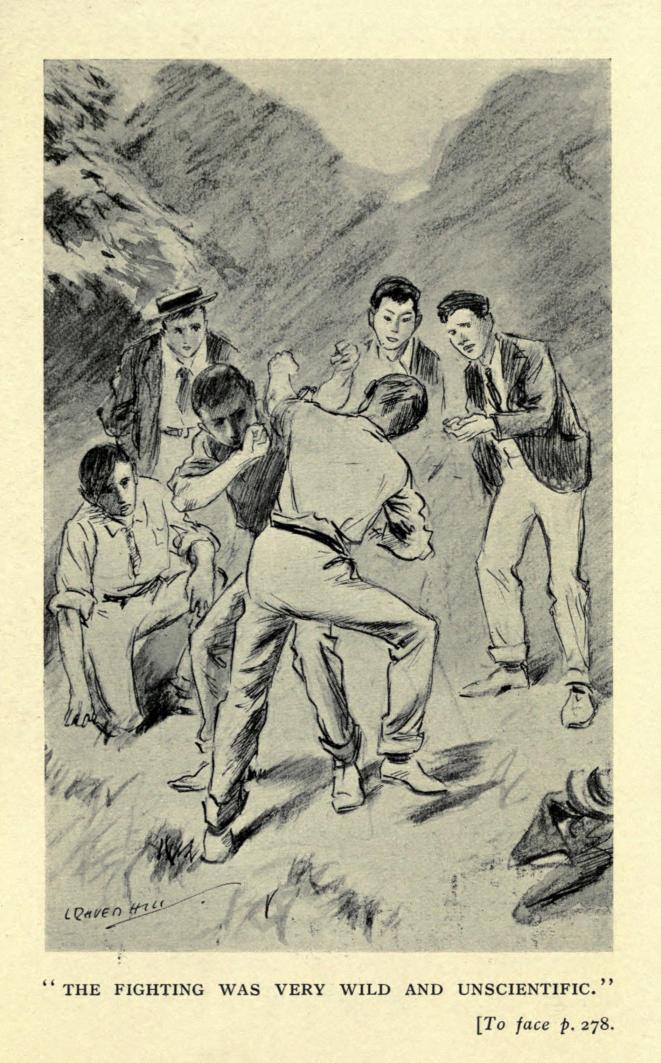
"THE FIGHTING WAS VERY WILD AND UNSCIENTIFIC."
"Round 9.—Both very weak. Referee had to caution both combatants for holding. Nothing much done, except that Saunders minor lost a tooth, said to be loose before the fight.
"Round 10 (and last).—Foster came first to the scratch, and managed to get home on Saunders minor's forehead and left aural appendage. Saunders minor was almost too tired to put up his hands. He tried to fight, but nature would not be denied, and Saunders minor fell in a very done-up state. He was counted out by the referee, and Thwaites flung up Saunders minor's sponge in token of defeat.
"When Foster discovered that he had won, he shed tears. But Saunders minor, though defeated, was quite collected in his mind. The men then shook hands and left the field with their friends.
"Remarks—
"We have seen better fights, and we have also seen worse ones. Foster has some good useful blows, but he wants patience and practice. He is not a born fighter, but might improve if he took pains. He had much the best of it in height and weight, including age, being a good deal older than his redoubtable antagonist. Though defeated, Saunders minor was by no means disgraced. He put up a very good fight, and at one time looked like winning; but luck was against him. Saunders minor, however, might give a very good account of himself with a man of his own size, and we hope soon to see him in the ring again. He has the knack of hitting hard and getting away. He was very little marked at the end of the battle, whereas his opponent's right eye will long bear the marks of his prowess.
(Signed) "LAWRENCE BASIL WEST, Esquire,
"Referee."
I read this to Saunders minor, and he agreed with it all, except the bit about being in the ring again soon. He assured me he did not care about fighting in a general way, or want to live for it, like West and me, but only now and again for some very special reason, as in the case of Foster. At any rate, though the loser, he had done all he wanted to do, and Foster had a caution of an eye that went on turning different colours, like a firework, till the very end of the term.
Such a wonderful, bulgy and curious eye could not of course be overlooked even by such a blind bat as old Briggs; and, needless to say, Browne jolly soon saw it. Then the truth came out, and that was the end of the Good Conduct Prize as far as Foster was concerned. He was frightfully sick about it; and when it began to appear that owing to these extraordinary things I, of all people, must get the Good Conduct Prize, he was sicker still, and called it a burlesque of justice, whatever that may be.
Anyway, it actually happened, and when prize day came, it was a clear and evident thing that I, Thwaites, had got the Good Conduct Prize in the third form. The Doctor began to read out the name; then, evidently under the idea that he had got it wrong, stopped and whispered to Mr. Warren, our form master; and Mr. Warren nodded, and the Doctor put on a puzzled look. Then he dashed at it and read out my name, and I had to go up and get the prize.
"A pleasing and unexpected circumstance, Geoffrey Thwaites," said the Doctor. "To be frank, that you should achieve this palm of victory causes me no little astonishment; but I can assure you that my surprise is only equalled by my gratification. You have not forgotten what I said to you last term, and I hope this satisfactory amelioration of manners may, when we reassemble, be followed by a corresponding increase of scholastic achievement. It will be no small gratification to your father, Geoffrey Thwaites, to welcome you under these conditions, instead of with the usual melancholy addition of a holiday punishment."
Then the Doctor picked up the Good Conduct Prize with a sort of innocent, inquiring air that he always puts on when giving the prizes. He pretends to be frightfully astonished at the beauty and magnificence of each book in turn; which, considering he chooses them all himself, is fearful bosh, and deceives nobody but a few mothers, who sometimes come if their sons happen to have pulled off anything.
Now Dr. Dunstan picked up a tidy-looking book, as far as its outside was concerned.
"What have we here?" he said, as if he had just found a bird's nest. "Why, no less a classic than Bunyan's Pilgrim's Progress! Fortunate boy! Here, bound in scarlet and gold, and richly illustrated, is a copy of that immortal work. Know, Thwaites, that in receiving the Pilgrim's Progress you become enriched by possession of one among the noblest and most elevated and improving masterpieces in the English language. Take it and read it again and again, my lad; and when you shall have mastered it, lend it to those less fortunate, that they, too, may profit by the wisdom and piety of these luminous pages."
Then the chaps clapped and stamped, and I bowed and took the book, and shook hands with the Doctor and cleared out.
Needless to say, my father was even more astonished than Dr. Dunstan. I came into his study to wish him good-evening when I got home, and he said, "Well, boy, holidays again? How have you got on? Don't—don't tell me there's any more trouble!"
"Far from it, father," I said. "I've got a prize."
"Good Heavens!" said my father. "You—a prize. What on earth for?"
"You mightn't think it, but for good conduct," I said.
"Good what?" cried out my father.
"Good conduct," said my mother. "I always told you there was a mistake. A beautiful, expensive-looking book with his name in it, written by Dr. Dunstan himself—the name I mean—not the book."
"Wonders never cease," said my father. Then he added, "Well done, capital! I'm more pleased to hear this than you've any idea of. You must keep it up through the holidays, though."
"If Saunders minor had won it, his father was going to give him a silver watch and chain," I said, just to see how that would strike my father.
"No doubt Saunders minor's father felt perfectly safe," said my father.
Which shows how people misunderstand.
However, my father was jolly decent about it; and, in fact, so was everybody.
My sister asked me if I should read the Good Conduct Prize.
"The pictures are ripping," she said. "Giants and all sorts of things."
"The pictures, as you say, are ripping," I told her; "but, unfortunately, the story itself is far from ripping."
"How do you know if you haven't read it?" she said.
"By what the Doctor told me," I answered. "It is one of the noblest and most improving masterpieces in the English language, so, needless to say, I've got no use for it."
TOMKINS ON 'TINNED COW'
No. XII
TOMKINS ON 'TINNED COW'
Tin Lin Chow was his proper name, but we called him 'Tinned Cow,' though he never much liked it, and said that his father would have made it hot for us if we had been in China. But we were at Merivale School in England, so we reckoned that Tinned Cow was near enough, that being good English anyway.
The chap was exactly the same colour as the stomach of the guinea-pig of Vincent Peters; and his father was allowed to wear a gold button in his hat, so he said, that being a sign of a man who wrote books in China. He wrote Chinese books for a living, and when we asked Tinned Cow if his father could turn out stuff a patch on Henty or Mayne Reid, he said much better. But he had to confess afterwards that his father was only doing a history of China in a hundred volumes, or some such muck; so evidently he was no real good, for all his gold button.
When the kid first came to learn English and get English ideas—owing to his father having convinced himself that Chinese ideas were rotten—he rather gave himself airs, and seemed to think because he was somebody at Pekin he must be at Merivale; but the only person who made anything of him was the Doctor. He used to bring everything round to China—even arithmetic, and he evidently thought it was rather fine to have a mandarin's son in the school. Especially as Tinned Cow had brothers coming on, who might follow. What a mandarin is exactly, Tinned Cow didn't know himself; but he seemed to think they were about equal to dukes, which, of course, must be nonsense, because dukes can become kings in time, whereas mandarins can't be emperors. In fact, the only mandarins I ever heard of till then were oranges.
He was a frightful liar, but good as a maker of kites. And Browne, the master in the lower fourth, said that both things were common to the Chinese character. For mere lies we had Fowle and Steggles, and others, even better than Tinned Cow, because his knowledge of English wasn't up to lying without being found out for some terms; but at kites he could smash anybody. His kites, in fact, were corkers, and he taught us to kite-fight, which is not bad sport when there's nothing better on. Chinese kites are very light, and all made of tissue-paper and cane, or bamboo, split up fine. For a cane, Tinned Cow had the beautiful cheek to go into Dr. Dunstan's study, when he was reading prayers in the chapel, and rout about in the cane corner and steal a good specimen, and hide it in the gym. That was the first thing that made me like the kid. But he said it was nothing, and seemed surprised that I thought much of it. He also said that over the pictures in a huge volume of Shakespeare the Doctor had, was tissue-paper of such a choice kind that it must undoubtedly be Chinese, and that, if so, it was the best in the world for kites. He said that if I would allow him to be my chum, he would get several sheets of this paper in a quiet moment, and make me the best kite he had yet made. Well, I never guessed then what a Chinese kid really is in the way of being a worm; so I agreed, provided he made two kites and put my initials on them in silver paper from a packet of chocolate—the initials, of course, being N.T. They stand for Norman Tomkins—merely Tomkins now, but Tomkins major next term, when my young brother comes to Merivale.
The chap was so frightfully keen to become my chum (my being captain of the second footer eleven) that he agreed to the two kites without a murmur, and stole the tissue paper and used the cane for the framework. So, rather curiously, the tissue paper from a swagger Shakespeare and a bit of one of old Dunstan's canes soared up to a frightful height over the school; and it happened that the Doctor saw it, and, little dreaming of what was soaring, patted Tinned Cow on the head, and greatly praised him, and said that the art of kite-flying in China was tremendously ancient, and that in the matter of kites, as well as many other more important things, China had instructed the world. Yet, when Fuller tried to sneak a quill pen for a private purpose, believing the Doctor was not in the study at the time, whereas he had merely gone behind a screen to find a book, Fuller got five hundred lines and the eighth Commandment to translate into Latin and Greek, and French and German. Which shows that to be found out is its own punishment, as Steggles told Fuller afterwards.
Well, I let Tinned Cow be my chum, and found him fairly decent, considering he was a Chinaman, for two terms. Then he began to settle down and learn English and football, and say that Merivale was better by long chalks than China. In fact, he rather hated China really, and said, except for toys and sweets and fireworks, that England was really far better. I may mention that his feet were small, but not like pictures, and he said that only wretched girls had their feet squashed in his country. He had a sister whose feet were squashed, and he said that she was pretty, which must have been another lie, because pictures show all Chinese women to be exactly and hideously all alike. But he had to admit that English girls were prettier, because Trelawny made him, and also said that he'd tattoo a lion and unicorn on the middle of his chest if he didn't. So he yielded; in fact, he always yielded very readily to force, though Fowle often tried, unknown to me, to arrange a fight for him. He had no idea even of doubling a decent fist, and said that only wild beasts fight without proper weapons. But once he took on Bray with single-sticks, and they chose a half-holiday and went into the wood by the cricket ground and fought well for two hours and a half; and a bruise on a Chinese skin is very interesting to see. Bray turned yellow, then blue, that deepened to black on the fourth day; but Tinned Cow, from the usual putty-like tint of his body, went lead-colour where Bray whacked his arm and leg. And Tinned Cow's bravery surprised me; but it was a draw, and he assured me that he didn't care a bit about being alive, and would have gone on hammering and being hammered until Bray had killed him if necessary. He said that in his country, when two chaps are going to fight, they begin by cutting frightful attitudes, and standing in rum and awful positions, and sticking out their muscles and making faces, like Ajax defying the lightning in the Dictionary of Antiquities. This the idiots do, each hoping to terrify the other chap, and funk him, and so defeat him without striking a blow. Tinned Cow said that most battles were settled in this way; and once, when Martin minimus called him a yellow weasel, he puffed out his cheeks and frowned, as well as you can without eyebrows, and crooked his hands like a bird's claws and tried to horrify Martin minimus, which he did; but it was young Martin's first term, and the kid was barely eight years old.
Now I come to that little brute Milly Dunstan, the Doctor's youngest daughter. She didn't care much about Tinned Cow at first, for she always takes about three terms to see what a new chap's like; but after the mandarin in China had sent Dr. Dunstan a gift of some rusty armour and screens and old religious books—more like window-blinds than decent books—and a live Chinese dog with a tongue like as if it had been licking ink, then Milly, who's the greediest little hateful wretch, even for a girl, I ever saw, suddenly dropped Blount, whose father was merely a lawyer, and began to encourage Tinned Cow like anything. He didn't understand her character as I and a few other chaps did. Bruce and Mathers and Fordyce knew her real nature, because she had pretty well absorbed all their pocket-money for term after term; and so I told Tinned Cow that her blue eyes and curls and little silly ways generally were simply a whitewashed sepulchre, and certainly wouldn't last longer than a hamper from Pekin; which, I told him, he'd jolly soon find out. But there's nothing so obstinate as the Chinese nation; and if she'd asked him for his pigtail, I believe Tinned Cow would have chopped it off for her, though he would not have dared to go home to his father after that till he'd grown a new one.
It seemed rather a horrid thing, Mathers said, a Christian girl to encourage a chap the colour of parsnips, not to mention his eyes, which were like buttonholes; but that was only because Milly had chucked Mathers; and we all knew what she really was; and, as Steggles said, she'd have sacrificed her whole family for a new sort of lemon drop; and of course when Tinned Cow found out how mad she was after sweets, he wrote to China, to his mother, for the best sweets in Pekin; which she sent. But while he was waiting for them, the Chinese dog got homesick, or something, and bit the boot-boy and was poisoned painlessly. Still Milly stuck to Tinned Cow, and walked openly about the playing-fields on match-days with him. And silly grown-up women, little knowing the bitter truth, said it was just like Dr. Dunstan's dear little girl to encourage a poor lonely foreign kid; but we knew what she was encouraging him for well enough.
In fact, Tinned Cow had translated part of his letter home to me. It was in Chinese characters, and went down the paper instead of along, and looked as if you'd dipped a grasshopper in ink and then put him out to dry. But his mother evidently understood, and sent such sweets as were never before sucked in England—since the Christian era very likely. And Tinned Cow had also asked for one of his mother's precious rings for Milly; but this he didn't much expect her to send; and she didn't. So he bought Milly a ring from a proper ring-shop with three weeks' pocket-money; which, seeing that he had the huge sum of five bob a week, amounted to fifteen shillings; and it had a real precious stone in it, though no one, not even Gideon, exactly knew what.
Anyway, Milly wore it at chapel, and flashed it at Tinned Cow when the Doctor had his back turned saying the Litany. And Blount said the flash of it was like a knife in his heart. Which shows what a footling ass Blount was over this wretched girl. I warned Tinned Cow, all the same, that he'd simply chucked fifteen bob away; because she'd change again the moment his Chinese sweets were finished. And she never gave back presents when she changed; as Millbrook had found to his cost, being an awfully rich chap, who gave her a bracelet that cost one pound ten—so he said. And when she threw him over and wouldn't give it up, Millbrook, who was certainly rich but a frightful hound, went to the Doctor. So he got his bracelet and left soon afterwards; and Milly, much to her horror, was sent to a boarding school for a term or two. But then old Dunstan, who is simply an infant in Milly's hands, gave way and let her come home again because she cried over a letter and splashed it with tears, or more likely common water, and told him that nobody in the world could teach her Greek but him. Which shows the cunningness of her. And many suchlike things she did.
Myself, though I despise all girls, I never hated one worse than this. The best a girl can be at any time is harmless; but Milly Dunstan was brimful of trickery, and, just because her eyes were accidentally blue, thought she could score off everybody and everything. Not that she ever scored off me. She knew that I barred her altogether, and scorned me in consequence, and called me "Master Tomkins" to make me waxy, me being only about four months younger than her.
She got his mother's pet name for him out of Tinned Cow, and called him by it in secret. Not that I ever heard it, or wanted to. And she also gave out that anybody calling him Tinned Cow any more would be her enemy; and one or two chaps were feeble enough actually to stop.
She utterly wrecked his character. Before, he'd been as keen as knives about sport and so on, and there is no doubt that he would have got into the second footer team next term if Gregson minor had passed his exam. for the army. But Milly Dunstan didn't care a straw about footer, though she understood cricket fairly well for a girl; and so Tinned Cow, like a fool, gave up all hope of getting on at footer, at which he promised to be some use, and went in like mad for cricket, at which he never could be any earthly good whatever. And that made another row, because Milly promised to walk twice round old Dunstan's private garden with Street, the captain of the third eleven (cricket), if he'd give Tinned Cow a trial in an unimportant match; and Street said "Right." And they went, during prep., and it happened that the Doctor, coming out of his greenhouse, caught them; and Street got five hundred lines; which naturally made him in such a bate, thinking it was a trap, that he refused to try Tinned Cow for ever.
I'm sure I did all I could, for, though I'd lost any feeling for him since he let this girl sit on him, still I was his chum once. And I tried to save him, and asked him, many a time and oft, why he let himself go dotty about a skimpy girl. And he said that it was her skimpiness he liked, for she put him in mind of his sister—only his sister was smaller, and, of course, had squashed feet. To see a girl who can walk about seems to be a fearful treat to the Chinese; so what they let theirs all squash their feet for, the Lord knows.
Tinned Cow confessed to me that Milly Dunstan was pretty sharp, and had been reading up all about China in one of the Doctor's books. In fact, he confessed also that she knew a lot more about China in general than he did. And some things she liked, and some she hated; and especially the marriage customs she hated; and she told Tinned Cow that unless he let her father marry them in a proper Christian church when the time came, it was off. So he promised; and he also promised, though very reluctantly, not to say a word about it to Dr. Dunstan until he got to be head of the sixth and the school. But he knew that at the rate he was going, he would never get there till he was at least fifty years old. And sons of mandarins marry very early indeed in their own country, so he said—as soon as they like, in fact—so Tinned Cow promised about getting to the top of the sixth reluctantly. Then he took to working and swatting; yet all his swatting only got him into the lower fourth in three terms. Then, seeing what a lot it meant getting into the sixth, and what a frightful hard thing it was, especially for a foreigner, to do it, Tinned Cow fell back upon the customs of his country; and his methods of cribbing were certainly fine and new. But they couldn't get him into the sixth, let alone to the top of it; and he tried still other Chinese customs in an arithmetic exam, and attempted to bribe Mr. Thwaites with four weeks' pocket-money—a pound, in fact—if he would arrange to let him get enough marks to go up a form. Of course, everybody knew that Mr. Thwaites had a wife and hundreds of small children at Merivale, and, though a sixteenth wrangler in olden times, was at present frightfully hard up. But what is a paltry pound to a sixteenth wrangler? Anyway Mr. Thwaites raged with great fierceness and took Tinned Cow to the Doctor; and as the Doctor hates strategy of this kind, he made it jolly hot for Tinned Cow and flogged him pretty badly. I asked if it hurt, being the first time the Doctor had ever flogged him, and he said the only thing that hurt was the horrid feeling that he'd offered too little to Thwaites. He said that in his country, and especially among mandarins, offering too little was almost as great a crime as offering too much, and that he deserved to be flogged on the feet as well as elsewhere. He said that his father was such a good judge of people that he always offered just the right sum; and he felt certain that in the case of Thwaites not a penny less than ten pounds ought to have been offered. It was the well-known hard-upishness of Thwaites that made him think a pound would do; but now, seeing what a little way money seemed to go with a man, he felt about the only chap within reach of being bribed was the drill sergeant; and of course he couldn't help Tinned Cow to get into the sixth. Besides, the drill sergeant had fought in China in his early days, and he had a sort of warlike repugnance against Tinned Cow that would have taken at least several pounds to get over.
So things went on until the arrival of the sweets from China; and they were all right, though Tinned Cow told me that Milly wasn't as keen about them as he expected, or at any rate she pretended not to be. The truth is that some of the very swaggerest Chinese sweets take nearly a lifetime thoroughly to like; and by the time that Milly began to feel the remarkable splendour of this sort, she'd finished them. However, she was fairly just—for her, and didn't throw the beggar over before the taste of the last sweet was out of her mouth, as you might have expected. In fact, she kept friendly for a matter of several weeks; and then she began to get rather sick of his Chinese ways—so she said—and cool off towards him, even though in his despair he promised to become a Christian and get her idols and fireworks and many other curiosities that probably wouldn't have been sent even if he'd written home for them.
But Chinese chaps have quite different ideas to English chaps, owing to their bringing-up; and things we utterly bar and consider caddish, such as sneaking, a Chinese chap will do freely without the least idea he is making a beast of himself. I didn't know this, or else I should never have allowed Tinned Cow to be my chum, but at last I discovered the fatal truth; and the worst of it was that he sneaked against my bitterest enemy, called Forrester, thinking that he was doing a right and proper thing towards me.
This chap Forrester I hated for many reasons, but chiefly because he'd beaten me, by about ten marks only, in a Scripture exam, owing to knowing the names of the father and mother of Moses, which are not generally known. I always had a fixed idea, funnily enough, that Moses was the son of Pharaoh's daughter; and I said so, and I added, as a shot—for shots often come off, though they are dangerous—that Holy Writ was quite silent concerning the father of Moses. And the Doctor frightfully hates a shot that misses, so I had to write out the whole business of Moses fifty times, till I was sick of the very name of the man; whereas Forrester won the prize. Well, this Forrester kept sardines in his desk and ate them freely during Monsieur Michel's class. But one tin, already opened, he forgot for several weeks, owning to its getting hidden behind his paint-box and caterpillar cage. And these sardines—being rather doubtful of them when he found them again—he gave to Milly Dunstan's Persian kitten; and Tinned Cow saw him do it. Well, the kitten showed that Forrester was quite right to be doubtful about the sardines by dying. It disappeared from that very hour, and was believed to have gone next door to die, as cats are generally very unwilling to die in their own homes, and always go next door to do so, curious to say. And Milly was in an awful bate when Tinned Cow told her, thinking it would please me; whereas, if anything could have made me get friends with Forrester again, it would have been to know he'd got this terrific score off Milly Dunstan. But her rage against Forrester was pretty frightful—especially, she said, because a boy whose strong point was Scripture could have done this thing; and she made Tinned Cow tell the Doctor; and such was his piffling weakness where she was concerned, that he did. But old Dunstan, who hated cats, and did not mind the kitten going in the least, said it was a case of circumstantial evidence—whatever that is—and the proofs of the cat's death were too slight, seeing the body couldn't be found, and also remembering a cat's power of eating sardines, even when a bit off. Then he turned against Tinned Cow, and told him that the character of an informer ill became any pupil of Dunstan's, and that to try and undo a fellow-student might be Oriental but was far from English, and so on—all in words that you can find in dictionaries, but nowhere else that I ever heard of.
Which showed the Doctor wasn't so keen about Tinned Cow as he used to be; and that was chiefly because Tinned Cow's younger brother was not coming to be educated in England after all, as Dr. Dunstan had hoped, but was going to Germany instead.
Anyway, when it was found out that Tinned Cow was a sneak—by birth, as you might say—chaps naturally flung him over; and Maynard refused to let the kid fag for him any more; and I, of course, told him that I was no longer his chum. He made a frightful fuss about this, and implored me to go on being his chum, and offered me a Chinese charm that had undoubtedly been the eye of a Buddhist idol in its time; but he was such an utter worm, and took such a Chinese view of things, that I had to refuse the charm and let him go. He was frightfully down about it, and slunk about in corners and offered to make kites for the smallest kids in the school—simply that he might have somebody friendly to him.
Then, when I think he was beginning to change his mind about England being better than China, the last straw came in the shape of a new boy called Vernon Vere—a chap of a good age—sixteen at least. He was the nephew of a viscount, or a marquis, or some such person, and he explained that with any luck he would be a marquis himself some day, because his only brother, though older, having shaky lungs, for which he was in the Canary Islands at that moment, might pass away and lose his turn.
I heard what followed from Corkey minimus, who was Milly's spy and carrier, for which he got a peach from the Doctor's orchard-house now and again in summer; but only ones that fell off. He told me that Milly received no less than three letters from Vernon Vere before he'd been at Merivale a month. And the third she answered.
So we knew that Tinned Cow was done for; and very soon he found it out himself, and then he turned several shades yellower and moped in the gymnasium for hours together, and lost all hope of doing any good at work, and sank down to the bottom of the lower fourth and spent all his spare time doing impositions. He went about like a dog that's frightened of being kicked; and many chaps did kick him, out of sheer cheerfulness, because he seemed as if he only wanted a kick to complete the picture. Then, one day, very civilly, he asked Freckles for his celebrated bowie-knife, that he goes bush-ranging with on half-holidays, and Freckles very kindly lent it, after Tinned Cow had promised not to cut anything harder than wood with it. Then Tinned Cow thanked him and went into the gym., saying that he only wanted to cut something soft. He didn't come back, and when the bell rang, Freckles and I—he being rather anxious about his bowie-knife—went up to the gym. to see what Tinned Cow was after. Suddenly Freckles shouted out from the shower-bath room, and, hearing him yell, I rushed in. And there was the wretched Tinned Cow in a most horrible mess. He'd taken off his shirt and given himself a dig in the ribs, or possibly two, and he was lying in a comfortable position bleeding to death. At least, so he hoped; and he begged us earnestly to mind our own business and leave him to 'salute the world,' as he said, without any bother. But we hooked it for Thwaites and Browne and Mannering; and they came and carried him in; and ruined their clothes with Chinese gore.
Of course we all thought Tinned Cow was booked, and Freckles, knowing the deadly sharpness of his knife, said the kid must kick to a certainty if he'd used the knife with proper care. Yet, strange to relate, he didn't die, but lived; which seemed to show that the knife of Freckles wasn't nearly such a fine one as he fancied. But he said that it only showed Tinned Cow had lost his nerve, and funked what he was doing at the critical moment.
Two mornings afterwards Dr. Dunstan told us all about it after prayers.
"This unhappy Asiatic," he said, "this young Celestial, from the pagan fastnesses of his native land, despite months not a few of tuition in this our manly and civilized atmosphere of Merivale, has relapsed upon the degraded and barbaric customs of a great but benighted country—a proof of the natural cowardice and baseness of the human heart when unillumined by the light of Christianity. The vain folly, which led him to his rash act is not for your ears. Let it suffice that Tin Lin Chow in a fit of mental infirmity, not to say active insanity, sought to deliver himself from imaginary miseries by the act of self-destruction—the 'hari-kari,' or 'happy dispatch,' as we translate it, of the Chinese. Thanks to fear at the crucial moment, or an ignorance of his own anatomy, or, as we should rather believe, the direct interposition of a merciful Providence that still has work for him to do, Tin Lin Chow failed of his fearful project and is now out of danger. For the rest, I may inform you that your comrade, when fit to travel, will return to his native land, and I can only hope and pray that the traditions of Merivale, its teaching and its tone, will cleave to him and leave their mark upon his character."
Of course the thing that was not for our ears was the reason why this little Chinese idiot had tried to kill himself. And that was because Milly Dunstan and everybody else had chucked him, but especially Milly. Anyway, his vitals healed up in a fortnight, and after six weeks or so had passed by, he was back at school again. But only for a few days. Then a ship sailed from London for China and, as Steggles very truly said, the only 'happy dispatch' that Tinned Cow got was a dispatch back to his native land. And probably he liked it better than England, when all was said and done; because the schools out there have got no sixth forms, so he told us. Therefore he'll be all right very likely—and live to thank his stars that he didn't kill himself after all. Though myself, I think he honestly tried and the fault was in the knife. Still, after two such sickening failures—I mean Milly Dunstan, and the attempt to hari-kari himself—I expect the kid won't ever want to make friends with girls again, or try to gash open his stomach, but just lead an ordinary sort of life without fuss, like other people do.
I made it up with him in a sort of way after his attempt to kill himself failed; and he explained to me how he ought to have done it; but the details were no use to me, because I wouldn't do it myself for all the girls in the world. Then Tinned Cow left, and he seemed sorry to go at the last moment; and he promised to send me some chopsticks and some chrysanthemum and other flower seeds of beautiful plants—knowing how frightfully keen I was about flowers—and materials for birds'-nest soup and other interesting things. But he never sent one of them; and I never thought he would, and didn't count upon it in the least, because, once back in his own country, where everybody tells lies from morning till night, simply from the habit of centuries and centuries, owing to China being the birthplace of civilization, you couldn't expect the beggar to keep his word.
And I expect nobody in this country will ever hear of him again. Not that that matters. But if I ever go to China, which I very likely shall do when I have time, I may look him up, I think—just to see if he got any good from coming over here. But I shouldn't think he really did.
THE END
RICHARD CLAY & SONS, LIMITED, BREAD STREET HILL, E.C., AND BUNGAY, SUFFOLK.
* * * * * * * *
Chapman & Hall's New Novels
The Death Man
By BENJAMIN SWIFT
Author of "Nancy Noon," "The Tormentor," "Life's Questionings," etc.
Sally: a Romance
By E. TEMPLE THURSTON
Author of "The Apple of Eden," "The Evolution of Catherine," etc.
The Watchers of the Plains
A Story of Western Canada
By RIDGWELL CULLUM
Author of "The Devil's Keg," "The Night Riders," etc.
Imperial Brown of Brixton
By REGINALD TURNER
Author of "The Comedy of Progress," "The Steeple," etc., etc.
Seed on Stony Ground
By U. L. MORICHINI
A plain-spoken religious novel, dealing critically with the Roman Church, which has had a very great success in Italy.
The White Cat
By GELETT BURGESS
Author of "The Lively City o' Ligg," "A Little Sister of Destiny," etc.
The House on the Borderland
By WILLIAM HOPE HODGSON
Author of "The Boats of the 'Glen Carrig,'" etc.
The Human Boy Again