Front matter (continued 3)
Reading edition
Is tea made of mint and sprigs of ling.'
"'If you wash your clothes on Good Friday, someone
Will be certain to die ere the year is done.'
"Whence Huxley Smythe has culled these pitiful superstitions I know not," continued the Doctor; "but he appears to be a veritable storehouse and compendium of them. They remind me only too painfully of a certain tiger's tail, though that incident is closed, and I desire to make no further mention of it. Had our theme been folklore, or those crude, benighted and indelicate fancies still prevailing among the bucolic population, Smythe must have conquered, and easily conquered. It is not so, however. He has chosen the occasion of the 'Bolsover' competition to reveal no little fantastic knowledge; but its lack of appropriate and apposite qualities effectually disposes of his claim. I will give you a last sample of his methods. A propos of absolutely nothing, on page four of his dissertation, Smythe submits this impertinence. He appears suddenly to have recollected it and inserted it in the body of his work, without the least consideration for its significance or my feelings.
"'There was an old man who lived in a wood
As you may plainly see,
And said he could do more work in a day
Than his wife could do in three.'"
The Doctor looked awful sternly at Smythe.
"This fragment—from some coarse old ballad, I suspect—is thrust upon me, as one might brandish a club in the face of an unoffending citizen. Smythe must chasten his taste and study the rudiments of logic and propriety before again he ventures to challenge our attention with original thoughts. Silence! Silence!" thundered the Doctor in conclusion; because Smythe's stuff made Steggles laugh out loud. Then several other chaps laughed, and in trying not to laugh, Wolf minor choked and made a noise, like a football exploding, that was far worse than laughter.
"There remains the effort of Rupert Walters," went on Dr. Dunstan. "He is the youngest of the competitors, and I find but little to praise in his achievement; yet it indicates a shadow of promise and a shade of imagination. Indeed, Mr. Briggs at first suspected that Walters had availed himself of secret and dishonest assistance; but this, I rejoice to know, is not the case. Walters has yet to learn to control the discharge of ink from his pen, and in matters of orthography also there is much to be desired for him—a remark which applies to all the competitors save Macmullen—but he possesses a dim and misty nucleus of feeling for the dignity of his native tongue. There is in his attempt a suggestion that at some distant date, if he is spared, and if he labours assiduously in the dead languages, Rupert Walters may control his living speech with some approach to distinction. I select his most pleasing passage."
The Doctor regarded young Walters over his spectacles for a moment with a frightfully encouraging expression that he sometimes puts on when things are going extra well. Then he read the pleasing passage, as he called it.
"'Often, walking in the country far from home, you may see the briars falling over the sides of the lanes, and the may trees white with bloom. They look lovely against the blue sky; and a curious thing is that the distant trees also look blue, and not green, by reason of distance. Near at hand, yellow and red flowers may be dotted about; but when you look along the lane, you only see haze, which is beautiful. If there is a river flowing near by, it is also very beautiful indeed, especially with water-lilies on it. And clouds are lovely too, if reflected in a sheet of water beside which yellow irises spring up, and their foliage looks rather bluish. If a trout rises, it makes white rings on the water.'
"Now, here," said the Doctor, "is a humble effort to set down what the eye of this tender boy has mirrored in the past. I need not tell you how he spells 'irises,' or 'curious,' or 'beautiful.' The fact remains that he has distanced his competitors and achieved the 'Bolsover' prize. Come hither, Rupert Walters. Let me shake your hand, my lad!"
So that was the end of it, and Walters seemed more frightened than anything. But he took his book, and the matter ended, and the four chaps had their essays back, with Briggs's red pencil remarks on them, to send home to their people.
The extraordinary truth only came to me three days later, when I happened to be having a talk with Walters and looking at his prize, which was duller even than most prizes. I said—
"How the dickens did you remember that trees look blue seen a mile off?"
And he said—
"I didn't remember it. If you'll swear not to tell, I'll explain. I shall be rather glad to tell somebody."
So I swore. Then Walters said—
"I was just sitting biting my pen and drawing on the blotting-paper and casting my eyes about and wondering what on earth to say, when I saw right bang in front of me a great picture—a whacker—full of trees and a lane, and water and hills, and every mortal thing, even to the flowers dabbed about in front. Well—there you are! I just tried to put down what I saw. And I did it only too well, if anything. Of course, in a sort of way, it was cribbing; but then, of course, in another sort of way, it wasn't. Anyway, you've sworn not to tell—not even Tomkins; so of course you won't tell."
And of course I didn't.
THE CASE FOR FOWLE
No. VII
THE CASE FOR FOWLE
I
It's awful difficult to understand why some boys are liked and some utterly barred. I'm nearly sixteen now, and I've been at Merivale for years, but still I can't see it. All I know is that the chaps most boys like, I don't, and the very few chaps I like, nobody else does. At first I thought it was hampers and asked my mother to send me extra large ones, which she did; and such hampers as mine were never seen before in any school, I should think. But the boys ate my water-melons and peaches and many such unusual things, just as if they were the wretched windfalls that Masters gets from his father's orchards, or the feeble home-made jam and common or garden cakes that come to other fellows on their birthdays. Then the very chaps that guzzle my rare things pretend afterwards I've tried to poison them, and so on; and young Gregson, who once ate half a bruised pineapple of mine that was a bit off, got ill; and after that only certain chaps would take the things I offered. And nobody once, all the time I've been here, has ever offered me as much as a dry biscuit out of their beastly hampers.
I pointed this out to Travers, who, though no friend of mine, always appeared to have more sense in a general way than most fellows; and he said—
"You sneer so at chaps. You always make it so jolly clear your hampers are the best in the world, that naturally they think you wouldn't care about their things. Besides, Steggles did offer you three ripe pears, for I saw him do it."
"Yes," I said, "he did—just because he knew they were over-ripe and thought to score off me. I knew why he had done it, and told him so."
"Then he offered them to me," said Travers, "so I can tell you that you are quite wrong. I took them and ate them on the spot, and they were perfectly good, decent pears. For once in a way Steggles was quite straight and meant no harm at all."
Well, I saw after a bit that it wasn't hampers, or anything of that sort; and then I thought it was games. But I wasn't going to make a fool of myself at footling games for anybody, and I always did get out of them when I could. However, it wasn't altogether games either, though certainly more games than hampers. Still, there were chaps who didn't play games any better than me—such as Richards, who always went to matches and was keen about games, though useless himself, and Ford, who made peculiar knots in rope, and Jameson, who drew pictures in the chaps' Latin grammars of the remarkable things mentioned in syntax. Then another great thing, showing what mean beasts most boys are, is the fact that if certain masters like certain boys, then other boys also like them.
Once, and only once, I got jolly friendly with a master who was very much disliked indeed by everybody else. I mean Browne. I never found him bad at first, and he used me a good bit in many ways and nearly always gave me full marks. But he changed frightfully over the business of the blackboard, and it happened like this. You see, as Browne thought well of me, he confided in me a bit out for walks; and I confided in him; and he asked me a lot of questions concerning a lot of boys; and, as I hated them all, I told him what he wanted to know. He was frightfully obliged and said I was a power for good in the school; and also said that such a boy as I am, without silly ideas about sneaking, may be of the greatest use to masters if he really has the welfare and interest of the school at heart. He also gave me a knife and seemed pretty sure I should win several prizes at the end of the term. In fact, we got very friendly and I certainly did him a very good turn by helping him to understand why some boys didn't like him, and telling him what they said about him behind his back. He was greatly obliged to me, and used the things I told him, and scored pretty badly off some chaps as a result. It rather surprised them to find how much he knew; but it didn't make them like him any better. Then they began to try and score off him, and finally, owing to an unfortunate accident, I got mixed up in it.
Steggles did an unusual thing to young Frost. Steggles had borrowed the matron's scissors to cut his toe-nails, which were turning in and tearing his toes and making them pour with blood. And after he had used them and shortened his toe-nails by about half-an-inch or so, he kept them and told the matron that he had lost them. Then came young Frost, who was a sort of relation of Trelawny, who was at that time easily the best-liked chap at Merivale.
Well, Steggles got young Frost up into the gym. alone, as he thought, and told him it was the rule for new boys to have their hair cut close to their heads, because they often brought infection to Merivale in that way. So he cut all young Frost's hair off; and I was there, hidden in a corner reading a grown-up novel that I had found in Browne's room. Because Browne, as a great favour, used to allow me in his study to see the remarkable things he has there—chiefly on the mantelpiece, including photographs of well-known actresses, said to be signed by themselves. So I saw Steggles cut off Frost's hair, and I did not know Steggles had seen me, but he had. And he made me swear not to tell, which I did; but knowing that an oath is not binding when the good of the school is involved, I told Browne about it, and he took the credit to himself over it and taxed Steggles with it. Of course Steggles denied it, and it couldn't be proved, because young Frost had a rotten idea it would be unsportsmanlike to sneak. So it came about that Browne couldn't do anything without getting me into a row, and accordingly nothing was done to Steggles. But Steggles did a lot to me, because of course he knew I was the only person who could have told Browne the truth, as young Frost hadn't.
Then a rather clever beast called Macmullen wrote a piece of poetry with rhymes, and after about twenty copies of this poetry had been sent to me anonymously written round picture-postcards, Macmullen got Travers to print it up on the blackboard just before Browne's mathematical lesson came on.
So when he arrived, there it was staring at him; and it was so exceedingly well printed that he could not possibly tell who had done it.
There is a young sneaker called Fowle
Who ought to be made to howl,
For the things that Browne knows,
Which you would not suppose,
All come from that blighter called Fowle.
I wanted to rub it out before Browne came, but of course the chaps wouldn't let me.
Browne read this carefully and took such a long time looking at it, that Steggles said he was learning it by heart. Then he picked up the duster and slowly rubbed it out. He made no remark whatever, and for the time being the score rather missed fire on Browne. But it didn't miss fire on me, because the next day, when I was passing his study, Browne called me in and asked me about it. He said—
"Who wrote that piece of impertinence on the blackboard yesterday?"
And I said—
"Macmullen invented it, sir, and Travers printed it up; but I don't know who told them there was a sort of understanding between us."
Then Browne was greatly enraged and said—
"How dare you say there is any understanding between us, Fowle? Such impertinence I never heard! What do I know about you and your affairs, excepting that you are deservedly a very unpopular boy! And I'll thank you not to bring any more of your mean tales to me. A tale-bearer is an odious thing; so remember; no more sneaking, or it will be very much the worse for you!"
I was so astonished that I couldn't do anything but stare.
"Now be off about your business," said Browne, and I went.
That shows pretty well what Mr. Browne was, I should think. The beastly ingratitude of the man seemed to me the most extraordinary thing that had ever happened; and after that I never could do right with Browne, and he sided against me and never would listen to me, even when I had to tell him things in self-defence.
I could easily show again and again that I was in the right and other chaps were in the wrong, or masters too, for that matter; but it was not much good trying to convince people with the whole of them against me. There was always a proper religious reason for the things I did, and though sometimes they looked queer until explained, I always could explain them. But after I got to be hated, nobody would so much as stop to listen to the explanations—not even the Doctor.
Everybody said he was just and fair, though an old footler; but I know very well he wasn't, owing to the time when Corkey minimus dropped a shilling in the playground and I found one there. Well, how could I know that because Corkey mins. had lost a shilling and I had found one, the one I had found was bound to be the identical same shilling that Corkey had lost? I shall always say it was frightfully unfair to me to order me to give up the shilling as the Doctor did, and then jaw me before the whole school.
Once my father said to me, "Always act from high motives, Roger," and I always did; but nobody ever gave me any credit for doing so; and when I told the Doctor over the affair of Gurney's tame white rabbit, which I found wandering alone in the playground after dark and killed with a cricket stump, for fear that it should starve to death, and was seen doing it by Gurney, who came to look for it—when I told the Doctor I had done this from the best motives and not because Gurney had taken me down in class the day before—he said that I was deceiving myself and told me that Satan had put it into my heart to kill Gurney's rabbit. Really I had only done it out of fear that a poor dumb creature would suffer; and yet the Doctor misunderstood me in such a wicked and spiteful way, that he caned me and made me dig a grave and bury the brute in front of the whole school as a punishment.
As to my feelings, which are frightfully keen, nobody cares a button about them and I have to do things, simply in self-defence, that I should never do if I was treated fairly. Even Tin Lin Chow when he was here had a better time than me, and I could tell you a lot of things you wouldn't believe in the matter of tortures, simply invented by Steggles and others in order to be applied to me. Steggles has invented two sets of tortures called 'mind tortures' and 'body tortures'; and the mind tortures are babyish, but the body tortures are well worth avoiding. So I always pretend the mind tortures are the worst, whereas really only a fool would care for them, as they mean nothing to anybody who is religious.
But what I meant to tell you was a fair case of the sort of things that happen to me and I have to endure. I was told that I was to be tried by court-martial, and I said "Why?" and Trelawny, the champion fighter of the school, put the case before me.
He said—
"It is well known in the lower school that you have got up more fights between kids than any other chap."
He then mentioned seven fights which he had written down.
"Now," he said, "did you or did you not arrange those seven fights?"
He had a lot of witnesses present and so I said—
"Five of them I arranged, because I wanted to see if——"
He interrupted me.
"You go about asking chaps if they give one another 'best,' and when they say 'no,' though they may be perfectly friendly, you go on at them till you work up a fight."
I denied it, and he said, "You can reserve your beastly defence for the court-martial. I've only got one more question to ask you at present, namely, Have you ever fought anybody yourself?"
And I said—
"No, Trelawny, I never have, because it would be contrary to my opinions."
Then he merely said I was a sticky and noxious worm that wanted poisoning with rat poison, and that nothing more need be said before the court-martial.
II
Well, the court-martial, though held by the sixth, was grossly unfair, and the thing they decided to do was simply cruel bullying in a superior form. To begin with, Macmullen, who is the champion speaker at our debates, was the leading witness against me; whereas I had nobody to speak for me, because though I was told three days before the trial to get somebody to speak for me, of course nobody would; and I had to stick up for myself, which was a thing I never could do. So I went down, and the fools pretended to prove that I had arranged hundreds of fights and been second at scores. And yet, somehow, I had never fought a single fight myself from the time I came there. Dozens of kids were called to witness at the court-martial that I had given them 'best' rather than fight them; and many were much younger than me, and one, called Foster, was only eleven, though certainly he was a great fighter, and many boys of fourteen had to give him best in the long run, though not till after they had fought him and been licked. Well, just because my religious opinions kept me from fighting anybody, and especially Foster, they called me an insect and a coward and a disgrace to the school and so on. Then Trelawny, as the head of the court-martial, gave a verdict and I was sentenced to have a fight, whether I liked it or not. Inquiries were made and finally the court-martial found a chap called Andrews, who was in my class and whose age was just one week less than mine. This Andrews and me they decided must fight; and when it was known, everybody wanted to be second for Andrews and nobody wanted to be second for me. Trelawny said we might have a week to train, and then the court-martial broke up. It was a brutal bit of work altogether, and I found rather an interesting thing, which was that Andrews felt quite differently to the affair to me. I talked to him privately as soon as I could, and pretended it was all rot and laughed at the whole thing. But he said it wasn't rot at all as far as he was concerned. He was a new boy and rather keen to make friends and be well thought of; so he considered this a jolly good opportunity and began to train as well as he knew how. I saw at a glance that he could lick me, for I'd never learned fighting and hated hurting anything, I'm sure, always; and I argued a good deal with Andrews about it. He said that his father had told him that a chance to make friends and distinguish himself would be sure to come. And Andrews said no doubt his father was right, and that the chance had come and that he was going to distinguish himself as much as he could on me.
Well, of course I saw what had to be done. Just at that time I was rather unfairly hated by Dr. Dunstan, because of an affair in the playground. There was a fir-tree in it at one corner, and I had found that turpentine came out if you cut notches in it. Well, into this turpentine I stuck live ants and then burnt them up with a burning-glass. It was nothing; but old Briggs, the writing master and natural history master, discovered me doing it and must needs make a ridiculous fuss. He told the Doctor and the Doctor made a ridiculous fuss too and turned against me and hated me. So Dunstan was out of the question, and there was only one other master I could tell, and that was Monsieur Michel, the French master. But he was weak and useless in an emergency like this; so finally I decided that the proper person to approach would be Andrews himself.
That much was pretty easy to decide, but then came the question what to say to him, and I was helped in this matter by a very lucky thing. It came out in class that Andrews was an absolute flyer at geography, and though not as good as me—me being head of the class in that subject—still he jolly soon got second to me and stopped there. I am a tremendous dab at geography myself; and if I knew as much about other things I should be in the sixth; and if a good many things I know—especially about religious saints—were regular subjects in school, instead of being barred altogether, I should also be in the sixth.
And finding out the greatness of Andrews at geography gave me the idea I wanted, which happened only just in time; because the day I spoke to him was a Wednesday and the next Saturday was the day we had to fight.
I said—
"Aren't you looking forward to Saturday?"
And he said—
"Yes, I am."
And I said—
"So am I, because I'm in training too; and I find that I fight tremendously well, and I'm only sorry I hadn't to fight a lot sooner."
But I couldn't deceive him with this, for a moment; so I soon changed the subject.
I introduced prizes and said that the Doctor was particularly keen about the subject of geography and always gave the best prizes for that.
"I know," he said, "and I should have had a jolly good chance if it hadn't been for you."
"You would," I said. "In fact, but for me you would be a snip for it."
We talked a bit and then I said—
"I wonder if your father would rather you made your mark by fighting me, or by winning the geography prize in your first term? Of course, to win any prize in your first term is a great score for a chap."
He said that he hadn't thought of it, and after I pressed him a lot, he admitted that there was no doubt the prize would suit his mother best, but he thought very likely if he won a fight it would suit his father best.
He said—
"My father's a soldier, and I'm going to be one; and so, naturally, fighting is more in my line than geography."
But I doubted this, and, in fact, I proved that a mere fight was nothing, whereas geography was a great deal and at least as much use to a soldier as fighting—especially after he had lost a battle.
Finally he said that I might be right, but that it didn't much matter as I was bound to win the geography prize, and he was equally bound to lick me next Saturday.
Then I made my great offer.
I said—
"Look here; I'm not afraid of fighting, or anything like that; but I've got religious objections to it and, in fact, though your father might like you to fight, my father would get into a frightful bate if I did. Really it might be jolly serious for me, and it would not matter to my father in the least whether I won the fight or lost it."
Andrews said that had nothing to do with him; so I went on and explained how it might have a great deal to do with him.
I said—
"You see, if you lost the fight, your father would very likely be very sick about it, and instead of getting rewarded, you might get nothing; whereas, if the fight fell through and you merely said firmly you had no reason for fighting me, and were not going to do it just because you were ordered to, and then went and won the geography prize, that would be a much greater score for you."
He admitted it might be, but didn't see how he could beat me at geography.
Then I said—
"If you refuse to fight me, you shall get the geography prize, because I need not put down anything like all I know and can boss a lot of questions purposely."
He said—
"It would please my mother and might do me a lot of good with my grandmother."
And I said—
"It certainly would; and next term, if you still want a fight, I'll easily arrange one for you with somebody else, and then you can make it all right with your father."
He said—
"Will you solemnly swear on human blood that you will boss the geography paper and let me get the prize?"
And to show him how much in earnest I was, I took out my knife there and then, and he pricked his finger and I pricked mine, and then I swore that I would let him have the geography prize, and he swore that he would refuse to fight me.
I felt that was a pretty good day's work, and so did he; but I felt it all the time, whereas Andrews only felt it in stray moments and, between whiles, was jolly savage with himself for swearing the blood oath. He was frightfully scorned for not fighting me, and the only thing that comforted him, and that only in secret, was that his mother and grandmother would be full of rejoicing in the holidays and richly reward him for winning the geography prize.
In fact, he kept on so obstinately about his mother, that I began to think about mine, and the sad grief it would be to her if I did not win this prize as usual. After a time I realized that I had actually put Andrews before my own dear mother, and I felt very shocked to think of what I had done.
The end of the term began to get nearer and nearer, and the exams. were going to begin soon. I tried hard not to think about geography and not to think about my mother, but Andrews found the only subjects that interested him were these subjects; and at last I simply had to avoid Andrews, because he kept on to such a sickening extent about what a score it would be to win it.
Very strange thoughts came over me during those days and I got more and more undecided as to what was right to do. There was my duty to Andrews, who, in a vague sort of way, had got the right to win the geography prize, and there was my duty to my father, who paid Dr. Dunstan a lot of money for letting me come to Merivale and naturally expected me to do my best; which I always did do, I'm sure. Then there was my duty to Dr. Dunstan; and to deceive him deliberately about my knowledge of geography was, of course, a very wrong thing to do. And, greatest of all, there was my own conscience, which is the 'still small voice' of the Bible. Besides, I'd been very careful to say that Andrews should have the geography prize, not that he should win it. No chap ever tried harder than me to do the right thing, and what made it so difficult was that my conscience and my duty to everybody but Andrews was on one side, while the stupid affair with Andrews was on the other side. Of course a blood oath is all nonsense if you are a Christian, and not in the least binding to a religious person. In fact, only savages believe in it at all. Therefore, as far as that went, I did not feel in the least bound to Andrews. If I had not been coming back the next term, I should have seen my way clearer very likely; but I was; and so was Andrews.
Somehow I couldn't decide till the actual day of the geography exam., and then, strangely enough, the paper seemed simply to have been made for me. I knew the answer to everything, and question No. 6 gave me a chance of saying some jolly good and peculiar things about Spain and the Holy Inquisition not generally known at all. Probably not a soul at Merivale but the Doctor and me knew them.
Somehow I felt it would be mean and wicked to pretend not to know all these things. My conscience simply cried out to me to do the paper as well as possible and leave the result in Higher Hands, because if Providence meant Andrews to win, he would win. So I did my best, as I usually do; and when the result was put up it was found that I had beaten Andrews by one hundred and ten marks, and Andrews was a long way ahead of everybody else.
Naturally Andrews, not understanding what it is to have such delicate feelings as me, was a good bit annoyed; but I was ready for him, and though I did not tell of my secret struggles to do right, which he would not have understood, I did explain that I had acted from proper motives.
I said—
"I promised that you should have the geography prize, not that you should win it. You shall have it, and the minute I get it on prize day, I shall hand it over to you."
But Andrews did not fall in with this, and I felt, somehow, that he wouldn't. He said several revengeful things about next term; but he may be dead before then, and anyway, much will happen in the holidays to make him forget this affair, or take a better view of it.
I only mention the thing, in fact, to show how hard it is to make chaps understand you if you always try to do right as much as you can. I should clearly like to leave Merivale, but there seems to be no chance of it at present.
My father often says, rather unkindly, that nobody ever wanted honour and truth and decency and manliness licked into them worse than I do; but my mother, who always understands me much better than him, says that many of the best and most famous men in the world have looked back to their school-days with hatred and loathing; and so I must no doubt be one of them; because nobody ever hated boys and masters and school in general worse than me. It will be very different when I get away from them all and go into the world; because there I shall meet plenty of nice people who think the same as I do.
'CHERRY RIPE'
No. VIII
'CHERRY RIPE'
I
This is an awful rum story about the extraordinary cunning of a man generally known as 'Cherry Ripe,' from selling cherries; and to tell it right I must first explain about our cricket ground and a wood and a field. After the cricket ground comes a narrow wood, well known as the place for fights, and also wood-pigeons' nests, which breed there in great quantities. It is a long and narrow wood, and then comes a field, also long but not so narrow. This field is a very up-and-down field, with hollows in it, and at the bottom, in one corner, a drinking-place for cows has been arranged, where yellow irises grow in summer, and where most of our tame frogs come from. There is a clump of trees in this field, and a hawk once built in them; but Freckles found the nest and took the eggs, so the hawk did not build there again. After the up-and-down field there comes an old, rather broken wall, and inside the wall is the orchard and nursery garden of Cherry Ripe.
Needless to say his real name was not 'Cherry Ripe' but Jenkins—not any relation to the Jenkins at Merivale, though chaps who wanted to rot Jenkins always pretended that Cherry Ripe was his father, which much annoyed Jenkins. Because this Cherry Ripe was a fierce and a common man, and had been known to be dismissed with a caution for ill-treating a horse, and was no friend to us either.
He made his living by fruit and vegetables; and at the right season of the year sold cherries, of which he had many fine trees in his nursery garden. He also had apples and pears and gooseberries in great abundance. He also laid out large pieces of his nursery garden in spring flowers for market, and he grew onions and turnips and rhubarb, and many other uninteresting things.
We naturally went there to see how it looked from time to time, and he chased us a good deal over the field; but, when we were once in the wood, he was of course powerless. In fact, he never caught anybody in fair hunting except Chilvers, who was once down by the pond collecting waterman beetles in his shoe, having nothing else to do it with. But Chilvers had never been in the nursery garden in his life, and told Cherry Ripe so. Only he refused to believe Chilvers, and said that he was trespassing just as much in the field as he would have been in the orchard. Which, in its paltry way, was true. Chilvers then offered him a penny and an Indian coin for twelve waterman beetles; and all he did was to say "No cheek!" and box Chilvers on the ear and tell him to be off. So he made a bitter enemy of Chilvers.
This Cherry Ripe was old and ugly. He never seemed to shave, and yet his beard never seemed to grow. What there was looked a mangy grey streaked with brown. He wore an old hat that had once been black, but was now rather inclined to turn green, and he had glittering eyes, one of which watered. He had also a curious way of lifting up and down his eyebrows, which young Smythe said showed a bad disposition, and was common to gorillas. He had been heard to laugh when picking apples with his daughters. But he never laughed at us, and when we took to calling him 'Cherry Ripe,' he hated us, and often shook his fist at us from a distance.
So we then felt something had to be done against him to score off him.
When this was decided upon, Steggles and Methuen and Pedlar and myself—me being Weston minor—and Chilvers went into committee, as it is called, and in fact we had a regular meeting. Many others wanted to join, but we felt five was enough, and we all had a jolly special private good reason for going into committee against Cherry Ripe.
Chilvers of course had been licked by Cherry Ripe, because to box one's ears is the same as licking one in a very insulting manner. Pedlar also had been insulted, and a good deal hurried twice by Cherry Ripe, when he found him catapulting quite harmlessly in his orchard in December, when of course there was nothing to take but vegetables; and Methuen and Steggles once meeting Cherry Ripe going the rounds with his cart and fruit and scales for weighing things, had politely stopped him and asked to buy two pennyworth of pears. And Cherry Ripe had the frightful impertinence to say that "No chap wearing them hats" should have so much as a spring onion of his growing, which was not only turning away business, but cheeking the school colours openly. So it seemed about time to do something, and we accordingly did. I may say that I had no particular grudge against Cherry Ripe, but I was well known at being better at wall-climbing than any chap who ever came to Merivale. Climbing had always been my strong point, and, as I was also going to be a missionary later in life, I kept it up, because you never know—not if you are a missionary.
The committee merely decided that as the cherry season was now near, we had better wait for it, and then, at the first opportunity, make a 'Jameson raid.' This is a particular sort of raid invented by the great Dr. Jameson of South Africa, and it consists of doing something so suddenly that nobody is ready. A Jameson raid is useless if the other side is prepared; it is also useless if you are not prepared yourself. The great thing is to be first, and also an important point is to commit the raid where and when it will be least expected. Therefore we gave it out, hoping that it would somehow get to Cherry Ripe, that we meant to make a raid on his young apples on Wednesday, being a half-holiday; whereas the truth was we were going to have a dash at his cherries on the Saturday. There was a cricket match on that day, and Steggles arranged details.
I won't say much about what happened, because the thing failed even more fearfully than Dr. Jameson's affair long ago. We were deceived in a most peculiar manner, owing to the deliberate cunning of Cherry Ripe; and afterwards, talking it over while we wrote two thousand Latin lines each, we came to the conclusion that there was a traitor at work. Naturally we thought of Fowle, but Fowle knew nothing; besides, he was in the hospital at the time with something the matter with his knee.
To go back, I must explain that all went well until we got on the top of Cherry Ripe's wall. Then what should we see but Cherry Ripe up a cherry tree and his daughters down below! They were a long way off, and we saw at a glance that it would take Cherry Ripe about a year to climb down from his tree, even if he saw us. As for his daughters, seeing our ages were fifteen and upwards, except Chilvers, who was certainly only thirteen, but could run faster than his sister, who was seventeen, we did not fear them.
As Cherry Ripe was picking cherries, we went for the green gooseberries. I dropped down first in a very stealthy manner, that Freckles had taught me before he went home to Australia; then Pedlar and Methuen dropped, and then Chilvers. He fell rather awkwardly and smashed off a large purple cabbage, and was glad of it.
But Steggles stopped on the wall, for some private reason. He said afterwards, when taxed with treachery, that it wasn't so in the least; but that from the very beginning he had had a curious feeling when he woke up that day. It is the feeling you get when you wake up on a day that you are going to be flogged; and you have the same feeling, only far, far worse, on the day when you are going to be hung. All criminals know this. Steggles certainly shouted "Cave!" as soon as the horrible moment came; but when he did finally drop off the wall, it was on the other side. In fact, he escaped and left us to our fate. Nothing could be done to Steggles, but we never felt the same to him again.
What happened was this. We were just eating a few gooseberries rather fast, before settling down steadily to fill our pockets, when Steggles gave the alarm. But it was too late. Suddenly there sprang up from their hiding-places no less than three men—the youngest not less than twenty years old; and the eldest was Cherry Ripe himself. This so much horrified us, as we had seen him at the top of a high cherry tree two hundred yards away only a second before, that we lost our instinct of self-preservation and fell a prey to the enemy. We were all caught, in fact, except Steggles, and we were then marched down to Cherry Ripe's house, and then along the road, and so back to Merivale. His hateful daughters stood and sniggered at us as we were taken past them; and then we saw that the whole thing was a mean plot, and, in fact, a swizz. A swizz is a chouse, and a chouse is the same as a sell. It was a scarecrow in the tree and not Cherry Ripe at all! The scarecrow wore his green hat, and his daughters pretended to be talking to him. As Peters said afterwards, Sherlock Holmes himself would have been almost deceived by such a deadly plot. Afterwards we found, curiously enough, that we had collected exactly thirteen gooseberries before the crash came, which shows that thirteen is an unlucky number, whatever scientific people may say against it.
Cherry Ripe brought us back to Merivale, and came to the front door and asked to see the Doctor. He gave his name as 'Mr. Jenkins, of the Merivale and District Fruit Farm,' and said it in a very grand tone of voice, as if he was somebody. But the Doctor, little knowing what was going to happen, sent out to tell Mr. Jenkins to walk in. Pedlar said he thought that the Doctor probably hoped Cherry Ripe had come with an advantageous offer to supply Merivale with green stuff at low prices; but of course this was not so.
Dr. Dunstan received us in his study, and he was much surprised to see Chilvers appear after Cherry Ripe, and still more surprised to see the rest of us come behind.
"And what may be the meaning of this deputation?" said the Doctor. "Perhaps you, Methuen, will explain."
But Cherry Ripe said that he had come to do the explaining. Certainly he told the truth, but he told it in a beastly mean way.
He said—
"There's times when a man has got to stand up for his rights, mister"—meaning the Doctor—"and this is one of 'em. These here young rips be always driving my life out of me, and an example must be made. I was half in a mind to send for a policeman; but I thought as I'd give 'em one more chance for their parents' sakes, so brought 'em to you, because no doubt you be paid very well for larning 'em their lessons and keeping 'em out of mischief. I've two things against 'em, and one is that they bawl 'Cherry Ripe' after me morning, noon, and night, and take sights at me, and do many other rude things; and the other is that now, this minute, I've catched 'em red-handed in my gooseberry-bed, tucking down my fruit for all they were worth. That's trespass and it's also theft, and I don't want no more of it."
"Thank you," said the Doctor. "You have stated your case with a lucidity and force that does you no little credit, Mr. Jenkins. Now the accused and the accuser may freely speak, whilst I, as arbiter between them, reserve the last word, and I fear the last action also." His eyes roamed over to the corner where the canes were kept. Then he went on—
"Your indictment consists of three articles, and we will take them in your own order. You submit that these youths have insulted you, have trespassed on your private property, and have stolen your goods. Now, boy Pedlar, have you or have you not, at any time and in any public place, addressed Mr. Jenkins, of the Merivale and District Fruit Farm, as 'Cherry Ripe'?"
"Yes, sir," said Pedlar.
"Methuen?"
"Yes, sir."
"Weston?"
"Yes, sir."
"Chilvers?"
"Yes, sir."
The Doctor seemed disappointed, and Cherry Ripe smiled with a grim and scornful smile.
"To accost an honest purveyor of the fruits of the earth with words which, in the nature of his calling, it is necessary that he should himself loudly repeat at intervals—to do this is a senseless and offensive act," said the Doctor. "Nothing can be said in favour of it. No earthly benefit—not even the meretricious semblance of benefit—can accrue to the boy who bawls 'Cherry Ripe!' after somebody else. The operation shows a lack of mental balance that may make us fear for the sanity of the performer, and regard the probable course of his future with dismay and the liveliest foreboding. But now we are faced with accusations of a very different character. It is asserted that you four boys have gone out of bounds, and disobeyed me; that you have trespassed on another's private property, and so made of no account the laws of man; and, lastly, that you have taken fruit that did not belong to you—that you have broken the eighth Commandment, and thus shattered the sacred edict of your Maker!"
The Doctor worked this up, as only he can, till we saw what an immense number of laws we had broken all at once—like you do when you begin to play golf—and, of course, it was a very solemn moment for everybody. Even Cherry Ripe looked rather frightened. The Doctor rolled it out, and shook his finger at Cherry Ripe as much as at us. Then came the questions.
"Is this infamous imputation true, Edgar Methuen?"
"Yes, sir."
"And you, Harold Pedlar?"
"Yes, sir."
"Weston?"
"Yes, sir."
"Chilvers?"
Chilvers, like a little fool, tried to hedge against the future.
"Yes, and I'm very sorry, sir," he said.
The Doctor looked at us as if we were some new sort of animals, and he didn't know how we had got in. He gave a tremendous snort, and took off his glasses. Then he turned to Cherry Ripe.
"To attempt any analysis of my personal emotions at this juncture would be vain," he said. "In these cases introspection may well be left for a subsequent occasion. For the moment justice cries with trumpet tongue. And be under no apprehension, Jenkins, that justice will miscarry on this occasion. As an agriculturist——"
Here the Doctor forgot us, and talked like anything to Cherry Ripe about growing vegetables, and Ceres and Pomona and Horace and Virgil, and other well-known people out of school books. He fairly terrified Cherry Ripe, I believe. Anyway, Cherry Ripe kept creeping nearer and nearer to the door. Then, at last, he got in a word.
"Don't be too hard on 'em this time, your honour. Just one, two, and another on the place that's made for it."
"Pardon me," answered the Doctor, raising his hand. "You now trench on my prerogative, Jenkins. The question of what is to follow may very well be left with the preceptor of these fallen boys. Have no fear for that. And to plead for leniency before the breaking of a Commandment is to admit a personal laxity of view that I, for one, am bound to deplore."
Cherry Ripe had now reached the door, and I believe he thought that if he stopped another moment the Doctor would cane him too. So he began to clear out. But first he said—
"Well, good-evening, all!" Then he hooked it—rather thankfully. And we wished we could.
We got four on each hand, and two thousand lines each, and to stop in for two half-holidays. So that, as Methuen very truly remarked, was first blood for Cherry Ripe.
II
Of course, this was merely the beginning of the great anti-Cherry Ripe feeling, and next term we were planning a deadly revenge with regard to Cherry Ripe's Kentish cobnuts, which were remarkably fine, when a great assistant came to our aid in the shape of Trelawny. This was that Trelawny who had such a terrible end in the matter of the protest of the wing dormitory. But many things happened first. He was fourteen, and a fighter from the beginning. All his relations were also fighters, and poetry had been made about one, who was condemned to death for magnificent fighting in historic times. This Trelawny, by the most curious accident, proved to know an immense deal about Cherry Ripe. And it came out that Trelawny's father, who was a retired soldier and only a colonel, though Trelawny said that if justice had been done he would be a general at least, actually owned miles of land about Merivale, including Cherry Ripe's nursery garden and the field.
"The beggar merely rents it from my father for so many pounds a year," said Trelawny. "Why, if I said a word to my father, I could have the man turned out altogether, and his daughters and everybody. I'll jolly soon teach him!"
This was a pretty good score for us, and we soon arranged to show Cherry Ripe that things were changed. Trelawny took to strolling about in Cherry Ripe's field as if it belonged to him; and, of course, as I pointed out to Trelawny, when his father died, though I hoped it would not be for ten years at least—still he had to—and when he did, the field and the orchard and everything would actually be Trelawny's own, to do what he liked with. He said it was so; and he said that he should jolly soon clear Cherry Ripe out, and build almshouses for old soldiers broken in the wars, when he came to have the ground. He wouldn't take nuts or anything. He said that was paltry; but he had a fixed idea that he ought to be perfectly free of the place, and he went on strolling about in it till at last Cherry Ripe surprised him down at the pond in the field. I was there, too, but Cherry Ripe didn't recognize me, which, no doubt, was lucky.
He seemed to have something on his mind, for he didn't get into a bate, but merely said—
"Now, you boys, you slope off to your playground—can't have you messing about here."
"Perhaps you don't know who you're talking to, Mr. Jenkins," said Trelawny in a frightfully grand tone of voice.
Then Cherry Ripe jumped.
"Lord, the sauce of your nippers now-a-days! Why can't your old gentleman over there teach you manners as well as figures and all the rest of it?"
Clearly he meant no less a person than Dr. Dunstan.
"My name is Trelawny," began Trelawny.
"A very fine name too," said Cherry Ripe. "Take care you never bring no discredit on it, there's a good boy."
"My father is your landlord," said Trelawny. "And I'll thank you not to call me 'boy'!"
Cherry Ripe was by no means so much struck by this as you might have expected.
"You're the Colonel's young shaver—eh? Well, I hope you'll turn out as sensible a man—though I do wish me and him saw alike on the subject of a new tomato house. However, everybody's a right to his own opinion."
Trelawny was fuming, like a train wanting to start.
"You don't seem to understand," he said, "that this very field we're in at this moment will be mine before long!"
"The Colonel's not ailing, I hope?" said Cherry Ripe very civilly.
I could now see that Mr. Jenkins was laughing at Trelawny, but, luckily, Trelawny did not see this, or he might have taken some very desperate step.
"And I want to say further," went on Trelawny, not answering about his father, "that as this land will be mine sooner or later, I have a perfect right to walk on it when and where I choose."
"Agreed," said Cherry Ripe; "and as I'm renting the land, and don't like rude little boys poking about where they've no business, I've got a perfect right to pull their ears for 'em when I catches 'em. So that's settled. Now we know where we are. Be off with you both, or I'll begin this minute!"
Trelawny was as furious as a grown man. He turned a sort of colour like stewed fruit; but, of course, we had to go. There was nothing else we could do—for the moment.
"I shall write to my father about this, and you'll soon find out you can't insult your own landlord's son with impunity," Trelawny shouted, as we got through the hedge back into our wood.
"Can't do better. And tell him what I said," answered Cherry Ripe.
Then he seemed to forget us, and stood quite still looking into the pond. Evidently he had other things on his mind besides Trelawny; but Trelawny didn't think so, and believed that Jenkins was standing like that in a frightful funk to think of the dangerous thing he'd done.
"However, it's too late now; I shall write to my father next Sunday," said Trelawny; and he did, and he got a letter back.
We were rather keen to hear what his father was going to do about it, and expected he would read it out to us. But he tore the letter up small, and chucked it away, and merely said he was surprised to find his father didn't agree with him.
"But I'll make it clear that the man ought to be sacked when I go home," said Trelawny.
Funnily enough, though he'd torn this letter up so small and flung it scornfully away, we found out afterwards what was in it; because Peters, who hoped to be a detective of crime when he grew up, always collected anything with writing on it to decipher mysteries; and it was him who found out what Johnson's pet name at home was, and how many sisters West had, and other things not generally known. He said if a letter was once torn up and flung away, that it was public property for a detective; and so when Trelawny had gone, Peters collected the bits of his letter, and pieced it together after taking frightful trouble. It was a detective-like thing but not a sportsmanlike thing to do, and Trelawny, when he came to hear of it, challenged Peters. In fact, they fought, and Peters was badly licked. Still, the letter certainly was rather curious, considering it came from Trelawny's own father.
It read like this—
"DEAR TEDDY,
"I've got your letter, and I've dropped a line to Jenkins, directing him to give you and any of your friends a real good hiding every time he catches you on his ground.
"Your affectionate father,
"TRELOAR TRELAWNY."
Of course, the thing couldn't be allowed to stop there. We were all on Trelawny's side, though his father wasn't. In fact, Pedlar and Methuen and me were rather vexed with Trelawny's father; and we told Trelawny so; and he said he was too. He said—
"We'll be revenged next term, as it is too late this. We must all think of a heavy score against Jenkins"—he never called Cherry Ripe anything but Jenkins for some reason—"and the best idea is the one we'll carry out."
And everybody interested in the matter quite agreed; but Steggles did not come into it, because Trelawny utterly barred Steggles from the first.
III
Next term the great idea of how to crush Cherry Ripe came to me out of the Bible. I let everybody speak first, and then, as nobody had said anything like as good, I said—
"We will do what the enemy did in the New Testament, and sow tares in his ground."
Everybody thought the idea fine but jolly difficult, and Chilvers asked—
"What are tares?"
I said I wasn't exactly sure, and Methuen said it was a sort of grass, and Trelawny said it was a parable. Anyhow, we didn't know where to buy them. Finally we decided not to ask for tares, but some sort of seed that would grow quickly, and get a deep hold of the ground, and ruin anything else for yards round. Unfortunately we didn't know much about wild things in general, and we asked Tomkins, who is our champion botanist, and he said "Willow herb." But there were no seeds about at that time of the year, it being February, and so Trelawny said—
"We will confide in Batson, who is well known to be the son of a greengrocer and seedsman."
But it happened that Batson, who was the gardener's boy at Dunstan's, was leaving to better himself. However, there was just time before he went, and we let him into our secret score against Cherry Ripe, and gave him two shillings with which to buy some seed of some vigorous growing thing to sow in Cherry Ripe's nursery garden and choke his vegetables when they came up. Batson said that he would do his best. He said it might have to be grass seed or clover, but he promised it should be a good choking thing.
Certainly it looked hopeful, because he soon brought a bag of seeds and said they were a kind of clover that, if once sown, could not be got out of the ground again without ploughing. Then came the question of the time, and we decided that next Saturday was the day. There happened to be a big game at football, but not a little one, so we were all free excepting Methuen, who kept goal for the first.
All went well, and when the match began to get exciting owing to hands being given against Bray in our 'twenty-five,' Trelawny and Pedlar and Chilvers and I went into the wood unseen and got to the Cherry Ripe side of it. Chaps had been in his field a good deal lately, hunting for a very beautiful red fungus that was to be found in the hedges, on dead sticks, and Cherry Ripe had been a good deal worried by them.
Then came the first surprise of that day. There was a huge board stuck up in the field facing our wood with these remarkable words on it—
+-----------------------+ | | | DANGER! | | BEWARE OF THE BULL! | | | +-----------------------+
Our first step was to get back into the hedge. The field seemed to be quite empty, but there are many hollows in it, and a bull might easily have been sitting down quite near us. Or it might have been hidden in the cluster of trees in the middle. One thing was clear. It was not at the pond.
Trelawny said—
"This man is worth fighting. I'm glad he's got a bull, because it makes more strategy necessary for us."
And Pedlar said—
"And I'm glad too."
But I was not glad, and so I didn't say so; and as for Chilvers, he went further and openly said that he thought a bull altered everything.
It was about a hundred and fifty yards across the field from the wood to Cherry Ripe's wall, and it is well known that a bull can run three times as fast as a man and five times as fast as a boy.
I reminded Trelawny of this, and he said—
"I know all that; it is a question of strategy."
And I said—
"Yes, but strategy won't alter facts."
He thought a bit and said—
"You chaps stop here and I'll reconnoitre."
But Pedlar, who was nearly six months older than Trelawny, said he ought to reconnoitre too. Finally they both went to reconnoitre in different directions and came back in five minutes. Neither had seen the bull.
"There's no bull!" said Trelawny. "It's a subterfuge. Come on."
"Wait," said Chilvers. "I have a feeling it's not a subterfuge. Something tells me there is a bull."
Trelawny said it was cowardice, and Chilvers said it was a presentiment. Anyway, no time could be lost, and Chilvers was firm, so we left him. He was half inclined to come, but said that an uncle of his had once been gored by a buffalo, or some such thing, in America, and somehow he felt that this particular adventure would not suit him, though he would have feared nothing else. Of course Trelawny explained that this was no excuse, even if true. But though white and very worried, Chilvers was firm. He refused to follow, so we went alone.
We made a detour of the trees in the middle of the field and crept forward in Indian file. Fifty yards from the wall Pedlar whispered that he saw something red in a hollow, which might easily be a bull's back; so Trelawny said "Sprint!" and we threw off caution to the winds and sprinted. So we got to the wall in safety, and, as if to reward us for the effort, what should we see on the other side but a beautiful bit of ground all prepared for seeds! It was smoothed and arranged, and little narrow trenches had been drawn in it about an inch deep—evidently for seeds. It was frightful luck and playing into the hands of the enemy as Trelawny said. He instantly gave the word and we dropped. There was not a soul in sight—only a spade and two rakes, where the man who had been working had left them.
"A commander always seizes any chance the enemy offer," said Trelawny. "Pour the seed pretty thick along the drills and everywhere else, then take the rakes and rake it all over until everything is quite smooth!"
So all Cherry Ripe's arrangements for planting seed were used by us to sow a particularly deadly sort of clover. We worked jolly hard, and in about five minutes the thing was done by me and Pedlar while Trelawny mounted guard.
Then the exciting work began and Trelawny shouted—
"Take cover! They're coming!"
But there was no cover, and so we all got back the way we had come, and just as Cherry Ripe and a man ran up from another part of the garden we reached the top of the wall and prepared to leap down. But luckily we didn't. In fact, even as it was we only just saved Pedlar and lugged him back in time.
The bull had arrived!
He was there, not more than twenty yards from the wall, and he was a whacker. He had an enormous body and head, and his forehead was curly, and his eyes fierce, and his horns rather short but very thick. A copper ring was in his nose, and his hoofs turned up rather curiously, like Turkish slippers. There was some hay flung down in front of him, and he was smelling it. He was evidently a large and fierce bull, and him being on one side of the wall and Cherry Ripe on the other made it a very tricky position for us on the top.
Trelawny said—
"This is critical!"
And Cherry Ripe said—
"Hullo, my brave chap, how d'you find your future property is looking? I hope you're pretty well satisfied?"
Trelawny said—
"This is a case for a parley."
But Cherry Ripe did all the parleying. We sat down on the wall, which was easier and safer than standing on it. We sat with our faces to Cherry Ripe and our backs to the bull.
"This is an ambuscade in a way," said Trelawny. "In fact, we are rather scored off. In war we should be shot. Not that it would matter, as we have done our work.
"Now, my young shavers," began Cherry Ripe, "I see you've been very busy down here on your own account, so perhaps you'll just step off that wall and do a bit of work for me. You can take your choice. Either we'll all go straight along to your old gentleman, and see what he'll say and do about it, or you can step down here—all three of you—and set to work over a bit of weeding. Take your choice and be quick."
"We'll confer," said Trelawny.
Which we did do; and Pedlar and I thought one thing and Trelawny thought another. He said that it would be far more dignified to go back and suffer from Dr. Dunstan as an equal; but Pedlar and I had done that before, and we didn't care in the least about the dignity. We said that to do a bit of weeding for Cherry Ripe would be mere child's play to four on each hand and perhaps more, not to mention a few thousand lines chucked in, and a couple of half-holidays gone.
So Trelawny said—
"I'm out-voted in the conference."
Then he got down and we got down also.
Cherry Ripe seemed rather pleased at what we had decided to do, because I don't think he wanted to have another talk with the Doctor any more than we did. But he certainly had arranged rather a big job for us.
"You've got to pick it clean, mind you—roots and all," he said. Then he divided the bit of land into three with sticks, and it seemed to us that we had to weed about as much as a cricket pitch each.
"You shall have the biggest job, young master," he said to Trelawny. "And that's only right and fair, because you're such a big man and take such big views."
Trelawny did not answer, but he was evidently in a very proud frame of mind. He seemed determined to show Cherry Ripe something, if it was only how to weed.
We worked jolly hard, and Cherry Ripe kept us at it. Then in the distance went up three cheers, and we knew the match was over; and, from the sound of the cheers, it looked as if we'd won, because after a match we always cheer the enemy, and we always cheer him heartier if we've beat him—not intentionally, but still the sound is different.
"Now you can all nip back," said Cherry Ripe. "Better go the way you came—through the wood."
"And be killed by your bull, I suppose," said Pedlar. "Not likely!"
"We have accepted your terms," said Trelawny, "and if you are an honourable foe, you'll let us out by the gate."
"Better go through the wood," answered Cherry Ripe. "It's a lot shorter, and as to the old bull, you needn't mind him. He's my daughter's pet. He wouldn't hurt a daddy-long-legs, much less a nice young chap like you. Tame isn't the word for him. A pet lamb's fierce to him. Come on. I'll go as far as the wood with you if you're frightened."
All this was true. And when we got back into the field, Cherry Ripe scratched the bull's curly head and the bull almost purred. It was the mildest and humblest sort of a bull you ever saw, though so huge; and to see such an enormous and happy bull so close was rather interesting in its way. In fact, we all gave it a pat, just to be able to say in after life that we had patted a monstrous bull.
"My youngest daughter often sits on his back," said Cherry Ripe. "This here bull has got a heart of gold, I do assure you."
"Another strategy," said Trelawny to me. "Certainly the man's cunning is frightful. I think I shall tell him about the seed—just to show him we've scored a bit too."
I advised not, but Trelawny was so stung by the way we'd been defeated all round by the wretched Cherry Ripe, that, as we were leaving him, he said—
"It may interest you to know that we've sowed that patch of your beastly ground under the wall with weeds of the deadliest sort. In fact, you'll never get them out again. So that's one for us, anyway."
"Well done!" said Cherry Ripe. "Where did you get the seed from?"
"That's our business," answered Trelawny. "Anyway, you'll find it out presently."
"Well," answered Cherry Ripe, "I know where you got the seed. It was from my good friend, Batson. And his boy be coming here to work next week. He's learned all your gardener at the school can teach him, and that wouldn't sink a ship. He brought the tale to his father, and his father brought it to me; and so I got the ground ready for you, knowing what a dashing fellow you are, and what a hurry you'd be in."
"More fool you then," said Trelawny.
"Not so fast. The seed you sowed was lettuce seed! Good-evening, my dears, and when you say your prayers afore you go to sleep to-night, you can all thank the Lord that you've done a bit of honest, useful work for once in your lives!"
* * * * *
We talked it over during prep., and Pedlar said—
"On the whole, we'd better keep this afternoon's work to ourselves."
And I said—
"We were overreached by superior cunning, and we'd better give Cherry Ripe best in future."
And Trelawny said—
"Wait! This, in a way, is a defeat. But I'll arrange a jolly good Waterloo for Cherry Ripe yet."
Meaning, of course, that he would be Wellington, and that Cherry Ripe would be merely Napoleon.
However, though I didn't say it to Trelawny, I doubt very much if he is clever enough to score off Cherry Ripe till he grows up. Then, of course, Cherry Ripe will find him a bitter and relentless foe.
THE QWARRY
No. IX
THE QWARRY
If your parints happen to live in India, of corse holidays are not all they might be. Becorse India is too far off to go to often, and such relations as aunts and uncles don't seem much to care to have you if you are the son of an Indian soldier. But grandmothers always seem to want to have you; at leest they do in the case of Travers; but his parints are ded. Anyway me and Morris have to stop at Dr Dunstan's for holidays, and so we have to be friends at those times. I am eleven and he is twelve and we are very diffrent, him being never knone to lose a conduct mark, and me being ordinry. I am called Foster and the hapiest day of my life was when I got ten shillings all at once, being my ninth birthday in a postal order from my father. The first fealing was one of shere joy, and the second fealing was that if it had been a pound it would have been better.
I remember the birthday only too well, though nearly two years ago, because immedeetly after getting the money I wrote to Mr Gammidge—the grand toy and games man—for some important things wanted by me and my chum, Smythe—him that cut off the Doctor's tiger's tail with such disasterous results. And by grate ill-luck that beest Steggles looked over my sholder and saw how I had begun my letter. I had asked Smythe how to begin it in a very respectful way, so as to please Mr Gammidge, and Smythe had said, "I should make it as friendly as you possibly can;" and I had said, "yes." Then I thort that as the friendliest letters I ever write are to my mother, I would begin it like that; and I had written down "Darling Mr Gammidge, I shall be very grately obliged by your sending me if you have time by return of post"—certain things. Becorse Mr Gammidge was quite as much to me as my mother in those days, if not more.
Well, the beestly Steggles saw this and set up a loud and hideous yell of laughter which was very paneful to me and Smythe. And presently, when he had drawn the attenshun of many chaps to the letter, he told us on no account to send it, but to write in a firm and manly tone and order the things. He said when you are sending postal orders you have always the rite to be firm and manly; and when you are asking for them, that is the time to be affecshunite. So we wrote the letter again and merely said, "Dere Mr Gammidge," and sined ourselves, "yours truly, Arnold Foster and Huxley Smythe."
I must now return to Morris, who was left at Merivale with me during the grate summer holiday last year. In a way his luck was friteful although he had nowhere to go in holidays. Even his amusements were such that they turned into marks and pleesed the masters, such as natural history; and his conduct marks were so exstraordinry that he never lost any at all without an effort.
In face he was nothing, being sandy-haired and pail with a remarkably small mouth and watery eyes. He had not much courage but was fond of chaps who had, and he liked me and Smythe more for our courage than anything. We tried without success to increese his courage, and he helped us a lot with work that didn't want courage but only intelleck, of which he had a grate deal.
It was reely owing to my courage that the adventure of the old slate qwarry happened. You see the holiday competishun for that year was a colleckshun of insect life, such as beetles, moths and butterflies, and as Merivale happened to be a fine place for insect life in general, Morris determined to win the prize if he could.
When the Doctor and his family went off to the seaside, the last thing he said to me and Morris was this—
"Farewell, my dear lads. Persue all innocent pleasures and give no corse of offence during the vocation. The Matron will be at your service and she has the key of the liberary. The playing field is also open to you, and having regard for the seeson I relax a little of the riggid discipline of time and place, of hours and bounderies, proper to the term. But I put you on your honour in this matter and feal that the chastening influenze of Morris will possibly serve to restrain the native exooberance of Foster. Lastly I have directed that the comissariat shall be ordered on a generous—nay, lavvish skale. Good-bye, my dear boys, and God bless you."
We said "good-bye," and I hoped that the Doctor and Missis Dunstan and the gurl Dunstans would have a good time; and the Doctor thanked me and said he was glad I had the grace to make that wish; and after he had gone, Morris said that he very nearly said "God bless you" to the Doctor, but staid just in time. And I said it was jolly lucky he had, for it certainly would have been friteful cheek to do it.
Then two cabs rolled away with the Doctor and his luggage and his family, and me and Morris were left. We found what 'comissariat' ment at dinner, and I will say that the food was magnificent, and the Matron was a brick all through the holidays—very diffrent to what she is in term time; and she told us a lot about her private life, which turned out that she was a widow Matron with a son. And Morris said "Why don't you bring your son here, Matron?" And I said "Of corse, why don't you?" And Morris said "It would hurt the Doctor's fealings a good deal if he knew you had a son being educated somewhere else." And she said it was all right and the Doctor was as kind as any man could be, and that the son was working hard and was a very good son, being an office-boy in a lawer's office in London.
Then came the qwarry and my temptashun of Morris, which ended in Morris going to the qwarry.
The qwarry was certainly out of bounds, and it was when out of bounds in secret with Freckles and other big chaps that I found all the wonders of it. It was a stone qwarry in Merivale Grate Wood, and there were game preserves near by, where Freckles hunted and practiced to be a bush-ranger when he went home to Australia. But of course Morris had never seen the place, because he never went out of bounds at all, from fear and also from goodness, but cheefly from fear.
I said to Morris on a fine day in the middle of August—
"Have you got any draggon-flies in your collectshun?"
And he said—
"There are no draggon-flies in Merivale."
And I said—
"You're a liar."
And he said—
"Well, anyway, I never saw one."
And I said—
"In the old qwarry in Merivale Grate Wood there are billions."
And he said—
"They can't live without water to cool their tails."
And I said—
"Any fool knows that. There's a stream and a pond in the qwarry and the draggon-flies and blackberries and butterflies, including peacocks and red admirals, are all as common as dirt."
"It's a friteful pity it's out of bounds," said Morris to me, and I explained that, though out of bounds in term time, yet, owing to the Doctor's speshul words to us before he went on his holiday, every thing was free now.
Then Morris said—
"He put us on our honour."
And I said—
"I've got just as much honour as you for that matter. But my honour covers the hole of Merivale Grate Wood, and if your honour doesn't do the same, you'll loose the draggon-flies."
Morris thought over this a good deal.
At last he said—
"There's no doubt that Slade and probably Thompson minor will get draggon-flies in their collectshuns, owing to their living by swamps and rivers."
And I said—
"Do what you like, only it happens I'm going to the qwarry to-morrow for the hole day, and Matron is going to make me sandwiches to take."
"If you honestly think it is an honourable thing to do——" said Morris.
"I honestly do think so," I said.
"I believe you're right," he said. Then rather a footling idea struck him.
"How would it be if we wrote a polite letter to the Doctor?" he asked.
"Not me," I said. "You may be sure that the Doctor, in his hard-eerned vocation, doesn't want polite letters from me or even you. In fact, it might so much anoy him that he might change his mind all together and not put us on our honour at all, but merely say we were to keep bounds, which would be deth to me. Not that I should do it in any case."
So after a lot more rot and jaw about his blessed honour, Morris came, and the day was jolly fine to begin with, and we went well armed for sport in genral. He had his butterfly-net and killing-bottle—a beestly thing full of cemicals but merciful in its way, becorse when you put a butterfly in and shut down the cork the butterfly becomes unconshus without pane and dies pretty cumfortably. All the same, as Morris said to me while we watched a lesser tortussshell passing away, "deth is deth," and the killing bottle was the only part of natural history he did not care about. Before we got to the qwarry he was wondering if the cemicals in the bottle would be strong enough for a draggon-fly.
I said—
"You've got to jolly well catch them first."
I had the sandwiches and a sling made of lether, which hurls a stone friteful distances. I had also got in secresy a packet of 'Windsor Pearl' cigarets and a box of matches. These I did not intend to show to Morris, because it wood have upset his honour again; but I had been a smoaker for years, having been tought by Steggles, and it seemed to me if I couldn't have a cigaret in the summer holidays now and then, I might as well give up smoaking all together.
There were tongue sandwiches, and bread and butter ones, and two hard-boiled eggs each, and two large lumps of carraway seed cake. It seemed a good deel to carry and yet not much to eat. I also took an india-rubber cup for water; but Morris said the water in the qwarry was no doubt where the draggon-flies lived in the first stages of their careers, and he douted if we could drink it with safety. He littel nue that he would soon drink it whether it was safe or not.
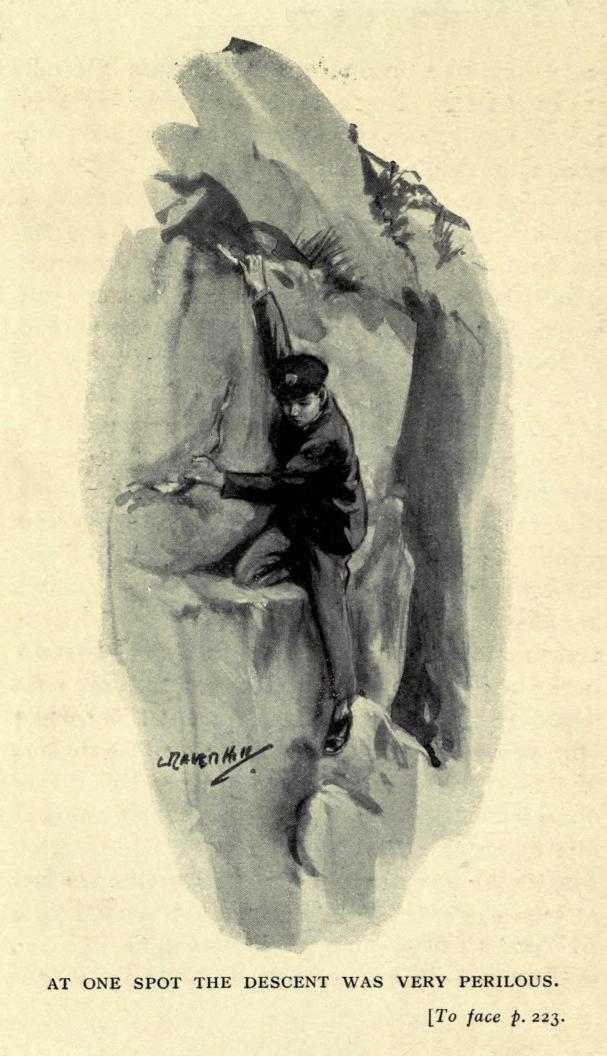
AT ONE SPOT THE DESCENT WAS VERY PERILOUS.
There was only one way into the qwarry and that was down a very steep and dangerous place. The opening into the qwarry was all filled up and there were raillings all round it to keep anybody from falling into it by night. Morris funked getting down for some time; then a draggon-fly actually sored past and so much excited him that he said he was reddy if I went first. I told him to see exactly what I did and then I went down. At one spot the dissent was very perilous owing to a huge stone that stuck out in the middle of the cliff. You had to curl over it and feal with your feet for a tree-root below, then, for one grate moment, you had to let go with your hands and cluch at a pointed stone on the right hand side. This stone was allways loose and wanted very delicate handling. To me, with years of practice, it was eesy; but I fealt sure it would be a bit of a twister for Morris.
He lowered down his killing-bottle and net and caterpillar-box, then he began to slowly dissend. But at the critikal moment he stretched for the pointed stone before he had got his foot on the root and all his wait came on the stone with the terrible result that the stone gave way. And when the big stone gave way, about a million other stones gave way also, so that Morris fell to the ground in an avvalanch of stones and the woods resounded with the sound. My first thort was keepers and my second thort was Morris.
He was alive and hardly hurt at all more than a spraned ankle. He went very white and sat down and shivered and felt his bones and limbs one by one. He said it was his first great escape from deth.
And I said—
"You may not have escaped all the same, becorse you've pulled down the cliff in your dissent, and that was the only way out of the qwarry, and now there isn't any way out at all!"
Which was perfectly true and not said to friten Morris. Getting out of the qwarry was far far worse than getting in and wanted a nerve of iron, which I hadn't mentioned to Morris till I got him safely in; but now he'd pulled down the place compleatly and left a naked precipice, and my nerve of iron was no good. In fact we were evidently going to have a grate adventure, and so I told Morris.
It certainly spoilt the day for him, becorse you can't very well have a ripping good picknick if you don't know how the picknick is going to end.
"It's a fine place for natural history no doubt," he said; "but we can't pretend we're going to have a good time now."
"We're going to have a long time anyway," I said.
He smiled in rather a gastlie way and said he hoped not, becorse the weather was changeing and it might rain later on.
Then I told him that wether didn't matter as there was a pretty dry cave where Freckles used to do his cooking of rabbits on half-holidays. Morris seemed glad about the cave. He rubbed his ankle and said, so far as that went, he fealt pretty right. Presently he said—
"There are certainly red admirals here in grate quantities and also draggon-flies, but somehow I don't feel I've got the heart to kill annything for the moment, espeshully after what I've just eskaped myself. Deth is deth."
"You'll be better after food," I said.
But he wouldn't hear of food.
"We must face the possishun," he said. "Here we are in a qwarry and we can't get out."
"Yes," I said.
"Very well. Then, there being no food in the qwarry except what we have brort with us, we shall soon be hungry."
"Yes," I said. "I am now."
Morris went on trying to be calm, but I could see the more he explained the situashun the more fritened he got. His voice shook when he said the next thing.
"You can't go on being hungry for more than a certain time. After you reech a certain pich, you die."
"Yes," I said.
"Well, there you are," he said.
He figetted about with his killing-bottle and things, then made a hopeless sort of a sound like an engine letting off steem.
"We must consider meens of eskape," I said. "People come here sometimes, no doubt.
"Only boys out of bounds," said Morris faintly. "Oh, what would I give to see the face of Freckles peep over the top!"
"It's impossible," I told him. "Freckles is spending the holidays with some cousins in Norfolkshire. But there are often keepers in the woods to look after the game."
"Then we must shout at intervals, night and day—as long as we've got the strength to do it, said Morris.
"Before each shout we will eat a sandwich to increese our strength," I said. But Morris fancied half a sandwich would be safer.
I thort it wasn't much good beginning by starving ourselves. In adventures nobody begins by starving—they end like that; but Morris, who has a watch, looked at it and said the time was only half-past ten and that, even if we were safe and within reach of food, we should not eat any for two hours and a half. But I said planely I could not waite that time and it ended by our dividing the food into two heaps of exactly the same size to a crumb. And I eat a sandwich boldly and fearlessly, but Morris shook his head and said it was foolhardy.
He took a very hopeless view from the first, and even thort that perhaps, when my food was all gone and his hardly begun, I should turn on him with the feerceness of starvashun and tare his food away from him. But I said, "No, Morris. What ever tortures I may suffer, I am a gentleman, and I would rather die a hundred times than take as much as one seed out of your peece of cake."
This comforted him rather. He put his hand on his chin and stared before him in a very feeble manner.
"Deth is deth," he began again.
"That's the third time you've said that," I told him, "and if you say it once more, I'll punch your head. Now, I'm going to utter the first grate shout, and I hope it may bring a keeper—not Thomas or Waxy West, for they are both very hard and beestly men, and very likely wouldn't rescue us even if they new we were here; but the under-keeper, Masters. He will certainly save us, and if he does, I'll give him my packet of cigarets."
I shouted six times; then I shouted six more times; then I told Morris to have a shot. But he made such a piffling, feeble squeak that you could hardly have heard him a quarter of a mile off.
"Lucky I can howl," I said, "or we should both be done for without a dout. Why, a lamb that has lost its mother would get up more row than that."
Morris was rather hurt at this. Me explained that he was making an Australian sound tought him by Freckles.
"It may not be loud," he said, "but it is a well-none sound in Australia and travel grate distances espeshully over water."
The menshun of water made us go and look at the pond. I was fritefully thirsty by now and drank some. It was grey in colour but clear when seen in my india-rubber cup and quite holesome to the taste. Morris douted, but still he drank. I advised him to catch some draggon-flies and he said he would after the next time for shouting had come. We arranged that I should shout every half-hour, and Morris wanted to give me one sandwich from his store as payment for the exershun of shouting; but I skorned it and told him I would not think of doing so.
After the second shouting, which did nothing, used my sling a bit and neerly hit a bird, and Morris cought a draggon-fly and let it go out of pitty, and then he cought another and kept it to see if the killing-bottle would kill it. It did. After about half a minute in the bottle the draggon was gone, and we shook him out and examined his butiful markings of yellow and black and his transparent wings, that had the colours of the rainbow on them when the sun fell on them in a particular manner.
Morris stroaked it in a sorroful way.
"It is out of its missery now. I wish me and you were," he said.
I said we hadn't begun our missery yet. I advised him to eat a sandwich and he did, but very reluctantly.
He said that water would keep life in the human frame for many weeks. He also said that he fealt, in a damp place like this, we might eesily get pewmonia. He wondered if I hadn't better shout every quarter of an hour. He also thort his watch was going far too slow owing to his fall down the side of the qwarry. The sun had gone behind some rather dark clouds and we couldn't be sure where it was.
The only thing that happened during the next hour was that the draggon-fly came to again, not being ded but merely incensible. It lifted a paw rather feebly to its forehead and evvidently had a headacke. Then it took a step or two and shivered a lot. Somehow it grately cheered Morris the draggon-fly recovering. He sed it had come out of the jaws of deth and so perhaps we should. He gave it an atom of tongue out of a sandwich, but it was not up to eating, and turned away from it. Then Morris got it some water to wet its glittering tail. This certainly refreshed it and so Morris dashed a few drops on its head which refreshed it still more. At half-past two it rose and flew several inches and at three it disappeered.
By this time I had eaten all my sandwiches and drunk tons of water and was pealing my first hard-boiled egg.
Suddenly Morris had an idea. He had only eaten one sandwich and was of course famishing with hunger. He said—
"If you was to write a message and tie it round a stone and sling it into space, it might be found and red. Then a resque party would be arranged and we should be saved."
It was pretty good for Morris, and I took out my pocket-book instantly and wrote three messages. And he wrote three. He sed it was like men on sinking ships, who send off messages in bottles that are found many years afterwards in Iceland. And I said it was. Of corse we hoped one at leest of the six messages might be found pretty soon. Years afterwards was no good to us.
I merely wrote—
"Lost in Grate Wood Qwarry and unable to get out. Arnold Foster. Come at once."
And Morris wrote—
"At the point of deth in Grate Wood Qwarry. No eskape. Food neerly done. A handsome reward will be given. William Arkwright Henderson Morris."
I asked him how he nue a handsome reward would be given, and he said he didn't, but that he felt it was a safe thing to say and might make all the diffrence to anybody finding the message. Then I shot off the six messages rapped round stones, and they eesily flew over the edge of the qwarry. I then shouted again and eat my first egg.
Just when it began to rain Morris had another grate idea. He said—
"Didn't you say something about a packet of cigarets some time ago?"
And I said—
"Yes, and I am glad you reminded me about them, becorse I just feal that one will do me a lot of good."
Then I pulled them out and opened the packet and took one and lit it.
"It is very restful in such an adventure as this," I told Morris.
Then he explained his idear. It is well none that when you are learning to smoak, your appetite is often spoilt for a time. Now Morris thort that if he smoaked, he would not want food, and so much valuable food might be saved, and life prolonged if necessary.