Front matter (continued 2)
Reading edition
Gideon looked rather puzzled.
"You don't seem to understand even yet, Bannister," he said. "You don't pay so much in the pound of the assets; you pay so much in the pound of the debts."
I didn't pretend to understand what Gideon meant by this complicated way of putting it, and told him so.
"All I want," I said, "is to do the strictly honourable thing and pay so much in the pound, which I have handed over to Gideon for that reason."
But Gideon, much to my surprise, seemed to feel rather annoyed at this.
"I wish you'd try and understand the situation," he said. "When you speak of so much in the pound, it's a figure of speech in a sort of way. It isn't a real, single, solitary pound."
"It's real enough," I said; "Thwaites gave it to me in exchange for a postal order."
"This pound is real, but——" Then Gideon broke off in a helpless sort of way, and then he began again.
"You owe two pounds—d'you see that?"
"Of course," I said. "That's the whole thing."
"And you've got one pound—d'you see that?"
He held it up, as if he was going to do a conjuring trick with it.
Of course I said I did see it.
"Then, if you owe two pounds and can only find one, how much are you going to pay in the pound?"
"Whatever you think would be sportsmanlike, Gideon," I said.
"It isn't a question of being sportsmanlike, it's a question of simple arithmetic," he said. "You've got twenty shillings, and you owe forty; you owe just twice as many as you've got; therefore it follows that you'll pay ten shillings in the pound; and that's a good deal more than many people can."
"I'll pay more than that," I said. "I'll pay fifteen shillings."
"What an ass you are, Bannister!" answered Gideon. "You can't pay fifteen shillings, you haven't got it to pay."
"My Dear chap," I said, "I've got a pound."
"You've got nothing at all," he said. "You pay ten shillings in each of the two pounds you owed, and then there's nothing left."
After that I began to see; and when we went into it all and got change, and paid each chap exactly half of what I owed him, it turned out that Gideon was perfectly right, and there wasn't a farthing left over. Everybody was fairly well satisfied except the tuck-woman, but nobody seemed much obliged to me; and I couldn't help thinking that though Gideon had been awfully decent about it, and managed it all frightfully well, nevertheless a grown man would have managed it even better. Because, take my father's bankruptcy and look how jolly different that turned out to mine. I don't know what he paid in the pound, but I do know there was enough left over for him to buy a bottle of champagne, and for my mother to say "Thank God!" Whereas my bankruptcy appeared to have left me exactly where I was before, and there was nothing whatever left over to buy even a bottle of ginger beer.
I pointed this out to Gideon, and he said—
"Of course I don't know how much your father paid in the pound."
Presently I said, "I'm awfully obliged to you, Gideon, and I shall never forget how kind you have been. And I wonder if you'd mind adding to your fearful kindness by lending me a penny."
"What for?" said Gideon; "ginger beer?"
"No," I said; "for a stamp to write to my grandmother. I may tell you privately that she sent that pound out of her own money, and it was very sporting of her, and of course I must thank her."
Gideon didn't much like it, I could see; but at last he brought out the penny and entered it in his book.
"If you can pay it back by the end of the term I'll charge no interest," he said.
And just to show what luck Gideon always has, the very next Sunday, at church, I found a three-penny piece, doubtless dropped by somebody, so Gideon had his penny back in three days, and I went so far as to offer him a halfpenny interest, but he would not take it from me.
THE TIGER'S TAIL
No. IV
THE TIGER'S TAIL
I
Curiously enough a very curious thing happened to the other foreign curiosity that Johnson maximus sent to Dr. Dunstan. You may remember that Johnson, who is in the merchant service, brought the Doctor home a parrot and a tiger's skin, and that strange things overtook the parrot, especially after death. Well, strange things also overtook the Bengal tiger's skin, owing to me and Freckles and Smythe. I am Macmullen, and the real name of Freckles was Maine, and he came from Australia and had a great ambition to be a bush-ranger in course of time, and revive the practice of bushranging in New South Wales. Among other things that he had was an important bowie-knife—the same the Chinese boy, Tin Lin Chow, borrowed to commit 'harri-kari' with and failed. Well, with his great feeling for sport, Freckles naturally felt a good deal of interest in the tiger's skin, and often went to look at it in the Doctor's study. It was a good one, no doubt—white and yellow and black, with a long tail and a very fine head. In this head were glass eyes, like life, and the mouth was open and pink, with terrific teeth—worn smooth where the tiger had chewed his prey.
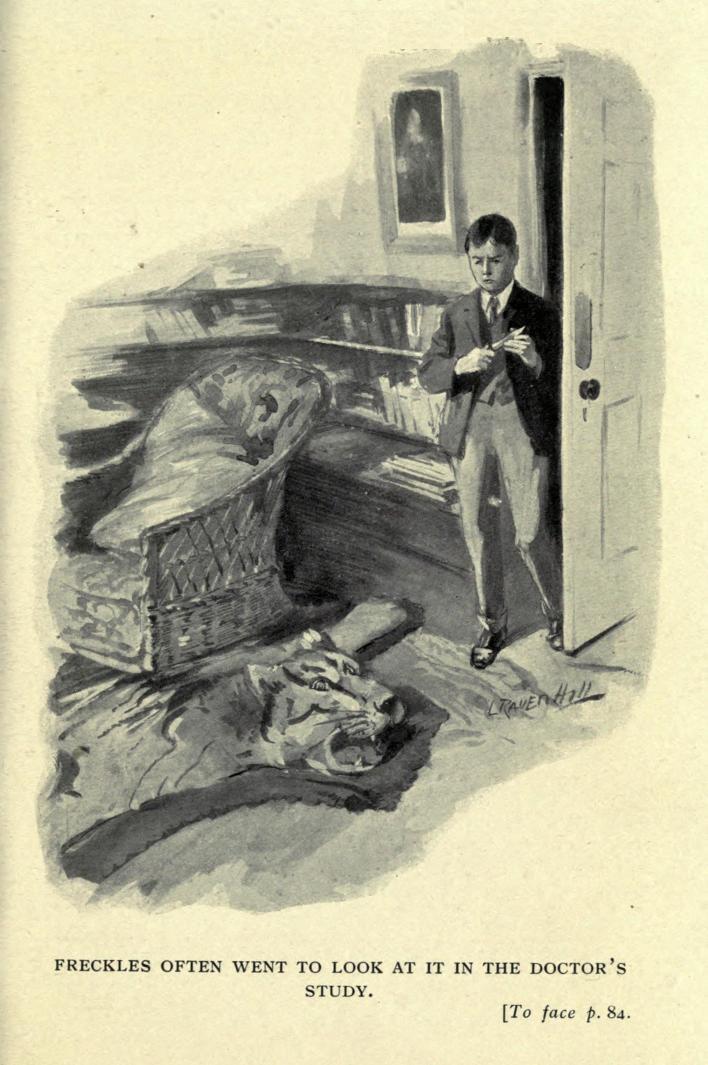
FRECKLES OFTEN WENT TO LOOK AT IT IN THE DOCTOR'S STUDY.
Then there came to Merivale a kid called Smythe. He was very small, but pretty solid and rather decent, and keen as mustard, and fiery in colour too.
It's a rum thing with boys, that some get chums with the greatest ease and some never do. And also the boys who often want to make chums never do, for some reason or other. But this kid soon made chums, though I couldn't tell you why. Of course he was nothing to me, because I'm thirteen—in fact, nearly fourteen—but for a chap just ten he was all right, and other chaps of his own age found him interesting. He had a lot of rather peculiar knowledge, gathered up from his father, who was a very learned man and wrote books for libraries. And he believed in heathen charms and old sayings, and remembered many queer things that his father had told him. He wanted to be the caretaker of a museum some day, but said that he hoped to be allowed to travel round the world first, like Darwin did, and see dwarfs and giants, and write books, and shoot a few specimens of different things not often heard of.
Of course he went through the ordinary adventures of new boys at Merivale, and it was in the matter of the 'kid test' that he became so generally known as a kid out of the common.
There is, just beyond the cricket ground, and before you come to the wood, a huge clump of rhododendrons that is covered with purple flowers in May. It is just the sort of place that a wild beast would choose for its lair, if there were wild beasts at Merivale, and it was a regular thing with kids to tell them that a savage animal did live there, and only came out at night. This beast was a test of the pluck of new kids, and the new kid who would walk past the rhododendrons after dark alone, was considered to be all right. Of course something was done to make it seem more terrible, and, in fact, till he left, John Batson, the gardener's boy, was always told to hide in the rhododendrons, and shake the bushes and growl when a test was being made. This he did very well, having a chronical sore throat, and a very harsh and growling voice, like a ferocious beast. But he had to go, owing to some row with the servants, and the new gardener's boy could only squeak, and was useless for the test. Generally, however, somebody in the fifth could be got, and for some time Freckles kindly obliged when a test had to be made. It amused him, and he growled very fairly well, and could also imitate wolves in a state of hunger, which he had once heard at a menagerie.
Well, young Smythe was told about the mystery of the rhododendron bed, and seemed more interested than frightened.
"Hasn't anybody ever seen the thing?" he asked.
"No," answered Steggles, who was there. "The sound it makes is so frightful that chaps generally run for their lives, and never wait to see it."
Smythe was very keen about it.
"I wish my father would come up and hear it," he said.
"The point is," explained Freckles, "that each kid must go past alone. It only growls for kids, and doesn't growl for grown-up people. It is a test of bravery. There are chaps here still who have never been brave enough to pass after the first growl. They were chaps who turned out quite brave in every other way, too."
"What have I to do?" asked Smythe.
"You've got to walk out on an appointed night, after evening school, and go round the rhododendron bed twice, no matter what happens. It is a winter beast, and is never heard in the summer. So it is a winter test. You've just come in time for it," explained Fowle, who was also there.
Smythe had been at Merivale about a fortnight when he was asked to undergo the great kid test.
He thought a bit after this speech from Fowle. Then he asked a question.
"And what do you think the creature is?"
"Nobody knows," said Fowle. "Of course if that was really known, something might be done."
"It ought to be shot," said Smythe; but Gideon thought not.
They all pretended to be serious, and Smythe quite believed the story, because he was very young. In fact, only one kid had ever refused to believe it.
"No," declared Gideon; "it may be the only beast of its kind in the world, and to shoot it would be a thousand pities."
"Then it ought to be photographed," said Smythe.
"Impossible, because nobody ever sees it," answered Steggles.
"That's no reason," said Smythe; "it might be done with Rontgen rays."
Which shows what a clever kid he was, though so ready to believe this rot about the beast.
"One person did see it, however," said Fowle, "and that was Montgomery, who went into a bank last term, and it left a great impression upon him."
"What did he say it looked like?" asked Smythe.
"A sort of thing between a tiger and a donkey," answered Fowle very seriously.
"Rum," said Smythe. "It might belong to the zebra family."
"Zebras don't growl," said Freckles.
"More they do," admitted Smythe. "They bray."
Then he went on to tell us some things about zebras that we didn't know ourselves.
"If it could be killed, it would be a good thing," said Smythe; "and the chap who did it would have a very precious charm, because the skin, or part of the skin of a savage beast is a very tremendous charm to the man or boy who gets it. The Boringos, my father said—at least, I think they were Boringos, or if not, Kinnatoos, or some other tribe—always wear the skin of a fierce beast next their own skin, and by so doing get the fierceness of the beast into themselves, and so nobody ever interferes with them, and they always have the most remarkable luck, and live to a great age. So this fierce beast would be a good chance."
"You might have a dash at it," said Freckles, though he could hardly help laughing. "If you killed it and skinned it, and wore a bit of the skin, it would be a fine thing for you."
"Yes, it would," admitted Smythe. "I'd risk a good deal; but I've got nothing to kill anything with except a catapult, and of course that's no good against a fierce and growling beast."
Everybody laughed, but young Smythe was as serious as possible.
"If anybody would lend me a decent knife, I'd have a go," he said.
"You'll be frightened when you hear its dreadful sound," declared Fowle. "I was, and I'm never ashamed to say so."
"Very likely I might be," admitted Smythe. "But often a jolly good thing has been done by a man who was in funk at the time; and I'd have a dash, anyhow; because, think if I succeeded, and got a charm that would last for a lifetime!"
"I'll lend you my well-known bowie-knife if you'll be careful of it," said Freckles.
With that he took it out of his pocket, where it hangs suspended by a lanyard, so that Freckles can get it in a moment, in time of need, when he goes on his hunting expeditions on half-holidays.
Young Smythe thanked him frightfully, and took the knife.
"It's just been sharpened for me by the gardener," explained Freckles. "It can pretty-well cut hairs, so you'd better be careful." And Smythe promised he would be.
Then it was decided that the test should take place that evening before evening prep. It was a good day to choose, because the Doctor and Mrs. Dunstan were going out to dinner somewhere, and we always felt a sort of feeling of more freedom at such times.
When the kid had gone I warned Freckles that he might be doing a dangerous thing; but he laughed and said not. Then Steggles had one of his terrific ideas, that nobody gets but Steggles, and he said—
"What a lark it would be if we could fake up a fierce beast, and make it come out of the rhodo. bed just as you let off a frightful yell, Freckles!"
Of course Freckles admitted it would.
"With some kids one couldn't dare," he said. "Such a thing happening to Mathers, for instance, would certainly make him go dotty for ever; but this kid doesn't know what fear is. It would be a lark to see what he'd do."
"You'd better be pretty careful, or he'll stab you," said Gideon. "He's jolly quick, and you'd look rather a fool if a new kid went and ran you through with your own bowie-knife."
"So I should," admitted Freckles; "but I'm not afraid. You forget my great power of seeing in the dark. I'm jolly near as good as a cat at it."
Then I suddenly had the most awfully fine idea, apart from machinery, that ever I did have. Little did I know what would happen, but still, looking back, it is only fair to me to admit the awful fineness of the idea. I said—
"The Doctor being out, couldn't we get the tiger-rug and stuff it with pillows, and stick it up on four cricket-stumps just round the corner of the rhodo. bed? Then, where we are all hidden behind the pavilion, we see the fun, and after it's over and the kid has bolted, we can take the skin back."
Freckles whistled, and Steggles asked—
"Did you think of that all by yourself, Macmullen?"
And I said, "Certainly I did."
But Gideon thought it wouldn't do.
"In his excitement he might actually stab the skin," he said; "and that would lessen the value of it a great deal. The Doctor would be frightfully annoyed."
"Not that that matters," said Steggles.
"No," admitted Gideon, "not to us; but a treasure is a treasure, and just for the sake of swizzling a kid it seems a pity to spoil a valuable tiger-skin worth three or four pounds at least, and perhaps more."
However, we didn't look at it in that light. Steggles and Freckles were a great deal taken with the idea, and Fowle, who was something of an artist, or thought he was, promised to make the tiger-skin look alive if somebody else got it. Of course he wouldn't have run the risk of taking it—such an utter footling coward as him. No more would Steggles.
I and Freckles both wanted to have the honour of getting it, and I argued that as the idea was mine I ought to be allowed to do this; but Freckles said that as a much more experienced hand at adventures and dangers than me, he must do it.
He said, "If it was machinery, Mac., I should say nothing; but for breaking rules and doing daring things after dark you are not in it with me."
Which was true. So he got the rug, and was late for prayers in consequence; but when Briggs reads prayers instead of the Doctor, many are late, because Briggs is short-sighted. Besides, the other masters generally don't come at all when Briggs reads them, though they never dare to stop away when the Doctor does.
Anyhow, Freckles got the rug, and Fowle, with some cricket-pads and Thompson's bicycle, faked up a most extraordinary and hideous monster looking out of the rhododendrons. It glared through its glass eyes and seemed ready to spring, and its tail was stretched into the path, with the point, as it were, wagging like a cat wags her tail when she's in a bate. Even before dusk it looked terrible, but much more so when it began to get dark.
Then the time came, and we hid behind the edge of the pavilion, and Freckles practised a growl or two, and got into the rhodo. bed, and Steggles found young Smythe and told him the time for the test had come.
Steggles said, "The playground is quite empty now, and I see the rhododendrons bending in the middle, so the beast is evidently there. You'd better be quick, and go and get it over—twice round, mind."
Smythe was pale, but firm.
"One thing," he said, "the chap called Fowle has been trying to funk me all the afternoon, and he says the beast has killed two boys in its time, and that they were both red-haired boys. Of course, if that's true, it is rather serious, me being red-haired."
"You needn't mind what Fowle says," answered Steggles; "he never passed the test at all. I remember when he came as a kid—the nastiest kid that ever did come, for that matter. He is a coward to the backbone, and would rather have paid away his pocket-money for the whole of the term than go through the test."
"So I was told," said Smythe; "and I told him he was a coward, and that I didn't care for him trying to funk me. All the same, if it really and truly killed two boys with red hair——"
"It didn't," replied Steggles. "On my word of honour, it didn't. It feeds on poultry, I believe, and nobody can really prove that it ever killed a boy. You just show what you're made of, and you'll soon find you've got good friends up in the fifth form, including me myself. As for Fowle, since Travers licked him with one hand tied behind him, and since Johnson found the name of 'Maude' written thirty-two times in various letterings on his blotting-paper, nobody has cared to be seen with him. He can draw angels with wings fairly well, though nobody wants them when they are drawn; and that's all he can do but sneak, and tell lies, and be a cur in general."
So Smythe was comforted, and took out the bowie-knife lent him by Freckles, and went off, as he supposed, into the empty playground. But there were at least twenty chaps hidden there to see what he would make of the beast that Fowle and Freckles and I had set up.
II
Well, young Smythe came boldly on, and only stopped when Freckles gave his first growl. Then the kid stood still, and then he pulled out the bowie-knife and opened it. He evidently felt that it would be better to do the deed pretty quick, before he had time to think about it; so, despite the sounds and howls of Freckles, he dashed round at his best pace, and was actually past the beast before he had grasped the horror of it. But he saw it all right, and he told me afterwards that the moment he saw it he began to stream with perspiration strangely enough, though the night was jolly cold. He also said that there came a very strange feeling in the pit of his stomach, but he couldn't be sure whether he felt frightfully hungry, or merely that he was going to be sick. He waited a moment before making the second dash round, and we could see him dimly panting, and his breath going into the air like steam. At the same moment the bell also rang, but nobody went immediately, because we wanted to see if Smythe would face the beast again. Freckles now began to imitate wolves in a state of hunger, and Steggles bet me sixpence that Smythe wouldn't go round again. But, of course, nobody but new boys, who don't know him, ever bets with Steggles, as he has never been known to pay when he loses. So I took no notice.
Then Smythe dashed round again, and we were just going to come out and rot him about it, and cheer him for passing the test, when he did a thing of the most astonishing character. He seemed now to have got a little accustomed to the horror of the beast, and he suddenly crept towards it with the bowie-knife of Freckles ready to strike. He regularly stalked it, like a hunter stalks his prey, and Freckles, who was hidden just behind the beast, growled and roared all he could; but I think he roared rather nervously, for the kid looked frightfully keen, and evidently meant to have a dash at the beast, whatever happened. We were just going to rush out and stop him, but he didn't give us time. He suddenly screamed very loudly, partly to keep up his own courage, and partly to distract the beast, and then he dashed forward, and stooped down and cut the creature's tail off at a blow! He then leapt aside very cunningly—to avoid its spring, as he told me afterwards; but of course it didn't spring, but only glared. A moment later Smythe was flying for his life—with the tail!
As if this wasn't curious enough, still stranger things happened afterwards. Because the next difficulty was what to do about it. In fact, after young Smythe had hooked it with the tail of the Doctor's tiger-skin, the rest of us looked rather fools. Of course, the first thing to do was to get the skin back into the study, and this Freckles did; and the next thing to do was to get the tail back from Smythe, and this Fowle, who was monitor in Smythe's dormitory, promised to do that night.
But Smythe wouldn't give it up. He had most carefully hidden it, and absolutely refused to give it to anybody! The next day Freckles, and Steggles, and I had Smythe before us in the gym., and asked for an explanation. We told him all about the test, and applauded him for his bravery, but explained that the tail he had cut off belonged to Dr. Dunstan's tiger-skin, and that its loss would make an awful row in the school, and very likely end in his being expelled. Then he said that Dr. Dunstan couldn't expel him, because he wouldn't know he had had anything to do with the tail. Which was true; besides, the Doctor being so blind, it might be a long time before he discovered the tail was gone. Then Smythe argued jolly well for a kid. He said that, for all he knew, the beast that we had made was a live, and furious, and dangerous beast; therefore his bravery in cutting the tail off single-handed with the bowie-knife was just as great as if it had been alive. Freckles admitted this. He said that the bravery of Smythe was undoubtedly immense, and that, so far as that went, he richly deserved to keep the tail. He even said that if he could have spared it he would have given Smythe the famous bowie-knife; but of course he could not do this, for it was his most important arm in all his own adventures when he practised to become a bushranger. Then Steggles asked Smythe what he had done with the tail; and Smythe made us promise faithfully not to tell, and we did so. Then he said that he was wearing it next his skin—round his stomach, in fact—and always should do so for the rest of his life, if it worked well.
He said, "It's awfully uncomfortable, and scratches something frightful, but that's a mere nothing to the advantages. I didn't, of course, kill the tiger, but in a way I might have; and, anyhow, I thought it was alive; and I'm going to give it a fair trial."
I asked him what he expected the tiger's tail would do for him, and he said, "Make me fierce. By rights the fierceness of the tiger ought to go straight into me, and I ought to fear nothing, in the same way that the tiger when it was alive feared nothing. But as I didn't actually kill the tiger, of course it may not work as I hope."
He assured us solemnly that he believed the beast was alive when he dashed at it and cut its tail off; and he also assured us that he had never seen the Doctor's tiger's skin, and did not so much as know that he had a tiger's skin. And we believed him, and let him keep the tail.
Steggles, however, warned young Smythe of one thing. He said, "Be jolly careful that Fowle doesn't see it when you're getting up or going to bed, or very likely he'll sneak. He hates you already for scoring off him, so mind you hide it from him."
Smythe naturally thanked Steggles a good deal for this kind advice, and said that he would be cautious, and that he already hated Fowle a good deal, and that if he really did become fierce pretty soon, Fowle would be the first to know it.
So there the thing was left, and when the Doctor found that his tiger's tail was gone—which he did do, owing to one of his daughters pointing it out—nobody knew anything at all about it.
The Doctor made far more fuss than we expected, and was bitterly hurt over the loss, and seemed to be inclined to expel everybody, because nobody would confess. But, of course, from the business point of view he couldn't do that, because, as Gideon said, his occupation would have been over, and it might have taken many years for him to collect together one hundred and three boys again. Gideon also said that the competition was fearful among school-masters, and expelling was quite a thing of the past, owing to the difficulty of getting new ones.
Then came the tremendous end of the whole business, and such fierceness as young Smythe had managed to get, after wearing the tiger's tail for three days, was as nothing to the fierceness of the Doctor when he found it out.
It burst upon us on a half-holiday, and the half-holiday, as such, was ruined by it. After saying 'Grace' at dinner, Dr. Dunstan told the school to be in chapel—every boy—at half-past two. Leave was stopped, and only the football team, which played a match that afternoon, was allowed to go. Everybody had theories during dinner, but nobody was right, or anything like right. We noticed that the Doctor seemed thundery, and that he looked sometimes very fixedly at the bottom of the table, where Mr. Mannering, the underest master of the lot, though a 'blue,' presided over the dinner of the lower school.
Then we went into chapel, and those interested in the tiger's tail were all there, except Freckles, who is in the footer eleven.
"Boys," began the Doctor, "I have received an anonymous letter, and if any among you should be in doubt of the meaning of that word, I may tell you that it is derived from the Greek a and onoma, signifying 'without a name,' or 'nameless.' The letter is, in fact, unsigned.
"Now, in the ordinary course of events, I should disdain to notice such a communication. As I remarked during a newspaper controversy in '82 to an agnostic writer who propounded infamous opinions and hid himself behind the nom de plume of 'Lucretius,' 'the man who fears to proclaim himself, and lacks the courage of his own views, ipso facto, places himself beneath the notice of any serious antagonist.' The discussion, which verged on the acrimonious, and to which two bishops contributed, was protracted through August and the earlier part of September. Then, having proved my points to the satisfaction of all religious men, I withdrew from the debate. That, however, is not what you are here to know, and, indeed, happened many years before any among you was born. What will more directly interest you is this: that for once I have decided to give weight to my nameless correspondent's communication. It is brief, and printed in capital letters. I shall rehearse it to you."
Then he read out these remarkable words—
"'Dear Sir,—The tiger's tail is worn by Smythe next his skin, under his vest.'
"That is all," continued Dr. Dunstan. "There is no clue—either to the sender or to his object in conveying this astounding information to me. Concerning him I shall make researches anon, when we have proved the truth or falsity of his statement; but for the present we are concerned with the name of Smythe. Now, the name of Smythe may not be familiar to many among you. I find that Smythe is a newcomer. He has been at Merivale only since the beginning of this term. He is very young, and unusually ignorant, but he is not too young, and not too ignorant to know the meaning of such simple and straightforward Anglo-Saxon as I am in the habit of employing when I address my boys. He is aware that I have a tiger's skin, and that this interesting relic is dear to me as the gift of one who distinguished himself within these walls, and carried the moral lessons, and even a little of the scholastic erudition of Merivale School into the larger life beyond, when he went down to the sea in ships. Huxley Smythe is also aware that this integument has been mutilated by some senseless and wicked hand. Then let him come forward and tell us more, if, indeed, he knows more than we all know. Let him step before me and explain the significance of these words from a nameless source. I hope with all my heart that he may proclaim them false, and, what is more, prove them false, for Huxley Smythe's father is a very distinguished and learned gentleman, and a Fellow of the Royal Society. It is impossible too highly to esteem his discoveries and surmises respecting the customs of the Ancients. Such a man puts truth before all things; such a man will be cut to the heart if his offspring should prove other than honest and upright. Come hither, Huxley Smythe!"
So Smythe went, and jolly cheap he looked. His face turned the colour of gooseberry fool, and his hair seemed to become many shades redder than usual as he walked up the chapel. He was naturally small, and he seemed much smaller than he was, owing to walking up the chapel all alone.
"Speak," said the Doctor, "and address your remarks to me. Do you, or do you not know what has become of the caudal appendage of my tiger-skin?"
"Yes, I do, sir," replied Smythe.
"You do, sir! Then why, when I invited information on this subject, did you deny it to me?"
Smythe did not reply to this question. He merely said, "I cut off the tiger's tail, sir, in a moment of great excitement, and having once got it, I thought I'd keep it."
"Well may you have been excited, sir, at the instant of such an outrage! And what next, sir?" asked the Doctor.
The whole of the upper part of his body began to lift in a lump, as it always did when he got worked into a rage.
"Next, sir, I decided to wear it round my waist."
"And will you be so good as to enlighten us as to the reason for this extraordinary decision?"
"The Boringos do it, sir, or else the Kinnatoos. My father told me that they——"
"Boringos, sir! Kinnatoos, sir! What are the Boringos to you, wretched youth—or the Kinnatoos, either? Because certain heathen nations, as yet far from the light, indulge in gross superstition for their own benighted ends, and credit inanimate objects with imaginary virtues and grotesque qualities which we, who are civilized, know right well that they do not possess—because these things are so, is that any reason why a Christian boy in a Christian school should seek to emulate their misguided credulity? The question before us is not why the Boringos do these things, but why you cut off my tiger's tail, sir, and wore it round your person?"
"To get fierce, sir," said Smythe.
The Doctor simply heaved in his indignation.
"To get fierce, sir!" he said, repeating Smythe's words in a tone of helpless despair.
"Yes, please, sir. With luck the fierceness of the tiger ought to go into me," explained Smythe.
"This is almost too much," said Dr. Dunstan.
"Because I thought that to be as fierce as a Bengal tiger would be useful, sir," Smythe ventured to say.
"Silence, sir!" roared the Doctor in such a tremendous tone of voice that Steggles whispered to me the Doctor himself must have been wearing about a dozen tigers' tails all his life.
"And how dare you want to be fierce, sir?" went on the Doctor. "You come among us a child from a Christian home—an inexperienced and ignorant youth. And yet at ten—for that is your age, Huxley Smythe—you develop a disgraceful yearning to deteriorate from the state of civilization to which you are born; you debase your intellect and your morality by deliberate efforts to become demoralized; you seek to take a retrograde step, and recover the ferocity of primitive—or, as we say, pre-Adamite—humanity. You have striven to acquire the physical brutality of palæolithic man, sir, and—worse, far worse—you deliberately endeavour to impress upon your nature the disgusting attributes of one of the most pestilential animals that an inscrutable Providence has created and let loose upon this planet. He who could seek to secure the attributes of the tiger, Huxley Smythe, must already possess the potentialities of the wild ass! Never in the whole course of my scholastic experience have I met anything quite so painful as this depravity in a child of ten. Shed no tears, sir," went on the Doctor; "the time has not yet come for tears."
Because Smythe was blubbing a good deal at this dreadful view the Doctor had taken of him. Of course he didn't understand a word of it, and that made it all the worse.
"And where is my tiger's tail now, sir?" finally asked Dr. Dunstan.
"On, sir," answered Smythe humbly.
"Then it had better be taken off, sir!" said Dunstan, and he roared again. "Divest yourself of your upper attire, wretched boy. Let this lesson not be lost on the least among us. Take off your clothes, sir, so that one and all of us shall be warned what evil instincts may, and do still mar human nature in the most unexpected quarters. I mourn for your accomplished father, Smythe; and still more for your poor mother. It was none too soon that they sent you into my care, young though you be. Go and stand beside the fire, sir, that the ordeal may not physically injure you."
The kid went to the chapel fire, which always burns in winter, and took off his coat and his waistcoat, his collar and his tie, and his shirt and his vest. Under the vest, fastened round pretty tight, just below his ribs, was the tiger's tail. He looked awfully rum like this, and still cried a bit. A few chaps, including several of the sixth, laughed out loud at the appearance of Smythe and the tail; but the Doctor soon shut them up.
"Silence! Silence!" he shouted out. "This is no laughing matter, Mayne; and you, Trelawny; and you, Cornwallis major. We ought to weep rather than laugh. Here is sortilege, necromancy, black art in our midst! Here we find a boy permeated with the—with the fetishism, the thaumaturgy, the demonology of the savage and the cannibal. And, what is more astounding still, we find him at Merivale! Take off that tail, sir!"
Smythe undid the tail, and took it off. There was a bright red mark all round his white body, and I should think the tail must have given him a pretty good doing. A tiger's hair is undoubtedly scratchy when applied to a tender part of the human frame, like the stomach; and perhaps savages know this, and that is really the reason why they wear them. Because nobody who kept a tiger's tail under his clothes for any length of time could help getting fairly snappy, if not actually fierce.
The Doctor ordered me to bring him the tail, because I happened to be near, and he caught my eye. This I did, and meantime Smythe got back into his clothes. Then the Doctor told the school it could go about its business—all but the culprit; and he marched away solemnly and slowly with Smythe and the tail.
The tail was very skilfully sewn back into its original place, and nobody who did not know the truth could have guessed at what had happened to it. And Smythe told us afterwards that Dunstan talked to him till tea-time, and then, suddenly reminded of the hour by the bell, flogged him, but very slightly. It is always a hopeful sign if the Doctor begins a row with talk; and the longer he talks, the less painful is the end. But if he begins with the licking and talks afterwards, it is bad, and adding insult to injury, as Steggles says.
One thing may be worth mentioning. The Doctor never asked for details, so Smythe never gave him any; and, as old Dunstan never heard about what Freckles did, or I did, we escaped intact. This made what Smythe had done seem far worse than it was. Of course we richly rewarded the kid for being such a jolly good plucked one, and gave him many a thing worth having; and we also made it up pretty thoroughly to Fowle for writing the anonymous letter to the Doctor. It proved to be him, because nobody else in the dormitory ever kept awake after everybody else was asleep, which was in itself a beastly mean thing to do; and we made him finally confess that he had spotted the tail. With the help of a Chinese torture that Tin Lin Chow had shown us, we made him confess. It is beautifully simple, and a kid can do it. And when Fowle confessed at the first twinge, and said he did it for revenge because young Smythe had cheeked him in front of about twenty chaps, we felt that he was beneath a fine thing like a Chinese torture, and just kicked the calves of his legs for a little while, and then arranged, as a punishment, for the whole school to send him to Coventry for a week. Which was done.
RICHMOND MINIMUS, PREACHER
No. V
RICHMOND MINIMUS, PREACHER
I
Properly speaking he wasn't 'minimus' in his preaching days; but once there were three Richmonds in the field, as Dr. Dunstan used to say, and after Richmond major went to Sandhurst, young Richmond ought to have become 'minor,' and very much wanted to, but nobody could get into the way of changing it. Even when he was left all alone and Richmond minor left to go into a tea merchant's office, chaps still called him 'minimus.'
His father was a clergyman who had risen into a rural dean; but Morrison, who lived at Exeter and understood a frightful deal about religious people, said that, while a very good thing in its way, a rural dean was mere dust beside a cathedral dean. He seemed to think really, though I don't know whether it is true, that a minor canon is almost as classy as a rural dean, if not quite. Anyway, the father of Richmond minimus was one, and, until Morrison explained that it was nothing to make a fuss about, we were all rather interested. No doubt it was through his father that Richmond got his preaching power. He was going into the Church himself some day, and looked forward to being something out of the common in course of time. He said that he always felt a great liking for church—even from his earliest years—and had never been known to object to going, though his brothers—especially the one now training to become a tea merchant—had not in the least cared for it.
He was a frightfully good kid, and Mathers always said he would die young, or else get consumption, if there was any truth in the stories we were allowed to read on Sunday afternoons. In these, which were different to week-day stories, there were many deaths. And sometimes the bad boys died and sometimes the good ones; but they died in a very different way. The good ones died in the lap of luxury, with their friends crying round the bed, and grapes and clergymen, and pretty well everything to make it all right; but the bad ones were smashed like flies, owing to setting machinery in motion; or fell over cliffs birds'-nesting; or got taken up by policemen. The difference was that the good ones died from sheer bad health. They had hectic coughs or something of that kind, and nobody could cure them—in fact, nobody ever seemed to try to; but the bad boys were always as hard as nuts and never had hectic coughs or anything. In fact, they would all be alive now if they had only gone to church on Sundays and not always chosen that day for adventures. In these adventures they invariably got mucked up, excepting when occasionally they were saved by good boys coming home from church, or sometimes even by good girls; which Stopford said must have been worse than death, owing to his hatred of girls.
This Stopford ought to have died a hundred times a Sunday really. He was not merely bad. That was nothing, because we all were. At any rate, none of us were good enough to get consumption. But he was a beast as well—an utter beast—and nobody liked him but Fowle; and nobody ever liked Fowle, so in self-defence Fowle had to like Stopford.
This Stopford was a bully, among other things, and a great hater of Richmond minimus. I think really it was the frightful sufferings of Richmond that made him take to preaching in a way, because, though Richmond minor was as old as Stopford, he had no muscles, being merely a piece of string for strength; so, though Richmond major could tackle Stopford, and did so till he left, after he had gone, there was nobody much to care whether Stopford bullied the kid or didn't bully him.
The first time I saw any of the instinct to preaching in Richmond minimus was after a footer match. It was the time when Buckland Grammar School licked us rather badly, owing to Mathers and Bray having smoked in secret before the match and being in far too footling a condition to play; and Richmond said to me afterwards, when we went back to Dunstan's, smothered by four goals to none, that often what we did in secret was rewarded openly.
I said—
"Hullo! That's like the Doctor on Sunday."
And he said—
"Let us take this defeat in a proper spirit, Gregson. It may be for our good. As you know, I suffer a great deal from Stopford. Well, it will all tell some day. I don't exactly understand now why Stopford is allowed to twist my arms and then hit the muscles till they ache for hours and often keep me awake at night; but there's a reason."
"The reason is that Richmond major has gone," I said.
"There's a better reason than that," he said. "I may turn Stopford from his beastliness yet. Once or twice I've staggered him a bit with telling him what will come of his cruelty to me."
That was the first time I seemed to see a screw loose in Richmond minimus; but he didn't absolutely preach right bang out until we'd had a missionary at the chapel one Sunday.
Our chapel was also the big school-room, and at one end were panels of wood on week-days which very cunningly opened and turned into the Ten Commandments on Sundays. On each side was a door, and one was the Doctor's private entrance into the chapel, and the other was a deep cupboard wherein were kept blackboards, large maps and other things. In this chapel the missionary, who was an old pupil of Dr. Dunstan's, preached to us about the heathen of some rather good-sounding place; and Richmond minimus was so excited that he gave all his pocket-money and borrowed two-pence of Williamson. In this manner he subscribed in all fivepence; and if he could have borrowed more he would have given more. From that day he decided to be a missionary at least, if not a martyr.
The missionary was certainly a good preacher, besides having seen lions wild. It shows the difference between chaps that the lion part interested me most and the heathen part bored me, while Richmond minimus simply hated the lions, but the heathen part seemed to act on him like ginger-beer and excite him to a fearful pitch.
Three days afterwards the fit burst out in Richmond minimus. I came into the big school-room one night, ten minutes before the tea-bell, and there he was preaching to about eight chaps, chiefly kids! But Mayne and Morant were also there listening, Mayne being high in the sixth. Words seemed to flow out of Richmond as easily as they flow out of a master! He was talking about pocket-money.
"What is it but round bits of silver and copper?" he said. "Yet, my dear friends, there is a great power in it, and we should not spend it all on self. There are thousands of people who never have pocket-money, but they deserve it quite as much as us; perhaps more. Suppose you have threepence a week, which I have myself. Will it hurt you to yield up one halfpenny to the charity box? Oh, my friends, it won't! Yet that half-penny, given cheerfully every week through the term, comes out at twelve halfpennies, which is sixpence. Do it gladly and your holidays will be brighter by sixpence well spent than they otherwise would be."
Here the bell rang, and Mayne seemed in doubt whether to smack young Richmond's head or rag him, or merely tell him he wasn't to preach again. However, he did nothing except say to his chum, Morant, that it was queer.
It wasn't what Richmond minimus said, but the way he said it. He was as keen and solemn as if he'd been preaching to a million people in a cathedral. The stuff about his wretched pocket-money might have been the most important thing ever uttered by a bishop, such was the way he said it. You couldn't help listening. It was only afterwards, when you thought about it, that you realized what tommy rot it was. To cast away a half-penny into the charity box weekly was a childish idea, I thought; and Gideon, who understands the ins and outs of pocket-money in a way nobody else does, owing to being the son of a diamond merchant, said that the idea was false political economy; and I said so too.
As to Stopford, the charity box was a painful subject with him ever since the Doctor happened to see him putting something into it. The Doctor had found him subscribing rather often, and knowing the other things that Stopford did, it much surprised him. So he set a trap and had the box empty next time Stopford subscribed; and so at last found out that it was Stopford who put in brace-buttons—a great problem that had puzzled everybody the whole term. And they weren't even his own brace-buttons.
After preaching three times Richmond minimus had the nerve to attack Stopford publicly in a sermon! About twenty chaps were listening to him, and as soon as he uttered the name, Stopford prepared to go and scrag him; but two or three big fellows told him to sit down and not interfere, and Richmond was so strung up and in such a frightfully excited state that he sailed right on and spoke about Stopford in a way that made many chaps bar Stopford for weeks afterwards.
"Oh, my friends," said Richmond—he was standing up in front of the panels that turn into the Commandments on Sundays, and we were sitting down in the body of the chapel—"Oh, my friends, and there is another peril—a horror that walks in the noonday—a human leviathan seeking what it may devour, and its name is Stopford! I who speak to you know only too well this thorn in the flesh. I have suffered many things from him, and shall again. But I suffer gladly. I am chastened for my own good. Offences must come, but woe betide Stopford. He will have his portion in the burning lake, my friends, for he is a son of Belial; and he will call for a cup of cold water and probably none will bring it. He is a bully, a coward, a cribber and a dirty beast who never even washes his neck if he can help it. But black though his body may be, his heart is blacker, dear friends——"
It was at this point that Stopford jumped up with his eyes blazing; but Trelawny rapped him on the head and told him to sit down again. And Richmond minimus went on faster and faster.
"Let us Christian spirits seek this vile boy and try and lift him out of the slough. Let us not shun him as a thing unclean; let us not dispatch him where the worms they crawl out and the worms they crawl in, dear friends, but let us rejoice over this sinner as over a piece of silver which is lost by a widow and was found again. Oh, my friends, remember that Stopford is a human creature with a soul. It is hard to believe this, but I am right. He is one of ourselves; that is the sad truth. For our own sakes—for the sake of the school—let us try and turn him from his evil ways, and teach him that to twist my arms in the sockets till they ache all night is doing the devil's work, and that to kick me till my shins, which are very thin, bleed and gather, is also the devil's work; and to take sweets out of desks is also the devil's work; not to mention many, many other things, such as smashing young Dobson's birthday present from home and——"
"I didn't take anybody's sweets, you little beast!" screamed out Stopford; and the big chaps roared and gave three cheers for Richmond and three hisses for Stopford.
It was a frightfully exciting sermon, though never finished, and Richmond minimus seemed quite dazed and wet with perspiration afterwards. I talked to him in secret during evening prep., and told him I was afraid that Stopford would never forgive him, and have a fearful score off him sooner or later. I said—
"I remember hearing my father tell a story about a great clergyman—the champion preacher, I believe—and being champion he had to preach to Queen Victoria, which he did do. But instead of being terrifically careful what he was about, he lost his head, like you did to-night, and I believe he gave it to the Queen pretty much like you gave it to Stopford. Not of course that the Queen was ever a quarter as bad as Stopford. In fact, it was high treason to say she was bad at all—such a magnificent Queen as her—easily the best ever known in history. And everybody was in a frightful rage with the champion preacher; and the Queen didn't like it too well herself; and the result was that he never became the Archbishop of Canterbury, though it was a dead snip for him before."
"I know," answered Richmond minimus, "but when you're preaching, the things come pouring into your mind. You can't pick and choose. You have to say what you're told to say, if you understand me."
I said I didn't in the least.
"If you wanted to give it to Stopford in a sermon you ought to have chosen a time when he wasn't among the audience," I said.
"For safety, yes," admitted Richmond; "but at these times when I preach, I care for nothing. I caught his little, hateful, pink-rimmed eyes on me and my rage against him rose. I felt like those old prophets when they had to go and give it straight out from the shoulder to the kings that did evil."
"It was jolly fine," I said. "But what about Stopford?"
"If he would meet me publicly and argue it out——" said Richmond minimus.
I laughed.
"That's not the way of Stopford," I said. "He won't argue about it; but he'll give you his sort of sermon when he gets you alone in a corner some evening after dark. Preachers are often pretty nearly martyred before they've done with it; and they die gladly; and very likely Stopford will martyr you."
"Very likely he will," said Richmond minimus; but not as if he looked forward to it.
II
Everybody in the lower school expected some pretty fearful things would happen to Richmond, but instead a miracle seemed to occur and Stopford did nothing. Gideon thought that he might have taken an action for libel against Richmond minimus if he had been grown up, owing to young Richmond's saying what he said about stealing sweets. It was well known to be true, but Gideon said that, curiously enough in law it didn't matter in the least if you said the truth. Because the law is often down on the truth far worse than on a lie. But Stopford never mentioned the matter again, and actually behaved kindly to Richmond and gave him two new kinds of nibs for his nib collection. He also let him have a picture of a very beautiful girl out of a box of cigarettes. I asked Richmond minimus what he thought of it, and he said Stopford was converted, and that Stopford was his first triumph. He was so earnest and hopeful about it that I felt when he became a missionary and went into those lands near the equator, that he wouldn't be contented with converting niggers, but jolly well want to convert lions and everything.
Encouraged by the remarkable success of Stopford, Richmond minimus preached several times more, and it got to be a regular lark, and chaps came from the other houses to hear him. Stopford always came and took it frightfully seriously; and then happened the row about Dr. Dunstan's medlar tree, and Mr. Browne caught Stopford after dark and reported him, and Mr. Mannering, the 'blue,' flogged Stopford at the order of the Doctor.
Now this Browne was the least but one of all the masters, and without doubt the utterest squirt that ever came to Merivale as a master. It is true that he was a Cambridge man, but there was nothing more to be said for him. Young Forrest, however, knew something more, for it happened by a curious accident that he came from the same place that Mr. Browne did. What it was that Forrest knew we couldn't understand; but it appeared that Browne gave Forrest a great deal of help with his prep. on condition that he would not mention it.
This man was very ignorant and could only teach kids, and even them he didn't teach well. It was well known that he had many cribs in his room, and often—especially when he had to take the fourth in algebra—he would creep away from time to time and look at his crib swiftly, and return, and do off a sum on the blackboard as if he had no difficulty at all. He was great at having favourites, and he always chose sneaks, and often turned on them afterwards, as he did on Fowle, and also on Stopford over the medlars; though when caught, Stopford solemnly swore to Browne that he was getting the medlars for him.
Anyway, nobody liked Browne, and when Stopford begged Richmond minimus to preach against Browne, he thought a little and finally said that he would.
I advised him strongly not to do it.
I said—
"Can't you see the frightful danger? Some word you may say may get to Browne's ears, and you may have a flogging at least, if you're not expelled."
But Richmond minimus shook his head.
He said—
"Not at all. A word in season often does good, as in the case of Stopford. I want to warn the fellows against the mean nature of Browne. I want to show them what Browne is and how a master may use his power like a beast, as Browne does."
"If it gets back to him, you're cooked," I said. "And you know how you work yourself up when you're preaching. I don't think it's at all wise."
"I've promised," answered Richmond minimus. "I'm going to preach to-morrow evening in the time after tea before prep.; and all Browne's house is coming to hear me."
Somehow I felt from the first it would be the undoing of Richmond minimus. The danger was too frightful. However, of course I went. It was the biggest congregation Richmond ever had, and he said that he itched to make a collection as he looked at the chaps—not for himself but for some good purpose. A crowd was in the chapel before I got there, and Browne's were all in a knot together, eager and longing to hear what young Richmond had to say about Browne. A lot of fellows from the sixth had also come in, and of course all the personal friends of Richmond minimus were there. Stopford was also there.
Richmond went up to the master's desk at the top of the room, full of calm cheek, and said a few things of a general sort; then he caught Stopford's eye. This reminded him and he began.
"Now I want to speak to you of a subject that will especially interest the boys of Mr. Browne's house, namely, Mr. Browne. My friends, I wish I could say something hopeful about him; I wish I could tell you that he was a bright, shining example for us all to follow and imitate; but alas! you know it is not so. Mr. Browne is a very mean character. Before saying these words about him I have thought a great deal about him and studied him very closely, when, I am afraid, dear friends, I ought to have been studying something else. But I tell you fearlessly to beware of him. I know he has favourites; I know he encourages the sneak and the tale-bearer in our midst; I dare say among you at this moment may be some wretched chap who will go to Browne after my sermon and tell him what I am saying now; but do I care? No, I do not care. Nobody need care if they are doing right. Browne has had a good deal of mystery about him, and I have come to the bottom of it. One among us who lives where Browne does, knows the truth. I will not name him; but he had his head slapped by Browne the day before yesterday, though it is well known Dr. Dunstan won't allow our heads to be slapped, owing to the danger of hurting the brain. At any rate Browne slapped his, and in a moment of natural anger, my dear friends, that boy told me the truth. Browne is a tailor's son! That, of course, is nothing against him. The shameful and disgusting thing is that Browne is ashamed of it! He hates to think of it. Oh, my friends, what a paltry nature is this. I dare say his father is a better man than he is, though he does make clothes; and I do not hesitate to tell you, my friends, that Browne's father makes clothes a long sight better than Browne teaches Latin; for we have all noticed the scabby manner in which he continually sneaks out of this room during class to rush up to his own study and consult cribs. I say nothing of his appearance. He cannot help that, though he could help those pink ties and those horrid boots with pearl buttons; but what I do say is that with such a lesson in our midst we must learn firstly, not to be ashamed of our parents, whoever they are; and secondly, not to make friends of dirty sneaks; and thirdly, not to be a hound in general; and fourthly, not to pretend we know enough Latin and algebra to teach it, when really we don't know any worth mentioning; and fifthly, and lastly, my friends——"
What Richmond minimus was going to say for fifthly, and lastly, against the wretched Browne, we didn't hear, for at this point a frightful thing happened. The door of the cupboard on Richmond's right, where the blackboards were kept, opened violently and out leapt no less a person than Mr. Browne himself!
A very strange sound went up from the congregation of Richmond minimus, but he said nothing. For a moment Browne stood at bay, glaring out of his double eye-glasses, like the picture of a wounded tiger in C. B. Fry's Magazine; then the chaps began to scutter out, and many dived and proceeded to the door entirely under the desks, hoping they would not be recognized. In fact, I did this myself. But Browne was not bothering about us. His eyes, which squint by nature, had turned in upon each side of his nose and he was darting a horrid glance of rage and scorn at Richmond minimus.
Then, with dreadful slowness, he raised his hand and took Richmond by the right ear and said—
"Come!"
And Richmond merely said, "Yes, sir," and went, led by Browne, to the Doctor. As for me, I felt that Richmond minimus need never have worried about not being a martyr. He was going to be a martyr all right now.
After the blow had fallen—about two days after—he told me exactly what happened. By a curious chance the Doctor was writing a sermon himself when Browne appeared before him. The Doctor always preaches at Merivale on the first Sunday in the month, and this was the sermon he was writing, no doubt.
He put down his pen and took off his glasses and stretched his eyes in a way he has; then he told Browne to speak. And Browne said—
"I have to report this boy for insolence and profanity combined. Never have I known a boy do such a thing. Before half the school assembled in the great school-room he stood up and preached."
"Preached!" said the Doctor, looking with great surprise at Richmond minimus. "What did he preach about?"
"About me!" said Browne furiously. "He dared to preach about my private affairs—at least——"
"Begin at the beginning," said the Doctor. "How did particulars of this outrage reach you, Browne?"
"Through the boy Stopford," said Browne; and Richmond minimus fairly gasped to think how mistaken he had been about converting Stopford.
"Stopford," explained Browne, "came to me and said that he was very much afraid that liberties were to be taken with my name. I refused to believe it at first. Then, to satisfy myself, I went into the great school-room at the time mentioned by Stopford and stood behind the blackboards in the cupboard."
Browne then related all that he had heard, and Richmond minimus said that he trembled with indignation and spoke so fast that Dr. Dunstan had to ask him once or twice to repeat the sentence. But Richmond admitted that Browne's version of the sermon was very fairly just.
Then the Doctor said—
"Thank you, Browne. I much regret your natural annoyance. You may leave the sequel to me."
So Browne hooked it and Richmond minimus was left alone with the Doctor.
The Doctor said nothing for some time. Then he sighed, and looked at his sermon, and rose and went to the cane corner.
"What led you to do this outrageous thing, impious boy?" he asked.
"I felt called to do it, sir," said Richmond minimus. "I've preached seven times now, and more fellows come each time."
"I am aware that you are probably destined for the sacred calling," said Dunstan solemnly, "and your theological papers have always led me to regard you as a promising recruit, Richmond minimus; but preaching, or I should say a travestie, a bizarre burlesque of that difficult branch of the pastor's calling! And to select one of your masters for a theme!"
"He seemed a good subject to show what we oughtn't to do, sir. In preaching, of course, you want——"
The Doctor looked his most awful look, and Richmond minimus dried up.
"Probably what I want in preaching is as well known to me as to you, preposterous youth!" said the Doctor. "The present question is not what I want in preaching, but what I want in boys; and what I expect from boys after they have been for the space of three years under my personal care and control. To play the buffoon before your fellows is in any case degrading; but to do it under pretence of advancing their moral welfare—to preach in jest—this is perilously akin to profanity. Only a vitiated spirit of secularism can explain so gross an action. My heart bleeds when I think upon your parents, Richmond minimus, and upon your brothers who worthily upheld the honour and dignity of Merivale, and now, in the wider field of life, are bringing forth the good fruit sowed within these scholastic cloisters."
The Doctor always spoke like this about chaps who had left.
"Then," said Richmond minimus, "the usual event happened and, as you know, on the next morning I had, in addition, to tell Browne I was sorry publicly after prayers."
"One thing," I said. "What was that 'fifthly and lastly' that you were prevented from preaching?"
But Richmond didn't remember; so it was lost.
"Shall you ever preach again here?" I asked him.
And he said not. He said—
"No. On the whole it isn't good enough. And yet you mustn't think I mind the martyrdom. Only of course I don't want to be utterly martyred and done for before I grow up."
He evidently meant to be a martyr in rather a biggish way in foreign parts, like the Germans in China; because when they are bashed by the heathen, Germany always gets a few miles of China as payment. And so Germany is proud of her martyrs, and the Emperor too.
What did become of Richmond minimus I can't tell you. He ran away once, to do good on a large scale, but he was captured and brought back before he had time to do much worth mentioning. He'll tell you that story himself. Anyway, he never preached again, and the whole affair, if it did nothing else, helped to show what Stopford was.
THE 'BOLSOVER' PRIZE
No. VI
THE 'BOLSOVER' PRIZE
I
There was once a chap at Dunstan's, ages and ages ago, called Bolsover, who turned into a novelist afterwards; and he was so frightfully keen about other chaps turning into novelists too that he gave a prize for composition. It was a book worth a guinea, and Dr. Dunstan had to choose it each year, and only the junior school was allowed to enter for it, according to the conditions made by the chap who gave it. Gideon calculated it out, and said that as twenty pounds is about good for one pound at simple interest in an ordinary way, the novelist chap must have handed twenty pounds over to Dr. Dunstan; and Steggles said he rather doubted if the novelist chap would have much cared for the books that Dr. Dunstan chose for the prizes; because they were not novels at all, but very improving books—chiefly natural history; which Steggles said was not good for trade from the novelist chap's point of view.
No doubt old Dunstan ought to have bought stories; and Steggles went further and said that it would have been a sporting thing for Dr. Dunstan to get the novelist chap's own books, of which he wrote a great many for a living. Steggles had read one once in the holidays, but he didn't tell me much about it, excepting that there was a man who appeared to have about four wives in it, and that it had three hundred and seventy-five pages and no pictures.
Anyway, the composition prize always interested us in the lower school, and it interested me especially once, because the subject was 'Wild Flowers,' and my cousin, Norman Tomkins, happened to be a frightful dab at them. When he heard about it, Tomkins went instantly to Gideon, who lends money at usury, being a Jew, and said, "Look here, Gid., I'll sell you the 'Bolsover' prize for ten shillings now on the spot. As it's worth a pound, you'll make fifty per cent. profit." And Gideon said, "The profit would be about right, but where's the prize?" And Tomkins said, "I've got to write for it on Monday week; but it's as good as mine, because nobody in the lower school knows anything about wild flowers excepting me, and I can tell you the name of thirty-four right off the reel; so there's an end of it, as far as I can see." Which shows what a hopeful sort of chap Tomkins was.
But unfortunately Gideon knew the great hopefulness of Tomkins about everything, and also knew that it did not always come off. He said, "Who are in for the prize?" And I said, "First Tomkins, then Walters, then Smythe, and also Macmullen."
"There you are," said Tomkins. "Just take them one by one and ask yourself. If it was wild animals, or queer old customs, Smythe might run me close, or even beat me; but in the subject of wild flowers he is nothing. Then young Walters doesn't know anything about anything, and his English is frightfully wild, owing to his having been born in India. Well, that only leaves Macmullen, and Macmullen's strong point is machinery. He never looked at a flower in his life. When we went out of bounds on the railway embankment, he simply sat and watched the signals work, and took down the number of a goods engine that was new to him. And when he got up, I discovered that he'd actually been sitting on a bee orchis—one of the rarest flowers in the world! When I showed him what he'd done, he merely said, 'A bee orchis? Lucky it don't sting!' So that shows he's no use. In fact, when he hears the subject hasn't got anything to do with steam power, I doubt if he'll go in."
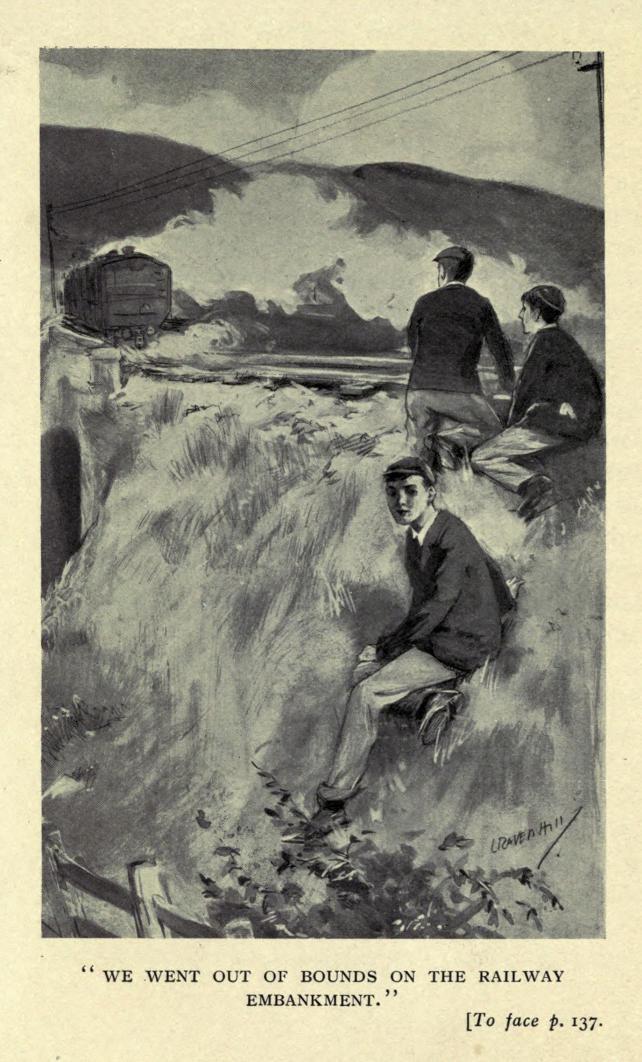
"WE WENT OUT OF BOUNDS ON THE RAILWAY EMBANKMENT."
But Gideon knew Macmullen better.
"He'll go in," he said. "His age is just right, and he won't be able to try again. He's not the chap to throw away the chance of getting a pound book just because the subject doesn't happen to be steam power. Besides, there's always time allowed to swat up the thing. I bet by Monday week Mac. will know as much about wild flowers as you do—perhaps more."
"Of course, as a chum of his, you say that," answered Tomkins. "But I've made a lifetime study of wild flowers, and it's childish to think that Macmullen, or anybody else, is going to learn all I know in a week."
"He can spell, anyway," said Gideon, "which is more than you can."
In fact, Gideon didn't seem so hopeful about Tomkins getting the prize as you might have thought, and it surprised Tomkins a good deal. Gideon had a right to speak, because in his time he'd won this prize himself. When he won it, the subject happened to be 'Postage Stamps'; which was, of course, like giving the prize to Gideon, owing to his tremendous knowledge about money in every shape.
The time was July, and so next half-holiday Tomkins and me went into the country for a walk, for Tomkins to freshen up his ideas about the wild flowers.
He certainly knew a lot, but several things that I picked bothered him, and once or twice, I think, he was altogether wrong about them. He also picked a good many that he evidently didn't know at all, and carried them back to school to ask Mr. Briggs the names of them and anything worth mentioning about them.
Then, coming back through Merivale, who should we see but Macmullen, with his nose flat against the window of an old book shop there!
"Look here," he said, "there's a second-hand botany in here for sevenpence, and I've only got fivepence. I tried the man by showing him the fivepence all at once, but he wouldn't come down. Can one of you chaps lend me twopence till next week?"
He looked at the flowers Tomkins had picked as he spoke.
"D'you know many of them?" said Tomkins, knowing well that Mac. wouldn't.
"Only that—that nettle," said Macmullen rather doubtfully.
"It isn't a nettle," said Tomkins. But he was so pleased to see what a frightful duffer Macmullen really was, that he lent him twopence on the spot.
I thought he was rather a fool to increase Macmullen's chances like this; but Tomkins said, in his large way, that a few facts out of a botany book wouldn't help Macmullen now, especially if he didn't know the difference between sage and nettles.
"By Jove, I don't believe he knows the difference between sage and onions, for that matter!" said Tomkins.
Then Mac. came out with the book, and we all went back together.
II
It was frightfully interesting to see the different ways those four chaps went about trying for the 'Bolsover' prize. Tomkins got special leave off games, and spent his spare time in the lanes. He confessed to me that he was frightfully ignorant about grasses, and thought, on the whole, that it would be safer to leave them out of the essay. Macmullen told me that the whole subject bored him a good bit, but he thought he could learn enough about it to do something decent in a week, because a pound book was worth the fag. He was always pulling flowers to pieces, and talking about calyxes and corollas, and seed-cases and stamens, and other wild things of that sort. I asked Tomkins if it promised well for Macmullen to learn about stamens and so on, and how to spell them; and Tomkins thought not.
Tomkins said, "Briggs may very likely favour him, as we know he has before, owing to his feeling for everything Scotch, from oatmeal downwards; but, all the same, the subject is wild flowers, not botany. It's rather a poetical subject in a way, and that's no good to Macmullen. No, I don't think Mac. has any chance, though he did ask old Briggs to lend him the number of the Encyclopædia Britannica with 'Botany' in it, to read in playtime."
"I believe Briggs was pleased, though," I said, "for I heard him answer that Mac. was going the right way to work. Anyway, Mac. read quite half the article and copied some out on a bit of paper before he chucked it in despair."
Tomkins nodded, and I think he saw that it was rather a grave thing for Macmullen to have done.
"I might read it myself," he said. "I'm a little foggy between genera and species, and varieties and natural orders, and so on. Not that all that stuff matters. What you want is really the name of the wild flowers themselves and their colours and ways. Do you happen to know any poetry about flowers of a sort easily learned by heart?"
I didn't; but young Smythe, who was there, answered that he did.
He said, "What you say about poetry is awfully interesting to me, Tomkins, because I had thought the same. And I know many rhymes of a queer sort, and I can make rhymes rather well myself, and I had an idea I would try and do the whole of my composition in rhyme."
"Like your cheek," said Tomkins. "My dear kid, it will take you all your time to write prose. And what do you know about flowers, anyway?"
"I do know something," said Smythe, "owing to my father, who collects odd rhymes and things. It's called folklore. It includes queer names of plants and animals; also about remedies for warts, and the charms for curing animals from witches, and overlooking, and suchlike. I know some awful funny things, anyway, that my governor has told me, though they may not be true."
Tomkins was a good deal interested in this.
"Fancy a kid like you knowing anything at all about it!" he said.
There was only Walters left, but he was no good at all, and he'd simply gone in for it because his people insisted upon his doing so. I asked Walters if he knew much about wild flowers, and he answered something about cucumber sandwiches, which he had once eaten in large quantities owing to being forgotten at a lawn-tennis party. He seemed to think because a cucumber was a vegetable, and a flower was a vegetable, that a cucumber was a flower. He said that was all he knew about the subject, excepting that dogs ate grass when not feeling well. So I told Tomkins he needn't bother about Walters.
Tomkins, however, assured us that he wasn't bothering about any of them. He said that facts were the things, and not theories. So while Macmullen swatted away at his botany, and Smythe collected rhymes and offered anybody three links of a brass chain for a word that rhymed with toad-flax, and Walters merely waited for the day, and made no effort as far as we could see, Tomkins poked about, and went one evening out of bounds, with Freckles and young Corkey, into the famous quarry at Merivale Great Wood. They were chased, but escaped owing to the strategy of Freckles; and Tomkins felt the 'Bolsover' prize was now an absolute cert for him, because in the preserves he had met with an exceedingly rare flower—at least, he said so; and he believed that by mentioning it, and making a sketch of it in his paper, he would easily distance Macmullen, who did not so much as know there was such a flower.
As far as ages went, I must tell you that Tomkins was thirteen and two weeks, and Macmullen thirteen and seven months, while Smythe was ten and Walters merely nine and a half.
All four put on a little side about it the Sunday before, and a good many other fellows wished they had gone in, because the papers had to be written in the Doctor's own study, and there are some magnificent pictures and marble statues in that room such as are very seldom seen by the lower school.
I asked each one after breakfast on the appointed day how he felt; and Tomkins said, "Hopeful"; and Macmullen said, "Much as usual"; and Smythe said, "Sleepy, because I've been awake nearly all night remembering rhymes I've heard my father say"; and Walters said he had a sort of rather horrid wish that his father had died the term before, because he didn't think his mother would ever have made him go in for a thing he hated so much as this.
III
Two hours were allowed for the essay, and by good luck I happened to meet the four chaps just as they came out. So I got their ideas fresh on what they'd done. Curiously enough, all four were hopeful. Tomkins, of course, I knew would be, and probably also Macmullen, but Smythe and even Walters seemed to fancy they had a chance too. This astonished me a good deal. So I said to Smythe—
"How the dickens d'you think any stuff you can have done would be near to what my cousin Tomkins has done?"
And he said—
"Because of the rhymes. I was quite astonished myself to find how they came; and I also remembered a charm for nettlerash, and some awfully peculiar sayings just at the right moment."
And Walters also declared he'd done better than he expected to do. He seemed rather flustered about it, and wouldn't give any details; but he was highly excited, and inked up to the eyes, as you might say. He gave me the idea of a chap who'd been cribbing.
Macmullen looked rather a pale yellow colour, which he always does look at moments of great excitement, especially just before his innings at cricket. He wouldn't say a word to a soul until he'd gone to his botany book and read up a lot of stuff. Then he felt better.
As to Tomkins, he told me privately, as his cousin, that he had got in the names of no less than forty-five plants and seven grasses.
"That must settle it," he said. And I said I thought so too.
Mr. Briggs corrected the essays that night, and prepared some notes upon them for the Doctor to read when the time of announcing the winner came. We all stared jolly hard at Briggs during prep. the next day, and Steggles, who has no fear of old Briggs, asked him who had won. But Briggs merely told him to mind his own business.
After prayers the next day the Doctor stopped in the chapel, which was also a school-room, and told everybody to remain in his place.
Then he whispered to Corkey major, and Corkey went off, and presently came back with a very swagger book bound in red leather and having a yellow back with gold letters upon it.
The Doctor dearly likes these occasions; and so do we, because it means missing at least one class for certain. When he once fairly begins talking, he keeps at it. Now he had the four essays on the desk in front of him, and the prize; and then he spoke to Briggs, and Briggs led up Macmullen and Tomkins and Smythe and Walters.
They knew this was coming, and had all prepared to a certain extent. I noticed that Smythe had borrowed a green tie from Webster, and that Mac. had turned his usual hue at times of excitement. Walters was still inky, despite pumice stone.
"We have now, my boys, to make our annual award of the 'Harold Bolsover' prize for English composition," began the Doctor. "Mr. Bolsover, whose name is now not unfavourably known to his countrymen as an ingenious fabricator of romance, was educated at this seminary. To me it fell to instruct his incipient intellect and lift the vacuity of his childish mind upwards and onwards into the light of knowledge and religion.
"The art of fiction, while it must not be considered a very lofty or important pursuit, may yet be regarded as a permissible career if the motives that guide the pen are elevated, and a high morality is the author's first consideration. Lack of leisure does not permit me to read story books myself; but I have little doubt that Mr. Bolsover's work is all that it should be from the Christian standpoint, and I feel confident that those lessons of charity, patience, loyalty, and honour, which he learnt from my own lips, have borne worthy fruit in his industrious brain.
"The work I have selected for the 'Bolsover' prize is Gilpin on Forest Scenery—a book which leads us from Nature to the contemplation of the Power above and behind Nature; a book wherein the reverend author has excelled himself and presented to our minds the loftiest thoughts, and to our eyes the most noble scenes, that his observance could record, and his skill compass within the space of a volume.
"For this notable reward four lads have entered in competition, and their emulation was excited by the theme of 'Wild Flowers,' which your senior master, Mr. Briggs, very happily selected. Wild flowers are the jewellery of our hedgerows, scattered lavishly by Nature's own generous hand to gladden the dusty wayside—to bring a smile to the face of the wanderer in the highway, and brightness to the eyes of the weary traveller by flood and field. None of you can have overlooked them. On your road to your sport—even in the very grass whereon you pursue your pastimes—the wild flowers abound. They deck the level sward; they smile at us from the cricket-field; they help to gladden the hour of mimic victory, or soften the bitter moment of failure, as we return defeated to the silent throng at the pavilion rails.
"Now, I have before me the thoughts of Nicol Macmullen, Norman Tomkins, Huxley Smythe, and Rupert Walters on this subject; and I very much regret to say that not one of them has produced anything which may be considered worthy of Merivale, worthy of Mr. Bolsover, or worthy of themselves. I do not overlook their tender years; I am not forgetting that to a mind like my own or that of Mr. Briggs—richly stored with all the best and most beautiful utterances on this subject—the crudities of immaturity must come with the profound and pitiful significance of contrast. No, no—I judge these four achievements from no impossible standard of perfection. I know too well how little can be expected from the boy who is but entering upon his teens—I am too familiar with the meagre attainments of the average lad of one decade to ask for impossible accuracy, for poetic thought, or pious sentiments; but certain qualities I have the right to expect—nay, demand——"
Here Steggles whispered to me—
"Blessed if I don't think he's going to cane them!"
"Certain qualities Mr. Harold Bolsover has also the right to expect and demand. Do we find them in these essays before us? Reluctantly I reply, we do not. But in order that you may judge whether your head-master is unreasonable, that you of the upper school may estimate the nature of the efforts upon which I base this adverse criticism, I propose to read brief extracts from each and from all of them.
"The initial error of the boy Nicol Macmullen appears to be a total misconception of the theme he was invited to illuminate. He begins his essay as follows."
The Doctor made a frightful rustling among Mac.'s papers, and everybody looked at Mac. He had not expected this, and his mouth worked very rummily, and his head went down between his shoulders, and he showed his under teeth and stared in a frightfully fixed way at the boot of Smythe, who sat next to him.
Then Dr. Dunstan began—
"'WILD FLOWERS.
"'By Nicol Macmullen.
"'The vegetable kingdom is a very large one. John Ray, a native of Sussex, did much to advance the study of it. He was born in 1628, and died in 1705. There was a history of plants written three hundred years before Christ. Linnæus was the man who invented the sexual system—a very useful invention. It is a stepping-stone. He first mentioned it in 1736. Seaweeds are also a part of the vegetable kingdom, but they have no flowers, and so may be dismissed without further mention. Also Algæ. Of leaves, it may be said that some fall and some do not. At least, speaking strictly, all fall, and this is called a deciduous tree; but not all at once, and this is called an evergreen. Glands occur in the tissue of the leaves, and they also have hairs. Buds also have hairs. The organs of plants is almost the largest subject in the vegetable kingdom, but I have no time to mention more than one or two organs to-day. The root descends into the soil, the stems rise aloft, and the flowers bud out at the ends of them. Mistletoe and broom-rape are called parasites, because they live on other trees, instead of being on their own.
"'Coming now to flowers, we find that they may be divided into two main families: wild and garden. We shall dismiss garden flowers, as they do not belong to our subject, but wild flowers are the most beautiful things in the vegetable kingdom. Especially honeysuckle and blackberries. Many others will occur to the reader also. The flower is the tout ensemble of those organs which are concerned in reproduction.'"
The Doctor stopped and put down Macmullen's essay. For my part, I was simply amazed at the amount Mac. knew, and I think everybody else was; but, strangely enough, the Doctor didn't like it.
"From this point our author quotes verbatim out of the pages of the Encyclopædia Britannica," continued Dr. Dunstan. "As an effort of memory the result is highly creditable, and Macmullen will have acquired a great deal of botanical knowledge which may possibly be of service to him in his future career; but as an essayist on wild flowers he is exceedingly evasive, and his effort fails radically and fundamentally. The subject is obviously not one that appeals to him. There is no sympathy, no love of his theme; above all, no moral deductions. Macmullen's mind has not been uplifted. He has, in fact, failed."
Mac. didn't seem to care as much as you would have thought. He told me afterwards he felt so thankful when the Doctor shut up about him and turned to Tomkins, that he forgot everything else but relief.
Tomkins became red when the Doctor picked up his essay; but it soon faded away—I mean the redness.
"Now here," said Dr. Dunstan, "we are met by an attempt of a very different character. The boy Tomkins appears to think that there is nothing more to be said about the flowers of the field than to utter their names. His prose lacks dignity; there is a feverish desire to tell us what everything is called. There is no poetry, no feeling. Vagueness, indeed, we have, but vagueness is not poetry, though to uncritical minds it may sometimes pass for such. This is how Tomkins approaches his subject. There is a breathlessness, a feeling of haste, as if somebody was chasing Tomkins along the road while he was making his researches. This, unless Tomkins has been guilty of trespass—an alternative I refuse to consider—is difficult to explain."
The Doctor then gave us a bit out of Tomkins—
"'As one walks down a country lane, one can often hardly see the leaves for the flowers. They burst upon the view in millions. The hedges are thronged with them; the scent is overpowering. Turn where you will, they greet the bewildered eye. They hang from the trees and spring from the earth; they twine also—as, for instance, briony and convolvuluses. At a single glance I take in dog-roses; campions of several sorts, including white; shepherd's purse—a weed; strawberry, primroses, cuckoo-flower, violet, bugle, herb robert, and also other wild geraniums of various kinds. They are in a crowded mass, all struggling for life. Stitchwort, nettle, archangel, cock's-foot grass, clematis, dock, heath, furze, bog-moss, darnel, dandelions, daisies, buttercups of sorts, marshmallow, water-lilies, rushes and reeds, poppies and peppermint, also ferns—one sees them all at a glance. Then, as one hastens swiftly onwards——'
"I gasp for breath," said the Doctor; "I absolutely refuse to hasten swiftly onwards with Tomkins. At this breakneck pace he drags us through that portion of the British flora at his command. There is doubtless knowledge here; there is even reflection, as when he says, at the end of his paper, that wild flowers ought to make us thankful for our eyesight and for the lesser gift of smell. But, taken as a whole, we have no balance, absolutely no repose, no light, and no shade. There is too much hurry and bustle, too little feeling for the beauty attaching to English scenery or English prose; too eager a desire to display erudition in the empty matter of floral nomenclature."
So that was the end of Tomkins. He was frightfully disappointed; but he felt so interested to know what wretched chaps like Smythe and Walters had done that was better, that he forgot even to be miserable about losing until afterwards.
Then the Doctor went for Smythe.
"Huxley Smythe next challenges our attention," he said. "Now, here we are confronted with a still more amazing misunderstanding. Smythe appears to know absolutely nothing whatever concerning wild flowers; but he has seized this occasion to display an extraordinary amount of peculiar information concerning other matters. He evidently imagines that this will answer his purpose equally well. Moreover, he endeavours to cast his work in a poetic form—with results that have bewildered even me, despite my half-century of knowledge of the genus puer. I do not say that rhyme is inadmissible. You shall not find me slow to encourage originality of thought even among the least of you; but Smythe trusts too little to himself and too much to other rhymsters—I will not call them poets. He has committed to memory many verses of a trivial and even offensive character. He has furnished me with a charm or incantation to remove warts. Elsewhere he commits himself to sentiments that may be described as flagrantly irreligious. It is true he glances obliquely at his subject from time to time; but not in a spirit which can admire or commend. We have, for instance, these lines—
"'Put yarrow under your pillow, they say,
You will see your true love the very next day.'
"'For pain in the stomach an excellent thing