NEW YORK TO ALBANY.
Reading edition
Desbrosses Street Pier to Forty-Second Street.
Our historic journey fittingly begins at Desbrosses Street, for here, near the old River-front, extending from Desbrosses along Greenwich, stood the Revolutionary line of breastworks reaching south to the Grenadier Battery at Franklin Street. Below this were "Jersey," "McDougall" and "Oyster" batteries and intervening earthworks to Port George, on the Battery, which stood on the site of old Fort Amsterdam, carrying us back to Knickerbocker memories of Peter Stuyvesant and Wowter Van Twiller. The view from the after-deck, before the steamer leaves the pier, gives scope for the imagination to re-picture the far-away primitive and heroic days of early New York.
Desbrosses Street Pier.—On leaving the lower landing a charming view is obtained of New York Harbor, the Narrows, Staten Island, the Bartholdi Statue of Liberty, and, in clear weather, far away to the South, the Highlands of Nevisink, the first land to greet the eye of the ocean voyager. As the steamer swings out into the stream the tourist is at once face to face with a rapidly changing panorama. Steamers arriving, with happy faces on their decks, from southern ports or distant lands; others with waving handkerchiefs bidding good-bye to friends on crowded docks; swift-shuttled ferry-boats, with hurrying passengers, supplying their homespun woof to the great warp of foreign or coastwise commerce; noisy tug-boats, sombre as dray horses, drawing long lines of canal boats, or proud in the convoy of some Atlantic greyhound that has not yet slipped its leash; dignified[page 42] "Men of War" at anchor, flying the flags of many nations, happy excursion boats en route to sea-side resorts, scows, picturesque in their very clumsiness and uncouthness—all unite in a living kaleidescope of beauty.
Rise, stately symbol! Holding forth Thy light and hope to all who sit In chains and darkness! Belt the earth With watch-fires from thy torch uplit! John Greenleaf Whittier.
Across the river on the Jersey Shore are seen extensive docks of great railways, with elevators and stations that seem like "knotted ends" of vast railway lines, lest they might forsooth, untwist and become irrecoverably tangled in approaching the Metropolis. Prominent among these are the Pennsylvania Railroad for the South and West; the Erie Railway, the Delaware, Lackawanna and Western, and to the North above Hoboken the West Shore, serving also as starting point for the New York, Ontario and Western. Again the eye returns to the crowded wharves and warehouses of New York, reaching from Castle Garden beyond 30th Street, with forest-like masts and funnels of ocean steamships, and then to prominent buildings mounting higher and higher year by year along the city horizon, marking the course of Broadway from the Battery, literally fulfilling the humor of Knickerbocker in not leaving space for a breath of air for the top of old Trinity Church spire.
Stevens' Castle.—About midway between Desbrosses Street and 42d Street Pier will be seen on the Jersey Shore a wooded point with sightly building, known as Stevens' Castle, home of the late Commodore Stevens, founder of the Stevens Institute of Technology. Above this are the Elysian Fields, near the river bank, known in early days as a quiet resort but now greatly changed in the character of its visitors. On the left will also be seen the dome and tower of St. Michael's Monastery, and above this Union Hill.
The Trap Rock Ridge, which begins to show itself above the Elysian Fields, increases gradually in height to the brow of the Palisades. West of Bergen Heights and Union Hill flows the Hackensack River parallel to the Hudson, and at this point only about two miles distant.
How still with all her towers and domes The city sleeps on yonder shore,— How many thousand happy homes Yon starless sky is bending o'er. Park Benjamin.
[page 43]
Forty-Second Street to One Hundred and Twenty-Ninth.
The 42d Street Pier is now at hand, convenient of access to travelers, as the 42d Street car line crosses Manhattan intersecting every "up and down" surface, subway or elevated road in the City, as does also the Grand, Vestry and Desbrosses Street at the lower landing. While passengers are coming aboard we take pleasure in quoting the following from Baedeker's Guide to the United States: "The Photo-Panorama of the Hudson, published by the Bryant Union Publishing Co., New York City (price 50 cents), shows both sides of the river from New York to Albany, accurately represented from 800 consecutive photographs. This new and complete object-guide will be of service to the tourist, and can be had at the steamers' news stands, head of grand stairway, or it will be sent by publishers, postpaid, on receipt of price."
Weehawken with its sad story of the duel between Hamilton and Burr is soon seen upon the west bank. A monument once marked the spot, erected by the St. Andrews Society of New York City on the ledge of rock where Hamilton fell early in the morning of the eleventh of July, 1804. The quarrel between this great statesman and his malignant rival was, perhaps, more personal than political. It is said that Hamilton, in accordance with the old-time code of honor, accepted the challenge, but fired into the air, while Burr with fiendish cruelty took deliberate revenge. Burr was never forgiven by the citizens of New York and from that hour walked its streets shunned and despised. Among the many poetic tributes penned at the time to the memory of Hamilton, perhaps the best was by a poet whose name is now scarcely remembered, Mr. Robert C. Sands. A fine picture of Hamilton will be found in the New York Chamber of Commerce where the writer was recently shown the[page 44] following concise paragraph from Talleyrand: "The three greatest men of my time, in my opinion, were Napoleon Bonaparte, Charles James Fox and Alexander Hamilton and the greatest of the three was Hamilton."
Where round yon capes the banks ascend Long shall the pilgrim's footsteps bend, There, mirthful heart shall pause to sigh, There tears shall dim the patriot's eye. Robert C. Sands.
The plain marble slab which stood in the face of the monument is still preserved by a member of the King family. It is thirty-six inches long by twenty-six and a half inches wide and bears the following inscription: "As an expression of their affectionate regard to his Memory and their deep regret for his loss, the St. Andrew's Society of the State of New York have erected this Monument."
Quite a history attaches to this stone (graphically condensed by an old gardener of the King estate): "It stood in the face of the monument for sixteen years, and was read by thousands, but by 1820 the pillar had become an eyesore to the enlightened public sentiment of the age, and an agitation was begun in the public prints for its removal. It was not, however, organized effort, but the order of one man, that at length demolished the pillar. This man was Captain Deas, a peace-loving gentleman, strongly opposed to duelling and brawls, and on seeing a party approaching the grounds often interposed and sometimes succeeded in effecting a reconciliation. He became tired of seeing the pillar in his daily walks, and, in 1820, ordered his men to remove it and deposit the slab containing the inscription in one of the outbuildings of the estate. This was done. But a few months afterward the slab was stolen, and nothing more was heard of it until thirteen years later, when Mr. Hugh Maxwell, president of the St. Andrew's Society, discovered it in a junk shop in New York. He at once purchased it and presented it to Mr. James G. King, who about this time came into possession of the Deas property, where it has since been carefully preserved."
This mansion of Captain Deas afterward known as the "King House on the Cliff" was a stately residence where[page 45] Washington Irving used to come and dream of his fair Manhattan across the river. It was also the head-quarters of Lafayette, after the battle of Brandywine.
I was an admirer of General Hamilton, and I sicken when I think of our political broils, slanders and enmities. Washington Irving.
The gardener also said: "the river road beneath us is cut directly through the spot. Originally it was simply a narrow and grassy shelf close up under the cliffs, six feet wide and eleven paces long. A great cedar tree stood at one end, and this sandbowlder, which we have also preserved, was at the other. It was about twenty feet above the river and was reached by a steep rocky path leading up from the Hudson, and, as there was then no road or path even along the base of the cliffs, it could be reached only by boats." The first duel at Weehawken of which there is any record was in 1799, between Aaron Burr and John B. Church (Hamilton's brother-in-law). The parties met and exchanged shots; neither was wounded. The seconds then induced Church to offer an apology and the affair terminated. The last duel was fought there September 28, 1845, and ended in a farce, the pistols being loaded with cork—a fitting termination to a relic of barbarism.
Riverside Drive and Park. Riverside Drive, on the east bank starting at 72d Street, is pronounced the finest residential avenue in the world. Distinguished among many noble residences is the home of Charles M. Schwab at 73d Street, which cost two million dollars; built on the New York Orphan Asylum plot for which he paid $860,000.
The Soldiers and Sailors Monument, 89th Street, a memorial to the citizens of New York, who took part in the Civil War, a beautiful work of art, circular in form, with Corinthian columns, erected by the city at a cost of a quarter of million of dollars was dedicated May 30, 1902. The corner-stone was laid in 1900 by President Roosevelt, at that time Governor. The location was well selected, and it presents one of the most attractive features of the river front.
We celebrate our hundredth year With thankful hearts and words of praise, And learn a lasting lesson here Of trust and hope for coming days. Wallace Bruce.
[page 46]
Columbia University, on Morningside Heights, has a fine outlook, crowning a noble site worthy of the old college, whose sons have been to the fore since the days of the Revolution in promoting the glory of the state and the nation. President Low has happily styled "Morningside," which extends from 116th to 120th Streets, "The Acropolis of the new world." The Library Building which he erected to his father's memory, is of Greek architecture and cost $1,500,000. It contains 300,000 volumes and is open night and day to the public. It also marks the battle ground and American victory of Harlem Heights in 1776.
The Cathedral of St. John the Divine (Protestant Episcopal), now in process of erection, occupies three blocks from 110th Street to 113th between Morningside Park and Amsterdam Avenue. The corner stone was laid in 1892 to be completed about 1940 at a cost of $6,000,000. The crypt quarried out of the solid rock has been completed and services are held in it every Sunday. Near at hand will be seen the beautiful dome of St. Luke's Hospital.
Grant's Tomb, Riverside Drive and 123d Street, has the most commanding site of the Hudson River front of New York. The bluff rises 130 feet and still retains the name of Claremont. The apex of the memorial is 280 feet above the river. Ninety thousand people contributed to the "Grant Monument Association fund" which, with interest, aggregated $600,000. The corner stone was laid by President Harrison in 1892 and dedicated April 27, 1897, on the seventy-fifth anniversary of Grant's birth, with a great military, naval and civil parade. The occasion was marked by an address of President McKinley and an oration of Gen. Horace Porter, president of the Grant Monument Association.
An attempt to remove Grant's body to Washington was made in Congress but overwhelmingly defeated. The speech by Congressman Amos Cummings in the House[page 47] of Representatives, was a happy condensation of the facts. He fittingly said: "New York was General Grant's chosen home. He tried many other places but finally settled there. A house was given to him here in Washington, but he abandoned it in the most marked manner to buy one for himself in New York. He was a familiar form upon her streets. He presided at her public meetings and at all times took an active interest in her local affairs. He was perfectly at home there and was charmed with its associations. It was the spot on earth chosen by himself as the most agreeable to him; he meant to live and die there. It was his home when he died. He closed his career without ever once expressing a wish to leave it, but always to remain in it.
"Men are usually buried at their homes. Washington was buried there; Lincoln was buried there; Garibaldi was buried there; Gambetta was buried there, and Ericsson was buried, not at the Capital of Sweden, but at his own home. Those who say that New York is backward in giving for any commendable thing either do not know her or they belie her. Wherever in the civilized world there has been disaster by fire or flood, or from earthquake or pestilence, she has been among the foremost in the field of givers and has remained there when others have departed. It is a shame to speak of her as parsimonious or as failing in any benevolent duty. Those who charge her with being dilatory should remember that haste is not always speed. It took more than a quarter of a century to erect Bunker Hill Monument; the ladies of Boston completed it. It took nearly half a century to erect a monument to George Washington in the City founded by him, named for him, and by his act made the Capital of the Nation; the Government completed it. New York has already shown that she will do far better than this."
His glory as the centuries wide, His honor bright as sunlit seas, His lullaby the Hudson tide, His requiem the whispering breeze. Wallace Bruce.
The Thirteen Elm Trees, about ten or fifteen minutes' walk from General Grant's Tomb, were planted by Alexander[page 48] Hamilton in his door-yard, a century ago, to commemorate the thirteen original States. This property was purchased by the late Hon. Orlando Potter, of New York, with the following touch of patriotic sentiment: "These famous trees are located in the northeast corner of One Hundred and Forty-third street and Convent Avenue; or, on lots fourteen and fifteen," said the auctioneer to the crowd that gathered at the sale. "In order that the old property with the trees may be kept unbroken, should the purchaser desire, we will sell lots 8 to 21 inclusive in one batch! How much am I offered?" "One hundred thousand dollars," quietly responded Mr. Potter. A ripple of excitement ran through the crowd, and the bid was quickly run up to $120,000 by speculators. "One hundred and twenty-five thousand," said Mr. Potter. Then there were several thousand dollar bids, and the auctioneer said: "Do I hear one hundred and thirty?" Mr. Potter nodded. He nodded again at the "thirty-five" and "forty" and then some one raised him $250. "Five hundred," remarked Mr. Potter, and the bidding was done. "Sold for $140,500!" cried the auctioneer. Mr. Potter smiled and drew his check for the amount. "I can't say what I will do with the property," said Mr. Potter. "You can rest assured, however, that the trees will not be cut down."
Rest in peace by stately rivers martyred soldiers of the free, Rest brave captain, at our threshold, where the Hudson meets the sea. Wallace Bruce.
Edgewater, opposite Grant's Tomb on the west bank, lies between Undercliff on the north and Shadyside on the south. The latter place was made historic by Anthony Wayne's capture of supplies for the American army in the summer of 1780 which formed the basis of a satirical poem by Major Andre, entitled "The Cow Chase."
The steamer is now approaching 129th street, and we turn again with pride to the beautiful tomb of General Grant which fittingly marks one point of a great triangle of fame—the heroic struggle of the American soldiers in 1776, the home of Alexander Hamilton, and the burial place of the greatest soldier of the Civil War.
Woodman, spare that tree! Touch not a single bough! In youth it sheltered me, And I will protect it now. George P. Morris.
[page 49]
One Hundred and Twenty-Ninth Street to Yonkers.
This upper landing of the Hudson River Day Line has a beautiful location and is a great convenience to the dwellers of northern Manhattan. On leaving the pier the steel-arched structure of Riverside Drive is seen on the right. The valley here spanned, in the neighborhood of 127th Street, was once known as "Marritje Davids' Fly," and the local name for this part of New York above Claremont Heights is still known as "Manhattanville." The Convent of the Sacred Heart is visible among the trees, and
Trinity Cemetery's Monuments soon gleam along the wooded bank. Among her distinguished dead is the grave of General John A. Dix whose words rang across the land sixty days before the attack on Fort Sumter: "If any man attempts to pull down the American flag shoot him on the spot." The John A. Dix Post of New York comes hither each Decoration Day and garlands with imposing ceremonies his grave and the graves of their comrades.
Near Carmansville was the home of Audubon, the ornithologist, and the residences above the cemetery are grouped together as Audubon Park. Near at hand is the New York Institute for the Deaf and Dumb, and pleasantly located near the shore the River House once known as West-End Hotel.
Washington Heights rise in a bold bluff above Jeffrey's Hook. After the withdrawal of the American army from Long Island, it became apparent to General Washington and Hamilton that New York would have to be abandoned. General Greene and Congress believed in maintaining the fort, but future developments showed that Washington was right. The American troops, so far as clothing or equipment was concerned, were in a pitiable condition, and the result of the struggle makes one of the darkest[page 50] pages of the war. On the 12th of November Washington started from Stony Point for Fort Lee and arrived the 13th, finding to his disappointment that General Greene, instead of having made arrangements for evacuating, was, on the contrary, reinforcing Fort Washington. The entire defense numbered only about 2000 men, mostly militia, with hardly a coat, to quote an English writer, "that was not out at the elbows." "On the night of the 14th thirty flat-bottomed boats stole quietly up the Hudson, passed the American forts undiscovered, and made their way through Spuyten Duyvil Creek into Harlem River. The means were thus provided for crossing that river, and landing before unprotected parts of the American works."
Faith's pioneers and Freedom's martyrs sleep Beneath their shade: and under their old boughs The wise and brave of generations past Walked every Sabbath to the house of God. Henry T. Tuckerman.
According to Irving, "On the 15th General Howe sent a summons to surrender, with a threat of extremities should he have to carry the place by assault." Magaw, in his reply, intimated a doubt that General Howe would execute a threat "so unworthy of himself and the British nation; but give me leave," added he, "to assure his Excellency, that, actuated by the most glorious cause that mankind ever fought in, I am determined to defend this post to the very last extremity."
"Apprised by the colonel of his peril, General Greene sent over reinforcements, with an exhortation to him to persist in his defense; and dispatched an express to General Washington, who was at Hackensack, where the troops from Peekskill were encamped. It was nightfall when Washington arrived at Fort Lee. Greene and Putnam were over at the besieged fortress. He threw himself into a boat, and had partly crossed the river, when he met those Generals returning. They informed him of the garrison having been reinforced, and assured him that it was in high spirits, and capable of making a good defense. It was with difficulty, however, they could prevail on him to return with them to the Jersey shore, for he was excessively excited."
Hark! Freedom's arms ring far and wide; Again these forts with beacons gleam; Loud cannon roar on every side— I start, I wake; I did but dream. Wallace Bruce.
[page 51]
"Early the next morning, Magaw made his dispositions for the expected attack. His forces, with the recent addition, amounted to nearly three thousand men. As the fort could not contain above a third of its defenders, most of them were stationed about the outworks."
About noon, a heavy cannonade thundered along the rocky hills, and sharp volleys of musketry, proclaimed that the action was commenced.
"Washington, surrounded by several of his officers, had been an anxious spectator of the battle from the opposite side of the Hudson. Much of it was hidden from him by intervening hills and forest; but the roar of cannonry from the valley of the Harlem River, the sharp and incessant reports of rifles, and the smoke rising above the tree-tops, told him of the spirit with which the assault was received at various points, and gave him for a time hope that the defense might be successful. The action about the lines to the south lay open to him, and could be distinctly seen through a telescope; and nothing encouraged him more than the gallant style in which Cadwalader with inferior force maintained his position. When he saw him however, assailed in flank, the line broken, and his troops, overpowered by numbers, retreating to the fort, he gave up the game as lost. The worst sight of all, was to behold his men cut down and bayoneted by the Hessians while begging quarter. It is said so completely to have overcome him, that he wept with the tenderness of a child."
"Seeing the flag go into the fort from Knyphausen's division, and surmising it to be a summons to surrender, he wrote a note to Magaw, telling him if he could hold out until evening and the place could not be maintained, he would endeavor to bring off the garrison in the night. Capt. Gooch, of Boston, a brave and daring man, offered to be the bearer of the note. He ran down to the river, jumped into a small boat, pushed over the river, landed under the bank, ran up to the fort and delivered the[page 52] message, came out, ran and jumped over the broken ground, dodging the Hessians, some of whom struck at him with their pieces and others attempted to thrust him with their bayonets; escaping through them, he got to his boat and returned to Fort Lee."
Up and down the valley of the Hudson the contending armies surged like the ebbing and flowing of the tides. William Wait.
Washington's message arrived too late. "The fort was so crowded by the garrison and the troops which had retreated into it, that it was difficult to move about. The enemy, too, were in possession of the little redoubts around, and could have poured in showers of shells and ricochet balls that would have made dreadful slaughter." It was no longer possible for Magaw to get his troops to man the lines; he was compelled, therefore, to yield himself and his garrison prisoners of war. The only terms granted them were, that the men should retain their baggage and the officers their swords.
Fort Lee, directly across the river, had a commanding position, but was entirely useless to the Revolutionary army after the fall of Fort Washington. It was therefore immediately abandoned to the British, as was also Fort Constitution, another redoubt near at hand.
It will be remembered that the American army after long continued disaster in and about New York, retreated southward from Fort Lee and Hackensack to the Delaware, where Washington with a strategic stroke brought dismay on his enemies and restored confidence to his friends and the Patriots' Cause.
The Palisades, or Great Chip Rock, as they were known by the old Dutch settlers, present the same bold front to the river that the Giant's Causeway does to the ocean. Their height at Fort Lee, where the bold cliffs first assert themselves, is three hundred feet, and they extend about seventeen or eighteen miles to the hills of Rockland County. A stroll along the summit reveals the fact that they are almost as broken and fantastic in form as the great rocks along the Elbe in Saxon-Switzerland.
The Palisades in sterner pride Tower as the gloom steals o'er the tide, For the great stream a bulwark meet That laves its rock-encumbered feet. Robert C. Sands.
As the basaltic trap-rock is one of the oldest geological[page 53] formations, we might still appropriately style the Palisades "a chip of the old block." They separate the valley of the Hudson from the valley of the Hackensack. The Hackensack rises in Rockland Lake opposite Sing Sing, within two or three hundred yards of the Hudson, and the rivers flow thirty miles side by side. Some geologists think that originally they were one river, but they are now separated from each other by a wall more substantial than even the 2,000 mile structure of the "Heathen Chinee."
It might also be interesting to note Prof. Newberry's idea that in pre-glacial times this part of the continent was several hundred feet higher than at present, and that the Hudson was a very rapid stream and much larger than now, draining as it did the Great Lakes: that the St. Lawrence found its way through the Hudson Channel following pretty nearly the line of the present Mohawk, and the great river emptied into the Atlantic some 80 miles south of Staten Island. This idea is confirmed by the soundings of the coast survey which discover the ancient page of the Hudson as here indicated on the floor of the sea far out where the ocean is 500 feet in depth. A speculation of what a voyager a few million years ago would have then seen might, however, as Hamlet observes, be "to consider somewhat too curiously" for ordinary up-to-date tourists. But even, granting all this to be true, the Palisades were already old, thrown up long ages before, between a rift in the earth's surface, where it cooled in columnar form. The rocky mould which held it, being of softer material, finally disintegrated and crumbled away, leaving the cliff with its peculiar perpendicular formation.
A recent writer has said: "The Palisades are among the wonders of the world. Only three other places equal them in importance, but each of the four is different from the others, and the Palisades are unique. The Giant's Causeway on the north coast of Ireland, and the[page 54] cliffs at Kawaddy in India, are thought by many to have been the result of the same upheaval of nature as the Palisades; but the Hudson rocks seem to have preserved their entirety—to have come up in a body, as it were—while the Giant's Causeway owes its celebrity to the ruined state in which the Titanic forces of nature have left it. The third wonder is at Staffa, in Scotland, where the rocks have been thrown into such a position as to justify the name of Fingal's Cave, which they bear, and which was bestowed on them in the olden times before Scottish history began to be written. It is singular how many of the names which dignify, or designate, favorite spots of the Giant's Causeway have been duplicated in the Palisades. Among the Hudson rocks are several 'Lady's Chairs,' 'Lover's Leaps,' 'Devil's Toothpicks,' 'Devil's Pulpits,' and, in many spots on the water's edge, especially those most openly exposed to the weather, we see exactly the same conformations which excite admiration and wonder in the Irish rocks."
Where the mighty cliffs look upward in their glory and their glow I see a wondrous river in its beauty southward flow. Thomas C. Harbaugh.
Under the base of these cliffs William Cullen Bryant one Sabbath morning wrote his beautiful lines:
"Cool shades and dews are round my way, And silence of the early day; Mid the dark rocks that watch his bed, Glitters the mighty Hudson spread, Unrippled, save by drops that fall From shrubs that fringe his mountain wall; And o'er the clear, still water swells The music of the Sabbath bells.
All, save this little nook of land, Circled with trees, on which I stand; All, save that line of hills which lie Suspended in the mimic sky— Seems a blue void, above, below, Through which the white clouds come and go; And from the green world's farthest steep I gaze into the airy deep."
A mellow sunset was settling upon the hills and waters and a thousand flashes played over the distant city as its spires and prominent objects caught its glow. N. P. Willis.
[page 55]
There are many strange stories connected with the Palisades, and one narrator says: "remarkable disappearances have occurred in the vicinity that have never been explained. On a conical-shaped rock near Clinton Point a young man and a young woman were seen standing some half a century ago. Several of their friends, who were back some thirty feet from the face of the cliff, saw them distinctly, and called out to them not to approach too near the edge. The young couple laughingly sent some answer back, and a moment later vanished as by magic. Their friends rushed to the edge of the cliff but saw no trace of them. They noticed at once that the tide was out, and at the base three or four boatmen were sauntering about as though nothing had happened (forgetting even, as Bryant did, that a vertical line from the top of the cliff on account of the crumbling debris of ages makes it impossible for even the strongest arm to hurl a stone from the summit to the margin of the river). A diligent search was instituted. Friends and boatmen joined in the search, but from that day to this they have never been heard from, no trace of them has been found, and the mystery of their disappearance is as complete now as it was five minutes after they vanished—a more tragical termination than the story of the old pilot on a Lake George steamer, who, surrounded one morning by a group of tourist-questioners, pointed to Roger Slide Mountain, and said: "A couple went up there and never came back again." "What do you suppose, captain," said a fair-haired, anxious listener, "ever became of them?" "Can't tell," said the captain, "some folks said they went down on the other side."
The old Palisade Mountain House, a few miles above Fort Lee, had a commanding location, but was burned in 1884 and never rebuilt. Pleasant villas are here and there springing up along this rocky balcony of the lower Hudson, and probably the entire summit will some day abound in castles and luxuriant homes. It is in fact within the[page 56] limit of possibility that this may in the future present the finest residential street in the world, with a natural macadamized boulevard midway between the Hudson and the sky.
What love yon cliffs and steeps could tell If vocal made by Fancy's spell! Robert C. Sands.
It grieves one to see the gray rocks torn away for building material, but, as fast as man destroys, nature kindly heals the wound; or to keep the Palisade figure more complete, she recaptures the scarred and broken battlements, unfolding along the steep escarpment her waving standards of green. It sometimes seems as if one can almost see her selecting the easiest point of attack, marshalling her forces, running her parallels with Boadicea-like skill, and carrying her streaming banners, more real than Macbeth's "Birnam-Wood" to crowning rampart and lofty parapet.
The New York side from the Battery to Inwood, the northern end of Manhattan Island, is already "well peopled." Until recently the land about Fort Washington has been held in considerable tracts and the very names of these suburban points suggest altitude and outlook—Highbridgeville, Fordham Heights, Morris Heights, University Heights, Kingsbridge Heights, Mount Hope, &c. The growth of the city all the way to Jerome and Van Cortlandt's Park during the last few years has been marvelous. It has literally stepped over the Harlem to find room in the picturesque county of Westchester.
The Island of Manhattan.—As we approach the northern limit of Manhattan we feel that in the preservation of the beautiful name "Manhattan," distinctive of New York's chief borough, Irving's dream has been happily realized. The meaning of this Indian word has been the subject of much discussion. It is, however, simply the name of a tribe. As the old historian De Laet says, "On the east side, on the main land dwell the Manhattoes," and again from the "Documentary History of New York." "It is so called from the people which inhabited the main land on the east side of the river."
Pleasant it is to lie amid the grass, Under these shady locusts half the day, Watching the ships reflected in the Bay, Topmast and shroud, as in a wizard's glass. Thomas Bailey Aldrich.
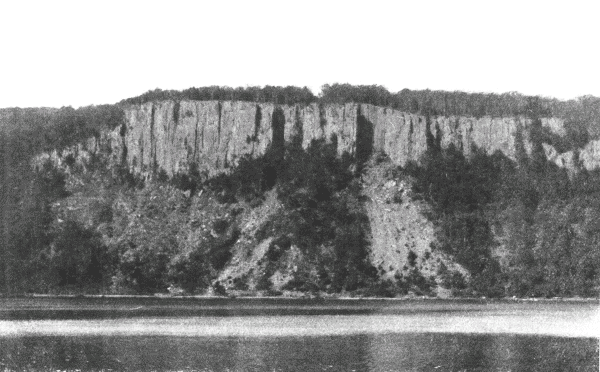
INDIAN HEAD, PALISADES
[page 57]
The word Manhattan signifies also it is said: "The People of the Islands," and it was evidently used by the Indians as a generic term designating the inhabitants of the island itself, and also of Long Island and the Neversink. This is in accordance with the testimony of Van der Donck. With Irving we all recognize the music and poetry of the name and are proud that our river of beauty is so happily heralded.
Spuyten Duyvil Creek.—Above Washington Heights, on the east bank, the Spuyten Duyvil meets the Hudson. This stream is the northern boundary of New York Island, and a short distance east of the Hudson bears the name of Harlem River. Its course is south-east and joins the East River at Randall's Island, just above Hell Gate. It is a curious fact that this modest stream should be bounded by such suggestive appellations as Hell Gate and Spuyten Duyvil. This is the first point of special legendary interest to one journeying up the Hudson and it takes its name according to the veracious Knickerbocker, from the following incident: It seems that the famous Antony Van Corlear was despatched one evening with an important message up the Hudson. When he arrived at this creek the wind was high, the elements were in an uproar, and no boatman at hand. "For a short time," it is said, "he vapored like an impatient ghost upon the brink, and then, bethinking himself of the urgency of his errand, took a hearty embrace of his stone bottle, swore most valorously that he would swim across en spijt en Duyvil (in spite of the Devil), and daringly plunged into the stream. Scarce had he buffeted half way over when he was observed to struggle violently, as if battling with the spirit of the waters. Instinctively he put his trumpet to his mouth, and giving a vehement blast—sank forever to the bottom."
O legends full of life and health, That live when records fail and die, Ye are the Hudson's richest wealth, The frondage of her history! Wallace Bruce.
The main branch of the Hudson River Railroad, with its station at Forty-second Street and Fourth Avenue, crosses the Harlem River at Mott Haven, and, following[page 58] its northern bank, meets the Hudson at this point, where the 30th Street branch, following the river, joins the main line. The steamer now passes Riverdale, with its beautiful residences and the Convent of Mount St. Vincent, one of the prominent landmarks of the Hudson, located on grounds bought of Edwin Forrest, the tragedian, whose "Font Hill Castle" appears in the foreground, and we come to
Yonkers, on the east bank, seventeen miles from New York, at the mouth of the Nepperhan. West of the creek is a large rock, called A-mac-lea-sin, the great stone to which the Indians paid reverence as an evidence of the permanency and immutability of their deity. The Mahican Village at the mouth of the creek was called Nappechemak. European settlements were made as early as 1639, as shown by deeds of purchase. Here are many important manufacturing industries: carpet, silk, and hat factories; mowers and reapers, gutta percha, rubber and pencil companies. Its "Recreation Pavilion" on the pier was a noble thing for the city to build—costing $50,000. The structure is of steel and capable of accommodating 5,000 people.
It is said that Yonkers derived its name from Yonk-herr—the young heir, or young sir, of the Phillipse manor. Until after the middle of the seventeenth century the Phillipse family had their principal residence at Castle Phillipse, Sleepy Hollow, but having purchased "property to the southward" from Adrian Van der Donck and obtained from the English king a patent creating the manor of Phillipsburgh, they moved from their old castle to the new "Manor Hall," which at this time was probably the finest mansion on the Hudson. This property was confiscated by act of Legislature in 1779, as Frederick Phillipse, third lord of the manor, was thought to lean toward royalty, and sold by the "Commissioners of Forfeiture" in 1785. It was afterwards purchased by John Jacob Astor, then passed to the Government, was bought[page 59] by the village of Yonkers in 1868, and became the City Hall in 1872. The older portion of the house was built in 1682, the present front in 1745. The woodwork is very interesting, also the ceilings, the large hall and the wide fire-place. In the room still pointed out as Washington's, the fire-place retains the old tiles, "illustrating familiar passages in Bible history," fifty on each side, looking as clear as if they were made but yesterday.
Once more I walk in the dark old street Wearily to and fro:— But I sit no more on the desolate pier Watching the river flow. Richard Henry Stoddard.
Mary Phillipse, belle of the neighborhood, and known in tradition as Washington's first love, was born in the "Manor House" July 3, 1730. Washington first met her on a visit to New York in 1756, after his return from Braddock's campaign, as guest of Beverly Robinson, who had married her elder sister.
It has been claimed by some writers that he proposed and was rejected, but it is doubtful whether he ever was serious in his attentions. At least there is no evidence that he ever "told his love," and she finally married Col. Roger Morris, one of Washington's associates on Braddock's staff. The best part of residential Yonkers lies to the northward, beautifully embowered in trees as seen from the Hudson. A line of electric street cars run north along Warburton Avenue. The street known as Broadway, is a continuation of Broadway, New York. Many of the river towns still keep this name, probably prophetic as a part of the great Broadway which may extend some day from the Battery to Peekskill.
Almost opposite Yonkers a ravine or sort of step-ladder cleft, now known as Alpine Gorge, reaches up the precipitous sides of the Palisades. The landing here was formerly called Closter's, from which a road zigzags to the top of the cliff and thence to Closter Village. Here Lord Grey disembarked in October, 1778, and crossed to Hackensack Valley, "surprising and massacring Col. Bayler's patriots, despite their surrender and calls for mercy."
Indian Head (510 feet) about two miles north of Alpine Gorge, is the highest point of the Palisades.
Eve o'er our path is stealing fast; Yon quivering splendors are the last; His latest glories fringe the height Behind us with their golden light. Robert C. Sands.
[page 60]
Yonkers to West Point
Passing Glenwood, now a suburban station of Yonkers, conspicuous from the Colgate mansion near the river bank, built by a descendant of the English Colgates who were familiar friends of William Pitt, and leaders of the Liberal Club in Kent, England, and "Greystone," once the country residence of the late Samuel J. Tilden, Governor of New York, and presidential candidate in 1876, we come to
Hastings, where a party of Hessians during the Revolutionary struggle were surprised and cut to pieces by troops under Colonel Sheldon. It was here also that Lord Cornwallis embarked for Fort Lee after the capture of Fort Washington, and here in 1850 Garibaldi, the liberator of Italy, whose centennial was observed July 4, 1907, frequently came to spend the Sabbath and visit friends when he was living at Staten Island. Although there is apparently little to interest in the village, there are many beautiful residences in the immediate neighborhood, and the Old Post road for two miles to the northward furnishes a beautiful walk or driveway, well shaded by old locust trees. The tract of country from Spuyten Duyvil to Hastings was called by the Indians Kekesick and reached east as far as the Bronx River.
Dobbs Ferry is now at hand, named after an old Swedish ferryman. The village has not only a delightful location but it is also beautiful in itself. In 1781 it was Washington's headquarters, and the old house, still standing, is famous as the spot where General Washington and the Count de Rochambeau planned the campaign against Yorktown; where the evacuation of New York was arranged by General Clinton and Sir Guy Carleton the British commander, and where the first salute to the flag of the United States was fired by a British man-of-war. A deep glen, known as Paramus, opposite Dobbs Ferry, leads to Tappan and New Jersey. Cornwallis[page 61] landed here in 1776. It is now known as Snedden's Landing.
A lovely country for a summer encampment, breezy hills commanding wide prospects, shady valleys watered by bright pastoral streams, the Bronx, the Spraine and the Neperan. Washington Irving.
At Dobbs Ferry, June 14, 1894, the base-stone of a memorial shaft was laid with imposing ceremony by the New York State Society of the Sons of the American Revolution, which erected the monument. There were one thousand Grand Army veterans in line, and addresses by distinguished orators and visitors. The Society and its guests, including members of the cabinet, officers of the army and navy, and prominent men of various States, accompanied by full Marine Band of the navy yard, with a detachment of Naval Reserves, participated in the event.
Voyagers up the river that day saw the "Miantonomoh" and the "Lancaster," under the command of Rear-Admiral Gherardi, anchored mid-stream to take part in the exercises. During the Revolution this historic house was leased by a Dutch farmer holding under Frederick Phillipse as landlord. After the war it was purchased by Peter Livingston and known since as the Livingston House. Arnold and Andre were to have met here but providentially for the American cause, the meeting took place at Haverstraw.
The Indian name of Dobbs Ferry was Wecquaskeck, and it is said by Ruttenber that the outlines of the old Indian village can still be traced by numerous shell-beds. It was located at the mouth of Wicker's Creek which was called by the Indians Wysquaqua.
Tappan Zee.—The steamer is now entering Irving's rich domain, and Tappan Zee lapping the threshold of "Sunnyside," seems almost a part of his very dooryard. The river, which has averaged about a mile in breadth, begins to gradually widen at Hastings, and almost seems like a gentle, reposeful lake.
Piermont, whose "mile-long-pier," built many years ago by the Erie Railroad, hardly mars the landscape so great is the majesty of the river, is seen on the west bank with Tower Hill rising above it from which four[page 62] states are seen. The view includes Long Island, the Sound and the Orange Mountains on the south, with the Catskills to the north and Berkshires to the northeast. Louis Gaylord Clark, a friend of Irving, and an early literary associate had a cottage on Piermont Hills.
We have a charming position for our French encampment along the Hudson among rocks and under magnificent tulip trees. Count Dumas.
Turning to the eastern shore, we see "Nuits," the Cottinet residence, Italian in style, built of Caen stone, "Nevis," home of the late Col. James Hamilton, son of Alexander Hamilton, the George L. Schuyler mansion, the late Cyrus W. Field's, and many pleasant places about Abbotsford, and come to
Irvington, on the east bank, 24 miles from New York, once known as Dearman's, but changed in compliment to the great writer and lover of the Hudson, who after a long sojourn in foreign lands, returned to live by the tranquil waters of Tappan Zee. In a letter to his brother he refers to Sleepy Hollow as the favorite resort of his boyhood, and says: "The Hudson is in a manner my first and last love, and after all my wanderings and seeming infidelities, I return to it with a heartfelt preference over all the rivers of the world." As at Stratford-on-Avon every flower is redolent of Shakespeare, and at Melrose every stone speaks of Walter Scott, so here on every breeze floats the spirit of Washington Irving. A short walk of half a mile north from the station brings us to his much-loved
"Sunnyside." Irving aptly describes it in one of his stories as "made up of gable-ends, and full of angles and corners as an old cocked hat. It is said, in fact, to have been modeled after the hat of Peter the Headstrong, as the Escurial of Spain was fashioned after the gridiron of the blessed St. Lawrence." Wolfert's Roost, as it was once styled (Roost signifying Rest), took its name from Wolfert Acker, a former owner. It consisted originally of ten acres when purchased by Irving in 1835, but eight acres were afterwards added. With great humor Irving put above the porch entrance "George Harvey,[page 63] Boum'r," Boumeister being an old Dutch word for architect. A storm-worn weather-cock, "which once battled with the wind on the top of the Stadt House of New Amsterdam in the time of Peter Stuyvesant, erects his crest on the gable, and a gilded horse in full gallop, once the weather-cock of the great Van der Heyden palace of Albany, glitters in the sunshine, veering with every breeze, on the peaked turret over the portal."
Irving chose his residence in the valley, not amid the mountains; by the fields and meadows of the broad Tappan Zee, rather than the Highlands; in a congenial region suited to his temperament. Dr. Bethune.
About fifty years ago a cutting of Walter Scott's favorite ivy at Melrose Abbey was transported across the Atlantic, and trained over the porch of "Sunnyside," by the hand of Mrs. Renwick, daughter of Rev. Andrew Jeffrey of Lochmaben, known in girlhood as the "Bonnie Jessie" of Annandale, or the "Blue-eyed Lassie" of Robert Burns:—a graceful tribute, from the shrine of Waverley to the nest of Knickerbocker:
A token of friendship immortal With Washington Irving returns:— Scott's ivy entwined o'er his portal By the Blue-eyed Lassie of Burns.
Scott's cordial greeting at Abbotsford, and his persistence in getting Murray to reconsider the publication of the "Sketch Book," which he had previously declined, were never forgotten by Irving. It was during a critical period of his literary career, and the kindness of the Great Magician, in directing early attention to his genius, is still cherished by every reader of the "Sketch Book" from Manhattan to San Francisco. The hearty grasp of the Minstrel at the gateway of Abbotsford was in reality a warm handshake to a wider brotherhood beyond the sea.
In purple tints woven together The Hudson shakes hands with the Tweed, Commingling with Abbotsford's heather The clover of Sunnyside's mead. Wallace Bruce.
Washington Irving.—While he was building "Sunnyside," a letter came from Daniel Webster, then Secretary of State, appointing him minister to Spain. It was unexpected and unsolicited, and Webster remarked that day to a friend: "Washington Irving to-day will be the most surprised man in America." Irving had already[page 64] shown diplomatic ability in London in promoting the settlement of the "North Western Boundary," and his appointment was received with universal favor. Then as now Sunnyside was already a Mecca for travelers, and, among many well-known to fame, was a young man, afterwards Napoleon the Third. Referring to his visit, Irving wrote in 1853: "Napoleon and Eugenie, Emperor and Empress! The one I have had as a guest at my cottage, the other I have held as a pet child upon my knee in Granada. The last I saw of Eugenie Montijo, she was one of the reigning belles of Madrid; now, she is upon the throne, launched from a returnless shore, upon a dangerous sea, infamous for its tremendous shipwrecks. Am I to live to see the catastrophe of her career, and the end of this suddenly conjured up empire, which seems to be of such stuff as dreams are made of? I confess my personal acquaintance with the individuals in this historical romance gives me uncommon interest in it; but I consider it stamped with danger and instability, and as liable to extravagant vicissitudes as one of Dumas' novels." A wonderful prophecy completely fulfilled in the short space of seventeen years.
How many such men as Washington Irving are there in America. God don't send many such spirits into this world. Lord Byron.
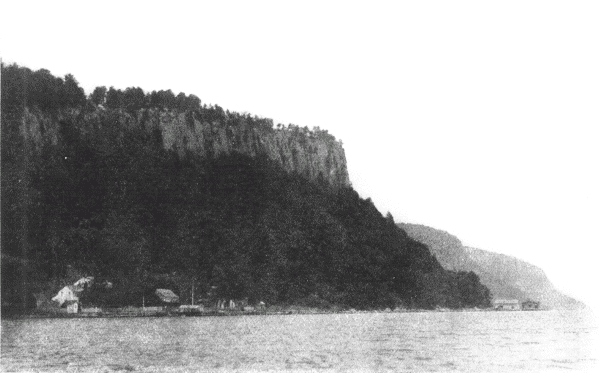
NORTHERN POINT OF PALISADES
The aggregate sale of Irving's works when he received his portfolio to Spain was already more than half a million copies, with an equal popularity achieved in Britain. No writer was ever more truly loved on both sides of the Atlantic, and his name is cherished to-day in England as fondly as it is in our own country. It has been the good fortune of the writer to spend many a delightful day in the very centre of Merrie England, in the quiet town of Stratford-on-Avon, and feel the gentle companionship of Irving. Of all writers who have brought to Stratford their heart homage Irving stands the acknowledged chief. The sitting-room in the "Red Horse Hotel," where he was disturbed in his midnight reverie, is still called Irving's room, and the walls are hung with portraits taken at different periods of his life. Mine[page 65] host said that visitors from every land were as much interested in this room as in Shakespeare's birth-place. The remark may have been intensified to flatter an American visitor, but there are few names dearer to the Anglo-Saxon race than that on the plain headstone in the burial-yard of Sleepy Hollow. Sunnyside is scarcely visible to the Day Line tourist. A little gleam of color here and there amid the trees, close to the river bank, near a small boat-house, merely indicates its location; and the traveler by train has only a hurried glimpse, as it is within one hundred feet of the New York Central Railroad. Tappan Zee, at this point, is a little more than two miles wide and over the beautiful expanse Irving has thrown a wondrous charm. There is, in fact, "magic in the web" of all his works. A few modern critics, lacking appreciation alike for humor and genius, may regard his essays as a thing of the past, but as long as the Mahicanituk, the ever-flowing Hudson, pours its waters to the sea, as long as Rip Van Winkle sleeps in the blue Catskills, or the "Headless Horseman" rides at midnight along the Old Post Road en route for Teller's Point, so long will the writings of Washington Irving be remembered and cherished. We somehow feel the reality of every legend he has given us. The spring bubbling up near his cottage was brought over, as he gravely tells us, in a churn from Holland by one of the old time settlers, and we are half inclined to believe it; and no one ever thinks of doubting that the "Flying Dutchman," Mynheer Van Dam, has been rowing for two hundred years and never made a port. It is in fact still said by the old inhabitants, that often in the soft twilight of summer evenings, when the sea is like glass and the opposite hills throw their shadows across it, that the low vigorous pull of oars is heard but no boat is seen.
Here was no castle in the air, but a realized day-dream. Irving was there, as genial, humorous and imaginative as if he had never wandered from the primal haunts of his childhood and his fame. Henry T. Tuckerman.
According to Irving "Sunnyside" was once the property of old Baltus Van Tassel, and here lived the fair Katrina, beloved by all the youths of the neighborhood, but more[page 66] especially by Ichabod Crane, the country school-master, and a reckless youth by the name of Van Brunt. Irving tells us that he thought out the story one morning on London Bridge, and went home and completed it in thirty-six hours. The character of Ichabod Crane was a sketch of a young man whom he met at Kinderhook when writing his Knickerbocker history. It will be remembered that Ichabod Crane went to a quilting-bee at the home of Mynheer Van Tassel, and, after the repast, was regaled with various ghost stories peculiar to the locality. When the "party" was over he lingered for a time with the fair Katrina, but sallied out soon after with an air quite desolate and chop-fallen. The night grew darker and darker. He had never before felt so lonesome and miserable. As he passed the fatal tree where Arnold was captured, there started up before him the identical "Headless Horseman" to whom he had been introduced by the story of Brom Bones. Nay, not entirely headless; for the head which "should have rested upon his shoulders was carried before him on the pommel of the saddle. His terror rose to desperation. He rode for death and life. The strange horseman sped beside him at an equal pace. He fell into a walk. The strange horseman did the same. He endeavored to sing a psalm-tune, but his tongue clove to the roof of his mouth. If he could but reach the bridge Ichabod thought he would be safe. Away then he flew in rapid flight. He reached the bridge, he thundered over the resounding planks. Then he saw the goblin rising in his stirrups, and in the very act of launching his head at him. It encountered his cranium with a tremendous crash. He was tumbled headlong into the dirt, and the black steed and the spectral rider passed by like a whirlwind. The next day tracks of horses deeply dented in the road were traced to the bridge, beyond which, on the bank of a broad part of the brook, where the water ran deep and black, was found the hat of the unfortunate Ichabod, and close beside it a shattered[page 67] pumpkin." All honor to him who fills this working-day world with humor, romance and beauty!
I beg you will have the kindness to let me know when Mr. Irving takes pen in hand again; for assuredly I shall expect a very great treat which I may chance never to hear of but through your kindness. Walter Scott.
I want to visit Washington Irving, I want to see your stupendous scenery, I want to go to the grave of Washington. Lord Byron.
Lyndehurst, Helen M. Gould's residence. A short distance north of "Sunnyside" is the home of Helen M. Gould, whose modest and liberal use of wealth in noble charities has endeared her to every American heart. The place was first known as the Paulding Manor House, where William Paulding, early mayor of New York, and nephew of one of the captors of Andre had his country home. It is a beautiful specimen of old time English architecture, with a suggestion, as some writers have noted, of Newstead Abbey. This part of the Hudson is particularly rich in beautiful residences, rising tier upon tier from the river to the horizon. Albert Bierstadt, the artist, had here a beautiful home, unfortunately burned many years ago.
The Old Post Road from New York to Albany is in many particulars the richest and greatest highway of our country.
Tappan.—Almost opposite Irvington about two miles southwest of Piermont, is old Tappantown, where Major Andre was executed October 2, 1780. The removal of his body from Tappan to Westminster was by a special British ship, and a singular incident was connected with it. The roots of a cypress tree were found entwined about his skull and a scion from the tree was carried to England and planted in the garden adjoining Windsor Palace. It is a still more curious fact that the tree beneath which Andre was captured was struck by lightning on the day of Benedict Arnold's death in London. Further reference will be made to Andre in our description of Tarrytown, and also of Haverstraw, where Arnold and Andre met at the house of Joshua Hett Smith.
Tarrytown, 26 miles from New York. It was here on the Old Post Road, now called Broadway, a little north of the village, that Andre was captured and Arnold's treachery exposed. A monument erected on the spot by[page 68] the people of Westchester County, October 7, 1853, bears the inscription:
on this spot, the 23d day of september, 1780, the spy, MAJOR JOHN ANDRE, Adjutant-General of the British Army, was captured by John Paulding, David Williams, and Isaac Van Wart. all natives of this county. History has told the rest.
The following quaint ballad-verses on the young hero give a realistic touch to one of the most providential occurrences in our history:
He with a scouting party Went down to Tarrytown, Where he met a British officer, A man of high renown, Who says unto these gentlemen, "You're of the British cheer, I trust that you can tell me If there's any danger near?"
Then up stept this young hero, John Paulding was his name, "Sir, tell us where you're going And also whence you came?" "I bear the British flag, sir; I've a pass to go this way, I'm on an expedition, And have no time to stay."
Young Paulding, however, thought that he had plenty of time to linger until he examined his boots, wherein he found the papers, and, when offered ten guineas by Andre, if he would allow him to pursue his journey, replied: "If it were ten thousand guineas you could not stir one step."
The centennial anniversary of the event was commemorated in 1880 by placing, through the generosity of John Anderson, on the original obelisk of 1853, a large statue representing John Paulding as a minute man.
That overruling Providence which has so often and so remarkably interposed in our favor, never manifested itself more conspicuously than in the timely discovery of Arnold's treachery. George Washington.
[page 69]
Tarrytown was the very heart of the debatable ground of the Revolution and many striking incidents mark its early history. In 1777 Vaughan's troops landed here on their way to attack Fort Montgomery, and here a party of Americans, under Major Hunt, surprised a number of British refugees while playing cards at the Van Tassel tavern. The major completely "turned the cards" upon them by rushing in with brandished stick, which he brought down with emphasis upon the table, remarking with genuine American brevity, "Gentlemen, clubs are trumps." Here, too, according to Irving, arose the two great orders of chivalry, the "Cow Boys" and "Skinners." The former fought, or rather marauded under the American, the latter under the British banner; the former were known as "Highlanders," the latter as the "Lower-Party." In the zeal of service both were apt to make blunders, and confound the property of friend and foe. "Neither of them, in the heat and hurry of a foray, had time to ascertain the politics of a horse or cow which they were driving off into captivity, nor when they wrung the neck of a rooster did they trouble their heads whether he crowed for Congress or King George."
It was also a genial, reposeful country for the faithful historian, Diedrich Knickerbocker; and here he picked up many of those legends which were given by him to the world. One of these was the legend connected with the old Dutch Church of Sleepy Hollow. "A drowsy, dreamy influence seems to hang over the land, and to pervade the very atmosphere. Some say the place was bewitched by a high German doctor during the early days of the settlement; others that an old Indian chief, the wizard of his tribe, held his pow-wows there before Hendrick Hudson's discovery of the river. The dominant spirit, however, that haunts this enchanted region, is the apparition of a figure on horse-back, without a head, said to be the ghost of a Hessian trooper, and was known[page 70] at all the country firesides as the 'Headless horseman' of Sleepy Hollow."
O waters of Pocantico! Wild rivulet of wood and glen! May thy glad laughter, sweet and low, Long, long outlive the sighs of men. S.H. Thayer.
SLEEPY HOLLOW CHURCH.
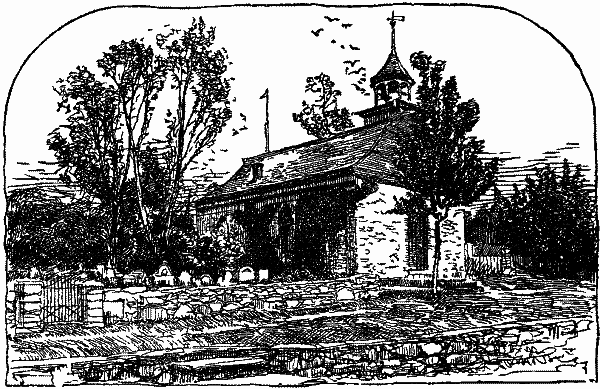
Sleepy Hollow.—The Old Dutch Church, the oldest on the Hudson, is about one-half mile north from Tarrytown.
It was built by "Frederick Filipse and his wife Katrina Van Cortland in 1690." The material is partly of stone and partly of brick brought from Holland. It stands as an appropriate sentinel near the entrance to the burial-yard where Irving sleeps. After entering the gate our way leads past the graves of the Ackers, the Van Tassels, and the Van Warts, with inscriptions and plump Dutch cherubs on every side that often delighted the heart of Diedrich Knickerbocker. How many worshippers since that November day in 1859, have come hither with reverent footsteps to read on the plain slab this simple inscription: "Washington Irving, born April 3, 1783. Died November 28, 1859," and recall Longfellow's beautiful lines:
[page 71]
"Here lies the gentle humorist, who died In the bright Indian Summer of his fame. A simple stone, with but a date and name, Marks his secluded resting place beside The river that he loved and glorified. Here in the Autumn of his days he came, But the dry leaves of life were all aflame With tints that brightened and were multiplied. How sweet a life was his, how sweet a death; Living to wing with mirth the weary hours, Or with romantic tales the heart to cheer; Dying to leave a memory like the breath Of Summers full of sunshine and of showers, A grief and gladness in the atmosphere."
If ever I should wish for a retreat whither I might steal from the world and its distractions, and dream quietly away the remnant of a troubled life, I know of none more promising than this little valley. Washington Irving.
Sleepy Hollow Church, like Sunnyside, is hidden away from the steamer tourist by summer foliage. Just before reaching Kingston Point light-house, a view, looking northeast up the little bay to the right, will sometimes give the outline of the building. Beyond this a tall granite shaft, erected by the Delavan family, is generally quite distinctly seen, and this is near the grave of Irving. A light-house, built in 1883, marks the point where the Pocantico or Sleepy Hollow Creek joins the Hudson:
Pocantico's hushed waters glide Through Sleepy Hollow's haunted ground, And whisper to the listening tide The name carved o'er one lowly mound.
To one loving our early history and legends there is no spot more central or delightful than Tarrytown. Irving humorously says that Tarrytown took its name from husbands tarrying too late at the village tavern, but its real derivation is Tarwen-Dorp, or Wheat-town. The name of the old Indian village at this point was Alipconck (the place of elms). It has often occurred to the writer that, more than any other river, the Hudson has a distinct personality, and also that the four main divisions of human life are particularly marked in the Adirondacks, the Catskills, the Highlands and Tappan Bay:
[page 72]
The Adirondacks, childhood's glee; The Catskills, youth with dreams o'ercast; The Highlands, manhood bold and free; The Tappan Zee, age come at last.
This was the spot that Irving loved; we linger by his grave at Sleepy Hollow with devotion; we sit upon his porch at Sunnyside with reverence:
Thrice blest and happy Tappan Zee, Whose banks along thy glistening tide Have legend, truth, and poetry Sweetly expressed in Sunnyside!
Whose golden fancy wove a spell As lasting as the scene is fair And made the mountain stream and dell His own dream-life forever share. Henry T. Tuckerman.
Nyack, on the west side, 27 miles from New York. The village, including Upper Nyack, West Nyack and South Nyack, has many fine suburban homes and lies in a semi-circle of hills which sweep back from Piermont, meeting the river again at the northern end of Tappan Zee. Tappan is derived from an Indian tribe of that name, which, being translated, is said to signify cold water. The bay is ten miles in length, with an average breadth of about two miles and a half.
Nyack grows steadily in favor as a place for summer residents. The hotels, boarding-houses and suburban homes would increase the census as given to nearly ten thousand people. The West Shore Railroad is two and a half miles from the Hudson, with (a) station at West Nyack. The Northern Railroad of New Jersey, leased by the New York, Lake Erie and Western (Chambers Street and 23d Street, New York), passes west of the Bergen Hills and the Palisades. The Ramapo Mountains, north of Nyack, were formerly known by ancient mariners as the Hook, or Point-no-Point. They come down to the river in little headlands, the points of which disappear as the steamer nears them. (The peak to the south, known as Hook Mountain, is 730 feet high.) Ball Mountain above this, and nearer the river, 650 feet. They were sometimes called by Dutch captains Verditege Hook.
The sails hung idly all night long, I dreamed a dream of you and me; 'Twas sweeter than the sweetest song,— The dream I dreamed on Tappan Zee. Wallace Bruce.
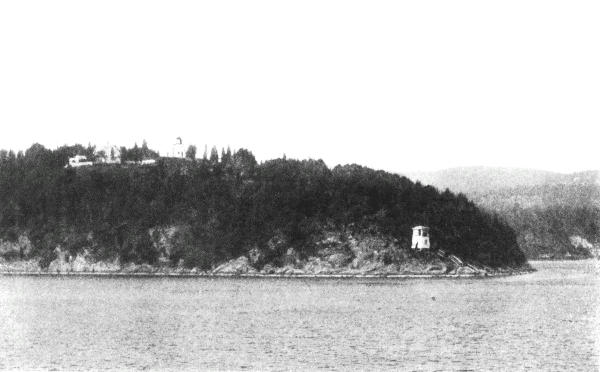
STONY POINT
[page 73]
Perhaps it took so long to pass these illusive headlands, reaching as they do eight miles along the western bank, that it naturally seemed a very tedious point to the old skippers. Midway in this Ramapo Range, "set in a dimple of the hills," is—
Rockland Lake, source of the Hackensack River, one hundred and fifty feet above the Hudson. The "slide way," by which the ice is sent down to the boats to be loaded, can be seen from the steamer, and the blocks in motion, as seen by the traveler, resemble little white pigs running down an inclined plane. As we look at the great ice-houses to-day, which, like uncouth barns, stand here and there along the Hudson, it does not seem possible that only a few years ago ice was decidedly unpopular, and wheeled about New York in a hand-cart. Think of one hand-cart supplying New York with ice! It was considered unhealthy, and called forth many learned discussions.
Returning to the east bank, we see above Tarrytown many superb residences, notably "Rockwood," the home of William Rockefeller, of the Standard Oil Company. The estate of General James Watson Webb is also near at hand. Passing Scarborough Landing, with the Hook Mountain and Ball Mountains on the left, we see
Ossining, formerly known as Sing Sing, on east bank. The low buildings, near the river bank, are the State's Prison. They are constructed of marble, but are not considered palatial by the prisoners that occupy the cells. It was quarried near by, and the prisons were built by convicts imported from Auburn in 1826. Saddlery, furniture, shoes, etc., are manufactured within its walls. There was an Indian chieftancy here known as the Sintsinks. In a deed to Philip Phillipse in 1685 a stream is referred to as "Kitchewan called by the Indians Sink-Sink." The Indian Village was known as Ossining, from "ossin" a stone and "ing" a place, probably so called from the rocky and stony character of the river banks.
How many, at this hour, along thy course, Slumber to thine eternal murmurings That mingle with the utterance of their dreams. William Cullen Bryant.
[page 74]
The heights above Tappan Zee at this point are crowned by fine residences, and the village is one of the pleasantest on the river. The drives among the hills are delightful and present a wide and charming outlook. Here also are several flourishing military boarding schools and a seminary for girls. The old silver and copper mines once worked here never yielded satisfactory returns for invested capital. Various industries give active life and prosperity to the town. Just above Sing Sing
Croton River, known by the Indians as Kitchawonk, joins the Hudson in a bay crossed by the New York Central Railroad Croton draw-bridge. East of this point is a water shed having an area of 350 square miles, which supplies New York with water. The Croton Reservoir is easily reached by a pleasant carriage drive from Sing Sing, and it is a singular fact that the pitcher and ice-cooler of New York, or in other words, Croton Dam and Rockland Lake, should be almost opposite. About fifty years ago the Croton first made its appearance in New York, brought in by an aqueduct of solid masonry which follows the course of the Hudson near the Old Post Road, or at an average distance of about a mile from the east bank. Here and there its course can be traced by "white stone ventilating towers" from Sing Sing to High Bridge, which conveys the aqueduct across the Harlem River. Its capacity is 100,000,000 gallons per day, which however began to be inadequate for the city and a new aqueduct was therefore begun in 1884 and completed in 1890, capable of carrying three times that amount, at a cost of $25,000,000. The water-shed is well supplied with streams and lakes. Lake Mahopac, one of its fountains, is one of the most beautiful sheets of water near the metropolis, and easily accessible by a pleasant drive from Peekskill, or by the Harlem Railroad from New York. The old Indian name was Ma-cook-pake, signifying a large inland lake, or perhaps an island near the shore. The same derivation is also seen in Copake Lake, Columbia[page 75] County. On an island of Mahopac the last great "convention" of the southern tribes of the Hudson was held. The lake is about 800 feet above tide, and it is pleasant to know that the bright waters of Mahopac and the clear streams of Putnam and Westchester are conveyed to New York even as the poetic waters of Loch Katrine to the city of Glasgow. The Catskill water supply, the ground of which was broken in 1907, is referred to in our description of Cold Spring and the Catskills.
Round the aqueducts of story As the mists of Lethe throng Croton's waves in all their glory Troop in melody along. George P. Morris.
Map of the Hudson River from Croton to Hyde Park.
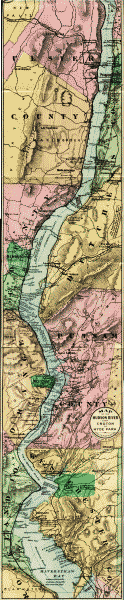
Just above Croton Bay and the New York Central Railroad draw-bridge will be seen the old Van Cortlandt Manor, where Frederick Phillipse and Katrina Van Cortlandt were married, as seen by the inscription on the old Dutch Church of Sleepy Hollow.
Teller's Point (sometimes known as Croton or Underhill's Point), separates Tappan Zee from Haverstraw Bay. It was called by the Indians "Senasqua." Tradition says that ancient warriors still haunt the surrounding glens and woods, and the sachems of Teller's Point are household words in the neighborhood. It is also said that there was once a great Indian battle here, and perhaps the ghosts of the old warriors are attracted by the Underhill grapery and the 10,000 gallons of wine bottled every season.
It was here the British warship "The Vulture," came with Andre and put him ashore at the foot of Mount Tor below Haverstraw.
The river now opens into a beautiful bay, four miles in width,—a bed large enough to tuck up fifteen River Rhines side by side. This reach sometimes seems in the bright sunlight like a molten bay of silver, and the tourist finds relief in adjusting his smoked glasses to temper the dazzling light.
Beneath these gold and azure skies The river winds through leafy glades, Save where, like battlements, arise The gray and tufted Palisades. Henry T. Tuckerman.
Haverstraw, 37 miles from New York. Haverstraw Bay is sometimes said to be five miles wide. Its widest point, however, from Croton Landing to Haverstraw, is,[page 76] according to United States Geological Survey, a little over four miles. The principal industry of Haverstraw is brick-making, and its brick yards reaching north to Grassy Point, are of materal profit, if not picturesque. The place was called Haverstraw by the Dutch, perhaps as a place of rye straw, to distinguish it from Tarrytown, a place of wheat. The Indian name has been lost; but, if its original derivation is uncertain, it at least calls up the rhyme of old-time river captains, which Captain Anderson of the "Mary Powell" told the writer he used to hear frequently when a boy:
"West Point and Middletown, Konnosook and Doodletown, Kakiak and Mamapaw, Stony Point and Haverstraw."
Quaint as these names now sound, they all are found on old maps of the Hudson.
High Torn is the name of the northern point of the Ramapo on the west bank, south of Haverstraw. According to the Coast Survey, it is 820 feet above tide-water, and the view from the summit is grand and extensive. The origin of the name is not clear, but it has lately occurred to the writer, from a re-reading of Scott's "Peveril of the Peak," that it might have been named from the Torn, a mountain in Derbyshire, either from its appearance, or by some patriotic settler from the central water-shed of England. Others say it is the Devonshire word Tor changed to Torn, evidently derived from the same source.
Emerging from these confused piles, the river as if rejoicing at its release from its struggle, expanded into a wide bay, which was ornamented by a few fertile and low points that jutted humbly into its broad basin. James Fenimore Cooper.
West Shore Railroad.—The tourist will see at this point, on the left bank of the river, the tunnel whereby the "West Shore" finds egress from the mountains. The traveler over this railway, on emerging from the quiet valley west of the Palisades, comes upon a sudden vision of beauty unrivaled in any land. The broad river seems like a great inland lake; and the height of the tunnel[page 77] above the silver bay gives to the panoramic landscape a wondrous charm. About a mile from the river, southwest of Grassy Point, on the farther side of the winding Minnissickuongo Creek, which finally after long meandering makes up its mind to glide into Stony Point Bay, will be seen Treason Hill marked by the Joshua Hett Smith stone house where Arnold and Andre met. The story of this meeting will be referred to at greater length in connection with its most dramatic incident at the old Beverley House in the Highlands. The Hudson here is about two miles in width and narrows rapidly as we pass Grassy Point on the west bank with its meadows and brick yards to
Stony Point, where it is scarcely more than half a mile to Verplank's Point on the eastern bank. This was, therefore, an important pass during the Revolution. The crossing near at hand was known as King's Ferry, at and before the days of '76, and was quite an avenue of travel between the Southern, Middle and Eastern States. The fort crowning a commanding headland, was captured by the British, June 1, 1779, but it was surprised and recaptured by Anthony Wayne, July 15 of the same year. A centennial was observed at the place July 15, 1879, when the battle was "refought" and the West Point Cadets showed how they would have done it if they had been on hand a century ago. Thackeray, in his "Virginians," gives perhaps the most graphic account of this midnight battle. The present light-house occupies the site of the old fort, and was built in part of stone taken from its walls. Upon its capture by the British, Washington, whose headquarters were at New Windsor, meditated a bold stroke and summoned Anthony Wayne, more generally known as "Mad Anthony," from his reckless daring, to undertake its recapture with a force of one thousand picked men. The lines were formed in two columns about 8 p.m. at "Springsteel's farm." Each soldier and officer put a piece of white paper in his hat[page 78] to distinguish him from the foe. No guns were to be loaded under penalty of death. General Wayne, at the head of the column, forded the marsh covered at the time with two feet of water. The other column led by Butler and Murfree crossed an apology for a bridge. During the advance both columns were discovered by the British sentinels and the rocky defense literally blazed with musketry. In stern silence, however, without faltering, the American columns moved forward, entered the abatis, until the advance guard under Anthony Wayne was within the enemy's works. A bullet at this moment struck Wayne in the forehead grazing his skull. Quickly recovering from the shock, he rose to his knees, shouted: "Forward, my brave fellows"; then turning to two of his followers, he asked them to help him into the fort that he might die, if it were to be so, "in possession of the spot." Both columns were now at hand and inspired by the brave general, came pouring in, crying "The fort's our own." The British troops completely overwhelmed, were fain to surrender and called for mercy. Wayne's characteristic message to Washington antedates modern telegraphic brevity:—"Stony Point, 2 o'clock a.m. The American flag waves here.—Mad Anthony." There were twenty killed and sixty wounded on each side. Some five hundred of the enemy were captured and about sixty escaped. "Money rewards and medals were given to Wayne and the leaders in the assault. The ordinance and stores captured were appraised at over $180,000 and there was universal rejoicing" throughout the land. "Stony Point State Park" was dedicated by appropriate ceremony July 16, 1902. At the close of Governor Odell's address the flag was raised by William Wayne, a lineal descendant of the hero, and the cruiser "Olympia" of Manila fame boomed forth her tribute. Verplank's Point, on the east bank (now full of brick-making establishments), was the site of Fort Lafayette. It was here that Baron Steuben drilled the soldiers of the American army. Back[page 79] from Green Cove above Verplanck's Point is "Knickerbocker Lake."
The star spangled banner, the flag of the brave, And the cross of old England in amity wave, But if ever the nations do battle again God send us such soldiers as Anthony Wayne. Minna Irving.
The echoes that so boldly rung When cannon flashed from steep to steep, And freedom's airy challenge flung, In each romantic valley sleep. Henry T. Tuckerman.
Tompkin's Cove.—North of Stony Point we see great quarries of limestone, the principal industry of the village of Tompkin's Cove. Gravel is also shipped from this place for Central Park roads and driveways in New York City. The tourist, looking north from the forward deck of the steamer, sees no opening in the mountains, and it is amusing to hear the various conjectures of the passengers; as usual, the "unexpected" happens. The steamer turns to the left and sweeps at once into the grand scenery of the Highlands. The straight forward course, which seems the more natural, would land the steamer against the Hudson River Railroad, crossing the Peekskill River. It is said that an old skipper, Jans Peek, ran up this stream, years before the railroad was built, and did not know that he had left the Hudson, or rather that the Hudson was "left" until he ran aground in the shoal water of the bay. The next morning he discovered that it was a goodly land, and the place bears his name unto this day.
The Highlands and the Palisades Mirror their beauty in the tide, The history of whose forest shades A nation reads with conscious pride. Wallace Bruce.
Peekskill, 40 miles from New York, is a pleasant city on the quiet bay which deeply indents the eastern bank. The property in this vicinity was known as Rycks Patent in 1665. In Revolutionary times Fort Independence stood on the point above, where its ruins are still seen. The Franciscan Convent Academy of "Our Lady of Angels," guards the point below. In 1797 Peekskill was the headquarters of old Israel Putnam, who rivaled "Mad Anthony" in brevity as well as courage. It will be remembered that Palmer was here captured as a spy. A British officer wrote a letter asking his reprieve, to which Putnam replied, "Nathan Palmer was taken as a spy, tried as a spy and will be hanged as a spy. P. S.—He is hanged." This was the birthplace of Paulding, one of Andre's captors, and he died here in 1818. He is buried in the old rural cemetery about two miles and a half[page 80] from the village, and a monument has been erected to his memory. Near at hand is the "Wayside Inn," where Andre once "tarried," also the Hillside Cemetery, where on June 19, 1898, the 123d anniversary of the battle of Bunker Hill, a monument was unveiled to General Pomeroy by the Society of the Sons of Revolution, New York. The church which Washington attended is in good preservation.
Near Peekskill is the old Van Cortlandt house, the residence of Washington for a short time during the Revolution. East of the village was the summer home of the great pulpit orator, Henry Ward Beecher. Peekskill was known by the Indians as Sackhoes in the territory of the Kitchawongo, which extended from Croton River to Anthony's Nose.
Turning Caldwell's Landing or Jones' Point, formerly known as Kidd's Point, almost at right angles, the steamer enters the southern gate of the Highlands. At the water edge will be seen some upright planks or caissons marking the spot where Kidd's ship was supposed to have been scuttled. As his history seems to be intimately associated with the Hudson, we will give it in brief:
The Story of Captain Kidd.—"My name was Captain Kidd as I sailed," are famous lines of an old ballad which was once familiar to our grandfathers. The hapless hero of the same was born about the middle of the seventeenth century, and it is thought, near Greenock, Scotland. He resided at one time in New York, near the corner of William and Cedar Streets, and was there married. In April, 1696, he sailed from England in command of the "Adventure Galley," with full armament and eighty men. He captured a French ship, and, on arrival at New York, put up articles for volunteers; remained in New York three or four months, increasing his crew to one hundred and fifty-five men, and sailed thence to Madras, thence to Bonavista and St. Jago, Madagascar, then to Calicut, then to Madagascar again, then sailed[page 81] and took the "Quedah Merchant." Kidd kept forty shares of the spoils, and divided the rest with his crew. He then burned the "Adventure Galley," went on board the "Quedah Merchant," and steered for the West Indies. Here he left the "Merchant," with part of his crew, under one Bolton, as commander. Then manned a sloop, and taking part of his spoils, went to Boston via Long Island Sound, and is said to have set goods on shore at different places. In the meantime, in August, 1698, the East Indian Company informed the Lords Justice that Kidd had committed several acts of piracy, particularly in seizing a Moor's ship called the "Quedah Merchant." When Kidd landed at Boston he was therefore arrested by the Earl of Bellamont, and sent to England for trial, 1699, where he was found guilty and executed. Now it is supposed that the crew of the "Quedah Merchant," which Kidd left at Hispaniola, sailed for their homes, as the crew was mostly gathered from the Highlands and above. It is said that they passed New York in the night, en route to the manor of Livingston; but encountering a gale in the Highlands, and thinking they were pursued, ran her near the shore, now known as Kidd's Point, and here scuttled her, the crew fleeing to the woods with such treasure as they could carry. Whether this circumstance was true or not, it was at least a current story in the neighborhood, and an enterprising individual, about fifty years ago, caused an old cannon to be "discovered" in the river, and perpetrated the first "Cardiff Giant Hoax." A New York Stock Company was organized to prosecute the work. It was said that the ship could be seen in clear days, with her masts still standing, many fathoms below the surface. One thing is certain—the company did not see it or the treasurer either, in whose hands were deposited about $30,000.
Beauty and majesty on either hand Have shared thy waters with their common realm. Knickerbocker Magazine.
SOUTHERN GATE OF HIGHLANDS
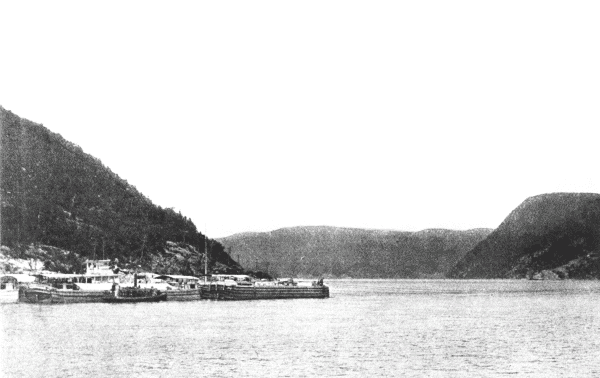
Their summits are the first to meet The morning's golden ray, And last to catch the crimson fires That warm the dying day. Minna Irving.
On the west shore rise the rock-beaten crags of—
The Dunderberg, the dread of the Dutch mariners.[page 82] This hill, according to Irving, was peopled with a multitude of imps, too great for man to number, who wore sugar-loaf hats and short doublets, and had a picturesque way of "tumbling head over heels in the rack and mist." They were especially malignant toward all captains who failed to do them reverence, and brought down frightful squalls on such craft as failed to drop the peaks of their mainsails to the goblin who presided over this shadowy republic. It was the dread of the early navigators—in fact, the Olympus of Dutch mythology. Verditege Hook, the Dunderberg, and the Overslaugh, were names of terror to even the bravest skipper. The old burghers of New York never thought of making their week's voyage to Albany without arranging their wills, and it created as much commotion in New Amsterdam as a modern expedition to the north pole. Dunderberg, in most of the Hudson Guides and Maps, is put down as 1,098 feet, but its actual altitude by the latest United States Geological Survey is 865 feet.
The State National Guard Encampment crowns a bluff, formerly known as Roa Hook, on the east bank, north of Peekskill Bay, a happy location in the midst of history and beauty. Every regiment in the State rallies here in turn during the summer months for instruction in the military art, living in tents and enjoying life in true army style. Visitors are cordially greeted at proper hours, and the camp is easily reached by ferry from Peekskill. A ferry also runs from Peekskill to Dunderberg, affording a hillside outing and a delightful view. It is expected that a spiral railroad, fourteen miles in length, undertaken by a recently organized corporation, but abandoned for the present, will make the spot a great Hudson River resort. The plan also embraces a palatial hotel on the summit and pleasure grounds upon the point at its base. Passing Manito Mountain on our right the steamer approaches
Anthony's Nose, a prominent feature of the Hudson.
The waters were hemmed in by abrupt and dark mountains, but the channel was still broad and smooth enough for all the steamboats in the Republic to ride in safety. Harriet Martineau.
ANTHONY'S NOSE.
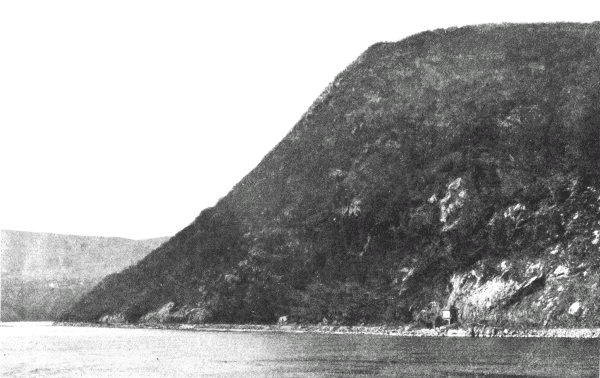
[page 83]
Strangely enough the altitude of the mountains at the southern portal of the Highlands has been greatly overrated. The formerly accepted height of Anthony's Nose has been reduced by the Geological Survey from 1,228 feet to 900. It has, however, an illustrious christening, and according to various historians several godfathers. One says it was named after St. Anthony the Great, the first institutor of monastic life, born A.D. 251, at Coma, in Heraclea, a town in Upper Egypt. Irving's humorous account is, however, quite as probable that it was derived from the nose of Antony Van Corlear, the illustrious trumpeter of Peter Stuyvesant. "Now thus it happened that bright and early in the morning the good Antony, having washed his burly visage, was leaning over the quarter-railing of the galley, contemplating it in the glassy waves below. Just at this moment the illustrious sun, breaking in all his splendor from behind a high bluff of the Highlands, did dart one of his most potent beams full upon the refulgent nose of the sounder of brass, the reflection of which shot straightway down hissing hot into the water, and killed a mighty sturgeon that was sporting beside the vessel. When this astonishing miracle was made known to the Governor, and he tasted of the unknown fish, he marveled exceedingly; and, as a monument thereof, he gave the name of Anthony's Nose to a stout promontory in the neighborhood, and it has continued to be called Anthony's Nose ever since." It was called by the Indians "Kittatenny," a Delaware term, signifying "endless hills." The stream flowing into the river south of Anthony's Nose is known as the Brocken Kill, broken into beautiful cascades from mountain source to mouth.
The beautiful and in some places highly singular banks of the Hudson rendered a voyage both amusing and interesting, while the primitive manners of the inhabitants diverted the gay and idle and pleased the thoughtful and speculative. Mrs. Grant of Laggan.
Iona Island, formerly a pleasure resort and picnic ground. An old-time joke of the Hudson was frequently perpetrated on strangers while passing the island. Some one would innocently observe, "I own a island on the Hudson." When any one obligingly asked, "Where?" the[page 84] reply would be with pointed finger, "Why there." But the United States Government owns it now against all comers, and its quiet lanes and picnic abandon have been exchanged for busy machine shops and military discipline. It is near the west bank, opposite Anthony's Nose. A short distance from the island, on the main land, was the village or cross-roads of Doodletown. This reach of the river was formerly known as The Horse Race, from the rapid flow of the tide when at its height. The hills on the west bank now recede from the river, forming a picturesque amphitheatre, bounded on the west by Bear Mountain. An old road directly in the rear of Iona Island, better known to Anthony Wayne than to the modern tourist, passes through Doodletown, over Dunderberg, just west of Tompkin's Cove, to Haverstraw. Here amid these pleasant foothills Morse laid the scene of a historical romance, which he however happily abandoned for a wider invention. The world can get along without the novel, but it would be a trifle slow without the telegraph. On the west bank, directly opposite the railroad tunnel which puts a merry "ring" into the tip of Anthony's Nose, is what is now known as Highland Lake, called by the Indians "Sinnipink," and by the immediate descendants of our Revolutionary fathers "Hessian Lake" or "Bloody Pond," from the fact that an American company were mercilessly slaughtered here by the Hessians, and, after the surrender of Fort Montgomery, their bodies were thrown into the lake.
Behold again the wildwood shade, The mountain steep, the checkered glade, And hoary rocks and bubbling rills, And pointed waves and distant hills. Robert C. Sands.
The capture of Fort Clinton and Fort Montgomery was two years before Mad Anthony's successful assault on Stony Point. Early in the history of the Revolution, the British Government thought that it would be possible to cut off the eastern from the middle and southern Colonies by capturing and garrisoning commanding points along the Hudson and Lake Champlain. It was therefore decided in London, in the spring of 1777, to have Sir Henry Clinton approach from the south and Burgoyne[page 85] from the north. Reinforcements, however, arrived late from England and it was September before Clinton transported his troops, about 4,000 in number, in warships and flat-boats up the river. Governor George Clinton was in charge of Fort Montgomery, and his brother James of Fort Clinton, while General Putnam, with about 2,000 men, had his headquarters at Peekskill. In addition to these forts, a chain was stretched across the Hudson from Anthony's Nose to a point near the present railroad bridge, to obstruct the British fleet. General Putnam, however, became convinced that Sir Henry Clinton proposed to attack Fort Independence. Most of the troops were accordingly withdrawn from Forts Montgomery and Clinton, when Sir Henry Clinton, taking advantage of a morning fog, crossed with 2,000 men at King's Ferry. Guided by a sympathizer of the British cause, who knew the district, he crossed the Dunderberg Mountain by the road just indicated. One division of 900 moving on Fort Montgomery, and another of 1,100 on Fort Clinton. Governor Clinton in the meantime ordered 400 soldiers to Fort Montgomery, and his reconnoitering party, met by the Hessians, fell back upon the fort, fighting as it retreated. Governor Clinton sent to General Putnam for reinforcements, but it is said that the messenger deserted, so that Putnam literally sat waiting in camp, unconscious of the enemy's movements. A simultaneous attack was made at 5 o'clock in the afternoon on both forts. Lossing says: "The garrisons were composed mostly of untrained militia. They behaved nobly, and kept up the defense vigorously, against a greatly superior force of disciplined and veteran soldiers, until twilight, when they were overpowered, and sought safety in a scattered retreat to the neighboring mountains. Many escaped, but a considerable number were slain or made prisoners. The Governor fled across the river in a boat, and at midnight was with General Putnam at Continental Village, concerting measures for stopping the invasion. James, forcing[page 86] his way to the rear, across the highway bridge, received a bayonet wound in the thigh, but safely reached his home at New Windsor. A sloop of ten guns, the frigate "Montgomery"—twenty-four guns—and two row-galleys, stationed near the boom and chain for their protection, slipped their cables and attempted to escape, but there was no wind to fill their sails, and they were burned by the Americans to prevent their falling into the hands of the enemy. The frigate "Congress," twenty-eight guns, which had already gone up the river, shared the same fate on the flats near Fort Constitution, which was abandoned. By the light of the burning vessels the fugitive garrisons made their way over the rugged mountains, and a large portion of them joined General Clinton at New Windsor the next day. They had left many of their brave companions behind, who, to the number of 250, had been slain or taken prisoners. The British, too, had parted with many men and brave officers. Among the latter was Lieutenant-Colonel Campbell. Early in the morning of the 7th of October, the river obstructions between Fort Montgomery and Anthony's Nose, which cost the Americans $250,000, were destroyed, and a light flying squadron, commanded by Sir James Wallace, and bearing a large number of land troops under General Vaughan, sailed up the river on a marauding expedition, with instructions from Sir Henry to scatter desolation in their paths. It was hoped that such an expedition would draw troops from the Northern army for the protection of the country below, and thereby assist Burgoyne."