NEW YORK TO ALBANY. (continued 2)
Reading edition
I love thy tempests when the broad-winged blast Rouses thy billows with his battle call, When gathering clouds, in phalanx black and vast Like armed shadows gird thy rocky wall. Knickerbocker Magazine.
Sir Henry Clinton, who had been advised by General Burgoyne that he must be relieved by October 12th, sent a messenger announcing his victory. Another of the many special providences of the American Revolution now occurs. The messenger blundered into the American camp, where some soldiers sat in British uniform, and found out too late that he was among enemies instead of friends. As Irving relates the incident in his "Life of Washington":
[page 87]
—"On the 9th (October) two persons coming from Fort Montgomery were arrested by the guard, and brought for examination. One was much agitated, and was observed to put something hastily into his mouth and swallow it. An emetic was administered, and brought up a silver bullet. Before he could be prevented he swallowed it again. On his refusing a second emetic, the Governor threatened to have him hanged and his body opened. This threat was effectual and the bullet was again 'brought to light.' It was oval in form, and hollow, with a screw in the centre, and contained a note from Sir Henry Clinton to Burgoyne, written on a slip of thin paper, and dated October 8th, from Fort Montgomery: 'Nous y voici (here we are), and nothing between us and Gates. I sincerely hope this little success of ours will facilitate your operations.' Burgoyne never received it, and on October 13th, after the battles of Bennington and Saratoga, surrendered to General Gates. Sir Henry Clinton abandoned the forts on hearing of his defeat, and returned to New York 'a sadder and wiser man.'"
Columbia! Columbia! to glory arise, The queen of the earth and the child of the skies. Timothy Dwight.
Far up the Hudson's silver flood I hear the Highlands call With whispering of leafy boughs And voice of waterfall. Minna Irving.
Beverley House.—Passing Cohn's Hook, pronounced Connosook, where Hendrick Hudson anchored on his way up the river September 14, 1609, we see before us on the right bank a point coming down to the shore marked by a boat house. This is Beverley Dock, and directly up the river bank about an eighth of a mile stood the old Beverley House, where Benedict Arnold had his headquarters when in command of West Point. The old house, a good specimen of colonial times, was unfortunately burned in 1892, and with it went the most picturesque landmark of the most dramatic incident of the Revolution. It will be remembered that Arnold returned to the Beverley House after his midnight interview with Andre at Haverstraw, and immediately upon the capture of Andre the following day, that Colonel Jamison sent a letter to Arnold, advising him of the fact. It was the morning of September 4th. General Washington was on[page 88] his way to West Point, coming across the country from Connecticut. On arriving, however, at the river, just above the present station of Garrison, he became interested in examining some defenses, and sent Alexander Hamilton forward to the Beverley House, saying that he would come later, requesting the family to proceed with their breakfast and not to await his arrival. Alexander Hamilton and General Lafayette sat gayly chatting with Mrs. Arnold and her husband when the letter from Jamison was received. Arnold glanced at the contents, rose and excused himself from the table, beckoning to his wife to follow him, bade her good-bye, told her he was a ruined man and a traitor, kissed his little boy in the cradle, rode to Beverley Dock, and ordered his men to pull off and go down the river. The "Vulture," an English man-of-war, was near Teller's Point, and received a traitor, whose miserable treachery branded him with eternal infamy on both continents. It is said that he lived long enough to be hissed in the House of Commons, as he once took his seat in the gallery, and he died friendless and despised. It is also said, when Talleyrand arrived in Havre on foot from Paris, in the darkest hour of the French Revolution, pursued by the bloodhounds of the reign of terror, and was about to secure a passage to the United States, he asked the landlord of the hotel whether any Americans were staying at his house, as he was going across the water, and would like a letter to a person of influence in the New World. "There is a gentleman up-stairs from Britain or America," was the response. He pointed the way, and Talleyrand ascended the stairs. In a dimly lighted room sat a man of whom the great minister of France was to ask a favor. He advanced, and poured forth in elegant French and broken English, "I am a wanderer, and an exile. I am forced to fly to the New World without a friend or home. You are an American. Give me, then, I beseech you, a letter of yours, so that I may be able to earn my bread." The[page 89] strange gentleman rose. With a look that Talleyrand never forgot, he retreated toward the door of the next chamber. He spoke as he retreated, and his voice was full of suffering: "I am the only man of the New World who can raise his hand to God and say, 'I have not a friend, not one, in America!'" "Who are you?" he cried—"your name?" "My name is Benedict Arnold!"
Wayne, Putnam, Knox and Heath are there, Steuben, proud Prussia's honored son; Brave Lafayette from France the fair, And chief of all our Washington. Wallace Bruce.
Andre's fate on the other hand was widely lamented. He was universally beloved by his comrades and possessed a rich fund of humor which often bubbled over in verse. It is a strange coincidence that his best poetic attempt on one of Anthony Wayne's exploits near Fort Lee, entitled "The Cow Chase," closed with a graphically prophetic verse:
"And now I've closed my epic strain, I tremble as I show it, Lest this same Warrior-Drover Wayne Should ever catch the poet."
By a singular coincidence he did: General Wayne was in command of the Tarrytown and Tappan country where Andre was captured and executed. It is also said that these lines were published by one of the Tory papers in New York the very day of Andre's capture. One of the old-time characters on the Hudson, known as Uncle Richard, has recently thrown new light on the capture of Andre by claiming, with a touch of genuine humor, that it was entirely due to the "effects" of cider which had been freely "dispensed" that day by a certain Mr. Horton, a farmer in the neighborhood.
In view of all he lost,—his youth, his love, And possibilities that wait the brave, Inward and outward bound dim visions move Like passing sails upon the Hudson's wave. Charlotte Fiske Bates.
It is impossible even in these later years, not to speak of twenty-five or fifty years ago, to travel along the shores of Haverstraw Bay or among the passes of the Highlands, without hearing some old-time stories about Arnold and Andre, and it would be strange indeed if a little romance had not here and there become blended with the real facts. Uncle Richard's account is undoubtedly[page 90] the best since the days of Knickerbocker. "Benedict Arnold, you know, had command of West Point, and he knew that the place was essential to the success of the Continental cause. He plotted, as everybody knows, to turn it over to the enemy, and in the correspondence which he carried on with General Clinton, young Andre, Clinton's aid, did all the writing. Things were coming to a focus, when a meeting took place between Arnold and Clinton's representative, Andre, at the house of Joshua Hett Smith, near Haverstraw. Andre came on the British ship "Vulture," which he left at Croton Point, in Haverstraw Bay. Well," so runs Uncle Richard's story, "it took a long time to get matters settled; they 'confabbed' till after daybreak. Then Arnold started back to the post which he had plotted to surrender. But daylight was no time for Andre to return to the "Vulture," so he hung round waiting for night.
"During that day, some men who were working for James Horton, a farmer on the ridge overlooking the river, who gave his men good rations of cider, drank a little too much of the hard stuff. They felt good, and thought it would be a fine joke to load and fire off an old disabled cannon which lay a mile or so away on the bank. They hauled it to the point now called Cockroft Point, propped it up, and then the spirit of fun—and hard cider—prompted them to train the old piece on the British ship "Vulture," lying at anchor in the Bay. The "Vulture's" people must have overestimated the source of the fire, for the ship dropped down the river, and Andre had to abandon the idea of returning by that means. He crossed the river at King's Ferry, and while on his way overland was captured at Tarrytown.
"Of course, the three brave men who refused to be bribed deserve all the glory they ever had; if it were not for them, who knows but the revolutionary war would have had a different ending. But they never would have had a chance to capture Andre if it had not been for[page 91] James Horton's men warming up on hard cider. Hard cider broke the plans of Arnold, it hung Andre, and it saved West Point." A boy misguided Grouchy en route to Waterloo. On what small hinges turn the destinies of nations!
A slanting ray lingered on the woody crests of the precipices that overhung the river, giving greater depth to the dark-gray and purple of the rocky sides. Washington Irving.
All the way from Anthony's Nose to Beverley Dock, where we have been lingering over the story of Andre, we have been literally turning a kaleidoscope of blended history and beauty, with scarcely time to note the delightful homes on the west bank, just above Fort Montgomery. Among them J. Pierpont Morgan's and the Pells', John Bigelow's and "Benny Havens'," or on the east bank of Hamilton Fish, just above Beverley Dock, Samuel Sloan and the late William H. Osborn, just north of Sugar Loaf Mountain; the mountain being so named as it resembles, to one coming up the river, the old-fashioned conical-shaped sugar-loaf, which was formerly suspended by a string over the centre of the hospitable Dutch tables, and swung around to be occasionally nibbled at, which in good old Knickerbocker days, was thought to be the best and only orthodox way of sweetening tea.
Buttermilk Falls, so christened by Washington Irving, is a pretty little cascade on the west bank. Like sparkling wit, it is often dry, and the tourist is exceptionally fortunate who sees it in full-dress costume after a heavy shower, when it rushes over the rocks in floods of snow-white foam. Highland Falls is the name of a small village a short distance west of the river, on the bluff, but not seen from the deck of the steamer.
The large building above the rocky channel is Lady Cliff, the Academy of Our Lady of Angels, under the Franciscan Sisters at Peekskill, opened September, 1900. It was originally built for a hotel, and widely known as Cranston's Hotel and Landing. As the steamer is now approaching the west bank we see above us the Cullum Memorial Hall, completed in 1899, a bequest of the late George W. Cullum of the class of 1833. The still[page 92] newer structure to the south is the officers' messroom, crowning the crest above the landing.
Then, as you nearer draw, each wooded height Puts off the azure hues by distance given! And slowly breaks upon the enamored sight, Ravine, crag, field and wood in colors true and bright. Theodore S. Fay.
West Point, taken all in all, is the most beautiful tourist spot on the Hudson. Excursionists by the Day Boats from New York, returning by afternoon steamer, have three hours to visit the various places of history and beauty. To make an easy mathematical formula or picturesque "rule of three" statement, what Quebec is to the St. Lawrence, West Point is to the Hudson. If the citadel of Quebec is more imposing, the view of the Hudson at this place is grander than that of the St. Lawrence, and the ruins of Fort Putnam are almost as venerable as the Heights of Abraham. The sensation of the visitor is, moreover, somewhat the same in both places as to the environment of law and authority. To get the daily character and quality of West Point one should spend at least twenty-four hours within its borders, and a good hotel, the only one on the Government grounds, will be found central and convenient to everything of interest. The parade and drills at sunset hour can best be seen in this way.
The United States Military Academy.—Soon after the close of the War of the Revolution, Washington suggested West Point as the site of a military academy, and, in 1793, in his annual message, recommended it to Congress, which in 1794 organized a corps of artillerists to be here stationed with thirty-two cadets, enlarging the number in 1798 to fifty-six. In 1808 it was increased to one hundred and fifty-six, and in 1812 to two hundred and sixty.
Up to 1812 only 71 cadets had been graduated. The roll of graduates now numbers about 5,000.
Each Congressman has the appointment of one cadet, supplemented by ten appointed by the President of the United States. These cadets are members of the regular army, subject to its regulations for eight years, viz: during four years of study and four years after graduating. The candidates are examined in June, each year, and[page 93] must be physically sound as well as mentally qualified. The course is very thorough, especially in higher mathematics. The cadets go into camp in July and August, and this is the pleasantest time to visit the point.
Enchanted place, hemmed in by mountain walls, By bristling guns and Hudson's restful shore. Kenneth Bruce.
The plans furnished by the architects of the new building will entirely change the appearance of the river front. The proposed massive structure crowning the cliff will "out-castle" the most massive fortifications of the walled cities of Europe. $7,500,000 has been appropriated to the work by Congress and the next generation will behold a new West Point.
In the rebuilding of the Post the Cadet Chapel, the Riding Hall, the Administration Building and some of the Officers' Quarters will be removed. Most of the old important buildings, however, will not be disturbed, and the Chapel will be placed as it were "intact" on another site. The plan leaves untouched the Cadet Barracks, the Cadet Mess, the Memorial Hall, the Library and the Officers' Mess. The tower of the new Post Headquarters will rise high and massive several stories above the other structures and present in enduring symbol the republic standing four square and firm throughout the ages.
In the "West Point Souvenir," prepared by W. H. Tripp, which every visitor will prize, are many suggestions and descriptions of value. From many visits and many sources we condense the following brevities:
The Cadet Barracks was built in 1845-51 of native granite. In 1882 the western wing was extended adding two divisions.
The Academy Building is immediately opposite the Headquarters, of Massachusetts granite, erected in 1891-95, and cost about $500,000. It contains recitation and lecture rooms of all departments of instruction.
The Ordnance Museum contains an interesting and extensive exhibit of ancient and modern firearms, also many valuable trophies from the Revolutionary, Mexican, Civil and Spanish wars.
Among the fair and lovely Highlands of the Hudson, shut in by deep green heights and ruined forts, hemmed in all round with memories of Washington, there could be no more appropriate ground for the military school of America. Charles Dickens.
[page 94]
The Cadet Chapel, immediately north of the Administration Building, was erected in 1834. The chapel contains many valuable trophies of the Revolutionary and Mexican wars, including three Hessian and two British flags that were once the property of Washington. The walls have many memorial tablets and a famous "blank" of Arnold. Here also are several cannon surrendered at Saratoga, October 17, 1777.
The Administration Building was completed in 1871.
The Library adjoins the Cadet Chapel on the east, built of native granite in 1841, costing about $15,000. In 1900 the building was entirely reconstructed of fire-proof material by appropriation of $80,000. The exterior walls of the original building entered into the remodeled structure. The Library, founded in 1812, has about 50,000 volumes.
The Gymnasium adjoins the Barracks on the west, erected of native granite, costing $90,000.
Memorial Hall, plainly seen from the Hudson, completed in 1899, is of Ionic architecture. The building cost $268,000, a legacy bequeathed by Gen. George W. Cullum, built of Milford granite for army trophies of busts, paintings and memorials. The bronze statute of Gen. John Sedgwick in the northwest angle of the plain was dedicated in 1868. The fine cenotaph of Italian marble was erected in 1885. It stands immediately in front of Memorial Hall.
Kosciusko's Monument was erected in 1828. It stands in the northeast angle of Fort Clinton.
The Chain-Battery walk runs from Kosciusko's Garden northward to Light House Point, near which was the battery that defended the chain across the river in the Revolution. The scene is of great beauty and has been known for many years by the name of "Flirtation Walk."
Where Kosciusko dreamed and proud scenes bring To mind the stormy days when Liberty Was cradled at West Point—the Highlands' key. Kenneth Bruce.
BATTLE MONUMENT, WEST POINT
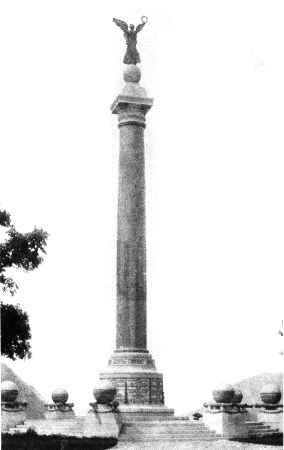
The Battle Monument, on Trophy Point, is the most beautiful on the reservation—a column of victory in memory of 2,230 officers and soldiers of the regular army[page 95] of the United States who were killed or died of wounds received in the war of the Rebellion. It is a monolith of polished granite surmounted by a figure of Fame. The shaft is 46 feet in length, 5 feet in diameter, and said to be the largest piece of polished stone in the world. The cost of the work was $66,000. The site was dedicated June 15, 1864. The monument was dedicated in 1897. The address was by Justice Brewer.
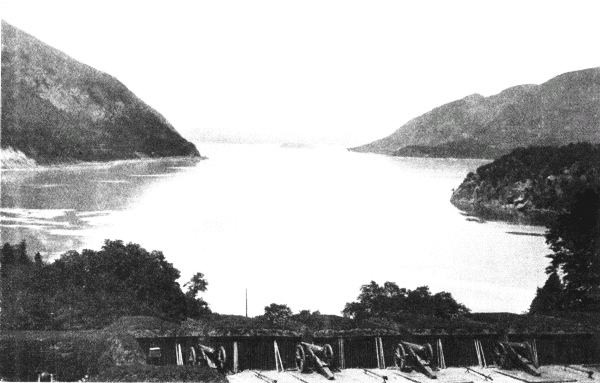
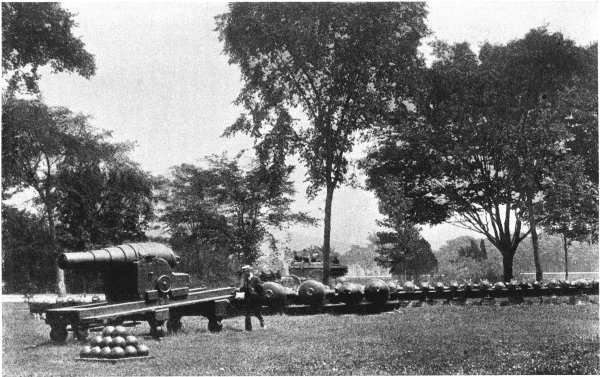
Trophy Point, on the north side of the plain, overlooking the river and commanding a majestic view of the Hudson and the city of Newburgh, has been likened by European travelers to a view on Lake Geneva. Here are the "swivel clevies" and 16 links of the old chain that was stretched across the river at this point. The whole chain, 1,700 feet long, weighing 186 tons, was forged at the Sterling Iron Works, transported to New Windsor and there attached to log booms and floated down the river to this point.
Old Fort Putnam was erected in 1778 by the 5th Massachusetts Regiment under the direction of Col. Rufus Putnam. It was originally constructed of logs and trees with stone walls on two sides to defend Fort Clinton on the plain below. It was garrisoned by 450 men, and had 14 guns mounted. In 1787 it was dismantled, and the guns sold as old iron. Its brick arch casements overgrown with moss, vines, and shrubbery are crumbling away, but are well worth a visit. It is 495 feet above the Hudson. A winding picturesque carriage road leads up from the plain, and the pedestrian can reach the summit in 20 minutes. On clear days the Catskill Mountains are visible.
Fort Clinton, in the northeast angle of the plain, was built in 1778 under the direction of the Polish soldier, Kosciusko. Sea Coast Battery is located on the north waterfront, Siege Battery on the slope of the hill below the Battle Monument. Targets for the guns on both batteries are on the hillside about a mile distant. Battery[page 96] Knox, which overlooks the river, was rebuilt in 1874 on the site of an old revolutionary redoubt.
Bright are the moments link'd with thee, Boast of a glory-hallowed land! Hope of the valiant and the free, Home of our youthful soldier band! Anonymous.
While Fort Putnam was being built Washington was advised that Dubois's regiment was unfit to be ordered on duty, there being "not one blanket in the regiment. Very few have either a shoe or a shirt, and most of them have neither stockings, breeches, or overalls. Several companies of inlisted artificers are in the same situation, and unable to work in the field."
What privations were here endured to establish our priceless liberty! It makes better Americans of us all to turn and re-turn the pages of the real Hudson, the most picturesque volume of the world's history.
West Point during the Revolution was the Gibraltar of the Hudson and her forts were regarded almost impregnable. Fort Putnam will be rebuilt as an enduring monument to the bravery of American soldiers.
The best way to study West Point, however, is not in voluminous histories or in the condensed pages of a guide book, but to visit it and see its real life, to wander amid its old associations, and ask, when necessary, intelligent questions, which are everywhere courteously answered. The view north seen in a summer evening, is one long to be remembered. In such an hour the writer's idea of the Hudson as an open book with granite pages and crystal book-mark is most completely realized as indicated in the Highland section of his poem, "The Hudson":
On either side these mountain glens Lie open like a massive book, Whose words were graved with iron pens, And lead into the eternal rock:
Which evermore shall here retain The annals time cannot erase, And while these granite leaves remain This crystal ribbon marks the place.
Under Spring's delicate marshalling every hill of the Highlands took its own place, and the soft swells of ground stood back the one from the other in more and more tender coloring. Susan Warner.
LOOKING NORTH FROM WEST POINT BATTERY
[page 97]
West Point to Newburgh.
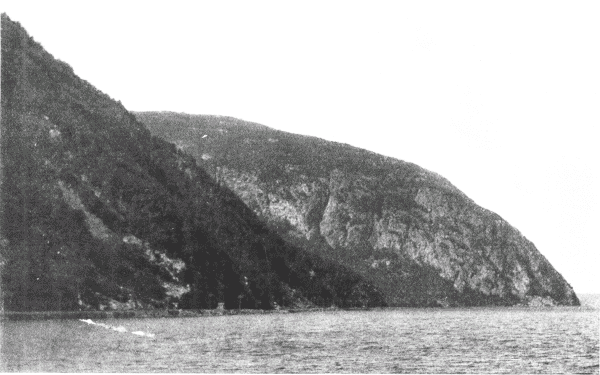
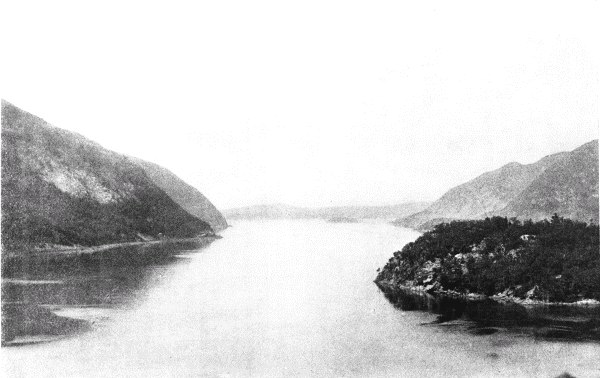
The steamer passes too near the west bank to give a view of the magnificent plateau with parade ground and Government buildings, but on rounding the point a picture of marvelous beauty breaks at once upon the vision. On the left the massive indented ridge of Old Cro' Nest and Storm King, and on the right Mount Taurus, or Bull Hill, and Break Neck, while still further beyond toward the east sweeps the Fishkill range, sentineled by South Beacon, 1,625 feet in height, from whose summit midnight gleams aroused the countryside for leagues and scores of miles during those seven long years when men toiled and prayed for freedom. Close at hand on the right will be seen Constitution Island, formerly the home of Miss Susan Warner, who died in 1885, author of "Queechy" and the "Wide, Wide World." Here the ruins of the old fort are seen. The place was once called Martalaer's Rock Island. A chain was stretched across the river at this point to intercept the passage of boats up the Hudson, but proved ineffectual, like the one at Anthony's Nose, as the impetus of the boats snapped them both like cords.
Some years ago, when the first delegation of Apache Indians was brought to Washington to sign a treaty of peace, the Indians were taken for an "outing" up the Hudson, by General O. O. Howard and Dr. Herman Bendell, Superintendent of Indian Affairs for Arizona. It is said that they noted with cold indifference the palaces along the river front: "the artistic terraces, the well-kept, sloping lawns, the clipped hedges and the ivy-grown walls made no impression on them, but when the magnificent picture of the Hudson above West Point revealed itself, painted by the rays of the sinking sun, these wild men stood erect, raised their hands high above their heads and uttered a monosyllabic expression of[page 98] delight, which was more expressive than volumes of words."
The queenly Hudson circling at thy feet Lingers to sing a song of joy and love, Pouring her heart in rippling wavelets sweet, Which sun-kissed glance up to thy throne above. Kenneth Bruce.
Sir Robert Temple also rises into rapture over the northern gate of the Highlands. "One of the fairest spectacles to be seen on the earth's surface; not on any other river or strait—not on Ganges or Indus, on the Dardanelles or the Bosphorus, on the Danube or the Rhine, on the Neva or the Nile—have I ever observed so fairy-like a scene as this on the Hudson. The only water-view to rival it is that of the Sea of Marmora, opposite Constantinople."
Most people who visit our river, naturally desire a brilliant sunlit day for their journey, and with reason, but there are effects, in fog and rain and driving mist, only surpassed amid the Kyles of Bute, in Scotland. The traveler is fortunate, who sees the Hudson in many phases, and under various atmospheric conditions. A midnight view is peculiarly impressive when the mountain spirits of Rodman Drake answer to the call of his "Culprit Fay."
"'Tis the middle watch of a summer night, The earth is dark but the heavens are bright, The moon looks down on Old Cro' Nest— She mellows the shade on his shaggy breast, And seems his huge gray form to throw In a silver cone on the wave below."
It is said that the "Culprit Fay" was written by Drake in three days, and grew out of a discussion which took place during a stroll through this part of the Highlands between Irving, Halleck, Cooper and himself, as to the filling of a new country with old-time legends. Drake died in 1820. Halleck's lines to his memory are among the sweetest in our language. It is said that Halleck, on hearing Drake read his poem, "The American Flag," sprang to his feet, and in a semi-poetic transport, concluded the lines with burning words, which Drake afterwards appended:
[page 99]
"Forever float that standard sheet, Where breathes the foe but falls before us, With Freedom's soil beneath our feet, And Freedom's banner streaming o'er us."
It floweth deep and strong and wide This river of romance Along whose banks on moonlight nights The Highland fairies dance. E.A. Lente.
Just opposite Old Cro' Nest is the village of Cold Spring, on the east bank, which receives its name naturally from a cold spring in the vicinity; and it is interesting to remember that the famous Parrott guns were made at this place, and many implements of warfare during our civil strife. The foundry was started by Gouverneur Kemble in 1828, and brought into wide renown by the inventive genius of Major Parrott. Cold Spring has a further distinction in having the first ground broken, about three miles from the river, for the greatest engineering enterprise of the age—"The Water Supply of the Catskills," when Mayor McClellan, in June, 1907, began the work with his silver shovel. A short distance north of the village is
Undercliff (built by John C. Hamilton, son of Alexander Hamilton, but more particularly associated with the memory of the poet, Col. George P. Morris), lies, in fact, under the cliff and shadow of Mount Taurus, and has a fine outlook upon the river and surrounding mountains. Standing on the piazza, we see directly in front of us Old Cro' Nest, and it was here that the poet wrote:
"Where Hudson's wave o'er silvery sands Winds through the hills afar, Old Cro' Nest like a monarch stands Crowned with a single star."
Few writers were better known in their own day than the poet of Undercliff, who wrote "My Mother's Bible," and "Woodman, Spare that Tree." On one occasion, when Mr. Russell was singing it at Boulogne, an old gentleman in the audience, moved by the simple and touching beauty of the lines,
"Forgive the foolish tear, But let the old oak stand."
[page 100]
rose and said: "I beg your pardon, but was the tree really spared?" "It was," answered Mr. Russell, and the old gentleman resumed his seat, amid the plaudits of the whole assembly. Truly
"Its glory and renown Are spread o'er land and sea."
When freedom from her mountain height Unfurled her standard to the air, She tore the azure robe of night And set the stars of glory there. Joseph Rodman Drake.
The first European name given to Storm King was Klinkersberg (so called by Hendrick Hudson, from its glistening and broken rock). It was styled by the Dutch "Butter Hill," from its shape, and, with Sugar Loaf on the eastern side below the point, helped to set out the tea-table for the Dunderberg goblins. It was christened by Willis, "Storm King," and may well be regarded the El Capitan of the Highlands. Breakneck is opposite, on the east side, where St. Anthony's Face was blasted away. In this mountain solitude there was a shade of reason in giving that solemn countenance of stone the name of St. Anthony, as a good representative of monastic life; and, by a quiet sarcasm, the full-length nose below was probably suggested.
The mountain opposite Cro' Nest is "Bull Hill," or more classically, "Mt. Taurus." It is said that there was formerly a wild bull in these mountains, which had failed to win the respect and confidence of the inhabitants, so the mountaineers organized a hunt and drove him over the hill, whose name stands a monument to his exit. The point at the foot of "Mount Taurus" is known as "Little Stony Point."
The Highlands now trend off to the northeast, and we see North Beacon, or Grand Sachem Mountain, and Old Beacon about half a mile to the north. The mountains were relit with beacon-fires in 1883, in honor of the centennials of Fishkill and Newburgh, and were plainly seen sixty miles distant.
This section was known by the Indians as "Wequehache," or, "the Hill Country," and the entire range was[page 101] called by the Indians "the endless hills," a name not inappropriate to this mountain bulwark reaching from New England to the Carolinas. As pictured in our "Long Drama," given at the Newburgh centennial of the disbanding of the American Army,
That ridge along our eastern coast, From Carolina to the Sound, Opposed its front to Britain's host, And heroes at each pass were found:
A vast primeval palisade, With bastions bold and wooded crest, A bulwark strong by nature made To guard the valley of the west.
Along its heights the beacons gleamed, It formed the nation's battle-line, Firm as the rocks and cliffs where dreamed The soldier-seers of Palestine.
It was also believed by the Indians that, in ancient days, "before the Hudson poured its waters from the lakes, the Highlands formed one vast prison, within whose rocky bosom the omnipotent Manitou confined the rebellious spirits who repined at his control. Here, bound in adamantine chains, or jammed in rifted pines, or crushed by ponderous rocks, they groaned for many an age. At length the conquering Hudson, in its career toward the ocean, burst open their prison-house, rolling its tide triumphantly through the stupendous ruins."
The Highlands are here moulded in all manner of heights and hollows; sometimes reaching up abruptly to twelve or fifteen hundred feet, and again stretching away in long gorges and gentle declivities. Susan Warner.
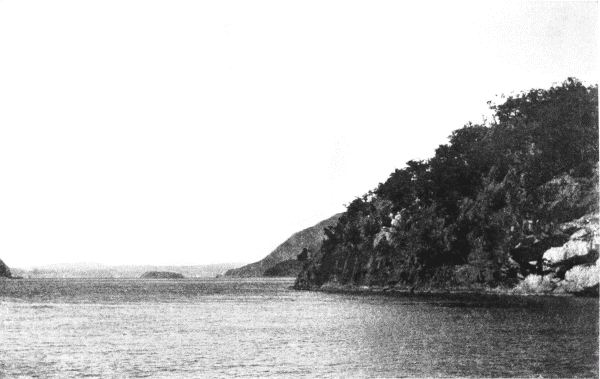
Pollopel's Island, east of the steamer's route, was once regarded as a haunted spot, but its only witches are said to be snakes too lively to be enchanted. In old times, the "new hands" on the sloops were unceremoniously dipped at this place, so as to be proof-christened against the goblins of the Highlands. Here also another useless "impediment" was put across the Hudson in 1779, a chevaux-de-frise with iron-pointed spikes thirty feet long, hidden under water, strongly secured by cribs of stone. This, however, was not broken and would probably have done effective work if some traitor to the cause had not[page 102] guided the British captains through an unprotected passage. The State at one time contemplated the purchase of this island on which to erect a statue to Hendrick Hudson. For some reason Governor Flower vetoed the bill. It is now owned by Mr. Francis Bannerman, an energetic business man, who perhaps some day may see his way to promote a monument to Hudson on the splendid pedestal which nature has already completed.
What sights and sounds at which the world has wondered Within these wild ravines have had their birth! Young Freedom's cannon from these glens have thundered And sent their startling echoes o'er the earth. Charles Fenno Hoffman.
Cornwall-on-the-Hudson.—This locality N. P. Willis selected as the most picturesque point on the Hudson. The village lies in a lovely valley, which Mr. Beach has styled in his able description, as "an offshoot of the Ramapo, up which the storm-winds of the ocean drive, laden with the purest and freshest air."
Idlewild.—Where Willis spent the last years of his life is a charming spot and rich with poetic memories. E. P. Roe also chose Cornwall for his home. Lovers of the Hudson are indebted to Edward Bok for his realistic sketch of an afternoon visit. The "Idlewild" of to-day is still green to the memory of the poet. Since Willis' death the place has passed in turn into various hands, until now it belongs to a wealthy New York lawyer, who has spent thousands of dollars on the house and grounds. The old house still stands, and here and there in the grounds remains a suggestion of the time of Willis. The famous pine-drive leading to the mansion, along which the greatest literary lights of the Knickerbocker period passed during its palmy days, still remains intact, the dense growth of the trees only making the road the more picturesque. The brook, at which Willis often sat, still runs on through the grounds as of yore. In the house, everything is remodeled and remodernized. The room from whose windows Willis was wont to look over the Hudson, and where he did most of his charming writing, is now a bedchamber, modern in its every appointment, and suggesting its age only by the high ceiling and curious mantel. Only a few city blocks from "Idlewild"[page 103] is the house where lived E. P. Roe, the author of so many popular novels, as numerous, almost, in number as the several hundreds of thousands of circulation which they secured. There are twenty-three acres to it in all, and, save what was occupied by the house, every inch of ground was utilized by the novelist in his hobby for fine fruits and rare flowers. Now nothing remains of the beauty once so characteristic of the place. For four years the grounds have missed the care of their creator. Where once were the novelist's celebrated strawberry beds, are now only grass and weeds. Everything is grown over, only a few trees remaining as evidence that the grounds were ever known for their cultivated products. A large board sign announces the fact that the entire place is for sale.
The river narrows at their proud behest And creeps more darkly as it deeper flows, And fitful winds swirl through the long defile Where the great Highlands keep their stern repose. E.A. Lente.
Cornwall has been for many years a favorite resort of the Hudson Valley and her roofs shelter in the summer season many thousand people. The road completed in 1876, from Cornwall to West Point, gives one a pleasant acquaintance with the wooded Highlands. It passes over the plateau of Cro' Nest and winds down the Cornwall slope of Storm King. The tourist who sees Cro' Nest and Storm King only from the river, has but little idea of their extent. Cro' Nest plateau is about one thousand feet above the parade ground of West Point, and overlooks it as a rocky balcony. These mountains, with their wonderful lake system, are, in fact, the "Central Park" of the Hudson. Within a radius of ten miles are clustered over forty lakes, and we very much doubt if one person in a thousand ever heard of them. A convenient map giving the physical geography of this section would be of great service to the mountain visitor. The Cornwall pier, built by the New York, Ontario and Western Railroad in 1892 for coal and freight purposes, will be seen on our left near the Cornwall dock. This railroad leaves the West Shore at this point and forms a pleasant tourist route to the beautiful inland villages and resorts of the State.
A solitary gleam struck on the base of the Highland peak, and moved gracefully up its side, until reaching the summit, it stood for a minute forming a crown of glory to the sombre pile. James Fenimore Cooper.
[page 104]
Newburgh to Poughkeepsie.
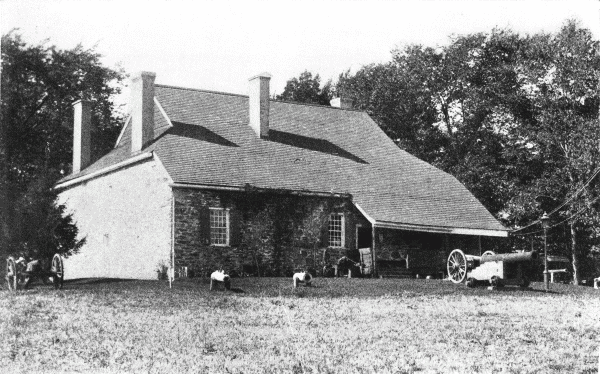
Newburgh, 60 miles from New York. Approaching the city of Newburgh, we see a building of rough stone, one story high, with steep roof—known as Washington's Headquarters. For several years prior to, and during the Revolution, this was the home of Jonathan Hasbrouck, known far and wide for business integrity and loyalty to liberty. This house was built by him, apparently, in decades; the oldest part, the northeast corner, in 1750; the southeast corner, in 1760, and the remaining half in 1770. It fronted west on the king's highway, now known as Liberty Street, with a garden and family burial plot to the east, lying between the house and the river. It was restored as nearly as possible to its original character on its purchase by the State in 1849, and it is now the treasure-house of many memories, and of valuable historic relics. A descriptive catalogue, prepared for the trustees, under act of May 11, 1874, by a patient and careful historian, Dr. E. M. Ruttenber, will be of service to the visitor and can be obtained on the grounds. The following facts, condensed from his admirable historical sketch, are of practical interest:
"Washington's Headquarters, or the Hasbrouck house, is situated in the southeast part of the city, constructed of rough stone, one story high, fifty-six feet front by forty-six feet in depth, and located on what was originally Lot No. 2, of the German Patent, with title vested in Heman (Herman?) Schoneman, a native of the Palatinate of Germany, who sold, in 1721, to James Alexander, who subsequently sold to Alexander Colden and Burger Meynders, by whom it was conveyed to Jonathan Hasbrouck, the grandson of Abraham Hasbrouck, one of the Huguenot founders of New Paltz. He was a man of marked character; of fine physique, being six feet and four inches in height; was colonel of the militia of the district, and[page 105] in frequent service in guarding the passes of the Highlands. His occupation was that of a farmer, a miller, and a merchant. He died in 1780. The first town meeting for the Precinct of Newburgh was held here on the first Tuesday in April, 1763, when its owner was elected supervisor. Public meetings continued to be held here for several years. During the early part of the Revolution, the committee of safety, of the precinct, assembled here; here military companies were organized, and here the regiment which Colonel Hasbrouck commanded assembled, to move hence to the defence of the Highland forts."
Sacred in this mansion hoary, 'Neath its roof-tree long ago Dwelt the father of our glory, He whose name appalled the foe. Mary E. Monell.
From this brief outline, it will be seen that the building is singularly associated with the history of the Old as well as of the New World: with the former through the original grantee of the land, recalling the wars which devastated the Palatinate and sent its inhabitants, fugitive and penniless, to other parts of Europe and to America; through his successor with the Huguenots of France, and, through the public meetings which assembled here, and especially through its occupation by Washington, with the struggle for American independence.
In the spring of 1782 Washington made this building his headquarters, and remained here until August 18, 1783, on the morning of which day he took his departure from Newburgh. At this place he passed through the most trying period of the Revolution: the year of inactivity on the part of Congress, of distress throughout the country, and of complaint and discontent in the army, the latter at one time bordering on revolt among the officers and soldiers.
It was at this place, on the 22d day of May, 1782, that Colonel Nicola, on behalf of himself and others, proposed that Washington should become king, for the "national advantage," a proposal that was received by Washington with "surprise and astonishment," "viewed with abhorrence," and "reprehended with severity." The temptation which was thus repelled by Washington, had[page 106] its origin with that portion of the officers of the army, who while giving their aid heartily to secure an independent government, nevertheless believed that that government should be a monarchy. The rejection of the proposition by Washington was not the only significant result. The rank and file of the army rose up against it, and around their camp-fires chanted their purpose in Billings' song, "No King but God!" From that hour a republic became the only possible form of government for the enfranchised Colonies.
With silvered locks and eyes grown dim, As victory's sun proclaimed the morn, He pushed aside the diadem With stern rebuke and patriot scorn. Wallace Bruce.
The inattention of Congress to the payment of the army, during the succeeding winter, gave rise to an equally important episode in the history of the war. On the 10th of March, 1783, the first of the famous "Newburgh Letters" was issued, in which, by implication at least, the army was advised to revolt. The letter was followed by an anonymous manuscript notice for a public meeting of officers on the succeeding Tuesday. Washington was equal to the emergency. He expressed his disapprobation of the whole proceeding, and with great wisdom, requested the field officers, with one commissioned officer from each company, to meet on the Saturday preceding the time appointed by the anonymous notice. He attended this meeting and delivered before it one of the most touching and effective addresses on record. When he closed his remarks, the officers unanimously resolved "to reject with disdain" the infamous proposition contained in the anonymous address.
The meeting of officers referred to was held at the New Building or "Temple" as it was called, in New Windsor, but Washington's address was written at his headquarters. The "Newburgh Letters," to which it was a reply, were written by Major John Armstrong, aid-de-camp to General Gates. The anonymously called meeting was not held. The motives of its projectors we will not discuss; but its probable effect, had it been successful, must be considered in connection with Washington's encomium of the[page 107] result of the meeting which he had addressed: "Had this day been wanting, the world had never known the height to which human greatness is capable of attaining."
Freemen pause! this ground is holy, Noble spirits suffered here, Tardy Justice, marching slowly, Tried their faith from year to year. Mary E. Monell.
Serene and calm in peril's hour, An honest man without pretence, He stands supreme to teach the power And brilliancy of common-sense. Wallace Bruce.
Notice of the cessation of hostilities was proclaimed to the army April 19, 1783. It was received with great rejoicings by the troops at Newburgh, and under Washington's order, was the occasion of an appropriate celebration. In the evening, signal beacon lights proclaimed the joyous news to the surrounding country. Thirteen cannon came pealing up from Fort Putnam, which were followed by a feu-de-joie rolling along the lines. The mountain sides resounded and echoed like tremendous peals of thunder, and the flashing from thousands of fire-arms, in the darkness of the evening, was like unto vivid flashes of lightning from the clouds. From this time furloughs were freely granted to soldiers who wished to return to their homes, and when the army was finally disbanded those absent were discharged from service without being required to return. That portion of the army, which remained at Newburgh on guard duty, after the removal of the main body to West Point in June, were participants here in the closing scenes of the disbandment, when, on the morning of November 3, 1783, "the proclamation of Congress and the farewell orders of Washington were read, and the last word of command given." From Monell's "Handbook of Washington's Headquarters" we also quote a general description of the house and its appearance when occupied by the commander-in-chief. "Washington's family consisted of himself, his wife, and his aid-de-camp, Major Tench Tilghman. The large room, which is entered from the piazza on the east, known as 'the room with seven doors and one window,' was used as the dining and sitting-room. The northeast room was Washington's bedroom and the one adjoining it on the left was occupied by him as a private office. The family room was that in the southeast; the kitchen was the southwest room; the parlor the northwest room. Between[page 108] the latter and the former was the hall and staircase and the storeroom, so called for having been used by Colonel Hasbrouck and subsequently by his widow as a store. The parlor was mainly reserved for Mrs. Washington and her guests. A Mrs. Hamilton, whose name frequently appears in Washington's account book, was his housekeeper, and in the early part of the war made a reputation for her zeal in his service, which Thacher makes note of and Washington acknowledges in his reference to an exchange of salt. There was little room for the accommodation of guests, but it is presumed that the chambers were reserved for that purpose. Washington's guests, however, were mainly connected with the army and had quarters elsewhere. Even Lafayette had rooms at DeGrove's Hotel when a visitor at headquarters.
"The building is now substantially in the condition it was during Washington's occupation of it. The same massive timbers span the ceiling; the old fire-place with its wide-open chimney is ready for the huge back-logs of yore; the seven doors are in their places; the rays of the morning sun still stream through the one window; no alteration in form has been made in the old piazza—the adornments on the walls, if such the ancient hostess had, have alone been changed for souvenirs of the heroes of the nation's independence. In presence of these surroundings, it requires but little effort of the imagination to restore the departed guests. Forgetting not that this was Washington's private residence, rather than a place for the transaction of public business, we may, in the old sitting-room respread the long oaken table, listen to the blessing invoked on the morning meal, hear the cracking of joints, and the mingled hum of conversation. The meal dispensed, Mrs. Washington retires to appear at her flower beds or in her parlor to receive her morning calls. Colfax, the captain of the life-guard, enters to receive the orders of the day—perhaps a horse and guard for Washington to visit New Windsor, or a barge for Fishkill[page 109] or West Point, is required; or it may be Washington remains at home and at his writing desk conducts his correspondence, or dictates orders for army movements. The old arm-chair, sitting in the corner yonder, is still ready for its former occupant.
"The dinner hour of five o'clock approaches; the guests of the day have already arrived. Steuben, the iron drill-master and German soldier of fortune, converses with Mrs. Washington. He had reduced the simple marksmen of Bunker Hill to the discipline of the armies of Europe and tested their efficiency in the din of battle. He has leisure now, and scarcely knows how to find employment for his active mind. He is telling his hostess, in broken German-English, of the whale (it proved to be an eel) he had caught in the river. Hear his hostess laugh! And that is the voice of Lafayette, relating perhaps his adventures in escaping from France, or his mishap in attempting to attend Mrs. Knox's last party. Wayne, of Stony Point; Gates, of Saratoga; Clinton, the Irish-blooded Governor of New York, and their compatriots—we may place them all at times beside our Pater Patriae in this old room, and hear amid the mingled hum his voice declare: 'Happy, thrice happy, shall they be pronounced hereafter, who have contributed anything, who have performed the meanest office in erecting this stupendous fabric of Freedom and Empire on the broad basis of independency; who have assisted in protecting the rights of human nature, and in establishing an asylum for the poor and oppressed of all nations and religions.'
"In France, some fifty years after the Revolution, Marbois reproduced, as an entertainment for Lafayette, then an old man, this old sitting-room and its table scene. From his elegant saloon he conducted his guests, among whom were several Americans, to the room which he had prepared. There was a large open fire-place, and plain oaken floors; the ceiling was supported with large beams and whitewashed; there were the seven small-sized doors[page 110] and one window with heavy sash and small panes of glass. The furniture was plain and unlike any then in use. Down the centre of the room was an oaken table covered with dishes of meat and vegetables, decanters and bottles of wine, and silver mugs and small wine glasses. The whole had something the appearance of a Dutch kitchen. While the guests were looking around in surprise at this strange procedure, the host, addressing himself to them said, 'Do you know where we now are?' Lafayette looked around, and, as if awakening from a dream, he exclaimed, 'Ah! the seven doors and one window, and the silver camp goblets such as the Marshals of France used in my youth. We are at Washington's Headquarters on the Hudson fifty years ago.'"
One window looking toward the east; Seven doors wide-open every side; That room revered proclaims at least An invitation free and wide. Wallace Bruce.
The goodness which characterizes Washington is felt by all around him, but the confidence he inspires is never familiar; it springs from a profound esteem for his virtues and a great opinion of his talents. Marquis de Chastellux.
From these headquarters Washington promulgated his memorable order for the cessation of hostilities and recalled the fact that its date, April 18th, was the anniversary of the battles of Lexington and Concord. Thomas F. Bayard.
The Hasbrouck family returned to their old home, made historic for all time, after the disbandment of the army and remained until it became the property of the State. On July 4, 1850, the place was formally dedicated by Major-General Winfield Scott, dedicatory address delivered by John J. Monell, an ode by Mary E. Monell, and an oration by Hon. John W. Edmunds. The centennial of the disbanding of the army was observed here October 18, 1883. After the noonday procession of 10,000 men in line, three miles in length, with governors and representative people from almost every State, 150,000 people, "ten acres" square, gathered in the historic grounds. Senator Bayard, of Delaware, was chairman of the day. Hon. William M. Evarts was the orator, and modestly speaking in the third person, Wallace Bruce, author of this handbook, was the poet. No one there gathered can ever forget that afternoon of glorious sunlight or the noble pageant. The great mountains, which had so frequently been the bulwark of liberty and a place of refuge for our fathers, were all aglow with beauty, as if, like Horeb's bush, they too would open their lips in praise and thanksgiving. One of the closing sentences of Senator Evarts' address is unsurpassed in modern or ancient[page 111] eloquence: "These rolling years have shown growth, forever growth, and strength, increasing strength, and wealth and numbers ever expanding, while intelligence, freedom, art, culture and religion have pervaded and ennobled all this material greatness. Wide, however, as is our land and vast our population to-day, these are not the limits to the name, the fame, the power of the life and character of Washington. If it could be imagined that this nation, rent by disastrous feuds, broken in its unity, should ever present the miserable spectacle of the undefiled garments of his fame parted among his countrymen, while for the seamless vesture of his virtue they cast lots—if this unutterable shame, if this immeasurable crime, should overtake this land and this people, be sure that no spot in the wide world is inhospitable to his glory, and no people in it but rejoices in the influence of his power and his virtue." In his lofty sentences the old heroes seemed to pass again in review before us, and the daily life of that heroic band, when Congress sat inactive and careless of its needs until the camp rose in mutiny, happily checked, however, by the great commander in a single sentence. It will be remembered that Washington began to read his manuscript without glasses, but was compelled to stop, and, as he adjusted them to his eyes, he said, "You see, gentlemen, that I have not only grown gray, but blind, in your service." It is needless to say that the "anonymously called" meeting was not held.
He quelled the half-paid mutineers, And bound them closer to the cause; His presence turned their wrath to tears, Their muttered threats to loud applause.
The great Republic had its birth That hour beneath the army's wing, Whose leader taught by native worth The man is grander than the king.
We hear the anthem once again,— "No king but God!"—to guide our way, Like that of old—"Good-will to men"— Unto the shrine where freedom lay. Wallace Bruce.
Near at hand, and also plainly seen from the river, is the new Tower of Victory, fifty-three feet high, costing[page 112] $67,000. It contains a life-size statue of Washington, in the act of sheathing his sword, with bronze figures representing the rifle, the artillery, the line officer and dragoon service of our country, with a bronze tablet on the east wall bearing the inscription: "This monument was erected under the authority of the Congress of the United States, and of the State of New York, in commemoration of the disbandment, under proclamation of the Continental Congress, of October 18, 1783, of the armies, by whose patriotic and military virtue, our national independence and sovereignty were established." The Belvidere, reached by a spiral staircase, is capable of holding one hundred persons, and the view therefrom takes in a wide extent of panoramic beauty. Newburgh has not only reason to be proud of her historical landmarks and her beautiful situation, but also of her commercial prosperity. In olden times, it was a great centre for all the western and southwestern district, farmers and lumbermen coming from long distances in the interior. Soon after the Revolution she was made a village, when there were only two others in the State. Before the days of the Erie canal, this was the shortest route to Lake Erie, and was made by stage via Ithaca. With increasing facilities of railway communication, she has also easily held her own against all commercial rivals. The West Shore Railroad, the Erie Railway, the New York Central and the New York and New England across the river, and several Hudson river steamers, make her peculiarly central. The city is favored with beautiful driveways, amid charming country seats. The New Paltz road passes the site where General Wayne had his headquarters, also, the "Balm of Gilead tree," which gave the name of Balmville to the suburban locality. Another road affords a glimpse of the "Vale of Avoca," named after the well-known glen in Ireland, of which Tom Moore so sweetly sung. Here, some say, a treacherous attempt was made on the life of Washington, but it is not generally [page 113] credited by critical historians. As the steamer leaves the dock, and we look back upon the factories and commercial houses along the water front, crowned by noble streets of residence, with adjoining plateau, sweeping back in a vast semi-circle as a beautiful framework to the wide bay, we do not wonder that Hendrick Hudson established a prophetic record by writing "a very pleasant place to build a town."
WASHINGTON'S HEADQUARTERS, NEWBURGH
Washington! Brave without temerity; laborious without ambition; generous without prodigality; noble without pride; virtuous without severity. Marquis de Chastellux.
Fishkill-on-the-Hudson.—Directly opposite Newburgh, one mile north of Denning's Point (formerly the eastern dock of the Newburgh ferry), rises on a pleasant slope, the newer Fishkill of this region. A little more than a mile from the landing, is the manufacturing village of Matteawan, connected by an electric railroad. Old Fishkill, or Fishkill Village, is about four miles inland, charmingly located, under the slope of the Fishkill range. This was once the largest village in Dutchess county, and was chosen for its secure position above the Highlands, as the place to which "should be removed the treasury and archives of the State, also, as the spot for holding the subsequent sessions of the Provincial Conventions," after they were driven from New York. A historical sketch of the town, by T. Van Wyck Brinkerhoff, presents many things of interest. "Its history, anterior to 1682, belongs to the red men of the valley, and, more than any other spot, this was the home of their priests. Here they performed their incantations and administered at their altars." According to Broadhead, "It would seem that the neighboring Indians esteemed the peltries from Fishkill as charmed by the incantations of the aboriginal enchanters who lived along its banks, and the beautiful scenery in which those ancient priests of the Highlands dwelt, is thus invested with new poetic associations." Dunlap speaks of them as "occupying the Highlands, called by them Kittatenny Mountains. Their principal settlement, designated Wiccapee, was situated in the vicinity of Anthony's Nose. Here too, lived the Wappingers, a[page 114] war-like and brave tribe, extending themselves along the Matteawan, along the Wappingers Kill and tributaries, along the Hudson, and to the northward, across the river into Ulster County. These and other tribes to the south, west and north, were parts of and tributaries to the great Iroquois confederation—the marvel for all time to come of a system of government so wise and politic, and for men so eloquent and daring. The Wappingers took part in the Dutch and Indian wars of 1643 and 1663, led on by their war chiefs, Wapperonk and Aepjen. A few Indian names are still remaining, and a few traces of their history still left standing. The name Matteawan is Indian, signifying 'Good Beaver Grounds,' and the name Wappinger still speaks of those who once owned the soil along the Hudson. Their name for the stream was Mawanassigh, or Mawenawasigh. Wiccapee and Shenondoah are also Indian names of places in Fishkill Hook, and East Fishkill, and Apoquague, still surviving as the name of a country postoffice, was the Indian style of what is now called Silver Lake, signifying 'round pond.' In Fishkill Hook until quite recently, there were traces of their burial grounds, and many apple and pear trees are still left standing, set there by the hands of the red man before the country had been occupied by Europeans."
For here amid these hills he once kept court— He who his country's eagle taught to soar And fired those stars which shine o'er every shore. Charles Fenno Hoffman.
To return to Brinkerhoff, "The first purchase of land in the county of Dutchess, was made in the town of Fishkill. On the 8th day of February, 1682, a license was given by Thomas Dongan, Commander-in-chief of the Province of New York, to Francis Rombout and Gulian Ver Planck, to purchase a tract of land from the Indians. Under this license, they bought, on the 8th day of August, 1683, of the Wappinger Indians, all their right, title and interest to a certain large tract of land, afterward known as the Rombout precinct. Gulian Ver Planck died before the English patent was issued by Governor Dongan; Stephanus Van Cortland was then joined in it with Rombout, and Jacobus Kipp substituted as the representative[page 115] of the children of Gulian Ver Planck. On the 17th day of October, 1685, letters patent, under the broad seal of the Province of New York, were granted by King James the Second, and the parties to whom these letters patent were granted, became from that time the undisputed proprietors of the soil. There were 76,000 acres of these lands lying in Fishkill, and other towns taken from the patent, and 9,000 acres lying in the limits of the town of Poughkeepsie. Besides paying the natives, as a further consideration for the privilege of their license, they were to pay the commander-in-chief, Thomas Dongan, six bushels of good and merchantable winter wheat every year." In the Book of Patents, at Albany, vol. 5, page 72, will be found the deed, of special interest to the historian and antiquarian.
It was a dainty day, and it grew more dainty towards its close as the lights and shadows stretched athwart our Highland landscape. Susan Warner.
"After the evacuation of New York, in the fall of 1776, and the immediate loss of the seaboard, with Long Island and part of New Jersey, Fishkill was at once crowded with refugees, as they were then called, who sought, by banishing themselves from their homes on Long Island and New York, to escape imprisonment and find safety here. The interior army route to Boston passed through this place. Army stores, workshops, ammunition, etc., were established and deposited here." The Marquis De Chastellux, in his travels in North America, says: "This town, in which there are not more than fifty houses in the space of two miles, has been long the principal depot of the American army. It is there they have placed their magazines, their hospitals, their workshops, etc., but all of these form a town in themselves, composed of handsome large barracks, built in the woods at the foot of the mountains: for the American army, like the Romans in many respects, have hardly any other winter quarters than wooden towns, or barricaded camps, which may be compared to the 'hiemalia' of the Romans." These barracks were situated on the level plateau between the residence of Mr. Cotheal and the mountains. Portions of these[page 116] grounds were no doubt then covered with timber. Guarding the approach from the south, stockades and fortifications were erected on commanding positions, and regularly manned by detachments from the camp.
Unto him and them all owing Peace as stable as our hills, Plenty like yon river flowing To the sea from thousand rills. Mary E. Monell.
"Upon one of these hills, rising out of this mountain pass-way, very distinct lines of earthworks are yet apparent. Near the residence of Mr. Sidney E. Van Wyck, by the large black-walnut trees, and east of the road near the base of the mountain, was the soldiers' burial ground. Many a poor patriot soldier's bones lie mouldering there; and if we did but know how many, we would be startled at the number, for this almost unknown and unnoticed burial ground holds not a few, but hundreds of those who gave their lives for the cause of American independence. Some fifteen years ago, an old lady who had lived near the village until after she had grown to womanhood, told the writer that after the battle of White Plains she went with her father through the streets of Fishkill, and in places between the Dutch and Episcopal churches, the dead were piled up like cord-wood. Those who died from wounds in battle or from sickness in hospital were buried there. Many of these were State militiamen, and it seems no more than just that the State should make an appropriation to erect a suitable monument over this spot. Rather than thus remain for another century, if a rough granite boulder were rolled down from the mountain side and inscribed: 'To the unknown and unnumbered dead of the American Revolution,' that rough unhewn stone would tell to the stranger and the passer-by, more to the praise and fame of our native town than any of us shall be able to add to it by works of our own; for it is doubtful whether any spot in the State has as many of the buried dead of the Revolution as this quiet burial yard in our old town!" Here also on June 2, 1883, was observed "The Fishkill Centennial," and few of our centennials have been celebrated amid objects of greater revolutionary interest. Near at hand, to quote[page 117] from the official report of the proceedings, is "Denning's Point where Washington frequently, while waiting, tied his horses under those magnificent 'Washington oaks,' as he passed backward and forward from New Windsor and Newburgh to Fishkill. Near by is the Verplanck House, Baron Steuben's old headquarters. On Spy Hill and Continental Hill troops were quartered. At Matteawan Sackett lived, and there is the Teller House built by Madame Brett, where officers frequently resorted, and there Yates dwelt when he presided over the legislative body while it held its sessions in Fishkill, that had much to do with forming our first State Constitution. Baron Steuben was for a while in the old Scofield House at Glenham. In Fishkill are those renowned old churches where legislative sittings were held, which were also used as hospitals for the sick, and one of which is otherwise known as being the place where Enoch Crosby, the spy, was imprisoned, and from which he escaped. Near at hand the Wharton House (Van Wyck House), forever associated with him, and made famous by Cooper's 'Spy.' In the Brinckerhoff House above, Lafayette was dangerously ill with a fever, and there, at Swartwoutville, Washington was often a visitor. Whenever Washington was at Fishkill he made Colonel Brinckerhoff's his headquarters. He occupied the bedroom back of the parlor, which remains the same 'excepting a door that opens into the hall, which has been cut through.' It is an old-fashioned house built of stone, with the date 1738 on one of its gables." With the story of Fishkill we close the largest page relating to our revolutionary heroes, and leave behind us the Old Beacon Mountains which forever sentinel and proclaim their glory.
No prouder sentinel of glory than the old Beacon Mountain whose watch-fire guarded the valley and spoke its rallying message to the Catskills and Berkshires and the very foothills of the Green Mountains. Wallace Bruce.
The sun touched mountains in some places were of a bright orange and the shadows between them deep neutral tint or blue. And the river apparently had stopped running to reflect. Susan Warner.
Low Point, or Carthage, is a small village on the east bank, about four miles north of Fishkill. It was called by the early inhabitants Low Point, as New Hamburgh, two miles north, was called High Point. Opposite Carthage is Roseton, once known as Middlehope, and above this we[page 118] see the residence of Bancroft Davis and the Armstrong Mansion. We now behold on the west bank a large flat rock, covered with cedars, recently marked by a lighthouse, the—
Duyvel's Dans Kammer.—Here Hendrick Hudson, in his voyage up the river, witnessed an Indian pow-wow—the first recorded fireworks in a country which has since delighted in rockets and pyrotechnic displays. Here, too, in later years, tradition relates the sad fate of a wedding party. It seems that a Mr. Hans Hansen and a Miss Kathrina Van Voorman, with a few friends, were returning from Albany, and disregarding the old Indian prophecy, were all slain:—
"For none that visit the Indian's den Return again to the haunts of men. The knife is their doom! O sad is their lot! Beware, beware of the blood-stained spot!"
Some years ago this spot was also searched for the buried treasures of Captain Kidd, and we know of one river pilot who still dreams semi-yearly of there finding countless chests of gold.
Two miles above, on the east side, we pass New Hamburgh, at the mouth of Wappingers Creek. The name Wappinger had its origin from Wabun, east, and Acki, land. This tribe, a sub-tribe of the Mahicans, held the east bank of the river, from Manhattan to Roeliffe Jansen's Creek, which empties into the Hudson near Livingston, a few miles south of Catskill Station on the Hudson River Railroad. Passing Hampton Point we see Marlborough, the head-centre of a large fruit industry, delightfully located in the sheltered pass of the Maunekill. On the east bank will be noticed several fine residences: "Uplands," "High Cliff," "Cedars," and "Netherwood." Milton is now at hand on the west bank, with its cosy landing and West Shore Railroad station. This pleasant village was one of the loved spots of J. G.[page 119] Holland, and the home of Mary Hallock Foote, until a modern "Hiawatha" took our Hudson "Minnehaha" to far away western mountains.
The tulip tree majestic stirs Far down the water's marge beside, And now awake the nearer firs, And toss their ample branches wide. Henry T. Tuckerman.
Springbrook, opposite Milton, a place of historic interest, near the river bank, was bought by Theophilus Anthony before the Revolution. Some of the links of the famous chain in the Highlands were forged here in 1777. When the British ships ascended the river the family fled to the woods, all but an old colored servant woman who wisely furnished the soldiers a good dinner and got thereby their good will to save the house. The old Flour Mill, however, was burned which stood on the same site as the present Springbrook Mill. Theophilus Anthony's only daughter married Thomas Gill after the Revolution, and from that time the property has been in the Gill family. Few places in the Hudson Valley have such ancient and continuous family history.
Locust Grove, with square central tower and open outlook, residence of the late Prof. S. F. B. Morse, inventor of the telegraph, is seen on the west bank; also the "Lookout," once known as Mine Hill, now a part of Poughkeepsie cemetery, with charming driveway to the wooded point where the visitor can see from his carriage one of the finest views of the Hudson. The completion of this drive is largely due to the enterprise of the late Mr. George Corlies, who did much to make Poughkeepsie beautiful. The view from this "Lookout" takes in the river for ten miles to the south, and reaches on the north to the Catskills. In a ramble with Mr. Corlies over Lookout Point, he told the writer that it was originally the purpose of Matthew Vassar to erect a monument on Pollopel's Island to Hendrick Hudson. Mr. Corlies suggested this point as the most commanding site. Mr. Vassar visited it, and concluded to place the monument here. He published an article in the Poughkeepsie papers to this effect, and, meeting Mr. Corlies one week afterwards, said, "Not one person in the city of Poughkeepsie[page 120] has referred to my monument. I have decided to build a college for women, where they can learn what is useful, practical and sensible." It is interesting to note the fountain-idea of the first woman's college in the world, as it took form and shape in the mind of its founder.
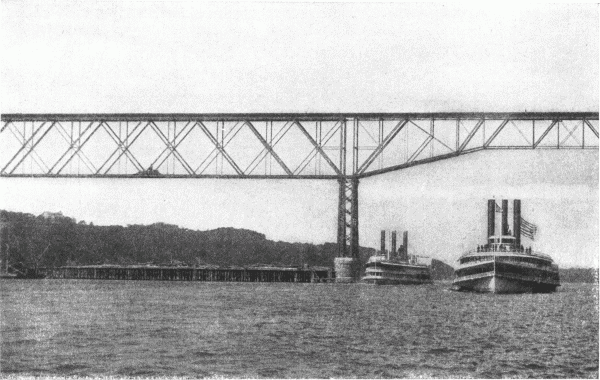
POUGHKEEPSIE BRIDGE
TROPHY POINT, WEST POINT
OLD CRO' NEST AND STORM KING
POLLIPEL'S ISLAND AND MOUNT TAURUS
THE CATSKILLS FROM THE HUDSON
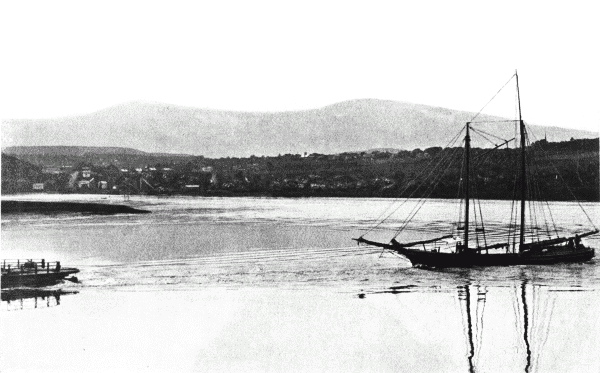
NORTHERN GATE OF HIGHLANDS
And from their leaguering legions thick and vast The galling hail-shot in fierce volley falls, While quick, from cloud to cloud, darts o'er the levin The flash that fires the batteries of heaven! Knickerbocker Magazine.
MORNING VIEW AT BLUE POINT.
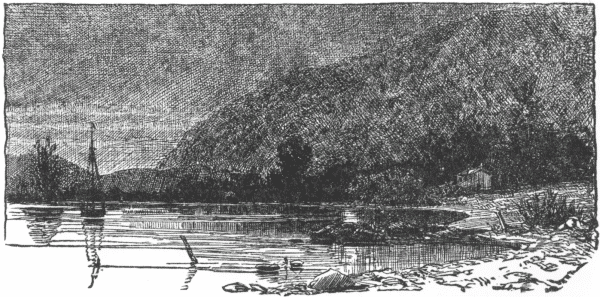
We now see Blue Point, on the west bank; and, in every direction, enjoy the finest views. The scenery seems to stand, in character, between the sublimity of the Highlands and the tranquil, dreamy repose of the Tappan Zee. It is said that under the shadow of these hills was the favorite anchorage of—
The Storm Ship, one of our oldest and most reliable legends. The story runs somewhat as follows: Years ago, when New York was a village—a mere cluster of houses on the point now known as the Battery—when the Bowery was the farm of Peter Stuyvesant, and the Old Dutch Church on Nassau Street (which also long since disappeared), was considered the country—when communication with the old world was semi-yearly instead of semi-weekly or daily—say two hundred years ago—the whole town one evening was put into great commotion by the fact that a ship was coming up the bay.
See you beneath yon sky so dark Fast gliding along a gloomy bark:— By skeleton shapes her sails are furled, And the hand that steers is not of this world. Legend of the Storm Ship.
[page 121]
She approached the Battery within hailing distance, and then, sailing against both wind and tide, turned aside and passed up the Hudson. Week after week and month after month elapsed, but she never returned; and whenever a storm came down on Haverstraw Bay or Tappan Zee, it is said that she could be seen careening over the waste; and, in the midst of the turmoil, you could hear the captain giving orders, in good Low Dutch; but when the weather was pleasant, her favorite anchorage was among the shadows of the picturesque hills, on the eastern bank, a few miles above the Highlands. It was thought by some to be Hendrick Hudson and his crew of the "Half Moon," who, it was well known, had once run aground in the upper part of the river, seeking a northwest passage to China; and people who live in this vicinity still insist that under the calm harvest moon and the pleasant nights of September, they see her under the bluff of Blue Point, all in deep shadow, save her topsails glittering in the moonlight.
Poughkeepsie, 74 miles from New York, is now at hand, Queen City of the Hudson, with name, derived from the Indian word Apokeepsing, signifying "safe harbor." Near the landing a bold headland juts out into the river, known as Kaal Rock, and no doubt this sheltering rock was a safe harbor in days of birch canoes. It has been recently claimed that the word signifies "muddy pond," which is neither true, appropriate or poetic. Poughkeepsie does not propose to give up her old-time "harbor name," particularly as it has been recently discovered that the name "Kipsie" was also given by the Indians to a "safe harbor" near the Battery on Manhattan Island. It is said that there are over forty different ways of spelling Poughkeepsie, and every year the postoffice record gives a new one. The first house was built in 1702 by a Mr. Van Kleeck. The State legislature had a session here in 1777 or 1778, when New York was held by the British and after Kingston had been burned by Vaughan.
On the crest of the waves, a something that glides Before the stiff breeze, and gracefully rides On the inflowing tide majestic and free A huge and mysterious bird of the sea. Irving Bruce.
[page 122]
Ten years later, the State convention also met here for ratification of the Federal Constitution. The town has a beautiful location, and is justly regarded the finest residence city on the river. It is not only midway between New York and Albany, but also midway between the Highlands and the Catskills, commanding a view of the mountain portals on the south and the mountain overlook on the north—the Gibraltar of revolutionary fame and the dreamland of Rip Van Winkle.
The azure heaven is filled with smiles, The water lisping at my feet From weary thought my heart beguiles. Henry Abbey.
The well known poet and litterateur, Joel Benton, who divides his residence between New York and Poughkeepsie, in a recent article, "The Midway City of the Hudson," written for the Poughkeepsie Sunday Courier, says:
"Poughkeepsie as a township was incorporated in 1788. The village bearing the name was formed in 1799 (incorporated as a city in 1854), and soon became the center of a large trade running in long lines east and west from the river. Dutchess County had at this time but a sparse population. There was a post-road from New York to Albany; but the building of the Dutchess Turnpike from Poughkeepsie to Sharon, Conn., connecting with one from that place to Litchfield, which took place in 1808, was a capital event in its history. This made a considerable strip of western Connecticut tributary to Poughkeepsie's trade.
"Over the turnpike went four-horse Concord stages, with berailed top and slanting boot in the rear for trunks and other baggage. Each one had the tin horn of the driver; and it was difficult to tell upon which the driver most prided himself—the power to fill that thrilling instrument, or his deft handling of the ponderous whip and multiplied reins. Travelers to Hartford and Boston went over this route; and an east and west through and way mail was a part of the burden. A sort of overland express and freight line, styled the Market Wagon, ran in and out of the town from several directions. One[page 123] or more of these conveyances started from as far east as the Housatonic River, and they frequently crowded passengers in amongst their motley wares.
"Speaking of the stage-driver's horn recalls the fact that when the steamboat arrived—which was so solitary an institution that for some time it was distinctly called 'The Steamboat'—the tin horn did duty also for it. When it was seen in the distance, either Albanyward or in the New York direction, a boy went through the village blowing a horn to arouse those who wished to embark on it. It is said the expectant passengers had ample time, after the horn was sounded, to make their toilets, run down to the river (or walk down) and take passage on it.
"In colonial days few were the people here; but they were a bright and stirring handful. It seems as if every man counted as ten. The De's and the Vans, the Livingstons, the Schuylers, the Montgomerys and ever so many more of the Hudson River Valley settlers are still making their impress upon the country. I suppose it need not now be counted strange that the strong mixture of Dutch and English settlers, with a few Huguenots, which finally made Dutchess county, were not a little divided between Tory and Whig inclinations. Around Poughkeepsie, and in its allied towns stretching between the Hudson River and the Connecticut line, there was much strife. Gov. George Clinton in his day ruled in the midst of much tumult and turbulence; but he held the reins with vigor, in spite of kidnappers or critics. When the British burned Kingston he prorogued the legislature to Poughkeepsie, which still served as a 'safe harbor.' As the resolution progressed the Tory faction was weakened, either by suppression or surrender.
"It was in the Poughkeepsie Court House that, by one vote, after a Homeric battle, the colony of New York consented to become a part of the American republic, which consent was practically necessary to its existence.[page 124] How large a part two small incidents played here towards the result of nationality. That single vote was one, and the news by express from Richmond, announcing Virginia's previous ratification—and added stimulus to the vote—was the other. Poughkeepsie honored in May, 1824, the arrival of Lafayette, and dined him, besides exchanging speeches with him, both at the Forbus House, on Market Street, very nearly where the Nelson House now stands, and at the Poughkeepsie Hotel. It was one of Poughkeepsie's great days when he came. Daniel Webster has spoken in her court house; and Henry Clay, in 1844, when a presidential candidate, stopped for a reception. And it is said that, by a mere accident, she just missed contributing a name to the list of presidents of the United States. The omitted candidate was Nathaniel P. Talmadge. He could have had the vice-presidential candidacy, the story goes, in 1840, but would not take it. If he had accepted it, he would have gone into history not merely as United States senator from New York and afterwards Governor of Wisconsin territory, but as president in John Tyler's place.
"In 1844, the New York State Fair was held here somewhere east of what is now Hooker Avenue. It was an occasion thought important enough then to be pictured and reported in the London Illustrated News. Two years after the telegraph wires were put up in this city, before they had yet reached the city of New York. Considering the fact that Prof. S. F. B. Morse, the telegraph inventor, had his residence here, this incident was not wholly inappropriate.
"The advent in 1849 of the Hudson River Railroad, which was an enterprise in its day of startling courage and magnitude, constituted a special epoch in the history of Poughkeepsie and the Hudson River towns. Men of middle age here well remember the hostility and ridicule the project occasioned when it was first broached. Some said no railroad ever could be built on the river's edge;[page 125] and, if you should build one, the enormous expense incurred would make it forever unprofitable. It seemed then the height of Quixotism to lay an expensive track where the river offered a free way to all. Property holders, whose property was to be greatly benefited, fought the railroad company with unusual spirit and persistence. But the railroad came, nevertheless, and needs no advocate or apologist to-day. There is no one now living here who would ask its removal, any more than he would ask the removal of the Hudson River itself."
And lo! the Catskills print the distant sky, And o'er their airy tops the faint clouds driven, So softly blending, that the cheated eye Forgets or which is earth or which is heaven. Theodore S. Fay.
Mountains on mountains in the distance rise, Like clouds along the far horizon's verge; Their misty summits mingling with the skies, Till earth and heaven seem blended into one. Bayard Taylor.
Poughkeepsie has been known for more than half a century as the City of Schools. The Parthenon-like structure which crowns College Hill was prophetic of a still grander and more widely known institution, the first in the world devoted to higher culture for women,—
Vassar College.—This institution, founded by Matthew Vassar, and situated two miles east of the city, maintains its prestige not only as the first woman's college in point of time, but also first in excellence and influence. The grounds are beautiful and graced by noble buildings which have been erected year by year to meet the continued demands of its patrons. The college is not seen from the river but is of easy access by trolley from the steamboat landing.
Eastman College is also one of the fixed and solid institutions of Poughkeepsie, located in the very heart of the city. It has accomplished good work in preparing young men for business, and has made Poughkeepsie a familiar word in every household throughout the land. It was fortunate for the city that the energetic founder of this college selected the central point of the Hudson as the place of all others most suited for his enterprise, and equally fortunate for the thousands of young men who yearly graduate from this institution, as the city is charmingly located and set like a picture amid picturesque scenery.
Among many successful public institutions of Poughkeepsie[page 126] are the Vassar Hospital, the Vassar Old Men's Home, the Old Ladies' Home, the State Hospital and the Vassar Institute of Arts and Sciences.
I went three times up the Hudson; and if I lived in New York should be tempted to ascend it three times a week during the summer. Harriet Martineau.
The opera house is one of the pleasantest in the country and received a high comment, still remembered, from Joseph Jefferson, for its perfect acoustic quality. The armory, the Adriance Memorial Library to the memory of Mr. and Mrs. John P. Adriance, and the historic Clinton House on Main Street purchased in 1898 by the Daughters of the Revolution, also claim the attention of the visitor. Several factories are here located, the best known being that of Adriance, Platt & Co., whose Buckeye mowers and reapers have been awarded the highest honors in Germany, Holland, France, Belgium, Sweden, Norway, Italy, Russia, Switzerland, and the United States, and are sold in every part of the civilized globe. The Phœnix Horseshoe Co., the Knitting-Goods Establishment, and various shoe, shirt and silk thread factories contribute to the material prosperity of the town. The drives about Poughkeepsie are delightful. Perhaps the best known in the United States is the Hyde Park road, six miles in extent, with many palatial homes and charming pictures of park and river scenery. This is a part of the Old Post Road and reminds one by its perfect finish of the roadways of England. Returning one can take a road to the left leading by and up to
College Hill, 365 feet in height, commanding a wide and extensive prospect. The city lies below us, fully embowered as in a wooded park. To the east the vision extends to the mountain boundaries of Dutchess County, and to the north we have a view of the Catskills marshalled as we have seen them a thousand times in sunset beauty along the horizon. This property, once owned by Senator Morgan and his heirs, was happily purchased by William Smith of Poughkeepsie, and given to the city as a public park. There is great opportunity here to make this a thing of beauty and a joy forever, for there[page 127] are few views on the Hudson, and none from any hill of its height, that surpass it in extent and variety. The city reservoir lies to the north, about one hundred feet down the slope of College Hill.
My heart is on the hills. The shades Of night are on my brow; Ye pleasant haunts and quiet glades, My soul is with you now! Robert C. Sands.
The South Drive, a part of the Old Post Road, passes the gateway of the beautiful rural cemetery, Locust Grove and many delightful homes. Another interesting drive from Poughkeepsie is to Lake Mohonk and Minnewaska, well-known resorts across the Hudson, in the heart of the Shawangunk (pronounced Shongum) Mountains, also reached by railway or stages via New Paltz. There are also many extended drives to the interior of the county recommended to the traveler who makes Poughkeepsie for a time his central point; chief among these, Chestnut Ridge, formerly the home of the historian Benson J. Lossing, lying amid the hill country of eastern Dutchess. Its mean altitude is about 1,100 feet above tide water, a fragment of the Blue Ridge branch of the Appalachian chain of mountains, cleft by the Hudson at West Point, stretching away to the Berkshire Hills. It is also easy of access by the Harlem Railroad from New York to Dover Plains with three miles of carriage drive from that point. The outlook from the ridge is magnificent; a sweep of eighty miles from the Highlands to the Helderbergs, with the entire range of the Shawangunk and the Catskills. Mr. Lossing once said that his family of nine persons had required during sixteen years' residence on Chestnut Ridge, only ten dollars' worth of medical attendance. Previous to 1868 he had resided in Poughkeepsie, and throughout his life his form was a familiar one in her streets.
Thy waves are old companions, I shall see A well-remembered form in each old tree And hear a voice long-loved in thy wild minstrelsy. Joseph Rodman Drake.
The Dover Stone Church, just west of Dover Plains Village, is also well worth a visit. Here a small stream has worn out a remarkable cavern in the rocks forming a gothic arch for entrance. It lies in a wooded gorge within easy walk from the village. Many years ago the writer of this handbook paid it an afternoon visit, and[page 128] the picture has remained impressed with wonderful vividness. The archway opens into a solid rock, and a stream of water issues from the threshold. On entering the visitor is confronted by a great boulder, resembling an old-fashioned New England pulpit, reaching half way to the ceiling. The walls are almost perfectly arched, and garnished here and there with green moss and white lichen. A rift in the rocks extends the whole length of the chapel, over which trees hang their green foliage, which, ever rustling and trembling, form a trellis-work with the blue sky, while the spray rising from behind the rock-worn altar seems like the sprinkling of holy incense. After all these years I still hear the voice of those dashing waters and dream again, as I did that day, of the brook of Cherith where ravens fed the prophet of old. It is said by Lossing, in his booklet on the Dover Stone Church, that Sacassas, the mighty sachem of the Pequoids and emperor over many tribes between the Thames and the Hudson River, was compelled after a disastrous battle which annihilated his warriors, to fly for safety, and, driven from point to point, he at last found refuge in this cave, where undiscovered he subsisted for a few days on berries, until at last he made his way through the territory of his enemies, the Mahicans, to the land of the Mohawks.
Tell me, where'er thy silver bark be steering, Bright Dian floating by fair Persian lands, Tell if thou visited, thou heavenly rover, A lovelier stream than this the wide world over. Charles Fenno Hoffman.
[page 129]
Poughkeepsie to Kingston.
Leaving the Poughkeepsie dock the steamer approaches the Poughkeepsie Bridge which, from Blue Point and miles below, has seemed to the traveler like a delicate bit of lace-work athwart the landscape, or like an old-fashioned "valance" which used to hang from Dutch bedsteads in the Hudson River farm houses. This great cantilever structure was begun in 1873, but abandoned for several years. The work was resumed in 1886 just in time to save the charter, and was finished by the Union Bridge Company in less than three years. The bridge is 12,608 feet in length (or about two miles and a half), the track being 212 feet above the water with 165 feet clear above the tide in the centre span. The breadth of the river at this point is 3,094 feet. The bridge originally cost over three million dollars and much more has been annually spent in necessary improvements. It not only affords a delightful passenger route between Philadelphia and Boston, but also brings the coal centres of Pennsylvania to the very threshold of New England. Two railroads from the east centre here, and what was once considered an idle dream, although bringing personal loss to many stockholders, has been of material advantage to the city.
As the steamer passes under the bridge the traveler will see on the left Highland station (West Shore Railroad) and above this the old landing of New Paltz. A well traveled road winds from the ferry and the station, up a narrow defile by the side of a dashing stream, broken here and there in waterfalls, to Highland Village, New Paltz and Lake Mohonk. The Bridge and Trolley Line from Poughkeepsie make a most delightful excursion to New Paltz, on the Wallkill, seat of one of the State normal colleges.
My thoughts go back to thee, oh lovely lake, Lake of the Sky Top! as thy beauties break Upon the traveller of thy mountain road, While sunset gilds thee, vision never fairer glowed! Alfred B. Street.
Prominent among many pleasant residences above Poughkeepsie are: Mrs. F. J. Allen's of New York, Mrs.[page 130] John F. Winslow's, Mrs. Thomas Newbold's, J. Roosevelt's and Archie Rogers'. The large red buildings above the Poughkeepsie water works are the Hudson River State Hospital. Passing Crum Elbow Point on the left and the Sisters of the White Cross Orphan Asylum, we see
Hyde Park, 80 miles from New York, on the east bank, named some say, in honor of Lady Ann Hyde; according to others, after Sir Edward Hyde, one of the early British Governors of the colony. The first prominent place above Hyde Park, is Frederick W. Vanderbilt's, with Corinthian columns; and above this "Placentia," once the home of James K. Paulding.
Immediately opposite "Placentia," at West Park on the west bank, is the home of John Burroughs, our sweetest essayist, the nineteenth century's "White of Selborne." Judge Barnard of Poughkeepsie, once said to the author of this handbook, "The best writer America has produced after Hawthorne is John Burroughs; I wish I could see him." It so happened that there had been an important "bank" suit a day or two previous in Poughkeepsie which was tried before the judge in which Mr. Burroughs had appeared as an important witness. The judge was reminded of this fact when he remarked with a few emphatic words, the absence of which seems to materially weaken the sentence: "Was that Burroughs? Well, well, I wish I had known it."
How soothing is this solitude With nature in her wildest mood, Where Hudson deep, majestic, wide, Pours to the sea his monarch tide. William Wilson.
Map of the Hudson River from Hyde Park to Cocksackie.
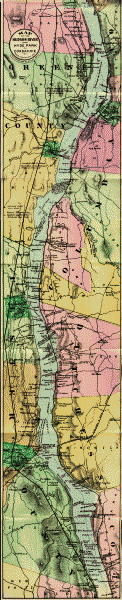
Mount Hymettus, overlooking West Park, so named by "the author and naturalist," has indeed been to him a successful hunting-ground for bees and wild honey, and will be long remembered for sweeter stores of honey encombed and presented in enduring type. Washington Irving says of the early poets of Britain that "a spray could not tremble in the breeze, or a leaf rustle to the ground, that was not seen by these delicate observers and wrought up into some beautiful morality." So John Burroughs has studied the Hudson in all its moods, knowing[page 131] ing well that it is not to be wooed and won in a single day. How clear this is seen in his articles on "Our River":
"Rivers are as various in their forms as forest trees. The Mississippi is like an oak with enormous branches. What a branch is the Red River, the Arkansas, the Ohio, the Missouri! The Hudson is like the pine or poplar—mainly trunk. From New York to Albany there is only an inconsiderable limb or two, and but few gnarls and excrescences. Cut off the Rondout, the Esopus, the Catskill and two or three similar tributaries on the east side, and only some twigs remain. There are some crooked places, it is true, but, on the whole, the Hudson presents a fine, symmetrical shaft that would be hard to match in any river in the world. Among our own water-courses it stands preeminent. The Columbia—called by Major Winthrop the Achilles of rivers—is a more haughty and impetuous stream; the Mississippi is, of course, vastly larger and longer; the St. Lawrence would carry the Hudson as a trophy in his belt and hardly know the difference; yet our river is doubtless the most beautiful of them all. It pleases like a mountain lake. It has all the sweetness and placidity that go with such bodies of water, on the one hand, and all their bold and rugged scenery on the other. In summer, a passage up or down its course in one of the day steamers is as near an idyl of travel as can be had, perhaps, anywhere in the world. Then its permanent and uniform volume, its fullness and equipoise at all seasons, and its gently-flowing currents give it further the character of a lake, or of the sea itself. Of the Hudson it may be said that it is a very large river for its size,—that is for the quantity of water it discharges into the sea. Its watershed is comparatively small—less, I think, than that of the Connecticut. It is a huge trough with a very slight incline, through which the current moves very slowly, and which would fill from the sea were its supplies from the[page 132] mountains cut off. Its fall from Albany to the bay is only about five feet. Any object upon it, drifting with the current, progresses southward no more than eight miles in twenty-four hours. The ebb-tide will carry it about twelve miles and the flood set it back from seven to nine. A drop of water at Albany, therefore, will be nearly three weeks in reaching New York, though it will get pretty well pickled some days earlier. Some rivers by their volume and impetuosity penetrate the sea, but here the sea is the aggressor, and sometimes meets the mountain water nearly half way. This fact was illustrated a couple of years ago, when the basin of the Hudson was visited by one of the most severe droughts ever known in this part of the State. In the early winter after the river was frozen over above Poughkeepsie, it was discovered that immense numbers of fish were retreating up stream before the slow encroachment of salt water. There was a general exodus of the finny tribes from the whole lower part of the river; it was like the spring and fall migration of the birds, or the fleeing of the population of a district before some approaching danger: vast swarms of cat-fish, white and yellow perch and striped bass were en route for the fresh water farther north. When the people along shore made the discovery, they turned out as they do in the rural districts when the pigeons appear, and, with small gill-nets let down through holes in the ice, captured them in fabulous numbers. On the heels of the retreating perch and cat-fish came the denizens of the salt water, and codfish were taken ninety miles above New York. When the February thaw came and brought up the volume of fresh water again, the sea brine was beaten back, and the fish, what were left of them, resumed their old feeding-grounds.