‘JAWA’ OR PEACE-MAKING
Reading edition
During the rainy months, when all work in the fields is suspended, and Nature herself attends to the rice, every path in the jungle leads idle feet to mischief, and, if war be forbidden by the Prenta, pent-up energy may find a wild outlet in boisterous protestations of peace, provided only that these protestations have at least a suggestion of war.
After our war expedition up the Baram just narrated, barely a fortnight elapsed before we were organizing a great Peace-making with those very people of the Tinjar who had been our foes. Tama Bulan, Tama Usong, Aban Deng, and Juman, the chiefest Chiefs of the Kayans and Kenyahs, with all their numerous warriors, were eager to join in the Peace-making, and pledge themselves to the Tinjar people for the friendliness of all the dwellers on the Baram and its tributaries.
Accordingly, the Baram Chiefs were summoned to the Fort, and the day before this great army of peace-makers set out, Dr. Hose invited these Chiefs and their adherents to a lavish feast at his house. The viands were prepared according to the taste of the guests, and, to make all feel perfectly at home, served on the floor of the veranda; the arrack, however, was of extra Chinese brew, and, of course, superior and very much stronger than the diluted, home-brewed liquor to which they were accustomed. Consequently, the hilarity and fluency of song and speech, upon a liberal and well-laid foundation of boiled pork, chicken, rice, and salted fish, was exuberant, but never boisterous. Perhaps the presence of so many powerful Chiefs, above all, that of the all-powerful Resident, had a restraining influence. We all sat down (should I not say, squatted?) at about four in the afternoon, and the last of the guests departed to their quarters in the Bazaar at about eleven o’clock at night. About fifteen pounds of tobacco were consumed, three good-sized pigs were stowed away, and the Chinese shop-keepers alone know how many jars of arrack were unsealed. Tama Bulan and Tama Usong were the last to leave the scene of revelry, and we watched (I must admit with great relief) their dusky figures disappear down the path, as, linked arm in arm, they meandered off in the broad moonlight toward the Bazaar.
Juman, for the second time the important member of an expedition, failed to appear, and since it was partly on his account that the trouble between the people of the two rivers had arisen, the Peace-making would be incomplete without him. In Borneo, after past wrongs, peace and good-fellowship cannot be gained by simple asseverations; there must be always a palpable exchange of beads, highly prized jars, brass gongs, etc., as an indemnity. The perpetrator of the wrong, or one of his descendants, must be present with his adherents to join in the sham fight, known as the ‘Jawa.’ The canoes of the peace-party were laden accordingly with articles for exchange, and with the paraphernalia of the men who were to engage in the sham fight.
At an early hour on the morning after the feast, we started up-river in the Government’s steam launch, for which the river is navigable for at least sixty miles above the Fort; behind us trailed the long line of canoes with the peace-makers,—a pretty woe-begone, head-achey looking lot, after the Chinese arrack of the night before. As the day wore on and we steamed slowly up against the strong current, dodging the ponderous logs that swept past, one by one the Chiefs climbed up from their canoes and sat limp and taciturn around us on the small deck of the steamer. Still no sign of Juman and his party. We had expected to meet him before we turned off into the Tinjar River. So necessary a personage could not be left behind; therefore, a letter was left for him at the mouth of the Tinjar. On a large sheet of paper, we painted a picture of a steam boat heading up-stream with inky volumes of smoke issuing from the funnel and a long line of canoes in tow; underneath was a gigantic hand pointing up-stream. This letter was fastened in a cleft pole stuck up on the bank; then we steamed at full speed up the large tributary.
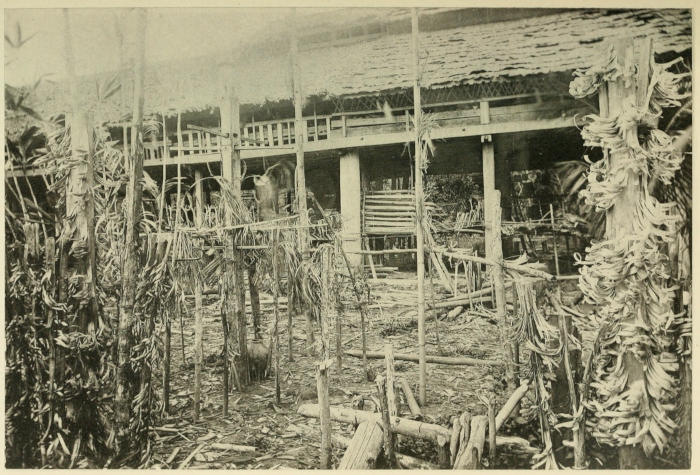
A CHARM AGAINST FEVER.
THE BARRIER AND CHARMS DEVISED BY THE DAYONG TO WARD OFF EVIL SPIRITS FROM THE HOUSE OF THE LELAK CLAN, AND TO DRIVE AWAY THE DEMONS WHO WERE ALREADY AFFLICTING THE HEAD-MAN OF THE HOUSE WITH FEVER AND TRYING TO LURE THE SOUL OUT OF HIS BODY.
A lovely feature peculiar to the Tinjar River is the hills cultivated with rice. On the lower reaches of the Baram, the flat, swampy ground extends for a mile or more from the river on both sides. Here, clearings extend over low undulating hills, and at this season of the year the rice was already six inches tall, and its tender emerald green was unspeakably refreshing after the dark foliage of the jungle. Twice we passed groups of men and women busily weeding the fields; but, poor wretches, as if their toil were not enough, they must all needs be clad in heavy war-cloaks; they had heard, so they said, that there was an enormous head-hunting army on the way from the Baram, and they were in hourly terror of being attacked and killed. We allayed their fears, and were delighted to learn that the fame of our War Expedition had travelled so bravely and had lost nothing in transmission.
Early in the afternoon we reached the household of the Lelaks, and halted for the night, to allow Juman to catch up with us. The old man of the house, whose adherents were not numerous enough to entitle him to the rank of a ‘Penghulu,’ and whose wealth was insufficient for the title of ‘Orang Kaya’ (Rich Man), merely presided over his household by reason of his age, and was known simply as the ‘Orang Tuah’ (Old Man). On our arrival, we were told that he was almost at death’s door from an attack of fever, and that every resource known to Dayong art had been tried in vain; evidently, the evil Spirits had resolved to entice his soul away, in spite of the elaborate barrier which the Dayongs had professionally erected in front of his house.
This barrier consisted of a circle of stakes cut, at intervals down their sides, into curled shavings; in the centre of the circle stood a high, squared pole painted with stripes of red and black; at about four feet from the ground, and again near its top, were cross-bars piercing it from front to back and from side to side. At its base stood an earthen jar filled with water, and round about outside the circle was a bristling thicket or sort of chevaux de frise of posts and stakes cut into manifold fringes of shavings, and several cleft sticks about three feet high, holding in the cleft an egg. To the Dayongs, these curled shavings and cleft sticks have a profound meaning which they either did not know or did not wish to divulge. All these prophylactics were, however, in vain; the evil Spirits obstinately and perversely refused to depart from the old man. Not being an angel, I pressed fearlessly within this charmed ground, and even took photographs there in spite of Tama Bulan’s solemn warning. He would not go near the barrier, and in awed tones warned me that just as sure as I touched any of those stakes I would have horrid dreams and most assuredly be clutched by a ghost and hideously scarred for life; should the ghost chance to clutch me by the throat, I would choke to death and never wake.[12]
After I had taken the photograph, we paid a visit to the old man as he lay feverishly tossing and turning on his hard board bed. I administered to him a placebo in the form of an assurance that I had skilfully caught and imprisoned the evil Spirits in my ‘box-with-an-eye’ (my camera), and they would trouble him no more; then, abandoning the ‘faith cure,’ I administered a generous dose of quinine.
The Lelaks are an unusually industrious household; they cultivate an abundance of rice and keep it stored for rainy days, in granaries which, although they are far away from their dwellings and hidden in the jungle, they decorate with graceful designs in black paint upon a white ground. In their houses, also, almost every beam-end is carved into barbaric figures of men or of monkeys in twisted positions with arms and legs interlacing; also many of the upright posts supporting the roof have carved in them deep niches to serve as seats.
In the evening, under the benign effects of a hearty meal of rice and fish and of numerous cigarettes, Tama Bulan became jovial, and his broad, genial smile beamed to right and left on all as he sat with his back against one of the carved house-posts, and proposed that we the guests should be entertained with some of the dances for which the Lelak women are famous. Of course, the women were coquettishly shy at first and scurried off to their rooms. Tama Bulan was not, however, to be thus put off or put down, but appealed to the Orang Tuah to send searching parties for the best dancers. Then he turned to Dr. Hose, and, in a metaphor of which he was fond, said, chuckling, ‘Tuan, this fishing doesn’t seem to be very successful; all the good, plump fish have gone up-stream, and left us nothing but these bony ones;’ here he nodded toward some old and thin beldames, calling them by the names of the poorer kinds of fish which generally are thrown away; but when, a few moments later, three young girls, dressed in their best skirts and with bright-coloured fillets round their heads, shuffled coyly out from their rooms ready for the dance, he lit a fresh cigarette and settled back comfortably in his seat, saying, ‘Aha! Here are plump fish worth looking at.’
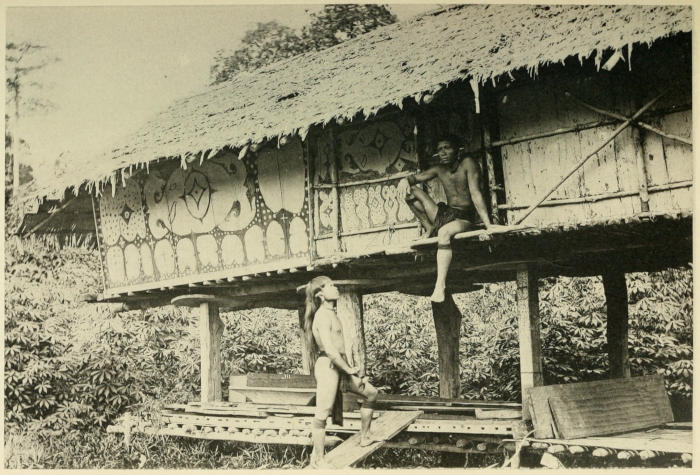
DECORATED STORE HOUSE FOR RICE.
THE PLANT GROWING DENSELY AROUND IT, IS WILD TAPIOCA.
The dance was like that of almost all of the Malay and allied races, more waving of the arms and swaying of the body than movements of the feet. It was exceedingly like the dances of the Javanese, wherein movements of hands and wrists are the chief features. It appeared to be a solemn performance; instead of the fixed, mechanical smile of our ballet dancers, there was a stare of constrained solemnity verging on a scowl.
The effect on the dancers themselves was marked; demure as were their motions, their excitement was great. One of them suddenly ceased and, leaning against the wall, declared that she was exhausted with the strain. Although the movements of the dance had been slow and gentle, she was undeniably almost in an ecstatic trance, with eyes half closed and breathing labored.
Very different were the Kayan dances which followed; the men vied with each other in wild leaps and shouts, springing high in the air and coming down on their knees, all the while battling with imaginary foes; slashing with their parang and waving their shield in rhythmical time to the drone of the kaluri.
Our hand-clapping by way of applause caused great laughter and astonishment, and the ever-present small boys imitated it in high glee. Their only fashion of showing approval or wonder is by a loud cluck with the tongue. Once on a time, when we happened to stop at a house which, during the selection of a rice-field, was under a ‘lali’ or restriction, (no stranger may then enter and no inmate leave it,) Dr. Hiller and myself were urgently requested to pace up and down in front of the house, after we had stripped ourselves to the waist, so that the inmates might have the privilege of seeing our Japanese tattooing. They had all gathered in a row behind the railing of the veranda, and as we passed along below, the succession of explosive clucks of unbounded admiration sounded like musketry in the distance. Eagerness to see our tattooing broke down for us many a barrier. Although the Borneans themselves are masters in the art, nevertheless they use but one colour, and could not believe that the variegated Japanese designs were not painted, instead of pricked in. Many a time this incredulity proved a sore trial, by subjecting us to vigorous attempts at rubbing off the colour with a dirty thumb, well moistened on the tongue. Here also at the Lelak house, at Tama Bulan’s urgent request, I stripped to the waist, and the sight of Hori Chiyo’s best handiwork on my back so inspired one elderly woman, that, after the chorus of clucks had subsided, she burst into song, which, being in the Lelak dialect, I was unable to understand, but was assured it was extremely complimentary.
The guest chambers in a Lelak house are boxes about five feet square, suspended from the roof, and to which access can be gained only by a ladder. Possibly, this is for the comfort of the guest; possibly, it is in order that he may not have too much liberty. We preferred, however, the floor of the veranda, but before morning I realized the error; three times was I awakened by an incubus of a dog curling himself up for sleep on my chest.
Late in the night, the whole house was aroused by the arrival of Juman and his adherents; he had read our letter and made the best time he could against the strong current. The expedition was now complete, and the following morning we abandoned the steamer and started off in canoes.
The Orang Tuah of the Lelaks maintained that my box-with-one-eye was better than all the Dayongs, and that of a surety I had effectively captured the evil Spirits; he was so much better that he insisted on going along with us. I must acknowledge I was none too well pleased with his determination; he was exceedingly feeble, and should he die the blame would be surely imputed to me.
Continuously along our route the numbers of the peace-makers were augmented by boat-loads from the houses that we passed, all anxious to join in the feasting which took place wherever we halted, and all wanted to be present at the final grand ratification in the house of Tama Aping Buling at the head-waters, where Kilup and Juman, bitter enemies, were to meet, and be reconciled.
Late in the afternoon during a terrific thunder-storm, we arrived at Tama Liri’s house, and although he is a Penghulu of importance, his house is a disgrace and he himself a troublesome thorn to the Sarawak Government. In the first place, there was no notched log whereby to cross the wide stretch of muddy bank; to get to the house we should have been compelled to wade through mud knee-deep, had not the Kayans and Kenyahs in our party devoted themselves energetically to showing the Berawans what could be done in the way of rapid work. In pelting sheets of rain and deafening peals of thunder they dragged forth a great fallen tree-trunk and cut notches in it. The Chief and his people, meanwhile, who ought to have been helping, sat at their ease up in the house and looked down unconcernedly. In the second place, Tama Liri’s house is built upon such ramshackle poles that they could not support the weight of boards, and, consequently, the flooring is of bamboo strips, and in places so weak that all were afraid that the whole flimsy structure would tumble about their ears. The Baram folk were by no means in a good temper when at last they gained the shelter of Tama Liri’s veranda. In the evening all the Chiefs took a malicious pleasure in telling their host what a miserable shanty he had instead of a house, and expressing the hope that by the time they revisited him he would have built a new one. In the midst of these vivacious observations, which did not seem, in the least, to disturb our stolid host, Tama Usong begged me to lend him my box of matches; on receiving it he passed it over to Tama Liri with the suave remark, ‘Here, Blood-brother, are some posts for your house; they are better than those you have, and you can buy more in the Bazaar, very cheap.’ All the Baram people, and even some of Tama Liri’s own followers, snorted and laughed at this stroke of wit, but the host adroitly diverted their thoughts by instantly expatiating on the pig, six spans long! which Aban Liah (not he himself, but his neighbor Aban Liah) was going to kill for the feast when we arrived at his house. Tama Liri added that it would have been better, of course, if it were eight spans long; this would have been the kind he would kill were he giving a feast. Tama Bulan was not in as good spirits as on the preceding evening. He was depressed by the illness of his nephew, Wan, who had been ailing ever since reaching the Baram Fort, and now, from exposure in the heavy rain during an attack of fever, was in the first stage of pneumonia and verging on delirium. Tama Bulan begged me to give him some medicine; but remembering the disagreeable time that I had in his own house, in consequence of the death of an inmate, I demurred, preferring to shift the responsibility on the Dayongs and the livers of pigs and entrails of chickens.
Tama Bulan assured me, however, that he had absolute confidence in my medicine, and always had, even at the time of Lueng’s death, when her brother, who thought we had poisoned her, wanted to kill Dr. Hiller and myself. ‘Besides,’ he added, ‘it will be so inconvenient to have Wan die in the house of Tama Liri; of all men, he will be the very one to demand immense compensation for the ill-luck brought on his miserable old house.’ Thereupon, I did all in my power for the boy; but in the morning, when the time came to leave, he was only a very little better, and it would have been highly dangerous to move him down to the boats. With great regret we were obliged to leave behind the dear old Kenyah Chief to take care of his good-for-nothing nephew. We had depended upon Tama Bulan to make the peace-ceremonies go off smoothly, and in strict adherence to Borneo customs. Wan’s father, a half-brother of Tama Bulan, was continually making trouble between the Kenyahs and the Sarawak Government, until Dr. Hose one day obtained possession of an invaluable charm of his, consisting of a small misshapen hen’s egg, whereon he based all his good luck. Only by the ever-present threat that his egg would be broken by Dr. Hose at the least sign of treason on his part, can he be controlled and kept peaceable, even, I believe, to this hour. Owing to the sins of the father, I was not quite so compassionate as I might have been, for this handsome but arrogant youth, who was now the cause of our losing the assistance of Tama Bulan. I left my watch with the dutiful old uncle, and exact diagrams of the positions of its hands when the medicines were to be given. Our next stage was to be but a short one: if Wan were better on the following day, Tama Bulan could catch up with us; if he were worse, my advice was that he should be moved to the boats carefully and an attempt made to get him home. Tama Bulan said he would much rather have him die in the canoe than in Tama Liri’s house. Judging by the general lack of recuperative power in the Borneo people when they are seriously ill, and by the small probability that my instructions would be strictly obeyed, I thought Wan was doomed, and so expressed myself to Tama Bulan, with the hope, at the same time, that the medicine would be efficacious.
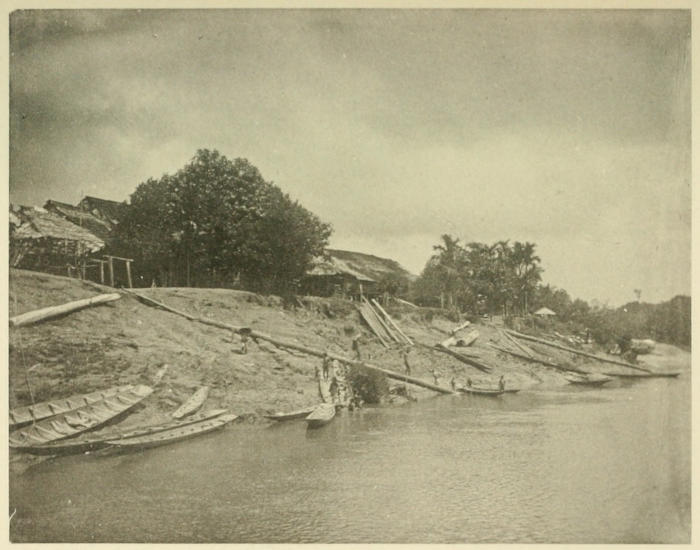
RIVER BANK IN FRONT OF A LONG-HOUSE.
Joined by Tama Liri and a number of his adherents, we set out for the house of Aban Avit; Tama Bulan dolefully and regretfully bade us good-bye, wishing us ‘Salamat jalan’—a lucky journey.
Aban Avit, also a Berawan, proved to be as much a credit to the tribe as Tama Liri is a disgrace; his house is strongly built, well floored, well roofed with iron-wood shingles, decorated here and there with carvings, and, around doors and along partition walls, ornamented with borders of loops and circles and dots painted in black and white by the Chief’s own hand. (Elsewhere I have described the house with some minuteness.)
No longer under Tama Bulan’s influence, the other Kayan Chiefs began to behave in a foolish and stubborn manner.
Tama Usong flatly refused to come up to the house because he disliked Aban Avit, and sulked in his boat on the other side of the river, preferring to endure torrents of rain at night rather than forget old scores until the very hour of the grand ratification of peace and amity at Tama Aping Buling’s. His absence, however, was not felt; the house was full of strangers; an old, sad-faced Chief, named Laki Jok Orong, had arrived only the day before, from the Rejang, and was on his way to the Baram, whither he was escorting a middle-aged woman who three years previously had been abducted from her home, and ever since held captive in a Rejang River house. Curiously enough, Dr. Kükenthal, on a visit to the lower Baram, had happened to photograph this very woman before her abduction,[13] and had sent a copy of the portrait to her family. Having discovered the house wherein the woman was detained, some of her friends set out to obtain her release. By means of this photograph, which they took with them, they were enabled to establish her identity beyond dispute, and brought her away. The features in the photograph were still recognisable, even under a thick coating of finger-marks. The woman herself now had possession of it, and, proudly unwrapping it from its many coverings of dirty cotton cloth and dried palm leaves, passed it round the circle.
Laki Jok Orong had a sad tale to tell of the oppression of his people by one Owang Taha, a half-breed Malay, and a sub-Resident for the Government, in the upper Rejang River. When he once got fairly started, he kept up the screed in a whining, lugubrious monotone that droned on and on till his audience, by desertions and by new arrivals, was changed several times, and at last engaged in general conversation; but none the less, the droning plaint of the Rejang Chief still went on and on. The seven or eight long, straggling hairs which he suffered to grow on his lip, above the right corner of his mouth waggled and waved, and in his ears the ornaments, carved out of a horn-bill’s crest to represent tiger-cat’s teeth, alternately pointed up and down as he dolefully shook his head over the never-ending rehearsal of his wrongs. I retired to my dark-tent, developed a dozen or more negatives, packed away all my trays and chemicals, and then when I rejoined the circle around the fire in the veranda, still from the outer edge of darkness quavered Jok Orong’s voice as persistent as ever,—and as unheeded.
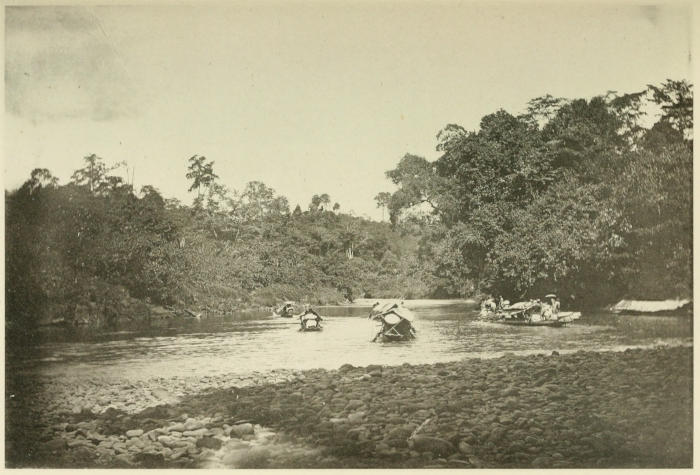
SOME CANOES OF THE PEACE-PARTY IN A QUIET REACH BETWEEN RAPIDS.
Early in the next forenoon, Tama Bulan and six of his best paddlers came swiftly up-stream to tell us that Wan was much better, but that they had decided to take him home with all speed. Of course, that Tama Bulan should turn round and immediately go back to Tama Liri’s was not for a moment to be thought of, and, although it was early in the day, jars of arrack were brought out, and the sullen Tama Usong and Juman, persuaded thereto by Tama Bulan, joined us in the veranda, and the unwearied Laki Jok Orong seized a fresh opportunity to indulge in the luxury of woe, and to begin, and continue the recital of innumerable wrongs. The etiquette in drinking toasts is the reverse of ours; with us, he who is toasted remains seated, generally with a sickly, self-conscious smile, while all the others rise and drink to him. In Borneo, however, the toast is the only one who rises and is the only one to drink, and he must leave no heel-taps; it is the company who remain seated, and break into a deafening humming and oo-oo-ing, which are kept up until the last drop is drained. Possibly, the custom arises from the fact that there are rarely cups enough to go round, and one sticky, begrimed, glass tumbler, or else a carved bamboo cup, (rarely used now-a-days,) must perforce pass from lip to lip. That there had been such things as bamboo drinking-cups, we discovered by mere accident from a song, commonly sung at these feasts, which runs:—‘I offer to you the glittering cup, I offer to you the bamboo cup.’ The words have a jingling rhythm:—
Akui mejee tebok klingee Ara wi wi ará Aku meju tebok bulu Ara wi wi ará.
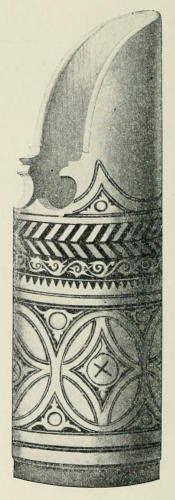
‘Tebok Bulu,’—Bamboo Drinking-cup.
Never having seen in use, as cups, aught else but pressed-glass tumblers or cocoanut shells, we asked what was meant by ‘tebok bulu’ and, by way of answer, a rummage began among the old mats and baskets piled on the rafters; whereupon, several bamboo cups were found, coated with dust and soot. They were carved into a sort of lip like a pitcher on the upper edge, and on the sides were decorated with engraved scrolls, bands, and circles. Tama Bulan was delighted to see them, and said he remembered well when there was no other kind of cup than the tebok bulu. He insisted that one should be washed out immediately and put to use, inasmuch as arrack always tasted far better from the bamboo. To Jok Orong, being a guest from afar, was accorded the honor of the first drink, and the oo-oo-ing was so thunderous that in his nervousness most of the arrack trickled down where his shirt front might have been. Then came Tama Bulan’s turn, and without the wink of an eyelid he drained the cup, and then gave a cleanly wipe round his mouth with the long, dangling end of his waist-cloth. So the flowing bowl passed round; one after another the Chiefs were toasted and oo-oo-ed, and Jok Orong’s perpetual-motion tongue was again set free, but instead of recapitulating his endless wrongs, he now divulged, for the first time, the true object of his visit. Having first privately conferred with Tama Bulan and obtained the latter’s hearty approval of his purpose, he formally announced to the whole company that he was on his way to the Baram Fort to convey to Dr. Hose, whom he now unexpectedly met on the road, the earnest wishes of the people of the Batang Kayan River, in Dutch Borneo, to emigrate to the Baram district, and place themselves under the protecting Government of Rajah Brooke. It was the very thing that Dr. Hose had been hoping to hear for some time past. It was especially fortunate that Tama Bulan happened to be on hand, and could give his weighty assurances that the immigrants would meet with cordial welcome. As a tangible proof of the friendship of the Kayans and Kenyahs of the Baram, a large bundle of presents was made up for Jok Orong to carry back with him. Tama Bulan purchased at once from Aban Avit two large brass gongs as his contribution, (a really lavish present;) Aban Avit sent a highly prized clay jar; Tama Usong and Juman contributed parangs and spear-heads, and Dr. Hose sent a bolt of white cotton cloth, three bolts of Turkey red, a bottle of Scotch whiskey, and, with his usual happy tact, a bundle of candles; these, he explained to Jok Orong, were to light the footsteps of the new comers and guide them to a land of ease and plenty,—a gift and a message exactly in accord with their own sentimental symbolism; and six months later, when a large number of these Batang Kayan people did move over to the Baram, the Chiefs all came to Dr. Hose and laid these candles before him in the court-room of the Fort.
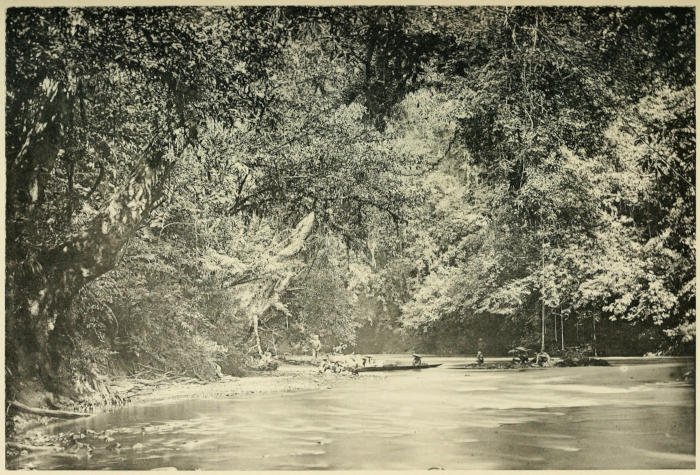
RIVER SCENE IN THE HEART OF BORNEO.
When the arrack was getting low and the lament of Jok Orong was beginning afresh, Tama Bulan arose to take his leave. All the people of the house, even the women and children, marched out in single file and took their places on the plank walk leading to the river-bank, and even on the notched log at the very edge of the water. As the brave old Kenyan Chief’s canoe swung out, all those who stood on the shore waved their large disc-like hats, shouting farewells and wishes for his safe journey home. He leaned far out from under the palm-leaf screen of his canoe, and with a broad smile, revealing a gleam of his shining black teeth, waved his hat and shouted success to the Great Peace-party; the swift current caught his boat, and it dashed out of sight round the turn of the river. There is unquestionably an unusual personal force in this middle-aged Kenyah Chief’s character; not a tribe that does not respect his name and speak of him with admiration mingled almost with reverence. In my book of photographs, which I carried about with me to overcome the objections of timid souls to having their portraits taken, Tama Bulan’s portrait soon became framed with a black margin of thumb-marks, and his features much dimmed by constant fingering,—the natives are never content simply to look at a portrait, but always insist on passing their hands over it; in landscapes, no matter how familiar the scene, they take no interest whatever. Tama Bulan’s influence cannot be attributed to fierce looks; his expression is, on the contrary, gentle and benign; nor is his presence commanding, but yet, when he once gives an order or pronounces judgement, there seems to be no thought of disobedience or of appeal. Certainly, he has one characteristic: keenness; we once asked him if he knew what was meant when, in talking English among ourselves, we said ‘T. B.’ (his initials); he at once replied, ‘I think, Tuan, you are, probably, talking about me.’ We were led to ask because we noticed several times that he looked up swiftly when these initials were uttered.
By the time that all the arrack had been quaffed, the promiscuous household of Aban Avit was somewhat demoralized; nevertheless, we picked out a party of eight or ten sober men to escort us to the top of an adjoining hill, whence we could get the bearings of several mountains which would give us cross-bearings when we reached the really hilly country. It was an exceedingly difficult ascent, although the hill was only five hundred feet high; so dense was the jungle with thorny palms, rattans, and the roots of ‘buttress trees,’ that we had to cut every step of our way to the top. When we reached the summit we were just as much closed in by trees as when we were at the foot. As a sight of the horizon was essential, there was no help for it but to sacrifice some of the grand old trees; so our men were set to work with their axes, and in a few minutes one after another of the venerable giants went toppling down the precipitous hillside, carrying smaller trees in their fall and making a crashing roar that reverberated from mountain to mountain like veritable peals of thunder. Then were disclosed views of the surrounding mountains through the open windows in the foliage, and we were enabled to take the bearings of Mt. Dulit, and Mt. Mulu, and the peaks of a low range of lime-stone hills that were to the south-westward near the coast.
The next day, during our toilsome paddling up-river, we overtook an old Chief named Jamma and his party, also on the way to Tama Aping Buling’s to participate in the Peace ceremonies.
Jamma had the reputation of having at all times a marvellously good opinion of himself, and on this occasion was travelling in grand state with gong-players in the bow of his boat discoursing that tinkling, staccato music, of which, it seems, he was an ardent admirer.
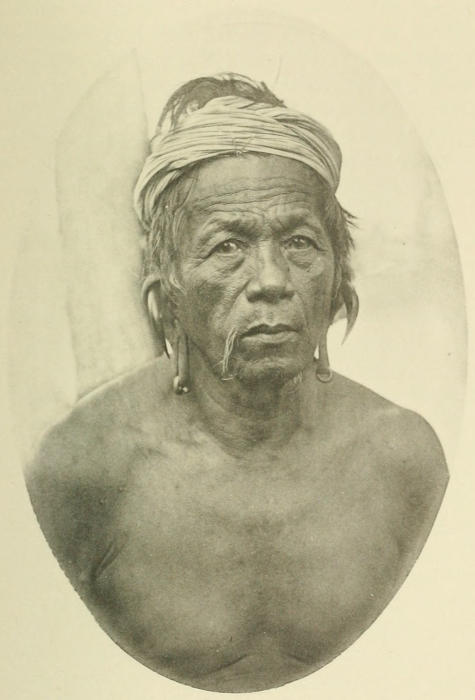
LAKI JOK ORONG, A REJANG RIVER CHIEF.
THE ORNAMENTS IN HIS EARS ARE CARVED OUT OF THE BEAK OF A HORN-BILL, IN IMITATION OF TIGER-CAT’S TEETH.
The instrument known as the ‘Kromong’ is an importation from Brunei, the ancient capital of Borneo, and consists of a series of eleven small brass gongs laid on ropes of rice straw and struck with a wooden beater. The result is perfect in time but absolutely devoid of melody; it is merely running up and down the imperfect scale of gongs in sequence, or beginning at the deepest toned, or largest gong, with the left hand, the third in the series is struck with the right hand, then the second with the left and the fourth with the right, and so up the line of all the eleven gongs, the left hand following the right at an interval of one gong. At a distance, possibly at a very great distance, the sound wafted across the water is really not unpleasant, recalling the gurgling and tinkling of a woodland brook; but close at hand its jangling monotony is beyond words exasperating.
Jamma, to whom was due this running accompaniment, is the nephew of the redoubtable Aban Jau, who, in the wild days before Sir Charles Brooke became Rajah of the Baram district, was the ruler over all the people of the Tinjar. For years he defied the Sarawak Government, and with his numerous and formidable household of eight hundred people was the terror of the whole region. His house was over a quarter of a mile in length, and was well stocked with brass swivel-guns brought from Brunei. But he was finally overpowered by the Rajah’s trained Iban soldiers and forced to submit to the laws and the taxes of Sarawak. Mild and moderate as these were, they were too galling to Aban Jau, and he soon after migrated to the regions of ‘Bulun Matai,’—the Land of the Dead,—his household was scattered, and nothing now remains of his long-house except rows of decaying posts stretching far away into a thick, impenetrable overgrowth of palms, gigantic ferns, and tangled vines. To judge of the dead uncle by the living nephew, it cannot be said that the breed is improved; the nephew, Jamma, is a decidedly repulsive old fellow in spite of his musical strain. At the time I made his acquaintance he was sadly in need of a razor, or rather, of a pair of tweezers; a five days’ scraggly growth of grizzled bristles covered his chin and cheeks; to aid his failing eyes he wore a pair of huge, circular, brass-rimmed spectacles, evidently a bargain, purchased at random from a Chinese trader; their focus did not in the least comply with the formula of his eye-sight, and made him squinny up his eyes in a number of wrinkles that would puzzle Cocker. The eyes behind the glasses resembled those of an Orang Utan; the whites were a dirty, blood-shot brown, and the iris appeared to have overrun and left a stain around it. His eyebrows and eyelashes had been pulled out, and beneath the lower lids hung wrinkled and flabby bags of skin. His upper lip was long, and came down to a point in the middle, and his lower lip was thick and everted, exposing the pale, moist, inner surface. His nose was broad and flat, and the nostrils opened directly forward and apparently into the cavities of his skull. On his head a thin, unhealthy-looking crop of whitish hair stood up, like a scrubbing-brush, where it was not covered by the very dirty and faded blue and white jockey cap of canton flannel, which he wore with unmeasured pride and with a ‘peace in the consciousness of being well dressed,’ which all his ‘religion could not bestow.’ The stretched lobe of his right ear had given way, and one long end dangled down on his chest and whipped from side to side whenever he moved his head quickly. Long experience has taught me utterly to distrust personal appearance at first sight, but in Jamma’s case a prolonged acquaintance confirmed a belief that his intense ugliness had struck in.
The Peace-party was by this time assuming large proportions; constant additions were made to it from the houses along the river, and late in the afternoon, after a vigorous and inevitable outburst from Jamma’s gongs, we pulled up at the high sandy bank in front of the house of Tama Aping Pang. Here, beyond the region of mosquitoes, and while darkness was closing in, cooking fires were built along the shore.
After the evening meal was finished and universal benevolence was diffused by soothing cigarettes, all the Kayans went up into the house to assist Juman in the rite of ‘Usut’—that is, of obliterating a feud. The interchange of Usut is obligatory between the descendants of enemies whenever they first enter each other’s houses; they may have met many times on most friendly terms in the jungle or in the houses of neighbours, but they must not take shelter under one another’s roof until they have appeased the wrongs done by and against their ancestors. The simple rite of giving Usut for ancestral wrongs is expanded into the performance of Jawa when, in addition, the descendants have been themselves wrongdoers.
Up the notched log we all mounted to the veranda and seated ourselves in a circle on the floor. Juman and Tama Aping Pang, a short and squat little man, with a decidedly Mongolian face, sat cross-legged and facing each other. Juman began the ceremony by flinging down a roughly made iron spear-head into the centre of the circle; thereupon Jamma, still wearing his goggles and his blue and white jockey cap, arose to officiate. Upon the flat surface of the spear-head a young chicken was at once decapitated, then torn to pieces, and its warm blood smeared thickly over the point. The hideous Jamma thereupon proclaimed, in the guttural grunts of the Sibop language, that all enmity between the Houses of Tama Aping Pang and Juman was at an end, and hereafter neither of them could be reproached with having allowed the slaughter of their ancestors to go unavenged. Whereupon sundry beads and trinkets were exchanged more as a formality than on account of their value, and some blood from the spear-point having been rubbed either on the chest or arms of everyone present, including ourselves, Juman and all his clan at once hailed Tama Aping Pang and all his clan, as friends. No carousing followed, and the weary Kayans soon retired to the river-bank and to their canoes to sleep.
This house of Tama Aping Pang is famed for its manufacture of ‘Sumpits,’ or blow-pipes. All along on the partition wall of the veranda, I noticed that they were stacked in all stages of manufacture, from the rough-hewn and thick staves up to the drilled and polished tubes. The best Sumpits are made of a hard, close-grained, reddish wood of a tree called ‘Niagang.’ This is used not only on account of its hardness but also because it is exceedingly straight and has very few knots. A staff of wood about eight feet long is shaved down until it is about three and a half inches in diameter; it is then inserted in a hole in the floor of the house, and so secured that one end remains five or six inches above the floor; over it a man stands with a long, slender rod of iron flattened to a rough edge at one end; this edge an assistant keeps constantly true to the centre of the long staff, while the man raises and drops the drill perpendicularly. Gradually a bore of about a quarter of an inch in diameter is thus produced. It is an exceedingly slow process; it takes at least eight or nine hours to drill through the whole length of the staff. The bore is now smoothed, first, by means of fine sand or clay smeared on a slim rattan, which is pulled through it many times rapidly backward and forward. It is then ready for polishing with another piece of rattan ending in a loop or a cleft, wherein leaves, like the bamboo, rich in silica, are bound; it is thus polished until it shines almost as brilliantly as a gun-barrel. The staff is now trimmed down to the diameter of about an inch and a half at the mouth, and to an inch at the muzzle, and then scraped and smoothed with knives and shark-skin files. If the tube happen to be slightly sprung, the curve is overcome by a broad iron spear-head bound on at the muzzle; when the pipe is held horizontally the weight of the iron counteracts the curve.
Some of the more highly finished blow-pipes are furnished with a sight, called by the Kayans ‘Bitan,’ ingeniously made of a cowrie shell imbedded in gutta-percha near the muzzle, with the slit-like opening turned upward and parallel with the shaft; again, others have an iron sight, near the muzzle, bound on with rattan. I have never seen any carved ornamentation on a blow-pipe except a plate of bone inlaid with strips of lead, at the mouth-end. ‘Sumpitan’ is the Malay name for the weapon; the Kayans call it ‘Leput,’ and the Punans simply ‘Put;’ Ibans, who clip and elide Malay words, drop the ending an, and call it ‘Sumpit.’ All these names are, possibly, derived from an imitation of the sound when the dart is blown through the tube and the tongue closes the opening with a quick pat.
Before our departure next morning there was lively trading in the specialty of the house. The house itself was really a notable monument of industry and artistic taste; many of the projecting beam-ends were carved and the partition walls decorated with borders and frescoes in black and red. For a bolt of red cloth I bought the elaborately carved door of a dwelling-room, whereof the photograph is on the opposite page.
Our next destination was the house of the crafty and treacherous Aban Liah, once a respected Penghulu, but on account of his duplicity in connection with the murder of the Chinaman by Tinggi, (set forth in the preceding pages,) the Government had degraded him. His house was selected, nevertheless, as a rendezvous for the whole Peace-party before ascending the river to the house of Tama Aping Billing, just then the candidate for the Penghulu-ship of the upper Tinjar, and also for Aban Liah’s seat in the Council Negri.
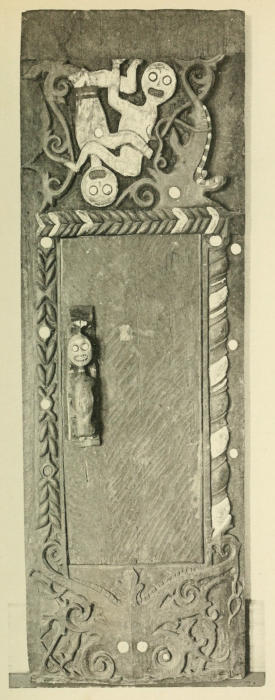
A DOOR-FRAME FROM THE HOUSE OF TAMA APING PANG, A SIBOP.
THE TWO LITTLE FIGURES ABOVE THE DOOR WERE SAID TO REPRESENT WAWA MONKEYS. THE CARVING TO THE RIGHT OF THEM IS, I BELIEVE, THE CONVENTIONALIZED HEAD OF A PIG. BELOW THE DOOR THE SAME DESIGN IS REPEATED, BUT REVERSED AND DOUBLE.
After the halt for luncheon, at mid-day, old Jamma courteously invited me into his boat, and in order to overcome my prejudice against him I accepted his invitation. He verily tried his best to make me comfortable; arranged mats and rolls of cloth for me to recline on; started up the gong-beater to his deafening and lugubrious work; told me with assiduous attention the names of the small tributary streams which we passed, and zealously pointed out one where some of his men had gone on a collecting trip for the ‘thing that smells,’—a circumlocution for camphor,—he was afraid to pronounce the name lest it bring bad luck to his collectors. That the river was pre-empted was manifest; across its mouth had been stretched a rope of rattan, and from it dangled wooden models of parangs, billiongs, (axes) and spears. These models indicated that the river was claimed by the camphor collectors; to disregard this warning exposed the offender to the malignity of all evil Spirits. The only way whereby such a taboo may be counteracted is to build a fire, and erect over it an arch of twigs and sticks cut at the ends and down the sides into curled shavings; when the fire burns up briskly, he who would break the taboo must carefully explain to the fire that he is a near friend to the claimants of the river, and entreat the flame and the smoke to convey his message of good-will both to them and to the Spirits of the jungle. After this ceremony he may, in perfect safety, pass under the rattan, and ascend the river.
In the course of this entertaining and instructive conversation, Jamma suddenly, and apparently for the first time, caught sight of my briar-wood pipe, and, apropos of nothing, exclaimed, ‘What a pity it is that the Tuan did not bring with him several pipes like the one he is now smoking.’ The mystery of his devotion to me was at once solved! Here was the secret of his hospitality; alack, I did not respond; blind to the palpable hint, I simply replied that it was indeed a pity, a great pity; I often liked to change my pipes, but that this one was so exceptionally sweet that I had brought no other. He had counted on my handing it over to him with alacrity, and at once his manner changed from ‘gay to grave, from lively to severe;’ the rest of the journey was passed in an obstinate silence, unbroken save by the banging of his brazen gongs.
Aban Liah began to show his evil disposition from the very moment we pulled up at his house; he insisted that Juman should never enter his house until Usut had been paid. This seemed designed to thwart the whole Peace-making; not only would much time be consumed in discussing the payment of Usut which was not due to Aban Liah, but furthermore the ceremony of Jawa and total settlement of Usut had been planned to take place in a day or two at Tama Aping Buling’s. Dr. Hose put a stop at once to all this nonsense by emphatically telling Aban Liah that Juman was now travelling with the Government,—that is, with Dr. Hose himself,—and as the Government intended to enter any house that was convenient, Juman should follow. I am thus particular in giving these details because of their tragic consequence to Aban Liah. In response, Aban Liah gave a grunt, and, muttering, shut himself up at once in his private room, where he sulked for half an hour, while the Kayans and Kenyahs were making themselves quite at home in his veranda. When they were all seated in groups, Dr. Hose went to the room and dragged forth the pouting, grumbling, obstinate old creature, and although the two men, Aban Liah and Juman, were perfectly well acquainted with each other, Dr. Hose made an elaborate ceremony of introducing them, as though they had never met before; this formal introduction really seemed to obliterate all previous hard feeling, and Aban Liah unbent as though graciously meeting a new acquaintance. Shortly afterward, our host cleared a space in his room for us, spread fresh mats, and put his fireplace at the disposal of our Chinese cook. When we all sat chatting in the veranda, Aban Liah seized the occasion to expatiate on the magnificent proportions of the pig that he was going to kill for us on the morrow, affirming that it was seven spans long (this was one span better than Tama Liri had held out to us), and very, very fat! His arrack also was of an especially fine brand, and plenty of it, too, in jars dusty with age.
Suddenly, messengers hurried in to announce that the Lerons from the house of the Leppu Anans close by, and friends and relatives of Tinggi, were on their way down-river to go through the ceremony of Jawa with Juman and his clan.
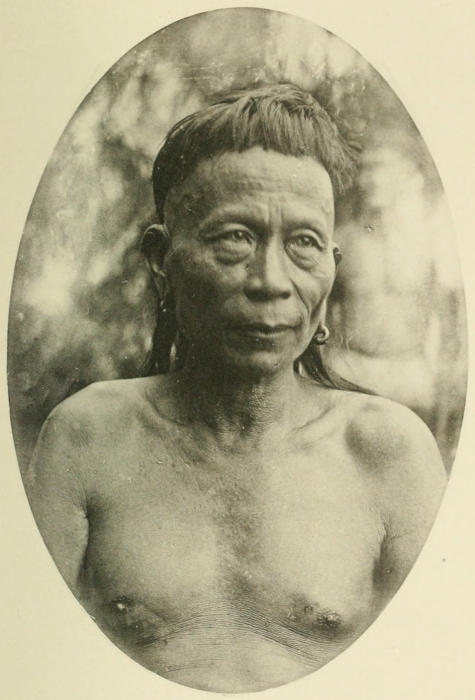
ABAN LIAH.
A BERAWAN CHIEF, WHO, DURING THE PEACE-MAKING, DIED OF A GUILTY CONSCIENCE.
The greatest excitement at once ensued; all jumped to their feet and began talking and gesticulating wildly. Dr. Hose, fearing that a real fight, instead of a sham one, might be the result, hurried up-river in a light canoe, to meet the approaching participators in the Jawa, and to restrain their zeal. These people, be it remembered, had vowed to kill Dr. Hose on sight, and had even made death-dealing images both of him and of Tama Bulan, as I have already mentioned. Dr. Hose’s absolute disregard of their bloodthirsty threats and machinations disarmed them completely; he boarded their canoe in the most friendly manner and accompanied them down-stream.
When they were opposite to Aban Liah’s house, the bravest in their party fired three or four blank shots from an old muzzle-loading gun. This salute Juman was bound to answer from the house. His gun was a breech-loader, but unfortunately so old, battered, and loose in its joints that a man at the stock stood in as much danger as a man at the muzzle. Juman’s apology for his reluctance to fire it off was—(literally translated) ‘Tuan, will you shoot off this snappang for me; I am afraid its engine has the fever.’ My assistant, Lewis Etzel, discharged it twice for him, and then made the hair of the Lerons stand on-end by discharging from his Winchester rifle six shots, in rapid succession. After this exchange of salutes, the Lerons disembarked and entered the house at the up-river end. After all were assembled in a dense crowd, panting with excitement, their eyes dilated and flashing, they paused for a second and then gave a wild yell, like a jeer of derision, and began stamping their feet on the rattling boards. It was truly deafening. Instantly Juman and his people were on their feet. There was a quick, frenzied dash, with yells and stamps, until they stood face to face. This was the instant that the sham, weaponless fight should have taken place, leaving black eyes and torn ears. For a moment, it seemed as though over-excitement would lead to a deeper tragedy. The reaction came unexpectedly from Juman, the chief actor in this dramatic show (which in sooth it really was). Juman, brave enough before a single man, Tinggi, was here overcome by an attack of—what shall I call it?—stage fright? The next moment we saw him wilt and ignominiously retreat from the affray. The wild hubbub subsided weakly. Criticisms of Juman’s conduct were at once loudly, freely, and universally expressed. But, unabashed, he stoutly maintained that he had fulfilled all that was required of him, and that now was the time for Usut. The Lerons had killed many of his ancestors in days of yore, and he demanded of them, as a salve for his wounded feelings, five ‘Tawaks’—(large bronze gongs made in Java) and five small gongs, (worth in all about three hundred Mexican dollars.) This considerable sum, the Lerons protested, was far too high a price to pay for wounds inflicted on Juman’s ancestors and his own feelings; finally, after much haggling and many excited gesticulations on both sides, a compromise was struck on one Tawak, one small gong, and a ‘Lukut sekála,’ one of those invaluable beads, prized above all others by Kayans, Kenyahs, and Ibans.
(I tried my best to solve the mysterious value of these beads, but in vain. They are by no means brilliant or showy; indeed, quite the contrary, they are rather dull and ugly; of about half an inch in diameter, and on the four quarters there is a little many-pointed star of dull yellow on a dark background. They look a good deal like old Venetian glass, but whence they originally came, or wherein consists their charm, the natives themselves could not or would not tell. Once on a time, some astute Chinese traders, counting on an assured fortune, sent a Lukut sekála to Germany, where it was copied with really marvellous fidelity. With these faultless imitations they were certain that they could deceive the natives, but the latter detected the counterfeit beads at once, and, although willing to purchase the forgeries, would pay but a pittance for them.)
By the terms of the Usut, whenever the Lerons should pay a return visit to Juman, he pledged himself to restore the Lukut sekála.
As soon as Juman’s Usut was finally settled with the Lerons, Aban Liah’s vaunted seven-span pig was brought forward for inspection and admiration. Tama Liri at once fell to measuring it off; when his last span reached the animal’s snout, he arose, and, gazing round on the circle and wagging his head with a beaming and triumphant smile, announced that after all the pig was barely five spans long. The chorus of clucks of surprise with which this announcement was greeted did not, however, in the least disconcert the boastful and deceitful old host.
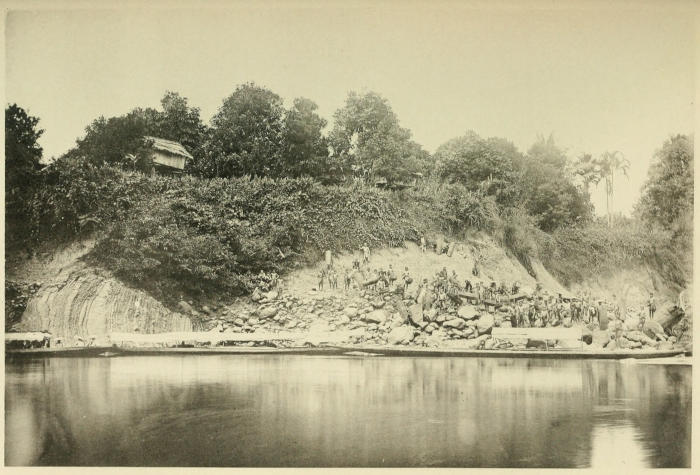
A CONTINGENT OF THE PEACE-PARTY.
Jamma, still resplendent in his dirty blue and white jockey cap and prodigious goggles, hustled about in a most officious manner, directing the guests and members of the household where to sit, and what to do, always in a half-apologetic tone, as if the host, Aban Liah, should be pardoned for not exactly knowing what was proper. Tama Talip, the Chief of the Lerons, now that everything in the way of Usut had been paid and snugly stowed, took his seat among the Kayans and Kenyahs, and denounced Juman’s demands and rehearsed the deaths among his forebears due to Juman’s bloodthirsty family. Juman listened stolidly, evidently not a little pleased to hear how very brave his ancestors had been. The talk went round the circle, and Jok Orong began again to drone forth the endless tale of his woes. The dreary knowledge of what this implied proved too much for the patience of the white contingent of the Peace-party, and we all crept unobserved out of the circle, and, having found, on the banks of the river, an upturned canoe, reclined thereon, and lazily watched in the gloaming the gigantic fruit-bats, (‘flying foxes’ they are called,) which were now thickly visible in all quarters of the sky and all bending their flight in one direction, toward their nocturnal feeding-ground. They imparted an antediluvian appearance to the sombre scene, and we seemed to have travelled back into a remote geologic period, among the pterodactyls. Not even the golden rays of level sunlight gleaming forth from beneath lowering clouds on the horizon could dispel this solemnity. At our feet sluggishly glided the darkening river, emerging, and again lost, from under the dense jungle on its banks, whence here and there tall, slender, tufted palms rose into the silent air from the unbroken green massed about their feet. On the opposite bank, in the distance, abruptly towered Mount Dulit, whose purple peaks were glowing with the last rays of sunlight. And ‘all the air a solemn stillness’ held, save when at intervals the muffled murmur of Jok Orong’s woes reached us from the house behind, but did not mar the scene; it partook of the nature of eternity and infinity; we felt that labitur et labetur in omne volubilis aevum.
On the next day a great feast was held; as one of the most important, nay, most vital, of preliminaries, the slaughter of the pigs took place, and the inspection of their livers for favorable or unfavorable omens. The pigs were brought up with their four feet tied together, and laid in a row outside the circle of Chiefs and elders in the veranda. Tama Talip, the Chief of the Lerons as well as an adopted father of Tinggi, whom Juman had slain, begged Dr. Hose to talk to a pig before it was killed, and enjoin it to divulge by its liver whether or not the Government was right in ordering the death of Tinggi. Dr. Hose consented to harangue the swine, but with much shrewdness, warned the assemblage, in advance, that no matter what the victim’s liver might indicate, he had pursued the course that seemed right to him, and would do so again in spite of all the livers of a thousand pigs. He stood forth in the centre of the circle, where the pig was lying, and paused solemnly for all conversation to cease; in spite, however, of the gravity of his bearing, and the sacredness of the occasion, some of the light-headed rabble, outside the circle, kept up a gabbling, whereupon he shouted at them in a voice so loud and stern, that their teeth chattered, and old Jamma’s hair stood up stiffer than before. In the pin-drop silence that followed, he suddenly gave the unsuspecting swine a vigorous kick to enforce attention, whereto, by an aggrieved squeal, the animal responded that it was all ears. His harangue was then addressed, partly to the pig and partly to the Lerons, almost in the following words:—‘Lerons, it is not one of our customs to ask from a pig what is in the hearts of men, but you people of up-river have faith in this custom and believe that a pig knows your feelings, [cries of ‘Betúl! Betúl!’—True! True!] I will on this occasion adopt your custom and talk to this pig. You tell me that this pig understands Malay, so I will talk in that language, that all may understand, Kayans, Kenyahs, Sibops, Berawans, and Lerons. Know then, that it was neither Juman nor Tama Bulan who slew Tinggi and his brother Sidup, but I, the Government, did it, and none other. If you have any fault to find, find it with me. Remember that, you, Tama Talip, there! And now, O sacred pig, tell us who is in the wrong and who is in the right. [Here, the pig receives another and vigorous call upon its attention, and responds befittingly.] If men of the Tinjar kill people, I will order men from the Baram to find the murderers and slay them. If men of the Baram kill people, I will order Tinjar men to find the murderers and slay them. Let this declaration of mine sink into your livers, all you people from both rivers, and never forget it.’ With these concluding words, he stamped his foot so suddenly and so loudly, that the old men, already awed by the silence and the solemnity of the hour, jumped almost from the floor, and Jamma shook his goggles off. Immediately the cry arose,—‘Kill the pig instantly, that he may hear nothing else to influence him!’ The poor beast was then quickly seized and taken to one side, and its neck sawed through with a dull parang, and before its death-struggles were fully over, its warm liver was deposited in a wooden bowl, and passed round the assembly for close inspection. They all tried to look extremely wise and expressed their opinions in a grave undertone to their neighbors; an old man, with one eye and a faded green velvet smoking-cap, winked and blinked at it, and then pensively resumed the mastication of a betel nut. Jamma pawed and fingered the liver all over, but maintained an ominous silence. Tama Talip screwed his mouth up on one side with a foreboding expression, clasped his hands over his knees, and began rocking backward and forward. The atmosphere became charged with perplexity and deep anxiety. Evidently, the fateful liver was only possibly favorable, and certainly dubious. The gall-bladder extended down nearly to the edge of the liver, and the small lobe which lies beside it was thin and long; so far, these features meant long life and prosperity. The chief points, which involved perplexity not unmixed with deep dismay, were that the lobe which represented the Government, was small, hard, and firm, while its inner border was ominously like a cord set into the surrounding substance; and, worst of all, above the attachment of the gall-bladder was an unprecedented, deeply indented scar, as if some of the liver had actually melted away! Consternation began to deepen. It was a hazardous minute for the Government. But Dr. Hose rose to the occasion, and at once proclaimed to all the clear and manifest interpretation of the extraordinary message from the pig. He asserted that the liver most unmistakably revealed to them, by the hardness of its lobe, the strength and unswerving justice of the Government, and that it was most difficult to break, while at the same time, it was as clear as noon-day that the thick, cord-like border showed how firmly the Government was united to the best interests of the people. Then turning to the scar above the gall-bladder, he made their very souls quiver and their flesh creep, by declaring that it unquestionably foretold the speedy and inevitable death of some very important Chief! (A little wholesome terror is a happy solvent in governing these people.) Several of the Chiefs present would have turned pale, if they could, at this frightful, terrifying revelation, but possibly they consoled themselves with the thought, hitherto unacknowledged by their self-conceit, that perhaps they were not so very, very important after all.
No one dared raise a dissenting voice to Dr. Hose’s lucid and manifest interpretation. A good instance, by the way, of one of the sources of his influence over them; he always contrives to turn to the Government’s account their superstitions and fears.
Aban Liah, our host, was the most apprehensive of all present. He well knew that he had once been all-important in his tribe, and that he had been unfaithful and treacherous to the Government; wherefore, the better to conceal his deadly fear, and revive his courage, he had his large jars of arrack brought out, and ostentatiously cut the dusty stiff rattans which bound down the covers. The first drink was tendered to the interminable Jok Orong, the guest from the Rejang, to whom all desired to show friendship and promise protection to his people should they move into the Baram district. He gulped down the drink quickly, but not so quickly that the crowd had not time enough to stamp and shout in the customary manner so mightily that the house most alarmingly trembled, creaked, and swayed, until caution prompted us to secure safe positions over good, strong beams; no accident happened, however, although a tremendous uproar accompanied the quaffing by each Chief. Before the second round of drinks, Dr. Hose insisted that they should deliver their speeches and protestations of peace while their brains were still unclouded, and as a preliminary the officious Jamma killed a fowl over a bowl of water, and then with a brush of wood cut into a tuft of shavings at one end spattered the blood and water over the audience. Then, still holding the blood-smeared brush in his hand, he launched into a vehement harangue, proclaiming this to be the very greatest of all Peace-makings that had ever been known on the banks of the Tinjar, and that the pig’s liver had shown them clearly and truly the strength and benefit of the Government. When he had nearly shaken off his absurd goggles and his jockey cap had assumed a jaunty air on the back of his head, he handed the bloodied brush over to Juman, who at once jumped to his feet, and in the Kayan language began to tell in a truly sensible way how he and Tama Bulan had been commanded by the Government to bring Tinggi to justice. He then deliberately narrated all the details of the killing, (which must have been pleasant to the ears of Tama Talip, the adopted father of Tinggi,) but gradually he worked himself up to a high pitch of excitement, beating the air with his arms, see-sawing backward and forward, and emphasising the close of each sentence by shouting ‘Bahh! Bahh!’ He asserted that he was but the servant of the Government when he killed Tinggi, and so staunch was his loyalty that, should the Government command him to kill his dear friend Tama Usong, he would hold it to be his duty to obey. His excitement soon over-mastered him, and when he began to indulge in bravado, and offer to engage any one member of Tinggi’s family in single combat, we deemed it high time to pull him down into his seat, and then plied him with congratulations, just as though he had fully rounded off his speech and finished all he wanted to say.
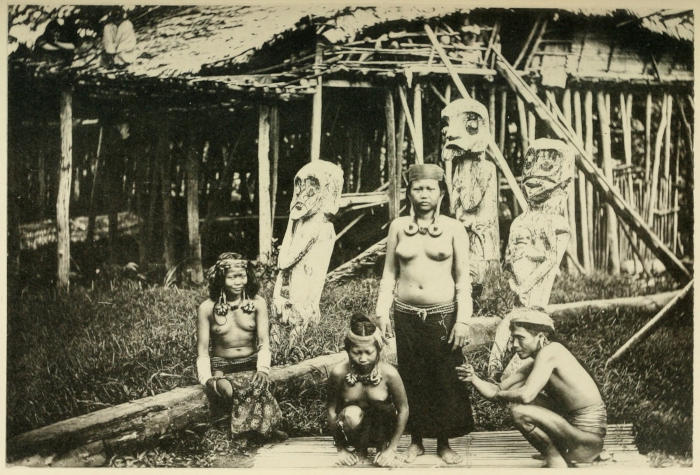
LIAN AVIT, A LEPPU ANNAN, WITH TIPANG, HIS WIFE, WHO IS STANDING, AND HER TWO SISTERS.
THE WOODEN FIGURES BEHIND THEM HAVE BEEN PLACED NEAR THE PATHWAY LEADING TO THE HOUSE, TO FRIGHTEN AWAY EVIL SPIRITS. THESE FIGURES ARE NOT WORSHIPPED AS IDOLS, NOR ARE OFFERINGS OR SACRIFICES MADE TO THEM, BUT THEY ARE REGARDED TO A CERTAIN EXTENT WITH REVERENCE. INASMUCH AS TO TOUCH THEM OR TREAT THEM DISRESPECTFULLY ENDANGERS THE OFFENDER TO TERRIBLE DREAMS AT NIGHT AND TO BEING SEIZED BY GHOSTLY HANDS, WHICH WILL LEAVE LASTING SCARS.
While he was on his feet, drinks had been passing around quietly and some of the older men, whose heads were none too strong, began to feel alcoholic effects. Old Aban Anyi, a devoted follower of Tama Usong, and a hero of many battles, who once told me with pride that he had killed many men, any quantity of women, and no end of children, hearing Juman boast that he would kill Tama Usong if he were so ordered by the Government, tried to get on his feet to challenge such braggart talk, but Tama Usong himself grabbed him forcibly by the back of his waist-cloth and thumped him down to his seat again, where he sat mumbling and protesting until soothed and silenced with another drink. The bloody ‘pla,’ or wooden brush, was next passed to Aban Liah, but his speech was weak and very apologetic throughout; he asserted that the Government had treated him badly by degrading him just because he did not tell the whereabouts of the murderers, Tinggi and Sidup; indeed, he never knew who the murderers were. Now the fact was that we knew, and all his hearers knew, that he had lied egregiously and persistently about the murderers, and had even concealed them in his own house. All this had been fully proved after the murderers had been killed. It was the sufficing cause of his loss of the Penghulu-ship.
Tama Usong’s turn came next to declare his good will to the people of the Tinjar, and before he began, a large cup of arrack was thrust upon him. The contents of the jars had become, by this time, nearly exhausted; consequently this cupfull had been dipped up from the dregs, and Tama Usong gulped into his mouth several large pasty lumps of fermented rice. In the embarrassment caused by holding the pla (which seems to be essential to public speaking) he blew the kernels of rice accidentally, but directly in his host’s face. The arrack was painfully present in his rambling and incoherent speech, to which no one paid any attention. At its conclusion all the Chiefs drank in turn from the same cup, and the formal part of the programme of the meeting ended.
Having gathered about him a fresh and untried audience, Jok Orong started in again with his endless, life-long tale of woe, which, we knew, only too well, would last until the arrack was utterly exhausted as well as his hearers; we, therefore, left them incontinently, preferring the peace and quiet of the Leppu Anan house, a short distance up-river, to the fingered feast of stewed fat pork with which Aban Liah was about to regale his guests.
The Leppu Anans are a clan from the Rejang, which not long before had been driven over to the Baram district by a threatened onslaught of the Ibans, who by some underhand means had obtained permission from the Government to attack them with a regularly organized force. Dr. Hose, hearing that this expedition had started, and knowing that the permission had been granted to the Ibans on false pretexts, and inasmuch as in this matter of life and death there was no time to communicate with the Government, instantly sent swift messengers to the homes of the Leppu Anans, telling them to fly for their lives, and promising them protection if they settled on the Tinjar. It was a terrible journey for the poor innocent creatures, loaded down, as they were, with all their household effects and retarded in their haste by the care for the women and children. Many of them, I was told, were so exhausted that they actually crawled and dragged themselves on all fours down the hills which separate the Rejang and Tinjar valleys.
The Ibans, consequently, found the Leppu Anan houses deserted and stripped of everything movable. Whereupon, not to be baulked of all spoils whatever, they attacked some of the friendly houses, the abodes of the very people who, on their journey up-river, had cheerily and kindly wished them success in their head-hunting. To the Bornean a head is a head, whether of friend or foe; so on this occasion the Ibans returned to their homes laden with spoils of their friends and enriched with heads which had not been on the shoulders of those against whom they had set out.
The Leppu Anans, in their new house, although they still harboured the small clan of Lerons who had vowed vengeance on Dr. Hose, nevertheless regarded Dr. Hose as their preserver, and no trouble taken in his behalf could be too great. They are quiet and gentle in their manners and very clean in their persons and about the house. We noticed with much relief that they did not throng about us, asking such inane questions the minute that we had landed, as, ‘When did you arrive?’ or, when helping us to disembark, ‘Did you come in a boat?’—questions which are really not at all unusual even from the very men who have been paddling your boat all day long. Possibly, true etiquette demands such questions among the natives themselves, who, for some occult reason, always desire their actual arrival and departure to pass unnoticed.
These Leppu Anans were intensely interested in my photographs, and literally climbed on each other’s shoulders to see them. In their anxiety to touch the page itself, they nearly crushed the lucky holder of the book. The picture which excited their unstinted admiration is of two Ibans bargaining for the sale of a highly prized Chinese jar; they read the meaning of it at once, explaining it over and over to each other; but opinion was divided as to the balance of trade; some thought the owner was a fool to refuse the pile of silver dollars which the purchaser was offering, while others contended that the man who offered so mean a sum for so fine a jar must have been crazy. (When I showed the photograph to the wife of the man who had posed for me as the owner, she was extremely indignant, protesting that I had no right to represent Angas as such a fool! No sensible man would ever refuse that pile of money for such a common old jar. She felt actually defrauded of all that wealth, and I am sure she looked on me as a thief.)
At noon the next day the Peace-party, which we had left to finish up the ‘seven’ span pig at Aban Liah’s, came up-river, and we all set out together on the last stage of the journey to Tama Aping Buling’s.
It was an exciting day’s travel; the rapids were extremely swift, and the Kayans, Kenyahs, Sibops, Berawans, Leppu Anans, and Lerons became inextricably intermingled in forcing their canoes past dangerous rocks and through narrows where the water rushed with almost irresistible power. Every man of the large assemblage was at the highest tension of excitement in anticipation of the stirring ceremonies close at hand, which after all, in the twinkling of an eye, by the merest accident, or by some trivial flaw in etiquette amid so large a body of hostile clans, might be converted to bloody battle.
When Tama Bulan was forced to leave us and turn back with his sick nephew, he provided, with usual forethought, a small pig, which was to be swiftly forwarded to Tama Aping Buling’s in advance of the Peace-party. In punctillious observance of native customs on such exalted occasions as the present, the pig must be sacrificed on the beach before the Kayans and Kenyahs disembarked. We were positively assured by Aban Liah on leaving his house, that the piglet had been sent on ahead the night before to Tama Aping Buling’s house at Long Dapoi; wherefore, when the Peace-party arrived, everything would be ceremoniously carried out. Our boat, a little in advance of the others, was gliding smoothly on a long stretch of quiet water just above turbulent rapids, when we were met by some men in a canoe from Tama Aping Buling’s; a short excited announcement from them revealed to us that all was not going rightly up-river; accordingly, we changed to their lighter boat, and sped up-stream, leaving our luggage and the Peace-party to follow as they could. The men who poled the canoe could talk but very little of any language but Sibop, so we hardly knew what was amiss until we arrived at the house. On the beach, we were met by Tama Aping Buling himself, almost in tears; before we could get fairly out of the boat, he squatted down, and, in a voice of despair, said, ‘Oh, Tuan Prenta, what shall be done! No pig has been sent to sacrifice when the Kayans arrive. There will be war instead of peace.’ It was even so. That old traitor, Aban Liah, had purposely kept back Tama Bulan’s pig in order that the Peace-making should be a failure, and that his rival, Tama Aping Buling, should get into trouble. Dr. Hose instantly turned and started down-stream to meet the Kayans, and keep them down-river until Aban Liah should either restore the pig or procure another and send it on ahead of them. Aban Liah was serenely imperturbable when accused to his face of the theft of the pig, and of his plot to create trouble; but eventually Dr. Hose’s unsparing denunciation, combined with the sullen threats of the tired Kayans, eager for the comfortable shelter of a house for the night, forced him actually to leave the party, and paddle off down-river to buy or borrow the indispensable little pig.
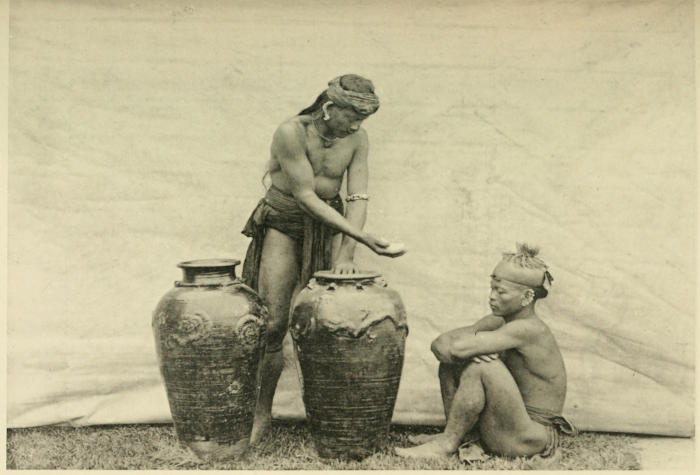
IBANS BARGAINING OVER THE SALE OF VALUABLE CHINESE JARS.
THE OFFER OF FIFTY MEXICAN DOLLARS IS TREATED WITH HAUGHTY REFUSAL. THE TWO MEN POSED THEMSELVES, AFTER MY SUGGESTION, FOR THE SUBJECT OF THE PICTURE.
They told us afterward that at house after house he was rebuffed, and, although there were plenty of pigs everywhere, not one could he borrow, beg, or steal, so universally disliked was he for his mean, tricky ways. Night came before he finally succeeded in procuring the sacrifice, so that the wearied Kayans were forced to sleep in their canoes, or in huts of boughs which they built on a pebbly island in midstream, and endure a drenching deluge of rain, illumined by such blinding lightning and deafening thunder as only the Tropics know.
The house built by Tama Aping Buling stands on the north bank of the river, just opposite to the mouth of the Dapoi, a large tributary. It is about two hundred feet from the river, on a high bank which slopes gradually to a wide pebbly beach. The house was only recently finished at that time, and had cost interminable labor; many of the piles whereon it was built were at least twenty inches in diameter, and supported the floor fully fifteen feet from the ground. The veranda was broad and well floored with wide, hewn planks, and roofed with shingles of billian wood, not nailed to the rafters, but tied on with strips of rattan. One end of the house was not yet quite finished, and shingles only partially covered it. This incomplete state was not, however, without its uses; it supplied Tama Aping Buling, while showing his house to us, with a chance to make a remark, which, hackneyed and threadbare as it is among them, is always uttered apparently in the belief that it will be received with all the applause of a novel and brilliant idea. With a wave of his hand toward the roofless rafters, Tama Aping explained, ‘This end of the house is occupied by Laki Langit and his children,’ which, interpreted, means, ‘Grandfather Sky and his children—the stars!’ We had heard the witticism so often that it was hard to force a smile,—but we did. Let him among us, who, in describing ‘full dress,’ has never called it ‘war-paint’ or ‘best bib and tucker,’ cast the first reproach at the unsophisticated Borneans.
Early on the following morning the wee pig was sacrificed on the beach and there left in its gore. Such a sacrifice, when made in ratification of a compact, renders the flesh inedible to all participants in the ceremony; hence the diminutive size of the pig. On the present occasion Aban Liah’s enforced pig was so extremely small, that I saw a lean and hungry dog seize it by the head after the sacrifice was over, and, slinging the body over his back, make off toward some tall grass, where he probably devoured the whole carcass at one meal,—possibly, at one gulp.
The sacrifice of the pig was certainly a beginning, but it did not seem to expedite the other ceremonies to be performed in the veranda of the house. The Kayans, never enthusiastic over this Peace-making, (which is not a fraternisation, but only an agreement not to kill each other on unprovoked raids,) were sulking in their huts on the karangans, under the pretext of drying themselves. All the while Tama Aping Buling and his clan, and the other Tinjar Chiefs and their clans, sat wearily waiting in the veranda for the Kayans to appear. There were several false reports that they were coming, and each time the host, Tama Aping, invariably alleged that most important matters needed attention in his private room, and as invariably had to be dragged, trembling, from his little dark sleeping-box, where he was crouching, to attend to the reception of his guests. One cause of Tama Aping’s conduct was dread lest it should leak out that he had been largely instrumental in giving the Government the information which eventually led to the detection of Tinggi and his brother, Sidup, both of whom had been, in point of fact, at one time inmates of his house; should this treachery become known, his own people, even, would turn against him, and his life would not be worth a black bead.
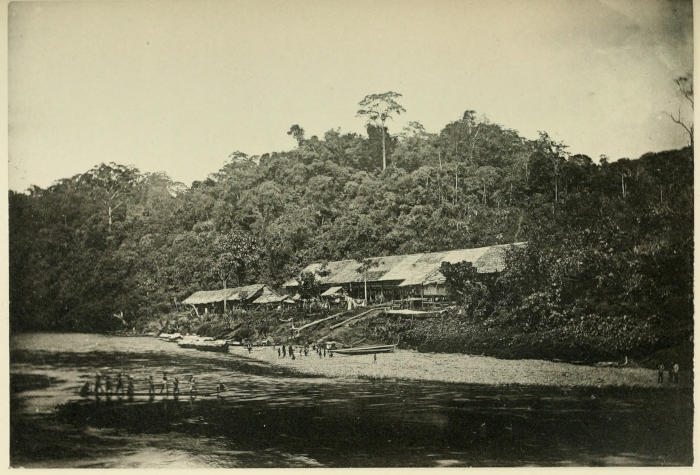
TAMA APING BULING’S HOUSE ON THE TINJAR.
THE SCENE OF THE NOTABLE PEACE-MAKING.
The forenoon passed; the day wore on to afternoon,—still no Kayans; we began to fear that they had turned back and had given up all idea of peace-making.
Jamma of the flabby, unhealthy lips, talked interminably, and his goggles seemed to grow bigger and his jockey cap dirtier every minute. Tama Talip silently munched betel nut, and squirted the blood-red juice incessantly through a crack in the floor. Aban Liah was depressed in spirit, and sat sullenly twisting an extinguished cigarette between his fingers. We became thoroughly wearied of the whole assemblage, and, unattended, paddled across the river to a grassy point where we could watch for the coming of the Kayans, and, at least for awhile, get rid of the natives. Even this watching became intolerable, and finally we decided to go up the clear Dapoi River a short distance and take a swim. Of course, this was the very time through the perversity of luck, that the Kayans decided to go up to the house, and we, unfortunately, were not on hand. Kilup, one of Tinggi’s brothers, took it upon himself to be the leader of a small Jawa party, and did not even wait for Juman to disembark from his canoe, but ran full speed down to the beach, and with his parang drawn,—a violation of propriety absolutely forbidden in every well-conducted Jawa—actually chopped at Juman’s boat and slashed the palm-leaf covering. They told us afterward that Juman behaved bravely, and sat unmoved in his boat,—his serenity was possibly due to the knowledge that the ‘snappang,’ albeit with the ‘fever-stricken engine,’ was at his side, and that, if necessity arose, its discharge would prove fatal to some one, either to himself or to Kilup. By the time we returned from our bath the excitement had subsided, but none the less, Tama Aping Buling remained secluded in the depths of his private apartments. Dr. Hose at once summoned Kilup before him, and incontinently imposed on him a fine of one tawak,—equivalent to thirty dollars, a really heavy fine. Kilup sat unmoved during his sentence, and then arose slowly and swaggered off to his room, where he was told to remain until sent for, under penalty of another fine, or, possibly, imprisonment in the Baram Fort.
The Kayans were very naturally greatly incensed at such treatment; certainly they had a right to expect a little more hospitality after their dolorous night in the soaking rain.
By way of precaution against too much zeal in the approaching sham fight, we made the Tinjar people place about half-way down the veranda a high, square platform, used ordinarily as a sleeping-shelf for guests; this would tend to keep the two forces apart and check too quick an onslaught. When this was done, Tama Liri was deputed to go down to the river and conduct the Kayans to the veranda. It is an inexcusable breach of decorum for any strangers outside the house, to pass in front of a Chief’s door, before ascending to the veranda; guests, therefore, from down-river should enter at the down-river end of the house, and vice versâ. Tama Liri knew this as well as he knew his name; but, solely to stir up more trouble, he conducted the Kayans who came from down-river to the up-river end of the house, which involved a direct insult to Tama Aping Buling. Of course, the Kayans remonstrated, but too late; and then, to retrieve the insult, had to tramp almost the whole length of the house in the mud and slime beneath the veranda; this added fresh fuel to the fire already burning in their breasts.
The Lerons, Sibops, Berawans, and Leppu Anans gathered at the up-river end of the veranda, to await the entrance of the Kayans, and we placed ourselves midway, so as to be on hand to moderate, if possible, too realistic a sham fight.
The Kayans and Kenyahs came quietly up the notched log, and halted in a close crowd until the last man had fairly entered the veranda. Standing thus within the house of one who had always been an enemy, and confronting their deadly foes, it is no wonder that they were trembling with excitement; their eyes were glancing suspiciously in all directions to detect any signs of treachery or the sight of concealed weapons. Suddenly, with one impulse, they began yelling, stamping, waving their arms, and leaping in the air. Immediately the Tinjar people joined in; in a second the whole veranda from end to end became a perfect pandemonium of shrieking, frenzied, gymnastic savages. Not a step did they advance toward each other, although everywhere there were furious, threatening gestures.
This appalling scene was kept up for fully a minute, and then the frightful turbulence gradually quieted down. Dr. Hose at once seized Juman by the arm and led him, followed by his people, right in among their bitter enemies; then glancing round quickly to see that no one had a weapon in hand, instantly proposed that they should all once more jump and stamp together, and he himself led off with a resounding stamp and a terrific shout. Juman followed, then another and another, until, in a trice, once more the house was trembling beneath them, and the rafters echoing; but this time friends and foes were almost shoulder to shoulder. The inanity, I think, of the proceeding slowly dawned on them; the shouting did not last as long as before; it became more and more feeble; at last it ceased suddenly, and they all sat down. Little by little the ice of mutual distrust began to thaw; here and there men who had been mortal foes were sitting cheek by jowl, engaged in friendly conversation.
At this stage, it was the host’s clear duty to bring out his arrack; his guests might at once have pledged each other, and friendship might have been cemented; but Tama Aping Buling was in his sleeping-room, probably buried beneath a pile of mats.
Speeches were made by Jamma, Aban Liah, and Juman, but they lacked earnestness and cordiality, and, at their conclusion, the pigs whose livers were to foretell the issue of this Peace-making and the futurity of the participants, were dragged into the centre of the assembly. As each one was brought in, it was harangued by the Dayongs, and adjured to tell the truth and to intercede with the Spirits to drive out all animosity from the people of the two rivers. The largest pig was reserved as the ‘Government’s pig,’ and had been selected on account of its size and beauty, but it did not turn out to be exactly what the Government would have chosen as its fittest representative. It was an albino, with lack-lustre, whitish eyes and a pale, mottled snout; it lay so still that I half expected it was about to cheat the sacrifice by dying a natural death. Of course, it fell to Dr. Hose’s lot to exhort this pig ante mortem to proclaim truthfully post mortem, by infallible omens in its liver, whether or not the Government’s course was right; but he gave the natives clearly to understand that, whatever the omens might be, they would not in the least influence him in the management of Government affairs; and that he followed the custom merely to please them. Thereupon, he prodded the pale-eyed and anæmic pig with his foot, to arouse its earnest attention, but no responsive grunt nor indignant squeal came from that cadaverous representative of the Government; it lay imperturbably still and blinked. As soon as his words ceased, the pig was dragged to one side, its throat cut, and its liver at once dexterously extracted. When this organ, which proved to be unusually large, was passed round among the Chiefs and among those who were skilled in the interpretation of auguries, it was pronounced with one accord to be in its every aspect most favourable; but, in an unlucky moment, just as it was about to be taken away, some one, inquisitively, lifted one of the lobes to examine the under surface, and instantly a convulsive horror and shuddering recoil ran through the whole assemblage,—a large, foul abscess was disclosed!
Once before, on this expedition, had the natives been shocked by a fateful foreboding of death, and now, for a second time, in yet clearer terms, had this death-warrant been delivered. On the first occasion, at Tama Liri’s house, their horrified eyes had noted a deep scar, and now with inexpressible dismay they beheld a corroding ulcer.
Dr. Hose, in solemn tones, again repeated the true interpretation of the blood-curdling portent:—a faithless, scheming Chief, who was secretly hostile to the Rajah and to his people, would very shortly die a miserable, inevitable death! Again the liver was passed round the awe-stricken circle; in vain they summoned their best ingenuity in suggesting a less dreadful interpretation, but it was only too clear that Dr. Hose’s words bore every impress of truth.
Old Aban Liah, of whose hostility to the Government there had been such recent proofs, sat a little outside the circle, and when the liver with its death-warrant was passed over to him, he waved it aside, and in tones that reminded me vividly of Shylock, and almost in Shylock’s very words, said, tremulously, ‘Let me go away; I am not well;’ and then added, apologetically: ‘the smell of this beastly, warm, raw flesh has made me ill. I must go.’ And he got up, with dazed looks, and went with uncertain steps to his room.
An hour or two later, in the evening, some of his friends came and begged me to go see him. To my surprise, I found him in a high fever and semi-delirious. I directed them to wrap him up warmly, to produce a sweat, and advised them to remove him to his own home as soon as possible. I supposed that he would be all right in the morning, when the effects of the feasting at his house the day before had passed off. I never dreamed that his illness would have a fatal termination.
Neither Aban Liah’s sudden illness, nor his absence, interfered with the Peace-making. Kilup was summoned from his room, and in the presence of the assembled tribes he was given such a vehement rating by the Government that he probably remembers it to this hour, and he was furthermore warned that even threatening language was punishable.
Still no arrack was broached, nor feast spread. At the slightest noise or excitement, off sped Tama Aping Buling to his room, and there remained in seclusion until all was again quiet. He had, in truth, more cause for alarm than the others; his wife, his children, and all the women of the household were dependent on him for protection in any outbreak of hostility; his guests had to look but after their own safety; these guests were now peaceable, but in a flash they might become mortal foes in deadly conflict.
Old Jamma was always to the fore, talking incessantly and making effusive attempts to ingratiate himself with everybody; but if all present shared my feelings, his thick, everted lips, and eyes distorted behind those prodigious goggles, would have checked every throb of sympathy. Furthermore, he had unaccountably changed his jockey cap for a war-cap of Tiger skin, with which he fairly terrified the Kayans. A skin of the great tiger is something so terrible to many of the natives that they dare not even touch it; an oath bound by a tiger’s tooth or tiger’s skin is one of their most solemn pledges. The Kenyahs and Sibops are the only tribes who may touch a Tiger’s skin with impunity.
It was not until afternoon had deepened into night that the feast and the arrack were brought out. The roar that went up when Juman drained the first cup could have been heard certainly for a mile, and the stamping was stupendous. In fact, under the weight of the three hundred jumping men, the floor sagged fully six inches, and the huge piles, whereon the house was built, swerved and sank deeper into the earth. Thus it went on, one toast after another, and roar upon roar; then they made speeches fervid with alcohol. Jamma talked rank, open treason when his tongue was loosened, and claimed the whole Tinjar River as a direct inheritance from his Uncle, Aban Jau; the Rajah had no right to be there, and the Government obstructed instead of helped the people. Very little attention, however, was paid to him, either by the assemblage, or by Dr. Hose, a neglect which cut him deeply; he ached to be of sufficient importance to receive a rebuke from the Government, but Dr. Hose merely replied, ‘We must all bear in mind the source whence these silly remarks come; I think you’ll all agree that they are not of the slightest consequence.’
The drinking, the stamping, and the shouting were kept up throughout the night, and, to our great content, the Kayan guests behaved well and restrained themselves within bounds. Jamma and his clan were the only flagrant offenders, talking treason and indulging in threats.
A smell of fermented arrack, stale fumes of rank tobacco, maudlin gabble from drunken men, the snarling and yelping of dogs, the clucking and cackling of poultry, the wailing of children, and the crying of babies, pervaded the world into which we awoke in Tama Aping Buling’s house the morning after the great Peace-making carouse.
Suddenly, above all sounds, arose repeated, piercing shrieks from terror-stricken women, excited shouting of men, slamming of doors, and the clatter of bare feet fleeing over the loose, rattling boards of the veranda. The master of the house flung himself, trembling, into our room and breathlessly announced that one of his men, overcome by the night’s debauch, had gone ‘amok’—as he said,—and, armed with parang and shield, had sworn to hack in pieces all whom he met; he was now rushing from room to room slashing right and left at the terrified and fugitive inmates. Two or three brave men had climbed to the loft above the partitions between the private rooms, and, with poles, were trying to beat down and disarm the maniac and lasso him with loops of rattan.
A man who runs amok both expects and desires to be killed, but endeavors to slaughter beforehand as many victims as possible. Dr. Hose caught up a long and heavy pestle used for husking rice, and we all hurried out in the veranda, armed with our revolvers, to assist in the capture of this most dangerous ruffian; and, since he desired to be killed, we were quite ready to gratify him. Just as we came opposite the room from which the maniac had driven the occupants, frantic with terror, the man himself rushed forth directly in front of Dr. Hose, but the latter was ready for him with a greeting which was as well-directed and cordial as it was unexpected. By one waive of the long pestle, his shield was instantly thrust aside, and there followed a disconcerting and most demoralising prod full in the pit of the stomach. All his valiant ‘amok’ collapsed, and, with eyes rolling in his head, he staggered back through the doorway and plumped down, with a flop, on the floor. Instantly the men overhead, with their rattan loops, had him encircled round the waist, and a vigorous pull suspended him in mid-air from a cross-beam; with their poles they knocked the weapons from his hands, and then, like a spider with a fly, they had him quickly swathed with rattans and bound hand and foot. The next thing was to take him to his own room, and leave him thus confined until he had recovered his senses. But while they were carrying him thither, the ever-officious, and withal treacherous, Jamma, staggered impetuously forward, and, vehemently insisting that the maniac should be set free, actually began to grapple with the carriers. In a twinkling, his wrist was seized by Dr. Hose, and he was whirled round; then, after executing an astonishing and dizzy pirouette, he lost his balance and went skimming along the floor, until, with a reverberating thump, his head struck the wall, and he lay motionless. Some friends ran to him and propped him up. He made no attempt to rise, but only blinked his bloodshot eyes, denuded for once of the goggles, and kept gasping, panting forth: ‘Why did the Government strike me? Why did the Government strike me?’ Finding his question unanswered, he lapsed into silence, and put in practice the ingenious idea of feigning death, wherein he was much helped by a sudden rush of alcoholic fumes to his head. His nephew and a few devoted friends lost not an instant’s time in laying out the corpse, and, seated beside the limp body, immediately struck up a funeral wail over his sad, untimely demise. It really seemed possible that the man might be dead, so, at Dr. Hose’s request, I examined him, but no trace of injury could I find on the corpse but a severe, darkly coloured bruise on its forehead; when, however, this bruise was bathed with arnica, I noticed that it wholly disappeared, and the discoloration was transferred to the absorbent cotton, and that the skin presented an unbroken surface. When I attempted to examine his eyes, the wrinkled resistance of the lids showed me his inflexible determination to remain dead.