A WAR EXPEDITION
Reading edition
About a year and a half before my first visit to Borneo, a Chinese trader, in the upper Tinjar River, had been killed solely for the sake of his head. Killing is by no means uncommon in Borneo; but this was a murder so cold-blooded, and the victim, moreover, a Chinaman, so unprepared for the game of head-hunting, that an unusual effort was made to find and punish the murderer. Although the head, just after it was cut off, had been hung up in the veranda of a house, and although the river-bank in front had been enlivened with a ‘Death-post,’ whereto portions of the victim had been attached, by way of public notice that a head had just been taken, the perpetrator of the deed showed, however, a guilty reluctance in claiming any glory, or even in making himself known; furthermore, not a member of that household, nor of any household on the Tinjar River, would give the slightest clue to the identity of the murderer. All the Chiefs, hitherto trusted, told endless lies about the crime, and with such success that they believed that they had at last baffled and befooled the ‘Prenta,’ the Government.
One day, about two years after the murder, a Malay trader, who had been up among the Tinjar people for many months, and was perhaps feeling a little sore over his poor bargains, let fall to Dr. Hose, the English Resident of the Baram district, some hints that again set in motion the wheels of justice and soon fastened the guilt of that murder on Tinggi, a dweller in the house of Tama Talip. The culprit was at once summoned to appear for trial at the Baram Fort, but his people hid him and resolutely defied the Government; consequently, a reward was offered for his capture alive, or for his head, if dead. Nevertheless, the Tinjar people continued to conceal and protect Tinggi, even after an influential Chief had been deposed by the Government for his duplicity in the matter, and, possibly, for the transparent quality of the lies he manufactured. There remained, therefore, nothing to be done but to appoint an entire stranger, a native from another river, to lead an expedition against the Lerons, the tribe that was protecting Tinggi. The man thus appointed was Tama Bulan, a Kenyah, and the most influential Chief in the Baram district, who accepted the appointment and gathered a force to ascend the Tinjar. Among his followers was Juman, a Kayan Chief and the lucky and sole possessor of a gun. Tama Bulan had been strictly commanded to take Tinggi, and no one else but Tinggi; on no account was he to suffer his Kayan or Kenyah followers to kill innocent people. Juman, with a small party ascended the Tinjar, to a point opposite the house of the Lerons. Tinggi, the murderer, emerged unattended from the house, entered a light canoe, and was crossing the river, apparently to surrender himself, when, at the last moment, he seemed to change his mind, and resolved to attempt an escape. In an instant, taking advantage of the swift current, he was dashing past Juman’s camp. The details of his death I had, as follows, from Juman himself: ‘Tinggi came down the river, Tuan, lying flat in his canoe until he was just opposite to me and my men; then he stood up, straight, brandishing his spear and his parang, and shouting defiance to us all. But,’ continued Juman, his eyes glowing with excitement, ‘I was all ready, Tuan; I raised this “snappang”[8] of mine, that the Government gave me; it was loaded full of nails; and I shot that insect, Tinggi, right here,—through the breast. Over he fell backward in his boat; he kept on waving his arms; I paddled fast after him in a canoe; I got along side of him; I caught hold of his head; I pulled it over to the edge of the boat; with two chops of my parang, like that and like that, off it came.’
This head was the first Juman had ever taken, and measureless was his pride in displaying the tattooing, to which he was thereby entitled, on the back of one of his hands; the other hand was to be similarly decorated as soon as the harvesting was over. Tinggi’s head he was allowed to hang from the roof of his veranda, opposite his door, in his house at Bowang Takun. Although this slaying of Tinggi was retributive justice, yet according to Borneo sentiment, it was a causa belli, and when I arrived at the Baram River, on a second visit to Borneo, about three months after these events, there were already reports of retaliating expeditions led by Tinggi’s brother, Kilup, in which the Tinjar people generally joined, against the peaceful dwellers on the Baram; women had been frightened from the rice-clearings by the traces of recent camp-fires, and of fresh footprints in the adjacent jungle, and doubtless would have been attacked, and killed, and decapitated, had not their husbands mounted guard each day, clad in war-coat and war-cap, and fully armed with spear, parang, and shield. Reports of new disturbances and threatened outrage came by every canoe from up the river that halted at the Baram Bazaar, until finally Dr. Hose determined to crush out this portentous feud betimes before it reached greater and, possibly, unmanageable proportions.
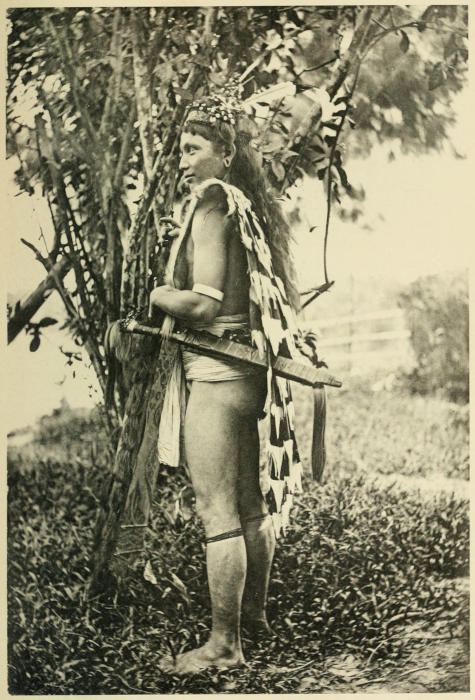
BORNEAN WAR COSTUME.
THE FEATHERS OF THE HORN-BILL ON THE WAR-CLOAK, AND THE TUFTS OF HUMAN HAIR ON THE SHIELD, WHICH THE WARRIOR HOLDS, ARE THE BADGES OF A SUCCESSFUL HEAD-HUNTER.
The whole Kayan population of the river was, moreover, somewhat in a commotion, owing to the accidental death of Oyang Luhat, one of its influential Chiefs. The control of three or four hundred people had thus fallen to his eldest son, Abun, and the large household were beginning to fret under the tedious restraints of the prolonged mourning; these restraints could be removed only by adding to the household collection a beneficent fresh head or two; consequently, under a new and vigorous young leader there was imminent danger of an extensive and formidable raid upon all the Tinjar people. Furthermore, it happened to be just at the beginning of the rainy season, when there was nothing to be done but to wait for the rice, already planted, to sprout and grow. Even in highly civilized communities, Satan finds some mischief still for idle hands to do, so, too, in Borneo what can be more natural than that days of idleness should prompt a mischievous use of spear and parang?
His Excellency, Rajah Brooke, (this wise and beneficent ruler,) has, of course, made every possible effort to eradicate the custom of head-hunting in Sarawak, but in a country without roads, and where news travels no faster than the river’s sluggish current, swift retribution for any outrage is impossible; and, with the small force of Englishmen who act as his Residents, it is almost inconceivably difficult, in districts isolated by well-nigh impenetrable jungle, to follow up and arrest any offender, much more a head-hunter, whom the natives themselves, holding head-hunting to be a most praiseworthy virtue, screen to the best of their ability.
Where the decapitated victim has relatives or near and dear friends, there the Rajah’s officers may possibly obtain some aid; but even under these favorable conditions, the information is reluctantly given, unless the hope is held out of a participation in the punishment or the retaliation.
In such circumstances, it is remarkable and redounds greatly to the efficiency of the Sarawak government, that exceedingly few murderers escape detection and punishment, even should it take years to trace them. The punishment is not always a death sentence; it may be a heavy fine. The veneration with which the practice of head-hunting is regarded by the tribes of the central high-lands, and the fact that they have been taught by their fathers and grandfathers that it is a religious duty, cannot but influence the Rajah and his Residents to incline to leniency in their judicial sentences on these people whenever there has been provocation, albeit slight, for the commission of the deed. Where a whole household of more than a hundred men has made an unprovoked raid upon an unsuspecting neighbor, the Rajah, on several occasions, has wisely allowed the injured tribe to make, as a kind of ‘wild justice,’ a retaliating raid upon the aggressors; but the expedition has been always under the direction of one of his Residents, who makes sure that only the guilty are attacked,—if unrestrained, the natives would be driven by excitement to kill all who cross their path, whether friend or foe.
To resume the story of the troublous times on the Baram. It was decided by the Government to quiet the disturbances at the very outset by administering a severe lesson to those turbulent natives on the Tinjar who still resented the legal slaying of the murderer, Tinggi; accordingly, a war expedition was planned, which should be the means of intimidating the seditious tribe, without, it was ardently hoped, the shedding of any blood, and, withal, of such an imposing character that the mere demonstration might, of itself, lead even to a lasting peace.
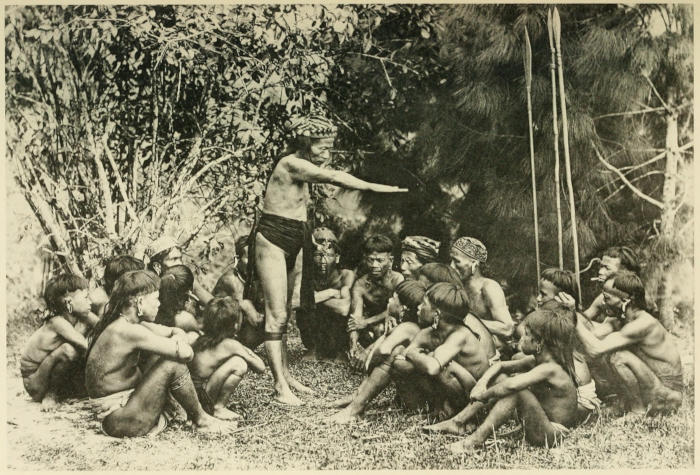
COUNCIL OF WAR, DURING A MARCH TO THE HOUSE OF AN ENEMY.
Dr. Hose decided, first of all, to investigate the truth of the rumours concerning the marauding Lerons. With this end in view, he decided to set out at once for the house of the young Chief, Abun, just mentioned, about one hundred and twenty miles up the Baram, where, if the rumours proved correct, his forces could be mustered.
We arrived after dark at Long Lama (‘Long’ meaning the mouth of a river, and ‘Lama’ being the name of a stream at whose junction with the Baram Abun’s house is situated). The river’s bank, sloping gradually in low, irregular terraces of sandy mud up to the house, about a hundred and fifty yards from the shore, was dotted in all directions with little fires, whereon the natives were cooking venison. A deer had been killed in the clearings, and, although the flesh is one of the greatest of delicacies, it must never be cooked in the house; the timidity of the deer will be infused into the household. By inhaling its spirit, liberated by fire, young men assimilate its timidity and become cowards in battle,—therefore the flesh is cooked in the open air, and the timid spirit at once makes its way again to the jungle. Several of the natives, when they recognized us, deserted their flesh-pots and came down to meet us, carrying fire-brands, which they waved vigorously to keep them blazing and give us light. Of course, all knew that a visit from the Resident meant something of importance, but, according to Kayan etiquette, the purpose must not be broached until we were settled in the veranda. Escorted by these torch-bearers we picked our way past the fires up the soggy, muddy bank, walked warily on the pathway of slippery logs, and so to the notched log whereby the veranda is gained.
The immense long-house, looking on its high, multitudinous piles like a gigantic centipede, stretched far away to the right and to the left into the darkness under rustling cocoanut palms; mongrel dogs barked and yapped round our heels, and from beneath the house snorting pigs rushed hither and thither in all directions. The house seemed deserted; the restrictions of mourning had banished all mirth, music, and song; the only signs of life along its whole length were three or four dim fires flickering on the clay hearths; hardly a sound was to be heard in it. With as much dignity as can be assumed when crawling on all fours up an almost perpendicular, and slippery, and notched pole, we gained the veranda, where the young Chief greeted us cordially, and ceremoniously conducted us to the clay hearth, the place of honor, in front of his own door. Fresh wood to replenish the fire was brought, and several small tin kerosene lamps, made by Chinese at the Bazaar, and without glass chimneys, were placed here and there, on the floor, and on the beams. It was not advisable, even had it been etiquette, to divulge at once the purpose of our visit, or even to allude to the Tinjar people; so dropping cross-legged about the fire, we accepted the proffered bead-work box of coarse Kayan tobacco and banana-leaf wrappers, and joined the encircling and rapidly increasing group, in a social cigarette. The talk drifted up-river and down-river, discussing crops of rice and the promise of the abundance of rattan, or of gutta, or of camphor yet to be gathered in the jungle. Occasional puffs of hot air were wafted in under the eaves, bringing with them the combined scent of the fires on the bank, of mud, and of damp chips from the logs which beneath the house were being fashioned into canoes. The brief twilight of the tropics was gone, the night was already as black as ink, although it was barely a half hour after sunset, and the insects had not yet begun the incessant din of their nocturnal medley.
Gradually, Dr. Hose led up the conversation to the killing of Tinggi and to the retaliation of the Lerons. At once eyes flashed, and every man was eager to set forth his account of the outrages; some asserted that women and children working in the rice-fields had been murdered; others maintained that certain rattan-cutters had caught sight of a large force of Tinjar people, in the jungle close by Long Lama; again, others said that the Tinjar marauders numbered hundreds, while others contended that there were, at most, but a dozen or so. Finally, it turned out that no one present had actually seen a single enemy, and the substance of the stories was so flimsy that the purpose of the expedition threatened to come to naught, when suddenly our ears caught the rhythmical and rapid thump of paddles, followed by the grating sound of the beaching of canoes. Flickering torches struggled up the bank toward the house, and, as though by telepathy, it flashed upon every one that Juman himself was at hand.
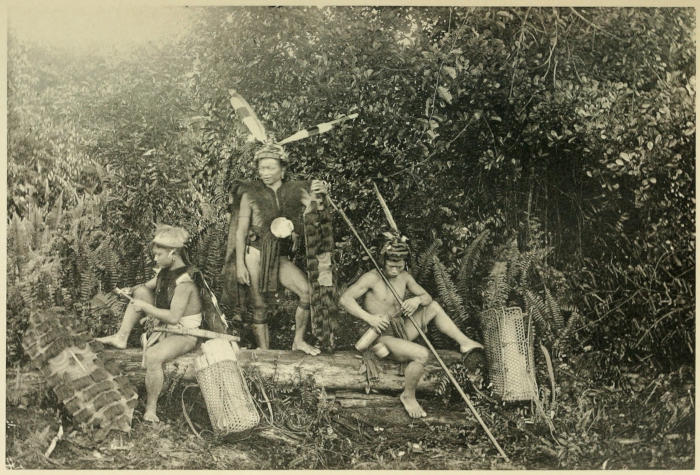
A CHIEF AND TWO SLAVES IN WAR COSTUME.
THE SLAVES ARE MAKING READY THE POISONED DARTS FOR THEIR BLOW-PIPES. IN THEIR HAMPERS ARE THE SLEEPING-MATS FOR THE CHIEF AND THEIR COOKING POTS.
Presently, sure enough, in came the hero of the hour, with fifteen or twenty followers. All took their places amid the squatting group, as unconcernedly as if their minds were as free of care, as their bodies of clothes. Juman seated himself beside us on the low platform. Again, we had to comply with the inviolable rules of Bornean propriety, and converse on any subject under heaven, save on the sole object of the visit; but this time it did not take so long to beat about the bush. After a few decorous minutes, Juman, jumping to his feet, poured forth to the assembly a harrowing account of the horrid dangers to which his household was exposed every hour of the day and night from this crowd of skulking, murderous Lerons! He spoke in Kayan, a language of soft, lingual, and prolonged vowel sounds, abruptly interspersed with short gutturals pronounced far back in the throat; and while relating his wrongs he stamped with his bare feet, turning first to this side, then to that, wildly waving his arms, snapping his fingers, and emphasising the close of each sentence by shouting ‘Bahh! bahh!’—a convenient exclamation to gain time for ideas; I fear it corresponded to the cough which afflicts our own after-dinner speakers. The telling point of the speech was that the camp of the enemy had been actually discovered close to Juman’s own fields, and, from the way that the jungle had been trodden down, the war-party must be in large numbers; much of the rice had been uprooted just as it was beginning to sprout, and many of their banana trees had been wantonly slashed to pieces. There were men here with Juman,—he called them forth and bade them tell their stories,—who had actually seen the encampment of the enemy, and the hundreds of footprints on the bank of the stream where they had rested. Juman was clearly an orator, and swayed at will the emotions of the assembly; volleys of grunts marked approval of his eager words; cigarettes burned quick and fast under excited puffing.
When Juman dropped on his haunches, there followed an ominous silence,—the hush before a storm. Dr. Hose at once perceived that the native blood was deeply stirred, and that these reports about the Lerons, who had no right to be in this part of the country at all, were probably correct, and would infallibly lead to an indiscriminate war. The thirst of the people for vengeance must not be absolutely thwarted, but judiciously controlled. Accordingly, he at once addressed them very earnestly, approving of their just indignation, and fearlessly telling them that the reason why their expeditions so often failed was because they lost so much time in consulting Omen Birds, that the enemy had time to prepare themselves or to decamp. Now was the hour when the lives of their wives and children depended upon instant action, and he impressively concluded by saying:—
‘This time do not ask advice from birds, get ready to-night at once, and we’ll all start at dawn to-morrow and chase these thieves and cowards back to their river! or else many fresh heads will hang in the houses on the Baram! But remember, that though the Government is with you in this fight, it makes war on the guilty, and on no one but the guilty. Go, therefore! Send messengers without delay, up-river and down, to summon all Kayan fighters to arms! And to be ready to join us to-morrow before the birds wake up!’
For several seconds every man sat motionless with dilated eyes and open mouth, hardly realising the joyful news. Then with one wild shout all bounded to their feet, and the whole house from end to end was staring wide awake and fairly quivering with life! Canoes were hastily launched in the darkness and dispatched up and down the black river, to bear the swift news to friendly houses miles away. The slamming of doors was incessant, dusty and long unused spears, shields, war-coats, caps, were eagerly brought from sleeping-rooms into the veranda, for inspection, or for repairs, or for fresh decorations. Clay lamps with damar-gum sizzling, sputtering, and smoking, were lit everywhere. Crouched about one lamp was a group of young men warming fresh ‘Ipoh’ (arrow poison), and smearing it on the tips of the darts for their blow-pipes. Around another, was gathered a group busily cutting new darts and shaping the pith butts to fit tightly in the bore of the blow-pipe. Others sharpened their spears and parangs, rearranging the dangling charms, which they smeared with the blood of chickens, while murmuring exhortations to them to protect the bearer from all harm and help the parang to deal death at a single blow. All the women, too, and the girls, joined in the hurry-scurry, and stitched, on the backs of war-coats, horn-bill feathers, or big butterflies embroidered in black and yellow beads. Many a love-knot was tied, that night, and fastened on parang, war-coat, and shield, and I am quite sure that some young hearts beat high with hopes of presenting, as the fairest of bridal gifts, what no female Kayan heart could possibly resist,—a lovely, fresh, human head. But, perhaps, I was too sentimental, and imputed romantic aspirations to those dusky breasts which entertained no such lodgers. For as I sat there passively watching this strange scene, so dramatic and unreal to me, and so earnest and real to the actors, I saw a girl with serious mien furtively thrust into a young warrior’s hand a strip of bead-work of her own making, wherewith to ornament the scabbard of his parang. I am sorry to say that, so far from responding to any tender sentiment, the young fellow looked decidedly sheepish, and not a little puzzled by the gift, and, alas! I could not detect that he even thanked her for it. Half an hour later I saw him wandering about, dangling the precious love-token aimlessly in his hand. I concluded that she had better throw him over; such ardour as his, never leads to where glory waits.
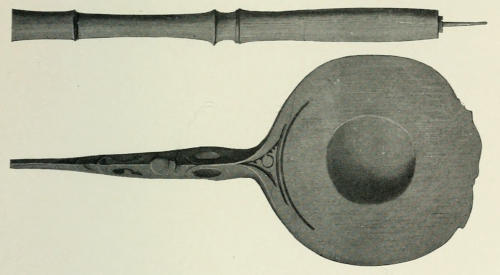
1. WOODEN FORM ON WHICH THE PITH BUTTS OF THE DARTS USED IN A BLOW-PIPE ARE SHAPED. THE PIECE OF PITH IS FASTENED ON THE POINT AT THE END, AND CUT TO THE PROPER CONE SHAPE. THE BASE OF THE CONE IS GAUGED BY THE WOODEN FORM, WHICH IS THE EXACT SIZE OF THE BORE OF THE BLOW-PIPE.
2. PALATE WHEREON ARROW POISON IS MIXED.
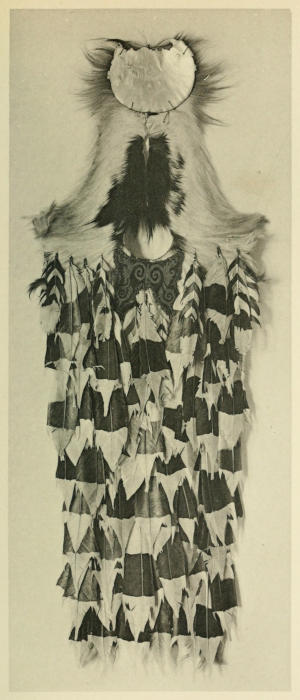
KAYAN WAR-COAT OF GOAT’S SKIN.
THE WARRIOR’S HEAD IS INSERTED THROUGH THE OPENING, AND THE PART DECORATED WITH THE FEATHERS OF A HORN-BILL PROTECTS HIS BACK, WHILE THE SHORT FLAP, WEIGHTED WITH THE PEARL SHELL, HANGS OVER HIS CHEST. ONLY THOSE WHO HAVE TAKEN HEADS ARE ENTITLED TO WEAR THE HORN-BILL FEATHERS, WHICH ARE ALWAYS TRIMMED TO POINTS WHEN USED TO DECORATE WAR-COATS. THE PEARL SHELL IS PLACED UPON THE COAT BECAUSE FROM THIS SHELL THE SPIRIT OF A WARRIOR, SLAIN IN BATTLE, MUST MAKE THE BOAT WHICH IS TO CARRY IT ACROSS THE RIVER TO THE HAPPY LAND OF THE DEAD. THE ORNAMENT OF BEAD-WORK. SHAPED LIKE A BUTTERFLY, JUST BELOW THE OPENING FOR THE HEAD, IS THE FEMININE CONTRIBUTION TOWARD THE DECORATION OF THE WAR-COAT.
Hearing vigorous stamping and loud shouting in the room of the young Chief, Abun, I entered unbidden. In the middle of the room, which was unusually large, stood an old warrior decked out in war-coat and cap, and brandishing a spear in one hand and a shield in the other; around him in a circle sat eight or ten young men watching breathlessly his every movement.
It was difficult to repress a smile at his antics; but the intense earnestness and wrapt attention of his pupils were absolute; he was instructing the novices how to lunge, guard, and parry with spear and shield. With a shrill shout and a lofty caper he dashed at an imaginary foe, warded off the attack with his shield, and, crouching low behind it, gave imaginary crippling jabs with his spear, emitting loud grunts the while, and hopping from right to left at each thrust; these thrusts were evidently fatal to the phantom foe, for, dropping his spear, the hoary instructor drew his parang, and with one chop, followed by sawing, severed an imaginary head from its body. His final explosive grunt, expressed as plain as words: ‘There it is! off at last! simple as kiss your hand!’ Again, he backed and sidled to show the motions when an enemy attacks in the rear; or, again, he showed how to creep stealthily, and at the same time to keep the body thoroughly covered by the shield, which, considering that this protecting article is four feet long by eighteen inches wide, cannot be called a difficult problem. Of course, the enemy was always stupid and completely deceived by the baldest feints, and inevitably fell an easy prey. But the open-eyed and open-mouthed youngsters drank in the instruction in gulps. Their instructor could not be called a handsome old man, his nose was a flattened aquiline, his lips thin and pushed far forward like a frog’s; his hands were, of course, tattooed, for his knowledge of warfare had been gained in many a battle, and his contribution to the household collection of heads was large; his hair was cropped short, (probably out of respect for the late Chief,) and stood up in gray bristles all over his head; his muscular development, however, was fine for a man of his years, and his litheness and agility were remarkable.
The alcove where I sat, watching this military drill, was the sleeping platform of the old widowed mother of the Chief; her mats had been already spread for the night, before this war excitement had begun. She sat beside me, speaking earnestly and bravely to her three sons, Abun, Madong, and Batu, squatting in front of her, each busily engaged, while listening to her, in selecting from their store the best darts for their blow-pipes, and replacing with new butts any old ones which were dry or cracked. ‘Be brave, sons of mine,’ she said, in earnest tones, ‘and remember your father, Oyang Luhat, the bravest of the brave, the friend of the Rajah, and one who obeyed every command of the Government. Bring back, I implore you, an enemy’s head, that your fearless father’s grave may be honoured with a fragment of it. Obey the orders of the Tuan Resident; if he forbids you to kill, then come back empty handed rather than disobey the Prenta. If you are killed, of course I shall wail and lament for you; but I am old, and shall meet you soon again with your father in Long Julán, where all brave warriors go who die in battle or by accident. And you, Batu, [the youngest, about eighteen years old,] be not headstrong, but follow your brothers and take their advice in everything.’
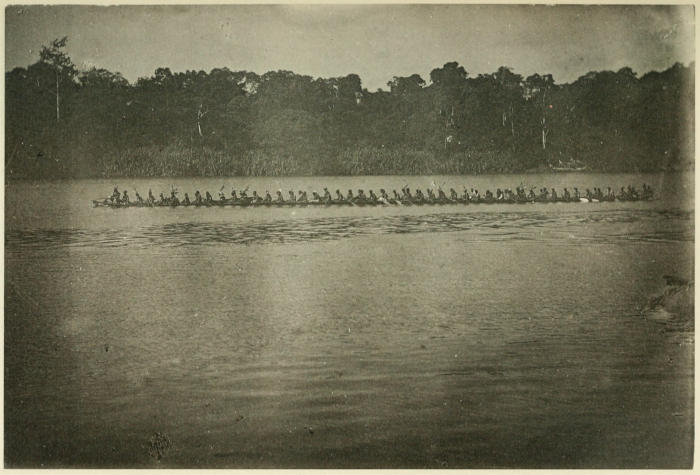
A WAR-CANOE, OR A RACING-CANOE, MADE FROM A SINGLE LOG.
IT IS ONE HUNDRED AND TWENTY FEET LONG AND HOLDS QUITE EASILY A HUNDRED MEN.
Her words were so simple and direct, and, withal, uttered in that soft, flowing language which I had learned to like so well, that, I confess, it never entered my mind at the time that her personal appearance was far from prepossessing. I saw in her only a modern instance of the Spartan mother, and quite forgot her few and blackened teeth, and her slit ear-lobes, enormously elongated by her mourning ear-rings of heavy wood. She sat on the floor half leaning back against the wall, with only a strip of blue cotton cloth (not immaculate) around her waist, and covering as far as the knee her thin, wrinkled, and tattooed legs, while she was addressing her three boys, of whom she was very proud. Her eyes, dimmed from age and from the daily glare of the sun, rested first on one, then on another, but most frequently on the youngest, Batu, whose marriage was to take place as soon as the tattooing on the legs of his bride was finished. Evidently her mother’s heart feared lest this high prize of his enamoured hopes, coupled with his youth, might spur him on to hazard more danger than his brothers. The ardour of the hour was contagious, and I saw (honesty bids me acknowledge) nothing unnatural or unmotherly in these prayers to her sons to bring home a freshly severed head, to hang in consecrated repose above the domestic hearth or on an honoured father’s grave.
In the veranda, all the bustle and excitement were continued; fresh recruits kept constantly arriving from neighbouring houses, and from rice-clearings, where men often pass the night in small huts. Outside, in front of the house, in the granaries for rice, there was also much commotion, the commissariat department must not be overlooked; a good store of rice had to be packed in baskets and bags of a size convenient for handling. In this work, the youngsters could help, and the sturdy little chaps, infected with the excitement of their elders, forgot sleep, and shouted and laughed as they darted here and there, and stumbled in the dark, carrying the baskets down to the canoes at the river’s edge.
Long before the excited stir and confusion had subsided, we were stretched out on our mats upon the floor to snatch a few hours of sleep before dawn; whether or not the natives slept at all is doubtful; when we awoke at the first streaks of gray in the east, the bustle of embarking was at its height.
Just as the first red beams of level light came gleaming down the long stretch of the river, five of the most energetic canoes swung out from the shore, and a mighty shout went up from their sixty or seventy paddlers; the foam and spray dashed and sparkled and glittered from the paddles; the thwarts creaked in their rattan bindings as the canoes fairly bent and quivered under the powerful strokes. Away they darted up-stream racing for the lead, the snow-white feathers in the warriors’ caps and on the war-coats, glittered like burnished silver as they fluttered and caught the glancing sunlight.
Every few minutes, canoes from down-stream, filled with warriors in panoply, came into view, just touched at the landing, asked a few breathless, excited questions, swerved off, and dashed after the leaders. The women, in a long line, leaned over the railing of the veranda, and, let us hope, ‘rained influence;’ certain it is that between the puffs of their cigarettes they broadly smiled encouragement to their lovers and husbands, who (it pains me to add) paid absolutely no attention to them. When ten or twelve canoes had started off, we followed in our big canoe, manned by Ibans from the Baram Fort, who, though of a different tribe, love fighting as passionately as do the Kayans. Not to be outdone, we started off with as brave a splash and as vigorous a shout as the best of them, and very soon had caught up with the main body of canoes that were just behind those that were the first to break the placid water and catch the full beams of the rising sun.
Indeed, it was a thrilling scene! It was war, savage war, and a war of savages. However it might end, be it bloody or bloodless, now at the outset fierce eagerness lit up all faces, and a frenzy for blood had mounted to every brain.
As we rounded a turn of the river we came to a sudden pause. The advance guard of five canoes had hauled up to the shore. On a narrow sandy bank an excited crowd of warriors were kindling a fire and putting up poles and arches of sticks cut along their whole length into curled shavings,—a bird of good omen had been seen on the right side! An exhilarating proof that, although the usual rites had been neglected, the blessed birds were, after all, propitious. The fire, an unfailing messenger from man to the omniscient Omen-givers, now announced to the birds that their favour was greatly appreciated. All the maturer men, pre-eminent among them our old friend, the whilom instructor in the warlike use of shield and spear, evidently also a pronounced and respectable conservative, were overjoyed, and danced, and shouted, round the fire before returning to their boats. Although no such spur was needed, yet unquestionably this favourable omen imparted a fierce exultant joy to all, and we started off with redoubled zeal.
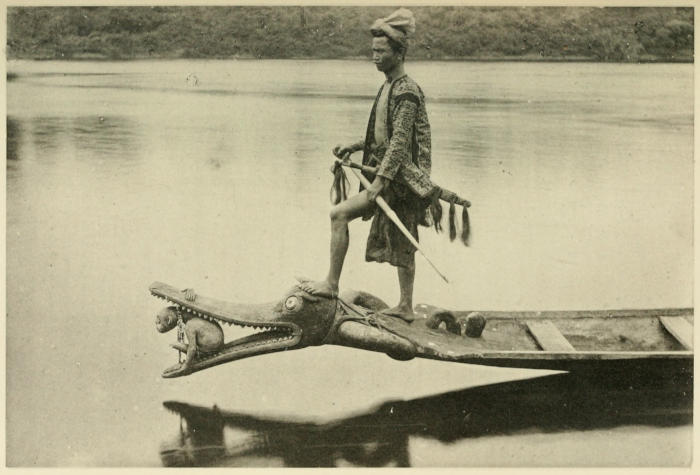
FIGURE-HEAD OF A LONG WAR-CANOE.
THE MAN IS AN IBAN OF THE REJANG DISTRICT, NOW SETTLED ON THE BARAM. HIS COAT IS OF NATIVE MANUFACTURE AND DESIGN.
The canoes kept fairly close together all day, but as the sun mounted higher and higher, and was at last directly overhead, the paddling became somewhat less vigorous; cumbersome war-coats and caps were placed in a heap in the centre of each boat. Three or four times we all halted and cooled ourselves off by a plunge in the stream, which, now that we had passed the lowlands, ran beautifully clear. Whenever we approached friendly houses, the paddling became furious, the shoutings and cries from all throats were renewed; to which, as a response, several canoes full of eager warriors would unfailingly push out from shore to join us. Then again was the air filled with a wild din of savage whoops and halloos, and thrills of excitement ran from boat to boat.
Late in the afternoon, under the westering sun, we reached Juman’s house at Bowang Takun; the house is a large one standing at some little distance back from the river and almost hidden under a luxuriant grove of cocoanut palms. Why the spot should be called Onion Lake, seeing that there are neither onions nor lakes there, is as inexplicable as some of the Bornean conventional tattoo designs. There is a slimy pond, to be sure, near the house, which as it is water might suggest a lake, and its exceedingly bad odor might supply a reminder of the vegetable.
As the day’s journey closed at Juman’s house, Juman very naturally claimed the privilege of acting as host to this large party. Furthermore, was he not the indirect,—but most happy cause, of this delightful war? Was not its joyous pretext to avenge his wrongs? Surely it was his pleasant duty then to feed the warriors royally. (And let me say in parenthesis that to supply, at a few hours’ notice, food and lodging for four or five hundred men might well task any hospitality save that of a Bornean.) Accordingly, his boats had pushed on ahead at the double quick, and reached his house several hours before us. When the forty or fifty canoes (with an average of at least ten men to a canoe) drew up to Juman’s beach, the slaughtering of pigs and fowls was still going on, and great troughs full of boiled rice were in preparation. In order not to be in the way, the whole army filled in the spare time by bathing in the river, and by washing their chawats, (waist-cloths,) which were spread out on the pebbly beach, and, until they were dried, the owners remained in the water. Before dark, all were summoned to the supper, which was spread in the veranda for the common folk, and in Juman’s own room for the select few. In two rows on the floor down the centre of the whole length of Juman’s room, where we dined, were squares of banana leaf, each one piled high with boiled rice, and beside each cover stood a little bowl of wood or of coarse china, filled with cubes of boiled pork and chicken. Between the rows, about every three feet, were large wooden bowls heaped with pulverised salted fish; these bowls were in common, all hands might dive into them for a savory pinch. As soon as all were squatted, some began to fall to at once; whereupon Juman shouted the obligatory welcome, ‘Kuman plahei plahei,’ which, as I have said, means eat slowly. He had no shade of fear that his guests would not eat heartily,—the duration of the meal must be long,—‘the linked sweetness long drawn out.’ Mrs. Juman and little Miss Juman (I failed to catch their names when I was presented), and several little Jumans were ubiquitous in their zeal that all should be helped, that every one should have plenty; when this was assured, they sat on one side and helped themselves. It was a remarkably quiet feast, all attention was absorbed in disposing of the food with neatness, and, in spite of the injunction of Kuman plahei plahei, with dispatch. Considering that all the eating was performed without knife, fork, spoon, or even chop-sticks, the cleanliness with which they all ate, brought a blush to our cheeks when we contemplated the quantity of rice scattered about our places when we had finished.
Darkness closed in soon after supper; the men all gathered in groups in the veranda. Again and again the stories about the hiding-place of the enemy were rehearsed, and those who had been among the fortunate discoverers of this hiding-place never lacked an interested party of listeners, who accepted implicitly every embellishment which each repetition brought forth. The plans for the expedition to the clearings on the following day were discussed, and, in a sort of Council of War, it was finally decided that the whole band should preserve as closed ranks as possible, and sedulously use every expedient in the jungle to indicate to the foe their formidable numbers. In case the enemy had scattered only to reassemble, its scouts would become aware of the perfectly equipped and enormous force with which it had to deal. (I mention these details to show that this expedition was not a mere armed mob, but that the leaders had some inkling of the rudiments of genuine tactics.) Every one was keen for the fight; a protracted peace on the Baram had made the people restless; the heads hanging from the rafters in the houses were becoming exceedingly dusty, and their beneficent virtue was, possibly, evaporating.
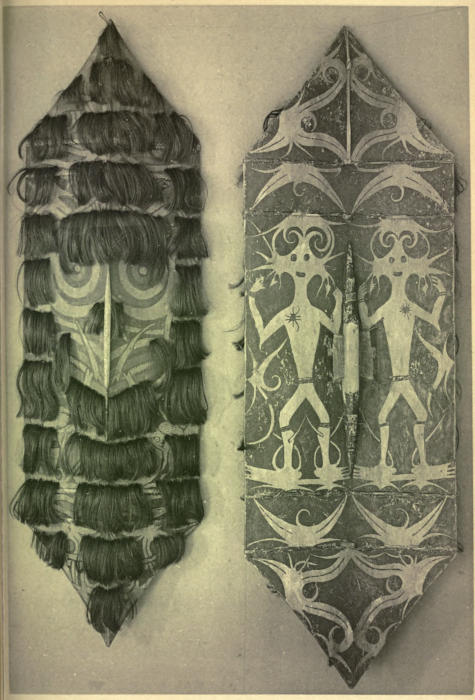
KELAVIT BOK—A HAIRY SHIELD.
ON THE OUTSIDE IS PAINTED A SQUATTING FIGURE, WITH THE ARMS HOOKED UNDER THE BEND OF THE KNEES, AND WITH A LARGE, GRINNING FACE, AND WIDE, STARING EYES AND LONG TUSKS. COVERING THE PAINTING ARE ROWS AND TUFTS OF HUMAN HAIR, CUT FROM THE HEADS OF SLAIN ENEMIES. ON THE INSIDE OF THE SHIELDS ARE USUALLY FIGURES OF MEN OR WOMEN; IT IS SAID THAT THE FIGURES OF WOMEN ARE PAINTED THERE SO THAT THE WARRIOR MAY BE CONSTANTLY REMINDED OF HIS WIFE AND FAMILY AT HOME, FOR WHOSE BENEFIT AND HONOUR HE IS STRIVING TO BRING BACK A FRESH HEAD. IN THE SHIELD HERE PHOTOGRAPHED, THE PATTERNS ABOVE AND BELOW THE FIGURES ARE EVIDENTLY DESIGNED FROM THE PECULIAR CURVES OF THE BEAK AND HORNY CREST OF THE HORN-BILL, THE WAR-BIRD OF ALL THE TRIBES. THESE DESIGNS ARE ALMOST INVARIABLE IN THE DECORATION OF KAYAN SHIELDS.
By the time, however, that all the excited rumors of the number of the foe, and of its movements, had been thoroughly sifted, I think I could detect indications that several of the older and cooler headed Chiefs began to waver in their belief that there would be after all any desperate conflict; possibly even, that this fierce show, with all the paraphernalia of war, would in itself prove all-sufficient, and that the enemy would be so intimidated that it would make no stand.
As the evening wore on and the damar lamps burned low with fitful sputters, I deserted the Council of War, and joined a group where care had been cast to the winds, and, by tacit consent, the evening before the battle was to be as gay and festive as possible. A youth was playing on the kaluri, and a sharp-featured man of middle age was the bard; he had a deep bass voice and seemed to be widely recognized as the possessor of an endless repertoire of songs,—every song that was called for, be it war-like, be it pastoral, be it of love, or be it of the nursery, he was familiar with, and at once launched into the solo, while the rest joined in the refrain.
I could not follow word for word these Kayan songs, which are often, no doubt, quite ancient. The unwritten languages of all the Polynesian races are subject to remarkably rapid modifications; wherefore the songs and legends which preserve their original form are very difficult for modern and foreign ears to understand. Juman sat cross-legged next to me, and interpreted to me in Malay, from time to time, fragments of the songs; one, I remember, had a very catchy rhythm with a constant refrain ‘Tama Poyong kapei paha, Ara wi wi ará.’ According to Juman, it was a woful ballad rehearsing the lament of a young girl to her mother because she had been commanded to marry ‘Tama Poyong, with the twisted leg;’ her plaintive objections to Tama Poyong as a husband, on various grounds, sent Juman and all the rest of the group into such fits of laughter that they could hardly join in the chorus, and, of course, I laughed in sympathy. Another song was of the workers in the fields, and then followed a minute account of the harvest-festival, when women dress like men in nothing but a chawat, and parade about the house in a long procession carrying shield, parang, and spear. The solo singer sat in the centre of the group, and with a smile glanced here and there about him in a half-embarrassed way, keeping time to his song by twirling the free end of his chawat round and round in front of him, and at times, for emphasis, whacking it down on his knee. Whenever women were represented as speaking, he broke into a high falsetto.
So the evening wore on till one by one the singers crept away, and soon, wrapped in their long, white cotton coverings, were stretched along the veranda like a row of corpses in shrouds.
The next morning the excitement in getting off in the boats that there had been at Long Lama was repeated. Eight or ten more canoes from up-river joined us just as we set out, making the total number of the fleet at least sixty, carrying about six hundred,—truly a very formidable army of keen, savage warriors. After ascending the river a short distance, the canoes fell into single file and turned into a narrow tributary stream, leading up to the rice-clearings.
On both sides, trees arched over the stream in a dense canopy; thick with orchids, ferns, and vines, which sent their blossoms, roots, and tendrils down, in heavy masses, almost sweeping our heads; gorgeous butterflies flickered and fluttered in their uncertain flight just above the surface of the water or gathered, like flaming jewels, on patches of mud on the banks; hordes of monkeys, aroused by the unusual bustle and turmoil on the river, peered, and chattered, and jeered at us from a safe distance above; while the harsh and deep-toned calls of the horn-bills boomed and echoed from the depths of the jungle.
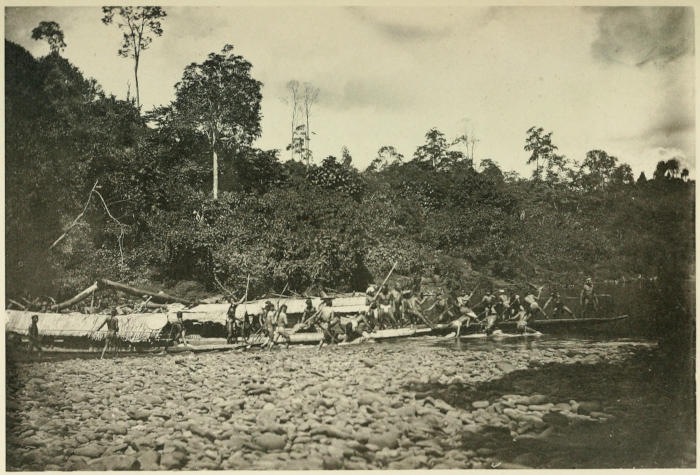
POLING CANOES OVER SWIFT BUT SHALLOW RAPIDS.
For several hours we zigzagged up the stream, following the deeper courses where the current ran less swift, under shady, far-reaching boughs, whose tips dabbled in the rippling water; gradually the stream narrowed and ran between rocks and pebbled islands. Paddles were ineffectual against the swift current, and the men halted to cut poles. One by one, the long line of canoes again moved off, the men grunting in chorus at each shove of the poles, whose successive movements travelled along the line like the rippling legs of a centipede; the man in the bow raises his pole and sweeps it ahead for a fresh hold, then the next man behind, on the opposite side of the boat, does likewise with the same motion, and so down the whole line, each waiting till the man in front has his pole firmly fixed. Then all the twenty together, with a profound and mighty grunt, give a shove that sends the boat ahead for fifteen or twenty feet.
By this time, we had approached so near to the lurking-place of the enemy that it was deemed advisable to have scouts sent ahead, especially to see that there were no trees on the banks which had been partially chopped through and were kept in position only by the vines binding them to adjoining trees; a fatal trap for enemies often used by the Borneans. When the trees are half cut through, it needs but a single blow with a parang to sever the vines that hold it and then down it goes crashing on the boats of an enemy, and while the occupants flounder in the water and are entangled among broken branches, nothing is easier than to reap an abundant and soothing harvest of human heads.
Thus we slowly toiled up the shallow water in the crawling canoes, while scouts kept abreast in the jungle, cutting a path for themselves in the dense tangle of thorny palms and rattans. Foremost among them were Abun, the Chief, and his youthful and ardent brother, Batu. They were as alert as hawks, peering everywhere for indications of the earnestly desired foe. Every now and then my eyes were dazzled by flashes from a diamond-shaped decoration on Abun’s war-cap. When we disembarked at noon I found that this glittering jewel was a tin trade-mark stamped in familiar letters: ‘Devoe’s Brilliant Kerosene Oil.’
For some inexplicable reason, the Borneans never breakfast before starting on any expedition; but, once started, they always seem to choose the most inopportune time for their first meal; just when they have fallen fairly into the swing of paddling or poling, they must needs land and build fires for cooking rice. Even war permits no exception to this exasperating custom; so at noon the whole fleet pulled up on a ‘karangan,’ or pebbly island, where, in fulfillment of the strategy planned the night before, fully a hundred fires were kindled under as many earthen pots, and over a widely extended area. While the rice was boiling, some energetic workers constructed a shelter with boughs and large palm leaves to protect the Chiefs and the ‘Kalunan putih,’ (white men,) from the vertical rays of the sun, which beat down pitilessly in this wide expanse of the stream, where a tributary, almost equal in size, joined its broad waters. The smoke drifted hazily and lazily into the thick, ever-dripping jungle, and the water swirled over the smooth hidden rocks and broke into ‘unnumbered smiles’ in the flecks of sunshine. War-caps and coats were laid aside, and for an hour there was rest for warriors, filled with peace and rice. It is to be feared that under this soothing influence the pristine enthusiasm which marked the start was slightly ebbing; ‘weary seemed the oar, and weary the wandering fields of barren foam;’ there is no knowing how much longer that hour would have lasted. Juman was keeping himself a little in the background, now that his alarming reports were so soon to be tested. Of a sudden the note of instant war was struck by Ma Obat, (Father of Medicine,) of most fierce aspect, but a braggart and at heart a coward; one of his eye-sockets was empty and in the other rolled a bloodshot orb, whose red lids, from which the lashes had been plucked, were everted. He started up, and, with a shout to his men to be quick, or they would never reach the enemy, bustled down to his boat, slipping his head through his war-coat and girding on his parang, as he went.
This sudden call broke the spell, and in a moment all were scurrying to the boats, but not before every peg whereon the pots had rested was with scrupulous care pulled up, and the embers scattered;—nothing brings worse luck to a war-party than the omission of this last duty in breaking camp. One by one the canoes started off again up-stream; sometimes making their way with difficulty between boulders, then again gliding swiftly over placid pools, the poles rattling and splashing on the pebbly bottom. Before long, we reached the head of navigation, and here at last were the rice-clearings,—the very ground whereon the foe had lately trod. For half a mile or more on the left bank of the river, the jungle had been cleared and the surface burnt, leaving only tall charred stumps of trees. Here and there were scattered thatched huts on high poles, where the guardians of the fields sleep at night; and all the undulating ground about the scraggy charred tree stems, was clothed thick with the lush, translucent green of sprouting rice.
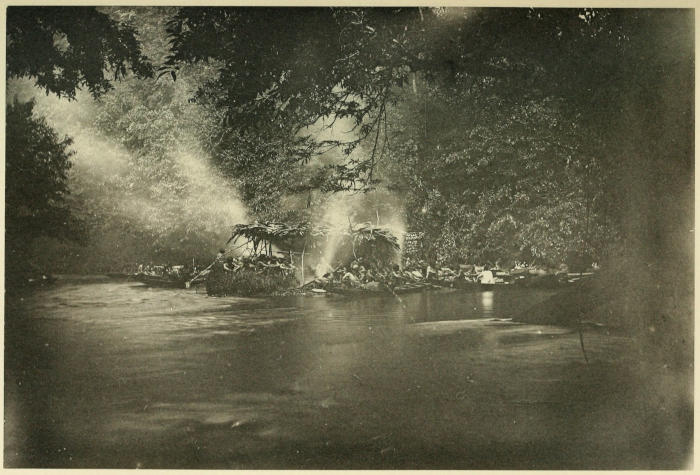
THE WAR-PARTY HALTED ON A ‘KARANGAN’ TO COOK BREAKFAST.
The path now led up the bed of the stream, here dwindled to a mere brook; the foliage was dense all about us, and all were obliged to advance as stealthily as possible. Every face was set, with keen eyes darting in every direction, and every muscle tense. Not an instant but was fraught to all with possible death; at any moment might come the sudden sharp sting of a poisoned arrow from an invisible, noiseless blow-pipe. No one picked his steps,—eyes could not be spared for that. The trembling of a leaf might mean a fatal wound. It was a thrilling, impressive hour. I suppose my heart would have beat quicker, had I not had a firm conviction that the victims of the unerring blow-pipe would be natives, not white men. Once I looked over my shoulder, and smiled at Abun just behind me, with the repoussé legend ‘Devoe’s oil’ glittering on his cap. He did not return the smile, but gravely shook his head, in deprecation of all lightmindedness in such a fateful time. Suddenly there was a commotion in the advance guard, loud cries and vehement talking. Then a quick movement forward. I thought we had actually encountered the enemy, but just as suddenly every man came to a halt and spears were grounded. Our foremost scouts had come upon the camping-ground of the wily Lerons; a capacious shelter of interlacing shrubs and overspread with large leaves had been discovered; the earth was blackened and deep with the ashes from their fires; round about, we found the jungle beaten down, and while we were closely examining these recent traces, one of our scouts came back in great excitement to lead us to the edge of the clearing, where a treacherous ambush had been made, whence a watch could be kept on the labourers in the rice-fields and a sudden onslaught made upon any unwary women or unarmed men.
The last doubt was now dispelled. Intruders with evil intent had been skulking in the neighborhood, in considerable numbers, and very recently,—but whither had they fled? Possibly, they were in hiding, awaiting a favorable chance to attack, or else, after we had given up the pursuit, to return to their deserted ambush.
The little army, gathered on the banks and in the dry bed of the stream, waited patiently until the scouts had returned from fruitlessly searching the jungle far and wide. Then a council of war was convened upon the karangan. It was of no use to advance further unless to attack some household on the Tinjar;—this was not advisable; no one knew with certainty from whose house these hostile intruders had come, and indiscriminate vengeance was out of the question where the Prenta was in the lead.
It was futile to attempt pursuit. The enemy was equipped for land travel, which we were not, and, as they had at least a day’s start, we could not hope to catch up with them. Bitter was the disappointment to all. Many vehemently declared that they were willing to go on, without rest or food, by night and day, only let them taste the glorious excitement of a fight for heads. Ma Obat turned his one seeing but unsightly eye on Dr. Hose, and boldly said, (unblushingly of course, and in a vainglorious tone,) ‘If the Tuan will let me go with only a few of my men, I promise I’ll bring back heads; if I don’t find these Lerons I know where to find some Ivans [thus pronounced by Kayans] collecting gutta and rattans.’ After this display of courage in killing unarmed victims, and of obedience to the Government, he assumed an expression of great ferocity, and rolled his cyclopean eye round the circle to note the effect of his words. To any one who knew how untutored, how undisciplined, how childlike are the minds of these savages, it could hardly have been discouraging, certainly not surprising, to see how many were the nods of approval which followed this treasonable speech; the zealous old ‘fencing-master’ was, as might be expected, decidedly on Ma Obat’s side, and a grizzled old warrior, who, during the discussion, had seized the opportunity of cooling himself off in a pool directly in view of the assembly, cried out, waving his arms and lying flat on his back in the water, ‘That’s the talk! that’s right! I’ll go with Ma Obat! and we’ll kill any one we meet, Ivan, Leron, Punan! any one is better than no one.’
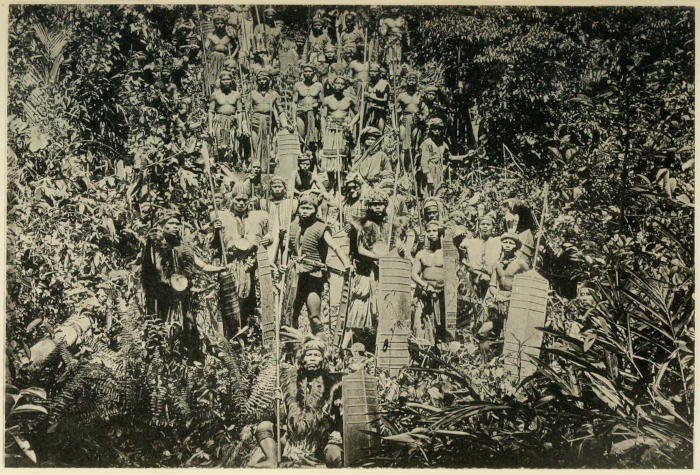
PARTY OF ARMED WARRIORS ON A NARROW TRAIL IN THE JUNGLE.
Ma Obat clearly knew his audience. I think he had really voiced the universal sentiment. Fortunately, the Resident was present, and the supreme head; never for a moment would he allow the possibility of such an unbridled expedition to have a lodgement in their minds. He turned to Abun, who had more men under his command than any other Chief, and to him put the question whether he would be willing to lead an expedition into the country of the Lerons, and solemnly promise that none but Leron men should be killed. The young fellow had a hard struggle; ardently as he longed to approve his lately inherited Chiefship by leading a head-hunt, and piously as he desired to honour his father’s grave with a fresh head, he knew the heavy fines the Government would impose on his House if innocent people were killed, and he distrusted the precipitate temper of his followers. All eyes were fixed on him as, for several seconds, he sat silent, gazing intently at a little pile of pebbles he was pushing up with his widespread toes. Then without lifting his eyes he almost whispered to the Resident, ‘Tuan, I cannot promise so much for my men. Every one of them has known me as a mere boy. Although they follow me for my father’s sake, I cannot promise they will do as I command when we get in sight of any dweller on the Tinjar, armed or unarmed. No, I cannot lead the expedition and keep this promise.’
At this reply, a grunt of unmistakable disapproval was emitted by the whole circle, and, to prevent at once any more insubordinate offers like Ma Obat’s, Dr. Hose immediately ended all discussion by a diplomatic speech, delivered after their fashion with great emphasis, and brought them all round (mere children as they are) to believe that the expedition had been a brilliant, absolute success. Was it not manifest that the enemy had scattered, and fled in wild disorder before them? Had not the real object of the war been gained? Were they not glorious conquerors, every one of them, since all danger to women and children had been removed? What hostile Leron would now dare to lurk about the rice-clearings, after he had noted the traces of this resolute army of invincible warriors? The only thing to do now was to start an enormous peace expedition into the Tinjar country, and put an end, once for all, to the present feuds by the payment and collection of ‘Usut’ [indemnity] and by the performance of ‘Jawa’ [a sham battle].
The speech was greeted with a shout as triumphant as if they saw the backs of their enemy disappearing before them; they sprang to their feet, and spears, shields, and parangs clattered, and plumes waved, and so clearly were they victors, that, in imagination, each warrior had a foeman’s head dangling at his belt.
One and all turned to retrace their steps. Where but an hour before, in strained silence, we had crept stealthily, now, that all danger of a lurking foe was dispelled, we scrambled along, laughing, shouting, clattering iron-shod spears on the stones, and hurrying to be first at the boats. Abun, Madong, and Batu did not share in this exultant mood; they alone seemed down-hearted; they and their household must continue to endure the burdensome restrictions of mourning.
It was during this straggling march that the ‘fencing-master,’ who was, it appears, a Past-Master in knowledge of all rites and usages of war, and his word law, announced that in a case like the present, where a war-party had failed to bring home a head because the enemy had scattered, it was quite in accordance with time-honoured, head-hunting custom to borrow a head; the benign influence, from a relic thus rejuvenated by posing as a head freshly taken, would then be diffused in its adopted home. This announcement amazingly heartened the young brothers.
We now shot in a few hours through rapids and over rocks, where, on our way up, we had toiled almost all day long. As the sun slowly declined, the faster we raced, helter-skelter; spray was flying, paddles thumping, the canoes, creaking and grinding over the rocks, dashed together in a mad race to be the first to reach Juman’s house and proclaim the glorious news that we had put the enemy to flight. The canoe wherein I sat, was one of the earliest to reach Bowang Takun, and I could, therefore, count the canoes as they came darting through the dense leafy arch where the smaller stream entered the Baram. There were in all sixty by the count. No sooner were they drawn up on the sloping bank, than their occupants, numbering at least six hundred, were one and all, dashing and splashing in the water. [Indeed, it might be almost asserted that the Kayans and Kenyahs live as much in the water as out of it. Although they may have been wading alongside of their canoes all day, yet there is never a halt of even a few minutes that they do not divest themselves of their one garment and at least extend themselves in the water, if it is not deep enough for swimming. It would be as monstrous for a Kayan boy not to know how to swim as for a white boy not to know how to run.]
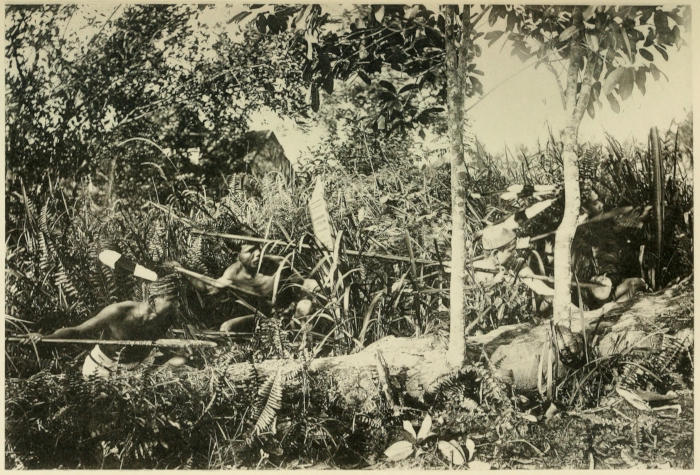
A STEALTHY APPROACH TO THE HOUSE OF AN ENEMY.
After the restful bath and the cooking of the evening meal, on the bank,—this time we were not Juman’s guests,—the expedition began to disband. Those who lived only a short distance up or down the river heaped their cumbersome accoutrements in their canoes and glided off into the darkness.
Abun’s party had a pious duty to perform; accordingly, we spent the night at Bowang Takun, where Abun was going to borrow the head. The loan was transacted with minutest care; the head was reverently lifted from its resting-place by a very old man, whose remnant of days on earth was nearly spent, and who, therefore, shrank less, than a younger man would shrink, from a touch which is sure to be followed by speedy death. From the moment that the skull was touched a deep solemnity fell on all. No laugh, no jest, no light word broke the reverence of what all felt to be a holy act. The skull was carefully swathed in palm leaves and tied under the bow of Abun’s boat, so that it just grazed the water.
Early on the following morning we all set out for Long Lama, Abun’s boat in the lead, and without stopping all that day we drifted silently down with the slow current under a scorching sun. Abun’s canoe and one or two others pushed on a little faster than the rest, and when at about five o’clock in the afternoon we were distant from Long Lama only one turn of the river, we found that they had there disembarked, and had already prepared a wonderfully decorated and elaborate camp; there the whole party must remain for the night, and not be even seen by any member of Abun’s household till dawn of the next day. All around the tent-like shelter of palm leaves were horizontal poles resting on forked sticks, whereon were hung the war-coats and caps, and the almost solid wall, thereby made, was completed by the shields, which were leaned against it to fill in any gaps. Spear-points glittered everywhere, and in front of this hut, or shelter, there was reared an archway of sticks, whereof the bark had been cut up in curled frills along the whole length.[9] Down near the edge of the water was a pile of green bamboo joints decorated with bands of plaited palm leaf; in these the rice must be cooked, and not in earthen pots,—possibly an instance of the tendency in all ceremonial rites to return to the most primitive methods.[10]
[In the accompanying photograph, Madong, the second son, is the well-built young fellow in the foreground; next to him is a young warrior whose name, I think, is Jok; then comes Abun, the Chief, with one hand resting on his shield; immediately on his left is Batu, the youngest son; and in front of him the elderly man, with close-cropped hair and upturned face, is the ‘fencing-master.’ At his feet is the pile of bamboo joints, and near them several hampers containing rolls of palm-leaf matting, whereon the natives sleep. In the background are the rows of war-coats and shields. I was at a disadvantage in taking this photograph; the light from the last rays of the setting sun was poor, and the support for my camera was an unstable sand-bank.]
The taboo against visiting the house did not extend to Dr. Hose and myself, nor to Dr. Hose’s Iban crew; none of us belonged to the household; so we left the Kayans at their sacred encampment, and were soon settled for the night amid all the comforts the house of Abun could afford.
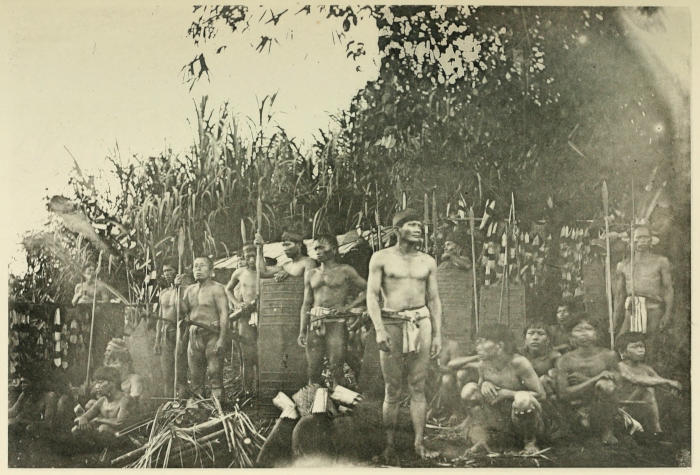
THE RETURN FROM A HEAD-HUNT.
THE CAMP OF ABUN’S FOLLOWERS ON THE EVENING BEFORE THE RETURN TO THEIR HOUSE WITH THE BORROWED HEAD, WHICH WAS TO REMOVE THE RESTRICTIONS IMPOSED BY THE MOURNING FOR A DEAD CHIEF.
At the very first faint glimmer of dawn I was awakened by an unusual stir throughout the house. The women and children and the few men who were so unfortunate as to have been obliged to remain behind, were all collecting along the edge of the veranda below the eaves, whence they could get a view of the river. Just at the very instant that the sun sent its first shaft of level light down the long expanse of river we heard coming from up-stream, a solemn, low, deep-toned chant, or rather humming, in harmony. There were no articulate words, only a continuous sound, in different keys, from treble to bass, of the double vowel oo, as in boom. A minute later the long line of canoes, lashed three abreast, slowly rounded the turn, and drifted toward the house. The men were all standing erect on the thwarts arrayed in all their many coloured war-clothes, with bands of plaited palm leaves around their knees and elbows and also on every spear and paddle. Only a few were at the paddles, merely enough to steer the procession, while all the others stood as motionless as statues, holding their spears upright and the point of their shields resting at their feet. On and on they slowly glided, propelled, it almost seemed, by this inexpressibly solemn dirge, which was wafting this sacred skull to a home it must for ever bless. The brilliant colours of the war-coats flashed brighter every minute as the sun rose higher, and lit up the framework of the wondrous pageant;—the cloudless blue sky over-head, the myriad spangled ripples of the glistening river beneath the dark masses of heavy foliage, suggesting, yet hiding, the ever-mysterious jungle, the hushed, awe-stricken group of women and children, awaiting the warriors’ return, and over all, the silence of earth and sky, broken only by the modulated cadences of that impressive harmony. On, on, they glided until the three foremost canoes touched the bank; then Abun alighted and unloosed the skull, still in its coverings of palm leaves, from the bow of his boat. In order to watch the ceremony more narrowly, I left the veranda as the boats neared the beach, and I shall not soon forget Abun’s solemn, absorbed demeanour. I could not catch his eye, and, unlike his usual self, he took not the smallest notice of my presence, nor did any of the others. Every face wore the wrapt expression of a profoundly religious rite. Without intermitting the chant, Abun, bearing the skull, led the procession in single file to the up-river end of the house. [The skull was now representing a freshly taken head, and there was no longer any danger to those who touched it.] When they were all gathered, still chanting, in a close group, the old ‘fencing-master’ stepped out to the front with a blow-pipe, and, looking in the direction of the Tinjar River (still chanting), addressed a vehement warning to the enemy, and then (still chanting) raised the blow-pipe to his lips, and blew a dart high in the air to carry the message to them. The chanting instantly ceased, and all gave a wild, exultant shout! The skull was placed upon the ground and its wrappings broken, and on four stakes near by were placed the bleeding fragments of a chicken which the ‘fencing-master’ had torn apart as if it were a piece of paper. Each warrior, in turn, then advanced and gravely brandished his parang over the skull, and, walking past the four stakes, smeared the blood of the chicken on his knees, and addressed the spirit of the fowl in a prayer to ‘protect him from all dangers, to impart strength and courage, and drive out all pains and stiffness from his bones.’ After they had passed the last stake they gave a loud, shrill shout, leaped high in the air, and ran quickly up the notched log into the house.
By this ceremony each one cast off the taboo of mourning. When all those who had actually been on the expedition had performed it, then followed those who had been obliged to remain at home; and after them, the small boys, even those who were scarcely able to walk. Everyone, without exception, must be adorned with bands of palm-leaf strips bound round their knees and elbows, and must be dressed in war-clothes. The small boys, however, wore only war-caps, not decorated with horn-bill feathers, but with the skull of a horn-bill, or the long feathers of the Argus pheasant. Those who were too tiny to hold a parang were carried by their fathers, and their little hands were guided while a feeble stroke was made at the head. Between their little lips several grains of rice, boiled in a bamboo joint, were then put, to symbolize that they too had been in a warriors’ camp and partaken of warriors’ fare. Then they were carried past the stakes, and smeared with the blood, while the father uttered the prayer for them, and, in place of the leap and manly shout, gave a bound in the air, and an explosive exclamation, before carrying them hurriedly up to the veranda.
As soon as every male inmate of the house, from feeble age to toddling infancy, had performed this rite, in a flash the charm of the taboo was snapt! In a twinkling, every corner in the house seemed turned into a barber’s chair. Ever since the death of Oyang Luhat, the late Chief, no hair had been trimmed, and long locks, so unsightly to Kayan eyes, had grown on the temples of the exquisite youths and fastidious loungers, who, before the taboo, figured as the ‘glass of fashion,’ as they certainly are always the ‘mould of form.’ Turn and turn about they scraped each other, and when the operation was finished, (which, judging from the character of the knives, must have been a fine lesson in the endurance of agony,) each one carefully gathered up the hair, and, rolling it in a ball, spit vigorously on it, and threw it as far as he could out of the veranda. I imagine this was done with the idea of preventing any one from collecting the hair, and thereby working a charm against the owner; or it may be that spitting upon the hair exorcises any evil Spirit lurking in it. I asked many a one why it was done, but the only reply was, ‘Adat seja’—merely custom.
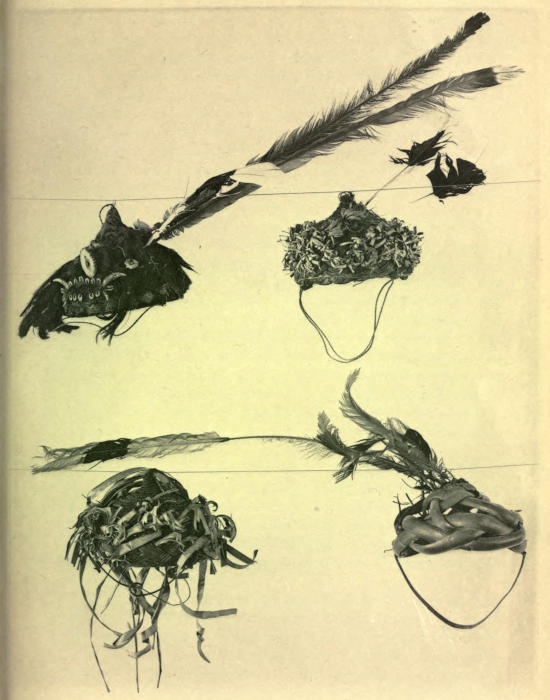
WAR-CAPS OF RATTAN AND SPLIT BAMBOO.
[In connection with this instance of a possible survival of primitive religion, let me mention that in this remote region I found an example of another well-known ancient custom:—wooden images are fashioned in the likeness of an enemy, and placed in the jungle; as the wooden representative decays the original sickens and dies.[11] In ‘The Free Museum of Science and Art,’ in Philadelphia, two of these images are preserved. They represent Dr. Hose and Tama Bulan. They were made by the Lerons after the killing of Tinggi, to be revenged on these two arch-foes. They were discovered by a friendly native and brought to Dr. Hose, whose image happily shows as yet no sign of decay; from the last reports the original also was in excellent health. See next page.]
Of course, it is quite unbefitting for women to go through the rite of slashing at the head; they never go on war expeditions. Therefore, they are freed from their mourning by being sprinkled with water dipped from the river in the palm leaves wherewith the head has been wrapped. Thereafter they resume their ornaments of bead-work, their ponderous brass ear-rings, and don fillets of gaily coloured cloth.
When every member of the household has been freed from the taboo by these rites, a fragment of the skull, wrapped in palm leaves, is attached to a long rope of bamboo twigs, and solemnly carried to the grave of the Chief, which, in the present case, was about half a mile down-stream. In the path which the sons and near relatives have to take to reach the grave, a living chicken, with its legs tied, is placed, and on it each one, in passing, must tread, (the poor fowl does not survive more than two or three footfalls.) The fragment of skull, lifted on the tip of a long bamboo pole, is hung to the edge of the ornamentation on top of the grave. When this is finished, all that can be possibly done to honour a dead Bornean Chief has been performed.
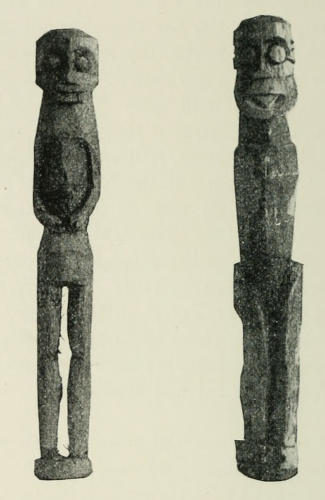
Wooden effigies of Dr. Hose and Tama Bulan, which were left to decay in the jungle, and thereby accomplish the death of the originals. One-half natural size.
I think the one on the left is Dr. Hose.
At night, the men who were away in the rice-fields, when the war-party returned, attain their freedom by smearing with the blood of fowls a little piece of wood cut into a brush of fine strips at one end; this brush they fasten on the side of one of their large basket-work fish-traps, placed on the floor of the veranda, and against this ensanguined brush they rub their knees, before uttering their prayer and giving the shout and the leap which the warriors gave outside the house. The fish-trap, on this occasion, they call their Father; ‘it catches everything it sees, and is afraid of nothing.’
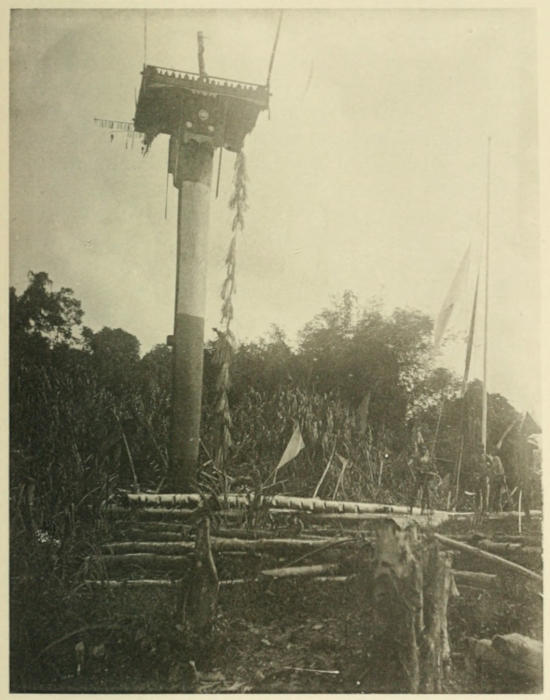
GRAVE OF OYONG LUHAT, THE FORMER CHIEF AT LONG LAMA.
A PIECE OF THE SKULL BORROWED TO TAKE THE PLACE OF A FRESHLY TAKEN HEAD HAS BEEN PLACED ON THE FLAT ROOF ABOVE THE COFFIN, AND THE LONG STREAMER OF SHREDDED PALM LEAVES ATTACHED TO THIS HALLOWED FRAGMENT OF SKULL STILL HANGS FROM THE TOP OF THE GRAVE. THE BODY OF THE CHIEF RESTS IN A COFFIN HEWN OUT OF A LOG AND PLACED HORIZONTALLY ACROSS THE TOP OF THE HIGH COLUMN. OVER THE COFFIN IS FASTENED A LARGE, SQUARE SLAB OF WOOD, CUT FROM A FLAT BUTTRESS ROOT OF A TAPANG TREE. THE STICKS PROJECTING FROM THE SQUARE TOP OF THE GRAVE ARE STRUNG WITH CIGARETTES, WHICH CARRY MESSAGES FROM THOSE WHO MADE THEM TO FRIENDS AND RELATIVES IN THE NEXT WORLD.
All hours of the next day are devoted to a promiscuous slaughter of pigs and chickens, and to the preparation of a great feast; every one contributes a pig or a fowl, according to his means; and on every pig’s liver the fateful omens must be deciphered. At intervals, along the whole length of the interminable veranda, are little enclosures wherein sit the shrewd old Dayongs, whose exhortations, before the slaughter, are potent with the pigs to have nice, lucky livers. As each pig, with its legs tied, is brought and laid before the Dayong to be exhorted and then killed, the owner pays the Dayong a small fee of a few beads, a strip of cloth, or the blade of a parang; after this preliminary fee-giving (a custom, not unknown elsewhere), the owner enters the little enclosure, and, seating himself beside a large gong, proceeds to bang it with a stick, and make as much din as possible; all the while the Dayong lectures and exhorts the wretched pig. The owner while beating the gong pays absolutely no attention to the Dayong’s words, which may be possibly etiquette, but is certainly not surprising,—not a syllable could be audible above the deafening squealing, clattering, banging resounding on all sides. Very likely the Dayong desires to have his platitudes overheard by no one except by the pig, whose attention to duty is every now and then enforced by a vigorous thump in the side from the fist, or a dig in the ribs from the thumb of his ghostly exhorter. When the Dayong thinks the auspicious moment has arrived, and that the swine has caught the drift of the exhortation, and has obligingly modified the streakings of his liver, he plunges a knife in the animal’s throat, catches the spouting blood in a bowl, and, before life is extinct, rips open the paunch, and extracts the dripping liver, whereon, in characters legible only to the Dayong, the pig had inscribed an assured knowledge of the future. Now and then, an avaricious Dayong will persist in reading dreadful portents on the liver; of course, a second pig must be brought, and a second fee paid; and so on until the Dayong is satisfied, then at once the signs become good. On the present occasion eighty-five pigs and sixty fowls were sacrificed. The young boys who have been on the expedition are made to feel that they are to be numbered among the warriors, by being compelled, on that first evening after their return from the head-hunt, to cook their own supper of pork and rice, and to sleep in the veranda among the grown-up men.
The pork is cut into small cubes and boiled in bamboo joints; a very pleasant flavor is thereby imparted to the meat, if you can shut your eyes very tight to the fingers that prepare it.
After the feast was cooked and served in wooden trays and bowls, we all squatted here and there about the veranda, and helped ourselves to the toothsome delicacies of parboiled pork and chicken, excellent boiled rice, pulverized salted fish, and bananas. Then dusty and musty cords were cut on many a jar of ‘Borak,’ or sweetened rice beer, and the festive cup, either half a cocoanut or blue pressed-glass tumbler, was passed from lip to lip. Speeches were made, in which the invincible bravery of every warrior was proclaimed, and frightful threats were hinted as to the fate of the Lerons, had they not fled like the cowards that they are. Festival songs and war-dances, with kaluri accompaniment, followed. When the jars of Borak were drained to the dregs, one by one the exhausted warriors crept to bed, saturated with the serene joy of duty done, glory gained, and honour paid to their departed Chief.
Even after all these ceremonies and the feast, the house is not utterly free from taboo: for ten days no work may be done in the clearings, nor may the men go for rattans or any jungle product. There is always a foundation of wisdom for these taboos. Thus, to keep the men collected in or near the house for a number of days, after a head-hunting raid, is a wise provision: the house cannot be surprised unawares by a retaliating force.
Thus ended this memorable War Expedition of the Kayans and Kenyahs of the Baram against the Lerons of the Tinjar, to vindicate Juman for the legal killing of Tinggi and drive the Lerons back to their own district,—a typical expedition, save alone that the Omen Birds were not consulted, and that it did not end in a wild and wanton raid on innocent people.
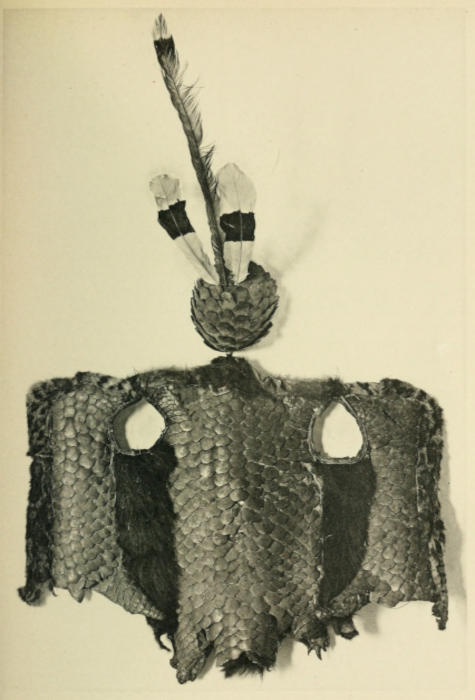
WAR-COAT AND CAP MADE OF THE SKIN OF A MANIS.