Chapter V · THE DANISH CONQUEST OF ENGLAND.[464] 975–1016.
Reading edition
CHAPTER V. THE DANISH CONQUEST OF ENGLAND.[464] 975–1016.
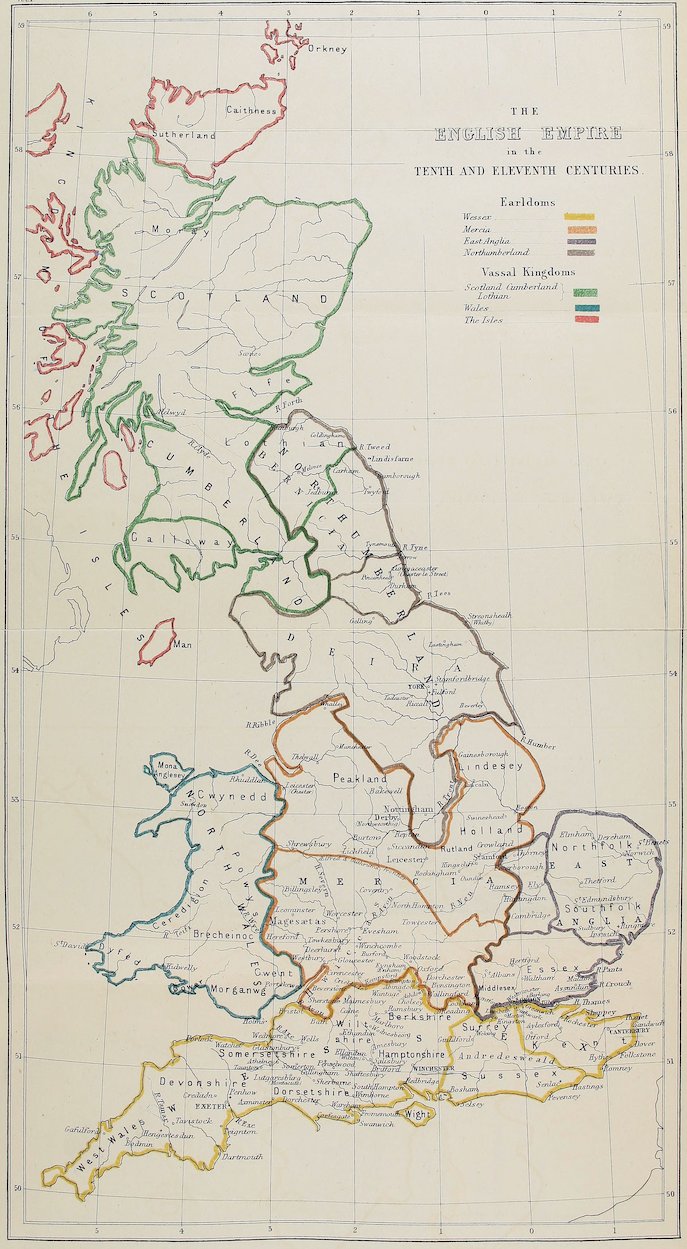
FOR THE DELEGATES OF THE CLARENDON PRESS.
261
Æthelred the Second, the prince in whose reign England and Normandy first began to have a direct bearing on each other’s affairs, is the only ruler of the male line of Ecgberht whom we can unhesitatingly set down as a bad man and a bad King. With singularly few exceptions, |Character of Æthelred the Second; his degeneracy.| the princes of that house form, as we have seen, one of the greatest lines to be found in the annals of any kingly house. With regard to one or two members of the family the evidence is so contradictory, they were cut off so young or reigned so short a time, that we have no certain knowledge what they really were. But Æthelred stands alone in giving us the wretched sight of a long reign of utter misgovernment, unredeemed, as far as we can see, by any of those personal virtues which have sometimes caused public errors and crimes to be forgotten. Personal beauty and a certain elegance of manners, qualities consistent with any amount of vice and folly, are the highest merits attributed to a prince, who, instead of the Unconquered, the Glorious, the Magnificent, or the Peaceful, has received no nobler historical surname than that of the Unready.[465] His actions display a certain amount of energy, perhaps rather of mere restlessness. It was at any rate an energy utterly unregulated and misapplied, an energy which began enterprises and never ended them, 262which wasted itself on needless and distant expeditions while no effective resistance was made to the enemy at the gates. Æthelred’s reign of thirty-eight years displays little but the neglect of every kingly duty, little but weakness, impolicy, cowardice, blind trust in unworthy favourites and even in detected traitors. It is full of acts of injustice and cruelty, some of which are laid to the charge of the King himself, while others, if he did not himself order them, he at least did nothing to hinder or to punish. In that age almost everything in the history of a nation depended on the personal |Importance of the personal character of rulers.| character of its ruler. One great King could raise a kingdom to the highest point of prosperity; one weak or wicked King could plunge it into the lowest depths of degradation. So it was with England in the tenth century. The fabric of glory and dominion which was built up by the labours of Ælfred, Eadward, Æthelstan, Eadmund, and Eadred, the fabric which was firmly welded together by the strong and peaceful rule of Eadgar, now seems to fall to pieces at the first touch of a vigorous and determined enemy. And yet it was not wholly so. The work of so many conquerors and lawgivers from Ecgberht |The English needed only leaders worthy of the people.| onwards was not wholly fruitless. England passed into the hands of a foreign master; but England passed into his hands as a single kingdom, retaining too her old dominion over her vassal principalities. And it should not be forgotten how completely the whole evil was due to incompetent, cowardly, or traitorous leaders. The heart of the English people was still sound. Wherever a brave and honest man was in local command, local resistance was as vigorous as it could have been under Ælfred himself. And in the last agony, when valour and wisdom seemed all too late, Eadmund, the glorious son of the wretched Æthelred, stood forth like one of the old heroes of his house, to win back half the land from the invader, and to lose the rest far more through guile and treason than 263through open warfare. The thing which is utterly inexplicable throughout the reigns both of Æthelred and of Eadmund is the strange and incomprehensible treason of two or three Englishmen in high command. It is equally strange how their treachery could repeatedly paralyse the efforts of a whole nation, and how, after their repeated treasons, the traitors were again taken into favour and confidence by the princes whom they had betrayed. Our facts are minute and explicit; but we often need some explanation of their causes which is not forthcoming. A few of those private letters of which we have such abundance two or three centuries later would give us the key to many difficulties which chronicles, laws, and charters leave wholly insoluble.
§ 1. Reign of Eadward the Martyr. 975–979.
Death of Eadgar. 975.
Eadgar was succeeded by his eldest son Eadward, whose treacherous murder, though he did not die in any cause of religion or patriotism, gained him the surname of the Martyr. But he did not succeed without an interregnum, without a disputed election, or even without something approaching to a civil war. It shows how thoroughly we are now standing on the firm ground of contemporary history that we can recover a distinct portraiture of many |Movement against the monks, headed by Ælfhere of Mercia;| of the actors in these scenes. The moment Eadgar was dead, a reaction took place against the monastic party, which was met by as powerful a movement on their behalf. Ælfhere, the Ealdorman of the Mercians and a kinsman of Eadgar,[466] headed the movement against the monks, and drove them out of several churches into which Eadgar’s favour had introduced them. But the monks found powerful supporters in the eastern part of the kingdom, where their cause was strongly supported, it would seem even in 264arms,[467] by two remarkable men who then held the governments |and resisted by Æthelwine of East-Anglia and Brihtnoth of Essex.| of East-Anglia and Essex. Æthelwine of East-Anglia, one of the founders of Ramsey abbey, is chiefly known for his bounty to monastic foundations, to whose gratitude he doubtless owed his singular surname of the Friend of God.[468] Alongside of him stood his maternal uncle Brihtnoth, Ealdorman of the East-Saxons,[469] whose lavish gifts to Ely, Ramsey, and other monasteries, won him well nigh the reputation of a saint, and whom we shall soon find dying a hero’s death in the defence of his |Disputed election to the crown.| country against heathen invaders. More interesting however in a constitutional point of view than these ecclesiastical disputes is the controversy as to the succession to the crown. The election of a minor is in any case a thing to be noticed, and a dispute between two minors is more remarkable still. Eadgar had left two sons, Eadward, aged about thirteen, the child of his first wife Æthelflæd, and Æthelred, aged seven years, the child of his second wife Ælfthryth, the daughter of Ordgar and widow of Æthelwold, who, under the Latinized name of Elfrida, has been |State of the succession; a minority unavoidable.| made the subject of so much strange romance.[470] Had Eadgar left a brother behind him, there can be no doubt that he would, like Ælfred and Eadred, have been placed on the throne by universal consent. But there was no son of Eadmund living; indeed it is not clear that there was any male descendant of Ælfred living. There were indeed men, like Æthelweard the historian,[471] who were 265sprung in the male line from Æthelwulf and Ecgberht; but in such distant kinsmen some unusual personal merit would probably have been needed to bring their claims on the crown into any notice. At this moment there was no grown man among the immediate members of the royal family, and there was no one, either among strangers or among more distant kinsmen, who possessed that predominant merit and predominant influence which marked out Harold for the crown ninety years later. The evils of a minority had therefore to be risked. Yet it seems strange that, if a minor King was to be accepted, there could be any doubt as to which minor was to be chosen. Eadward is said to have been distinctly recommended by his father, and with good reason. He was the elder son, and though primogeniture gave no positive right, yet it would surely be enough to turn the scale, even in a doubtful case, and this case, one would have thought, was not doubtful. The election of Eadward would have the unspeakable gain of bringing the minority to an end six years sooner than the election of his brother. Yet we read on good authority[472] that there was a distinct division of sentiment among the electors, and that a strong party supported the child Æthelred against the boy Eadward. In this we can hardly fail to see the influence of the widowed Lady[473] Ælfthryth, |Party of Ælfthryth and the monks.| in alliance with one of the two parties in the state. And there is every reason to believe that the party of Ælfthryth was the party of the monks. She was, by her first marriage, the sister-in-law of Æthelwine, and we find several signs that neither Dunstan nor the monks were so powerful under Eadward as they had been under his |Patriotic conduct of Dunstan,| father. It was therefore a distinct sacrifice of their party to their country, when Dunstan and his fellow Archbishop 266|and election of Eadward.| Oswald settled the controversy by a vigorous appeal on behalf of Eadward, urging the will of the late King, and no doubt enlarging also on the manifest expediency of the choice. Eadward was accordingly elected, crowned, and anointed. But that his short reign was not wholly favourable to the monastic party may be inferred by the continuance of the controversy, and the holding of several |Banishment of Earl Oslac.| synods to discuss the points at issue.[474] We may see a similar influence at work in the banishment of Earl Oslac, a special favourite of Eadgar, whose punishment and its injustice are bitterly lamented by our best authorities.[475] It will be remembered that, when the last Northumbrian |954.| King was overthrown by Eadred, the government of the country was entrusted to an Earl of the King’s choice. |966.| Oswulf, thus appointed by Eadred, ruled over all Northumberland, till Eadgar again divided the old kingdoms of Bernicia and Deira, giving the northern province to Oswulf and the southern to Oslac.[476] On Oslac’s banishment, the whole seems to have been again united under Waltheof, who was probably of the family of Oswulf, and of whose own descendents we shall often hear again.
§ 2. From the election of Æthelred to the first dispute with Normandy. 979–1000.
Murder of Eadward and election of Æthelred. 979.
Eadward, after a four years’ reign, was cruelly murdered. There is little doubt that this foul deed was done by the instigation, if not by the personal order, of his step-mother Ælfthryth,[477] whose son Æthelred was now elected at the age 267of ten years.[478] For thirty-seven years England was governed |Death of Dunstan. 988.| by him or in his name, and after Dunstan was gone, the reign of Æthelred meant only the reign of his unworthy favourites. The world soon learned how great was the change when the Imperial sceptre of Britain was no longer grasped by the hand of Eadgar the Peaceful. Æthelred had not been two years on the throne when the Danish invasions began again. The whole interest of the history so completely gathers round this fearful scourge that we may pass swiftly by the few, and mostly unlucky, events of |London burned. 982. (Chron. and Flor. Wig.)| internal history which are handed down to us. In one year London was burned, seemingly by one of those accidental fires which, then and long after, were so common and so destructive in cities where the buildings were mainly |Siege of Rochester. 986.| of wood. In another year, owing to some internal sedition the cause of which is not explained, Æthelred, then a youth of seventeen, besieged the town of Rochester, and being unable to take it, ravaged and alienated some of the |987.| lands of the bishopric.[479] In another year we hear of an epidemic fever, and of a murrain among beasts, seemingly the forerunner of the modern cattle-plague, which raged through the whole of England in a way unknown to former times.[480] Besides these misfortunes of different kinds, 268|Death of Ælfhere. 983.| Ælfhere of Mercia died, and was succeeded in his ealdormanship by his son Ælfric, who was banished some years afterwards, we are not told for what cause. The first marriage |Banishment of Ælfric. 986.| of Æthelred to the daughter of one of his nobles, whose name and parentage are uncertain, and the birth of his sons Æthelstan and Eadmund, afterwards the renowned Ironside, must also be placed within this period.[481]
The Danish invasions renewed;
From these obscure domestic events we turn to the terrible drama of the Danish wars. This new series of invasions, which led in the end to the submission of all England to a Danish King, form the third and last period of Danish warfare. But the third period, after so long an interval, is as it were ushered in by a kind of repetition of the two earlier periods. Before the great attack on the |first, with mere plundering incursions, [980–982];| kingdom of England by a King of all Denmark, we find a short period of mere plunder and a short period of attempted settlement. During the first years of Æthelred the Danish invasions once more become mere piratical incursions. Then for a few years they cease altogether. |then attempts at settlement, [988–993].| Then they begin a second time, in a shape which seems to imply intended settlement, and which presently grows into |Characters of Swegen of Denmark and Olaf of Norway.| regular political conquests. The leading spirit of all these invasions was Swegen,[482] the son of Harold Blaatand, the Danish King who played so important a part in the affairs of Normandy. And for a while there appears by his side another rover of the North, whose career was, if possible, stranger than his own, the famous Olaf Tryggvesson of Norway. But it is hard indeed to force the entries in the English Chronicles, which hardly ever touch upon the 269internal affairs of Scandinavia,[483] into agreement with the half fabulous narratives in the Danish historians and in the Norwegian sagas. Swegen, baptized in his infancy, and held at the font by an Imperial godfather, had received the name of Otto, as Guthrum received the name of Æthelstan.[484] But he cast away his new name and his new faith, and waged war against his Christian father on behalf of Thor and Odin.[485] The life of Olaf, as told in the sagas of his country,[486] is one of the most amazing either in history or in romance. The posthumous child of a murdered King and a fugitive Queen, he is sold as a slave in Esthonia, he flourishes through court favour in Russia, he wins principalities by marriage in Wendland and in England, and is converted to Christianity by an abbot in the Scilly Islands. The early life of Swegen is likewise connected by tradition with England; he is said to have been driven from Denmark, to have sought for shelter in England, and, when repelled by Æthelred, to have taken refuge for a time at the more hospitable court of Kenneth of Scotland.[487] It is highly probable that Swegen took a part as a private wiking in the first three years of piracy, which chiefly laid waste the shores of Wessex and Kent. The presence of Olaf in England may also be inferred from the statement that Cheshire was ravaged by enemies who are distinctly pointed out as Norwegians.[488] That Swegen indeed had a hand 270in the earlier incursions is almost proved by an interval |Cessation of inroads. 982–988.| of peace succeeding them. This interval doubtless answers to the time of Swegen’s parricidal war with his father, which is quite enough to account for the cessation of |They begin again.| his attacks upon England. After six years’ intermission, |Battle at Watchet. 988.| the invasions began again with an attack on Watchet on the western coast of Somerset, in which several English thegns were killed, but the Danes were at last beaten off.[489] Three years later, a much more serious attack was made on the east of England, seemingly with the intention |Norwegian invasion. 991.| of making a settlement. This seems to have been a Norwegian expedition; the leaders were Justin and Guthmund, sons of Steitan, and there seems every reason to believe that Olaf Tryggvesson himself was present also.[490] |Plunder of Ipswich.| They plundered Ipswich and thence advanced into Essex, where the brave Ealdorman Brihtnoth met them in battle |Battle of Maldon and death of Brihtnoth.| at Maldon. The hero of the monks was also the hero of the soldiers, and the exploits and death of the valiant Ealdorman were sung in strains which rank among the noblest efforts of Teutonic poetry.[491] It is a relief to turn 271from the wretched picture of misgovernment and treachery which the reign of Æthelred presents, and to hear the deeds of one of the few righteous who were left told in our own ancient tongue in verses which echo the true ring of the battle-pieces of Homer. The fight of Maldon is the only battle of the days of Æthelred of which any minute details are preserved, and every detail throws light on something in the manners or the military tactics of the age. The battle took place near the town of Maldon, on the banks of the tidal river Panta, now called the Blackwater. The town lies on a hill; immediately at its base flows one branch of the river, while another, still crossed by a mediæval bridge, flows at a little distance to the north. The Danish ships seem to have lain in the branch nearest to the town, and their crews must have held the space between the two streams, while Brihtnoth came to the rescue from the north. He seems to have halted on the spot now marked by the church of Heybridge,[492] having both streams between him and the town. He rode to the spot, but when he had drawn up his army in order, he alighted from his horse and took his place among his own household troops.[493] These were men bound to him by the traditional tie of personal fidelity handed on from the earliest recorded days of the Teutonic race. Like Harold at Senlac, Brihtnoth fought on foot; an English 272King or Ealdorman used his horse only to carry him to and from the field of battle; in the actual combat the first in rank was bound to share every danger of his lowlier comrades.[494] The wikings now sent a herald, offering to withdraw and go back to their ships, on payment of money to be assessed at their own discretion. Brihtnoth of course indignantly refused any such demand; steel and not gold was the only metal that could judge between him and them. The two hosts now stood on the two sides of the water, a deep and narrow channel, which, as the tide was coming in, could not be at once crossed. The bridge, a still older predecessor doubtless of that which still remains, was held, at Brihtnoth’s order, by three champions whose exploit reminds us, like some other incidents of the battle, of one of the most famous tales in the poetical history of Rome. The dauntless three who kept the bridge at Maldon were Wulfstan the son of Ceola, Ælfhere, and Maccus, the name of which last champion may suggest some curious inquiries as to his origin.[495] Till the tide turned, the two armies stood facing each other, eager 273for battle, but unable to do more than exchange a few flights of arrows. At last the turn of the tide made the ford passable; the Northmen began to cross, and Brihtnoth, perhaps with a kind of chivalrous feeling which was doubtless utterly thrown away upon such enemies, allowed large numbers of them to pass unhindered.[496] And now the fight began in earnest. The English stood, as at Senlac, in the array common to them and their enemies, a strong line, or rather wedge, of infantry, forming a wall with their shields. As in the old Roman battles, the fight began with the hurling of the javelins, and was carried on in close combat with the broadsword.[497] Brihtnoth was wounded early in the battle, and his sister’s son Wulfmær was disabled. But the brave old chief went on fighting, and, after slaying several wikings with his own hand, he was cut down, and two gallant followers who fought at his side were slain with him. One of these was another Wulfmær, the young son of Wulfstan, who fought by his lord while his father was guarding the bridge. After the death of the valiant Ealdorman, the thoroughly Homeric character of the story comes out more strongly than ever. The fight 274over the body of Brihtnoth sounds like the fight over the body of Patroklos,[498] or like that later day when
“Fiercer grew the fighting
Around Valerius dead.”
Two caitiffs, the only faithless ones among the body-guard of the fallen hero, two brothers whose names are handed down to infamy as Godric and Godwig, the sons of Odda, forgot their duty to their lord who had shown them such favours, and fled from the field, leaving his body in the hands of his enemies. Godric even added the further treason of mounting the horse on which Brihtnoth had ridden to the field, so that many thought that it was the Ealdorman himself who had fled.[499] The English were thus thrown into confusion; the fortress of shields was broken.[500] The enemy had thus time to mangle the body of Brihtnoth, |Faithfulness of the comitatus of Brihtnoth.| and to carry off his head as a trophy.[501] But the fight was renewed by Brihtnoth’s special comrades, whose names and exploits are handed down to us in verses which breathe the true fire of the warlike minstrelsy common to Greek and Teuton. There fought Ælfwine the son of Ælfric, of a lordly house among the Mercians;[502] there fought Æseferth the son of Ecglaf, a Northumbrian hostage who had 275escaped from the enemy;[503] there fought Brihtwold, old in years but valiant among the foremost; there fought Eadward the Long, and Leofsunu, and others whose names live only in the nameless poet’s verse, but among whom one must not be forgotten, one whose tale shows that, deep as were the corruptions of English life under this wretched reign, there was at least room left for lowly merit to raise itself to honour. This was Dunnere, a churl by birth, but whose rank is spoken of without the least shadow of contempt, and whose words and deeds placed him on a level with the noblest of his comrades. In short, the whole personal following of the East-Saxon Ealdorman seems to have fought and fallen around his body.[504] The heathen had the victory;[505] but the defeat of the English seems to have been by no means decisive. We do not read that the Danes were able to spoil or burn the town, according to their usual custom, and the body of Brihtnoth was carried off in |His burial at Ely.| safety and found a worthy resting-place. On an island in the great fen land between Mercia and East-Anglia, on a height which in that part of Britain passes for a considerable hill, the virgin Queen Æthelthryth (the Etheldreda of hagiology) had, three centuries before, forsaken every duty of royal and married life, to rule over a sisterhood which proved fruitful in saints of royal birth.[506] Thus arose the great monastery of Ely; but, like many other religious houses, it was utterly destroyed in the Danish invasion of the ninth century. When the monks 276were in the height of their power under Eadgar, Bishop Æthelwold, their great patron, chose the forsaken site for a new foundation; a church was built, and a body of monks took possession of the former home of sainted princesses. Among the benefactors of the new house the Ealdorman of the East-Saxons was one of the foremost. The first Abbot, whether from kindred or from accident, bore the same name as his benefactor the Ealdorman. He, according to the legend, died a martyr’s death, through the practice of the Lady Ælfthryth, the unworthy niece of the pious chieftain.[507] The second Abbot Ælfsige was bound to Brihtnoth by the tie of mutual benefits. He now hastened to the place of slaughter, and carried off the body of so great a benefactor of his house. The remains of Brihtnoth were buried in the newly hallowed minster, the humble forerunner of the most stately and varied of England’s cathedral churches. Under its mighty lantern the brave and pious Ealdorman slept in peace, till, under pretence of restoration, his bones were disturbed by the savages of the |Gifts of his widow Æthelflæd; the Ely Tapestry.| eighteenth century. His widow Æthelflæd shared his devotion to the house of Saint Æthelthryth. She added to his gifts of lands; she offered a bracelet of gold, perhaps part of the badges of his office; and she adorned the minster with one gift, which, if it survived, would rank among the most precious monuments of the history and art of the age. Ely once could rival Bayeux; among the choicest treasures of Ely under her first Bishop, a hundred and twenty years later, was the tapestry on which the devotion of Æthelflæd had wrought the glorious deeds of the hero of Maldon.[508]
277At Maldon the invaders had gained a victory, but it was a victory which showed what Englishmen could still do when they had men of the old stamp to lead them. But the dastardly flight of the sons of Odda showed that England also contained men of another temper. And unhappily the policy of Æthelred was now guided by men of the stamp of Godric, not by men of the stamp of Brihtnoth. The shameful payment of money, which the brave old Ealdorman had so indignantly refused, was the only means of safety which suggested itself to a King in the first vigour of youth and to his chief counsellors in Church and State. |The Danes first bought off. 991.| The year which beheld the fight of Maldon beheld also, for the first time, the Lord of all Britain stoop to buy peace from a few ship-crews of heathen pirates.[509] This was the beginning of that senseless and fatal system of looking to gold to do the work of steel, of trusting to barbarians who never kept their promises, and who of course, as soon as they had spent one instalment of tribute, came back again to seek for more. But this plain lesson was one which Æthelred and his advisers seemed never able to learn. The spirit of the nation, which under men like Brihtnoth was ready for vigorous resistance, was thus |Advisers of the measure;| quenched, and its energy frittered away. The evil counsellors who stand charged with the infamy of first suggesting this unhappy measure were men of the highest rank in the nation. The great Dunstan was dead; he was taken away from the evil to come in the very year in which the 278invasions began again. After a momentary occupation of |Sigeric, Archbishop of Canterbury, [990–994];| the metropolitan throne by Æthelgar, Bishop of the South-Saxons, who died the next year, the primacy fell to the lot of Sigeric, Bishop of Wiltshire or Ramsbury. The first act of this prelate was to drive out the secular priests from the metropolitan church, where Dunstan himself had let them abide.[510] If Sigeric was at all versed in the fitting lore of his office, the history of the Old Testament might have supplied him with many precedents to show the fatal nature of his policy. No Jewish King had ever gained anything by buying off the Assyrian, and an English King was not likely to fare any better by buying off the Dane. But Sigeric joined with the Ealdormen Æthelweard and Ælfric in gaining the King’s leave to purchase peace for their own districts at the hands of the invaders by the |Ealdorman Æthelweard,| payment of ten thousand pounds.[511] Æthelweard, “Patricius Consul Fabius Quæstor Æthelwerdus,”[512] was a man of royal descent, who is memorable as our only lay historian of this age, but who would have been more worthy of honour in his literary character, had he, like his kinsman Ælfred, stooped to write in his native tongue, instead of |and Ealdorman Ælfric.| clothing a most meagre record in most inflated Latin. As for Ælfric, his identity and his actions form one of the standing difficulties of this time. His doings, as favourite |Peace purchased of the Northmen. 991.| and as traitor, are spread over several years of the reign of Æthelred. Having bought a respite for their own districts,[513] the Primate and the two Ealdormen next persuaded the 279King and his Witan to buy a general peace for the whole land.[514] The terms of the treaty show that, if the invaders were not actually to settle in the land, they were at least not expected to make a speedy departure. They engage to help King Æthelred against any fleet which may come to invade England; neither party is to receive the enemies of the other; and various provisions are made, which would be quite out of place if the Northmen had been expected to sail away at once. And the events of the next |Fleet assembled at London. 992.| year clearly show that they did not sail away, and they seem also to imply that the peace was broken. For in that year Æthelred and his Witan[515] gathered together a fleet at London, which was placed under the command of two Bishops, Æscwig of Dorchester and Ælfric[516] of Wiltshire, and of two lay chiefs, Thored the Earl, of whom we have already heard, and who, according to one account, was the King’s father-in-law,[517] and, unluckily for the enterprise, Ælfric the Ealdorman. We have now reached the first of that long series of utterly inexplicable treasons, which were, in a way no less utterly inexplicable, always forgiven by those against whom they were wrought. One can understand the wretched policy which buys off an enemy or the sheer cowardice which flees from an enemy. Contemptible as both of them are, neither of them implies any deliberate treachery or any positive perversion of heart. But what human motive could induce an English Ealdorman deliberately to betray his country to the heathen invaders? Yet so to do now becomes the regular course on the part of the 280royal favourites, a class who form a strange contrast to the brave men, chiefs and people alike, whose patriotic efforts |Treason of Ælfric.| were so often thwarted by them. Ælfric now first sent word to the Northmen to beware lest they should be surrounded by the English fleet, and then actually joined them |Naval victory of the English. 992.| with his own contingent. The English, among whom the East-Angles and the citizens of London were the foremost, pursued and gave battle; the Danes were defeated with great slaughter; the traitor’s ship was taken with all |Ælfgar blinded. 993.| that was in it, but he himself narrowly escaped. Æthelred took a base and cowardly revenge by blinding Ælfric’s son Ælfgar, against whom there is nothing whatever to show that he had any share in his father’s crime. Yet, strange to say, within a few years Ælfric himself was again in favour, and again in a position to command and to betray English armies.
Military and commercial importance of London.
The storm was thus turned away from London. The importance of that great city was daily growing throughout these times. We cannot as yet call it the capital of the kingdom; but its geographical position made it one of the chief bulwarks of the land, and there was no part of the realm whose people could outdo the patriotism and |Comparison with Paris.| courage of its valiant citizens. London at this time fills much the same place in England which Paris filled in Northern Gaul a century earlier. The two cities, in their several lands, were the two great fortresses, placed on the two great rivers of the country, the special objects of attack on the part of the invaders and the special defence of the country against them. Each was, as it were, marked out by great public services to become the capital of the whole kingdom. But Paris became a national capital only because its local Count grew into a national King; London, amidst all changes within and without, has always kept more or less of her ancient character as a free city. Paris was merely a military bulwark, the 281dwelling-place of a ducal or a royal sovereign; London, no less important as a military post, had also a greatness which rested on a surer foundation. London, like a few other of our great cities, is one of the ties which connect our Teutonic England with the Celtic and Roman Britain of earlier times. Her British name still lives on, unchanged by the Teutonic conquerors. Before we first hear of London as an English city, she had cast away her Roman and Imperial title; she was no longer Augusta;[518] she had again taken her ancient name, and through all changes she clave to her ancient character. The commercial fame of London dates from the early days of Roman dominion.[519] The English Conquest may have caused an interruption for a while, but it was only for a while. As early as the days of Æthelberht the commerce of London was again renowned.[520] Ælfred had rescued the city from the Dane; he had built a citadel for her defence,[521] the germ of that Tower which was to be first the dwelling-place of Kings, and then the scene of the martyrdom of their victims. Among the Laws of Æthelstan none are more remarkable than those which deal with the internal affairs of London and with the regulation |Commerce of London.| of her earliest commercial corporations.[522] During the reign of Æthelred the merchant city again became the 282object of special and favourable legislation.[523] Her Institutes speak of a commerce spread over all the lands that bordered on the Western Ocean. Flemings and Frenchmen, men of Ponthieu, of Brabant, and of Lüttich, filled her markets with their wares and enriched the civic coffers with their tolls. Thither too came the men of Rouen, whose descendants were, at no distant day, to form no |Privileges enjoyed by the “Men of the Emperor.”| small element among her own citizens. And, worthy and favoured above all, came the sea-faring men of the Old-Saxon brother-land, the pioneers of the mighty Hansa of the North, which was in days to come to knit together London and Novgorod in one bond of commerce, and to dictate laws and distribute crowns among the nations by whom London was now threatened. The demand for toll and tribute fell lightly on those whom English legislation distinguished as the men of the Emperor.[524] The manifest advantages of their trade, perhaps some feeling or memory of their common blood and speech, gained privileges for them to which the Gaul and the Norman had no claim, privileges which did not extend to the kindred Fleming, vassal as he was of the Parisian King, or to the Lorrainer, still a vassal of Cæsar, but already exposed to the contagion of foreign influence and language. The chief seat of their enterprise was indeed as yet not open to them, and the chief seat of their dominion was as yet not in being. Queenly Lübeck had not yet begun to cover her peninsula with her stately spires, her soaring gateways, the rich and varied dwellings of her merchant-princes, and the proud pile of that council-house which was to become the centre of the commerce and policy of Northern 283Europe. The Baltic, one day to be an Hanseatic lake, was still surrounded throughout its coasts by savage or piratical tribes to whom all Christendom alike was hostile. But, if the Trave was not yet reached, the Elbe and the Weser were already occupied. The fame of Hamburg and of Bremen was as yet ecclesiastical rather than commercial; still we may well believe that, among the continental brethren whom London welcomed, there were some who had ventured forth from their infant havens. And the Rhine at least was still open; the ancient Colony of Agrippina was already a chief mart of Teutonic commerce; as early as the days of Charles and Offa, commerce between England and the Empire was a matter of special interest on both sides;[525] and now, in the days of Æthelred, the men of the Emperor, alone among the natives of foreign lands, were emphatically spoken of as “worthy of good laws, even as we ourselves.”[526]
Ravages in the North of England. 993.
The great merchant city was thus saved, mainly, as we shall often find it in these wars, by the valour of her own citizens. The Northmen, baffled in their attack on London, turned their course northward; they stormed King Ida’s fortress of Bamburgh, the earliest seat of Northumbrian kingship; they then turned back to the mouth of the Humber, and ravaged the country on both sides of that river. The men of Lindesey and Deira were no less ready to defend their country than the men of London and East-Anglia; but they had less worthy leaders. |Treason of Fræna, Frithegist, and Godwine.| Just as the battle was beginning, the English commanders set the example of flight. Their names were Fræna, Frithegist, and Godwine, two of them at least old servants of Eadgar, and it is distinctly implied that the cause of their cowardice and treachery was that they were themselves 284of Danish descent, and that they therefore sympathized with the invaders rather than with those whom it was their duty to defend.[527]
Affairs of Wales.
Our narrative is thus far, on the whole, straightforward and intelligible; but two difficult questions now present themselves. Were these Scandinavian invasions accompanied by any efforts on the part of the Celtic inhabitants of Britain to shake off the English supremacy? Was Æthelred, while thus attacked by foreign invaders, himself engaged in foreign disputes and wars, perhaps in |Border warfare with the Welsh.| actual invasion of a foreign land? As far as the Welsh are concerned, it would be alike impossible and unprofitable to try to trace out every detail of the border warfare which was always going on along the Mercian frontier. The English Chronicles scarcely ever condescend to speak of the ups and downs of these endless skirmishes, while |Scandinavian incursions in Wales.| the Welsh Chronicles are full of them. They tell us of a good many incursions of the “Saxons,” but they are far fuller of the ravages of the “Black Pagans,” who were probably much oftener Northmen from Ireland and the Western Islands than actual Danes from Denmark. And it is small honour to the Emperor of all Britain that his plan of buying off the heathen ravagers had perhaps been |988.| forestalled by a vassal prince of Wales.[528] This prince, Meredydd, son of Owen, seems to have spread his dominion over the greater part of the modern principality,[529] and in the year of the battle of Maldon we distinctly find 285him, not only at war with the English, but in league with the Northmen. A prince of Gwent and Morganwg,[530] |War with Meredydd. 991.| in company with an English commander whose name appears to have been Æthelsige, ravaged the kingdom of Meredydd as far as Saint David’s. In return for this, Meredydd, with an army of heathen mercenaries,[531] ravaged Morganwg, the dominion of the Welsh ally of England. One would be more anxious to know what was the position of Scotland at this time. The reception of Swegen by Kenneth, if it be historical, might seem to point to an unfriendly feeling towards England; but we have no notices of Scottish affairs till some years later.
Æthelred’s relations with Normandy.
A more important question still now presents itself. As far as we can gather from most imperfect and contradictory accounts, it seems that it was during these years that the first direct intercourse between England and Normandy took place, and that that intercourse was |Disputes arising from the shelter given in Normandy to Danish vessels.| of an unfriendly, if not a directly hostile, kind.[532] The quarrel seems to have arisen out of the hospitable reception which was given in the Norman ports to the piratical fleets which were engaged in the plunder of England. The old connexion with Denmark, the good services which had been rendered by King Harold, were not forgotten in Normandy. The kind reception thus due to the Danes in general may have extended itself even to those who were in fact Harold’s rebellious subjects, warring against the champion of the faith common to Normandy and England. The Norman havens lay most conveniently 286open for the sale of the plunder of Wessex; it is even possible that some of the inhabitants of those parts of Normandy where the old Danish spirit still lingered may have joined their heathen kinsmen in incursions on the opposite coast.[533] Considering the chronology, it seems most |988.| likely that the invasion of Somerset which took place in the year of Dunstan’s death was aided and abetted by Richard’s subjects in one or other of these ways. A dispute thus arose between Æthelred and the Duke; whether it led to open war is uncertain. At any rate it assumed importance enough to call for the intervention of the |Reconciliation brought about by Pope John the Fifteenth. 991.| common father of Christendom. The reigning Pope, John the Fifteenth, stepped in to reconcile two Christian princes who were weakening one another in the presence of threatening, if not triumphant, heathendom. A prelate named Leo, described as Bishop of Trier, was sent by the Pontiff to the court of Æthelred on a message of peace. He thence went to Duke Richard at Rouen, accompanied by an English embassy, consisting of Æthelsige, Bishop of Sherborne, and two thegns named Leofstan and Æthelnoth, who are not otherwise distinguished, but whose names are attached to many of the charters of the time. Peace was concluded on the terms that neither party should receive the enemies of the other, nor even each other’s subjects, unless they were provided with passports from their own sovereign.[534]
Increasing connexion between England and Normandy
There can be no doubt that in these transactions we may see the germs of much that came to pass in later years. The first recorded intercourse between the courts of Rouen and Winchester paved the way for that chain 287|from this time.| of events which was at last to establish a descendant of Richard in the royal city of Æthelred. Each country now began to feel the importance of the other, whether as a friend or as an enemy. As we go on in the reign of Æthelred, we shall find intercourse of all kinds with Normandy growing more frequent at every step. And for the first and the last time in the common history of the two countries, the Roman Bishop appears in his fitting character of a common peacemaker and father. The next Pontiff who mingles in a strife between a King of the English and a Duke of the Normans shows himself in quite another light.
§ 3. From the first dispute with Normandy to the Massacre of Saint Brice. 991–1002.
Great combined expedition of Olaf and Swegen. 994.
We must now again come back to the consecutive narrative of the Danish wars. In the year after the sack of Bamburgh and the ignominious flight of the thegns of Lindesey, the invasions began again on a more terrible scale. They were no longer the plundering expeditions of private wikings, or of the sons of Kings spending their hot youth in this wild warfare against their neighbours. They were no longer the expeditions of adventurous chieftains seeking to better their fortunes by winning themselves new homes at the point of the sword. The two mightiest powers of the North were now joined together in a momentary league to compass the utter subjugation of England. Instead of the sea-rovers of a few years back, the invaders are now two powerful Kings with royal fleets and armies at their disposal. Olaf, King of the Norwegians, and Swegen, King of the Danes, joined their forces in a greater expedition than any that Brihtnoth had ever met with steel or Æthelred with gold. The pretext for war on the part of Olaf is not clear; Swegen gave out 288that he came to revenge the inhospitable treatment which he had received from the King of the English in the days of his adversity.[535] At the head of a fleet of ninety-four |Attack on London defeated by the citizens. 994.| ships, the two Kings of the North sailed up the Thames and laid siege to London—the first, but not the last, siege which the great city was to undergo in this fearful warfare. For the first, but not for the last time, the valiant burghers, who had already learned to grapple with the Dane on his own element, beat back the invaders from their walls. The fire of twelve years back had doubtless been a mere passing blow; it could have done little to lessen the strength of the Roman rampart and of the tower of Ælfred. But it was not only to such worldly bulwarks that the defenders of London trusted; on that day the Mother of God, of her mild-heartedness, rescued the Christian city from its foes.[536] An assault on the wall, coupled with an attempt to burn the town, was defeated with great slaughter of the besiegers, and the two Kings sailed away the same day in wrath and sorrow.[537] Here was another triumph of English valour; but in this reign valour and counsel were always local; cowardice and utter incapacity reigned at head-quarters. Under Ælfred or Æthelstan, such a check as the invaders had met with before London would have been followed up by some crushing defeat, and the slain of Maldon would have been avenged in the glories of another Brunanburh. Under the wretched Æthelred the very valour of the Londoners only led to the more fearful desolation of other parts of |Ravages in the South-East of England.| the kingdom. The enemy were allowed to ravage the coast at pleasure; at last, meeting with no resistance, 289they seized on horses, and rode through the eastern and southern shires, pillaging, burning, murdering, without regard to age or sex.[538] These horrors were carried on without interruption throughout the whole range of Essex, Kent, and Sussex; at last the invaders crossed the West-Saxon frontier, and by their presence in Hampshire threatened the royal city and the royal person. London and Essex might have been forgotten, but it was now clearly time to do something. But what was to be done? Æthelred and his Witan could think of nothing but their |Æthelred again buys peace.| old wretched expedient. The invaders were again bought off; they were allowed to winter at Southampton; a special tax was levied on Wessex to supply the crews with food and pay, and a general tax was levied on all England to raise the sum of sixteen thousand pounds as a payment to the two Kings.[539] For once this policy, favoured |Embassy of Ælfheah and Æthelward to Olaf.| by special circumstances, was partly successful. The union of Denmark and Norway was broken, and one of the invading Kings was won over to lasting peace and neutrality. Both the leaders of the heathen fleet were baptized men. Swegen indeed, the godson of Cæsar, had denied his faith, and had waged war against his own father on behalf of heathendom. But the baptism of Olaf was more recent and more voluntary. His later history sets him before us as a zealous Christian, who evangelized his kingdom at the point of the sword, and who, in the name of the religion of mercy, paid back upon the heathen all that 290Christian confessors and martyrs had suffered at their hands. A faith which shows itself in such works as these may indeed be far removed from the true spirit of the Gospel; but such fiery zeal at least implies the firmest belief in the dogmas which it is ready to force upon all men at all hazards. We can then well understand that Olaf, already a Christian, might easily be led to repent of the wrongs which he was dealing out on a Christian land, whose sovereign and people had never wronged him. He willingly listened to an English embassy which came to win him over more completely to the side of his brethren in the faith. One of the ambassadors sent was Ælfheah—the Alphege of hagiology—then the Bishop of the diocese in which Olaf was wintering, but who was some years later to ascend the metropolitan throne and to win the crown of martyrdom at the hands of the still heathen Danes. His colleague was the literary Ealdorman, Patricius Consul Fabius Quæstor Ethelwerdus, again more vigorous in negotiation than in warfare. The Norwegian King exchanged hostages with Æthelred; he was led “with mickle worship” to the court at Andover; he was received with every honour and enriched with royal gifts. |Olaf’s confirmation and adoption.| Already baptized, he received the rite of confirmation[540] from Bishop Ælfheah, and was adopted by Æthelred as |He departs for Norway. 995.| his son. The royal neophyte promised never again to invade England; and, as soon as summer appeared, he sailed away to his own country and faithfully kept his |His later days and death. 1000.| promise. The later days of this prince, who fills so large a space both in the history and in the romance of his 291country, were spent in the forcible introduction of Christianity into his own kingdom, and in a war with his momentary ally of Denmark, in a sea-fight against whom he at last perished.
Inaction of Swegen. 994–1003.
One enemy was thus changed, if not into a friend, at least into a neutral; and the other, perhaps weakened by the conversion of his ally, seems to have remained comparatively inactive for several years. Of Swegen himself we hear nothing in English history for nine years, and when he did come again, he had a terrible reason for coming. The Danish fleet however stayed on the English coast, but for a while we hear of no further ravages. It would seem that the interval was partly employed in attacks both on the vassals and on the continental kinsmen of England. In the year of Olaf’s departure, Swegen is said to have ravaged the Isle of Man,[541] and there is no doubt that these years were a time in which both Danes and Swedes were busily employed in attacks on the land of the continental Saxons.[542] In England this short respite was largely devoted to the work of legislation, and to the carrying on of the ordinary business of |Meetings of the Witenagemót. 995.| government. Meetings of the Witan were frequent. More than one such took place during the year of Olaf’s departure,[543] a year of some importance in ecclesiastical history. |Ælfric elected Archbishop by the Witan.| Archbishop Sigeric died, and the vacant office was given, by the election of the Witan assembled at Amesbury in Wiltshire,[544] to the Bishop of the diocese in which they were 292met, Ælfric of Ramsbury, a prelate whose name is still remembered as the author of various contributions to our early theological literature. In the same year also one of |Bishopric of Lindisfarn. 635–883.| the greatest and most famous of English bishoprics found its permanent resting-place. The bishopric of Bernicia or Northern Northumberland, one originally planted by Scottish missionaries, had its first seat in the Holy Island of Lindisfarn, where, for a short time during the later part of the seventh century, the lonely see was made illustrious by the monastic virtues of its sixth Bishop |Saint Cuthberht. 685–687.| Saint Cuthberht.[545] He became the patron of the see, and his body was looked on as its choicest possession. In the great Danish invasion of the ninth century, the Bishop and his clerks fled from their island, and carried the body of the saint hither and thither, till it found a resting-place |The See removed to Chester-le-Street; 883;| at Cunegaceaster or Chester-le-Street.[546] Here the bishopric remained for more than a century, till, in the year which we have now reached, Ealdhun, the reigning prelate, removed |thence to Durham, 995.| it once more to the site which his successors have kept ever since. This translation was not exactly a forestalling of that general removal of bishoprics from smaller to more considerable towns, which we shall find carried out systematically soon after the Norman Conquest. Ealdhun removed his see to a spot which he was the first to make into a dwelling-place of men. As in after days the Wiltshire bishopric was translated from the hill of the elder Salisbury to the plain which has been covered by the younger, so, by an opposite process, Ealdhun now moved his chair from Cunegaceaster to a site nobler than that 293occupied by any other minster in England. The body of Saint Cuthberht and the episcopal throne of his successors were placed by the happy choice of Ealdhun on that height whence the abbey and castle of Durham still look down upon the river winding at their feet. He found the spot a wilderness;[547] but a town soon grew up around the church; Cunegaceaster was before long outstripped by Durham, and we shall in a few years see the new city acting as an important military post. And as the city grew, its prelates grew |Greatness and temporal authority of the See of Durham.| also. In process of time the successors of Ealdhun came to surpass all their episcopal brethren in wealth and in temporal authority. The prelate of Durham became one, and the more important, of the only two English prelates whose worldly franchises invested them with some faint shadow of the sovereign powers enjoyed by the princely churchmen of the Empire. The Bishop of Ely in his island, the Bishop of Durham in his hill-fortress, held powers which no other English ecclesiastic was allowed to share. Aidan and Cuthberht had lived almost a hermit’s life among their monks on their lonely island; their successors grew into the lords of a palatinate, in which it was not the peace of the King but the peace of the Bishop which the wrong-doer was, in legal language, held to have broken. The outward look of the city at once suggests its peculiar character. Durham alone among English cities, 294with its highest point crowned, not only by the minster, but by the vast castle of the Prince-Bishop, recalls to mind those cities of the Empire, Lausanne or Chur or Sitten, where the priest who bore alike the sword and the pastoral staff looked down from his fortified height on a flock which he had to guard no less against worldly than against ghostly foes.[548] Such a change could never have taken place if the see of Saint Cuthberht had still lingered in its hermit-island; it could hardly have taken place if his body had ended its wanderings on a spot less clearly marked out by nature for dominion. The translation of the see to Durham by Ealdhun is the turning-point in the history of that great bishopric. And it is something more; it is worthy of notice in the general history of England as laying the foundation of a state of things which in England remained exceptional, but which, had it gained a wider field, would have made a lasting change in the condition of the country. The spiritual Palatine of Durham and the temporal Palatine of Chester stood alone in the possession of their extraordinary franchises. The unity of the kingdom was therefore not seriously endangered by the existence of these isolated principalities, especially as the temporal palatinate so early became an apanage of the heir to the Crown. But had all bishoprics possessed the same rights as Durham, had all earldoms possessed the same rights as Chester, England could never have remained an united monarchy. It must have fallen in pieces in exactly the same way in which the Empire did, and from essentially the same cause.
Witenagemót at Cealchyth, [996]; at Calne and Wantage.
Another meeting of the Witan was held the next year at Cealchyth,[549] and a more important one the year after at 295Calne, which after a few days transferred its sittings to Wantage.[550] Here, besides the usual business of confirming the King’s grants of lands or privileges to churches or to |[997].| private men, a code of laws was drawn up. At an earlier Gemót, held at Woodstock in an uncertain year, a code had been published,[551] designed mainly for the purely English parts of the kingdom; the labours of the Witan at Wantage, remarkable as it seems in a spot so purely Saxon, seem to have had a special reference to the country which had been occupied by the Danes.[552] These laws, like so many other of our ancient codes, are chiefly devoted to the administration of justice and to the preservation of the peace. Neither in them nor in the earlier laws of Woodstock can we discern any distinct allusion to the special circumstances |Renewed ravages of the Danes, 997–998.| of the times. But in the very year of the Gemót of Wantage the Danish ravages began again. For two years they were confined to the coasts of Wessex and its immediate dependencies. In the first year the invaders set out, seemingly from their old quarters near Southampton, they doubled the Land’s End and ravaged Cornwall, Devonshire, Somerset, and South Wales,[553] plundering, burning, and slaying everywhere, and, what is specially 296noticed, burning the monastery at Tavistock. The next year they cruelly ravaged Dorset and Wight, and at last took up their quarters in that island, whence they wrung |Witenagemót of London. 998.| contributions from Hampshire and Sussex. During this last year a Gemót was held at London.[554] Whether any measures were taken to resist the Danes does not appear; but it seems that Wulfsige, Bishop of the Dorsætas, took measures to substitute monks for canons in his cathedral church at Sherborne,[555] and the King restored to the church |Ravages of the Danes in Kent. 999.| of Rochester the lands of which he had robbed it in his youth.[556] The gift, however valuable to the bishopric, did little towards protecting the citizens of Rochester. The next year the Danes sailed up the Thames and the Medway, and besieged the town. The men of Kent went forth to battle, but they were defeated after a hard struggle, and the Danes horsed themselves and ravaged the whole western |The Witenagemót collects a fleet and army.| part of the shire. The Wise Men then met again, this time to devise means for carrying on the war. They voted, and actually got together, a fleet and army; but nothing came of it. Both in this year and in the former year everything went wrong. Armies were often gathered together; but time was wasted in all manner of delays, and meanwhile the soldiers who were assembled did nearly as much damage as the enemy. If things ever got on so far that they met the enemy in battle, either ill luck or treachery always |Their inefficiency, and general misery of the country.| gave the victory to the heathen. And when the ships were gathered together, there was only delay from day to day; the crews were harassed grievously; when things should have been forward, they were only the more backward; they let the enemy’s army ever increase; and ever they went away from the sea, and the enemy followed 297them; and in the end there was nothing for either the land-force or the sea-force, but grieving of the folk and spending of money and emboldening of their foes.[557]
Causes of the inefficient resistance to the Danes.
Such is the picture of the times which is given us by our best authorities. And it is clear that, to bring about such a state of things, there must have been causes which lay deeper than the mere incapacity or carelessness of Æthelred or than the treachery of a few chiefs of Danish descent.[558] On the other hand, it is perfectly clear that there was no lack of zeal or courage on the part of the people in any part of the country where the invaders landed. This is shown by the valiant resistance which the invaders always met with whenever local power was in worthy hands. It is not unlikely that the forms of the English constitution of that day were partly in fault. The power of resistance was perhaps weakened by the very amount of freedom, general and local, which the English already enjoyed; it was certainly weakened by the still very imperfect nature of the union which existed between the different parts of |General question of the action of constitutional states.| the kingdom. We have in our own times often heard the complaint that a free government is less able than a despotism to carry on a war with vigour. This charge is refuted, if by nothing else, by the result of the great civil |1861–5.| war in America. But the experiences of that civil war, and many experiences of our own, combine to show that a free country has greater difficulty than a despotism in the mere setting about of a war. No free state could expect to rival the readiness, vigour, and daring with |1866.| which Prussia opened the wonderful campaign which made her the head of Germany. The very institutions which secure national, local, and personal freedom, sometimes form 298a temporary, though most certainly only a temporary, hindrance, especially in the case of civil war or of sudden invasion. The old free institutions of England threw difficulties in the way of national resistance, difficulties which the genius of Ælfred, his son, or his grandson, would have overcome, but which were utterly overwhelming to Æthelred |Imperfect union of the parts of the kingdom.| and his advisers. Most likely too, while the kingdom was still so imperfectly united, one part of the country did not greatly care for the misfortunes of another. The devastation of Kent and Wessex would not cause any very deep sorrow or alarm to the Danish people of Northumberland. Local resistance was always possible. A valiant Ealdorman might, with comparative ease, get together his own personal following and the able-bodied men of his shire. But even this process took time. While the English were arming, the Danes were plundering; and when a battle took place, the Danish force, which a general national movement would have crushed at once, commonly proved |Difficulties caused by English constitutional forms.| too strong for the array of any one district. A general national resistance was of course still more necessarily a work of time. The King had no standing army; he could at all times demand the services of his personal following, but even they could not be assembled in a moment; and no real national step could be taken, no national army or fleet could be brought together, no money could be gathered or expended, without the consent of the Witan. And when the Witan met, we can well understand that personal jealousies and still more local jealousies, to say nothing of the causes which always affect all assemblies, would often hinder, or at least delay, the adoption of any vigorous resolution. And when the Witan had passed their vote, they had to go back to their shires and hundreds to announce the determinations of the national council,[559] and to gather together the forces of their several districts. One 299shire would be ready perhaps months before another, while all the while there was the most pressing need for immediate action. Such an army would become dispirited and demoralized before it had really come together. The difficulty of subsistence too, when it was not likely that regular pay could be given, would often drive the defenders of the country to become almost as destructive as its invaders. |Effect of the personal character of the King.| Even when there was no actual treason or cowardice, all these things would be difficulties in the way of the greatest of princes; under such a prince as Æthelred they were found to be simply unsurmountable. Ælfred had carried England through dangers as great as those which threatened her now; but it needed an Ælfred to do such a work. Under Æthelred nothing was done; or, more truly, throughout his whole reign he left undone those things which he ought to have done, and he did those things which he ought not to have done.
Character of Æthelred; vigorous always in the wrong place.
For the fault of Æthelred, after all, was not mere weakness.[560] The Unready King showed occasional glimpses of vigour which might for a moment remind men that he came of the same stock as Eadward the Unconquered and as Æthelstan the Glorious. But it was a vigour which came only by fits and starts, and which acted only at unfitting times and for unfitting objects. As far as we can judge by his actions, the character of Æthelred was not one of mere abject incapacity like Edward of Caernarvon. He was rather like Richard of Bourdeaux, idle, careless, 300governed by worthless favourites, but showing ever and anon, though always in the wrong place, signs of a strong will and a capacity for vigorous action. So now it was at this memorable crisis of his kingdom. He had at last got together a fleet and an army, and, having got them |The Danes sail to Normandy. 1000.| together, he would do something with them. But the Danes were gone; they had got together their plunder, and had sailed away, as before, to sell it in the Norman havens.[561] Æthelred took advantage of their absence to plunge into a needless war with one of his own vassals. |Æthelred ravages Cumberland in person, and his fleet ravages Man. 1000.| It does not seem that, up to this time, he had ever once thought of going forth in person to battle against the Danes; but the Emperor of Britain could trust no one but himself to lead an army against the Under-king of Cumberland. He ravaged nearly the whole of the principality by land, and he would have ravaged it by sea also, only the fleet which set out from Chester was hindered by contrary winds from meeting him at the appointed spot.[562] It did however reach Man, and harried the island. The cause of all this untimely activity is not stated by our best English authorities. Man especially, which had been harried by Swegen only a few years before,[563] must have been singularly unlucky if it contrived thus to provoke the wrath of both the contending Kings. Nor is it at all clear why Malcolm was attacked in his under-kingdom of |Malcolm’s refusal to pay Danegeld.| Cumberland. A Scottish writer tells us that Æthelred had called on Malcolm to contribute to some of the payments made to the Danes, probably to the great sum paid 301to Olaf and Swegen six years before. In short he wished to make the dependent kingdom of Cumberland liable, like an English shire, to the impost of Danegeld. Malcolm, we are told, answered with proper spirit. If King Æthelred went forth to battle, he was ready, as in duty bound, to follow his over-lord with his own forces; but he had never covenanted to pay money, and no money would he pay. The authority for this story is not of the first order; but it falls in so exactly with the relations between the two princes that it has strong internal likelihood in its favour. Malcolm was not an English Ealdorman, ruling an integral part of the English realm; he was a vassal prince reigning over a dependent kingdom, a kingdom which formed a part of the English Empire, but which had never been under the direct rule of the English crown. That kingdom Malcolm held on the terms on which it had been originally granted to his predecessor, those of military service by land and sea.[564] A money tribute had indeed been levied on some of the Welsh princes; but military service was clearly the only contribution which a King of Cumberland owed to the Emperor of Britain. But Æthelred was enraged at his refusal, which, he alleged, could proceed from nothing but good will to the enemy. He accordingly ravaged the country, but afterwards concluded peace with Malcolm. If this story be true, Malcolm was fully justified in his refusal, and the conduct of Æthelred was a gross breach of the mutual duty of lord and vassal.
Second quarrel with Normandy, 1000.
It is also likely that this untimely activity on the part of Æthelred led him also to match himself against an enemy of a very different kind from the vassal King of Cumberland. As far as probable conjecture can guide us through mazes where difficulties and contradictions meet us at every step, it was during this burst of misapplied 302energy that Æthelred became again involved in a dispute, most likely in an open war, with the Duke of the Normans.[565] |[996.]| Richard the Fearless, his former antagonist, was now dead, and the reigning prince was his son Richard the Second, surnamed the Good. Of the dealings between the two countries we have no account from any English authority, and the version which we find in the Norman writers, though doubtless containing some germs |Æthelred’s invasion of Normandy, as described by Norman writers.| of truth, is evidently exaggerated in detail. According to them Æthelred sent a fleet into Normandy, with orders to burn and destroy throughout the land, and to spare nothing except the Mount of Saint Michael with its revered sanctuary. As for the reigning Duke, he was to be taken prisoner, and to be brought into the presence of his conqueror with his hands tied behind his back. The English fleet crossed the Channel, and its crews landed in the peninsula of Coutances and began to carry out the |Defeat of the English.| royal orders. But Neal, the valiant Viscount of the district, gathered the men of the country, and smote the invaders with such a slaughter that of those who actually landed one man only escaped to the ships. The fleet sailed home with the news of its discomfiture. Æthelred is pictured as waiting for the triumphant return of his fleet with the news of the conquest of Normandy. His first inquiry is for the captive Duke. But instead of seeing Richard with his hands tied behind him, he only hears that his men have not so much as seen the Duke, that the men of one county had been enough to destroy all their host, that the very women had joined in the strife, striking down the choicest warriors of England with the staves on which they bore their waterpots. These details are of course pure romance; but the existence of such a story seems to show that some hostilities really did take place. Æthelred’s fleet may have pursued the Danish fleet 303when it sailed to Normandy, and in so doing it may in |Probable explanation of the story.| some way have violated the neutrality of the Norman coast. Or Æthelred, in his present fit of energy, may have been so indignant at the reception of the Danes in the Norman havens as to send out an expedition by way of reprisal. But the grotesque pride and folly implied in the Norman story is incredible even in Æthelred. The details are valuable only as showing the kind of tales which, as we shall see more fully as we go on, the Norman writers thought good to pass off as the English history of the time.
Marriage of Æthelred and Emma; its evil results.
Whatever was the exact nature of the mutual wrongs now done to each other by Normans and Englishmen, the quarrel did not last long. Æthelred seems now to have been a widower;[566] the peace between the two countries was therefore confirmed by a marriage between him and the Duke’s sister Emma, one of the legitimated children of Richard the Fearless and Gunnor.[567] Her beauty and accomplishments are highly extolled, but her long connexion |1002–1051.| with England, as the wife of two Kings and the mother of two others, brought with it nothing but present evil, and led to the future overthrow of the English kingdom |The marriage of Emma opened the way for the Norman Conquest.| and nation. The marriage of Æthelred and Emma led directly to the Norman Conquest of England.[568] With that marriage began the settlement of Normans in England, their admission to English offices and estates, their general influence in English affairs, everything, in short, that paved the way for the actual Conquest. Through 304Emma came that fatal kindred and friendship between her English son and her Norman great-nephew, which suggested and rendered possible the enterprise which seated her great-nephew on the throne of England. From the moment of this marriage, English and Norman history are inextricably connected, and Norman ingenuity was ever ready to take any advantage that offered itself for strengthening the foreign influence in England. The former dispute between Æthelred and the elder Richard was a mere prologue; we have now reached the first act of the drama. If an English fleet really did sail to Normandy and ravage the Constantine peninsula, those ships were like the ships which Athens sent across the Ægæan at the bidding of Aristagoras—they were indeed the beginning of evils.[569]
Emma comes to England. 1002.
The marriage however did not take place for two years. According to one story Æthelred went over to Normandy to bring home his bride in person.[570] The evidence is distinctly the other way; but to go on such an errand, when the miseries of war were at their height, was perhaps in character with a prince so apt to be enterprising at the wrong moment. A like piece of vigorous courtship is the one act of energy recorded of one of Æthelred’s descendants, |1589| James, Sixth of Scotland and First of England. If Æthelred really did go over to Normandy, he was the first English King, since Ælfred in his childhood, who set foot on the continent, as his son Eadmund was the last 305English King for several centuries who did not.[571] And |A foreign Lady most unusual in England.| for an English King to espouse a foreign wife was something yet more strange to Englishmen than for an English King to visit foreign lands. The marriage of the daughters of English Kings with foreign princes had been common from the days of Ælfred onwards; but a foreign Lady by the side of an English King had not been seen |855.| since Æthelwulf brought home the young daughter of Charles the Bald.[572] And the marriage of Æthelwulf and Judith was most likely the first instance since the Frankish |561–597.| princess whom Augustine found as the queen of the Kentish Bretwalda.[573] And the stranger wives alike of Æthelberht and of Æthelred came as the forerunners of mighty changes. The foreign marriage of Æthelberht paved the way for the admission of the Teutonic and heathen island into the common fold of the Christian commonwealth. The foreign marriage of Æthelred paved the way for the more thorough fusion of England into the general European system, by giving her a foreign King, a foreign nobility, and, for many purposes, a foreign |Emma changes her name to Ælfgifu.| tongue. It shows the strong insular feeling of the nation, and it curiously illustrates the history of English personal nomenclature, that the foreign Lady had to take an English name. The English stock of personal names, though made out of the same elements as the names used by other Teutonic nations, contained but few which were common to England and to the continent.[574] This Old-English nomenclature, with the exception of a few specially royal and saintly names, has gone so utterly out of use that it sounds strange to us to read that the Lady, to make 306herself acceptable to the English people, had to lay aside the foreign name of Emma, and to make herself into an Englishwoman as Ælfgifu.[575] So, by the opposite process, |1100.| a hundred years later, when an English Eadgyth married a Norman King, she had to change herself into a Norman Matilda. And it is well to mark that the royal bride, like other Teutonic brides, had her morning-gift, a gift which took the form of cities and governments, and a gift which brought no good to England.[576] And according to some accounts, the marriage brought with it as little of domestic happiness as of public advantage. Emma bore to |Her children. Ælfred. 1036.| Æthelred two sons, Ælfred, who perished miserably in an attempt on the English crown, and Eadward, who lived to be at once King and saint, and to be, perhaps through his own grovelling superstition, the last male descendant of Cerdic and Ecgberht by whom that crown was actually worn.[577] But we are told that the royal parents did not agree. We can well believe that Emma showed the imperious spirit of her race, and scandal adds that Æthelred forsook her for rivals, no doubt of his own nation.[578] Of the 307truth of these reports nothing can be said, and the public crimes and misfortunes of Æthelred are so great as to leave little time or inclination to search into his possible private vices.
I have spoken of the marriage of Emma slightly out of place, in order to bring it into its natural connexion with other Norman affairs. We must now go back two |1000.| years. The dealings of Æthelred with Normandy and Cumberland fell in the last year of the first millennium of the Christian æra. It was no uncommon belief at the |Expected end of the world.| time that the end of that period of a thousand years was the fated moment for the destruction of the world. And certainly at no time were the promised signs of wars and rumours of wars, of distress of nations and perplexity, more rife throughout the world than when the second millennium |Condition of Europe and Asia.| opened. In the East of Europe, Basil the Second, the mightiest name in the long roll of the Byzantine Cæsars, was engaged in his fearful struggle for life and death with the Bulgarian invader. In the further East, the Turkish dynasty of Ghazni was laying the foundations of that power which, in the hands of other dynasties of the same race, was to overwhelm alike Constantinople and Bulgaria and all other realms from the Indus to the Hadriatic. In Southern Europe, Otto the Wonder of the World was running that short and marvellous career which, for a moment, seemed to promise that Rome should again become, in deed as well as in name, the seat of universal Empire. The prospects of England seemed darker than those of any other corner of Europe. In the East and in the South, if old systems were falling, new ones 308were rising, but our island seemed given up to simple desolation and havoc. It would appear that, though the mass of the Danish fleet had sailed to Normandy, some of the ships must have stayed in their old quarters in the |Danes in the English Service; Pallig.| Solent. Some at least among the Danes had taken service under the English King. Such was the case with Pallig, a Danish Earl, evidently of the highest distinction, as he was married to Gunhild, a sister of King Swegen himself.[579] His wife, and probably himself, had embraced Christianity, and he had received large gifts from the King, both in |Invasion of Sussex and Hampshire. 1001.| money and in land. The Danes who had stayed in England now burst into Sussex, and ravaged as far as a place called Æthelingadene.[580] They then pressed on into Hampshire, and, as so often happened, they were met by the men of the shire, and by the men of that shire only. The details of the battle are unusually minute; eighty-one of the English were killed and a much greater number of the Danes; but the Danes kept possession of the place of slaughter. Among the English dead were several men of rank,[581] among them two “high-reeves” of the King—probably the Sheriffs of Hampshire and Sussex—Æthelweard and Leofwine.[582] The Danes then went westward, 309seemingly in concert with the fleet which was coming back |Treason of Pallig.| from Normandy. But they were first met by Pallig, who had already forsaken the service of Æthelred, and who now joined them with such ships as he could bring with him. They sailed up the Teign, and burned King’s Teignton[583] and other places. After this, peace—no doubt the usual kind of peace—was made with them. But by this |Return of the Danes from Normandy.| time they had fallen in with their comrades. The Danes who had sailed to Normandy now came back, no doubt still further embittered at Æthelred’s doings in that country, whatever may have been their exact nature. Their fleet seems to have sailed straight from Normandy to the mouth of the Exe; they were there met by the other Danes, Pallig and the rest, and their united forces sailed |Importance of Exeter; early history of the city.| up the river.[584] About ten miles from its mouth lay a city[585] which held nearly the same position in the West of England which York held in the North and London in the South-east. The Roman city of Isca had not fallen into the power of the Teutonic invaders till after their conversion to Christianity; it therefore had not shared the fate which befell Anderida at the hands of Ælle and Uriconium at the hands of Ceawlin. Under the slightly changed name of Exanceaster or Exeter, the capital and bulwark of the Western shires had long formed one of the 310choicest possessions of the West-Saxon Kings. The city |877.| had been warmly striven for between Ælfred and his Danish enemies, and, among the ups and downs of his earlier struggle with the invaders, it had been more than |Exeter, hitherto half Welsh, becomes purely English under Æthelstan, and is strongly fortified. 926.| once taken and lost again. Up to the time of Æthelstan Exeter had remained, as many towns in Wales and Ireland remained for ages afterwards, a joint possession of Teutonic and Celtic inhabitants.[586] No doubt there was an English and a Welsh town, an Englishry and a Welshry,[587] and we may be equally sure that the English inhabitants formed a dominant class or patriciate among their fellow-burghers. But Æthelstan, in the course of his Western wars, thought it good that so important a post should be left in no hands but such as he could wholly rely on. The Welsh inhabitants were accordingly removed; the city became altogether English; a |Witenagemót and Laws of Exeter.| solemn assembly of the Witan was held to commemorate and to confirm the new acquisition, and one series of the laws of Æthelstan were put forth in the now purely English city of Exeter.[588] The town was now strongly fortified; it was surrounded with a wall of squared stones,[589] 311a fact worthy of the attention of those who seem to think that our forefathers before the Norman Conquest were incapable of using the commonest tools, or of putting stone and mortar together in any way. The chief architectural ornament of the city had indeed no existence. |Exeter not yet a Bishop’s See.| The cathedral church, so strange in its outline, so commanding in its position, did not yet crown the height which, alone among the episcopal seats of Southern England, makes some pretensions to rival the temples built on high at Lincoln and at Durham, at Geneva and at Lausanne. Indeed, like Lincoln and Durham, it had not even a predecessor. Exeter was not yet a Bishop’s see; the episcopal care of West-Wales was still divided between the Bishop of Devonshire at Crediton and the |Municipal condition of the city.| Bishop of Cornwall at Bodmin. The history of the city at a somewhat later time seems to show that it enjoyed a large share of municipal freedom; still, as an integral part of the West-Saxon realm, it was a royal possession, and the royal authority was represented |Its commercial and military importance.| by a reeve of the King’s choice. Both the commercial and the military importance of the city were of the first rank. In our days the trade of Exeter has long been of small moment; commerce has long been carried on in vessels which need a deeper stream; as early as the thirteenth century the trade of the city itself began to be interfered with by the foundation of the port of Topsham nearer the mouth of the river. But the small craft of the tenth century could sail straight up to the city for |The Danes attack the city, but are driven off by the citizens.| purposes either of commerce or of war. The Danes now attacked Exeter, just as they had attacked London; but the citizens of the Western capital fought with as good a will, and with as thorough success, as their brethren 312of the East.[590] King Æthelstan’s wall stood them in good stead,[591] and the attack of the barbarians was altogether fruitless. But the result of the resistance of Exeter was much the same as the result of the resistance of London. The city was saved, but, for that very reason,[592] the ravages of the invaders fell with redoubled violence upon the surrounding country. Æthelred was as unready as ever; the host which had been prompt to ravage Cumberland and perhaps |Devonshire ravaged and the Defnsætas and Sumorsætas defeated at Pinhoe.| Normandy, was not at hand to aid any local efforts. The Danes spread themselves over the country, harrying, burning, killing, in their accustomed manner. The men of Somerset and Devonshire gathered their forces, and met the enemy at Pinhoe,[593] not far from the rescued city. But the force of two shires was not enough for the purpose. The Danes had the advantage of numbers,[594] and put the irregular English levies to flight. They then, as usual, took to themselves horses, and ravaged the country still more thoroughly and unsparingly than before. At last they went back to their ships with a vast booty, and sailed to their old quarters in the Isle of Wight. Thence they carried on their usual harryings, both in the island and on the coasts of Hampshire and Dorset, no man now daring to withstand them.
Witenagemót of 1001.
The Witan met in the course of this year in an assembly which confirmed a grant of the King to the abbey of Shaftesbury, a grant which is remarkable on two grounds. It distinctly sets forth the wretchedness of the times in 313a way rather unusual in such documents, and it shows that the King’s brother Eadward was already looked on as |First Gemót of 1002.| a saint.[595] Another meeting was held early the next year, |Charters granted at it.| in which the King granted to Archbishop Ælfric the estate of a lady which she had forfeited to the crown by her unchastity.[596] Possibly at the same meeting, or at another in the same year, Æthelingadene, the scene of one of the late battles, along with some other property, was granted by Æthelred to the monastery of Wherwell, his mother’s foundation, for the good of her soul and of that of his father.[597] It may be that in all this we hear the voice of his brother’s blood crying from the ground.[598] But the state of the nation was not altogether neglected; still the Assembly of the Wise could think of nothing better than the old wretched remedy which had so often |Payment again made to the Danes.| failed them. The Danes were again to be bought off at their own terms, and Leofsige Ealdorman of the East-Saxons was sent to find out what those terms were.[599] They 314now, fairly enough, raised their price; twenty-four thousand pounds was asked and was paid as the condition of their ceasing from their ravages. But, while the negotiation was going on, the negotiator, on what ground or in what quarrel we are not told, killed the King’s high-reeve Æfic in his own house.[600] The Witan were still in session; |Leofsige outlawed.| they took cognizance of the murder, and Leofsige was outlawed and driven out of the land for his crime.[601] All this |Emma comes over.| must have happened early in the year, as it was after these events, though still in Lent,[602] that the Norman Lady came |Second or Third Gemót of 1002.| over. Before the year was out, another Witenagemót was held,[603] at which Æthelred and his counsellors contrived to 315do what otherwise might have seemed impossible, to |Massacre of the Danes. November 13, 1002.| put the heathen invaders in the right. This winter, on the mass-day of Saint Brice, took place that famous massacre of the Danes which has given a wide field for the exaggerated and romantic details of later writers, but which stands out in bloody colours enough on the page |Plot of the Danes to kill the King and his Witan.| of authentic history.[604] According to our best authorities, tidings were brought to the King that the Danes who were in England were plotting with one consent to kill him and his Witan and to seize upon the kingdom. Except that other means of destruction must have been intended, this sounds very like a forestalling of the Gunpowder Plot. The Danes were indeed thoroughly faithless, but an intended general massacre of the whole Witenagemót when in full session, which the words seem to imply, is hardly credible. Another attack on London or Exeter, or a harrying of some district which was as yet untouched, would be much more likely. One cannot help suspecting that we have here a good deal of exaggeration, exaggeration, I mean, not in the Chroniclers but in the reports spread abroad at the time by Æthelred and his advisers. However this may be, the King, no doubt with the consent of the second (or third) Gemót of the year, ordered a general massacre of all the Danes in England, an order which could never have been carried into execution if it had not been supported by the general hatred of the whole nation. It is said that letters were secretly sent to all parts of the kingdom, ordering the bloody work to be done |Probable extent of the massacre.| throughout the whole land on one day. The persons slain were most likely such among those Danes who had served in the late invasions as had stayed in England on the faith of the treaty concluded in the spring. A general massacre of all persons of Danish descent throughout England is not to be thought of; such a massacre would have amounted 316to the slaughter of a large part of the inhabitants of Northumberland and East-Anglia. There is nothing in the earliest account to imply that any but men were slaughtered, and, among the Danes, every man was a soldier, or rather a pirate. That such men were not slaughtered without resistance is not wonderful. One instance is incidentally recorded, how such Danes as were at Oxford, flying from their English destroyers, sought shelter in the minster of Saint Frithswyth, and how they defended themselves against all the people of the borough, until their assailants betook themselves to fire and burned the Danes along with the church and its records. This one piece of detail seems to be trustworthy;[605] but the tale began very early to get improved by all kinds of romantic additions. The slaughter of actual enemies was not enough. We first hear of a massacre of Danish women; then, among an infinite variety of horrors of all sorts, we come to a massacre of English women who had become wives or mistresses of Danes, and of the children who were the fruit of such unions. It is not likely that there were many Danish women to massacre, and the notion of a general massacre of women most |Murder of Gunhild.| likely arose out of one particular case. That Gunhild, the wife of Pallig and sister of Swegen, was put to death is too probable, especially if it be true that she had given herself as a hostage for the good faith of her countrymen. The prince who blinded the son of Ælfric to avenge his father’s treason,[606] and who afterwards took the father himself again into favour, was capable even of so cowardly and foolish a vengeance as this. The traitor Pallig, if he was caught, would doubtless be put to death, and that with perfect justice, unless he was personally included in the last treaty. And it may be that Gunhild had to behold the slaughter of her husband and her son, and that with her dying voice 317she foretold the woes which her death would bring upon England. Such a prediction needed no special prophetic inspiration.
§ 4. From the Massacre of Saint Brice to Swegen’s Conquest of England. 1002–1013.
Results of the massacre.
The vespers of Saint Brice were not only a crime but a blunder. From this time forth the Danish invasions become far more constant, far more systematic, and they |Invasion by Swegen in person. 1003.| affect a far larger portion of the kingdom. The next year King Swegen came again in person.[607] He now had a real injury; the blood of his sister and his countrymen might have called for vengeance at the hands of a gentler and more forgiving prince. He did not land in any of those parts of the island where we should have most naturally looked for the opening of a campaign; he began his attack in the region which had been the chief seat of warfare for years before. Most likely he knew well where the |Exeter betrayed to Swegen by Hugh the Frenchman.| weakness of England lay. The Danish King sailed to Exeter, the city whose burghers had so gallantly repelled the former attack. But the state of things within the walls of the western capital was now sadly changed for the worse. The royal rights over Exeter had been granted to the Norman Lady as part of her morning-gift. Hugh, a Frenchman, whether earl or churl[608] matters not, was now 318the royal reeve in Exeter, the first of a long line of foreigners who, under Emma, her son, and her great-nephew, were to fatten on English estates and honours. Hugh was either a coward or a traitor, most likely both. Exeter was stormed and plundered; the noble walls of King Æthelstan were broken down from the east gate to the |Swegen ravages Wiltshire.| west, and the city was left defenceless.[609] Swegen returned to his ships with a vast plunder, and then went on to the |A battle hindered by Ælfric, again in command of the English.| harrying of Wiltshire. The men of that shire and their neighbours of Hampshire were gathered together, ready and eager to meet the enemy in battle. The people were as sound at heart as they had been three years before, but they had no longer the same valiant leaders. The battle of Æthelingadene seems to have fallen with special severity on the chief men, and we now find the force of these two shires in the last hands in which we should have looked to find them. The old traitor Ælfric,[610] who had done his best, eleven years before,[611] to betray London to the enemy, who had himself been driven from the land, and whose innocent son had paid a cruel penalty for his offence, was now, through some unrecorded and inexplicable intrigue, again in royal favour, again in command of an English army, again trusted to oppose the very enemy with whom he had before traitorously leagued himself. But, as our Chronicles tell us with a vigorous simplicity, he was again at his old tricks; as soon as 319the armies were so near that they could look on one another, the English commander pretended to be taken suddenly ill;[612] retchings and spittings followed as a proof of his sickness; in such a case a battle could not possibly be thought of. One wonders that some brave man, however unauthorized, did not seize the command by common consent;[613] but the paltry trick was successful; the spirits of the English were broken, and they went away in |Fluctuation of spirits among non-professional soldiers.| sadness without a battle.[614] In all this history, just as in old Greek history,[615] we are often surprised at the mere accidents on which the fate of battles depends, how much one man’s valour or cowardice or treason can bring about, how much turns on the mood in which the soldiers find themselves at the moment of action. In this case the English are described as having come together with the utmost good will, and as being thoroughly eager to do their duty. Yet a transparent artifice at once paralyses them, and they become wholly incapable of action. We must remember that here, just as in Greece, we are dealing, not with professional soldiers, but with citizen soldiers; we are dealing with times when every man was sometimes a soldier, and when none but professed pirates were soldiers always. Such soldiers are not mere machines in the hand of a master of the game; they do not simply do their professional duty in blind obedience; they have a real part and interest in what is going on; they are therefore liable to be affected by the ordinary feelings of men in a way in which professional soldiers are much less 320strongly affected. Such men are specially liable to fluctuations of the spirits; they are easily encouraged and easily disheartened; men who fight like heroes one day may be overcome by a sudden panic the next. Hence the extraordinary importance which, with troops of this kind, attaches to the personal exhortation and personal example of the general; a chief who simply stands aloof and gives orders can never win a victory. The particular speech put into the mouth of a general before battle is no doubt commonly the invention of the historian; but that generals found it needful to make such speeches, and that such speeches had a most important effect on the spirit and conduct of their armies, is clear in every history of this kind of warfare. No doubt even professional soldiers still remain men, and are liable to be in some degree affected in the same way; still habit and discipline make a great change; an army in which each man is really fighting for his hearth and home is liable to these influences in a tenfold degree. Before long we shall see England possessed of an army combining the merits of both systems, an army uniting discipline and patriotism; but as yet the country had no standing force, and had to depend solely on the enthusiasm and the sense of duty of the general levies of each particular district. In this case, the spirit of the men of Wiltshire and Hampshire was all that a leader could wish for; if some brave man had stepped forward, had cut down the traitor Ælfric, and had called on the English to follow him against the enemy, a battle would have been certain and a victory probable. But no man had the energy to do this; therefore the base trick thoroughly succeeded, the spirit of the troops was damped, and the English host went away without striking a blow. But even in retreat it must have been formidable, as it seems to have been left quite unmolested by the enemy. Still the whole shire was left 321defenceless. The town of Wilton was sacked and burned. |Swegen sacks and burns Wilton and Salisbury.| Swegen then marched to Salisbury. The Salisbury of |Old Sarum.| those days was not the modern city in the plain, which circles, with but little of beauty or interest in itself, around the most graceful of West-Saxon minsters. The object of Swegen’s march was still the old hill-fortress,[616] where the Briton and the Roman had entrenched |552.| themselves, and at whose foot Cynric had won one of those great battles which mark the western stages of the Teutonic invasion. After the days of Swegen a Norman castle and a Norman minster rose and fell on that historic spot, and the chosen stronghold of so many races lived to become one of the bye-words of modern political discussion. Like Exeter, Salisbury was not yet a Bishop’s see; the prelate of Wiltshire had his lowly cathedral church in the obscure Ramsbury; but the choice of Salisbury at the end of the century as the seat of the united sees of Wiltshire and Dorset shows that it must already have been a place of importance according to the standard of the time. Yet one would think that its importance must always have been mainly that of a military post; one can hardly conceive Old Sarum being at any time a place of trade or the home of any considerable population. Whatever the place consisted of at this time, Swegen sacked and burned it, and returned to his ships with great spoil.[617]