Chapter IV · SKETCH OF THE HISTORY OF NORMANDY DURING THE TENTH CENTURY.[188]
Reading edition
CHAPTER IV. SKETCH OF THE HISTORY OF NORMANDY DURING THE TENTH CENTURY.[188]
The two foreign conquests of England which form the main subject of English history during the eleventh century were the work of nations which came originally 149of the same stock. First came the Danes themselves; |Normans and English originally kinsmen.| then came the Normans, the descendants of Danish or other Scandinavian settlers in Gaul. In mere blood therefore the Normans were allied in different degrees to all the Teutonic inhabitants of Britain, and they were very closely allied to the descendants of the Danish settlers in the North and East of England. And there can be little doubt that this original community of blood really had an important practical effect, and that the speedy fusion of Normans and English was greatly promoted by the fact that conquerors and conquered were in truth kinsmen. |Practical, but unrecognized, effects of this kindred.| But this influence was a purely silent one, and it was in no way acknowledged by those on whom it acted. Neither side thought at all of any kindred as existing between them. And to all appearance, no two nations of Western Europe could have been found which, in speech, feelings, |The Danes in England become Englishmen.| and manners, differed more widely from one another. The Danes who settled in England had been easily turned into Englishmen. Though the likeness of speech and institutions between the two nations has often been exaggerated, it was something not only real but palpable. It needed no historical research to find it out; it was something which men of both nations could feel for themselves. Among the earlier Teutonic settlers in Britain, we can well believe that there were some whose original kindred with the Teutons of Scandinavia was quite as close as their original kindred with some of their fellow Teutons in 150Britain. Anyhow, the languages of the two nations were closely allied; their institutions were very similar, those of England being doubtless the more advanced and regularly organized of the two. Religion formed the main difference between them; but the Danes in England soon adopted the Christian faith, and they were followed, after no very great interval, by their brethren in Denmark. Thus the Danish settler in England, when once baptized, readily became an Englishman, differing from the Angle or the Saxon only as the Angle and the Saxon differed from one another. This absorption into a kindred nation is less remarkable than the fact that the same people in another land adopted, with not much greater difficulty, a language and culture which was wholly alien to them. |The Danes in Gaul become Frenchmen.| For, as the Danes who settled in England became Englishmen, so the Danes who settled in Gaul equally became Frenchmen. The Normans of the eleventh century were men of Scandinavian descent who had cast away every outward trace of the language, manners, and feelings which made them kindred to Englishmen, and had adopted instead the language, manners, and feelings of Latin France. Before they landed in England, they had become Frenchmen; though still proud of the Norman name, they were content, as speakers of the French tongue, to call themselves Frenchmen in distinction from the Teutonic English.[189] No doubt the old Scandinavian element was still at work within them; it made them Frenchmen on a far nobler and grander scale than other Frenchmen, and it enabled them, when they had once settled in England, unconsciously but surely to become Englishmen. Still, when they followed their Duke to the conquest of England, they were in every outward respect no longer Scandinavians but Frenchmen. In a word, they were no longer Northmen but Normans; the change in the form 151of the name aptly sets forth the change in those who bore it.[190]
§ 1. General Effects of the Scandinavian Settlements in Gaul.
Importance of the Norman settlement in Gaul.
The settlement of the Northmen in Gaul, and their consequent change into Normans, is the great continental event of the first half of the tenth century; it challenges a place alongside of the restoration of the Empire by Otto |Comparison of the settlements of Rolf and Guthrum.| in the second half. Its beginnings indeed might seem small. A band of Scandinavian pirates settled in Northern Gaul, exactly as another band of Scandinavian pirates had, thirty years before, settled in Eastern Britain. In both cases the sovereign of the invaded land found it expedient to secure the safety of the rest of his dominions, by surrendering a portion of them to the invader and by requiring baptism and nominal homage as guaranties for peace and good neighbourhood. The settlement of Rolf in Neustria exactly answers to the settlement of Guthrum in East-Anglia. Charles the Simple and his counsellors may well have justified their act by quoting the example of Ælfred himself. But the results of the two events were widely different. The East-Anglian and Northumbrian Danes were fused into the general mass of Englishmen, and they were soon distinguished from other Englishmen by |Results of the Norman settlement on general history.| nothing more than mere provincial differences. But the settlement of Rolf in Neustria had far wider results. It affected the later history of all Europe. The Scandinavians in Gaul embraced the creed, the language, and the manners of their French neighbours, without losing a whit of their old Scandinavian vigour and love of adventure. The people thus formed became the foremost apostles alike of French chivalry and of Latin Christianity. They were the Saracens of Christendom, spreading themselves over 152every corner of the world and appearing in almost every |Their prominence in devotion,| character. They were the foremost in devotion, the most fervent votaries of their adopted creed, the most lavish in gifts to holy places at home, the most unwearied in pilgrimages to holy places abroad. And yet none knew better how to hold their own against Pope and prelate; the special children of the Church were as little disposed to unconditional obedience as the most stiffnecked |and in war.| of Ghibelines. And they were no less the foremost in war; they were mercenaries, crusaders, plunderers, conquerors; |Change of their tactics.| but they had changed their element and they had changed their mode of warfare. No Norman fleets now went forth on the errand of the old wikings; the mounted knight and the unerring bowman had taken the place of the elder tactics which made the fortress of shields invincible. North, south, east, the Norman lances were lifted; and they were lifted in the most opposite of causes. |Their exploits in the Eastern Empire,| Norman warriors pressed into the remotest East to guard Eastern Christendom against the first Turkish invader;[191] other Norman warriors were soon found to be the most dangerous enemies of Eastern Christendom in its own |1071.| home. If the Norman fought by the side of Rômanos at |1081.| Manzikert, he threatened the Empire of Alexios with overthrow at Dyrrhachion. His conquests brought with |in England,| them the most opposite results in different lands. To free |in Sicily.| England he gave a line of oppressors; to enslaved Sicily he gave a line of beneficent rulers. But to England he gave also a conquering nobility, which in a few generations became as truly English in England as it had become French in Normandy. If he overthrew our Harolds and our Waltheofs, he gave us a Fitzwalter and a Bigod to win back the rights for which Harold and Waltheof had fallen. In the arts of peace, like his Mahometan prototypes, 153he invented nothing; but he learned, adapted, improved, |Influence of the Normans on art; their welcome of foreigners.| and disseminated everything. He ransacked Europe for scholars, poets, theologians, and artists. At Rouen, at Palermo, and at Winchester, he welcomed merit in men of every race and every language. He guided Lanfranc and Anselm from Lombardy to Bec and from Bec to Canterbury. Art, under his auspices, produced alike the stern grandeur of Caen and Ely and the brilliant gorgeousness of Palermo and Monreale. In a word, the indomitable vigour of the Scandinavian, joined to the buoyant vivacity of the Gaul, produced the conquering |Disappearance of the Norman race,| and ruling race of Europe. And yet that race, as a race, has vanished. It has everywhere been absorbed by the |in Sicily,| races which it has conquered. From both Sicilies the Norman has vanished as though he had never been. And there too have vanished along with him the races which he used as his instruments, and which he alone taught to work in harmony. Greek, Saracen, and Norman have alike disappeared from the realm of good King William. |in Britain.| In our own land the fate of the Norman has been different. He abides in his lineage and in his works, but he is Norman no longer. He has settled in every corner of the British islands; into every corner of those islands he has carried with him the inborn qualities of his own race, but in every corner of those islands he has assumed the outward characteristics of the races among which he settled. The Scottish Bruce or the Irish Geraldine passed from Scandinavia to Gaul, from Gaul to England, from England to his own portion of our islands; but at each migration he ceased to be Scandinavian, French, or English; his patriotism was in each case transferred to his new country, and his historic being belongs wholly to the home which he had last won. In England itself the Norman has vanished from sight no less than from Apulia and insular Sicily. He has sunk beneath the silent and passive influence of a race 154less brilliant but more enduring than his own. The Norman has vanished from the world, but he has indeed left a name |Famous men of Norman descent.| behind him. Of him came Richard the Fearless and William the Bastard; of him came that Robert whose foot was first placed upon the ransomed battlements of the |1099.| Holy City, and that mightier Robert who in one year |1086.| beheld the Cæsars of East and West flee before him.[192] |Frederick the Second.| And of his stock, far more truly than of the stock of Imperial Swabia, came the Wonder of his own and of all succeeding ages,[193]—poet, scholar, warrior, legislator—the terror and the marvel of Christendom and of Islam—the foe alike of Roman Pontiffs and of Moslem Sultans—who won alike the golden crown of Rome and the thorny crown of Salem—dreaded in one world as the foremost champion of Christ, cursed in another as the apostate votary of Mahomet—the gay, the brave, the wise, the relentless, and the godless Frederick.
Effects of the Norman settlement on French history.
But on no country was the effect of the Scandinavian settlement in Gaul so deep as it was on Gaul itself. It may sound like a strange paradox, but there can be little doubt that it was the settlement of the Northern pirates which finally made Gaul French in the modern sense. Their settlement was made during the transitional period of West-Frankish history. The modern French nation and language were just beginning to appear. Paris, not yet the capital, had been found to be the most 155important military post in the kingdom, and the lords of Paris had shown themselves to be its most vigorous defenders. |Period of struggle in West-France. 887–987.| The tenth century was a period of struggle between the Teutonic and the Romance tongues, between Laon and Paris, between the descendants of Charles the Great and the descendants of Robert the Strong.[194] The Norman stepped into the scene of confusion, and he finally decided the quarrel in favour of the French dynasty of |Origin of modern France.| Paris against the Frankish dynasty of Laon. Modern France, we must ever remember, has no part or lot in either of the two dynasties whose associations she so persistently usurps, the Karlings and their predecessors the Merwings. Till the ninth century there was no geographical division which at all answered to modern France.[195] Charles the Great more than once contemplated a division of his Empire; but not one of his proposed divisions coincided even in the roughest way with the limits of the |First glimpse of modern France.| kingdom of the Valois and the Bourbons. Modern France makes its first indistinct appearance in the division which was made on the death of Lewis the Pious. Then, for the |839.| first time, Northern and Southern Gaul, Neustria and Aquitaine, were united to make the kingdom of Charles the Bald. The kingdom thus formed was the first germ of modern France. It roughly answers to its geographical 156extent, and, what is still more to the purpose, we see that a new nation, with a new language, was springing up |843.| within it. The final settlement of Verdun confirmed the existence of the new kingdom. The Empire was then divided into three kingdoms, the Western, the Eastern, and the narrow debateable ground between them, known as Lotharingia. This last kingdom fell to pieces, while the kingdoms on each side of it grew, flourished, and contended for its fragments. These are the two kingdoms of the East and the West-Franks, which we are already sorely tempted to call by the familiar names of Germany and France.
FOR THE DELEGATES OF THE CLARENDON PRESS.
157Neustria and Aquitaine were never again formally separated |1360.| till the Peace of Bretigny in the fourteenth century.[196] |Union under Charles the Third. 885–887.| Neustria and Austrasia, the kingdoms of the Western and the Eastern Franks, were never again united except during the ephemeral reign of Charles the Third or the Fat. That Emperor, the last who reigned over both the Eastern and the Western Franks,[197] was deposed by common consent |Division of the Empire. 888.| of his various Kingdoms. Four kingdoms now appeared, answering to those of Germany, Italy, France, and Burgundy. And now a more important step still was taken |Kingdoms of East and West-Franks.| in the direction of modern France. The Western Franks took to themselves a new dynasty and a new capital. Since the death of the great Charles, the city on the |Growing importance of Paris.| Seine, the old home of Julian, had been gradually rising in consequence. It plays an important part during the reign of his son Lewis the Pious. Characteristically |830.| enough, Paris first appears in Carolingian history as the scene of a conspiracy against her Teutonic master. There it was that the rebels assembled who seized and imprisoned, |Paris the chief bulwark against the Northmen.| and at last deposed, the pious Emperor.[198] Later in the ninth century Paris won for herself a more honourable renown; she became the bulwark of Gaul against the inroads of the Northmen. The pirates soon found out the importance of the position of the city in any attack or defence of Gaul on her northern side. The Seine, and Paris upon the Seine, now became the great objects of Scandinavian attack. Thrice in the reign of Charles the Bald did the |Formation of the March of Paris. 861.| invaders enter the city. At last a new power was formed, chiefly with the object of defending Gaul from their attack. A large district was granted in fief by Charles the Bald to Robert the Strong, as a march or border territory, to be defended against the invading Northman and the rebellious Breton. And of this march, under Robert’s son Odo, Paris became the head. The power thus formed was destined to a career which seems not unusual for such frontier districts. Rome herself, then still the home of Empire, had begun her own career as a march of the Latin against the Etruscan. So, in later times, the Mark of Brandenburg, the outlying defence of Germany against the Slave, and the Eastern Mark, her outlying defence against the Magyar, have, under the names of Prussia and Austria, eclipsed the older names of Saxony, Swabia, Bavaria, and Eastern Francia. So it was with this outlying march granted to Count Robert by Charles the Bald. Paris now became a centre, a capital; if not a royal, at least a ducal, city. The fief of Robert grew 158into the duchy of France, and the duchy of France grew into the kingdom. Robert himself became the forefather of the first Capets, of the Valois, and of the Bourbons. |Paris defended by Odo. 885–886.| The great siege of Paris by the Northmen, and its gallant defence by Count Odo, or Eudes, the son of Robert, greatly raised the position alike of the city and of its lord. On the deposition of Charles the Third ineffectual attempts were indeed made on behalf of other candidates, but, in the |Odo elected King. 888.| end, Count Odo was elected and consecrated to what now begins to be called the Kingdom of France, a kingdom over |1848.| which his descendants were still reigning thirty years ago.[199]
Odo of Paris then became “Rex Francorum,” in a sense which, as applied to his family, we cannot better represent than by the title of “King of the French.” His own family was of German descent;[200] but, throughout the following century, his dynasty represents, perhaps quite unconsciously, the growing French nationality, just as the dynasty of Laon represents the decaying Teutonic element. The Dukes and Kings of Paris spoke French long before the end of the tenth century, while the Karlings of Laon still spoke their ancestral Frankish.[201] The hundred years’ struggle between the Carolingian house at Laon and the Capetian[202] house at Paris now begins. This period falls naturally into two stages. In the first stage, the lords of Paris directly disputed the crown with the heirs of Charles; in the second, they preferred the position of kingmakers to that of Kings. Odo was elected as the hero of 159the siege of Paris, the true champion of Gaul and of |Charles the Simple and Robert.| Christendom. But he soon found a rival in Charles the Simple, whose only claim was the doubtful belief that the blood of his great namesake flowed in his veins. It was in the course of his troubled reign that the Scandinavian invaders made that settlement in Gaul which grew into the Norman duchy. It was at his hands that the first Norman Duke received the investiture of his dominions. But the settlement was made at the immediate cost, not of the Carolingian King at Laon, but of the Capetian Duke at Paris. It was from France, in the strictest sense, that Normandy was cut off. The lord of Rouen now stepped in as a kind of umpire between the two rival powers, and throughout the whole struggle of the century no question was of greater importance than whether the power of Normandy should be arrayed on the side of Paris or on the side of Laon. We have now to record the history of the Norman settlement itself, and the history of the Normans in Gaul during the period of struggle, and to show how important an element they were in determining the controversy in favour of the competitor most foreign to their own ancient blood and speech.
§ 2. Settlement and Reign of Rolf. 911–927.
Comparison of the Danish ravages in England and within the Empire.
The history of the ravages of the Northmen within the Empire, and of their final settlement in Northern Gaul, reads like the tale of their ravages and settlements in our own island told again. Their incursions into the two countries were often closely connected. The same armies and the same leaders are often heard of in Britain and in Gaul, and each country drew a certain advantage from the sufferings of the other. Each often enjoyed a season of comparative rest while the other was undergoing some unusually fearful devastation. The two stories are nearly 160the same, except that the Gaulish part of the tale especially reads, so to speak, like one long reign of Æthelred from the very beginning. There is nothing at all answering to our long succession of great and victorious Kings from Ælfred onwards. That such was the case was not wholly the fault of the princes who reigned in any part of the Empire. The power of the great Charles had kept the heathen in awe, but it is not granted to every man to |The progress of the Danes favoured by the divisions in the Empire,| be a Charles or even an Æthelstan. When the great Emperor was gone, when the terror of his name was forgotten, ceaseless internal divisions made his Empire an easy prey. Those divisions were themselves inevitable, but they brought with them their inevitable consequences; the land lay open, almost defenceless, before the enemy. Indeed the divisions were actually more fatal because they |and by the partial unity which it retained.| were not complete; the very amount of unity which the Empire still kept proved a further source of weakness. The Empire did not at once split up into national kingdoms, divided by ascertained boundaries, each of them actuated by a national feeling and capable of national resistance to an invader. The state of things was not unlike the elder state of things in the days of the tyrants or provincial Emperors. In those days each ambitious general gave himself out as Cæsar and Augustus; he aspired to the whole Empire, and he held such portions of it as he could win and keep. So now every King was a King of the Franks, ready to hold so much of the common Frankish realm as he could win and keep. Between potentates of this kind there could hardly be either the same formal alliances, or the same sort of international good understanding, which may exist between really distinct nations, each of which is assured of its own position. None of the rival Kings could feel sure that any other King would help him against the common enemy. None of them could feel sure that some 161other King might not seize the opportunity of a Danish inroad to deprive him of his kingdom, or even that he might not league himself with the heathen invaders against him. It followed therefore that the invaders never encountered the whole strength of the Empire, that they seldom encountered the whole strength even of any one of its component kingdoms. The Carolingian princes, as far as mere vigour and ability goes, have been grossly and unfairly depreciated.[203] The truth is that most of them were men of by no means contemptible natural gifts, but that they were, partly by their own fault, partly by force of circumstances, placed in a position in which they could not use their real vigour and ability to any good purpose. Thus the whole second half of the ninth century is taken up with almost uninterrupted incursions of the Scandinavian pirates on the whole coast of both the Eastern |Position of Germany,| and the Western kingdoms. Germany indeed, owing to the inland position of the greater part of her territory, remained comparatively unscathed. She suffered far more from the Magyars than she suffered from the Northmen. Still the whole Saxon and Frisian coast was as cruelly ravaged as any other part of Europe, and the great rivers afforded the heathens the means of making their way far |Gaul,| into the interior of the country. The Western Kingdom, with its far greater extent of sea-board, suffered far more |and Italy.| severely than the Eastern. Even the Mediterranean coasts of Burgundy and Italy were not wholly spared,[204] though in those seas the Northman was less to be dreaded than the Saracen. In all these countries we find the same kind of devastations which we find in England. In the course 162of the history, we come across many noble examples of |Instances of resistance to the invaders.| local resistance to the invaders, and several examples of considerable victories gained over them. But we nowhere find any such steady check put to their progress as marks the first half of the tenth century in England. That is to say, no Carolingian prince had the means, even if he had the ability, to carry out the vigorous policy of Eadward the Elder. Yet it would be unjust to withhold their due share of honour from several kings and princes who at |Victory of Arnulf, 891;| least did what they could. The Emperor Arnulf in the |of Lewis, 881.| East,[205] the young King Lewis in the West,[206] gained glorious and, for the moment, important victories over the invaders, and the triumph of Lewis is commemorated in one of the earliest surviving efforts of High-German poetry.[207] The great siege of Paris and its defence by Odo have already been spoken of as among the determining causes which led in the end to the change of dynasty. But such victories were, after all, mere momentary checks; they delivered one part of the country at the expense of another, and the evil went on till it was gradually cured by various indirect |The ravages cease as the Northmen settle and become French.| means. As in England, the Northmen gradually changed from mere plunderers into conquerors and settlers. Instead of ravaging the whole country, they occupied portions of it. Thus they gradually changed, not only into members of the general commonwealth of Christendom but into Frenchmen, distinguished from other Frenchmen only by the large share of their inborn Scandinavian vigour which |No attempt at political conquest, as in England.| they still kept. As the North became more settled and Christianized, as it began to form a political system of its own, the mere piratical incursions gradually ceased, but the attempt at a complete conquest of the whole country, which was successfully tried in England, was never 163attempted in Gaul. No King of all Denmark or of all Norway ever tried to displace a King of the West-Franks and to reign in his stead over his kingdom. The insular position of Britain, the original kindred between Danes and Englishmen, the actual occupation of so large a portion of the country by earlier Danish settlers, all helped to make such a design possible in England, while even the powers of Swegen or Cnut could hardly have succeeded in carrying out such a scheme in Gaul.
Scattered settlements of the Northmen in Gaul.
The Northmen settled largely in Gaul, but they nowhere occupied any such large unbroken sweep of territory as that which became the Denalagu in England. No such large extent of coast lay so invitingly open to them, and it does not appear that there was any one Danish invasion of Gaul on so great a scale as the great Danish invasion of England under Ingwar and Hubba. The Danish settlements in Gaul were therefore scattered, while in England they were continuous. The Danes in England therefore, though they gradually became Englishmen, still kept on a distinct local existence and local feelings, and they continued to form a distinct and important element in the country. But the Danish settlers in Gaul, holding a district here and a district there, sank much more completely into the general mass of the inhabitants. Some of these settlements were a good way inland, like Hasting’s settlement at Chartres.[208] Ragnald too occupied, at least for a while, the country at the mouth of the Loire.[209] But these settlements led to no permanent results. One alone among the Scandinavian settlements in Gaul was destined 164to play a real part in history. This was the settlement of Rolf or Rollo at Rouen.
The Rouen settlement; its exceptional importance.
This settlement, the kernel of the great Norman Duchy, had, I need hardly say, results of its own and an importance of its own which distinguish it from every other Danish colony in Gaul. But it is well to bear in mind that it was only one colony among several, and that, when the grant was made, it was probably not expected to be more lasting or more important than the others. But, while the others soon lost any distinctive character, the Rouen settlement lasted; it grew, it became a power in Europe, and in Gaul it became even a determining power. It is perhaps the unexpected developement of the Rouen settlement, together with the peculiar turn which Norman policy soon took, which accounts for the bitterness of hatred with which the Northmen of Rouen are spoken of by the French writers down to at least the end of the tenth century. By that time they had long been Christian in faith and French in speech, and yet the most truly French writer of the age can never bring himself to speak of them by any other name than that of the Pirates.[210] To this feeling we see nothing at all analogous in English history. We see traces of strong local diversities, sometimes rising into local jealousies, between the Danes in England and their Anglian and Saxon neighbours; but there is nothing to compare with the full bitterness of hatred which breathes alike in the hostile rhetoric of Richer and in the ominous silence of the discreet Flodoard.
Rolf or Rollo the founder of the settlement.
The lasting character of his work at once proves that the founder of the Rouen colony was a great man; but he is a great man who must be content to be judged in the main by the results of his actions. The authentic history 165of Rolf, Rollo, or Rou,[211] may be summed up in a very short space. We have no really contemporary narrative of his actions, unless a few meagre and uncertain entries in some of the Frankish annals may be thought to deserve that name. I cannot look on the narrative of our one Norman writer, put together, from tradition and under courtly influence, a hundred years after the settlement, as at all entitled to implicit belief. Even less faith is due to Northern Sagas put together at a still later time. The French authors again are themselves not contemporary,[212] and their notices are exceedingly brief. I therefore do not feel myself at all called upon to narrate in detail the exploits which are attributed to Rolf in the time before his final settlement. He is described as having been |Earlier exploits of Rolf. 876–911?| engaged in the calling of a wiking both in Gaul and in Britain for nearly forty years before his final occupation of Rouen,[213] and he is said to have entered into friendly relations with a King Æthelstan in England. This Æthelstan has been confounded, in the teeth of all chronology, with our great Æthelstan, but it is clear that the person intended is Guthrum-Æthelstan of East-Anglia.[214] 166In all this there is nothing improbable, but we can hardly look upon it as certain. And the exploits attributed to Rolf are spread over so many years,[215] that we cannot help suspecting that the deeds of other chieftains have been attributed to him, perhaps that two leaders of the same name have been confounded. Among countless expeditions in Gaul, Britain, and Germany, we find Rolf charged with an earlier visit to Rouen,[216] with a share in the great siege of Paris,[217] and with an occupation or destruction of Bayeux.[218] But it is not till we have got some way into the reign of Charles the Simple, not till we have gone through several years of the tenth century, that Rolf begins clearly to stand out as a personal historic |Rolf in possession of Rouen. 911.| reality. He now appears in possession of Rouen, or of whatever remains of that city had outlived his former harryings. From that starting-point he attacked Chartres. |Defeat of Rolf at Chartres. 911.| Beneath the walls of that city he underwent a defeat at the hands of the Dukes Rudolf of Burgundy and Robert of Paris, which was attributed to the wonder-working powers of the great local relic, the under-garment of the Virgin.[219] But this victory, like most victories over the Northmen, had no lasting effect. Rolf was not dislodged from Rouen, nor was his career of havoc and conquest at all seriously checked. But, just as in the case of Guthrum in England, his evident disposition to settle in the country suggested an attempt to change him from a wasting enemy into a |Peace of Clair-on-Epte. 912.| peaceable neighbour. The Peace of Clair-on-Epte was the fellow of the Peace of Wedmore, and King Charles and Duke Robert of Paris most likely had the Peace of Wedmore before their eyes. |Comparison with the Peace of Wedmore.| A definite district was granted 167to Rolf, for which he became the King’s vassal; he was admitted to baptism, and received the King’s natural daughter in marriage. And, just as in the English case, the territory granted was not part of the King’s immediate dominions. No part of Wessex was granted to Guthrum; he was merely confirmed in the possession of the lands which he had already conquered at the expense of the |Advantage of the cession to the Crown.| other English kingdoms. Ælfred, as I have already shown,[220] though he lost as an over-lord, gained as an immediate sovereign by the closer incorporation of a large part of Mercia with his own kingdom. Charles also gained by the settlement of Rolf, though certainly not in the same direct way. His immediate territories were not increased, but they were at least not diminished; the grant to Rolf was made at the cost, not of the Frankish |The cession made at the expense of the Duchy of Paris.| King at Laon but of the French Duke at Paris. The district ceded to Rolf was part of the great Neustrian march or duchy which had been granted to Odo of Paris, and which was now held by his brother Duke Robert. Rouen was thus, from the very beginning, something taken away from Paris, and which cut off Paris from the sea. Still the Parisian duchy was not so utterly broken up as the kingdoms of Northumberland, East-Anglia, and Mercia had been; the King had therefore no opportunity of annexing any part of the dominions of Robert, as Ælfred had of annexing a large part of the dominions of Burhred. Still Charles was strengthened indirectly. Duke Robert had to yield to manifest destiny. He had lost Rouen, and his only way to keep Paris was to enter into friendly relations with the new lord of Rouen. |Prominent agency of Duke Robert.| Robert was therefore the chief mover in the whole business; he was Rolf’s godfather at his baptism and gave him his own Christian name. The Duke thus made the most of his loss; but to the King the transaction was a 168distinct gain. He got two vassals instead of one, two vassals whose relations to one another were likely to be dangerous, and between whom it might often be easy to play off one against the other. Events soon proved that the King had gained a far more faithful vassal in the new proselyte to Christianity and French culture than he already possessed in the turbulent and dangerous lord of Paris. At a later time we shall find the relations between Laon, Rouen, and Paris altogether changed; but for a while the Northmen of the Seine were the firmest support |The Normans the chief support of Charles the Simple.| of the Carolingian throne. During all the later warfare of the reign of Charles the Simple, Rolf clave steadily to the cause of the lord whose man he had become. The Duke of Rouen had no object in opposing the King of Laon, while, by supporting him, he might easily gain an increase of territory at the expense of his nearer neighbours.
Tale of Rolf’s homage to Charles.
The legendary details of Rolf’s homage to Charles are familiar to every one. It is a well-known tale how Rolf was called on to kiss the feet of his benefactor, how he refused with an oath, how he bade one of his followers to perform the degrading ceremony in his stead, how the rude Northman did indeed kiss the King’s foot, but only by lifting it to his own mouth to the imminent danger of the monarch’s seat on his throne.[221] The tale may rest on a true tradition, or it may be a mere invention of Norman vanity; in either case alike it sets forth the original spirit of the men who were to become the noblest representatives of the system within whose pale they were now entering. |Rolf the vassal of Charles.| But whatever was the exact form of the homage, there can be no reasonable doubt that Rolf became, in the full |Exaggerated claims of independence made| sense of the word, the vassal of King Charles.[222] The interested and extravagant Norman writers constantly assert an entire independence on the part of the colonists 169|by the Norman writers.| and their chief. The land was granted, but it was granted as a pure allodial possession; the Duke of the Normans, though he did not bear the kingly title, nevertheless held, as a King, the monarchy of the Norman land.[223] If anything, it was King Charles who swore fealty to Rolf rather than Rolf who swore fealty to King Charles. All this we may safely put aside, partly as the deliberate creation of Norman vanity, partly as the inflated rhetoric of an author who was writing as the mere laureate of the Norman court. The historian’s own tale of the homage, with its real or mythical incidents, is of itself enough to upset his constitutional theories. That Rolf did homage is plain enough, and, on Rolf’s death, his successor in the duchy |Little practical submission implied in the homage.| renewed the homage. But I must again repeat the caution how little of real subjection is implied in such vassalage at any time, and how purely nominal it became whenever the lord was weak and the vassal strong. Rolf became King Charles’s man and King Charles became Rolf’s lord; but the obligation, after all, amounted to little more than an obligation of mutual defence; all internal sovereignty over the ceded land passed to Rolf without reserve. In the hands of Charles the Great or of Æthelstan such an over-lordship as this was a reality; in the hands of Æthelred or of Charles the Simple it was a mere name. Yet Rolf undoubtedly proved a really faithful vassal to King Charles. No doubt his interest happily coincided with his duty. Still we can well believe that in a new Christian and a new vassal, and a man evidently disposed honestly to do his duty in his new state of life, the sense of right and wrong, in this as in other respects, may well have been far stronger than it was in Dukes of Paris or Burgundy who had long been used to form and to break such engagements with equal ease.
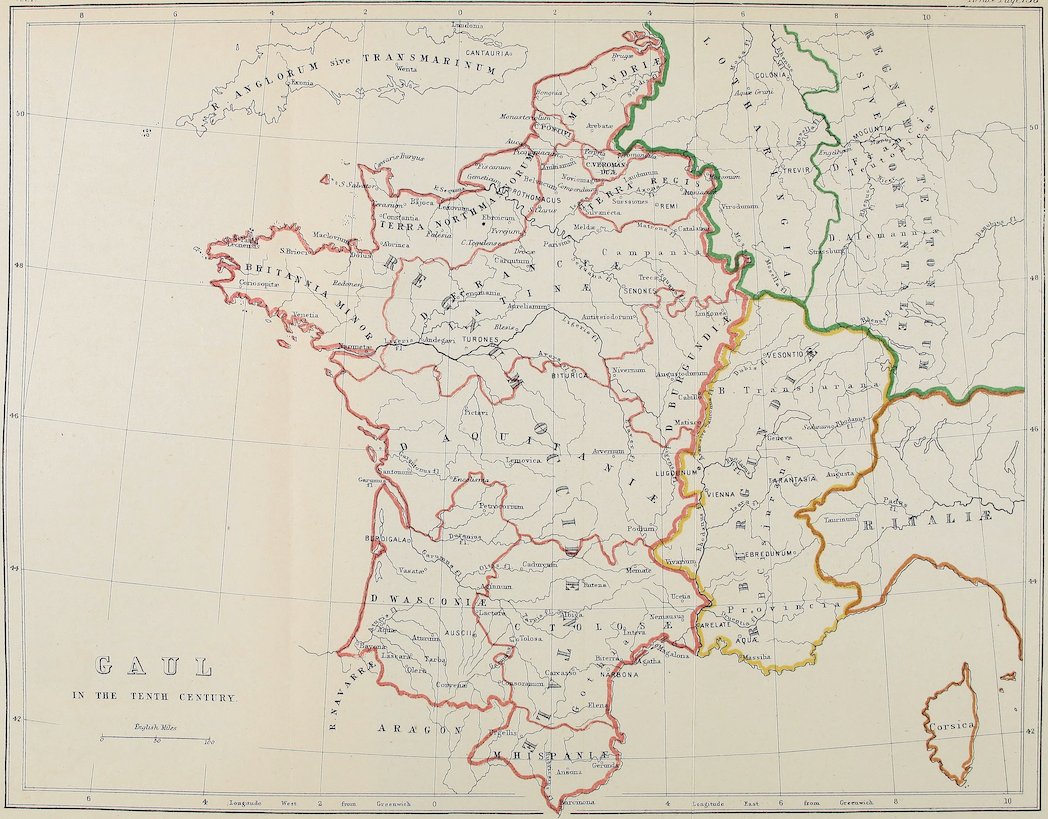
It must not be thought that the district now granted to 170|Extent of the territory granted to Rolf.| Rolf took in the whole of the later duchy of Normandy. Rouen was the heart of the new state, which took in lands on both sides of the Seine. From the Epte to the sea was its undoubted extent from the south-east to the north. But the western frontier is much less clearly defined. On the one hand, the Normans always claimed a certain not very well defined superiority over Britanny as part of the original grant. On the other hand, it is quite certain that Rolf did not obtain immediate possession of what was afterwards the noblest portion of the heritage of his |The Bessin and the Côtentin later acquisitions.| descendants. The Bessin, the district of Bayeux, was not won till several years later, and the Côtentin, the peninsula of Coutances, was not won till after the death of Rolf. The district granted to Rolf was doubtless, as in the case of Guthrum, mainly determined by the extent of his actual possessions. If, as is most likely, the Dive was the western boundary, the ceded territory answered to nothing in earlier geography, civil or ecclesiastical. It was larger than the diocese of Rouen; it was very much smaller |No geographical name for the “Terra Northmannorum.”| than the province. As a new division, it had—sharing therein the fate of Germany and France—no recognized geographical name. Its inhabitants were the Northmen, the Northmen of the Seine, the Northmen of Rouen. The land itself was, till near the end of the century, simply the Land of the Northmen,[224] a land capable of indefinite extension. So in Britain the vague description of the Denalagu supplanted the ancient names and boundaries of more than one Old-English kingdom. The title of the chief was as little fixed as the name of his dominions; he is Prince, Duke, Count, Marquess, Patrician,[225] according to the taste of each writer. In the mouths of vigorous and 171plain-spoken enemies his people are only the Pirates, and himself the leader of the Pirates, down to the end of the century.[226]
Internal government of Rolf known only from its results.
Of Rolf’s internal government, of the laws and institutions of the new state, of the details of the settlement of the country, we know absolutely nothing. Norman tradition sets Rolf before us as the mirror of princes, as the type of that class of ruler which that age most valued, the stern, speedy, impartial, minister of justice.[227] But we may judge of the reign of Rolf from its results. What Normandy became shows plainly enough that its first prince must have been a worthy forerunner of our own Cnut. Once settled in the land, he seems to have become as eager for its welfare as he had before been for its devastation. He must have promoted the general adoption, not only of the religion, but of the speech and manners of his neighbours. Otherwise Normandy could never have played the part which it did play even in the next reign, nor could his capital have become so thoroughly French as it was within a short time after his |No records of early Norman history.| death. But of the early institutions and early internal history of Normandy all records have perished, or, more probably, no records ever existed. We have no chronicles, no charters, nothing whatever to guide us but the results. |The settlement probably analogous to the Danish settlement in England.| From such indications as we have we may perhaps infer that the settlement was, on the whole, of much the same kind as the Danish settlement in England.[228] We cannot conceive any systematic extirpation or expulsion of the older inhabitants, such as accompanied the English Conquest of Britain. At the same time we can well believe that, after so many years of systematic havoc at the 172hands of the wikings, large districts may have stood almost as empty and untilled as if such systematic |Evidence from the peasant revolt. 997.| extirpation or expulsion had taken place. But it is certain that, a hundred years after the conquest, there was a peasantry at once oppressed enough and powerful enough to rise in a well-organized revolt.[229] Though in Normandy, as in England, the condition of the private settlers is likely to have gradually sunk, still we cannot believe that any descendants of the original conquerors could, in so short a time, have been brought down to such utter bondage. These peasants must have been mainly the descendants of the original Gauls, with whatever intermixture of Roman and Teutonic elements the successive conquests of the country had brought with them. |Probable position of the races in the country.| Probably the landowners, great and small, were almost universally of Scandinavian descent, while the remnant of the original population had been brought down to a state of serfdom. It is certain that there is nothing in English history at all answering to this insurrection till we come to the great revolt of the villains of the fourteenth century. This difference seems to point to a wholly different condition of the lower orders in the two countries. |Vestiges of the Danish language.| As regards the language of Normandy, the Danish tongue has utterly vanished out of the land; it had vanished out of the greater part of the land even before we reach any contemporary records; still considerable vestiges, strangely disguised as they are, may to this day be made out in the local nomenclature. In Northern Gaul, just as in Eastern England, many a place lost its name, and took a new name from its new Scandinavian lord. Here and there also we find descriptive names, meaningless in French, but which are, with a slight effort, intelligible in English.[230] These may, according to their 173geographical position, be either remnants of the Danish speech of Rolf and his followers or remnants of the speech of an earlier Teutonic settlement in part of the country of which I shall presently have to speak. Of the early political condition of the duchy we have absolutely no |Normandy not an absolute monarchy.| account. On the absence of such information one illustrious inquirer[231] has grounded a theory that Normandy had no assembly, no Parliament, no Estates of any kind, but that the Duke, Marquess, Patrician, or whatever he is to be called, ruled without any restraint on his personal will. I confess that I find it impossible to accept a theory so utterly repugnant to the analogy of every other Teutonic people. If there be any truth in Norman tradition, the followers of Rolf, as long as they stayed on ship-board, acknowledged no lord, and professed principles of the most extreme democratic equality.[232] However this may be, it is not likely that, as soon as they were settled on land, they should at once cast away those free institutions which were common to them with all the |Instances of the action of the States.| other branches of the common stock. And there is evidence enough to show that an assembly of some kind was often consulted from the very beginnings of the Norman state, and especially that the transfer of the ducal crown from one prince to another was effected with much the same forms as the same change would have called for in England.[233] At the same time I fully admit that to 174fix the exact constitution of the Norman assembly at this early time would be still harder than to fix the exact constitution of an English Witenagemót. The little light which we have may perhaps enable us to infer that it put on an aristocratic character almost from the beginning. It has also been supposed that, unlike perhaps every other assembly of the kind, it contained no ecclesiastical members;[234] but if this was the case in the earlier days of the duchy, the rule had clearly been relaxed before the reign of the great William.
Rolf’s attachment to the Carolingian party.
We must remember that we are now in the very thick of the struggle between the two dynasties of Laon and Paris. The Norman stepped in as if sent to be the fated arbiter between the two. When Rolf made his settlement, Charles the Simple was the acknowledged King of the West-Franks; from him he received his grant; with him he entered into the mutual engagements of lord and vassal. With him and his dynasty Rolf sided, and he probably saved the Carolingian crown from utter overthrow, just as a change of policy in his successors finally decided the |End of the Karlings in Germany. 912.| same controversy the other way. It must be remembered that, in the year of Rolf’s settlement, the Carolingian line came to an end in the Eastern Kingdom. The East-Frankish Duke Conrad was now raised to the Teutonic throne, and was presently followed by Henry of Saxony. But Lotharingia refused to acknowledge either of the Kings so chosen. The border land appears throughout our history as ever fluctuating between the Eastern and Western kingdoms. But Lotharingian policy was dictated by one intelligible rule, that of unswerving loyalty to the Carolingian house, wherever its representative might be 175|Lotharingia attaches itself to Charles the Simple.| found. So now Lotharingia transferred its allegiance to the single Karling who still kept the royal title, and acknowledged the King of Laon as its lord. The power of Charles was thus directly strengthened to the East, while it was indirectly strengthened by the grant to the Northmen in the West. This increase of power on the part of Charles probably led to the conspiracy which soon broke out against |Robert of Paris chosen King. 922.| him, and which issued in the election of Robert of Paris as an opposition King. In the wars which followed, Charles |Rolf sides with Charles.| rested to a great extent on the arms of the Northmen, both Rolf’s settled Northmen of the Seine and the Northmen of the Loire, the followers of Ragnald, who had not |Robert killed at Soissons. 923.| yet won so distinct a local habitation.[235] When Robert was killed at Soissons, his son Hugh the Great refused the crown for himself. He was known as Duke of the French, |Rudolf of Burgundy chosen.| and, satisfied with that title, he bestowed the kingly name on his brother-in-law Rudolf, Duke of French Burgundy.[236] |Imprisonment of Charles at Peronne. 923.| Charles was afterwards treacherously seized and imprisoned by Rudolf’s fellow-conspirator Herbert Count of Vermandois, in the same fortress in which in after days a King |1468.| of France was imprisoned by a Duke of Burgundy.[237] Rolf’s 176combined policy and loyalty led him to refuse all allegiance |War between Normandy and France. 923–927.| to the usurpers. A war of several years followed between him and the French of Paris under Duke Hugh. The horrors of warfare were not felt on one side only. The Norman land was twice invaded, and Rolf’s fortress of Eu, its chief defence on its north-eastern border, was taken by storm.[238] But these incursions were more than repaid in kind; a large Danegeld was more than once paid to Rolf, and was levied throughout France and Burgundy,[239] and the |Acquisition of Maine and Bayeux. 924.| general results of the war left Rolf in possession of a most important increase of territory. He obtained the district of Bayeux; he obtained also a more fully recognized superiority over Britanny, and it is also distinctly asserted that |Abdication [927?] and death [932?] of Rolf.| he obtained a grant of the land of Maine.[240] Rolf did not long survive these successes; the year of his death is uncertain; but it seems most likely that, by the consent—perhaps at the demand—of the estates of his principality, he resigned |William Longsword succeeds, and does homage to Charles. 927.| the government in favour of his son William, surnamed Longsword.[241] A change in the policy of Herbert of Vermandois had restored Charles to freedom and to some nominal measure of authority. The new prince of the Northmen therefore paid to the true Carolingian King 177the homage which his father had paid before him, but which he had steadily refused to the Parisian and Burgundian pretenders.
Value of Rolf’s last acquisition.
The acquisition of the territory which this last war added to the dominions of Rolf was inferior in importance only to the original acquisition of Rouen. And it is only on the ground of its being the original acquisition, the beginning and starting-point of the whole settlement, that the possession of Rouen itself can be looked on as more important than the possession of the noble region which |Maine.| was now added to the Land of the Northmen. Maine indeed was the most precarious of all possessions. The struggles for its retention and recovery, the adventures of its gallant Counts and of its no less gallant citizens, form no small part of the later history of the Norman |The Bessin.| duchy. But the acquisition of Bayeux and its territory gave Normandy all that created and preserved the genuine and Norman character; it gave her the cities which are adorned with the noblest works of the days of her independence; it gave her the spot which was to be the earliest home of her mightiest son. Caen, around whose castle and whose abbeys so much of Norman and French history was to centre—Bayeux itself, the see of the mighty Odo, where the tale of the Conquest of England still lives in the pictured history which forms its most authentic record—Cerisy, with its stern and solemn minster, the characteristic work of the Conqueror’s father—Falaise, immortal as the birthplace of the Conqueror himself—all these historic spots lie within the region which the last warfare of the reclaimed wiking had added to the Norman land. |The Saxon colony at Bayeux;| Bayeux itself is a city whose history has an especial claim on the attention of Englishmen. Nowhere, out of the Old-Saxon and Frisian lands, can we find another district of continental Europe which is so truly a brother-land of our own. The district of Bayeux, occupied by a Saxon 178colony in the latest days of the old Roman Empire,[242] occupied again by a Scandinavian colony as the result of its conquest by Rolf, has retained to this day a character which distinguishes it from every other Romance-speaking |its lasting influence on the district.| portion of the continent. The Saxons of Bayeux kept their name and their distinct being under the Frankish dominion;[243] we can hardly doubt that the Scandinavian settlers found some parts at least of the district still Teutonic, and that nearness of blood and speech exercised over them the same influence which the same causes exercised over the Scandinavian settlers in England. Danes and Saxons were welded together into one Teutonic people, and they kept their Teutonic language and character long after Rouen had become, in speech at least, no less French than Paris. With their old Teutonic speech, the second body of settlers seem to have largely kept their old Teutonic faith. We shall presently find Bayeux the centre of a heathen and Danish party in the duchy, in opposition to Rouen, the centre of the new speech and the new creed. The blood of the inhabitants of the Bessin must be composed of nearly the same elements, mingled in nearly the same proportions, as the blood of the inhabitants of the Danish districts of England.[244] To this day there is no Romance-speaking region of the continent in which an Englishman feels himself so thoroughly at home as in this 179old Saxon and Danish land. In every part of Normandy, as compared with France or Aquitaine,[245] the Englishman feels himself at home; but in the district of Bayeux he seems hardly to have left his own island. The kindred speech indeed is gone; but everything else remains. The land is decidedly not French; men, beasts, everything, are distinctively of a grander and better type than their fellows in the mere French districts; the general aspect of the land, its fields, its hedges, all have an English look. And no contrast can be greater than that which may be often seen between the tall, vigorous, English-looking, Norman yeoman, out of whose mouth we instinctively feel that the common mother-tongue ought to come, and the French soldier, whose stature, whose colour, whose every feature, proclaims him to be a man of another race, and whose presence proclaims no less unmistakeably that the glory of Normandy has passed away.
§ 3. Reign of William Longsword. 927–943.
Rolf, the converted pirate, died, according to his Norman |Religion of Rolf.| admirers, in the odour of sanctity.[246] According to the wild reports of his enemies, he mingled the two religions, and, while making gifts to the Christian churches, offered Christian captives in sacrifice to his Scandinavian idols. Such a strange confusion is possible at some earlier stage of his career; but we need much better evidence than we have to convince us that he was guilty of any such doings just before his death.[247] But, whatever traces of heathendom 180may have cloven to Rolf himself, it is certain that his son |Birth and education of William Longsword.| William Longsword, half a Frenchman by birth, was almost wholly a Frenchman in feeling. His mother was French; but he did not spring from the union of the converted Northman with the royal blood of the West-Franks. Gisla bore no children to her already aged husband, and William was the son of a consort who both preceded and followed her in his affections. She was known as Popa, whether that designation was really a baptismal name or, as some hint, a mere name of endearment. She was the daughter of a certain Count Berengar, and was carried off as a captive by Rolf when he took Bayeux in his pirate days.[248] Her brother, Bernard Count of Senlis, plays an important part in the reigns of his nephew and great-nephew. Popa and her son seem to have stood in a doubtful position which they share with more than one |Norman and Frankish laxity as to marriage.| other Norman Duke and his mother. Rolf and Popa were most likely married, as the phrase was, “Danish fashion,”[249] which, in the eyes of the Church, was the same as not being married at all. A woman in such a position might, almost at pleasure, be called either wife or concubine, and might be treated as either the one or the other. Her children might, as happened to be convenient, be either branded as bastards or held entitled to every right of legitimate birth. Rolf put away Popa when he married King Charles’s 181daughter, and when King Charles’s daughter died, he took Popa back again.[250] So William, Popa’s son, put away Sprota, the mother of his son Richard, when he married Liudgardis of Vermandois.[251] This strange laxity with regard to marriage, though spoken of as something specially Danish, was in truth hardly more Danish than Frankish. The private history of the Frankish Kings, Merwings and Karlings alike, is one long record of the strangest conjugal relations. Ordinary concubinage is not amazing anywhere; what stands out specially conspicuous in the history of these Kings—nowhere more conspicuous than in the history of the great Charles—is the liberty which they assumed of divorcing their Queens at pleasure, and sometimes of having several acknowledged Queens at once. |William Longsword French rather than Danish.| William, born of a doubtful union of this kind, was far more French than Danish in feeling. His tutor was Botho, a Danish companion of Rolf, but one who threw himself thoroughly into the French and Christian interest. Such an education made William familiar with the language and feelings of both classes of his subjects; but his own sympathies lay with the speech, as well as with the creed, of his mother; he was more at home in Romanized Rouen than in Teutonic Bayeux. In the existing state of things, divided as the duchy was between the Danish or heathen and the French or Christian party, the personal sympathies of the prince were of the highest importance, and there can be no doubt that the French feelings and Christian convictions of William had a most decisive effect on the history of the Norman state.[252]
182The first great event in the internal history of the duchy |Breton revolt. 931.| during the reign of William is a general revolt of its Breton dependencies. This event was probably not unconnected with the general course of affairs in Gaul. At William’s accession, two Kings, Charles the Simple and Rudolf of Burgundy, disputed the crown of the West-Franks. William, as we have seen, became the vassal of |William’s attachment to the cause of Charles. His peace with Hugh and Herbert. 928.| Charles, and refused all submission to Rudolf. Even in finally making peace with his great French neighbours, Hugh of Paris and Herbert of Vermandois, William made it a condition that Herbert should do homage to Charles as he himself had done. Herbert, it should be remembered, was himself of Carolingian descent, and might have further designs of his own. It was only on these terms that William restored Herbert’s son, who had been given to his father Rolf as a hostage.[253] Charles remained for some while a puppet in the hands of Herbert, brought forth as a sovereign or confined as a prisoner, as suited the ever-shifting |Death of Charles the Simple. 929.| relations of Herbert, Hugh, and Rudolf. At last the unhappy descendant and namesake of the great Emperor died in bonds at Peronne, whether actually murdered by Herbert, or simply worn out by sorrow and captivity, it matters little.[254] Rudolf was now the only acknowledged King, and he soon showed himself to be, in one respect at least, fully worthy of his crown. The independent and unsettled Northmen of the Loire had committed |King Rudolf defeats the Northmen of the Loire at Limoges. 930.| great devastations in Aquitaine. King Rudolf overcame them in a great battle at Limoges, where he utterly broke their power, and procured the acknowledgement of his own supremacy over Aquitaine.[255] It was probably this 183great defeat of one Norman army by a King to whom no |The Bretons rise.| Norman had hitherto done homage which encouraged the Bretons to make an attempt to throw off the Norman yoke altogether. That yoke was of a twofold kind; there was the more regular and endurable supremacy of the Norman Duke at Rouen, and there was also the constant annoyance of small bands or colonies of independent adventurers within their frontiers or upon their borders. Under their princes, |Massacre of the Normans, Michaelmas 931.| Juhel Berengar and Alan, the Bretons rose; they made a massacre of the Normans in their own country, which may have given a precedent for the later massacre of the Danes in England.[256] The feast of Saint Michael in the one case was what the feast of Saint Brice was in the other. |The Bretons attack Bayeux.| Flushed with success, they entered the Norman duchy, and attacked Rolf’s latest and most precious acquisition, Teutonic Bayeux.[257] Alike under Saxon and under Norman occupation, the Teutonic colony was a thorn in the side of the Celts, which they were always eager to get rid of. |The revolt crushed.| But William completely crushed the revolt, and its only result was to bring all Britanny more completely under Norman control, and to extend the immediate boundaries |Normandy gains the Côtentin peninsula.| of his duchy. The districts of Avranches and Coutances, with the noble peninsula to which the latter city gives its name, were now added to the immediate Norman dominion.[258]
High position of England under Æthelstan.
At this point comes the first of many signs which we shall meet with in the course of our story, all of which show the high position which England held at this time, 184and the important influence exercised on foreign politics by the renowned prince who now filled the West-Saxon throne. In this, as in every other respect, all depended on the personal character of the King. It was now exactly as it was ages later. England under Æthelstan differed from England under Æthelred, just as England under Elizabeth or Cromwell differed from England under the first or the second pair of Stewarts. Through the whole of this period, the King of the English, the common friend and kinsman of most of the contending princes, appears as a dignified mediator among them. Through the marriages of his sisters, some contracted before, some after his election to the crown, Æthelstan was the brother-in-law of most of the chief princes of Western Europe. |His connexion with most of the Western Princes.| He stood in this relation to King Otto, to King Charles, to King Lewis of Arles, to Duke Hugh of Paris, and to a nameless prince near the Alps.[259] On the imprisonment |Eadgifu and Lewis take refuge in England.| of Charles, his Queen Eadgifu,[260] with her young son Lewis, had taken refuge in England,[261] and the future King of the West-Franks was now learning lessons of war and statesmanship at the hands of his glorious uncle. So |Alan of Britanny does the like.| now, on the extinction of the Breton insurrection, while Berenger submitted to the Normans, Alan took shelter 185with Æthelstan,[262] as his father before him is said to have taken shelter with Eadward. England might in either case seem a strange place of refuge for a banished Armorican prince and his following. The descendants of those who had originally fled before the English conquerors now sought for safety in the very land from which their forefathers had been driven. And at this particular moment such a refuge might seem stranger than ever. The Breton exiles sought shelter in England at the hands of the very King by whom the last footsteps of Celtic independence in Southern Britain were trampled out. Æthelstan and William of Rouen might well seem to be carrying out |Relations of England with Normandy less friendly than with the other states.| the same work on opposite sides of the sea. But a nearer tie of common hostility might well at that moment unite the Breton and the Englishman. Each was engaged in a struggle with Scandinavian intruders in his own land. Between the Danes in England and the Danes in Normandy communications never wholly ceased, and, long after this time, we shall find the connexion between Denmark and Normandy directly affecting the course of English events. The Normans and their Duke seem always to have been on less intimate terms with England than most of the neighbouring states; William stands almost alone among princes of equal rank in not being honoured with the hand of a sister of glorious Æthelstan. The Norman historian even puts forth a claim on the part of his Duke to a dominion over England,[263] which is 186among the most ridiculous outpourings of his lying vanity. Still such a boast speaks something as to the feelings which existed between the Danes in Gaul and the great destroyer of the Danish power in Britain. With Æthelstan then, the common champion of Christian and civilized Europe, at the court which was the common shelter of the oppressed, the common school of every princely virtue, did the Breton prince, fleeing from his conqueror, |Restoration of Alan. 936.| seek the safest and the most honourable refuge. At a later date, when the influence of Æthelstan on the affairs of Gaul was specially great, Alan and his companions were allowed to return.[264] He received a large part of Britanny as a vassal of the Norman Duke; he appears to have remained steady in his allegiance, and he is henceforth constantly mentioned among the chief peers of the Norman |His struggles with the Northmen of the Loire.| state.[265] But he could win back the actual possession of his dominions only by hard fighting against the independent Normans of the Loire. These pirates, even after Rudolf’s victory at Limoges, held many points of the country, and they were hardly more inclined to submit to the Norman Duke at Rouen than to the Breton Count at Vannes.[266] Alan restored the ruined city of Nantes, and 187did much for his recovered dominions in various ways. The relations between Normandy and Britanny were now definitely settled, as far as anything could ever be said to be settled in that age. The boundary between the dominions of the vassal and his lord was fixed by the Norman acquisition |The Côtentin becomes thoroughly Norman.| of the Côtentin and Avranchin. These lands, the last won part of Normandy, form one of the districts which became most thoroughly Norman. They stood open for Norman colonization; and we shall presently see that colonization was allowed, perhaps invited, not only from the settled parts of Normandy, but even directly from the heathen North itself.
Along with the peninsula of Coutances the Norman Dukes obtained a possession which was afterwards to form a bond of connexion of a singular kind between Normandy and England.[267] In comparing the extent of the West-Frankish kingdom at this age with that of modern France in our own day,[268] while mentioning many |Normandy acquires the Channel Islands.| points in which the French frontier has advanced, I had to mention three points where it has fallen back. The extent of the land whose princes acknowledged a nominal superior in the West-Frankish King took in Flanders, Barcelona, and the Channel Islands. Those islands, a natural appendage to the Constantine peninsula, now became Norman. When continental Normandy was lost by John, the insular part of the duchy was still retained, and it has ever since remained a possession of the English crown. As long as the English Kings kept the title either 188of Duke of Normandy or of King of France, here was a portion of the duchy or of the kingdom whose actual possession might be said to make good their claim to the rest. This insular Normandy remains to this day French in speech, but deeply attached, and with good reason, to the |Peculiar relation of the islands to England.| English connexion. The islands form distinct commonwealths, dependent on the British crown, but not incorporated with the United Kingdom. This condition of a dependency is perhaps that which best suits a community which has a distinct existence of its own, but which could not possibly maintain its independence as a distinct and sovereign state. Keeping their ancient constitutions, and enjoying the protection of the power of England, the Norman islands unite the safety of a great kingdom with the local independence of a small commonwealth. How much they would lose by becoming a French department I need not stop to point out. But they would also lose, not nearly so much, but still not a little, by becoming an English county. The right of sending one or two members to the British Parliament, where, among so many greater interests, their voice could hardly be heard, would be a poor exchange for their present legislative independence. Parliament can indeed, on any emergency which may call for its interference, legislate for the Norman islands. But it must legislate specially for them, after special consideration of the circumstances of the case. The islands cannot find themselves unexpectedly bound by some piece of general legislation, passed without their knowledge and possibly contrary to their interests. Thus the dependent condition of the islands secures a greater consideration of their interests than they could receive if they formed an integral portion of the kingdom. We occasionally hear of internal abuses in the Channel Islands which are held to need the intervention of Parliament, but we never hear of external grievances laid to the charge 189of Parliament itself. The Norman islands seem to be far |Comparison with Orkney.| more contented as dependencies than those Norwegian islands which, having been formed into a Scottish county, have become an integral part of the United Kingdom. The ancient earldom of Orkney, represented in Parliament by a single member, has its wrongs, or at least its grievances; of the wrongs or grievances of Jersey or Guernsey no one ever heard. And this singular and beneficial relation in which these interesting little communities stand at this day to the English crown is connected by a direct chain of cause and effect with the revolt of the Bretons against Norman supremacy nine hundred and forty years ago.
William, thus become the conqueror of the Bretons, ruled for the present as a French prince. As such, his French speech, French connexions, and French religion, caused him to be hated and dreaded by a large portion of his subjects. A strong Danish and heathen party still survived within the older limits of the duchy, and the newly won lands probably contained some of those independent Danish settlements by which Britanny in general was so |Revolt of the Danish party in Normandy, 932.| infested. Out of these two elements a Danish and heathen revolt was organized. Its leader was Riulf, seemingly an independent Danish chief settled in the Constantine |Legendary details of the revolt and its suppression.| peninsula. The story, as we have it,[269] reads like a romance. The rebels rise in arms; they demand one concession after another; the panic-stricken Duke is ready to yield everything; he even proposes to resign his duchy and to flee to his French uncle at Senlis. But he is recalled to a better mind by his veteran counsellor, the Danish-born Bernard. He then wins an almost miraculous victory over the rebels, and, for the time at least, crushes all signs of revolt. These details cannot be accepted as historical; but one or two points in the story are instructive. The rebels are made to demand the cession of all the country 190west of the river Risle. The land which would have been left to the Duke after such a cession nearly answers to the original grant to Rolf, excluding the later acquisitions of |Geographical character of the two parties.| Bayeux and Coutances. This demand, like everything else in the history, shows how thoroughly the Norman parties were geographical parties. The Christian and French-speaking Duke might keep Christian and French-speaking Rouen and Evreux; but the heathen and Danish land to the west must be independent of a prince who had cast |Christianity and French manners supported by a party among the native Danes.| away the creed and speech of his forefathers. On the other hand, we see that there were men of Danish birth, old companions of Rolf, men who retained a strong national feeling, who still distinctly threw in their lot with the French party. They wished Normandy to remain an united and independent state; they had not the slightest wish to merge Normandy in France in any political sense; but they wished the Norman duchy to be a member of the general French commonwealth, French in religion, language, and civilization. Such a man was Botho, the old tutor of William and afterwards tutor to William’s son; such were Oslac, bearing a name famous in our own Northumbrian history, and Bernard the Dane, who plays an important part in Norman affairs for many years to |William’s French and Christian government.| come. Through the overthrow of the rebellion this party was now dominant, and William reigned as a Christian prince, as a French prince, aiming at an influence in French affairs proportioned to the extent of his dominion on Gaulish soil. Through his whole life he was subject to strong religious impulses, and, according to a legend which may well contain some groundwork of truth, he was with difficulty hindered from becoming a monk in his own foundation of Jumièges.[270] Yet he was by no means lavish 191in grants to the Church, and the ecclesiastical foundations, which had suffered so cruelly during the Scandinavian incursions, still remained weak and impoverished, and, in many cases, altogether desolate. His general government is described as just and vigorous, and he seems to have |He does not wholly break with the Danish element.| deservedly won the general love of his subjects. And it is certain that, though he laboured to bring his dominions within the pale of Christian and French civilization, he did not wholly cast away the national speech and national feelings of his fathers. It is not unlikely that his policy towards the Danish element in the duchy varied at different periods of his reign. He may have found that the transformation of a nation must needs be a work of time, that too much haste might hinder the object which he had at heart, that a certain measure of toleration, in language, in manners, and even in religion, might be needful in order to bring about a final change in |Towards the end of his reign he makes further advances to the Danes.| any of those points. In his later days he may even have gone further than this. After all his efforts to identify himself with the French, and to act as a French prince among other French princes, he still found himself scorned and hated, still looked on as Duke only of the Pirates. Under the influence of such feelings, he may to some extent have thrown himself into the hands of the Danish party. According to a story which cannot be received as it stands, but which probably contains some germs of truth, he admitted a fresh Danish colony, direct from Denmark, into the newly-acquired peninsula of Coutances.[271] 192It is certain that he entrusted his son Richard to the care, not of any French clerk or Bishop, but to his own old |Danish education of his son Richard.| tutor, the Danish-born Botho. The boy was purposely taken to Bayeux, the Teutonic city which Botho himself, in his pirate days, had helped to harry. He was sent thither expressly to become familiar with the ancestral tongue, which was already forgotten at Rouen,[272] but which was still spoken by the mixed Saxon and Danish population of the Bessin. The boy was to be brought up in a Danish city, but by a native Dane who had accepted Christianity and French manners. We may be sure that no religious apostasy was dreamed of; but William now saw that the sovereign of Normandy must be neither pure Dane nor pure Frenchman, but, as far as might be, Dane and Frenchman at once.
Part played by William Longsword in general history.
For the purposes of the present sketch, the internal developement of the Norman duchy, the distinction between its Danish and its French elements, its relations to its Celtic neighbours and vassals, are points of more importance than the part played by its second Duke in the general politics of Gaul. Yet the history of Normandy would be hardly intelligible without some understanding of the general position of the duchy as one of the great |Utter confusion of this period.| fiefs of the West-Frankish crown. The reign of William Longsword forms the most confused part even of the confused Gaulish history of the tenth century. It is a period utterly without principles, almost without definite parties; even the strife between Laon and Paris, between the Karling and the house of Robert, between the Frank and the Frenchman, is in a manner lulled as long as Rudolf of Burgundy fills the Western throne. Every vassal of the Western crown sought little beyond his own gain and aggrandizement, and all of them freely 193changed sides as often as it suited their interest so to do. And William himself added as much to the confusion as any man, by changing sides perhaps oftener |Comparison between William and the French Princes.| than anybody else. And hardly any practical difference was made by the fact that William seems to have been several degrees less selfish and unprincipled than his neighbours. He was evidently a creature of impulse, and his impulses, if they often led him astray, often led him to righteous and generous actions. Though we cannot set him down, with his panegyrist, as a saint and a martyr, we can at least see in him far nobler qualities than any that can be seen in the contemporary princes of Vermandois, of Flanders, or even of ducal France. Still the practical difference was slight. William was doubtless morally a better man than his neighbours; but politically he was as untrustworthy as the worst of them. His plighted faith went for as little as the plighted faith of a deliberate perjurer. Impulse led him to one course one day, and impulse led him to an opposite course the next day. He probably never was intentionally treacherous, but he did as many of what were in effect treacherous actions as the basest traitor among them all.
Condition of Gaul.
Northern Gaul was at this time divided in very unequal proportions between the King and several vassal princes more powerful than himself. Of Southern Gaul |Practical independence of Aquitaine.| it is hardly needful to speak; of Aquitaine we hear just enough to show that the lands north and south of the Loire were aware of each other’s existence, and that a nominal connexion was held to exist between them. The Aquitanian princes now and then stooped to pay a nominal homage to the King of the West-Franks; otherwise the South moved in a world of its own, a world which was very slightly touched by the revolutions of Laon, Rouen, or Paris. It must always be remembered that the royal city was Laon, a city close upon the Lotharingian frontier, 194in a district where the Teutonic speech still lingered.[273] |The King’s domain.| The royal domain took in only Laon, Compiègne, and a small territory about those towns. Through the election of Rudolf, ducal Burgundy was brought into a temporary connexion with the crown, but that connexion lasted no longer than the reign of Rudolf himself. To |Lotharingia; explanation of its continual revolutions.| the east and north-east of the royal dominions lay Lotharingia, the border land, ever fluctuating in its allegiance between the Eastern and Western kingdoms. But all its fluctuations follow one unvarying principle, namely that its inhabitants preferred the rule of a Karling to that of any one else, but that, when no Karling was to be had, they preferred the rule of a |Germany.| German to that of a Frenchman. Beyond Lotharingia lay the Eastern Francia, the Teutonic Kingdom, now rapidly rising into greatness under the vigorous Kings |The Saxon Kings.| of the Saxon house. Deeming themselves the true successors of Charles, speaking his tongue and crowned in his royal city, the Saxon Kings already aspired to reunite the scattered fragments of his Empire. Within the Western |Arnulf of Flanders.| Kingdom we find three chief princes, Arnulf of Flanders, Herbert of Vermandois, and Hugh of Paris. The Flanders of those days, it should be remembered, reached far to the south of any border which Flanders has had for some centuries past. Calais, Boulogne, and Arras were all Flemish, and in those days Flemish still meant Low-Dutch. Ponthieu was a frontier district, with a Count of its own, whose homage was disputed between Flanders and Normandy. Of the present sovereign of Flanders it is enough to say that his actions show him to have been |Herbert of Vermandois.| capable of any crime. To the south of Flanders lay Vermandois, governed by the faithless, unprincipled Herbert, himself of Carolingian descent, but the greatest of all 195sinners against Carolingian royalty; the gaoler, most likely the murderer, of Charles the Simple. His one object was to extend by any means his comparatively narrow territories. More powerful than any other Western prince, far more powerful than his nominal King, was the lord of the Western Francia, the Duke of the French, |The Duchy of France.| Hugh the Great of Paris. His dominions took in the greater part of central Gaul north of the Loire, but, since the establishment of the Norman duchy, they nowhere |Ducal Burgundy.| reached to the sea. Ducal Burgundy need hardly be mentioned; on the death of Rudolf, Duke and King, the duchy was split into several parts, a large share |Archbishopric of Rheims.| falling to the lot of Hugh himself. Along with these temporal principalities we might almost reckon the metropolitan see of Rheims, whose Primate, alone among Western bishops, made some faint approach to the position of the princely prelates of Germany. This great and wealthy church constantly formed an apple of discord among the temporal powers which surrounded it. The rival princes were always striving, sometimes to thrust their nominees into the archbishopric, sometimes to appropriate to themselves the estates of the see. A large share of the history of the times is taken up with disputes about the succession to the archbishopric, which sometimes take the form of ecclesiastical synods, sometimes that of temporal campaigns and sieges. In the end the temporal importance of the see was greatly lessened through the loss of several of its most valuable possessions, |Hugh the Great.| among them the famous lordship of Coucy. Among all these princes Hugh of France stands out the foremost, alike from the extent of his dominions and from the peculiarity of his personal position. The nephew of King Odo, the son of King Robert, the father of King Hugh, the brother-in-law of King Rudolf, King Æthelstan, and King Otto himself, the Duke of the French never would 196be himself a King. He had no scruple against making |His Policy.| war on the King, none against robbing him of his dominions, none against assuming a complete control over his actions and even keeping him in personal bondage. He had no scruple even against transferring his allegiance from one King to another, against becoming a vassal of the Eastern instead of the Western crown. But if he went thus far, he would go no further; he would always have a King over him, if only to show how much greater he was than any King; but a King he himself never would be. Three times at least he might easily have mounted the throne; but he always declined the glittering bauble that lay within his grasp. In all this there seems something like a guiding principle; and even in other respects, faithless and ambitious as Hugh was, he was distinctly better than some of his fellows. It is some slight comfort to find that a man who was honoured with the hand of a sister of Æthelstan was at least not stained with any such frightful crimes as those which have handed down the names of Arnulf and Herbert to everlasting shame.[274]
William’s relation to the Kingdom, (927); his fidelity to Charles.
When William succeeded his father, Normandy was at war with France; that is, it was at war with Herbert of Vermandois and Hugh of Paris, and with Rudolf of Burgundy, their King of the West-Franks. But Rolf, and after him William, acknowledged no King but the imprisoned Charles. From him Rolf had received his lands; to him Rolf had done homage; to him William repeated that homage on the earliest opportunity, and he never did homage to Rudolf till the death of Charles left the Burgundian Duke without a competitor for the |926–928.| kingly title. Peace was made and peace was again confirmed, without any acknowledgement of the usurper’s 197claim. It was not till three years later, when Charles |After Charles’s death William does homage to Rudolf. 933.| was dead, and when Rudolf, by his victory at Limoges, had shown himself worthy to reign, that William, seemingly of his own act and deed and without any special circumstances calling for such a course, did homage to Rudolf,[275] and received from him a grant of the maritime Britanny. |Rudolf’s grant of Britanny.| This grant most likely carried with it both a general confirmation of the superiority of Normandy over Britanny and a special confirmation of the transfer of Avranches and Coutances to the immediate dominion of the Norman Duke. Meanwhile Hugh and Herbert were running their usual course; it is hardly the duty of an English, or even of a Norman, historian to reckon up the number of times that they transferred their allegiance from Charles to |Herbert does homage to Henry. 931.| Rudolf and from Rudolf to Charles. It is of more importance to mark that Herbert, at a moment when Rudolf and Hugh were both at war with him, did not scruple to transfer his allegiance to the Eastern King |Rudolf dies. 936.| Henry.[276] At last Rudolf died, and now a most important change took place. It might not be very clear what was the use of a King, if his vassals, several of them more powerful than himself, might rebel against him and make war on him at pleasure. Still, though all the princes were agreed in allowing to the King the smallest possible amount of territory and power, none of the princes was |Diet of election for the new King.| prepared to do without a King altogether. A Diet of election was held, of which some most remarkable details are preserved.[277] The prime mover in the whole matter was Hugh the Great. He might himself have become a 198candidate; all central and southern Gaul, his own duchy |Central and Southern Gaul favours Hugh; the Eastern part favours Lewis.| and the lands beyond the Loire, sought to confer the crown upon him. But the Eastern part of the kingdom, where there still lingered some traces of Teutonic blood and speech, some feelings of reverence for the blood of the great Emperor, favoured the election of Lewis the son of Charles, who was now living under the protection of his |Hugh declines the crown and procures the election of Lewis.| English uncle. Hugh, according to his invariable policy, declined the crown for himself. He already enjoyed the reality of kingship, and he shrank with a superstitious dread from a title which had brought little gain to his uncle and his brother-in-law and still less to his own father. It was on the motion of the Duke of the French that the assembly agreed to elect Lewis as King of the |Embassy to Æthelstan. 936.| West-Franks, and to send an embassy to Æthelstan to ask for the restoration of his nephew to the throne of his fathers. The embassy passed over into England, and found the King at York.[278] It was the year before Brunanburh, when the presence of Æthelstan was doubtless specially called for in his northern dominions. The ambassadors spoke in the name of Duke Hugh and of all the chief men of the Gauls, and prayed for Lewis to be their |Negotiations between Æthelstan and Hugh.| King. Æthelstan, somewhat doubtful of their good faith,[279] demanded oaths and proposed a further conference. The King of the English hastened to the coast of Kent, and the Duke of the French to the coast of Flanders, not far from Boulogne. Fire signals were exchanged on each side, the materials being found in the wooden houses which 199lined the shores.[280] Let us hope that, whatever Hugh or Arnulf may have done, Æthelstan at least made good the loss to his subjects. Several English Bishops and Thegns passed over, having at their head Oda, Bishop of the Wilsætas or of Ramsbury, afterwards the famous Primate.[281] Before Æthelstan would trust his nephew across the sea, he demanded satisfactory oaths from the assembled princes; otherwise he would give Lewis one of his own kingdoms, where he might reign safely and prosperously.[282] This was no empty boast; the Emperor of Britain had kingdoms to bestow, lower indeed in rank, but safer and more powerful, than the nominal royalty of Laon. The princes of Gaul swore as they were bidden; but it was agreed that the Duke of the French should be the chief adviser, or rather the protector and guardian, of the new King.[283] Lewis crossed the sea; he landed in the realm which was now his, he sprang on his horse,[284] and rode on amid the cheers of |Lewis crowned King. 936.| his new subjects. He went to his royal city of Laon, where he was consecrated King by Artald Archbishop of Rheims; he then went with his guardian on an expedition into Burgundy, more to his guardian’s profit than to his own.[285] He then visited his powerful vassal at Paris; but 200in the next year, safe on the rock of Laon, he threw off |He declares his independence of Hugh. 937.| the yoke; he declared his independence of Duke Hugh, and sent for his mother Eadgifu, seemingly to take Hugh’s place as his chief counsellor.[286]
Character of King Lewis; his vigorous and active reign.
The reign of Lewis—Lewis from beyond Sea—is of itself enough to confute the common mistake of believing that the line of Charles the Great ended in a race of imbecile fainéants, like those whom Pippin had set aside.[287] Lewis may be called ambitious, turbulent, and perfidious, but no man was ever less of a fainéant. His life was in truth one of preternatural activity. Early adversity, combined with an education at the hands of glorious Æthelstan, had brought out some very vigorous qualities in his young nephew. If Lewis was ambitious, turbulent, and perfidious, he was but paying off Hugh of Paris and William of Rouen in their own coin. In truth no two positions can well be more unlike one another than the position of |Contrast between the late Karlings and the late Merwings.| the later Karlings and that of the later Merwings. The Duke of the French might now and then put on something of the guise of a Mayor of the Palace, but Pippin and Hugh had very different masters to deal with. The nominal ruler of a vast realm, led about as an occasional pageant and leaving the government of his dominions to an all-powerful minister, is the exact opposite to a King whose domains have shrunk up to the territory of a single city, and who has to spend his life in hard blows to keep that last remnant of his heritage from the ambition of vassals whose territories are far wider than his own. Lewis had to strive in turn against France, 201Normandy, and Vermandois, and now and then he was able to give each of them nearly as good as they brought. And, small as was the extent of the King’s actual domains, there was still an abiding reverence for the royal name, which breathes in every page of the chroniclers, and which was not without influence even on the minds of the men who fought against him. Still Lewis had constantly to fight for the small remnant of dominion which was left to him. The restless Herbert had to be |938.| driven from a fortress built on the very slope of the King’s |939.| own rock of Laon.[288] The next year we find both William and Hugh in arms against the King in a quarrel arising out of the border disputes of Normandy and Flanders.[289] William was at war with Arnulf, the quarrel between these two great potentates being, if not caused in the first |Affairs of Montreuil. 939.| instance, at any rate aggravated by their differences as to the affairs of a smaller neighbour. This was Herlwin, Count of Montreuil or Ponthieu, whose dominions lay between Normandy and Flanders. Properly he seems to have been a vassal of the Duke of the French,[290] but when his dominions were seized by Arnulf, he got no help from Hugh, while he got very effective help from William. |Montreuil taken by Arnulf and recovered by Herlwin.| By the aid of a Norman force, headed, according to one account, by the Norman Duke himself, Montreuil was recovered, and Herlwin reinstated.[291] But greater powers than any of these were soon to come on the stage. One of them indeed figures in a rather unlooked-for way in the story of Herlwin. When Montreuil was taken by Arnulf, 202|Herlwin’s wife and children sent to Æthelstan.| the wife and children of the dispossessed Count were sent, of all the people in the world, to King Æthelstan in England. That they should have taken refuge at his court would have been only the natural course of things; but it sounds strange at first that the prisoners should be sent to the King of the English, if not actually as captives in bonds, yet at least as persons over whom some degree of watch was to be kept.[292] The explanation is most likely to be found in the close alliance between Æthelstan and Lewis, possibly also in the kindred between Æthelstan and Arnulf, who was, like Æthelstan, a grandson of Ælfred. Just now Arnulf was the friend, and William |William excommunicated. 939.| the enemy, of Lewis, and William was actually excommunicated by the Bishops in the King’s interest for his harryings of the Flemish territory. That a similar fate fell on Herbert for his aggressions on the lands of the archbishopric of Rheims is less wonderful.[293] Æthelstan soon afterwards again appears as the ally of his nephew, even when ties equally strong might have drawn him towards |Otto the Great, King of the East-Franks. 936.| his nephew’s enemies. King Henry of Germany was now dead, and his son, the great Otto, the brother-in-law of Æthelstan, had succeeded to the throne of the Eastern Franks in the same year in which their common nephew had succeeded to the royalty of the West. After some opposition at the hands of his own brothers, the future restorer of the Empire had received the Frankish diadem in the great Emperor’s minster at Aachen. But the men of border Lotharingia refused to acknowledge another Saxon; there was now again a Karling who was a crowned King; none but that Karling could be their lawful sovereign; 203the Saxon Duke had been chosen King of Saxony only, because a chief was needed to defend the land against the Slaves, and because the true Carolingian King was at that |The Lotharingians transfer their allegiance from Otto to Lewis. 939.| moment disqualified.[294] The Lotharingians therefore transferred their allegiance from Otto to Lewis. Their first application was rejected; a second, made by the temporal princes of the country—the Bishops clave to Otto—was accepted.[295] A war naturally followed between Lewis and Otto, in which Lotharingia was ravaged by the German King. Lewis was however not without allies. The West-Saxon King stepped in as the champion of his Frankish |The English fleet in the Channel.| nephew against his Old-Saxon brother-in-law; an English fleet appeared in the channel; but in an inland war this naval help could be of little avail, and nothing came of the English intervention beyond the ravage of some parts of the opposite coast.[296] A series of intrigues and 204backslidings now follow which fairly baffle the chronicler. While Lewis was gaining new subjects to the East, his vassals within his own kingdom almost unanimously forsook |The Western princes do homage to Otto.| him. Not only his old enemies Hugh and Herbert, but the fickle Duke of the Normans, and Arnulf, in whose cause he had himself been so lately warring, all met Otto and transferred their homage from Lewis to him.[297] The motive for this course is not very clear. Otto was indeed a more distant, but he was a far more powerful, over-lord, one far more likely to exercise effective authority over his |Activity of Lewis.| vassals. But the indefatigable Lewis found new friends in Lotharingia; he went into Elsass to a conference with |Lotharingia won and lost.| Hugh of Provence;[298] he drove the partisans of Otto out of Lotharingia, and returned to Laon to chastise a Bishop suspected of treason. These successes were only momentary; Lotharingia was soon recovered by Otto.[299] But the conspiracy of the Western princes against their King was no |William does homage and makes special promises to Lewis. 940.| less transitory. In the year following the general defection William of Normandy changed sides; he met Lewis in the neighbourhood of Amiens; he did homage, and received from the King a fresh grant of his dominions.[300] And he seems to have made something more than the usual promises of allegiance. He is said to have pledged himself either to die in the King’s cause or to restore him to the full exercise of his royal authority.[301] Yet before the 205year was out William was again in arms, helping Hugh |The princes, William among them, besiege Rheims, and depose Archbishop Artald. 940.| and Herbert in a siege of Rheims.[302] The metropolitan see was disputed between Hugh, a son of Herbert, and Artald, a vigorous champion of the King, who had performed the ceremony of his coronation. Artald was now in possession of the bishopric, and had been endowed by the King with great temporal privileges and with the title of Count.[303] War against the Primate was in every sense war against the King. The city surrendered; Herbert’s Archbishop was admitted; and the conspirators then went a step further in rebellion by besieging the King’s |Hugh and Herbert again do homage to Otto at Attigny. 940.| own city of Laon. Hugh and Herbert presently took a still more daring step by inviting Otto to Attigny, within the acknowledged West-Frankish border, and there renewing their homage to him.[304] With this last transaction William |William renews his homage to Lewis.| had nothing to do; before long we find him again the faithful homager of King Lewis, receiving him with all kingly-state at Rouen, and seemingly bringing with him to their due allegiance, not only his own Breton vassals, but his brother-in-law William of Aquitaine.[305]